Tag: vanderbilt study

  • The Liquidity Paradox: Why PredictIt’s $850 Limit Beat Polymarket’s $2.4 Billion in 2024

    The Liquidity Paradox: Why PredictIt’s $850 Limit Beat Polymarket’s $2.4 Billion in 2024

    In the wake of the most heavily traded political event in history, a landmark study from Vanderbilt University has sent shockwaves through the burgeoning prediction market industry. The report, titled "Prediction Markets? The Accuracy and Efficiency of $2.4 Billion in the 2024 Presidential Election," reveals a startling inverse relationship between raw capital and predictive precision. While the 2024 cycle saw billions of dollars flow into contracts on a potential Trump-Harris matchup, the massive liquidity often cited as the primary strength of these markets appears to have been their greatest vulnerability.

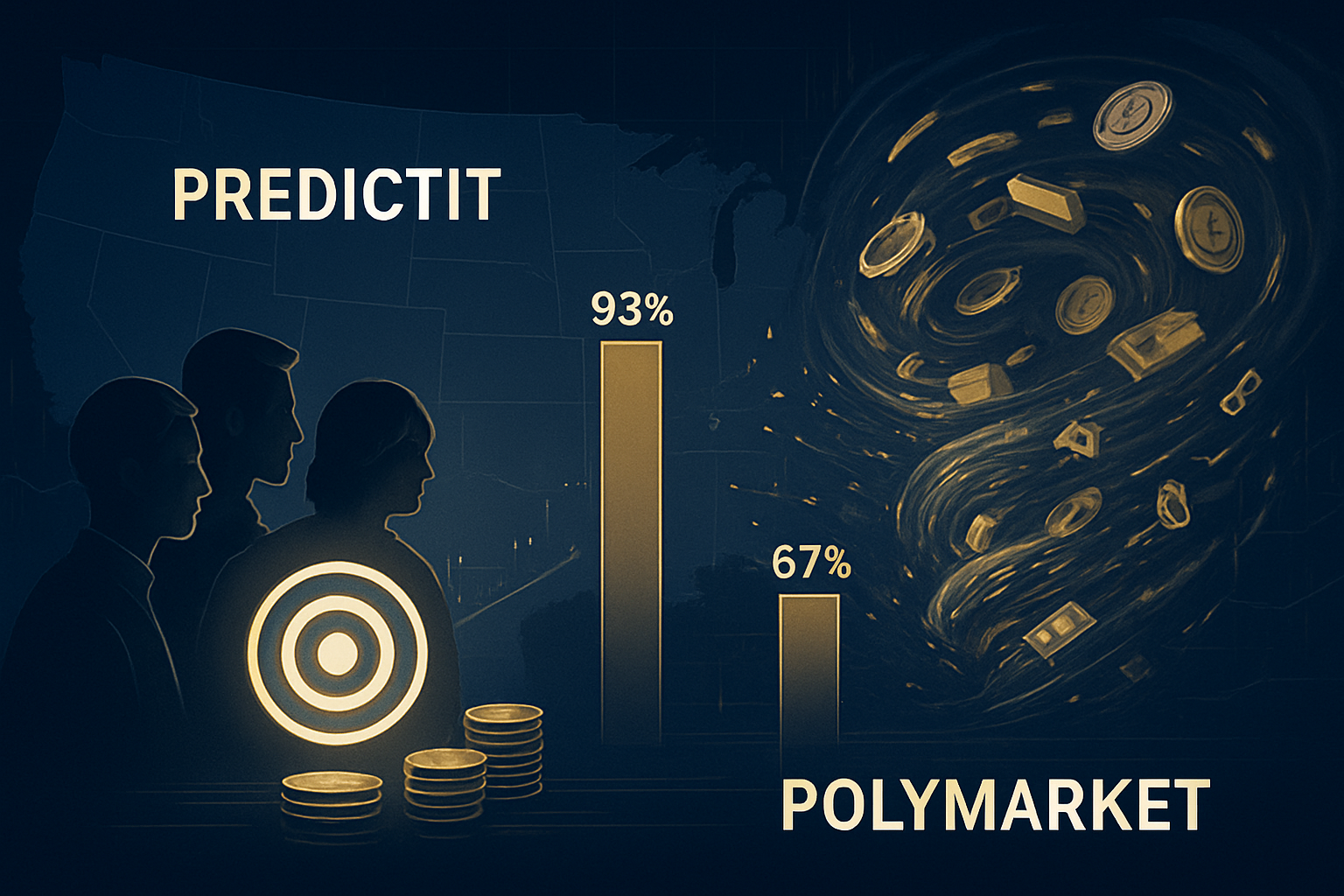
    The study, led by Joshua D. Clinton and TzuFeng Huang, analyzed over 2,500 political contracts across the final five weeks of the campaign. It found that PredictIt, the academic-aligned platform known for its stringent $850 individual betting limit, achieved a staggering 93% accuracy rate on Election Eve. This outperformed the federally regulated Kalshi (78%) and the decentralized volume-leader Polymarket (67%), the latter of which became a global phenomenon for its nine-figure "whale" positions but struggled to separate signal from noise.

    The Market: What's Being Predicted

    The focus of the Vanderbilt research was the 2024 U.S. Presidential Election, a cycle that transformed prediction markets from niche hobbies into mainstream financial instruments. The primary contracts involved the winner of the Presidency, individual state outcomes, and control of the House and Senate. By November 2024, Polymarket had recorded over $2.4 billion in total volume on its primary presidential winner contract, while Kalshi, which recently gained legal clearance to offer election betting, saw its volume surge in the final weeks following a partnership with Robinhood (Nasdaq: HOOD).

    Prices on these exchanges function as implied probabilities: a contract trading at $0.52 indicates a 52% consensus chance of an event occurring. Throughout the cycle, these odds fluctuated wildly. In October 2024, Polymarket prices famously diverged from traditional polling, at one point giving Donald Trump a 67% chance of victory while national polls remained within the margin of error. This divergence created massive arbitrage opportunities—situations where traders could bet on opposite outcomes across different platforms to lock in a guaranteed profit—which Vanderbilt researchers found peaked just days before the vote.

    Why Traders Are Betting

    The 2024 election was characterized by a fundamental clash between "data-driven" traders and "sentiment-driven" whales. On Polymarket, a single anonymous French trader, dubbed the "Théo" whale, reportedly wagered over $30 million on a Republican sweep. This outsized position single-handedly shifted the platform's odds, a move that researchers now believe contributed to Polymarket's lower 67% accuracy rating by creating a "feedback loop" of artificial confidence.

    Conversely, PredictIt’s success is being attributed to its "enforced diversity." Because no single user can risk more than $850 on a single contract, the price is determined by the collective wisdom of thousands of unique participants rather than a handful of deep-pocked speculators. This structure effectively neutralized the impact of institutional influence from players like Interactive Brokers (Nasdaq: IBKR), which launched its own ForecastEx exchange to cater to high-net-worth hedgers. While traditional forecasting methods like polling struggled with non-response bias, the Vanderbilt study suggests that markets with lower entry barriers and tighter limits may actually provide a "purer" signal.

    Broader Context and Implications

    The Vanderbilt findings arrive at a critical juncture for the industry. The perceived accuracy of prediction markets has led to major media integration, with real-time odds now a staple of coverage on CNBC, owned by Comcast (Nasdaq: CMCSA), and CNN, owned by Warner Bros. Discovery (Nasdaq: WBD). However, the 26-point accuracy gap between PredictIt and Polymarket suggests that these media outlets may be anchoring their coverage to the wrong data sets.

    Furthermore, the study highlights a failure in market efficiency. Theoretically, if the same event is being predicted on two different platforms, the prices should be identical. Vanderbilt found this was rarely the case. The lack of correlation between platforms suggests that traders were often reacting to internal "social media vibes" rather than external political developments. This has already triggered a regulatory response in Washington. Following reports of potential insider trading on international events, Representative Ritchie Torres introduced the "Public Integrity in Financial Prediction Markets Act of 2026," which seeks to restrict government officials from participating in these markets to prevent information asymmetry.

    What to Watch Next

    As we move toward the 2026 midterm elections, the industry is undergoing a massive consolidation. DraftKings Inc. (Nasdaq: DKNG) and Flutter Entertainment (NYSE: FLUT), the parent of FanDuel, are reportedly exploring the integration of event contracts directly into their sports betting apps, which would introduce tens of millions of new users to the ecosystem. The key question for 2026 is whether these platforms will adopt the "whale-friendly" model of Polymarket or the "capped-signal" model of PredictIt.

    The next major milestone for the industry will be the first quarterly report from the Commodity Futures Trading Commission (CFTC) under its new oversight framework. This report is expected to address the "Vanderbilt Gap" and could potentially lead to new rules regarding maximum position sizes for political contracts. Investors should also monitor the stock performance of Intercontinental Exchange (NYSE: ICE), which has a strategic stake in the infrastructure powering these markets, as a bellwether for institutional confidence in the sector.

    Bottom Line

    The Vanderbilt University study serves as a sobering reality check for the "liquidity is king" mantra. The 93% accuracy of PredictIt proves that a well-designed market with restricted participation can significantly outperform a multi-billion-dollar global pool dominated by speculative capital. It suggests that for prediction markets to fulfill their promise as a superior forecasting tool, they must prioritize the breadth of their participant base over the depth of their order books.

    As we look toward the 2026 and 2028 cycles, the "Vanderbilt Gap" will likely define the debate over market regulation and design. For now, the takeaway is clear: if you want to know who will win an election, look to the market where the many bet a little, rather than the market where the few bet a lot. The $2.4 billion experiment of 2024 has shown that in the world of high-stakes forecasting, volume is no substitute for variety.


    This article is for informational purposes only and does not constitute financial or betting advice. Prediction market participation may be subject to legal restrictions in your jurisdiction.

    PredictStreet focuses on covering the latest developments in prediction markets. Visit the PredictStreet website at https://www.predictstreet.ai/.
  • Size vs. Science: How PredictIt’s Small-Scale Market Outpaced Global Giants in Accuracy

    Size vs. Science: How PredictIt’s Small-Scale Market Outpaced Global Giants in Accuracy

    As the dust settles on the hyper-active forecasting cycles of the last two years, a landmark study from Vanderbilt University has sent shockwaves through the prediction market industry. For years, the prevailing wisdom was that "liquidity is king"—that the more money and participants a market has, the more accurate its "crowdsourced wisdom" becomes. However, according to research led by Professor Joshua D. Clinton and TzuFeng Huang, the reality is far more nuanced.

    Analyzing over 2,500 individual markets during the peak of the 2024 election season, the Vanderbilt study revealed a startling hierarchy of accuracy. PredictIt, the long-standing "academic" platform often criticized for its strict trade limits, emerged as the victor with a staggering 93% accuracy rate. Meanwhile, the regulated U.S. exchange Kalshi followed with 78%, and the high-volume, crypto-based behemoth Polymarket trailed at 67%. As of January 16, 2026, these findings are forcing a massive rethink of how we value market signals over raw trading volume.

    The Market: What’s Being Predicted

    The study focused on the efficiency and predictive power of four major platforms: PredictIt, Kalshi, Polymarket, and the Iowa Electronic Markets (IEM). Researchers tracked 2,500 political contracts, specifically focusing on down-ballot races and niche "event contracts" that are often ignored by mainstream polls but are vital for professional hedgers and political strategists.

    While Polymarket captured the world's attention by processing billions of dollars in volume, the Vanderbilt data suggests that this volume may have been a double-edged sword. PredictIt, which historically capped individual bets at $850 (a limit recently adjusted following its 2025 regulatory victory), maintained a "purer" information signal. Because traders on PredictIt couldn't simply "move" the market with millions of dollars, the price discovery was driven by a broader consensus of smaller, highly informed participants.

    In contrast, Kalshi—the first CFTC-regulated exchange for election contracts in the U.S.—has seen its market share explode in early 2026. By January 12, 2026, Kalshi commanded over 66% of the daily regulated volume, yet even its robust, institutional-grade infrastructure couldn't match the pinpoint accuracy of PredictIt's more restricted environment in the Vanderbilt analysis.

    Why Traders Are Betting

    The discrepancy in accuracy has largely been attributed to "whale" activity and the resulting herd behavior. The most famous example cited in the study is "Théo," the so-called "French Whale" who famously bet over $30 million on a Donald Trump victory on Polymarket. While Théo’s specific bet proved profitable, the Vanderbilt researchers argue that such massive, concentrated positions create "noise" that distorts the market for everyone else.

    When a single actor holds 20% of the "Yes" shares in a major contract, it creates a feedback loop. Other traders, seeing the price rise, assume there is new, secret information and follow the trend—a classic case of herd behavior. This "social media hype" led to what researchers identified as "negative serial correlation," where prices would spike based on momentum rather than data, only to crash or correct shortly after.

    This phenomenon has sparked intense interest from retail platforms like Robinhood Markets, Inc. (NASDAQ: HOOD) and Interactive Brokers Group, Inc. (NASDAQ: IBKR), both of which have integrated event contracts into their suites. Traders on these platforms are now increasingly looking for "alpha" by identifying when a market is being moved by a "whale" versus when it is being moved by genuine information.

    Broader Context and Implications

    The Vanderbilt study’s findings come at a pivotal moment for the industry's reputation. Throughout 2025, the narrative was that prediction markets were the "new polls," offering a real-time, incentivized alternative to traditional survey data. However, the 67% accuracy rate of the largest player, Polymarket, suggests that "crowdsourced wisdom" can easily devolve into the "madness of crowds" when unregulated or dominated by high-net-worth individuals.

    This has led to a shift in how institutional players, such as Flutter Entertainment PLC (NYSE: FLUT)—the parent company of FanDuel—view the space. While prediction markets are a powerful tool for sentiment analysis, the Vanderbilt data proves that size does not always equal smarts. The regulatory landscape has shifted accordingly; following its full compliance status in late 2025, PredictIt has leaned into its "accuracy-first" branding, even launching an AI-driven mascot named "Itoldyousaurus" to highlight its superior track record over its more capitalized rivals.

    Furthermore, the entry of traditional betting companies like DraftKings Inc. (NASDAQ: DKNG) into the event contract space has introduced more sophisticated risk management tools designed to prevent the kind of market distortion seen with the "French Whale" incident.

    What to Watch Next

    As we move deeper into 2026, the industry is watching how Polymarket will respond to these accuracy critiques. The platform recently announced a high-profile partnership with the Golden Globes to be their "exclusive prediction partner," signaling a pivot toward entertainment and culture markets where "whale" distortion might be less politically sensitive but equally profitable.

    The next major milestone for the industry will be the 2026 midterm election cycle. Analysts are watching to see if Kalshi’s dominance in market share (now valued at roughly $11 billion) will finally translate into the top spot for accuracy, or if the "PredictIt Effect"—where small, capped markets produce better data—will hold true once again.

    Additionally, keep an eye on the integration of "neighbor polling" techniques into market strategies. After "Théo" successfully used this method to justify his $30 million bet, several new hedge funds are reportedly building proprietary algorithms to scan prediction markets for "whale-driven" vs. "consensus-driven" price movements.

    Bottom Line

    The Vanderbilt study serves as a sobering reminder that prediction markets are not infallible oracles; they are tools that are only as good as the incentives and participants within them. PredictIt’s 93% accuracy rate suggests that when you limit the ability of individuals to "buy" the narrative, the resulting price is far more likely to reflect reality.

    For the average investor or observer, the lesson is clear: volume is a measure of interest, not necessarily truth. While Polymarket may have the most "noise" and Kalshi the most "institutional backing," the "quiet" markets of PredictIt have, for now, proven to be the most reliable indicators of the future. As prediction markets become a mainstream fixture on platforms like Robinhood, the battle between "big money" and "broad data" is only just beginning.


    This article is for informational purposes only and does not constitute financial or betting advice. Prediction market participation may be subject to legal restrictions in your jurisdiction.

    PredictStreet focuses on covering the latest developments in prediction markets.
    Visit the PredictStreet website at https://www.predictstreet.ai/.