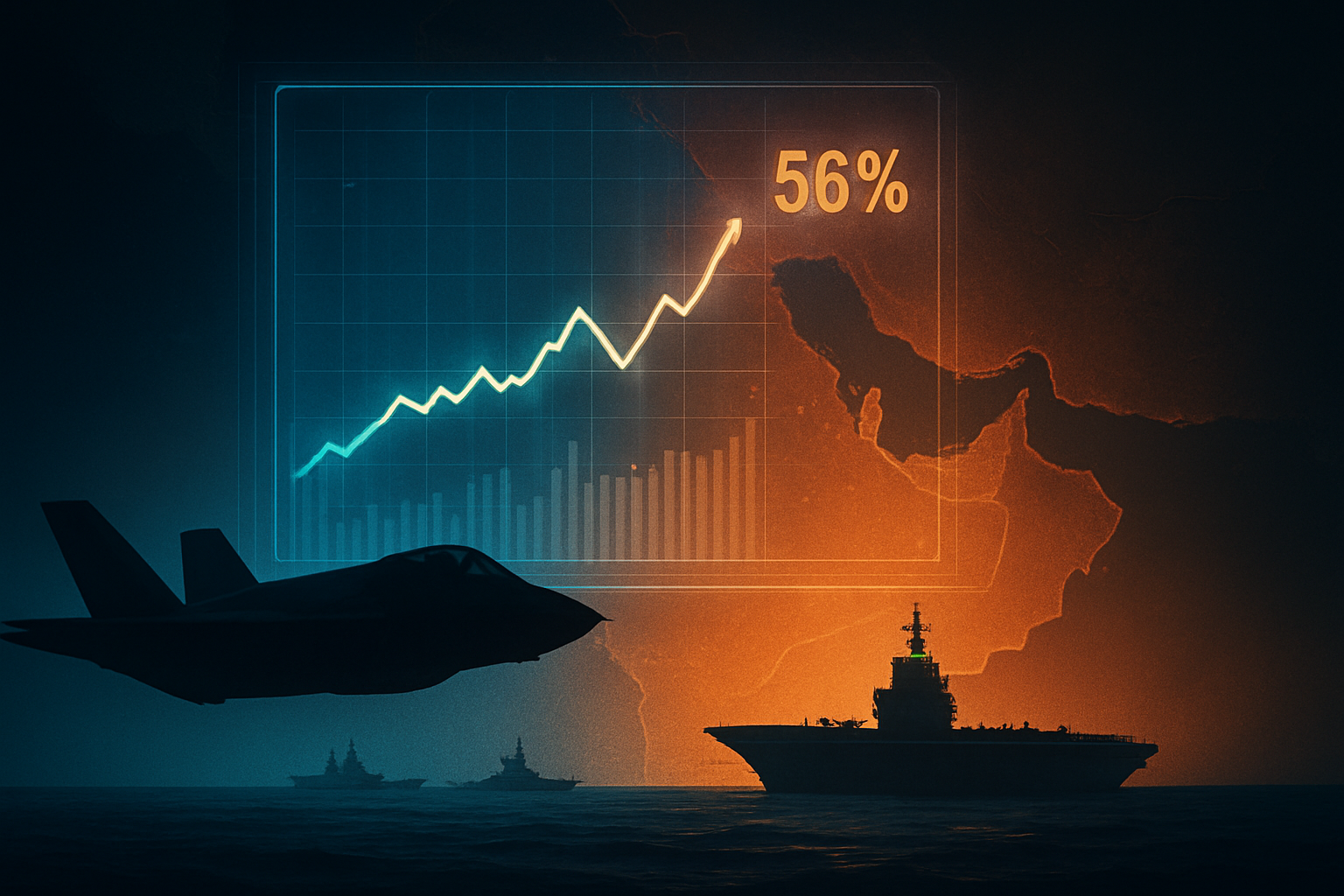
As the diplomatic thaw of the winter freezes over, the shadow of conflict in the Middle East has lengthened. On the decentralized prediction platform Polymarket, the collective intelligence of thousands of global traders is currently pricing in a staggering 56% probability that the United States will conduct a kinetic strike against Iran by June 30, 2026. This surge in odds reflects a sudden and sharp pivot from the relative optimism seen just weeks ago, signaling a "war risk premium" that is now dominating geopolitical discourse.
The market has become a focal point for institutional investors, defense analysts, and political junkies alike, amassing a significant $203 million in trading volume. This level of liquidity suggests that the 56% figure is not mere speculation from retail participants, but a calculated assessment from "whales" and informed actors who are effectively betting on the failure of high-stakes diplomacy. With the June deadline approaching, the high volume indicates a rare consensus: the current status quo between Washington and Tehran is increasingly viewed as unsustainable.
The Market: What’s Being Predicted
The primary vehicle for this sentiment is the Polymarket contract titled "U.S. strike on Iran by June 30, 2026." The contract is binary, meaning it will resolve to either "Yes" or "No." For the market to resolve as "Yes," the U.S. military must conduct a "kinetic operation"—defined as an aerial, drone, or missile strike—specifically against official Iranian territory or its diplomatic missions. Notably, the criteria exclude cyberattacks or strikes on Iranian proxies in third countries like Syria or Iraq, focusing the bet strictly on direct state-on-state escalation.
Trading volume on this specific market has exploded to over $203 million, making it one of the most liquid geopolitical contracts in the history of prediction markets. Throughout early February 2026, the price per "Yes" share has fluctuated wildly. After peaking at 69% in early January following domestic unrest in Iran, the odds dipped to 25% during the lead-up to the Oman peace talks. However, the current rebound to 56% represents a "dead cat bounce" in diplomacy that has left traders bracing for a military resolution.
The liquidity provided by such a high volume allows for large institutional entries, which has historically led to higher accuracy in these markets compared to traditional punditry. On Polymarket, where participants have "skin in the game," the price movement is often seen as a leading indicator, reacting to news cycles minutes—or sometimes hours—before mainstream media outlets can provide a comprehensive analysis.
Why Traders Are Betting
The primary driver behind the current 56% odds is the spectacular collapse of the "Oman Round" of indirect negotiations on February 4, 2026. Intended to de-escalate nuclear tensions and provide a framework for a new "Maximum Pressure 2.0" deal, the talks broke down when Tehran refused to include its regional missile program in the scope of the treaty. This diplomatic failure was immediately followed by a series of tactical skirmishes in the Arabian Sea.
On February 3, 2026, a U.S. Navy F-35C, manufactured by Lockheed Martin (NYSE: LMT), shot down an Iranian surveillance drone that had aggressively approached the USS Abraham Lincoln strike group. This incident, combined with reports of a massive U.S. naval "armada" currently transiting toward the Persian Gulf, has convinced many traders that the Trump administration is seeking a decisive "red line" moment.
Furthermore, "whale" activity—large-scale bets often exceeding $500,000—has shifted toward the "Yes" side. These large-scale traders appear to be betting that the naval standoff in the Strait of Hormuz will reach a breaking point by mid-summer. Sentiment analysis within the prediction community suggests that while a full-scale invasion is considered unlikely, a targeted "demonstration strike" on Iranian nuclear facilities or IRGC infrastructure is now the baseline expectation for more than half the market.
Broader Context and Implications
This market is not operating in a vacuum; it is deeply correlated with the broader defense and energy sectors. As strike odds climbed above the 50% threshold, shares of major defense contractors like Northrop Grumman (NYSE: NOC) saw a "gamma squeeze" effect, with the stock rising 20% year-to-date. Traders are increasingly using Polymarket as a hedging tool for their equity portfolios. If the odds of a strike increase, defense stocks generally rise, allowing investors to offset potential losses in other sectors sensitive to high oil prices or regional instability.
The U.S.-Iran market also highlights a growing trend where prediction markets act as "truth engines" in an era of fragmented information. The high volume of $203 million serves as a bulwark against manipulation; it would require an immense amount of capital to artificially move the price of the contract for more than a few minutes. This makes the 56% probability a sobering metric for policymakers, as it suggests that the "smart money" sees conflict as more likely than not.
Historically, markets like these have been remarkably prescient. Similar liquidity was seen in the lead-up to the capture of Nicolás Maduro in Venezuela in early 2026, where prediction markets flagged the operation hours before it was officially announced. However, critics point out that these markets can also create a "feedback loop," where high strike odds in the betting world might embolden hawks in the real world, though the causality of such a relationship remains a subject of intense academic debate.
What to Watch Next
As we move closer to the June 30 deadline, several key milestones will likely dictate the next major swing in the odds. First, the International Atomic Energy Agency (IAEA) is scheduled to release a "special report" in late February regarding Iran’s enrichment levels at the Fordow facility. Any indication that Iran has reached "breakout capacity" will likely send the Polymarket "Yes" shares into the 70% to 80% range.
Second, the movement of the USS Abraham Lincoln and its supporting strike group is being tracked by traders via satellite imagery and maritime transponders. A move into the Persian Gulf proper, rather than staying in the Gulf of Oman, would be viewed as a high-conviction signal for an imminent strike. Traders are also monitoring the legislative progress of the proposed $1.5 trillion U.S. defense budget for FY2027; a fast-tracked approval would provide the fiscal "green light" for prolonged engagement.
Finally, keep an eye on "insider" signals. In previous high-stakes geopolitical markets, sudden, massive buy orders for "Yes" shares often preceded official military announcements by 4-12 hours. If the volume spikes past the $250 million mark without a corresponding news event, it may indicate that those with proximity to the Pentagon are placing their final bets.
Bottom Line
The 56% probability of a U.S. strike on Iran by June 30, 2026, is a chilling reminder of how quickly the geopolitical landscape can deteriorate. With over $203 million at stake, this is no longer a niche curiosity; it is a high-stakes financial instrument that reflects a genuine belief among participants that diplomacy has reached its end.
The correlation between these market movements and the stock prices of companies like Lockheed Martin (NYSE: LMT) and Northrop Grumman (NYSE: NOC) suggests that the "war risk" is being integrated into the very fabric of the global economy. Whether these traders are right or wrong, the sheer scale of the betting volume indicates that the world is bracing for a summer of high-intensity friction. For now, the "wisdom of the crowd" suggests that the fuse is lit, and the clock is ticking.
This article is for informational purposes only and does not constitute financial or betting advice. Prediction market participation may be subject to legal restrictions in your jurisdiction.
PredictStreet focuses on covering the latest developments in prediction markets.
Visit the PredictStreet website at https://www.predictstreet.ai/.