Tag: Trump Administration

  • High Stakes in the Cabinet: Noem and Gabbard Lead Kalshi Departure Markets Amid Mounting Controversies

    High Stakes in the Cabinet: Noem and Gabbard Lead Kalshi Departure Markets Amid Mounting Controversies

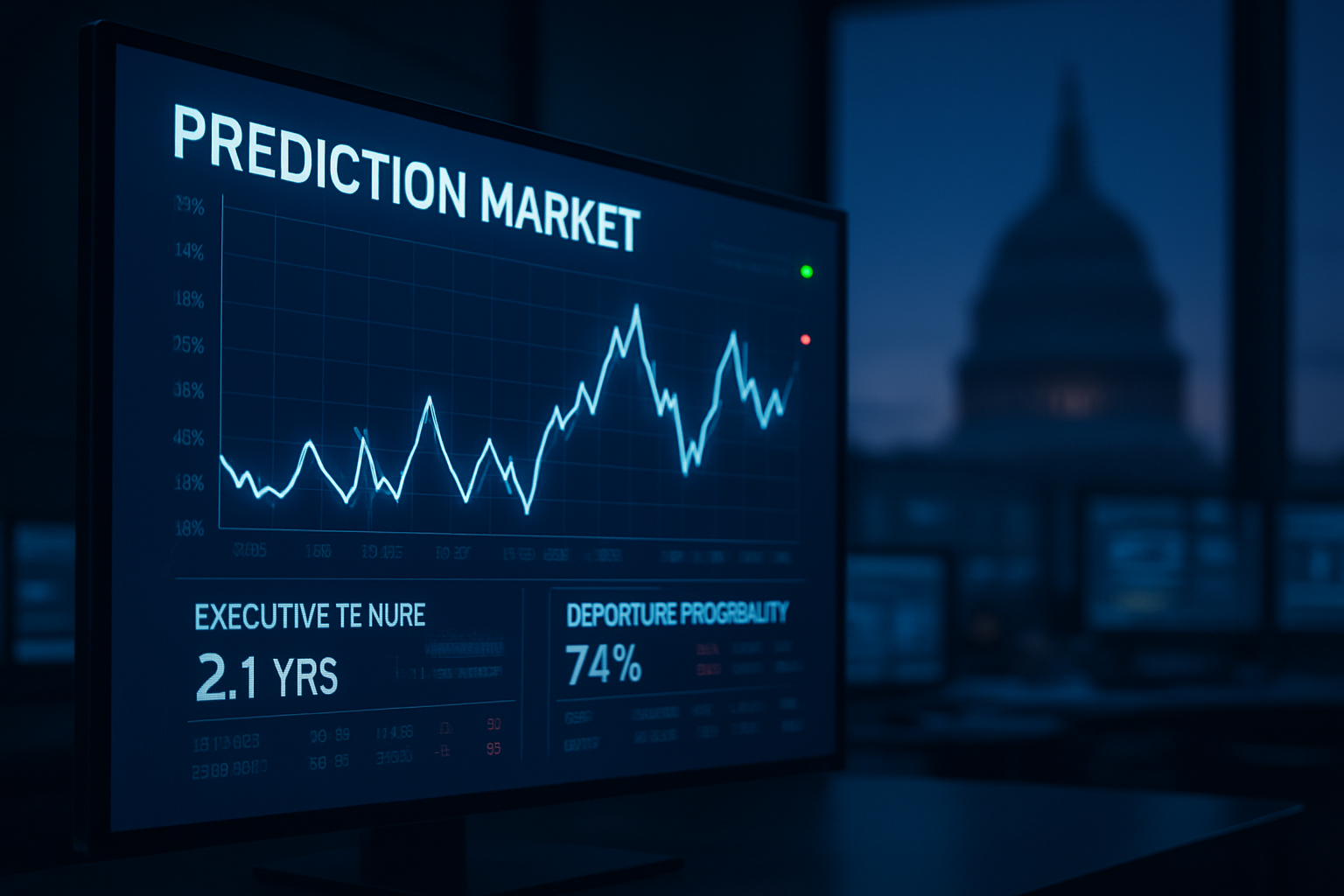
    As the second Trump administration enters its second year, the "honeymoon phase" for his Cabinet appears to be over—at least according to prediction markets. On the regulated exchange Kalshi, traders are increasingly betting on a major shakeup in the President's inner circle. Recent weeks have seen a sharp spike in the probability of departures for several high-profile officials, with Department of Homeland Security (DHS) Secretary Kristi Noem and Director of National Intelligence (DNI) Tulsi Gabbard topping the list of most likely exits.

    Currently, the market for "Who will leave the Trump Administration this year?" shows Noem and Gabbard both trading at near-coin-flip odds. Noem’s probability of departure before the end of 2026 has surged to approximately 50%, while Gabbard follows closely at 47%. These figures represent a dramatic shift from the relatively stable outlook seen just six months ago, signaling that prediction market participants are pricing in a period of intense political instability within the executive branch.

    The Market: What’s Being Predicted

    The primary venue for these predictions is Kalshi, the first U.S.-regulated prediction market, which has seen record volumes in its "Cabinet Tenure" contracts. These markets are structured around specific binary outcomes: whether a named official will remain in their post through a certain date. The "Who will be the first Cabinet member to leave?" contract is particularly liquid, with Kristi Noem currently the runaway favorite at a 34-40% chance of being the first to depart.

    The resolution criteria for these markets are strict. A "departure" is defined as a formal resignation, firing, or impeachment and removal from office. Temporary leaves or deaths are excluded. For traders, the timeline is the critical factor; these contracts are currently focused on the 2026 calendar year. Since her confirmation in January 2025 by a 59-34 vote, Noem's "leave" odds were initially low—around 15%—but the market sentiment soured as domestic enforcement actions intensified. Similarly, Tulsi Gabbard, who was sworn in on February 13, 2025, has seen her odds fluctuate wildly alongside news of intelligence community friction.

    Why Traders Are Betting

    The sudden bearishness on Noem’s job security is largely attributed to the fallout from "Operation Metro Surge." Following a large-scale ICE deployment in Minneapolis in early January 2026, which resulted in the fatal shootings of protesters, Noem’s vocal defense of federal agents and her classification of victims as "domestic terrorists" triggered a firestorm of bipartisan criticism. While President Trump has publicly backed her, traders are watching for "friendly fire" from Republican senators like Roger Wicker (R-MS), who have expressed concerns over Noem’s proposed "detention warehouses." Such fractures within the GOP base often precede a Cabinet departure, and Kalshi whales have been moving aggressively on "Yes" contracts for her exit.

    Tulsi Gabbard’s precarious position is fueled by a different set of pressures. Recent reports of a "highly classified whistleblower complaint" allegedly suppressed by the DNI’s office have led to calls for her removal from both sides of the aisle. Furthermore, headlines in early 2026 suggested Gabbard may have blindsided the White House by revoking 37 high-level security clearances without prior notification. These events have created a perception of a "rogue" DNI, a narrative that prediction market participants are betting will eventually lead to her resignation or dismissal. The volatility in these roles has also begun to weigh on government services firms like Booz Allen Hamilton (NYSE: BAH) and Palantir Technologies (NYSE: PLTR), as investors worry about continuity in federal contracts.

    Broader Context and Implications

    This market activity underscores a broader trend in the maturation of prediction markets. Unlike traditional polling or punditry, which often lag behind the news cycle, Kalshi’s prices react in real-time to every leaked memo and late-night tweet. The fact that Noem and Gabbard are trading at such high exit probabilities suggests that the "wisdom of the crowd" sees an unsustainable level of friction between these officials and the political realities of 2026.

    Historically, prediction markets have been remarkably accurate in forecasting Cabinet turnover. During Trump's first term, similar (though then unregulated) markets on platforms like Polymarket often correctly anticipated the departures of figures like Rex Tillerson and John Bolton. The real-world implications of these "departure odds" are significant; high exit probabilities can often become self-fulfilling prophecies, as the perceived "lame duck" status of an official diminishes their ability to lead their department or negotiate with Congress.

    What to Watch Next

    The immediate future of the Noem and Gabbard markets will likely hinge on several key milestones. For Noem, the upcoming Senate Judiciary Committee oversight hearings scheduled for late February will be a make-or-break moment. If she faces significant pushback from Republican committee members, her departure odds could easily climb into the 60-70% range. Traders are also monitoring the White House press briefings for any softening of the President’s "total confidence" rhetoric.

    For Gabbard, the "Gang of Eight" briefing on the alleged whistleblower complaint remains the primary catalyst. If the complaint is forwarded to Congress against her wishes, it could be the "smoking gun" that forces a leadership change at the DNI. Additionally, keep an eye on other high-risk officials like Attorney General Pam Bondi (currently at 48% to leave) and FBI Director Kash Patel (at 54%), whose own controversies regarding the release of redacted files and resource management are creating a "cluster" of high-probability departures.

    Bottom Line

    The Kalshi markets offer a sobering look at the stability of the current administration. While confirmation hearings are long over, the "job security" phase of the second Trump term is proving to be even more volatile. The high odds for both Kristi Noem and Tulsi Gabbard reflect a market that believes the current level of controversy is untenable for a long-term tenure.

    For observers of prediction markets, this is a masterclass in how these platforms aggregate political risk. Whether Noem and Gabbard survive the year remains to be seen, but the markets have already placed their bets: the status quo is unlikely to hold. As we move deeper into 2026, these departure markets will serve as a vital barometer for the internal health and longevity of the administration's most powerful offices.


    This article is for informational purposes only and does not constitute financial or betting advice. Prediction market participation may be subject to legal restrictions in your jurisdiction.

    PredictStreet focuses on covering the latest developments in prediction markets.
    Visit the PredictStreet website at https://www.predictstreet.ai/.

  • The Great De-Regulation: How a ‘Hollowed Out’ CFTC Ignited a $1 Billion Prediction Market Boom

    The Great De-Regulation: How a ‘Hollowed Out’ CFTC Ignited a $1 Billion Prediction Market Boom

    As of January 22, 2026, the landscape of American finance is undergoing its most radical transformation in decades, driven not by a new asset class, but by the systematic dismantling of the guardrails that once hemmed it in. The Commodity Futures Trading Commission (CFTC), once the primary antagonist of event-based wagering, has been effectively reshaped into a partner for the industry. Under a "regulatory light" mandate from the Trump administration, the agency has seen a wave of leadership departures and significant workforce cuts, leaving a skeleton crew that is more focused on "future-proofing" markets than policing them.

    This vacuum has sparked an unprecedented explosion in trading activity. Daily volumes across major platforms have surged past $800 million this month, as traders bet on everything from the outcome of Supreme Court cases to the exact timing of the next federal interest rate cut. Currently, the "market of markets"—the probability that prediction markets will achieve over $1 trillion in annual volume by the end of 2026—has climbed to a staggering 68% on Kalshi, up from just 24% a year ago.

    The Market: What's Being Predicted

    The most high-stakes "market" currently captivating traders isn't a political race or a sporting event, but the legal survival of the industry itself. On the regulated exchange Kalshi, a high-liquidity contract titled "Federal Preemption of State Gambling Laws" is currently trading at 72 cents (implying a 72% probability). This market resolves to "Yes" if a federal court or legislative action confirms that CFTC-regulated event contracts override state-level bans on "gambling" before December 31, 2026.

    This specific contract has become a proxy for the entire industry’s expansion. While the federal government has signaled a hands-off approach, several states—most notably Massachusetts and Tennessee—have issued cease-and-desist orders against Kalshi, claiming its sports and event contracts constitute illegal gambling. Trading volume on this "Supremacy Clause" market has surpassed $120 million, with liquidity provided by a mix of institutional hedge funds and retail speculators.

    The resolution criteria are strictly tied to a final ruling from a U.S. appellate court or the signing of federal legislation that explicitly protects "Event Contract" providers from state interference. As the CFTC’s own enforcement capabilities have shrunk due to a 15% reduction in total headcount, the market is increasingly betting that the federal government will lack the will—or the staff—to help states enforce local bans against federally registered exchanges.

    Why Traders Are Betting

    The primary driver of the current "bull market" in prediction platforms is the appointment of Michael Selig as the sole acting Commissioner and Chairman of the CFTC. With four of the five commission seats currently vacant following a series of high-profile resignations in 2025, Selig has wielded unprecedented unilateral authority. His "Future-Proof" initiative has effectively ended the era of "regulation by enforcement," moving toward a model where the agency provides a "minimum effective dose" of oversight.

    Traders are also reacting to the sensational "Maduro Trade" of early January, where a user on Polymarket reportedly turned $30,000 into $400,000 by betting on the capture of Venezuelan leader Nicolás Maduro just hours before a U.S. military operation. While critics decried the trade as evidence of "insider information," the market saw it as a proof of concept: prediction markets are now the fastest way to aggregate intelligence. This has led to "whale" activity on Polymarket—which relaunched for U.S. users in December 2025 via the acquisition of the exchange QCX—where single positions on geopolitical outcomes are now routinely exceeding $5 million.

    Furthermore, traditional finance is moving in. Institutional brokers like Interactive Brokers Group, Inc. (NASDAQ: IBKR) have begun facilitating "intermediated access" to these markets, treating event contracts as a legitimate alternative asset class for portfolio hedging. This shift from "fringe betting" to "institutional hedging" has provided the floor of liquidity necessary for the 2026 boom.

    Broader Context and Implications

    The "regulatory light" environment is a direct byproduct of a broader federal push to shrink the civil service. In early 2025, the CFTC terminated nearly a dozen probationary employees in its Enforcement and Market Oversight divisions. This workforce reduction has made the agency dependent on the industry it regulates. In a move that would have been unthinkable two years ago, the CFTC’s new Innovation Advisory Committee now includes the CEOs of both Kalshi and Polymarket as charter members.

    This closeness has sparked a legislative backlash. Rep. Ritchie Torres recently introduced the Public Integrity in Financial Prediction Markets Act of 2026, which seeks to ban federal officials from trading on contracts influenced by non-public government data. The market's reaction to this bill has been telling; the probability of its passage currently sits at only 15%, as traders bet that the de-regulatory momentum in the executive branch will stall any attempts at legislative restriction.

    The historical accuracy of these markets is also playing a role in their survival. During the 2024 and 2025 cycles, prediction markets consistently outperformed traditional polling and economic forecasting from major banks like Goldman Sachs Group, Inc. (NYSE: GS). This track record has given the current de-regulatory push a "veneer of utility"—the argument being that these markets are a public good that provides more accurate data than the government itself can produce.

    What to Watch Next

    The immediate horizon is dominated by the "State vs. Federal" legal showdown. A preliminary injunction in Massachusetts has temporarily halted Kalshi’s sports contracts in that state, but a federal court in the Second Circuit is expected to rule on the "Supremacy Clause" issue by late spring. A "Yes" ruling there would likely cause the probability of a nationwide expansion to jump to near-certainty.

    Additionally, watch for the growth of Opinion, a new competitor backed by YZi Labs and supported by crypto-billionaire interests. Opinion allows users to earn yield on their "staked" bets, a feature that has already captured 40% of the daily volume in the decentralized prediction space. If the CFTC allows Opinion to register as a U.S. exchange under the current "light" framework, it would signal the total capitulation of traditional financial barriers.

    Finally, the mid-year "Workforce Audit" of the CFTC will be a key milestone. If the agency continues to lose senior attorneys and economists without replacement, its ability to even conduct basic market surveillance will be called into question, potentially leading to a "Wild West" scenario that could either accelerate growth or lead to a catastrophic market failure.

    Bottom Line

    The transformation of the CFTC from a skeptical watchdog to a de-regulatory facilitator has turned prediction markets into the most dynamic sector of the 2026 economy. By hollowing out the agency’s enforcement arm and prioritizing "innovation" over "oversight," the current administration has cleared a path for Kalshi and Polymarket to become the primary venues for price discovery in the modern age.

    What we are witnessing is the birth of "Information Finance." In this new era, prediction markets are no longer just for enthusiasts; they are the scoreboard for reality. However, the risk remains that a "regulatory light" environment is also a "vulnerability heavy" one. As traders flock to these platforms, the lack of a robust workforce at the CFTC means the industry is essentially self-policing.

    For now, the odds favor the innovators. With daily volumes nearing $1 billion and the federal government standing down, the prediction market boom appears to be just getting started. Whether this leads to a more transparent world or a more volatile one remains the ultimate bet.


    This article is for informational purposes only and does not constitute financial or betting advice. Prediction market participation may be subject to legal restrictions in your jurisdiction.

    PredictStreet focuses on covering the latest developments in prediction markets.
    Visit the PredictStreet website at https://www.predictstreet.ai/.

  • The Homecoming: Polymarket’s U.S. Relaunch Signals a New Era for Prediction Markets

    The Homecoming: Polymarket’s U.S. Relaunch Signals a New Era for Prediction Markets

    NEW YORK — Polymarket, the world’s largest decentralized prediction platform, has officially begun its long-awaited homecoming. After years of operating in a regulatory exile that forced it to block American IP addresses, the platform is now aggressively onboarding thousands of users from its domestic waitlist. This strategic pivot follows a landmark regulatory shift under the second Trump administration, effectively ending the adversarial era that defined the platform's relationship with Washington during the Biden years.

    The return isn't just a expansion of geography; it is a fundamental transformation of the industry. As of late January 2026, Polymarket is no longer just a "crypto-native" darling of the offshore world. Through a series of high-stakes acquisitions and a favorable new regime at the Commodity Futures Trading Commission (CFTC), the platform is positioning itself to challenge retail giants like Robinhood Markets, Inc. (NASDAQ: HOOD) and established incumbents like Interactive Brokers Group, Inc. (NASDAQ: IBKR) for the future of "event-based" finance.

    The Market: What's Being Predicted

    The current focus of the prediction market community isn't just the outcomes of elections or sports, but the success of Polymarket itself. On Polymarket’s own global platform, a high-volume contract titled “Will Polymarket hit 1 million active U.S. users by Q3 2026?” is currently trading at a 68% probability. This optimism is fueled by the platform’s official U.S. relaunch, which was catalyzed by its $112 million acquisition of QCX, a CFTC-licensed exchange and clearinghouse, in late 2025.

    This acquisition allowed Polymarket to bypass the years of litigation that have hampered other startups. By operating as a Designated Contract Market (DCM), the platform can now legally offer a wide array of event contracts to American retail investors. Trading volume on the U.S.-specific app has already topped $450 million in its first full month of operation, with significant liquidity flowing into markets surrounding Federal Reserve interest rate cuts and the 2026 midterm election cycles.

    The resolution criteria for these new U.S. markets are strictly tied to verified data feeds, a requirement of their new CFTC status. Unlike the "Wild West" days of 2021, the current iteration of Polymarket features a dual-layered settlement system that combines decentralized oracles with a traditional regulatory oversight board, a move intended to satisfy the stringent transparency demands of the current administration.

    Why Traders Are Betting

    The primary driver behind the surge in activity is the radical shift in the U.S. regulatory climate. Under the previous administration, the CFTC, led by former Chair Rostin Behnam, viewed prediction markets with deep skepticism, often characterizing them as unregulated gambling. In contrast, the current CFTC Chair, Michael Selig, has embraced the concept of prediction markets as "information aggregators" and "truth engines."

    Traders are also reacting to the institutionalization of the space. In October 2025, the Intercontinental Exchange, Inc. (NYSE: ICE), the parent company of the New York Stock Exchange, led a $2 billion investment round in Polymarket, valuing the company at a staggering $9 billion. This "seal of approval" from traditional finance (TradFi) has given whales the confidence to take massive positions, with some individual traders reportedly betting upwards of $10 million on macro-economic outcomes.

    Furthermore, the influence of political figures has not gone unnoticed. With Donald Trump Jr. serving as a strategic advisor to several firms in the prediction market space, including investment through 1789 Capital, the market perceives a "regulatory moat" that protects these platforms from the kind of enforcement actions seen during the Gary Gensler era at the SEC. This perceived safety has led to a massive migration of capital from offshore platforms back to regulated U.S. entities.

    Broader Context and Implications

    Polymarket’s return marks a maturation of the "crypto-to-utility" pipeline. For years, critics argued that blockchain technology lacked a "killer app" beyond speculation. Prediction markets have silenced that critique by providing a service that traditional polling and forecasting have failed to deliver: real-time, skin-in-the-game accuracy. During the 2024 election cycle, Polymarket famously outpaced mainstream media outlets in predicting key swing state outcomes, a feat that cemented its reputation among the political elite.

    The implications of this shift are profound for the broader financial sector. We are witnessing the birth of a new asset class where "knowledge" is the primary currency. The formation of the Coalition for Prediction Markets (CPM) by Polymarket, Coinbase Global, Inc. (NASDAQ: COIN), and Robinhood (NASDAQ: HOOD) in late 2025 highlights a unified front against state-level attempts to tax or ban these markets. These companies are betting that federal oversight will provide a more stable environment for growth than a patchwork of state gambling laws.

    However, the rapid growth has not been without controversy. In early January 2026, Senators Adam Schiff and Alex Padilla called for investigations into potential "information asymmetry" (insider trading) after a series of suspiciously timed trades on Polymarket preceded the news of a major political upheaval in South America. These legislative challenges suggest that while the executive branch is currently friendly, the legislative branch remains a source of potential friction for the industry.

    What to Watch Next

    The immediate milestone to monitor is the conversion of the Polymarket U.S. waitlist into active, funded accounts. Industry analysts expect the platform to hit the 500,000-user mark by the end of Q1 2026, particularly as it expands its offerings into "culture markets"—betting on the Oscars, the Grammys, and high-profile tech product launches.

    Perhaps the most anticipated event is the rumored launch of a native "POLY" governance token. While the company has remained tight-lipped, the integration of a tokenized incentive structure for U.S. users would be a first for a CFTC-regulated DCM. If approved, it could set a precedent for how other crypto-based companies like Kraken or Gemini might approach domestic expansion.

    Investors should also keep a close eye on the "Public Integrity in Financial Prediction Markets Act," a bill recently introduced in the House. If passed, it would ban federal employees from trading on these platforms, a move that could dampen liquidity in political markets but might ultimately enhance the industry's credibility by preventing conflicts of interest.

    Bottom Line

    The return of Polymarket to the United States is the definitive "growing up" moment for the prediction market industry. By aligning with the current administration's pro-innovation stance and securing the backing of TradFi giants like ICE, Polymarket has moved from the periphery of the internet to the center of the financial discourse.

    As the platform clears its waitlist and stabilizes its domestic operations, the divide between "gambling" and "forecasting" will continue to blur. For the average investor, this means access to a powerful new tool for hedging against real-world uncertainty. For the industry at large, it signifies that the most valuable commodity in the 21st century is not oil or gold, but accurate, incentivized information.

    The next six months will determine whether Polymarket can maintain its dominance in a crowded domestic field, or if the weight of regulation will eventually slow the very innovation that made it a global powerhouse. For now, however, the odds are firmly in favor of the prediction market giant.


    This article is for informational purposes only and does not constitute financial or betting advice. Prediction market participation may be subject to legal restrictions in your jurisdiction.

    PredictStreet focuses on covering the latest developments in prediction markets.
    Visit the PredictStreet website at https://www.predictstreet.ai/.
  • JD Vance Emerges as the 2028 Betting Favorite: Why Prediction Markets Are Frontrunning the ‘Heir Apparent’ Narrative

    JD Vance Emerges as the 2028 Betting Favorite: Why Prediction Markets Are Frontrunning the ‘Heir Apparent’ Narrative

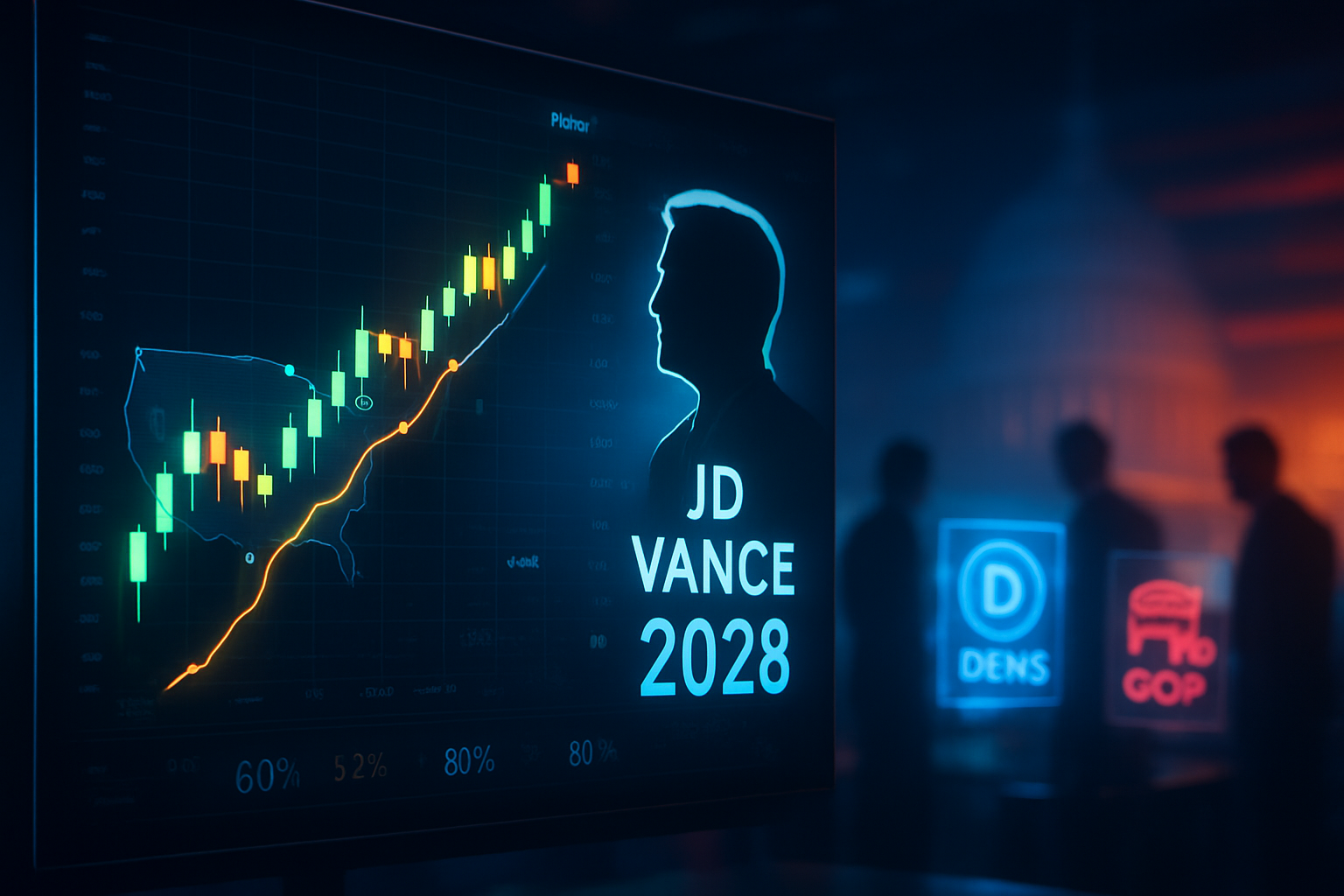
    As the second year of the second Trump administration begins on this January 20, 2026, the political world is already looking toward the horizon of 2028. While traditional pundits often wait for the midterm results to declare favorites, prediction market traders have already reached a consensus. Vice President JD Vance has solidified his position as the early frontrunner to succeed Donald Trump, commanding a significant lead on regulated exchanges like Kalshi.

    Currently, Vance is trading at a 48% probability to secure the Republican nomination and a 27% probability to win the presidency outright. These figures represent a massive consolidation of "MAGA" sentiment around the Vice President, who has spent the last year positioning himself as the primary defender and legislative enforcer of the administration’s "America First" agenda. This early betting activity is generating intense interest because it suggests a level of field-clearing dominance rarely seen this far out from an open election cycle.

    The Market: What's Being Predicted

    The 2028 Presidential market has become a centerpiece of the burgeoning "information finance" sector. On Kalshi, the first regulated event contract exchange in the U.S., volume for the "Next President" market has surged as traders react to Vance's increasing visibility. Unlike the crypto-native Polymarket, which also shows Vance as the leader with a 26% win probability, Kalshi’s audience consists of U.S.-based retail and institutional traders who are increasingly using these markets as a hedge against political volatility.

    The market's growth has been fueled by major retail integrations. Robinhood Markets (NASDAQ: HOOD) recently launched its "Prediction Markets Hub," which has simplified access to these contracts for millions of investors, while Interactive Brokers (NASDAQ: IBKR) continues to see high institutional engagement through its ForecastEx exchange. This increased liquidity means that the 27% probability assigned to Vance is backed by hundreds of millions of dollars in traded volume, making it a more robust signal than a typical early-cycle poll.

    The resolution criteria for these markets are straightforward: the candidate must be sworn in as President on January 20, 2029. While the timeline is long, the markets are highly active, with daily fluctuations driven by Senate tie-breaking votes, cabinet maneuvers, and the perceived health of the current President.

    Why Traders Are Betting

    Traders are backing Vance primarily due to his "heir apparent" status, which was cemented by President Trump’s explicit public endorsements during the 2025 legislative session. Vance’s stock rose sharply following his decisive tie-breaking vote in the Senate on January 15, 2026, which defeated a War Powers Resolution regarding operations in Venezuela. This moment signaled to traders that Vance is not just a figurehead but a functional "enforcer" of the administration’s foreign policy.

    Furthermore, Vance has been the face of the "DOGE AI" regulatory rollout, a massive initiative led by the Department of Government Efficiency. By championing a tool aimed at cutting federal regulations by 50%, Vance has appealed to the tech-optimist and deregulation-focused wings of the GOP. This has effectively sidelined potential primary rivals like Marco Rubio—currently serving as Secretary of State—and Ron DeSantis, who both trail Vance by over 30 points in nomination probability.

    Compared to traditional forecasting, prediction markets are often more sensitive to "insider" sentiment and the reality of incumbency. While a voter might tell a pollster they are "undecided" because they don't like Vance’s personal favorability ratings, a trader on DraftKings (NASDAQ: DKNG) or FanDuel, owned by Flutter Entertainment (NYSE: FLUT), is more likely to bet on the structural advantage of the sitting Vice President in a party that has largely consolidated under one banner.

    Broader Context and Implications

    The divergence between market odds and traditional polling is a key trend in early 2026. A recent Quinnipiac University poll placed Vance’s approval rating "underwater" at 41% approval and 49% disapproval. However, prediction markets tend to ignore favorability in favor of "electability" and institutional support. Traders are betting that Vance’s unpopularity with the general public may not matter if the Democratic field remains fragmented among figures like Governor Gavin Newsom (20% win probability) and Governor Josh Shapiro (4% win probability).

    This market also reveals a significant shift in how public sentiment is measured. With the Intercontinental Exchange (NYSE: ICE) reportedly investing $2 billion to help regulated exchanges expand their political offerings, prediction markets are becoming a "source of truth" for major corporations. Companies are no longer just looking at polls; they are looking at where the money is moving to hedge against tax changes or regulatory shifts that would accompany a Vance presidency.

    Historically, early favorites in prediction markets have a mixed record, but the "incumbent VP" status provides a unique historical tailwind. Similar markets in the early 2000s correctly identified Al Gore and George W. Bush as favorites years before their respective nominations, though they famously underestimated the rise of outsiders like Barack Obama in 2008.

    What to Watch Next

    The upcoming 2026 midterm elections will be the first major test for Vance’s standing. Markets currently suggest that if the GOP maintains control of the Senate, Vance’s odds will likely climb toward 35-40%. Conversely, a "Blue Wave" that puts a Democrat in the Speaker's chair would likely see Vance’s odds tumble as traders look for a more "moderate" alternative to lead the 2028 ticket.

    Key dates to monitor include the upcoming nomination for the next Chair of the Federal Reserve. With Jerome Powell’s term ending in May, Vance’s public support for a "supply-side" candidate like Kevin Warsh could move markets significantly. Additionally, any major movement in the Democratic primary markets—specifically if Gavin Newsom officially forms an exploratory committee—could tighten the spread between the two frontrunners.

    Traders should also watch for the potential IPO of Kalshi later this year. A successful public listing for the exchange would likely bring even more liquidity and institutional "whales" into the 2028 Presidential market, further refining the odds as more sophisticated capital enters the fray.

    Bottom Line

    The 2028 Presidential market on Kalshi and other platforms currently paints a picture of a race that is JD Vance’s to lose. By successfully navigating his role as the administration’s legislative point man and avoiding a serious primary challenge, Vance has convinced the betting public that the MAGA succession plan is firmly in place.

    While his favorability ratings remain a concern for the general election, prediction markets are currently prioritizing his institutional advantages over his personal popularity. As we move deeper into 2026, these markets will serve as a high-stakes barometer for the durability of the Trump-Vance coalition and the ability of the Democratic Party to find a singular challenger to disrupt the current "heir apparent" narrative.


    This article is for informational purposes only and does not constitute financial or betting advice. Prediction market participation may be subject to legal restrictions in your jurisdiction.

    PredictStreet focuses on covering the latest developments in prediction markets. Visit the PredictStreet website at https://www.predictstreet.ai/.