
Tag: Trump

  • The ‘InfoFi’ Dynasty: Trump Family Seals Dominance Over the Prediction Market Industry

    The ‘InfoFi’ Dynasty: Trump Family Seals Dominance Over the Prediction Market Industry

    As of February 6, 2026, the intersection of high finance and political power has reached a new frontier. The Trump family, led by Donald Trump Jr., has successfully pivoted from the political arena into the bedrock of the global "Information Finance" (InfoFi) movement. With strategic advisory roles at the industry’s two largest platforms, Kalshi and Polymarket, and the recent launch of a proprietary prediction wing within Trump Media & Technology Group (NASDAQ: DJT), the family has positioned itself as the gatekeeper of the world’s most accurate "truth engines."

    The prediction market sector, once a niche hobby for data nerds and political junkies, has exploded into a multi-billion dollar pillar of the financial system. Current odds across major platforms suggest that prediction market volume will surpass traditional polling revenue by a factor of ten by the end of 2026. This surge is being driven by a massive influx of retail capital and the family’s aggressive branding of these markets as the ultimate antidote to "fake news"—a move that has turned market forecasting into a populist movement.

    The Market: What's Being Predicted

    The current landscape is dominated by a three-way battle for liquidity. Kalshi, the federally regulated heavyweight now valued at approximately $11 billion, has seen its user base skyrocket following its integration with retail trading giants like Robinhood Markets, Inc. (NASDAQ: HOOD). Meanwhile, Polymarket, the decentralized leader, has cemented its status with a $9 billion valuation, bolstered by a landmark $2 billion investment from the Intercontinental Exchange (NYSE: ICE) in late 2025.

    However, the newest and most disruptive entrant is Truth Predict, the prediction market arm of Truth Social. Launched in late 2025, Truth Predict utilizes a partnership with Crypto.com’s CFTC-registered derivatives arm to offer U.S. users legal, regulated event contracts. Traders are currently betting on everything from the 2026 midterm election outcomes to specific Federal Reserve interest rate hikes. The most active market at the moment, "Will the DJT Shareholder Token reach $10.00 by June?", has seen over $500 million in volume, reflecting the intense intersection of fandom and finance.

    Why Traders Are Betting

    The primary driver for the current betting frenzy is the perceived "insider edge" provided by the Trump family’s involvement. Donald Trump Jr.’s dual advisory roles at Kalshi and Polymarket—facilitated by the venture capital firm 1789 Capital—have signaled to traders that these platforms are no longer just mirrors of public sentiment, but are actively influenced by the pulse of the political establishment. Omeed Malik, President of 1789 Capital, has been a central figure in this transition, framing the firm's eight-figure investment in Polymarket as a move toward "patriotic capitalism."

    Traders are also reacting to the "InfoFi" narrative. By rebranding prediction markets as a layer of the financial system dedicated to accurate data rather than gambling, the Trump family has attracted a more sophisticated class of institutional investors. Notable large positions, or "whales," have moved from traditional hedge funds into InfoFi platforms, using them as hedges against political volatility. For example, several large-scale bets on U.S. foreign policy shifts in early 2026 have yielded massive returns, leading some to speculate that prediction markets are now front-running traditional news outlets by hours, if not days.

    Broader Context and Implications

    The rise of the "Trump InfoFi Empire" marks a fundamental shift in how the public consumes information. For decades, traditional polling and media analysis were the primary tools for forecasting; today, the market price is the "scoreboard of reality." This shift has profound implications for democratic processes. As prediction markets become more liquid, they exert a gravitational pull on policy, as politicians and officials look to market probabilities to gauge the success of their initiatives.

    From a regulatory standpoint, the landscape is complex but stabilizing. Following a series of legal victories against the CFTC in 2024 and 2025, prediction markets have gained the legal standing of commodities exchanges. However, the Trump family’s deep involvement has sparked a new debate over potential conflicts of interest and "insider trading" in InfoFi. While federal oversight remains favorable under the current administration, several states are still pushing for local restrictions, viewing the integration of social media and betting as a public health risk.

    What to Watch Next

    The coming months will be a stress test for the InfoFi ecosystem. On February 2, 2026, Trump Media & Technology Group set a record date for its "DJT shareholder token" program, which is expected to launch later this month. If this program successfully bridges the gap between equity ownership and prediction market participation, it could create a new model for corporate governance and shareholder engagement.

    Furthermore, the industry is closely watching for a potential merger or "super-app" development. Rumors suggest that Truth Predict may seek to acquire a larger stake in a decentralized protocol to expand its global reach beyond the U.S. regulatory perimeter. Any such move would likely trigger a massive shift in liquidity across the board. The 2026 midterm primaries will serve as the first major test of whether these markets can maintain their accuracy under the weight of unprecedented retail and political pressure.

    Bottom Line

    The Trump family’s deepening involvement in prediction markets represents the ultimate convergence of media, finance, and politics. By leveraging the advisory power of Donald Trump Jr. and the capital of 1789 Capital, the family has effectively turned the prediction market industry into a central pillar of their "Information Finance" vision. These markets are no longer just about betting on outcomes; they are about defining what is true in an era of digital fragmentation.

    Ultimately, the success of platforms like Kalshi, Polymarket, and Truth Predict suggests that the world has moved past the era of the "expert" and into the era of the "market." As liquidity grows, the "scoreboard of reality" will only become harder to ignore. For investors and citizens alike, the message is clear: the most valuable commodity in 2026 is no longer just money, but the accurate prediction of what comes next.


    This article is for informational purposes only and does not constitute financial or betting advice. Prediction market participation may be subject to legal restrictions in your jurisdiction.

    PredictStreet focuses on covering the latest developments in prediction markets.
    Visit the PredictStreet website at https://www.predictstreet.ai/.
  • The Maduro Whale: Inside the $400,000 Trade That Sparked a Washington Firestorm

    The Maduro Whale: Inside the $400,000 Trade That Sparked a Washington Firestorm

    The capture of Venezuelan leader Nicolás Maduro by U.S. special operations forces on January 3, 2026, was a geopolitical earthquake that few saw coming. But for one anonymous trader on the decentralized prediction platform Polymarket, the event was more than a headline—it was a $400,000 windfall. Hours before President Donald Trump took to Truth Social, owned by Trump Media & Technology Group Corp. (NASDAQ: TMTG), to announce that "Operation Absolute Resolve" had successfully taken Maduro into custody, a series of aggressive bets were placed that have now triggered a federal investigation and a legislative firestorm in Washington.

    At the time the trades were executed, the market-implied probability of Maduro’s downfall by the end of January sat at a measly 7%. The sudden, massive influx of capital from a single account, just as the raid was commencing in Caracas, has forced a reckoning for the prediction market industry. Critics argue the trade is the "smoking gun" of insider trading on decentralized platforms, while proponents claim the market performed exactly as intended: by surfacing truth before the rest of the world caught up.

    The Market: What's Being Predicted

    The controversy centers on a specific contract on Polymarket: "Will Nicolás Maduro be out of power by January 31, 2026?" For much of late 2025, this was a low-liquidity "longshot" market. Traders viewed Maduro’s grip on power as firm, despite escalating rhetoric from the White House. Trading volume hovered in the low tens of thousands of dollars, and the "Yes" shares were trading at roughly 8 cents, implying an 8% chance of success.

    On the morning of January 3, 2026, the market dynamics shifted violently. An account using the handle "Burdensome-Mix" began vacuuming up "Yes" shares. According to on-chain data, the user deployed approximately $32,537 across several hours. By the time the trade was completed, the sudden demand had pushed the odds up to 15%, though most of the general public remained unaware of the military operation unfolding in real-time.

    The contract was structured to resolve based on a consensus of major news outlets or an official government statement. When President Trump’s announcement went live at 4:21 AM EST, the "Yes" shares immediately hit $1.00. The "Burdensome-Mix" account cashed out shortly after, realizing a profit of over $403,000—a staggering 1,240% return on investment in under 24 hours.

    Why Traders Are Betting

    The "too-perfect" timing of the "Burdensome-Mix" trade is the primary driver of the current controversy. Financial watchdogs, including experts at Better Markets, have noted that the account was funded and the positions established just as U.S. forces were descending on Maduro’s compound in Caracas. This suggests the bettor may have had access to classified details of the raid’s timing or its authorization.

    While most traders were reacting to public news cycles and historical precedent, the "Maduro Whale" appeared to be trading on a certainty that didn't exist in the public record. This has reignited the debate over "information leakage" in high-stakes geopolitics. In a decentralized environment like Polymarket, which operates on the Polygon blockchain, users are often shielded by pseudonymity. This makes it difficult to determine if the trader was a government official, a military contractor, or an associate of a political appointee with direct knowledge of Operation Absolute Resolve.

    Beyond the "Burdensome-Mix" account, other "whales" have entered the fray, betting on secondary contracts related to the fallout, such as whether a U.S.-backed transition government will be installed by March. The market for "Will the U.S. invade Venezuela?" also saw a massive spike in volume, though it led to a secondary dispute: Polymarket’s decentralized oracle initially hesitated to rule the capture of a leader as an "invasion," leading to a $10.5 million liquidity deadlock that frustrated many institutional participants.

    Broader Context and Implications

    This incident has provided the ultimate ammunition for lawmakers who have long been skeptical of event-based wagering. On January 9, 2026, Representative Ritchie Torres (D-NY) introduced the Public Integrity in Financial Prediction Markets Act of 2026. The bill aims to strictly prohibit federal officials and those with access to classified information from participating in markets that overlap with their official duties. The legislation has gained rapid, high-profile co-sponsorship from veteran lawmakers including Nancy Pelosi and Brad Sherman.

    The regulatory response has been swift. Michael S. Selig, the recently appointed Chairman of the Commodity Futures Trading Commission (CFTC), announced that the agency is moving to establish a formal framework for "Event Contracts." While the CFTC has historically been hostile toward political betting, the Maduro incident has shifted the focus toward anti-manipulation and insider trading rules rather than outright bans.

    Competitors in the regulated space, such as Kalshi and the prediction wings of Coinbase Global, Inc. (NASDAQ: COIN) and Robinhood Markets, Inc. (NASDAQ: HOOD), have moved to distance themselves from Polymarket. These platforms, which operate under U.S. regulatory umbrellas, have joined a newly formed Coalition for Prediction Markets to lobby for a clear federal framework that would mandate "Know Your Customer" (KYC) protocols for all large-scale event traders—a move that could fundamentally change the "permissionless" nature of decentralized betting.

    What to Watch Next

    The immediate focus for the market is the resolution of the "Invasion" contract. The dispute over whether a "snatch-and-extract" operation constitutes an invasion is currently being adjudicated by UMA, the decentralized oracle used by Polymarket. The outcome of this dispute will serve as a litmus test for whether decentralized governance can handle the nuances of international law and military terminology, or if centralized oversight is inevitable.

    In Washington, all eyes are on the progress of the Torres bill. If it passes, it would mark the first time prediction markets are explicitly named in U.S. federal code as a venue for potential insider trading. Such a development could lead to a massive migration of "smart money" away from offshore platforms and toward regulated U.S. exchanges that offer better legal protections, albeit with more transparency.

    Finally, keep an eye on the "Burdensome-Mix" wallet. If the U.S. Department of Justice moves to freeze the assets or subpoena the exchange that served as the wallet's ramp, it will signal a new era of enforcement where "code is law" no longer protects traders from the reach of federal investigators.

    Bottom Line

    The Maduro trade has proven that prediction markets are a double-edged sword. On one hand, they functioned as a "truth machine," moving the odds of a regime change in Venezuela hours before the world’s media caught wind of the story. On the other hand, the $400,000 profit for a perfectly timed, anonymous bet has exposed the systemic vulnerabilities of platforms that operate outside traditional financial oversight.

    As prediction markets continue to mature into a multi-billion dollar industry, the "Maduro Whale" will likely be remembered as the catalyst for the industry's "Great Regulation." Whether these markets can survive the transition from the "Wild West" of decentralized finance to the strictly governed corridors of federal oversight remains the biggest bet of all. For now, the Maduro trade serves as a stark reminder: in the world of prediction markets, information is the most valuable currency—and sometimes, it’s too valuable for the law to ignore.


    This article is for informational purposes only and does not constitute financial or betting advice. Prediction market participation may be subject to legal restrictions in your jurisdiction.

    PredictStreet focuses on covering the latest developments in prediction markets. Visit the PredictStreet website at https://www.predictstreet.ai/.

  • Arctic Real Estate: Greenland Acquisition Odds Surge as Trump Pivots to NATO ‘Framework’

    Arctic Real Estate: Greenland Acquisition Odds Surge as Trump Pivots to NATO ‘Framework’

    As of January 24, 2026, the geopolitical landscape has been rocked by a sudden and intense focus on the world's largest island. What was once dismissed as a peripheral diplomatic curiosity has transformed into one of the most liquid and debated markets in the prediction space. Traders are currently grappling with the nuances of "ownership" versus "control," as President Donald Trump’s administration signals a strategic pivot that has recalibrated expectations across major forecasting platforms.

    On Polymarket, the flagship contract tracking whether the U.S. will acquire Greenland has seen its volume skyrocket to a massive $25 million. Meanwhile, on the regulated exchange Kalshi, a broader contract predicting whether the U.S. will take control of any part of Greenland before 2029 is currently pricing in a 47% probability. This surge in interest follows a pivotal week of diplomacy at the World Economic Forum in Davos, where a shift in rhetoric has fundamentally changed how the market views the "Greenland question."

    The Market: What's Being Predicted

    The prediction markets regarding Greenland are currently bifurcated into two distinct categories: outright sovereignty and strategic jurisdictional control. On Polymarket, a crypto-native platform, the primary focus is on the total acquisition of the island before the end of 2026 or 2027. Despite the high volume, the odds for a full "purchase" remain relatively conservative, hovering between 13% and 20%. This reflects the significant legal and international hurdles required for a total transfer of sovereignty from the Kingdom of Denmark.

    In contrast, Kalshi, which operates under the oversight of the Commodity Futures Trading Commission (CFTC), offers a contract with a wider lens. Their market—"Will the U.S. take control of any part of Greenland before 2029?"—is trading at a much higher 47% chance. The discrepancy lies in the resolution criteria. While Polymarket traders are betting on a formal deed or annexation, Kalshi traders are betting on "formal jurisdiction" or "governance" over specific "pockets" of the island. This distinction has made the Kalshi contract a preferred vehicle for those betting on a hybrid "leasing" or "basing" model.

    The liquidity in these markets is unprecedented for a geopolitical event of this nature. Polymarket’s $25 million volume demonstrates the global interest and the "whale" activity often seen in decentralized finance. On the other hand, Kalshi’s $3.8 million in total Greenland-related contracts shows a growing participation from institutional and retail traders who prefer a regulated environment to express their views on American foreign policy.

    Why Traders Are Betting

    The primary driver of the recent market movement was a bombshell announcement on January 21, 2026. During the Davos summit, President Trump revealed he had reached a "framework of a future deal" with NATO Secretary-General Mark Rutte. This announcement marked a significant de-escalation from earlier in the month when the administration had floated the possibility of 25% tariffs against European allies to force a sale.

    Traders responded immediately to this "NATO Framework." By ruling out military force and dropping tariff threats, the administration shifted the goalposts toward a "Sovereign Base" model, similar to the UK’s Sovereign Base Areas in Cyprus. This model would allow the U.S. to exert permanent sovereign control over specific strategic zones—particularly those housing the proposed "Golden Dome" missile defense system—without requiring Denmark to surrender the entire island.

    Major defense contractors like RTX Corporation (NYSE: RTX) and Lockheed Martin Corporation (NYSE: LMT) are central to this narrative. The "Golden Dome" project, a cornerstone of the Trump administration's defense policy, would require significant infrastructure in the Arctic. Traders are betting that the promise of increased NATO-wide security and shared mineral rights will be enough to sway the Danish government toward a compromise.

    Broader Context and Implications

    The Greenland market is more than just a bet on real estate; it is a proxy for the shifting dynamics of the 21st-century "Great Power Competition." The Arctic has become a frontline for energy security and rare earth mineral extraction. MP Materials Corp. (NYSE: MP) and other mineral producers have seen their prospects tied to these geopolitical maneuvers, as Greenland holds some of the world's largest untapped deposits of neodymium and praseodymium.

    This market also highlights the growing utility of prediction platforms as a sentiment gauge. While traditional polls or punditry might dismiss a "Greenland deal" as impossible, the $25 million in "skin in the game" on Polymarket suggests that a significant portion of the global community views some form of U.S. jurisdictional expansion as a realistic possibility.

    Historically, prediction markets have been more accurate than pundits in forecasting complex international negotiations. By aggregating the collective intelligence of thousands of participants, these markets are pricing in a "middle path" outcome: the U.S. will likely not "buy" Greenland in a traditional real estate transaction, but it may very well obtain "de facto" sovereignty over the island's most critical assets.

    What to Watch Next

    The immediate focus for traders will be the upcoming NATO ministerial meetings in February 2026. This is where the technical details of the "Sovereign Base" framework are expected to be hashed out. Any signal from the Danish government or the Greenlandic Self-Rule Government that they are open to "jurisdictional leases" would likely send the Kalshi odds well above the 50% mark.

    Key milestones to monitor include:

    • The "Golden Dome" Budget Allocation: If Congress fast-tracks funding for Arctic missile defense, it will signal that the "control" model is the administration's primary objective.
    • Danish Parliamentary Statements: Watch for any shift in the "Not for Sale" rhetoric toward "Strategic Cooperation Agreements."
    • Rare Earth Mining Licenses: Any U.S.-led consortia receiving licenses to mine in southern Greenland would serve as a "soft" indicator of increasing American influence.

    Bottom Line

    The prediction markets for Greenland have evolved from a fringe curiosity into a sophisticated barometer for a new era of American diplomacy. The shift from "outright purchase" to a "NATO security framework" has allowed the market to find a more realistic equilibrium, reflected in the 47% probability of the U.S. taking control of strategic portions of the island by 2029.

    For observers of prediction markets, the Greenland saga is a masterclass in how market resolution criteria can dictate price discovery. While the "ownership" dream of 2019 has faded, the "strategic control" reality of 2026 is gaining steam. Whether this results in a formal lease or a new type of sovereign partnership, the $25 million already wagered shows that the market is convinced the Arctic map is about to be redrawn.


    This article is for informational purposes only and does not constitute financial or betting advice. Prediction market participation may be subject to legal restrictions in your jurisdiction.

    PredictStreet focuses on covering the latest developments in prediction markets.
    Visit the PredictStreet website at https://www.predictstreet.ai/.
  • The Greenland Gamble: Polymarket Traders Price in a 20% Chance of U.S. Acquisition Amid Trump Tariff Threats

    The Greenland Gamble: Polymarket Traders Price in a 20% Chance of U.S. Acquisition Amid Trump Tariff Threats

    As of January 21, 2026, the world of prediction markets is fixated on an audacious geopolitical wager: the "Greenland Gamble." On the decentralized platform Polymarket, traders are currently pricing in a 20% to 23% probability that the United States will successfully acquire Greenland by the end of 2026. This surge in betting activity follows a series of aggressive diplomatic and economic maneuvers by the second Trump administration, which has effectively tied the island's sovereignty to the future of transatlantic trade.

    The market has become a focal point for political analysts and investors alike, as it represents a real-time sentiment gauge on President Donald Trump’s "transactional" foreign policy. Just this morning, during a keynote address at the World Economic Forum in Davos, Switzerland, the President reiterated his intent to "once again discuss the acquisition of Greenland," framing it as a necessity for American national security and a hedge against Chinese expansion in the Arctic. With over $13.8 million in trading volume, the Greenland market is no longer a fringe curiosity; it is a high-stakes arena where the future of international borders is being traded in real-time.

    The Market: What's Being Predicted

    The primary vehicle for this speculation is the Polymarket contract titled "Will the U.S. acquire Greenland by the end of 2026?" The rules for resolution are stringent. To trigger a "Yes" payout, there must be a formal transfer of sovereignty—such as a signed treaty, ratified legislation by both the U.S. and Denmark, or a clear legal instrument of sale—on or before December 31, 2026. Notably, the market explicitly excludes scenarios where the U.S. merely secures additional military basing rights, long-term leases, or "joint administration" agreements that do not involve a total change in territorial ownership.

    The odds have undergone a dramatic transformation over the last few months. In late 2025, the market hovered in the low single digits, with most participants viewing the proposal as a relic of Trump’s first term. However, the probability spiked following the January 17, 2026, announcement of a tiered tariff system targeting European nations. Liquidity in the market remains robust, with individual "whale" positions reaching hundreds of thousands of dollars, suggesting that some institutional-level traders believe the Danish government’s resolve may have a price.

    Why Traders Are Betting

    The 20% probability is largely driven by what traders call the "Tariff Bazooka." On January 17, President Trump announced via Truth Social that a 10% tariff would be imposed on eight European nations—including Denmark, France, and Germany—beginning February 1, 2026. He warned that these rates would jump to 25% by June if a "Complete and Total purchase" of Greenland was not finalized. For traders, this creates a binary outcome: either Denmark yields to economic pressure, or the U.S. risks a full-scale trade war with the European Union.

    Beyond trade leverage, the strategic importance of Greenland’s mineral wealth is fueling the "Yes" side of the trade. Companies like Critical Metals Corp (Nasdaq: CRML) have seen their stock prices skyrocket—CRML is up 154% since the start of the year—as the U.S. Export-Import (EXIM) Bank signaled interest in a $120 million loan for the Tanbreez rare-earth project. Similarly, Greenland Resources Inc. (TSX: MOLY) has become a proxy for the island's value, as its Malmbjerg Molybdenum Project is central to the manufacture of high-strength defense steel. Traders betting "Yes" believe that the U.S. administration views Greenland not just as land, but as a critical supply chain asset that is "too big to leave to the Danes."

    Broader Context and Implications

    The "Greenland Gamble" highlights a growing trend in prediction markets: their use as a hedge against radical geopolitical shifts. If the U.S. were to actually acquire the territory, it would be the most significant expansion of American borders since the 1867 purchase of Alaska. However, the obstacles remain formidable. Danish Prime Minister Mette Frederiksen has repeatedly called the proposal "absurd," and the European Union has threatened to trigger its "Anti-Coercion Instrument," which would allow for massive retaliatory tariffs on American goods.

    Historically, prediction markets have often been more accurate than traditional pundits because they force participants to "put their money where their mouth is." In this case, the 20% odds suggest that while the "sale" is unlikely, it is no longer impossible. The market reflects a world where traditional norms of sovereignty are being challenged by economic might. It also underscores a shift in how the public views Greenland—no longer as an autonomous territory of Denmark, but as a "real estate deal" in a new era of Great Power competition.

    What to Watch Next

    The immediate milestone for this market is February 1, 2026, the date the first 10% tariffs are scheduled to go into effect. If the Trump administration follows through with the implementation, traders expect the Polymarket odds to climb toward 30% as the economic pressure on Copenhagen intensifies. Conversely, any joint statement from NATO or a successful EU retaliatory package could send the "Yes" shares tumbling.

    Another key factor is the internal politics of Greenland itself. Greenland’s Prime Minister, Jens-Frederik Nielsen, has maintained that the island is "not for sale." However, the U.S. has been increasing its "soft power" presence in the capital, Nuuk, through increased diplomatic staff and promises of massive infrastructure investment. Any shift in the Greenlandic Parliament’s stance toward "independence followed by a U.S. compact" would be a massive catalyst for market movement.

    Bottom Line

    The 20% probability of a Greenland acquisition represents a significant "Trump Premium"—a belief that the former developer's unorthodox and aggressive negotiating tactics can achieve what traditional diplomacy cannot. While the Danish government remains officially opposed, the massive volume on Polymarket suggests that a sizeable portion of the financial world is taking the threat of a trade-for-territory swap seriously.

    Ultimately, the Greenland market serves as a fascinating case study in the power of prediction markets to quantify geopolitical risk. Whether the "Gamble" pays off or resolves to zero, the 20% odds currently reflect a world that is bracing for a fundamental reorganization of the Arctic. For now, the eyes of the world remain on the February 1st tariff deadline, which will likely serve as the first true test of this extraordinary 21st-century land deal.


    This article is for informational purposes only and does not constitute financial or betting advice. Prediction market participation may be subject to legal restrictions in your jurisdiction.

    PredictStreet focuses on covering the latest developments in prediction markets. Visit the PredictStreet website at https://www.predictstreet.ai/.
  • The Death of the Toss-Up: How Polymarket’s $19B Election Bet Vindicated Prediction Markets

    The Death of the Toss-Up: How Polymarket’s $19B Election Bet Vindicated Prediction Markets

    When the dust finally settled on the 2024 U.S. Presidential Election, the biggest winner wasn't just on the ballot; it was the platform that saw the outcome coming long before the first cable news network called a single swing state. Polymarket, the decentralized prediction platform, didn't just participate in the election cycle—it dominated the narrative, processing nearly $19 billion in cumulative volume across its various election-related contracts and correctly calling the outcome in all 50 states.

    While traditional polling aggregators and mainstream media outlets spent the final weeks of the campaign describing the race as a "dead heat" or a "coin flip," Polymarket’s traders were already pricing in a decisive shift. The platform reached a staggering 95% probability for a Donald Trump victory at 11:43 p.m. ET on Election Night—nearly six hours before the Associated Press made its official call at 5:34 a.m. ET. This massive divergence has fundamentally altered how political outcomes are forecasted, moving the needle from subjective opinion polling toward the "liquid truth" of incentivized markets.

    The Market: What's Being Predicted

    At the heart of the 2024 frenzy was a suite of over 50 individual state-level markets and a flagship "Presidential Election Winner 2024" contract. This primary market alone saw a cumulative volume of approximately $3.7 billion, but when including markets for House and Senate control, popular vote margins, and candidate-specific milestones, the total ecosystem volume surged toward the $19 billion mark. This liquidity provided a level of stability and signal clarity that smaller, regulated U.S. competitors were only beginning to match at the time.

    The resolution criteria were binary: which candidate would secure the majority of electoral votes as certified by the states. Throughout October 2024, as polls showed the candidates within the margin of error, Polymarket consistently priced Trump as a 60/40 favorite. This "spread" represented a significant departure from traditional forecasting models, which stayed locked in a 50/50 toss-up narrative until the early hours of Wednesday morning.

    The success of these markets caught the attention of major financial players. Robinhood Markets, Inc. (NASDAQ: HOOD) and Interactive Brokers Group, Inc. (NASDAQ: IBKR) both launched their own "event contracts" in late October 2024, following a landmark court ruling involving the exchange Kalshi. However, Polymarket’s early lead in liquidity and its crypto-native user base allowed it to remain the primary reference point for "real-time" probability during the most critical hours of the election.

    Why Traders Were Right

    The accuracy of Polymarket in 2024 is largely attributed to the "Wisdom of Crowds" and the concept of "skin in the game." Unlike poll respondents, who may experience "social desirability bias"—telling pollsters what they think is the "correct" or "polite" answer—prediction market traders face immediate financial consequences for being wrong. This financial incentive filters out noise and forces participants to find the most accurate information available, including obscure county-level data and early voting trends that traditional models often lag behind.

    A significant factor in the market’s movements was the presence of high-conviction "whales." One notable trader, a French national identified as "Théo," reportedly bet upwards of $30 million on a Trump victory. While critics initially feared this was a "market manipulation" attempt to skew perception, post-election analysis revealed it was a sophisticated data-driven play based on "neighbor polls"—a method that asks respondents who they think their neighbors will vote for, which historically captures hidden support more accurately.

    Furthermore, the markets were faster to react to major campaign catalysts. For instance, when President Joe Biden withdrew from the race in July 2024, Polymarket odds had already priced the probability of his exit at over 70% weeks in advance, while many political pundits were still dismissing the possibility. This speed allowed institutions like Bloomberg to integrate Polymarket data directly into their terminals, providing professional traders with a faster volatility gauge than any poll could offer.

    Broader Context and Implications

    The 2024 cycle has marked a permanent shift in the relationship between prediction markets and the financial sector. Since the election, the "event contract" asset class has exploded. By early 2026, Intercontinental Exchange, Inc. (NYSE: ICE), the parent company of the New York Stock Exchange, made a landmark investment in the sector, signaling that prediction data is now viewed as an essential alternative data set for hedging political and economic risk.

    The regulatory landscape has also shifted dramatically. Following the success of the 2024 markets, the CFTC has faced increased pressure to provide a clearer framework for event contracts. This has paved the way for more mainstream adoption, with Coinbase Global, Inc. (NASDAQ: COIN) acquiring prediction-infrastructure firms to scale these offerings to their millions of retail users. Even the sports betting giants DraftKings Inc. (NASDAQ: DKNG) and Flutter Entertainment plc (NYSE: FLUT) have launched dedicated "prediction" verticals to capture the growing demand for non-sports wagering.

    Historically, prediction markets were seen as a niche interest for crypto enthusiasts. However, the 2024 results—specifically the Brier score of 0.0296, which significantly outperformed Nate Silver’s "Silver Bulletin" model—have validated them as a superior forecasting tool. This success has sparked a broader debate about the "death of polling," as organizations like the New York Times face questions about why their sophisticated polling models failed to capture the "clean sweep" that the markets were already pricing in.

    What to Watch Next

    As we look toward the 2026 midterm elections, prediction markets are no longer a "side-show" but the main event. Analysts expect cumulative volumes for the 2026 cycle to exceed $25 billion, as institutional participation grows and more brokerages offer direct access to political contracts. The focus is now shifting toward "Micro-Prediction Markets," where traders can bet on specific policy outcomes, such as the likelihood of corporate tax rate changes or the passage of specific healthcare legislation.

    Key milestones to monitor include the upcoming SEC and CFTC rulings on the cross-listing of event contracts on traditional equity exchanges. If approved, we could see a future where political "odds" are traded as easily as shares of Alphabet Inc. (NASDAQ: GOOGL) or Meta Platforms, Inc. (NASDAQ: META). Furthermore, the integration of AI-driven trading bots into these markets is expected to increase liquidity even further, though it may also introduce new challenges regarding market manipulation and flash volatility.

    Bottom Line

    Polymarket’s performance in the 2024 election was a watershed moment for decentralized finance and political science. By correctly calling every state and providing a high-certainty victory signal hours before official media calls, the platform proved that markets can process complex, disparate information more efficiently than traditional institutions. The $19 billion in volume wasn't just a figure of speculation; it was a figure of participation in a new era of "liquid democracy."

    As we move into 2026, the era of the "unpredictable" election may be coming to an end. While polling remains a useful tool for understanding voter sentiment, prediction markets have established themselves as the definitive tool for understanding voter outcomes. For investors and political observers alike, the lesson of 2024 is clear: follow the money, not the polls.


    This article is for informational purposes only and does not constitute financial or betting advice. Prediction market participation may be subject to legal restrictions in your jurisdiction.

    PredictStreet focuses on covering the latest developments in prediction markets.
    Visit the PredictStreet website at https://www.predictstreet.ai/.
  • The “Permanent Crisis”: Trump Impeachment Odds Surge to 57% as 2026 Midterm Fever Hits Prediction Markets

    The “Permanent Crisis”: Trump Impeachment Odds Surge to 57% as 2026 Midterm Fever Hits Prediction Markets

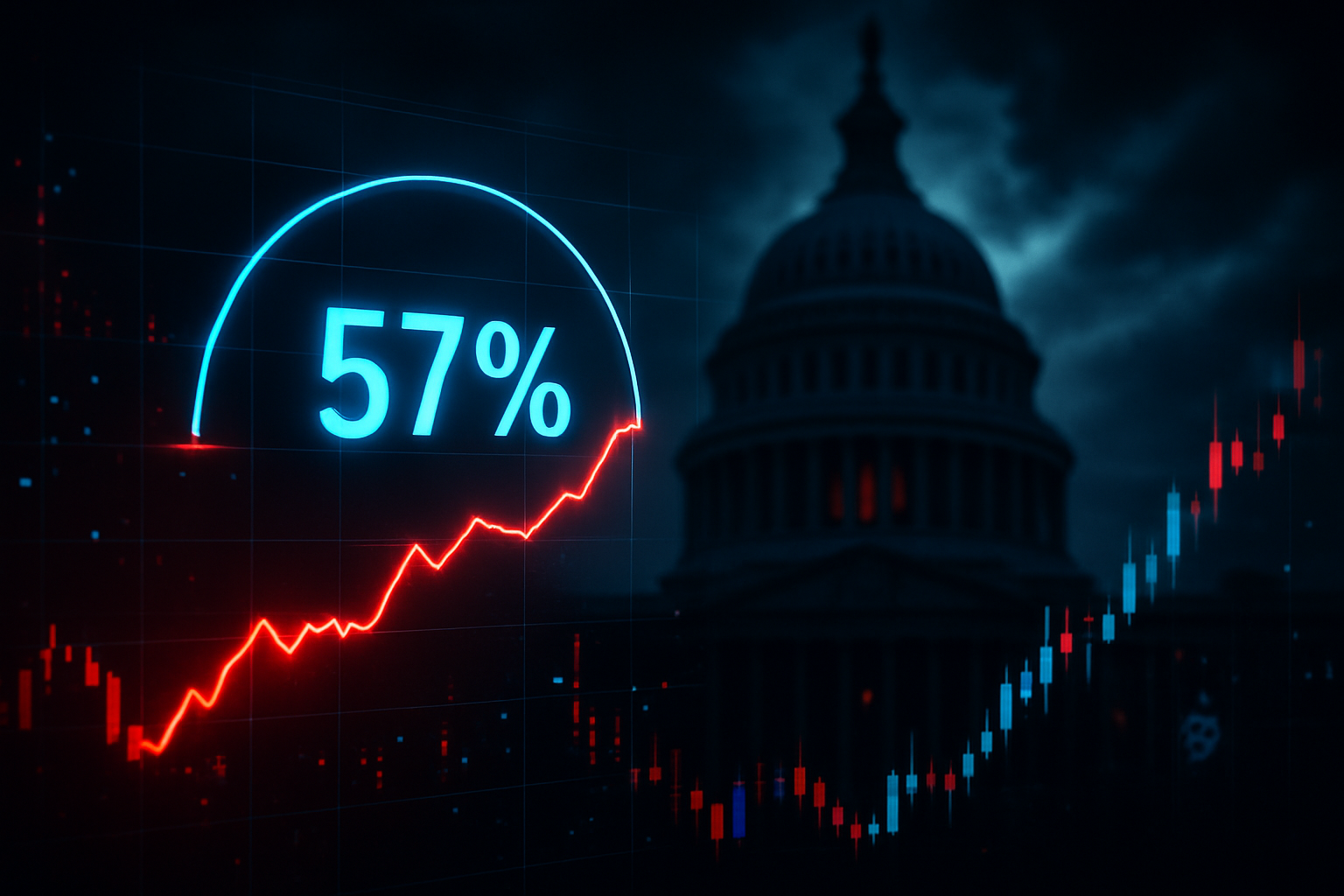
    As the United States enters the second year of Donald Trump’s second term, the political landscape has reached a boiling point that prediction markets are now pricing as a coin-flip for a constitutional crisis. On Kalshi, the regulated exchange for event contracts, the probability of President Trump being impeached by the House of Representatives has surged to a record high of 57%. This spike represents a dramatic shift in market sentiment, up from just 22% in early November 2025, signaling that traders believe the current friction between the executive branch and legislative oversight is nearing an inevitable fracture.

    The surge in "Yes" contracts is generating massive interest across the financial sector, as political volatility increasingly dictates market movements. For investors and political analysts alike, the 57% threshold is a psychological and statistical watershed. It suggests that the "permanent crisis" state of the administration—fueled by controversial executive actions and a looming midterm election—is no longer being treated as noise, but as a definitive fundamental driver of the 2026 economic and political outlook.

    The Market: What's Being Predicted

    The specific contract driving this conversation is Kalshi’s "Will Donald Trump be impeached in 2026?" market. Unlike traditional polling, which often lags behind the news cycle, this market provides a real-time gauge of how much capital is willing to back the likelihood of a formal House vote. While the odds of impeachment (the House vote) have climbed to 57%, the "Removal from Office" market remains significantly lower, hovering around 18%. This discrepancy highlights a nuanced view from traders: they expect a partisan House to pull the trigger, but do not yet see the two-thirds Senate majority required for a conviction.

    Trading volume on Kalshi and its decentralized counterpart, Polymarket, has exploded in the first two weeks of January 2026. Combined, these platforms have seen over $12 million in volume specifically related to the president’s tenure and potential exit. On Kalshi, the liquidity is being bolstered by institutional participation as hedge funds use these contracts to hedge against the broader market volatility often triggered by executive instability.

    The resolution criteria for these contracts are strictly legalistic. For a "Yes" payout on the impeachment contract, the U.S. House of Representatives must pass at least one Article of Impeachment before midnight on December 31, 2026. With the 2026 midterms scheduled for November, the timeline is compressed; traders are betting on whether a lame-duck Republican-led House would act under extreme pressure, or if a newly elected Democratic majority would make it their first order of business in a potential "January Surprise."

    Why Traders Are Betting

    The sudden leap to 57% is not the result of a single event, but a rapid-fire succession of "Black Swan" incidents in early January. On January 3, 2026, the administration announced the capture of Venezuelan President Nicolás Maduro by U.S. special forces in Caracas—an action taken without Congressional approval that has sparked an immediate War Powers resolution in the Senate. This was followed closely by the January 7 shooting of an American citizen during an ICE operation in Minneapolis, which triggered nationwide protests and a unified call from House Democrats to introduce "Articles of Tyranny."

    Furthermore, traders are closely watching the "Midterm Calculus." Current prediction markets on Interactive Brokers (Nasdaq: IBKR) and Robinhood (Nasdaq: HOOD) show a 74% probability of Democrats retaking control of the House in November 2026. "The smart money is moving toward a scenario where the House flips and impeachment follows almost instantly," says one high-volume trader on Polymarket. "If the GOP loses the House in November, the lame-duck period becomes a high-risk zone for retaliatory or defensive impeachment filings."

    Another major factor is the residual impact of the "Epstein Files Transparency Act" signed in late 2025. Recent allegations that the Department of Justice, led by Attorney General Pam Bondi, heavily redacted or "disappeared" certain documents have alienated some moderate Republicans. When a few key GOP members of the House Oversight Committee began expressing "openness" to an inquiry last week, the Kalshi odds jumped nearly 15 points in a single 24-hour trading session.

    Broader Context and Implications

    This surge in impeachment odds fits into a larger trend of prediction markets replacing traditional punditry as the primary source of political forecasting. In the 2024 election cycle, platforms like Kalshi and Polymarket were noted for their accuracy relative to polls, and in 2026, they have become even more integrated into the financial ecosystem. The fact that impeachment is trading at 57% tells us that the market views the U.S. government as being in a state of functional paralysis, where executive maneuvers are constantly met with the threat of legislative "nuclear" options.

    The real-world implications are significant. A high probability of impeachment typically leads to a "risk-off" sentiment in the broader equities market. Historically, periods of impeachment inquiry lead to increased volatility in the S&P 500 as investors fret over the delay of fiscal policy and the potential for civil unrest. The 57% figure acts as a "Volatility Index" for the 2026 midterms, suggesting that regardless of the legal outcome, the political process will be fraught with disruption.

    Regulatory oversight of these markets has also matured. The Commodity Futures Trading Commission (CFTC) has kept a close watch on these specific event contracts, ensuring that the surge in odds isn't the result of market manipulation but rather a genuine reflection of public and institutional sentiment. The accuracy of these markets in 2026 will likely determine the future of regulated political betting in the U.S. for decades to come.

    What to Watch Next

    The next major milestone for this market is the expected Supreme Court ruling on the "Reciprocal Tariff Act," slated for the end of January. If the Court strikes down the President's use of national emergency powers to bypass Congress on trade, many analysts expect the impeachment odds to climb toward 65% as the "abuse of power" narrative gains legal teeth. Conversely, a victory for the administration could see the odds retreat toward the 40% range.

    Additionally, the release of the final, unredacted portions of the 2025 Special Counsel reports—demanded by a bipartisan Senate subpoena—could serve as a massive catalyst. Any evidence that corroborates "political weaponization" of the DOJ would likely provide the necessary political cover for moderate House Republicans to join an impeachment inquiry.

    Traders should also monitor the 2026 Midterm "Control of the House" contracts. There is a direct mathematical correlation between the odds of a Democratic House and the odds of Trump’s impeachment. As the primary season kicks off in the spring, any sign of a "Blue Wave" building in the suburbs will almost certainly be front-run by the impeachment markets on Kalshi.

    Bottom Line

    The rise of Donald Trump’s impeachment odds to 57% on Kalshi is a stark indicator of the high-friction environment defining early 2026. It reflects a marketplace that has moved past the shock of the President’s unconventional tactics and is now coldly calculating the legislative consequences. The convergence of international military incidents, domestic civil unrest, and the looming midterm elections has created a volatile cocktail that traders are betting will end in a formal House rebuke.

    Ultimately, these prediction markets serve as more than just a betting platform; they are a sophisticated tool for measuring the stability of the American executive branch. Whether the 57% probability translates into a "Yes" resolution or retreats, the current activity proves that the market's appetite for political risk is at an all-time high. As we move deeper into the 2026 election cycle, the Kalshi ticker may be the most honest barometer we have for the health of the U.S. political system.


    This article is for informational purposes only and does not constitute financial or betting advice. Prediction market participation may be subject to legal restrictions in your jurisdiction.

    PredictStreet focuses on covering the latest developments in prediction markets.
    Visit the PredictStreet website at https://www.predictstreet.ai/.