Tag: Trading Volume

  • The TradFi Tipping Point: ICE’s $2 Billion Bet Transforms Polymarket into a Global Liquidity Powerhouse

    The TradFi Tipping Point: ICE’s $2 Billion Bet Transforms Polymarket into a Global Liquidity Powerhouse

    In a move that has effectively ended the "Wild West" era of decentralized forecasting, Intercontinental Exchange (NYSE: ICE) has finalized a landmark $2 billion strategic investment in Polymarket. This massive capital injection, completed in January 2026, values the platform at $9 billion and serves as an institutional "seal of approval" that has fundamentally rewired the relationship between traditional finance (TradFi) and the prediction market ecosystem.

    As of late January 2026, the results of this institutional pivot are staggering. Polymarket has reported a cumulative trading volume of $33.4 billion for the previous year, proving that the appetite for "Information Finance" has moved far beyond crypto-native speculators. With a massive liquidity backstop now in place, Wall Street's largest firms are no longer just watching these markets from the sidelines; they are using them to hedge macro risks with the same frequency they use the S&P 500 or Treasury futures.

    The Market: What's Being Predicted

    The $2 billion investment from Intercontinental Exchange is more than a mere cash infusion; it is a structural integration of prediction markets into the global financial plumbing. As part of the deal, ICE—the parent company of the New York Stock Exchange—has become the exclusive global distributor of Polymarket’s real-time data. This means that "market-implied probabilities" for everything from Federal Reserve pivots to geopolitical conflicts are now streamed directly into institutional terminals alongside traditional benchmarks.

    While the platform’s cumulative volume reached $33.4 billion, its monthly activity has stabilized at a robust $19 billion. The market depth has improved exponentially. Previously, a million-dollar trade could significantly "move the needle" on an outcome's probability, creating volatility that deterred institutional desks. With the ICE-backed liquidity backstop, the order books now possess the depth to handle nine-figure positions with minimal slippage.

    Currently, the most liquid market on the platform revolves around the Federal Reserve’s upcoming policy meeting. Traders are pricing in an 81% probability that the Fed will "Hold" rates, a figure that is being cited by major outlets like CNBC and Bloomberg as the definitive "source of truth," superseding traditional economist surveys.

    Why Traders Are Betting

    The surge in volume is being driven by a fundamental shift in how "information" is valued. TradFi firms now treat the "probability of outcome" as a distinct, tradeable asset class. Proprietary trading firms are utilizing Polymarket to hedge against "Black Swan" events that traditional insurance or equity derivatives cannot adequately cover.

    "The liquidity provided by the ICE partnership changed the game," says one head of macro trading at a Tier-1 bank. "Before, prediction markets were a curiosity. Now, when we see a 15% move in a geopolitical contract, we treat it with the same seriousness as a 15% move in Brent Crude."

    Recent high-profile successes have further fueled this betting frenzy. For instance, traders on Polymarket accurately signaled the capture of Nicolás Maduro hours before official confirmation, with one savvy participant netting a $436,000 profit. Such "alpha" is drawing in sophisticated players who specialize in alternative data and investigative research, moving the market closer to perfect information.

    Broader Context and Implications

    This mainstream explosion comes amid a radical shift in the regulatory climate. In early January 2026, the new Commodity Futures Trading Commission (CFTC) Chair, Michael Selig, launched the "Selig Initiative." This policy pivot directed the agency to withdraw older proposals that sought to ban event contracts, signaling a new era of federal support for "lawful innovation" in prediction markets.

    However, the rapid growth has not been without friction. The sheer amount of money flowing through these markets has caught the attention of Capitol Hill. Representative Ritchie Torres recently introduced the "Public Integrity in Financial Prediction Markets Act," aimed at preventing federal employees from trading on contracts where they might possess non-public information. This move highlights the growing concern that prediction markets are becoming so accurate that they could incentivize insider trading by those within the government.

    Furthermore, the "mainstreamization" of these markets is being accelerated by tech giants. On January 21, 2026, Alphabet (NASDAQ: GOOGL) updated its Google ads policy to allow federally regulated prediction markets to advertise, sparking a massive user acquisition race between Polymarket and its rivals.

    What to Watch Next

    As we move deeper into 2026, the battle for dominance is shifting from liquidity to accessibility. While Polymarket holds the "mindshare" for macro and geopolitical events, its regulated rival Kalshi has seen a "sports flywheel" effect that pushed its own volume to $43.1 billion. The next major milestone will be the integration of prediction market data into consumer-facing fintech apps like Robinhood (NASDAQ: HOOD) and Coinbase (NASDAQ: COIN), which are rumored to be exploring direct trading interfaces for event contracts.

    The immediate focus for traders, however, remains the ongoing legal battle between federal regulators and individual states. While the CFTC has signaled a "hands-off" approach under the Selig Initiative, several states—including Massachusetts and New York—are pursuing injunctions to protect their local gaming monopolies. How these state vs. federal jurisdictional disputes are resolved will determine whether prediction markets can maintain their current growth trajectory.

    Bottom Line

    The Intercontinental Exchange investment marks the moment prediction markets grew up. By providing a $2 billion liquidity backstop and integrating event data into the world’s most important financial terminals, ICE has effectively canonized Polymarket as a permanent fixture of the global economy.

    With $33.4 billion in cumulative volume and a regulatory environment that is finally trending toward clarity, the industry is no longer a speculative experiment. It is a sophisticated engine for price discovery that turns collective intelligence into actionable financial data. As we head toward the 2026 midterm elections and more economic uncertainty, the world will likely spend less time looking at polls and more time looking at the "truth" reflected in the order books of Polymarket.


    This article is for informational purposes only and does not constitute financial or betting advice. Prediction market participation may be subject to legal restrictions in your jurisdiction.

    PredictStreet focuses on covering the latest developments in prediction markets.
    Visit the PredictStreet website at https://www.predictstreet.ai/.

  • The Day Information Finance Went Mainstream: Inside the $700 Million Prediction Market Explosion

    The Day Information Finance Went Mainstream: Inside the $700 Million Prediction Market Explosion

    January 12, 2026, will be remembered as the day the "invisible hand" of the market finally grew a voice. In a historic 24-hour window, global prediction markets processed a staggering $701.7 million in daily trading volume, a milestone that effectively signals the end of the industry's experimental phase. This surge wasn't just a win for speculators; it represented a fundamental shift in how the public consumes and prices information.

    At the center of this whirlwind was Kalshi, which solidified its position as the undisputed heavyweight of the space. Capturing a dominant 66.4% market share, Kalshi processed approximately $465.9 million in trades. This unprecedented liquidity was fueled by a "perfect storm" of geopolitical shocks and a groundbreaking integration with Robinhood Markets, Inc. (NASDAQ: HOOD), which has turned millions of retail brokerage accounts into real-time sentiment gauges.

    The Market: What's Being Predicted

    While prediction markets were once the domain of niche political junkies and crypto-natives, the January 12 record was built on a diversified portfolio of high-stakes event contracts. The volume was split across a variety of platforms, with Kalshi leading the pack, followed by Polymarket and Opinion Labs (Opinion), which each captured roughly 14.3% of the daily share (approximately $100 million each). Smaller entrants like Predict Fun and Probable also saw record activity, though they remained in the shadow of the "Big Three."

    The primary driver of Kalshi’s dominance has been its status as a CFTC-regulated exchange, which allowed for its seamless integration into the Robinhood (NASDAQ: HOOD) ecosystem. Since the 2025 launch of the "Prediction Markets Hub," over 24 million retail traders have gained the ability to trade "Yes/No" outcomes as easily as they buy shares of an ETF. On January 12, Robinhood users reportedly accounted for over 50% of Kalshi’s total volume, transforming complex event derivatives into a standard retail asset class.

    Liquidity on these platforms has reached a critical mass where institutional-sized positions can now be entered with minimal slippage. This has attracted major quantitative firms like Susquehanna International Group (SIG) and DRW, who have reportedly established dedicated "Information Finance" desks to arbitrage discrepancies between prediction markets and traditional financial instruments.

    Why Traders Are Betting

    The massive volume spike on January 12 was triggered by several high-impact events that occurred simultaneously. The most dramatic was a sudden geopolitical shock in South America: the capture of Venezuelan leader Nicolás Maduro. While traditional news outlets scrambled to verify reports, prediction markets moved in milliseconds. One trader on Polymarket famously turned a $30,000 position into $400,000 by betting on the capture just hours before it was officially confirmed, a feat that drew thousands of new users to the platform in a "gold rush" of reactionary trading.

    Domestically, a high-stakes constitutional standoff between the U.S. Department of Justice and Federal Reserve Chair Jerome Powell became a massive liquidity sink. Traders poured over $120 million into contracts regarding a potential March 2026 interest rate cut. As rumors of a Fed "rebellion" against DOJ directives swirled, the odds of a rate cut fluctuated wildly between 34% and 74%, providing a real-time heat map of institutional anxiety that traditional polling could never capture.

    Furthermore, the early positioning for the 2026 Midterm elections saw significant "whale" activity. Large-scale traders used the markets to hedge against potential legislative gridlock, with a heavy concentration of volume on "Split Congress" outcomes. For many institutional players, these bets are no longer seen as gambles but as essential hedges against political risk that could impact their broader equity portfolios.

    Broader Context and Implications

    This record-breaking day marks a turning point for "Information Finance"—the concept that prices are the most accurate way to aggregate disparate pieces of information. For years, skeptics argued that prediction markets were too thin and prone to manipulation. However, the $701.7 million volume suggests that the markets have finally reached a level of maturity where they can serve as a "source of truth" that rivals or even exceeds traditional news wires like Bloomberg.

    The "Robinhood Effect" cannot be overstated. By demystifying event contracts and placing them alongside traditional stocks, Robinhood (NASDAQ: HOOD) has effectively democratized the ability to profit from being right about the world. This has not gone unnoticed by regulators. In the wake of the January 12 surge, lawmakers in New York have expedited discussions around the ORACLE Act, a proposed regulatory framework intended to clarify the legal boundaries between event trading and gambling.

    Historically, prediction markets have shown a remarkable ability to outperform expert pundits. By requiring participants to "put their money where their mouth is," these platforms filter out the noise of partisan bias and social media echo chambers. The January 12 milestone confirms that the public is increasingly looking to these markets to understand what is actually happening, rather than what people hope is happening.

    What to Watch Next

    As the dust settles from this record day, all eyes are on the Federal Reserve standoff. The volatility in interest rate contracts suggests that the market expects a major resolution before the end of the first quarter. Traders should monitor the liquidity in these contracts; if the $700 million daily volume becomes a new baseline, we could see even more aggressive price discovery in the coming weeks.

    Additionally, the expansion of Robinhood's (NASDAQ: HOOD) prediction offerings will be a key metric for the industry's growth. There are rumors that the platform may soon offer "Cross-Exchange" liquidity, allowing users to tap into multiple prediction market backends from a single interface. Such a move would likely push daily volumes past the $1 billion mark before the end of the year.

    Finally, keep a close watch on the legislative front. The success of January 12 has painted a target on the industry's back. How Kalshi and its peers navigate the impending ORACLE Act and potential CFTC challenges will determine whether this $700 million day was a one-time peak or the beginning of a new era in global finance.

    Bottom Line

    The record-shattering performance of January 12, 2026, proves that prediction markets are no longer a sideshow—they are the main event. With Kalshi and Robinhood (NASDAQ: HOOD) leading the charge, the barrier to entry for "Information Finance" has been permanently lowered. The ability of these markets to price in a presidential capture and a Federal Reserve crisis in real-time demonstrates an efficiency that traditional institutions are struggling to match.

    Ultimately, this milestone tells us that in an era of "alternative facts" and fragmented media, the world is hungry for a decentralized, incentive-aligned source of truth. As liquidity continues to grow and institutional players deepen their involvement, the odds found on prediction markets will likely become the primary lens through which we view future global events. The $701.7 million day wasn't just about the money; it was about the markets finally proving they can handle the weight of the world's most important questions.


    This article is for informational purposes only and does not constitute financial or betting advice. Prediction market participation may be subject to legal restrictions in your jurisdiction.

    PredictStreet focuses on covering the latest developments in prediction markets.
    Visit the PredictStreet website at https://www.predictstreet.ai/.
  • The New Wall Street: Prediction Markets Smash Records with $701.7 Million Day

    The New Wall Street: Prediction Markets Smash Records with $701.7 Million Day

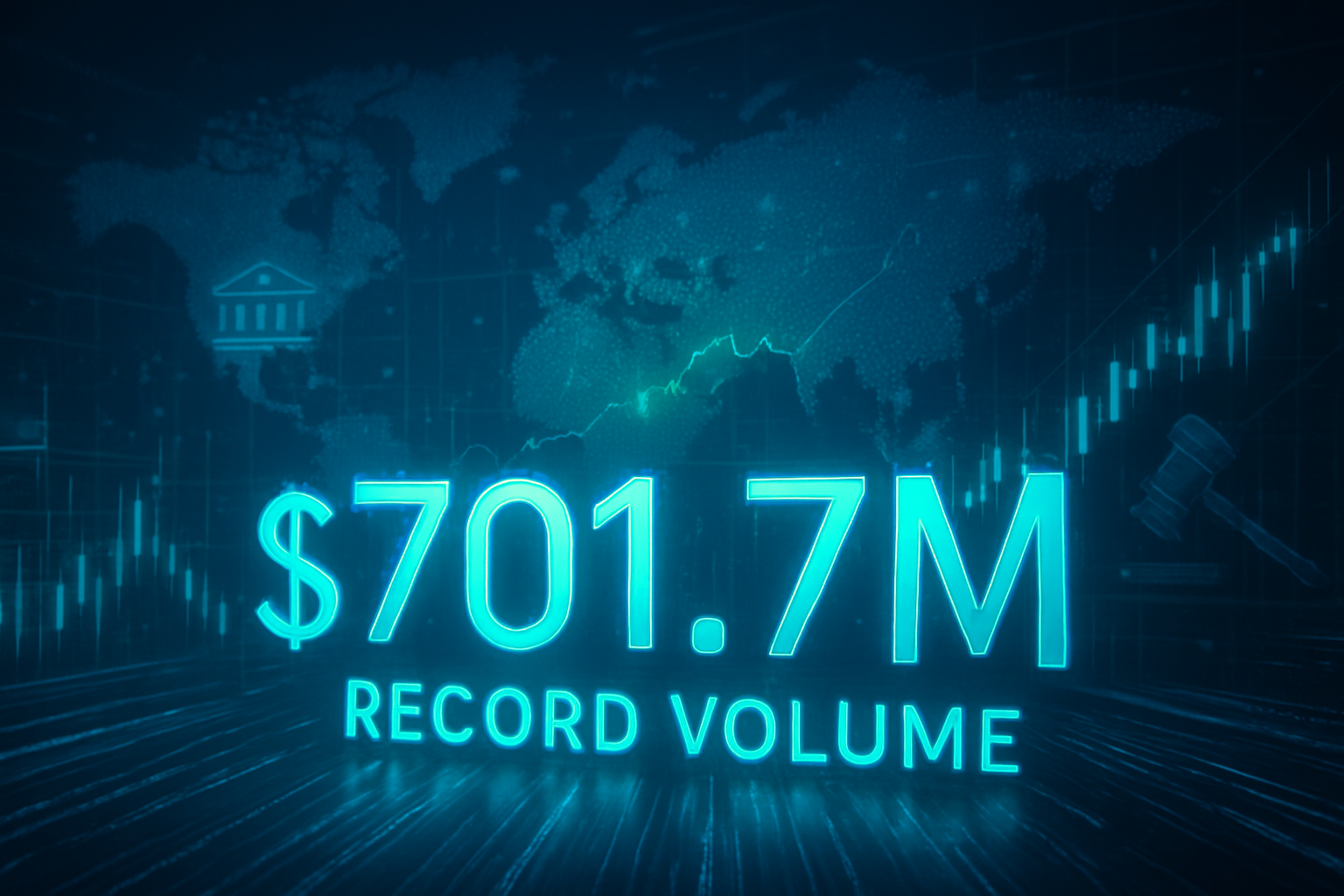
    The world of finance shifted on its axis this week. On Monday, January 12, 2026, prediction markets achieved a staggering, record-breaking $701.7 million in single-day trading volume. This milestone represents more than just a spike in activity; it marks the definitive arrival of "information finance" as a primary pillar of the global economy. For years, skeptics dismissed these platforms as glorified sportsbooks, but as of early 2026, they have transformed into what many are calling the world’s most accurate "truth engines."

    The surge was driven by a perfect storm of constitutional crises, geopolitical shocks, and the institutionalization of retail trading. At the center of the frenzy was a high-stakes standoff between the U.S. Department of Justice (DOJ) and Federal Reserve Chair Jerome Powell, alongside the sudden capture of Venezuelan President Nicolás Maduro. With millions of dollars moving by the second, the probability of a March interest rate cut fluctuated wildly, peaking at 74% as traders digested real-time updates that outpaced traditional news cycles by minutes.

    The Market: What's Being Predicted

    The $701.7 million daily volume was dominated by a "triopoly" of platforms that have spent the last year racing for market share. Kalshi solidified its position as the industry leader, capturing 66.4% of the volume with $465.9 million in trades. Much of this dominance is credited to Kalshi’s deep integration with Robinhood Markets, Inc. (NASDAQ:HOOD), which launched its dedicated "Prediction Markets Hub" last year, putting event contracts into the hands of over 100 million retail investors.

    While Kalshi owned the domestic macro markets, Polymarket and Opinion battled for the remaining share. Polymarket recorded $100.04 million in volume, buoyed by a $2 billion liquidity injection from the Intercontinental Exchange, Inc. (NYSE:ICE). Meanwhile, the relative newcomer Opinion (Opinion Labs) matched that figure with $100 million, specializing in high-frequency, AI-driven macro indicators.

    The most traded contracts on January 12 included:

    • The Federal Reserve Standoff: Contracts on whether Jerome Powell will resign or be removed before the March FOMC meeting.
    • The Maduro Aftermath: Predictions on the stability of a transitional government in Venezuela following Maduro’s capture.
    • NFL Postseason "Combos": A new feature on Kalshi that allows users to parlay economic outcomes with sports results—for instance, "CPI under 2.5% AND the Kansas City Chiefs win."

    Why Traders Are Betting

    The primary driver for this week’s massive volume was the unprecedented constitutional friction involving the Federal Reserve. On the evening of January 11, Chair Jerome Powell revealed that the DOJ had served the Fed with subpoenas regarding a massive headquarters renovation—a move Powell labeled a "pretext" for political interference. This sent traders into a frenzy. On Kalshi, the "Will the Fed cut rates in March?" contract saw over $120 million in volume on Monday alone as institutions used the market to hedge against a potential central bank decapitation.

    Geopolitical "insider" activity also fueled the surge. Following the U.S. military raid that captured Nicolás Maduro, a single anonymous trader on Polymarket turned a $32,000 bet into $400,000. The bet, placed just hours before the news broke, has sparked intense debate about the role of prediction markets in surfacing non-public information. Traders are no longer just betting on what they think will happen; they are betting on what they know is happening in the shadows.

    Furthermore, the "Mainstreet-ing" of these markets through Robinhood (NASDAQ:HOOD) has changed the trader profile. No longer restricted to crypto-enthusiasts, the January 12 record saw a massive influx of traditional retail investors treating "The Fed" or "The Greenland Declaration" as if they were tech stocks.

    Broader Context and Implications

    This record volume occurs against a backdrop of intense regulatory friction. While the federal courts largely cleared the way for election betting in 2025, a new "second front" has opened at the state level. Just this past week, the Tennessee Sports Wagering Council issued cease-and-desist orders to Kalshi and Polymarket, claiming their event contracts infringe on state gambling monopolies. However, on January 15, 2026, a federal judge granted a temporary restraining order (TRO) protecting Kalshi, suggesting that federal Commodity Futures Trading Commission (CFTC) oversight may preempt state law.

    The massive volume is also forcing Congress's hand. On January 9, Rep. Ritchie Torres (D-NY) introduced the "Public Integrity in Financial Prediction Markets Act of 2026." The bill aims to ban federal officials from trading on these platforms to prevent the very "information leakage" seen in the Maduro case.

    Despite these hurdles, the historical accuracy of these markets remains their greatest defense. Throughout the early 2026 geopolitical turmoil, prediction market odds have consistently moved 10 to 15 minutes ahead of major news wires like Bloomberg or Reuters. For many hedge funds, these markets are no longer a side-show—they are the primary signal.

    What to Watch Next

    The immediate focus for traders is the "Powell Pivot." With the DOJ investigation ongoing, any sign of Powell’s resignation will likely trigger another $500 million+ day. Markets are currently pricing a 35% chance of a leadership change at the Fed by February 1.

    On the regulatory front, keep an eye on the Ninth Circuit Court of Appeals. A ruling is expected by early February regarding Nevada’s attempt to shutter prediction market operations. If the court sides with Kalshi, it will effectively create a "green zone" for event contracts across the Western United States. Additionally, the finalization of the ICE (NYSE:ICE)-Polymarket integration is expected to bring a wave of institutional liquidity that could make $700 million days the new normal.

    Bottom Line

    The record-breaking volume of January 12 is a watershed moment for finance. It proves that prediction markets have solved the "liquidity trap" that previously kept them in the shadow of the New York Stock Exchange. By providing a clear, numerical probability for events that traditional markets struggle to price—like constitutional crises or military raids—platforms like Kalshi and Polymarket have become indispensable.

    For investors, the message is clear: the most valuable commodity in 2026 is no longer just data, but the synthesis of that data into tradable odds. As long as the world remains volatile, these "truth engines" will continue to grow, regulatory pressure notwithstanding.


    This article is for informational purposes only and does not constitute financial or betting advice. Prediction market participation may be subject to legal restrictions in your jurisdiction.

    PredictStreet focuses on covering the latest developments in prediction markets.
    Visit the PredictStreet website at https://www.predictstreet.ai/.