Tag: TradFi

  • The ICE Age of InfoFi: How a $2 Billion Bet Turned Polymarket into Wall Street’s Truth Engine

    The ICE Age of InfoFi: How a $2 Billion Bet Turned Polymarket into Wall Street’s Truth Engine

    The landscape of global finance shifted permanently this winter as the Intercontinental Exchange (NYSE: ICE) finalized a staggering $2 billion strategic investment into Polymarket. For years, prediction markets were viewed as the "Wild West" of decentralized finance—a niche playground for crypto-natives and political junkies. However, with the backing of the world’s most powerful exchange operator, the narrative has shifted from speculative curiosity to institutional necessity.

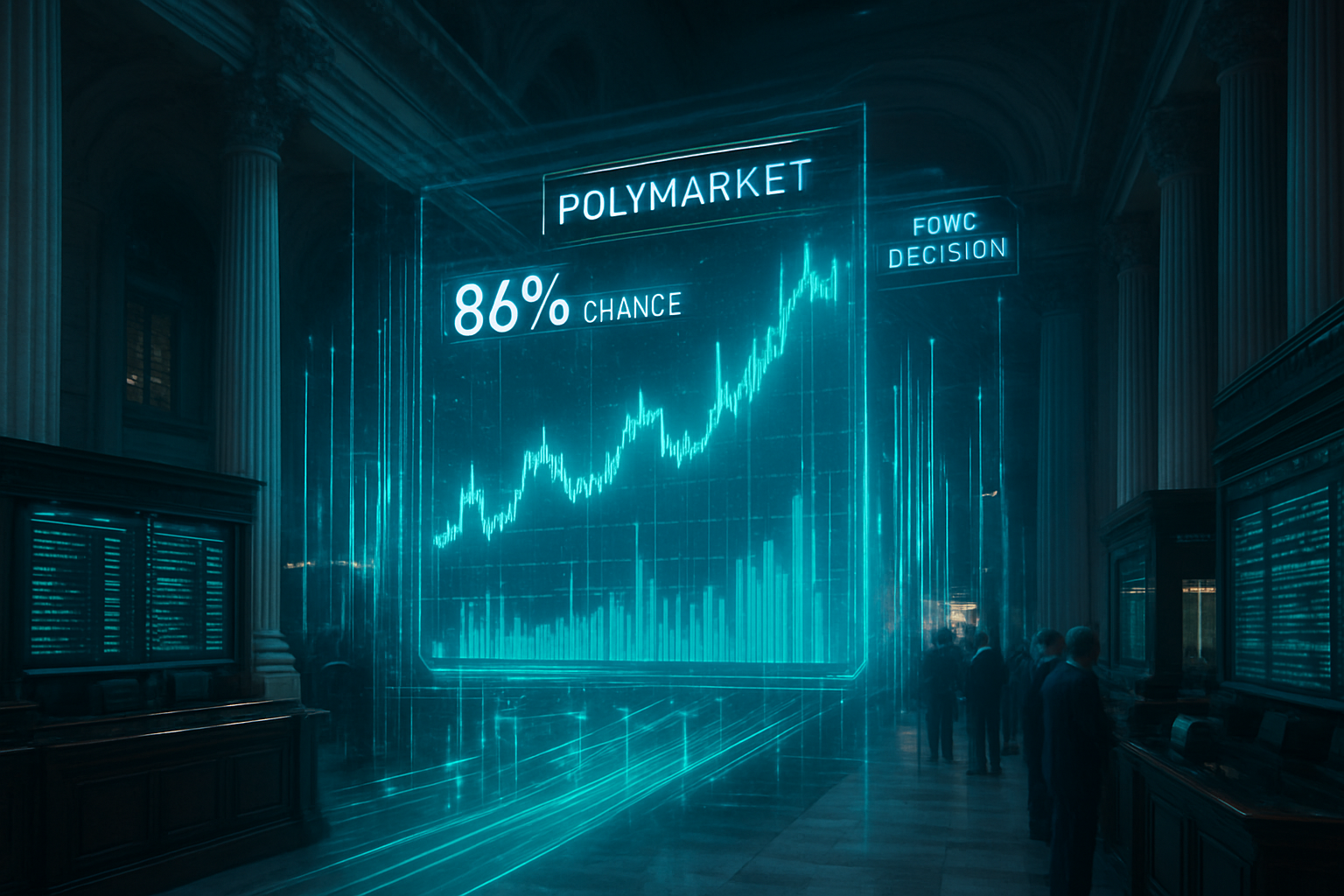
    As of early February 2026, the "institutional seal of approval" has propelled Polymarket’s cumulative trading volume to a record-shattering $33.4 billion, with $12 billion of that activity occurring in January 2026 alone. The market is currently laser-focused on the Federal Reserve’s March policy meeting, where traders are pricing in an 86% probability that interest rates will remain unchanged. This surge in volume and precision isn't just a trend; it is the arrival of "Information Finance" (InfoFi) as a foundational pillar of the global economy.

    The Market: What's Being Predicted

    While Polymarket rose to prominence during the 2024 election cycle, the platform has evolved into a multi-asset "truth engine" following its $112 million acquisition of the CFTC-licensed derivatives exchange, QCX. This regulatory pivot allowed Polymarket to legally relaunch in the United States, bringing domestic institutional capital into the fold. Today, the most liquid markets are no longer just about politics; they are about macroeconomic shifts and corporate performance.

    The March FOMC Decision market is currently the platform’s crown jewel, boasting over $72 million in active volume. Beyond the Fed, traders are heavily engaged in corporate "Earnings Beats" markets for tech giants like NVIDIA (NASDAQ: NVDA) and Amazon (NASDAQ: AMZN). For instance, the market currently assigns a 95% probability to an NVIDIA earnings beat later this month, a signal that traditional equity traders are now using to front-run movements in the NASDAQ 100. These contracts resolve based on official government reports or SEC filings, providing a clear, binary outcome that eliminates the ambiguity often found in traditional analyst forecasts.

    Why Traders Are Betting

    The primary driver behind this explosion in activity is the "liquidity backstop" provided by the Intercontinental Exchange (NYSE: ICE). Historically, prediction markets suffered from thin order books, where a $1 million trade could drastically swing the odds. With ICE’s $2 billion infusion, the platform now possesses the depth to handle nine-figure positions from hedge funds and institutional desks without significant slippage.

    Wall Street giants like Goldman Sachs (NYSE: GS) and Point72 have reportedly begun integrating Polymarket’s real-time probability data into their risk management models. Traders are no longer betting just to "win" a wager; they are using these markets to hedge macro risks. For example, a firm heavily exposed to Iranian oil disruptions may take a "Yes" position on the "US strikes Iran by March 31" market (currently at 42%) as a direct hedge against geopolitical volatility. This shift from "gambling" to "hedging" has fundamentally changed the participant profile of the platform.

    Furthermore, the integration of Polymarket data into ICE Connect terminals has placed prediction market odds alongside S&P 500 benchmarks and Treasury yields. This proximity has fostered a new level of trust among traditional finance (TradFi) firms, who now view these decentralized probabilities as more reliable and reactive than traditional polling or lagging economic indicators.

    Broader Context and Implications

    The ICE-Polymarket alliance marks the end of the "polling era" in financial forecasting. In a world where traditional surveys have repeatedly failed to capture public sentiment or economic reality, prediction markets offer a "skin-in-the-game" alternative. When people put money behind their opinions, the noise of partisan bias is filtered out, leaving a high-fidelity signal that has consistently outperformed think-tank models in terms of Brier scores—the gold standard for measuring forecasting accuracy.

    This transition also highlights a major regulatory win for the industry. By securing a CFTC-licensed path through the QCX acquisition, Polymarket has neutralized the legal "grey area" that plagued the sector for years. This regulatory clarity is what allowed the Intercontinental Exchange (NYSE: ICE) to step in, providing a template for how other legacy financial institutions might interact with blockchain-based protocols.

    The implications for "InfoFi" are vast. We are seeing the birth of an asset class where the underlying commodity is truth. As more real-world assets (RWAs) are tokenized, the line between a prediction market and a traditional futures market will continue to blur, creating a unified global ledger for both value and information.

    What to Watch Next

    The next major milestone for the ICE-Polymarket partnership is the widely rumored "Tokenization Initiative." Industry insiders suggest that the two entities are working on a framework to bring SpaceX IPO participation to the platform. Currently, traders assign an 84% chance that SpaceX will be the largest IPO of 2026. If Polymarket can facilitate the trading of "pre-IPO" synthetic shares or derivatives, it could disrupt the entire private equity landscape.

    Another key date to monitor is the upcoming nomination for the next Federal Reserve Chair. Following reports of a nomination plan in late January, the market for "Who will Trump nominate as Fed Chair?" has seen Kevin Warsh emerge as the 58% frontrunner. Any shift in these odds will likely precede official White House announcements, serving as the ultimate "alpha" for bond traders.

    Finally, the industry is watching for the full integration of Polymarket accounts into retail brokerage apps. Once a user can trade Apple (NASDAQ: AAPL) stock and "Apple Earnings Beat" prediction contracts within the same interface, the mainstreaming of prediction markets will be complete.

    Bottom Line

    The $2 billion investment by the Intercontinental Exchange (NYSE: ICE) is more than just a capital infusion; it is the moment prediction markets graduated to the major leagues of global finance. By providing the liquidity and regulatory cover necessary for institutional participation, ICE has turned Polymarket into a $33 billion "truth engine" that Wall Street can no longer ignore.

    This evolution proves that prediction markets are not merely a tool for betting on elections, but a sophisticated financial instrument for price discovery in an increasingly uncertain world. As we move deeper into 2026, the markets that once seemed like high-stakes experiments are now the very benchmarks by which the world measures its future. Whether it is interest rate cuts or corporate earnings, the "smart money" is no longer looking at polls—it’s looking at the tape.


    This article is for informational purposes only and does not constitute financial or betting advice. Prediction market participation may be subject to legal restrictions in your jurisdiction.

    PredictStreet focuses on covering the latest developments in prediction markets.
    Visit the PredictStreet website at https://www.predictstreet.ai/.
  • The TradFi Tipping Point: ICE’s $2 Billion Bet Transforms Polymarket into a Global Liquidity Powerhouse

    The TradFi Tipping Point: ICE’s $2 Billion Bet Transforms Polymarket into a Global Liquidity Powerhouse

    In a move that has effectively ended the "Wild West" era of decentralized forecasting, Intercontinental Exchange (NYSE: ICE) has finalized a landmark $2 billion strategic investment in Polymarket. This massive capital injection, completed in January 2026, values the platform at $9 billion and serves as an institutional "seal of approval" that has fundamentally rewired the relationship between traditional finance (TradFi) and the prediction market ecosystem.

    As of late January 2026, the results of this institutional pivot are staggering. Polymarket has reported a cumulative trading volume of $33.4 billion for the previous year, proving that the appetite for "Information Finance" has moved far beyond crypto-native speculators. With a massive liquidity backstop now in place, Wall Street's largest firms are no longer just watching these markets from the sidelines; they are using them to hedge macro risks with the same frequency they use the S&P 500 or Treasury futures.

    The Market: What's Being Predicted

    The $2 billion investment from Intercontinental Exchange is more than a mere cash infusion; it is a structural integration of prediction markets into the global financial plumbing. As part of the deal, ICE—the parent company of the New York Stock Exchange—has become the exclusive global distributor of Polymarket’s real-time data. This means that "market-implied probabilities" for everything from Federal Reserve pivots to geopolitical conflicts are now streamed directly into institutional terminals alongside traditional benchmarks.

    While the platform’s cumulative volume reached $33.4 billion, its monthly activity has stabilized at a robust $19 billion. The market depth has improved exponentially. Previously, a million-dollar trade could significantly "move the needle" on an outcome's probability, creating volatility that deterred institutional desks. With the ICE-backed liquidity backstop, the order books now possess the depth to handle nine-figure positions with minimal slippage.

    Currently, the most liquid market on the platform revolves around the Federal Reserve’s upcoming policy meeting. Traders are pricing in an 81% probability that the Fed will "Hold" rates, a figure that is being cited by major outlets like CNBC and Bloomberg as the definitive "source of truth," superseding traditional economist surveys.

    Why Traders Are Betting

    The surge in volume is being driven by a fundamental shift in how "information" is valued. TradFi firms now treat the "probability of outcome" as a distinct, tradeable asset class. Proprietary trading firms are utilizing Polymarket to hedge against "Black Swan" events that traditional insurance or equity derivatives cannot adequately cover.

    "The liquidity provided by the ICE partnership changed the game," says one head of macro trading at a Tier-1 bank. "Before, prediction markets were a curiosity. Now, when we see a 15% move in a geopolitical contract, we treat it with the same seriousness as a 15% move in Brent Crude."

    Recent high-profile successes have further fueled this betting frenzy. For instance, traders on Polymarket accurately signaled the capture of Nicolás Maduro hours before official confirmation, with one savvy participant netting a $436,000 profit. Such "alpha" is drawing in sophisticated players who specialize in alternative data and investigative research, moving the market closer to perfect information.

    Broader Context and Implications

    This mainstream explosion comes amid a radical shift in the regulatory climate. In early January 2026, the new Commodity Futures Trading Commission (CFTC) Chair, Michael Selig, launched the "Selig Initiative." This policy pivot directed the agency to withdraw older proposals that sought to ban event contracts, signaling a new era of federal support for "lawful innovation" in prediction markets.

    However, the rapid growth has not been without friction. The sheer amount of money flowing through these markets has caught the attention of Capitol Hill. Representative Ritchie Torres recently introduced the "Public Integrity in Financial Prediction Markets Act," aimed at preventing federal employees from trading on contracts where they might possess non-public information. This move highlights the growing concern that prediction markets are becoming so accurate that they could incentivize insider trading by those within the government.

    Furthermore, the "mainstreamization" of these markets is being accelerated by tech giants. On January 21, 2026, Alphabet (NASDAQ: GOOGL) updated its Google ads policy to allow federally regulated prediction markets to advertise, sparking a massive user acquisition race between Polymarket and its rivals.

    What to Watch Next

    As we move deeper into 2026, the battle for dominance is shifting from liquidity to accessibility. While Polymarket holds the "mindshare" for macro and geopolitical events, its regulated rival Kalshi has seen a "sports flywheel" effect that pushed its own volume to $43.1 billion. The next major milestone will be the integration of prediction market data into consumer-facing fintech apps like Robinhood (NASDAQ: HOOD) and Coinbase (NASDAQ: COIN), which are rumored to be exploring direct trading interfaces for event contracts.

    The immediate focus for traders, however, remains the ongoing legal battle between federal regulators and individual states. While the CFTC has signaled a "hands-off" approach under the Selig Initiative, several states—including Massachusetts and New York—are pursuing injunctions to protect their local gaming monopolies. How these state vs. federal jurisdictional disputes are resolved will determine whether prediction markets can maintain their current growth trajectory.

    Bottom Line

    The Intercontinental Exchange investment marks the moment prediction markets grew up. By providing a $2 billion liquidity backstop and integrating event data into the world’s most important financial terminals, ICE has effectively canonized Polymarket as a permanent fixture of the global economy.

    With $33.4 billion in cumulative volume and a regulatory environment that is finally trending toward clarity, the industry is no longer a speculative experiment. It is a sophisticated engine for price discovery that turns collective intelligence into actionable financial data. As we head toward the 2026 midterm elections and more economic uncertainty, the world will likely spend less time looking at polls and more time looking at the "truth" reflected in the order books of Polymarket.


    This article is for informational purposes only and does not constitute financial or betting advice. Prediction market participation may be subject to legal restrictions in your jurisdiction.

    PredictStreet focuses on covering the latest developments in prediction markets.
    Visit the PredictStreet website at https://www.predictstreet.ai/.