Tag: Stock Analysis

  • The Memory Backbone: How Micron Technology Captured the AI Supercycle

    The Memory Backbone: How Micron Technology Captured the AI Supercycle

    By [Your Name], Senior Financial Correspondent
    December 25, 2025

    Introduction

    As we close out 2025, the global technology landscape has been irrevocably altered by the generative AI revolution. While NVIDIA (NASDAQ: NVDA) remains the face of this movement, a shift in the investment narrative has occurred over the last 18 months: the realization that the "intelligence" of the modern data center is only as fast as the memory that feeds it. At the heart of this realization sits Micron Technology, Inc. (NASDAQ: MU).

    Once regarded as a cyclical commodity manufacturer prone to the "boom and bust" cycles of the PC and smartphone markets, Micron has successfully pivoted to become a top-tier provider of High-Bandwidth Memory (HBM). In 2025, Micron’s stock has outperformed major indices as the company transitioned from a secondary player in HBM to a formidable rival to South Korean giants. With its HBM3E production capacity sold out through 2026, Micron is no longer just a memory maker; it is the critical infrastructure partner for the world’s most advanced AI workloads.

    Historical Background

    Founded in 1978 in the basement of a dental office in Boise, Idaho, Micron Technology’s journey is one of survival and relentless cost optimization. In its early decades, the company survived the "Memory Wars" of the 1980s and 90s, where dozens of Japanese and American firms were forced out of the DRAM market due to intense price competition.

    Micron’s modern era began in earnest in 2017 when Sanjay Mehrotra, the co-founder of SanDisk, took the helm as CEO. Mehrotra shifted the company’s focus from mere volume to "technology leadership." Under his tenure, Micron achieved several "industry firsts," including the first 176-layer and 232-layer NAND and the early adoption of Extreme Ultraviolet (EUV) lithography in DRAM. This technical prowess laid the groundwork for Micron to enter the AI era not as a follower, but as a leader in power efficiency and performance.

    Business Model

    Micron operates through four primary business segments, primarily centered around DRAM (Dynamic Random Access Memory) and NAND (Flash storage):

    1. Compute and Networking Business Unit (CNBU): Includes memory for cloud servers, enterprise data centers, and client PCs. This is currently the largest growth driver due to HBM demand.
    2. Mobile Business Unit (MBU): Provides low-power DRAM and NAND for smartphones.
    3. Storage Business Unit (SBU): Focused on SSDs for consumer and enterprise markets.
    4. Embedded Business Unit (EBU): Tailored memory solutions for automotive, industrial, and "Edge" AI applications.

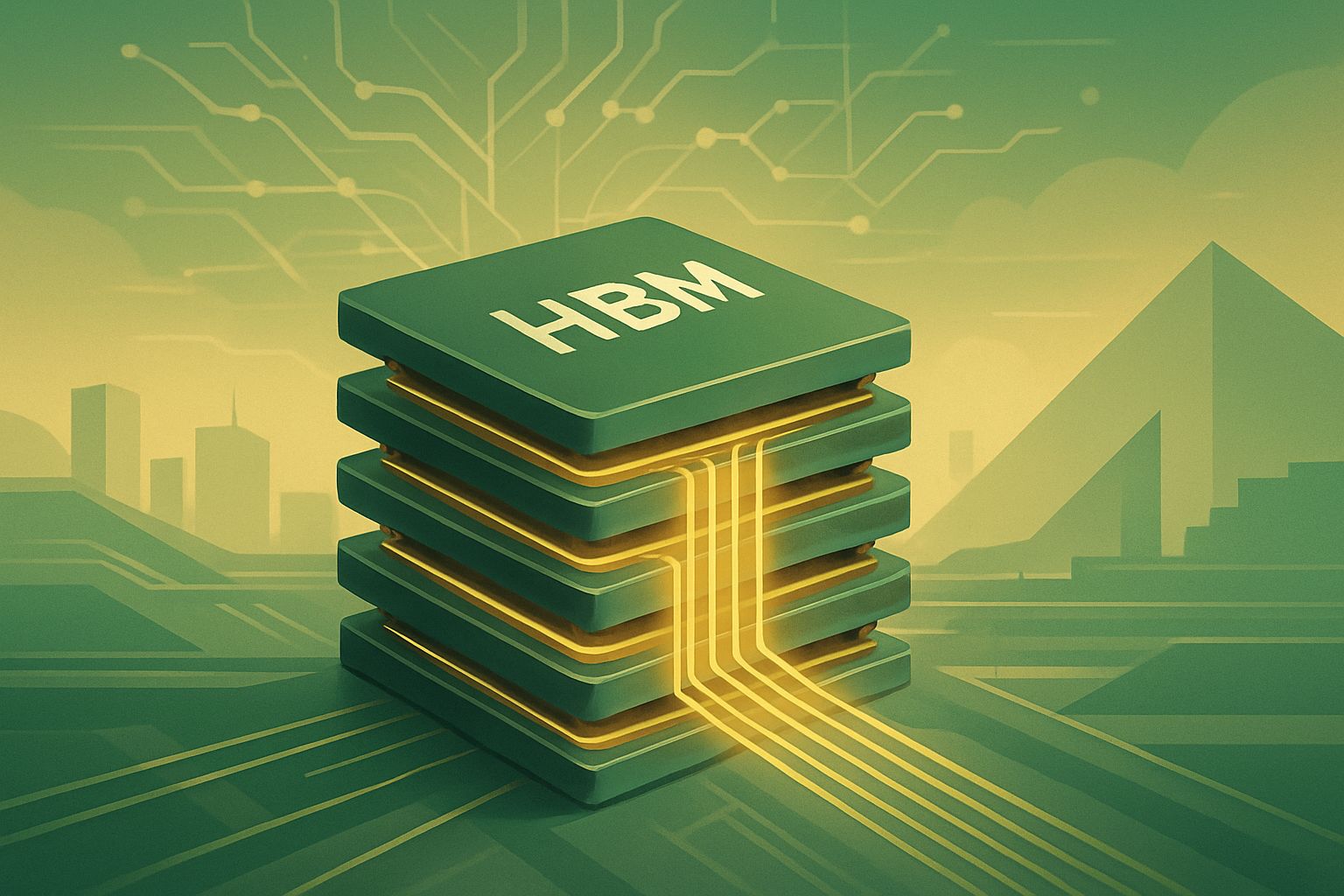
    The fundamental shift in 2025 has been the "HBM-ization" of the business model. HBM is a specialized DRAM where memory chips are stacked vertically and linked via Through-Silicon Vias (TSVs). Because HBM requires three times the wafer capacity of standard DDR5 memory, its production has significantly tightened the overall supply of DRAM, giving Micron unprecedented pricing power.

    Stock Performance Overview

    Micron’s stock performance over the last decade illustrates a transformation from a cyclical laggard to a high-growth tech titan:

    • 1-Year Performance (2025): The stock has surged approximately 65% year-to-date, driven by consecutive quarterly earnings beats and upward revisions in HBM market share.
    • 5-Year Performance: Looking back to 2020, MU has appreciated nearly 280%. While it faced a brutal downturn in 2023 during the post-pandemic "inventory correction," the rebound starting in early 2024 has been one of the most aggressive in the semiconductor sector.
    • 10-Year Performance: Over a 10-year horizon, Micron has outperformed the S&P 500 significantly, though with much higher volatility. Investors who held through the 2015-2016 and 2022-2023 troughs have seen massive multi-bagger returns as the company's "trough" earnings levels have consistently risen.

    Financial Performance

    The fiscal year 2025 (ended August 2025) was a watershed moment for Micron’s balance sheet.

    • Revenue: Micron reported FY2025 revenue of $37.38 billion, a 49% increase year-over-year.
    • Profitability: Gross margins, which were negative during parts of 2023, expanded to over 45% by late 2025. This was driven by the high ASP (Average Selling Price) of HBM3E products, which command margins significantly higher than traditional DRAM.
    • Earnings Per Share (EPS): For the most recent quarter (Q1 FY2026, ending Nov 2025), Micron delivered record EPS, with analysts projecting a full-year FY2026 EPS range of $30.00 to $36.00.
    • Capital Expenditure: To meet demand, Micron’s CapEx for 2025 exceeded $12 billion, focused on HBM packaging and the expansion of its Boise, Idaho fabrication facility.

    Leadership and Management

    CEO Sanjay Mehrotra remains the architect of Micron’s current success. His strategy has been characterized by "disciplined supply management"—refusing to overproduce even when prices are high, to avoid the gluts of the past.

    Supporting him is Manish Bhatia, EVP of Global Operations, who has been instrumental in navigating the complex ramp-up of HBM3E 12-Hi production. The leadership team’s reputation among institutional investors is currently at an all-time high, praised for their transparency regarding "yield" challenges and their success in securing long-term supply agreements with major CSPs (Cloud Service Providers).

    Products, Services, and Innovations

    Micron’s product roadmap is currently the envy of the memory industry:

    • HBM3E (High-Bandwidth Memory): Micron’s flagship HBM3E provides 30% lower power consumption than its nearest competitor. In early 2025, Micron moved into volume production of its 12-Hi (36GB) stacks, which have become the standard for NVIDIA’s latest Blackwell-series GPUs.
    • HBM4: In late 2025, Micron began sampling HBM4, which utilizes a 2048-bit interface. This next-generation memory is expected to enter mass production in 2026, promising a 60% increase in bandwidth.
    • LPCAMM2: A revolutionary modular memory form factor for laptops that delivers the power efficiency of soldered LPDDR5X with the serviceability of a module—critical for "AI PCs" that require massive amounts of local RAM.

    Competitive Landscape

    The DRAM market remains an oligopoly, dominated by three players:

    1. SK Hynix: The early leader in HBM. As of late 2025, they still hold approximately 60% of the HBM market, though their lead is being chipped away.
    2. Micron (MU): Now firmly entrenched as the #2 or #3 player depending on the month. In Q2 2025, Micron briefly overtook Samsung in HBM market share, currently sitting at roughly 21-22%.
    3. Samsung Electronics: Despite its massive scale, Samsung struggled with HBM3E yields throughout 2024 and early 2025. However, a late-2025 recovery has seen Samsung reclaim some ground, keeping the "Big Three" in a fierce technological arms race.

    Micron’s competitive edge lies in its power efficiency and its U.S.-based manufacturing footprint, which appeals to Western customers concerned about supply chain resilience.

    Industry and Market Trends

    Three macro trends are defining Micron’s trajectory:

    • The 3-to-1 Wafer Trade Ratio: Producing one bit of HBM takes roughly three times the wafer capacity of one bit of standard DDR5. This "wafer cannibalization" has created a structural shortage in the memory market, leading to rising prices across all DRAM categories.
    • AI at the Edge: 2025 has seen the rise of "AI PCs" and "AI Smartphones" (like the iPhone 17 Pro). These devices require 2x to 3x the RAM of previous generations to run LLMs locally, providing a huge tailwind for Micron’s Mobile and Client business units.
    • Server Refresh Cycle: Beyond AI, traditional data center servers are being upgraded to DDR5, which carries higher margins than the aging DDR4 standard.

    Risks and Challenges

    Despite the optimism, Micron faces significant headwinds:

    • Geopolitical Friction: Micron remains a "political football" in the US-China trade war. While the 2023 CAC ban in China has been partially mitigated, further restrictions on equipment or sales remain a constant threat.
    • Yield Risks: HBM is notoriously difficult to manufacture. Any "hiccup" in the assembly of 12-Hi or 16-Hi stacks could lead to massive write-offs and margin compression.
    • Cyclicality: While many argue "this time is different," the memory industry has never permanently escaped its cyclical nature. A sudden slowdown in AI capital expenditure by the "Magnificent Seven" would leave Micron with massive, expensive excess capacity.

    Opportunities and Catalysts

    • HBM4 Transition: Micron’s early progress in HBM4 could allow it to capture market share from SK Hynix in 2026.
    • Stock Buybacks: With free cash flow reaching record levels in late 2025, management has hinted at a massive increase in its share repurchase program for 2026.
    • Automotive AI: As Level 3 and Level 4 autonomous driving become more common, cars are essentially becoming "data centers on wheels," requiring gigabytes of high-performance DRAM.

    Investor Sentiment and Analyst Coverage

    Wall Street sentiment on Micron is overwhelmingly "Bullish." As of December 2025:

    • Price Targets: Major banks like Goldman Sachs and Morgan Stanley have raised their targets to the $180 – $210 range.
    • Institutional Ownership: Large hedge funds have increased their positions in MU, treating it as a "pure play" on the AI infrastructure layer with a lower valuation (P/E ratio) than NVIDIA or AMD.
    • Retail Sentiment: On social platforms, Micron is frequently cited as the "best value" in the semiconductor space.

    Regulatory, Policy, and Geopolitical Factors

    Micron is a primary beneficiary of the U.S. CHIPS and Science Act.

    • In December 2024, the government finalized a $6.14 billion grant for Micron.
    • Boise Expansion: Micron has accelerated the construction of its Boise "ID2" fab, with first wafer output expected by mid-2027.
    • New York Mega-Fab: While the Clay, NY project faced some environmental delays in 2025, it remains the largest private investment in New York history, intended to ensure U.S. memory sovereignty through 2045.

    Conclusion

    As we look toward 2026, Micron Technology stands at the pinnacle of its 47-year history. The company has successfully shed its image as a commodity vendor, proving it can compete at the highest levels of semiconductor engineering.

    For investors, the case for Micron is built on the "scarcity" of memory. In a world where AI models are growing exponentially, memory is the bottleneck. While the inherent cyclicality of the chip industry remains a risk, the structural shift toward HBM and Edge AI provides a floor for earnings that didn't exist five years ago. Micron is no longer just a participant in the tech industry; it is the vital, high-speed foundation upon which the future of artificial intelligence is being built.


    This content is intended for informational purposes only and is not financial advice.

  • The Oracle Ascendant: AI Factories, The $523 Billion Backlog, and the Ellison Empire

    The Oracle Ascendant: AI Factories, The $523 Billion Backlog, and the Ellison Empire

    Date: December 25, 2025

    Introduction

    As 2025 draws to a close, Oracle Corporation (NYSE: ORCL) stands at a historic crossroads, shedding its reputation as a legacy software provider to emerge as the literal engine room of the generative AI revolution. Long considered a "dinosaur" of the 1990s tech boom, Oracle has orchestrated one of the most improbable second acts in corporate history. Today, the company is not just a database provider; it is a global "AI factory" operator, securing massive infrastructure contracts that dwarf its previous market valuation.

    Oracle is currently in focus for two primary reasons: a staggering explosion in its cloud backlog, which recently crossed the half-trillion-dollar mark, and the increasing convergence of Chairman Larry Ellison’s personal interests with the broader tech and media landscape through the high-stakes Paramount-Skydance-Warner Bros. Discovery saga. As investors weigh the company's hyper-growth against its massive capital expenditure and debt levels, Oracle has become the ultimate litmus test for the sustainability of the AI infrastructure cycle.

    Historical Background

    Founded in 1977 as Software Development Laboratories (SDL) by Larry Ellison, Bob Miner, and Ed Oates, Oracle was born from a paper by IBM researcher Edgar F. Codd regarding relational database management systems (RDBMS). While IBM was slow to commercialize the technology, Ellison saw its potential, winning a contract from the CIA to build a system codenamed "Oracle."

    The company went public in 1986, just a day before Microsoft. Throughout the 1990s and 2000s, Oracle became the dominant force in enterprise software, fueled by an aggressive "grow-by-acquisition" strategy. Under Ellison’s ruthless leadership, Oracle swallowed rivals like PeopleSoft, Siebel Systems, and Sun Microsystems. However, the 2010s proved difficult as the company was slow to embrace the cloud, initially dismissing it as a "fad" while Amazon Web Services (AWS) and Microsoft Azure seized the market. The last five years have seen a frantic and successful pivot to "Generation 2" Cloud Infrastructure (OCI), culminating in the company's current status as a preferred partner for AI heavyweights.

    Business Model

    Oracle’s business model has transitioned from high-margin, one-time software licenses to a recurring, high-growth cloud subscription model. Its revenue is categorized into four primary segments:

    1. Cloud Services and License Support: The largest segment, including Oracle Cloud Infrastructure (OCI) and Software-as-a-Service (SaaS) offerings like NetSuite and Fusion ERP. This is the company’s "bread and butter," providing steady, high-margin recurring revenue.
    2. Cloud License and On-Premise License: Revenue from customers who still prefer to manage their own data centers or buy perpetual licenses. This segment is shrinking as a percentage of total revenue but remains highly profitable.
    3. Hardware: Inherited largely from the Sun Microsystems acquisition, this includes high-end servers and storage units like the Exadata database machine.
    4. Services: Consulting and support services, recently bolstered by the integration of Cerner, the electronic health records giant acquired for $28 billion in 2022.

    The core of the "New Oracle" is OCI, which specializes in high-performance computing (HPC) optimized for the massive data transfers required to train Large Language Models (LLMs).

    Stock Performance Overview

    Over the past decade, ORCL has transformed from a low-volatility value play into a high-growth momentum stock.

    • 10-Year View: Investors have seen a significant rerating of the stock. From 2015 to 2020, Oracle traded largely sideways or with modest gains. However, the post-2023 AI pivot led to a tripling of the share price.
    • 5-Year View: The stock has outperformed the S&P 500, particularly in the 2024-2025 period, as the market began to price in Oracle's role as a primary host for NVIDIA-powered AI clusters.
    • 1-Year View: The last 12 months have been marked by high volatility. Shares surged following the announcement of a $300 billion partnership with OpenAI in September 2025, but have faced periodic pullbacks as the company announced record-breaking capital expenditures that impacted near-term free cash flow.

    Financial Performance

    Oracle’s recent financial results highlight a company in a state of hyper-expansion. In its Q2 Fiscal Year 2026 report (announced earlier this month), the company reported:

    • Revenue: $16.1 billion, a 14% year-over-year increase.
    • OCI Growth: Cloud infrastructure revenue grew by a staggering 68%, outpacing all "Hyperscaler" competitors.
    • The RPO Metric: Remaining Performance Obligations (RPO)—the value of signed contracts not yet recognized as revenue—hit an unprecedented $523 billion. This backlog represents decades of guaranteed future revenue, primarily from AI infrastructure deals.
    • Capital Expenditure (CapEx): To meet this demand, Oracle has guided for $50 billion in CapEx for FY2026. This aggressive spending has led to a "CapEx Shock," resulting in negative free cash flow for the current fiscal year—a rarity for a company of Oracle’s size.
    • Valuation: Oracle currently trades at a forward P/E ratio higher than its 10-year average, reflecting the market’s belief that its AI backlog will eventually translate into massive net income.

    Leadership and Management

    The leadership of Oracle remains one of the most unique and enduring partnerships in Silicon Valley.

    • Larry Ellison (Chairman and CTO): At 81, Ellison remains the driving force behind the company’s technical strategy. His vision of a "distributed cloud" and his personal relationship with NVIDIA CEO Jensen Huang have been instrumental in Oracle’s resurgence.
    • Safra Catz (CEO): Known as one of the most disciplined financial minds in tech, Catz has overseen the complex transition to cloud margins and the integration of large-scale acquisitions like Cerner.
    • Strategy and Governance: Oracle’s leadership is often criticized for its "imperial" style, with Ellison maintaining a tight grip on direction. However, the duo’s ability to pivot a $400 billion company mid-stream has silenced many critics.

    Products, Services, and Innovations

    Oracle’s current edge lies in its "Generation 2 Cloud." Unlike AWS or Azure, which were built for general-purpose web hosting, OCI was designed with "flat" networks and RDMA (Remote Direct Memory Access), which allows thousands of GPUs to talk to each other at lightning speeds—a requirement for AI training.

    • NVIDIA Superclusters: Oracle is the first cloud provider to deploy NVIDIA Blackwell GB200 systems at scale, creating "AI Superclusters" with over 100,000 GPUs.
    • Autonomous Database: Oracle’s flagship software now uses machine learning to self-patch, self-tune, and self-secure, reducing human labor costs and error.
    • Cerner Health: Oracle is currently rewriting Cerner’s legacy healthcare software into a cloud-native, AI-driven platform intended to automate clinical notes and diagnostic suggestions.

    Competitive Landscape

    Oracle competes in a "Land of Giants," yet it has successfully carved out a high-end niche.

    • Microsoft (MSFT) and Google (GOOGL): Once bitter rivals, Oracle has turned them into partners through the "Oracle Database@Azure" and "Oracle Database@Google Cloud" initiatives. This "multi-cloud" strategy allows customers to use Oracle's database while utilizing the AI tools of other providers.
    • Amazon (AMZN): AWS remains the primary competitor in cloud infrastructure. While AWS has a larger market share, Oracle is winning on price-performance for specific AI training workloads.
    • SAP (SAP) and Salesforce (CRM): Oracle competes aggressively in the ERP (Enterprise Resource Planning) and CRM spaces, though its focus has shifted heavily toward the infrastructure layer in recent years.

    Industry and Market Trends

    The dominant trend shaping Oracle’s future is Sovereign AI. Governments in Europe, the Middle East, and Asia are increasingly demanding that their AI infrastructure and data reside within their own borders. Oracle’s "Alloy" program—which allows partners to become cloud providers using Oracle’s tech—positions it perfectly for this trend toward localized, sovereign data centers.

    Additionally, the "Multi-cloud" trend is now the industry standard. Enterprises no longer want to be locked into a single vendor. Oracle’s willingness to put its hardware inside Microsoft and Google data centers has turned its greatest weakness (lack of a general-purpose cloud ecosystem) into a strength.

    Risks and Challenges

    Despite the massive backlog, Oracle faces significant headwinds:

    • The Debt Burden: With roughly $90 billion in net debt following the Cerner acquisition and continued high-interest rates, Oracle’s balance sheet is stretched.
    • CapEx Burn: Spending $50 billion a year on data centers is a high-stakes gamble. If the AI bubble bursts or demand cools, Oracle could be left with massive amounts of expensive, underutilized hardware.
    • Execution Risk: Building out the infrastructure to support a $523 billion backlog is a logistical nightmare. Supply chain delays in NVIDIA chips or power grid constraints could prevent Oracle from turning that backlog into actual revenue.
    • Cerner Integration: The transformation of Cerner has been slower and more expensive than initially projected, weighing on the company’s margins.

    Opportunities and Catalysts

    The most immediate catalyst for Oracle is the OpenAI Project Stargate. As the primary compute provider for training GPT-5 and beyond, Oracle is tethered to the most successful startup in the AI space.

    Furthermore, the Autonomous Healthcare vision—using AI to fix the broken medical record system—represents a multi-billion dollar opportunity if Oracle can successfully modernize Cerner. Any announcement of a successful, large-scale rollout of AI clinical assistants within the Cerner ecosystem would likely serve as a major stock catalyst.

    Investor Sentiment and Analyst Coverage

    Wall Street is currently divided into two camps.

    • The Bulls (e.g., Cantor Fitzgerald): Argue that Oracle’s RPO is "the most impressive number in tech history," suggesting that the company’s revenue will double over the next five years as the backlog is realized.
    • The Bears (e.g., Goldman Sachs): Express concern over "CapEx burnout." They worry that Oracle is over-earning in the short term due to an infrastructure land grab that may not lead to long-term software-style margins.

    Institutional ownership remains high, with Vanguard and BlackRock holding significant stakes, but hedge fund activity has become more tactical, trading the stock around quarterly earnings volatility.

    Regulatory, Policy, and Geopolitical Factors

    Oracle is heavily influenced by the "Data Sovereignty" movement. New laws in the EU (AI Act) and various Middle Eastern nations require that data be stored and processed locally. Oracle’s decentralized cloud architecture is a direct response to these regulatory requirements.

    However, the Larry Ellison-Paramount-Skydance saga adds a layer of complexity. Larry Ellison’s $40.4 billion personal guarantee for the Paramount-Skydance merger and the subsequent bid for Warner Bros. Discovery has raised questions about his focus and the potential for "media-tech" synergies. While these are personal investments, they leverage Ellison’s Oracle-derived wealth and have led to speculation that OCI could become the backend for a new global media titan, potentially inviting antitrust scrutiny or "key man" risk concerns.

    Conclusion

    Oracle’s transformation into an AI infrastructure titan is one of the most compelling stories in the current market. With a $523 billion backlog and a partnership with the most important players in the AI ecosystem, the company has successfully secured its future for the next decade.

    However, the "New Oracle" is a higher-risk, higher-reward entity than the "Old Oracle." The shift from a cash-flow cow to a high-CapEx growth engine requires investors to have a higher stomach for volatility and a long-term belief in the AI cycle. As Larry Ellison continues to build both a technological and a media empire, Oracle remains a fascinating, albeit complex, cornerstone of the modern digital economy. Investors should watch the realization rate of the RPO backlog and the stabilizing of the Cerner margins as the primary indicators of health in 2026.


    This content is intended for informational purposes only and is not financial advice.
  • Walmart (WMT) 2025: The Evolution of a Tech-Powered Retail Ecosystem

    Walmart (WMT) 2025: The Evolution of a Tech-Powered Retail Ecosystem

    Today’s Date: December 25, 2025

    Introduction

    Walmart Inc. (NYSE: WMT) enters the final days of 2025 not merely as the world’s largest grocer, but as a sophisticated, tech-powered ecosystem that has successfully redefined the retail paradigm. For decades, the Bentonville-based giant was viewed through the lens of a traditional brick-and-mortar discounter. However, over the past five years, a strategic pivot toward high-margin revenue streams—including advertising, data monetization, and fulfillment services—has transformed the company into a formidable competitor to pure-play tech giants. With its stock hovering near record highs and a market capitalization approaching the $900 billion milestone, Walmart’s narrative in 2025 is one of a legacy behemoth that managed to disrupt itself before the market could do it for them.

    Historical Background

    Founded by Sam Walton in 1962 in Rogers, Arkansas, Walmart was built on the simple philosophy of "Everyday Low Prices" (EDLP). The company revolutionized retail logistics in the 1970s and 80s, becoming the first major retailer to utilize a private satellite communication system to track inventory. By the 1990s, it had surpassed Sears as the largest U.S. retailer.

    The early 2010s were a period of reckoning for the company as it struggled to respond to the rise of Amazon.com (NASDAQ: AMZN). The 2016 acquisition of Jet.com for $3.3 billion served as the definitive catalyst for its modern era, bringing in a new wave of digital-native leadership. Over the subsequent decade, Walmart integrated its digital and physical operations, scaled its international presence through the acquisition of Flipkart in India, and divested underperforming units like Asda in the UK, setting the stage for the tech-integrated giant it is today.

    Business Model

    Walmart’s business model in 2025 is a multi-layered ecosystem centered on "omnichannel" convenience. While retail remains the core, the company has diversified its revenue sources into several distinct segments:

    • Walmart U.S. and International: High-volume sales of groceries, health and wellness, and general merchandise across more than 10,500 stores globally.
    • Sam’s Club: A membership-based warehouse model that has become a digital leader within the company, testing high-tech retail features like "Scan & Go."
    • E-commerce & Marketplace: A rapidly growing digital storefront that allows third-party sellers to use Walmart’s logistics network (Walmart Fulfillment Services).
    • Walmart Connect: A retail media network that sells targeted advertising to suppliers, leveraging Walmart’s massive first-party customer data.
    • Walmart Luminate: A data-as-a-service (DaaS) product that monetizes consumer insights for large-scale manufacturers.

    Stock Performance Overview

    The performance of WMT stock over the last decade illustrates its transition from a "value" dividend play to a "growth-at-a-reasonable-price" (GARP) favorite.

    • 1-Year Performance: In 2025, Walmart shares rose approximately 24%, outperforming the S&P 500 as investors flocked to its defensive-yet-growing profile.
    • 5-Year Performance: Following the successful 3-for-1 stock split in early 2024, the total return over the last five years stands at roughly 150%.
    • 10-Year Performance: Since 2015, the stock has yielded a staggering total return of approximately 560% (adjusted for splits and dividends), reflecting a fundamental re-rating of the company's valuation multiples.

    As of December 24, 2025, the stock trades at approximately $111.61, benefiting from strong institutional accumulation and its inclusion in nearly every major large-cap index.

    Financial Performance

    Walmart’s financial health in late 2025 is characterized by "operating leverage"—growing operating income at a faster rate than revenue.

    • FY 2025 Results: The company reported record revenue of $681 billion.
    • Q3 FY 2026 (Nov 2025): Revenue grew 5.8% year-over-year to $179.5 billion, with global e-commerce sales surging 27%.
    • Margins: Operating margins have seen steady expansion as high-margin businesses like advertising (Walmart Connect) grew at double-digit rates.
    • Capital Allocation: The company continues to be a dividend aristocrat, raising its payout by 13% earlier this year to $0.94 per share. Its debt-to-equity ratio remains conservative, allowing for aggressive investment in automation.

    Leadership and Management

    The end of 2025 marks a historic transition for Walmart. CEO Doug McMillon, who has led the company since 2014, announced his retirement effective February 1, 2026. McMillon is credited with navigating the "retail apocalypse" and successfully challenging Amazon.

    His successor, John Furner, currently the CEO of Walmart U.S., is a company veteran who started as an hourly associate in 1993. Furner is widely respected for his operational discipline and his role in integrating the digital and physical customer experience. The board’s choice of Furner signals continuity in the "omnichannel" strategy and a continued focus on leveraging technology to drive productivity.

    Products, Services, and Innovations

    Innovation in 2025 is no longer experimental for Walmart; it is foundational.

    • Agentic AI: Walmart has deployed "agentic" AI systems across its supply chain. These autonomous AI agents manage inventory replenishment and route optimization with minimal human intervention, contributing to a 20% reduction in "cost-to-serve."
    • Shoppable TV (Vizio): Following the integration of the Vizio smart TV platform, Walmart now offers "shoppable ads," allowing customers to purchase products directly from their television screens using their Walmart+ profiles.
    • Drone Delivery: In the Dallas-Fort Worth metroplex, nearly 75% of residents are now eligible for drone delivery. In 2025 alone, the company completed over 150,000 deliveries, mostly within a 30-minute window.
    • Private Labels: The "Great Value" and "Member's Mark" brands have reached record penetration, particularly in grocery, as inflation-conscious consumers seek quality alternatives.

    Competitive Landscape

    Walmart’s primary rivals remain Amazon, Target (NYSE: TGT), and Costco (NASDAQ: COST), but its competitive position has strengthened.

    • Grocery Dominance: Walmart holds a 30% share of the U.S. digital grocery market, far ahead of Amazon’s 20%. Its physical footprint allows it to fulfill orders closer to the customer, reducing shipping costs for fresh food.
    • Target vs. Walmart: Walmart has capitalized on "inflation fatigue," attracting a significant number of households earning over $100,000 who have traded down from Target to Walmart's value-driven ecosystem.
    • Sam's Club vs. Costco: Sam’s Club is narrowing the membership gap by focusing on digital-first members, utilizing AI-driven personalization and seamless checkout experiences that appeal to younger demographics.

    Industry and Market Trends

    The retail industry in 2025 is being shaped by two major forces: automation and the "China Plus One" sourcing strategy.

    • Automation: Faced with persistent labor shortages for skilled trades and logistics roles, Walmart has automated approximately 60% of its distribution centers by late 2025.
    • Consumer Sentiment: While inflation has cooled since 2022, consumer price sensitivity remains high. This has benefited Walmart, which thrives in "risk-off" economic environments.
    • Media Convergence: The line between retail and media is blurring. Walmart is now a major player in the "Retail Media" space, competing with Google and Meta for ad dollars from consumer-packaged-goods (CPG) companies.

    Risks and Challenges

    Despite its strengths, Walmart faces several significant headwinds:

    • Regulatory Scrutiny: In late 2025, an unsealed FTC complaint alleged that Walmart and PepsiCo violated the Robinson-Patman Act, a 1936 law targeting price discrimination. The lawsuit claims Walmart received preferential pricing that disadvantaged smaller independent grocers.
    • Tariff Exposure: The 20% tariffs on Chinese imports enacted earlier this year have pressured margins. While Walmart has diversified its supply chain, it remains exposed to geopolitical volatility in Asia.
    • Execution Risk: The leadership transition from McMillon to Furner carries inherent risks, particularly as the company continues its massive multi-billion dollar investment in automation.

    Opportunities and Catalysts

    • Fintech Expansion: Walmart’s majority-owned fintech venture, "One," hit a $2.5 billion valuation in 2025. With over 3 million active users and a new high-yield credit card product, "One" represents a major opportunity to monetize Walmart’s massive unbanked and underbanked customer base.
    • Monetizing Data (Luminate): As 90% of large suppliers now subscribe to the Luminate platform, Walmart is successfully converting its "cost center" (data management) into a "profit center" (SaaS revenue).
    • International Growth: Flipkart’s potential IPO in 2026 remains a significant catalyst for unlocking shareholder value in the International segment.

    Investor Sentiment and Analyst Coverage

    Wall Street sentiment on Walmart is overwhelmingly positive at the end of 2025. Institutional investors view the company as a "safe haven" with growth characteristics.

    • Analyst Ratings: Currently, over 80% of analysts covering the stock have a "Buy" or "Strong Buy" rating.
    • Retail Sentiment: Retail investors have remained loyal following the 2024 stock split, viewing the lower nominal share price as an attractive entry point for a foundational portfolio holding.
    • Hedge Fund Activity: Large institutional funds have increased their weighting in Walmart, citing the stability of its cash flows and the high-margin potential of Walmart Connect.

    Regulatory, Policy, and Geopolitical Factors

    Walmart’s global operations are deeply influenced by trade policy. To mitigate the impact of 2025 tariffs on Chinese goods, the company has tripled its exports from India and increased sourcing from Vietnam and Mexico.

    On the domestic front, labor policy continues to be a focal point. Walmart recently raised starting salaries for truck drivers to $115,000 to combat a national shortage, while also establishing internal training academies to "upskill" associates for roles in its automated fulfillment centers. This proactive labor strategy has largely shielded the company from the unionization efforts seen in other sectors.

    Conclusion

    Walmart’s journey into late 2025 is a masterclass in corporate evolution. By leveraging its unrivaled physical scale to build a high-margin digital and data ecosystem, the company has transformed from a low-growth retailer into a tech-centric powerhouse. While the upcoming leadership transition and ongoing antitrust investigations present genuine risks, the company’s diversified revenue streams—particularly in advertising and fintech—provide a buffer that few competitors can match.

    For investors, Walmart represents a unique blend of defensive stability and innovative growth. As the company moves toward the "Trillion Dollar Club," the key metric to watch will be the continued acceleration of its "tech-powered" margins over traditional retail sales.


    This content is intended for informational purposes only and is not financial advice.

  • The Autonomy Frontier: Tesla’s 2026 Robotaxi Pivot and the $600 Valuation Quest

    The Autonomy Frontier: Tesla’s 2026 Robotaxi Pivot and the $600 Valuation Quest

    As of December 25, 2025, Tesla (NASDAQ: TSLA) stands at the precipice of its most ambitious transformation since the launch of the Model 3. After a volatile 2024 that saw the company navigate a global slowdown in electric vehicle (EV) demand, Tesla has spent 2025 aggressively repositioning itself as an "Embodied AI" and robotics powerhouse. The narrative has shifted from quarterly delivery numbers to "unsupervised" autonomy. With the massive 2026 Robotaxi rollout now just months away, the market is pricing in a future where Tesla is no longer a car company, but the primary infrastructure provider for a trillion-dollar autonomous transportation network.

    Historical Background

    Founded in 2003 by Martin Eberhard and Marc Tarpenning, and quickly joined by Elon Musk—who led the Series A and became CEO in 2008—Tesla’s journey has been one of repeated near-death experiences and industry-shaking triumphs. From the 2008 Roadster to the production "hell" of the Model 3 in 2018, Tesla proved that EVs could be profitable, high-performance, and desirable. Over the last decade, the company evolved from a niche California automaker into a global giant with "Gigafactories" in Nevada, Texas, Berlin, and Shanghai. By 2023, the Model Y had become the world's best-selling vehicle, a feat once thought impossible for an EV. However, the late-2024 pivot toward the "Cybercab" marked a new era: the move away from human-driven hardware toward a fleet of autonomous assets.

    Business Model

    Tesla’s business model is now a four-pronged ecosystem:

    1. Automotive: Sale and lease of Model S, 3, X, Y, Cybertruck, and the upcoming Cybercab. This remains the largest revenue driver but is increasingly viewed as a delivery mechanism for software.
    2. Energy Generation and Storage: A high-margin segment involving Megapacks for utilities and Powerwalls for homes. In 2025, this segment’s margins exceeded 30%, becoming a significant contributor to the bottom line.
    3. Software and Services: This includes Full Self-Driving (FSD) subscriptions, Supercharging revenue (now open to most competitors), and performance upgrades.
    4. Robotics and AI: The nascent but high-potential division focused on Optimus (humanoid robots) and the "Tesla Network," the proprietary ride-hailing app designed to compete with Uber (NYSE: UBER) and Waymo (owned by Alphabet (NASDAQ: GOOGL)).

    Stock Performance Overview

    Tesla’s stock performance has historically been a rollercoaster of high-beta volatility.

    • 1-Year (2025): The stock saw a resurgence of approximately 65% in 2025 as FSD v13 and v14 demonstrated breakthrough improvements in safety and interventions.
    • 5-Year: Despite a brutal 2024, the five-year trajectory remains positive, fueled by the massive scaling of the Model Y and the maturation of the Energy segment.
    • 10-Year: For long-term holders, TSLA has been a generational wealth creator, outperforming the S&P 500 by over 1,000% as it transitioned from a speculative startup to the world’s most valuable automaker.

    Financial Performance

    Financial results for the 2025 fiscal year reflect a "stabilization and recovery" phase. After a margin squeeze in 2024 caused by aggressive price cuts, Tesla’s operating margins recovered to approximately 11% by Q4 2025.

    • Revenue: Projected at $117.2 billion for 2025, up nearly 20% year-over-year.
    • Net Profit: Estimated at $10.5 billion, a significant rebound from the lackluster 2024 earnings.
    • Cash Flow: Tesla continues to maintain a pristine balance sheet with over $30 billion in cash and equivalents, allowing it to self-fund the massive capital expenditures required for the "unboxed" manufacturing lines for the Cybercab.

    Leadership and Management

    Tesla’s leadership remains synonymous with Elon Musk. While his involvement in other ventures like X (formerly Twitter) and SpaceX has drawn criticism regarding "key man risk," his 2024 pay package resolution reaffirmed his long-term commitment to Tesla. The management team has been bolstered by a deeper bench of AI talent, with focus shifting toward engineers like Ashok Elluswamy and the robotics team. The board remains a mix of long-term Musk allies, though pressure from institutional investors for more traditional oversight continues to be a recurring theme.

    Products, Services, and Innovations

    The crown jewel of Tesla’s 2026 roadmap is the Cybercab. Unveiled in late 2024, the Cybercab is a dedicated two-seater without a steering wheel or pedals, utilizing inductive (wireless) charging.

    • FSD v14: Released in late 2025, this end-to-end neural network-based software is the "brain" of the Robotaxi. It has reached safety levels that Tesla claims are 10x higher than a human driver.
    • Optimus v2.5: Thousands of these humanoid robots are now active in Giga Texas, performing repetitive tasks and proving the commercial viability of general-purpose robotics.
    • The Unboxed Process: A revolutionary manufacturing technique that builds vehicle modules simultaneously rather than on a traditional linear assembly line, intended to cut costs by 50%.

    Competitive Landscape

    Tesla faces a two-front war. In the EV hardware space, Chinese giants like BYD (OTC: BYDDY) offer high-quality vehicles at lower price points, challenging Tesla’s market share in Europe and Asia. In the autonomy space, Waymo has a "head start" in terms of miles driven and regulatory permits in cities like Phoenix and San Francisco. However, Tesla’s competitive edge lies in scale. While Waymo operates thousands of vehicles, Tesla has millions of FSD-equipped cars on the road, creating a data flywheel that no competitor can match.

    Industry and Market Trends

    The automotive industry is currently navigating the "valley of death" between early adopters and mass-market EV transition. Higher interest rates throughout early 2025 dampened consumer spending, but the shift toward AI and software-defined vehicles is accelerating. There is also a growing "Energy Transition 2.0," where battery storage for the grid (Tesla Megapack) is becoming as profitable as the cars themselves.

    Risks and Challenges

    • Regulatory Bottlenecks: While the technology for Robotaxis may be ready, "unsupervised" approval is a fragmented, city-by-city legal battle.
    • Technical Edge Cases: FSD must still prove it can handle extreme weather and rare road occurrences with 100% reliability.
    • Execution Risk: Moving the "unboxed" process from concept to mass production for the Cybercab in 2026 is a monumental engineering challenge.

    Opportunities and Catalysts

    • The 2026 Robotaxi Launch: Mass production of the Cybercab is slated for April 2026. This is the ultimate "prove it" moment for the stock.
    • FSD Licensing: Rumors persist that major legacy automakers are in late-stage talks to license Tesla’s FSD software, which would provide pure-margin recurring revenue.
    • China Expansion: The 2025 rollout of FSD in the Chinese market represents a massive untapped revenue stream.

    Investor Sentiment and Analyst Coverage

    Wall Street is currently divided but leaning bullish.

    • Wedbush (Dan Ives): Maintained a $600 price target in late 2025, calling the Robotaxi rollout the "AI story of the decade."
    • Morgan Stanley (Adam Jonas): Views Tesla as a "Top Pick" in the AI sector, with a $430 base case.
    • Ark Invest (Cathie Wood): Remains the most bullish, with a long-term 2029 target of $2,600, predicated on Robotaxis capturing 90% of the enterprise value.
    • Bearish Sentiment: Skeptics point to the "Elon Premium" and the possibility that Waymo’s lidar-based approach is safer than Tesla’s vision-only system.

    Regulatory, Policy, and Geopolitical Factors

    Tesla’s future is deeply intertwined with government policy. In the U.S., federal incentives for domestic manufacturing continue to favor Tesla's vertical integration. However, geopolitical tensions with China remain a double-edged sword: Tesla relies on China for its supply chain and a large portion of its sales, but faces increasing scrutiny over data security. Domestic deregulation of autonomous vehicle testing in late 2024 has provided a tailwind for the 2026 rollout.

    Conclusion

    As we look toward 2026, Tesla is no longer just an automaker; it is a betting slip on the future of autonomous intelligence. The 2025 recovery has repaired the technical damage to the stock, and the fundamental shift toward high-margin software and energy storage is well underway. While the "Cybercab" rollout carries immense execution risk, the data advantage Tesla possesses is formidable. For investors, the coming twelve months will determine whether Tesla can finally bridge the gap between "Full Self-Driving" as a supervised aid and "Robotaxi" as a transformative global utility.


    This content is intended for informational purposes only and is not financial advice.

  • Broadcom’s AI and VMware Revolution: A 2025 Deep Dive into the Infrastructure Giant

    Broadcom’s AI and VMware Revolution: A 2025 Deep Dive into the Infrastructure Giant

    Today’s Date: December 25, 2025

    Introduction

    As we close out 2025, few companies have reshaped the technology landscape as profoundly as Broadcom Inc. (NASDAQ: AVGO). Once viewed as a quiet, diversified semiconductor conglomerate, Broadcom has evolved into an indispensable titan of the artificial intelligence (AI) era. Its dominance is no longer defined just by high-speed switches or wireless chips for iPhones; it is now the architect behind the custom silicon powering the world’s largest AI clusters and the software engine driving the global shift toward private clouds.

    With the $69 billion acquisition of VMware now fully integrated and its custom AI chip business reaching record heights, Broadcom finds itself in a unique position. It is the primary alternative to NVIDIA in the networking space and the essential partner for hyperscalers like Google and Meta. As of late 2025, Broadcom’s market capitalization exceeds $1.5 trillion, reflecting its status as the "backbone" of the next industrial revolution.

    Historical Background

    Broadcom’s journey is a masterclass in aggressive growth through consolidation. The modern Broadcom is the result of a 2016 merger where Singapore-based Avago Technologies acquired the original Broadcom Corp. for $37 billion. Under the leadership of Hock Tan, the combined entity adopted a relentless strategy of acquiring "franchise" businesses—market-leading technologies that are difficult to replace and possess high barriers to entry.

    Over the last decade, Tan has systematically expanded this portfolio. Key acquisitions included Brocade (storage networking) in 2017, CA Technologies (mainframe software) in 2018, and Symantec’s enterprise security business in 2019. However, the 2023 closing of the VMware acquisition marked the most significant pivot in the company's history, transitioning Broadcom from a hardware-centric firm into a balanced software and semiconductor powerhouse.

    Business Model

    Broadcom operates a bifurcated but highly synergistic business model. Its revenue is derived from two primary segments:

    1. Semiconductor Solutions: This segment accounts for the majority of revenue, focusing on hardware that enables data to move quickly and efficiently. This includes networking switches (Tomahawk and Jericho series), custom ASICs (Application-Specific Integrated Circuits), broadband access, and wireless chips.
    2. Infrastructure Software: Following the VMware integration, this segment has grown to represent nearly 40% of total revenue. It focuses on the "Broadcom Cloud" stack, primarily centered around VMware Cloud Foundation (VCF), as well as mainframe management and cybersecurity.

    The brilliance of the model lies in its customer concentration. Broadcom focuses on "the top 1,000" customers—hyperscalers, global banks, and telecommunications giants—who require high-end, mission-critical technology and are willing to pay for performance and stability.

    Stock Performance Overview

    The performance of AVGO shares has been nothing short of legendary for long-term investors. Following a 10-for-1 stock split in July 2024 to improve accessibility for retail investors, the stock has continued its upward trajectory.

    • 1-Year Performance: In 2025, AVGO shares surged approximately 52%, significantly outperforming the broader Philadelphia Semiconductor Index (SOXX).
    • 5-Year Performance: Investors who held Broadcom through the early 2020s have seen returns exceeding 500%, driven by the pandemic-era digital transformation and the subsequent AI boom.
    • 10-Year Performance: Over the last decade, Broadcom has consistently outperformed the S&P 500, delivering a total return including dividends that places it among the top decile of large-cap tech performers.

    Financial Performance

    Broadcom’s fiscal 2025 results have set new benchmarks for the industry. The company reported total annual revenue of approximately $64 billion, a 24% increase year-over-year.

    The integration of VMware has been a massive catalyst for margin expansion. Broadcom achieved an adjusted EBITDA margin of 68% in 2025, the highest in its history. This was driven by the successful transition of VMware’s customer base from perpetual licenses to high-margin subscription bundles. AI-related revenue exceeded $20 billion in FY2025, representing roughly 32% of total sales—up from 15% just two years prior. Free cash flow generation remains robust, with the company returning nearly $27 billion to shareholders in the form of dividends and buybacks during the calendar year.

    Leadership and Management

    Hock Tan, Broadcom’s President and CEO, is widely regarded as one of the most effective, albeit polarizing, leaders in the technology sector. His management philosophy centers on "operating at scale" and ruthless efficiency. Tan’s approach involves identifying R&D projects with the highest return on investment while divesting or cutting costs in non-core areas.

    In 2025, Tan’s leadership team successfully navigated the VMware transition, which involved collapsing thousands of software products into four core bundles. Despite criticisms from some smaller clients regarding price hikes, Tan has maintained a steadfast focus on serving high-value enterprise customers, a strategy that has consistently rewarded shareholders.

    Products, Services, and Innovations

    Broadcom’s innovation pipeline in 2025 is dominated by two pillars: high-speed networking and custom AI processors.

    • Tomahawk 6: Launched in late 2025, the Tomahawk 6 switch chip offers 102.4 Tbps of bandwidth, making it the industry standard for connecting massive GPU clusters in AI data centers.
    • Custom ASICs (XPUs): Broadcom remains the leader in custom silicon. It co-develops the TPU (Tensor Processing Unit) for Alphabet Inc. (NASDAQ: GOOGL) and the MTIA for Meta Platforms (NASDAQ: META). In late 2025, Broadcom confirmed a landmark deal with OpenAI to develop a custom inference chip, a project dubbed "Titan."
    • VMware Cloud Foundation (VCF) 9.0: The latest software release has enabled "Private AI," allowing enterprises to run large language models (LLMs) on their own infrastructure without sending sensitive data to public clouds.

    Competitive Landscape

    Broadcom’s primary rival in the AI networking space is NVIDIA (NASDAQ: NVDA). While NVIDIA dominates the GPU market, Broadcom is winning the "interconnect" battle. In 2025, the industry saw a "Crossover Event" where high-speed Ethernet (Broadcom’s forte) began to outpace NVIDIA’s proprietary InfiniBand technology in new AI data center deployments.

    In the custom silicon market, Broadcom faces competition from Marvell Technology (NASDAQ: MRVL). However, Broadcom’s deep relationship with Google and its recent wins at Meta and OpenAI have solidified its lead. Marvell remains a strong player in the carrier and storage markets, but Broadcom’s "full-system" approach—providing both the chip and the networking fabric—gives it a distinct competitive edge.

    Industry and Market Trends

    The "AI Supercycle" remains the dominant macro driver for Broadcom. As enterprises move past the initial phase of AI experimentation and into large-scale deployment, the need for efficient "east-west" data traffic (communication between servers) has skyrocketed.

    Furthermore, 2025 has seen a resurgence in "Private Cloud" adoption. Many corporations, spooked by the rising costs and data sovereignty issues of public clouds, are reinvesting in on-premise data centers using VMware’s software stack. This "re-centralization" of IT infrastructure is a significant tailwind for Broadcom’s software division.

    Risks and Challenges

    Despite its dominance, Broadcom faces several headwinds:

    • Regulatory Scrutiny: In late 2025, European regulators (CISPE) continued to challenge the VMware acquisition, citing licensing changes that some claim are anti-competitive.
    • Customer Concentration: A significant portion of Broadcom’s semiconductor revenue comes from a handful of clients—Apple, Google, and Meta. If any of these giants successfully bring their silicon design entirely in-house, Broadcom would face a substantial revenue gap.
    • Debt Load: While Broadcom has been aggressively paying down the debt used to acquire VMware, it still carries a significant leverage profile compared to "net cash" peers like NVIDIA.

    Opportunities and Catalysts

    Looking into 2026, the potential for further growth is immense. The ramp-up of the OpenAI custom chip represents a multi-billion dollar opportunity. Additionally, as more enterprises adopt the "Ultra Ethernet" standard, Broadcom’s networking division is expected to see sustained 20%+ growth.

    Another catalyst is the potential for further "tuck-in" acquisitions. With the VMware integration complete, Hock Tan has hinted that Broadcom remains "selectively acquisitive," potentially looking at specialized software or optical interconnect firms to further round out its AI infrastructure portfolio.

    Investor Sentiment and Analyst Coverage

    Wall Street remains overwhelmingly bullish on AVGO. As of December 2025, over 85% of analysts covering the stock maintain a "Strong Buy" or "Buy" rating. Institutional ownership remains high, with major funds viewing Broadcom as a "lower-volatility" way to play the AI boom compared to the more volatile GPU manufacturers.

    Retail sentiment has also improved significantly following the 2024 stock split, as the lower nominal share price allowed for more participation from individual investors. Broadcom is now a common fixture in most "Magnificent 7-adjacent" portfolios.

    Regulatory, Policy, and Geopolitical Factors

    Geopolitical tensions between the U.S. and China remain a key risk factor. Broadcom has successfully reduced its direct revenue exposure to China to approximately 20% in 2025. However, it remains vulnerable to export controls on high-end networking chips.

    On the policy front, the U.S. CHIPS Act continues to provide indirect benefits by incentivizing domestic manufacturing, though Broadcom primarily operates as a fabless designer, relying on TSMC (NYSE: TSM) for production. Any disruption in the Taiwan Strait remains the "black swan" risk for the entire semiconductor sector.

    Conclusion

    Broadcom Inc. has transformed from a components supplier into the essential architect of the AI-powered enterprise. By masterfully combining world-class networking hardware with an indispensable software stack in VMware, Hock Tan has built a recurring revenue machine that is both highly profitable and strategically defensive.

    For investors, Broadcom offers a compelling proposition: the growth of AI infrastructure paired with the stability of enterprise software. While regulatory challenges and customer concentration require careful monitoring, Broadcom’s position as the gatekeeper of the "open" AI data center makes it one of the most important companies to watch as we head into 2026.


    This content is intended for informational purposes only and is not financial advice.
  • The Architecture of Intelligence: A Deep Dive into Meta Platforms and the Llama Revolution (2025)

    The Architecture of Intelligence: A Deep Dive into Meta Platforms and the Llama Revolution (2025)

    As of December 25, 2025, Meta Platforms, Inc. (NASDAQ: META) stands as the undisputed titan of the "Open Intelligence" movement. Once defined primarily by social networking, the company has spent the last 24 months executing one of the most aggressive pivots in corporate history. Under the leadership of Mark Zuckerberg, Meta has transitioned from a provider of digital town squares into a global infrastructure powerhouse for Artificial Intelligence.

    The year 2025 has been a watershed moment for Meta. With the release of the Llama 4 family and the aggressive expansion of its "Superintelligence Labs," Meta is no longer just chasing the frontier; it is attempting to define it. By commoditizing the underlying technology of AI through open-source distribution while simultaneously outspending rivals on hardware, Meta has positioned itself as the "Android of AI"—the ubiquitous foundation upon which the next generation of computing is being built.

    Historical Background

    Meta’s journey began in a Harvard dormitory in 2004 as Facebook, a simple social directory. Over the next two decades, it evolved through massive acquisitions—Instagram in 2012 and WhatsApp in 2014—to become the dominant force in mobile communication.

    The company’s defining transformation, however, began in October 2021 when it rebranded from Facebook to Meta Platforms. Initially, this was viewed as a pivot toward the "Metaverse," a vision of immersive virtual reality (VR) and augmented reality (AR). While the Metaverse remains a long-term project, the "Year of Efficiency" in 2023 recalibrated the company’s focus. Zuckerberg recognized that the bridge to the Metaverse was not just headsets, but the intelligence powering them. This realization birthed the current AI-first era, where the company consolidated its disparate research arms into a singular, hyper-focused machine aimed at achieving Artificial General Intelligence (AGI).

    Business Model

    Meta’s business model is a sophisticated ecosystem of "Free-to-Use" services powered by high-margin advertising and emerging hardware revenue.

    • Family of Apps (FoA): Facebook, Instagram, Messenger, and WhatsApp generate the vast majority of revenue through advertising. In 2025, AI-driven targeting tools like "Advantage+" have revolutionized ad ROI, allowing Meta to extract higher value per impression.
    • Reality Labs (RL): This segment focuses on hardware (Quest headsets, Ray-Ban Meta glasses) and the Horizon OS. While still a loss leader, RL is the primary vehicle for Meta’s AI "personal agents."
    • The AI Ecosystem (Llama): Meta utilizes a "Loss Leader" strategy for its Llama Large Language Models. By releasing the model weights for free (mostly), Meta prevents rivals like OpenAI or Google from establishing a proprietary monopoly, while forcing the industry to build on Meta-compatible standards.
    • Enterprise and API Revenue: In late 2024 and 2025, Meta introduced paid tiers for hyperscale cloud providers and enterprise support, creating a secondary revenue stream from its previously free AI models.

    Stock Performance Overview

    The stock performance of META has been a rollercoaster of institutional skepticism and subsequent vindication.

    • 1-Year Performance (2025): The stock surged to an all-time high of $796.25 in August 2025, driven by the successful launch of Llama 4. However, a late-year correction brought the price back to the $710–$730 range as investors grew wary of massive CAPEX guidance.
    • 5-Year Performance: Since the lows of late 2022 (when it dipped below $90), META has seen a recovery of nearly 700%. It outperformed the S&P 500 and the Nasdaq-100 significantly during this period.
    • 10-Year Performance: Long-term holders have been rewarded with a roughly 600% gain, overcoming the 2018 Cambridge Analytica scandal and the 2022 Metaverse-pivot crash.

    Financial Performance

    Meta’s 2025 financial results highlight a company with immense cash generation capabilities facing unprecedented capital requirements.

    • Revenue: 2025 projected revenue is approximately $185 billion, representing a 15% increase from 2024.
    • Operating Margins: Despite heavy spending, operating margins remain healthy at roughly 38%, thanks to the lean operational structure established during the "Year of Efficiency."
    • CAPEX: The most striking figure is the 2025 capital expenditure, which reached a record $64–$72 billion. This spending is almost entirely dedicated to AI infrastructure, including NVIDIA (NASDAQ: NVDA) B200 and Rubin R100 GPUs.
    • Cash Flow: Free Cash Flow (FCF) has tightened in late 2025 due to the GPU "arms race," causing some volatility in analyst sentiment.

    Leadership and Management

    Mark Zuckerberg remains the undisputed architect of Meta’s strategy. In 2025, his reputation has shifted from a social media mogul to a "wartime" AI visionary.

    A key leadership move in 2025 was the formation of the Meta Superintelligence Labs (MSL), which consolidated FAIR (Fundamental AI Research) and the GenAI product teams. Zuckerberg’s decision to appoint high-level engineering talent to lead these labs—often bypassing traditional corporate hierarchies—has accelerated the company’s shipping cadence. The board of directors has also been bolstered with more semiconductor and infrastructure expertise to oversee the company’s massive data center expansions.

    Products, Services, and Innovations

    The crown jewel of Meta’s current portfolio is the Llama 4 model family. Released in early 2025, Llama 4 "Maverick" utilized a Mixture-of-Experts (MoE) architecture that allowed for high-speed, native multimodal reasoning on consumer devices.

    Beyond software, Ray-Ban Meta Smart Glasses have become the surprise hit of the mid-2020s. By integrating Llama 4 directly into the wearables, Meta has created a "Personal AI" that can see what the user sees, effectively turning the world into a searchable, interactive interface. Furthermore, the company’s Hyperion Data Center—a 1-gigawatt facility completed in late 2025—represents the pinnacle of AI training infrastructure.

    Competitive Landscape

    Meta competes on several fronts:

    • OpenAI & Microsoft (NASDAQ: MSFT): While OpenAI holds a slight edge in "frontier" reasoning with GPT-5, Meta’s open-source strategy has captured the developer market.
    • Alphabet/Google (NASDAQ: GOOGL): Meta has successfully chipped away at Google’s search-intent dominance by integrating AI search directly into WhatsApp and Instagram.
    • Apple (NASDAQ: AAPL): The battle for the "Face" (AR/Smart Glasses) is the primary friction point between Meta and Apple. Meta’s lower price points and open ecosystem currently give it a volume advantage over the Apple Vision Pro line.

    Industry and Market Trends

    The "Compute Divide" is the defining trend of 2025. Only a handful of companies can afford the $50B+ annual CAPEX required to train frontier models. Meta is firmly in this "Billionaire’s Club." Additionally, the shift toward Edge AI—running models locally on phones and glasses rather than the cloud—is a trend Meta is aggressively leading to reduce latency and cloud costs.

    Risks and Challenges

    • CAPEX Sustainability: The primary risk is whether the AI-driven revenue (ads and subscriptions) can scale fast enough to justify the $70B annual infrastructure spend.
    • The "Behemoth" Problem: Meta’s flagship Llama 4 "Behemoth" model (2T parameters) faced delays in late 2025, suggesting that scaling laws may be hitting diminishing returns.
    • Talent Attrition: Competition for AI researchers is fierce, with startups and rivals often poaching Meta’s top talent with massive equity packages.

    Opportunities and Catalysts

    • Project Avocado: Slated for 2026, this is rumored to be Meta’s first "Reasoning-First" model, potentially putting it on par with OpenAI’s most advanced systems.
    • WhatsApp Monetization: The transition of WhatsApp into an AI-driven commerce platform remains a massive, untapped multi-billion dollar opportunity.
    • Sovereign AI: Meta is partnering with various governments to provide Llama as the foundation for national AI initiatives, expanding its geopolitical influence.

    Investor Sentiment and Analyst Coverage

    Wall Street is currently "Cautiously Bullish." Most analysts maintain a "Buy" rating, citing Meta's dominant position in the open-source ecosystem. However, hedge fund activity in Q4 2025 showed some profit-taking, as the high valuation and rising interest rates made the "growth-at-any-cost" AI strategy more scrutinized. The consensus price target sits at $820, representing a modest upside from current levels.

    Regulatory, Policy, and Geopolitical Factors

    Meta’s relationship with regulators remains complex.

    • United States: The 2025 Executive Order 14179 has created a more "innovation-friendly" environment for AI training, favoring Meta’s rapid development cycle.
    • European Union: In a bold move, Meta paused the deployment of new multimodal features in the EU in late 2025, citing the "unworkable" requirements of the EU AI Act. This standoff remains a significant hurdle for Meta's European growth.
    • Geopolitics: Meta’s hardware supply chain remains heavily dependent on TSMC (NYSE: TSM) and NVIDIA, making it vulnerable to any escalating tensions in the Taiwan Strait.

    Conclusion

    As we look toward 2026, Meta Platforms has successfully shed its image as a legacy social media firm. It is now a high-stakes infrastructure and intelligence play. By betting the company on the Llama ecosystem and the "Superintelligence Labs," Mark Zuckerberg has ensured that Meta is indispensable to the future of AI.

    For investors, the thesis is clear but risky: Meta is the best-positioned company to own the "operating system" of the AI era, but the cost of maintaining that position is astronomical. The coming year will determine whether Meta can turn its technical "Superintelligence" into a sustained financial super-cycle.


    This content is intended for informational purposes only and is not financial advice.

  • Amazon 2025 Deep Dive: The $6B USPS Standoff and the AWS AI Pivot

    Amazon 2025 Deep Dive: The $6B USPS Standoff and the AWS AI Pivot

    As of December 25, 2025, Amazon.com, Inc. (NASDAQ: AMZN) stands at a critical crossroads between its heritage as a global logistics juggernaut and its future as a vertically integrated artificial intelligence (AI) powerhouse. While the company continues to dominate the e-commerce landscape, the narrative surrounding the retail giant has shifted toward two high-stakes developments: a burgeoning $6 billion contract dispute with the United States Postal Service (USPS) and a massive multi-billion dollar bet on custom AI infrastructure through Amazon Web Services (AWS).

    Today, Amazon is more than just a store; it is the backbone of the modern internet and a pioneer in autonomous supply chains. However, as capital expenditures (CapEx) reach record highs and regulatory pressures mount, investors are closely watching whether the "everything store" can successfully pivot into the "everything AI" era while navigating a changing relationship with the federal government.

    Historical Background

    Founded in 1994 by Jeff Bezos as an online bookstore, Amazon’s history is defined by its "Day 1" philosophy—a relentless focus on long-term growth over short-term profits. The company’s trajectory has been marked by several "bet-the-company" moves: the launch of Amazon Prime in 2005, which revolutionized consumer expectations for delivery, and the creation of AWS in 2006, which essentially invented the modern cloud computing industry.

    Under the leadership of Andy Jassy, who took the helm as CEO in 2021, Amazon has transitioned from a period of hyper-expansion during the pandemic to a phase of radical efficiency and technological re-invention. The 2020s have seen Amazon move deeper into physical healthcare (One Medical), satellite internet (Project Kuiper), and most recently, the silicon-level architecture of generative AI.

    Business Model

    Amazon operates a diversified ecosystem that generates revenue from five primary segments:

    1. Online Stores: Direct sales of products to consumers.
    2. Third-Party Seller Services: Commissions, fulfillment (FBA), and shipping fees from independent merchants.
    3. Amazon Web Services (AWS): Providing on-demand cloud computing, storage, and AI services. AWS is the company's primary profit engine.
    4. Advertising: Selling sponsored placements and video ads across its web properties and Prime Video.
    5. Subscription Services: Revenue from Prime memberships, Audible, and Amazon Music.

    The "Amazon Flywheel" remains the core of the business model: lower prices lead to more customers, which attracts more third-party sellers, which increases selection and lowers the cost structure, allowing for even lower prices.

    Stock Performance Overview

    Over the last decade, Amazon has been one of the market's most consistent performers, though 2025 has been a year of consolidation.

    • 10-Year Horizon: Investors who bought AMZN in 2015 have seen gains exceeding 800%, as the company transitioned from a low-margin retailer to a high-margin cloud and advertising leader.
    • 5-Year Horizon: The stock faced volatility following the 2021 peak, but recovered strongly in 2024.
    • 1-Year Performance (2025): Throughout 2025, AMZN hit an all-time high of $258.60 in November before settling near $228.35 by Christmas Day. Despite a modest year-to-date gain of roughly 5.4%, it has lagged behind some of its "Magnificent 7" peers like Google, largely due to concerns over its massive $125 billion AI-related capital expenditure.

    Financial Performance

    Amazon’s Q3 2025 results, reported in late October, highlighted a reacceleration in its highest-margin business.

    • Revenue: Reached $180.2 billion, a 13% year-over-year (YoY) increase.
    • AWS Performance: Cloud revenue surged to $33 billion (up 20.2% YoY), driven by the adoption of generative AI services.
    • Net Income: Reported at $21.2 billion, though this was weighed down by a $2.5 billion FTC settlement and restructuring costs related to 14,000 corporate job cuts.
    • CapEx: In a staggering show of force, Amazon spent $34.2 billion in Q3 alone, bringing its 2025 total toward $125 billion. This spending is primarily focused on data centers and the Project Kuiper satellite constellation.

    Leadership and Management

    CEO Andy Jassy has spent 2025 streamlining Amazon’s management structure. In a bold move to eliminate bureaucracy, the company reduced its management-to-employee ratio by nearly 15% this year.

    At the helm of the cloud division, AWS CEO Matt Garman has been instrumental in shifting the focus from general-purpose cloud services to specialized AI infrastructure. The leadership team’s reputation remains strong regarding operational excellence, though they face ongoing scrutiny over labor practices and the high-profile USPS dispute.

    Products, Services, and Innovations

    Amazon’s current innovation pipeline is dominated by two pillars: Agentic AI and Global Connectivity.

    • Rufus: Amazon’s AI-powered shopping assistant is now fully integrated into the mobile app, fundamentally changing how consumers discover products through natural language queries.
    • Project Kuiper: Amazon has begun the commercial rollout of its satellite internet service, aiming to provide low-latency broadband globally and compete directly with SpaceX’s Starlink.
    • Amazon Bedrock: This platform has become the industry standard for enterprises to build AI applications using multiple foundation models, including Amazon’s proprietary Titan models and Anthropic’s Claude.

    Competitive Landscape

    Amazon faces intense competition across three distinct fronts:

    • E-commerce: Walmart has emerged as a formidable digital rival, while discount platforms like Temu and Shein continue to pressure the low-end consumer segment.
    • Cloud Computing: Microsoft (NASDAQ: MSFT) Azure and Google (NASDAQ: GOOGL) Cloud are locked in a "features war" with AWS, particularly regarding which platform offers the best AI development environment.
    • AI Hardware: For the first time, Amazon is competing with its partner NVIDIA (NASDAQ: NVDA) by encouraging customers to use its own Trainium and Inferentia chips.

    Industry and Market Trends

    The two dominant trends of late 2025 are the Vertical Integration of AI and the Regionalization of Logistics.
    Cloud providers are no longer content with buying GPUs from third parties; they are designing their own silicon to lower costs. Simultaneously, the logistics industry is shifting away from national postal monopolies toward fragmented, high-tech local delivery networks—a move Amazon is spearheading.

    Risks and Challenges

    The $6B USPS Dispute

    The most immediate operational risk is the breakdown in negotiations with the USPS. For years, Amazon has utilized the Postal Service for "last-mile" delivery in rural areas under favorable terms. However, in late 2025, the USPS proposed a "reverse auction" model for its facility access, which would force Amazon to bid against rivals for delivery slots. With Amazon contributing an estimated $6 billion annually to USPS revenue, a full departure would be catastrophic for the Postal Service and would require Amazon to spend billions more to bridge the rural delivery gap themselves.

    Regulatory Pressure

    The $2.5 billion settlement with the FTC in 2025 was a significant blow, resolving several antitrust claims but leaving the company under a microscope. Regulators in both the U.S. and the EU continue to investigate Amazon’s dual role as a marketplace operator and a first-party seller.

    Opportunities and Catalysts

    AWS AI Infrastructure

    AWS’s custom AI chips, Trainium3 and Inferentia2, represent a massive margin-expansion opportunity. By moving customers away from expensive NVIDIA hardware and onto Amazon’s own silicon, AWS can significantly improve its operating margins while offering lower prices to developers.

    The OpenAI-AWS Partnership

    In 2025, OpenAI’s commitment of $38 billion in compute spend on AWS over seven years has solidified AWS’s position as the premier host for frontier AI models. This partnership acts as a "halo effect," attracting other AI startups to the ecosystem.

    Investor Sentiment and Analyst Coverage

    Despite the high CapEx, Wall Street sentiment remains overwhelmingly positive. Of the 45 major analysts covering AMZN, 44 maintain a "Strong Buy" rating. The consensus view is that Amazon’s massive infrastructure spending today will result in a near-monopoly on AI-driven enterprise services by the end of the decade. Institutional investors like Vanguard and BlackRock have slightly increased their positions in Q4 2025, betting on a retail margin recovery in 2026.

    Regulatory, Policy, and Geopolitical Factors

    Geopolitical tensions continue to impact Amazon’s supply chain, particularly for its private-label electronics. Additionally, the global push for "Sovereign AI" has led AWS to launch "AI Factories"—private, localized data centers that comply with specific national data laws, a move that has opened up significant new revenue streams in Europe and the Middle East.

    Conclusion

    Amazon enters 2026 as a company in the midst of a profound transformation. While the $6 billion USPS dispute presents a logistical challenge, it is ultimately a catalyst for Amazon to finish building the world’s most sophisticated, independent delivery network. Meanwhile, the aggressive pivot to custom AI silicon through AWS positions the company to capture the lion's share of the generative AI revolution’s infrastructure layer.

    For investors, the key metric for 2026 will be the "Return on AI Investment." If AWS can successfully transition its massive 2025 CapEx into sustained 20%+ revenue growth, Amazon’s current valuation may soon look like a bargain. However, the road ahead requires navigating a complex web of regulatory oversight and the daunting task of scaling a global satellite network simultaneously.


    This content is intended for informational purposes only and is not financial advice.

  • Microsoft (MSFT): The Sovereign of the AI Cloud Era

    Microsoft (MSFT): The Sovereign of the AI Cloud Era

    Date: December 25, 2025

    Introduction

    As we close the book on 2025, one narrative has dominated the global financial markets more than any other: the transition of Artificial Intelligence from a speculative buzzword into the operational backbone of the global economy. At the epicenter of this seismic shift stands Microsoft (NASDAQ: MSFT). Once a company defined by its desktop operating system, Microsoft has spent the last decade reinventing itself as the world’s "AI Cloud." Today, with a market capitalization flirting with the $4 trillion mark, Microsoft is no longer just a software vendor; it is the primary utility provider for the intelligence age. This article explores how the integration of Azure AI and the democratization of "Agentic" workflows have solidified Microsoft’s position as a permanent fixture in the modern enterprise stack.

    Historical Background

    Founded in 1975 by Bill Gates and Paul Allen, Microsoft’s early history was defined by the goal of "a computer on every desk and in every home." After dominating the PC era with Windows and Office, the company faced a period of stagnation in the 2000s under Steve Ballmer, struggling to find its footing in mobile and search. The turning point came in 2014 when Satya Nadella took the helm. Nadella pivoted the company toward a "mobile-first, cloud-first" strategy, eventually evolving into "AI-first." The 2019 partnership with OpenAI—initially viewed as a niche $1 billion bet—has since been recognized as one of the most consequential strategic alliances in corporate history, providing Microsoft with the early-mover advantage that it has aggressively exploited throughout 2023, 2024, and 2025.

    Business Model

    Microsoft operates a highly diversified and high-margin business model divided into three primary segments:

    • Intelligent Cloud: This is the company’s crown jewel, encompassing Azure, SQL Server, and Enterprise Services. By late 2025, Azure has become the primary destination for GenAI application development.
    • Productivity and Business Processes: This segment includes the Office 365 suite, LinkedIn, and Dynamics 365. The growth here is now driven by "Copilot" upsells—premium AI features that have increased the Average Revenue Per User (ARPU).
    • More Personal Computing: This includes Windows, Xbox/Gaming (now bolstered by the Activision Blizzard acquisition), and Surface devices. While slower-growing than Cloud, this segment provides massive cash flow and serves as a gateway for Microsoft’s AI-powered Windows 12 interface.

    Stock Performance Overview

    Microsoft’s stock has been a paragon of consistent growth.

    • 1-Year Performance: In 2025, MSFT shares rose approximately 28%, significantly outperforming the S&P 500 as investors rewarded the company’s ability to turn AI infrastructure into tangible revenue.
    • 5-Year Performance: Since late 2020, the stock has more than tripled, reflecting the massive scaling of the Azure ecosystem.
    • 10-Year Performance: Looking back to 2015, Microsoft has delivered a staggering total return exceeding 800%, a testament to Nadella’s successful transformation of the company’s core identity.

    Financial Performance

    Microsoft’s Fiscal Year 2025 (ending June 30, 2025) was a landmark period. The company reported $281.7 billion in revenue, representing 15% year-over-year growth. Even more impressive was the net income, which surpassed $100 billion for the first time in company history.
    Operating margins have remained remarkably resilient, holding steady between 43% and 46%. This is particularly notable given the company’s massive capital expenditure. In the most recent quarter (Q3 2025), Microsoft reported a free cash flow of $24.2 billion, providing the "war chest" necessary to continue its aggressive AI infrastructure build-out.

    Leadership and Management

    The leadership team, led by CEO Satya Nadella, is widely regarded as one of the most capable in the technology sector. CFO Amy Hood has been instrumental in maintaining margin discipline during the high-CapEx transition to AI. Under their leadership, Microsoft has cultivated a "growth mindset" culture that contrasts sharply with the insular "Windows-only" focus of the past. The board of directors has also been lauded for its proactive governance regarding AI ethics and risk management, a key factor in maintaining investor trust.

    Products, Services, and Innovations

    The year 2025 saw the launch of Azure AI Foundry, a comprehensive platform that allows enterprises to manage and deploy over 11,000 different AI models.

    • Copilot Agents: The most significant innovation of 2025 was the introduction of "Agentic AI" through Microsoft Copilot Studio. Instead of just answering questions, these agents can now autonomously perform tasks—like processing a claim or managing a supply chain—within the Microsoft 365 ecosystem.
    • Custom Silicon: To mitigate its reliance on NVIDIA (NASDAQ: NVDA), Microsoft has successfully scaled its Maia 100 and Maia 200 AI accelerators and Cobalt 200 CPUs, which now power a significant portion of the Azure AI fleet, reducing power consumption and operational costs.

    Competitive Landscape

    The "Cloud Wars" have intensified. Amazon (NASDAQ: AMZN) Web Services (AWS) still holds the largest overall market share at approximately 30%, but Azure has narrowed the gap, reaching a 22% share by late 2025.

    • Microsoft vs. Google (NASDAQ: GOOGL): While Google leads in raw AI research and consumer-facing Gemini applications, Microsoft dominates the enterprise integration space.
    • Microsoft vs. Salesforce (NYSE: CRM): In the CRM and enterprise productivity space, Microsoft’s deep integration of AI across Teams and Dynamics has created a "walled garden" that is difficult for specialized competitors to breach.

    Industry and Market Trends

    Two major trends defined 2025: Sovereign Cloud and On-Device AI. Governments in the EU and Asia are increasingly demanding that data and AI processing stay within national borders. Microsoft has responded with "Azure Local" and "Sovereign Cloud" offerings. Simultaneously, the rise of "AI PCs"—laptops with dedicated Neural Processing Units (NPUs)—has allowed Microsoft to push AI capabilities directly onto the Windows desktop, reducing cloud latency and costs.

    Risks and Challenges

    Despite its dominance, Microsoft faces several headwinds:

    • CapEx Efficiency: The company is spending roughly $80-100 billion annually on data centers. If the revenue growth from AI workloads (currently contributing ~15 points to Azure growth) slows down, the market may punish the stock for over-investment.
    • Energy Constraints: The sheer power required to run AI data centers is a physical limit to growth. Microsoft has turned to nuclear energy (notably the Three Mile Island deal) to secure future power, but supply chain delays in energy infrastructure remain a risk.
    • Antitrust Scrutiny: Regulators in the US and EU continue to investigate Microsoft’s relationship with OpenAI and its bundling of Teams with Office 365.

    Opportunities and Catalysts

    • Cybersecurity: Microsoft Security is now a $25 billion+ business. The integration of "Security Copilot" allows firms to defend against AI-driven cyber threats, making it an essential purchase for every IT department.
    • Gaming Monetization: 2026 is expected to be the year the Activision Blizzard acquisition fully integrates into the Xbox Game Pass "Cloud Gaming" model, potentially disrupting the traditional console market.
    • Small Language Models (SLMs): Microsoft’s "Phi" series of models allows for powerful AI to run on low-cost hardware, opening up massive opportunities in the Internet of Things (IoT) and edge computing.

    Investor Sentiment and Analyst Coverage

    Wall Street remains overwhelmingly bullish. As of December 2025, over 90% of analysts covering MSFT have a "Strong Buy" or "Buy" rating. Institutional ownership remains high at 72%, with major funds treating the stock as a "core" tech holding. While the P/E ratio of ~34x is higher than the historical average, many analysts argue this is justified by the visibility of the company’s AI revenue stream compared to peers.

    Regulatory, Policy, and Geopolitical Factors

    The EU AI Act, which became fully enforceable in 2025, has forced Microsoft to implement rigorous transparency and safety protocols. Geopolitically, the company remains a central player in the US-China "Tech Cold War," as Microsoft’s cloud services are often restricted in certain markets, and its supply chain for AI chips remains sensitive to global trade tensions. However, Microsoft’s strong relationship with the US government through contracts like the Joint Warfighting Cloud Capability (JWCC) provides a stable revenue floor.

    Conclusion

    Microsoft ends 2025 as the undisputed leader of the enterprise AI revolution. By successfully pivoting from a "tool provider" to an "intelligence provider," the company has created a flywheel effect where more data on Azure leads to better AI models, which in turn attracts more enterprise customers. While the high valuation and astronomical capital expenditures require a degree of caution, the fundamental integration of Microsoft into the very fabric of global business operations makes it one of the most resilient and promising assets for the long-term investor. As we look toward 2026, the key metric to watch will be the "Agentic AI" adoption rates and the continued displacement of legacy software by autonomous Microsoft-driven workflows.


    This content is intended for informational purposes only and is not financial advice.

  • Alphabet Inc. (GOOGL) Deep Dive 2025: Gemini 3 and the Future of Search

    Alphabet Inc. (GOOGL) Deep Dive 2025: Gemini 3 and the Future of Search

    As of late December 2025, Alphabet Inc. (NASDAQ: GOOGL) stands at the most critical juncture in its 27-year history. Once the undisputed gatekeeper of the internet, the company is now navigating a dual-front battle: an existential regulatory challenge from the U.S. Department of Justice and a paradigm-shifting technological race in generative artificial intelligence. Today, on December 25, 2025, Alphabet is no longer just a search engine company; it is an "Agentic AI" powerhouse. The recent rollout of Gemini 3 has silenced many critics who feared the company had lost its innovative edge, yet the shadow of a potential court-ordered breakup looms larger than ever. With a market capitalization recently surpassing the $3 trillion milestone, Alphabet remains a titan under siege, attempting to reinvent the very core of its multi-billion-dollar business model while defending its dominance in a fragmenting digital landscape.

    Historical Background

    Alphabet’s journey began in a Stanford University dorm room in 1996, where Larry Page and Sergey Brin developed "BackRub," a search engine that ranked pages based on link relationships. Incorporated as Google in 1998, the company revolutionized the web by providing order to the chaos of the early internet. Its 2004 Initial Public Offering (IPO) was a watershed moment for Silicon Valley, but the company’s true transformation occurred through strategic acquisitions—most notably the $1.65 billion purchase of YouTube in 2006 and the acquisition of Android in 2005.

    In 2015, the company restructured into Alphabet Inc., a holding company designed to separate its core Google business (Search, YouTube, Ads, Chrome) from its "Other Bets," such as the self-driving unit Waymo and the life-sciences firm Verily. This structure was intended to provide transparency and allow the core business to fund moonshot innovations. Over the last decade, Google shifted from being "mobile-first" to "AI-first," a transition that culminated in the 2023 merger of its two elite AI labs, Google Brain and DeepMind, into Google DeepMind.

    Business Model

    Alphabet’s business model is a masterclass in ecosystem dominance, primarily fueled by data and attention. It operates through three main segments:

    1. Google Services: This includes Search, YouTube, Android, Chrome, and Google Maps. The primary revenue driver here is performance-based and brand advertising. Despite the rise of social media and AI competitors, Search remains the company’s "crown jewel," generating the vast majority of its free cash flow.
    2. Google Cloud: Once a distant third to Amazon (NASDAQ: AMZN) and Microsoft (NASDAQ: MSFT), Google Cloud has become a massive profit engine by late 2025. It provides infrastructure (GCP) and platform services, increasingly leaning into specialized AI chips (TPUs) and Vertex AI for enterprise clients.
    3. Other Bets: This segment includes high-risk, high-reward ventures. By 2025, Waymo has emerged as the clear leader in this group, expanding its commercial robotaxi services to multiple major U.S. cities and showing signs of long-term viability.

    The model relies on a feedback loop: free high-quality services (Search, Maps) attract users; user data improves ad targeting; ad revenue funds R&D for AI; and AI makes the services more indispensable.

    Stock Performance Overview

    Alphabet’s stock performance has been a saga of resilience. Over the 10-year horizon, GOOGL has significantly outperformed the S&P 500, driven by the steady growth of digital advertising. However, the 5-year window shows more volatility, particularly during the "AI Panic" of early 2023 when ChatGPT first launched.

    In the past year (2024-2025), the stock has seen a dramatic recovery. After starting 2024 at roughly $140, shares surged by over 30% to hit all-time highs in late 2025, eventually crossing the $3 trillion market cap threshold in September. This recent rally was fueled by the successful monetization of AI in the Cloud segment and the realization that "AI Overviews" in Search did not lead to the immediate ad-revenue collapse that bears had predicted. Notable moves in 2025 were often tied to Gemini model updates, which served as a barometer for the company’s technical health.

    Financial Performance

    Alphabet’s 2025 fiscal year has been characterized by "disciplined growth." The company reported 2024 revenue of $350 billion, and analysts expect the 2025 total to exceed $385 billion.

    • Profitability: Operating margins expanded to 32% in late 2024 and have remained stable through 2025, thanks to aggressive cost-cutting and a focus on "re-layering" the workforce for AI efficiency.
    • Google Cloud: This segment reached an annual revenue run rate of $45 billion in 2025, with operating margins doubling to over 20%.
    • Capital Expenditure: To stay ahead in the AI race, Alphabet’s CapEx has exploded, reaching a staggering $85 billion to $93 billion projected for 2025. This spending is primarily focused on data centers and custom AI silicon.
    • Cash Position: Despite the high spend, Alphabet maintains one of the cleanest balance sheets in the world, with over $100 billion in cash and equivalents, allowing for consistent share buybacks.

    Leadership and Management

    Sundar Pichai, CEO of Alphabet and Google, has led the company through its most turbulent era. While criticized in early 2024 for being "too slow" to respond to OpenAI, Pichai’s steady hand and focus on "responsible AI" have ultimately won back investor confidence.

    The leadership team saw a significant shift in late 2024 when Anat Ashkenazi took over as CFO, succeeding the legendary Ruth Porat (who transitioned to President and CIO). Ashkenazi has been credited with more aggressive capital allocation toward AI infrastructure while maintaining the "Ruthian" discipline regarding non-core spending. Meanwhile, Demis Hassabis, head of Google DeepMind, has become the public face of the company’s technical prowess, overseeing the Gemini roadmap.

    Products, Services, and Innovations

    The centerpiece of Alphabet’s 2025 strategy is Gemini 3, released in November. Unlike its predecessors, Gemini 3 is an "Agentic" model, capable of "Deep Think" reasoning.

    • Gemini 3: This model can handle complex, multi-day tasks—such as planning a business trip, booking all flights and hotels, and cross-referencing them with a user’s calendar—without human intervention.
    • AI Overviews: In Search, AI-generated summaries have evolved to include "reasoning paths," showing users how the AI arrived at a specific conclusion.
    • Project Astra: This universal AI assistant, integrated into Android and specialized "Google Glass 2" prototypes, allows the AI to "see" and "hear" the world in real-time, providing contextual assistance.
    • Custom Silicon: Alphabet’s sixth-generation Tensor Processing Units (TPUs) now power the majority of its internal AI training, reducing reliance on Nvidia (NASDAQ: NVDA) and providing a significant cost advantage.

    Competitive Landscape

    The search landscape is more competitive in 2025 than at any time since the 1990s.

    • OpenAI & Microsoft: Microsoft Bing, powered by the latest GPT iterations, remains a persistent threat, particularly in the enterprise space. OpenAI's standalone "ChatGPT Search" (formerly SearchGPT) has gained traction among power users for ad-free, informational queries.
    • Perplexity AI: This "Answer Engine" has carved out a niche for academic and professional research, forcing Google to accelerate its own AI-first search interface.
    • Apple (NASDAQ: AAPL): With "Apple Intelligence" now fully integrated across billions of devices, Apple’s choice of default search engine is a high-stakes geopolitical battleground, especially given the DOJ’s scrutiny of their $20 billion/year exclusivity deal.
    • Social Search: TikTok and Instagram continue to siphon off "discovery" searches from Gen Z users, forcing YouTube to pivot more heavily into AI-driven short-form video.

    Industry and Market Trends

    The broader tech sector is currently defined by the "Inference Era." While 2023-2024 was about training models, 2025 is about running them efficiently at scale.

    • Agentic Workflows: The industry is moving away from chatbots toward "agents" that perform actions.
    • Fragmented Discovery: Users no longer start every search at a single bar; they use specialized AI for different intents (shopping, coding, travel).
    • The Energy Crunch: The massive power requirements for AI data centers have become a macro driver, leading Alphabet to invest heavily in small modular nuclear reactors (SMRs) to power its future operations.

    Risks and Challenges

    Alphabet faces three primary risks that could derail its momentum:

    1. Regulatory Breakup: In August 2024, a judge ruled Google was a monopolist in search. By mid-2025, the DOJ has actively pushed for the divestiture of the Chrome browser or the Android OS. Even if avoided, a ban on "default" search agreements could cost Google significant market share.
    2. Ad-Revenue Cannibalization: As AI provides direct answers, the need for users to click on traditional "blue links" decreases, potentially lowering Click-Through Rates (CTRs) for ads.
    3. The CapEx "Treadmill": Alphabet is spending nearly $90 billion a year on infrastructure. If AI monetization (via Cloud or Gemini Advanced) fails to keep pace, the return on invested capital (ROIC) could suffer, leading to a stock de-rating.

    Opportunities and Catalysts

    Despite the risks, the catalysts for Alphabet remain potent:

    • Waymo Commercialization: By late 2025, Waymo is no longer a "science project." It is a revenue-generating leader in autonomous transport, with rumors of a potential spin-off or IPO in 2026.
    • Enterprise Cloud AI: As companies move from "experimenting" to "deploying" AI, Google Cloud’s Vertex AI platform is seeing massive adoption, providing high-margin recurring revenue.
    • The "Sum of the Parts" Unlock: Ironically, a forced breakup could be a catalyst. Analysts argue that YouTube, Cloud, and Search as independent entities might be valued higher by the market than they are as a single conglomerate.

    Investor Sentiment and Analyst Coverage

    Wall Street remains "Cautiously Bullish" on Alphabet. As of December 2025, roughly 80% of analysts maintain a "Buy" rating.

    • Hedge Funds: There has been a notable increase in institutional ownership in late 2025, as managers view GOOGL as the "value play" among the "Magnificent Seven," trading at a lower forward P/E ratio than Microsoft or Nvidia.
    • Retail Sentiment: Retail investors have been buoyed by the company's dividend initiation in 2024 and consistent share buybacks, though concerns about the DOJ case remain a frequent topic of "retail chatter" on social finance platforms.

    Regulatory, Policy, and Geopolitical Factors

    The geopolitical landscape for Alphabet is a minefield.

    • U.S. Antitrust: Beyond the Search case, the April 2025 AdTech ruling found Google held an illegal monopoly over the advertising technology stack. This could force a sale of Google Ad Manager, fundamentally changing how the company sells ads across the web.
    • EU AI Act: Alphabet must navigate the stringent requirements of the European Union’s AI Act, which mandates high levels of transparency for foundational models like Gemini 3.
    • U.S.-China Tech War: Restrictions on high-end AI chip exports and the competition for global AI standards continue to influence Alphabet’s international strategy and R&D focus.

    Conclusion

    Alphabet Inc. enters 2026 as a company transformed. The Gemini 3 rollout has proven that Google can compete—and lead—in the age of generative AI, effectively evolving the "Search" paradigm into an "Answer" and "Action" paradigm. However, the legal challenges it faces are unprecedented. The central question for investors is whether the company’s technological brilliance can outrun its regulatory baggage.

    While the risk of a structural breakup is real, Alphabet’s fundamental financial strength, its burgeoning Cloud business, and its leadership in autonomous driving via Waymo provide a margin of safety. Investors should watch the "Remedies Phase" of the DOJ trials in early 2026 and the pace of AI margin expansion as the primary indicators of Alphabet’s long-term trajectory. In the battle for the future of the internet, Alphabet is no longer the undisputed king, but it remains the most formidable contender.


    This content is intended for informational purposes only and is not financial advice.

  • ZIM Integrated Shipping: Modernizing the Fleet Amid a Takeover Tug-of-War

    ZIM Integrated Shipping: Modernizing the Fleet Amid a Takeover Tug-of-War

    As of December 24, 2025, ZIM Integrated Shipping Services Ltd. (NYSE: ZIM) remains one of the most volatile and debated stocks on the New York Stock Exchange. Known for its massive dividend payouts and its "global niche" strategy, ZIM has recently captured investor attention with a notable 5.8% single-day price jump and a renewed focus on its fleet acquisition strategy. While the broader shipping industry faces a transition toward decarbonization and the normalization of freight rates, ZIM has positioned itself as a high-leverage player capable of extracting outsized profits from geopolitical disruptions. This article explores the company’s recent strategic moves, its financial standing, and why it has become the center of takeover speculation as we head into 2026.

    Historical Background

    Founded in 1945, ZIM has evolved from a national carrier for the nascent state of Israel into a premier global container shipping company. Originally established by the Jewish Agency, the Histadrut labor federation, and the Maritime League, its early mission was to transport immigrants and essential goods. Over the decades, ZIM privatized and expanded, navigating the treacherous waters of the global shipping cycles.

    The most transformative era for ZIM began in 2017 under the leadership of CEO Eli Glickman, who transitioned the company toward an "asset-light" model. Rather than owning its fleet—a capital-intensive endeavor—ZIM moved toward chartering vessels, allowing for greater operational flexibility. Its 2021 IPO on the NYSE was a watershed moment, coinciding with the post-pandemic shipping boom that turned ZIM into a multi-billion-dollar profit engine and one of the world's highest-yielding dividend stocks.

    Business Model

    ZIM’s business model is distinct among the "Top 10" global ocean carriers. While rivals like Maersk and MSC own a majority of their fleets, ZIM charters approximately 90% of its capacity. This allows the company to rapidly scale its fleet size up or down based on market demand.

    Key Revenue Sources:

    • Trans-Pacific Trade: ZIM’s strongest market, connecting Asia to the U.S. East Coast and Gulf.
    • Intra-Asia and Cross-Atlantic: Niche routes where ZIM leverages its digital tools to optimize cargo loads.
    • ZIMonitor: A high-margin premium service for temperature-controlled (reefer) cargo, catering to pharmaceutical and food industries.

    The company focuses on "active capacity management," shifting vessels to the most profitable routes in real-time. This strategy is supported by a heavy reliance on the spot market, which allows ZIM to capture immediate pricing spikes during periods of supply chain distress.

    Stock Performance Overview

    Over the past five years, ZIM’s stock performance has been a roller coaster. After debuting at $15 in 2021, the stock soared to over $90 in 2022 during the supply chain crisis, only to retreat as freight rates normalized.

    • 1-Year Performance (2025): The stock has seen a recovery from its 2023 lows, driven by the Red Sea crisis and the subsequent rerouting of ships around the Cape of Good Hope.
    • Recent 5.8% Jump: This specific move was triggered by a combination of a significant earnings beat in late 2024 and a massive special dividend announcement. Furthermore, rumors of a management-led buyout and interest from Mediterranean Shipping Company (MSC) have provided a "takeover floor" for the share price.
    • 10-Year Context: Though ZIM has only been public for four years, its pre-IPO history was marked by several debt restructurings, a reminder of the industry's extreme cyclicality.

    Financial Performance

    ZIM’s financial health in 2025 is characterized by strong cash reserves but declining year-over-year margins compared to the 2021-2022 peak.

    • Earnings: In its most recent filings for 2025, ZIM reported an Adjusted EBITDA margin of approximately 32%, a healthy figure though lower than the 44% seen in 2024.
    • Dividends: ZIM remains committed to returning 30-50% of annual net income to shareholders. In late 2024, the company distributed a combined regular and special dividend of $3.65 per share, attracting yield-hungry investors.
    • Cash Position: As of late 2025, ZIM maintains a cash pile of over $2.8 billion. This liquidity is a double-edged sword; it provides a buffer against downturns but has also made the company an attractive target for acquisition.

    Leadership and Management

    CEO Eli Glickman has been the architect of ZIM's modern strategy. His focus on digitalization and the "asset-light" chartering model has been largely credited with the company's survival and subsequent prosperity. However, 2025 has brought leadership into the spotlight for different reasons.

    Glickman, alongside shipping magnate Rami Ungar, reportedly explored a management-led buyout in late 2025 to take the company private at $20 per share. While the board rejected the offer as "undervaluing" the company’s massive cash position and new LNG fleet, the move signaled management's extreme confidence in the company's long-term value despite market skepticism.

    Products, Services, and Innovations

    ZIM’s "innovation pipeline" is centered on two pillars: Sustainability and Digitalization.

    • LNG Fleet Renewal: ZIM has successfully integrated 28 new LNG-powered vessels into its fleet as of 2025. These ships are more fuel-efficient and meet the stringent IMO 2023/2024 carbon intensity regulations, giving ZIM a competitive edge in "green shipping."
    • ZIMark: A partnership utilizing AI and big data to optimize logistics and container tracking.
    • Digital Freight Forwarding: ZIM has invested heavily in digital platforms that allow small and medium-sized enterprises (SMEs) to book shipping space as easily as an airline ticket, bypassing traditional freight forwarders.

    Competitive Landscape

    ZIM is the 9th or 10th largest carrier globally, competing against giants like MSC, A.P. Moller – Maersk (CPH: MAERSK-B), and Hapag-Lloyd (ETR: HLAG).

    • The Advantage: ZIM’s smaller size and "niche" focus allow it to be more agile. It can enter and exit specific trade lanes faster than its larger peers.
    • The Vulnerability: Without the massive economies of scale enjoyed by MSC or Maersk, ZIM’s unit costs can be higher during periods of low freight rates.
    • Strategic Ties: ZIM maintains a long-standing cooperation agreement with the 2M Alliance (though the alliance itself is evolving), allowing it to share vessel space on key trans-Pacific routes.

    Industry and Market Trends

    The shipping industry in 2025 is navigating a "perfect storm" of conflicting trends:

    1. Overcapacity: A massive wave of new-build ships ordered in 2021-2022 is finally entering the market, threatening to depress freight rates.
    2. Geopolitical Risk: The Red Sea crisis has persisted longer than many expected, forcing ships to take the long route around Africa. This effectively "absorbs" the overcapacity by increasing the time ships are at sea.
    3. Decarbonization: Carbon taxes (like the EU ETS) are becoming a reality, favoring companies like ZIM that have shifted toward LNG and more efficient hull designs.

    Risks and Challenges

    Investing in ZIM is not for the faint of heart. The primary risks include:

    • Cyclicality: Shipping is a boom-and-bust industry. If global trade slows or the Red Sea crisis resolves suddenly, freight rates could collapse.
    • Charter Rates: Because ZIM charters most of its ships, it is vulnerable to rising charter costs. If the cost to rent ships rises faster than the price it charges customers, margins will be squeezed.
    • Geopolitical Sensitivity: As an Israeli company, ZIM faces unique security risks and potential political boycotts in certain regions, particularly during times of heightened Middle East tension.

    Opportunities and Catalysts

    • The Takeover Play: With ZIM’s stock trading significantly below its book value (which includes its massive cash pile and new fleet), the company is a prime acquisition target. A bidding war between MSC and Hapag-Lloyd remains a major catalyst for the stock.
    • Acquisition Strategy: ZIM’s recent $2.3 billion charter agreement for ten 11,500 TEU LNG vessels ensures it has the modern, "green" capacity needed to compete through 2030.
    • Dividends: Any spike in freight rates (due to weather, labor strikes, or further conflict) translates almost immediately into higher special dividends for ZIM shareholders.

    Investor Sentiment and Analyst Coverage

    Wall Street remains divided on ZIM. Institutional analysts generally maintain "Sell" or "Neutral" ratings, citing the risk of industry-wide overcapacity in 2026. However, retail sentiment is markedly different. On social media and retail trading platforms, ZIM is often viewed as a "dividend king" and a high-conviction play on continued global instability. Hedge funds have also shown increased interest, with some taking positions to play the "arbitrage" between ZIM's market cap and its higher liquidation value.

    Regulatory, Policy, and Geopolitical Factors

    The regulatory environment is tightening. The International Maritime Organization (IMO) and the European Union are pushing for zero-emission shipping. ZIM’s decision to move toward LNG puts it ahead of many competitors who are still reliant on heavy fuel oil. Additionally, U.S. trade policy remains a critical factor; any intensification of trade wars with China could directly impact ZIM’s primary trans-Pacific revenue stream.

    Conclusion

    As of Christmas Eve 2025, ZIM Integrated Shipping remains a high-octane bet on the future of global trade. The company’s recent 5.8% price jump reflects a market that is beginning to price in either a permanent floor for freight rates or a likely acquisition of the company. With its modernized LNG fleet and a management team that has proven its ability to navigate crises, ZIM is no longer the "distressed" carrier it was a decade ago. Investors should watch for the board's reaction to future buyout offers and the upcoming 2026 guidance, which will reveal whether the "asset-light" gamble has truly paid off in a post-disruption world.


    This content is intended for informational purposes only and is not financial advice.