Tag: Sam Darnold

  • A Billion-Dollar Kickoff: Super Bowl LX Prediction Markets Hit Record $1B in Trading Volume

    A Billion-Dollar Kickoff: Super Bowl LX Prediction Markets Hit Record $1B in Trading Volume

    As the Seattle Seahawks and New England Patriots prepare to take the field for Super Bowl LX at Levi’s Stadium, the real action is happening on digital ledger boards and order books. In a historic first for the industry, the 2026 Super Bowl has become the most heavily traded sporting event in the history of prediction markets, signaling a fundamental shift in how Americans and global observers hedge against—and profit from—the "Big Game."

    Leading the charge are the two titans of the space: Kalshi and Polymarket. On Kalshi, the first U.S.-regulated exchange to legally offer sports event contracts, trading volume for the game-winner market has surged past $180 million. Meanwhile, Polymarket, the decentralized heavyweight operating internationally, has seen its Super Bowl LX championship market swell to nearly $700 million. Together with smaller niche platforms, the total liquidity poured into this single Sunday matchup has eclipsed the $1 billion mark, dwarfing the volume seen just two years ago.

    The Market: What's Being Predicted

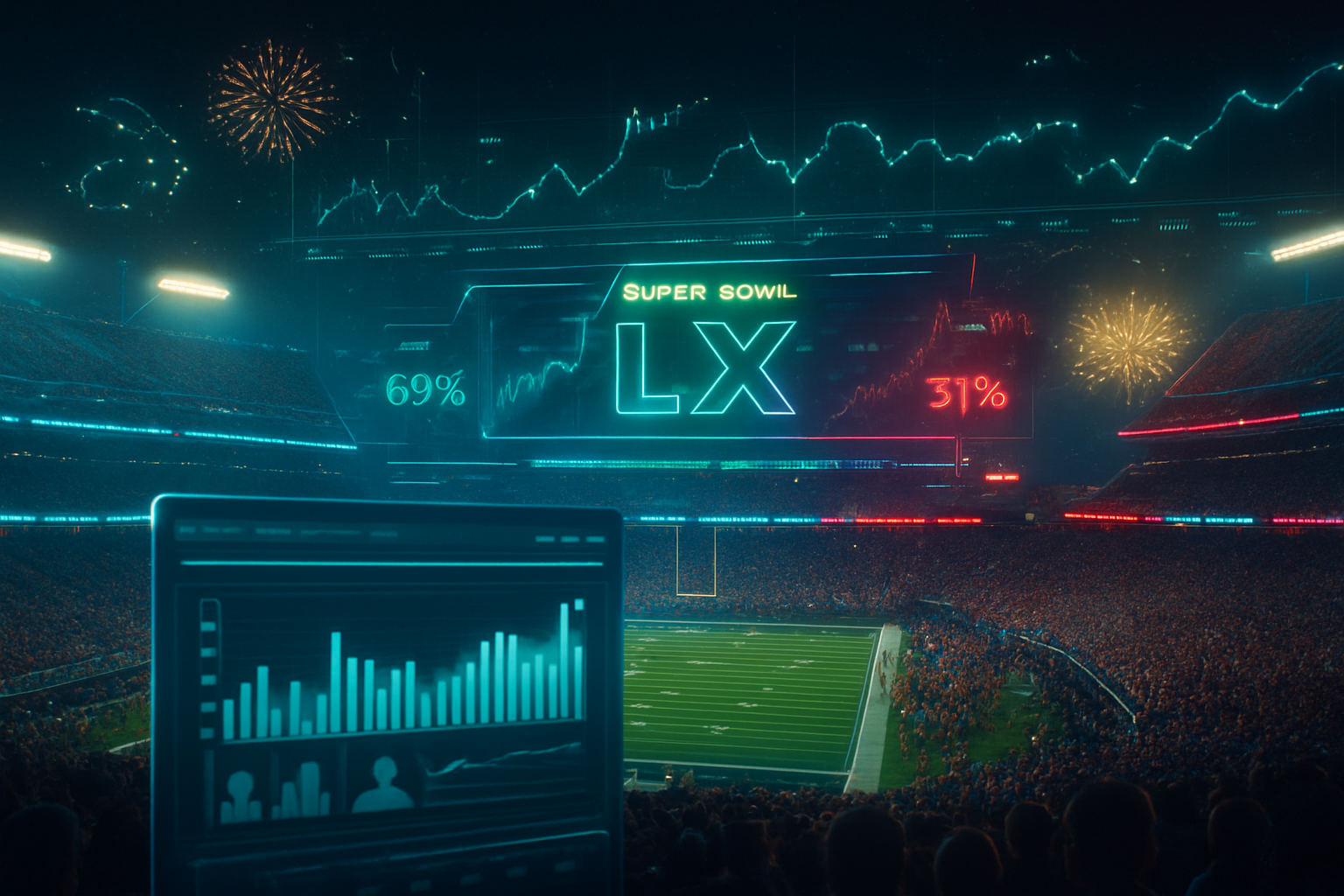
    The central question for traders is simple: Who walks away with the Lombardi Trophy? As of the morning of February 8, 2026, the markets show a rare, high-conviction consensus favoring the Seattle Seahawks. On Kalshi, the Seahawks are trading at a 69% probability of winning, while Polymarket participants are slightly more conservative, pricing them at 68%.

    This divergence, though small, represents millions of dollars in arbitrage opportunity for sophisticated traders. The markets are highly liquid, with "yes" contracts for the Seahawks priced at roughly 69 cents, meaning a $100 bet would return roughly $145 if Seattle triumphs. The resolution criteria are strictly defined by the official NFL score at the end of regulation or overtime, with Kalshi’s contracts clearing through the CFTC-regulated framework that treats these bets as commodity derivatives rather than traditional wagers.

    Why Traders Are Betting

    The massive volume is driven by a compelling narrative: the "Legacy Rematch." Eleven years after the infamous goal-line interception in Super Bowl XLIX, these two franchises meet again with entirely different rosters but equally high stakes. Traders are particularly bullish on Seahawks quarterback Sam Darnold, who has undergone a career-defining renaissance this season. Darnold currently leads the MVP prediction markets with +130 odds, as traders bet that a Seattle win is inextricably linked to his performance.

    On the other side, the New England Patriots, led by the sensational sophomore Drake Maye, are the market’s underdog. Despite the Patriots' superior 17–3 regular-season record, "whales" on Polymarket have been selling New England positions throughout the week. Analysts suggest this is due to concerns over Maye’s youth—he is attempting to become the youngest QB to win a Super Bowl—and the Seahawks’ top-ranked defensive unit.

    Broader Context and Implications

    This Super Bowl marks a defining moment for the prediction market industry. Following a series of landmark legal victories against the CFTC in 2025, Kalshi’s ability to offer "sports event contracts" has been cemented under federal law. This has transformed the Super Bowl from a purely gambling-focused event into a financial one. Institutional players are now using these markets to hedge against regional economic shifts—such as Seattle-based corporations hedging against the productivity dip of a victory parade.

    The regulatory environment has also matured. Under the leadership of the new CFTC Chairman, the federal government has begun treating these markets as essential tools for price discovery. Unlike traditional sportsbooks like DraftKings or FanDuel, which often limit winning players and take a high "vig," prediction markets offer a transparent, peer-to-peer exchange where the "price" is determined solely by supply and demand. This transparency is attracting a new class of "macro-sports" traders who treat the NFL season like the commodities market.

    The presence of public companies in the prop markets further highlights the mainstreaming of this data. Traders are currently moving millions in "novelty props" related to Super Bowl commercials and halftime appearances:

    • Hims & Hers Health, Inc. (NYSE: HIMS): Markets are betting on the reception of their "Rich People Live Longer" ad, which focuses on GLP-1 access.
    • T-Mobile US, Inc. (NASDAQ: TMUS): A highly active market is predicting whether the Backstreet Boys' pink-themed commercial will be ranked in the top three of the post-game "Ad Meter."
    • PepsiCo, Inc. (NASDAQ: PEP): Even as they have stepped back from halftime sponsorship, Pepsi is the subject of high-volume contracts regarding their stadium-wide sustainability initiatives.

    What to Watch Next

    As kickoff approaches, the most volatile markets to monitor will be the Halftime Show props. Current odds suggest a 72% chance that Bad Bunny opens his set with "Tití Me Preguntó." However, a late-breaking rumor about a guest appearance by Lady Gaga (currently at a 61% probability) could send shockwaves through the "Halftime Guest" contracts.

    In-game trading will also be a major factor. For the first time, Kalshi will offer "micro-contracts" during the game, allowing traders to bet on the outcome of individual drives. If the Patriots score an early touchdown, expect the Seahawks' 69% win probability to plummet, creating a "buy the dip" opportunity for Seattle believers.

    Bottom Line

    Super Bowl LX is more than just a championship game; it is the "Proof of Concept" for prediction markets as a global financial infrastructure. With over $180 million on Kalshi and $700 million on Polymarket, the sheer scale of the liquidity proves that the public's appetite for high-stakes, transparent forecasting is insatiable.

    Whether Sam Darnold completes his redemption arc or Drake Maye begins a new dynasty, the real winner today is the market itself. We have moved past the era of the "bookie" and into the era of the "exchange." As the ball is teed up, the world isn't just watching a game—it's watching a billion-dollar live-data experiment unfold in real-time.


    This article is for informational purposes only and does not constitute financial or betting advice. Prediction market participation may be subject to legal restrictions in your jurisdiction.

    PredictStreet focuses on covering the latest developments in prediction markets.
    Visit the PredictStreet website at https://www.predictstreet.ai/.
  • NFC West Rivalry Dominates Super Bowl LX Prediction Markets as Polymarket Volume Hits $688 Million

    NFC West Rivalry Dominates Super Bowl LX Prediction Markets as Polymarket Volume Hits $688 Million

    As the NFL postseason reaches its fever pitch, the eyes of the financial and sporting worlds are locked on a high-stakes showdown in the Pacific Northwest. With the NFC Championship game scheduled for tomorrow, January 25, 2026, prediction markets have transformed a regional rivalry into a global betting phenomenon. The race for the Super Bowl LX title has narrowed significantly, with the Seattle Seahawks and Los Angeles Rams emerging as the clear frontrunners to hoist the Lombardi Trophy in Santa Clara next month.

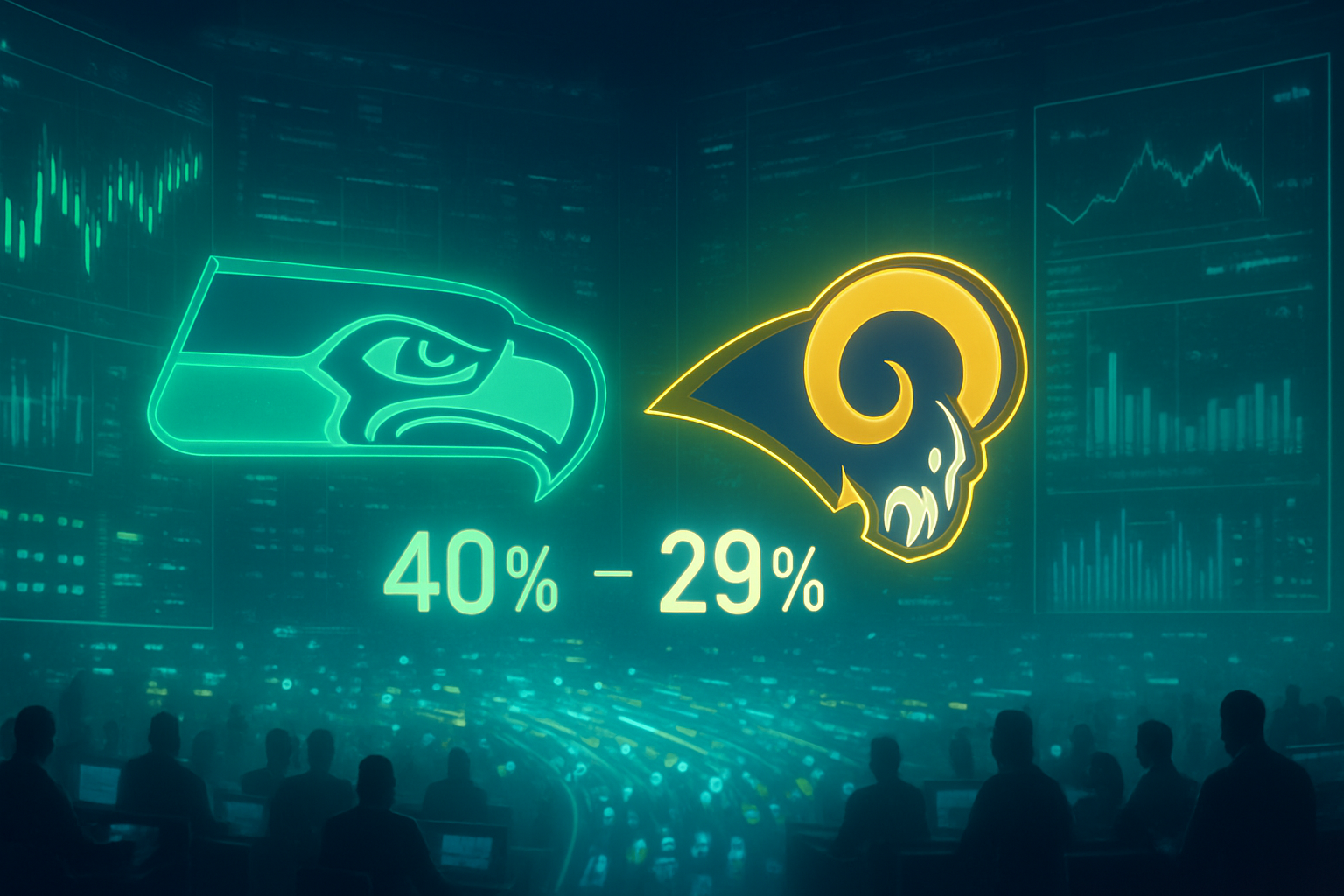
    On the decentralized platform Polymarket, the "Super Bowl LX Champion" market has exploded, surpassing $688 million in total trading volume. This surge in liquidity reflects a growing consensus among "sharps" and retail traders alike that the winner of the upcoming Seahawks-Rams clash will be the heavy favorite to win the championship on February 8. Currently, the Seahawks lead the market with an implied probability of 38-40%, while the Rams follow closely at 28-29%. These figures represent a massive shift from the preseason, where both teams were viewed as secondary contenders behind the AFC powerhouses.

    The Market: What's Being Predicted

    The primary market generating this historic volume is the "Winner of Super Bowl LX" contract on Polymarket. Unlike traditional sportsbooks like DraftKings (NASDAQ: DKNG) or FanDuel, owned by Flutter Entertainment (NYSE: FLUT), which offer fixed odds, these prediction markets operate as a binary exchange. Traders buy and sell "shares" in a team’s success, with prices fluctuating between $0.00 and $1.00 based on real-time sentiment and news. A price of $0.40, for instance, implies a 40% chance of that team winning the championship.

    While Polymarket leads in offshore volume, the U.S.-regulated exchange Kalshi has also seen record participation in its NFL-related event contracts. The liquidity in the Seahawks-Rams "match-up" has reached such heights that it now rivals the trading volume seen during the 2024 presidential election cycle. This is largely due to the "de facto Super Bowl" narrative: with the AFC representative likely to be a depleted Denver Broncos squad or a surging but underdog New England Patriots, traders view the NFC Championship as the true deciding factor for the season.

    The resolution of these contracts is straightforward: the market will pay out $1.00 for the team that wins Super Bowl LX on February 8, 2026. However, the secondary market for the NFC Championship specifically has also seen massive action, with Seattle currently trading as a 57% favorite to advance past Los Angeles tomorrow at Lumen Field.

    Why Traders Are Betting

    The divergence in odds between Seattle and Los Angeles is largely driven by a classic "unstoppable force vs. immovable object" dynamic. Seattle’s 40% chance to win the Super Bowl is anchored by their league-leading defense. Under the tutelage of head coach Mike Macdonald, the Seahawks’ defensive unit has become the gold standard of the 2025-2026 season, allowing a mere 17.2 points per game. Traders have reacted favorably to the health of Seattle’s secondary, particularly All-Pro cornerback Devon Witherspoon, whose ability to erase opponents' top options has made the Seahawks a favorite for risk-averse bettors.

    On the offensive side, the "Darnold Renaissance" has provided the necessary stability for Seattle. Quarterback Sam Darnold, despite an oblique strain suffered in mid-January, has been cleared to start. His efficient play—marked by a 99.1 passer rating this season—has convinced the market that Seattle's offense can do just enough to let their defense win games.

    Conversely, the Los Angeles Rams' 29% odds are a bet on elite offensive ceiling and veteran experience. Matthew Stafford led the NFL in passing yards this season (4,707), fueled by a legendary campaign from Puka Nacua and the mid-season acquisition of Davante Adams. However, the Rams' defense has shown cracks, ranking 10th in points allowed and struggling in high-scoring shootouts. Traders are also wary of Stafford’s health, as he manages a sprained index finger on his throwing hand. Though he has been removed from the official injury report, his 47.6% completion rate in last week’s snowy Divisional Round game has some whales hesitant to back the Rams at a higher price point.

    Broader Context and Implications

    The $688 million volume on Polymarket is a watershed moment for prediction markets in the sporting arena. Historically, these platforms were dominated by political and geopolitical events, but the 2025-2026 NFL season has proven that sports can provide the necessary volatility and public interest to sustain massive liquidity. This shift suggests that prediction markets are increasingly being used as a more "accurate" barometer of outcome than traditional betting lines, as the "wisdom of the crowd" adjusts instantly to micro-news, such as practice reports or weather shifts.

    From a regulatory standpoint, the success of these markets continues to draw scrutiny. While Kalshi has carved out a regulated niche in the U.S., Polymarket remains a dominant force globally, operating in a complex legal landscape. The massive participation in the Super Bowl LX market highlights a growing demand for transparent, peer-to-peer betting options that offer better "odds" (lower vig) than centralized sportsbooks.

    Furthermore, the market's heavy lean toward the NFC winner reveals a significant lack of confidence in the AFC field. With the Denver Broncos losing star quarterback Bo Nix to a season-ending injury, the AFC's "win probability" has been cannibalized by the Seahawks and Rams. This inter-conference disparity is a rare occurrence in prediction markets, which typically see more parity between the two sides of the bracket this close to the Super Bowl.

    What to Watch Next

    The most immediate catalyst for the market will be the NFC Championship kickoff tomorrow. Any early-game injury to either Sam Darnold or Matthew Stafford will cause violent swings in the "Super Bowl Champion" contract. Traders should specifically monitor the Seattle pass rush; if they can pressure Stafford early, his finger injury could become a focal point, potentially driving the Rams' championship odds down into the low teens within the first quarter.

    Following the game, the market will consolidate into a two-team race between the NFC champion and the winner of the Patriots-Broncos AFC title game. If Seattle advances, expect their Super Bowl odds to jump from 40% to as high as 65% or 70% overnight, assuming they open as significant favorites against whoever emerges from the AFC.

    Finally, the weather forecast for Super Bowl LX in Santa Clara will be a key variable. Unlike the freezing conditions of the Divisional Round, the temperate California climate favors the Rams' high-flying passing attack. Should Los Angeles pull off the upset tomorrow, their odds to win it all would likely surge, as they are viewed as a "better" team on a fast, neutral track.

    Bottom Line

    The prediction market for Super Bowl LX has become a $688 million referendum on the dominance of the NFC West. Seattle’s defensive prowess and Sam Darnold's steady hand have made them the statistically favored "safe" bet, while the Rams represent a high-upside alternative for those who believe in Matthew Stafford’s championship pedigree.

    As a tool for insight, these markets have provided a more nuanced view of the playoffs than simple point spreads. They have accounted for the "AFC weakness" factor and the impact of specific injuries with a speed that traditional media struggle to match. Whether Seattle's 40% probability holds firm or collapses under the pressure of a Rams offensive onslaught, the 2026 season will be remembered as the year prediction markets truly conquered the gridiron.


    This article is for informational purposes only and does not constitute financial or betting advice. Prediction market participation may be subject to legal restrictions in your jurisdiction.

    PredictStreet focuses on covering the latest developments in prediction markets.
    Visit the PredictStreet website at https://www.predictstreet.ai/.