Tag: Robinhood

  • States Launch “Guerrilla War” Against Kalshi: The Legal Battle Reshaping the 2026 Prediction Market Landscape

    States Launch “Guerrilla War” Against Kalshi: The Legal Battle Reshaping the 2026 Prediction Market Landscape

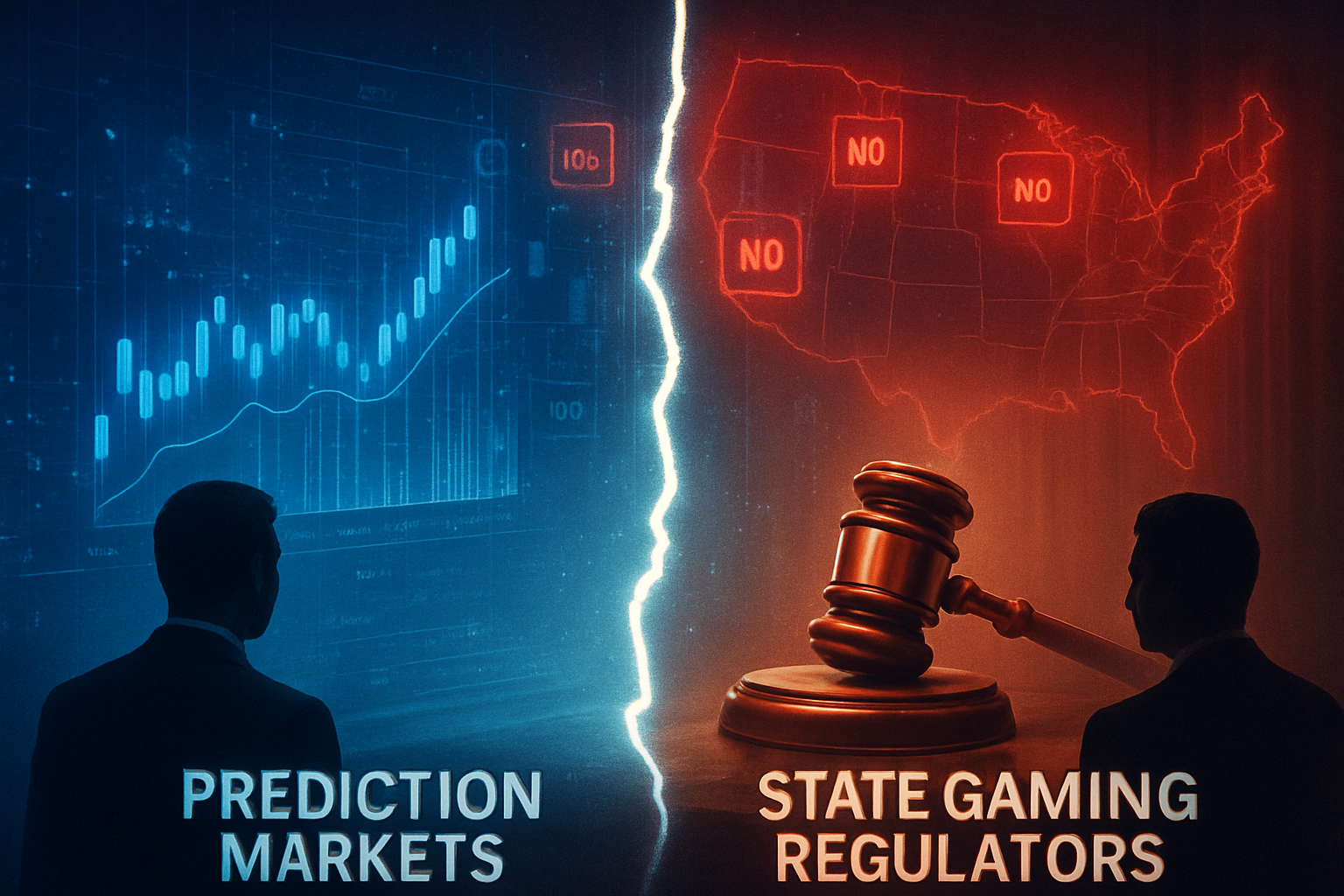
    The high-stakes world of prediction markets is currently facing its most existential threat since the landmark 2024 election cycle. As of February 8, 2026, Kalshi—the first federally regulated prediction market—is locked in what legal scholars are calling a "guerrilla war" with state gaming regulators in Massachusetts, Nevada, and Connecticut. At the heart of the conflict is a fundamental disagreement over the definition of a "contract": Is an event-based prediction a federally protected financial derivative, or is it simply unlicensed gambling?

    Traders are closely watching the fallout, with current market sentiment on peer-to-peer forecasting platforms shifting rapidly. While Kalshi dominated the late 2024 and early 2025 volume cycles, the threat of state-mandated geofencing has caused its probability of maintaining volume leadership for 2026 to slip. For the first time in two years, decentralized rival Polymarket has overtaken Kalshi in "Total 2026 Volume" odds, with traders pricing in a 47% chance for the offshore platform to lead the year, compared to Kalshi’s 34%, as regulatory "indigestion" begins to take its toll on domestic liquidity.

    The Market: What’s Being Predicted

    The primary market under the microscope isn't just a single event contract, but the survival and growth of the regulated prediction market industry itself. Specifically, traders are betting on whether Kalshi can successfully maintain its dominance in the "Sports Event Contract" sector—a category that accounted for a staggering 91.1% of its $9.1 billion trading volume in January 2026.

    On Kalshi’s own platform and institutional dashboards like those offered by Interactive Brokers (NASDAQ: IBKR), liquidity has become fragmented as state-level injunctions take effect. The resolution of this legal friction hinges on several key criteria: the ability of Kalshi to overturn state-level cease-and-desist orders and whether the federal government will intervene to assert preemption over state "police powers." If Kalshi is forced to geofence more than 10 states by the end of Q3 2026, analysts expect a "liquidity crater" that could permanently hand the crown to decentralized competitors.

    Why Traders Are Betting

    The sudden bearishness on Kalshi’s 2026 outlook stems from a series of legal setbacks in early 2026. In late January, Judge Christopher K. Barry-Smith of the Suffolk County Superior Court granted a preliminary injunction in Commonwealth of Massachusetts v. KalshiEX LLC, ruling that Kalshi’s sports-related contracts constitute "unlicensed gambling." The judge’s observation that the interface "mirrors digital gambling experiences" has terrified bulls who believed federal CFTC regulation provided a "bulletproof vest" against state gaming commissions.

    Whale activity has notably shifted toward defensive positions. Large-scale traders are hedging their domestic exposure by moving capital into macro-focused exchanges like ForecastEx, operated by Interactive Brokers (NASDAQ: IBKR), which focuses on non-sports contracts like CPI and interest rates to avoid the "gambling" label. Meanwhile, Robinhood (NASDAQ: HOOD), which previously partnered with Kalshi to offer event markets to its retail base, has seen its stock price face volatility as it weighs the risks of its own upcoming proprietary exchange launch, LedgerX.

    Broader Context and Implications

    This "guerrilla war" represents a classic clash between federal and state authority. While Kalshi remains a Designated Contract Market (DCM) under the oversight of the Commodity Futures Trading Commission (CFTC), states are utilizing the "Gaming Clause" of the Commodity Exchange Act to argue that federal law does not extinguish their right to regulate wagering. This has created a "phantom liquidity" scenario—where national price discovery exists in theory, but is physically blocked for millions of Americans via geofencing.

    The real-world implications are profound. If state regulators succeed in reclassifying these markets as gambling, the dream of a unified, high-liquidity national prediction market may die. Instead, the industry would be forced into the fragmented, state-by-state licensing model used by sportsbooks like DraftKings or FanDuel. Furthermore, Coinbase (NASDAQ: COIN) has entered the fray, proactively suing regulators in Connecticut and Illinois to defend the federal preemption of blockchain-based prediction products, signaling that the entire crypto and fintech ecosystem sees this as a do-or-die moment for digital assets.

    What to Watch Next

    The most immediate catalyst for the market is a high-stakes hearing in Connecticut scheduled for February 12, 2026. Traders view this as a pivotal test for the "federal preemption" defense; a defeat for Kalshi here is expected to trigger a domino effect of geofencing across the Northeast.

    Beyond February, the Ninth Circuit Court of Appeals is scheduled to hear oral arguments in KalshiEX LLC v. Nevada Gaming Control Board in April 2026. This case is particularly significant because Nevada is the epicenter of American gambling regulation. If Kalshi wins in the Ninth Circuit, it could provide the legal precedent needed to halt the state-level "guerrilla war" and restore investor confidence. Conversely, a loss would likely cement Kalshi's status as a regional, rather than national, player for the remainder of the year.

    Bottom Line

    The legal friction between Kalshi and state gaming commissions has transformed the prediction market landscape from a "blue ocean" of growth into a jurisdictional battlefield. While Kalshi’s $9.1 billion volume in January shows the massive appetite for regulated event contracts, the 91.1% concentration in sports contracts has left the platform uniquely vulnerable to state regulators who view any "win-loss" outcome as their exclusive domain.

    Ultimately, the 2026 volume leadership race is no longer just about who has the better app or more markets—it is about who can navigate the complex web of American federalism. If Kalshi cannot secure a "preemption victory" in the coming months, the prediction market industry may face a Great Bifurcation: a regulated, institutional market for macro events, and a decentralized, offshore market for everything else. For now, the "guerrilla war" continues, and the odds of a Kalshi-dominated 2026 are narrowing by the day.


    This article is for informational purposes only and does not constitute financial or betting advice. Prediction market participation may be subject to legal restrictions in your jurisdiction.

    PredictStreet focuses on covering the latest developments in prediction markets.
    Visit the PredictStreet website at https://www.predictstreet.ai/.

  • The New Casino-Bank: How Robinhood is Democratizing Truth and Risk with Event Contracts

    The New Casino-Bank: How Robinhood is Democratizing Truth and Risk with Event Contracts

    In the world of retail finance, the "meme stock" era has officially been replaced by the "event contract" era. Leading this charge is Robinhood (NASDAQ: HOOD), which has successfully pivoted its massive user base from speculative equity trading toward the rapidly expanding frontier of prediction markets. As of early February 2026, the platform has moved far beyond its origins, transforming into a one-stop-shop where a user can buy Bitcoin, trade S&P 500 options, and now, hedge their weekend plans against an NFL upset—all within the same interface.

    The timing could not be more critical. With Super Bowl LX between the Seattle Seahawks and the New England Patriots just days away, Robinhood’s prediction markets are seeing unprecedented liquidity. Unlike traditional sportsbooks that operate on a "house vs. player" model, Robinhood’s partnership with Kalshi allows users to trade directly against one another. This "peer-to-peer" (P2P) structure has driven the cumulative volume of event contracts on Robinhood to over 11 billion, creating a "truth engine" that many analysts believe is more accurate than any traditional polling or punditry.

    The Market: What's Being Predicted

    The current centerpiece of Robinhood's prediction ecosystem is its comprehensive suite of football event contracts, launched in partnership with the CFTC-regulated exchange Kalshi in August 2025. This market covers every NFL regular-season game and the "Power Four" college football conferences. Unlike the opaque odds of Las Vegas, these contracts trade between $0.00 and $1.00. If you buy a "Seattle Seahawks to Win" contract at $0.60, the market is effectively giving them a 60% chance of victory; if they win, your contract settles at $1.00, netting a $0.40 profit.

    Since its inception, the platform has rapidly expanded its "menu" of outcomes. Traders can now speculate on point spreads, over/under totals, and as of December 2025, highly specific player props like anytime touchdowns or quarterback passing yards. The liquidity is staggering: the Super Bowl LX winner market alone has seen over $166 million in volume across the Robinhood-Kalshi ecosystem. This represents a nearly six-fold increase over the volume seen just one year ago, signaling a massive shift in how the public engages with major cultural events.

    Why Traders Are Betting

    The primary driver behind this retail migration is the introduction of "Custom Combos," a sophisticated feature that mimics traditional sports betting parlays but functions through a financial Request-for-Quote (RFQ) mechanism. When a user bundles up to 10 different outcomes—such as a Seahawks win, a Federal Reserve rate cut, and a specific movie’s opening weekend performance—Robinhood’s system polls market makers, led by Susquehanna International Group, to provide a real-time price.

    Traders are also drawn to the efficiency of the "bid-ask spread" compared to the "vig" of a traditional sportsbook. While companies like DraftKings (NASDAQ: DKNG) or FanDuel typically bake a 5% to 10% margin into their odds, Robinhood's peer-to-peer model often sees spreads as thin as a single penny. "I'm not betting against a bookie who wants me to lose," says one high-volume trader on the platform. "I'm trading a financial instrument against someone who simply has a different view of the future."

    Furthermore, the ability to "day trade" these contracts has revolutionized the experience. In a traditional bet, your money is locked until the final whistle. On Robinhood, if the Seahawks take a 14-point lead in the first quarter, the price of a "Yes" contract might jump from $0.60 to $0.85, allowing traders to exit early and lock in gains—a mechanic that feels much more like trading stocks than placing a wager.

    Broader Context and Implications

    Robinhood’s aggressive expansion into this space is part of a larger strategic vision that CEO Vlad Tenev calls the "Prediction Market Supercycle." By framing these as "truth futures" rather than gambling, Robinhood is navigating a complex regulatory landscape. Because the trades are routed through the CFTC-regulated Kalshi—and soon through Robinhood's newly acquired MIAXdx (formerly LedgerX) exchange—the platform can offer these products in states where traditional sports betting remains illegal, such as California and Texas.

    This vertical integration is a game-changer. In January 2026, Robinhood completed its 90% acquisition of MIAXdx, giving it its own Designated Contract Market (DCM) and clearinghouse. This move reduces the company's reliance on third-party partners and paves the way for "Robinhood-exclusive" contracts that could range from hyper-local weather events to corporate earnings outcomes.

    The move is also paying off on the balance sheet. Prediction markets have become Robinhood’s fastest-growing revenue stream, currently on a trajectory to contribute over $300 million in annual revenue. It has effectively turned "news" into a tradable asset class, competing not just with sportsbooks, but with traditional derivatives exchanges like the CME Group (NASDAQ: CME) and Interactive Brokers (NASDAQ: IBKR), which has also launched its own "ForecastEx" platform.

    What to Watch Next

    As we move past the Super Bowl, the next major test for Robinhood’s infrastructure will be the 2026 mid-term election cycle and the integration of AI-assisted trading tools. Tenev has hinted at a future where users can use "AI Hedging Agents" to automatically buy event contracts that protect them against real-world risks, such as a rise in gas prices or a drop in their local housing market.

    Additionally, the industry is closely watching for potential regulatory pushback. While the CFTC has currently allowed these "event contracts" to flourish, a shift in the political or legal winds could result in tighter restrictions on what qualifies as a "financial event." Robinhood’s ownership of MIAXdx is a defensive moat in this regard, providing it with the legal standing of a registered exchange rather than just a brokerage.

    Bottom Line

    Robinhood's pivot to prediction markets represents the final evolution of the "everything app" for the retail investor. By blurring the lines between sports, politics, and finance, the platform has created a high-engagement ecosystem that thrives on the 24-hour news cycle. The sheer volume seen in the 2025-2026 football season suggests that the public's appetite for "trading the truth" is only beginning to grow.

    Ultimately, Robinhood (NASDAQ: HOOD) is betting that prediction markets will eventually be viewed as a core pillar of a modern portfolio. Whether it’s hedging a mortgage or speculating on a touchdown, the message to retail traders is clear: the future is no longer something to just watch—it’s something to trade.


    This article is for informational purposes only and does not constitute financial or betting advice. Prediction market participation may be subject to legal restrictions in your jurisdiction.

    PredictStreet focuses on covering the latest developments in prediction markets.
    Visit the PredictStreet website at https://www.predictstreet.ai/.

  • The Truth Machine: How Prediction Markets Became Global Financial Infrastructure in 2025

    The Truth Machine: How Prediction Markets Became Global Financial Infrastructure in 2025

    The year 2025 will be remembered in financial history as the moment prediction markets evolved from a niche curiosity into a foundational pillar of the global economy. What was once dismissed as "gambling for nerds" has transformed into a high-stakes "truth machine," providing real-time data that traditional polling and expert analysis have struggled to match. In just twelve months, the industry shed its speculative reputation, proving that when people put money where their mouths are, the resulting data is more accurate than any focus group.

    The numbers are staggering. Monthly trading volume across major platforms surged from under $100 million in early 2024 to a consistent baseline of over $13 billion by the end of 2025. During periods of extreme macroeconomic volatility, such as the Federal Reserve’s surprise mid-year pivot, volumes peaked as high as $22 billion. This explosive growth wasn't just driven by a few "whales" or election hobbyists; it was propelled by the deep integration of prediction markets into the daily workflows of retail investors and corporate treasuries alike.

    The Market: What's Being Predicted

    The transformation of prediction markets in 2025 was defined by the transition from "event betting" to "event hedging." While the 2024 U.S. presidential election provided the initial spark, the market's liquidity migrated toward complex economic and regulatory outcomes throughout 2025. Today, traders are less focused on who will win an award show and more focused on whether the "Digital Asset Market Clarity Act" will pass the Senate, or if a specific judicial ruling will impact the business model of a Fortune 500 company.

    The landscape is dominated by two primary titans: Polymarket, the decentralized giant that pioneered high-volume crypto-settled markets, and Kalshi, the first CFTC-regulated prediction market in the United States. Throughout 2025, these platforms transitioned into high-liquidity exchanges where billions of contracts change hands daily. According to market data, daily trading volumes reached a peak of $700 million in early 2026, with liquidity depth in key economic markets (such as CPI prints and Fed rate decisions) now rivaling that of traditional interest rate swaps.

    The resolution criteria for these markets have also become more sophisticated. Rather than simple "Yes/No" binary outcomes, 2025 saw the rise of "range markets" and "scalar contracts," allowing participants to bet on the exact percentage of a tax hike or the precise date of a regulatory approval. This level of granularity has turned prediction markets into a "real-time demand curve for uncertainty," according to industry analysts.

    Why Traders Are Betting

    The primary driver behind this $13 billion monthly volume is accessibility. In 2025, prediction markets became "financial infrastructure" through a series of high-profile integrations. Robinhood Markets, Inc. (NASDAQ: HOOD) launched its "Prediction Markets Hub" in partnership with Kalshi in March 2025, bringing event-based trading to over 24 million active users. This was followed by Coinbase Global, Inc. (NASDAQ: COIN), which integrated prediction market contracts directly into its main application, allowing users to trade on events using USD or USDC. Even the decentralized finance (DeFi) space saw a massive boost when the Phantom wallet integrated prediction markets, enabling millions of Solana users to trade outcomes with a single tap.

    This "Great Integration" solved the friction problems that had previously hampered the industry. "Prediction markets… do a very, very good job at distilling information and surfacing truth to people," said Kalshi CEO Tarek Mansour during a late-2025 briefing. Mansour has long argued that the core value of these markets isn't the payout, but the information they generate. "It’s much harder to lie when you have some money on the line… You’re actually much more truthful, and that’s why these markets work so well."

    Beyond retail enthusiasm, institutional demand has shifted from speculative to strategic. Quantitative hedge funds and corporate risk officers are now using these markets as a more efficient way to price risks that traditional insurance or derivatives don't cover. If a company's revenue is threatened by a potential government shutdown, they can now purchase a "Yes" contract on that event as a direct hedge, effectively creating a customized insurance policy.

    Broader Context and Implications

    The success of prediction markets in 2025 has created a new paradigm known as "Information Finance." This shift has profound implications for public sentiment and democratic accountability. In a world of deepfakes and algorithmic echo chambers, prediction markets provide a decentralized, incentivized source of truth. When a news report contradicts a market price, savvy observers have learned to trust the money.

    This trend has been bolstered by a series of regulatory victories. After years of legal battles, the CFTC’s acceptance of regulated event markets allowed for the entry of major institutions like AQR Capital Management and Saba Capital Management. These firms now use prediction markets to hedge "tail risks"—rare but catastrophic events that could otherwise devastate a portfolio. The historical accuracy of these markets throughout 2025 was notable, with market odds correctly anticipating several key Supreme Court rulings and interest rate shifts weeks before they occurred.

    However, the rise of these markets has also sparked debate. Critics argue that "betting on disaster" could create perverse incentives, though proponents counter that the markets merely reflect existing risks rather than creating them. What is undeniable is that prediction markets have become a vital feedback loop for policymakers, who now monitor the "probability of success" for their own legislation in real-time.

    What to Watch Next

    As we look further into 2026, the next frontier for prediction markets is their full integration into institutional terminal software. Rumors suggest that major financial data providers are in talks to include Kalshi and Polymarket feeds as standard features alongside stock tickers and bond yields. This would further cement their role as a primary source of market intelligence for global traders.

    Another development to monitor is the expansion into local and municipal prediction markets. Several states are exploring "policy markets" to gauge public opinion and the likely impact of new zoning laws or tax initiatives. Furthermore, the arrival of more "AI agents" as market participants is expected to increase liquidity even further, as automated bots trade on sub-second news releases, driving prices toward efficiency faster than humanly possible.

    Bottom Line

    The story of prediction markets in 2025 is the story of a technology finally finding its "killer app": the truth. By growing from a $100 million niche to a $13 billion-a-month pillar of financial infrastructure, platforms like Kalshi and Polymarket have proven that the wisdom of the crowd is best captured when that crowd has a stake in being right.

    For the average investor, the inclusion of prediction markets in platforms like Robinhood Markets, Inc. (NASDAQ: HOOD) and Coinbase Global, Inc. (NASDAQ: COIN) means that "hedging your life" is now as easy as buying a stock. Whether you are a corporation protecting against a regulatory shift or a retail trader looking for an unbiased source of information, prediction markets have become the ultimate tool for navigating an increasingly uncertain world. As Tarek Mansour noted, these markets don't just predict the future—they reveal the truth of the present.


    This article is for informational purposes only and does not constitute financial or betting advice. Prediction market participation may be subject to legal restrictions in your jurisdiction.

    PredictStreet focuses on covering the latest developments in prediction markets.
    Visit the PredictStreet website at https://www.predictstreet.ai/.

  • Gamifying the Fed: Robinhood’s ‘Custom Combos’ Turn Macroeconomics into the Ultimate Parlay

    Gamifying the Fed: Robinhood’s ‘Custom Combos’ Turn Macroeconomics into the Ultimate Parlay

    As the clock ticks toward the February Consumer Price Index (CPI) release, a new kind of "game day" ritual is taking over the morning routines of young investors. Forget the NFL playoffs or the NBA finals—for the 24 million active users on Robinhood (NASDAQ: HOOD), the most exciting play of the season is the "Macro Stack."

    In January 2026, Robinhood officially launched its "Custom Combos" feature, a revolutionary addition to its Prediction Markets Hub that allows users to bundle up to 10 different event outcomes into a single, high-leverage contract. With the potential for payouts exceeding 40-to-1 on "Goldilocks" economic scenarios, the feature is effectively gamifying macroeconomics for a demographic that treats Jerome Powell’s press conferences with the same fervor as a Super Bowl halftime show. Currently, the market is pricing in a 91% probability that the Federal Reserve will hold rates steady in March, but the real action lies in the "long-shot parlays" where traders are betting on a surprise rate cut paired with a core inflation miss.

    The Market: What's Being Predicted

    At the heart of this frenzy is the Robinhood Prediction Markets Hub, which has rapidly evolved since the platform’s first foray into election contracts in late 2024. The "Custom Combos" feature operates on a Request for Quote (RFQ) system powered by MIAXdx, the CFTC-regulated exchange in which Robinhood (NASDAQ: HOOD) acquired a 90% stake in early 2026. This vertical integration allows Robinhood to offer seamless, near-instant settlement on complex, multi-leg event contracts.

    Unlike traditional prediction platforms like Polymarket or Kalshi, which typically focus on single binary outcomes, Custom Combos allow for "horizontal betting" across categories. A typical high-volume combo in early February 2026 might include:

    • The CPI Leg: Predicting February YoY CPI falls below 2.3%.
    • The Fed Leg: Predicting a "Pause" at the March 18 FOMC meeting.
    • The Tech Leg: Predicting that Nvidia (NASDAQ: NVDA) will close the month above $1,800.
    • The Political Leg: Predicting a specific outcome in a 2026 U.S. Midterm primary.

    Because every "leg" of the parlay must hit for the contract to pay out at its full $1-per-share value, the cost of entry is remarkably low—often just pennies per share—creating the "lotto ticket" appeal that has long driven the success of sports betting parlays. Trading volume on the Hub has already surpassed 11 billion cumulative contracts, with "Custom Combos" accounting for an estimated 30% of new activity.

    Why Traders Are Betting

    The surge in "Macro Parlay" activity is driven by a cultural shift Robinhood executives call "Information Finance." For Gen Z and Millennial traders, the traditional 60/40 portfolio feels antiquated. Instead, they are using Custom Combos to express complex views on how the world works, often using these markets to "hedge their lives."

    "I'm long on tech stocks, so if the Fed hikes and the market crashes, my portfolio takes a hit," explains one viral trader on X whose 5-leg "Recession Hedge" combo recently turned $200 into $8,500. "By betting on a 'Triple Threat'—high CPI, a Fed hike, and an unemployment spike—I'm basically buying insurance that pays out if my day job or my stocks are in trouble."

    This "hedging life" mentality is frequently augmented by Robinhood’s "Cortex AI" assistant, which suggests "Optimal Combos" based on real-time news sentiment. If a major retailer like Walmart (NYSE: WMT) reports sluggish guidance, Cortex might prompt a user to "add a leg" predicting a dip in retail sales data, further increasing the potential payout. This creates a feedback loop where news consumption is immediately monetized, shifting the investor's role from a passive observer to an active, high-velocity speculator.

    Broader Context and Implications

    The timing of the "Custom Combo" craze is no coincidence. On February 4, 2026, the Commodity Futures Trading Commission (CFTC) made a landmark policy reversal, withdrawing a 2024 proposal that sought to ban "gaming" and sports-related event contracts. This move has been hailed as a "Green Light" for the prediction economy, signaling that federal regulators now view event contracts as legitimate financial derivatives rather than prohibited gambling.

    However, the rise of these markets has reignited the debate over the "gamification" of finance. Critics argue that by mimicking the structure of sports betting—complete with "boosted odds" and viral "gain porn" screenshots—Robinhood is encouraging risky behavior among inexperienced traders. Proponents, meanwhile, argue that these markets serve as a "truth engine," providing more accurate forecasts than traditional pundits or polling.

    Historically, prediction markets have shown remarkable accuracy in forecasting FOMC decisions and election outcomes. By aggregating the "wisdom of the crowd" into a tradable price, Robinhood is creating a real-time sentiment gauge that institutional players are beginning to watch closely. The convergence of sports betting mechanics with macroeconomic data is not just a feature; it’s the birth of a new asset class where "knowledge of the world" is the primary currency.

    What to Watch Next

    The immediate focus for the market is the February 13 CPI print. "Nowcast" models from the Cleveland Fed currently project a 2.34% YoY headline increase, but the spread on Robinhood suggests retail traders are split between a "cool-down" and a "sticky inflation" narrative. Any significant deviation from the 2.34% mark will likely trigger massive payouts—or liquidations—for thousands of "Macro Stacks."

    Looking further ahead, the March 18 FOMC meeting remains the "Anchor Leg" for most custom combos. While a "Hold" is the overwhelming consensus at 91%, the 9% of traders betting on a cut are looking at astronomical payouts if the Fed pivots early. Additionally, as the 2026 Midterm election cycle heats up, expect Robinhood to introduce "Political-Economic Combos," where users can bet on how specific election results might impact localized economic data or sector-specific stock prices.

    Bottom Line

    Robinhood’s "Custom Combos" represent a fundamental evolution in how retail investors engage with the world. By lowering the barrier to entry for complex derivative trading and wrapping it in the familiar, high-adrenaline interface of a sportsbook, Robinhood has successfully turned the "dismal science" of economics into a viral entertainment product.

    While the risks of high-leverage parlays are real, the success of the Prediction Markets Hub suggests that the demand for "Information Finance" is here to stay. As the CFTC moves toward a more permissive framework and MIAXdx provides the institutional-grade plumbing, the "Macro Parlay" may soon become as common in the American household as the Sunday night football bet. In this new era, the Federal Reserve isn't just a regulatory body—it’s the most watched team in the league.


    This article is for informational purposes only and does not constitute financial or betting advice. Prediction market participation may be subject to legal restrictions in your jurisdiction.

    PredictStreet focuses on covering the latest developments in prediction markets.
    Visit the PredictStreet website at https://www.predictstreet.ai/.

  • The State vs. The Exchange: Kalshi’s High-Stakes Legal Battle with Gaming Regulators Threatens 2026 Volume Leadership

    The State vs. The Exchange: Kalshi’s High-Stakes Legal Battle with Gaming Regulators Threatens 2026 Volume Leadership

    As of February 2, 2026, the meteoric rise of prediction markets has hit a significant roadblock not in Washington D.C., but in the state houses of Nevada and Connecticut. While 2025 was defined by Kalshi’s historic legal victory against the Commodity Futures Trading Commission (CFTC), 2026 has opened with a multi-front "guerrilla war" as state gaming authorities attempt to reclassify prediction markets as unlicensed gambling.

    The core of the dispute rests on Kalshi’s aggressive expansion into sports event contracts—markets that allow users to hedge on the outcome of NFL games, the Super Bowl, and NBA matchups. With state regulators in Nevada and Connecticut issuing cease-and-desist orders, the legal battle is no longer a matter of administrative law, but a fundamental question of federal preemption. Traders are now pricing in a significant risk that Kalshi could be forced to geofence up to 15 states by the end of the year, a move that could jeopardize its status as the world’s volume leader in the prediction market space.

    The Market: What's Being Predicted

    The primary "market" currently under observation is the legal survival of Kalshi’s sports contracts in key jurisdictions. In January 2026 alone, Kalshi processed an estimated $9.1 billion in trading volume, with a staggering 91.1% of that activity tied directly to sports event contracts. For comparison, its main rival, Polymarket, saw approximately $7.5 billion in volume during the same period.

    While Kalshi currently maintains a 28.1% share of the global prediction market volume, meta-markets on platforms like Manifold Markets have begun to reflect a shift in sentiment. Traders are currently giving Polymarket a 47% chance of finishing 2026 as the top platform by volume, while Kalshi’s odds have slipped to 34%. This inversion is driven almost entirely by the regulatory friction in Nevada and Connecticut.

    The resolution of these state-level battles depends on two upcoming legal milestones:

    1. Connecticut District Court: A high-stakes hearing scheduled for February 12, 2026, where a judge will decide whether to grant a preliminary injunction against the Connecticut Department of Consumer Protection (DCP).
    2. The Ninth Circuit Court of Appeals: Oral arguments are set for April 2026 regarding the Nevada Gaming Control Board's (NGCB) attempt to shut down Kalshi operations in the state.

    Why Traders Are Betting

    Traders and legal analysts are divided on the "federal preemption" defense. Kalshi argues that because its contracts are regulated by the CFTC as financial derivatives under the Commodity Exchange Act (CEA), state gaming laws are preempted. However, the Nevada Gaming Control Board disagrees, citing NRS 463.0193, which defines any wager on a sporting event as gambling that requires a state license.

    The market sentiment shifted significantly in late November 2025, when U.S. District Judge Andrew Gordon dissolved a preliminary injunction that had protected Kalshi in Nevada. Gordon’s ruling suggested that stripping states of their power to regulate gambling would "upset decades of federalism." This legal pivot has led "whale" traders to hedge their Kalshi positions by moving liquidity toward platforms like Polymarket or Robinhood (NASDAQ: HOOD), the latter of which also faces scrutiny but has a broader diversification of assets.

    Furthermore, the Connecticut DCP, led by Commissioner Bryan T. Cafferelli, has introduced a "consumer protection" narrative, arguing that Kalshi lacks the age-verification rigors and responsible gaming safeguards required by state law. This has introduced a new variable: even if Kalshi wins on the "gambling" definition, it could still be hamstrung by state-level administrative hurdles.

    Broader Context and Implications

    This conflict represents the "final frontier" for prediction markets in the United States. If Kalshi loses these cases, it would create a fragmented "patchwork" regulatory environment. This would lead to what analysts call "phantom liquidity"—where price discovery occurs on a national level, but users in states like Nevada or Connecticut are geofenced out, leading to wider spreads and less efficient markets.

    The implications for 2026 volume leadership are profound. Kalshi’s business model is uniquely exposed to sports, which act as the "on-ramp" for many retail traders. If the platform is forced to exit Nevada—the spiritual home of American sports betting—its competitive advantage over Polymarket and newer entrants like Crypto.com (which also received a Connecticut cease-and-desist) could evaporate.

    Historically, prediction markets have thrived on being "information engines." However, the transition into sports has moved them into the crosshairs of powerful state gaming commissions that protect billions in tax revenue from traditional sportsbooks. The current legal battle is less about "what is a derivative" and more about "who gets to tax the trade."

    What to Watch Next

    The immediate focus for the market is the February 12 hearing in Connecticut. Judge Vernon Oliver’s decision on the preliminary injunction will serve as a bellwether. If he sides with the DCP and allows the cease-and-desist to stand, it is expected that 5–10 other states will follow suit with similar orders by the end of Q1 2026.

    Beyond the courtroom, watch for Kalshi to potentially pivot its product mix. To mitigate the "unlicensed gambling" risk, the exchange may begin prioritizing "non-event" economic contracts or midterm election hedging markets to dilute the percentage of its volume coming from sports.

    Finally, the Ninth Circuit's oral arguments in April will be the definitive moment for the industry. A ruling in favor of the Nevada Gaming Control Board would likely force the issue to the U.S. Supreme Court, creating years of uncertainty for the prediction market sector.

    Bottom Line

    Kalshi entered 2026 with the momentum of a dominant incumbent, but the "State-Level Pushback" has proven to be a more resilient foe than the federal CFTC. The argument that sports event contracts are unlicensed gambling is gaining traction among state judges who are wary of federal overreach into local police powers.

    For prediction market participants, the current volatility in "platform dominance" markets is a reflection of this legal reality. While Kalshi still holds the volume crown today, its path to 2026 leadership is now narrow and heavily dependent on winning a series of high-stakes legal coin flips. If the Connecticut and Nevada dominos fall against the exchange, the "regulated US market" may look very different by this time next year.

    The next two weeks will be among the most consequential in the history of the industry. As the February 12 deadline approaches, expect liquidity to be cautious and the "State-Level Risk" premium to remain high.


    This article is for informational purposes only and does not constitute financial or betting advice. Prediction market participation may be subject to legal restrictions in your jurisdiction.

    PredictStreet focuses on covering the latest developments in prediction markets.
    Visit the PredictStreet website at https://www.predictstreet.ai/.

  • The “Mainstream Moment”: Prediction Markets Evolve Into Wall Street’s New Favorite Asset Class

    The “Mainstream Moment”: Prediction Markets Evolve Into Wall Street’s New Favorite Asset Class

    As of early February 2026, the financial world has officially crossed the Rubicon. Prediction markets, once relegated to the fringes of internet forums and academic theory, have fully integrated into the DNA of the global financial system. The tipping point arrived not with a single event, but through a series of massive institutional migrations that have turned "Event Contracts" into a standard fixture on the screens of retail investors and professional traders alike.

    Currently, the market for Federal Reserve policy shifts serves as the most potent example of this transformation. On Kalshi, the probability of a 25-basis-point rate cut at the March 2026 meeting is currently trading at 64%, with over $450 million in open interest across the curve. This isn't just a niche bet anymore; it is the "real-time truth engine" being cited by major networks and used by hedge funds to hedge macro risk. The surge in interest is driven by a unprecedented level of accessibility, with prediction market data now flowing through the same pipelines as the S&P 500.

    The Market: What's Being Predicted

    While the 2024 election was the catalyst, the "Market" in early 2026 is no longer just about politics. The focus has shifted toward high-frequency economic indicators and corporate events. On Kalshi, the "Fed Funds Rate" contracts remain the liquidity kings, but new categories are exploding. Traders are now actively betting on quarterly earnings beats for companies like Apple Inc. (NASDAQ:AAPL) and NVIDIA Corporation (NASDAQ:NVDA), as well as the monthly Consumer Price Index (CPI) prints.

    These markets are primarily trading on two dominant domestic platforms: Kalshi and the recently expanded event contract suite from Robinhood Markets, Inc. (NASDAQ:HOOD). Since Robinhood’s January 2026 launch of "Custom Combos," liquidity has reached record highs. Trading volume across the industry topped an estimated $45 billion in 2025, and February 2026 is already on track to break monthly records. The resolution criteria for these contracts are now strictly standardized, typically relying on official government data or audited corporate filings, providing a level of "settlement certainty" that was missing in the early days of the industry.

    Why Traders Are Betting

    The migration of traders into prediction markets is being fueled by three major technological and strategic shifts. First is the integration of Coinbase Global, Inc. (NASDAQ:COIN) into the Kalshi ecosystem. By leveraging Coinbase Custody and USDC for settlement, institutional players can now move millions of dollars into event contracts with the same speed and security they expect from the crypto or equity markets. This has eliminated the "on-ramp friction" that previously kept large capital on the sidelines.

    Second, the introduction of Robinhood's "Custom Combos" has revolutionized how retail speculators interact with the news. Similar to a parlay in sports betting but structured as a CFTC-regulated financial instrument, Custom Combos allow users to bundle up to 10 different outcomes—such as a Fed rate cut, a specific CPI print, and a tech earnings beat—into a single high-payout contract. This "gamification of macroeconomics" has brought a younger, more aggressive demographic of traders into the space.

    Finally, the narrative has shifted because the data has become unavoidable. When CNBC (subsidiary of Comcast Corporation (NASDAQ:CMCSA)) and CNN (subsidiary of Warner Bros. Discovery, Inc. (NASDAQ:WBD)) began featuring live Kalshi tickers on-air in late 2025, it created a feedback loop. Traders are betting because they see the "market odds" mentioned in every major news cycle, treating the probability percentages as more reliable than traditional expert punditry or lagging opinion polls.

    Broader Context and Implications

    The mainstreaming of these platforms represents the birth of what Ethereum founder Vitalik Buterin famously termed "Information Finance" (InfoFi). By 2026, prediction markets are no longer just places to gamble; they are seen as the most accurate sensors of public and private information available. The Intercontinental Exchange, Inc. (NYSE:ICE), the parent company of the New York Stock Exchange, essentially validated this in late 2025 by investing $2 billion in the space and integrating prediction data into its professional terminals (ICE Connect).

    This integration has profound implications for public sentiment. Unlike polls, which can be influenced by social desirability bias, prediction markets require "skin in the game." The resulting data is cleaner, faster, and less partisan. This has forced regulatory bodies, particularly the CFTC, to move from a posture of skepticism to one of structured oversight. The 2026 landscape is defined by a rigorous regulatory framework that treats event contracts as a legitimate asset class, alongside futures and options.

    What to Watch Next

    As we move toward the middle of 2026, the next major milestone is the full vertical integration of these platforms. Robinhood’s acquisition of a 90% stake in MIAXdx in January 2026 suggests that the firm will soon launch its own dedicated clearinghouse for event contracts, potentially cutting out middlemen and lowering fees even further. This could trigger a "fee war" that benefits retail traders.

    The upcoming 2026 Midterm Elections will be the next "Stress Test" for these integrated systems. We should expect to see the first multi-platform "Election Night" where CNN and CNBC use real-time market data to call states or predict shifts in Congressional control before traditional models have enough data to do so. Watch for the emergence of "Cross-Platform Arbitrage," where traders exploit price differences between the crypto-native Polymarket and the regulated domestic exchanges like Kalshi.

    Bottom Line

    The mainstreaming of prediction markets via major financial platform integrations is the definitive financial story of 2026. By embedding event contracts into the tools that 100 million Americans already use—like Robinhood and Coinbase—the industry has moved past the "early adopter" phase. These markets are now a vital piece of the global information infrastructure, providing a hedge against uncertainty in an increasingly volatile world.

    Ultimately, the rise of prediction markets tells us that in the digital age, market-based consensus is more valuable than ever. Whether you are a retail trader using Robinhood to bet on a "Custom Combo" of tech news or an institutional investor using Kalshi to hedge interest rate risk on a CNBC-branded dashboard, the message is clear: the future is not just something we wait for—it is something we price.


    This article is for informational purposes only and does not constitute financial or betting advice. Prediction market participation may be subject to legal restrictions in your jurisdiction.

    PredictStreet focuses on covering the latest developments in prediction markets.
    Visit the PredictStreet website at https://www.predictstreet.ai/.

  • The Wall Street Takeover: How TradFi Giants Are Reshaping the Prediction Market Landscape

    The Wall Street Takeover: How TradFi Giants Are Reshaping the Prediction Market Landscape

    The dawn of 2026 has marked a definitive shift in the global financial ecosystem: prediction markets are no longer the exclusive playground of crypto-native speculators and data scientists. What was once a niche corner of the internet, often viewed with regulatory skepticism, has been institutionalized. Today, the "Wall Street Takeover" of prediction markets—now increasingly referred to as Information Finance (InfoFi)—is in full swing, as traditional brokerage giants and fintech powerhouses integrate event-based trading into their core offerings.

    Currently, markets tracking the "Volume King of 2026" suggest a fierce four-way battle. While Polymarket remains a dominant force with a 47% implied probability of maintaining its lead, newcomers like ForecastEx and the soon-to-be-native Coinbase platform are rapidly gaining ground. The entry of these regulated behemoths has injected billions in institutional liquidity, transforming prediction markets into a standardized asset class that rivals traditional options and futures.

    The Market: What's Being Predicted

    The most significant movement in the industry is the meteoric rise of ForecastEx, the dedicated prediction exchange launched by Interactive Brokers Group, Inc. (NASDAQ: IBKR). Since its debut in mid-2024, ForecastEx has evolved from a fledgling experiment into an institutional powerhouse. By January 2026, the platform reported cumulative notional volumes exceeding $1 billion, with a focus on macro-economic indicators such as the Fed funds rate, Consumer Price Index (CPI), and climate-related data.

    Unlike retail-centric platforms, ForecastEx trades on a specialized "ForecastTrader" interface, appealing to hedge funds and institutional desks that require high levels of regulatory compliance. Currently, the platform's "Interest on Open Positions" feature—a first in the industry—has attracted significant capital, as traders earn a yield on the cash value of their open contracts. This structural advantage has allowed Interactive Brokers to capture roughly 12% of the total institutional prediction market share as of early 2026.

    Meanwhile, the retail sector is being dominated by Robinhood Markets, Inc. (NASDAQ: HOOD). After a successful pilot during the 2024 election cycle, Robinhood has scaled its event contract offerings to include everything from NFL game outcomes to the approval dates of Bitcoin ETFs. In November 2025 alone, Robinhood processed a staggering 3.0 billion event contracts, signaling that prediction markets have become a primary engagement driver for its 24 million+ user base.

    Why Traders Are Betting

    The surge in trading volume is driven by a unique confluence of factors: regulatory clarity, platform integration, and a new era of "Truth-Based Hedging." Traders are no longer just betting on outcomes for fun; they are using these markets to hedge against specific real-world risks. For instance, institutional desks on ForecastEx are frequently using Fed rate contracts to hedge their bond portfolios, finding these markets to be more direct and liquid than traditional interest rate swaps in certain scenarios.

    The move toward "Native" integration is also a massive catalyst. Coinbase Global, Inc. (NASDAQ: COIN) is currently the focus of intense market speculation. Having spent much of 2025 facilitating trades through a partnership with Kalshi, Coinbase recently acquired "The Clearing Company," a startup comprised of top-tier engineering talent from earlier prediction market pioneers. This move signals an imminent shift: the launch of a native, fully integrated prediction market within the Coinbase app, expected in late Q1 2026.

    Traders are already positioning themselves for this launch. On "Meta-Prediction" markets, the probability of Coinbase reaching $500 million in monthly volume within its first 90 days of native operation has climbed to 65%. The expectation is that Coinbase will leverage its 100 million+ users to bridge the gap between DeFi (Decentralized Finance) and regulated TradFi prediction products.

    Broader Context and Implications

    This shift represents more than just new competition; it is the legitimization of the "Wisdom of Crowds" as a financial utility. The inclusion of Intercontinental Exchange (NYSE: ICE)—the parent company of the New York Stock Exchange—into the mix further underscores this. In late 2025, ICE made a landmark $2 billion investment in Polymarket. Today, ICE distributes Polymarket’s real-time pricing data to institutional trading desks globally, treating event contracts as a high-fidelity alternative to traditional polling and forecasting.

    The regulatory environment has also thawed significantly. The CFTC, which once sought to ban certain event contracts, has largely embraced the sector following several pivotal court rulings and a shift in administrative priorities. This has allowed platforms like Robinhood to finalize their acquisition of the MIAX Derivatives Exchange (rebranded as "Rothera"), giving them the infrastructure to clear and settle their own proprietary event products.

    Furthermore, the 2026 FIFA World Cup is looming as the "Super Bowl" for prediction markets. Analysts estimate that the cumulative betting volume for the tournament could exceed $5 billion across all platforms, potentially surpassing the 2024 U.S. Presidential election as the single largest event in the history of the industry.

    What to Watch Next

    The coming months will be defined by the "Native Wars." As Coinbase prepares its Q1 2026 launch, all eyes will be on whether they can convert their massive crypto-native user base into active event traders. If Coinbase successfully integrates these markets into its core trading interface, it could trigger a "liquidity drain" from smaller, non-regulated platforms.

    Key dates to monitor include:

    • Late February 2026: The expected formal announcement of Coinbase’s native "Event Center."
    • Q2 2026: The launch of Robinhood’s "Rothera" exchange, which is expected to introduce "micro-event" contracts for high-frequency retail traders.
    • June 2026: The start of the FIFA World Cup, which will serve as the ultimate stress test for the liquidity and stability of these institutional platforms.

    Bottom Line

    The "Wall Street Takeover" is no longer a prediction—it is a reality. The transition of prediction markets from the fringes of crypto to the core of platforms like Interactive Brokers, Robinhood, and Coinbase marks the beginning of the InfoFi era. These markets are increasingly viewed not as gambling, but as the most efficient way to price information and hedge against the uncertainty of a complex global landscape.

    As we move deeper into 2026, the success of these platforms will depend on their ability to maintain liquidity and provide "truth-priced" data. For the average investor, this means a new world of opportunities: the ability to trade the news as it happens, with the security and scale of the world’s largest financial institutions. The message from Wall Street is clear: the future of finance is the future itself.


    This article is for informational purposes only and does not constitute financial or betting advice. Prediction market participation may be subject to legal restrictions in your jurisdiction.

    PredictStreet focuses on covering the latest developments in prediction markets.
    Visit the PredictStreet website at https://www.predictstreet.ai/.
  • The Retail Revolution: Robinhood’s Billion-Dollar Bet on Prediction Markets

    The Retail Revolution: Robinhood’s Billion-Dollar Bet on Prediction Markets

    On January 20, 2026, the landscape of American finance shifted when Robinhood Markets, Inc. (NASDAQ:HOOD) announced it had acquired a 90% majority stake in MIAXdx, a CFTC-regulated derivatives exchange. This move signals more than just a corporate expansion; it marks the moment prediction markets—once a niche interest for crypto enthusiasts and political junkies—officially became a cornerstone of the retail investing experience.

    With over 27 million funded accounts and a history of disrupting traditional brokerages, Robinhood’s aggressive entry into the space is already rattling established giants like Polymarket and Kalshi. As of late January 2026, Robinhood has processed over 11 billion cumulative event contracts, leveraging its massive user base to drive unprecedented liquidity into markets ranging from the outcome of Super Bowl LX to the 2026 U.S. Midterm elections. The "Robinhood Effect," which famously upended the equity markets in 2021, is now recalibrating the odds in the world of binary outcomes.

    The Market: What's Being Predicted

    The current crown jewel of the prediction market world is the Super Bowl LX matchup between the Seattle Seahawks and the New England Patriots, scheduled for February 8, 2026. On the Robinhood platform, which now routes much of its volume through its own MIAXdx-powered infrastructure, the Seahawks are holding steady as the favorites with a 67.7% implied probability of victory.

    While sports are the primary driver of daily retail frequency, the high-stakes "long game" is being played in the 2026 U.S. Midterm Election markets. Traders are currently pricing in a 76% chance of a Democratic takeover of the House of Representatives, while the GOP is favored at 68% to maintain control of the Senate. These markets are no longer just for speculators; they have become essential hedging tools for corporations and institutional investors looking to manage legislative risk.

    Liquidity has reached levels previously thought impossible for event derivatives. In the first three weeks of January 2026 alone, the total notional value traded across Robinhood’s prediction suite exceeded $2.5 billion. This surge in volume has narrowed bid-ask spreads to fractions of a cent, making event contracts a viable alternative to traditional options for short-term retail traders.

    Why Traders Are Betting

    The explosion in betting activity is driven by a combination of regulatory clarity and the "gamification" of macro events. In late 2024, a landmark court victory for Kalshi against the Commodity Futures Trading Commission (CFTC) opened the floodgates for regulated election betting in the U.S. Robinhood capitalized on this immediately, launching its first contracts just days before the 2024 presidential election.

    The current momentum is also fueled by a new generation of "macro-traders" who find event contracts more intuitive than complex Greeks in the options market. For many Robinhood users, betting $10 on a Federal Reserve rate pause (currently trading at a 98% certainty for the March meeting) is simpler and more direct than trading treasury ETFs or bank stocks.

    Furthermore, "whale" activity has become more transparent. Large positions, some exceeding $5 million, have been spotted in the Midterm House control markets, likely placed by political action committees (PACs) or hedge funds using prediction markets as a real-time sentiment gauge that is often more accurate than traditional polling.

    Broader Context and Implications

    Robinhood’s entry has fundamentally reordered the industry hierarchy. Throughout 2024, the crypto-native Polymarket held a near-monopoly on prediction volume. However, by January 2026, the tide has turned. Kalshi, boosted by its partnership with Robinhood and Interactive Brokers Group, Inc. (NASDAQ:IBKR), now commands roughly 66% of the U.S. regulated market share.

    The acquisition of MIAXdx allows Robinhood to move from being a broker to a self-clearing exchange operator. This vertical integration reduces fees and allows for "Custom Combo" bets—parlays on political and economic outcomes that were previously impossible. This move echoes the strategy of traditional giants like Intercontinental Exchange, Inc. (NYSE:ICE), but with a focus on the "everyday" trader.

    Regulators have also softened their stance. The current CFTC leadership, under Chair Michael Selig, has moved away from trying to ban these markets, instead opting for a framework that treats event contracts as a legitimate asset class. This has provided the legal "green light" necessary for institutional capital to enter the fray, further stabilizing these markets against the volatility seen in earlier, unregulated iterations.

    What to Watch Next

    The upcoming month will be a litmus test for Robinhood’s new infrastructure. The Super Bowl LX "flywheel" is expected to generate record-breaking volume on February 8, testing the reliability of the MIAXdx clearing system under extreme load.

    Beyond sports, the focus will shift to the March primary season for the 2026 Midterms. If the House control markets remain lopsided (currently 76% for Democrats), watch for a potential "correction" as Republican-aligned traders begin to hedge against the prevailing narrative. Additionally, the transition of the Federal Reserve Chair in May 2026 is already generating significant "who will it be?" volume, with BlackRock (NYSE:BLK) executive Rick Rieder currently leading the odds at 52%.

    Bottom Line

    Robinhood’s 90% stake in MIAXdx is the final piece of a puzzle that transforms prediction markets from a curiosity into a financial powerhouse. By marrying a 27-million-strong retail army with institutional-grade exchange infrastructure, Robinhood has created a liquidity moat that even the most established prediction platforms will find difficult to cross.

    As we look toward the remainder of 2026, it is clear that prediction markets are the new "social layer" of finance. They provide a more accurate, real-time reflection of public sentiment than polls, and a more accessible hedging tool than traditional derivatives. Whether you are betting on a Super Bowl winner or a shift in Congressional power, the message is clear: the future of forecasting isn't in a crystal ball—it's in the order book.


    This article is for informational purposes only and does not constitute financial or betting advice. Prediction market participation may be subject to legal restrictions in your jurisdiction.

    PredictStreet focuses on covering the latest developments in prediction markets.
    Visit the PredictStreet website at https://www.predictstreet.ai/.
  • The 2026 Volume War: Polymarket and Kalshi Battle for the Future of ‘InfoFi’

    The 2026 Volume War: Polymarket and Kalshi Battle for the Future of ‘InfoFi’

    As of late January 2026, the prediction market landscape has officially transitioned from a niche fascination into a multi-billion dollar pillar of global finance. The industry, now frequently referred to as "Information Finance" or "InfoFi," hit a staggering record of $5.23 billion in combined weekly trading volume earlier this month. At the heart of this explosion is an intense "volume war" between the decentralized giant Polymarket and the CFTC-regulated Kalshi, with the two platforms currently locked in a struggle for absolute market dominance.

    On the meta-forecasting platform Manifold Markets, a high-stakes contract titled "Top 1 Prediction Market by Volume in 2026" has become the definitive scoreboard for industry insiders. Currently, Polymarket leads the field with 47% odds of finishing the year as the volume king, while Kalshi trails at 34%. This 13-point gap highlights a growing sentiment among professional traders: while Kalshi may have the raw numbers today thanks to a heavy pivot into sports, Polymarket’s "event-pure" dominance in politics and global news makes it the more resilient long-term bet.

    The Market: What's Being Predicted

    The central question for 2026 is whether the "notional volume" generated by sports bettors can outpace the "information volume" generated by political and economic speculators. The Manifold Markets contract has seen significant volatility over the last thirty days. In December 2025, Kalshi held a slight lead as the NFL and NCAA seasons reached their peak. However, January 2026 has seen a sharp reversal, with Polymarket's odds surging from 38% to 47% in just three weeks.

    While Kalshi is currently on pace to facilitate roughly $9.1 billion in volume for January alone, much of this is concentrated in high-frequency sports wagers. In contrast, Polymarket has seen a massive influx of liquidity following its late-2025 acquisition of QCEX, a CFTC-licensed exchange. This strategic move allowed Polymarket to relaunch legally in the United States as a Designated Contract Market (DCM), tapping into a massive domestic waitlist that has existed since its 2022 regulatory settlement.

    Other competitors are also entering the fray, though they remain in the shadow of the Big Two. ForecastEx, the native platform of Interactive Brokers (NASDAQ: IBKR), currently holds 12% odds on Manifold, while Robinhood (NASDAQ: HOOD) sits at 7%. The resolution of these markets typically hinges on publicly reported audited volume, which has become a key metric for equity analysts tracking the fintech sector.

    Why Traders Are Betting

    The primary driver behind Polymarket’s current lead in the meta-contract is the perceived fragility of Kalshi’s sports-heavy volume. As of January 2026, an estimated 91.1% of Kalshi's volume is derived from sports contracts. While the NCAA Championship game on January 20 alone generated $111 million in activity, Kalshi hit a major regulatory speed bump last week. A Massachusetts judge issued a preliminary injunction barring the platform from offering sports contracts in the state, ruling they constitute illegal gambling under state law. With other states like New York and New Jersey reportedly considering similar moves, traders are fleeing Kalshi’s volume odds.

    Polymarket, meanwhile, has doubled down on its status as a "global truth engine." Its volume is significantly more diversified, with sports accounting for only 39.9% of its activity. The rest is driven by high-stakes geopolitical and financial events. Recent notable activity includes:

    • The "Maduro Trade": Massive wagers on the political future of Nicolás Maduro, which spiked to over $150 million in volume this month.
    • Fed Chair Nominations: Markets regarding the second Trump administration's potential Federal Reserve appointments have surpassed $329 million in cumulative volume.
    • Military Conflict: Markets on Iran-related military escalations saw $107 million in liquidity in a single weekend.

    Whale activity has also shifted. Institutional desks that previously used Interactive Brokers (NASDAQ: IBKR) for hedging are increasingly seen providing liquidity on Polymarket’s new US-regulated arm, attracted by the platform's superior depth in non-sports categories.

    Broader Context and Implications

    The "Volume War" of 2026 represents the final validation of prediction markets as a legitimate asset class. This shift has been accelerated by a friendlier regulatory environment in Washington. The new CFTC Chair, Michael Selig—appointed in December 2025—has publicly characterized prediction markets as "essential federally regulated derivatives," effectively providing a legal shield against the more aggressive state-level bans that have plagued Kalshi’s sports expansion.

    Furthermore, the integration of these markets into mainstream financial "plumbing" is nearly complete. Polymarket now provides real-time forecast data to major media outlets owned by News Corp (NASDAQ: NWSA), including The Wall Street Journal and Barron’s. Similarly, Coinbase (NASDAQ: COIN) has officially integrated prediction market feeds into its "Everything Exchange," allowing retail users to trade event contracts alongside traditional crypto assets.

    What this reveals about public sentiment is a profound distrust in traditional polling. In 2026, the "Polymarket Price" is often cited by news anchors as more reliable than data from traditional research firms. The market is no longer just a place to bet; it is the primary source of truth for the probability of future events.

    What to Watch Next

    The upcoming 2026 Midterm Elections will likely be the single largest volume event in the history of prediction markets. Traders are watching to see if Polymarket can maintain its momentum as the go-to destination for political junkies. Additionally, the 2026 FIFA World Cup, hosted across North America, will be a massive test for Polymarket’s new exclusive partnership with Major League Soccer (MLS). If Polymarket can capture a significant slice of World Cup volume while maintaining its political dominance, Kalshi will find it nearly impossible to reclaim the lead.

    Key dates to monitor include the February 15 CFTC hearing on cross-margining for event contracts, which could allow traders to use their equity or crypto portfolios as collateral for prediction market positions. Any further state-level injunctions against Kalshi will also serve as a "buy" signal for Polymarket's 2026 volume odds.

    Bottom Line

    The battle between Polymarket and Kalshi is more than a corporate rivalry; it is a test of what prediction markets are actually for. Kalshi is currently winning the battle of raw numbers by catering to the sports-betting public through its integration with Robinhood (NASDAQ: HOOD). However, Polymarket is winning the battle of "relevance" by dominating the markets that matter to global decision-makers.

    As of January 30, 2026, the 47% to 34% split on Manifold Markets suggests that the "smart money" favors the platform that prioritizes information over entertainment. Whether Kalshi can pivot back to its roots in economic forecasting or Polymarket can successfully navigate the complexities of US regulation remains the multi-billion dollar question. For now, the "Volume War" shows no signs of cooling down, and the ultimate winner will likely define the future of how the world processes information.


    This article is for informational purposes only and does not constitute financial or betting advice. Prediction market participation may be subject to legal restrictions in your jurisdiction.

    PredictStreet focuses on covering the latest developments in prediction markets.
    Visit the PredictStreet website at https://www.predictstreet.ai/.
  • The New Wall Street: How Robinhood and Webull Turned Every American Into a Forecaster

    The New Wall Street: How Robinhood and Webull Turned Every American Into a Forecaster

    As of late January 2026, the financial landscape has undergone a tectonic shift that few saw coming just two years ago. The integration of prediction markets into the everyday brokerage accounts of millions has transformed "event contracts" from a niche obsession into a multi-billion dollar pillar of mainstream finance. Today, the ability to trade on the outcome of a Federal Reserve meeting or a geopolitical standoff is as accessible as buying a fractional share of an index fund.

    Currently, the market is bracing for the January 28 Federal Reserve announcement. While traditional futures markets suggest a modest 16% chance of a rate cut, prediction markets on Robinhood Markets, Inc. (NASDAQ: HOOD) and Kalshi are signaling a 96% "certainty" of a pause. This massive divergence is generating unprecedented interest, with over $1.2 billion in notional value changing hands in the last week alone. Traders are increasingly looking to these markets—not as a form of gambling, but as the most accurate "financial weather vane" available in the digital age.

    The Market: What's Being Predicted

    The central engine of this revolution is the "Binary Event Contract"—a simple "Yes/No" proposition that settles at $1.00 if an event occurs and $0.00 if it does not. Through strategic partnerships with Kalshi, a CFTC-regulated exchange, and the recent vertical integration of Robinhood Markets, Inc. (NASDAQ: HOOD) into the exchange space, retail traders now have 24/7 access to hundreds of these markets. These contracts are currently trading on Robinhood, Webull, and Interactive Brokers Group, Inc. (NASDAQ: IBKR) through its ForecastX subsidiary.

    The sheer volume of these markets is staggering. As of January 27, 2026, Robinhood has surpassed 11 billion event contracts traded since its initial pilot launch in late 2024. While political outcomes—such as the 2026 U.S. Midterm elections—remain the "heavyweights" of the platform, high-frequency "hourly" contracts on S&P 500 movements and Bitcoin price targets have become the bread and butter for retail speculators.

    Liquidity has improved dramatically, thanks to the entry of institutional market makers like Susquehanna International Group (SIG). In the past, a $100,000 bet could move a niche prediction market by 10 or 20 points. Today, the "Robinhood effect" ensures that even multi-million dollar positions in major economic contracts experience minimal slippage. This deep liquidity has allowed these platforms to challenge the dominance of offshore, unregulated competitors like Polymarket, which, despite its massive global mindshare, now shares the stage with the U.S.-regulated giants.

    Why Traders Are Betting

    The primary driver of the current "betting fever" is the search for "Alpha"—information that the traditional market hasn't priced in yet. Traders are using prediction markets to hedge real-world risks. For example, a homebuyer might buy "Yes" contracts on a Fed rate hike to offset the cost of their potential mortgage increase. This "financialization of information" has moved beyond speculation into a form of personal insurance.

    Recent "whale" activity has also fueled the fire. In mid-January 2026, a series of high-conviction trades on Venezuelan political stability—dubbed the "Maduro Trade"—saw massive returns for early movers, signaling a major geopolitical shift before traditional news outlets could even confirm the story. This "wisdom of the crowd" often acts as a leading indicator, moving 10 to 15 minutes ahead of the Bloomberg terminal.

    Furthermore, the psychology of the retail trader has evolved. The "gamification" of the 2021 meme-stock era has matured into a more sophisticated "skin in the game" philosophy. Notable retail "whales," some generating over $100,000 in monthly profits by specializing in niche categories like box office results or hyper-local weather patterns, have become influencers in their own right. They argue that prediction markets are the only "honest" markets because they reward accuracy over hype.

    Broader Context and Implications

    The mainstreaming of prediction markets via Robinhood and Webull represents a victory for the "democratization of finance." This shift was largely enabled by the CLARITY Act of 2025, which provided a clear federal regulatory roadmap for event derivatives. However, the road hasn't been entirely smooth. Just this month, regulators in Massachusetts and New York issued cease-and-desist orders against certain sports-related contracts, highlighting a growing tension between federal oversight and state-level gambling concerns.

    Historical data from the 2024 U.S. election proved that prediction markets were significantly more accurate than traditional polling, a fact that has emboldened the industry. This accuracy has led to the emergence of "Information Finance," a sector where firms like Intercontinental Exchange, Inc. (NYSE: ICE) are now investing billions. These companies view prediction market data as a valuable commodity, selling real-time probability feeds to hedge funds and government agencies.

    Perhaps the most significant move in this space occurred on January 21, 2026, when Robinhood completed its acquisition of a 90% stake in MIAXdx. By owning its own exchange and clearinghouse, Robinhood is signaling that it no longer wants to be just a storefront for Kalshi’s products; it wants to be the primary architect of the world's event-trading infrastructure.

    What to Watch Next

    The immediate focus for the market is the January 28 FOMC meeting. If the Fed defies the 96% probability and cuts rates, it could trigger one of the largest "liquidation events" in the history of prediction markets, testing the resilience of the clearinghouses. Beyond the Fed, the upcoming Super Bowl LXI in February is expected to be the largest sports-related prediction event in history, with Webull already offering zero-commission trading for the game.

    Investors should also monitor the legal battles in Massachusetts. A court victory for Kalshi could open the floodgates for more "exotic" contracts across all 50 states, while a loss could force platforms to geofence their most popular products. The evolution of the "Prediction Hub" on these apps is also expected to include more AI-driven sentiment analysis, helping users synthesize thousands of news points into a single "Yes/No" trade.

    Finally, keep an eye on the integration of these markets into retirement accounts. There are already whispers in Washington about a pilot program that would allow 401(k) participants to use event contracts for downside protection against inflation—a move that would truly cement prediction markets as a permanent fixture of the American financial diet.

    Bottom Line

    The integration of prediction markets into the platforms of Robinhood and Webull has fundamentally changed how the public interacts with news and data. What was once a hobby for mathematicians and political junkies is now a legitimate asset class used by millions to hedge risk and express opinions. The "wisdom of the crowd" is no longer a theoretical concept; it is a tradable, liquid, and highly accurate financial instrument.

    This shift tells us that the future of finance is not just about what companies are worth, but about what events are worth. As we look toward the 2026 Midterms and beyond, these markets will likely continue to outperform traditional forecasting methods. While regulatory hurdles remain, the momentum behind "Information Finance" appears unstoppable.

    For the retail trader, the message is clear: the era of being a passive observer of world events is over. In the world of 2026, every headline is a trade, and every prediction has a price.


    This article is for informational purposes only and does not constitute financial or betting advice. Prediction market participation may be subject to legal restrictions in your jurisdiction.

    PredictStreet focuses on covering the latest developments in prediction markets. Visit the PredictStreet website at https://www.predictstreet.ai/.