Tag: risk management

  • Predictive Power: Iran Conflict Markets Surge to $107M as Traders Price in 83% Chance of US Action

    Predictive Power: Iran Conflict Markets Surge to $107M as Traders Price in 83% Chance of US Action

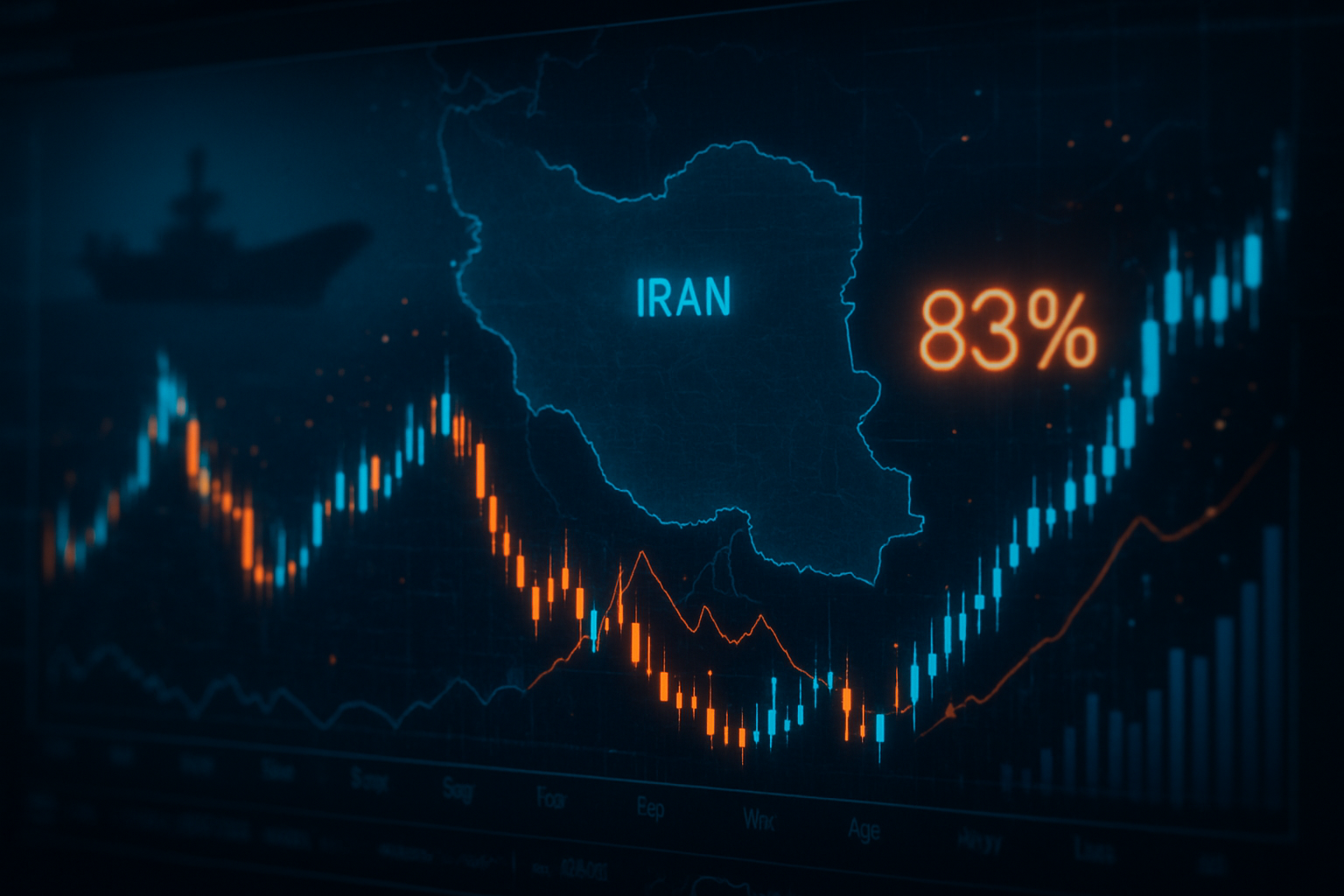
    As of January 27, 2026, the geopolitical landscape in the Middle East has reached a fever pitch, and nowhere is this tension more visible than on global prediction markets. Polymarket, the world’s largest decentralized prediction platform, has seen the volume in its Iran-related military action markets explode to over $107 million. Traders are currently pricing in a staggering 83% probability that the United States will conduct a military strike against Iranian targets before June 30, 2026—a sharp climb from just 48% at the start of the year.

    The surge in trading activity follows a volatile 2025, marked by direct military confrontations and shifting diplomatic alliances. What was once dismissed as "digital gambling" has transformed into a critical barometer for global risk. With millions of dollars at stake, these markets are no longer just reflecting public opinion; they are serving as a high-stakes "shadow intelligence" network that many institutional investors now monitor more closely than traditional news broadcasts from outlets like CNN, owned by Warner Bros. Discovery (NASDAQ: WBD).

    The Market: What's Being Predicted

    The focal point of this massive liquidity is the "US Military Action Against Iran" umbrella market on Polymarket. This contract, which has recorded over $107 million in total volume, requires a definitive "Yes" resolution if the U.S. military executes an airstrike, naval attack, or ground operation on Iranian soil, airspace, or maritime territory. While the 83% chance of U.S. action dominates the long-term outlook, short-term contracts are equally active. A market predicting an Israeli strike by January 31, 2026, is currently trading at a low 6%—a dramatic drop from 53% earlier this month—suggesting that traders believe unilateral Israeli action is being sidelined in favor of a coordinated, U.S.-led operation.

    The resolution criteria for these markets are notoriously strict to prevent ambiguity. For a "Yes" to be triggered, the action must be a physical kinetic strike; economic sanctions or cyberattacks are explicitly excluded. Verification relies on official government statements or a consensus of at least five major international news organizations, including Thomson Reuters (NYSE: TRI), the Associated Press, and The New York Times Company (NYSE: NYT). This level of rigor has attracted professional arbitrageurs and institutional desks looking for a clear, binary way to play geopolitical volatility.

    Why Traders Are Betting

    The current bullishness on military action is heavily informed by the events of June 2025, known as "Operation Rising Lion." During that period, Israel conducted surgical strikes on Iranian nuclear facilities in Natanz and Isfahan. In the 48 hours leading up to those strikes, Polymarket odds for an Israeli attack surged from 14% to nearly 99%, providing a much faster signal than traditional media. This historical accuracy has emboldened traders in the current cycle.

    However, the market is also being driven by whispers of "insider" activity. The platform is still reeling from the controversy surrounding a trader known as "Rundeep," who allegedly placed massive "Yes" bets just hours before Operation Rising Lion. This has led to increased scrutiny from intelligence agencies, including Israel's Shin Bet, though the decentralized nature of the platform makes enforcement difficult. Beyond speculation, the fundamental drivers include the continued expansion of Iran's enrichment programs and the recent deployment of U.S. carrier strike groups to the North Arabian Sea, which many see as a precursor to the 83% probability currently reflected in the odds.

    Broader Context and Implications

    The evolution of these markets represents a paradigm shift in risk management. Hedge funds are no longer just using traditional derivatives to hedge their energy exposure; they are "shorting" peace. For instance, risk managers for global logistics firms have been using the "Strait of Hormuz Closure" market—currently at 48%—to offset potential spikes in shipping insurance costs. The "wisdom of the crowd" found in prediction markets often incorporates fragmented information from ground-level sources and diplomatic leaks that haven't yet reached the mainstream.

    Furthermore, these markets have shown a significant correlation with other asset classes. Analysts have noted a high inverse correlation between the "Iran Strike" odds and the price of Bitcoin, while safe-haven assets have moved in tandem with the conflict probability. In early 2026, as the odds of a U.S. strike climbed, Gold prices surged past the $5,000 per ounce mark. Even major tech platforms like Alphabet Inc. (NASDAQ: GOOGL) via Google Finance have begun integrating real-time prediction market data into their dashboards, signaling a growing acceptance of these odds as legitimate financial signals.

    What to Watch Next

    The immediate focus for traders is the January 31, 2026, deadline for the unilateral Israeli strike market. While the 6% probability suggests the immediate threat of a solo mission has passed, any sudden movement in these odds could signal a breakdown in U.S.-Israel coordination. Market participants are also keeping a close eye on the "Regime Stability" contracts. Currently, there is a 27% probability that Supreme Leader Ali Khamenei will be removed from power by March 31, 2026, reflecting the domestic unrest that has plagued Iran since late 2025.

    As we approach the June 30th deadline for the primary U.S. strike market, expect liquidity to tighten and volatility to increase. Key dates for U.S. Congressional testimony on Middle East policy and the scheduled rotation of naval assets in the Persian Gulf will be major catalysts for market movement. Traders will be looking for any deviation from the current 83% "Yes" price as a signal of a possible diplomatic breakthrough or a delay in military plans.

    Bottom Line

    The $107 million volume in Iran military action markets underscores a new reality: prediction markets are becoming the world’s most efficient processing engine for geopolitical risk. By incentivizing the discovery of truth through financial gain, platforms like Polymarket are providing a level of clarity that traditional intelligence and media often struggle to match. The high conviction behind an impending U.S. strike suggests that the "smart money" is preparing for a significant escalation in the first half of 2026.

    Whether these markets are accurately predicting the future or simply reflecting a collective anxiety, their impact on modern finance is undeniable. As tools for hedging and "shadow intelligence," they have become essential for anyone navigating the complexities of the modern Middle East. For now, all eyes remain on the 83% probability, a number that carries the weight of billions in potential economic impact and the lives of millions in the region.


    This article is for informational purposes only and does not constitute financial or betting advice. Prediction market participation may be subject to legal restrictions in your jurisdiction.

    PredictStreet focuses on covering the latest developments in prediction markets. Visit the PredictStreet website at https://www.predictstreet.ai/.
  • From Gambling to Gauges: Wall Street Embraces Prediction Markets as the New Macro Hedge

    From Gambling to Gauges: Wall Street Embraces Prediction Markets as the New Macro Hedge

    As of mid-January 2026, the global financial landscape is witnessing a profound shift in how risk is priced and managed. Long dismissed as the domain of political junkies and speculators, prediction markets have officially entered the "Institutional Era." This morning, January 19, 2026, trading desks at major investment banks are no longer just looking at the Bloomberg Terminal for yields; they are looking at the live odds on Kalshi and Polymarket to determine the true probability of a 25-basis-point Fed rate cut in March.

    The interest is driven by a staggering surge in liquidity. On January 12, the prediction market industry processed a record $701.7 million in a single 24-hour session, fueled by the "Maduro Incident"—a geopolitical shock involving the capture of the Venezuelan leader that was priced into prediction markets hours before it hit mainstream news wires. This "information edge" has transformed these platforms from niche betting sites into what Wall Street now calls "Information Finance."

    The Market: What's Being Predicted

    While the 2024 U.S. presidential election served as the "proof of concept" for prediction markets, the focus in 2026 has shifted toward sophisticated economic and finance-related hedging tools. On Kalshi, the flagship regulated U.S. exchange, the "Federal Reserve Target Rate" contracts have become the new gold standard for interest rate forecasting. In December 2025 alone, Kalshi’s Fed contracts saw $394 million in volume, frequently outpacing the predictive accuracy of the NY Fed’s own Nowcast models.

    Beyond interest rates, institutional traders are increasingly using "CPI-Linked Contracts" and "GDP Growth Caps" to hedge against specific macro-economic outcomes. Polymarket, which transitioned into a fully licensed U.S. exchange in late 2025 after its parent company, Intercontinental Exchange (NYSE:ICE), made a landmark $2 billion investment, now offers global "Tail Risk" contracts. These allow firms to hedge against low-probability, high-impact events like a sudden sovereign default or a localized conflict affecting shipping lanes. The liquidity is now deep enough that a firm can move $50 million in or out of a macro position without the massive slippage that plagued these markets just two years ago.

    Why Traders Are Betting

    The migration of Wall Street firms to prediction markets is driven by the search for "directness." Unlike traditional options or futures, which can be influenced by Greeks like theta or vega, a prediction market contract is a binary representation of an event occurring. Goldman Sachs Group Inc (NYSE:GS) recently established a dedicated "Event Desk" within its Global Banking & Markets segment to facilitate these trades for clients. According to CEO David Solomon in a recent earnings call, these contracts are now viewed as "sophisticated derivative activities" rather than speculative bets.

    Quant shops like Susquehanna International Group (SIG) and Jane Street have also become dominant players, acting as market makers to ensure deep liquidity. These firms use prediction markets to capture "basis" differences—the gap between what a prediction market says an event is worth and what traditional derivatives say. Furthermore, the "Truth Engine" effect—where prediction markets aggregate non-public or "gray" information into a single price—provides a real-time risk gauge that traditional forecasting methods simply cannot match. For instance, during the Maduro capture in early January, the "odds of a regime change" on Polymarket spiked to 85% nearly two hours before the official military announcement, allowing savvy hedgers to adjust their oil-exposed positions in real-time.

    Broader Context and Implications

    This cultural shift was cemented by the CLARITY Act of 2025, a landmark piece of legislation that officially classified event contracts as "digital commodities" under the oversight of the Commodity Futures Trading Commission (CFTC). This regulatory "green light" solved the compliance hurdles that had previously kept major banks on the sidelines. The 2024 election was the catalyst, as prediction markets correctly predicted the outcome of key swing states while traditional pollsters struggled with high margins of error.

    The implications go far beyond finance. Prediction markets are now being used as a public policy tool. By 2026, the odds for a "Soft Landing" or "Recession in 2026" are cited in Congressional testimony as a measure of public and market confidence. However, the growth has not been without controversy. The "Public Integrity in Financial Prediction Markets Act of 2026" is currently being debated in the House, aiming to prevent government employees with inside information on policy shifts from trading on these platforms. Despite these regulatory growing pains, the historical accuracy of these markets has proven that they are superior at distilling complex global data into actionable prices.

    What to Watch Next

    The immediate focus for institutional traders is the upcoming 2026 U.S. Midterm Elections. Unlike previous cycles, firms are setting up "Election Hedging Wraps" that combine prediction market contracts with traditional S&P 500 hedges to protect against the volatility of a potential shift in House control. Watch for the volume on these mid-term contracts to hit new highs by mid-summer as firms begin their quarterly risk assessments.

    Additionally, keep a close eye on the rollout of "Event-Linked Notes" (ELNs) by major banks. These products will allow pension funds and insurance companies to gain exposure to prediction market yields without directly trading on Kalshi or Polymarket. This "securitization" of event risk is expected to bring billions in new capital into the space by the end of 2026. Finally, the integration of event contracts into retail platforms like Robinhood Markets Inc (NASDAQ:HOOD) will continue to bridge the gap between institutional hedging and retail sentiment, potentially creating a feedback loop that increases price accuracy.

    Bottom Line

    The transformation of prediction markets from a fringe curiosity to a vital piece of the global financial infrastructure is complete. In 2026, "hedging an event" has become as standard as "hedging a currency." Wall Street’s adoption of platforms like Kalshi and Polymarket represents more than just a search for new profits; it represents a fundamental shift toward "Information Finance," where the most valuable asset is not capital, but the ability to accurately predict the future.

    While regulatory scrutiny will continue to evolve, the underlying utility of these markets as a "truth engine" is undeniable. For institutional traders, the question is no longer whether prediction markets are legitimate, but how much of their risk profile they can afford not to hedge on them. As we look toward the remainder of 2026, expect prediction markets to become the primary barometer for the global economy, providing a clearer view of what's coming than any model or poll ever could.


    This article is for informational purposes only and does not constitute financial or betting advice. Prediction market participation may be subject to legal restrictions in your jurisdiction.

    PredictStreet focuses on covering the latest developments in prediction markets.
    Visit the PredictStreet website at https://www.predictstreet.ai/.