Tag: PredictIt

  • The Return of the King: PredictIt’s ‘Grand Relaunch’ and the $3,500 Revolution

    The Return of the King: PredictIt’s ‘Grand Relaunch’ and the $3,500 Revolution

    The landscape of political forecasting has shifted beneath the feet of Washington insiders and retail traders alike. As of February 2026, the "Grand Relaunch" of PredictIt has officially transformed the platform from an embattled academic experiment into a fully regulated powerhouse known as the Aristotle Exchange. By shedding its restrictive "no-action" status and adopting a Designated Contract Market (DCM) framework, PredictIt has effectively reset the terms of engagement for political handicappers heading into the critical 2026 midterms.

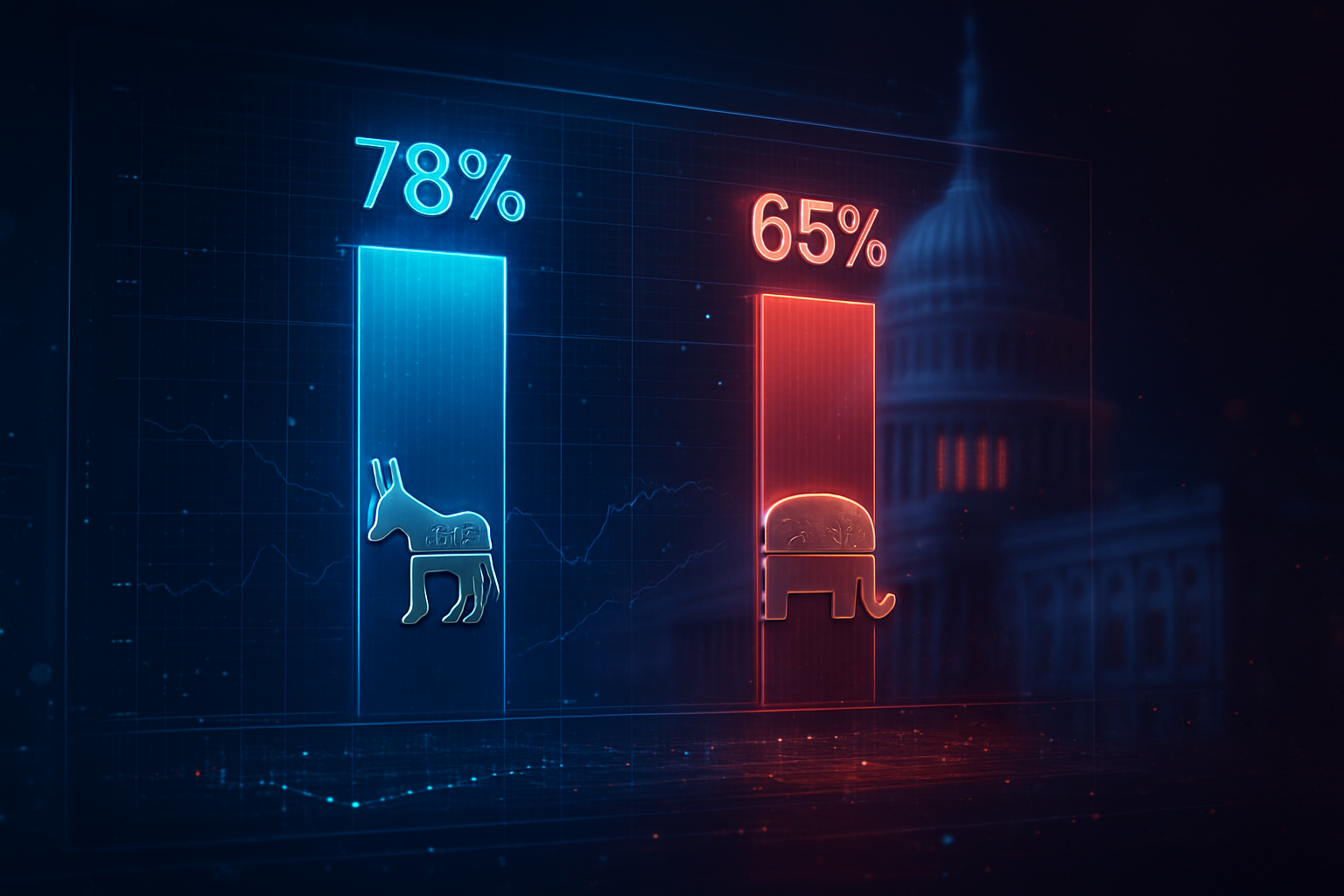
    Currently, the markets are flashing a clear, if divided, signal for the upcoming elections: a 78% probability that Democrats will reclaim the House of Representatives, contrasted with a 65% chance that Republicans will maintain their grip on the Senate. This divergence is driving record-breaking volume to the newly revamped platform, as traders move quickly to capitalize on the highest investment limits in PredictIt’s history. The platform’s transition marks a new era where political sentiment is not just polled, but priced with professional-grade precision.

    The Market: What's Being Predicted

    The centerpiece of the "Grand Relaunch" is the move to the Aristotle Exchange, a transition that has fundamentally altered the mechanics of political betting. For years, PredictIt was hamstrung by an $850 individual investment limit and a 5,000-trader cap per contract—rules that often led to "sold out" markets and distorted prices. Under the new DCM status, the investment limit has been quadrupled to $3,500, and the trader cap has been abolished entirely. This allows for deeper liquidity and ensures that prices more accurately reflect the aggregate wisdom of the crowd rather than just the first few thousand people to the gate.

    To handle this influx of capital, the exchange has integrated the Eqlipse Clearing technology from Nasdaq (NASDAQ: NDAQ), providing a level of institutional reliability previously unseen in the political prediction space. The 2026 midterm contracts are the first major test of this infrastructure. Currently, the "Party Control of the House" market is trading at 78 cents for Democratic control, while the "Senate Majority" market remains more competitive, with Republican shares hovering at 65 cents. These contracts are set to resolve following the certification of the November 2026 election results, providing a multi-billion dollar real-time barometer of the national mood.

    Why Traders Are Betting

    The surge in activity is driven by a combination of regulatory certainty and the historic stakes of the 2026 cycle. Previously, many large-scale traders avoided PredictIt due to the legal "gray area" created by its long-running battle with the CFTC. Now, with a permanent license in hand, "whales" who previously occupied the shadows are entering the fray. The $3,500 limit, while still retail-focused compared to traditional futures markets, is enough to allow sophisticated handicappers to build meaningful positions across dozens of individual race markets.

    Traders are currently leaning heavily into the "House Flip" narrative, largely based on the historical precedent that the president's party almost always faces setbacks in the first midterm of a second term (or the second midterm of a long tenure). However, the 65% odds for a Republican Senate suggest that the "GOP Firewall" in key states like Texas and Iowa remains formidable. Strategists are using these markets to hedge against potential policy shifts, as a divided government would likely stall any major legislative agendas regarding tax reform or climate spending through 2028.

    Broader Context and Implications

    PredictIt’s evolution is part of a broader "Prediction Market Arms Race." While PredictIt has captured the traditionalist and academic crowd, it faces stiff competition from Kalshi, which has marketed itself as the "Wall Street" of events, and Polymarket, which recently secured a massive $2 billion investment from the Intercontinental Exchange (NYSE: ICE). The fact that the parent company of the New York Stock Exchange is now backing a primary competitor highlights how mainstream this asset class has become.

    Beyond the numbers, these markets reveal a deepening skepticism toward traditional polling. In the 2024 cycle, prediction markets famously front-ran polling shifts in swing states, a trend that traders expect to continue in 2026. The move to a DCM model also brings PredictIt under stricter oversight, requiring enhanced transparency and anti-manipulation protocols. This regulatory "clean-up" is essential for the industry's survival, as it positions prediction markets as a legitimate financial tool rather than a niche gambling product.

    What to Watch Next

    As we move deeper into the 2026 primary season, several key milestones will likely trigger volatility in the House and Senate markets. First, the filing deadlines in March and April will clarify the candidate fields, particularly in "toss-up" districts where incumbent retirements could cause double-digit swings in the odds. Any movement in the 78% House probability will likely be tied to these candidate quality assessments.

    Furthermore, economic indicators—specifically inflation data and consumer sentiment—will serve as the primary "macro" drivers for the midterm markets. If the Federal Reserve continues its current path of interest rate stabilization, the 65% Republican Senate lead may soften as the "incumbent penalty" decreases. Conversely, any economic shock would likely solidify the Democratic House advantage. Traders should also watch for the launch of "Individual Seat" markets, which will offer the granular data that professional political consultants now rely on more than internal polling.

    Bottom Line

    The "Grand Relaunch" has successfully reclaimed PredictIt’s position at the top of the political forecasting hierarchy. By increasing limits and professionalizing its backend through the Aristotle Exchange, the platform has solved the liquidity issues that plagued its previous iteration. The current 78/65 split for the House and Senate provides a fascinating roadmap for the next two years of American governance, suggesting a return to the "gridlock" that markets often prefer.

    Ultimately, the transformation of PredictIt into a regulated financial exchange is a win for the entire "Information Finance" sector. It proves that there is a sustainable, legal path for event-based trading in the United States. Whether the 78% Democratic House probability holds or fails, the real winner is the market itself, which has finally found a way to turn political uncertainty into a transparent, tradable, and highly accurate forecasting engine.


    This article is for informational purposes only and does not constitute financial or betting advice. Prediction market participation may be subject to legal restrictions in your jurisdiction.

    PredictStreet focuses on covering the latest developments in prediction markets.
    Visit the PredictStreet website at https://www.predictstreet.ai/.
  • The InfoFi Divide: Why PredictIt Traders Are Fading the ‘Public Integrity’ Act Despite CEO Support

    The InfoFi Divide: Why PredictIt Traders Are Fading the ‘Public Integrity’ Act Despite CEO Support

    The InfoFi Divide: Why PredictIt Traders Are Fading the 'Public Integrity' Act Despite CEO Support

    As the 2026 midterm election cycle kicks into high gear, a legislative battle over the soul of the "Information Finance" (InfoFi) movement has reached a fever pitch on Capitol Hill. At the center of the storm is H.R. 7004, the "Public Integrity in Financial Prediction Markets Act of 2026." While the bill aims to curb insider trading by government officials on event contracts, the very traders it seeks to regulate remain deeply skeptical of its prospects.

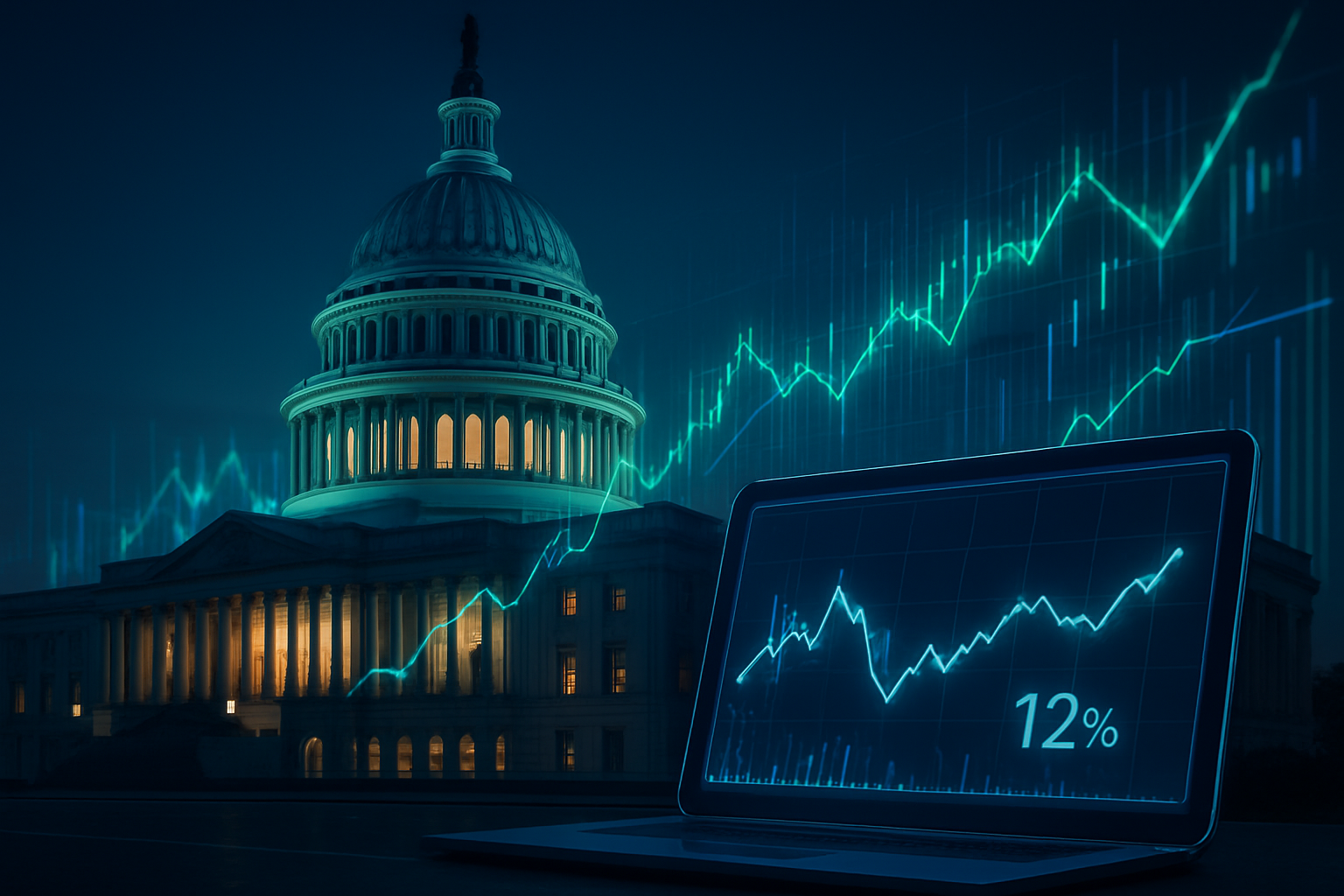
    On the popular political betting platform PredictIt, the contract for H.R. 7004’s passage in 2026 is currently trading at just $0.12, implying a slim 12% chance of the bill becoming law this year. This bearish sentiment persists despite a rare alignment of interests between high-profile Democrats, led by Representative Ritchie Torres (D-NY) and Speaker Emerita Nancy Pelosi, and industry titan Tarek Mansour, the CEO of Kalshi. The clash highlights a growing divide between the optimistic "InfoFi" narrative—which views prediction markets as the ultimate truth-seeking tool—and the harsh realities of a gridlocked Congress during an election year.

    The Market: What’s Being Predicted

    The primary market tracking the bill's fate is PredictIt's "Will H.R. 7004 (Public Integrity Act) pass in 2026?" contract. Since its launch in mid-January, the market has seen significant volatility, initially spiking to 25 cents following the bill's introduction before drifting down to its current 12-cent floor. The contract is designed to pay out $1.00 if the bill is signed into law by December 31, 2026, and $0.00 otherwise.

    Trading volume has been robust, with over 150,000 shares exchanged in the last three weeks alone. Liquidity has improved significantly since PredictIt’s successful 2025 transition into a fully regulated Designated Contract Market (DCM) under the Aristotle Exchange, which saw the removal of the 5,000-trader cap and an increase in individual investment limits to $3,500. While offshore giant Polymarket—which recently saw a $2 billion investment from the Intercontinental Exchange (NYSE: ICE)—hosts similar thematic markets, PredictIt remains the primary venue for US-based traders specifically focused on the legislative process.

    Why Traders Are Betting

    The 12% probability reflects a classic "efficient market" assessment of legislative hurdles. While the bill, nicknamed the "STOCK Act for Prediction Markets," seeks to ban federal officials and congressional staff from trading contracts tied to their official duties, traders point to the looming midterm elections as a primary obstacle. History suggests that non-essential, complex financial regulation rarely moves through both chambers in the final months before a nationwide vote.

    However, the "Yes" side is being fueled by lingering public outrage over the infamous "Maduro Trade" of early January 2026. In that event, a Polymarket user netted over $400,000 on a wager involving the removal of Venezuelan President Nicolás Maduro just hours before a secret U.S. military operation was announced. This perceived insider advantage has given proponents like Tarek Mansour a powerful narrative. Mansour has aggressively lobbied for the bill, pursuing a "Clean Market" strategy to differentiate regulated U.S. exchanges like Kalshi from their offshore counterparts. By supporting federal oversight, Mansour hopes to institutionalize prediction markets as a legitimate asset class comparable to those traded on the Nasdaq (NASDAQ: NDAQ).

    Broader Context and Implications

    The debate over H.R. 7004 is the latest chapter in the evolution of InfoFi. In 2026, prediction markets are no longer seen as mere gambling dens; they are increasingly integrated into the global financial infrastructure. The concept of "Information Finance" posits that pricing the probability of real-world events provides a vital public service, often outperforming traditional media and intelligence agencies in accuracy. For instance, InfoFi advocates point to a February 2026 shift in "Government Shutdown" odds on Kalshi that preceded official news by nearly three minutes, a phenomenon now called the "InfoFi Premium."

    This transition has been aided by a regulatory pivot at the Commodity Futures Trading Commission (CFTC). Under Chairman Michael Selig, the agency has moved away from its 2024-era attempts to ban election markets, instead focusing on "modernization." The Public Integrity Act represents the legislative branch's attempt to catch up with this new reality. If passed, it would provide the legal certainty that institutional giants like Interactive Brokers (NASDAQ: IBKR) have sought before fully committing their balance sheets to the event contract space.

    What to Watch Next

    Traders should keep a close eye on the House Financial Services Committee, where H.R. 7004 is currently stalled. A scheduled hearing on February 15 will be a critical bellwether. If the committee moves to a "markup" session—where the bill is debated and amended—the PredictIt odds could easily double overnight. Conversely, if the bill is not attached to a "must-pass" piece of legislation, such as the upcoming spring budget resolution, the 12% probability may continue its slow decay toward zero.

    Another key factor is the stance of the White House. While President Biden has generally supported measures to increase government transparency, his administration has remained quiet on the specific nuances of InfoFi. A formal Statement of Administration Policy (SAP) in favor of the bill would be a massive catalyst for market movement, potentially bringing in "whales" who have been waiting on the sidelines for a clearer political signal.

    Bottom Line

    The 12% probability of H.R. 7004's passage reveals a cynical but perhaps realistic view of Washington's ability to police itself. While the "InfoFi" revolution has successfully rebranded prediction markets as essential data tools, the political will to enact a "STOCK Act" for this new frontier remains tested by the distractions of an election year.

    Ultimately, whether the bill passes or not, the debate itself has solidified the status of prediction markets in the national discourse. By forcing a conversation on public integrity and the "pricing of truth," H.R. 7004 has already achieved one of the primary goals of any InfoFi instrument: it has forced the market to put a price on the integrity of the government itself. For now, the market says that price is low, and the hurdles are high.


    This article is for informational purposes only and does not constitute financial or betting advice. Prediction market participation may be subject to legal restrictions in your jurisdiction.

    PredictStreet focuses on covering the latest developments in prediction markets.
    Visit the PredictStreet website at https://www.predictstreet.ai/.
  • PredictIt’s ‘Grand Relaunch’: Higher Stakes, No Caps, and the Return of the ‘Cadillac’ of Politics

    PredictIt’s ‘Grand Relaunch’: Higher Stakes, No Caps, and the Return of the ‘Cadillac’ of Politics

    As the 2026 midterm election cycle kicks into high gear, the political prediction landscape has been fundamentally reshaped by the official relaunch of PredictIt. Long considered the "academic gold standard" for political forecasting, the platform has emerged from years of regulatory limbo with a massive upgrade that many are calling the "New Era" of information finance. Following its late 2025 transition into a fully regulated exchange, PredictIt is no longer just a research experiment; it is a high-octane venue for price discovery that is already challenging the dominance of rivals like Kalshi and Polymarket.

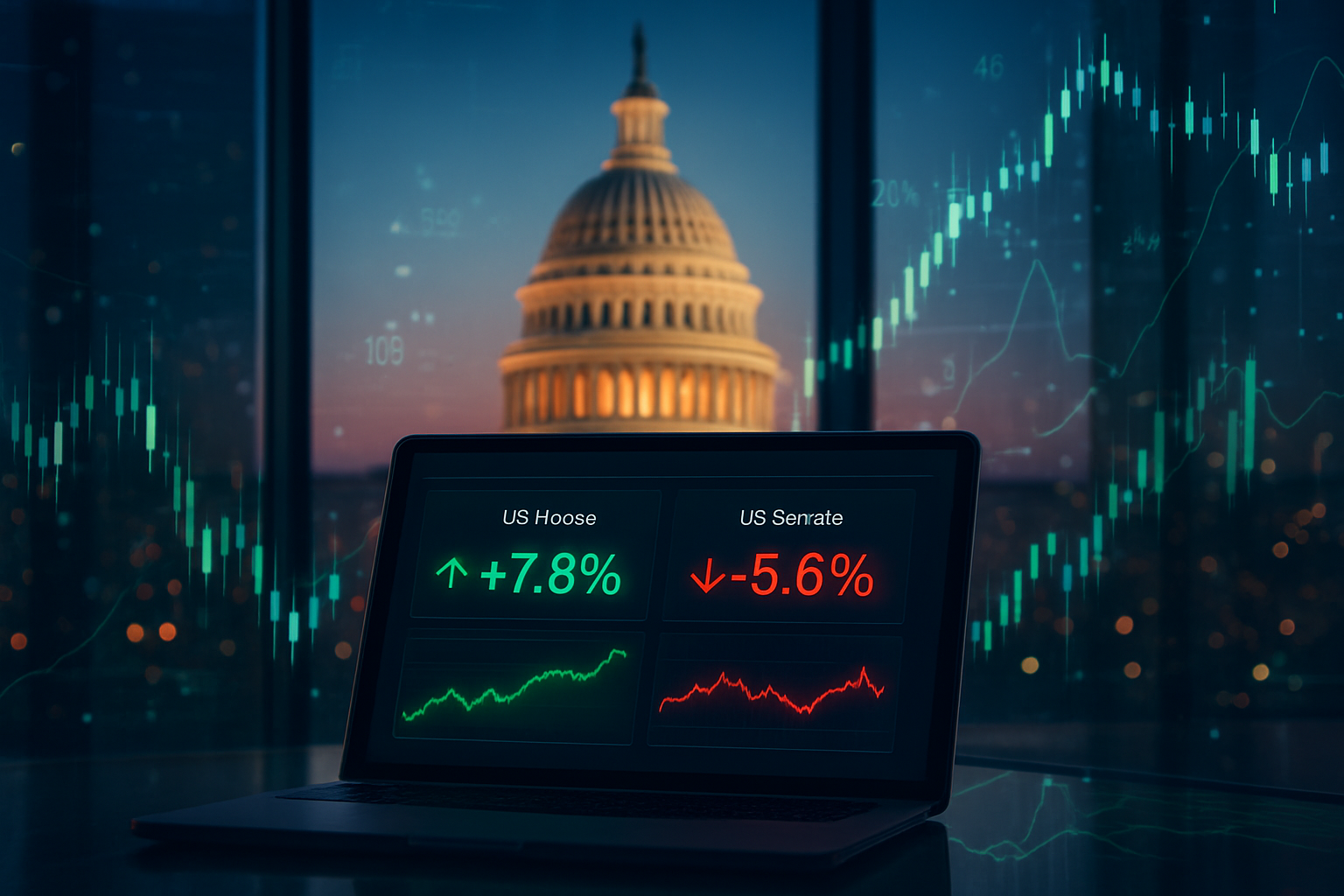
    Currently, the markets are flashing a clear signal for the November 2026 contests. PredictIt traders are pricing in a 78% probability of a Democratic House and a 65% probability of a Republican Senate, suggesting a return to divided government. This surge in activity is driven by the platform's new $3,500 individual investment limit and the total removal of the 5,000-trader cap—changes that have fundamentally altered the liquidity profile of political contracts and restored PredictIt’s status as a top-tier destination for serious political handicappers.

    The Market: What's Being Predicted

    The "New PredictIt," now operating as a fully registered Designated Contract Market (DCM) under the Aristotle Exchange, has moved beyond its humble beginnings as an academic project at Victoria University of Wellington. The platform now trades with a legal status comparable to institutional giants like Interactive Brokers Group (NASDAQ: IBKR) and the CME Group (NASDAQ: CME). For the first time, traders can take positions up to $3,500 in a single contract, a 411% increase from the previous $850 cap.

    More importantly, the removal of the 5,000-trader limit has solved the platform’s historical "liquidity desert" problem. Previously, popular markets would frequently "sell out," causing PredictIt prices to disconnect from the broader market. Today, the 2026 "Balance of Power" contracts are seeing millions of shares traded daily. The current consensus across PredictIt and its competitors shows a narrowing path for a "Trifecta" for either party, with a Democratic House/Republican Senate split trading as the most likely outcome at 45%.

    Why Traders Are Betting

    The influx of capital into PredictIt is driven by three main factors: regulatory certainty, higher limits, and its reputation for "smart money" data. By pegging the new $3,500 limit to the federal individual campaign contribution cap, PredictIt has created a psychological and financial link to the real world of political finance. Traders are no longer just "gaming" a small-cap market; they are deploying significant capital that reflects deeper political insights.

    Bettors are currently reacting to the typical midterm "pendulum effect," where the party in power (Republicans) faces headwinds in the House due to legislative gridlock and historical trends. However, the Senate map for 2026 heavily favors Republican incumbents, which explains the high 65-68% odds for a GOP hold in the upper chamber. Unlike the whale-driven volatility often seen on crypto-based platforms like Polymarket, PredictIt’s capped limit (even at $3,500) filters out massive market manipulation while still allowing for a sophisticated class of "super-forecasters" to move the needle.

    Broader Context and Implications

    The relaunch of PredictIt marks a turning point in the "Information Finance" wars. For years, PredictIt was the "Cadillac" of prediction markets—esteemed for its data but limited by its engine. Now, with the engine rebuilt by Aristotle International and oversight from the Nasdaq, Inc. (NASDAQ: NDAQ) Eqlipse Clearing technology, it is competing directly for the retail trader's attention. This shift is part of a larger trend where prediction markets are becoming mainstream financial tools, integrated into the apps of brokers like Robinhood Markets, Inc. (NASDAQ: HOOD) and backed by the clearing power of the Intercontinental Exchange (NYSE: ICE).

    The regulatory settlement that allowed this relaunch (Clarke vs. CFTC) has provided a blueprint for other platforms. By graduating from a "no-action letter" to a DCM, PredictIt has proven that prediction markets can coexist with traditional financial regulation. The real-world implication is that political campaigns and corporate strategy offices now look at PredictIt’s $3,500-limit data as more reliable than traditional polling, which has struggled with response rates and demographic weighting in recent years.

    What to Watch Next

    As we move toward the summer of 2026, keep a close eye on the "Statewide Control" markets. These are often the first to react to local scandals or shifts in economic sentiment that haven't hit the national polls yet. Additionally, the 2028 Presidential Primary markets on PredictIt are already seeing significant volume. Because the platform has abolished trader caps, these long-dated contracts are providing a much clearer picture of "who is the frontrunner" than was possible in the 2020 or 2024 cycles.

    Key dates to monitor include the June 2026 primary season. If Democrats overperform in "purple" districts, expect the 78% House odds to hit the 85-90% range, potentially triggering a sell-off in Republican-aligned equities. Conversely, any shift in the Senate odds—currently a Republican stronghold—would signal a total collapse of the GOP's 2026 defensive strategy.

    Bottom Line

    The return of PredictIt as a fully functional, high-limit exchange is a victory for data transparency and market efficiency. By positioning itself as the "Cadillac"—reliable, regulated, and academically backed—it offers a unique middle ground between the "Wild West" of uncapped crypto markets and the rigid macro-focus of traditional commodities exchanges.

    For the 2026 and 2028 cycles, the increased liquidity means that the "PredictIt Price" is once again the most important number in politics. As more retail investors migrate from platforms like Coinbase Global, Inc. (NASDAQ: COIN) into specialized political event contracts, the accuracy of these markets is likely to reach all-time highs. Whether you are a trader looking for an edge or a voter looking for the truth, the "New PredictIt" is officially the place to watch.


    This article is for informational purposes only and does not constitute financial or betting advice. Prediction market participation may be subject to legal restrictions in your jurisdiction.

    PredictStreet focuses on covering the latest developments in prediction markets.
    Visit the PredictStreet website at https://www.predictstreet.ai/.
  • The ‘STOCK Act for InfoFi’: Markets Skeptical of Congressional Crackdown on Insider Trading

    The ‘STOCK Act for InfoFi’: Markets Skeptical of Congressional Crackdown on Insider Trading

    The nascent but rapidly maturing world of "Information Finance" (InfoFi) is facing its most significant regulatory test yet. Introduced in early January 2026, the Public Integrity in Financial Prediction Markets Act of 2026 (H.R. 7004) seeks to formally ban federal officials, political appointees, and government employees from trading in prediction markets using non-public information. The bill, which many have dubbed the "STOCK Act for Prediction Markets," comes in the wake of a scandalous wager involving the ouster of a foreign leader that has sent shockwaves through Washington and the financial world.

    Despite the high-profile nature of the controversy, prediction markets themselves remain unconvinced that the legislative hammer will fall anytime soon. On the non-profit platform PredictIt, contracts for the bill’s passage in 2026 are currently trading at a lowly 12 to 15 cents, implying less than a 15% probability that the legislation will clear both chambers and reach the President's desk this year. This skepticism highlights a growing disconnect between the public outrage in the halls of Congress and the cold, hard calculations of the trading pits.

    The Market: What's Being Predicted

    The primary venue for speculating on this legislative outcome is PredictIt, where the market "Will H.R. 7004 pass in 2026?" has seen a surge in volume since the bill’s introduction on January 9. Trading opened at a cautious 8 cents and peaked briefly at 22 cents following a fiery press conference by the bill’s sponsor, Rep. Ritchie Torres (D-NY), before settling back to its current range. The low price suggests that while the bill has political momentum, traders expect it to languish in the House Committee on Oversight and Accountability, a common fate for ethics-related legislation during a midterm election cycle.

    On Kalshi, the first CFTC-regulated prediction market in the U.S., the platform has opted not to list a direct contract on the bill to avoid potential conflicts of interest among its politically active user base. However, traders are using a proxy market: "Will the CFTC adopt new insider trading rules by year-end?" That contract is currently priced at 20 cents (20%), reflecting a belief that even if H.R. 7004 fails, regulatory agencies may act independently to tighten the screws on market participants.

    The liquidity in these markets has remained robust, with over $500,000 in open interest across the major platforms. The resolution criteria are strictly tied to the bill being signed into law by 11:59 PM ET on December 31, 2026.

    Why Traders Are Betting

    The sudden urgency for H.R. 7004 was sparked by the now-infamous "Maduro Trade." On January 3, 2026, an anonymous trader on the decentralized platform Polymarket wagered $32,000 that Venezuelan leader Nicolás Maduro would be removed from power by the end of the month. Hours later, the U.S. government announced "Operation Absolute Resolve," a successful raid that led to Maduro’s capture. The trader's position skyrocketed, netting a profit of over $400,000.

    "The timing was too perfect to be anything other than a leak from someone with high-level security clearance," said one veteran PredictIt trader. This event has become the "smoking gun" for proponents of H.R. 7004, who argue that prediction markets have become a "dark pool" for government insiders to monetize classified intelligence.

    However, the "No" voters (those betting against the bill) point to the gridlocked nature of the current Congress. With a slim majority and a crowded legislative calendar, passing a bill that restricts the financial activities of members of Congress and their staff is a notoriously difficult task. Furthermore, platforms like Interactive Brokers Group (NASDAQ: IBKR) and Robinhood Markets, Inc. (NASDAQ: HOOD), which have expanded their "event contract" offerings, have lobbied for "surgical" regulation rather than broad bans, fearing that over-regulation could stifle the liquidity that makes these markets useful forecasting tools.

    Broader Context and Implications

    The debate over H.R. 7004 represents a pivotal moment for the prediction market industry. For years, proponents like economist Robin Hanson have argued that "insider trading" is actually a feature of these markets, as it forces the most accurate information to the surface. However, as prediction markets move into the mainstream—competing with traditional financial instruments—they are being held to the same integrity standards as the Nasdaq (NASDAQ: NDAQ) or the New York Stock Exchange.

    Tarek Mansour, CEO of Kalshi, has taken a proactive stance, publicly supporting the spirit of H.R. 7004. He argues that regulated U.S. exchanges already have surveillance systems in place to catch suspicious activity, similar to those used by the Cboe Global Markets (BATS: CBOE). By codifying these rules into law, the industry hopes to distinguish "clean" regulated platforms from offshore, unregulated competitors that have become magnets for illicit activity.

    If the bill were to pass, it would likely lead to a "Know Your Customer" (KYC) overhaul across the industry, requiring platforms to flag accounts held by "Politically Exposed Persons" (PEPs). This could temporarily reduce liquidity but significantly increase the institutional credibility of prediction markets as a source of "truth" for policymakers and businesses.

    What to Watch Next

    The next major catalyst for the market will be a scheduled hearing in the House Financial Services Committee in late February 2026. Market analysts suggest that if the bill gains even a single prominent Republican co-sponsor during that session, the odds on PredictIt could jump from 15% to over 30% instantly.

    Additionally, the Commodity Futures Trading Commission (CFTC) is expected to release its report on the "Maduro Trade" investigation in early March. Any evidence linking the trade to a specific government official would likely create an irresistible public mandate for Congress to act, potentially forcing a floor vote on H.R. 7004 before the summer recess.

    Investors should also watch for any defensive moves from the major platforms. If Polymarket or other decentralized venues implement voluntary bans on federal official trading, the "fire" behind the legislative push might subside, as lawmakers often prefer industry self-regulation over passing new statutes.

    Bottom Line

    The "Public Integrity in Financial Prediction Markets Act" is the first major legislative attempt to define the boundaries of the "InfoFi" era. While the markets are currently pricing in a high degree of skepticism regarding the bill's passage, the underlying issues of market integrity and insider access are not going away.

    For prediction markets to fulfill their potential as "truth machines," they must navigate the transition from a niche hobby to a regulated financial ecosystem. Whether or not H.R. 7004 becomes law, the "Maduro Trade" has ensured that the days of consequence-free insider wagering in prediction markets are likely over. Traders who can correctly anticipate the timing and severity of this regulatory "moat-building" will be the ones who profit as the industry matures.


    This article is for informational purposes only and does not constitute financial or betting advice. Prediction market participation may be subject to legal restrictions in your jurisdiction.

    PredictStreet focuses on covering the latest developments in prediction markets. Visit the PredictStreet website at https://www.predictstreet.ai/.

  • PredictIt’s ‘New Era’: Regulated, Uncapped, and Ready for the 2026 Midterm Surge

    PredictIt’s ‘New Era’: Regulated, Uncapped, and Ready for the 2026 Midterm Surge

    The landscape of American political forecasting has fundamentally shifted. For over a decade, PredictIt was the "little engine that could"—a research project operating under the restrictive constraints of an academic "No-Action" letter from federal regulators. Today, January 26, 2026, those training wheels are officially gone. PredictIt has completed its transformation into a fully regulated Designated Contract Market (DCM) and Derivatives Clearing Organization (DCO) under the Commodity Futures Trading Commission (CFTC).

    The result is a "New Era" for the platform, characterized by the removal of the infamous 5,000-trader cap and a quadrupling of individual investment limits. As the 2026 Midterm Elections approach, these changes have already triggered a massive influx of liquidity. Currently, PredictIt traders are pricing a 78% chance ($0.78) that Democrats will retake the House of Representatives, while giving Republicans a 65% chance ($0.65) to maintain their grip on the Senate. This divergence—suggesting a return to divided government—is generating record-breaking volume as the platform finally competes on a level playing field with institutional giants.

    The Market: What's Being Predicted

    The "New" PredictIt, now officially operated by the parent company Aristotle International, Inc., is no longer just a place for $850 bets and "sold out" contracts. Under its new DCM status, the platform has listed hundreds of contracts for the 2026 cycle. The most active markets currently center on the 2026 Midterm Control, where the "Balance of Power" contract is the crown jewel of the exchange.

    On PredictIt, the market for a "Democratic House / Republican Senate" split is currently trading at 46¢, the consensus favorite among the three major US-facing platforms. Unlike the "Old" PredictIt, where high-interest markets would hit the 5,000-trader limit months before an election, the new "unlimited" capacity has allowed these contracts to absorb millions in trade volume.

    The liquidity is bolstered by a significant regulatory win: the individual investment limit per contract has been raised from a mere $850 to $3,500. This figure was strategically chosen to mirror the Federal Election Campaign Act (FECA) individual contribution limit, allowing traders to back their convictions with meaningful capital without opening the door to the "market-moving" whale activity often seen on offshore crypto platforms like Polymarket.

    Why Traders Are Betting

    The surge in PredictIt’s activity is driven by a unique blend of high-conviction political quants and a regulatory framework that emphasizes accuracy over pure speculation. While the platform has modernized, it has retained its reputation for precision. A 2025 Vanderbilt University study noted that PredictIt's capped-investment model (even at $3,500) achieved a 93% accuracy rate in down-ballot races during the 2024 cycle, outperforming more "liquid" competitors.

    Traders are currently reacting to several early-2026 catalysts:

    • Geopolitical Volatility: Recent administrative friction regarding Greenland and military shifts in South America have made GOP "Sweep" contracts (21¢) feel like a risky bet.
    • The "Core Four" Senate Races: Markets for critical seats in Ohio, Alaska, Maine, and North Carolina are seeing intense action. PredictIt traders are notably more bullish on Senator Susan Collins (R-ME) holding her seat (66¢) compared to the more volatile pricing on Polymarket.
    • The Power of the Purse: Sentiment suggests that voters are seeking a "check" on the executive branch, a historical pattern that PredictIt’s sophisticated trader base is pricing as a near-certainty for the House.

    Broader Context and Implications

    This transition marks the end of the "wild west" era for US prediction markets. For years, the industry was a binary choice: the restricted academic environment of PredictIt or the regulated, yet non-political, markets of Kalshi. In late 2024 and throughout 2025, a series of legal victories—most notably Clarke v. CFTC—cleared the path for political event contracts to be treated as legitimate financial instruments rather than "gambling."

    The mainstreaming of these markets is evident in the involvement of major public companies. Robinhood Markets (NASDAQ: HOOD) has successfully integrated event-contract trading for its millions of users via a partnership with Kalshi, while Interactive Brokers (NASDAQ: IBKR) has expanded its ForecastEx subsidiary to compete directly for institutional flow. Even heavyweights like CME Group (NASDAQ: CME) and Goldman Sachs (NYSE: GS) have begun exploring the clearing and settlement of event-based derivatives.

    PredictIt’s new DCM/DCO status means it is no longer an "exception" to the rule; it is a core pillar of the new financial infrastructure. This regulatory clarity has narrowed the bid-ask spreads on major contracts to as little as a single penny, providing a "wisdom of the crowd" data point that is often more reliable than traditional polling.

    What to Watch Next

    As we move toward the 2026 primary season, the "New Era" PredictIt will face its first major stress test. Watch for the following milestones:

    1. The $10 Million Milestone: Analysts expect the "House Control" market to be the first in PredictIt history to reach $10 million in total volume before the summer, thanks to the removed trader caps.
    2. State-Level Challenges: While federal regulators are now on board, several states, including Massachusetts and Nevada, are currently embroiled in legal battles over whether "prop-style" event contracts violate state gaming laws.
    3. The Polymarket US Rollout: Polymarket’s recent acquisition of a CFTC-licensed exchange (QCX) means it will soon exit its beta phase. The "liquidity war" between PredictIt’s accuracy and Polymarket’s volume will be the defining story of the 2026 election.

    Bottom Line

    PredictIt’s evolution from a university research project to a fully-fledged, CFTC-regulated exchange is the most significant development in the prediction market space this decade. By removing the 5,000-trader cap and raising investment limits to $3,500, the platform has successfully professionalized without losing the "distributed intelligence" that made its forecasts so accurate in the past.

    For the average trader, this means a more robust, liquid, and legally secure way to hedge against political outcomes or profit from unique insights. For the broader public, it provides a high-fidelity signal of the nation's political trajectory. As of January 2026, the signal is clear: the markets are betting on a divided Washington, but the real winner is the legitimacy of the prediction market itself.


    This article is for informational purposes only and does not constitute financial or betting advice. Prediction market participation may be subject to legal restrictions in your jurisdiction.

    PredictStreet focuses on covering the latest developments in prediction markets. Visit the PredictStreet website at https://www.predictstreet.ai/.


  • The David of Data: Why Political Quants Still Bet on PredictIt Over the Polymarket ‘Whale’ Waves

    The David of Data: Why Political Quants Still Bet on PredictIt Over the Polymarket ‘Whale’ Waves

    As the 2026 midterm election cycle enters its first high-stakes primary season this January, the prediction market landscape looks radically different than it did during the 2024 presidential frenzy. While the crypto-fueled giants like Polymarket continue to draw billions in volume from international speculators, a quieter, more academic battle is being waged on PredictIt. Despite the entry of institutional heavyweights like Interactive Brokers Group (NASDAQ: IBKR) and Robinhood Markets (NASDAQ: HOOD) into the forecasting space, seasoned political quants and "small-cap" traders are doubling down on PredictIt as the only platform capable of filtering out the "whale-driven" noise that has increasingly distorted uncapped markets.

    Currently, PredictIt’s 2026 "Balance of Power" markets show a nuanced picture: Republican odds of holding the House have softened to 58%, while the Democratic "Blue Wave" scenario—the party regaining control of both chambers—is trading at a steady 32 cents. These prices have remained remarkably stable compared to the volatile swings seen on decentralized platforms, where single six-figure trades frequently send "win" probabilities oscillating by 5 to 10 percentage points in a matter of hours. For the data-driven trader, this stability is not a lack of liquidity; it is a feature of the market’s design.

    The Market: What’s Being Predicted

    The central focus of PredictIt’s 2026 portfolio is the fight for the 120th Congress. Unlike the "wild west" era of 2022, PredictIt enters 2026 as a fully regulated Designated Contract Market (DCM), having survived a grueling three-year legal battle with the Commodity Futures Trading Commission (CFTC). The platform’s "relaunch" in late 2025 brought significant structural upgrades: the historical $850 individual investment limit was raised to $3,500, and the 5,000-trader-per-contract cap was abolished entirely.

    Despite these increases, PredictIt remains a "small-stakes" environment compared to the uncapped millions flowing through Polymarket or the institutional-grade ForecastEx exchange operated by Interactive Brokers. As of January 23, 2026, PredictIt’s most active contracts involve individual Senate races in battleground states like Pennsylvania and Arizona, where "Yes" shares for incumbents are trading between 45 and 55 cents. The resolution criteria remain strictly tied to official certification by state and federal authorities, with most 2026 markets scheduled to settle by mid-November.

    Why Traders Are Betting

    The primary driver for the continued loyalty to PredictIt is the "Whale Effect"—a phenomenon that reached its zenith during the 2024 election. Analysts point to the "Théo" incident on Polymarket, where a single French trader used four accounts (including "Fredi9999") to bet over $30 million on a Donald Trump victory. While Théo’s bet was ultimately profitable, it created what quants call an "informational cascade," where the market price reflected one wealthy individual's private conviction rather than the collective intelligence of the crowd.

    Political quants argue that PredictIt’s $3,500 limit acts as a "signal filter." To move a price on PredictIt, a candidate needs the consensus of thousands of unique individuals rather than one deep-pocketed "whale." This distributed model prevents the "narrative capture" that occurs when a billionaire or a crypto-fund "buys the tape" to influence public perception or social media sentiment.

    "PredictIt is the 'small-cap' market of politics," says one veteran quantitative trader who moved their activity back to the platform in late 2025. "On Polymarket, you're trading against the ego of a whale. On PredictIt, you're trading against the collective research of 10,000 political junkies who are reading local precinct reports. The latter is a much purer signal of what’s actually happening on the ground."

    Broader Context and Implications

    The debate over market design is backed by recent academic data. A 2025 study from Vanderbilt University analyzed over 2,500 political contracts from the 2024 cycle and found that PredictIt achieved a staggering 93% accuracy rate in predicting down-ballot winners, compared to 67% for Polymarket and 78% for Kalshi. Researchers concluded that the capped-investment model effectively prioritized "distributed knowledge" over "speculative capital."

    This accuracy gap has significant real-world implications for how media organizations and campaigns use these markets. While Robinhood Markets (NASDAQ: HOOD) has successfully "mainstreamed" prediction markets for the retail masses—reporting over 11 billion contracts processed by January 2026—PredictIt remains the "academic gold standard." The platform's transition to a non-profit management structure under the Prediction Market Research Consortium (PMRC) has further solidified its role as a tool for political science research rather than just a venue for high-stakes gambling.

    Furthermore, the regulatory landscape has stabilized. Following the landmark 2024 legal victory by Kalshi against the CFTC, and PredictIt’s subsequent 2025 win in the Western District of Texas, prediction markets are now recognized as legitimate hedging tools. This has allowed PredictIt to coexist with massive brokerages like Interactive Brokers Group (NASDAQ: IBKR), which focuses on macro-hedging (like inflation and climate), leaving PredictIt to dominate the niche of high-conviction retail political forecasting.

    What to Watch Next

    As we move toward the summer of 2026, several key milestones will test the "Signal vs. Whale" theory. The first is the wave of Republican primaries in the Sun Belt, where PredictIt's prices currently diverge from Polymarket by as much as 400 basis points. Quants are watching to see if PredictIt’s "small-cap" traders correctly identify insurgent candidates before the large-scale liquidity on other platforms catches up.

    Additionally, the potential for a "Black Swan" event—such as a major Supreme Court ruling or a shift in Federal Reserve policy—will likely see Polymarket prices react violently as whales hedge their portfolios. In contrast, PredictIt’s $3,500 cap is expected to keep prices more grounded, reflecting the slower, more deliberate shift in voter sentiment.

    Bottom Line

    PredictIt’s unique position in the 2026 landscape proves that in the world of forecasting, bigger is not always better. By maintaining a capped-investment structure, the platform has preserved its status as a sanctuary for those who value the "wisdom of crowds" over the "power of the purse." For political quants, the platform offers a "clean" data set that is remarkably resistant to the manipulation and volatility that plague uncapped, crypto-native markets.

    As the 2026 midterms approach, the "Accuracy War" will likely intensify. While the billions in volume may reside on Polymarket and Robinhood, the most reliable signal of the next Speaker of the House may well be found in the $3,500-limit trenches of PredictIt. For the savvy trader, the message is clear: watch the volume for the excitement, but watch the "small-caps" for the truth.


    This article is for informational purposes only and does not constitute financial or betting advice. Prediction market participation may be subject to legal restrictions in your jurisdiction.

    PredictStreet focuses on covering the latest developments in prediction markets.
    Visit the PredictStreet website at https://www.predictstreet.ai/.
  • Betting on the Law: Why the ‘Maduro Trade’ Has Prediction Markets Bracing for Federal Oversight

    Betting on the Law: Why the ‘Maduro Trade’ Has Prediction Markets Bracing for Federal Oversight

    As of January 21, 2026, the fast-evolving world of "Information Finance" is facing its most significant legislative reckoning to date. Congressman Ritchie Torres (D-NY) has officially introduced the Public Integrity in Financial Prediction Markets Act of 2026 (H.R. 7004), a bill designed to bring the ethics of Wall Street to the burgeoning world of event contracts. The move follows a month of intense scrutiny after a series of suspiciously well-timed bets on the platform Polymarket sparked a national conversation about insider trading in geopolitical forecasting.

    Currently, the market's own participants are skeptical about the bill's chances. On PredictIt, the contract for "Will H.R. 7004 pass in 2026?" is trading at a mere 12 cents, implying just a 12% probability of becoming law before the end of the year. Despite the low odds, the bill has become a focal point for traders and regulators alike, as it represents the first major attempt to codify a "STOCK Act" for the prediction market industry.

    The Market: What's Being Predicted

    The PredictIt market tracking the passage of the Torres bill has seen a surge in volume over the last ten days, following the bill's formal introduction on January 9. While the 12% probability suggests a uphill battle, the market is highly liquid, with hundreds of thousands of shares changing hands as traders weigh the legislative appetite for regulation in a midterm election year.

    The bill, backed by high-profile co-sponsors including Speaker Emerita Nancy Pelosi, specifically targets "covered individuals"—which includes federal elected officials, political appointees, and congressional staff. It seeks to prohibit these individuals from trading on event contracts tied to government policy or actions if they possess material non-public information. On the regulated exchange Kalshi, a secondary market has emerged regarding whether the Commodity Futures Trading Commission (CFTC) will independently adopt similar rules by year-end, currently trading at a slightly more optimistic 20% probability.

    Why Traders Are Betting

    The primary catalyst for this legislative push was the so-called "Maduro Trade." On January 3, 2026, just hours before the Trump Administration announced the successful capture of Venezuelan leader Nicolás Maduro, an anonymous account on Polymarket placed a $32,537 bet that Maduro would be out of power by the end of the month. The trade netted over $400,000, fueling allegations that a government or military insider leaked the timing of the raid to profit on the platform.

    Traders are currently split into two camps. The "No" voters (holding the 88% majority) argue that a divided Congress is unlikely to reach a consensus on such a niche issue during an election cycle. They point to the complexity of defining "material non-public information" in the context of global events. Conversely, the "Yes" bulls believe the optics of the "Maduro Trade" are too toxic for politicians to ignore, and that a bipartisan coalition could form to "clean up" the markets before more scandals emerge.

    There is also a significant strategic divide between platforms. Kalshi CEO Tarek Mansour has expressed support for the bill, noting that regulated U.S. platforms already have internal prohibitions on insider trading. By contrast, decentralized and offshore platforms like Polymarket—which have recently faced scrutiny for accurate betting patterns ahead of the Golden Globes—stand to lose the most from federal enforcement.

    Broader Context and Implications

    The Torres bill arrives at a time when prediction markets are transitioning from niche hobbies to mainstream financial tools. Major retail platforms like Robinhood Markets, Inc. (NASDAQ:HOOD) and Interactive Brokers Group, Inc. (NASDAQ:IBKR) through its ForecastEx exchange, have aggressively expanded their event contract offerings throughout 2025. This institutionalization has brought increased pressure from state regulators.

    In just the first three weeks of 2026, Tennessee and Connecticut have issued cease-and-desist orders against several platforms for offering sports-related contracts without gaming licenses. In New York, Assemblymember Clyde Vanel is pushing the ORACLE Act, which would strictly limit the types of events New Yorkers can bet on. The federal Torres bill is seen by some as a way to provide a unified national framework that could preempt a "patchwork" of confusing state laws.

    Historically, prediction markets have been remarkably accurate at forecasting legislative outcomes, often outperforming traditional pundits. If the 12% probability on PredictIt holds steady, it suggests that despite the public outcry over the Maduro incident, the legislative path for H.R. 7004 is fraught with political gridlock.

    What to Watch Next

    The next major hurdle for the bill is a scheduled hearing before the House Financial Services Committee in mid-February. Traders will be listening closely for any signals from committee leadership; if the bill receives a favorable recommendation to move to the House floor, the PredictIt odds could easily double overnight.

    Furthermore, the Trump Administration's stance remains a wildcard. While the administration has been generally hands-off regarding financial deregulation, the embarrassment of a potential military leak leading to a "Maduro Trade" profit could shift the White House's posture toward supporting "integrity measures" for the sector.

    Finally, keep an eye on the CFTC's upcoming open meeting in March. If the Commission indicates it will move forward with its own rulemaking regarding insider trading on event contracts, the legislative urgency for H.R. 7004 may diminish, causing the passage odds to plummet further as administrative action takes the lead.

    Bottom Line

    The Public Integrity in Financial Prediction Markets Act of 2026 is a watershed moment for the "InfoFi" industry. It highlights a fundamental tension: the power of prediction markets to aggregate information versus the risk that they become a vehicle for government corruption.

    While the current 12% probability of passage reflects a skeptical trading community, the very existence of the bill has already changed the industry. Major players like Interactive Brokers (NASDAQ:IBKR) and Robinhood (NASDAQ:HOOD) are likely to tighten their own compliance frameworks in anticipation of eventual oversight. Whether through H.R. 7004 or administrative action, the "wild west" era of unregulated geopolitical betting appears to be drawing to a close.


    This article is for informational purposes only and does not constitute financial or betting advice. Prediction market participation may be subject to legal restrictions in your jurisdiction.

    PredictStreet focuses on covering the latest developments in prediction markets.
    Visit the PredictStreet website at https://www.predictstreet.ai/.

  • The Accuracy War: PredictIt vs. Kalshi vs. Polymarket

    The Accuracy War: PredictIt vs. Kalshi vs. Polymarket

    The 2024 U.S. Presidential election served as a high-stakes laboratory for the burgeoning world of prediction markets, pitting established academic platforms against crypto-native giants and regulated newcomers. As of January 19, 2026, the dust has finally settled on the post-election post-mortems, revealing a surprising "Accuracy War" where the most liquid markets weren’t necessarily the most correct. While all major platforms eventually signaled a Republican victory, the path they took—and the volatility they experienced—highlighted deep structural divides in how we forecast the future.

    Currently, the market is shifting its focus to the 2026 Midterms, with "control of the House" contracts already seeing significant early action. On Kalshi, the probability of a Democratic "Blue Wave" in 2026 is currently hovering at 42%, while PredictIt traders are more cautious at 38%. This 400-basis-point spread is a direct result of the different participant bases and fee structures that define these platforms. The divergence is generating intense interest among arbitrageurs who are looking to exploit the lingering "accuracy gap" that defined the 2024 cycle.

    The Market: What's Being Predicted

    The core of the "Accuracy War" centers on how PredictIt, Kalshi, and Polymarket processed the 2024 election data compared to their current handling of the 2026 legislative outlook. During the 2024 cycle, Polymarket dominated the headlines with over $3.3 billion in total volume, while the regulated U.S. exchange Kalshi struggled initially after a late legal entry in October 2024. PredictIt, the long-standing academic project, operated under a cloud of regulatory uncertainty that was only resolved in mid-2025.

    A landmark study from Vanderbilt University released in late 2025 found that PredictIt achieved a staggering 93% accuracy rate across 2,500 individual contracts, compared to 78% for Kalshi and just 67% for Polymarket. This disparity has fundamentally changed how traders view these platforms. While Polymarket offers the highest liquidity and the "wisdom of the global crowd," its signals were often distorted by massive "whale" positions, such as the famous $30 million bet by a French trader that skewed Republican odds for weeks.

    Today, the resolution criteria for 2026 markets have become more standardized thanks to the 2025 CLARITY Act, which provided a federal framework for event contracts. Kalshi has surged to a dominant position, claiming a 66.4% share of daily volume as of mid-January 2026. Polymarket, meanwhile, has successfully pivoted into the U.S. market, launching a regulated domestic arm in December 2025 to compete directly with Kalshi and PredictIt on American soil.

    Why Traders Are Betting

    The primary driver of the odds today is the varying "friction" created by fee structures. PredictIt remains the most expensive venue, charging a 10% fee on all gross profits and a 5% fee on withdrawals. This creates a "PredictIt Premium," where a contract might trade at 55 cents when the "true" probability is closer to 50%, simply because traders need a higher margin to cover the fees. In contrast, the newly launched Polymarket US (DCM) has introduced a hyper-competitive 0.10% fee to lure traders away from Kalshi’s probability-weighted fee model, which averages around 1.2% per trade.

    Participant demographics also play a crucial role. PredictIt’s $3,500 trading limit (raised from $850 in July 2025) ensures that the market represents a "crowd of peers" rather than a "market of whales." This "enforced diversity" is credited with its high accuracy in 2024; it was essentially a massive survey of informed U.S. voters with skin in the game. On the other hand, the international nature of Polymarket Global often leads to "sentiment-driven" spikes, where global crypto-traders bet on "narratives" rather than granular U.S. state-level polling or legislative nuances.

    Recent news has also influenced the 2026 odds. Following the partnership between Kalshi and Warner Bros. Discovery (NASDAQ: WBD)'s CNN to integrate live odds into political broadcasts, a surge of "retail" money has entered the market. This influx of less-experienced traders often creates "noise" that savvy pros—many of whom utilize institutional tools from Comcast (NASDAQ: CMCSA)'s CNBC—are quick to capitalize on through mean-reversion strategies.

    Broader Context and Implications

    The "Accuracy War" has broader implications for how prediction markets are integrated into the global financial system. The 2025 CLARITY Act was a watershed moment, finally clarifying that event contracts are legitimate financial tools for hedging real-world risks. This has allowed major news organizations, including News Corp (NASDAQ: NWS)'s Dow Jones and The Wall Street Journal, to treat prediction market prices with the same reverence as the S&P 500 or Treasury yields.

    Furthermore, the 2024 results debunked the "Liquidity Equals Accuracy" myth. The fact that the highest-volume market (Polymarket) was the least accurate in its price discovery suggested that "whales" can, in fact, move the needle and create misleading signals. This has led to a renewed interest in the "PredictIt model" of capping individual stakes to ensure a broader, more representative sample of opinions. It suggests that for political events, the "wisdom of the crowd" works best when the crowd isn't dominated by a few deep-pocketed individuals.

    The regulatory environment has also matured. The CFTC’s shift from an adversarial to a collaborative stance with platforms like PredictIt has encouraged more academic research into how these markets can serve as "early warning systems" for geopolitical instability or economic shifts. Prediction markets are no longer seen as "gambling" but as a vital layer of the information economy.

    What to Watch Next

    As we approach the 2026 Midterms, all eyes are on the performance of Polymarket’s new U.S.-regulated exchange. If it can maintain its low fee structure while attracting the high-quality, domestic participant base that PredictIt enjoys, it could theoretically combine the best of both worlds: high liquidity and high accuracy. Traders should watch for any shifts in the "spread" between PredictIt and Kalshi prices; a narrowing gap would indicate that the markets are becoming more efficient at cross-platform arbitrage.

    Key dates to monitor include the upcoming "State of the Union" in February 2026, which historically triggers massive volume and price swings in legislative control contracts. Additionally, the first major "test" of the CLARITY Act’s enforcement provisions is expected this spring, as several platforms attempt to launch "economic indicator" contracts tied to sensitive data like the Consumer Price Index (CPI) before they are officially released.

    Bottom Line

    The competition between PredictIt, Kalshi, and Polymarket has evolved into a sophisticated ecosystem where "accuracy" is the ultimate currency. While Polymarket won the battle for volume in 2024, PredictIt won the battle for precision. In 2026, the playing field is leveling as Kalshi dominates the regulated U.S. space and Polymarket enters the domestic arena with a competitive edge.

    The key takeaway for any market observer is that prediction markets are not a monolith. The "odds" on one platform are a reflection of its specific rules, its fees, and its people. As we head into a new election cycle, the "Accuracy War" continues, and the winners will be the platforms that can best balance the need for deep liquidity with the necessity of a diverse, informed participant base.

    Ultimately, prediction markets have proved their worth as a superior alternative to traditional polling. In an era of fragmented media and partisan bubbles, the cold, hard numbers of a trading screen offer the most honest look at where the world is actually heading.


    This article is for informational purposes only and does not constitute financial or betting advice. Prediction market participation may be subject to legal restrictions in your jurisdiction.

    PredictStreet focuses on covering the latest developments in prediction markets.
    Visit the PredictStreet website at https://www.predictstreet.ai/.

  • The 2026 Tax Reckoning: A Trader’s Guide to Prediction Market Earnings

    The 2026 Tax Reckoning: A Trader’s Guide to Prediction Market Earnings

    As the calendar turns to January 18, 2026, millions of Americans are opening their mailboxes and email inboxes to find a new kind of tax document. Following the explosive growth of prediction markets throughout 2025—a year defined by massive volume in election contracts, Fed rate cut forecasts, and climate milestones—the Internal Revenue Service (IRS) is preparing for its most significant season of event-contract reporting in history.

    For traders on platforms like Kalshi, PredictIt, and the newly regulated Polymarket US, the tax bill for 2025 is no longer a theoretical concern. With billions of dollars in volume traded over the last twelve months, the IRS is paying closer attention than ever to how "event contract" proceeds are categorized. Whether you were betting on the outcome of the D.C. Circuit Court cases or the latest inflation prints, understanding the difference between a 1099-MISC and a self-reported DeFi audit is the difference between a smooth filing and a costly audit.

    The Market: What’s Being Predicted

    The current "market" being predicted by tax professionals and platform operators is the finality of IRS guidance. For the 2025 tax year, the industry remains in a transitional state. On regulated exchanges like Kalshi and Interactive Brokers Group, Inc. (NASDAQ: IBKR), activity has shifted from niche political betting to a mainstream financial asset class. These platforms are now competing directly with traditional options for the attention of retail and institutional traders alike.

    Liquidity in these markets reached record highs in late 2025, particularly following the relaunch of Polymarket’s US-regulated entity in December. While the global version of Polymarket continues to operate on the Polygon blockchain, the US version has adopted a strict Know Your Customer (KYC) and reporting framework. This has created a bifurcated tax landscape: one where domestic platforms provide neat, government-ready forms, and another where decentralized participants must play detective with their own digital wallets.

    The "resolution criteria" for this tax season are the April 15, 2026, filing deadline. Traders are currently betting on whether the IRS will issue a last-minute Revenue Ruling to clarify the treatment of these contracts. Until then, most platforms are defaulting to the most conservative reporting standards, leaving the burden of interpretation on the individual taxpayer.

    Why Traders Are Strategizing

    The core of the 2025 tax debate centers on classification: Are these earnings gambling winnings, capital gains, or "Other Income"? Most traders are finding that their profits are being pushed toward Schedule 1, Line 8z as "Other Income." The reason is largely administrative. The IRS has historically lacked a specific "event contract" category, and in the absence of a designated brokerage form like a 1099-B for all platforms, the 1099-MISC has become the default for Kalshi and PredictIt.

    However, a growing number of "whales" and professional traders are pushing back, citing the landmark 2024-2025 legal victories. Specifically, after the CFTC dropped its appeal against Kalshi in May 2025, prediction markets were effectively codified as federally regulated derivatives. This has led aggressive tax strategies to favor Section 1256 treatment. Under this rule, 60% of gains are taxed at long-term capital gains rates and 40% at short-term rates, regardless of the holding period—a massive tax break compared to the ordinary income rates found on Line 8z.

    This tension is driving recent movement in tax-preparation software and crypto-audit tools. Traders who used the global version of Polymarket are currently using blockchain explorers to calculate their "cost basis" for every share of "Yes" or "No" they held. Because these tokens are technically "disposed of" at the moment of market resolution, every single trade is a taxable event, much like trading stocks on Robinhood Markets, Inc. (NASDAQ: HOOD).

    Broader Context and Implications

    The 2025 tax season is the first to feel the impact of the One Big Beautiful Bill Act (OBBBA), signed into law on July 4, 2025. A little-known provision in the OBBBA limits gambling loss deductions to 90% of winnings for non-professional bettors. This has created a panicked rush to ensure prediction market activity is classified as "derivative trading" rather than "wagering." If the IRS views your Polymarket activity as gambling, you could be taxed on your wins while being unable to fully deduct your losses.

    This regulatory friction reveals a growing pains phase for the industry. While the CFTC now views these markets as legitimate financial instruments, the IRS's lag in updating Form 1040 instructions has created a "gray zone." Historically, the IRS has been slow to move on new asset classes—as seen with the decade-long wait for clear crypto guidance—but the sheer volume of the 2025 election cycle may force their hand sooner than expected.

    The accuracy of these markets as forecasting tools has already been proven; now, their survival as a viable investment class depends on tax parity. If prediction market gains continue to be taxed as ordinary "Other Income" (potentially reaching rates as high as 37%) while traditional futures enjoy the 60/40 split of Section 1256, liquidity may migrate to more tax-efficient, if less accurate, financial products.

    What to Watch Next

    Between now and the April filing deadline, the most important milestone is the potential release of an IRS "Internal Technical Advice" memo. This document would provide the first official hint at whether the IRS will honor the CFTC’s classification of event contracts as derivatives. Traders should also watch for the 1099-MISC mailings from PredictIt and Kalshi, which are expected to land in late January and early February.

    Furthermore, the "Polymarket Split" will be a key scenario to monitor. Many US traders likely used the global platform via VPNs in early 2025 before switching to the regulated US app in December. These individuals will face a nightmare of cross-platform reporting, needing to reconcile decentralized wallet history with the centralized 1099s they receive from the new US entity.

    If a major court case emerges in the next few months—perhaps a trader suing for the right to use Section 1256—it could set a precedent that changes the math for the entire industry. For now, the probability remains high that most casual users will simply follow the platforms' lead and report on Line 8z to avoid the "red flag" of an unconventional filing.

    Bottom Line

    The 2025 tax year represents the end of the "Wild West" era for prediction market taxation. As the IRS catches up to the volume of the past year, the distinction between "Other Income" on Schedule 1 and capital gains on Schedule D has become the most important trade of the season.

    Regulated platforms like Kalshi and PredictIt have simplified the process with 1099-MISC forms, but in doing so, they have largely locked their users into ordinary income tax rates. Meanwhile, Polymarket users face the double-edged sword of self-reporting: more work and higher audit risk, but the potential to argue for more favorable capital gains treatment.

    As we move toward the April 15 deadline, one thing is certain: the era of "tax-free" prediction market gains is over. Whether you viewed your 2025 trades as a hobby, a hedge, or a high-stakes bet, the IRS is now an uninvited partner in every market you enter.


    This article is for informational purposes only and does not constitute financial or betting advice. Prediction market participation may be subject to legal restrictions in your jurisdiction.

    PredictStreet focuses on covering the latest developments in prediction markets.
    Visit the PredictStreet website at https://www.predictstreet.ai/.
  • The “Volume Trap”: Why PredictIt’s 93% Accuracy Is Shaking the Prediction Market Foundation

    The “Volume Trap”: Why PredictIt’s 93% Accuracy Is Shaking the Prediction Market Foundation

    A landmark study from Vanderbilt University has sent shockwaves through the burgeoning prediction market industry, delivering a rigorous autopsy of the 2024 election cycle that fundamentally challenges the "liquidity equals truth" dogma of modern finance. As of January 17, 2026, the findings are reshaping how institutional investors, political strategists, and retail traders view the reliability of real-time forecasting platforms.

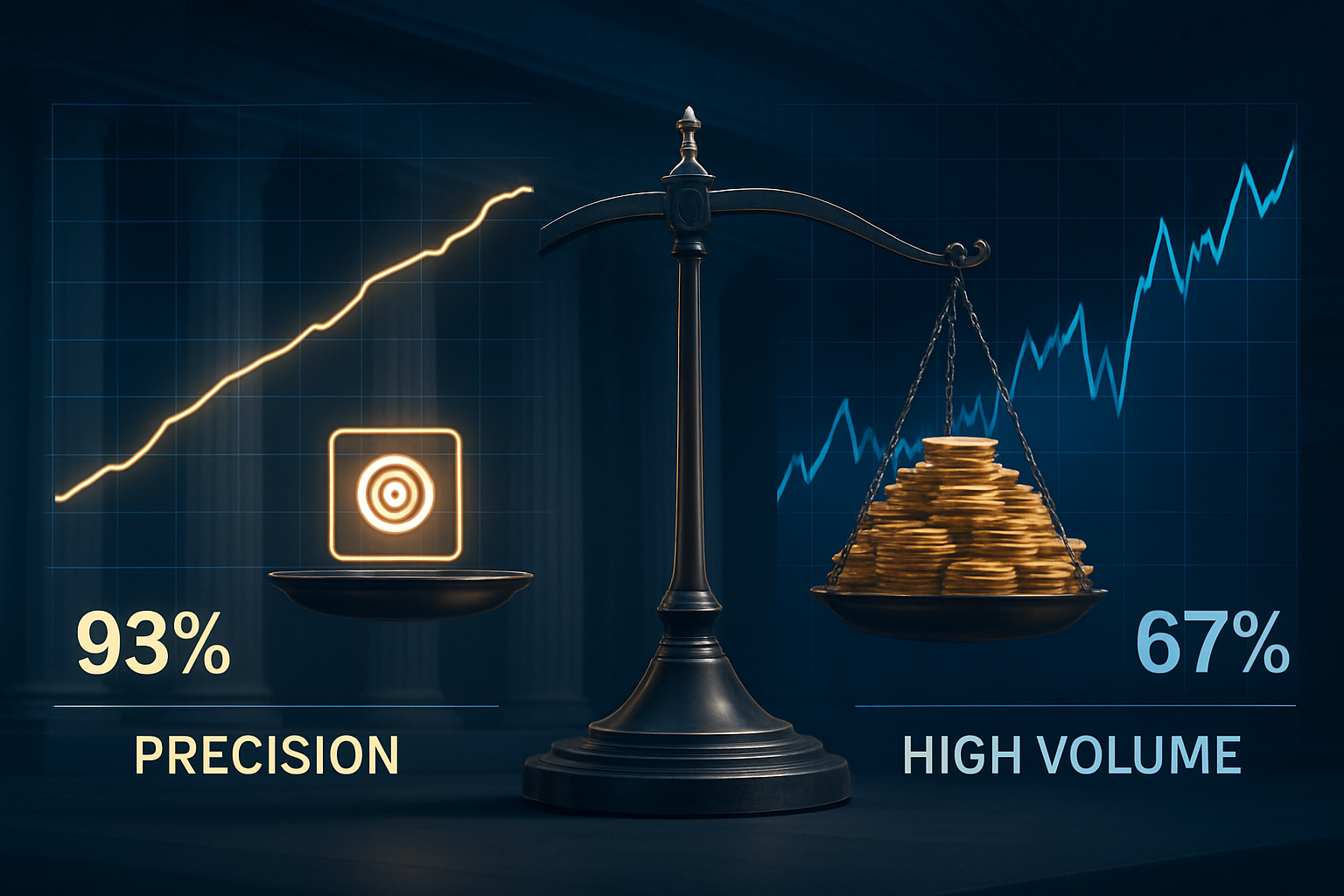
    The study, titled "Prediction Markets? The Accuracy and Efficiency of $2.4 Billion in the 2024 Presidential Election," revealed a surprising hierarchy of precision: PredictIt, the oldest and most restricted of the major platforms, achieved a staggering 93% accuracy rate in correctly forecasting election outcomes. Meanwhile, the regulated U.S. exchange Kalshi (NYSE: KLS) trailed at 78%, and the crypto-native heavyweight Polymarket—despite processing billions in volume—languished at a 67% accuracy rate. This data has sparked a heated debate over the "Volume Trap," a phenomenon where massive liquidity may actually degrade the quality of the information signal.

    The Market: What's Being Predicted

    The Vanderbilt researchers, led by Professor Joshua D. Clinton and TzuFeng Huang, analyzed more than 2,500 political contracts spanning the 2024 U.S. election cycle. The focus was not merely on the top-line Presidential winner but also on a granular level: battleground state margins, House and Senate control, and down-ballot races. While all three platforms—PredictIt, Kalshi, and Polymarket—traded identical outcomes, their price discovery mechanisms behaved in fundamentally different ways.

    PredictIt, which has historically operated under a Commodity Futures Trading Commission (CFTC) no-action letter with strict $850-per-contract limits (raised to $3,500 by late 2025), showed the highest resilience to volatility. In contrast, Kalshi, a federally regulated exchange, and Polymarket, which operates on the Polygon blockchain, saw massive influxes of "whale" capital. Polymarket, in particular, recorded a historic $2.4 billion handle for the 2024 election, yet its prices frequently diverged from the eventual reality, especially in state-level contests.

    The study used "log-loss" and Brier scores to measure how "confidently wrong" markets were. A Brier score rewards markets that are 90% certain of an outcome that occurs, while heavily penalizing those that are 90% certain of an outcome that fails. The results showed that while Polymarket had the most liquidity, it suffered from "mutual exclusivity errors," where the sum of probabilities for competing outcomes often exceeded 100%, indicating a lack of internal logic among its high-volume traders.

    Why Traders Are Betting

    The disparity in accuracy between these platforms can be attributed to the type of traders each platform attracts and the incentives created by their respective architectures. According to the Vanderbilt study, PredictIt’s success is a direct result of its restrictive "retail-only" model. Because no single trader can bet millions of dollars to "move the needle," the price is driven by a diverse crowd of "super-forecasters"—political staffers, data scientists, and wonks who trade on nuanced information rather than momentum.

    Conversely, the "Volume Trap" identified in the study describes a feedback loop seen on high-volume platforms like Polymarket. When high-net-worth "whales"—such as the widely reported "Théo" account that bet over $30 million on a Trump victory—place massive positions, it creates a "narrative gravitational pull." Smaller traders often follow the price movement (herding) rather than the underlying polling data or ground-game metrics. This creates "artificial confidence," where the market price reflects the conviction of a few wealthy individuals rather than the collective intelligence of the crowd.

    Institutional players are now taking notice of these findings. Companies like Interactive Brokers Group, Inc. (Nasdaq: IBKR), through their ForecastEx exchange, and Robinhood Markets, Inc. (Nasdaq: HOOD) have begun refining their contract offerings to prioritize "cleaner" data signals. Traders on these platforms are increasingly looking for ways to arbitrage the gap between the "pure" signal of PredictIt and the "noisy" sentiment of crypto-driven markets.

    Broader Context and Implications

    The Vanderbilt study arrives at a critical juncture for the industry. For years, proponents of prediction markets argued that the more money at stake, the more accurate the forecast would be. The 2024 data suggests the opposite may be true for political events: that concentrated capital can act as a pollutant to price discovery. This has significant regulatory implications, as the CFTC has long expressed concerns that high-stakes political betting could be used to manipulate public perception.

    PredictIt’s 93% accuracy provides a powerful defense for the "limited-stake" model, suggesting that such markets function more like a refined intelligence tool than a gambling venue. This distinction is vital as prediction markets move toward becoming a mainstream financial asset class. If the market's primary value is its "signal" for decision-makers, then accuracy—not volume—is the most valuable metric.

    Furthermore, the study highlights a "State-Level Disconnect." While Polymarket was highly accurate on the national "binary" outcome (who wins the Presidency), it was notably poor at predicting the specific electoral college math. This suggests that global speculators (the "whales") are good at broad sentiment but lack the "on-the-ground" knowledge that smaller, regional traders on PredictIt possess.

    What to Watch Next

    As we enter the 2026 Midterm election cycle, the industry is pivoting. Watch for a "flight to quality" among professional bettors. We are likely to see the emergence of "Aggregator Platforms" that weight prices based on the Vanderbilt accuracy rankings—giving a 93% weight to PredictIt signals and a lower weight to high-volume, low-accuracy sources.

    Key dates to monitor include the upcoming CFTC hearings on contract limits, where the Vanderbilt study is expected to be cited as "Exhibit A" for maintaining position caps. Additionally, look for the performance of new "Expert-Only" markets being developed by traditional financial firms that aim to replicate PredictIt’s success by restricting participation to verified domain experts rather than the highest bidder.

    The next major test for these platforms will be the 2026 Congressional primaries. If the "Volume Trap" holds true, we should expect to see Polymarket prices swing wildly based on social media trends, while PredictIt remains a more boring, but ultimately more accurate, barometer of political reality.

    Bottom Line

    The Vanderbilt University study has shattered the myth that the biggest market is always the smartest market. In the world of political forecasting, it appears that "less is more." PredictIt’s 93% accuracy rate proves that a well-regulated, capped-limit market can outperform a multi-billion dollar crypto giant by filtering out noise and focusing on high-quality, diverse information sources.

    For the prediction market industry, this is a "growing pain" moment. It forces a realization that liquidity is a double-edged sword. While volume provides the profit that sustains exchanges, it can simultaneously degrade the very "wisdom of the crowd" that makes these markets valuable to society in the first place.

    Ultimately, the Vanderbilt findings suggest that for those looking to see the future of American politics, the smartest move isn't to follow the money—it’s to follow the signal. As the 2026 Midterms loom, the "PredictIt Model" stands as the gold standard for anyone who values truth over hype.


    This article is for informational purposes only and does not constitute financial or betting advice. Prediction market participation may be subject to legal restrictions in your jurisdiction.

    PredictStreet focuses on covering the latest developments in prediction markets.
    Visit the PredictStreet website at https://www.predictstreet.ai/.