Tag: Prediction Markets

  • The $400,000 Tip-Off: How the ‘Maduro Trade’ Broke Polymarket and Sparked a DC Crackdown

    The $400,000 Tip-Off: How the ‘Maduro Trade’ Broke Polymarket and Sparked a DC Crackdown

    The capture of Venezuelan President Nicolás Maduro by U.S. forces on January 3, 2026, was a geopolitical shockwave that few saw coming. But while the world’s intelligence agencies and newsrooms were caught off guard, a single anonymous trader on the prediction platform Polymarket appeared to have a front-row seat to the planning. In a series of high-conviction bets placed just hours before the "snatch-and-extract" operation in Caracas, a user known as "Burdensome-Mix" turned a modest $32,000 into a windfall of over $400,000.

    The trade has since become the center of a firestorm in Washington D.C. and New York, reigniting the debate over the legality and ethics of prediction markets. With odds on Maduro’s removal hovering at a mere 7% just before the raid, the sudden influx of "informed" capital has led lawmakers to question whether these platforms have become the ultimate venue for modern-day insider trading. The event, now dubbed the "Maduro Trade," is currently the primary exhibit in a push for federal regulation that could fundamentally alter the landscape of event-based betting.

    The Market: What's Being Predicted

    The controversy centers on several interlinked contracts hosted on Polymarket, a decentralized prediction platform that has surged in popularity despite its regulatory battles in the United States. The most prominent contract, "Maduro out by January 31, 2026?", saw relatively low volume throughout December as analysts remained skeptical of any immediate regime change in Venezuela. For much of the holiday season, shares were trading at approximately $0.07, representing a consensus probability of just 7%.

    However, the liquidity of the market changed drastically on December 26, 2025, when the "Burdensome-Mix" account was created. The trader began accumulating "Yes" shares aggressively across four specific contracts: Maduro’s removal, the presence of U.S. forces in Venezuela, and a controversial market titled "Will the US invade Venezuela by January 31?" By the early hours of January 3, the trader had amassed a position of $32,537.

    When news of the capture broke, the contracts "Yes" shares immediately spiked to $1.00. While the removal and troop presence contracts resolved smoothly, the "Invasion" contract, which saw over $10.5 million in total volume, became a flashpoint. Polymarket's refusal to initially pay out "Yes" holders—arguing that a tactical raid did not constitute a full-scale "invasion"—led to a "semantic freeze" that left millions in limbo and infuriated the trading community.

    Why Traders Are Betting

    The sheer precision of the "Maduro Trade" has led experts to believe this wasn't the result of superior geopolitical analysis, but rather what critics call the "Alpha Raccoon" effect. This term describes traders who exploit massive information asymmetry, likely derived from government or military leaks. Analysts note that "Burdensome-Mix" held four times more contracts than the next-highest bidder, suggesting a level of "conviction" that is rarely seen in speculative markets without inside knowledge.

    Suspicion has also fallen on the intersection of the political and financial worlds. Scrutiny has specifically targeted the dual roles of prominent figures like Donald Trump Jr., whose firm 1789 Capital has invested heavily in the sector. With Trump Jr. serving as a strategic advisor to the regulated exchange Kalshi and an advisory board member for Polymarket, critics argue that the proximity between prediction market stakeholders and the executive branch creates a moral hazard where non-public military plans could be commodified.

    From a trading perspective, the Maduro event showcased the limits of traditional forecasting. While mainstream media was focused on diplomatic stalemates, the "whisper" in the prediction markets was shouting. Proponents of the markets, such as economist Robin Hanson, argue that this is actually a feature, not a bug. They contend that the "Maduro Trade" forced private information into a public price, providing a more accurate signal to the world than any news outlet could offer.

    Broader Context and Implications

    The fallout from the Maduro Trade is now fueling a significant legislative push. On January 9, 2026, Rep. Ritchie Torres (D-NY) introduced the Public Integrity in Financial Prediction Markets Act of 2026. The bill aims to criminalize insider trading on these platforms by federal officials and their families. Torres has been vocal about his concerns, describing the current state of prediction markets as "the most corrupt corner of Washington."

    In Albany, the New York State Assembly is moving forward with the ORACLE Act (A9251). If passed, the act would effectively ban New York residents from trading on contracts linked to political or catastrophic events, potentially classifying them as unlicensed gambling. This mirrors the aggressive stance taken by the CFTC under Chair Michael Selig, who has been pressured by a group of 12 Democratic senators, led by Catherine Cortez Masto, to investigate the "improbable" timing of the Caracas-related trades.

    The financial community remains deeply divided. While some see these markets as essential tools for "hedging uncertainty"—a sentiment echoed by Thomas Peterffy, Chairman of Interactive Brokers (Nasdaq: IBKR)—others, like Daniel Taylor of the Wharton School, warn that the lack of robust oversight by the CFTC undermines the integrity of the entire financial system. Unlike the SEC's clear mandate over equities, the "event contract" space remains a regulatory gray zone.

    What to Watch Next

    The immediate focus for the industry is the progress of the Torres bill in D.C. and the ORACLE Act in New York. If these laws pass, they could force platforms like Polymarket to implement rigorous KYC (Know Your Customer) and "insider" screening processes similar to those used by traditional stock exchanges. We are also expecting a formal report from the CFTC by the end of Q1 2026 regarding the specific trades made by the "Burdensome-Mix" account.

    Another key milestone is the resolution of the "Invasion" contract dispute. The outcome of this arbitration will set a precedent for how prediction markets handle "edge cases" where the technical definition of an event differs from the public's perception. If Polymarket is forced to pay out, it could face a liquidity crunch; if it refuses, it may lose the trust of its most active whales.

    Finally, market watchers are looking at the 2026 midterm election markets. If "informed" trades continue to appear hours before major policy shifts or announcements, the calls for a total ban on political betting will likely become deafening. The maturation of these platforms hinges on their ability to prove they are tools for collective intelligence, not just laundry mats for classified leaks.

    Bottom Line

    The "Maduro Trade" has proven that prediction markets are no longer just a niche hobby for data nerds; they are potent, sometimes dangerous, tools of financial intelligence. A single trader turning $32,000 into $400,000 by betting on a secret military operation has stripped away the illusion that these platforms are immune to the same "insider" pressures that haunt Wall Street.

    As we move further into 2026, the question is not whether prediction markets will exist, but who will be allowed to use them and under what constraints. While the efficiency of the "Maduro price signal" was undeniably high, the cost of that efficiency may be a wave of regulation that brings the "Wild West" era of Polymarket to a definitive end. For now, the "Alpha Raccoons" are in the spotlight, and Washington is finally reaching for the trap.


    This article is for informational purposes only and does not constitute financial or betting advice. Prediction market participation may be subject to legal restrictions in your jurisdiction.

    PredictStreet focuses on covering the latest developments in prediction markets.
    Visit the PredictStreet website at https://www.predictstreet.ai/.
  • The New Wall Street: Prediction Markets Smash Records with $701.7 Million Day

    The New Wall Street: Prediction Markets Smash Records with $701.7 Million Day

    The world of finance shifted on its axis this week. On Monday, January 12, 2026, prediction markets achieved a staggering, record-breaking $701.7 million in single-day trading volume. This milestone represents more than just a spike in activity; it marks the definitive arrival of "information finance" as a primary pillar of the global economy. For years, skeptics dismissed these platforms as glorified sportsbooks, but as of early 2026, they have transformed into what many are calling the world’s most accurate "truth engines."

    The surge was driven by a perfect storm of constitutional crises, geopolitical shocks, and the institutionalization of retail trading. At the center of the frenzy was a high-stakes standoff between the U.S. Department of Justice (DOJ) and Federal Reserve Chair Jerome Powell, alongside the sudden capture of Venezuelan President Nicolás Maduro. With millions of dollars moving by the second, the probability of a March interest rate cut fluctuated wildly, peaking at 74% as traders digested real-time updates that outpaced traditional news cycles by minutes.

    The Market: What's Being Predicted

    The $701.7 million daily volume was dominated by a "triopoly" of platforms that have spent the last year racing for market share. Kalshi solidified its position as the industry leader, capturing 66.4% of the volume with $465.9 million in trades. Much of this dominance is credited to Kalshi’s deep integration with Robinhood Markets, Inc. (NASDAQ:HOOD), which launched its dedicated "Prediction Markets Hub" last year, putting event contracts into the hands of over 100 million retail investors.

    While Kalshi owned the domestic macro markets, Polymarket and Opinion battled for the remaining share. Polymarket recorded $100.04 million in volume, buoyed by a $2 billion liquidity injection from the Intercontinental Exchange, Inc. (NYSE:ICE). Meanwhile, the relative newcomer Opinion (Opinion Labs) matched that figure with $100 million, specializing in high-frequency, AI-driven macro indicators.

    The most traded contracts on January 12 included:

    • The Federal Reserve Standoff: Contracts on whether Jerome Powell will resign or be removed before the March FOMC meeting.
    • The Maduro Aftermath: Predictions on the stability of a transitional government in Venezuela following Maduro’s capture.
    • NFL Postseason "Combos": A new feature on Kalshi that allows users to parlay economic outcomes with sports results—for instance, "CPI under 2.5% AND the Kansas City Chiefs win."

    Why Traders Are Betting

    The primary driver for this week’s massive volume was the unprecedented constitutional friction involving the Federal Reserve. On the evening of January 11, Chair Jerome Powell revealed that the DOJ had served the Fed with subpoenas regarding a massive headquarters renovation—a move Powell labeled a "pretext" for political interference. This sent traders into a frenzy. On Kalshi, the "Will the Fed cut rates in March?" contract saw over $120 million in volume on Monday alone as institutions used the market to hedge against a potential central bank decapitation.

    Geopolitical "insider" activity also fueled the surge. Following the U.S. military raid that captured Nicolás Maduro, a single anonymous trader on Polymarket turned a $32,000 bet into $400,000. The bet, placed just hours before the news broke, has sparked intense debate about the role of prediction markets in surfacing non-public information. Traders are no longer just betting on what they think will happen; they are betting on what they know is happening in the shadows.

    Furthermore, the "Mainstreet-ing" of these markets through Robinhood (NASDAQ:HOOD) has changed the trader profile. No longer restricted to crypto-enthusiasts, the January 12 record saw a massive influx of traditional retail investors treating "The Fed" or "The Greenland Declaration" as if they were tech stocks.

    Broader Context and Implications

    This record volume occurs against a backdrop of intense regulatory friction. While the federal courts largely cleared the way for election betting in 2025, a new "second front" has opened at the state level. Just this past week, the Tennessee Sports Wagering Council issued cease-and-desist orders to Kalshi and Polymarket, claiming their event contracts infringe on state gambling monopolies. However, on January 15, 2026, a federal judge granted a temporary restraining order (TRO) protecting Kalshi, suggesting that federal Commodity Futures Trading Commission (CFTC) oversight may preempt state law.

    The massive volume is also forcing Congress's hand. On January 9, Rep. Ritchie Torres (D-NY) introduced the "Public Integrity in Financial Prediction Markets Act of 2026." The bill aims to ban federal officials from trading on these platforms to prevent the very "information leakage" seen in the Maduro case.

    Despite these hurdles, the historical accuracy of these markets remains their greatest defense. Throughout the early 2026 geopolitical turmoil, prediction market odds have consistently moved 10 to 15 minutes ahead of major news wires like Bloomberg or Reuters. For many hedge funds, these markets are no longer a side-show—they are the primary signal.

    What to Watch Next

    The immediate focus for traders is the "Powell Pivot." With the DOJ investigation ongoing, any sign of Powell’s resignation will likely trigger another $500 million+ day. Markets are currently pricing a 35% chance of a leadership change at the Fed by February 1.

    On the regulatory front, keep an eye on the Ninth Circuit Court of Appeals. A ruling is expected by early February regarding Nevada’s attempt to shutter prediction market operations. If the court sides with Kalshi, it will effectively create a "green zone" for event contracts across the Western United States. Additionally, the finalization of the ICE (NYSE:ICE)-Polymarket integration is expected to bring a wave of institutional liquidity that could make $700 million days the new normal.

    Bottom Line

    The record-breaking volume of January 12 is a watershed moment for finance. It proves that prediction markets have solved the "liquidity trap" that previously kept them in the shadow of the New York Stock Exchange. By providing a clear, numerical probability for events that traditional markets struggle to price—like constitutional crises or military raids—platforms like Kalshi and Polymarket have become indispensable.

    For investors, the message is clear: the most valuable commodity in 2026 is no longer just data, but the synthesis of that data into tradable odds. As long as the world remains volatile, these "truth engines" will continue to grow, regulatory pressure notwithstanding.


    This article is for informational purposes only and does not constitute financial or betting advice. Prediction market participation may be subject to legal restrictions in your jurisdiction.

    PredictStreet focuses on covering the latest developments in prediction markets.
    Visit the PredictStreet website at https://www.predictstreet.ai/.
  • The $393 Million Signal: How Prediction Markets Nailed the Fed’s December Pivot

    The $393 Million Signal: How Prediction Markets Nailed the Fed’s December Pivot

    The final weeks of 2025 marked a historic turning point for both monetary policy and the burgeoning industry of prediction markets. As the Federal Reserve prepared for its final meeting of the year, a massive wave of capital flooded platforms like Kalshi and Polymarket, correctly forecasting a 25 basis point rate cut that many institutional analysts had doubted just weeks prior. In a stunning display of "wisdom of the crowd," traders pushed the odds of a December cut from a mere 45% in mid-November to over 80% by early December, providing a real-time roadmap for an economy in transition.

    This shift wasn't just a minor adjustment; it was a total recalibration of global economic expectations. At the heart of this movement was an unprecedented level of liquidity, with nearly $393 million wagered on the outcome of the December FOMC meeting. As the dust settles in mid-January 2026, the accuracy of these markets has solidified their status as essential tools for investors, policymakers, and the general public, often moving faster than traditional financial news cycles.

    The Market: What's Being Predicted

    The primary focus of the late-2025 trading frenzy was the Federal Open Market Committee (FOMC) meeting held on December 10–11. While the year had been defined by a "higher for longer" narrative, the narrative began to crumble as inflation data cooled. On Polymarket, the world’s largest decentralized prediction platform, the "Fed Decision: December" market became a titan of liquidity. Total volume on the event reached a staggering $393.9 million, making it one of the most traded non-political events in the platform's history.

    Simultaneously, Kalshi, the first regulated prediction market in the U.S., saw its own surge in activity. The platform's 25 basis point cut contract, which was trading at a sub-45% probability in early November, skyrocketed to an 80% consensus by November 24. These markets required a specific resolution: the target range for the federal funds rate had to be lowered by exactly 0.25 percentage points. Unlike traditional futures, these contracts offered a binary "Yes" or "No" outcome, allowing retail and institutional traders to hedge their portfolios with surgical precision.

    The liquidity was bolstered by the entry of major players. While Polymarket dominated in sheer volume, the price discovery on Kalshi was often cited by analysts as a leading indicator for the CME Group (NASDAQ: CME) FedWatch tool. By the time the Fed entered its traditional "blackout" period before the meeting, prediction market odds had already settled into a high-confidence range of 85% to 92%, effectively front-running the official announcement.

    Why Traders Are Betting

    The sudden shift in sentiment was catalyzed by a "perfect storm" of economic data and shifting rhetoric. In mid-November, the consensus was shaky; a series of robust employment figures had suggested the Fed might "skip" a December cut to prevent the economy from overheating. However, the release of the Personal Consumption Expenditures (PCE) price index—the Fed’s preferred inflation gauge—changed everything. The report showed core inflation cooling to 2.4%, providing the "greater confidence" that Chair Jerome Powell had frequently mentioned as a prerequisite for easing.

    Furthermore, a rise in the unemployment rate to 4.1% signaled a labor market that was "cooling but not collapsing," a scenario that favored a preemptive cut to ensure a soft landing. Traders also had to navigate a unique "data vacuum" caused by a brief government shutdown in late 2025, which delayed several official reports. During this period of uncertainty, prediction markets became the primary source of truth, as "whales" (large-scale traders) utilized alternative data sets—including private-sector payroll estimates and real-time shipping data—to place massive bets before the official numbers were even released.

    Notable activity included several "million-dollar positions" on Polymarket that bet heavily on the "Yes" outcome for a 25 bps cut when the odds were still below 60%. These positions, often suspected to be from sophisticated hedge funds or algorithmic traders, helped drive the price up and forced a realization across broader markets that the Fed’s path was more dovish than previously assumed.

    Broader Context and Implications

    The success of the December rate cut markets represents a milestone for the legitimacy of prediction markets. For years, these platforms were viewed as niche outlets for political junkies or crypto enthusiasts. However, the alignment between prediction markets and the CME Group (NASDAQ: CME) FedWatch tool—which stood at an 87.6% probability for a cut just days before the meeting—shows that these "alternative" venues are now operating at a level of sophistication equal to the multitrillion-dollar futures markets.

    The real-world implications are profound. When prediction markets move the odds of a rate cut from 45% to 80% in a week, it triggers immediate ripples in mortgage rates, corporate bond yields, and the valuation of growth stocks. Companies like Robinhood Markets (NASDAQ: HOOD) and Interactive Brokers (NASDAQ: IBKR) have taken note, increasingly integrating or expanding their exposure to event-based trading as users demand more direct ways to trade on macroeconomic news.

    Furthermore, this event highlighted the regulatory evolution of the space. As Kalshi fought and won key legal battles to offer more diverse markets, the influx of $393 million in volume proved that there is a massive, untapped appetite for regulated, transparent forecasting tools. Historical data from 2024 and 2025 now shows that prediction markets often capture "tail risks" and sudden sentiment shifts more accurately than traditional survey-based economic forecasts.

    What to Watch Next

    With the December cut now a matter of record, the focus has shifted immediately to the first FOMC meeting of 2026, scheduled for January 28. Current markets are currently pricing in a "wait and see" approach, but the volatility seen in December has taught traders not to get comfortable. The next major catalyst will be the upcoming CPI (Consumer Price Index) report and the initial Q4 GDP estimates.

    Traders should also keep a close eye on the "path to neutral" markets. While the December 25 bps cut was a victory for the doves, the debate for 2026 is centered on where the rate-cutting cycle ends. Platforms are already hosting high-volume markets on whether the terminal rate will fall below 3.00% by the end of this year. As of mid-January, these markets are showing a 60% probability of at least two more cuts before June 2026.

    Bottom Line

    The "December Pivot" will likely be remembered as the moment prediction markets truly came of age as a real-time economic sentiment indicator. By successfully processing complex data during a period of high uncertainty and a government data blackout, these platforms provided a clearer signal than many traditional financial institutions. The $393 million wagered on the outcome was not just a bet; it was a massive, decentralized calculation of the American economic future.

    As we move deeper into 2026, the convergence between prediction markets and traditional finance is only accelerating. Whether you are a retail investor looking to hedge against interest rate volatility or a policymaker gauging public expectations, the "wisdom of the crowd" on Kalshi and Polymarket is now a metric that cannot be ignored. The sudden shift from 45% to over 80% was the warning shot; the 25 basis point cut was the confirmation that the crowd was right all along.


    This article is for informational purposes only and does not constitute financial or betting advice. Prediction market participation may be subject to legal restrictions in your jurisdiction.

    PredictStreet focuses on covering the latest developments in prediction markets.
    Visit the PredictStreet website at https://www.predictstreet.ai/.
  • Betting on the Blue Wave: 2026 Midterm Markets Hit Record $700 Million Daily Volume

    Betting on the Blue Wave: 2026 Midterm Markets Hit Record $700 Million Daily Volume

    As the calendar turns to early 2026, the political landscape is already being reshaped not by campaign rallies, but by the rapid-fire clicks of high-stakes traders. Prediction markets have officially entered their "super-cycle," with the 2026 U.S. Midterm elections driving unprecedented liquidity. For the first time in history, daily trading volume across the sector eclipsed the $700 million mark on January 12, signaling that forecasting platforms have moved from the periphery of political discourse to its very epicenter.

    At the heart of this surge is a stark divergence between traditional polling and market sentiment. While early polls suggest a competitive generic ballot, traders on platforms like Kalshi and Polymarket are aggressively pricing in a Democratic takeover of the House of Representatives, with odds hovering near 80%. Simultaneously, Vice President JD Vance has emerged as a paradox: a polarizing figure in public approval ratings, yet the undisputed betting favorite to lead the Republican ticket in 2028.

    The Market: What's Being Predicted

    The primary focus of the early 2026 cycle is the "Balance of Power" contracts, which allow traders to bet on the specific partisan split of the 110th Congress. On Kalshi, the leading regulated exchange in the U.S., the most liquid market currently concerns House control. Democrats are priced at 74–75 cents, implying a roughly 75% chance of retaking the lower chamber. Polymarket, the decentralized heavyweight, shows an even more bullish outlook for the left, with shares trading at 78–79 cents.

    In the Senate, however, the map tells a different story. Despite a national environment that favors Democrats, the 2026 Senate map is structurally difficult for the opposition. Republicans currently hold a 53–47 majority, and prediction markets give them a 66–68% probability of retaining control. The "Split Congress" outcome—a Democratic House and Republican Senate—is currently the "favorite" scenario among institutional traders, priced at 48% on Kalshi.

    Liquidity has reached a tipping point. On January 12, 2026, total daily volume across major platforms hit $701.7 million. Kalshi dominated this record-breaking day, accounting for 66.4% of the volume, largely driven by its "Combos" features which allow users to bet on complex political and economic outcomes simultaneously. This level of liquidity ensures that even "whale" positions of $1 million or more can be absorbed without radical price slippage, attracting a new class of sophisticated market participants.

    Why Traders Are Betting

    The aggressive positioning in favor of a "blue wave" in the House is being driven by what traders call the "Referendum Effect." Historically, the first midterm of a second presidential term is brutal for the incumbent party. However, traders are looking beyond history and focusing on specific policy catalysts. The second Trump administration's aggressive stances on tariffs and immigration, along with a recent tie-breaking vote by Vice President JD Vance to block a war powers resolution regarding Venezuela, have created a volatile political environment that traders believe will provoke a significant voter backlash.

    Furthermore, JD Vance’s standing as the 2028 heir apparent has turned 2026 into a proxy war for his future. On Kalshi, Vance holds a 27–28% chance of being the 2028 Republican nominee—a massive lead over rivals like Marco Rubio (11%). Traders are betting that the 2026 midterms will serve as the ultimate "stress test" for the Vance-led wing of the GOP. If the party loses the House by a wider margin than expected, his 2028 odds are predicted to crater, making these midterm contracts a hedge for 2028 presidential bets.

    The discrepancy between polls and markets is also a major factor in current trading strategies. While Morning Consult shows a modest Democratic lead of +2, markets are pricing in a much more decisive shift. Professional bettors are essentially betting that traditional polling is undercounting "suburban flight" and the impact of recent macroeconomic shifts. This "Knightian risk"—the uncertainty of how a second-term administration's disruptions will manifest at the ballot box—is currently being priced more heavily by markets than by pollsters.

    Broader Context and Implications

    The $700 million daily volume milestone is not just a win for the platforms; it represents a fundamental shift in how the public consumes political intelligence. Institutional players, including hedge funds and data analytics firms, are increasingly using these markets as a real-time sentiment gauge that reacts faster than any 1,000-person phone survey. The rise of these markets has also caught the attention of major financial institutions like Interactive Brokers (NASDAQ: IBKR), which has expanded its forecast market offerings to meet the demand for regulated election trading.

    The real-world implications of these odds are already being felt in Washington. Legislative strategies for the remainder of 2026 are being adjusted based on the high probability of a divided government. If the markets continue to hold at 75% for a Democratic House, we can expect a rush of Republican "legacy" legislation in the first half of the year before the window closes.

    From a regulatory standpoint, the 2026 cycle is the first to operate under a fully clarified legal framework following years of litigation between the CFTC and exchange platforms. This clarity has allowed for the entry of "market makers" who provide the deep liquidity necessary for the $700 million days we are now seeing. The historical accuracy of these markets—which outperformed polls in the 2024 general election—gives these early 2026 numbers a level of perceived authority that is influencing donor behavior and candidate recruitment.

    What to Watch Next

    As we head into the spring of 2026, several "volatility triggers" could shift the current odds. The primary season will be the first major test; if "Vance-aligned" candidates struggle in deep-red districts, expect his 2028 presidential odds to slide and the Democratic House probability to climb even higher. Traders will also be watching the quarterly GDP prints and Federal Reserve decisions closely, as any signs of an economic cooling could cement the "blue wave" narrative.

    Key dates to monitor include the filing deadlines in March and April, which will reveal the quality of the challengers Democrats have recruited for key swing districts. If high-profile "star" candidates jump into races that were previously considered safe Republican seats, the markets will likely react before the first television ad even airs. Additionally, the "Senate Floor" is a critical metric; if Republicans' odds of holding the Senate dip below 60%, it would signal a total collapse of the GOP's defensive map, a scenario not currently priced into the market.

    Bottom Line

    The 2026 midterm cycle is proving that prediction markets are no longer a "niche" interest but a primary pillar of the American political and financial ecosystem. The $700 million daily volume record is a testament to the growing trust in these platforms as accurate aggregators of disparate information. Currently, the "wisdom of the crowd" is betting heavily on a divided government, viewing a Democratic House takeover as a near-certainty while keeping the Senate in Republican hands.

    JD Vance remains the central figure of this drama. As the market's favorite for 2028, his political capital is effectively being "traded" through the 2026 midterm contracts. For observers and participants alike, the message from the markets is clear: the 2026 midterms will not just be a fight for the gavel, but a high-stakes referendum on the future of the Republican party's leadership. As liquidity continues to pour in, these markets will offer the most ruthless and accurate map of the American electorate’s intentions.


    This article is for informational purposes only and does not constitute financial or betting advice. Prediction market participation may be subject to legal restrictions in your jurisdiction.

    PredictStreet focuses on covering the latest developments in prediction markets.
    Visit the PredictStreet website at https://www.predictstreet.ai/.
  • The $120 Million Bet: Why ‘Hard’ Economic Markets are Dominating Kalshi’s Order Books

    The $120 Million Bet: Why ‘Hard’ Economic Markets are Dominating Kalshi’s Order Books

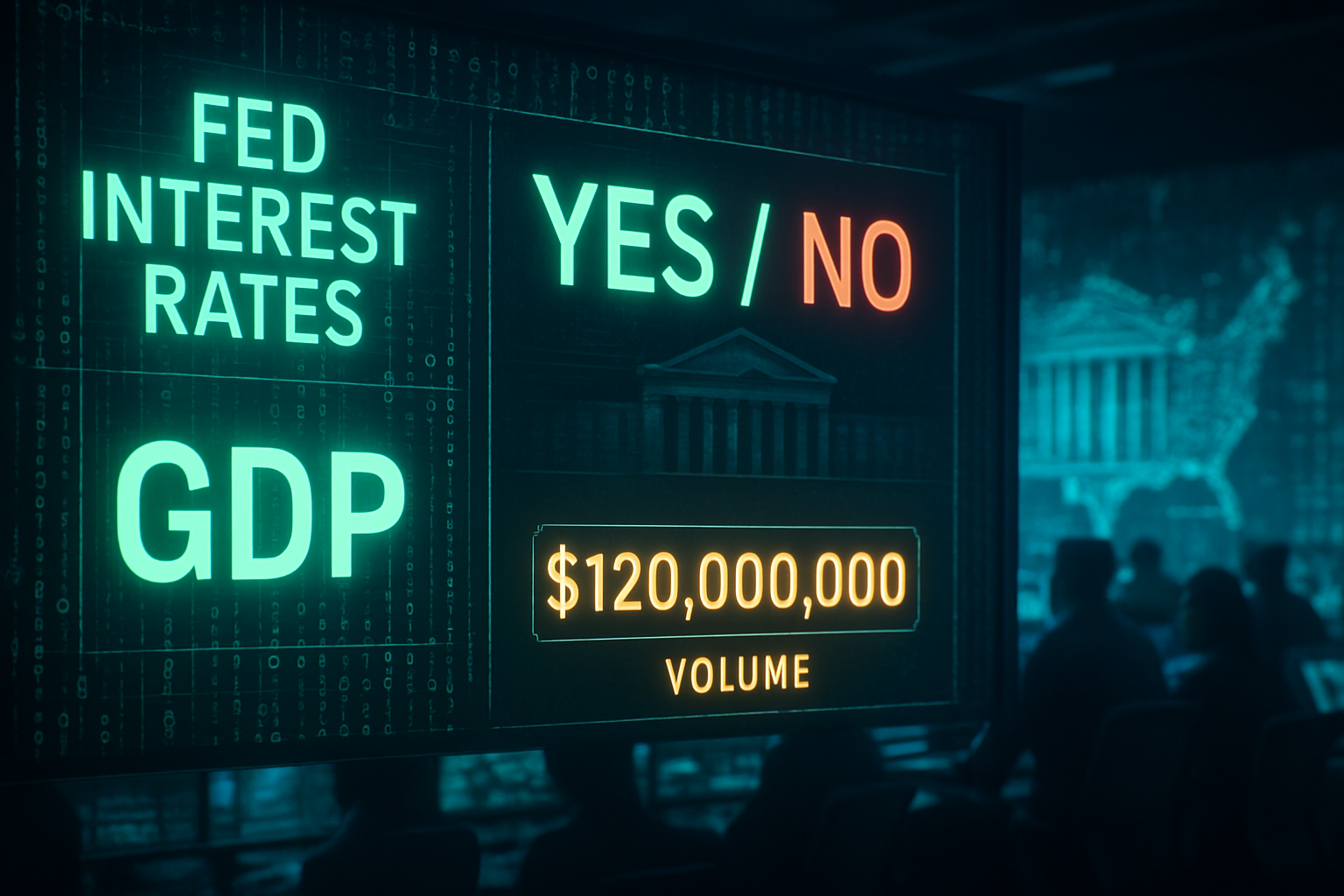
    As of January 15, 2026, the global prediction market landscape has evolved from a speculative niche into a $20 billion pillar of institutional finance. While political elections once provided the primary fuel for these platforms, the focus has shifted decisively toward "hard" macroeconomic data. The centerpiece of this shift is Kalshi’s blockbuster contract, "Will the Fed cut rates in March 2026?", which has just crossed a staggering $120 million in trading volume.

    Currently, the market reflects a cautious consensus. Traders are pricing in a 95% probability that the Federal Reserve will maintain current rates during the upcoming January 28 meeting, but the March contract is where the real battle is being fought. With professional desks and retail investors alike pouring capital into these binary options, prediction markets are no longer just guessing games—they are serving as the "truth engine" for the modern economy.

    The Market: What's Being Predicted

    The headline event for the first quarter of 2026 is the Federal Reserve’s interest rate trajectory. On Kalshi, the flagship "Will the Fed cut rates in March?" contract has become one of the most liquid financial instruments in the event-trading space. Unlike traditional interest rate futures traded on the CME Group (NASDAQ: CME), which involve complex calculations of the effective federal funds rate, Kalshi’s contracts are legally structured binary derivatives. They pay out $1 if the event occurs and $0 if it does not, making the trading price a direct proxy for the market-implied probability.

    The liquidity in this market is unprecedented. The $120 million volume in the March contract is supported by a mix of institutional "whales" and a massive influx of retail traders following the platform's 2025 integration with Robinhood Markets (NASDAQ: HOOD). Resolution is straightforward: the market settles based on the official post-meeting statement from the Federal Open Market Committee (FOMC). If the Fed announces a cut of at least 25 basis points, "Yes" contracts pay out; if they hold or hike, "No" contracts take the pot.

    Why Traders Are Betting

    The surge in volume isn't just driven by retail enthusiasm; it is powered by professional firms like Susquehanna and DRW, alongside hedge funds such as Saba Capital. These entities use Kalshi to hedge "tail risk"—extreme events that traditional bond or equity hedges might fail to cover. For instance, if a portfolio is heavily exposed to high-duration Treasuries, a surprise "no cut" in March could be devastating. By buying "No" contracts on Kalshi, these firms create a direct, linear hedge against a hawkish Fed.

    Furthermore, these markets are proving to be more agile than traditional forecasting. While the Atlanta Fed’s GDPNow model recently estimated Q4 2025 growth at a robust 5.3%, Kalshi’s "GDP Print" markets have consistently traded at a more conservative 45-52% probability for a high-growth outcome. Professional traders are betting on this divergence, using prediction markets to exploit what they see as "model lag" in traditional economic indicators. In 2025, Kalshi traders outperformed Wall Street consensus on inflation data by nearly 40%, cementing the platform's reputation for accuracy during periods of high volatility.

    Broader Context and Implications

    The dominance of "hard" economic markets on Kalshi reflects a broader trend: the institutionalization of prediction markets. Because Kalshi is a CFTC-regulated exchange, its contracts are treated as legally structured derivatives, allowing large-scale asset managers like BNY (NYSE: BK) to participate without the regulatory hurdles associated with offshore or decentralized platforms. This legal clarity has allowed prediction markets to steal market share from the traditional CME FedWatch tool, which many traders now view as slower and more volatile.

    This shift also reveals a fundamental change in how public sentiment is measured. Unlike surveys or "nowcasts," prediction markets require participants to put real capital at risk, filtering out noise and focusing on the most likely outcomes. The historical accuracy of these markets throughout late 2025 has turned them into a primary source of data for newsrooms and policy makers. When the "hard" markets speak, the financial world now listens with the same intensity it once reserved for Bloomberg terminals or Federal Reserve minutes.

    What to Watch Next

    The immediate focus for traders is the January 28 FOMC meeting. While a "pause" is almost entirely priced in, the language used by the Fed Chair will cause immediate, violent swings in the March cut contract. Every word regarding labor market cooling or stubborn service-sector inflation will be instantly reflected in the Kalshi price.

    Additionally, the release of the final Q4 2025 GDP print in late January will be a major catalyst. If the GDP data aligns with the more cautious prediction market view rather than the optimistic "nowcasts," it could trigger a massive migration of capital away from traditional economic models and into event-based derivatives. Traders should also keep an eye on February’s CPI (Consumer Price Index) release, which will serve as the final major data point before the March Fed decision.

    Bottom Line

    The transition of prediction markets from political novelties to essential macroeconomic tools is now complete. The $120 million volume in Kalshi’s March rate cut contract is a testament to the platform's liquidity and its growing role in the global financial infrastructure. By providing a regulated, binary way to trade on the most important economic indicators, Kalshi has effectively democratized sophisticated hedging strategies.

    As we move toward the March decision, these markets will likely remain the most accurate barometer of economic reality. Whether the Fed cuts or holds, the real winner in 2026 is the prediction market itself, which has finally proven that the "wisdom of the crowd"—when backed by $120 million—is a force that even the most established financial institutions can no longer ignore.


    This article is for informational purposes only and does not constitute financial or betting advice. Prediction market participation may be subject to legal restrictions in your jurisdiction.

    PredictStreet focuses on covering the latest developments in prediction markets.
    Visit the PredictStreet website at https://www.predictstreet.ai/.

  • The Mirage of Liquidity: Why Analyst ‘DANNY’ Warns Retail Traders are ‘Exit Liquidity’ in Prediction Markets

    The Mirage of Liquidity: Why Analyst ‘DANNY’ Warns Retail Traders are ‘Exit Liquidity’ in Prediction Markets

    In the high-stakes arena of global prediction markets, where fortunes are made and lost on the blink of a headline, a new and sobering narrative is taking hold. As of January 15, 2026, the meteoric rise of platforms like Polymarket has turned prediction trading into a multi-billion dollar industry. However, a growing chorus of analysts is warning that the "wisdom of the crowd" may actually be a sophisticated trap for the unwary.

    Leading this charge is the prominent, albeit pseudonymous, market analyst known as 'DANNY', whose recent report, "99% Will Lose Everything," has sent shockwaves through the trading community. DANNY’s thesis is simple but devastating: the vast majority of retail participants are not trading against the "crowd," but are instead serving as "exit liquidity" for a class of data-rich insiders and professional "Information Whales" who move prices long before the general public even sees the news.

    The Market: What's Being Predicted

    While prediction markets technically allow users to bet on everything from Federal Reserve interest rate hikes to the winners of the 2026 midterm elections, the real "market" currently under scrutiny is the integrity of the platforms themselves. Polymarket, the decentralized heavyweight in the space, has recently seen its legitimacy challenged by a landmark study from Columbia University.

    The study, published in late 2025, utilized a network-based algorithm to trace linked wallet addresses. The findings were staggering: approximately 25% of Polymarket’s total historical volume was identified as wash trading—the act of traders buying and selling to themselves to create a false appearance of high liquidity and interest. In specific high-volatility sectors like sports and global geopolitical events, that figure reportedly spiked to over 45%.

    Currently, the odds on many major contracts are shifting wildly, but analysts like DANNY argue these are "ghost signals." On Polymarket, where volume often reaches hundreds of millions of dollars per week, the "liquidity" that retail traders rely on to enter and exit positions is often an artificial construct designed to lure in small-time bettors. This creates a dangerous environment where price movements do not represent actual sentiment change, but rather a coordinated manipulation of the order book.

    Why Traders Are Betting

    Despite these warnings, the allure of the "big win" remains stronger than ever. Retail traders are often driven by the success stories of "whales" who seem to possess a prophetic ability to time the market. A notable example frequently cited by DANNY is the trader nicknamed "Alpha Raccoon," who reportedly netted over $1.5 million by predicting Alphabet Inc. (NASDAQ:GOOGL) Year in Search results hours before they were made public.

    Similarly, the capture of Venezuelan leader Nicolás Maduro in early January 2026 saw a single anonymous wallet pocket over $400,000 in a matter of hours. These events drive a massive FOMO (Fear Of Missing Out) among retail participants who believe they can catch the next "alpha" signal.

    However, DANNY points out that these are not lucky guesses. "Information Whales" utilize advanced data-scraping tools, real-time news terminals like Bloomberg (Private), and even military-grade intelligence to front-run the market. By the time a retail trader sees a volume spike and decides to jump in, the professional has often already secured the favorable price and is looking for someone to buy their position—the aforementioned "exit liquidity."

    Broader Context and Implications

    The debate over information asymmetry has sparked a regulatory firestorm in Washington. On January 10, 2026, U.S. Representative Ritchie Torres introduced the Public Integrity in Financial Prediction Markets Act of 2026, which aims to curb the influence of non-public information in these markets. The bill follows a Senate inquiry into offshore platforms that operate outside the purview of the Commodity Futures Trading Commission (CFTC).

    The divide between regulated exchanges like Kalshi (Private) and offshore entities like Polymarket is becoming a central theme of the industry. While Kalshi enforces strict anti-insider trading rules for government officials, Polymarket has historically leaned into the philosophy that "insider trading is a feature, not a bug," arguing that it forces information into the price more efficiently.

    This "feature," however, comes at a high cost to public trust. If 25% to 60% of signals are faked or front-run, the prediction market loses its value as a tool for public sentiment and becomes a playground for a new era of digital high-frequency manipulation.

    What to Watch Next

    Traders should keep a close eye on the upcoming regulatory hearings scheduled for late January, where the CFTC is expected to testify regarding the enforcement of wash-trading bans on decentralized protocols. If the "Torres Bill" gains momentum, we could see a massive migration of volume from unregulated platforms to more transparent, audited exchanges.

    Furthermore, new "transparency tools" are being developed by third-party blockchain forensic firms to help retail traders identify wash-trading patterns in real-time. Monitoring wallet clusters—where multiple accounts send funds back and forth to create volume—will be a critical skill for any trader hoping to survive in 2026.

    The next major test for these markets will be the spring 2026 economic data releases. Watch for sudden, high-volume price shifts that occur minutes before official government reports are published; these are the "smoke" that often precedes the fire of insider activity.

    Bottom Line

    The rise of prediction markets as a mainstream financial tool is undeniable, but the warnings from analysts like DANNY suggest that the industry is in a "Wild West" phase where the house—and the whales—always have the advantage. For the retail trader, high volume should no longer be seen as a sign of health, but as a signal for extreme caution.

    Until platforms implement more robust anti-wash-trading protocols and regulators provide a clearer framework for "fair play," the information gap remains a chasm that few retail participants will successfully cross. As DANNY famously put it in his report, "In a market of information, the person with the fastest cable always wins."

    Skepticism, scrutiny of wallet patterns, and a healthy distrust of volume spikes are the only tools retail traders have to avoid becoming the exit liquidity for the next big whale trade.


    This article is for informational purposes only and does not constitute financial or betting advice. Prediction market participation may be subject to legal restrictions in your jurisdiction.

    PredictStreet focuses on covering the latest developments in prediction markets.
    Visit the PredictStreet website at https://www.predictstreet.ai/.
  • The $60 Billion Revolution: How Prediction Markets Outpaced Projections to Challenge the Sports Betting Throne

    The $60 Billion Revolution: How Prediction Markets Outpaced Projections to Challenge the Sports Betting Throne

    As we cross the midpoint of January 2026, the final tallies for the previous year have confirmed a seismic shift in global finance: prediction markets are no longer a niche curiosity for political junkies and crypto-enthusiasts. In 2025, the industry didn't just meet the ambitious $40 billion volume projection set by analysts—it shattered it, recording a staggering $63.5 billion in total notional volume.

    This 302% year-over-year explosion has placed prediction markets on a direct collision course with the $300 billion global sports betting industry. What was once seen as "gambling for nerds" is now being recognized as a sophisticated "Information Finance" ecosystem. Driven by regulatory breakthroughs in the United States and massive retail distribution via major brokerage apps, the probability of prediction markets becoming a permanent, dominant fixture of the financial landscape has moved from a "maybe" to a near-certainty.

    The Market: What's Being Predicted

    The scope of prediction markets expanded dramatically in 2025. While election cycles traditionally provide the largest volume spikes, the market successfully pivoted to "evergreen" categories including economic data, climate events, and, most notably, sports. Leading the charge are Kalshi, the first regulated U.S. prediction exchange, and Polymarket, the decentralized giant that remains a powerhouse in international and crypto-native circles.

    By the end of 2025, the distribution of volume shifted significantly toward regulated event contracts. Kalshi emerged as the surprise volume leader in the final quarter, finishing the year with $23.8 billion in volume, a more than 1,100% increase from 2024. Much of this growth came from their expansion into sports event contracts, which allowed users to trade on the outcome of NFL and NBA games with the transparency and regulatory oversight of a financial derivative rather than a traditional sportsbook.

    Meanwhile, Polymarket maintained its relevance by recording $22.5 billion in volume. Despite losing its dominant market share to regulated U.S. competitors, Polymarket’s liquidity in non-U.S. political events and "culture" markets remains unmatched. The barrier to entry for the average investor vanished in March 2025 when Robinhood (NASDAQ: HOOD) launched its "Prediction Markets Hub" in partnership with Kalshi, instantly putting event contracts into the pockets of over 24 million retail traders.

    Why Traders Are Betting

    The 2025 surge was fueled by a fundamental realization among participants: prediction markets offer better "yield" on information than almost any other asset class. Unlike the stock market, where a company's price is influenced by thousands of variables from interest rates to management changes, a prediction market contract on the Federal Reserve's next rate hike or a specific legislative vote has a clear, binary resolution.

    Traders are also increasingly using these markets as a hedge. For example, in late 2025, businesses sensitive to hurricane damage used Interactive Brokers (NASDAQ: IBKR) and its ForecastEx platform to hedge against climate risks. By buying "Yes" contracts on specific weather events, they created a form of ad-hoc insurance that was more flexible and faster-paying than traditional policies.

    The "whale" activity has also shifted from anonymous crypto wallets to institutional desks. The strategic $2 billion investment by Intercontinental Exchange (NYSE: ICE) into Polymarket in late 2025 signaled that the world's most powerful financial institutions now view the data generated by these markets as a high-fidelity signal for risk management.

    Broader Context and Implications

    The path to $63.5 billion was paved by a landmark regulatory victory in May 2025. After years of litigation, the CFTC officially dropped its appeal against Kalshi, effectively greenlighting the listing of election and political derivatives in the U.S. This decision removed the "grey market" stigma that had plagued the industry since the early days of Intrade and PredictIt.

    This regulatory clarity has allowed prediction markets to begin eating into the market share of traditional sportsbooks like DraftKings (NASDAQ: DKNG) and Flutter Entertainment (NYSE: FLUT). Because event contracts on exchanges like Kalshi are structured as derivatives with lower "vig" (the house take) than traditional sports betting "juice," savvy bettors are migrating toward prediction markets for better pricing.

    Beyond the money, these markets have proven to be the most accurate "source of truth" in a fragmented media landscape. Throughout 2025, prediction market prices consistently front-ran traditional polling and expert commentary on everything from the European central bank decisions to the success of major film releases.

    What to Watch Next

    As we look toward the rest of 2026, the primary catalyst on the horizon is the U.S. Midterm Elections. Early volume for "Control of the House" and "Control of the Senate" contracts is already outpacing the levels seen at this stage in the 2022 and 2024 cycles. Analysts are now projecting that the industry could surpass the $100 billion annual volume milestone by the end of this year.

    The next major milestone to monitor is the potential integration of event contracts into more mainstream retirement and savings products. There is growing talk on Wall Street about "Event-Linked ETFs" that would allow institutional investors to gain exposure to a basket of prediction market outcomes as a non-correlated asset class.

    Furthermore, keep an eye on the "cross-pollination" between sports betting and prediction markets. As more jurisdictions clarify the rules, expect traditional sportsbooks to launch their own exchange-style interfaces to compete with the low-fee models of Kalshi and Robinhood.

    Bottom Line

    The story of 2025 was the year prediction markets grew up. By surpassing the $40 billion projection and hitting $63.5 billion, the industry has proven that the appetite for "trading on the truth" is massive and globally distributed. The integration into platforms like Robinhood has democratized access, making the act of forecasting as simple as buying a share of stock.

    Ultimately, prediction markets are evolving into the world’s most efficient central nervous system. They don’t just offer a place to bet; they provide a real-time, financially-backed consensus on the direction of our society. As we head deeper into 2026, the question is no longer whether prediction markets will rival sports betting, but how long it will take before they surpass it.


    This article is for informational purposes only and does not constitute financial or betting advice. Prediction market participation may be subject to legal restrictions in your jurisdiction.

    PredictStreet focuses on covering the latest developments in prediction markets.
    Visit the PredictStreet website at https://www.predictstreet.ai/.
  • The New Insurance: Institutional Hedging Transforms Prediction Markets into Essential Risk Management Tools

    The New Insurance: Institutional Hedging Transforms Prediction Markets into Essential Risk Management Tools

    As of January 15, 2026, the global financial landscape has witnessed a paradigm shift in how institutional investors manage tail risk and policy uncertainty. What was once dismissed as a niche domain for retail speculators has matured into a sophisticated layer of market infrastructure. Prediction markets, or event contracts, are now being utilized by top-tier hedge funds and quantitative trading desks to isolate and hedge specific regulatory and legislative outcomes that traditional equity and bond markets are often too blunt to capture.

    Leading this institutional charge is Oldenburg Capital Partners, a firm that has become synonymous with the "selective use" of event contracts to navigate macro volatility. By the start of 2026, Oldenburg and its peers have integrated prediction market data directly into their risk-modeling engines. The logic is simple: while a 10-year Treasury note might react to inflation data, a Kalshi contract on the passage of the Digital Asset Market Clarity Act (the "CLARITY Act") provides a direct, high-conviction hedge for a firm's venture exposure to decentralized finance. With total daily trading volume across major platforms hitting a staggering $701.7 million last week, the era of the "prediction market as insurance" has officially arrived.

    The Market: What's Being Predicted

    The core of the institutional boom lies in the diversification of contracts available on platforms like Kalshi and the newly-relaunched U.S. arm of Polymarket. These platforms have moved far beyond election forecasting, offering deep liquidity in "binary" outcomes for SEC rulings, Federal Reserve pivots, and legislative milestones. For instance, the market for the SEC vs. Coinbase appellate decision, currently trading on Kalshi, has seen its "Yes" contract (predicting a Coinbase victory on the "investment contract" definition) hover at 62 cents, implying a 62% probability of a favorable ruling.

    This liquidity is no longer an accident. Following the massive expansion of Interactive Brokers (NASDAQ: IBKR) and its ForecastEx exchange, institutional participation has been incentivized by high collateral yields. IBKR currently offers an estimated 3.83% incentive coupon on the collateral of open event positions, effectively paying firms to provide liquidity. Meanwhile, CME Group (NASDAQ: CME) has entered the fray with 24/7 swap-based event contracts for GDP and CPI benchmarks, bridging the gap between traditional futures and event-driven binary options. Total monthly notional volume for the industry has now stabilized above $13 billion, a ten-fold increase from early 2024 levels.

    Why Traders Are Betting

    The primary driver for firms like Oldenburg Capital Partners and Saba Capital Management is the ability to hedge "policy cliffs." Traditional derivatives—such as credit default swaps or equity puts—often carry significant "noise" from broader market sentiment. In contrast, an event contract allows a fund manager to hedge the exact moment a regulatory shift occurs.

    Boaz Weinstein’s Saba Capital has reportedly used recession-dated contracts on Polymarket to hedge credit market instruments that may be lagging behind shifting economic narratives. "In the traditional market, you're betting on the reaction to an event," says one senior trader at a high-frequency firm. "In prediction markets, you’re betting on the event itself. For a risk manager, that distinction is worth billions."

    Another key factor is the "conviction gap." Institutional desks often find that prediction markets reflect "on-the-ground" legal and political intelligence faster than the stock market. During the recent debates over the GENIUS Act—a stablecoin regulatory bill—prediction market odds shifted 15 points in favor of a "No" vote a full 48 hours before bank stocks began to sell off, providing a critical window for firms to adjust their exposure.

    Broader Context and Implications

    This institutionalization is the result of a hard-fought regulatory evolution. Following landmark legal victories against the CFTC in late 2024, event contracts were codified as a protected class of derivatives. This provided the legal "moat" necessary for massive capital entry from companies like Intercontinental Exchange (NYSE: ICE), the parent of the New York Stock Exchange, which invested nearly $2 billion into Polymarket’s back-end infrastructure in late 2025.

    The real-world implications are profound. Prediction markets are increasingly viewed as a more accurate "source of truth" than traditional polling or expert pundits. Their historical accuracy—most notably during the 2024 U.S. election and the subsequent 2025 debt ceiling negotiations—has earned them the respect of central bankers and policy makers. However, this success has also invited scrutiny. In early 2026, states like New Jersey and Tennessee have issued cease-and-desist orders against certain "Opinion" markets, triggering a "preemption" legal battle that many expect will eventually be settled by the U.S. Supreme Court.

    What to Watch Next

    The immediate focus for the market is the upcoming Q1 2026 legislative calendar. Two major events are expected to move the needle:

    1. The CLARITY Act Vote: Expected in late February, this will determine the regulatory framework for the next decade of digital asset innovation. Prediction markets currently give it a 45% chance of passage.
    2. The 2026 Midterm "Whale" Activity: Large institutional positions are already being built in "Congressional Control" contracts, as firms seek to hedge against potential shifts in corporate tax rates and defense spending.

    Additionally, the market is monitoring the "collateral war" between Interactive Brokers and CME Group. As these giants compete for liquidity, the cost of hedging through event contracts is expected to drop, further attracting traditional asset managers who have previously stayed on the sidelines.

    Bottom Line

    The emergence of prediction markets as an institutional hedging tool marks the end of their "wild west" era. For firms like Oldenburg Capital Partners, these markets are no longer a curiosity—they are a necessity. By providing a clear, binary way to price risks that were previously "unhedgeable," prediction markets have filled a critical gap in the global financial system.

    As we move further into 2026, expect to see the "prediction premium" become a standard metric in macro analysis. Whether it’s a court ruling, a legislative vote, or a central bank decision, the smart money is no longer just watching the news—they are trading the outcome. In a world of increasing political and regulatory volatility, the ability to turn "what if" into a tradable asset is the ultimate competitive advantage.


    This article is for informational purposes only and does not constitute financial or betting advice. Prediction market participation may be subject to legal restrictions in your jurisdiction.

    PredictStreet focuses on covering the latest developments in prediction markets. Visit the PredictStreet website at https://www.predictstreet.ai/.
  • Empire State vs. Event Contracts: The High-Stakes Battle to Regulate Prediction Markets

    Empire State vs. Event Contracts: The High-Stakes Battle to Regulate Prediction Markets

    As of mid-January 2026, a legal and legislative storm is brewing in Albany that could redefine the future of information finance in the United States. New York, a state traditionally at the center of global finance, has become the primary battleground for a clash between state-level gambling regulators and the emerging asset class of prediction markets. Lawmakers are currently weighing aggressive new legislation that seeks to classify event contracts as unlicensed gambling, even as platforms like Kalshi and Polymarket argue they are essential financial tools for hedging risk and discovering truth.

    The tension has reached a fever pitch following several "high-signal" events in early 2026, most notably a controversial "Maduro trade" on Polymarket where a single user reportedly turned $32,000 into $400,000 just hours before a U.S. military raid in Venezuela. This incident has catalyzed federal and state lawmakers to act, with New York residents now caught in the crosshairs of a jurisdictional tug-of-war. On decentralized platforms like Manifold, traders currently give an 81% probability to the theory that federal preemption will eventually shield these markets from state bans, yet the short-term outlook for New York-based traders remains fraught with legal uncertainty.

    The Market: What's Being Predicted

    The "market" currently under the most intense scrutiny isn't a single election or a sporting event, but the legal survival of the platforms themselves in New York. Two major pieces of legislation have defined the landscape in early 2026. The first, Assembly Bill A9251, known as the ORACLE Act (Oversight and Regulation of Activity for Contracts Linked to Events), was re-referred to the Assembly Committee on Consumer Affairs and Protection on January 7, 2026. Sponsored by Assemblymember Clyde Vanel, the bill is a scorched-earth proposal that would ban New Yorkers from trading on any contracts linked to political outcomes, catastrophic events, or the price of individual securities.

    On the other side of the aisle, the New York Prediction Market Regulation Act (Senate Bill S8889), introduced by Senator Jeremy Cooney on January 13, 2026, offers a more moderate path. This bill would treat prediction markets as financial entities rather than gambling houses, requiring them to obtain a license from the Department of Financial Services (DFS). While the ORACLE Act threatens platforms with fines of up to $1 million per day for non-compliance, the Cooney bill seeks to integrate them into the state’s robust financial oversight system.

    Currently, Kalshi is operating in New York under a "litigation stay" after receiving a cease-and-desist letter from the New York State Gaming Commission in late 2025. Kalshi’s legal team argues that because they are a designated contract market (DCM) regulated by the Commodity Futures Trading Commission (CFTC), federal law preempts state gambling statutes. Polymarket, which recently signed a high-profile marketing partnership with the New York Rangers, owned by Madison Square Garden Sports Corp. (NYSE: MSGS), remains in a more precarious "invite-only" status for U.S. users as it navigates the final hurdles of domestic compliance.

    Why Traders Are Betting

    The surge in regulatory pressure has not dampened trading volume; if anything, it has highlighted the unique utility of these markets. The "Maduro trade" of early January became a lightning rod for the debate. Critics, including Representative Ritchie Torres (D-NY), point to the trade as evidence of potential "insider trading" by individuals with non-public information about government operations. However, proponents argue that the market correctly priced in the high probability of the event, providing a more accurate geopolitical forecast than traditional intelligence agencies or news outlets.

    Traders are increasingly using these platforms not just for speculation, but as a hedge against real-world volatility. For instance, institutional traders are reportedly using Kalshi’s "recession" and "interest rate" markets to offset risks that traditional derivatives, often found on the Intercontinental Exchange (NYSE: ICE), may not cover as efficiently. The ability to "bet" on a catastrophe or a regulatory shift is, in financial terms, no different from buying an insurance policy or a credit default swap.

    The primary factor driving the current 81% "preemption" odds on Manifold is the historical precedent of the Commodity Exchange Act (CEA). Legal experts argue that if the federal government (via the CFTC) has authorized a market, a state cannot unilaterally ban it under the guise of "public morality." This has led to a "whale" strategy where large positions are being taken on the belief that Kalshi will win its lawsuit against the NY Gaming Commission, effectively opening the floodgates for fully regulated event trading across the country.

    Broader Context and Implications

    The fight in New York is the tip of the spear for a broader national conversation regarding the distinction between "financial trading" and "gambling." New York Attorney General Letitia James has been a vocal critic, maintaining that if a product "behaves like a bet," it should be subject to the state's strict gambling laws. This stance ignores the information-aggregation benefits that economists call the "wisdom of the crowd," which has consistently outperformed traditional polling and expert analysis in predicting everything from Fed rate hikes to the 2024 election results.

    Enter Representative Ritchie Torres and the Public Integrity in Financial Prediction Markets Act of 2026, introduced on January 9. Unlike the NY State bills which target the platforms, the Torres bill targets the traders—specifically government insiders. By proposing a ban on federal officials trading on markets where they have "material nonpublic information," Torres is essentially treating prediction markets like the stock market. This is a significant move toward legitimization; it suggests that prediction markets are a permanent fixture of the financial landscape that simply requires the same ethical guardrails as Wall Street.

    If New York successfully bans these markets, it could lead to a fragmented "digital wall" across the U.S., where prediction market access depends on one’s GPS coordinates. This "geofencing" reality is already a point of contention, as traders in New Jersey or Connecticut can access markets that their New York neighbors cannot. The historical accuracy of these markets suggests that such a ban would not only hurt traders but would deprive policymakers of a vital source of real-time data.

    What to Watch Next

    The coming weeks are critical for the New York market. On the legislative front, the ORACLE Act (A9251) currently lacks a Senate sponsor. If Senator Jeremy Cooney’s DFS-focused bill (S8889) gains traction instead, it would signal a victory for the "financial trading" camp and provide a roadmap for other states like California and Illinois to follow.

    In the courts, all eyes are on the Southern District of New York, where a ruling on Kalshi’s motion for a preliminary injunction against the Gaming Commission is expected by late February. A win for Kalshi would effectively freeze the state's ability to enforce gambling-based crackdowns on federal-regulated exchanges. Conversely, a loss would likely embolden AG Letitia James to pursue broader enforcement actions against decentralized platforms like Polymarket.

    Finally, keep a close watch on the progress of Representative Torres’ federal bill. While it seeks to limit who can trade, its passage would be a landmark moment for the industry, officially recognizing event contracts as a legitimate financial instrument under the umbrella of "public integrity."

    Bottom Line

    The regulatory struggle in New York is more than a legal dispute; it is an existential battle over the definition of risk. By attempting to shoehorn prediction markets into 20th-century gambling definitions, New York risk stifling a powerful 21st-century tool for price discovery and information clarity. The high probability assigned to "federal preemption" by the markets themselves suggests that traders believe the future of finance is too big for any single state to stop.

    Ultimately, the "Maduro trade" and the resulting Torres bill highlight a shift in the narrative. The question is no longer if prediction markets should exist, but how to ensure they operate with integrity. As 2026 progresses, the outcome of the Empire State’s war on event contracts will likely determine whether prediction markets remain a niche hobby or become the bedrock of the global information economy.


    This article is for informational purposes only and does not constitute financial or betting advice. Prediction market participation may be subject to legal restrictions in your jurisdiction.

    PredictStreet focuses on covering the latest developments in prediction markets.
    Visit the PredictStreet website at https://www.predictstreet.ai/.
  • The Death of the Pollster: How Prediction Markets Seized Narrative Authority from Pollsters

    The Death of the Pollster: How Prediction Markets Seized Narrative Authority from Pollsters

    The 2024 U.S. Presidential Election will be remembered not just for its political outcome, but as the moment the "narrative authority" in American discourse shifted from traditional polling to prediction markets. For decades, the public relied on poll aggregators and pundits to define the "toss-up" nature of elections. However, as the dust settled on the 2024 cycle, a clear winner emerged in the business of information: the markets. While traditional polls remained frozen in a "dead heat" narrative until Election Day, platforms like Polymarket and Kalshi had already moved to a 60% probability for a Trump victory weeks earlier—a signal that proved far more accurate than the "margin of error" hedging of the legacy media.

    As of January 15, 2026, this shift is no longer a fringe theory. It is a structural reality. Prediction markets have moved from the periphery of the crypto world into the core of the global financial system. Today, the probabilities generated by thousands of traders are treated with the same weight as the S&P 500 or Treasury yields. The 2024 election served as the ultimate proof-of-concept, demonstrating that when "skin in the game" meets real-time data, the resulting "wisdom of the crowd" updates faster and more accurately than any 1,000-person phone survey ever could.

    The Market: What's Being Predicted

    The 2024 Presidential Election market was the largest event contract in history, with Polymarket alone processing over $3.6$ billion in volume. During the final stretch in October 2024, the divergence between markets and polls reached a fever pitch. While the New York Times and other legacy outlets described a race within the margin of error, Trump’s odds on Polymarket and Kalshi climbed steadily, peaking between 57% and 67%. This gap led to accusations of market manipulation, but the resolution of the market—a decisive Trump victory—validated the traders' conviction.

    Today, the prediction market landscape has expanded significantly beyond that single election. Major financial institutions have stepped in to provide liquidity and access. Robinhood Markets, Inc. (NASDAQ: HOOD) launched its "Prediction Markets Hub" in early 2025, which has since become the company's fastest-growing business line. Similarly, Interactive Brokers Group, Inc. (NASDAQ: IBKR) integrated event contracts via its ForecastEx exchange, allowing institutional investors to hedge against geopolitical and economic risks. The market is no longer just predicting "who wins," but is now used for forecasting Fed rate decisions, Supreme Court rulings, and even corporate earnings.

    The shift in liquidity has been transformative. In the 2024 cycle, a "whale" making a $10 million bet could move the needle; in 2026, the participation of retail giants like Robinhood means that millions of smaller participants are providing a much "thicker" and more resilient price signal. These markets resolve instantly upon a verifiable event, such as an Associated Press call or a government data release, providing a definitive settlement that eliminates the weeks of post-game punditry that used to follow major events.

    Why Traders Are Betting

    The primary reason prediction markets outperformed polling in the 2024 cycle was the speed of information processing. Traditional polls often suffer from a "reality gap"—the 7 to 14 days it takes to collect, weight, and publish data. Traders, however, react in seconds. A prime example was the June 2024 debate between Joe Biden and Donald Trump. While pundits spent days debating the "optics," Polymarket odds for Biden’s withdrawal from the race surged from 20% to nearly 70% within hours. The polls didn't reflect this massive shift for nearly two weeks, by which time the political reality had already moved on.

    Traders also utilize granular, real-time data that pollsters often ignore. In the final weeks of 2024, "whales" on these platforms were reportedly monitoring early voting returns and voter registration shifts in key swing states like Pennsylvania and Nevada. By pricing in this hard data—rather than relying on "likely voter" models—the markets were able to identify Trump’s under-polled strength. This "information finance" approach allows participants to synthesize disparate signals, from satellite imagery of parking lots to obscure regulatory filings, into a single, actionable price.

    Comparison to traditional methods shows a stark contrast in incentives. A pollster faces little personal financial risk for being wrong if they stay within the "consensus" margin of error. A trader, however, faces immediate financial loss for inaccuracy. This incentive structure forces market participants to strip away personal bias and focus on the most likely outcome. This is why, despite a heavy media narrative favoring a Harris "momentum" story in late 2024, the markets remained skeptical, correctly identifying that the underlying data did not support the hype.

    Broader Context and Implications

    The success of prediction markets in 2024 has led to a total reconfiguration of media and regulation. In 2025, CNN and CNBC followed the lead of financial terminals by signing landmark data-sharing deals with Kalshi. Now, in early 2026, it is common to see live probability tickers during news broadcasts, replacing the outdated "pundit panels." This marks the official transition of prediction markets into the "truth layer" of the internet—a place where public sentiment is quantified rather than guessed.

    However, this transition hasn't been without conflict. We are currently witnessing a "preemption war" in the legal system. Following the landmark Kalshi v. CFTC ruling that legalized election betting at the federal level, several states including Michigan and Nevada attempted to classify these markets as "illegal gambling" in late 2025. A coalition of companies, including Robinhood (NASDAQ: HOOD) and Kalshi, is currently fighting these state-level bans in federal court, arguing that federal oversight by the Commodity Futures Trading Commission (CFTC) preempts state gambling laws.

    Beyond politics, the real-world implications are profound. Corporations are now using these markets to manage risk. For instance, a tech company might buy "Yes" contracts on a specific regulatory crackdown to hedge the potential drop in their stock price. This creates a more stable economic environment where "unforeseeable" events are actually priced in months in advance. The historical accuracy of these markets, particularly since the 2024 pivot, has turned them into an essential tool for both the C-suite and the kitchen table.

    What to Watch Next

    As we look toward the 2026 midterm elections, the focus has shifted to how these markets will handle even more complex local data. We are seeing the emergence of "hyper-local" markets that predict everything from mayoral races to city-level zoning changes. The key milestone to monitor will be the outcome of the current federal court cases regarding state-level bans. If the courts rule in favor of the Prediction Market Coalition by mid-2026, it will clear the way for a truly national, frictionless market.

    Another factor to watch is the integration of Artificial Intelligence into the trading ecosystem. By January 2026, an estimated 40% of prediction market volume is driven by AI agents that can scan thousands of news sources and data points simultaneously. This could lead to even faster market adjustments, potentially moving odds before a human can even read a headline. The interaction between human intuition and AI data processing will be the next frontier in refining the accuracy of these platforms.

    Finally, keep an eye on how traditional pollsters attempt to "market-ize" their own products. We are already seeing some legacy firms launching their own "expert-only" markets to compete with the retail-driven platforms. Whether these closed systems can compete with the massive liquidity of open platforms like Polymarket remains to be seen, but the competition is healthy for the overall goal: more accurate information.

    Bottom Line

    The shift from polling to prediction markets represents the most significant change in how we measure public opinion in a century. The 2024 election was the "Big Bang" for this industry, proving that financial incentives create a more accurate signal than voluntary surveys. By January 2026, the debate is no longer about whether these markets work, but about how far their influence will reach into every facet of our economic and social lives.

    For the average citizen, this means the end of the "polling rollercoaster." Instead of reacting to a single outlier poll that generates a week of anxiety-inducing headlines, we can now look at a stable, liquid market that aggregates all available information into a single number. While markets are not infallible and can still experience volatility, they have proven to be the most reliable compass in an increasingly complex and noisy information landscape.

    The legacy of the 2024 cycle is clear: in the battle for narrative authority, the crowd with skin in the game has won. As we move deeper into 2026, the question is no longer "What do the polls say?" but "Where is the money moving?" The answer to that question has become the most important signal in the world.


    This article is for informational purposes only and does not constitute financial or betting advice. Prediction market participation may be subject to legal restrictions in your jurisdiction.

    PredictStreet focuses on covering the latest developments in prediction markets.
    Visit the PredictStreet website at https://www.predictstreet.ai/.