
Tag: Prediction Markets

  • Truth Engines: How Prediction Markets Are Pricing the Next Chapter of Global Instability

    Truth Engines: How Prediction Markets Are Pricing the Next Chapter of Global Instability

    In the high-stakes world of global diplomacy and macroeconomics, traditional intelligence and polling have often struggled to keep pace with the rapid-fire shifts of the 2020s. However, as of February 8, 2026, a new class of "truth engines" has emerged as the definitive guide for investors navigating a fractured world. Prediction markets, once seen as a niche for political junkies, are now providing the cold, hard data needed to price geopolitical risk—and the latest signals from these markets are painting a picture of strategic stability in the face of long-standing tensions.

    Currently, two major narratives are dominating the boards on platforms like Polymarket and Kalshi. First, despite aggressive posturing in the Middle East, the likelihood of a U.S. military strike on Iran remains remarkably low, with markets pricing only a 5% chance of such an event occurring by the February 13 milestone. Simultaneously, across the Pacific, traders are pricing in a near-certainty: a landslide victory for the Liberal Democratic Party (LDP) in the Japanese general elections, a result that promises to cement Tokyo’s current fiscal and defense trajectories for the foreseeable future.

    The Market: What's Being Predicted

    The geopolitical forecasting landscape has seen an explosion in liquidity throughout early 2026. On the decentralized platform Polymarket, the contract "U.S. Kinetic Action Against Iran before July" has become a primary benchmark for energy traders. While tensions spiked in early January following naval maneuvers in the Arabian Sea, the "no" side of the contract has seen heavy accumulation. Traders are currently pricing the "unlikely" scenario with high confidence; specifically, the market for a strike within the next week (by February 13) sits at a mere 5% probability. This represents a significant decoupling from the more alarmist rhetoric found in some mainstream media outlets.

    In Japan, the prediction markets have been even more decisive. Following the dissolution of the Diet earlier this year, the "Winner of Japanese General Election" contracts on both Kalshi and Polymarket have stayed pinned above 95% for the Liberal Democratic Party (LDP). Market participants aren't just betting on a win; they are betting on the scale of the victory. The "LDP 300+ Seats" contract—referring to the 465-seat Lower House—is currently trading at 82%, suggesting a "supermajority" is the most likely outcome. This high-conviction pricing has turned the election into a "volatility-dampening" event for the Japanese Yen and the Nikkei 225.

    Why Traders Are Betting

    The divergence between the low probability of conflict in Iran and the high-conviction LDP landslide is driven by a series of quiet diplomatic and political maneuvers. In the case of Iran, traders are closely monitoring the high-stakes negotiations currently taking place in Oman. Reports of a potential nuclear framework or a "long-term freeze" agreement between U.S. Special Envoy Steve Witkoff and Iranian officials have led "whale" traders—those with massive positions—to bet heavily against an escalation. This "skin in the game" approach suggests that those with the most to lose believe the diplomatic channel is far more robust than publicly acknowledged.

    Regarding Japan, the LDP's dominance is anchored by the perceived stability under Prime Minister Sanae Takaichi. Investors are betting on her "proactive fiscal policy" and the expansion of Japan's defense capabilities. Defense contractors like Mitsubishi Heavy Industries (TYO: 7011) and Kawasaki Heavy Industries (TYO: 7012) have seen their stock prices correlate closely with the "LDP Landslide" contract prices. Traders see the LDP as the only viable path for a Japan that is increasingly wary of regional security threats, making the landslide prediction more of a mathematical certainty than a political gamble.

    Broader Context and Implications

    This shift toward prediction markets marks the rise of "Information Finance," or InfoFi. Major institutional players, including firms like Susquehanna International Group and DRW, are reportedly utilizing these markets to hedge against "black swan" geopolitical events. For instance, an institutional investor heavily exposed to oil could hedge against a sudden spike in crude prices by taking a "Yes" position on the U.S.-Iran strike contract. If the 5% "long shot" occurs, the prediction market payout helps offset the volatility in the energy markets.

    Furthermore, the accuracy of these markets has begun to eclipse traditional forecasting methods. While political analysts often rely on historical precedent or diplomatic "cheap talk," prediction markets force participants to filter out bias through the threat of financial loss. This "truth engine" effect has made them an essential tool for companies like Toyota Motor Corp (NYSE: TM) and Lockheed Martin Corp (NYSE: LMT), which must plan years in advance for supply chain disruptions or shifts in defense spending. The historical accuracy of these markets during the 2024 U.S. elections and the 2025 European trade disputes has only bolstered their reputation as the most reliable early warning systems available.

    What to Watch Next

    As we approach the February 13 cutoff for the current Iran strike contracts, all eyes will be on the conclusion of the Oman talks. Any breakdown in communication or a sudden tactical provocation in the Persian Gulf could cause the 5% probability to gap upward, creating a "gamma squeeze" effect for those betting on peace. A move from 5% to even 20% would signal a massive shift in the geopolitical consensus and likely trigger a rally in defense-related equities.

    In Japan, the official vote counting is expected to conclude within the next 24 hours. While the landslide is essentially priced in, the exact margin of the LDP victory will dictate the strength of the yen. If the LDP surpasses 310 seats, it would give the Takaichi administration a mandate for more aggressive economic reforms, potentially moving the USD/JPY pair toward the 155.00 level. Investors should watch the "Supermajority" contracts for any last-minute volatility that might suggest a late shift in voter sentiment.

    Bottom Line

    The current state of the prediction markets suggests a world that is pragmatically avoiding the "worst-case scenarios" that often dominate the headlines. With a U.S.-Iran strike deemed highly unlikely (5%) and a stable LDP government in Japan nearly guaranteed, the markets are pricing in a window of relative geopolitical continuity.

    As these "truth engines" continue to mature, they are doing more than just predicting outcomes; they are providing a framework for managing the unmanageable. By turning geopolitical risk into a tradable asset, prediction markets are allowing investors to hedge against instability and find clarity in an increasingly complex global landscape. For now, the "smart money" is betting on the status quo, even if the rhetoric in the streets remains heated.


    This article is for informational purposes only and does not constitute financial or betting advice. Prediction market participation may be subject to legal restrictions in your jurisdiction.

    PredictStreet focuses on covering the latest developments in prediction markets.
    Visit the PredictStreet website at https://www.predictstreet.ai/.

  • The Agentic Spring: Why Prediction Markets Are Betting Big on Claude 5 and the AI Agent Revolution

    The Agentic Spring: Why Prediction Markets Are Betting Big on Claude 5 and the AI Agent Revolution

    As of February 8, 2026, the artificial intelligence sector is moving at a pace that traditional tech journalism can barely track. On Manifold Markets, a leading prediction platform known for its real-time crowdsourced intelligence, a feverish surge of betting activity has centered on the "Agentic Spring." The most watched contract on the site currently gives an 82% probability that Anthropic will release Claude 5 (Sonnet) before the end of March 2026. This surge follows a chaotic first week of February that saw major product launches from both OpenAI and Anthropic, signaling a definitive shift in the industry from passive chatbots to autonomous agentic systems.

    The interest isn't just academic; it’s a reflection of a high-stakes arms race among the "Big Three"—Anthropic, Meta (NASDAQ: META), and OpenAI. While markets for a unified "Agent App" release in February remain cautiously priced at 27%, recent maneuvers by these companies have already begun to fulfill the spirit of these predictions. With traders reacting to technical leaks and internal platform logs, prediction markets have become the de facto front-runner for identifying the next major shift in the AI landscape.

    The Market: What's Being Predicted

    The primary focus for traders right now is the "Claude 5 Release" market on Manifold. Unlike traditional binary options, this market operates as a play-money forecasting tool that has historically sniffed out Anthropic’s product cycles with uncanny accuracy. The odds for a Claude Sonnet 5 release before March 1st skyrocketed from 45% in late January to its current 82% peak. This movement has been accompanied by high trading volume, with thousands of unique participants betting on various granular outcomes, including the model’s performance on software engineering benchmarks.

    Specifically, the resolution criteria for the lead market require an official announcement or public API availability of a model branded as "Claude 5" or "Claude 5 Sonnet." A secondary market is tracking the likelihood of an "Agent App" from the major players, currently at a 43% probability for a launch before the end of Q1. These markets are heavily influenced by recent activity on developer platforms like Alphabet’s (NASDAQ: GOOGL) Google Vertex AI, where traders monitor for new model identifiers.

    Why Traders Are Betting

    The 82% confidence in an imminent Claude 5 release is not based on vibes alone. On February 3, 2026, a technical leak on a cloud provider's error log revealed a model identifier: claude-sonnet-5@20260203. Codenamed "Fennec" internally, this model is rumored to be the successor to the highly successful Claude 4 line. Traders are betting that Anthropic is preparing a "spoiler" release to counter the momentum of Microsoft-backed (NASDAQ: MSFT) OpenAI, which just launched its Frontier platform on February 5.

    Furthermore, the competitive pressure is immense. OpenAI’s recent release of GPT-5.3 Codex—optimized for long-running agentic tasks—has set a new bar for what "AI Agents" should be able to do. Anthropic’s response has already begun with the February 5th rollout of Claude Opus 4.6, which introduced "Agent Teams." Traders are viewing Sonnet 5 as the "efficiency play"—a model that can match the reasoning of the heavyweights while being significantly cheaper to run, making it the perfect engine for mass-market autonomous agents.

    Broader Context and Implications

    This surge in Manifold activity highlights how prediction markets are evolving into an essential tool for the tech sector. While traditional analysts wait for press releases, prediction markets synthesize rumors, GitHub commits, and cloud log leaks into a single, tradable probability. This "real-time gauge" is particularly valuable during the current shift toward the Agentic Era, where the goal is no longer just generating text but performing complex, multi-step actions like managing a legal review or building a full software application autonomously.

    The implications of an 82% probability for Claude 5 are significant for the broader economy. If Anthropic delivers on these expectations, it signals that the cost of "reasoning" is dropping faster than anticipated. This trend is mirrored in Meta’s strategy; Mark Zuckerberg recently highlighted "agentic commerce" as a core pillar of Meta’s 2026 roadmap, aiming to integrate autonomous shopping concierges into WhatsApp and Instagram. Prediction markets are essentially forecasting the death of the "chat box" and the birth of the "AI employee."

    What to Watch Next

    The next three weeks are critical for these markets. The most significant upcoming milestone is the rumored release of Meta’s Llama 4 "Behemoth" in late February. If Meta releases a flagship open-weights model that rivals Claude 5, it could force Anthropic to accelerate its rollout, potentially pushing the March 1st release odds even higher. Traders are also closely watching for any "o-series" updates from OpenAI, specifically an o2 full-scale reasoning engine that could serve as the backbone for more advanced agents.

    Investors and tech enthusiasts should also keep an eye on performance benchmarks. A key Manifold market is currently trading at a 79% chance that Sonnet 5 will outperform the current Opus 4.6 in coding tasks. If early developer previews of Sonnet 5 (under NDAs) begin to leak, expect these odds to consolidate toward 95% or higher. Conversely, if February ends without an Anthropic announcement, we could see one of the largest "market crashes" in recent AI forecasting history.

    Bottom Line

    The 82% odds on Manifold Markets for a Claude 5 release by March suggest that the AI industry is entering its most aggressive competitive phase yet. These markets have moved beyond mere speculation, acting as a sophisticated processing unit for disparate pieces of technical data. Whether it is the "Fennec" leak or the competitive pressure from OpenAI's Frontier, the signal is clear: the wait for the next generation of AI is nearly over.

    As prediction markets continue to outperform traditional forecasting in the tech space, they provide a vital service for those trying to navigate the "Agentic Spring." If the crowd is right, the next few weeks will redefine our relationship with AI—from tools we talk to, to agents that work for us.


    This article is for informational purposes only and does not constitute financial or betting advice. Prediction market participation may be subject to legal restrictions in your jurisdiction.

    PredictStreet focuses on covering the latest developments in prediction markets.
    Visit the PredictStreet website at https://www.predictstreet.ai/.
  • Bitcoin’s $70,000 Tug-of-War: Polymarket Traders Recalibrate as $85,000 Dreams Fade

    Bitcoin’s $70,000 Tug-of-War: Polymarket Traders Recalibrate as $85,000 Dreams Fade

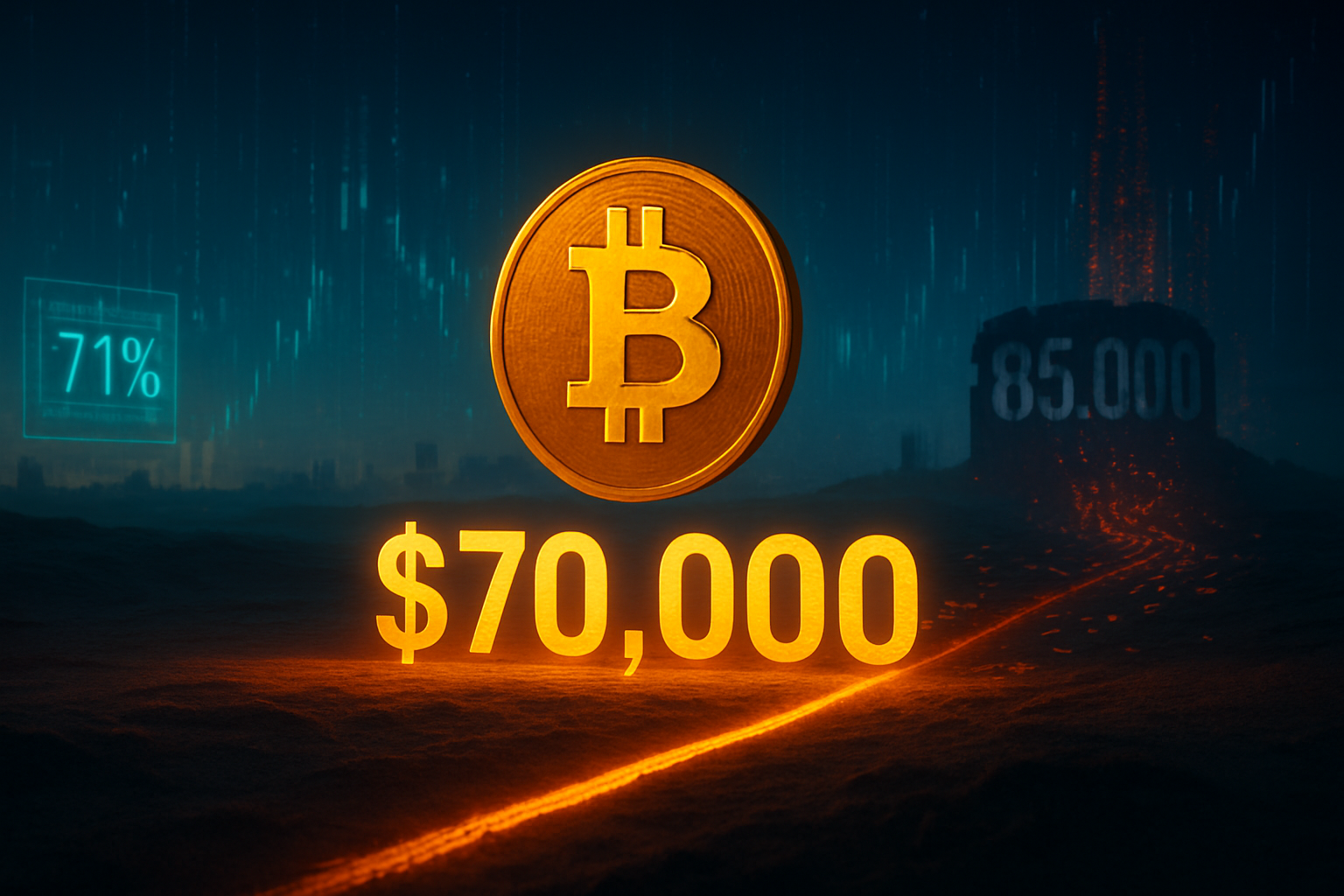
    As of February 8, 2026, Bitcoin is locked in a fierce battle around the $70,000 mark, a level that has become the definitive "line in the sand" for traders on decentralized prediction platforms. On Polymarket, the world’s leading prediction market, the probability of Bitcoin touching $70,000 this month has surged to a commanding 71%, up significantly from 62% just a week ago. This shift signals a consolidation phase after a turbulent start to the year, as the market pivots from aggressive moonshot targets to a more grounded reality.

    The surge in confidence for the $70,000 floor comes at a cost, however. Just weeks ago, traders were pricing in a rapid ascent to $85,000 and beyond. Those upside expectations have since collapsed, with odds for an $85,000 target cratering from nearly 60% in late January to a mere 12-32% today. This dramatic repricing reflects a growing consensus that the "bull-run fever" of late 2025 has cooled, replaced by a range-bound environment dominated by institutional cooling and shifting liquidity.

    The Market: What's Being Predicted

    The current focus of the crypto prediction space is centered on Bitcoin’s February 2026 price action. On Polymarket and its regulated competitor Kalshi, hundreds of millions in volume are being traded across various price-point contracts. The primary contract—"Will Bitcoin touch $70,000 in February?"—is currently the most liquid, with its 71% probability serving as a benchmark for the broader market’s sentiment.

    While the "touch" probability is high, the "settle" probability tells a more nuanced story. Traders are only pricing in a 54% chance that Bitcoin ends the month at or above $75,000, suggesting that while the market expects a push upward, it doesn't necessarily expect a sustained rally. On Kalshi, shorter-term weekly contracts for the mid-February period show even tighter odds, with most participants betting on a price range that keeps the asset pinned between $65,000 and $75,000 through the next ten days.

    Trading volume has spiked as the $70,000 barrier approaches. Liquidity on these platforms has deepened significantly compared to 2024, allowing "whales" to hedge massive spot positions. These markets will resolve based on the price feeds from major exchanges like Coinbase Global, Inc. (NASDAQ: COIN), ensuring a transparent and objective conclusion to the bets at the stroke of midnight on February 28.

    Why Traders Are Betting

    The primary catalyst for this bearish repricing is the unexpected wave of redemptions hitting U.S. Spot Bitcoin ETFs. After a record-breaking 2025, institutional giants like BlackRock, Inc. (NYSE: BLK) are seeing their first sustained period of net outflows. Total assets in these ETFs have plummeted from $128 billion to $97 billion in less than a month, with over $2.8 billion in net redemptions recorded in the last two weeks of January alone.

    This "mechanical" selling pressure has changed the game for prediction market traders. Analysts note that the average purchase price for many institutional entrants sits between $84,000 and $88,000. With Bitcoin trading well below those levels, many of these positions are currently "underwater," triggering automated risk-management protocols that dump supply back onto the market. This explains the "collapse" of the $85,000 upside odds; traders realize that any push toward $80k will likely be met with a massive wall of institutional selling.

    Furthermore, the absence of aggressive "dip buying" during the brief slide to $60,000 in early February has signaled a tactical retreat by Wall Street. Unlike the retail-driven pumps of the past, the current market is heavily influenced by the balance sheets of companies like MicroStrategy Incorporated (NASDAQ: MSTR). When these major players go quiet, prediction market odds quickly reflect the lack of upward momentum, leading to the current $65,000-$85,000 implied range.

    Broader Context and Implications

    This shift in Polymarket sentiment highlights the evolution of prediction markets as a leading indicator for the broader financial world. Traditionally, investors looked to the futures and options markets on the CME to gauge sentiment. However, the "wisdom of the crowd" on Polymarket has often been faster to price in the impact of ETF flows than traditional analysts. The 71% probability for a $70,000 touch acts as a psychological anchor, potentially creating a self-fulfilling prophecy as retail traders align their strategies with the "prediction market consensus."

    Real-world implications are significant. The failure to reclaim the $85,000 level could signal a broader "cooling off" period for the entire digital asset class. If Bitcoin cannot maintain the $70,000 support, it may validate the fears of skeptics who argue that the 2025 rally was overextended. This market sentiment also affects the regulatory landscape, as agencies monitor these prediction markets for signs of manipulation or as gauges of financial stability in the crypto ecosystem.

    Historically, Polymarket has been remarkably accurate in predicting Bitcoin "floors" during periods of high volatility. In mid-2025, the platform correctly priced in a 15% correction three weeks before it hit the mainstream news. Traders now view these markets not just as a place to bet, but as a crucial data point for risk management in a world where crypto and traditional finance are increasingly intertwined.

    What to Watch Next

    As we move toward mid-February, several key milestones will determine if the $70,000 "line in the sand" holds. Traders are keeping a close eye on the next round of 13F filings and weekly ETF flow reports. If redemptions from funds like the Grayscale Bitcoin Trust (OTC: GBTC) begin to slow, the 71% probability of hitting $70,000 could quickly transform into a bet on a $75,000 breakout.

    Key dates to monitor include the February 15 "options expiry," which often brings heightened volatility. If Bitcoin is still hovering near $68,000 by that date, the probability of a late-month surge will likely drop, and we could see the $65,000 support tested once again. Polymarket traders are currently pricing a 57% chance of a retest of $65,000 before the month is out, making the next 10 days critical for the asset's short-term trajectory.

    Bottom Line

    The current state of the Bitcoin prediction markets on Polymarket reflects a market in transition. The exuberant $85,000 targets of last month have vanished, replaced by a calculated focus on the $70,000 pivot point. With a 71% probability of touching that mark, the crowd is betting on resilience, but the underlying data—fueled by massive ETF outflows—suggests that any recovery will be a slow, arduous climb.

    This episode serves as a powerful reminder of the utility of prediction markets. While traditional price targets often remain static, prediction market odds are dynamic, reacting in real-time to every billion-dollar outflow and every shift in institutional sentiment. For now, the "line in the sand" is drawn at $70,000, and the coming weeks will reveal whether that line is built on stone or shifting sand.


    This article is for informational purposes only and does not constitute financial or betting advice. Prediction market participation may be subject to legal restrictions in your jurisdiction.

    PredictStreet focuses on covering the latest developments in prediction markets.
    Visit the PredictStreet website at https://www.predictstreet.ai/.

  • The Prediction Market ‘Civil War’: Polymarket and Kalshi Battle for 2026 Dominance

    The Prediction Market ‘Civil War’: Polymarket and Kalshi Battle for 2026 Dominance

    As the prediction market industry enters its most volatile and high-stakes year to date, the internal rivalry between the sector’s two largest titans has spilled over into the markets themselves. On Manifold Markets, a high-liquidity "meta-market" titled "Top 1 prediction market by volume in 2026?" has become the primary scoreboard for what insiders are calling the "Civil War" of forecasting platforms. This contract allows traders to bet on which platform—the decentralized, crypto-native Polymarket or the CFTC-regulated Kalshi—will emerge as the undisputed volume leader by the end of the year.

    As of February 8, 2026, Polymarket holds a commanding 47% lead in the odds, while Kalshi trails at 34%. This 13-point gap reflects a significant shift in market sentiment over the last month, driven by a series of massive institutional investments and regulatory pivots that have fundamentally altered the landscape. For industry watchers, this market is more than just a bet; it is a real-time proxy for the future of information finance, pitting the speed of blockchain-based markets against the institutional legitimacy of regulated exchanges.

    The Market: What's Being Predicted

    The "Civil War" contract on Manifold Markets focuses on one primary metric: total USD-equivalent trading volume for the 2026 calendar year. While Manifold is technically a play-money platform, the market has attracted significant liquidity, with over $50 million in notional value traded on this specific question. The resolution criteria are strict, requiring the winner to be determined by verified third-party data from sources like The Block or CoinGecko, as well as official transparency reports from the platforms themselves.

    Currently, the market favors Polymarket at 47%. This lead is bolstered by Polymarket’s massive international reach and its dominance in "high-signal" event contracts—specifically geopolitics, tech milestones, and global macroeconomics. Meanwhile, Kalshi’s 34% probability reflects its growing but narrower focus on the U.S. retail sector. Interestingly, the market excludes "pure sports betting" from the volume count to maintain a focus on event-based forecasting. This is a critical distinction, as recent reports indicate that roughly 91% of Kalshi’s raw volume in early 2026 has been driven by its new sports-integrated contracts.

    Trading volume on this meta-market has spiked following the announcement of a $2 billion institutional investment in Polymarket by Intercontinental Exchange (NYSE: ICE). This move signalized to traders that Polymarket is no longer a niche crypto experiment but a serious contender for global financial infrastructure. The liquidity in the "Civil War" market is so high that several hedge funds are reportedly using it as a hedge against their equity positions in traditional exchange stocks.

    Why Traders Are Betting

    The 47-to-34 split in odds represents a fundamental debate over the "on-ramp" of the future. Polymarket bulls point to the platform's recent partnership with Circle, which transitioned the exchange to native USDC. This move provided institution-grade settlement infrastructure, making it easier for large-scale traders to move millions into prediction markets without the friction of bridging assets. The inclusion of native dollar-denominated stability has neutralized one of Kalshi’s biggest historical advantages: ease of use for non-crypto users.

    Conversely, those backing Kalshi argue that its integration with popular apps like Sleeper, which has over 10 million users, will eventually swamp Polymarket’s volume. By routing prediction market orders directly through a popular fantasy sports interface, Kalshi is tapping into a retail base that Polymarket, currently restricted in many jurisdictions, cannot easily access. "Kalshi is building the pipes for the average person," noted one high-volume Manifold trader. "Polymarket is building the engine for the global elite. Historically, volume follows the pipes."

    Whale activity has also moved the needle. Several large positions were opened in early February following a CFTC "innovation-first" agenda announcement, which withdrew several 2024 proposals that sought to ban certain event contracts. This regulatory softening was initially seen as a win for Kalshi, but the market reacted in favor of Polymarket, as traders speculated that a friendlier U.S. environment would eventually allow Polymarket to relaunch a fully regulated U.S. arm, potentially through its partnership with Coinbase Global, Inc. (NASDAQ: COIN).

    Broader Context and Implications

    This "Civil War" meta-market is playing out against a backdrop of intense regulatory scrutiny and a shift in how the public consumes news. Prediction markets are increasingly being used as the primary source of truth for major events, often moving faster than traditional news wires. The outcome of this volume battle will likely dictate which platform becomes the "Bloomberg Terminal of the masses." If Polymarket wins, it validates the decentralized, borderless model of forecasting. If Kalshi wins, it proves that regulatory compliance and traditional financial plumbing are the only way to achieve true scale.

    The stakes are also high for traditional brokerages. Robinhood Markets, Inc. (NASDAQ: HOOD) and Interactive Brokers (NASDAQ: IBKR), via its ForecastEx subsidiary, have been watching the volume growth of these specialized platforms with wary eyes. A dominant victory for either Polymarket or Kalshi could lead to an acquisition spree as traditional firms look to integrate these high-engagement tools into their existing suites.

    However, a new "jurisdictional civil war" is brewing at the state level. While federal regulators have cooled their opposition, state gaming commissions in Massachusetts and Nevada have recently issued cease-and-desist orders to Kalshi, attempting to reclassify event contracts as unlicensed gambling. This legal friction is a major reason why Kalshi’s odds haven’t overtaken Polymarket's, as traders fear a fragmented U.S. market could stifle Kalshi’s growth while Polymarket thrives globally.

    What to Watch Next

    The upcoming week is expected to be a major catalyst for the market. Super Bowl LX on February 8, 2026, will serve as a massive stress test for Kalshi’s infrastructure and its integration with retail apps. While "pure sports" volume is excluded from the Manifold contract, the halo effect of millions of new users joining the platform to bet on the game could lead to a surge in political and economic volume—areas that do count toward the resolution.

    Beyond the Super Bowl, the next major milestone is the Q1 2026 earnings season. While neither platform is currently public, their volume reports will be scrutinized by the traders on Manifold. Any sign that Polymarket’s $2 billion injection from ICE is being used to subsidize trading fees or launch a massive marketing campaign could see its 47% lead expand toward a 60% "super-majority."

    Finally, rumors of a native prediction market launch from Coinbase (NASDAQ: COIN) in late Q1 have pushed the "Other" category in the Manifold market to a 19% probability. If Coinbase enters the fray, the "Civil War" could quickly become a three-way battle, potentially diluting the volume of both leaders and forcing a massive re-pricing of the current odds.

    Bottom Line

    The "Civil War" on Manifold Markets has transformed from a curiosity into a vital industry benchmark. Polymarket’s current 47% lead suggests that the market currently values global reach and institutional backing over Kalshi’s 34% bet on U.S. retail dominance and regulatory alignment. However, with the year only just beginning, the gap remains bridgeable.

    This market reveals that the prediction market industry has matured beyond its experimental phase. We are now in an era of "Info-Finance," where the platforms themselves are the subjects of intense speculation. For traders, the key will be monitoring whether Kalshi can overcome its current state-level legal hurdles or if Polymarket’s crypto-native efficiency will continue to outpace its regulated rival.

    Ultimately, the 2026 volume winner will likely set the standard for the entire industry for the next decade. Whether it is the decentralized giant or the regulated incumbent, the outcome will signal how the world’s information is priced and who owns the "real-time scoreboard" of human knowledge.


    This article is for informational purposes only and does not constitute financial or betting advice. Prediction market participation may be subject to legal restrictions in your jurisdiction.

    PredictStreet focuses on covering the latest developments in prediction markets.
    Visit the PredictStreet website at https://www.predictstreet.ai/.
  • States Launch “Guerrilla War” Against Kalshi: The Legal Battle Reshaping the 2026 Prediction Market Landscape

    States Launch “Guerrilla War” Against Kalshi: The Legal Battle Reshaping the 2026 Prediction Market Landscape

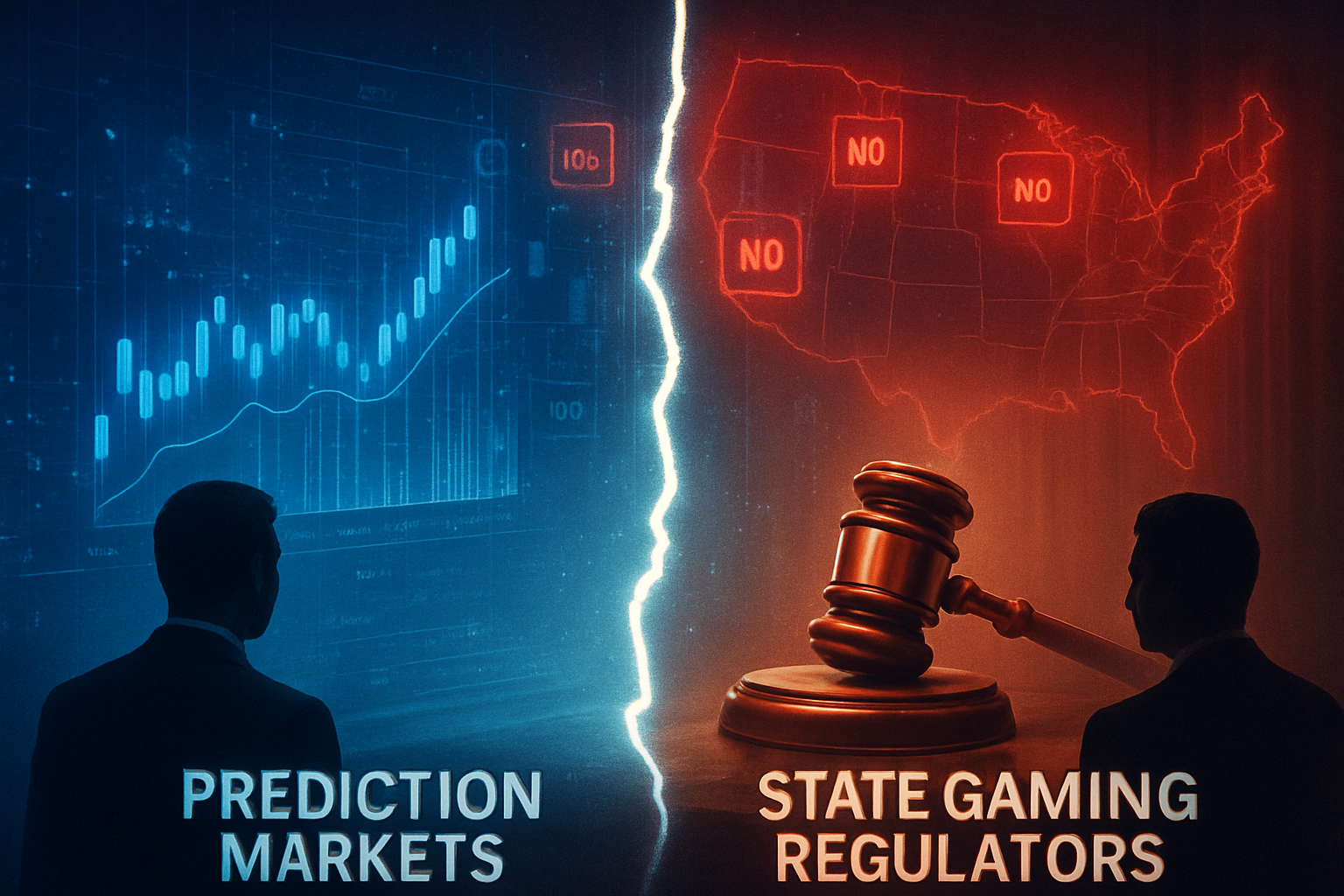
    The high-stakes world of prediction markets is currently facing its most existential threat since the landmark 2024 election cycle. As of February 8, 2026, Kalshi—the first federally regulated prediction market—is locked in what legal scholars are calling a "guerrilla war" with state gaming regulators in Massachusetts, Nevada, and Connecticut. At the heart of the conflict is a fundamental disagreement over the definition of a "contract": Is an event-based prediction a federally protected financial derivative, or is it simply unlicensed gambling?

    Traders are closely watching the fallout, with current market sentiment on peer-to-peer forecasting platforms shifting rapidly. While Kalshi dominated the late 2024 and early 2025 volume cycles, the threat of state-mandated geofencing has caused its probability of maintaining volume leadership for 2026 to slip. For the first time in two years, decentralized rival Polymarket has overtaken Kalshi in "Total 2026 Volume" odds, with traders pricing in a 47% chance for the offshore platform to lead the year, compared to Kalshi’s 34%, as regulatory "indigestion" begins to take its toll on domestic liquidity.

    The Market: What’s Being Predicted

    The primary market under the microscope isn't just a single event contract, but the survival and growth of the regulated prediction market industry itself. Specifically, traders are betting on whether Kalshi can successfully maintain its dominance in the "Sports Event Contract" sector—a category that accounted for a staggering 91.1% of its $9.1 billion trading volume in January 2026.

    On Kalshi’s own platform and institutional dashboards like those offered by Interactive Brokers (NASDAQ: IBKR), liquidity has become fragmented as state-level injunctions take effect. The resolution of this legal friction hinges on several key criteria: the ability of Kalshi to overturn state-level cease-and-desist orders and whether the federal government will intervene to assert preemption over state "police powers." If Kalshi is forced to geofence more than 10 states by the end of Q3 2026, analysts expect a "liquidity crater" that could permanently hand the crown to decentralized competitors.

    Why Traders Are Betting

    The sudden bearishness on Kalshi’s 2026 outlook stems from a series of legal setbacks in early 2026. In late January, Judge Christopher K. Barry-Smith of the Suffolk County Superior Court granted a preliminary injunction in Commonwealth of Massachusetts v. KalshiEX LLC, ruling that Kalshi’s sports-related contracts constitute "unlicensed gambling." The judge’s observation that the interface "mirrors digital gambling experiences" has terrified bulls who believed federal CFTC regulation provided a "bulletproof vest" against state gaming commissions.

    Whale activity has notably shifted toward defensive positions. Large-scale traders are hedging their domestic exposure by moving capital into macro-focused exchanges like ForecastEx, operated by Interactive Brokers (NASDAQ: IBKR), which focuses on non-sports contracts like CPI and interest rates to avoid the "gambling" label. Meanwhile, Robinhood (NASDAQ: HOOD), which previously partnered with Kalshi to offer event markets to its retail base, has seen its stock price face volatility as it weighs the risks of its own upcoming proprietary exchange launch, LedgerX.

    Broader Context and Implications

    This "guerrilla war" represents a classic clash between federal and state authority. While Kalshi remains a Designated Contract Market (DCM) under the oversight of the Commodity Futures Trading Commission (CFTC), states are utilizing the "Gaming Clause" of the Commodity Exchange Act to argue that federal law does not extinguish their right to regulate wagering. This has created a "phantom liquidity" scenario—where national price discovery exists in theory, but is physically blocked for millions of Americans via geofencing.

    The real-world implications are profound. If state regulators succeed in reclassifying these markets as gambling, the dream of a unified, high-liquidity national prediction market may die. Instead, the industry would be forced into the fragmented, state-by-state licensing model used by sportsbooks like DraftKings or FanDuel. Furthermore, Coinbase (NASDAQ: COIN) has entered the fray, proactively suing regulators in Connecticut and Illinois to defend the federal preemption of blockchain-based prediction products, signaling that the entire crypto and fintech ecosystem sees this as a do-or-die moment for digital assets.

    What to Watch Next

    The most immediate catalyst for the market is a high-stakes hearing in Connecticut scheduled for February 12, 2026. Traders view this as a pivotal test for the "federal preemption" defense; a defeat for Kalshi here is expected to trigger a domino effect of geofencing across the Northeast.

    Beyond February, the Ninth Circuit Court of Appeals is scheduled to hear oral arguments in KalshiEX LLC v. Nevada Gaming Control Board in April 2026. This case is particularly significant because Nevada is the epicenter of American gambling regulation. If Kalshi wins in the Ninth Circuit, it could provide the legal precedent needed to halt the state-level "guerrilla war" and restore investor confidence. Conversely, a loss would likely cement Kalshi's status as a regional, rather than national, player for the remainder of the year.

    Bottom Line

    The legal friction between Kalshi and state gaming commissions has transformed the prediction market landscape from a "blue ocean" of growth into a jurisdictional battlefield. While Kalshi’s $9.1 billion volume in January shows the massive appetite for regulated event contracts, the 91.1% concentration in sports contracts has left the platform uniquely vulnerable to state regulators who view any "win-loss" outcome as their exclusive domain.

    Ultimately, the 2026 volume leadership race is no longer just about who has the better app or more markets—it is about who can navigate the complex web of American federalism. If Kalshi cannot secure a "preemption victory" in the coming months, the prediction market industry may face a Great Bifurcation: a regulated, institutional market for macro events, and a decentralized, offshore market for everything else. For now, the "guerrilla war" continues, and the odds of a Kalshi-dominated 2026 are narrowing by the day.


    This article is for informational purposes only and does not constitute financial or betting advice. Prediction market participation may be subject to legal restrictions in your jurisdiction.

    PredictStreet focuses on covering the latest developments in prediction markets.
    Visit the PredictStreet website at https://www.predictstreet.ai/.
  • The End of Bridge Risk: Why the Circle-Polymarket Native USDC Shift is a Watershed Moment for Institutional Forecasting

    The End of Bridge Risk: Why the Circle-Polymarket Native USDC Shift is a Watershed Moment for Institutional Forecasting

    The prediction market landscape shifted significantly this week as the world’s leading forecasting platform, Polymarket, officially commenced its transition to native USDC for on-chain settlement. In a strategic partnership with Circle Internet Group (NYSE: CRCL), the move marks the definitive end of the "bridged asset" era for the platform, replacing the older, more vulnerable USDC.e (bridged USDC) with a direct, regulated dollar instrument issued on the Polygon network.

    The news has sent ripples through the forecasting community, where traders are currently pricing in a record-breaking year for volume. On Manifold Markets, the probability that Polymarket maintains its "Volume Crown" through 2026 has surged to 47%, a 10% jump following the announcement. Investors view this migration not merely as a technical upgrade, but as a critical "de-risking" event that opens the floodgates for large-scale institutional participation.

    The Market: What's Being Predicted

    The primary market capturing the implications of this partnership is the "2026 Global Prediction Volume Leader" contract. Trading across several platforms including Manifold and decentralized forecasting protocols, the market asks which entity will record the highest total trading volume by December 31, 2026.

    As of February 8, 2026, the odds are as follows:

    • Polymarket: 47% (Up from 37% last month)
    • Kalshi: 34%
    • PredictIt: 12%
    • Other (Incentivized DEXs): 7%

    Liquidly in these "meta-markets" has spiked, with over $15 million in total volume traded on the outcome of Polymarket’s dominance alone. The resolution criteria are strictly tied to audited transparency reports and on-chain data. Traders are also closely monitoring the "Super Bowl LX Volume" market, where bets are currently favoring a total handle exceeding $1.5 billion, a figure many believe would be impossible without the capital efficiency gains provided by native USDC.

    Why Traders Are Betting

    The bullish sentiment surrounding Polymarket’s volume is driven by the removal of "bridge risk." Previously, institutions were hesitant to commit hundreds of millions of dollars to a platform relying on Bridged USDC (USDC.e), which depends on the security of third-party bridge protocols. A bridge exploit could theoretically render the collateral worthless, a tail risk that most compliance departments refused to accept.

    "The transition to native USDC is the final green light for the 'big money,'" says one high-frequency trader holding a six-figure position in the Volume Leader market. "We’ve seen reports that DRW and other major liquidity providers are spinning up dedicated prediction market desks. They don't trade in 'wrapped' or 'bridged' assets; they trade in regulated dollars. This move gives them that."

    Furthermore, the recent $2 billion investment from Intercontinental Exchange (NYSE: ICE) into Polymarket has fundamentally changed the platform's profile. With a valuation now nearing $9 billion, the platform is no longer a "crypto-native experiment" but a pillar of the modern financial stack. Traders are betting that the combination of ICE's institutional reach and Circle's native settlement layer will create a feedback loop of liquidity that competitors like Kalshi—which operates in a more restricted regulatory environment—may struggle to match.

    Broader Context and Implications

    The shift highlights a growing divide in the crypto ecosystem between "internet-native finance" and traditional fintech. By integrating native USDC, Polymarket gains access to Circle’s 1:1 redemption pipeline, ensuring that every dollar on the platform is backed by regulated reserves. This reduces technical complexity by removing the multi-step bridging process, which often added friction and hidden costs for professional traders.

    In a joint statement, the leaders of both companies emphasized the long-term vision of this integration. Jeremy Allaire, CEO of Circle, noted:

    "The internet financial system driven by Circle platforms has been built to enable money and capital to work at the speed of the internet. Polymarket has been at the forefront of innovation in marrying the speed of information with the speed of markets."

    Shayne Coplan, CEO of Polymarket, added:

    "Using USDC supports a consistent, dollar-denominated settlement standard that enhances market integrity and reliability as participation on the platform continues to grow. This is about building the foundation for the next decade of global digital markets."

    Analysts at Mizuho (NYSE: MFG) recently upgraded their outlook on the sector, citing the "prediction market effect" as a primary driver for stablecoin velocity. Their report suggests that every major event—from elections to the Super Bowl—now acts as a direct pipeline for native USDC adoption, creating a "sticky" ecosystem where capital remains on-chain rather than cycling back to fiat.

    What to Watch Next

    The immediate focus for the market is the phased rollout of the migration. Key milestones to monitor include:

    1. The "Grand Migration" Deadline: Polymarket has signaled a 90-day window to sunset USDC.e. Any delays in this timeline could cause temporary volatility in the Volume Leader markets.
    2. Institutional Onboarding Announcements: Traders are watching for formal partnerships with Tier-1 banks or market-making firms. If a firm like Goldman Sachs (NYSE: GS) were to announce a partnership for event-contract hedging, Polymarket’s odds of dominance would likely skyrocket toward 80%.
    3. Regulatory Feedback: While the move to native USDC is a step toward "professionalization," regulators at the CFTC continue to monitor the platform’s growth. Any new enforcement actions or restrictive "no-action" letters could flip the market in favor of regulated U.S. exchanges like Kalshi.

    Bottom Line

    The transition to native USDC is more than a backend update; it is a declaration of intent. Polymarket is effectively signaling that it is ready to handle the liquidity of the world's largest financial institutions. For prediction markets, this move addresses the two greatest hurdles to mainstream adoption: technical complexity and counterparty risk.

    As of February 2026, the "Volume Crown" remains Polymarket’s to lose. The platform has successfully leveraged its early-mover advantage and combined it with a robust, institutional-grade settlement layer. While competitors are catching up, the synergy between Circle’s regulated dollar and Polymarket’s peerless forecasting engine has created a formidable moat. For the average trader, this means more liquidity, tighter spreads, and the peace of mind that their collateral is as safe as a dollar in a bank—only faster.


    This article is for informational purposes only and does not constitute financial or betting advice. Prediction market participation may be subject to legal restrictions in your jurisdiction.

    PredictStreet focuses on covering the latest developments in prediction markets.
    Visit the PredictStreet website at https://www.predictstreet.ai/.
  • The Grocery Gambit: Polymarket’s $1 Million NYC Pop-Up Sparks High-Stakes Political Betting

    The Grocery Gambit: Polymarket’s $1 Million NYC Pop-Up Sparks High-Stakes Political Betting

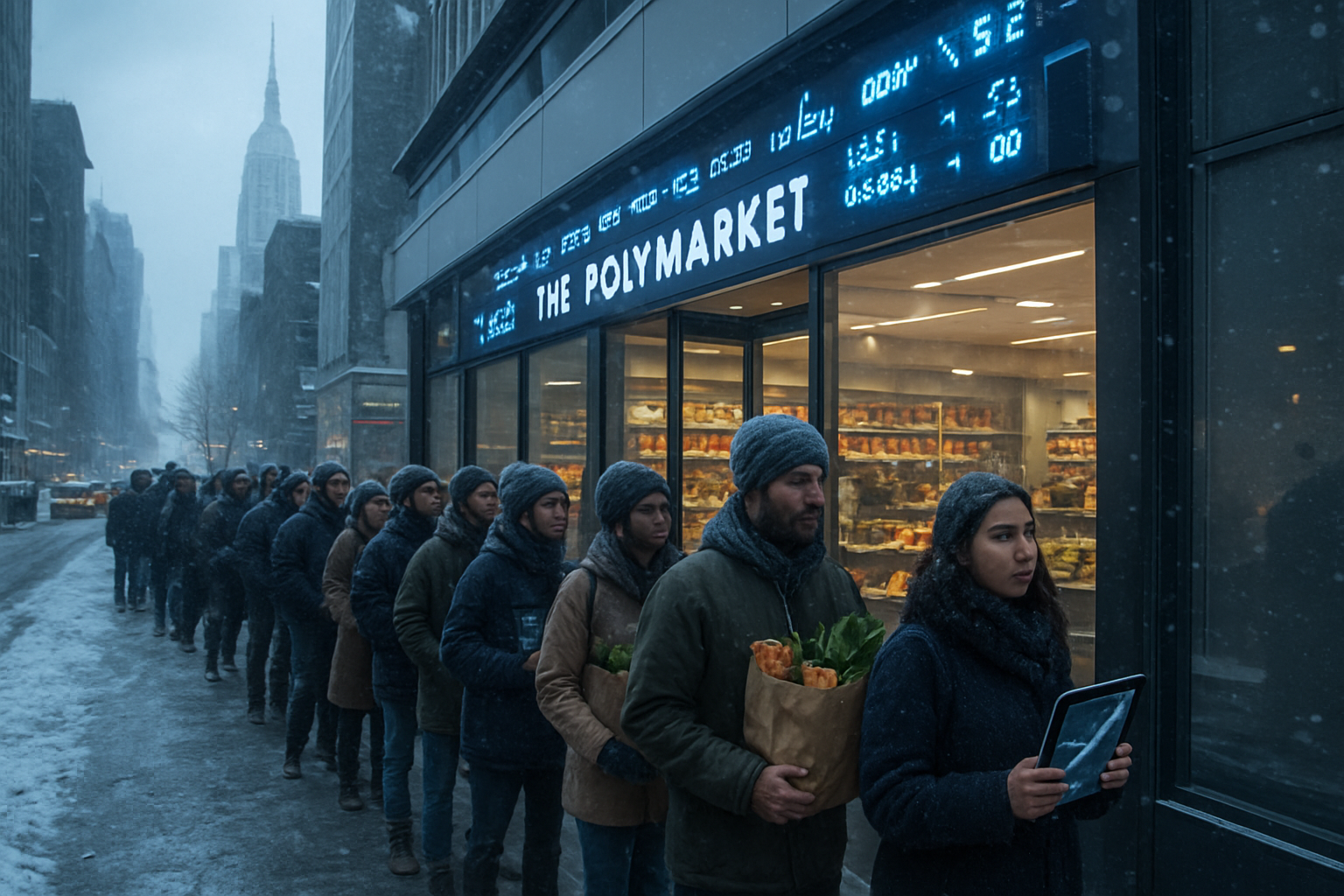
    As of February 8, 2026, the intersection of decentralized finance and urban politics has reached a fever pitch in New York City. Prediction market giant Polymarket has announced a "free grocery store" pop-up in downtown Manhattan, a move that traders are betting will either be a masterstroke of PR or a regulatory lighting rod. Currently, markets on Polymarket and rival Kalshi are pricing in a 68% probability that the "The Polymarket" store will run out of stock before its scheduled closing on February 16, reflecting both the immense demand for free goods and the skepticism surrounding the logistics of this corporate-led "food sovereignty" experiment.

    The event, which includes a massive $1 million donation to the Food Bank for NYC, is widely viewed by traders as a sardonic critique of the city's shifting political landscape. With the recent inauguration of Mayor Zohran Mamdani—a democratic socialist who campaigned on establishing city-run municipal grocery stores—the prediction markets are buzzing. Investors are not just betting on whether the milk stays on the shelves; they are wagering on whether this private-sector "flex" will successfully delegitimize the new administration's signature public policy before it even leaves the pilot phase.

    The Market: What's Being Predicted

    The primary market generating heat is "Will 'The Polymarket' run out of stock before Feb 15?", currently trading on Polymarket with high liquidity. Traders are also eyeing a secondary market on whether the NYC Department of Health will issue a "cease and desist" order to the pop-up before its five-day run concludes. Volume across these event-based contracts has surged to over $4.2 million in the last 48 hours, as New Yorkers and global speculators alike weigh the efficiency of "crypto-philanthropy" against the city’s notoriously stringent health and safety regulations.

    Unlike traditional political betting, these markets are resolved based on verifiable on-the-ground outcomes. Resolution for the "stock-out" market depends on independent journalist verification and social media reports of empty shelves for more than four consecutive hours. Meanwhile, a "meta-market" has emerged regarding the user acquisition rates of prediction platforms: "Will Polymarket's NYC user base grow by >15% in Feb 2026?" This highlights the ultimate goal of the stunt—converting the visibility of the $1 million donation and the free store into a surge of new participants in the prediction ecosystem.

    Why Traders Are Betting

    Traders are leaning into the "logistical chaos" thesis. History shows that free giveaways in high-density urban areas like NYC often face overwhelming demand that outstrips even the most well-funded corporate budgets. The $1 million donation to the Food Bank for NYC—estimated to provide 10 million meals—adds a layer of legitimacy that makes some "Yes" bettors nervous, as it suggests Polymarket has secured the supply chain expertise of established nonprofits.

    However, the political friction is the real driver of the "No" (shutdown) bets. Mayor Zohran Mamdani’s response to the stunt was a masterclass in sardonic politics. Quoting a viral Clickhole headline, Mamdani posted: "Heartbreaking: The Worst Person You Know Just Made A Great Point." While Mamdani acknowledges the desperate need for food security, his administration is reportedly wary of a private entity—especially one frequently at odds with the Commodity Futures Trading Commission (CFTC)—using hunger as a marketing tool. Traders are closely monitoring City Hall’s press briefings, looking for signs that the Department of Health might find a "technical violation" in the store’s refrigeration or labeling to shut down the mockery.

    Broader Context and Implications

    This stunt is a pointed jab at the legacy of former Mayor Eric Adams, whose failed "NYC Token" crypto-initiative left many in the tech sector frustrated by government-led blockchain experiments. By succeeding where the previous administration’s digital assets failed, Polymarket is attempting to prove a broader point: markets can provide immediate, tangible relief more efficiently than bureaucracy. This "free grocery" model is a direct challenge to the municipal grocery store pilot program, a $60 million initiative proposed by the Mamdani administration.

    The real-world implications are stark. If Polymarket can operate a "frictionless" grocery store for five days without the administrative overhead of city-run programs, it strengthens the narrative that decentralized platforms can solve public goods problems. However, critics point out the temporary nature of the stunt. Unlike the proposed city stores, Polymarket’s pop-up is a five-day marketing budget line item, not a sustainable solution. This skepticism is reflected in the markets for "Mamdani’s Municipal Grocer Pilot Success", which have seen a slight dip in confidence as the public gets a taste of private-sector speed.

    What to Watch Next

    The key date to monitor is February 12, the store's opening day. If lines wrap around several city blocks, as expected, the "stock-out" probability will likely climb toward 80%. Conversely, if the Food Bank for NYC’s involvement ensures a steady replenishment of goods, we could see a massive "No" swing. Traders should also watch the social media accounts of the NYC Department of Health. Any mention of an unpermitted "distribution of perishables" could send the "Shutdown" market into a frenzy.

    Furthermore, the competition between Polymarket and Kalshi is heating up. Kalshi recently countered with a $50-per-shopper giveaway at independent retailers, attempting to maintain its status as the "regulated" alternative. Any public company involvement, such as a logistics partnership with United Parcel Service, Inc. (NYSE: UPS) or a supply deal with a major distributor like Sysco Corporation (NYSE: SYY), could provide the store with the operational backbone needed to stay open, significantly moving the odds in the "No stock-out" direction.

    Bottom Line

    Polymarket’s "The Polymarket" pop-up is more than just a giveaway; it is a high-stakes experiment in brand positioning and political commentary. By putting $1 million on the line and mocking the mayor’s signature policy, the platform has turned the act of buying groceries into a tradable event. The markets currently favor a "chaotic success"—one where the store runs out of food due to overwhelming demand but succeeds in dominating the news cycle.

    Ultimately, this event signals a new era for prediction markets, where platforms move beyond just predicting the news and start creating it to test their own market theories. Whether the store remains open or is shuttered by a wary City Hall, the real winner may be the prediction market format itself, which has once again proven its ability to capture the nuance of a complex, politically charged moment in real-time.


    This article is for informational purposes only and does not constitute financial or betting advice. Prediction market participation may be subject to legal restrictions in your jurisdiction.

    PredictStreet focuses on covering the latest developments in prediction markets.
    Visit the PredictStreet website at https://www.predictstreet.ai/.
  • The Return of the King: PredictIt’s ‘Grand Relaunch’ and the $3,500 Revolution

    The Return of the King: PredictIt’s ‘Grand Relaunch’ and the $3,500 Revolution

    The landscape of political forecasting has shifted beneath the feet of Washington insiders and retail traders alike. As of February 2026, the "Grand Relaunch" of PredictIt has officially transformed the platform from an embattled academic experiment into a fully regulated powerhouse known as the Aristotle Exchange. By shedding its restrictive "no-action" status and adopting a Designated Contract Market (DCM) framework, PredictIt has effectively reset the terms of engagement for political handicappers heading into the critical 2026 midterms.

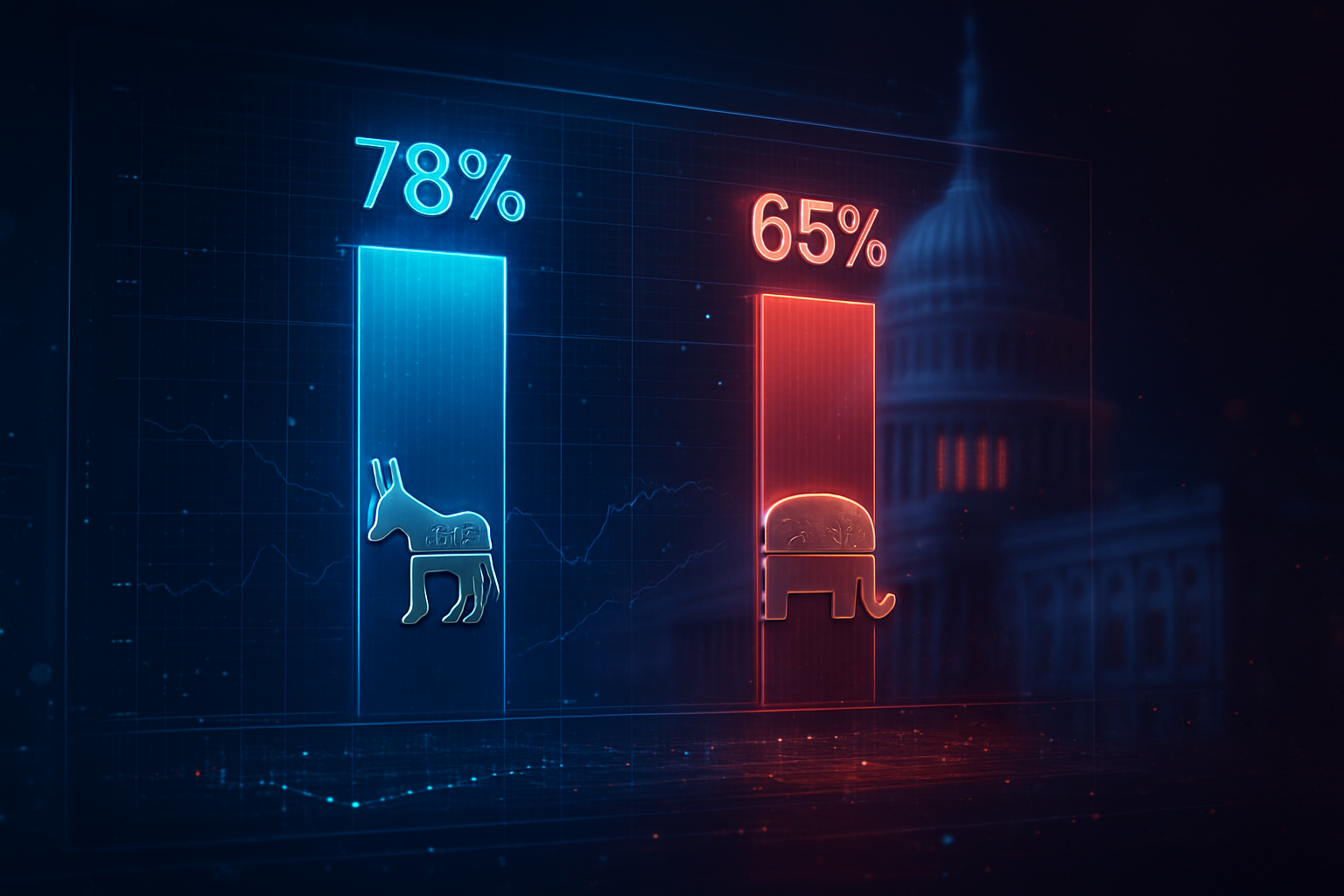
    Currently, the markets are flashing a clear, if divided, signal for the upcoming elections: a 78% probability that Democrats will reclaim the House of Representatives, contrasted with a 65% chance that Republicans will maintain their grip on the Senate. This divergence is driving record-breaking volume to the newly revamped platform, as traders move quickly to capitalize on the highest investment limits in PredictIt’s history. The platform’s transition marks a new era where political sentiment is not just polled, but priced with professional-grade precision.

    The Market: What's Being Predicted

    The centerpiece of the "Grand Relaunch" is the move to the Aristotle Exchange, a transition that has fundamentally altered the mechanics of political betting. For years, PredictIt was hamstrung by an $850 individual investment limit and a 5,000-trader cap per contract—rules that often led to "sold out" markets and distorted prices. Under the new DCM status, the investment limit has been quadrupled to $3,500, and the trader cap has been abolished entirely. This allows for deeper liquidity and ensures that prices more accurately reflect the aggregate wisdom of the crowd rather than just the first few thousand people to the gate.

    To handle this influx of capital, the exchange has integrated the Eqlipse Clearing technology from Nasdaq (NASDAQ: NDAQ), providing a level of institutional reliability previously unseen in the political prediction space. The 2026 midterm contracts are the first major test of this infrastructure. Currently, the "Party Control of the House" market is trading at 78 cents for Democratic control, while the "Senate Majority" market remains more competitive, with Republican shares hovering at 65 cents. These contracts are set to resolve following the certification of the November 2026 election results, providing a multi-billion dollar real-time barometer of the national mood.

    Why Traders Are Betting

    The surge in activity is driven by a combination of regulatory certainty and the historic stakes of the 2026 cycle. Previously, many large-scale traders avoided PredictIt due to the legal "gray area" created by its long-running battle with the CFTC. Now, with a permanent license in hand, "whales" who previously occupied the shadows are entering the fray. The $3,500 limit, while still retail-focused compared to traditional futures markets, is enough to allow sophisticated handicappers to build meaningful positions across dozens of individual race markets.

    Traders are currently leaning heavily into the "House Flip" narrative, largely based on the historical precedent that the president's party almost always faces setbacks in the first midterm of a second term (or the second midterm of a long tenure). However, the 65% odds for a Republican Senate suggest that the "GOP Firewall" in key states like Texas and Iowa remains formidable. Strategists are using these markets to hedge against potential policy shifts, as a divided government would likely stall any major legislative agendas regarding tax reform or climate spending through 2028.

    Broader Context and Implications

    PredictIt’s evolution is part of a broader "Prediction Market Arms Race." While PredictIt has captured the traditionalist and academic crowd, it faces stiff competition from Kalshi, which has marketed itself as the "Wall Street" of events, and Polymarket, which recently secured a massive $2 billion investment from the Intercontinental Exchange (NYSE: ICE). The fact that the parent company of the New York Stock Exchange is now backing a primary competitor highlights how mainstream this asset class has become.

    Beyond the numbers, these markets reveal a deepening skepticism toward traditional polling. In the 2024 cycle, prediction markets famously front-ran polling shifts in swing states, a trend that traders expect to continue in 2026. The move to a DCM model also brings PredictIt under stricter oversight, requiring enhanced transparency and anti-manipulation protocols. This regulatory "clean-up" is essential for the industry's survival, as it positions prediction markets as a legitimate financial tool rather than a niche gambling product.

    What to Watch Next

    As we move deeper into the 2026 primary season, several key milestones will likely trigger volatility in the House and Senate markets. First, the filing deadlines in March and April will clarify the candidate fields, particularly in "toss-up" districts where incumbent retirements could cause double-digit swings in the odds. Any movement in the 78% House probability will likely be tied to these candidate quality assessments.

    Furthermore, economic indicators—specifically inflation data and consumer sentiment—will serve as the primary "macro" drivers for the midterm markets. If the Federal Reserve continues its current path of interest rate stabilization, the 65% Republican Senate lead may soften as the "incumbent penalty" decreases. Conversely, any economic shock would likely solidify the Democratic House advantage. Traders should also watch for the launch of "Individual Seat" markets, which will offer the granular data that professional political consultants now rely on more than internal polling.

    Bottom Line

    The "Grand Relaunch" has successfully reclaimed PredictIt’s position at the top of the political forecasting hierarchy. By increasing limits and professionalizing its backend through the Aristotle Exchange, the platform has solved the liquidity issues that plagued its previous iteration. The current 78/65 split for the House and Senate provides a fascinating roadmap for the next two years of American governance, suggesting a return to the "gridlock" that markets often prefer.

    Ultimately, the transformation of PredictIt into a regulated financial exchange is a win for the entire "Information Finance" sector. It proves that there is a sustainable, legal path for event-based trading in the United States. Whether the 78% Democratic House probability holds or fails, the real winner is the market itself, which has finally found a way to turn political uncertainty into a transparent, tradable, and highly accurate forecasting engine.


    This article is for informational purposes only and does not constitute financial or betting advice. Prediction market participation may be subject to legal restrictions in your jurisdiction.

    PredictStreet focuses on covering the latest developments in prediction markets.
    Visit the PredictStreet website at https://www.predictstreet.ai/.

  • The Greek Freak Becomes a Shareholder: Giannis Antetokounmpo Joins Kalshi as ‘Financialization of Everything’ Hits the NBA

    The Greek Freak Becomes a Shareholder: Giannis Antetokounmpo Joins Kalshi as ‘Financialization of Everything’ Hits the NBA

    The intersection of professional sports and prediction markets reached a fever pitch this week as Milwaukee Bucks superstar Giannis Antetokounmpo officially joined Kalshi as a major shareholder. The announcement, made on February 6, 2026, through his family office and investment arm, Ante Inc., has sent shockwaves through both the financial and athletic worlds. With the viral declaration, “We all on Kalshi now,” Antetokounmpo has become the first active NBA legend to take an equity stake in a federally regulated prediction market, signaling a massive shift in how athletes view their influence in the "truth machine" economy.

    While the move has sparked excitement among prediction market enthusiasts, it has also reignited a fierce debate over the ethics of active athletes partnering with platforms that profit from forecasting their own professional futures. On Kalshi, markets predicting Giannis’s next team or the Bucks’ championship odds have seen a 400% surge in trading volume following the news. Traders are currently pricing the probability of Giannis remaining in Milwaukee past the 2026 season at 68%, a figure that has fluctuated wildly as users weigh the impact of his new business interests against his on-court loyalty.

    The Market: What’s Being Predicted

    The "market" in question is two-fold: the specific event-based contracts on Kalshi regarding NBA outcomes and the broader adoption of prediction markets as a mainstream financial tool. Currently, Kalshi is hosting several high-stakes markets directly impacted by the "Giannis Effect." The most active is the "NBA Championship Winner 2026" contract, where the Milwaukee Bucks are currently trading at 14¢ (implying a 14% chance of victory). Following Giannis’s announcement, the liquidity in this market jumped from $2.4 million to over $10 million in 48 hours.

    Trading volume on Kalshi has been hitting record highs, with the platform recently crossing the $15 billion annual volume mark. Unlike traditional sportsbooks, Kalshi operates as a Commodity Futures Trading Commission (CFTC)-regulated exchange, where participants buy and sell "Yes" or "No" contracts on real-world events. The resolution criteria are strictly data-driven; for example, the "Giannis Trade" market resolves based on official NBA transactions registered with the league office by the June 2026 deadline.

    This influx of liquidity is not just about basketball. Traders are using the Giannis partnership as a proxy for Kalshi's overall growth. As the platform moves toward the "everything exchange" model, the odds of Kalshi surpassing DraftKings Inc. (NASDAQ: DKNG) in daily active users by 2027 have risen from 22% to 35% on several secondary prediction platforms.

    Why Traders Are Betting

    Traders are flocking to these markets for several reasons, chief among them being the "insider sentiment" surrounding Giannis. While Kalshi has strictly banned Antetokounmpo from trading in any NBA-related markets to comply with regulatory standards, the public perceives his equity stake as a massive "vote of confidence" in the platform's stability. Bulls in the market argue that Giannis’s involvement will bring a flood of retail liquidity from the sports world into more serious economic and political markets.

    However, the "Greek Freak" is not without his detractors. Skeptics point to the regulatory tightrope Kalshi is walking. By banning the superstar from trading his own sport, Kalshi is attempting to stay ahead of the CFTC’s concerns regarding conflict of interest. Traders on the "No" side of the growth markets argue that a single regulatory crackdown on athlete-shareholders could tank the platform’s momentum.

    Recent news has also influenced the markets: the Bucks' recent three-game losing streak briefly sent the "Giannis stays in Milwaukee" contract tumbling to 55¢ before his shareholder announcement pushed it back up. The "Giannis Effect" is proving to be a powerful, if volatile, market mover, with whale-sized positions being taken by decentralized finance (DeFi) hedge funds looking to capitalize on the convergence of sports and fintech.

    Broader Context and Implications

    The partnership comes at a time when Kalshi’s CEO, Tarek Mansour, is aggressively pushing his philosophy of the "financialization of everything." Mansour views the world as a series of tradable risks and believes that prediction markets are the ultimate "truth machine." By bringing in an athlete of Giannis’s caliber, Mansour is signaling that prediction markets are no longer just for "political junkies" or "finance bros"—they are for everyone who has an opinion on the future.

    This move stands in stark contrast to the dark cloud currently hanging over the NBA. In October 2025, the league was rocked by the arrest of Miami Heat guard Terry Rozier, who was indicted for his alleged role in a prop-betting manipulation scheme. Simultaneously, Portland Trail Blazers head coach Chauncey Billups was linked to a high-stakes poker and money laundering ring. These scandals have made the league hyper-sensitive to any gambling-adjacent activities, making Giannis’s "We all on Kalshi now" statement particularly provocative.

    Critics argue that the line between "financial hedging" and "gambling" is being dangerously blurred. While Mansour defends Kalshi as a tool for price discovery and risk management, the optics of an active player owning a piece of the exchange that hosts markets on his own career milestones are challenging for many to stomach. The broader implication is a future where every move a celebrity makes is a tradable event, potentially incentivizing behavior that aligns with market outcomes rather than competitive integrity.

    What to Watch Next

    The next few months will be a litmus test for the viability of this partnership. All eyes are on the CFTC and the NBA’s disciplinary office. Should the league determine that Giannis’s ownership stake violates collective bargaining agreements regarding gambling interests, he could face unprecedented fines or suspension. A market has already opened on Kalshi titled "Will the NBA fine Giannis over Kalshi stake?"—currently trading at a 40% "Yes" probability.

    Additionally, keep a close watch on the resolution of the Terry Rozier and Chauncey Billups cases. If the courts come down hard on these figures, the political pressure on the NBA to distance itself from all prediction and betting platforms will intensify. Conversely, if Kalshi successfully navigates the 2026 trade deadline without a conflict-of-interest scandal, it could pave the way for other superstars like LeBron James or Kevin Durant to follow suit.

    Finally, the upcoming quarterly volume reports from Kalshi will be the ultimate indicator of whether the Giannis partnership was a masterstroke or a marketing gimmick. If the platform can convert sports fans into regular traders of economic and political contracts, the "financialization of everything" may truly become an unstoppable reality.

    Bottom Line

    The entry of Giannis Antetokounmpo into the prediction market space as a shareholder is a watershed moment for the industry. It validates Tarek Mansour’s vision of a world where opinions are backed by capital, and where the boundaries between sports, finance, and social influence are permanently erased. However, the move is a high-risk gamble that places Giannis at the center of a burgeoning regulatory and ethical firestorm.

    As a tool, prediction markets are proving their resilience and their ability to capture the public imagination in ways traditional finance cannot. Whether they can maintain their integrity in the face of superstar involvement remains to be seen. For now, the markets suggest a future of explosive growth, tempered by the ever-present threat of a regulatory hammer.

    The odds favor a transformative 2026 for Kalshi, but as any seasoned trader knows, the "Greek Freak" has a way of defying the odds—both on the court and on the exchange.


    This article is for informational purposes only and does not constitute financial or betting advice. Prediction market participation may be subject to legal restrictions in your jurisdiction.

    PredictStreet focuses on covering the latest developments in prediction markets.
    Visit the PredictStreet website at https://www.predictstreet.ai/.
  • A Billion-Dollar Kickoff: Super Bowl LX Prediction Markets Hit Record $1B in Trading Volume

    A Billion-Dollar Kickoff: Super Bowl LX Prediction Markets Hit Record $1B in Trading Volume

    As the Seattle Seahawks and New England Patriots prepare to take the field for Super Bowl LX at Levi’s Stadium, the real action is happening on digital ledger boards and order books. In a historic first for the industry, the 2026 Super Bowl has become the most heavily traded sporting event in the history of prediction markets, signaling a fundamental shift in how Americans and global observers hedge against—and profit from—the "Big Game."

    Leading the charge are the two titans of the space: Kalshi and Polymarket. On Kalshi, the first U.S.-regulated exchange to legally offer sports event contracts, trading volume for the game-winner market has surged past $180 million. Meanwhile, Polymarket, the decentralized heavyweight operating internationally, has seen its Super Bowl LX championship market swell to nearly $700 million. Together with smaller niche platforms, the total liquidity poured into this single Sunday matchup has eclipsed the $1 billion mark, dwarfing the volume seen just two years ago.

    The Market: What's Being Predicted

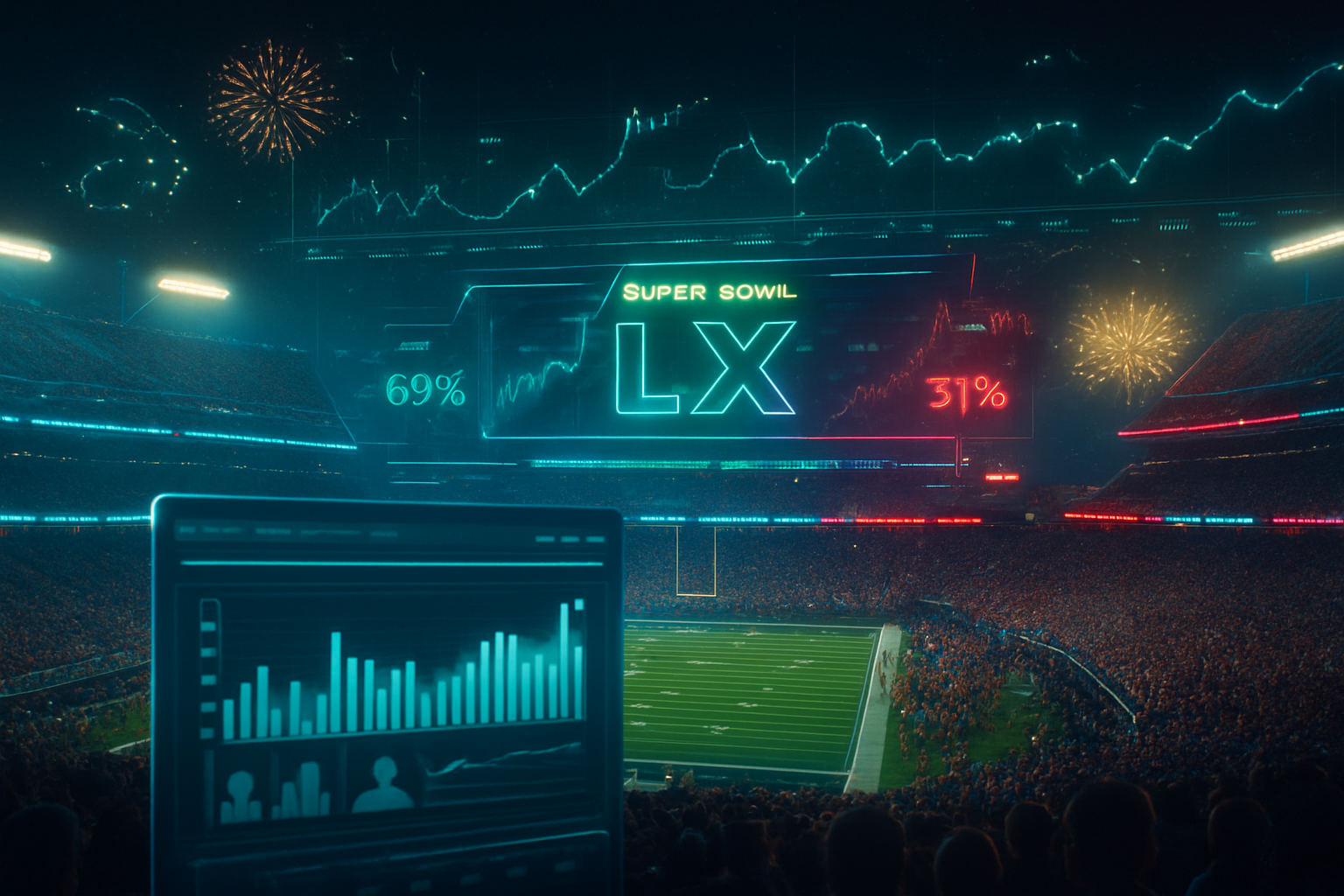
    The central question for traders is simple: Who walks away with the Lombardi Trophy? As of the morning of February 8, 2026, the markets show a rare, high-conviction consensus favoring the Seattle Seahawks. On Kalshi, the Seahawks are trading at a 69% probability of winning, while Polymarket participants are slightly more conservative, pricing them at 68%.

    This divergence, though small, represents millions of dollars in arbitrage opportunity for sophisticated traders. The markets are highly liquid, with "yes" contracts for the Seahawks priced at roughly 69 cents, meaning a $100 bet would return roughly $145 if Seattle triumphs. The resolution criteria are strictly defined by the official NFL score at the end of regulation or overtime, with Kalshi’s contracts clearing through the CFTC-regulated framework that treats these bets as commodity derivatives rather than traditional wagers.

    Why Traders Are Betting

    The massive volume is driven by a compelling narrative: the "Legacy Rematch." Eleven years after the infamous goal-line interception in Super Bowl XLIX, these two franchises meet again with entirely different rosters but equally high stakes. Traders are particularly bullish on Seahawks quarterback Sam Darnold, who has undergone a career-defining renaissance this season. Darnold currently leads the MVP prediction markets with +130 odds, as traders bet that a Seattle win is inextricably linked to his performance.

    On the other side, the New England Patriots, led by the sensational sophomore Drake Maye, are the market’s underdog. Despite the Patriots' superior 17–3 regular-season record, "whales" on Polymarket have been selling New England positions throughout the week. Analysts suggest this is due to concerns over Maye’s youth—he is attempting to become the youngest QB to win a Super Bowl—and the Seahawks’ top-ranked defensive unit.

    Broader Context and Implications

    This Super Bowl marks a defining moment for the prediction market industry. Following a series of landmark legal victories against the CFTC in 2025, Kalshi’s ability to offer "sports event contracts" has been cemented under federal law. This has transformed the Super Bowl from a purely gambling-focused event into a financial one. Institutional players are now using these markets to hedge against regional economic shifts—such as Seattle-based corporations hedging against the productivity dip of a victory parade.

    The regulatory environment has also matured. Under the leadership of the new CFTC Chairman, the federal government has begun treating these markets as essential tools for price discovery. Unlike traditional sportsbooks like DraftKings or FanDuel, which often limit winning players and take a high "vig," prediction markets offer a transparent, peer-to-peer exchange where the "price" is determined solely by supply and demand. This transparency is attracting a new class of "macro-sports" traders who treat the NFL season like the commodities market.

    The presence of public companies in the prop markets further highlights the mainstreaming of this data. Traders are currently moving millions in "novelty props" related to Super Bowl commercials and halftime appearances:

    • Hims & Hers Health, Inc. (NYSE: HIMS): Markets are betting on the reception of their "Rich People Live Longer" ad, which focuses on GLP-1 access.
    • T-Mobile US, Inc. (NASDAQ: TMUS): A highly active market is predicting whether the Backstreet Boys' pink-themed commercial will be ranked in the top three of the post-game "Ad Meter."
    • PepsiCo, Inc. (NASDAQ: PEP): Even as they have stepped back from halftime sponsorship, Pepsi is the subject of high-volume contracts regarding their stadium-wide sustainability initiatives.

    What to Watch Next

    As kickoff approaches, the most volatile markets to monitor will be the Halftime Show props. Current odds suggest a 72% chance that Bad Bunny opens his set with "Tití Me Preguntó." However, a late-breaking rumor about a guest appearance by Lady Gaga (currently at a 61% probability) could send shockwaves through the "Halftime Guest" contracts.

    In-game trading will also be a major factor. For the first time, Kalshi will offer "micro-contracts" during the game, allowing traders to bet on the outcome of individual drives. If the Patriots score an early touchdown, expect the Seahawks' 69% win probability to plummet, creating a "buy the dip" opportunity for Seattle believers.

    Bottom Line

    Super Bowl LX is more than just a championship game; it is the "Proof of Concept" for prediction markets as a global financial infrastructure. With over $180 million on Kalshi and $700 million on Polymarket, the sheer scale of the liquidity proves that the public's appetite for high-stakes, transparent forecasting is insatiable.

    Whether Sam Darnold completes his redemption arc or Drake Maye begins a new dynasty, the real winner today is the market itself. We have moved past the era of the "bookie" and into the era of the "exchange." As the ball is teed up, the world isn't just watching a game—it's watching a billion-dollar live-data experiment unfold in real-time.


    This article is for informational purposes only and does not constitute financial or betting advice. Prediction market participation may be subject to legal restrictions in your jurisdiction.

    PredictStreet focuses on covering the latest developments in prediction markets.
    Visit the PredictStreet website at https://www.predictstreet.ai/.