Tag: Prediction Markets

  • The New Yield Curve: Why Wall Street is Now Following Prediction Markets for Fed and CPI Guidance

    The New Yield Curve: Why Wall Street is Now Following Prediction Markets for Fed and CPI Guidance

    As the Federal Reserve prepares for its first policy meeting of 2026 on January 27–28, a significant shift has occurred in how the financial world anticipates interest rate decisions. The traditional dominance of professional economic surveys and even standard bond-market derivatives is being challenged by prediction markets like Kalshi and Polymarket. For the upcoming January FOMC meeting, prediction markets are currently pricing a "no change" decision with an overwhelming 96% probability, firmly pegging the federal funds rate at its current 3.50%–3.75% range.

    This decisive certainty stands in subtle contrast to traditional instruments. While the CME FedWatch tool, operated by CME Group (NASDAQ: CME), reflects a still-significant 16% chance of a rate cut, prediction market traders have almost entirely written off the possibility of a January move. This divergence is not an anomaly; over the past eighteen months, prediction markets have consistently outpaced institutional forecasts in both speed and accuracy, forcing major players like Goldman Sachs (NYSE: GS) and JPMorgan Chase (NYSE: JPM) to integrate these platforms into their primary research dashboards.

    The Market: What's Being Predicted

    The focus of the current forecasting cycle centers on the "Fed Path" and monthly Consumer Price Index (CPI) data. On Kalshi, a federally regulated exchange, the "January Fed Meeting" contract has seen record-breaking participation from institutional traders. Meanwhile, the decentralized platform Polymarket has seen its January Fed decision volume exceed $425 million, as global participants bet on everything from the specific basis point move to the exact wording used in Chair Jerome Powell’s final few press conferences before his term expires in May.

    Unlike traditional surveys, which provide a "snapshot" of economist sentiment once a month, these markets trade 24/7. This allows them to react instantaneously to breaking news—such as the early January 2026 labor data that showed unemployment stabilizing at 4.5%. While traditional analysts were still revising their notes, prediction market odds for a January "hold" surged from 85% to 96% within minutes of the data release. These markets don't just predict the outcome; they predict the brackets of the outcome, with contracts available for specific CPI increments (e.g., "Will CPI be between 2.6% and 2.7%?").

    Why Traders Are Betting

    The migration of capital toward prediction markets is driven by the concept of "Information Finance." Traders argue that these platforms offer a "truth engine" fueled by "skin in the game." Unlike a bank economist whose compensation is rarely tied directly to the accuracy of a single CPI forecast, a prediction market participant faces an immediate financial loss if they are wrong. This financial incentive filters out the "herding" behavior often seen in institutional forecasts, where analysts are frequently hesitant to deviate too far from the consensus.

    Recent history has validated this approach. In late 2024, Kalshi research demonstrated that their market-based CPI forecasts had a 40.1% lower Mean Absolute Error (MAE) than the Wall Street consensus. When "inflation shocks" occurred—moments where data deviated significantly from expectations—the prediction markets' error was nearly 67% lower than that of professional economists. Wall Street has taken note; firms like Jane Street and Susquehanna International Group have established dedicated desks to arbitrage discrepancies between prediction market odds and traditional interest rate swaps.

    Broader Context and Implications

    The institutionalization of these markets reached a fever pitch in late 2025 when the Intercontinental Exchange (NYSE: ICE), the parent company of the New York Stock Exchange, announced a landmark $2 billion investment in Polymarket. This move signaled that prediction markets are no longer considered "niche betting sites" but are essential financial infrastructure. The utility of these markets extends beyond interest rates; they have become the premier venue for pricing geopolitical risk.

    A recent example of this was the "Maduro Incident" in early January 2026. While mainstream news wires were still verifying reports of a political shift in Venezuela, prediction markets were already repricing global energy costs and interest rate expectations. By the time the news hit the Bloomberg (Private) terminals, the odds of a "hawkish hold" by the Fed had already moved, as traders anticipated the inflationary impact of potential oil supply disruptions. This ability to aggregate disparate, global information in real-time is what makes these platforms indispensable in 2026.

    What to Watch Next

    As we move toward the January 28 FOMC announcement, all eyes remain on the "sticky" PCE inflation data, currently hovering around 2.7%. If the prediction markets hold their 96% conviction of a "pause," any deviation by the Fed would trigger a massive "repricing event" across all asset classes. Traders are also looking toward the March 17-18 meeting, where the odds are currently split: a 79% probability of another hold versus a growing sentiment for a 25-basis-point cut if labor markets show further cooling.

    Beyond the immediate rate decisions, the next major milestone is the nomination of the next Federal Reserve Chair. Prediction markets currently give a 61% probability that the administration will nominate a candidate with a "higher-for-longer" bias, a sentiment that is already beginning to flatten the yield curve in the prediction space for the latter half of 2026. These leadership markets are moving with more fluidity than any political punditry, reflecting real-time shifts in the Washington, D.C. power dynamic.

    Bottom Line

    Prediction markets have fundamentally changed the "alpha" equation for economic forecasting. By providing a 24/7, high-liquidity environment where information is priced instantly, they have exposed the lag inherent in traditional economic models. The 40% accuracy advantage over Wall Street consensus is no longer a statistical fluke—it is a testament to the power of decentralized, incentivized data aggregation.

    For the retail investor and the institutional titan alike, the message is clear: the most accurate "yield curve" in 2026 is no longer found solely in the bond market. It is found in the fluctuating odds of the prediction exchanges. As we approach the end of January, the 96% "hold" consensus on Kalshi and Polymarket suggests that the Fed’s path is already priced in, leaving the "surprises" to those who are still relying on yesterday’s surveys.


    This article is for informational purposes only and does not constitute financial or betting advice. Prediction market participation may be subject to legal restrictions in your jurisdiction.

    PredictStreet focuses on covering the latest developments in prediction markets.
    Visit the PredictStreet website at https://www.predictstreet.ai/.
  • The Emerald City Renaissance: Seattle Seahawks Emerge as Super Bowl LX Favorites as Prediction Market Volume Explodes

    The Emerald City Renaissance: Seattle Seahawks Emerge as Super Bowl LX Favorites as Prediction Market Volume Explodes

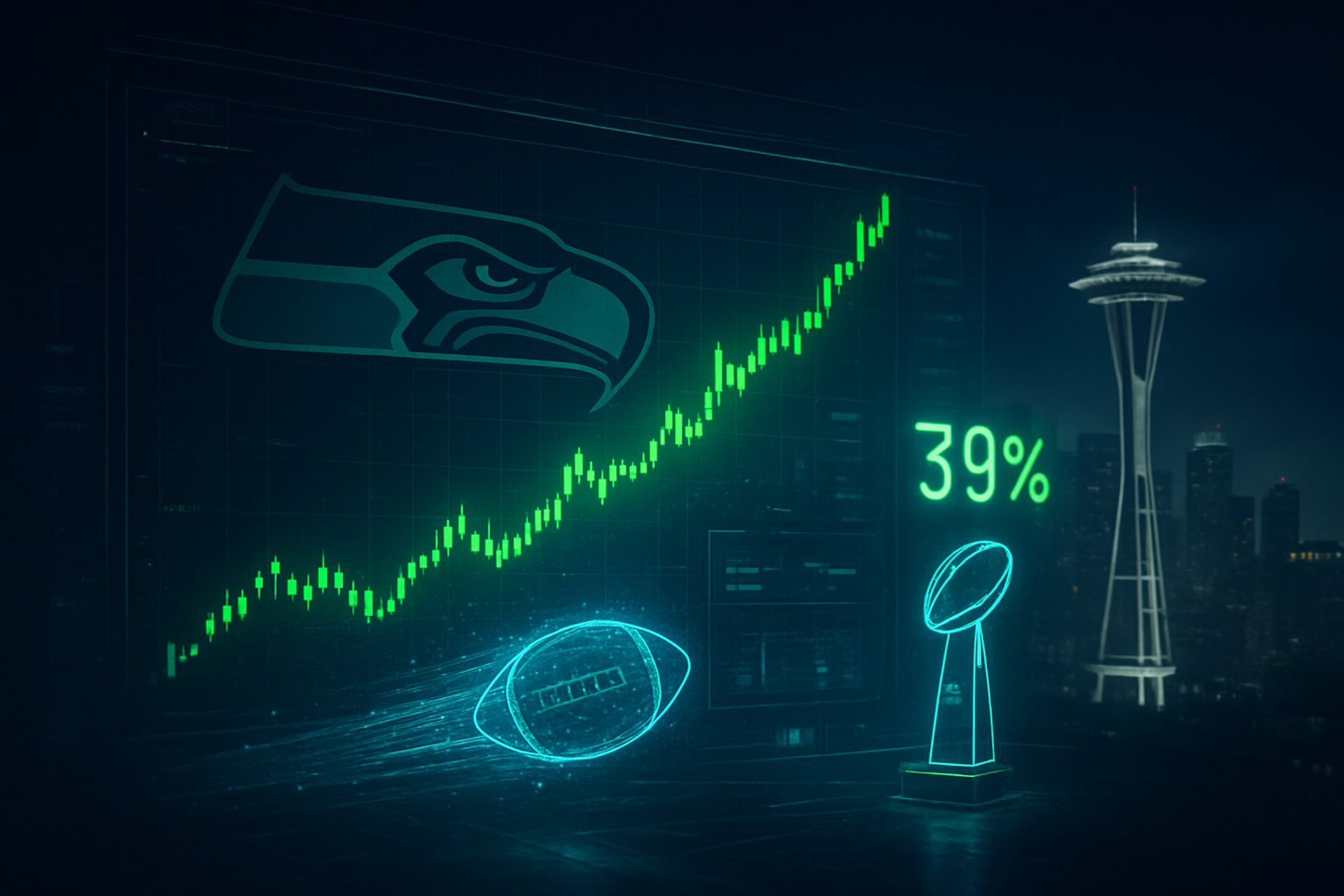
    As the NFL post-season reaches its fever pitch, the prediction market landscape is signaling a seismic shift in the professional football hierarchy. With Super Bowl LX just weeks away, the Seattle Seahawks have defied preseason expectations to become the definitive favorites to lift the Lombardi Trophy. According to the latest data from the regulated prediction exchange Kalshi, the Seahawks currently command a staggering 39% implied probability of winning the championship, trading at $0.39 per contract.

    The surge in Seattle’s odds follows a dominant regular season and a brutalizing performance in the Divisional Round that has captivated both casual fans and sophisticated "sports traders." For a team that many expected to be in a transition year under second-year head coach Mike Macdonald, the Seahawks’ ascension represents one of the most significant market movements in the history of sports-based prediction contracts.

    The Market: What's Being Predicted

    The primary vehicle for this speculation is the "Super Bowl LX Winner" market on Kalshi. Unlike traditional sportsbooks, these markets operate as a binary exchange where contracts pay out $1.00 if the event occurs and $0.00 if it does not. The current price of $0.39 reflects a market consensus that Seattle is significantly more likely to win it all than any other remaining contender.

    The liquidity in this market has reached historic levels. As of January 20, 2026, the Super Bowl winner market has seen over $45 million in total trading volume. In the 24 hours following Seattle’s 41-6 dismantling of the San Francisco 49ers, more than $800,000 in notional volume was traded on the Seahawks' "Yes" contracts alone. This high level of liquidity allows for "whale" positions—trades worth hundreds of thousands of dollars—to be executed without causing the extreme price slippage often seen in lower-volume markets.

    The resolution criteria are straightforward: the market will settle based on the official results of Super Bowl LX, scheduled for February 8, 2026, at Levi’s Stadium. While other platforms like Polymarket have seen similar trends, the domestic, regulated nature of Kalshi has made it the preferred venue for institutional-sized bets on the 2025-2026 NFL season.

    Why Traders Are Betting

    The bullish sentiment surrounding Seattle is backed by a combination of statistical dominance and favorable situational factors. The Seahawks finished the regular season with a franchise-record 14-3 record, securing the No. 1 seed in the NFC. Traders are particularly focused on the "Macdonald Effect." In his second year, head coach Mike Macdonald has successfully installed a defensive scheme that analysts are calling a "reimagined Legion of Boom," with the unit finishing the season ranked No. 1 in both points allowed (17.2 per game) and defensive DVOA.

    On the offensive side, the "Darnold Redemption" arc has provided the necessary volatility for high-upside betting. Quarterback Sam Darnold, playing under a one-year deal, finished second in the NFL in yards per attempt (8.5). While he remains a high-variance player, his chemistry with Jaxon Smith-Njigba—who shattered franchise records with 1,793 receiving yards—has made Seattle’s offense nearly impossible to stop when clicking.

    Market dynamics were also heavily influenced by the collapse of the traditional AFC powers. The Kansas City Chiefs, perennial favorites, were eliminated from playoff contention in December after a season-ending ACL injury to Patrick Mahomes. This "power vacuum" in the AFC, combined with the Seattle defense's ability to shut down high-powered offenses, has funneled capital toward the Seahawks as the safest "long" position in the field.

    Broader Context and Implications

    The rise of the Seahawks as a prediction market darling highlights the growing intersection of sports and fintech. As regulated exchanges like Kalshi continue to gain traction, the "wisdom of the crowd" is increasingly viewed as a more accurate barometer of team strength than traditional polling or even Elo ratings. The speed at which Seattle's odds adjusted after the Mahomes injury and the subsequent 49ers blowout demonstrates the efficiency of these markets in processing real-world news.

    From a corporate perspective, the Seahawks’ success is a boon for the Pacific Northwest economy and its major stakeholders. While the team is owned by the Paul G. Allen Trust, the region’s economic heavyweights, including Microsoft (NASDAQ: MSFT) and Amazon (NASDAQ: AMZN), often see indirect benefits from the increased national spotlight and tourism associated with a deep playoff run. Furthermore, the high viewership expected for the upcoming games is a major driver for Comcast (NASDAQ: CMCSA), whose NBC subsidiary will broadcast Super Bowl LX.

    This market also underscores a shift in how fans engage with the NFL. Rather than placing a one-time wager at a sportsbook, traders are now "hedging" their fandom, buying and selling "shares" of teams as if they were tech stocks. This provides a continuous feedback loop of public sentiment that was previously unavailable to the general public.

    What to Watch Next

    The most immediate catalyst for the market will be the NFC Championship game on January 25, 2026. Seattle is set to host the Los Angeles Rams at Lumen Field. While the Seahawks are favored, the Rams (currently at 27% on Kalshi) have a veteran quarterback and a history of playing Seattle close, having split their regular-season series. A Seahawks win would likely send their Super Bowl contract price soaring toward the $0.55 – $0.60 range.

    Traders should also monitor the health of key Seahawks players. The mid-season acquisition of return specialist Rashid Shaheed from the New Orleans Saints has been a game-changer; any injury to Shaheed or defensive anchors like Devon Witherspoon could cause a sharp correction in the "Yes" contract price.

    Finally, the AFC Championship between the New England Patriots and the Denver Broncos will determine Seattle's ultimate opponent. If the Patriots and their breakout star Drake Maye (currently at 27% probability) advance, the market may tighten, as Maye’s dual-threat capability is seen as the only viable "kryptonite" to Mike Macdonald’s defensive scheme.

    Bottom Line

    The Seattle Seahawks have transitioned from a "surprise contender" to a "market-certified juggernaut." The $0.39 price tag on Kalshi reflects more than just home-field advantage; it reflects a belief in a complete team built on an elite defense and a high-efficiency offense.

    For the prediction market industry, Super Bowl LX represents a milestone in maturity. The tens of millions of dollars in volume and the rapid price discovery seen in the Seahawks’ market suggest that these platforms are no longer just niches for political junkies—they are becoming the definitive scoreboard for the sports world. Whether the Seahawks can fulfill the market's high expectations remains to be seen, but for now, the smart money is firmly planted in the Pacific Northwest.


    This article is for informational purposes only and does not constitute financial or betting advice. Prediction market participation may be subject to legal restrictions in your jurisdiction.

    PredictStreet focuses on covering the latest developments in prediction markets.
    Visit the PredictStreet website at https://www.predictstreet.ai/.
  • Betting on the Ban: New York Lawmakers Propose $1M Daily Fines for “Reckless” Prediction Markets

    Betting on the Ban: New York Lawmakers Propose $1M Daily Fines for “Reckless” Prediction Markets

    As the 2026 legislative session kicks off in Albany, a high-stakes battle is unfolding over the future of decentralized and regulated forecasting in the Empire State. New York lawmakers are currently scrambling to pass legislation that could either legitimize prediction markets as the next frontier of finance or crush them under the weight of "reckless gambling" labels and million-dollar penalties. At the center of the storm is a series of competing bills aimed at platforms like Kalshi and Polymarket, with traders now betting heavily on whether New York will ultimately pull the plug on the industry.

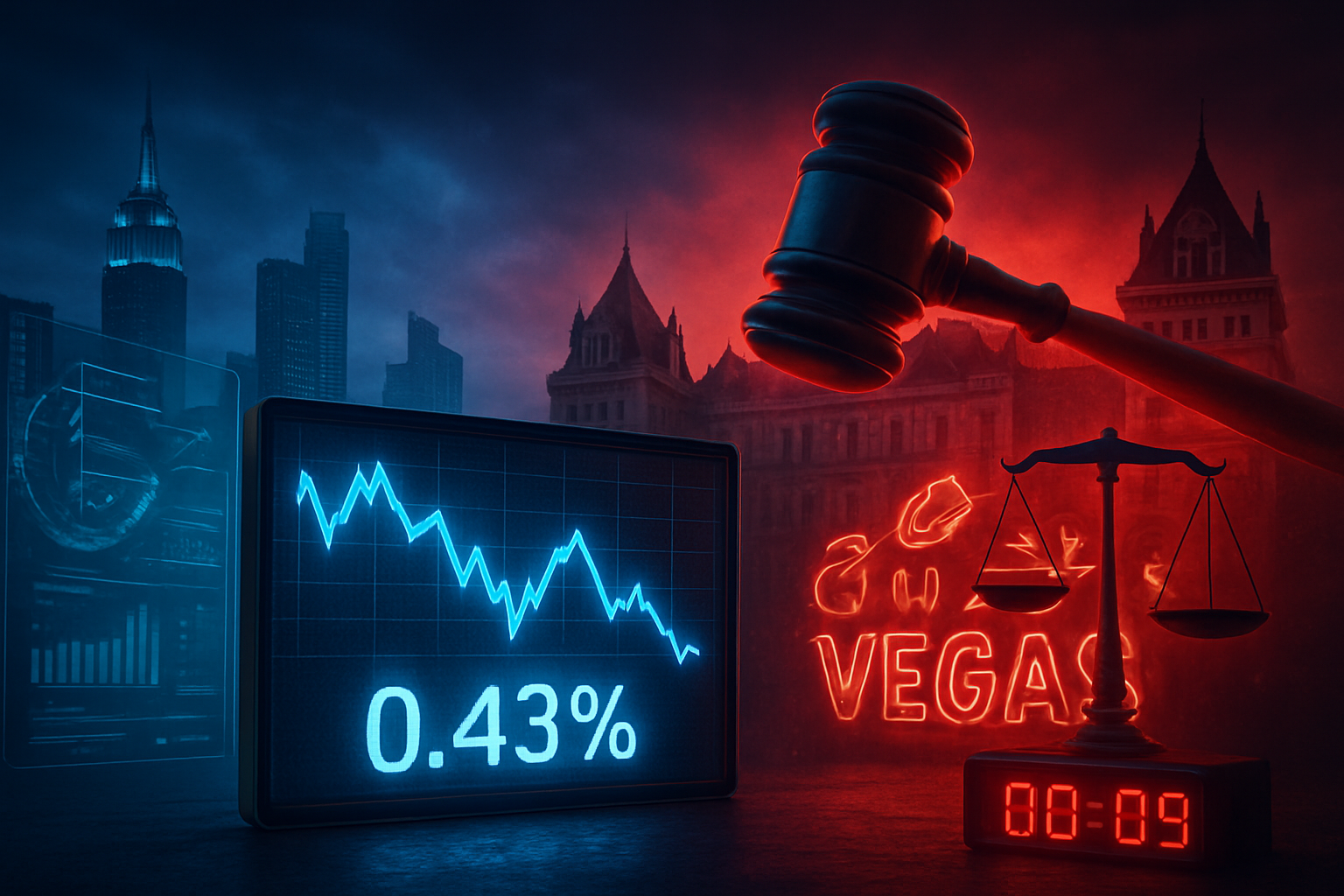
    Currently, a prominent contract on Kalshi—"Will New York pass a bill to ban political event contracts in 2026?"—is trading at a 38% probability. While this reflects a significant drop from the 65% "panic" highs seen in late 2025, the market remains volatile as two distinct legislative paths emerge. The interest is driven by a unique convergence of financial technology, political anxiety, and a massive tax disparity that has traditional sports betting giants like DraftKings (NASDAQ: DKNG) and Flutter Entertainment (NYSE: FLUT), the parent company of FanDuel, re-evaluating their entire business models.

    The Market: What's Being Predicted

    The primary market under the microscope is the legislative outcome of the 2025–2026 New York session. Traders are specifically weighing the chances of Assembly Bill A9251, colloquially known as the ORACLE Act. Sponsored by Assemblymember Clyde Vanel, the bill is the most aggressive anti-prediction market measure in the country. It seeks to categorize these platforms as "unlicensed gambling" and would impose civil fines of up to $50,000 for persistent violations, escalating to a staggering $1 million per day for platforms that continue to offer contracts on "sensitive" categories like elections, war, or securities prices.

    The ORACLE Act is currently being challenged by a more moderate proposal: Senate Bill S8889, the New York Prediction Market Regulation Act. Introduced on January 13, 2026, by Senator Jeremy Cooney, this rival bill suggests a licensing framework under the New York Department of Financial Services (DFS), treating event contracts as financial instruments rather than bets. Trading volume on these outcomes has surged across Kalshi and Interactive Brokers (NASDAQ: IBKR), which operates the ForecastEx exchange. On Manifold Markets, "shadow markets" are even pricing in an 81% probability that federal law will eventually preempt any state-level ban, citing the Supremacy Clause and the Commodity Futures Trading Commission's (CFTC) oversight.

    Why Traders Are Betting

    The sudden legislative urgency in Albany was catalyzed by a controversial event known among traders as the "Maduro Trade." In early January 2026, a single trader on Polymarket reportedly turned a $32,000 position into more than $400,000 just hours before a U.S.-led raid in Venezuela. New York lawmakers have seized on this as a smoking gun for "insider trading," arguing that prediction markets provide a lucrative outlet for individuals with material non-public information to profit from state secrets or geopolitical instability.

    Beyond insider trading fears, there is a massive financial incentive driving the legislative friction: taxes. In New York, traditional sportsbooks like FanDuel and DraftKings are hit with a punitive 51% tax on gross gaming revenue. Prediction markets, which operate as financial exchanges, currently bypass this tax, offering a "loophole" that allows for "sports-like" wagering under a much lighter tax burden. This has created a "Wall Street vs. Vegas" narrative. Traders are betting that the powerful gambling lobby will eventually force the state to either tax prediction markets at the 51% rate or ban them entirely to protect the state's lucrative sports-betting revenue stream.

    Notable "whale" activity has been spotted on Kalshi, where several institutional-sized positions have recently moved the "Ban" probability downward. These traders appear to be betting that the Cooney Bill (S8889) will provide a "middle path" that satisfies regulators' demands for anti-money laundering (AML) and consumer protections without a total shutdown.

    Broader Context and Implications

    This battle is about more than just a single state's laws; it is a referendum on whether prediction markets are "truth machines" or "reckless gambling" dens. For years, proponents have argued that these markets provide the most accurate real-time data on everything from Fed rate hikes to election results. However, New York’s ORACLE Act explicitly targets the "truth machine" claim, with sponsors arguing that the "social utility" of a market does not exempt it from gambling regulations.

    The real-world implications of a New York ban would be catastrophic for the industry’s domestic growth. As a global financial hub, New York's stance often dictates the regulatory appetite of other states. If the ORACLE Act passes, it could trigger a "regulatory winter," forcing platforms to geofence New Yorkers—a difficult task given the prevalence of VPNs, as seen with Polymarket's previous struggles.

    Furthermore, the pivot of companies like DraftKings (NASDAQ: DKNG) is telling. After years of lobbying against prediction markets, they are now launching their own "event contract" products to capture the lower-tax financial model. Their involvement suggests that the future of prediction markets might not be a total ban, but rather a "corporate capture" where only the largest, most established gaming and financial firms are granted licenses to operate.

    What to Watch Next

    Traders should circle late February 2026 on their calendars. This is when a critical ruling is expected in the federal case Kalshi v. New York State Gaming Commission. If a federal judge grants a preliminary injunction against the state’s current restrictive stance, it could effectively render the ORACLE Act moot before it even reaches the Assembly floor.

    In the immediate term, the next major milestone is the Assembly Committee on Consumer Affairs and Protection vote on the ORACLE Act. If the bill moves out of committee with its $1 million daily fine provision intact, the probability of a "Ban" on Kalshi is expected to spike back above 50%. Conversely, if the Cooney Bill gains traction in the Senate Banks Committee, the market will likely continue its downward trend as a regulated "Financial Exchange" model becomes the more probable outcome.

    Bottom Line

    The legislative scramble in New York represents the ultimate "identity crisis" for prediction markets. Are they the next evolution of the NASDAQ, or are they a high-tech version of a sportsbook? The 38% probability of a ban suggests that while the "ban-heavy" rhetoric is loud, the market believes a more nuanced, regulated future is the likely winner.

    For prediction markets to survive in New York, they will likely have to accept a "Vegas-lite" regulatory package: strict 21+ age verification, robust AML protocols, and perhaps a new "event contract tax" that bridges the gap between financial capital gains and the 51% sportsbook rate. As the "Maduro Trade" showed, the transparency of the blockchain is a double-edged sword; it proves the market's accuracy, but it also provides the evidence regulators need to cry foul.

    Ultimately, the battle in Albany is a test of the industry's resilience. If prediction markets can survive the ORACLE Act's $1 million daily fines, they will have proven their status as a permanent fixture of the modern financial landscape.


    This article is for informational purposes only and does not constitute financial or betting advice. Prediction market participation may be subject to legal restrictions in your jurisdiction.

    PredictStreet focuses on covering the latest developments in prediction markets.
    Visit the PredictStreet website at https://www.predictstreet.ai/.

  • The $32,000 ‘Glint’ Before the Storm: Did a Polymarket Trader Have Advance Knowledge of Maduro’s Capture?

    The $32,000 ‘Glint’ Before the Storm: Did a Polymarket Trader Have Advance Knowledge of Maduro’s Capture?

    The sudden and dramatic capture of Nicolás Maduro by U.S. special operations forces in early January 2026 sent shockwaves through the global political landscape. However, for those watching the prediction markets, the real explosion happened hours before the first Delta Force helicopter crossed the Venezuelan border. A single, anonymous trader placed a high-stakes bet that has now become the center of a firestorm involving allegations of insider trading and calls for a federal crackdown on the industry.

    As the dust settles in Caracas and Maduro awaits trial in New York, the focus has shifted to Polymarket, the decentralized betting platform that correctly—if suspiciously—predicted the regime's collapse. At the heart of the controversy is a $32,000 wager that ballooned into a nearly half-million-dollar payout, occurring just as the final authorization for "Operation Absolute Resolve" was being signed in the Oval Office.

    The Market: What's Being Predicted

    The primary theater for this financial drama was the Polymarket contract titled "Will Maduro remain in power?" Throughout the final months of 2025, as the U.S. tightened a naval blockade on Venezuelan oil exports, the market remained remarkably skeptical of a total regime change. For most of December, the odds of Maduro being ousted by January 31, 2026, hovered between a mere 7% and 10%. Liquidity was high, with the market attracting over $57 million in total volume as speculators weighed the likelihood of continued diplomatic stalemate against the possibility of military action.

    The resolution criteria for the market were explicit: the contract would settle as "Yes" (for removal) if Maduro was physically removed from Venezuelan territory or if he officially resigned and a successor was recognized by the international community. Trading remained relatively stagnant until the evening of January 2, 2026, when a flurry of activity—led by a single account—completely upended the order book.

    In addition to the "power" market, a secondary contract regarding a potential "U.S. invasion" of Venezuela saw over $10.5 million in volume. While the "power" market resolved in favor of those betting on Maduro's downfall, the "invasion" market sparked its own controversy. Despite the presence of U.S. troops, Polymarket ruled the event as "No," citing their criteria that defined an invasion as "establishing territorial control" rather than a "snatch-and-extract" raid. This semantic nuance has led to a "Polyscam" backlash among traders who feel the platform moved the goalposts to avoid a massive payout.

    Why Traders Are Betting

    The sudden shift in odds was driven by a trader using the pseudonym "Burdensome-Mix." This account, created only weeks prior, began a methodical accumulation of "Yes" shares in late December. The defining moment occurred at 9:58 PM ET on January 2—less than an hour before President Donald Trump reportedly signed the final strike authorization. At that time, with the "downfall" probability still sitting at 8%, "Burdensome-Mix" dropped a final $32,537 into the pool.

    When the news of the raid broke at 4:21 AM the following morning, the shares spiked to a full $1.00. The trader walked away with a profit of $436,759.61, a staggering 12-fold return on an event the broader market viewed as highly improbable. Analysts from various crypto-intelligence firms have pointed out that the timing was too precise to be a mere coincidence. "It is statistically an anomaly to see that level of conviction on a low-probability event right before the command is given," noted one lead researcher at Polysights.

    Traditional forecasting methods, including geopolitical risk assessments from major firms, had estimated the likelihood of a direct military extraction as a "tail risk" due to the potential for regional escalation. However, the prediction markets proved once again that they can act as a magnet for "dark information." Whether this trader was a high-level government staffer, a military contractor, or simply an incredibly lucky speculator remains the subject of intense debate.

    Broader Context and Implications

    This incident has reignited the conversation regarding the role of prediction markets in modern governance. Supporters of platforms like Polymarket and Kalshi argue that these markets serve as an invaluable tool for "truth discovery." CEO Shayne Coplan has previously suggested that if someone has inside information, the market provides a way for that truth to be priced in, essentially alerting the public to impending events before they happen.

    However, the "Maduro Trade" has also caught the attention of regulators who see it differently. Following the capture, U.S. Representative Ritchie Torres introduced the "Public Integrity in Financial Prediction Markets Act of 2026." The bill seeks to explicitly bar government officials, their staff, and military personnel from trading on markets where they possess material nonpublic information. The concern is that prediction markets could become a new, harder-to-track avenue for corruption and the monetization of classified secrets.

    The geopolitical ramifications are equally massive. As the U.S. signals its intention to oversee a "safe transition" in Venezuela, global energy markets are already reacting. Companies like Chevron (NYSE: CVX), ExxonMobil (NYSE: XOM), and ConocoPhillips (NYSE: COP) are being watched closely by investors as the potential for the revitalization of Venezuela’s massive oil reserves becomes a reality. The prediction markets correctly signaled the end of the Maduro era, but the resulting regulatory fallout may change how these platforms operate forever.

    What to Watch Next

    The immediate focus for the markets is now on the stability of the transitional government in Caracas. While Vice President Delcy Rodríguez was technically sworn in as acting president, her hold on power is tenuous. Polymarket has already launched new contracts regarding the date of the next Venezuelan general election and the potential for a formal U.S. military occupation to secure oil fields.

    On the regulatory front, a group of 12 U.S. Senators has called on the Commodity Futures Trading Commission (CFTC) to launch a full-scale investigation into the "Burdensome-Mix" trade. If the identity of the trader is linked to the U.S. government or the military, it could lead to the first major "insider trading" prosecution in the history of decentralized prediction markets. This would likely result in mandatory Know Your Customer (KYC) requirements that could alienate a large portion of the current user base.

    Bottom Line

    The capture of Nicolás Maduro will be remembered as a pivotal moment in 21st-century history, but in the world of finance, it will be remembered as the "Maduro Trade." The event highlighted the uncanny ability of prediction markets to sniff out "black swan" events before they occur, often by attracting those with "inside" knowledge who are looking for a payout.

    While the $32,000 bet by "Burdensome-Mix" was a masterstroke of timing, it has also put a target on the back of the entire prediction market industry. As lawmakers move to close the "insider trading" loophole, the platform's reputation for being an unbiased aggregator of truth is being tested. Ultimately, the Maduro controversy proves that when the stakes are high enough, the line between a "prediction" and "privileged information" becomes razor-thin.


    This article is for informational purposes only and does not constitute financial or betting advice. Prediction market participation may be subject to legal restrictions in your jurisdiction.

    PredictStreet focuses on covering the latest developments in prediction markets.
    Visit the PredictStreet website at https://www.predictstreet.ai/.
  • JD Vance Emerges as the 2028 Betting Favorite: Why Prediction Markets Are Frontrunning the ‘Heir Apparent’ Narrative

    JD Vance Emerges as the 2028 Betting Favorite: Why Prediction Markets Are Frontrunning the ‘Heir Apparent’ Narrative

    As the second year of the second Trump administration begins on this January 20, 2026, the political world is already looking toward the horizon of 2028. While traditional pundits often wait for the midterm results to declare favorites, prediction market traders have already reached a consensus. Vice President JD Vance has solidified his position as the early frontrunner to succeed Donald Trump, commanding a significant lead on regulated exchanges like Kalshi.

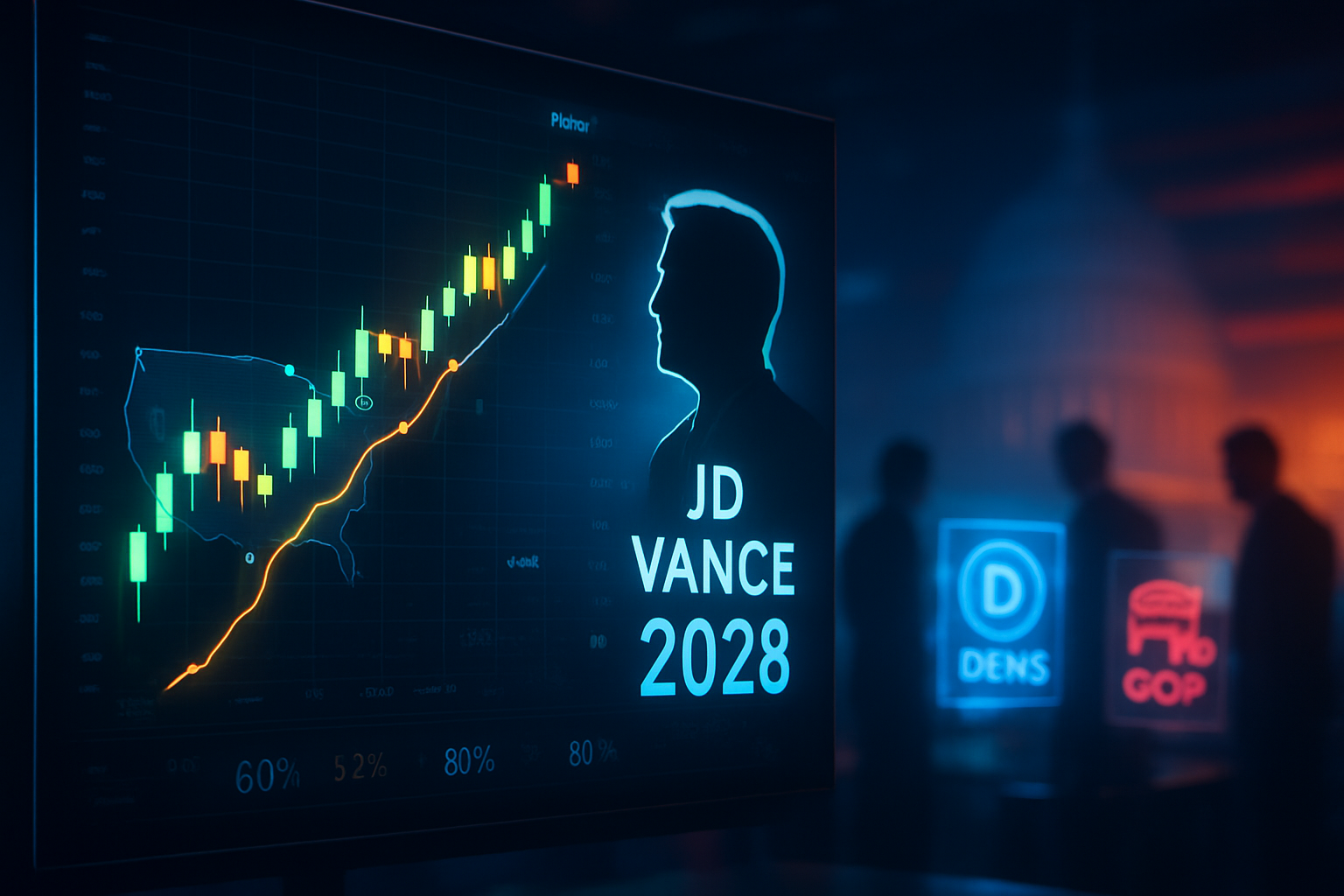
    Currently, Vance is trading at a 48% probability to secure the Republican nomination and a 27% probability to win the presidency outright. These figures represent a massive consolidation of "MAGA" sentiment around the Vice President, who has spent the last year positioning himself as the primary defender and legislative enforcer of the administration’s "America First" agenda. This early betting activity is generating intense interest because it suggests a level of field-clearing dominance rarely seen this far out from an open election cycle.

    The Market: What's Being Predicted

    The 2028 Presidential market has become a centerpiece of the burgeoning "information finance" sector. On Kalshi, the first regulated event contract exchange in the U.S., volume for the "Next President" market has surged as traders react to Vance's increasing visibility. Unlike the crypto-native Polymarket, which also shows Vance as the leader with a 26% win probability, Kalshi’s audience consists of U.S.-based retail and institutional traders who are increasingly using these markets as a hedge against political volatility.

    The market's growth has been fueled by major retail integrations. Robinhood Markets (NASDAQ: HOOD) recently launched its "Prediction Markets Hub," which has simplified access to these contracts for millions of investors, while Interactive Brokers (NASDAQ: IBKR) continues to see high institutional engagement through its ForecastEx exchange. This increased liquidity means that the 27% probability assigned to Vance is backed by hundreds of millions of dollars in traded volume, making it a more robust signal than a typical early-cycle poll.

    The resolution criteria for these markets are straightforward: the candidate must be sworn in as President on January 20, 2029. While the timeline is long, the markets are highly active, with daily fluctuations driven by Senate tie-breaking votes, cabinet maneuvers, and the perceived health of the current President.

    Why Traders Are Betting

    Traders are backing Vance primarily due to his "heir apparent" status, which was cemented by President Trump’s explicit public endorsements during the 2025 legislative session. Vance’s stock rose sharply following his decisive tie-breaking vote in the Senate on January 15, 2026, which defeated a War Powers Resolution regarding operations in Venezuela. This moment signaled to traders that Vance is not just a figurehead but a functional "enforcer" of the administration’s foreign policy.

    Furthermore, Vance has been the face of the "DOGE AI" regulatory rollout, a massive initiative led by the Department of Government Efficiency. By championing a tool aimed at cutting federal regulations by 50%, Vance has appealed to the tech-optimist and deregulation-focused wings of the GOP. This has effectively sidelined potential primary rivals like Marco Rubio—currently serving as Secretary of State—and Ron DeSantis, who both trail Vance by over 30 points in nomination probability.

    Compared to traditional forecasting, prediction markets are often more sensitive to "insider" sentiment and the reality of incumbency. While a voter might tell a pollster they are "undecided" because they don't like Vance’s personal favorability ratings, a trader on DraftKings (NASDAQ: DKNG) or FanDuel, owned by Flutter Entertainment (NYSE: FLUT), is more likely to bet on the structural advantage of the sitting Vice President in a party that has largely consolidated under one banner.

    Broader Context and Implications

    The divergence between market odds and traditional polling is a key trend in early 2026. A recent Quinnipiac University poll placed Vance’s approval rating "underwater" at 41% approval and 49% disapproval. However, prediction markets tend to ignore favorability in favor of "electability" and institutional support. Traders are betting that Vance’s unpopularity with the general public may not matter if the Democratic field remains fragmented among figures like Governor Gavin Newsom (20% win probability) and Governor Josh Shapiro (4% win probability).

    This market also reveals a significant shift in how public sentiment is measured. With the Intercontinental Exchange (NYSE: ICE) reportedly investing $2 billion to help regulated exchanges expand their political offerings, prediction markets are becoming a "source of truth" for major corporations. Companies are no longer just looking at polls; they are looking at where the money is moving to hedge against tax changes or regulatory shifts that would accompany a Vance presidency.

    Historically, early favorites in prediction markets have a mixed record, but the "incumbent VP" status provides a unique historical tailwind. Similar markets in the early 2000s correctly identified Al Gore and George W. Bush as favorites years before their respective nominations, though they famously underestimated the rise of outsiders like Barack Obama in 2008.

    What to Watch Next

    The upcoming 2026 midterm elections will be the first major test for Vance’s standing. Markets currently suggest that if the GOP maintains control of the Senate, Vance’s odds will likely climb toward 35-40%. Conversely, a "Blue Wave" that puts a Democrat in the Speaker's chair would likely see Vance’s odds tumble as traders look for a more "moderate" alternative to lead the 2028 ticket.

    Key dates to monitor include the upcoming nomination for the next Chair of the Federal Reserve. With Jerome Powell’s term ending in May, Vance’s public support for a "supply-side" candidate like Kevin Warsh could move markets significantly. Additionally, any major movement in the Democratic primary markets—specifically if Gavin Newsom officially forms an exploratory committee—could tighten the spread between the two frontrunners.

    Traders should also watch for the potential IPO of Kalshi later this year. A successful public listing for the exchange would likely bring even more liquidity and institutional "whales" into the 2028 Presidential market, further refining the odds as more sophisticated capital enters the fray.

    Bottom Line

    The 2028 Presidential market on Kalshi and other platforms currently paints a picture of a race that is JD Vance’s to lose. By successfully navigating his role as the administration’s legislative point man and avoiding a serious primary challenge, Vance has convinced the betting public that the MAGA succession plan is firmly in place.

    While his favorability ratings remain a concern for the general election, prediction markets are currently prioritizing his institutional advantages over his personal popularity. As we move deeper into 2026, these markets will serve as a high-stakes barometer for the durability of the Trump-Vance coalition and the ability of the Democratic Party to find a singular challenger to disrupt the current "heir apparent" narrative.


    This article is for informational purposes only and does not constitute financial or betting advice. Prediction market participation may be subject to legal restrictions in your jurisdiction.

    PredictStreet focuses on covering the latest developments in prediction markets. Visit the PredictStreet website at https://www.predictstreet.ai/.

  • The $112 Million Regulatory Heist: Polymarket’s QCX Acquisition and the Battle for America’s Prediction Market

    The $112 Million Regulatory Heist: Polymarket’s QCX Acquisition and the Battle for America’s Prediction Market

    In a move that has sent shockwaves through the burgeoning "information economy," Polymarket has officially staged its return to the United States. Following a multi-year exile by federal regulators, the world’s largest prediction market platform successfully bypassed the typical years-long licensing process by executing a strategic $112 million acquisition of QCX, a Commodity Futures Trading Commission (CFTC)-regulated derivatives exchange and clearinghouse. As of January 20, 2026, this "regulatory shortcut" has transformed the competitive landscape, setting the stage for a high-stakes showdown with its chief rival, Kalshi.

    Traders are currently pricing in a high probability that Polymarket’s U.S. arm will achieve parity with its global volume by the end of Q3 2026. This market sentiment is driven by the platform's aggressive integration with traditional financial infrastructure and its recent high-profile partnerships. However, the move has ignited a fierce rivalry with Kalshi, which has spent years building its brand as the "compliant" alternative. As prediction markets transition from niche crypto-products to mainstream financial tools, the battle between these two giants represents more than just a fight for market share; it is a battle for the soul of the predictive era.

    The Market: What's Being Predicted

    The central focus of traders today is the rapid expansion of Polymarket US, the platform’s domestic, regulated entity. Unlike the crypto-native global site, Polymarket US operates as a registered Designated Contract Market (DCM) and Derivatives Clearing Organization (DCO)—licenses it inherited through the acquisition of QCX (collectively QCX, LLC and QC Clearing LLC). This structure allows Polymarket to list event contracts that are cleared and settled within the U.S. financial system, providing a degree of legitimacy that was once its greatest weakness.

    Currently, the primary "meta-market" being traded across platforms involves the comparative volume growth of Polymarket US versus Kalshi. In early 2026, Kalshi remains the leader in regulated U.S. volume, holding approximately 66.4% of the market, largely due to its deep integration with Robinhood (NASDAQ: HOOD). However, Polymarket’s volume has surged by 40% month-over-month since its limited December 2025 relaunch. Liquidity on the new platform is being bolstered by institutional market makers like Susquehanna International Group (SIG), which has expanded its operations to support Polymarket’s new regulated order books.

    The resolution criteria for these competition markets typically hinge on official CFTC quarterly reports or verified third-party data providers like ElectionBettingOdds or VolumeWatch. Traders are closely monitoring the "Self-Certification" filings Polymarket submitted in late 2025, which include contracts for athletic point spreads, Federal Reserve interest rate hikes, and even the outcomes of specific state-level legislative sessions.

    Why Traders Are Betting

    The sudden shift in the prediction market hierarchy is being driven by a "perfect storm" of regulatory clarity and massive capital infusion. Polymarket’s acquisition of QCX was not just a legal maneuver; it was backed by a landmark $2 billion strategic investment from the Intercontinental Exchange (NYSE: ICE), the parent company of the New York Stock Exchange. This partnership has given Polymarket a seat at the table with the world’s largest institutional investors, many of whom are betting that prediction markets will eventually replace traditional polling and even some forms of weather and economic forecasting.

    Furthermore, traders are reacting to the divergent strategies of the two platforms. While Kalshi has doubled down on sports-centric "event parlays" to attract the retail betting crowd, Polymarket is positioning itself as the "Bloomberg of Truth," focusing on geopolitical risk and macroeconomic indicators. Notable "whale" activity has been observed in markets related to the 2026 midterm elections, where Polymarket’s historical accuracy in 2024 has given it a reputational edge over traditional media outlets like CNN or the New York Times.

    Public sentiment is also heavily influenced by the high-profile figures backing these platforms. Polymarket has strengthened its domestic ties by adding Donald Trump Jr. (via 1789 Capital) to its advisory board, while Kalshi has aligned itself with the traditional Wall Street guard, securing endorsements from veterans at Charles Schwab (NYSE: SCHW) and Sequoia Capital. This political and financial polarization is creating unique trading opportunities for those who believe one "camp" has a superior information network.

    Broader Context and Implications

    The Polymarket-QCX deal marks the end of the "Wild West" era for prediction markets. By choosing to buy their way into compliance, Polymarket has acknowledged that the path to global dominance must run through the U.S. regulatory framework. This has massive implications for the broader fintech sector. We are seeing a "convergence" where prediction markets are becoming indistinguishable from traditional derivatives exchanges like those operated by the CME Group (NASDAQ: CME).

    However, this newfound legitimacy has brought about a new theater of conflict: state-level regulation. In just the last week of January 2026, the Nevada Gaming Control Board filed a lawsuit against Polymarket to halt its sports-related contracts, arguing they constitute unlicensed gambling. This mirrors a broader trend where federal approval (via the CFTC) is being challenged by state gaming commissions who fear a loss of tax revenue and oversight.

    Historically, prediction markets have been more accurate than pundits because they require participants to "put their money where their mouth is." The current rivalry is essentially a stress test for this theory. If Polymarket can maintain its predictive accuracy while scaling within a regulated framework, it could fundamentally change how corporations hedge risk. For example, airline companies might use these markets to hedge against geopolitical instability in specific regions, rather than just relying on fuel futures.

    What to Watch Next

    The immediate focus for the market is the progression of the Public Integrity in Financial Prediction Markets Act of 2026, also known as the "Torres Bill." If passed, this legislation would ban federal employees from trading on prediction markets, a move that Kalshi supports to increase market "integrity" but which Polymarket critics argue is a veiled attempt to limit the platform's information advantage.

    Key dates to watch include:

    • February 12, 2026: The deadline for Polymarket to respond to the Nevada cease-and-desist order. A loss here could force a temporary withdrawal from several "gaming-heavy" states.
    • March 2026: The expected launch of Polymarket’s full integration into the Intercontinental Exchange (NYSE: ICE) trading terminals, which would allow hedge funds to trade event contracts directly alongside equities and bonds.
    • Q2 2026 Earnings: Watch for Interactive Brokers (NASDAQ: IBKR) and its subsidiary ForecastEx to report whether they have gained ground against the two market leaders, as they offer the lowest-fee alternative for institutional traders.

    Bottom Line

    The return of Polymarket to the U.S. via the QCX acquisition represents a pivotal moment in financial history. It signifies that prediction markets are no longer a "niche" interest for crypto enthusiasts but a core pillar of the modern financial system. The rivalry with Kalshi has created a competitive "arms race" that is driving innovation, lowering fees, and increasing the depth of these markets.

    For the average observer, the takeaway is clear: the "Information Economy" is here to stay. Whether Polymarket’s aggressive "legalization via acquisition" strategy ultimately triumphs over Kalshi’s "compliance-first" pedigree remains to be seen, but the real winner is the market itself. As these platforms grow in liquidity and legitimacy, the world gains a more transparent, data-driven way to look into the future.

    The odds favor a split market—one where Kalshi dominates the retail sports-betting crossover and Polymarket reigns supreme as the institutional engine for geopolitical and economic forecasting. But in a world where everything is a market, the only certain bet is that the volatility is just beginning.


    This article is for informational purposes only and does not constitute financial or betting advice. Prediction market participation may be subject to legal restrictions in your jurisdiction.

    PredictStreet focuses on covering the latest developments in prediction markets.
    Visit the PredictStreet website at https://www.predictstreet.ai/.
  • The Great Unlocking: How Regulatory Thaw Fueled a 1,000% Surge in Prediction Markets

    The Great Unlocking: How Regulatory Thaw Fueled a 1,000% Surge in Prediction Markets

    As of January 19, 2026, the landscape of American finance looks fundamentally different than it did just two years ago. The once-fringe world of prediction markets has exploded into a mainstream powerhouse, driven by a radical shift in federal oversight. What began as a high-stakes legal battle between Kalshi and the Commodity Futures Trading Commission (CFTC) has transformed into a government-endorsed "Information Finance" revolution. Today, traders are no longer just betting on the weather or the next Fed rate cut; they are participating in a massive, real-time data engine that is reshaping how we understand public sentiment.

    The primary catalyst for this boom has been the current administration’s decision to abandon the aggressive, restrictive posture of the Biden era. By dropping long-standing legal appeals and appointing market-friendly leadership at the CFTC, the federal government has effectively signaled that the "barriers to entry" are down. This regulatory green light has allowed the industry leader, Kalshi, to report a staggering 1,000% surge in trading volume over the last 14 months, signaling that the era of prediction markets as a "legal gray area" is officially over.

    The Market: What's Being Predicted

    The current market focus has moved far beyond the binary "win/loss" contracts of the 2024 election. On Kalshi, the primary US-regulated exchange, the volume is now dominated by a mix of high-frequency economic data and professional sports. Current odds on the platform suggest a 68% probability of a 25-basis-point interest rate cut by the Federal Reserve in March, a figure that is now cited by major news outlets alongside traditional polling and analyst forecasts.

    While Kalshi remains the dominant dedicated exchange, the market has seen massive liquidity injections from retail giants. Robinhood Markets, Inc. (NASDAQ: HOOD) launched its "Prediction Markets Hub" in early 2025, quickly becoming a central node for retail traders betting on everything from box office numbers to the outcome of the 2026 midterm primaries. Simultaneously, Interactive Brokers Group, Inc. (NASDAQ: IBKR) has utilized its ForecastEx platform to cater to institutional clients, offering contracts that allow corporations to hedge against climate-related disasters and supply chain disruptions.

    The liquidity in these markets has reached unprecedented levels. In December 2025 alone, the industry-wide monthly volume exceeded $13 billion. Kalshi’s internal data shows that its weekly volume now regularly tops $2 billion, a 10x increase from its pre-2024 levels when the CFTC was still actively attempting to block its election-related contracts. These markets typically resolve based on hard data—official government reports, league statistics, or verified election results—ensuring a level of transparency that traditional "opinion-based" forecasting lacks.

    Why Traders Are Betting

    The 1,000% surge in volume is not merely a product of curiosity; it is the result of a "perfect storm" of legal clarity and institutional adoption. Under the Biden administration, the CFTC viewed prediction markets through the lens of "gaming" and "gambling," leading to years of litigation that suppressed volume and scared away institutional capital. However, the landmark 2024 court ruling in Kalshi v. CFTC—which the current administration chose not to overturn or further contest—legitimized these contracts as "event derivatives."

    Traders are also flocking to these markets because they are proving to be more accurate than traditional methods. During the 2024 election cycle, prediction markets famously reacted to shifts in voter sentiment faster than traditional polling, which often suffered from a "lag" of 72 hours or more. This "real-time truth" has attracted "whales"—high-net-worth individuals and hedge funds—who use prediction markets as a sophisticated alternative to traditional hedging.

    The recent movement in the 2026 Midterm "Control of the House" market is a prime example. While traditional analysts remain split, the Kalshi market has seen a heavy lean toward the incumbent party retaining control (currently at 62%), driven by several multi-million dollar positions from traders who specialize in district-level demographics. This shift from "opinion" to "financial stake" has created a more disciplined and accurate forecasting environment.

    Broader Context and Implications

    The "breakdown of barriers" is more than just a regulatory shift; it represents the birth of a new asset class. The current administration's "hands-off" approach, spearheaded by the new CFTC leadership, has allowed for the development of the "Safe Harbor Act." This proposed legislation, heavily lobbied for by a coalition including Robinhood (HOOD) and Coinbase Global, Inc. (NASDAQ: COIN), aims to provide a permanent federal framework that would prevent future administrations from re-imposing the scrutiny seen in 2023.

    Real-world implications are already manifesting. Insurance companies are now looking at Interactive Brokers’ (IBKR) climate contracts as a secondary market for risk. If a prediction market shows an 80% chance of a Category 4 hurricane hitting Florida, the pricing of that contract provides a more immediate, market-driven "risk premium" than traditional actuarial tables.

    However, this growth hasn't been without friction. While federal barriers have crumbled, a new battle is emerging at the state level. States like Nevada and Massachusetts have issued cease-and-desist orders against some platforms, arguing that these markets infringe upon state-regulated gambling and tax revenues. This "War of Federalism" is likely the next major hurdle for the industry, as platforms fight to ensure that a federal "green light" isn't extinguished by state-level "red tape."

    What to Watch Next

    The coming months will be a litmus test for the sustainability of this growth. The most significant upcoming milestone is the potential passage of the Safe Harbor Act in Congress. If signed into law, it would effectively "bulletproof" the industry against regulatory whiplash, likely triggering another massive influx of institutional capital from traditional Wall Street firms that are currently waiting on the sidelines.

    Investors should also monitor the expansion of "Sports Event Contracts" on Kalshi and Robinhood (HOOD). With sports betting already a multi-billion dollar industry in the US, the transition of sports fans into "event derivative traders" could push volumes even higher. The NFL playoffs and the upcoming 2026 World Cup are expected to be the largest non-political events in the history of prediction markets, with some analysts predicting single-event volumes exceeding $500 million.

    Finally, keep an eye on the "State vs. Federal" legal challenges. A Supreme Court petition regarding whether federal commodities law preempts state gambling statutes is widely expected by mid-2026. The outcome of such a case would define the geographic boundaries of the market for the next decade.

    Bottom Line

    The 1,000% volume surge reported by Kalshi is the loudest signal yet that prediction markets have graduated from a niche hobby to a structural component of the US financial system. The shift from the restrictive, "scrutiny-first" mindset of the previous administration to the current era of "Information Finance" has unlocked a level of liquidity and public participation that was once unthinkable.

    What this tells us is that the public has a massive appetite for "skin in the game" truth-seeking. In an era of deepfakes and polarized media, prediction markets provide a rare, objective scoreboard. While state-level regulatory battles and the need for permanent federal legislation remain, the momentum is undeniably in favor of growth.

    The likely outcome for 2026 is a continued "institutionalization" of the space. As Robinhood (HOOD) and Interactive Brokers (IBKR) further integrate these markets into their core apps, the line between "investing" and "predicting" will continue to blur, eventually making the "price" of an event as common a metric as the price of a stock.


    This article is for informational purposes only and does not constitute financial or betting advice. Prediction market participation may be subject to legal restrictions in your jurisdiction.

    PredictStreet focuses on covering the latest developments in prediction markets.
    Visit the PredictStreet website at https://www.predictstreet.ai/.

  • The Accuracy War: PredictIt vs. Kalshi vs. Polymarket

    The Accuracy War: PredictIt vs. Kalshi vs. Polymarket

    The 2024 U.S. Presidential election served as a high-stakes laboratory for the burgeoning world of prediction markets, pitting established academic platforms against crypto-native giants and regulated newcomers. As of January 19, 2026, the dust has finally settled on the post-election post-mortems, revealing a surprising "Accuracy War" where the most liquid markets weren’t necessarily the most correct. While all major platforms eventually signaled a Republican victory, the path they took—and the volatility they experienced—highlighted deep structural divides in how we forecast the future.

    Currently, the market is shifting its focus to the 2026 Midterms, with "control of the House" contracts already seeing significant early action. On Kalshi, the probability of a Democratic "Blue Wave" in 2026 is currently hovering at 42%, while PredictIt traders are more cautious at 38%. This 400-basis-point spread is a direct result of the different participant bases and fee structures that define these platforms. The divergence is generating intense interest among arbitrageurs who are looking to exploit the lingering "accuracy gap" that defined the 2024 cycle.

    The Market: What's Being Predicted

    The core of the "Accuracy War" centers on how PredictIt, Kalshi, and Polymarket processed the 2024 election data compared to their current handling of the 2026 legislative outlook. During the 2024 cycle, Polymarket dominated the headlines with over $3.3 billion in total volume, while the regulated U.S. exchange Kalshi struggled initially after a late legal entry in October 2024. PredictIt, the long-standing academic project, operated under a cloud of regulatory uncertainty that was only resolved in mid-2025.

    A landmark study from Vanderbilt University released in late 2025 found that PredictIt achieved a staggering 93% accuracy rate across 2,500 individual contracts, compared to 78% for Kalshi and just 67% for Polymarket. This disparity has fundamentally changed how traders view these platforms. While Polymarket offers the highest liquidity and the "wisdom of the global crowd," its signals were often distorted by massive "whale" positions, such as the famous $30 million bet by a French trader that skewed Republican odds for weeks.

    Today, the resolution criteria for 2026 markets have become more standardized thanks to the 2025 CLARITY Act, which provided a federal framework for event contracts. Kalshi has surged to a dominant position, claiming a 66.4% share of daily volume as of mid-January 2026. Polymarket, meanwhile, has successfully pivoted into the U.S. market, launching a regulated domestic arm in December 2025 to compete directly with Kalshi and PredictIt on American soil.

    Why Traders Are Betting

    The primary driver of the odds today is the varying "friction" created by fee structures. PredictIt remains the most expensive venue, charging a 10% fee on all gross profits and a 5% fee on withdrawals. This creates a "PredictIt Premium," where a contract might trade at 55 cents when the "true" probability is closer to 50%, simply because traders need a higher margin to cover the fees. In contrast, the newly launched Polymarket US (DCM) has introduced a hyper-competitive 0.10% fee to lure traders away from Kalshi’s probability-weighted fee model, which averages around 1.2% per trade.

    Participant demographics also play a crucial role. PredictIt’s $3,500 trading limit (raised from $850 in July 2025) ensures that the market represents a "crowd of peers" rather than a "market of whales." This "enforced diversity" is credited with its high accuracy in 2024; it was essentially a massive survey of informed U.S. voters with skin in the game. On the other hand, the international nature of Polymarket Global often leads to "sentiment-driven" spikes, where global crypto-traders bet on "narratives" rather than granular U.S. state-level polling or legislative nuances.

    Recent news has also influenced the 2026 odds. Following the partnership between Kalshi and Warner Bros. Discovery (NASDAQ: WBD)'s CNN to integrate live odds into political broadcasts, a surge of "retail" money has entered the market. This influx of less-experienced traders often creates "noise" that savvy pros—many of whom utilize institutional tools from Comcast (NASDAQ: CMCSA)'s CNBC—are quick to capitalize on through mean-reversion strategies.

    Broader Context and Implications

    The "Accuracy War" has broader implications for how prediction markets are integrated into the global financial system. The 2025 CLARITY Act was a watershed moment, finally clarifying that event contracts are legitimate financial tools for hedging real-world risks. This has allowed major news organizations, including News Corp (NASDAQ: NWS)'s Dow Jones and The Wall Street Journal, to treat prediction market prices with the same reverence as the S&P 500 or Treasury yields.

    Furthermore, the 2024 results debunked the "Liquidity Equals Accuracy" myth. The fact that the highest-volume market (Polymarket) was the least accurate in its price discovery suggested that "whales" can, in fact, move the needle and create misleading signals. This has led to a renewed interest in the "PredictIt model" of capping individual stakes to ensure a broader, more representative sample of opinions. It suggests that for political events, the "wisdom of the crowd" works best when the crowd isn't dominated by a few deep-pocketed individuals.

    The regulatory environment has also matured. The CFTC’s shift from an adversarial to a collaborative stance with platforms like PredictIt has encouraged more academic research into how these markets can serve as "early warning systems" for geopolitical instability or economic shifts. Prediction markets are no longer seen as "gambling" but as a vital layer of the information economy.

    What to Watch Next

    As we approach the 2026 Midterms, all eyes are on the performance of Polymarket’s new U.S.-regulated exchange. If it can maintain its low fee structure while attracting the high-quality, domestic participant base that PredictIt enjoys, it could theoretically combine the best of both worlds: high liquidity and high accuracy. Traders should watch for any shifts in the "spread" between PredictIt and Kalshi prices; a narrowing gap would indicate that the markets are becoming more efficient at cross-platform arbitrage.

    Key dates to monitor include the upcoming "State of the Union" in February 2026, which historically triggers massive volume and price swings in legislative control contracts. Additionally, the first major "test" of the CLARITY Act’s enforcement provisions is expected this spring, as several platforms attempt to launch "economic indicator" contracts tied to sensitive data like the Consumer Price Index (CPI) before they are officially released.

    Bottom Line

    The competition between PredictIt, Kalshi, and Polymarket has evolved into a sophisticated ecosystem where "accuracy" is the ultimate currency. While Polymarket won the battle for volume in 2024, PredictIt won the battle for precision. In 2026, the playing field is leveling as Kalshi dominates the regulated U.S. space and Polymarket enters the domestic arena with a competitive edge.

    The key takeaway for any market observer is that prediction markets are not a monolith. The "odds" on one platform are a reflection of its specific rules, its fees, and its people. As we head into a new election cycle, the "Accuracy War" continues, and the winners will be the platforms that can best balance the need for deep liquidity with the necessity of a diverse, informed participant base.

    Ultimately, prediction markets have proved their worth as a superior alternative to traditional polling. In an era of fragmented media and partisan bubbles, the cold, hard numbers of a trading screen offer the most honest look at where the world is actually heading.


    This article is for informational purposes only and does not constitute financial or betting advice. Prediction market participation may be subject to legal restrictions in your jurisdiction.

    PredictStreet focuses on covering the latest developments in prediction markets.
    Visit the PredictStreet website at https://www.predictstreet.ai/.
  • Betting on the Brink: Inside the Explosive Rise of Geopolitical Disaster Markets

    Betting on the Brink: Inside the Explosive Rise of Geopolitical Disaster Markets

    As of January 19, 2026, the global financial landscape is increasingly dominated by a controversial new asset class: geopolitical instability. Following the chaotic start to the year—marked by the capture of Nicolás Maduro in Venezuela on January 3 and a subsequent hypersonic missile test by Pyongyang on January 4—prediction markets have seen an unprecedented surge in activity. These "disaster markets," which allow traders to bet on everything from nuclear tests to regime changes, are no longer just niche corners of the internet; they have become a multi-billion-dollar "parallel intelligence" infrastructure.

    On platforms like Polymarket and Kalshi, the volume of bets regarding North Korean aggression and potential U.S. diplomatic breakthroughs has reached a fever pitch. Currently, the market for a face-to-face summit between Donald Trump and Kim Jong-un in 2026 is trading at a robust 42% probability, while more extreme "invasion" contracts are seeing high-frequency fluctuations as traders attempt to price in the risk of a global kinetic conflict. This shift has transformed prediction markets into a leading indicator of real-world volatility, often moving faster than traditional news cycles.

    The Market: What's Being Predicted

    The focus of the early 2026 trading season has been the Korean Peninsula. On the decentralized platform Polymarket, cumulative volume for 2025 reached nearly $40 billion, with a significant portion dedicated to "North Korean provocation" contracts. Specifically, the market for "North Korea to launch a ballistic missile by January 31, 2026" saw a massive spike in liquidity following the January 4 test. Before the launch was even officially confirmed by the Pentagon, "Yes" contracts reached near-parity, suggesting that traders with localized intelligence or advanced satellite monitoring were front-running the official news.

    On the regulated U.S. exchange Kalshi, the focus is more diplomatic but no less high-stakes. Traders are currently eyeing the "Kim Jong-un to visit the U.S. in 2026" contract. While the odds remain lower at 18%, the volume has increased tenfold since the start of the year. Unlike the "wild west" markets on offshore platforms, Kalshi’s contracts are strictly defined, requiring a physical presence in the 50 U.S. states to resolve.

    In Asia, a new Binance-backed platform named Opinion has gained massive traction, specifically targeting South Korean retail investors. This platform hosts hyper-local markets, such as "DMZ skirmish before March" and "Cyberattack on Seoul infrastructure." Weekly volumes on Opinion have reportedly exceeded 2 trillion won ($1.5 billion), highlighting a regional obsession with hedging against the very real possibility of local disaster.

    Why Traders Are Betting

    The motivations for these bets are shifting from speculative gambling to strategic hedging. Institutional players, once wary of the "death pool" optics, are now the primary drivers of volume. Goldman Sachs (NYSE: GS) recently acknowledged that it tracks a "Basket of Geopolitical Risk Stocks" that directly correlates with the odds seen on these prediction platforms. For a hedge fund manager, a "Yes" bet on a North Korean missile launch acts as a protective hedge against their long positions in South Korean equities or global tech manufacturing.

    "We aren't just looking at what CNN says anymore," noted one anonymous high-volume trader on Polymarket. "We are looking at where the $500,000 'whale' positions are moving at 3:00 AM. When a whale bets $30,000 at 7-cent odds on a regime change and wins, like we saw with the Maduro removal in early January, you realize these markets are being fed by people with boots-on-the-ground information."

    Furthermore, the "Trump Factor" remains a primary catalyst. The market's 42% odds for a Trump-Kim summit reflect a belief in the return of "personal diplomacy" and the President's penchant for grand, televised summits. Traders are betting on the President's unpredictability, using historical patterns from the 2018-2019 period to gauge the likelihood of a sudden de-escalation that would see Kim Jong-un on U.S. soil.

    Broader Context and Implications

    The rise of these markets has ignited a firestorm of ethical debate. Critics argue that allowing individuals to profit from war and suffering is inherently "ghoulish." In response, Representative Ritchie Torres introduced the Public Integrity in Financial Prediction Markets Act of 2026 earlier this month. The bill aims to prevent federal officials from trading on outcomes they might influence, treating prediction markets with the same scrutiny as the equities market to prevent "government insider trading."

    The ethical concern extends to moral hazard: could a high-stakes bet on an assassination or a terrorist attack actually incentivize the event? While no such link has been proven, the sheer amount of money—over $10 billion in monthly volume in late 2025—makes the possibility a central concern for regulators at the CFTC.

    Despite the controversy, the accuracy of these markets is difficult to ignore. Throughout 2025, prediction markets consistently outperformed traditional think tanks and intelligence agencies in forecasting regional skirmishes. The correlation between these markets and the stock prices of major defense contractors is now nearly 1:1. For instance, Hanwha Aerospace (KRX: 000880) and LIG Nex1 (KRX: 079550) saw their stock prices surge by 25.4% and 15.2% respectively in the first week of 2026, perfectly mirroring the rising "conflict odds" on Polymarket. Similar movements were seen in U.S. giants like Lockheed Martin (NYSE: LMT) and Northrop Grumman (NYSE: NOC).

    What to Watch Next

    The coming weeks will be a critical litmus test for these disaster markets. All eyes are on the upcoming vote for the 2026 U.S. defense budget, which President Trump has proposed at a record $1.5 trillion. If the budget passes with its current focus on "Pacific Deterrence," expect the odds for a diplomatic summit to drop while "Missile Launch" and "Satellite Deployment" contracts see increased action.

    Key dates to monitor include the late-February anniversary of the founding of the Korean People’s Army. Traditionally a time for military parades, traders are already positioning themselves for a "spectacular" missile demonstration. Additionally, any movement in the stock of Korea Aerospace Industries (KRX: 047810) will be closely watched; the company’s stock has recently moved in tandem with markets predicting the detection of new North Korean submarine-launched ballistic missile (SLBM) capabilities.

    Bottom Line

    The emergence of "geopolitical disaster" markets represents a fundamental shift in how the world processes risk. What was once considered a morally questionable hobby has matured into a vital instrument for financial hedging and information aggregation. Whether it is the 42% chance of a Trump-Kim summit or the split-second reaction to a missile launch, these markets provide a raw, unfiltered look at public and institutional sentiment that traditional polls cannot match.

    However, the legal landscape is shifting. As the Torres Bill makes its way through Congress and the ethical debate over "profiting from chaos" intensifies, the future of these platforms may depend on their ability to self-regulate. For now, they remain the most accurate—and perhaps the most unsettling—barometer of a world on the edge.


    This article is for informational purposes only and does not constitute financial or betting advice. Prediction market participation may be subject to legal restrictions in your jurisdiction.

    PredictStreet focuses on covering the latest developments in prediction markets. Visit the PredictStreet website at https://www.predictstreet.ai/.

  • The 100-Hour Hustle: How Logan Sudeith Became the Face of the $100,000-a-Month Prediction Market Elite

    The 100-Hour Hustle: How Logan Sudeith Became the Face of the $100,000-a-Month Prediction Market Elite

    As of January 2026, the image of the "professional trader" has undergone a radical transformation. Gone are the days when high-stakes finance was solely the province of Wall Street floor traders or quantitative hedge fund analysts staring at Bloomberg terminals. Today, the new face of alpha is Logan Sudeith, a 25-year-old former risk analyst from Atlanta, Georgia, who famously resigned from a stable $75,000-a-year job to trade the "scoreboard of reality" full-time.

    Sudeith represents a burgeoning class of "Professional Event Traders" (PMTs) who have turned prediction markets like Kalshi and Polymarket into their personal ATM machines. While many retail investors were still learning the ropes of "Information Finance" in late 2024, Sudeith was already scaling a lifestyle that defies traditional labor norms: working 100-hour weeks, "bed-lounging" with a laptop, and DoorDashing every meal to ensure he never misses a live market ticker. The results have been staggering, culminating in a recent milestone that has sent shockwaves through the community—a single $100,000 profit month.

    The Market: What’s Being Predicted

    The markets Sudeith and his peers navigate are far more granular than the broad indices of the traditional stock market. While a typical investor might buy shares in Apple Inc. (NASDAQ: AAPL) or Tesla, Inc. (NASDAQ: TSLA) based on quarterly earnings, Sudeith trades on the specificities of daily life. These "event contracts" allow traders to buy and sell shares in the probability of a specific outcome, ranging from Federal Reserve interest rate hikes to the specific phrasing used by political figures in press conferences.

    The primary arenas for this activity are Kalshi and Polymarket. By early 2026, Kalshi has seen its valuation surge to a reported $11 billion, with weekly volumes frequently exceeding $2 billion. Meanwhile, Polymarket has completed a massive re-entry into the U.S. market following its acquisition of a CFTC-licensed exchange. These platforms offer thousands of niche markets, such as whether a certain bill will pass the Senate by Friday, the exact number of times a sports commentator will say "air ball," or the winner of the New York City mayoral race—a trade that netted Sudeith over $7,400 in profit.

    Why Traders Are Betting

    For Sudeith, the "edge" isn't found in guessing the future, but in identifying "mispriced probabilities." His strategy involves a blend of high-speed data mining and obsessive monitoring of live events. To win $40,236 on the Time Magazine Person of the Year contract, Sudeith didn't just guess; he meticulously analyzed historical selection patterns and tracked late-breaking media signals that the broader market had ignored.

    "Professional event trading is about being faster and more informed than the person on the other side of the contract," says one peer in Sudeith's "Crypto Inner Circle" Discord. Traders now use institutional-grade tools like API integrations for millisecond execution and order flow analysis software to spot "insidered" activity—outlier bets that suggest a trader has non-public information, such as the exact release date of a new AI model. Sudeith’s 100-hour work week is dedicated to this information gathering, often focusing on high-volatility events like Donald Trump's speeches, where a single keyword—like "drill baby drill"—can move half a million dollars in a matter of seconds.

    Broader Context and Implications

    The rise of traders like Logan Sudeith signals a broader shift toward "Information Finance," a term popularized in 2025 to describe the use of markets to aggregate truth. Major brokerages like Robinhood Markets, Inc. (NASDAQ: HOOD) have leaned into this trend, now offering regulated event contracts to their millions of retail customers. In late 2025, Robinhood reported that its users traded over 2.5 billion event contracts, treating questions about Fed rate cuts with the same seriousness as blue-chip stocks.

    This mainstreaming has been bolstered by a shifting regulatory environment. While previous administrations viewed prediction markets with skepticism, the current 2026 landscape treats them as vital forecasting tools. News networks like CNN and CNBC now display "Kalshi Tickers" alongside traditional stock prices, acknowledging that these markets are often more accurate than traditional polling or expert punditry. The "sober boom" of prediction markets has turned what was once a "gray market" into a fundamental pillar of the American financial system.

    What to Watch Next

    As the industry matures, the focus is shifting toward the institutionalization of event trading. We are likely to see the emergence of "Event Hedge Funds" that utilize the same high-frequency strategies Sudeith pioneered, potentially squeezing out solo retail traders. The next major milestone to monitor will be the launch of "Macro-Event ETFs," which would allow investors to hedge against broad geopolitical risks—like the outbreak of a trade war or a global pandemic—through a single diversified product.

    Furthermore, keep an eye on the "rulescucks"—a slang term for traders who win on the technical wording of contracts. As the stakes rise, the precision of contract language is becoming a legal battleground. The resolution of high-profile disputes in early 2026 will set the precedent for how these markets are governed for the next decade.

    Bottom Line

    Logan Sudeith’s journey from a $75,000-a-year analyst to a six-figure-a-month event trader is the quintessential success story of the Information Finance era. It proves that in a world of infinite data, the ability to accurately price probability is one of the most valuable skills in the modern economy. Sudeith isn't just betting; he is participating in a global machine that rewards truth and punishes noise.

    As prediction markets continue to integrate with traditional finance through platforms like Robinhood Markets, Inc. (NASDAQ: HOOD), the line between "gambling" and "investing" continues to blur. For Sudeith and the new class of PMTs, the world is no longer just a series of events—it is a series of tradeable opportunities, provided you are willing to put in the 100 hours a week to find them.


    This article is for informational purposes only and does not constitute financial or betting advice. Prediction market participation may be subject to legal restrictions in your jurisdiction.

    PredictStreet focuses on covering the latest developments in prediction markets.
    Visit the PredictStreet website at https://www.predictstreet.ai/.