Tag: Prediction Markets

  • Hedge or Hazard? The Billion-Dollar Legal War to Define Sports Prediction Markets

    Hedge or Hazard? The Billion-Dollar Legal War to Define Sports Prediction Markets

    As of January 21, 2026, the American financial landscape is locked in a high-stakes jurisdictional civil war. On one side, federal regulators and Silicon Valley giants argue that prediction markets are sophisticated hedging tools—derivatives no different than corn futures or interest rate swaps. On the other, state attorneys general and powerful tribal gaming interests contend they are nothing more than unlicensed, high-tech sportsbooks masquerading as financial exchanges.

    At the heart of this conflict is a simple question with a multi-billion dollar answer: Is predicting the outcome of a Sunday night NFL game an act of financial risk management or a common bet? With Robinhood Markets, Inc. (HOOD:NASDAQ) reporting over 11 billion contracts traded on its platform in the last year, and Kalshi expanding its reach into every major professional league, the outcome of this legal debate will determine the future of how Americans interact with risk.

    The Market: What's Being Predicted

    The current prediction market ecosystem has evolved far beyond its humble origins of political forecasting. Today, platforms like Kalshi and the newly launched Fanatics Markets—a joint venture between Crypto.com and the sports merchandise giant—offer a dizzying array of "event contracts." These include everything from the point spread of the Super Bowl to the number of passing yards a specific quarterback will achieve in a season.

    Unlike traditional sportsbooks, these markets operate as peer-to-peer exchanges. On Kalshi, for instance, the "NFL: Chiefs to Win Super Bowl LX" contract currently trades at 18 cents, implying an 18% probability of victory. Prices are dictated by supply and demand rather than a house-set line. Trading volume has reached unprecedented heights; since Robinhood (HOOD:NASDAQ) acquired its own Designated Contract Market (DCM), MIAXdx, liquidity has surged, with daily volumes often rivaling mid-cap stocks.

    The resolution of these markets is strictly binary. If the event occurs, the contract settles at $1.00; if it doesn't, it goes to zero. While this sounds like a bet, the platforms argue the underlying mechanics—regulated by the Commodity Futures Trading Commission (CFTC)—make them legitimate financial instruments.

    Why Traders Are Betting

    The surge in volume is driven by a new class of "hedgers" who view sports outcomes as a unique asset class. Professional ticket brokers, for example, use these markets to hedge against a local team being eliminated from the playoffs, which would crater their inventory value. Similarly, small businesses in "sports towns" are using prediction markets to offset the loss of revenue that occurs when a home team underperforms.

    "We aren't gambling; we're managing exposure," says one high-frequency trader who recently moved a significant portion of his portfolio into sports derivatives. "If I have a massive position in regional brewery stocks, I am fundamentally exposed to the performance of the local sports teams that drive bar traffic. These markets allow me to offset that risk with surgical precision."

    However, traditional gaming interests and the American Gaming Association (AGA) argue this is a semantic distraction. They point to the "whale" activity on these platforms—multi-million dollar positions on individual game outcomes—as evidence of speculative gambling. Critics argue that the lack of traditional "gaming taxes" gives these platforms an unfair competitive advantage over licensed sportsbooks like DraftKings Inc. (DKNG:NASDAQ) or FanDuel.

    Broader Context and Implications

    The legal friction is currently manifesting in a "federal-state divide." While the CFTC, under the leadership of Chairman Michael Selig, has embraced a "Future-Proof" initiative to accommodate these markets, state regulators are pushing back. Just yesterday, January 20, 2026, a Massachusetts judge issued a preliminary injunction against Kalshi, ruling that sports "prop bets" are "substantively indistinguishable" from wagering and require a state gaming license.

    This conflict is further complicated by the Indian Gaming Regulatory Act (IGRA). A coalition of California tribes, including the Blue Lake Rancheria, has sued Robinhood (HOOD:NASDAQ) and Kalshi, alleging that allowing users to trade these contracts on tribal lands violates their exclusive gaming rights. This is not merely a regulatory spat; it is an existential threat to the tribal gaming model, which generates over $40 billion in annual revenue.

    Historically, prediction markets have been more accurate than pundits or polls because traders have "skin in the game." If the legal system ultimately classifies them as gambling, they will be subjected to a fragmented state-by-state regulatory regime that could kill the liquidity necessary for them to function as accurate forecasting tools.

    What to Watch Next

    The immediate future of the industry hinges on the Ninth Circuit Court of Appeals. The court is currently reviewing Blue Lake Rancheria v. Kalshi, a case that could determine whether federal law (the Commodity Exchange Act) preempts tribal and state gaming regulations. A ruling is expected by mid-summer 2026.

    Additionally, monitor the Ho-Chunk Nation’s lawsuit in Wisconsin, which has a trial date set for May 2027. This case specifically targets the definition of "occurrence" versus "outcome." If the court finds that a football game is an "occurrence" (a neutral event) rather than a "gamble," it will provide a massive legal shield for the industry.

    Finally, keep an eye on the partnership between Crypto.com and the "Plaee" infrastructure. If more crypto-native platforms gain DCM status, the sheer volume of "on-chain" prediction trading may become too large for state regulators to effectively police, forcing a federal legislative solution from Congress.

    Bottom Line

    The battle over sports prediction markets is a proxy for a larger debate about the nature of risk in the 21st century. To the platforms and their millions of users, these are the ultimate democratized financial tools—allowing anyone to hedge against the unpredictable. To the states and tribes, they are a "Trojan Horse" for unregulated gambling that bypasses years of established law and tax revenue.

    The data from the first few weeks of 2026 suggests that the market’s appetite for these contracts is insatiable. However, the "Massachusetts Injunction" served as a cold reminder that federal approval does not mean a clear path forward. For investors in companies like Robinhood (HOOD:NASDAQ), the legal bills may be as significant as the trading fees in the years to come.

    Ultimately, the resolution of this debate will likely require a Supreme Court ruling or a comprehensive new act of Congress. Until then, prediction markets will continue to operate in a gray zone—part hedge fund, part stadium concourse—testing the limits of American financial law.


    This article is for informational purposes only and does not constitute financial or betting advice. Prediction market participation may be subject to legal restrictions in your jurisdiction.

    PredictStreet focuses on covering the latest developments in prediction markets.
    Visit the PredictStreet website at https://www.predictstreet.ai/.
  • The Greenland Gamble: Polymarket Traders Price in a 20% Chance of U.S. Acquisition Amid Trump Tariff Threats

    The Greenland Gamble: Polymarket Traders Price in a 20% Chance of U.S. Acquisition Amid Trump Tariff Threats

    As of January 21, 2026, the world of prediction markets is fixated on an audacious geopolitical wager: the "Greenland Gamble." On the decentralized platform Polymarket, traders are currently pricing in a 20% to 23% probability that the United States will successfully acquire Greenland by the end of 2026. This surge in betting activity follows a series of aggressive diplomatic and economic maneuvers by the second Trump administration, which has effectively tied the island's sovereignty to the future of transatlantic trade.

    The market has become a focal point for political analysts and investors alike, as it represents a real-time sentiment gauge on President Donald Trump’s "transactional" foreign policy. Just this morning, during a keynote address at the World Economic Forum in Davos, Switzerland, the President reiterated his intent to "once again discuss the acquisition of Greenland," framing it as a necessity for American national security and a hedge against Chinese expansion in the Arctic. With over $13.8 million in trading volume, the Greenland market is no longer a fringe curiosity; it is a high-stakes arena where the future of international borders is being traded in real-time.

    The Market: What's Being Predicted

    The primary vehicle for this speculation is the Polymarket contract titled "Will the U.S. acquire Greenland by the end of 2026?" The rules for resolution are stringent. To trigger a "Yes" payout, there must be a formal transfer of sovereignty—such as a signed treaty, ratified legislation by both the U.S. and Denmark, or a clear legal instrument of sale—on or before December 31, 2026. Notably, the market explicitly excludes scenarios where the U.S. merely secures additional military basing rights, long-term leases, or "joint administration" agreements that do not involve a total change in territorial ownership.

    The odds have undergone a dramatic transformation over the last few months. In late 2025, the market hovered in the low single digits, with most participants viewing the proposal as a relic of Trump’s first term. However, the probability spiked following the January 17, 2026, announcement of a tiered tariff system targeting European nations. Liquidity in the market remains robust, with individual "whale" positions reaching hundreds of thousands of dollars, suggesting that some institutional-level traders believe the Danish government’s resolve may have a price.

    Why Traders Are Betting

    The 20% probability is largely driven by what traders call the "Tariff Bazooka." On January 17, President Trump announced via Truth Social that a 10% tariff would be imposed on eight European nations—including Denmark, France, and Germany—beginning February 1, 2026. He warned that these rates would jump to 25% by June if a "Complete and Total purchase" of Greenland was not finalized. For traders, this creates a binary outcome: either Denmark yields to economic pressure, or the U.S. risks a full-scale trade war with the European Union.

    Beyond trade leverage, the strategic importance of Greenland’s mineral wealth is fueling the "Yes" side of the trade. Companies like Critical Metals Corp (Nasdaq: CRML) have seen their stock prices skyrocket—CRML is up 154% since the start of the year—as the U.S. Export-Import (EXIM) Bank signaled interest in a $120 million loan for the Tanbreez rare-earth project. Similarly, Greenland Resources Inc. (TSX: MOLY) has become a proxy for the island's value, as its Malmbjerg Molybdenum Project is central to the manufacture of high-strength defense steel. Traders betting "Yes" believe that the U.S. administration views Greenland not just as land, but as a critical supply chain asset that is "too big to leave to the Danes."

    Broader Context and Implications

    The "Greenland Gamble" highlights a growing trend in prediction markets: their use as a hedge against radical geopolitical shifts. If the U.S. were to actually acquire the territory, it would be the most significant expansion of American borders since the 1867 purchase of Alaska. However, the obstacles remain formidable. Danish Prime Minister Mette Frederiksen has repeatedly called the proposal "absurd," and the European Union has threatened to trigger its "Anti-Coercion Instrument," which would allow for massive retaliatory tariffs on American goods.

    Historically, prediction markets have often been more accurate than traditional pundits because they force participants to "put their money where their mouth is." In this case, the 20% odds suggest that while the "sale" is unlikely, it is no longer impossible. The market reflects a world where traditional norms of sovereignty are being challenged by economic might. It also underscores a shift in how the public views Greenland—no longer as an autonomous territory of Denmark, but as a "real estate deal" in a new era of Great Power competition.

    What to Watch Next

    The immediate milestone for this market is February 1, 2026, the date the first 10% tariffs are scheduled to go into effect. If the Trump administration follows through with the implementation, traders expect the Polymarket odds to climb toward 30% as the economic pressure on Copenhagen intensifies. Conversely, any joint statement from NATO or a successful EU retaliatory package could send the "Yes" shares tumbling.

    Another key factor is the internal politics of Greenland itself. Greenland’s Prime Minister, Jens-Frederik Nielsen, has maintained that the island is "not for sale." However, the U.S. has been increasing its "soft power" presence in the capital, Nuuk, through increased diplomatic staff and promises of massive infrastructure investment. Any shift in the Greenlandic Parliament’s stance toward "independence followed by a U.S. compact" would be a massive catalyst for market movement.

    Bottom Line

    The 20% probability of a Greenland acquisition represents a significant "Trump Premium"—a belief that the former developer's unorthodox and aggressive negotiating tactics can achieve what traditional diplomacy cannot. While the Danish government remains officially opposed, the massive volume on Polymarket suggests that a sizeable portion of the financial world is taking the threat of a trade-for-territory swap seriously.

    Ultimately, the Greenland market serves as a fascinating case study in the power of prediction markets to quantify geopolitical risk. Whether the "Gamble" pays off or resolves to zero, the 20% odds currently reflect a world that is bracing for a fundamental reorganization of the Arctic. For now, the eyes of the world remain on the February 1st tariff deadline, which will likely serve as the first true test of this extraordinary 21st-century land deal.


    This article is for informational purposes only and does not constitute financial or betting advice. Prediction market participation may be subject to legal restrictions in your jurisdiction.

    PredictStreet focuses on covering the latest developments in prediction markets. Visit the PredictStreet website at https://www.predictstreet.ai/.
  • Prediction Powerhouse: Kalshi Hits $11 Billion Valuation as Sports Surge Drives $1 Billion Weekly Volume

    Prediction Powerhouse: Kalshi Hits $11 Billion Valuation as Sports Surge Drives $1 Billion Weekly Volume

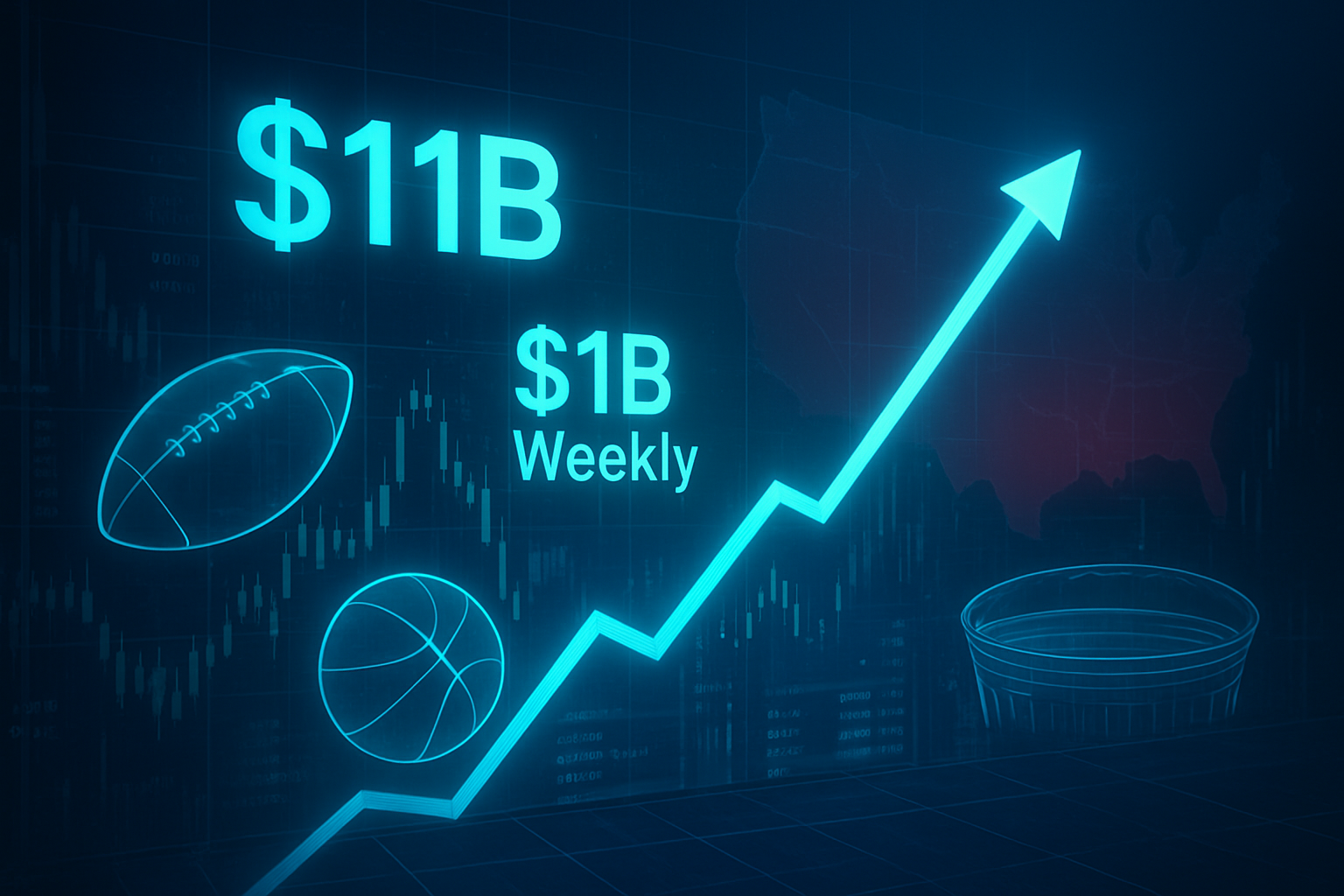
    The rapid evolution of prediction markets has reached a fever pitch as Kalshi, the first federally regulated exchange for event contracts, officially reached "decacorn" status this month. With a fresh $11 billion valuation and weekly trading volumes consistently surpassing the $1 billion mark, the platform has transformed from a niche economic forecasting tool into a dominant force in the global wagering landscape. However, this meteoric rise has placed Kalshi directly in the crosshairs of state regulators, sparking a legal battle that could redefine the boundaries between financial commodities and sports gambling.

    The surge in activity marks a significant shift in the prediction market ecosystem. While the 2024 U.S. elections served as the initial catalyst for mainstream adoption, Kalshi’s sustained growth into early 2026 is being driven by a strategic pivot into sports event contracts. Traders are no longer just betting on interest rate hikes or election outcomes; they are high-frequency trading the point spreads of NFL games and the over/under of NBA totals, all through a platform regulated by the Commodity Futures Trading Commission (CFTC).

    The Market: Kalshi’s Explosive Growth and Dominance

    In December 2025, Kalshi solidified its position as a market leader by closing a massive $1.1 billion Series E funding round. This capital injection, led by the crypto-focused venture firm Paradigm and supported by heavyweights like Sequoia Capital and Alphabet Inc. (NASDAQ: GOOGL) via its growth fund CapitalG, valued the exchange at a staggering $11 billion. Other participants included Andreessen Horowitz, ARK Invest (NYSE Arca: ARKK), and IVP, signaling broad institutional confidence in the "everything market" model.

    The valuation is backed by eye-popping performance metrics. By the final week of December 2025, Kalshi reported a record-breaking $1.7 billion in notional trading volume. Daily volumes have also seen a dramatic uptick, with the platform recording approximately $291 million on January 1, 2026, alone. This represents an 1,100% year-over-year increase, largely fueled by the platform's expansion into sports. Unlike traditional sportsbooks, Kalshi’s contracts are structured as binary options, allowing for unique hedging strategies and price discovery that mimic traditional financial markets.

    Why Traders Are Betting: The Retail Revolution

    The primary driver behind Kalshi’s volume explosion is its aggressive integration with retail trading platforms and media giants. Kalshi has successfully moved beyond its own app by embedding its markets into the interfaces of Robinhood Markets, Inc. (NASDAQ: HOOD) and Coinbase Global, Inc. (NASDAQ: COIN). This "brokerage-as-a-service" model allows millions of retail investors to trade event contracts alongside their stocks and cryptocurrencies, lowering the barrier to entry for a new generation of traders.

    Furthermore, Kalshi has effectively institutionalized prediction market data through exclusive partnerships with major news networks. Starting in January 2026, live market odds from Kalshi have become a staple on Warner Bros. Discovery (NASDAQ: WBD)'s CNN and Comcast Corporation (NASDAQ: CMCSA)'s CNBC. These integrations provide real-time, market-based sentiment on everything from corporate earnings to playoff outcomes, creating a self-reinforcing loop of visibility and trading activity. For many traders, the transparency of an order-book-based exchange offers a more "fair" alternative to the opaque "vig" of traditional sportsbooks.

    Broader Context and Implications: The 38-State Legal Firestorm

    Despite its commercial success, Kalshi is facing an existential legal challenge. A coalition of 38 states and the District of Columbia recently filed a joint amicus brief in the ongoing case of Maryland vs. Kalshi. The states argue that Kalshi’s sports contracts are "functionally indistinguishable" from sports wagering and should therefore fall under state-level gambling regulations rather than federal CFTC oversight. This coalition, which includes major markets like California and New York, contends that Kalshi is bypassing state taxes and consumer protection laws.

    The tension reached a breaking point on January 20, 2026, when a Massachusetts judge granted a preliminary injunction against the exchange. The ruling effectively bans Kalshi from offering sports event contracts in the state starting January 23, 2026. This is the first major state-level ban to take effect, creating a fragmented legal landscape where Kalshi may be legal in New Jersey (where it recently won a stay against a cease-and-desist) but prohibited in neighboring states. The outcome of these battles will determine if prediction markets can coexist with the traditional gaming industry or if they will be relegated back to strictly economic and political events.

    What to Watch Next

    The coming months will be pivotal for Kalshi's $11 billion valuation. Investors and traders are closely watching the Maryland vs. Kalshi case, as a final ruling there could set a precedent for other states in the 38-member coalition. If Maryland successfully argues that state gaming laws supersede CFTC regulation for sports contracts, Kalshi could face a wave of "geofencing" requirements, significantly impacting its liquidity and volume.

    Another key milestone is the potential for further integration with daily fantasy sports (DFS) platforms. Kalshi’s existing partnership with PrizePicks has already expanded its reach, and rumors of a deeper tie-up with other major DFS operators could further bolster volumes. However, these moves will likely attract even more scrutiny from powerful tribal gaming groups and established casino operators who view Kalshi’s growth as a direct threat to their regulated monopolies.

    Bottom Line

    Kalshi has successfully proven that there is a massive appetite for a "market for everything," bridging the gap between Wall Street and Main Street through the gamification of real-world outcomes. Reaching an $11 billion valuation and $1 billion in weekly volume is a testament to the platform's technical scale and the public's desire for transparent, high-liquidity prediction markets.

    However, the "State vs. Federal" jurisdictional battle looms large. While Kalshi has the backing of Silicon Valley and the federal oversight of the CFTC, the combined weight of 38 state attorneys general and the established gaming lobby presents a formidable obstacle. For now, Kalshi remains the undisputed king of prediction markets, but its path to long-term stability depends on whether it can convince the legal system that its contracts are tools for risk management, not just another way to bet on the big game.


    This article is for informational purposes only and does not constitute financial or betting advice. Prediction market participation may be subject to legal restrictions in your jurisdiction.

    PredictStreet focuses on covering the latest developments in prediction markets.
    Visit the PredictStreet website at https://www.predictstreet.ai/.
  • The Empire State’s Existential Bet: Will New York Shutdown the Prediction Market Boom?

    The Empire State’s Existential Bet: Will New York Shutdown the Prediction Market Boom?

    As the 2026 legislative session kicks off in Albany, the future of the prediction market industry in the United States is being decided not in a courtroom or on a trading floor, but in the halls of the New York State Assembly. The Oversight and Regulation of Activity for Contracts Linked to Events (ORACLE) Act, also known as Assembly Bill A9251, has emerged as the most significant threat to the burgeoning "event contract" sector since its mainstream explosion in 2024.

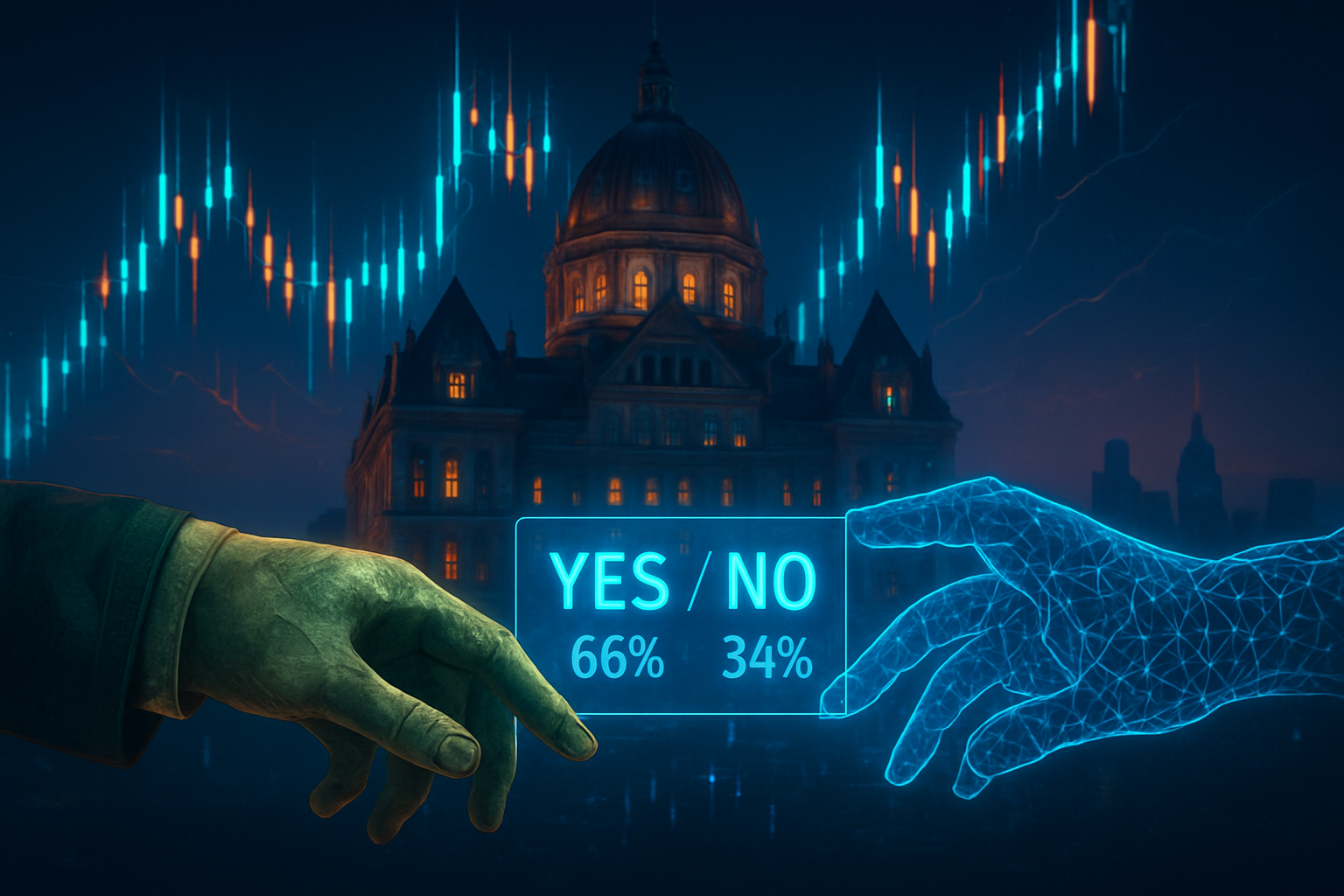
    Currently, decentralized markets on platforms like Polymarket are pricing in a 64% probability that New York will successfully enact a ban on key prediction categories by the end of 2026. This legislative surge follows a period of rapid growth and high-profile controversy, most notably a series of trades linked to geopolitical events that have lawmakers questioning whether these platforms are "truth machines" or high-stakes casinos for insider trading.

    The Market: What's Being Predicted

    The legislative battle in New York has become a market in its own right. On Polymarket, the world’s largest decentralized prediction platform, tens of millions of dollars are riding on the outcome of "New York Ban" contracts. These markets surged to a 64% "Yes" probability in mid-January 2026, immediately following the re-introduction of the ORACLE Act (A9251) on January 7.

    The bill, sponsored by Assemblymember Clyde Vanel (D-Queens), is often referred to by industry insiders as the "Nuclear Option." If passed, it would classify prediction market trading on politics, sports, and "catastrophic events"—such as wars or mass shootings—as unlicensed gambling. The penalties are draconian: any platform failing to comply with a court-ordered injunction would face a staggering $1 million per day fine.

    While the "ban" side remains the favorite on decentralized platforms, the outlook on regulated exchanges like Kalshi tells a more nuanced story. A proxy market on Kalshi reflecting the state’s regulatory climate saw the probability of a ban drop from 65% to 38% in the third week of January. This volatility is largely attributed to a competing, more moderate piece of legislation: Senate Bill S8889. Introduced by Senator Jeremy Cooney, S8889 seeks to license and tax prediction markets under the New York Department of Financial Services (DFS), treating them as financial derivatives rather than gambling.

    Why Traders Are Betting

    The primary driver behind the ORACLE Act’s momentum is the "insider trading" narrative. Lawmakers in Albany have been fixated on the so-called "Maduro Trade" of early January 2026, where a single Polymarket whale allegedly turned a $32,000 position into $400,000 just hours before a U.S.-led operation in Venezuela. Assemblymember Vanel has used this incident as a rallying cry, arguing that these markets invite "corruption and the gamification of tragedies."

    However, institutional "whales" are increasingly betting on a compromise. Notable large-scale positions have recently been taken on the "No Ban" side, fueled by several key factors:

    • Industry Pushback: A newly formed "Coalition for Prediction Markets," led by Interactive Brokers (NASDAQ: IBKR) and Robinhood (NASDAQ: HOOD), has launched a massive lobbying effort in Albany. They argue that banning these markets would drive innovation out of the world’s financial capital.
    • The "MSG Strategy": In a bold attempt to win over public sentiment, Polymarket recently signed a sponsorship deal with the New York Rangers, displaying live event odds on the scoreboards at Madison Square Garden. Traders believe this "normalization" strategy makes a total ban politically difficult for Governor Kathy Hochul.
    • Federal Preemption: Legal experts betting on the "No" side believe that because platforms like Kalshi are regulated by the Commodity Futures Trading Commission (CFTC), federal law will ultimately override (or "preempt") state-level bans under the Commodity Exchange Act.

    Broader Context and Implications

    The New York battle is a microcosm of a larger national struggle over the definition of "gambling" versus "hedging." For years, prediction markets operated in a gray area, but the recent entry of major public firms has forced the issue. DraftKings (NASDAQ: DKNG) and Flutter Entertainment (NYSE: FLUT), the parent company of FanDuel, have recently split from traditional gaming trade groups to support a regulated prediction market framework, signaling that the line between sports betting and financial forecasting is permanently blurring.

    If the ORACLE Act passes in its current form, it could set a dangerous precedent for other states. New York’s aggressive stance contrasts sharply with states like New Jersey and Illinois, which are exploring ways to tax these markets as a new revenue stream. For the industry, New York is the "must-win" state. A ban here would not only lock out a massive retail market but would also threaten the liquidity and accuracy of global contracts that rely on the participation of New York-based financial professionals.

    The debate also reveals a fundamental shift in how the public consumes information. Proponents, including IBKR Chairman Thomas Peterffy, describe these markets as "Truth Discovery Engines" that outperform traditional polling and expert analysis. Critics, meanwhile, view them as an unregulated "Wild West" that incentivizes bad actors to profit from chaos.

    What to Watch Next

    The next 60 days will be critical for the ORACLE Act. Traders are closely monitoring the Assembly Committee on Consumer Affairs and Protection, where A9251 is currently being debated. A vote to move the bill out of committee would likely send the "Ban" odds back toward the 80% range.

    Key dates to watch:

    • February 24, 2026: A major ruling is expected in the Southern District of New York (SDNY) regarding Kalshi’s ongoing litigation with the New York Gaming Commission. This court case will serve as a bellwether for whether the state has the legal authority to override federal oversight.
    • The Budget Deadline (April 1, 2026): Governor Kathy Hochul has signaled a desire to "safeguard" the public from gamified finance. If she includes language from the ORACLE Act in her executive budget, it would be a near-certain sign that a ban is coming.
    • The Cooney Bill Hearings: Keep an eye on Senator Cooney’s S8889. If this bill gains support from the Department of Financial Services, it could offer a "third way" that keeps prediction markets legal but strictly regulated.

    Bottom Line

    The legislative fight in New York represents a defining moment for prediction markets. On one side, the ORACLE Act seeks to slam the door shut on what it views as a predatory and dangerous new form of gambling. On the other, a coalition of fintech giants and retail traders is fighting to preserve a tool they believe is essential for the 21st-century information economy.

    As of late January 2026, the markets remain split. While the political momentum in the Assembly favors a ban, the sheer weight of the financial and legal arguments from firms like Interactive Brokers (NASDAQ: IBKR) and Robinhood (NASDAQ: HOOD) suggests that a total shutdown is far from guaranteed. For now, the safest bet is that New York’s regulatory landscape is about to get much more complicated, and the "truth" about these markets will be decided by the highest bidder in Albany.


    This article is for informational purposes only and does not constitute financial or betting advice. Prediction market participation may be subject to legal restrictions in your jurisdiction.

    PredictStreet focuses on covering the latest developments in prediction markets.
    Visit the PredictStreet website at https://www.predictstreet.ai/.
  • Betting on the Law: Why the ‘Maduro Trade’ Has Prediction Markets Bracing for Federal Oversight

    Betting on the Law: Why the ‘Maduro Trade’ Has Prediction Markets Bracing for Federal Oversight

    As of January 21, 2026, the fast-evolving world of "Information Finance" is facing its most significant legislative reckoning to date. Congressman Ritchie Torres (D-NY) has officially introduced the Public Integrity in Financial Prediction Markets Act of 2026 (H.R. 7004), a bill designed to bring the ethics of Wall Street to the burgeoning world of event contracts. The move follows a month of intense scrutiny after a series of suspiciously well-timed bets on the platform Polymarket sparked a national conversation about insider trading in geopolitical forecasting.

    Currently, the market's own participants are skeptical about the bill's chances. On PredictIt, the contract for "Will H.R. 7004 pass in 2026?" is trading at a mere 12 cents, implying just a 12% probability of becoming law before the end of the year. Despite the low odds, the bill has become a focal point for traders and regulators alike, as it represents the first major attempt to codify a "STOCK Act" for the prediction market industry.

    The Market: What's Being Predicted

    The PredictIt market tracking the passage of the Torres bill has seen a surge in volume over the last ten days, following the bill's formal introduction on January 9. While the 12% probability suggests a uphill battle, the market is highly liquid, with hundreds of thousands of shares changing hands as traders weigh the legislative appetite for regulation in a midterm election year.

    The bill, backed by high-profile co-sponsors including Speaker Emerita Nancy Pelosi, specifically targets "covered individuals"—which includes federal elected officials, political appointees, and congressional staff. It seeks to prohibit these individuals from trading on event contracts tied to government policy or actions if they possess material non-public information. On the regulated exchange Kalshi, a secondary market has emerged regarding whether the Commodity Futures Trading Commission (CFTC) will independently adopt similar rules by year-end, currently trading at a slightly more optimistic 20% probability.

    Why Traders Are Betting

    The primary catalyst for this legislative push was the so-called "Maduro Trade." On January 3, 2026, just hours before the Trump Administration announced the successful capture of Venezuelan leader Nicolás Maduro, an anonymous account on Polymarket placed a $32,537 bet that Maduro would be out of power by the end of the month. The trade netted over $400,000, fueling allegations that a government or military insider leaked the timing of the raid to profit on the platform.

    Traders are currently split into two camps. The "No" voters (holding the 88% majority) argue that a divided Congress is unlikely to reach a consensus on such a niche issue during an election cycle. They point to the complexity of defining "material non-public information" in the context of global events. Conversely, the "Yes" bulls believe the optics of the "Maduro Trade" are too toxic for politicians to ignore, and that a bipartisan coalition could form to "clean up" the markets before more scandals emerge.

    There is also a significant strategic divide between platforms. Kalshi CEO Tarek Mansour has expressed support for the bill, noting that regulated U.S. platforms already have internal prohibitions on insider trading. By contrast, decentralized and offshore platforms like Polymarket—which have recently faced scrutiny for accurate betting patterns ahead of the Golden Globes—stand to lose the most from federal enforcement.

    Broader Context and Implications

    The Torres bill arrives at a time when prediction markets are transitioning from niche hobbies to mainstream financial tools. Major retail platforms like Robinhood Markets, Inc. (NASDAQ:HOOD) and Interactive Brokers Group, Inc. (NASDAQ:IBKR) through its ForecastEx exchange, have aggressively expanded their event contract offerings throughout 2025. This institutionalization has brought increased pressure from state regulators.

    In just the first three weeks of 2026, Tennessee and Connecticut have issued cease-and-desist orders against several platforms for offering sports-related contracts without gaming licenses. In New York, Assemblymember Clyde Vanel is pushing the ORACLE Act, which would strictly limit the types of events New Yorkers can bet on. The federal Torres bill is seen by some as a way to provide a unified national framework that could preempt a "patchwork" of confusing state laws.

    Historically, prediction markets have been remarkably accurate at forecasting legislative outcomes, often outperforming traditional pundits. If the 12% probability on PredictIt holds steady, it suggests that despite the public outcry over the Maduro incident, the legislative path for H.R. 7004 is fraught with political gridlock.

    What to Watch Next

    The next major hurdle for the bill is a scheduled hearing before the House Financial Services Committee in mid-February. Traders will be listening closely for any signals from committee leadership; if the bill receives a favorable recommendation to move to the House floor, the PredictIt odds could easily double overnight.

    Furthermore, the Trump Administration's stance remains a wildcard. While the administration has been generally hands-off regarding financial deregulation, the embarrassment of a potential military leak leading to a "Maduro Trade" profit could shift the White House's posture toward supporting "integrity measures" for the sector.

    Finally, keep an eye on the CFTC's upcoming open meeting in March. If the Commission indicates it will move forward with its own rulemaking regarding insider trading on event contracts, the legislative urgency for H.R. 7004 may diminish, causing the passage odds to plummet further as administrative action takes the lead.

    Bottom Line

    The Public Integrity in Financial Prediction Markets Act of 2026 is a watershed moment for the "InfoFi" industry. It highlights a fundamental tension: the power of prediction markets to aggregate information versus the risk that they become a vehicle for government corruption.

    While the current 12% probability of passage reflects a skeptical trading community, the very existence of the bill has already changed the industry. Major players like Interactive Brokers (NASDAQ:IBKR) and Robinhood (NASDAQ:HOOD) are likely to tighten their own compliance frameworks in anticipation of eventual oversight. Whether through H.R. 7004 or administrative action, the "wild west" era of unregulated geopolitical betting appears to be drawing to a close.


    This article is for informational purposes only and does not constitute financial or betting advice. Prediction market participation may be subject to legal restrictions in your jurisdiction.

    PredictStreet focuses on covering the latest developments in prediction markets.
    Visit the PredictStreet website at https://www.predictstreet.ai/.
  • The $400,000 ‘Sure Thing’: Maduro Capture Sparks Prediction Market Insider Trading Crisis

    The $400,000 ‘Sure Thing’: Maduro Capture Sparks Prediction Market Insider Trading Crisis

    CARACAS/NEW YORK — On January 3, 2026, at 4:21 a.m. EST, a post on Truth Social, the platform owned by Trump Media & Technology Group (NASDAQ: DJT), sent shockwaves across the globe: Venezuelan strongman Nicolás Maduro had been captured by U.S. special operations forces in "Operation Absolute Resolve." While the world grappled with the geopolitical fallout of the regime's collapse, a more localized explosion was occurring on the blockchain-based prediction platform Polymarket.

    Just hours before the first official confirmation of the capture, a single anonymous trader turned a $32,000 gamble into a staggering $436,000 windfall. The "pitch-perfect" timing of the wager has ignited a firestorm of controversy, with critics alleging that the trade was not a feat of "crowd wisdom," but a blatant case of insider trading using classified military intelligence. As the dust settles on the streets of Caracas, the focus is shifting to Washington, where regulators are facing renewed pressure to police the "Wild West" of geopolitical betting.

    The Market: What's Being Predicted

    The specific contract at the center of the storm was titled "Will Nicolás Maduro be out of office by January 31, 2026?" For months, this market had been a niche corner of Polymarket, with the "Yes" shares trading at a dismal $0.05 to $0.08—implying less than a 10% chance of a transition of power. Trading volume remained steady but unremarkable until the final week of December 2025.

    As the clock ticked toward the New Year, the market's liquidity deepened significantly. Total volume on Maduro-related contracts surpassed $15 million across Polymarket and its regulated competitor Kalshi. However, while Kalshi—which operates under the oversight of the Commodity Futures Trading Commission (CFTC)—saw odds hover around 13% based on public reports of civil unrest, Polymarket experienced a sudden, violent surge in "Yes" buying in the pre-dawn hours of January 3.

    The resolution criteria for the market were straightforward: Maduro had to be physically removed from power, resign, or be captured by a foreign entity. While the "Out of Office" market resolved quickly in favor of "Yes" holders, a sister market regarding a "U.S. Invasion of Venezuela" has remained frozen in a $10.5 million legal limbo. Polymarket’s oracle has so far refused to pay out the "Invasion" contracts, arguing that a "snatch-and-extract" mission does not meet the technical definition of an invasion intended to occupy territory—a move that has left many retail traders feeling cheated by the "house."

    Why Traders Are Betting

    The focus of the investigation is an account originally named "Burdensome-Mix," which was created on December 26, 2025. Blockchain forensics provided by firms such as Chainalysis reveal that the account was funded via a direct transfer from Coinbase Global, Inc. (NASDAQ: COIN), suggesting the trader made little effort to hide their identity behind privacy mixers.

    Between midnight and 2:00 a.m. on the day of the capture, "Burdensome-Mix" aggressively purchased nearly 500,000 "Yes" shares. "This wasn't a hedge or a speculative play," noted one high-volume trader on the platform. "This was someone who knew the helicopters were already in the air." By the time the Truth Social announcement went live, the trader's $32,537 investment had ballooned to nearly half a million dollars.

    Analysts point to the sharp divergence between Polymarket and traditional forecasting as evidence of an information leak. While intelligence agencies and political pundits were still debating the likelihood of a coup, the prediction market "knew" something was coming. This has raised the uncomfortable possibility that U.S. military personnel, intelligence officers, or high-level administration officials may be using prediction markets as a "tax-free bonus" system to profit from secret state actions.

    Broader Context and Implications

    The Maduro windfall has become a defining moment for the prediction market industry. For years, proponents have argued that these markets are the most accurate way to aggregate disparate information and predict the future. However, if that information is sourced from classified briefings rather than public analysis, the "wisdom of the crowd" becomes a mask for corruption.

    The political backlash was instantaneous. On January 9, 2026, Representative Ritchie Torres (D-N.Y.) introduced the Public Integrity in Financial Prediction Markets Act of 2026. The bill aims to close the "geopolitical loophole" by criminalizing the use of non-public material information by federal employees to trade on prediction platforms. "If you have a security clearance, you shouldn't have a Polymarket account," Torres told reporters on Capitol Hill.

    Furthermore, the incident has highlighted the jurisdictional "gray zone" of Polymarket. Because the platform technically bars U.S. users, it often escapes the direct reach of the CFTC. However, the use of U.S.-based exchanges like Coinbase to fund these accounts provides a potential hook for federal investigators. Senate leaders have already sent a formal letter to CFTC Chairman Michael Selig demanding an investigation into whether the platform is being used to facilitate money laundering or insider trading by government actors.

    What to Watch Next

    The immediate future of prediction markets depends on the outcome of two major investigations. First, the CFTC is expected to issue a report on the Maduro trades by the end of Q1 2026. If they find evidence that the "Burdensome-Mix" trader had ties to the U.S. government, it could lead to a permanent ban on geopolitical event contracts in the United States.

    Second, the "Invasion vs. Capture" dispute is headed for a potential class-action lawsuit. The $10.5 million in locked funds represents a significant portion of Polymarket’s current liquidity. If the platform is forced to pay out to "Invasion" bettors, it could face a liquidity crunch; if it refuses, it risks losing the trust of the very community that fuels its growth.

    Traders should also monitor the progress of the Torres Bill in the House Financial Services Committee. If passed, it would represent the first major legislative framework specifically targeting prediction market ethics, potentially forcing platforms to implement "Know Your Customer" (KYC) protocols that check for government employment and security clearances.

    Bottom Line

    The capture of Nicolás Maduro should have been a triumphant moment for prediction markets—proof that they can signal world-changing events before the traditional media. Instead, the "Burdensome-Mix" trade has left the industry defending its very existence. The line between "superior analysis" and "insider information" has blurred to the point of invisibility, creating an existential crisis for decentralized forecasting.

    As we move further into 2026, the Maduro scandal serves as a warning: when the stakes are global and the information is classified, prediction markets may not be reflecting the wisdom of the crowd so much as the secrets of the few. Whether the industry can survive this transition from a niche hobby to a high-stakes geopolitical tool remains to be seen.


    This article is for informational purposes only and does not constitute financial or betting advice. Prediction market participation may be subject to legal restrictions in your jurisdiction.

    PredictStreet focuses on covering the latest developments in prediction markets.
    Visit the PredictStreet website at https://www.predictstreet.ai/.
  • The Rhetoric Jackpot: Inside the Multi-Billion Dollar Culture of Betting on the Trump Dialect

    The Rhetoric Jackpot: Inside the Multi-Billion Dollar Culture of Betting on the Trump Dialect

    WASHINGTON, D.C. — January 20, 2026 — Exactly one year after Donald Trump was sworn in as the 47th President of the United States, a new kind of ticker tape is dominating the financial landscape. It isn't tracking the S&P 500 or the price of gold, but rather the specific syllables spoken by the Commander-in-Chief. As President Trump arrives in Davos, Switzerland, today for the World Economic Forum, thousands of traders are glued to their screens, wagering millions on whether he will utter his signature catchphrase: "drill, baby, drill."

    On leading prediction platforms like Polymarket and Kalshi, these "rhetoric markets" have evolved from niche political curiosities into high-volume financial instruments. As of this morning, the probability of Trump saying "drill, baby, drill" during his Davos address tomorrow stands at a steady 54%, while more aggressive bets on his first-year anniversary comments have seen nearly $1.5 billion in weekly volume. What started as a "prop bet" culture has transformed into a sophisticated ecosystem where linguistic patterns are traded with the same intensity as tech stocks.

    The Market: What’s Being Predicted

    The mechanics of betting on presidential speech have become remarkably granular. While traditional markets focus on policy outcomes—such as the likelihood of a Fed Chair appointment—the "mention markets" track the specific vocabulary used in public addresses, tweets (now officially integrated into Truth Social and X), and press conferences. These contracts are typically structured as binary "Yes/No" outcomes: “Will Trump say ‘Drill Baby Drill’ by Jan 31?”

    Currently, the epicenter of this activity is Kalshi, which has seen its total volume skyrocket to over $23.8 billion in 2025 following a landmark regulatory year. For the upcoming 2026 State of the Union, the "Drill Baby Drill" contract is one of the most liquid on the platform, attracting professional market makers and retail "vibe traders" alike. These markets are joined by other high-stakes linguistic wagers, including the odds of Trump mentioning "Bitcoin" (currently 53%) or using the term "Trump Derangement Syndrome" (trading at 47%).

    The resolution criteria for these bets are handled with judicial precision. Platforms employ dedicated verification teams to scan official White House transcripts and high-fidelity audio recordings. On Polymarket, which recently normalized its U.S. operations through a partnership with a CFTC-licensed exchange, these contracts often resolve within minutes of a speech's conclusion, triggering massive liquidity flows.

    Why Traders Are Betting

    The surge in rhetoric betting is driven by the unique predictability of Donald Trump’s linguistic "greatest hits." Unlike traditional politicians whose speeches are vetted by committees of speechwriters for nuance, Trump’s reliance on branding and repetition—what some analysts call "The Billboard Effect"—makes him the perfect subject for event contracts.

    "It’s about sentiment analysis and pattern recognition," says Logan Sudeith, a professional trader who has reportedly earned six figures annually by tracking the President's frequency of specific adjectives. Traders are not just guessing; they are using sophisticated AI tools, often powered by Alphabet Inc. (NASDAQ: GOOGL) and other tech giants, to analyze the President's recent Truth Social posts as leading indicators for his verbal speeches. If "drill" appears in a 3:00 AM post, the "Yes" contracts on Kalshi usually see a 10-15% bump by dawn.

    There is also a significant "whale" presence in these markets. Famous accounts like "Freddy9999," who netted an estimated $50 million during the 2024 election cycle, continue to move the needle. These large-scale positions often act as a hedge; energy sector investors may buy "Yes" contracts on "drill, baby, drill" to offset potential volatility in oil prices, using the President's rhetoric as a proxy for upcoming deregulation.

    Broader Context and Implications

    The institutionalization of these markets marks a paradigm shift in how the public consumes political news. Major media outlets like CNBC, owned by Comcast Corp. (NASDAQ: CMCSA), and CNN now incorporate prediction market odds directly into their chyrons, viewing the "wisdom of the crowd" as a more accurate "truth signal" than traditional polling or punditry.

    The entry of retail powerhouses like Robinhood Markets, Inc. (NASDAQ: HOOD) and Interactive Brokers Group, Inc. (NASDAQ: IBKR) into the event-contract space has further democratized this "culture of the bet." Even the Intercontinental Exchange, Inc. (NYSE: ICE), the parent company of the New York Stock Exchange, has moved into the infrastructure of these markets, reflecting a belief that event-based hedging is the next frontier of finance.

    However, this trend raises significant questions about the "gamification" of governance. Critics argue that when millions of dollars are riding on a single phrase, it creates an incentive for the President to intentionally move markets—or for staff to leak speech drafts to favored traders. Despite these concerns, the CFTC has largely pivoted toward a "regulated expansion" model, acknowledging that these markets provide valuable data on public expectations.

    What to Watch Next

    The immediate focus is the President's Davos address on Wednesday, January 21, 2026. While "drill, baby, drill" is the legacy bet, "Greenland" has become the dark horse of the week. Following reports of renewed interest in the island’s natural resources, "mention markets" for the word "Greenland" have climbed to near 100% certainty for the Davos trip.

    Beyond the vocabulary, the market is awaiting the nomination of the next Federal Reserve Chair. Currently, Kevin Warsh leads the prediction pools with a 61% probability, and traders are listening for specific keywords—like "sound money" or "interest rate cuts"—that might signal his official appointment during tomorrow's speech.

    Investors should also monitor the growing influence of AI trading agents. By early 2026, an estimated 40% of the volume in rhetoric markets is driven by bots that execute trades faster than human speech can be processed by the ear. This "high-frequency linguistics" is expected to create extreme volatility in the seconds after the President approaches a microphone.

    Bottom Line

    The culture of betting on "drill, baby, drill" is more than just a political gimmick; it is the birth of a new asset class. By turning presidential rhetoric into a tradable commodity, prediction markets have provided a real-time, financially-backed sentiment gauge that traditional media can no longer ignore.

    As we cross the one-year mark of the 47th presidency, the lesson for investors is clear: in the modern era, a politician's words are no longer just "talk"—they are a price point. Whether this leads to a more informed electorate or simply a more volatile one remains to be seen, but for now, the markets are waiting with bated breath for the next "drill."


    This article is for informational purposes only and does not constitute financial or betting advice. Prediction market participation may be subject to legal restrictions in your jurisdiction.

    PredictStreet focuses on covering the latest developments in prediction markets. Visit the PredictStreet website at https://www.predictstreet.ai/.
  • The Odds of Governance: How Prediction Markets Redefined the NYC Mayoral Race

    The Odds of Governance: How Prediction Markets Redefined the NYC Mayoral Race

    As New York City enters the first weeks of the Zohran Mamdani administration, political analysts and financial traders alike are looking back at the 2025 mayoral race not just for its ideological shift, but as a watershed moment for the prediction market industry. For the first time in a major U.S. municipal election, real-time betting data from platforms like Kalshi and Polymarket moved from the fringes of political nerd-dom into the center of campaign strategy, social media warfare, and high-budget television advertisements.

    By the time the polls closed on November 4, 2025, prediction markets were showing a staggering 95% probability of victory for Mamdani, the 34-year-old Democratic Socialist. This high-conviction forecast stood in stark contrast to traditional polling, which suggested a much tighter "margin of error" race against former Governor Andrew Cuomo. The markets’ aggressive stance—and the candidates' reactions to it—has ignited a fierce debate over whether these financial instruments are tools for clarity or weapons of psychological voter suppression.

    The Market: What's Being Predicted

    The 2025 NYC Mayoral market was the largest municipal betting event in history, facilitated by a significant regulatory expansion earlier in the year. Leading the charge were Kalshi, a regulated exchange, and Polymarket, the decentralized giant. Together, these platforms saw hundreds of millions of dollars in trading volume, providing a liquidity depth that allowed for sophisticated price discovery throughout the turbulent campaign cycle.

    The market narrative was defined by the "Cuomo Collapse." In early 2025, markets assigned Andrew Cuomo an 80–90% chance of returning to the governor’s mansion’s city-level equivalent. However, the price of "Mamdani Yes" contracts began a meteoric rise in June 2025, surging from a mere 7 cents to over 50 cents in a matter of weeks. By late October, as the general election approached, the markets were effectively "locked," with Mamdani trading at nearly 94 cents on Kalshi, implying a nearly certain victory that traditional pollsters were hesitant to call.

    The resolution criteria for these markets were strictly tied to the official certification of results by the NYC Board of Elections. However, the sheer volume of "event contracts" allowed traders to hedge against specific outcomes, such as a ranked-choice voting upset or even the likelihood of a legal challenge to the results—a market that spiked briefly after Cuomo supporters alleged voter fraud in early November.

    Why Traders Are Betting

    The divergence between market odds and traditional polling was the primary driver of the year's heavy trading volume. While polls often struggled with the complexities of New York’s ranked-choice voting and the enthusiasm of younger demographics, traders were quick to price in the "ground game" advantage of Mamdani’s progressive coalition.

    "The markets weren't just looking at who people said they would vote for; they were looking at the momentum of the donor base and the collapse of the centrist vote after Eric Adams' indictment," said one high-frequency trader who specialized in political contracts. Notable "whale" activity also influenced the boards. Billionaire Bill Ackman, a frequent commentator on market integrity, publicly questioned the odds on social media, suggesting that large positions were being taken to create a "mirage of inevitability" for the Mamdani campaign.

    In response, the Mamdani campaign did something unprecedented: they weaponized the odds. At "NYC Is Not For Sale" rallies, Mamdani frequently pointed to Kalshi odds on large screens to warn his base against complacency. By showing how the "smart money" had shifted from Cuomo to him, he argued that the power of grassroots organizing was literally changing the financial forecast of the city. This feedback loop—where market data influences the very events it is trying to predict—has become a central point of study for political scientists.

    Broader Context and Implications

    The NYC race served as a proof-of-concept for the mainstreaming of prediction markets. Public companies like Robinhood Markets, Inc. (NASDAQ: HOOD) and Interactive Brokers Group, Inc. (NASDAQ: IBKR) had expanded their "Election Event" offerings throughout 2025, allowing retail investors to trade on political outcomes with the same ease as buying a share of Apple Inc. (NASDAQ: AAPL). This accessibility brought political betting into the living rooms of average New Yorkers, but not without significant controversy.

    The most heated debate involved "victory ads" run by Kalshi. On the morning of Election Day, the platform ran digital billboards in Times Square and ads on Meta Platforms, Inc. (NASDAQ: META) and Alphabet Inc. (NASDAQ: GOOGL) properties that effectively "called" the race for Mamdani based on their 93% probability data. Critics, including the Cuomo campaign, argued that declaring a winner while people were still standing in line to vote was a dangerous new form of voter suppression.

    Furthermore, the post-election "Deportation Market"—which allowed users to bet on the odds of the Ugandan-born, naturalized Mamdani being deported under a potential future federal administration—showed the darker side of these platforms. The existence of such a market drew condemnation from civil rights groups, highlighting the regulatory vacuum regarding "distasteful" or "unethical" contracts that nonetheless meet the technical criteria for being a predictable event.

    What to Watch Next

    As the Mamdani administration begins its first 100 days, the focus of prediction markets has shifted from "who will win" to "what will they do." Currently, active markets are tracking whether the new Mayor can successfully implement his promised citywide rent freeze by July 2026. Traders are currently pricing that outcome at a cautious 42% probability, reflecting skepticism over the legal hurdles in the State Legislature.

    Another key milestone is the upcoming FY 2026 budget. With a projected $2 billion deficit, markets on the "NYC Credit Rating Downgrade" are seeing increased activity. Investors should also keep an eye on federal-city relations; contracts regarding federal funding cuts for "Sanctuary Cities" are already trading on Polymarket, with significant implications for Mamdani’s ambitious social programs.

    Bottom Line

    The 2025 NYC Mayoral race proved that prediction markets are no longer a niche hobby for economists; they are a potent political force. By accurately forecasting the "Mamdani Wave" long before it was reflected in mainstream media narratives, these markets provided a level of real-time insight that traditional methods failed to capture.

    However, the controversy over campaign-led "odds ads" and the ethical questions surrounding sensitive contracts suggest that the industry is at a crossroads. While platforms like Kalshi and Polymarket offer a more efficient way to aggregate information, the "commodification of expectations" can have real-world consequences on voter turnout and political stability. As we look toward the 2028 presidential cycle, the lessons of New York City will serve as the primary case study for how—or if—prediction markets should be regulated in the heat of a democratic contest.


    This article is for informational purposes only and does not constitute financial or betting advice. Prediction market participation may be subject to legal restrictions in your jurisdiction.

    PredictStreet focuses on covering the latest developments in prediction markets.
    Visit the PredictStreet website at https://www.predictstreet.ai/.
  • The New Tape: Why Wall Street Is Obsessed with Prediction Market Alpha

    The New Tape: Why Wall Street Is Obsessed with Prediction Market Alpha

    As of January 20, 2026, a fundamental shift has occurred in the plumbing of global finance. For decades, the "tape"—the real-time feed of stock and bond prices—was the undisputed source of truth for traders. Today, that tape has a rival. Professional desks at major banks and hedge funds are increasingly turning to prediction markets like Kalshi and Polymarket not just to hedge, but for "Information Discovery"—identifying market-moving signals before they hit the Bloomberg terminal.

    This week, the "Information Discovery" trend reached a fever pitch. While traditional interest rate futures at CME Group (NASDAQ: CME) showed a lingering 16% chance of a rate cut at the upcoming January FOMC meeting, prediction markets had already moved to a 96% "certainty" of a pause. This 12-point "certainty gap" allowed savvy traders to front-run moves in the USD/EUR forex pairs and adjust positions in interest-rate-sensitive stocks before the broader market caught on. With daily trading volumes in the sector hitting a record $701.7 million this month, prediction markets have officially graduated from political novelties to essential financial infrastructure.

    The Market: What's Being Predicted

    The current landscape of prediction markets is dominated by two primary forces: the regulated U.S. powerhouse Kalshi and the decentralized giant Polymarket, which recently finalized its re-entry into the U.S. via the $112 million acquisition of QCX. These platforms host thousands of "event contracts" ranging from the mundane (monthly CPI prints) to the tectonic (geopolitical regime changes).

    Unlike traditional derivatives, which are often tied to the underlying price of an asset, event contracts settle based on the binary outcome of a real-world event. For instance, the "Will the Fed raise rates in January?" contract on Kalshi has seen massive liquidity, with over 2.5 billion contracts traded across integrated platforms like Robinhood Markets, Inc. (NASDAQ: HOOD) in the final quarter of 2025 alone. Current odds on Kalshi show a stagnant 4% probability for a hike, a signal that has remained remarkably stable even as traditional bond yields fluctuated wildly last week.

    The speed of resolution is also a key factor. While traditional markets often wait for official government reports or press releases, prediction markets react to "boots on the ground" data in real-time. This has created a high-velocity environment where liquidity and volume have skyrocketed, with the total notional value of the prediction market sector exceeding $13 billion in late 2025.

    Why Traders Are Betting

    The move toward prediction markets is driven by a simple realization: these markets are often more accurate and faster than professional surveys or analyst consensus. Institutional traders are using these platforms to find "alpha"—the elusive market-beating edge.

    A prime example occurred earlier this month on January 3, 2026. Hours before U.S. forces announced the capture of Venezuelan President Nicolás Maduro, specific geopolitical contracts on Polymarket began to swing violently toward a "Yes" outcome. A handful of anonymous traders netted over $400,000 on the move. More importantly, this signal preceded a 10% intraday surge in Chevron (NYSE: CVX) and other Latin American-exposed energy stocks when the NYSE opened the following Monday. Traders who monitored the Polymarket signal were able to position themselves in Chevron before the news was fully digested by traditional equity desks.

    Large-scale "whale" activity is also becoming more transparent. Boaz Weinstein of Saba Capital recently highlighted a divergence where prediction markets priced recession risk at 50%, while traditional credit markets implied only a 2% chance. This allowed hedge funds to construct "paired trades"—effectively using the cheap "No Recession" contracts as a hedge while shorting expensive credit instruments. This sophisticated arbitrage is why firms like Susquehanna International Group (SIG) have stepped in as official market makers for Kalshi, and why JPMorgan Chase & Co. (NYSE: JPM) has reportedly integrated real-time prediction market feeds into its internal research dashboards.

    Broader Context and Implications

    The "Information Discovery" trend is the crown jewel of the "Information Finance" era. It represents a shift from guessing what will happen to pricing what is actually happening in the collective consciousness of the most informed participants. Historically, prediction markets have outperformed pundits and polls in nearly every major election and economic cycle since 2020.

    The regulatory environment has finally provided the tailwinds necessary for this institutional adoption. The passage of the Digital Asset Market CLARITY Act of 2025 provided a federal framework that reclassified many event-related assets as commodities, ending years of legal limbo between the SEC and the CFTC. While state-level challenges remain—with New Jersey and Nevada recently issuing cease-and-desist orders against certain sports-related contracts—the federal path for economic and political markets is clearer than ever.

    For the broader public, these markets provide a "bullshit detector" for the 24-hour news cycle. When a politician makes a claim or a CEO issues a vague guidance, the market price on a corresponding event contract serves as an immediate, incentivized truth-check.

    What to Watch Next

    As we move through the first quarter of 2026, the primary focus will be on the "Macro Trifecta": the February CPI print, the Q1 earnings season for "Magnificent Seven" stocks like Microsoft (NASDAQ: MSFT), and the implementation of the CLARITY Act’s secondary market rules.

    Traders should specifically watch for discrepancies between the "Earnings Surprise" contracts on ForecastEx—the platform run by Interactive Brokers Group (NASDAQ: IBKR)—and the implied volatility in the options market. If prediction markets begin to signal an earnings beat for big tech 48 hours before the release, we could see significant pre-market moves in the underlying stocks.

    Additionally, the battle between state and federal regulators will reach the Supreme Court later this year. The outcome of these cases will determine if prediction markets can expand into more granular, localized events, or if they will remain focused on high-level macro and geopolitical shifts.

    Bottom Line

    The rise of "Information Discovery" marks the end of the analyst-survey era and the beginning of the market-signal era. As Goldman Sachs Group, Inc. (NYSE: GS) executives noted in their latest earnings call, prediction markets are no longer a "side-show"; they are a fundamental data layer that informs how the world's largest banks price risk.

    The key takeaway for any investor is that the "truth" is now priced in real-time, 24/7, by people with skin in the game. Whether you are trading stocks, currencies, or commodities, ignoring the signals from Kalshi and Polymarket is becoming a luxury that professional traders can no longer afford. As liquidity continues to pool in these markets, their ability to predict the future—and move the present—will only grow.


    This article is for informational purposes only and does not constitute financial or betting advice. Prediction market participation may be subject to legal restrictions in your jurisdiction.

    PredictStreet focuses on covering the latest developments in prediction markets.
    Visit the PredictStreet website at https://www.predictstreet.ai/.
  • The Maduro Trade Fallout: Markets Brace for Federal Crackdown on “Government Insiders”

    The Maduro Trade Fallout: Markets Brace for Federal Crackdown on “Government Insiders”

    As of January 20, 2026, the prediction market world is grappling with a new reality: the prospect of a federal ban on government employees and politicians trading the very outcomes they influence. Prompted by a suspicious $400,000 windfall on the offshore platform Polymarket, Congressman Ritchie Torres (D-NY) has formally introduced the Public Integrity in Financial Prediction Markets Act of 2026 (H.R. 7004). The bill aims to codify "insider trading" rules for the burgeoning world of "Information Finance," marking the most significant legislative attempt to regulate the space since the 2012 STOCK Act.

    Currently, proxy markets on PredictIt and Kalshi suggest that while the public is outraged, the path to legislative victory remains steep. A PredictIt contract tracking the passage of a general ban on congressional trading is currently hovering at a 12% probability, reflecting deep-seated skepticism that a divided Congress will move quickly in a midterm election year. However, interest in the bill is surging as major retail platforms like Robinhood (NASDAQ:HOOD) and Interactive Brokers (NASDAQ:IBKR) pivot to support the legislation, hoping that federal guardrails will finally provide the regulatory certainty needed to fend off aggressive state-level bans.

    The Market: What's Being Predicted

    The "Torres Bill" market is less a single contract and more a cluster of interconnected wagers across multiple platforms. On PredictIt, the "Will Congress pass a ban on member stock trading?" contract—long used as a barometer for ethics legislation—saw a 4-cent spike following the introduction of H.R. 7004 on January 9, 2026. Meanwhile, on Kalshi, a contract focused on whether the Commodity Futures Trading Commission (CFTC) will adopt new insider trading rules by the end of 2026 has climbed to 20%, suggesting traders believe administrative action may be more likely than a full act of Congress.

    Trading volume has been particularly heavy in the "Federal Preemption" markets on Manifold, where the probability that federal law will override state-level bans (like New York’s proposed ORACLE Act) is trading at a staggering 81%. This reflects a consensus that the Torres Bill is being used as a bargaining chip: the industry will accept a ban on "government insiders" in exchange for a federal "safe harbor" that protects platforms from being labeled as illegal gambling by state attorneys general.

    The resolution criteria for most of these markets depend on H.R. 7004 being signed into law by December 31, 2026. If the bill stalls in committee or fails to find Republican co-sponsors by the summer recess, the "No" side of these contracts is expected to become the dominant play.

    Why Traders Are Betting

    The primary driver of the current "No" sentiment (88% on PredictIt) is the historical difficulty of passing any legislation that limits the financial freedom of lawmakers. Traders cite the original STOCK Act’s long gestation period and subsequent weakening as evidence that the Torres Bill faces an uphill battle. "Washington moves at a snail’s pace, but these markets move at the speed of light," says one high-volume trader on Kalshi. "The odds are low not because people hate the bill, but because they don't believe this Congress can agree on what day of the week it is."

    However, a "whale" position recently emerged on the "Yes" side, betting that the scandalous nature of the "Maduro Trade" provides a unique political catalyst. In early January 2026, an anonymous Polymarket user bet $32,000 on the capture of Venezuelan President Nicolás Maduro just hours before a U.S.-led operation was announced, netting a nearly 1,200% return. This event has unified public sentiment against "information asymmetry" in a way that dry policy debates never could.

    Furthermore, the strategic support from Interactive Brokers (NASDAQ:IBKR) has changed the math. IBKR’s ForecastEx exchange has been a vocal proponent of the bill, arguing that banning insiders is essential for prediction markets to be viewed as "Truth Machines" rather than casinos. This institutional backing suggests that the bill isn't just a progressive pet project, but a necessary step for the industry's survival.

    Broader Context and Implications

    The Torres Bill represents a pivotal moment in the evolution of prediction markets. For years, these platforms have existed in a legal gray area, frequently clashing with the CFTC. The introduction of H.R. 7004 signals that prediction markets have finally reached a level of cultural and financial significance where they require their own equivalent of the SEC’s Rule 10b-5.

    This bill isn't just about ethics; it's about the "financialization" of information. If passed, it would treat political outcomes as material nonpublic information, putting a US Senator on the same legal footing as a corporate CEO. This would likely increase institutional trust in the data produced by these markets, as the fear of "insider manipulation" would be mitigated by the threat of federal prosecution.

    The bill also highlights a growing rift between regulated U.S. platforms and offshore entities. While Kalshi and Robinhood (NASDAQ:HOOD) have integrated surveillance tools to identify suspicious activity, offshore platforms like Polymarket remain harder to police. By pushing for federal legislation, U.S. platforms are effectively attempting to "standardize" the market in a way that favors compliant, regulated exchanges.

    What to Watch Next

    The next 60 days will be critical for the Torres Bill and the associated markets. Traders should monitor the House Committee on Oversight and Government Reform for any scheduled hearings. Testimony from the CEOs of major exchanges or from CFTC officials could cause immediate 10-20% swings in the probability of the bill's passage.

    Key dates to watch:

    • February 15, 2026: The deadline for the first round of committee reports.
    • March 2026: The expected release of the CFTC's semi-annual regulatory agenda, which may indicate if the commission plans to act independently of Congress.
    • Summer 2026: The point at which midterm election campaigning traditionally freezes non-essential legislation.

    If the bill fails to gain at least five Republican co-sponsors by the end of Q1, the probability of passage will likely crater to the low single digits. Conversely, any new "smoking gun" evidence linking the Maduro Trade to a specific government official would likely send "Yes" odds skyrocketing.

    Bottom Line

    The Public Integrity in Financial Prediction Markets Act of 2026 is a "growing pain" for a trillion-dollar industry in the making. While the current 12% probability of passage reflects a cynical view of congressional efficiency, the underlying movement suggests that the era of the "unregulated wild west" for prediction markets is drawing to a close.

    Whether the Torres Bill passes or the CFTC implements similar rules by fiat, the message from the markets is clear: for prediction platforms to serve as the ultimate "Truth Machine," they must first be purged of the insiders who hold the levers of power. For now, the smartest bet may not be on the bill itself, but on the continued shift of prediction markets toward the regulated, institutionalized core of the American financial system.


    This article is for informational purposes only and does not constitute financial or betting advice. Prediction market participation may be subject to legal restrictions in your jurisdiction.

    PredictStreet focuses on covering the latest developments in prediction markets.
    Visit the PredictStreet website at https://www.predictstreet.ai/.