
Tag: Prediction Markets

  • The New Wall Street: Intercontinental Exchange’s $2 Billion Bet Cements Polymarket as the Global “Truth Engine”

    The New Wall Street: Intercontinental Exchange’s $2 Billion Bet Cements Polymarket as the Global “Truth Engine”

    The landscape of global finance has been fundamentally reshaped this week as Intercontinental Exchange (NYSE: ICE), the powerhouse owner of the New York Stock Exchange, finalized a landmark $2 billion strategic investment into Polymarket. This massive capital injection, which values the decentralized prediction platform at a staggering $9 billion, marks a definitive turning point in the institutionalization of "Information Finance."

    By backing a platform once viewed as a niche corner of the crypto world, ICE is betting that the ability to price the probability of future events is not just a form of betting, but the next major asset class. In a world increasingly saturated with deepfakes and narrative-driven media, markets that force participants to "put their money where their mouth is" are emerging as the most reliable arbiters of truth.

    The Market: From Niche Crypto Site to a $9 Billion Powerhouse

    The scale of Polymarket’s ascent is unprecedented. Just two years ago, the platform was a breakout success of the 2024 election cycle; today, it is a foundational piece of the global financial infrastructure. The $2 billion investment from Intercontinental Exchange (NYSE: ICE) has allowed Polymarket to scale its liquidity to levels that rival traditional commodities markets.

    Current trading volumes on Polymarket have surged to over $5 billion monthly as of January 2026, with liquidity across thousands of markets—from Federal Reserve interest rate pivots to the outcome of corporate mergers and geopolitical conflicts. Under the terms of the deal, ICE has become the exclusive global distributor of Polymarket’s data. This means that real-time "market-implied probabilities" are now streamed directly into institutional trading terminals alongside traditional benchmarks like the S&P 500 and Brent Crude.

    The platform's resolution criteria, which rely on decentralized oracles and a growing partnership with ZK-verified (Zero-Knowledge) data sources, have become the gold standard for accuracy. This transparency was a key prerequisite for ICE’s involvement, ensuring that the platform’s "wisdom of the crowd" is resistant to manipulation and meets the stringent audit requirements of institutional investors.

    Why Traders Are Betting: The Rise of "Information Finance" (InfoFi)

    The driving force behind this valuation isn't just a passion for gambling—it is the birth of "Information Finance," or InfoFi. Popularized by Ethereum co-founder Vitalik Buterin, InfoFi posits that market mechanisms are the most efficient way to distill human judgment into actionable data. Unlike traditional finance, where information is often a byproduct of price action, Polymarket is designed specifically to elicit the truth.

    Traders are increasingly moving capital into prediction markets to hedge against "black swan" events that traditional derivatives cannot cover. For instance, supply chain managers are using Polymarket to hedge against the risk of specific regulatory changes in Southeast Asia, while institutional desks are betting on the success of clinical trials as a more accurate alternative to analyst reports.

    Recent whale activity on the platform suggests a shift in strategy. Large positions are no longer just speculative; they are often part of complex multi-leg trades where a prediction market position serves as an insurance policy for a traditional equity portfolio. As institutional players like Robinhood (NASDAQ: HOOD) and Coinbase (NASDAQ: COIN) integrate these markets directly into their retail interfaces, the liquidity gap between "betting" and "investing" continues to evaporate.

    Broader Context and Implications

    The institutional backing of Polymarket represents a total surrender by traditional polling and forecasting industries. After the 2024 and 2025 election cycles, where prediction markets consistently outperformed traditional pundits in accuracy, the "market-implied probability" has become the default metric for public sentiment.

    This shift has significant regulatory implications. In late 2025, Polymarket successfully navigated its way back into the U.S. market by acquiring QCEX, a CFTC-licensed derivatives exchange. This move, combined with the ICE partnership, has largely pacified regulatory concerns regarding market integrity and consumer protection. It has also sparked a "two-horse race" with Kalshi, which recently reached an $11 billion valuation by focusing on regulated U.S. domestic financial and sports contracts.

    Furthermore, the adoption of InfoFi is changing how corporations plan for the future. Companies are no longer relying solely on "expert" consultants; they are looking at where the money is moving on prediction platforms. If a market shows an 80% probability of a specific carbon tax passing, companies begin restructuring their operations months before the first vote is even cast in a legislature.

    What to Watch Next

    As we look toward the remainder of 2026, the next phase of this evolution will be the rise of AI-moderated "micro-markets." Both Polymarket and ICE have hinted at a new layer of the platform that will allow for the creation of millions of small-scale markets—governed by AI and settled automatically via smart contracts—to provide high-fidelity information on niche scientific and social questions.

    Key dates to monitor include the upcoming "Global InfoFi Summit" in March, where several major central banks are expected to discuss the use of prediction market data in setting monetary policy. Additionally, keep a close eye on the full integration of Polymarket data into the Robinhood (NASDAQ: HOOD) app, which is expected to bring tens of millions of new retail participants into the "truth economy."

    The most critical milestone, however, will be the first "Information-Linked Bond" issuance expected by a G20 nation later this year—a debt instrument where interest rates are tied directly to the achievement of specific social or environmental outcomes as measured by prediction market consensus.

    Bottom Line

    The $2 billion investment from Intercontinental Exchange is more than a capital raise; it is a coronation. It signals that prediction markets have graduated from the fringes of the internet to the center of the financial universe. By treating information as a tradable commodity, Polymarket has created a "Truth Engine" that the world's most powerful financial institutions now find indispensable.

    What this tells us is that in 2026, the most valuable currency is no longer just capital—it is accuracy. As prediction markets continue to mature, they will likely become the primary tool for how humanity navigates an increasingly complex and uncertain future. For investors, the message is clear: if you aren't looking at the markets to see what's coming, you aren't looking at the whole picture.


    This article is for informational purposes only and does not constitute financial or betting advice. Prediction market participation may be subject to legal restrictions in your jurisdiction.

    PredictStreet focuses on covering the latest developments in prediction markets.
    Visit the PredictStreet website at https://www.predictstreet.ai/.
  • The ‘Truth Machine’ vs. The Insider: Kalshi CEO Backs Federal Ban on Political Insider Trading

    The ‘Truth Machine’ vs. The Insider: Kalshi CEO Backs Federal Ban on Political Insider Trading

    As prediction markets move from the fringes of the internet to the center of the American financial landscape, a new battle is brewing over the integrity of the information they produce. On January 9, 2026, Representative Ritchie Torres (D-NY) introduced the Public Integrity in Financial Prediction Markets Act of 2026 (H.R. 7004), a landmark bill designed to prohibit federal officials from trading on non-public information. The legislation has found an enthusiastic, if strategic, ally in Tarek Mansour, the CEO of Kalshi, who views the bill not just as a regulatory necessity, but as a crucial step in fulfilling the industry's destiny as an "antidote" to misinformation.

    Despite the high-profile support from tech leaders and over 30 Democratic co-sponsors—including Speaker Emerita Nancy Pelosi—traders remain deeply skeptical that the bill will clear a divided Congress during a tumultuous midterm election year. On the political forecasting platform PredictIt, the market for "Will H.R. 7004 pass in 2026?" is currently trading at just 12 cents, implying a meager 12% probability of success. Nevertheless, the debate surrounding the bill has ignited a conversation about the "InfoFi" (Information Finance) sector’s ability to serve as a definitive source of unbiased truth.

    The Market: What's Being Predicted

    The primary market under the microscope is the legislative fate of H.R. 7004. While the bill itself is the subject of intense lobbying, traders are using multiple platforms to hedge their bets on the future of prediction market regulation.

    • PredictIt: The "Will H.R. 7004 pass in 2026?" contract has seen steady volume since the bill’s introduction, but prices have struggled to break above the 15-cent mark.
    • Kalshi: While Kalshi does not host a contract on the specific bill (avoiding a potential conflict of interest), it has listed a proxy market: "Will the CFTC adopt new insider trading rules by year-end?" This contract is currently trading at a 20% probability, suggesting that traders see administrative action by the Commodity Futures Trading Commission as more likely than a formal act of Congress.
    • Manifold: On the decentralized front, traders are betting on "Federal Preemption," with an 81% probability that federal law will eventually override state-level bans. This suggests that while H.R. 7004 might fail, some form of federal legitimization is viewed as an inevitability.

    The resolution criteria for these markets typically require the bill to be signed into law by the President or for the CFTC to finalize a rule in the Federal Register by December 31, 2026.

    Why Traders Are Betting

    The sudden urgency for H.R. 7004 was triggered by what has become known in trading circles as the "Maduro Trade." In early January 2026, an anonymous account on the decentralized platform Polymarket placed a $32,000 bet that Venezuelan President Nicolás Maduro would be ousted. Hours later, a U.S.-led special forces operation resulted in his capture. The trader netted over $400,000, sparking a firestorm of allegations that the bet was placed with material non-public information.

    "This was the smoking gun," says one high-volume trader on PredictIt. "If someone can bet on a military raid before the public knows about it, the market isn't a forecast—it's a leak. That’s what is driving the 12% odds. People want the ban, but they don't think Congress can move fast enough to stop the 'leakers' who might be sitting in the very rooms where these decisions are made."

    Public companies are also entering the fray. Interactive Brokers (NASDAQ: IBKR), through its affiliate exchange ForecastEx, has emerged as a vocal proponent of the legislation. By establishing federal guardrails, IBKR aims to transition prediction markets from "casinos" to "Truth Machines" that institutional investors can trust. Similarly, Robinhood (NASDAQ: HOOD) has voiced support for the bill as it expands its own "Prediction Markets Hub," seeking a stable regulatory environment to compete with offshore giants.

    Broader Context and Implications

    Tarek Mansour’s support for the bill is central to his vision for Kalshi. He has repeatedly described prediction markets as the ultimate "antidote to misinformation." In his view, the "skin in the game" required to trade forces a level of honesty that traditional polling and media narratives cannot replicate. By supporting a ban on political insider trading, Mansour is attempting to shield the "purity" of the data.

    "Kalshi is supportive of the bill Ritchie Torres is looking to introduce… because we already implement it," Mansour stated in a recent public address. He argues that for prediction markets to serve as a source of unbiased truth, they must be free from the distortion of "governing for profit."

    This push for regulation marks a significant divide in the industry. While regulated U.S. exchanges like Kalshi and ForecastEx seek to align with federal law, decentralized platforms have historically operated in a gray area. However, even the broader crypto ecosystem is leaning toward cooperation. Coinbase (NASDAQ: COIN) is currently lobbying for the Digital Asset Market CLARITY Act, which shares many of the same goals as H.R. 7004: providing a clear federal framework that would legitimize the sector. Even Intercontinental Exchange (NYSE: ICE), the parent company of the New York Stock Exchange, is watching closely after making a significant investment in the sector late last year.

    What to Watch Next

    The next major milestone for H.R. 7004 will be its first hearing in the House Financial Services Committee, expected in late February. Traders will be looking for signs of bipartisan support; if the bill picks up Republican co-sponsors, the PredictIt odds could see a significant "step up" toward the 30-40 cent range.

    Additionally, keep a close eye on the CFTC’s upcoming open meetings. If the Commission moves to preemptively issue a "Notice of Proposed Rulemaking" regarding event contracts and insider trading, it could effectively render H.R. 7004 redundant, causing those legislative markets to collapse while the "CFTC Rules" proxy markets on Kalshi spike.

    Finally, the behavior of "whales"—large-volume traders—on platforms like Polymarket will continue to serve as a catalyst. Any further "suspicious" windfalls tied to government action will likely increase the political pressure on Congress to act, potentially turning H.R. 7004 from a 12% long shot into a front-burner priority.

    Bottom Line

    The battle over H.R. 7004 represents a maturation point for the prediction market industry. Whether the bill passes or not, the "Truth Machine" narrative championed by Tarek Mansour is winning the cultural war. The market’s 12% probability of passage isn't a reflection of the bill's popularity, but rather a cynical (and often accurate) assessment of Congressional gridlock.

    Ultimately, the support from CEOs like Mansour and major financial players like Interactive Brokers (NASDAQ: IBKR) suggests that the era of the "unregulated wild west" in prediction markets is drawing to a close. If these platforms are to fulfill their promise as an antidote to misinformation, they must first prove they can keep the insiders out of the game.


    This article is for informational purposes only and does not constitute financial or betting advice. Prediction market participation may be subject to legal restrictions in your jurisdiction.

    PredictStreet focuses on covering the latest developments in prediction markets. Visit the PredictStreet website at https://www.predictstreet.ai/.

  • The Great Prediction War of 2026: Polymarket and Kalshi Battle for Dominance

    The Great Prediction War of 2026: Polymarket and Kalshi Battle for Dominance

    As of January 26, 2026, the landscape of global finance is being reshaped not by interest rate swaps or traditional equities, but by the "Great Prediction War." On the popular meta-forecasting platform Manifold Markets, a high-stakes contract titled "Top 1 Prediction Market by Volume in 2026" has become the industry's most-watched barometer. Currently, Polymarket holds a 47% chance of leading the year in trading volume, while its chief rival, Kalshi, sits at 34%.

    This market is generating unprecedented interest because it represents more than a corporate rivalry; it is a battle for the soul of "Information Finance." In the last few weeks, the odds have fluctuated wildly following a series of regulatory rulings and massive institutional investments. While Kalshi dominated 2025 in raw notional volume, a recent crackdown on sports-related contracts has shifted momentum toward Polymarket, which is currently preparing for a landmark return to the United States market.

    The Market: What's Being Predicted

    The Manifold Markets meta-contract focuses on which platform will facilitate the highest total trading volume (measured in USD equivalent) for the 2026 calendar year. For resolution purposes, the contract strictly excludes "pure sports betting" to distinguish prediction markets from traditional gambling operations. This distinction is critical: in 2025, Kalshi cleared a staggering $43.1 billion in notional volume, but nearly 90% of that was derived from sports event contracts. Polymarket, meanwhile, recorded $33.4 billion, almost entirely through geopolitical, macroeconomic, and cultural markets.

    Currently, the odds reflect a "mindshare" premium for Polymarket at 47%. Traders are betting that as the 2026 U.S. midterm elections approach, the demand for non-sports "truth pricing" will outpace the retail sports volume that Kalshi has historically relied upon. Liquidity in this meta-market has surged, with over $5 million in play on Manifold alone, as whales from both the crypto and traditional finance sectors hedge their bets on the future of the industry.

    Why Traders Are Betting

    The 13-point lead held by Polymarket is largely driven by its recent institutional pivot. In October 2025, the platform secured a $2 billion strategic investment from the Intercontinental Exchange (NYSE: ICE), the parent company of the New York Stock Exchange. This partnership signaled that prediction markets are no longer "fringe" crypto projects but are being integrated into the plumbing of global markets.

    Conversely, Kalshi—which is heavily integrated with Robinhood Markets, Inc. (NASDAQ: HOOD)—has hit a regulatory speed bump. On January 20, 2026, a Massachusetts judge issued a preliminary injunction requiring Kalshi to cease offering sports-related contracts in the state. This legal friction has caused a 10% drop in Kalshi's 2026 volume odds, as traders fear more states may follow suit, strangling the platform’s primary volume driver.

    Furthermore, the "Maduro Trade" in early January—where a whistleblower allegedly profited $400,000 on a contract regarding the capture of Nicolás Maduro just hours before the news broke—has reinforced Polymarket's reputation as a "truth engine" that can price in information faster than any traditional news wire or intelligence agency.

    Broader Context and Implications

    The "Great Prediction War" coincides with the rise of "Information as an Asset Class." In 2026, information is no longer just something you consume; it is something you trade. Major market makers like Susquehanna International Group and DRW have officially entered the space, treating event contracts as legitimate financial derivatives used to hedge against "black swan" events.

    This shift has moved prediction markets away from the "speculative casino" label that plagued them in 2024. Today, corporations use these markets to hedge against specific geopolitical risks, such as semiconductor trade deals or the "Greenland Acquisition" negotiations. The historical accuracy of these markets during the 2024 election cycle has given them a "gold standard" status, often leading mainstream media polls by 48 to 72 hours in identifying shifts in public sentiment.

    What to Watch Next

    The next major catalyst for this market is Polymarket's anticipated re-entry into the U.S. market. Currently, there is a 90% priced-in probability that the CFTC will grant Polymarket full operational status in the U.S. by Q2 2026. If this occurs, a massive influx of domestic liquidity could solidify Polymarket’s lead over Kalshi.

    Investors should also keep a close eye on the 2026 midterm election cycles. If the volume for political "control of the house" markets exceeds the volume for the 2026 World Cup, Polymarket is almost certain to win the volume war. However, if Kalshi can successfully pivot its Robinhood user base toward macroeconomic contracts—such as CPI or Fed rate hike predictions—the 34% underdog could see a rapid resurgence.

    Bottom Line

    The battle between Polymarket and Kalshi is the defining economic conflict of 2026. While Kalshi has the advantage of existing U.S. infrastructure and a massive retail partnership with Robinhood, Polymarket’s backing by the NYSE’s parent company and its dominance in "truth-based" geopolitical markets give it the current edge.

    Ultimately, the "Great Prediction War" tells us that the world has entered the era of Information Finance. Whether the winner is the platform that masters sports and retail or the one that dominates geopolitical intelligence, the real victor is the market itself. Prediction markets are no longer just tools for bettors; they are the most accurate sensors we have for a volatile, fast-moving world.


    This article is for informational purposes only and does not constitute financial or betting advice. Prediction market participation may be subject to legal restrictions in your jurisdiction.

    PredictStreet focuses on covering the latest developments in prediction markets.
    Visit the PredictStreet website at https://www.predictstreet.ai/.
  • The Bay State Shutdown: Massachusetts Court Bars Kalshi Sports Markets in Landmark Ruling

    The Bay State Shutdown: Massachusetts Court Bars Kalshi Sports Markets in Landmark Ruling

    In a decision that has sent shockwaves through the prediction market and sports betting industries, Judge Christopher Barry-Smith of the Suffolk County Superior Court ruled on January 20, 2026, that the platform Kalshi must halt its sports-related "event contracts" in Massachusetts. The preliminary injunction represents a massive victory for Massachusetts Attorney General Andrea Joy Campbell, who argued that Kalshi’s offerings—despite being regulated as commodities at the federal level—functionally constitute unlicensed sports wagering under state law.

    The news has immediately trickled into the prediction markets themselves. On Polymarket, a contract asking if Kalshi will stop offering sports contracts in Massachusetts by January 31 is currently trading at just 4 cents (4%). This low probability for an immediate exit is not a sign of Kalshi’s legal strength, but rather a reflection of a tactical delay: on January 23, Judge Barry-Smith "kicked the can down the road" by staying the enforcement of his own injunction. This maneuver effectively allows Kalshi to remain operational through the 2026 Super Bowl while the court considers a longer-term stay pending appeal.

    The Market: What's Being Predicted

    The central conflict involves Kalshi’s suite of sports-themed event contracts, including "Moneyline," "Point Spread," and "Over/Under" predictions. While traditional sportsbooks like DraftKings Inc. (NASDAQ: DKNG) and Flutter Entertainment (NYSE: FLUT)—the parent company of FanDuel—operate under the Massachusetts Sports Wagering Law (G.L. c. 23N), Kalshi has long maintained that its products are binary options or "swaps" regulated by the Commodity Futures Trading Commission (CFTC).

    The specific market in question is whether Kalshi will be forced to "geofence" Massachusetts, effectively blocking residents from accessing these specific sports contracts. Since the January 20 ruling, trading volume on the "legal outcome" markets has spiked. Analysts are watching two key fronts:

    • The Immediate Exit: Traders on Polymarket are betting on the specific date Kalshi will flip the switch to "off" for Massachusetts users.
    • The Appellate Survival: On platforms like Manifold Markets, traders are pricing in a roughly 35% chance that Kalshi successfully overturns this injunction in the Massachusetts Appeals Court by the end of Q2 2026.

    Resolution of these markets depends on the next set of court filings due on January 30 and February 4, which will determine if Kalshi gets to keep its "open for business" sign hanging through the spring.

    Why Traders Are Betting

    The volatility in these legal prediction markets is driven by the judge’s explicit rejection of "federal preemption." Kalshi’s primary defense—that its status as a federal Designated Contract Market (DCM) shields it from state gambling laws—was described by Judge Barry-Smith as "overly broad." Traders are betting on whether this judicial skepticism will spread to other jurisdictions.

    Recent news of a "domino effect" has heavily influenced market sentiment. Following the Massachusetts ruling, gaming commissions in New York, Ohio, and Nevada filed the Barry-Smith decision as "supplemental authority" in their own ongoing legal battles against Kalshi. Whale activity on Polymarket has notably shifted toward "Yes" positions for a Massachusetts exit, as the judge's comments about Kalshi’s "self-inflicted" harm suggest a lack of sympathy for the platform's business model.

    Strategic traders are also eyeing the 2026 Super Bowl as a pivot point. The court’s decision to delay the injunction’s enforcement until early February suggests a "last hurrah" for Kalshi’s sports volume in the state. Those betting on the "4-cent" Polymarket contract are banking on the legal bureaucracy moving slower than the NFL playoff calendar.

    Broader Context and Implications

    This injunction is the first of its kind in the United States. While other states have issued cease-and-desist letters, this is the first time a U.S. court has granted a preliminary injunction specifically targeting a CFTC-regulated platform’s sports offerings. It draws a stark line in the "event contract vs. sports betting" debate, with Judge Barry-Smith ruling that if a product "mirrors digital gambling experiences," it must be regulated as such.

    The real-world implications are significant for the broader prediction market ecosystem. If Massachusetts successfully forces Kalshi to obtain a gaming license, it sets a precedent that federal oversight does not equal a "blanket shield" for all products. This could force prediction markets to:

    1. Raise the minimum age from 18 to 21 for certain contracts.
    2. Pay state taxes on "handle" similar to traditional sportsbooks.
    3. Implement strict geofencing, fragmenting the national liquidity that makes prediction markets efficient.

    This case reveals a growing tension between the "innovate first, ask permission later" ethos of fintech and the "historic police powers" of states to regulate vice and gambling.

    What to Watch Next

    The most critical date on the horizon is February 4, 2026, when the court is expected to issue a final ruling on whether the injunction will be stayed during the entirety of Kalshi’s appeal. If the stay is denied, Kalshi will have to immediately block Massachusetts users from sports markets, likely causing the Polymarket "Yes" shares to moon.

    Investors should also monitor the Massachusetts Gaming Commission (MGC). If Kalshi decides to apply for a license rather than fight, it would represent a total surrender of its "not gambling" legal thesis. Additionally, keep an eye on federal movements; if the CFTC issues new guidance in response to this state-level encroachment, it could provide Kalshi with the federal "hook" it needs to revive its preemption argument in the Appeals Court.

    Bottom Line

    The Massachusetts ruling is a watershed moment that challenges the very identity of prediction markets. By labeling sports-based event contracts as "wagers," Judge Barry-Smith has stripped away the linguistic armor Kalshi used to differentiate itself from the likes of DraftKings.

    As a tool, these prediction markets on the case itself show that while the legal community is divided, traders are increasingly pessimistic about Kalshi’s ability to maintain a "one-size-fits-all" federal regulatory approach. If the injunction holds, 2026 may be remembered as the year the "Wild West" of prediction markets was finally fenced in by the traditional boundaries of state gaming law.

    The ultimate outcome will likely depend on whether the Massachusetts Appeals Court views these contracts as legitimate hedging tools for the "knowledge economy" or simply a clever way to bypass the high taxes and strict rules of the sportsbook industry.


    This article is for informational purposes only and does not constitute financial or betting advice. Prediction market participation may be subject to legal restrictions in your jurisdiction.

    PredictStreet focuses on covering the latest developments in prediction markets. Visit the PredictStreet website at https://www.predictstreet.ai/.
  • NHL Goes “All-In” on Prediction Markets: Inside the Landmark Deal with Kalshi and Polymarket

    NHL Goes “All-In” on Prediction Markets: Inside the Landmark Deal with Kalshi and Polymarket

    The National Hockey League (NHL) has officially shattered the glass ceiling for the prediction market industry. In a multiyear deal that has become the talk of both Wall Street and the sports world, the league has partnered with Kalshi and Polymarket to provide official proprietary data and broadcast branding rights. As of late January 2026, this collaboration has transformed how fans interact with the game, turning speculative interest into high-volume, data-driven markets.

    Currently, the primary focus of these markets is the 2026 Stanley Cup winner. On Polymarket, the Colorado Avalanche are the current frontrunners with a 21.0% probability of taking home the Cup, followed closely by the Tampa Bay Lightning at 11.1%. The market is seeing unprecedented activity, with traders reacting in real-time to every puck drop, injury report, and official league announcement. The integration of official data has not only stabilized these odds but has also sparked a surge in retail and institutional participation.

    The Market: What's Being Predicted

    At the center of this partnership are the "event contracts" hosted on Kalshi and Polymarket. Unlike traditional sportsbooks like DraftKings Inc. (NASDAQ: DKNG) or Flutter Entertainment (NYSE: FLUT) (the parent company of FanDuel), these platforms operate as peer-to-peer exchanges where users trade shares in an outcome. The flagship market is the "2026 Stanley Cup Champion," which has seen its total trading volume on Polymarket explode to over $7.06 million as of January 25, 2026.

    Kalshi, which operates as a regulated exchange in the U.S., has seen similar success. Its 2026 Stanley Cup market recorded nearly $1 million in volume within just its first week of the league partnership in late 2025. The key to this volume is liquidity; by using official NHL proprietary data to settle contracts, the "basis risk"—the fear that a market might settle incorrectly—has been virtually eliminated. Contracts are now settled instantly based on verified league statistics, a move that has attracted "sharp" traders who previously stayed on the sidelines of decentralized markets.

    Why Traders Are Betting

    The current surge in "Yes" shares for the Colorado Avalanche (trading at roughly $0.21 to $0.26 across platforms) is driven by their dominant start to the 2026 calendar year. Traders are betting on the "steamroller" effect, as the Avalanche have dismantled high-ranking opponents throughout January. However, it isn't just team performance driving the action. The official partnership allows these platforms to offer hyper-specific in-game contracts, such as "Will Connor McDavid record 3+ points tonight?", with settlement guaranteed by the NHL's own data feed.

    Furthermore, the "whale" activity—large-scale positions taken by institutional players—has shifted toward the Carolina Hurricanes and Edmonton Oilers, both hovering around 8-10% probability. Traders are utilizing sophisticated hedging strategies, playing the prediction markets against traditional lines found on sports networks like ESPN, owned by The Walt Disney Company (NYSE: DIS), to find arbitrage opportunities. The consensus among top traders is that the reliability of official data makes these markets a more accurate "source of truth" than traditional sportsbooks, which often bake in a higher house edge or "vig."

    Broader Context and Implications

    This partnership marks a massive step for the legitimacy of the prediction market industry. For years, platforms like Polymarket operated in a regulatory grey area, often forced to use generic names like "Florida Hockey Team" due to licensing restrictions. Now, with the NHL’s blessing and branding, the league's logos and the "official partner" designation are appearing on everything from Digitally Enhanced Dasherboards (DEDs) to the virtual blue line signage during national broadcasts.

    NHL Commissioner Gary Bettman has emphasized that the deal provides the league with "regulatory control," allowing them to request the removal of any contracts that could jeopardize league integrity. This level of cooperation between a major sports league and prediction platforms is a historical first, signaling a shift in how professional sports leagues view the intersection of data, gambling, and fan engagement. It suggests a future where every major league could eventually have a "prediction market partner" to provide an alternative, more transparent layer to the betting ecosystem.

    What to Watch Next

    The immediate focus for traders is the upcoming 2026 Stadium Series in Tampa, where the Lightning will face the Bruins on February 1. Markets for this event are expected to see record-breaking daily volume, as the NHL plans to feature live prediction market odds directly on the broadcast. These "live odds" will move in real-time based on exchange activity, offering fans a secondary screen experience that traditional betting apps struggle to replicate.

    Looking further ahead, the NHL Trade Deadline in March will be the next major catalyst. Prediction markets are already forming around which star players will be moved, with "official data" ensuring that the moment a trade is registered with the league office, the market resolves. This transparency is expected to drive even higher engagement from fans who want to capitalize on breaking news before it hits the mainstream wire.

    Bottom Line

    The NHL’s partnership with Kalshi and Polymarket is more than just a sponsorship deal; it is a fundamental shift in the sports data economy. By providing proprietary data and broadcast space, the NHL has effectively "deputized" prediction markets as an official extension of the fan experience. This has resulted in a more robust, liquid, and trusted marketplace for hockey fans and professional traders alike.

    As the Avalanche continue their march toward the playoffs, the prediction markets will remain the most accurate barometer of public and institutional sentiment. For the industry at large, this deal serves as a blueprint: when leagues embrace the transparency of prediction markets, they don't just increase engagement—they build a more resilient and legitimate ecosystem for the future of sports.


    This article is for informational purposes only and does not constitute financial or betting advice. Prediction market participation may be subject to legal restrictions in your jurisdiction.

    PredictStreet focuses on covering the latest developments in prediction markets.
    Visit the PredictStreet website at https://www.predictstreet.ai/.

  • PredictIt’s ‘New Era’: Regulated, Uncapped, and Ready for the 2026 Midterm Surge

    PredictIt’s ‘New Era’: Regulated, Uncapped, and Ready for the 2026 Midterm Surge

    The landscape of American political forecasting has fundamentally shifted. For over a decade, PredictIt was the "little engine that could"—a research project operating under the restrictive constraints of an academic "No-Action" letter from federal regulators. Today, January 26, 2026, those training wheels are officially gone. PredictIt has completed its transformation into a fully regulated Designated Contract Market (DCM) and Derivatives Clearing Organization (DCO) under the Commodity Futures Trading Commission (CFTC).

    The result is a "New Era" for the platform, characterized by the removal of the infamous 5,000-trader cap and a quadrupling of individual investment limits. As the 2026 Midterm Elections approach, these changes have already triggered a massive influx of liquidity. Currently, PredictIt traders are pricing a 78% chance ($0.78) that Democrats will retake the House of Representatives, while giving Republicans a 65% chance ($0.65) to maintain their grip on the Senate. This divergence—suggesting a return to divided government—is generating record-breaking volume as the platform finally competes on a level playing field with institutional giants.

    The Market: What's Being Predicted

    The "New" PredictIt, now officially operated by the parent company Aristotle International, Inc., is no longer just a place for $850 bets and "sold out" contracts. Under its new DCM status, the platform has listed hundreds of contracts for the 2026 cycle. The most active markets currently center on the 2026 Midterm Control, where the "Balance of Power" contract is the crown jewel of the exchange.

    On PredictIt, the market for a "Democratic House / Republican Senate" split is currently trading at 46¢, the consensus favorite among the three major US-facing platforms. Unlike the "Old" PredictIt, where high-interest markets would hit the 5,000-trader limit months before an election, the new "unlimited" capacity has allowed these contracts to absorb millions in trade volume.

    The liquidity is bolstered by a significant regulatory win: the individual investment limit per contract has been raised from a mere $850 to $3,500. This figure was strategically chosen to mirror the Federal Election Campaign Act (FECA) individual contribution limit, allowing traders to back their convictions with meaningful capital without opening the door to the "market-moving" whale activity often seen on offshore crypto platforms like Polymarket.

    Why Traders Are Betting

    The surge in PredictIt’s activity is driven by a unique blend of high-conviction political quants and a regulatory framework that emphasizes accuracy over pure speculation. While the platform has modernized, it has retained its reputation for precision. A 2025 Vanderbilt University study noted that PredictIt's capped-investment model (even at $3,500) achieved a 93% accuracy rate in down-ballot races during the 2024 cycle, outperforming more "liquid" competitors.

    Traders are currently reacting to several early-2026 catalysts:

    • Geopolitical Volatility: Recent administrative friction regarding Greenland and military shifts in South America have made GOP "Sweep" contracts (21¢) feel like a risky bet.
    • The "Core Four" Senate Races: Markets for critical seats in Ohio, Alaska, Maine, and North Carolina are seeing intense action. PredictIt traders are notably more bullish on Senator Susan Collins (R-ME) holding her seat (66¢) compared to the more volatile pricing on Polymarket.
    • The Power of the Purse: Sentiment suggests that voters are seeking a "check" on the executive branch, a historical pattern that PredictIt’s sophisticated trader base is pricing as a near-certainty for the House.

    Broader Context and Implications

    This transition marks the end of the "wild west" era for US prediction markets. For years, the industry was a binary choice: the restricted academic environment of PredictIt or the regulated, yet non-political, markets of Kalshi. In late 2024 and throughout 2025, a series of legal victories—most notably Clarke v. CFTC—cleared the path for political event contracts to be treated as legitimate financial instruments rather than "gambling."

    The mainstreaming of these markets is evident in the involvement of major public companies. Robinhood Markets (NASDAQ: HOOD) has successfully integrated event-contract trading for its millions of users via a partnership with Kalshi, while Interactive Brokers (NASDAQ: IBKR) has expanded its ForecastEx subsidiary to compete directly for institutional flow. Even heavyweights like CME Group (NASDAQ: CME) and Goldman Sachs (NYSE: GS) have begun exploring the clearing and settlement of event-based derivatives.

    PredictIt’s new DCM/DCO status means it is no longer an "exception" to the rule; it is a core pillar of the new financial infrastructure. This regulatory clarity has narrowed the bid-ask spreads on major contracts to as little as a single penny, providing a "wisdom of the crowd" data point that is often more reliable than traditional polling.

    What to Watch Next

    As we move toward the 2026 primary season, the "New Era" PredictIt will face its first major stress test. Watch for the following milestones:

    1. The $10 Million Milestone: Analysts expect the "House Control" market to be the first in PredictIt history to reach $10 million in total volume before the summer, thanks to the removed trader caps.
    2. State-Level Challenges: While federal regulators are now on board, several states, including Massachusetts and Nevada, are currently embroiled in legal battles over whether "prop-style" event contracts violate state gaming laws.
    3. The Polymarket US Rollout: Polymarket’s recent acquisition of a CFTC-licensed exchange (QCX) means it will soon exit its beta phase. The "liquidity war" between PredictIt’s accuracy and Polymarket’s volume will be the defining story of the 2026 election.

    Bottom Line

    PredictIt’s evolution from a university research project to a fully-fledged, CFTC-regulated exchange is the most significant development in the prediction market space this decade. By removing the 5,000-trader cap and raising investment limits to $3,500, the platform has successfully professionalized without losing the "distributed intelligence" that made its forecasts so accurate in the past.

    For the average trader, this means a more robust, liquid, and legally secure way to hedge against political outcomes or profit from unique insights. For the broader public, it provides a high-fidelity signal of the nation's political trajectory. As of January 2026, the signal is clear: the markets are betting on a divided Washington, but the real winner is the legitimacy of the prediction market itself.


    This article is for informational purposes only and does not constitute financial or betting advice. Prediction market participation may be subject to legal restrictions in your jurisdiction.

    PredictStreet focuses on covering the latest developments in prediction markets. Visit the PredictStreet website at https://www.predictstreet.ai/.

  • The Oracle of War: Shin Bet Probes Polymarket as ‘Rundeep’ Bets on Near-Term Iran Strike

    The Oracle of War: Shin Bet Probes Polymarket as ‘Rundeep’ Bets on Near-Term Iran Strike

    The intersection of high-stakes military intelligence and decentralized finance has reached a boiling point this week as Israeli security services launch an unprecedented investigation into a single prediction market account. The focus is on the user known as Rundeep (formerly RicoSauve666), whose uncanny ability to "predict" Israeli military operations has earned them over $150,000 in profits and the intense scrutiny of the Shin Bet.

    As of January 26, 2026, the global eyes of the trading community are fixed on a specific market: "Israel strikes Iran by January 31, 2026?" What began as a low-probability long shot earlier this month has surged in value, driven largely by the massive positions taken by Rundeep. With only five days remaining until the deadline, the odds have fluctuated wildly between 38% and 50%, reflecting a market that is no longer just speculating on geopolitics, but following what many believe to be a direct leak from within the Israeli defense establishment.

    The Market: What's Being Predicted

    The current focus of the controversy is a high-volume contract on the decentralized platform Polymarket. The market asks a binary question: will Israel conduct a kinetic strike against Iranian territory before the clock strikes midnight on January 31? While diplomatic channels remain officially quiet, the liquidity in this specific market has ballooned to over $12 million, making it one of the most active geopolitical contracts of the year.

    The odds for this event were languishing at a mere 16% in the first week of January. However, the momentum shifted dramatically when the Rundeep account resurfaced from a seven-month hiatus. After placing an initial wager of approximately $15,517 on the "Yes" outcome, the market saw a "follow-trade" effect. Retail traders and institutional "whales" alike have begun mirroring the account's moves, assuming that the user has access to classified military timelines. The resolution criteria are strict: an officially acknowledged strike or undeniable satellite confirmation of an attack on Iranian soil.

    Why Traders Are Betting

    The obsession with Rundeep stems from a track record that many analysts call "statistically impossible" without insider knowledge. The account first gained notoriety during Operation Rising Lion in June 2025. During that 12-day conflict (June 13–24), the user—then trading as RicoSauve666—placed four high-conviction bets just 48 hours before the first missiles were launched. At the time, the market gave a strike only a 14% chance of occurring.

    The user’s precision was surgical, betting on the exact dates of the initial aerial assault on Iranian nuclear facilities in Natanz and Isfahan. By the time the operation concluded, the account had cleared over $154,219 in profit. The Shin Bet and the Israel Defense Forces (IDF) have reportedly been "looking into" the account for months, but the recent activity has accelerated the probe. Authorities are reportedly weighing the risk of a formal criminal investigation against the possibility that such a move would confirm to the world that the account’s bets are indeed based on top-secret military clocks.

    Traders are not just betting on war; they are betting on the integrity of the source. The phenomenon has turned Polymarket into a "shadow intelligence agency," where the movement of a single digital wallet carries more weight for some than official statements from the Pentagon or the Knesset.

    Broader Context and Implications

    The Rundeep saga is part of a growing trend of "geopolitical insider trading" that is forcing a reckoning for prediction market platforms. Earlier this month, a different anonymous account profited over $400,000 on the surprise capture of Venezuelan leader Nicolás Maduro, placing bets just hours before U.S.-led forces moved in. This has caught the attention of regulators in Washington.

    U.S. Representative Ritchie Torres (D-NY) has already introduced the Public Integrity in Financial Prediction Markets Act of 2026. The bill aims to prohibit federal officials and political appointees from trading on these platforms and would classify the use of material non-public information in prediction markets as a federal crime. While proponents of these markets, including Coinbase Global, Inc. (NASDAQ: COIN) CEO Brian Armstrong, have previously argued that such "insiders" help create a more accurate "truth oracle," national security experts are concerned that these platforms provide a financial incentive for leaking state secrets.

    The historical accuracy of these markets has often outperformed traditional intelligence analysis, but at a cost. If military commanders can see their own surprise attacks being priced in real-time by anonymous bettors, the strategic element of surprise is fundamentally compromised.

    What to Watch Next

    The next 120 hours are critical. If the "Israel strikes Iran" market resolves as "Yes" by January 31, it will virtually confirm that Rundeep has a direct line to the IDF's tactical plans. This could lead to a massive crackdown on the platform or a "purge" of suspected leakers within the Israeli security establishment.

    Conversely, if the deadline passes without a strike, the "Oracle" will be debunked, likely causing a massive liquidity exit from geopolitical markets as traders lose faith in the "insider" narrative. Watch for any sudden shifts in the odds during the overnight hours in Tel Aviv; in previous operations, Rundeep's most aggressive betting occurred precisely six to eight hours before kinetic action.

    Bottom Line

    The Rundeep investigation highlights the double-edged sword of prediction markets. While they offer unparalleled foresight into global events by aggregating hidden information, they also create a "marketplace for secrets" that can destabilize international relations. As of now, the market is pricing in a coin-flip chance of a major conflict in the Middle East within the week.

    For the Shin Bet, the goal is no longer just about catching a leaker; it is about managing the narrative in a world where the blockchain may know the date of the next war before the generals do. Whether Rundeep is a high-ranking official or an incredibly lucky analyst, the $150,000 in profits has already changed the way the world watches the drums of war.


    This article is for informational purposes only and does not constitute financial or betting advice. Prediction market participation may be subject to legal restrictions in your jurisdiction.

    PredictStreet focuses on covering the latest developments in prediction markets.
    Visit the PredictStreet website at https://www.predictstreet.ai/.
  • Traders Betting on ‘Snowmageddon’ in NYC: Markets Price in Major Accumulation for Winter Storm Fern

    Traders Betting on ‘Snowmageddon’ in NYC: Markets Price in Major Accumulation for Winter Storm Fern

    As Winter Storm Fern barrels toward the Northeast, New York City is bracing for its most significant snowfall in years, and prediction markets are reflecting the high stakes. On Kalshi, the CFTC-regulated exchange, traders have aggressively bid up the probability of a major event, with the consensus now pointing toward a heavy accumulation that could shut down the city through Monday, January 26, 2026.

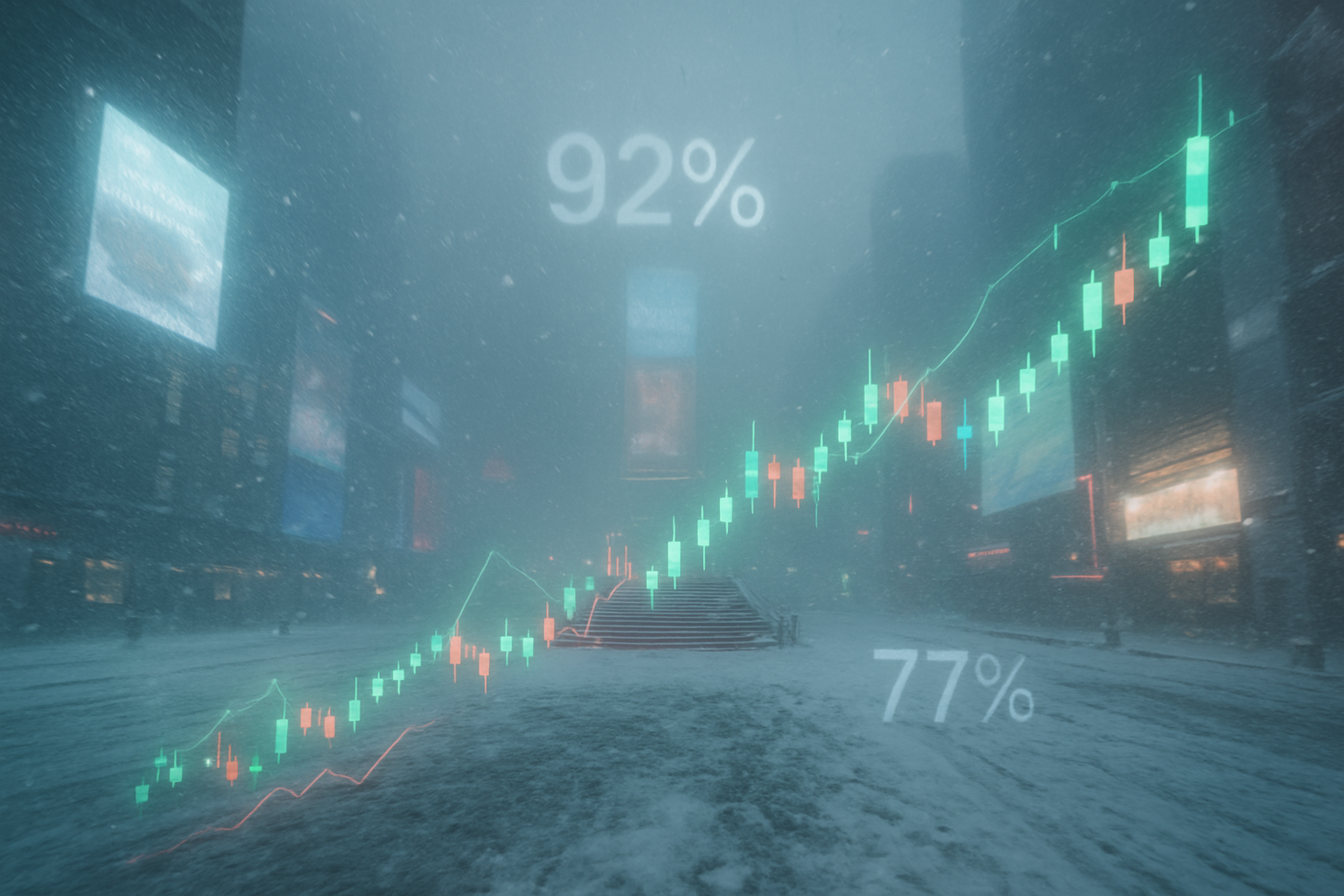
    Current market data indicates a staggering 92% probability that New York City will see more than 6 inches of snow by the time the storm concludes. Perhaps more surprisingly, the "long tail" of the forecast—the chance of a true blizzard scenario—is seeing significant action. Traders are currently pricing in a 77% chance that snowfall exceeds 10 inches, a sharp increase from just 48 hours ago as meteorological models began to align. This surge in betting activity has turned the weather into one of the most liquid and volatile markets on the platform this week.

    The Market: What's Being Predicted

    The primary hub for this activity is Kalshi, where the "Snow in NYC this month?" markets have seen a massive influx of capital. Total monthly volume for NYC snowfall contracts has surpassed $720,000, driven largely by the high-conviction trades surrounding this specific weekend window. The market is structured around tiered thresholds, allowing participants to hedge or speculate on specific accumulation levels as measured by the National Weather Service (NWS) at Central Park.

    As of Saturday morning, January 24, the odds for various thresholds are:

    • Above 6.0 inches: 92% ($0.92)
    • Above 8.0 inches: 86% ($0.86)
    • Above 10.0 inches: 77% ($0.77)
    • Above 12.0 inches: 65% ($0.65)

    The specific "6 to 10 inch" bracket has become a focal point for conservative bettors, though the implied probability for the storm stalling in this range is actually shrinking (now at approximately 15%) because traders are increasingly "over-betting" the higher totals. If the storm exceeds 10 inches, the "Above 6" and "Above 10" contracts both pay out, but the rapid appreciation of the "Above 12" contract—now at 65%—suggests that the market anticipates a historic over-performance rather than a moderate dusting.

    Why Traders Are Betting

    The primary driver for the recent market movement is the rare convergence of the two major global forecasting systems: the American GFS and the European ECMWF. Early in the week, the models were divided, with the European model suggesting a "glancing blow" of light snow and sleet. However, as of the 18z runs on January 23, the models have harmonized, both showing a powerful coastal low-pressure system deepening rapidly as it moves past the Jersey Shore.

    Beyond pure speculation, there is evidence of significant hedging activity. Large positions have been observed from entities likely tied to the logistics and service industries. For example, snow removal contractors and local logistics hubs often use these markets to offset the increased operational costs—such as overtime pay and salt procurement—that a major storm triggers.

    Public companies are already reacting to the forecast. The Home Depot (NYSE: HD) has reported a surge in emergency preparedness sales in the Tri-State area, while logistics giants like FedEx (NYSE: FDX) and UPS (NYSE: UPS) have issued service disruption alerts. For a professional trader or a business owner, a $0.77 contract on a "10-inch plus" event acts as an insurance policy against the inevitable economic slowdown that follows a city-wide standstill.

    Broader Context and Implications

    This flurry of activity highlights a growing trend: the shift of weather forecasting from a public service announcement to a high-stakes financial instrument. While traditional meteorology provides the "what" and "where," prediction markets provide a "wisdom of the crowd" assessment of the "how likely." The $720,000 monthly volume on Kalshi for a single city's snowfall suggests that these markets are moving past their niche origins and becoming essential tools for local economic planning.

    Historically, weather prediction markets have shown a remarkable ability to filter out the "hype" often found in sensationalist media coverage. Because traders have real capital at risk, they tend to react only to hard data—such as model shifts or barometric pressure changes—rather than the "doom-scrolling" narratives often seen on social media. In this case, the fact that the "Above 12 inches" market is trading as high as 65% serves as a louder warning to city officials than a standard weather advisory might.

    Furthermore, the regulatory environment for these markets has matured. Kalshi’s oversight by the CFTC provides a level of security and transparency that encourages larger institutions to participate. This liquidity, in turn, makes the market's "price" more accurate, creating a feedback loop where the market price becomes a reliable data point for emergency management and retail supply chain adjustments.

    What to Watch Next

    The most critical window for the market occurs between 1:00 AM on Sunday, January 25, and Monday afternoon. The New York City Department of Sanitation (DSNY) has already issued a high-level "Snow Alert," deploying over 2,000 workers and 700 salt spreaders. Traders should monitor the "warm nose" phenomenon—a layer of warm air that the ECMWF model suggests could sneak into the city center. If this happens, snow could turn to sleet, causing the "Above 12 inch" contracts to crash while the "6 to 10 inch" bracket potentially pays out.

    Another key milestone is the official measurement at Central Park. Because prediction markets resolve based on specific, verifiable data sources, any discrepancy between localized neighborhood totals and the Central Park reading can lead to late-stage market volatility. Traders will be glued to the NWS hourly updates throughout the night on Sunday to see if the rate of accumulation matches the aggressive 1-to-2-inches-per-hour rates currently being priced in.

    Bottom Line

    The NYC snowfall market for January 24-26, 2026, is a textbook example of how prediction markets can aggregate complex scientific data into a single, actionable price. With over $720,000 in monthly volume, the "crowd" is signaling a high-conviction belief that Winter Storm Fern will be a transformative event for the city. The 77% probability of exceeding 10 inches is a clear indicator that the market is leaning toward a severe scenario.

    For residents and businesses, these odds are more than just numbers; they are a signal to finish preparations. Whether it’s Walmart (NYSE: WMT) prepping its supply chain or a local delivery service bracing for delays, the market’s aggressive pricing of the 10-to-12-inch range suggests that the window for "hoping for the best" has closed. As the first flakes begin to fall late Saturday, the markets have already spoken: New York should prepare for a long, white weekend.


    This article is for informational purposes only and does not constitute financial or betting advice. Prediction market participation may be subject to legal restrictions in your jurisdiction.

    PredictStreet focuses on covering the latest developments in prediction markets.
    Visit the PredictStreet website at https://www.predictstreet.ai/.
  • The Price of Peace: Prediction Markets Signal Uncertainty for Russia and India as ‘Board of Peace’ Deadline Looms

    The Price of Peace: Prediction Markets Signal Uncertainty for Russia and India as ‘Board of Peace’ Deadline Looms

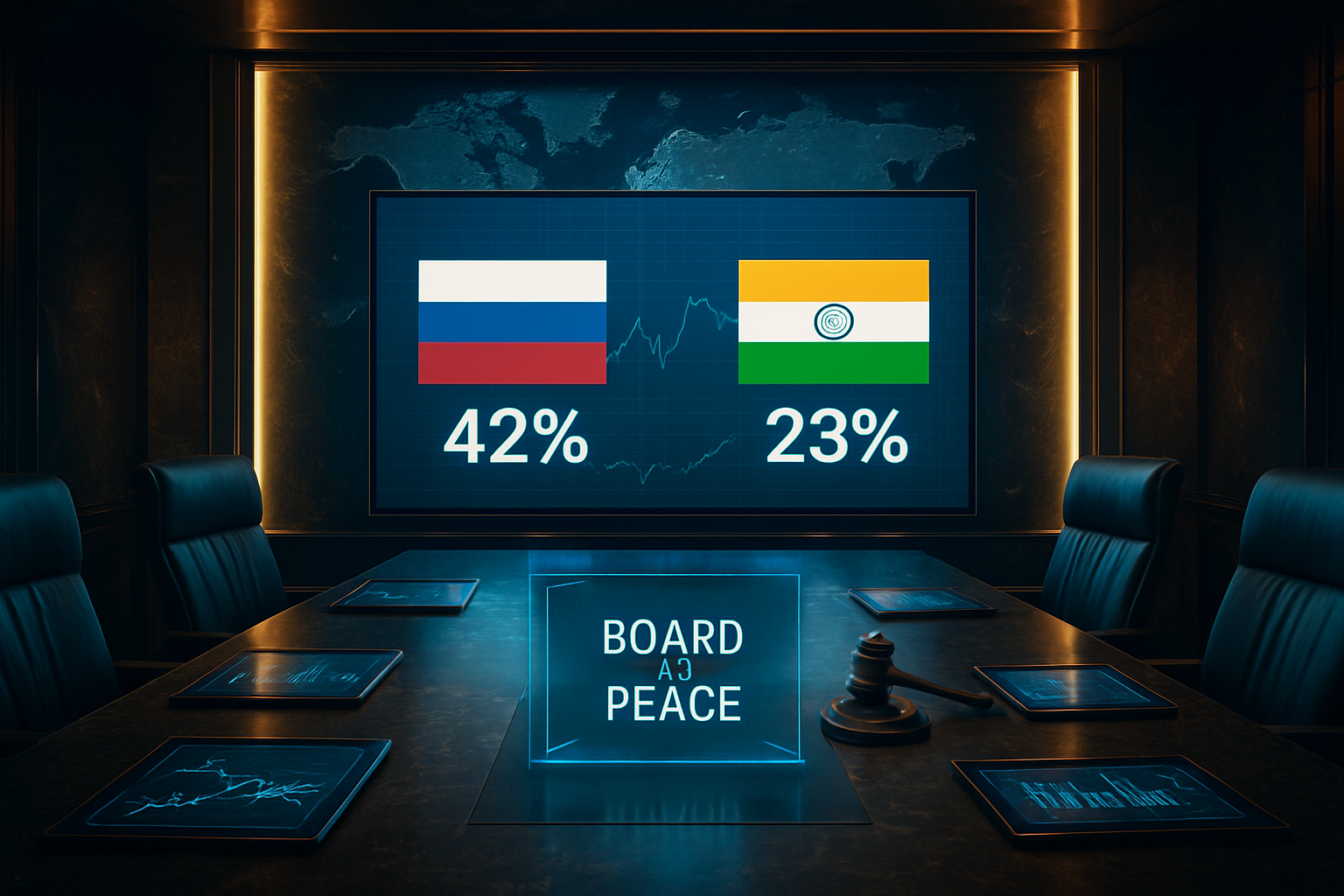
    With the March 31 resolution date fast approaching, traders on decentralized prediction platforms are locked in a high-stakes debate over the future of the "Board of Peace" (BoP). As of January 24, 2026, the market for the new global conflict-resolution body has become a focal point for geopolitical speculators, with Russia currently sitting at a 42% probability of joining and India trailing at 23%. This burgeoning market, which has already surpassed $418,000 in trading volume, is increasingly viewed as a real-time barometer for the success of President Donald Trump’s "transactional diplomacy" initiative.

    The Board of Peace, which began as a roadmap for the reconstruction of Gaza, has rapidly evolved into an alternative to traditional international institutions. For traders, the core question isn't just about diplomacy, but about who is willing to pay the reported $1 billion "membership fee" to secure a seat at a table chaired by Trump and a circle of high-profile advisors. The movement in the odds over the last 48 hours reflects a volatile week in international relations, following a dramatic launch ceremony at Davos that saw some allies embraced and others publicly sidelined.

    The Market: What's Being Predicted

    The primary venue for this speculation is Polymarket, where the contract "Which countries will join the Board of Peace by March 31?" has seen a surge in liquidity since the Davos summit on January 22. The market requires a definitive confirmation of membership from the Board’s executive leadership or official government statements by the end of the first quarter. While early predictions saw a "big tent" approach, the reality has proven more exclusionary, leading to wild swings in the "Yes" and "No" shares for several major powers.

    Russia’s odds have been a rollercoaster, fluctuating between 40% and 51% this week before settling at 42%. The resolution criteria are strict: membership must be formalized, which in Russia’s case involves a complex web of sanctions relief and the potential use of frozen assets. Meanwhile, India’s 23% odds represent a significant collapse from a mid-January high of 48%. The $418,700 in volume suggests that while this is a relatively new market, it is attracting sophisticated traders who are monitoring "Truth Social" posts and official diplomatic cables with equal intensity.

    Why Traders Are Betting

    The 42% probability for Russia is tied to a "frozen asset" gambit that has captivated market participants. President Vladimir Putin has reportedly expressed interest in joining the BoP, but on the condition that Russia’s $1 billion entry fee is paid using its own assets currently frozen in U.S. financial institutions. Traders are split on whether the Trump administration will accept this circular payment method. Recent reports of secret meetings in Moscow involving Special Envoy Steve Witkoff and Jared Kushner have kept the "Yes" side alive, as speculators bet that a broader peace framework for Ukraine is being baked into the BoP's expansion.

    Conversely, the bearish sentiment surrounding India (23%) stems from New Delhi’s strategic decision to skip the Davos launch. Prime Minister Narendra Modi is reportedly wary of the BoP’s "personality-driven" nature and its potential to undermine India’s long-standing non-aligned status. The market reacted sharply to the Trump administration’s recent imposition of 50% tariffs on Indian goods, a move many traders interpret as a "stick" intended to force BoP participation. This contrasts sharply with traditional forecasting from think tanks like Chatham House, which often underestimate the impact of such aggressive trade leverage on diplomatic timelines.

    Broader Context and Implications

    The Board of Peace market highlights a shift in how the world views international order—moving from institutional consensus to a "private-sector led" diplomatic model. The presence of Marc Rowan, CEO of Apollo Global Management (NYSE: APO), on the BoP’s Executive Board has signaled to the markets that reconstruction efforts will be run like a corporate turnaround. This has led to increased scrutiny of the board's "for-sale" permanent seats, a concept that has shocked traditional diplomats but energized prediction market "whales" who thrive on high-stakes, transactional outcomes.

    The market also reflects a broader trend where prediction platforms react faster than news cycles. For example, when the U.S. publicly rescinded Canada’s invitation earlier this week following critical remarks from Prime Minister Mark Carney, the Polymarket odds for Canada plummeted to near zero within minutes. This real-time processing of "diplomacy by social media" provides a level of clarity that traditional polling or expert analysis cannot match. It also raises questions about how global trade, influenced by companies like Tesla (NASDAQ: TSLA) and their international supply chains, will be impacted by who is "in" or "out" of the Board's favor.

    What to Watch Next

    The upcoming trilateral talks in Abu Dhabi, scheduled for the final week of January, are the next major catalyst for this market. These meetings between U.S., Russian, and Ukrainian officials are expected to clarify whether the Board of Peace will serve as the primary vehicle for a Ukraine ceasefire. If a breakthrough occurs, Russia’s 42% odds could moon toward 80% overnight. Traders should also watch for any "softening" of the tariff rhetoric toward India, which would indicate that back-channel negotiations are progressing.

    Key dates include the February 15 "Interim Board Review" and the March 31 final resolution. Any official statements from World Bank President Ajay Banga, who also holds a seat on the BoP executive board, could provide clues regarding the financial architecture of the membership fees. If the World Bank provides a mechanism for emerging economies to join without the $1 billion upfront cost, we could see a massive rally in the odds for countries currently sitting in the single digits or low teens.

    Bottom Line

    The Board of Peace prediction market is more than just a bet on diplomatic membership; it is a live-action valuation of a new, transactional world order. Russia’s 42% odds suggest a market that is cautiously optimistic about a historic pivot, provided the financial and legal hurdles of frozen assets can be cleared. India’s 23% odds reflect the growing pains of a nation caught between its traditional foreign policy and the new reality of "membership-driven" trade access.

    As we move toward the March 31 deadline, this market will likely remain one of the most liquid and volatile sectors in the forecasting world. It proves that in 2026, the boundaries between geopolitics, high finance, and prediction markets have effectively dissolved. Whether the BoP becomes a lasting institution or a transient diplomatic experiment, the traders on Polymarket are currently the ones providing the most honest assessment of its prospects.


    This article is for informational purposes only and does not constitute financial or betting advice. Prediction market participation may be subject to legal restrictions in your jurisdiction.

    PredictStreet focuses on covering the latest developments in prediction markets.
    Visit the PredictStreet website at https://www.predictstreet.ai/.
  • Betting on a Revolution? Khamenei’s Exit Odds Hit 21% Amid Tehran Turmoil

    Betting on a Revolution? Khamenei’s Exit Odds Hit 21% Amid Tehran Turmoil

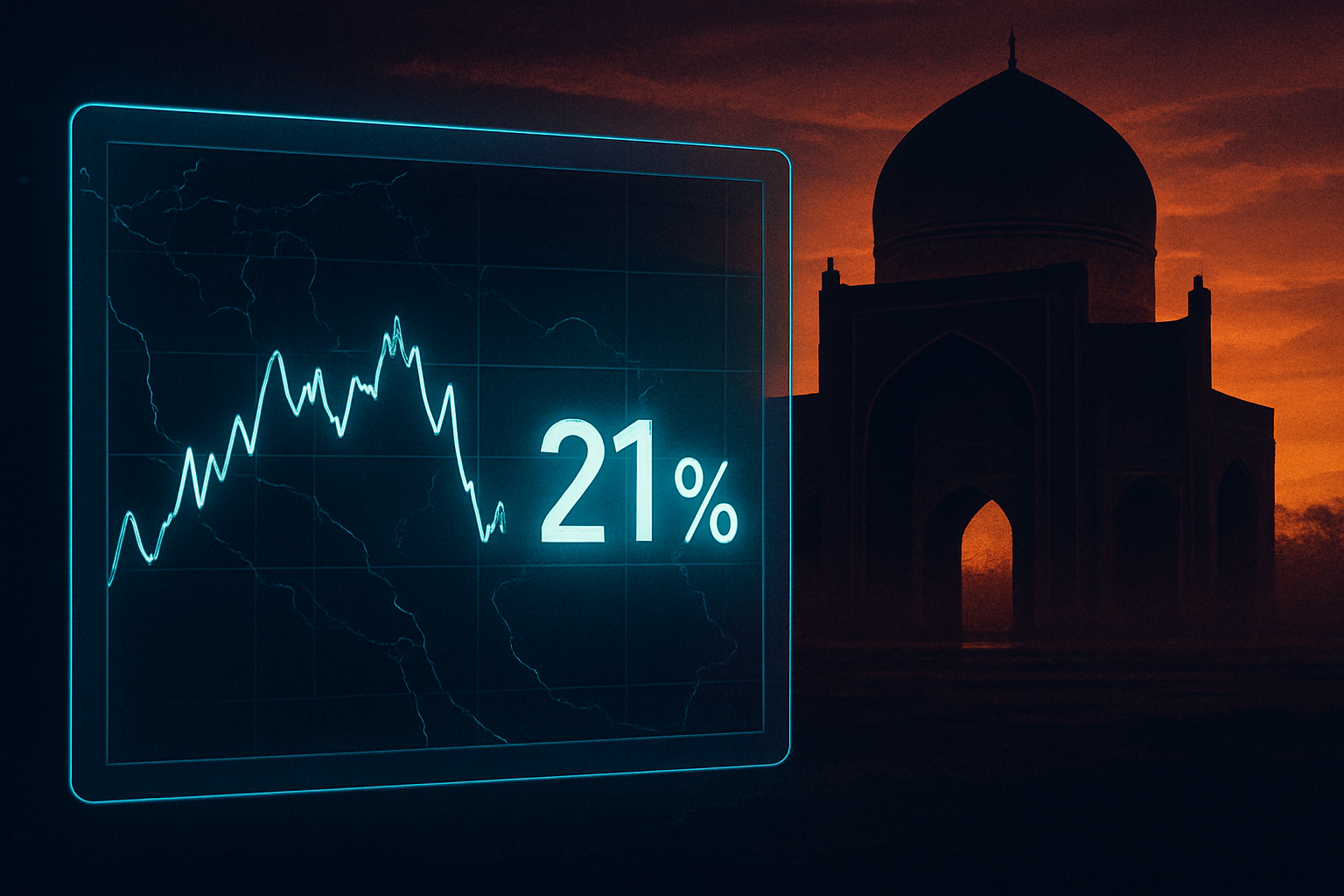
    As of January 24, 2026, the geopolitical landscape of the Middle East is being distilled into a single, high-stakes number on the world’s leading prediction markets. Traders on Polymarket are currently pricing in a 21% probability that Ali Khamenei will be out as the Supreme Leader of Iran by February 28, 2026. This surge in betting activity comes as Tehran faces its most existential crisis since the 1979 Revolution, driven by a combination of internal domestic uprising and intensifying external military pressure.

    The market has captured the attention of both retail speculators and institutional analysts, with trading volume recently surpassing the $1.25 million mark. In a region where official state media often masks the truth, many are looking to these decentralized platforms as a more accurate barometer of the regime's stability. The 21% chance reflects a significant uptick in volatility; just weeks ago, the odds of a transition before March were in the low single digits.

    The Market: What's Being Predicted

    The primary contract driving this conversation is Polymarket’s "Khamenei out as Supreme Leader by February 28?" This binary market allows participants to buy "Yes" or "No" shares, with the price of a "Yes" share representing the market-implied probability of the event. The resolution criteria are explicit: the market will resolve to "Yes" if Ali Khamenei ceases to be the Supreme Leader for any reason—including death, resignation, or removal—at any point before the February 28 deadline.

    Liquidity in the market has been robust, sustained by over $1 million in total volume. This depth allows for large "whale" positions to enter without immediately destabilizing the price, suggesting that the 21% figure is a settled consensus rather than a fluke of low-volume trading. While Polymarket is the epicenter of this activity, similar shadow markets and private forecasting circles have seen comparable spikes in "regime change" sentiment.

    The contract’s expiration date is particularly noteworthy. February 28 marks the end of a critical winter window where Iranian infrastructure is traditionally strained and geopolitical tensions often peak around the anniversary of the 1979 Revolution. If Khamenei remains in power through 11:59 PM ET on that date, the market resolves to "No," rewarding the current 79% majority of skeptics.

    Why Traders Are Betting

    The sudden interest in this market is driven by a convergence of "Black Swan" events. Chief among them are credible reports concerning the 86-year-old leader’s health. Intelligence suggests Khamenei has been suffering from "advanced cognitive impairment" and has experienced several "coma-like episodes" over the last quarter. As of late January, reports indicate he has moved into a fortified bunker in Tehran, with his son, Masoud Khamenei, reportedly managing the day-to-day operations of the Office of the Supreme Leader.

    Furthermore, Iran is currently in the grip of the "Economic Uprising" that began on December 28, 2025. Sparked by a total collapse of the Iranian rial, protests have spread to over 180 cities. Unlike previous movements, this unrest has seen a brutal state response, with human rights groups estimating deaths in the thousands. The use of live ammunition by security forces has only galvanized the protesters, many of whom are calling for the return of Prince Reza Pahlavi to lead a transitional government.

    Traders are also closely monitoring the movement of U.S. military assets. A massive carrier strike group, led by the USS Abraham Lincoln, is currently positioned in the Persian Gulf. The Trump administration has issued stern "red lines" regarding the execution of protesters, and the market is pricing in the possibility that a U.S. or Israeli kinetic action could serve as the final catalyst for a leadership collapse. Defense contractors like Lockheed Martin (NYSE: LMT) and Raytheon (NYSE: RTX) are seeing increased scrutiny from investors as the likelihood of a major regional escalation climbs.

    Broader Context and Implications

    The existence of a million-dollar market on the life or death of a world leader highlights the evolving role of prediction markets in international relations. While critics argue that these markets can be macabre or even incentivize "assassination markets," proponents argue they provide an invaluable "wisdom of the crowds" that traditional intelligence often misses. For companies with significant exposure to global energy markets or shipping, such as ExxonMobil (NYSE: XOM) or Maersk, these odds act as a real-time risk hedge.

    Historically, prediction markets have been remarkably prescient at identifying the "breaking point" of autocratic regimes before they are officially acknowledged. The 21% probability is not just a bet on a person’s health; it is a bet on the failure of a 47-year-old political system under extreme duress. If the market continues to climb toward 50%, it could trigger a "reflexive" effect, where the belief in the regime's fall becomes a self-fulfilling prophecy, discouraging security forces from defending a leader they believe is already gone.

    Moreover, the regulatory environment for such markets remains complex. While platforms like Kalshi operate under CFTC oversight in the U.S., Polymarket’s decentralized nature allows global participants—including those inside Iran using VPNs—to cast their "vote" with their capital. This provides a rare, unfiltered look at Iranian sentiment that social media platforms like those owned by Meta Platforms (NASDAQ: META) struggle to provide due to government-imposed internet blackouts.

    What to Watch Next

    As we move toward the February 28 resolution date, several key milestones will likely move the needle. The most significant is the February 11 anniversary of the Islamic Revolution. Traditionally a day of state-sponsored rallies, this year it is expected to be a flashpoint for the opposition. If the regime fails to mobilize its base or if the security forces show signs of defection during the anniversary, the "Yes" odds could easily double overnight.

    The status of the nationwide internet blackout, which began on January 8, is another critical variable. If the blackout is lifted and footage of the scale of the uprising reaches the international community, the pressure on the U.S. and its allies to intervene will increase. Conversely, a sudden televised appearance by Khamenei—if he is cognitively and physically able—would likely cause the "Yes" shares to crater as the market recalibrates for a longer survival timeline.

    Finally, traders are keeping a close eye on the U.S. Treasury's new 25% tariff on countries continuing to trade with Iran. If China (NYSE: BABA) or India-based firms begin to pull back from Iranian oil contracts in response to these tariffs, the resulting economic "asphyxiation" could trigger a palace coup before the month is out.

    Bottom Line

    The 21% probability on Polymarket is a stark reminder that the status quo in Iran is more fragile than it has been in decades. While a one-in-five chance is far from a certainty, the $1.25 million in volume suggests this is more than mere speculation; it is an aggregation of geopolitical anxiety and whispered intelligence.

    Prediction markets are proving to be a ruthless but efficient tool for cutting through state propaganda. Whether Khamenei remains in power on March 1 or not, the "Khamenei Exit" market has already succeeded in quantifying the unquantifiable. It tells us that the "invincibility" of the Islamic Republic is currently being questioned by the most honest metric we have: the willingness of people to put their money where their mouth is.

    In the coming weeks, the movements of the USS Abraham Lincoln and the resilience of the protesters in the streets of Tehran will dictate whether that 21% was a high-water mark or merely the beginning of the end.


    This article is for informational purposes only and does not constitute financial or betting advice. Prediction market participation may be subject to legal restrictions in your jurisdiction.

    PredictStreet focuses on covering the latest developments in prediction markets.
    Visit the PredictStreet website at https://www.predictstreet.ai/.