Tag: Polymarket

  • The Maduro Payout: How a $33,000 Prediction Market Bet Preceded a Delta Force Raid

    The Maduro Payout: How a $33,000 Prediction Market Bet Preceded a Delta Force Raid

    In the early morning hours of January 3, 2026, the world woke to the stunning news that U.S. Army Delta Force commandos had successfully captured Nicolás Maduro in a daring raid codenamed Operation Absolute Resolve. While the geopolitical shockwaves were immediate, a different kind of explosion was occurring in the world of "InfoFi" or information finance. On the decentralized prediction platform Polymarket, a single anonymous trader had just completed one of the most controversial "perfect" trades in the history of prediction markets.

    The trader, known only by the username "Burdensome-Mix," managed to turn a relatively modest investment of roughly $32,537 into a staggering $436,000. The timing was more than just lucky; the bulk of the "Yes" shares on Maduro’s ouster were purchased on January 2—less than 24 hours before 150 aircraft, many manufactured by defense giants like Lockheed Martin (NYSE: LMT) and Boeing (NYSE: BA), crossed into Venezuelan airspace. As the news of Maduro’s capture in Caracas broke, the market for "Maduro out by January 31, 2026" instantly hit 100%, sparking a firestorm of allegations regarding insider trading and the ethics of profiting from classified military operations.

    The Market: What's Being Predicted

    The specific contract at the center of the controversy was "Maduro out by January 31, 2026." For months, the market had traded at low probabilities, reflecting a general skepticism that the long-standing Venezuelan leader would be unseated anytime soon. Most geopolitical analysts and traders on Polymarket had priced the "Yes" shares between 5¢ and 12¢ throughout late 2025, suggesting a less than 15% chance of his removal.

    Trading volume on the Maduro contract was relatively thin until the final 48 hours. While other political markets, such as those tracking the U.S. midterm elections, saw millions in liquidity, the Maduro market was a niche corner of the platform. However, the sudden influx of capital from "Burdensome-Mix" and a few other newly created accounts on January 2 caused the odds to spike sharply just before the resolution event.

    The resolution criteria for the market were straightforward: the market would resolve to "Yes" if Nicolás Maduro ceased to be the de facto or de jure head of state of Venezuela by the end of January. When Maduro was transported to New York City to face federal charges of narco-terrorism—a story widely covered by major outlets including The New York Times (NYSE: NYT)—the market was settled, and the "Maduro Payout" was officially cemented.

    Why Traders Are Betting

    The "Maduro Trade" has become a case study in the power and peril of prediction markets. Most traders in the weeks leading up to the raid were betting based on public sentiment, sanctions analysis, and diplomatic posturing. Traditional forecasting methods and mainstream news outlets had given no indication that a military intervention of this scale was imminent.

    However, the activity of "Burdensome-Mix" suggests a different strategy entirely. The trader did not gradually build a position; they executed a high-conviction "snipe." Analysis of the blockchain data reveals that the account was funded specifically to make this play, with almost no prior history of trading on Polymarket. This "pitch-perfect" timing led many to conclude that the trader had access to non-public information—potentially as a government official, military contractor, or high-level staffer with knowledge of the January 3 deadline.

    Large "whale" activity in prediction markets often acts as a signal to other participants. In this case, the sudden movement in the Maduro market caused a minor flurry of "follow-the-leader" trades, but the sheer speed of the military operation meant that only those already in the market by midnight on January 2 were able to reap the massive 1,200% returns.

    Broader Context and Implications

    The "Maduro Payout" has pushed prediction markets into the crosshairs of federal regulators and lawmakers. The controversy centers on whether these platforms are providing a valuable public service by aggregating information or if they are simply creating a new, unregulated venue for corruption.

    In response to the scandal, Representative Ritchie Torres (D-NY) introduced H.R. 7004, titled the "Public Integrity in Financial Prediction Markets Act of 2026." Introduced on January 9, just six days after the raid, the bill seeks to apply the ethical guardrails of the 2012 STOCK Act to the prediction market space. If passed, the law would explicitly prohibit federal employees, members of Congress, and military personnel from trading on markets that are directly influenced by their official duties or access to classified data.

    Historically, prediction markets have been praised for their accuracy, often outperforming traditional polling or expert pundits. However, when that accuracy is derived from "insider" knowledge rather than collective intelligence, the "integrity of the signal" is compromised. The debate now raging in Washington is whether a ban on insider participation will make these markets more ethical but less accurate, or if it is a necessary step to prevent the "gamification" of national security.

    What to Watch Next

    The immediate focus for the prediction market community is the movement of H.R. 7004 through the House Committees on Oversight and Government Reform. Supporters of the bill argue it is essential for the long-term legitimacy of the industry. Conversely, some industry leaders at firms like Kalshi—which recently fought its own legal battles with the CFTC—have expressed a cautious willingness to accept "rules of the road" if it means avoiding a total ban on event contracts.

    In the coming weeks, market participants should watch for:

    • Subpoenas and Investigations: There is a strong possibility that the Department of Justice will attempt to identify "Burdensome-Mix." If the trader is found to be a U.S. government employee, it could lead to the first-ever criminal prosecution for "prediction market insider trading."
    • Platform Response: Polymarket and other decentralized platforms may implement more stringent KYC (Know Your Customer) protocols to appease regulators, potentially ending the era of truly anonymous high-stakes political betting.
    • New Defense Markets: In the wake of Maduro’s capture, new markets are already appearing regarding the stability of the transition government in Venezuela and the potential for similar operations in other regions.

    Bottom Line

    The "Maduro Payout" is a landmark moment that proves prediction markets can be the most accurate forecasters in the world—but for all the wrong reasons. While the $400,000 profit for "Burdensome-Mix" is a legendary "win" in the annals of crypto-betting, it has also become a lightning rod for legislative reform that could fundamentally change how these platforms operate.

    Prediction markets are transitionary tools, moving from the fringe of the internet to the center of the financial and political discourse. As H.R. 7004 moves through Congress, the industry faces a choice: embrace regulation and institutionalize "InfoFi," or remain a "Wild West" where the person with the most classified briefcase also has the most profitable portfolio. For now, the Maduro trade remains a stark reminder that in the world of prediction markets, some "predictions" are actually certainties in disguise.


    This article is for informational purposes only and does not constitute financial or betting advice. Prediction market participation may be subject to legal restrictions in your jurisdiction.

    PredictStreet focuses on covering the latest developments in prediction markets.
    Visit the PredictStreet website at https://www.predictstreet.ai/.
  • The Great Prediction War of 2026: Polymarket and Kalshi Battle for the Volume Crown

    The Great Prediction War of 2026: Polymarket and Kalshi Battle for the Volume Crown

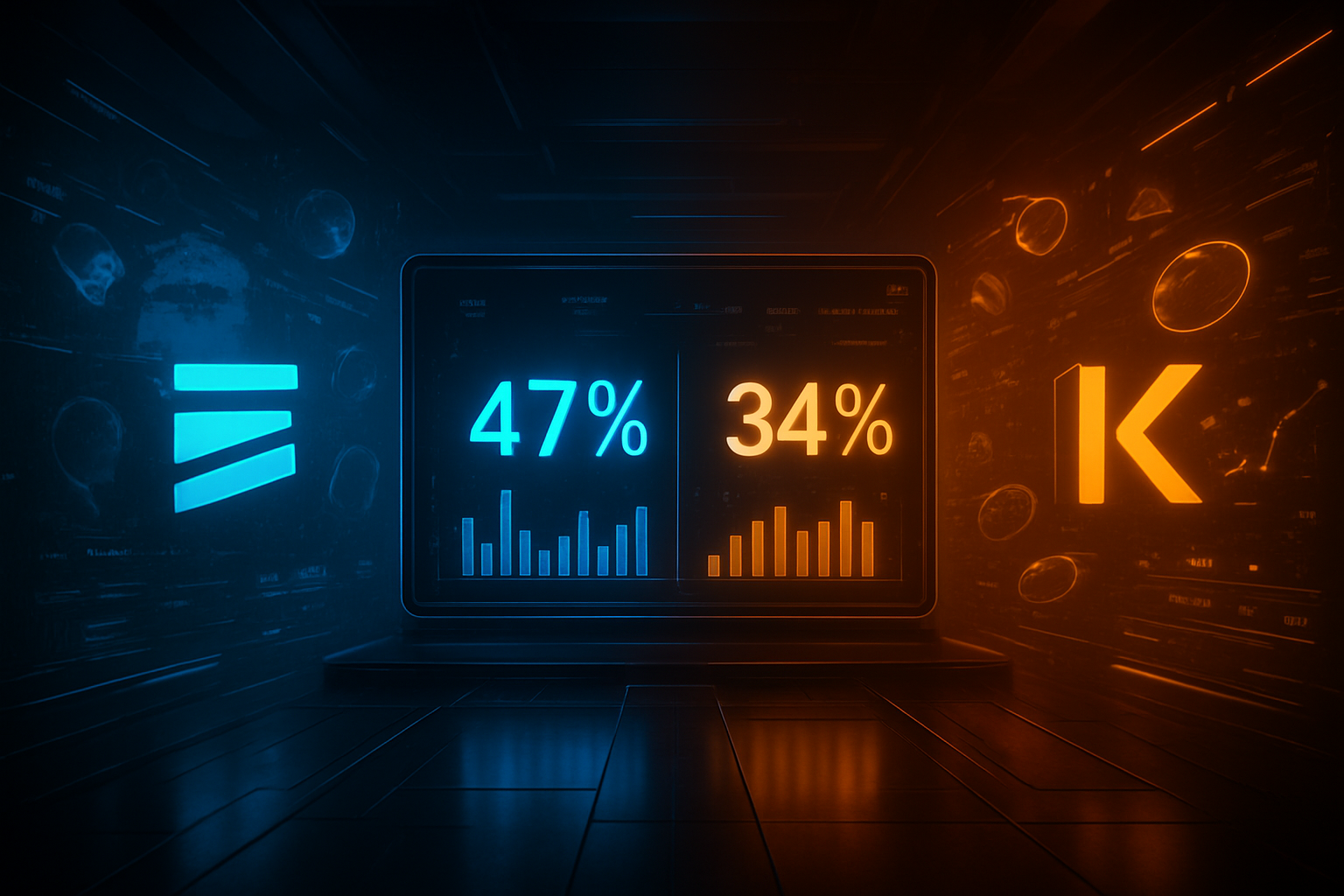
    As of early February 2026, the prediction market landscape has transformed from a niche hobby for "superforecasters" into a multi-billion dollar pillar of the global financial system. At the heart of this explosion is a titanic struggle for dominance between the two undisputed heavyweights: Polymarket and Kalshi. The stakes are nothing less than the title of the world’s primary "truth engine." Currently, a high-traffic contract on Manifold Markets, which serves as a meta-layer for industry sentiment, gives Polymarket a 47% chance of claiming the 2026 volume crown, while Kalshi trails at 34%.

    This rivalry has divided the trading community into two distinct camps. While Kalshi has leveraged its regulatory compliance to become the "Robinhood of events," Polymarket has maintained its status as the "Bloomberg of the blockchain," dominating the high-stakes world of geopolitical and macroeconomic forecasting. The current betting activity on Manifold reflects a growing debate: will the raw mass-market appeal of sports propel Kalshi to the top, or will Polymarket’s dominance in "high-signal" global events prove more lucrative?

    The Market: What's Being Predicted

    The central point of contention is the definition of "volume leadership." The Manifold Markets contract, which has seen heavy participation from industry insiders and "whales," specifically tracks which platform will handle the most notional volume for the calendar year 2026. However, there is a critical caveat in the resolution criteria: the contract excludes "pure sports betting" volume to focus on "event-based information finance." This distinction is vital because, in 2025, Kalshi cleared a staggering $43.1 billion in total volume, but over 90% of that was tied to sports contracts through its integration with Robinhood Markets, Inc. (NASDAQ:HOOD).

    Polymarket, which ended 2025 with $33.4 billion in volume, is currently the favorite on Manifold because of its perceived monopoly on "pure" prediction markets. Traders are pricing in the fact that while Kalshi attracts millions of small-dollar sports bettors, Polymarket attracts massive institutional liquidity on "high-alpha" events. The odds have shifted significantly since January 1st, when the two were nearly neck-and-neck. Polymarket’s recent surge to 47% follows a series of high-volume geopolitical events in January that saw over $5 billion in monthly activity on the platform.

    Why Traders Are Betting

    The divergence in odds is driven by the vastly different "moats" each platform has built. Kalshi’s strength lies in its "sports flywheel." By partnering with the NHL and other major leagues, Kalshi has turned prediction markets into a regulated alternative to traditional sportsbooks. This has created a massive influx of retail traders, but it also makes the platform vulnerable to regional regulatory shifts. For example, a recent preliminary injunction in Massachusetts has barred Kalshi from offering sports contracts in the state, a move that traders fear could be replicated in other high-volume states like New York or Nevada.

    Conversely, Polymarket’s 47% lead is fueled by its "Geopolitical/Macro" dominance. In January 2026, the platform famously outperformed every major news outlet during "Operation Absolute Resolve" in Venezuela. While traditional media struggled to verify reports on the ground, the "Maduro Trade" on Polymarket saw $56.6 million in volume, accurately pricing the regime's collapse hours before official confirmation. Similarly, markets regarding the nomination of Kevin Warsh as the next Federal Reserve Chair saw over $368 million in volume, with the "Yes" side hitting 94% probability just before the official announcement from the White House.

    Traders are also closely watching the "whale" activity. Large institutional firms like Susquehanna and DRW have reportedly been shifting more liquidity into Polymarket’s macro markets, viewing them as a superior hedging tool compared to traditional derivatives. This "institutionalization" of the truth is a major factor driving the Manifold odds in Polymarket's favor.

    Broader Context and Implications

    This rivalry represents a pivotal moment for "Information Finance" (InfoFi). The 2024 US Election was the "Big Bang" for this industry, proving that prediction markets could act as a more accurate barometer of reality than traditional polling. Now, in 2026, the question is no longer if these markets work, but how they will be regulated and integrated into the broader economy.

    The regulatory environment has shifted dramatically under the new CFTC Chairman, Michael Selig. His "pro-market" stance has been a boon for both platforms, but a new conflict has emerged: the war between federal pre-emption and state-level gaming commissions. While Selig has expressed support for a federal framework for prediction markets, states like New Jersey and Nevada are fighting to classify these platforms as "gambling," which would subject them to high taxes and restrictive licensing.

    Furthermore, Polymarket’s successful re-entry into the US market—via its $112 million acquisition of QCEX, a CFTC-licensed exchange—has leveled the playing field. This move stripped Kalshi of its "only legal US option" advantage, forcing the competition to be fought purely on the quality of the markets and the depth of liquidity.

    What to Watch Next

    The coming months will provide several "stress tests" for these platforms. The first major milestone is the resolution of the Massachusetts legal challenge against Kalshi. If the court upholds the ban on sports contracts, Kalshi’s volume could take a significant hit, likely causing its Manifold odds to plummet further. On the other hand, if Kalshi successfully defends its model as "economic hedging" rather than gambling, it could reclaim its momentum.

    For Polymarket, the key will be maintaining its edge in "breaking news" markets. Watch for the upcoming "Global Climate Accord" negotiations in March; if Polymarket can once again provide a faster, more accurate signal than traditional diplomacy observers, it will cement its status as the world’s premier information source. Additionally, the potential for a "super-app" launch from Polymarket later this year could further bridge the gap with Kalshi’s retail-friendly interface.

    Bottom Line

    The battle for the 2026 volume crown is more than just a competition between two apps; it is a fight to define the future of how humanity consumes information. Kalshi is betting on the ubiquity of sports and the power of mainstream financial integrations. Polymarket is betting on the value of "pure" truth and the global demand for geopolitical clarity.

    The Manifold Markets odds—47% for Polymarket and 34% for Kalshi—suggest that while sports volume is impressive, traders believe the real future of prediction markets lies in the "Macro" niche. As we move deeper into 2026, the platform that can best navigate the regulatory minefield while maintaining deep liquidity on world-changing events will likely emerge victorious. For now, the "Truth Engine" of Polymarket holds the lead, but in a market where everything is a bet, nothing is guaranteed.


    This article is for informational purposes only and does not constitute financial or betting advice. Prediction market participation may be subject to legal restrictions in your jurisdiction.

    PredictStreet focuses on covering the latest developments in prediction markets.
    Visit the PredictStreet website at https://www.predictstreet.ai/.
  • The InfoFi Revolution: How Prediction Markets Became the World’s Fastest Financial Data Feed

    The InfoFi Revolution: How Prediction Markets Became the World’s Fastest Financial Data Feed

    As of February 1, 2026, the global financial landscape has been fundamentally rewired by a concept once relegated to the fringes of crypto-economic theory: Information Finance, or "InfoFi." What began as a tool for political junkies to hedge election risks has evolved into the world’s most potent data transmission mechanism. Prediction markets have transitioned from "betting parlors" to the "source of truth" for the global financial machine, with liquidity across major platforms now exceeding $50 billion annually.

    The most profound shift, however, is not in who is trading, but what is trading. Today, algorithmic bots—not humans—are the primary participants in prediction markets. These AI agents treat shifts in event probabilities as "truth events," using them as high-speed triggers to execute multi-billion dollar trades in traditional markets like the S&P 500 (NYSEARCA: SPY) and U.S. Treasuries. In this new era, the prediction market moves first, and the rest of the world follows in milliseconds.

    The Market: What's Being Predicted

    The prediction market landscape in early 2026 is dominated by two giants: the decentralized Polymarket and the federally regulated Kalshi. While these platforms still offer markets on everything from the Oscars to weather events, the high-volume activity is concentrated in macro-economic and geopolitical "nexus events." Currently, the most liquid markets center on Federal Reserve policy, specifically the "March 2026 Rate Cut" and "Year-End Inflation" contracts.

    Liquidity has reached a critical mass where "whale" positions—often exceeding $50 million—are common. On Kalshi, the "Federal Reserve Target Rate" contracts have seen their daily volume rival that of traditional interest-rate futures at the CME Group (NASDAQ: CME). The resolution criteria for these markets are ironclad, often tied to official government releases or blockchain-verified data, providing the "clean" data sets that algorithmic models crave.

    The speed of price discovery is now staggering. On Feb 1, 2026, a 4% shift in the probability of a "Government Shutdown" on Kalshi was reflected in the market price within 400 milliseconds of a leaked Congressional memo, whereas traditional news wires took nearly three minutes to report the same information. This delta—the "InfoFi Premium"—is where the new generation of traders makes their fortunes.

    Why Traders Are Betting

    The rise of "Information Arbitrage" is the primary driver behind current market movements. Traditional hedge funds and high-frequency trading (HFT) firms have deployed specialized AI agents, such as the widely discussed "Alphascope" and "Polybro" bots, to scan these markets 24/7. These bots do not just bet on the outcome; they use the outcome as a leading indicator for traditional assets.

    For instance, when a prediction market on Polymarket shows an uptick in the probability of a specific regulatory change, bots immediately execute trades in the affected sectors. If a contract for "SEC Leadership Change" moves toward "Yes," bots may preemptively buy or sell the Bitcoin Trust (NASDAQ: IBIT) or shares of Coinbase Global, Inc. (NASDAQ: COIN). Traders are no longer waiting for the news to break; they are trading on the collective intelligence of the "skin-in-the-game" participants who are incentivized to find the truth first.

    Furthermore, the introduction of the CLARITY Act of 2026 (Digital Asset Market Clarity Act) has legitimized these strategies. The Act provides a clear regulatory framework for "event contracts," allowing institutional giants like Apollo Global Management (NYSE: APO) and BlackRock, Inc. (NYSE: BLK) to treat prediction market positions as legitimate hedges against systemic risk. This institutional inflow has compressed spreads and made prediction market signals more reliable than ever.

    Broader Context and Implications

    The "feedback loop" between prediction markets and traditional finance has created a self-reinforcing cycle. When a prediction market shifts, it triggers automated selling in the S&P 500 (NYSEARCA: SPY). This market movement is then picked up by other algorithms as a "momentum signal," which in turn causes more traders to enter the prediction market to hedge their newfound exposure. This loop has effectively turned prediction markets into the world’s fastest financial data feed.

    This phenomenon reveals a deepening skepticism of traditional media and analyst reports. In the 2026 economy, a "buy" rating from a major bank carries less weight than a 10-cent move in a prediction market. The public sentiment captured here is cold and calculated; it is the sentiment of people willing to lose money if they are wrong, which distinguishes it from the "cheap talk" of social media or cable news.

    Historically, prediction markets have shown a remarkable ability to outperform "expert" consensus. During the 2024 election cycle and the subsequent economic shifts of 2025, markets like Kalshi consistently priced in outcomes weeks before traditional polling or economic forecasting firms. This accuracy has forced regulators at the CFTC to pivot from a stance of hostility to one of integration, recognizing that these markets provide a vital "early warning system" for the financial stability of the United States.

    What to Watch Next

    As we move further into 2026, the next major milestone is the full integration of prediction market APIs into mainstream brokerage platforms. Rumors persist that platforms like Charles Schwab (NYSE: SCHW) and Robinhood Markets, Inc. (NASDAQ: HOOD) are preparing to offer "Event Hedging" tabs, allowing retail investors to buy "No" on a recession as easily as they buy an ETF.

    The upcoming March FOMC meeting will be the ultimate test of the InfoFi feedback loop. Currently, Kalshi is pricing a 62% chance of a 25-basis-point cut, while traditional Fed Fund Futures are lagging at 54%. If the prediction market proves correct again, it may mark the moment when "Event Contracts" officially replace "Futures" as the primary tool for interest rate discovery.

    Additionally, the expansion of "Synthetic Straddles"—where traders hedge physical assets against event outcomes—is expected to grow. Watch for how high-tech firms like NVIDIA Corporation (NASDAQ: NVDA) see their stock volatility correlate with "Taiwan Conflict" or "AI Regulation" contracts. The tighter this correlation becomes, the more the prediction market acts as the "shadow price" for the world's most valuable companies.

    Bottom Line

    Prediction markets have evolved from a niche curiosity into the central nervous system of global finance. By 2026, "InfoFi" has proven that information is not just something you read—it is something you price. The rise of algorithmic bot trading has eliminated the latency between a "truth event" and a market reaction, making the world more efficient but also more volatile for those who cannot keep pace with the machines.

    This shift tells us that the most valuable commodity in the modern economy is no longer oil or even data, but accuracy. Prediction markets provide a ruthless mechanism for filtering noise and surfacing reality. For the modern investor, ignoring these signals is no longer an option; the bots have already integrated them, and the feedback loop is only getting faster.

    Whether we are looking at interest rates, election results, or corporate mergers, the prediction market is now the first place the "truth" appears. As institutional adoption continues and regulatory clarity deepens, the line between "betting" and "investing" will continue to blur until it disappears entirely.


    This article is for informational purposes only and does not constitute financial or betting advice. Prediction market participation may be subject to legal restrictions in your jurisdiction.

    PredictStreet focuses on covering the latest developments in prediction markets. Visit the PredictStreet website at https://www.predictstreet.ai/.
  • Betting on the Brink: Geopolitical Supercycle Drives Record $230M+ into Prediction Markets

    Betting on the Brink: Geopolitical Supercycle Drives Record $230M+ into Prediction Markets

    As the world wakes up on February 1, 2026, the traditional tools of diplomacy and statecraft are increasingly being viewed through a new, high-resolution lens: the prediction market. In a year already defined by unprecedented volatility, three major geopolitical flashpoints have emerged as the primary drivers of global speculation. Traders are currently navigating a landscape where the United States is locked in a high-stakes naval standoff with Iran, the federal government has just entered a partial shutdown, and a fragile hope for peace in Eastern Europe hangs in the balance.

    The numbers are staggering. As of this morning, over $147 million has been wagered on whether the U.S. will launch a direct military strike against Iran, while a separate $87 million market tracks the fallout of the current domestic budget crisis. Meanwhile, the most watched contract of the year—the prospect of a Russia-Ukraine ceasefire—is currently hovering at a 45% probability. These markets are no longer just hobbies for the "pundit class"; they have become essential "truth events," providing a cold, hard-money assessment of global stability that often moves faster than official government briefings.

    The Market: What's Being Predicted

    The geopolitical "Big Three" of 2026 are primarily concentrated on Polymarket and Kalshi, with the former hosting the lion's share of international military speculation. The "US strikes Iran" market, which has seen its volume swell to $147 million, is specifically trading on whether the U.S. military will conduct a kinetic operation against Iranian territory or its assets by the end of the second quarter. Current odds have fluctuated wildly, spiking recently as the USS Abraham Lincoln carrier strike group reached its station off the Iranian coast.

    On the domestic front, Kalshi has become the epicenter for the $87 million "Government Shutdown" contracts. These markets are uniquely designed for U.S. participants to hedge against the economic disruption caused by the current partial shutdown that began yesterday, January 31, 2026. Unlike military markets, these contracts are highly technical, resolving based on official Congressional funding status for specific departments, including the Department of Homeland Security (DHS).

    Finally, the Russia-Ukraine ceasefire market has become the definitive sentiment barometer for the ongoing Abu Dhabi peace talks. Trading at a 45% probability for a signed agreement by March, the market reflects a "coin-flip" reality despite the optimistic rhetoric from the State Department. Liquidity in this market is at an all-time high, with major institutional players using the 45% mark to price risk in European energy and defense stocks, such as Lockheed Martin (NYSE: LMT) and Northrop Grumman (NYSE: NOC).

    Why Traders Are Betting

    The 83% implied probability of a U.S. strike on Iran—despite the 45% ceasefire odds in Ukraine—is fueled by the traumatic military escalations of 2025. Traders vividly remember "Operation Midnight Hammer" in June 2025, when the U.S. bombed the Fordow nuclear facility. The recent 2026 surge in betting volume was triggered by Iran's brutal crackdown on internal dissent earlier this month, leading to a "MIGA" (Make Iran Great Again) posture from the Trump administration. Large-scale "whales" in these markets are betting that the U.S. cannot afford to let its 2025 momentum dissipate without achieving total regime concessions.

    In the "Government Shutdown" market, the driving force is a specific domestic flashpoint: the Minneapolis Shooting. In early January 2026, federal agents were involved in a fatal encounter with U.S. citizens, causing a massive rift in the Senate. Traders who correctly predicted the January 31 shutdown (then a 15% longshot) focused on the intransigence of House leadership regarding DHS funding reforms. Many high-volume traders are currently betting that the shutdown will be short-lived—less than 72 hours—expecting a stopgap measure to pass by Monday evening.

    Regarding the Russia-Ukraine conflict, the 45% ceasefire probability represents a cautious optimism born from the "Energy Truce" brokered by President Trump in mid-January. While traditional diplomats cite "unreconcilable differences" regarding occupied territories, prediction market traders are looking at secondary signals: the massive reduction in artillery fire and the repositioning of General Dynamics (NYSE: GD) equipment away from the front lines. The market suggests that while a full "peace treaty" is unlikely, a formal cessation of hostilities is a near-even bet.

    Broader Context and Implications

    This surge in volume represents a maturation of prediction markets as a vital component of the global intelligence architecture. For years, skeptics dismissed these platforms as "gambling for geeks," but in 2026, they serve as a real-time sanity check against propaganda. When the Russian Foreign Ministry claims talks are failing, but the ceasefire market stays steady at 45%, global observers look to the market for the underlying "truth." This has created a feedback loop where even officials at companies like Palantir (NYSE: PLTR) and RTX Corporation (NYSE: RTX) are rumored to monitor these odds to assess operational risk.

    Furthermore, the $87 million shutdown market highlights the regulatory evolution of platforms like Kalshi. By providing a legal, regulated venue for U.S. traders to hedge against legislative failure, these markets have effectively democratized "political insurance." However, the sheer scale of the $147 million Iran market has also drawn the attention of the Commodity Futures Trading Commission (CFTC), which remains concerned about the ethics of profiting from kinetic warfare.

    Historically, these markets have outperformed traditional polling and expert panels. During the 43-day shutdown of late 2025, prediction markets correctly identified the resolution date three days before a deal was announced to the press. This track record is exactly why we are seeing such massive capital inflows today; traders believe the collective "wisdom of the crowd" can pierce the fog of war more effectively than a single analyst at a think tank.

    What to Watch Next

    The next 48 hours will be critical for all three markets. For the "US strikes Iran" contract, all eyes are on the Persian Gulf. Any reports of Iranian naval provocation or a "freedom of navigation" exercise by the U.S. Navy will likely send the 83% probability toward the 95% range. Conversely, any last-minute diplomatic outreach from Tehran could see a sharp "crash" in the contract price, creating a high-volatility environment for intraday traders.

    In Washington, the "Shutdown" market will react to the House's Monday session. If a vote on the stopgap funding bill fails to materialize by 4:00 PM EST tomorrow, the probability of a "long-term shutdown" (defined as >14 days) will likely double. Traders should watch for any movement on DHS funding reforms, as this remains the primary "poison pill" in current negotiations.

    Finally, the Abu Dhabi peace talks entering their second round today (February 1) is the "make-or-break" moment for the 45% ceasefire probability. If the parties agree to an extension of the Energy Truce by tomorrow evening, expect the ceasefire odds to jump to 60%. If the talks break down without a scheduled Round 3, the market will likely plummet toward 10%, signaling a return to full-scale winter offensive operations.

    Bottom Line

    As we enter February 2026, prediction markets have become the "central nervous system" of geopolitical risk. The $147 million volume in Iran-related markets and the $87 million shutdown bets prove that participants are no longer just guessing; they are aggressively pricing the future. The 45% ceasefire probability for Russia and Ukraine is perhaps the most telling figure of all—it is a clear-eyed rejection of both total war and total peace, signaling a "frozen conflict" scenario that markets are uniquely equipped to navigate.

    Ultimately, these markets tell us that the world is currently in a state of precarious equilibrium. Whether it is the tension in the Strait of Hormuz or the legislative gridlock in D.C., the odds reflect a global community that is bracing for impact while simultaneously looking for an exit ramp. For observers and investors alike, the primary takeaway is clear: in the "truth economy" of 2026, the most reliable signal is not what world leaders say, but where the money is moving.


    This article is for informational purposes only and does not constitute financial or betting advice. Prediction market participation may be subject to legal restrictions in your jurisdiction.

    PredictStreet focuses on covering the latest developments in prediction markets.
    Visit the PredictStreet website at https://www.predictstreet.ai/.

  • The Billion-Dollar Pivot: How ICE and Wall Street Giants Transformed Prediction Markets into a Global Utility

    The Billion-Dollar Pivot: How ICE and Wall Street Giants Transformed Prediction Markets into a Global Utility

    The landscape of global finance reached a definitive turning point in late 2025, as prediction markets shed their reputation as "crypto-native niches" to become a cornerstone of the institutional financial stack. This transformation was signaled most loudly by the Intercontinental Exchange (NYSE: ICE), the parent company of the New York Stock Exchange, which finalized a staggering $2 billion strategic investment in Polymarket in October 2025. The deal, which valued the platform at $9 billion, effectively signaled to the world that "Information Finance" (InfoFi) is no longer a speculative experiment but a critical utility for the 21st-century economy.

    As of February 1, 2026, prediction markets are no longer just about calling election winners or sporting results; they are being utilized as real-time "truth engines" for everything from Federal Reserve policy shifts to corporate merger success rates. With liquidity exploding and institutional heavyweights like Susquehanna International Group (SIG) and Jane Street taking massive positions, the market-implied probability is now often cited alongside the S&P 500 as a primary indicator of global sentiment.

    The Market: What's Being Predicted

    The sheer scale of prediction market activity has reached levels that were unimaginable just two years ago. In 2024, the industry celebrated a cumulative volume of $9 billion, largely driven by the U.S. presidential cycle. By the end of 2025, that figure had skyrocketed to $63.5 billion—a massive 302% year-over-year increase. In January 2026 alone, Polymarket recorded over $5 billion in trading volume, cementing its position as the world's largest event-based liquidity pool.

    This growth is anchored by two primary platforms: Polymarket and Kalshi. While Polymarket dominated international and crypto-settled volume, its mid-2025 acquisition of QCEX—a CFTC-licensed exchange and clearinghouse—allowed it to legally re-enter the U.S. market under a regulated framework. Meanwhile, Kalshi has seen its own surge in institutional volume, particularly in "macro-contracts" where traders bet on inflation prints, GDP growth, and interest rate decisions. The average trade size has evolved from a retail-centric $300 in early 2024 to nearly $4,800 today, reflecting the heavy participation of algorithmic funds and high-net-worth desks.

    Resolution criteria have also become more sophisticated. Gone are the days of ambiguous headlines; most institutional contracts now settle against hard data feeds from government agencies or agreed-upon third-party auditors. The integration of these markets into platforms like ICE Connect means that a trader in London can now see a real-time probability of a corporate acquisition failing as easily as they can see a stock price, with settlement timelines often occurring within minutes of a verifiable event.

    Why Traders Are Betting

    The institutionalization of this space is being led by the "big three" of market making: Susquehanna International Group (SIG), Jane Street, and Jump Trading. SIG, in particular, has become the primary institutional market maker for Kalshi, ensuring deep liquidity for contracts that were once too thin for professional use. These firms aren't just betting on outcomes; they are engaging in complex "cross-platform arbitrage." By exploiting the 4–6 cent price gaps between Polymarket’s crypto-settled contracts and Kalshi’s fiat-settled contracts, they provide the friction-reducing liquidity that has stabilized these markets.

    Beyond arbitrage, a new strategy known as "Meta-Contract Hedging" has emerged among firms like Jane Street. These desks reportedly use prediction markets to hedge platform-specific or systemic risks. For example, if a firm has a large directional exposure to a specific commodity, it may take an offsetting position in a prediction market contract regarding geopolitical stability in a key producing region. This allows for a more granular form of insurance than traditional options or futures might provide.

    Traditional forecasting methods—such as political polling or expert analyst consensus—are increasingly viewed as "lagging indicators" compared to the prediction market "lead." In the recent January 2026 Federal Open Market Committee (FOMC) cycle, prediction markets accurately priced in a "hawkish pause" three days before the leading Wall Street analysts updated their client notes. This speed and accuracy have made these markets an irresistible tool for any desk seeking an informational edge.

    Broader Context and Implications

    The shift toward prediction markets marks the birth of "InfoFi," a term coined by industry insiders to describe the financialization of information. This trend suggests that the most valuable commodity in the modern economy is not capital, but accurate, real-time data. By putting a price on the truth, these markets create a financial incentive for individuals with "hidden information" to bring it to the public square, effectively Air-dropping the role of the expert analyst.

    Regulatory clarity has played a pivotal role in this evolution. In January 2026, the newly appointed CFTC Chairman, Michael Selig, officially withdrew previous proposals to ban event contracts. Selig’s "Planting the Flag" announcement characterized prediction markets as vital for "price discovery and aggregating dispersed information." This federal endorsement has largely silenced the legal uncertainty that plagued the sector in 2022 and 2023, though some state-level friction persists in jurisdictions like Nevada and Connecticut regarding sports-related event contracts.

    Real-world implications are already being felt in corporate boardrooms. Companies are now using prediction markets as a form of "decision support." A major logistics firm might monitor the "Suez Canal Blockage Risk" market to decide whether to reroute ships, while tech giants are using internally-run prediction markets to gauge whether a product will launch on schedule. This represents a fundamental shift in how organizations manage risk and allocate resources.

    What to Watch Next

    The next major milestone is the full integration of prediction market data into consumer-facing technology. Alphabet Inc. (NASDAQ: GOOGL) has already begun testing "Market Probabilities" within its search results, treating prediction market odds as more authoritative than traditional news headlines for breaking events. If this goes wide, the "Wisdom of the Crowds" will become the default lens through which the average person views the future.

    We are also anticipating a wave of further consolidation and public offerings. Following the ICE-Polymarket deal, rumors are circulating that Robinhood Markets, Inc. (NASDAQ: HOOD), in partnership with SIG, may look to spin off its recently acquired prediction exchange (formerly MIAXdx) into a standalone public entity by late 2026. This would provide retail investors with a direct way to play the growth of the infrastructure itself, rather than just the individual contracts.

    Finally, keep an eye on "Climate Prediction Markets." As global weather patterns become more volatile, insurance companies are looking to these platforms to create "Parametric Climate Contracts." These would allow farmers or coastal businesses to hedge against specific weather events (like a Category 4 hurricane hitting a specific zip code) with near-instant payouts, bypassing the months-long claims process of traditional insurance.

    Bottom Line

    Prediction markets have officially crossed the chasm from a hobbyist fascination to a core global financial utility. The entry of Intercontinental Exchange (NYSE: ICE) and the active participation of firms like Jane Street and Susquehanna have provided the capital and credibility necessary to turn these platforms into "truth engines." What we are witnessing is the democratization of forecasting—a world where the collective intelligence of the market is more powerful than any single institution.

    As we move deeper into 2026, the distinction between a "financial market" and a "prediction market" will continue to blur. Whether you are a hedge fund manager protecting a billion-dollar portfolio or a retail trader looking for the most accurate news, the "market-implied probability" is now the gold standard of truth. The institutionalization of this space is not just a win for traders; it is a win for clarity in an increasingly uncertain world.


    This article is for informational purposes only and does not constitute financial or betting advice. Prediction market participation may be subject to legal restrictions in your jurisdiction.

    PredictStreet focuses on covering the latest developments in prediction markets.
    Visit the PredictStreet website at https://www.predictstreet.ai/.
  • Betting on the News: How Prediction Markets Are Redefining Mainstream Media

    Betting on the News: How Prediction Markets Are Redefining Mainstream Media

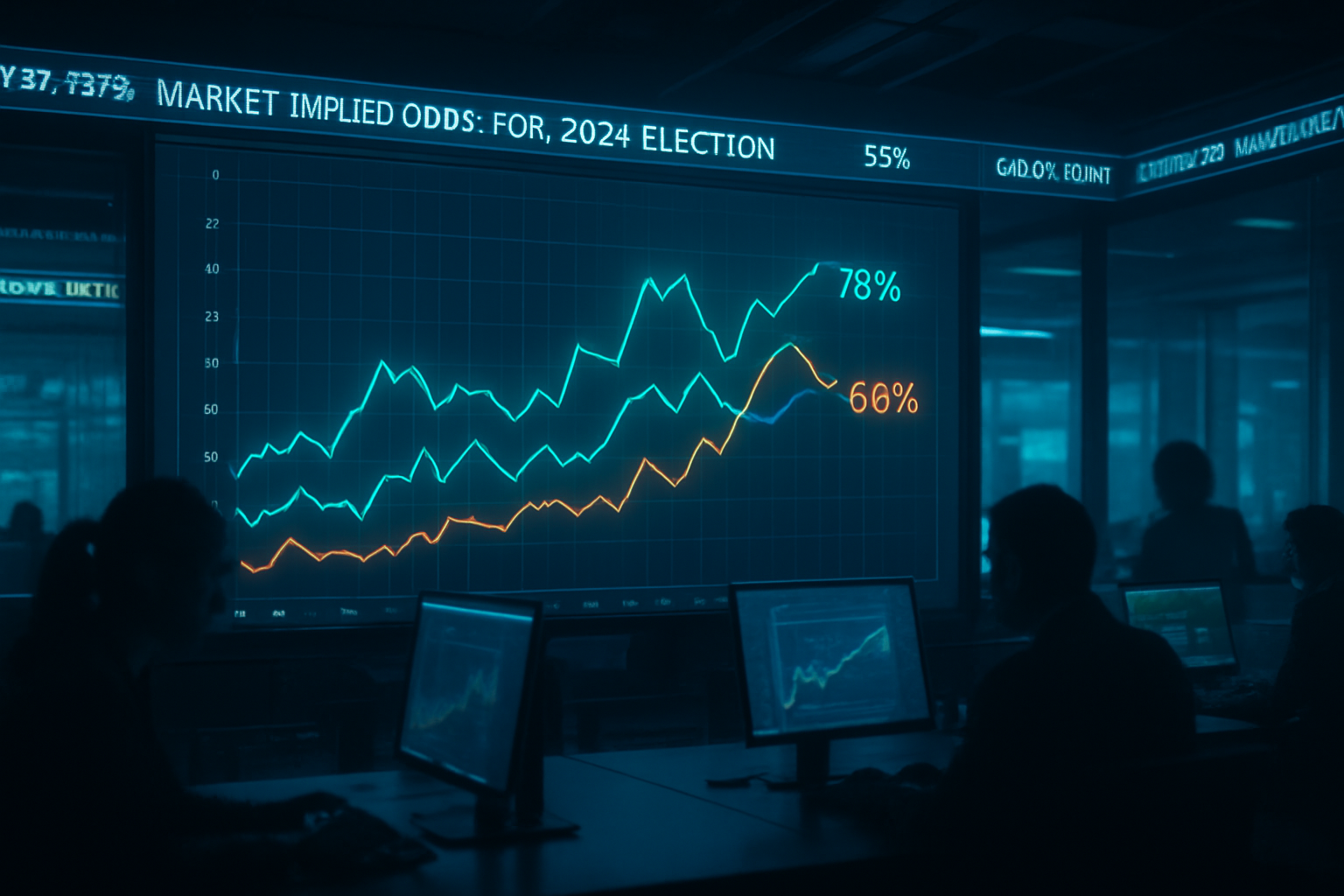
    The traditional news ticker is undergoing a radical transformation. As of February 1, 2026, the familiar crawl of stock prices and weather updates has been joined—and in some cases replaced—by a far more dynamic metric: real-time "wisdom of the crowd" probabilities. From the halls of the U.S. Congress to the red carpets of Hollywood, prediction markets have officially breached the mainstream, becoming the primary "source of truth" for major news networks.

    Currently, all eyes are on the 2026 U.S. Midterm Elections, where prediction markets on platforms like Polymarket and Kalshi are processing tens of billions of dollars in volume. Traders are pricing in a 78% probability that Democrats will flip the House of Representatives, while Republicans maintain a 66-68% chance of holding the Senate. This shift toward market-based forecasting is generating massive interest because it offers a real-time, financially incentivized alternative to traditional polling, which has struggled with lag times and declining response rates. Recent movement suggests the "Midterm Correction" narrative is strengthening, as markets react instantly to shifts in consumer sentiment and legislative gridlock.

    The Market: What's Being Predicted

    The integration of prediction market data into mainstream media is no longer experimental; it is structural. In late 2025 and early 2026, the landscape shifted through a series of landmark partnerships. CNN (Warner Bros. Discovery, Inc. – NASDAQ: WBD) designated Kalshi as its exclusive prediction data provider, with Chief Data Analyst Harry Enten now using real-time market odds to "fact-check" traditional polling data during live broadcasts. Similarly, CNBC (Comcast Corporation – NASDAQ: CMCSA) has launched a dedicated "Kalshi Hub," integrating economic and financial forecasts directly into flagship shows like Squawk Box and Fast Money.

    On the decentralized side, Polymarket has secured an expansive deal with Dow Jones (News Corp – NASDAQ: NWSA), embedding market-implied probabilities across The Wall Street Journal, Barron’s, and MarketWatch. One of the most visible results of this deal is a custom "Earnings Calendar" that displays the probability of an EPS beat for companies like NVIDIA Corporation (NASDAQ: NVDA) alongside traditional analyst estimates. Even entertainment hasn't been spared; Polymarket served as the official prediction partner for the 83rd Annual Golden Globes on CBS (Paramount Global – NASDAQ: PARA) last month, where market odds accurately predicted 26 out of 28 winners.

    Trading volume has scaled alongside this media exposure. In January 2026 alone, the industry hit a record-breaking $12 billion in total trading volume. Kalshi, which operates as a U.S.-regulated exchange, has seen a surge in "notional volume" from institutional players, while Polymarket continues to dominate the "event-pure" categories like global politics and cultural milestones.

    Why Traders Are Betting

    The fundamental driver behind the surge in prediction market participation is the concept of "Skin in the Game." Unlike traditional survey respondents who provide opinions for free, prediction market participants must back their views with capital. This financial incentive creates a powerful filtering mechanism that prioritizes accuracy over partisanship or social desirability bias.

    Traders are currently reacting to several high-impact catalysts:

    • Monetary Policy: With the Federal Reserve's March meeting approaching, Kalshi traders are pricing a 62% probability of a 25-basis-point rate cut, a figure that fluctuates in real-time as new labor and inflation data is released.
    • Political Appointments: The market has already "priced in" a shift in central bank leadership, with Kevin Warsh holding a 99% probability on Polymarket to be the next Fed Chair nominee.
    • Corporate Moves: High-conviction betting is occurring around the potential IPO of OpenAI (Private, backed by Microsoft Corp – NASDAQ: MSFT), with markets currently leaning toward a "No" for a 2026 debut at 52%.

    Mainstream media outlets are gravitating toward this data because it is more sensitive to "signal" than traditional methods. While a poll might take a week to conduct and process, a prediction market reacts to a breaking news headline or a leaked memo in seconds. This speed has made markets the preferred tool for "Sharps"—a new class of professional event traders who treat news as a tradable financial asset, often referred to as "Information Finance" or InfoFi.

    Broader Context and Implications

    The 2024 U.S. Presidential Election served as the definitive "proof-of-concept" for this shift. While legacy models and media pundits described the race as a "toss-up" until the final hours, prediction markets on Polymarket and Kalshi moved to a decisive ~60% probability for a Donald Trump victory weeks in advance. This historical accuracy has significantly diminished the "gambling" stigma that once plagued the industry.

    The regulatory landscape has also stabilized. Kalshi’s landmark legal victory against the CFTC in late 2024 cleared the way for political event contracts to be regulated as legitimate financial derivatives in the United States. This legal clarity has allowed institutional firms to use these markets as hedging tools, protecting their portfolios against geopolitical shocks or sudden policy shifts.

    However, the rise of "InfoFi" is not without controversy. Critics argue that the "gamblification" of news and awards shows could lead to market manipulation or a loss of journalistic nuance. Despite these concerns, the efficiency of the "wisdom of the crowd" continues to outperform individual experts. By turning public sentiment into a tradable price, these markets are providing a level of transparency into collective expectations that was previously impossible to quantify.

    What to Watch Next

    As we move deeper into 2026, the primary focus will remain on the Midterm Elections. Any significant legislative breakthroughs or failures in Washington will cause immediate volatility in the "Control of the House" and "Control of the Senate" markets. Analysts will be watching to see if the current 78% Democratic favoritism for the House holds firm as campaign season intensifies.

    In the corporate world, watch for the resolution of the OpenAI IPO markets and the impact of Amazon.com, Inc. (NASDAQ: AMZN) and its reported multi-billion dollar investment talks on the startup's valuation. These markets often front-run official corporate announcements by days. Additionally, the 2026 FIFA World Cup markets are already beginning to see "early-bird" liquidity, marking the first time a major sporting event will have deep, multi-year prediction markets integrated into the pre-tournament coverage.

    Finally, keep an eye on the evolving nature of media graphics. If current trends continue, the "Market Probability" may soon become the standard lead for every political and economic headline, effectively retiring the phrase "too close to call."

    Bottom Line

    The partnership between prediction platforms and mainstream media marks a turning point in the information age. By integrating data from Kalshi and Polymarket, networks like CNN, CNBC, and the WSJ are acknowledging that markets are often better at synthesizing complex information than humans are. The rise of InfoFi has turned news consumption from a passive experience into a probabilistic exercise.

    For the average viewer, this means "the news" is no longer just a series of events that have happened, but a real-time dashboard of what is likely to happen. Whether you are a trader looking for an edge or a citizen trying to cut through the noise, the "wisdom of the crowd" has become the most important signal in the room. As 2026 progresses, the line between the trading floor and the newsroom will only continue to blur.


    This article is for informational purposes only and does not constitute financial or betting advice. Prediction market participation may be subject to legal restrictions in your jurisdiction.

    PredictStreet focuses on covering the latest developments in prediction markets.
    Visit the PredictStreet website at https://www.predictstreet.ai/.

  • The Selig Revolution: CFTC Reclaims the Prediction Market Frontier

    The Selig Revolution: CFTC Reclaims the Prediction Market Frontier

    The landscape of American financial forecasting shifted fundamentally on January 29, 2026. In a move that market participants are calling a "regulatory ceasefire," Commodity Futures Trading Commission (CFTC) Chairman Michael Selig formally withdrew the proposed ban on political and sports event contracts—a relic of the Rostin Behnam era that had throttled the industry for nearly two years. Selig’s directive doesn't just allow these markets to exist; it actively "plants the flag," asserting exclusive federal jurisdiction over event contracts and effectively daring state-level regulators to challenge the agency’s authority.

    As of February 1, 2026, the impact on the markets has been immediate and profound. Trading volumes on domestic exchanges have surged to record highs, with the 2026 Midterm Election markets now serving as the primary "information engine" for political analysts. Current odds across major platforms suggest a 76% probability of Democrats reclaiming the House, while Republicans maintain a 67% chance of holding the Senate. The "Selig Shift" has transformed prediction markets from a legal battleground into a cornerstone of the broader financial ecosystem.

    The Market: What's Being Predicted

    The focus of the trading world has centered on two massive pillars: the 2026 Midterm Elections and the impending Super Bowl LX. Following the CFTC’s policy pivot, Kalshi has seen a localized explosion in volume, processing a record $403 million on January 4 alone. The primary contract currently being traded is the "Control of Congress" parlay, which has seen its bid-ask spreads compress by nearly 20% since Selig took office, a direct result of increased market-maker confidence.

    Meanwhile, Polymarket—despite its decentralized roots—has solidified its role as a global liquidity hub, particularly for international sports and geopolitical events. The "World Cup 2026 Winner" market is already drawing tens of millions in "early-bird" liquidity, with Spain currently priced as the favorite at 18%. On the regulated side, ForecastEx—the exchange operated by Interactive Brokers (NASDAQ: IBKR)—is dominating the macro-economic space. Their "US Recession by Q1 2026" contract currently holds over 128,000 open positions, providing a real-time gauge of institutional sentiment that many argue is more accurate than traditional consensus surveys.

    Why Traders Are Betting

    The surge in activity is driven by a newfound sense of legal permanence. For years, the threat of a sudden federal ban or a patchwork of state-level "gaming" lawsuits kept institutional capital on the sidelines. Selig’s "Clear Standards" framework has changed the calculus. By categorizing event contracts as vital tools for "price discovery" and "information aggregation" rather than gambling, the CFTC has given the green light to major financial players.

    Recent activity from "whales"—large-scale traders—indicates a shift toward high-conviction information trades. For instance, a controversial $400,000 payout on Polymarket regarding the capture of a foreign head of state in early 2026 has highlighted the market’s ability to front-run traditional news cycles. Furthermore, the entry of retail giants like Robinhood (NASDAQ: HOOD), which recently acquired a 90% stake in the exchange now known as Rothera, has brought a flood of new participants who view event trading as a natural extension of their equity and crypto portfolios.

    Broader Context and Implications

    This "New Era of Regulation" represents a strategic victory for federal preemption. Selig has made it clear that the CFTC views prediction markets as commodity derivatives under the Commodity Exchange Act (CEA). This stance is designed to shield exchanges from the aggressive cease-and-desist orders issued by states like Michigan and New York in late 2025. By "planting the flag," the CFTC is centralizing oversight, ensuring that a trader in California and a trader in Florida are operating under the same set of rules.

    However, Selig’s vision is not a "Wild West" scenario. The "Clear Standards" initiative introduces rigorous anti-manipulation and anti-fraud protections, specifically targeting "insider trading" within event markets. This institutionalization is a double-edged sword: while it brings the liquidity and stability required for prediction markets to be taken seriously by policymakers, it also introduces a level of surveillance and reporting that may alienate some of the industry’s early, privacy-focused adopters.

    What to Watch Next

    The immediate focus for the market is a high-stakes federal hearing scheduled for February 12, 2026. This case will determine whether the CFTC’s assertion of federal authority can legally override state gaming bans. Traders are already betting on the outcome, with a "Federal Preemption Success" contract currently trading at 0.62—indicating a 62% market confidence that the CFTC will prevail in court.

    Furthermore, the launch of Robinhood’s proprietary exchange in Q2 2026 is expected to be a liquidity "Big Bang" for the industry. If the current regulatory trajectory holds, we may see the first-ever "Event Derivatives" ETFs filed by the end of the year, further blurring the lines between traditional finance and the prediction economy.

    Bottom Line

    The transition from Rostin Behnam’s restrictive stance to Michael Selig’s "Future-Proof" framework marks the end of the prediction market’s infancy. By embracing political and sports contracts as legitimate financial instruments, the CFTC has finally aligned its regulatory posture with the reality of the 21st-century information economy.

    Predictive markets are no longer just a niche hobby for "pundits and punters"; they have become an essential piece of national infrastructure. While challenges regarding state-level jurisdiction and market integrity remain, the "Selig Revolution" has provided the one thing every trader craves: clarity. As we move closer to the 2026 Midterms, the signals generated by these markets will likely be the most watched—and most accurate—metrics in the world.


    This article is for informational purposes only and does not constitute financial or betting advice. Prediction market participation may be subject to legal restrictions in your jurisdiction.

    PredictStreet focuses on covering the latest developments in prediction markets.
    Visit the PredictStreet website at https://www.predictstreet.ai/.

  • The Maduro Capture Windfall: How a $33,000 Bet Sparked an Insider Trading Scandal

    The Maduro Capture Windfall: How a $33,000 Bet Sparked an Insider Trading Scandal

    The predawn hours of January 3, 2026, will be remembered for one of the most audacious military operations in modern history: "Operation Absolute Resolve." As U.S. special operations forces descended on Caracas to extract Venezuelan President Nicolás Maduro, the geopolitical landscape shifted in an instant. But while the world watched the tactical execution of the raid, a different kind of drama was unfolding on the digital ledgers of Polymarket, where an anonymous trader turned a modest $32,537 into a staggering $436,760 windfall.

    The trade—executed just hours before the first F-35 fighter jets, manufactured by Lockheed Martin (NYSE: LMT), crossed into Venezuelan airspace—has become the flashpoint for a heated national debate. With the "Maduro Out of Office" contract spiking from a mere 7% probability to near-certainty in a matter of minutes, the "Burdensome-Mix" trader’s suspiciously well-timed bet has prompted federal investigations, new legislation, and a fundamental questioning of whether prediction markets are a "truth machine" or a playground for insiders with access to classified military intelligence.

    The Market: What's Being Predicted

    The primary vehicle for this financial phenomenon was a Polymarket contract titled "Will Nicolás Maduro be out of power by January 31, 2026?" Throughout late 2025, the market had been relatively stagnant, reflecting a skepticism that any U.S. administration would risk a direct kinetic intervention. For months, the odds hovered between 3% and 10%, with trading volumes picking up only slightly as diplomatic tensions rose.

    By the time the operation was launched, the total volume across Maduro-related contracts had swelled to an unprecedented $64.3 million. Polymarket commanded the lion's share of this liquidity, hosting $56.6 million in total wagers. Other platforms, including Kalshi and Interactive Brokers (NASDAQ: IBKR), also saw significant action, as retail and institutional traders sought to hedge against the potential for a localized energy crisis or regional instability.

    The resolution criteria for the Polymarket contract were stringent: Maduro had to be removed from the presidency or effectively unable to exercise power by the end of the month. When news broke at 4:30 a.m. EST that Maduro was in custody and being transported to New York to face narco-terrorism charges, the contract hit its ceiling. For the "Burdensome-Mix" trader, whose final "Yes" shares were purchased at a deep discount, the payout was nearly 13 times their initial investment.

    Why Traders Are Betting

    The surge in betting activity wasn't just driven by geopolitical enthusiasts. In the weeks leading up to the raid, sophisticated traders were monitoring "on-chain" activity and physical movement of military assets. Lockheed Martin (NYSE: LMT) and other defense contractors had seen an uptick in maintenance contracts and logistics deployments, a signal that many "whale" accounts on prediction markets interpreted as a precursor to action.

    However, the "Burdensome-Mix" trade was different. Unlike the gradual accumulation of positions seen by institutional hedgers on platforms like Interactive Brokers (NASDAQ: IBKR), this specific user placed a concentrated series of bets in a six-hour window before the operation was public knowledge. This "information asymmetry" is what separates a smart macro play from a suspected leak. Analysts noted that the odds shifted significantly enough to suggest that someone, somewhere, knew the "go-order" had been given.

    Moreover, the integration of prediction market data into mainstream platforms has changed the betting psychology. Alphabet (NASDAQ: GOOGL) and Meta (NASDAQ: META) have recently begun embedding real-time "Probability Widgets" into search results and social feeds. This democratization of data meant that as soon as the "Burdensome-Mix" whale moved the needle, thousands of retail traders on Robinhood (NASDAQ: HOOD) followed suit, creating a feedback loop that accelerated the price movement before the first official press release from the White House.

    Broader Context and Implications

    The Maduro windfall has effectively ended the "wild west" era of prediction markets. On January 9, 2026, Representative Ritchie Torres (D-NY) introduced the Public Integrity in Financial Prediction Markets Act, a bill designed to extend the insider-trading prohibitions of the STOCK Act to event contracts. The logic is clear: if it is illegal for a Senator to trade stocks based on a classified briefing, it should be equally illegal to bet on the outcome of a military raid they helped oversee.

    The Commodity Futures Trading Commission (CFTC), under the leadership of Chairman Michael S. Selig, has taken a nuanced stance. Rather than banning political contracts—a move the agency considered in 2024—Selig has opted to "plant the flag" as the definitive regulator. The agency is now drafting standards for "market integrity" that would require platforms like Polymarket to implement more robust Know Your Customer (KYC) protocols and report "suspiciously timed" trades directly to federal investigators.

    The event has also highlighted a growing rift in how these platforms settle disputes. While the "Maduro Out" contracts were paid out smoothly, a secondary contract on "U.S. Invasion of Venezuela" remains in a $10.5 million legal limbo. Polymarket’s decentralized oracle initially ruled that a "snatch-and-extract" capture did not qualify as an "invasion," leading to an outcry from traders who argued the spirit of the bet was fulfilled. This dispute highlights the "contract risk" that remains a major hurdle for prediction markets seeking institutional legitimacy.

    What to Watch Next

    The immediate focus for the markets now shifts to the legal proceedings in New York. Prediction markets are already active on whether Maduro will be convicted before the end of 2026 and whether a new Venezuelan election will be held by the fourth quarter. These markets are currently trading at a 65% probability for a conviction, though legal experts warn that the discovery process could be lengthy.

    Investors should also keep a close eye on the legislative progress of the Torres Bill. If it passes, we could see a massive "de-risking" event where government-adjacent traders exit the markets, potentially leading to a temporary drop in liquidity across high-stakes political contracts. Furthermore, the CFTC’s upcoming "integrity standards" will likely dictate whether mainstream brokers like Robinhood (NASDAQ: HOOD) continue to expand their event contract offerings or pull back due to compliance costs.

    Finally, the resolution of the $10.5 million "Invasion" dispute on Polymarket will be a landmark moment for the industry. If the platform's decentralized governance cannot reach a consensus that satisfies the majority of participants, it may accelerate the migration of serious capital toward more traditionally regulated exchanges like Kalshi or those offered by Interactive Brokers (NASDAQ: IBKR).

    Bottom Line

    The "Maduro Capture" windfall is a double-edged sword for the prediction market industry. On one hand, the markets successfully "predicted" the event by showing a massive, albeit suspicious, move in probability hours before the media could report it. This reinforces the idea of prediction markets as the world’s most efficient "truth machine," aggregating information from those with the highest conviction.

    On the other hand, the $436,000 profit for a single anonymous user has laid bare the vulnerabilities of these platforms to insider trading. If prediction markets are to become a permanent fixture of the global financial system—used by companies like Lockheed Martin (NYSE: LMT) to gauge geopolitical risk or by Alphabet (NASDAQ: GOOGL) to verify news—they must survive the regulatory firestorm currently brewing in Washington.

    As Maduro awaits trial, the prediction market for his ultimate fate remains the most liquid geopolitical contract in history. Whether these markets represent the future of intelligence or a new frontier for corruption remains the $64 million question.


    This article is for informational purposes only and does not constitute financial or betting advice. Prediction market participation may be subject to legal restrictions in your jurisdiction.

    PredictStreet focuses on covering the latest developments in prediction markets. Visit the PredictStreet website at https://www.predictstreet.ai/.

  • The Great Prediction War: Polymarket and Kalshi Battle for the Soul of Information Finance

    The Great Prediction War: Polymarket and Kalshi Battle for the Soul of Information Finance

    The prediction market landscape has officially entered its most volatile and high-stakes era yet. Following a staggering 2025 that saw over $40 billion in total trading volume, the industry is now locked in what analysts are calling the "Great Prediction War." This isn't just a race for market share; it is a fundamental clash between two visions of the future: the decentralized, crypto-native "truth engine" of Polymarket and the regulated, Wall Street-compliant exchange model of Kalshi.

    As of February 1, 2026, the "meta-market" on Manifold Markets—where traders bet on the success of other platforms—paints a picture of a tightening race. Polymarket currently leads the odds at 47% to be the top platform by volume in 2026, while Kalshi holds a strong 34% share. The stakes have never been higher, as these platforms compete to fulfill the promise of "Information Finance," a concept where markets aren't just for gambling, but serve as the definitive source of truth for a world drowning in misinformation.

    The Market: What's Being Predicted

    The primary metric of success in the Great Prediction War is notional trading volume, and the numbers are staggering. In 2025, the industry hit a record-breaking $40 billion in volume, a nearly 400% increase from the previous year. This growth was fueled by a perfect storm of global events, ranging from hyper-local sports betting to high-stakes geopolitical conflicts. On Manifold Markets, the "Top Prediction Market by Volume in 2026" contract has become one of the most liquid markets on the site, serving as a real-time scoreboard for the industry's civil war.

    Polymarket’s 47% favorite status is largely driven by its dominance in "high-signal" events. During 2025, the platform processed over $33 billion in trades, much of it concentrated in areas where traditional media often lags: Federal Reserve policy shifts, the nuances of the Russia-Ukraine conflict, and major cultural milestones. Traders favor its decentralized infrastructure, which allows for rapid market creation and a global user base that brings diverse, often "insider" perspectives to the pricing.

    Kalshi, meanwhile, is the heavy-hitting incumbent of the regulated space. While it trails Polymarket in the Manifold odds at 34%, its 2025 performance was technically superior in raw notional volume, clocking in at $43.1 billion. However, much of this volume was derived from high-frequency sports contracts—a sector currently under fire from state regulators. The market is currently pricing in the risk that Kalshi’s legal battles over sports betting might stunt its growth, allowing Polymarket’s broader, global event catalog to take the lead in 2026.

    Why Traders Are Betting

    The divergence in odds between Polymarket and Kalshi reflects a deeper debate over the utility of "insider" information. A recent flashpoint occurred during the so-called "Maduro Trade," where a Polymarket user reportedly netted $400,000 by betting on the capture of Nicolás Maduro just hours before the news was officially broken by international wires. This incident has reinforced the belief among "Information Finance" advocates that decentralized markets are superior "truth engines" precisely because they incentivize those with privileged information to reveal it through their trades.

    Conversely, the "regulated" camp argues that long-term institutional adoption requires the safeguards that only a platform like Kalshi can provide. Goldman Sachs (NYSE: GS) CEO David Solomon recently noted that institutional clients are looking for "event-contract derivatives" that are cleared through regulated exchanges to hedge against macro risks. For these players, the transparency and compliance of Kalshi are more valuable than the raw speed of a crypto-native platform.

    Furthermore, the integration of prediction markets into mainstream retail apps has changed the game. Robinhood (Nasdaq: HOOD) and Interactive Brokers (Nasdaq: IBKR) have both moved to offer event contracts directly to their millions of users. This influx of retail "dumb money" has created massive liquidity, allowing professional traders to execute sophisticated arbitrage strategies between the decentralized prices on Polymarket and the regulated prices on Kalshi or ForecastEx.

    Broader Context and Implications

    The "Great Prediction War" is occurring against a backdrop of intense regulatory scrutiny. In January 2026, a Massachusetts judge issued a preliminary injunction against Kalshi, halting its sports-related contracts on the grounds that they constitute unlicensed gambling. This ruling has sent ripples through the industry, raising questions about whether the "regulated" path is actually more perilous than the decentralized one. Meanwhile, in Washington, U.S. Representative Ritchie Torres has introduced the "Public Integrity in Financial Prediction Markets Act of 2026," aimed at preventing government officials from trading on policy-related markets.

    These developments highlight the central tension of Information Finance: how to maintain the accuracy of the market without allowing it to become a "cesspool of insider trading," as some critics claim. The industry's massive 2025 volume proved that there is an insatiable appetite for these markets, but the legal framework is still struggling to catch up. The outcome of the Polymarket vs. Kalshi rivalry will likely dictate the regulatory template for the next decade.

    The validation of these markets is also coming from the highest levels of traditional finance. Intercontinental Exchange (NYSE: ICE), the parent company of the New York Stock Exchange, recently took a strategic stake in the sector, signaling that prediction markets are no longer a niche curiosity but a legitimate asset class. As these markets become more integrated with the global financial system, their ability to "predict" the future will increasingly be used by corporations to guide multi-billion dollar investment decisions.

    What to Watch Next

    The next six months will be a decisive period in the Great Prediction War. The most significant upcoming milestone is the full U.S. rollout of "Polymarket US." Following its 2025 acquisition of the CFTC-licensed exchange QCEX, Polymarket is preparing to launch a hybrid model that combines its popular interface with a fully compliant U.S. clearinghouse. If successful, this could neutralize Kalshi’s primary advantage and send Polymarket’s Manifold odds soaring past 60%.

    Simultaneously, the market is watching the moves of Robinhood (Nasdaq: HOOD). The platform recently announced a joint venture with Susquehanna International Group (SIG) to build its own in-house exchange for event contracts. If Robinhood decides to bypass both Kalshi and Polymarket to keep its users within its own ecosystem, it could disrupt the current duopoly and create a third front in the prediction war.

    Finally, keep a close eye on the "Torres Bill" in Congress. If the legislation passes with strict anti-insider trading provisions, it could paradoxically hurt the "accuracy" of the markets by removing the very people—government insiders—who have the most signal to provide. The debate over whether a market should be "fair" or "accurate" will be the defining philosophical struggle of 2026.

    Bottom Line

    The Great Prediction War of 2026 is more than a competition for trading fees; it is a battle to define how humanity aggregates truth in the digital age. Polymarket’s current lead in the Manifold meta-market suggests that traders value the platform's global reach and "pure" information signal, despite the regulatory clouds hanging over the crypto space. However, Kalshi’s 34% probability remains a formidable threat, backed by the weight of Wall Street and a "compliance-first" philosophy that may ultimately win over the world’s largest institutional hedgers.

    As we move deeper into 2026, the $40 billion volume of the previous year will likely be eclipsed as Information Finance becomes a standard feature of every retail brokerage account and corporate treasury. Whether the winner is a decentralized protocol or a regulated exchange, the real victor is the concept of the prediction market itself. We are moving toward a world where the "market price" of an event is seen as more reliable than a news headline or a political poll.

    For participants, the message is clear: the volatility in these platforms' odds reflects the volatility of our times. The Great Prediction War is just beginning, and the prize is nothing less than the authority to tell the world what will happen next.


    This article is for informational purposes only and does not constitute financial or betting advice. Prediction market participation may be subject to legal restrictions in your jurisdiction.

    PredictStreet focuses on covering the latest developments in prediction markets. Visit the PredictStreet website at https://www.predictstreet.ai/.
  • The Financialization of Truth: How X’s Integration of Live Prediction Markets is Rewiring Global News

    The Financialization of Truth: How X’s Integration of Live Prediction Markets is Rewiring Global News

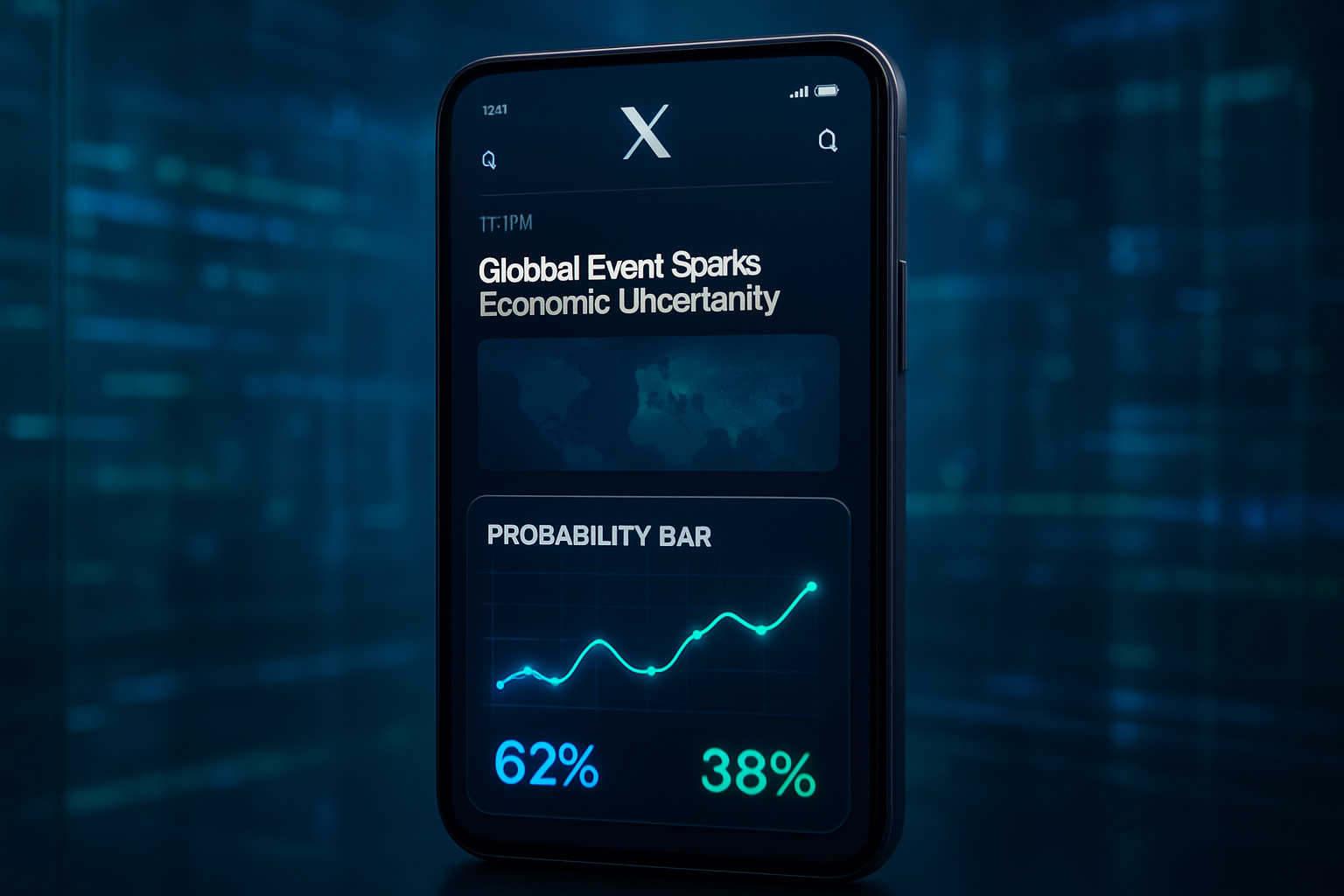
    As of January 30, 2026, the way we consume news on X (formerly Twitter) has undergone a fundamental shift. No longer just a scroll of opinions and viral clips, the platform has transformed into what analysts are calling an "Information Finance" (InfoFi) engine. The cornerstone of this transformation is the seamless integration of live prediction market data, where every major news event—from Federal Reserve rate decisions to the capture of foreign leaders—is accompanied by a "Probability Bar" showing the real-time consensus of the betting public.

    Currently, the market for "X’s Proprietary Prediction Exchange" is trading at a 31% probability of launching by year-end, reflecting intense speculation that Elon Musk will soon move beyond his current partnership with Polymarket to build a native betting ecosystem. This integration has moved prediction markets from a niche hobby for "superforecasters" to a primary layer of "consensus reality" for millions of users. The result is a surge in market liquidity, with single-day volumes on platforms like Kalshi and Polymarket recently hitting a record $701.7 million, driven largely by the "social-to-market" pipeline established on X.

    The Market: What's Being Predicted

    The most actively watched market currently integrated into the X ecosystem is the "2026 Midterm Election Control" series, which has already seen over $8 billion in open interest across both Polymarket and Kalshi. These odds are now natively displayed in the X search bar. When a user searches for "Senate Majority," the top result is no longer a poll or a news article, but a live widget showing a 58% implied probability for a Republican-controlled Senate.

    Beyond politics, the integration has birthed "Mindshare Markets," where traders bet on the viral potential of creators or the success of specific X-exclusive shows. The primary platform for these trades remains Polymarket, which became X’s "Official Prediction Market Partner" in June 2025. However, the regulated U.S. side of the volume is increasingly captured by Kalshi, following its massive partnership with Coinbase Global (NASDAQ: COIN) that brought prediction trading to all 50 states earlier this month.

    Liquidity has reached a tipping point. By late 2025, major market makers began providing deep liquidity to these event contracts, treating them as legitimate financial hedges. The resolution criteria for these markets are now often tied to "Grok-verified" outcomes—where X’s AI, Grok, synthesizes data from multiple news agencies and government filings to provide a definitive settlement trigger, a move that has significantly reduced "dispute" wait times on decentralized platforms.

    Why Traders Are Betting

    The primary driver of the current betting frenzy is the discovery of "alpha" within the social feed. The capture of Nicolás Maduro on January 3, 2026, serves as the ultimate case study. Hours before President Trump announced the operation on Truth Social, an anonymous trader on Polymarket placed a $32,000 bet that Maduro would be out of power by the end of the month. The odds were a mere 5.5% at the time; the trader walked away with a profit of over $436,000.

    This incident highlighted the "insider" nature of prediction markets—where those with unique information or superior data-processing capabilities can profit before the news hits the mainstream. For the average X user, these markets are becoming a more trusted source than traditional polling. While traditional pollsters were still debating "margin of error" during the recent special elections, prediction markets accurately moved in real-time as precincts reported, often leading the news cycle by 15 to 20 minutes.

    Institutional interest has also spiked. Firms that once viewed these platforms as "gambling" are now using them for risk management. For example, airline companies are using "Travel Demand" event contracts on Interactive Brokers (NASDAQ: IBKR) to hedge against fuel price volatility, while retail traders are using Robinhood Markets (NASDAQ: HOOD) to bet on everything from FDA approvals to box office numbers, treating event contracts as a high-leverage alternative to traditional options.

    Broader Context and Implications

    The integration of prediction data on X is a symptom of a larger trend: the "Financialization of Truth." In an era of AI-generated misinformation and deepfakes, prediction markets provide a financial incentive for accuracy. If a viral video is faked, the market odds for the related event typically don't move, or they move against the fake, acting as a "real-time truth widget" for the public.

    However, this transition has not been without controversy. The Maduro incident sparked a regulatory firestorm, leading Representative Ritchie Torres to introduce the "Public Integrity in Financial Prediction Markets Act" in January 2026. This bill aims to prohibit federal officials and their staff from trading on these markets, citing the risk of "information-based frontrunning."

    The competitive landscape is also heating up. Alphabet Inc. (NASDAQ: GOOGL) has integrated Kalshi data directly into Google Finance and Search "Probability Widgets," while Meta Platforms, Inc. (NASDAQ: META) is reportedly testing its own "Truth Widgets" for Instagram and Threads. Even gaming giants like DraftKings (NASDAQ: DKNG) have entered the fray, launching standalone prediction apps to capture the "sports-adjacent" market of cultural events. This suggests that the "wisdom of the crowd" is becoming the standard metric for news validation across the entire tech industry.

    What to Watch Next

    The coming months will be a stress test for the "InfoFi" ecosystem. The primary milestone to monitor is the potential IPO of Kalshi, which is currently trading at a 62% probability for a 2026 debut. A successful IPO would signal that regulators and institutional investors have fully embraced event derivatives as a permanent fixture of the U.S. financial system.

    Investors should also watch the "X Coin" or "X Stablecoin" rumors. There is a 10% probability on Polymarket that X will launch its own USD-pegged stablecoin by the end of 2026. If this occurs, it could allow X to bypass third-party payment processors and create a closed-loop betting ecosystem, potentially increasing its market share against decentralized competitors.

    Finally, keep an eye on the "Grok-3" rollout scheduled for later this quarter. If the next iteration of the AI can execute trades autonomously based on news sentiment, we could see a massive spike in "algorithmic forecasting," further increasing liquidity but also increasing the risk of "flash crashes" in specific event contracts.

    Bottom Line

    The integration of live prediction data into X has fundamentally changed the relationship between information and value. We are no longer just passive observers of the news; we are active participants in its valuation. By attaching a price tag to the "truth," prediction markets have created a more efficient, albeit more volatile, information ecosystem.

    For prediction markets, this is the "mainstream moment" many have forecasted for a decade. The partnership between X and Polymarket, coupled with the institutional backing from companies like Intercontinental Exchange (NYSE: ICE), has provided the infrastructure needed for these markets to scale. While regulatory hurdles like the Torres Bill remain, the momentum of "InfoFi" appears irreversible.

    Ultimately, the probability widgets on our feeds are telling us more than just the "odds"—they are reflecting a new world where "consensus reality" is determined not by what we say, but by where we are willing to put our money.


    This article is for informational purposes only and does not constitute financial or betting advice. Prediction market participation may be subject to legal restrictions in your jurisdiction.

    PredictStreet focuses on covering the latest developments in prediction markets.
    Visit the PredictStreet website at https://www.predictstreet.ai/.