
Tag: Polymarket

  • Bitcoin’s $70,000 Tug-of-War: Polymarket Traders Recalibrate as $85,000 Dreams Fade

    Bitcoin’s $70,000 Tug-of-War: Polymarket Traders Recalibrate as $85,000 Dreams Fade

    As of February 8, 2026, Bitcoin is locked in a fierce battle around the $70,000 mark, a level that has become the definitive "line in the sand" for traders on decentralized prediction platforms. On Polymarket, the world’s leading prediction market, the probability of Bitcoin touching $70,000 this month has surged to a commanding 71%, up significantly from 62% just a week ago. This shift signals a consolidation phase after a turbulent start to the year, as the market pivots from aggressive moonshot targets to a more grounded reality.

    The surge in confidence for the $70,000 floor comes at a cost, however. Just weeks ago, traders were pricing in a rapid ascent to $85,000 and beyond. Those upside expectations have since collapsed, with odds for an $85,000 target cratering from nearly 60% in late January to a mere 12-32% today. This dramatic repricing reflects a growing consensus that the "bull-run fever" of late 2025 has cooled, replaced by a range-bound environment dominated by institutional cooling and shifting liquidity.

    The Market: What's Being Predicted

    The current focus of the crypto prediction space is centered on Bitcoin’s February 2026 price action. On Polymarket and its regulated competitor Kalshi, hundreds of millions in volume are being traded across various price-point contracts. The primary contract—"Will Bitcoin touch $70,000 in February?"—is currently the most liquid, with its 71% probability serving as a benchmark for the broader market’s sentiment.

    While the "touch" probability is high, the "settle" probability tells a more nuanced story. Traders are only pricing in a 54% chance that Bitcoin ends the month at or above $75,000, suggesting that while the market expects a push upward, it doesn't necessarily expect a sustained rally. On Kalshi, shorter-term weekly contracts for the mid-February period show even tighter odds, with most participants betting on a price range that keeps the asset pinned between $65,000 and $75,000 through the next ten days.

    Trading volume has spiked as the $70,000 barrier approaches. Liquidity on these platforms has deepened significantly compared to 2024, allowing "whales" to hedge massive spot positions. These markets will resolve based on the price feeds from major exchanges like Coinbase Global, Inc. (NASDAQ: COIN), ensuring a transparent and objective conclusion to the bets at the stroke of midnight on February 28.

    Why Traders Are Betting

    The primary catalyst for this bearish repricing is the unexpected wave of redemptions hitting U.S. Spot Bitcoin ETFs. After a record-breaking 2025, institutional giants like BlackRock, Inc. (NYSE: BLK) are seeing their first sustained period of net outflows. Total assets in these ETFs have plummeted from $128 billion to $97 billion in less than a month, with over $2.8 billion in net redemptions recorded in the last two weeks of January alone.

    This "mechanical" selling pressure has changed the game for prediction market traders. Analysts note that the average purchase price for many institutional entrants sits between $84,000 and $88,000. With Bitcoin trading well below those levels, many of these positions are currently "underwater," triggering automated risk-management protocols that dump supply back onto the market. This explains the "collapse" of the $85,000 upside odds; traders realize that any push toward $80k will likely be met with a massive wall of institutional selling.

    Furthermore, the absence of aggressive "dip buying" during the brief slide to $60,000 in early February has signaled a tactical retreat by Wall Street. Unlike the retail-driven pumps of the past, the current market is heavily influenced by the balance sheets of companies like MicroStrategy Incorporated (NASDAQ: MSTR). When these major players go quiet, prediction market odds quickly reflect the lack of upward momentum, leading to the current $65,000-$85,000 implied range.

    Broader Context and Implications

    This shift in Polymarket sentiment highlights the evolution of prediction markets as a leading indicator for the broader financial world. Traditionally, investors looked to the futures and options markets on the CME to gauge sentiment. However, the "wisdom of the crowd" on Polymarket has often been faster to price in the impact of ETF flows than traditional analysts. The 71% probability for a $70,000 touch acts as a psychological anchor, potentially creating a self-fulfilling prophecy as retail traders align their strategies with the "prediction market consensus."

    Real-world implications are significant. The failure to reclaim the $85,000 level could signal a broader "cooling off" period for the entire digital asset class. If Bitcoin cannot maintain the $70,000 support, it may validate the fears of skeptics who argue that the 2025 rally was overextended. This market sentiment also affects the regulatory landscape, as agencies monitor these prediction markets for signs of manipulation or as gauges of financial stability in the crypto ecosystem.

    Historically, Polymarket has been remarkably accurate in predicting Bitcoin "floors" during periods of high volatility. In mid-2025, the platform correctly priced in a 15% correction three weeks before it hit the mainstream news. Traders now view these markets not just as a place to bet, but as a crucial data point for risk management in a world where crypto and traditional finance are increasingly intertwined.

    What to Watch Next

    As we move toward mid-February, several key milestones will determine if the $70,000 "line in the sand" holds. Traders are keeping a close eye on the next round of 13F filings and weekly ETF flow reports. If redemptions from funds like the Grayscale Bitcoin Trust (OTC: GBTC) begin to slow, the 71% probability of hitting $70,000 could quickly transform into a bet on a $75,000 breakout.

    Key dates to monitor include the February 15 "options expiry," which often brings heightened volatility. If Bitcoin is still hovering near $68,000 by that date, the probability of a late-month surge will likely drop, and we could see the $65,000 support tested once again. Polymarket traders are currently pricing a 57% chance of a retest of $65,000 before the month is out, making the next 10 days critical for the asset's short-term trajectory.

    Bottom Line

    The current state of the Bitcoin prediction markets on Polymarket reflects a market in transition. The exuberant $85,000 targets of last month have vanished, replaced by a calculated focus on the $70,000 pivot point. With a 71% probability of touching that mark, the crowd is betting on resilience, but the underlying data—fueled by massive ETF outflows—suggests that any recovery will be a slow, arduous climb.

    This episode serves as a powerful reminder of the utility of prediction markets. While traditional price targets often remain static, prediction market odds are dynamic, reacting in real-time to every billion-dollar outflow and every shift in institutional sentiment. For now, the "line in the sand" is drawn at $70,000, and the coming weeks will reveal whether that line is built on stone or shifting sand.


    This article is for informational purposes only and does not constitute financial or betting advice. Prediction market participation may be subject to legal restrictions in your jurisdiction.

    PredictStreet focuses on covering the latest developments in prediction markets.
    Visit the PredictStreet website at https://www.predictstreet.ai/.

  • The Prediction Market ‘Civil War’: Polymarket and Kalshi Battle for 2026 Dominance

    The Prediction Market ‘Civil War’: Polymarket and Kalshi Battle for 2026 Dominance

    As the prediction market industry enters its most volatile and high-stakes year to date, the internal rivalry between the sector’s two largest titans has spilled over into the markets themselves. On Manifold Markets, a high-liquidity "meta-market" titled "Top 1 prediction market by volume in 2026?" has become the primary scoreboard for what insiders are calling the "Civil War" of forecasting platforms. This contract allows traders to bet on which platform—the decentralized, crypto-native Polymarket or the CFTC-regulated Kalshi—will emerge as the undisputed volume leader by the end of the year.

    As of February 8, 2026, Polymarket holds a commanding 47% lead in the odds, while Kalshi trails at 34%. This 13-point gap reflects a significant shift in market sentiment over the last month, driven by a series of massive institutional investments and regulatory pivots that have fundamentally altered the landscape. For industry watchers, this market is more than just a bet; it is a real-time proxy for the future of information finance, pitting the speed of blockchain-based markets against the institutional legitimacy of regulated exchanges.

    The Market: What's Being Predicted

    The "Civil War" contract on Manifold Markets focuses on one primary metric: total USD-equivalent trading volume for the 2026 calendar year. While Manifold is technically a play-money platform, the market has attracted significant liquidity, with over $50 million in notional value traded on this specific question. The resolution criteria are strict, requiring the winner to be determined by verified third-party data from sources like The Block or CoinGecko, as well as official transparency reports from the platforms themselves.

    Currently, the market favors Polymarket at 47%. This lead is bolstered by Polymarket’s massive international reach and its dominance in "high-signal" event contracts—specifically geopolitics, tech milestones, and global macroeconomics. Meanwhile, Kalshi’s 34% probability reflects its growing but narrower focus on the U.S. retail sector. Interestingly, the market excludes "pure sports betting" from the volume count to maintain a focus on event-based forecasting. This is a critical distinction, as recent reports indicate that roughly 91% of Kalshi’s raw volume in early 2026 has been driven by its new sports-integrated contracts.

    Trading volume on this meta-market has spiked following the announcement of a $2 billion institutional investment in Polymarket by Intercontinental Exchange (NYSE: ICE). This move signalized to traders that Polymarket is no longer a niche crypto experiment but a serious contender for global financial infrastructure. The liquidity in the "Civil War" market is so high that several hedge funds are reportedly using it as a hedge against their equity positions in traditional exchange stocks.

    Why Traders Are Betting

    The 47-to-34 split in odds represents a fundamental debate over the "on-ramp" of the future. Polymarket bulls point to the platform's recent partnership with Circle, which transitioned the exchange to native USDC. This move provided institution-grade settlement infrastructure, making it easier for large-scale traders to move millions into prediction markets without the friction of bridging assets. The inclusion of native dollar-denominated stability has neutralized one of Kalshi’s biggest historical advantages: ease of use for non-crypto users.

    Conversely, those backing Kalshi argue that its integration with popular apps like Sleeper, which has over 10 million users, will eventually swamp Polymarket’s volume. By routing prediction market orders directly through a popular fantasy sports interface, Kalshi is tapping into a retail base that Polymarket, currently restricted in many jurisdictions, cannot easily access. "Kalshi is building the pipes for the average person," noted one high-volume Manifold trader. "Polymarket is building the engine for the global elite. Historically, volume follows the pipes."

    Whale activity has also moved the needle. Several large positions were opened in early February following a CFTC "innovation-first" agenda announcement, which withdrew several 2024 proposals that sought to ban certain event contracts. This regulatory softening was initially seen as a win for Kalshi, but the market reacted in favor of Polymarket, as traders speculated that a friendlier U.S. environment would eventually allow Polymarket to relaunch a fully regulated U.S. arm, potentially through its partnership with Coinbase Global, Inc. (NASDAQ: COIN).

    Broader Context and Implications

    This "Civil War" meta-market is playing out against a backdrop of intense regulatory scrutiny and a shift in how the public consumes news. Prediction markets are increasingly being used as the primary source of truth for major events, often moving faster than traditional news wires. The outcome of this volume battle will likely dictate which platform becomes the "Bloomberg Terminal of the masses." If Polymarket wins, it validates the decentralized, borderless model of forecasting. If Kalshi wins, it proves that regulatory compliance and traditional financial plumbing are the only way to achieve true scale.

    The stakes are also high for traditional brokerages. Robinhood Markets, Inc. (NASDAQ: HOOD) and Interactive Brokers (NASDAQ: IBKR), via its ForecastEx subsidiary, have been watching the volume growth of these specialized platforms with wary eyes. A dominant victory for either Polymarket or Kalshi could lead to an acquisition spree as traditional firms look to integrate these high-engagement tools into their existing suites.

    However, a new "jurisdictional civil war" is brewing at the state level. While federal regulators have cooled their opposition, state gaming commissions in Massachusetts and Nevada have recently issued cease-and-desist orders to Kalshi, attempting to reclassify event contracts as unlicensed gambling. This legal friction is a major reason why Kalshi’s odds haven’t overtaken Polymarket's, as traders fear a fragmented U.S. market could stifle Kalshi’s growth while Polymarket thrives globally.

    What to Watch Next

    The upcoming week is expected to be a major catalyst for the market. Super Bowl LX on February 8, 2026, will serve as a massive stress test for Kalshi’s infrastructure and its integration with retail apps. While "pure sports" volume is excluded from the Manifold contract, the halo effect of millions of new users joining the platform to bet on the game could lead to a surge in political and economic volume—areas that do count toward the resolution.

    Beyond the Super Bowl, the next major milestone is the Q1 2026 earnings season. While neither platform is currently public, their volume reports will be scrutinized by the traders on Manifold. Any sign that Polymarket’s $2 billion injection from ICE is being used to subsidize trading fees or launch a massive marketing campaign could see its 47% lead expand toward a 60% "super-majority."

    Finally, rumors of a native prediction market launch from Coinbase (NASDAQ: COIN) in late Q1 have pushed the "Other" category in the Manifold market to a 19% probability. If Coinbase enters the fray, the "Civil War" could quickly become a three-way battle, potentially diluting the volume of both leaders and forcing a massive re-pricing of the current odds.

    Bottom Line

    The "Civil War" on Manifold Markets has transformed from a curiosity into a vital industry benchmark. Polymarket’s current 47% lead suggests that the market currently values global reach and institutional backing over Kalshi’s 34% bet on U.S. retail dominance and regulatory alignment. However, with the year only just beginning, the gap remains bridgeable.

    This market reveals that the prediction market industry has matured beyond its experimental phase. We are now in an era of "Info-Finance," where the platforms themselves are the subjects of intense speculation. For traders, the key will be monitoring whether Kalshi can overcome its current state-level legal hurdles or if Polymarket’s crypto-native efficiency will continue to outpace its regulated rival.

    Ultimately, the 2026 volume winner will likely set the standard for the entire industry for the next decade. Whether it is the decentralized giant or the regulated incumbent, the outcome will signal how the world’s information is priced and who owns the "real-time scoreboard" of human knowledge.


    This article is for informational purposes only and does not constitute financial or betting advice. Prediction market participation may be subject to legal restrictions in your jurisdiction.

    PredictStreet focuses on covering the latest developments in prediction markets.
    Visit the PredictStreet website at https://www.predictstreet.ai/.
  • The End of Bridge Risk: Why the Circle-Polymarket Native USDC Shift is a Watershed Moment for Institutional Forecasting

    The End of Bridge Risk: Why the Circle-Polymarket Native USDC Shift is a Watershed Moment for Institutional Forecasting

    The prediction market landscape shifted significantly this week as the world’s leading forecasting platform, Polymarket, officially commenced its transition to native USDC for on-chain settlement. In a strategic partnership with Circle Internet Group (NYSE: CRCL), the move marks the definitive end of the "bridged asset" era for the platform, replacing the older, more vulnerable USDC.e (bridged USDC) with a direct, regulated dollar instrument issued on the Polygon network.

    The news has sent ripples through the forecasting community, where traders are currently pricing in a record-breaking year for volume. On Manifold Markets, the probability that Polymarket maintains its "Volume Crown" through 2026 has surged to 47%, a 10% jump following the announcement. Investors view this migration not merely as a technical upgrade, but as a critical "de-risking" event that opens the floodgates for large-scale institutional participation.

    The Market: What's Being Predicted

    The primary market capturing the implications of this partnership is the "2026 Global Prediction Volume Leader" contract. Trading across several platforms including Manifold and decentralized forecasting protocols, the market asks which entity will record the highest total trading volume by December 31, 2026.

    As of February 8, 2026, the odds are as follows:

    • Polymarket: 47% (Up from 37% last month)
    • Kalshi: 34%
    • PredictIt: 12%
    • Other (Incentivized DEXs): 7%

    Liquidly in these "meta-markets" has spiked, with over $15 million in total volume traded on the outcome of Polymarket’s dominance alone. The resolution criteria are strictly tied to audited transparency reports and on-chain data. Traders are also closely monitoring the "Super Bowl LX Volume" market, where bets are currently favoring a total handle exceeding $1.5 billion, a figure many believe would be impossible without the capital efficiency gains provided by native USDC.

    Why Traders Are Betting

    The bullish sentiment surrounding Polymarket’s volume is driven by the removal of "bridge risk." Previously, institutions were hesitant to commit hundreds of millions of dollars to a platform relying on Bridged USDC (USDC.e), which depends on the security of third-party bridge protocols. A bridge exploit could theoretically render the collateral worthless, a tail risk that most compliance departments refused to accept.

    "The transition to native USDC is the final green light for the 'big money,'" says one high-frequency trader holding a six-figure position in the Volume Leader market. "We’ve seen reports that DRW and other major liquidity providers are spinning up dedicated prediction market desks. They don't trade in 'wrapped' or 'bridged' assets; they trade in regulated dollars. This move gives them that."

    Furthermore, the recent $2 billion investment from Intercontinental Exchange (NYSE: ICE) into Polymarket has fundamentally changed the platform's profile. With a valuation now nearing $9 billion, the platform is no longer a "crypto-native experiment" but a pillar of the modern financial stack. Traders are betting that the combination of ICE's institutional reach and Circle's native settlement layer will create a feedback loop of liquidity that competitors like Kalshi—which operates in a more restricted regulatory environment—may struggle to match.

    Broader Context and Implications

    The shift highlights a growing divide in the crypto ecosystem between "internet-native finance" and traditional fintech. By integrating native USDC, Polymarket gains access to Circle’s 1:1 redemption pipeline, ensuring that every dollar on the platform is backed by regulated reserves. This reduces technical complexity by removing the multi-step bridging process, which often added friction and hidden costs for professional traders.

    In a joint statement, the leaders of both companies emphasized the long-term vision of this integration. Jeremy Allaire, CEO of Circle, noted:

    "The internet financial system driven by Circle platforms has been built to enable money and capital to work at the speed of the internet. Polymarket has been at the forefront of innovation in marrying the speed of information with the speed of markets."

    Shayne Coplan, CEO of Polymarket, added:

    "Using USDC supports a consistent, dollar-denominated settlement standard that enhances market integrity and reliability as participation on the platform continues to grow. This is about building the foundation for the next decade of global digital markets."

    Analysts at Mizuho (NYSE: MFG) recently upgraded their outlook on the sector, citing the "prediction market effect" as a primary driver for stablecoin velocity. Their report suggests that every major event—from elections to the Super Bowl—now acts as a direct pipeline for native USDC adoption, creating a "sticky" ecosystem where capital remains on-chain rather than cycling back to fiat.

    What to Watch Next

    The immediate focus for the market is the phased rollout of the migration. Key milestones to monitor include:

    1. The "Grand Migration" Deadline: Polymarket has signaled a 90-day window to sunset USDC.e. Any delays in this timeline could cause temporary volatility in the Volume Leader markets.
    2. Institutional Onboarding Announcements: Traders are watching for formal partnerships with Tier-1 banks or market-making firms. If a firm like Goldman Sachs (NYSE: GS) were to announce a partnership for event-contract hedging, Polymarket’s odds of dominance would likely skyrocket toward 80%.
    3. Regulatory Feedback: While the move to native USDC is a step toward "professionalization," regulators at the CFTC continue to monitor the platform’s growth. Any new enforcement actions or restrictive "no-action" letters could flip the market in favor of regulated U.S. exchanges like Kalshi.

    Bottom Line

    The transition to native USDC is more than a backend update; it is a declaration of intent. Polymarket is effectively signaling that it is ready to handle the liquidity of the world's largest financial institutions. For prediction markets, this move addresses the two greatest hurdles to mainstream adoption: technical complexity and counterparty risk.

    As of February 2026, the "Volume Crown" remains Polymarket’s to lose. The platform has successfully leveraged its early-mover advantage and combined it with a robust, institutional-grade settlement layer. While competitors are catching up, the synergy between Circle’s regulated dollar and Polymarket’s peerless forecasting engine has created a formidable moat. For the average trader, this means more liquidity, tighter spreads, and the peace of mind that their collateral is as safe as a dollar in a bank—only faster.


    This article is for informational purposes only and does not constitute financial or betting advice. Prediction market participation may be subject to legal restrictions in your jurisdiction.

    PredictStreet focuses on covering the latest developments in prediction markets.
    Visit the PredictStreet website at https://www.predictstreet.ai/.
  • The Grocery Gambit: Polymarket’s $1 Million NYC Pop-Up Sparks High-Stakes Political Betting

    The Grocery Gambit: Polymarket’s $1 Million NYC Pop-Up Sparks High-Stakes Political Betting

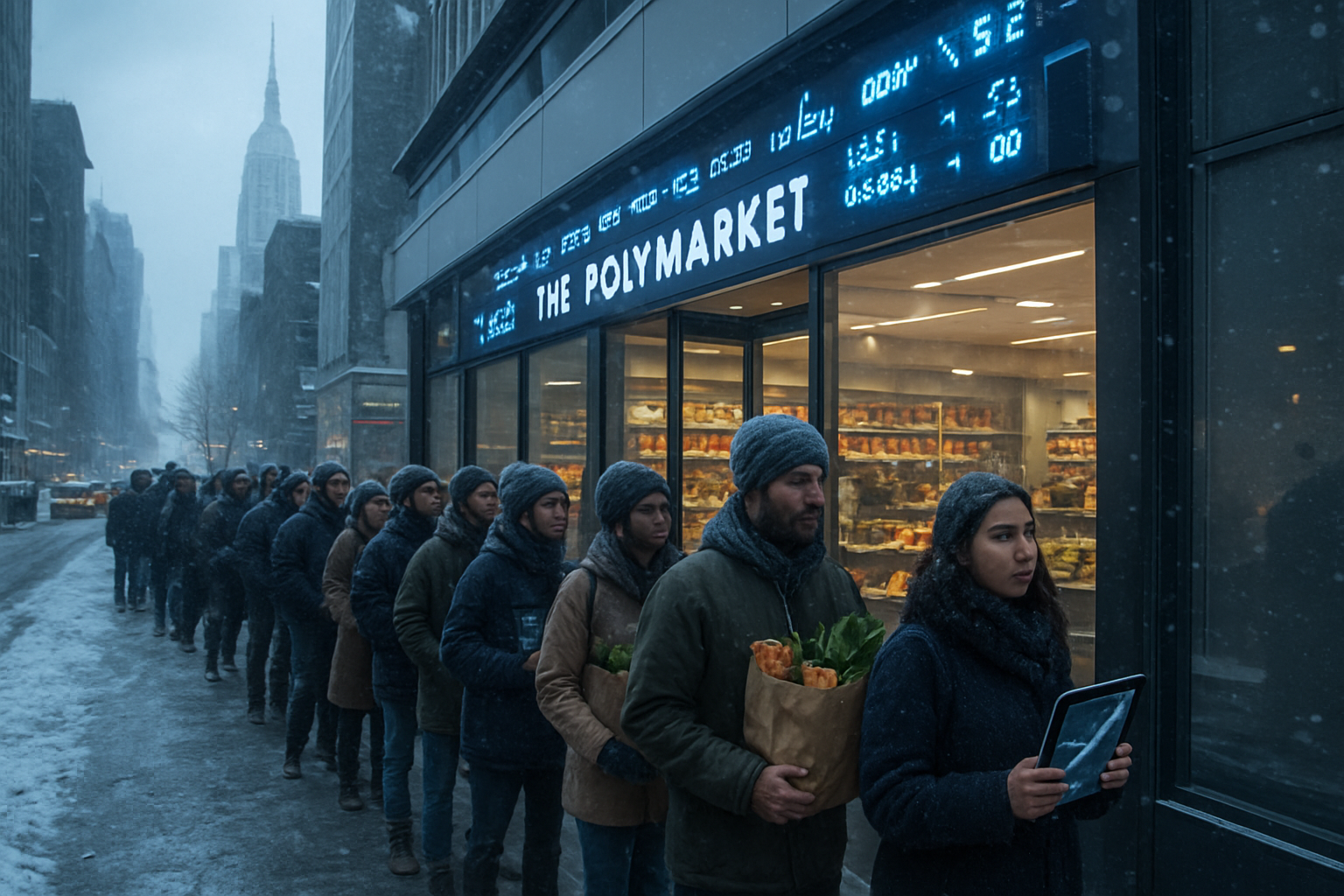
    As of February 8, 2026, the intersection of decentralized finance and urban politics has reached a fever pitch in New York City. Prediction market giant Polymarket has announced a "free grocery store" pop-up in downtown Manhattan, a move that traders are betting will either be a masterstroke of PR or a regulatory lighting rod. Currently, markets on Polymarket and rival Kalshi are pricing in a 68% probability that the "The Polymarket" store will run out of stock before its scheduled closing on February 16, reflecting both the immense demand for free goods and the skepticism surrounding the logistics of this corporate-led "food sovereignty" experiment.

    The event, which includes a massive $1 million donation to the Food Bank for NYC, is widely viewed by traders as a sardonic critique of the city's shifting political landscape. With the recent inauguration of Mayor Zohran Mamdani—a democratic socialist who campaigned on establishing city-run municipal grocery stores—the prediction markets are buzzing. Investors are not just betting on whether the milk stays on the shelves; they are wagering on whether this private-sector "flex" will successfully delegitimize the new administration's signature public policy before it even leaves the pilot phase.

    The Market: What's Being Predicted

    The primary market generating heat is "Will 'The Polymarket' run out of stock before Feb 15?", currently trading on Polymarket with high liquidity. Traders are also eyeing a secondary market on whether the NYC Department of Health will issue a "cease and desist" order to the pop-up before its five-day run concludes. Volume across these event-based contracts has surged to over $4.2 million in the last 48 hours, as New Yorkers and global speculators alike weigh the efficiency of "crypto-philanthropy" against the city’s notoriously stringent health and safety regulations.

    Unlike traditional political betting, these markets are resolved based on verifiable on-the-ground outcomes. Resolution for the "stock-out" market depends on independent journalist verification and social media reports of empty shelves for more than four consecutive hours. Meanwhile, a "meta-market" has emerged regarding the user acquisition rates of prediction platforms: "Will Polymarket's NYC user base grow by >15% in Feb 2026?" This highlights the ultimate goal of the stunt—converting the visibility of the $1 million donation and the free store into a surge of new participants in the prediction ecosystem.

    Why Traders Are Betting

    Traders are leaning into the "logistical chaos" thesis. History shows that free giveaways in high-density urban areas like NYC often face overwhelming demand that outstrips even the most well-funded corporate budgets. The $1 million donation to the Food Bank for NYC—estimated to provide 10 million meals—adds a layer of legitimacy that makes some "Yes" bettors nervous, as it suggests Polymarket has secured the supply chain expertise of established nonprofits.

    However, the political friction is the real driver of the "No" (shutdown) bets. Mayor Zohran Mamdani’s response to the stunt was a masterclass in sardonic politics. Quoting a viral Clickhole headline, Mamdani posted: "Heartbreaking: The Worst Person You Know Just Made A Great Point." While Mamdani acknowledges the desperate need for food security, his administration is reportedly wary of a private entity—especially one frequently at odds with the Commodity Futures Trading Commission (CFTC)—using hunger as a marketing tool. Traders are closely monitoring City Hall’s press briefings, looking for signs that the Department of Health might find a "technical violation" in the store’s refrigeration or labeling to shut down the mockery.

    Broader Context and Implications

    This stunt is a pointed jab at the legacy of former Mayor Eric Adams, whose failed "NYC Token" crypto-initiative left many in the tech sector frustrated by government-led blockchain experiments. By succeeding where the previous administration’s digital assets failed, Polymarket is attempting to prove a broader point: markets can provide immediate, tangible relief more efficiently than bureaucracy. This "free grocery" model is a direct challenge to the municipal grocery store pilot program, a $60 million initiative proposed by the Mamdani administration.

    The real-world implications are stark. If Polymarket can operate a "frictionless" grocery store for five days without the administrative overhead of city-run programs, it strengthens the narrative that decentralized platforms can solve public goods problems. However, critics point out the temporary nature of the stunt. Unlike the proposed city stores, Polymarket’s pop-up is a five-day marketing budget line item, not a sustainable solution. This skepticism is reflected in the markets for "Mamdani’s Municipal Grocer Pilot Success", which have seen a slight dip in confidence as the public gets a taste of private-sector speed.

    What to Watch Next

    The key date to monitor is February 12, the store's opening day. If lines wrap around several city blocks, as expected, the "stock-out" probability will likely climb toward 80%. Conversely, if the Food Bank for NYC’s involvement ensures a steady replenishment of goods, we could see a massive "No" swing. Traders should also watch the social media accounts of the NYC Department of Health. Any mention of an unpermitted "distribution of perishables" could send the "Shutdown" market into a frenzy.

    Furthermore, the competition between Polymarket and Kalshi is heating up. Kalshi recently countered with a $50-per-shopper giveaway at independent retailers, attempting to maintain its status as the "regulated" alternative. Any public company involvement, such as a logistics partnership with United Parcel Service, Inc. (NYSE: UPS) or a supply deal with a major distributor like Sysco Corporation (NYSE: SYY), could provide the store with the operational backbone needed to stay open, significantly moving the odds in the "No stock-out" direction.

    Bottom Line

    Polymarket’s "The Polymarket" pop-up is more than just a giveaway; it is a high-stakes experiment in brand positioning and political commentary. By putting $1 million on the line and mocking the mayor’s signature policy, the platform has turned the act of buying groceries into a tradable event. The markets currently favor a "chaotic success"—one where the store runs out of food due to overwhelming demand but succeeds in dominating the news cycle.

    Ultimately, this event signals a new era for prediction markets, where platforms move beyond just predicting the news and start creating it to test their own market theories. Whether the store remains open or is shuttered by a wary City Hall, the real winner may be the prediction market format itself, which has once again proven its ability to capture the nuance of a complex, politically charged moment in real-time.


    This article is for informational purposes only and does not constitute financial or betting advice. Prediction market participation may be subject to legal restrictions in your jurisdiction.

    PredictStreet focuses on covering the latest developments in prediction markets.
    Visit the PredictStreet website at https://www.predictstreet.ai/.
  • A Billion-Dollar Kickoff: Super Bowl LX Prediction Markets Hit Record $1B in Trading Volume

    A Billion-Dollar Kickoff: Super Bowl LX Prediction Markets Hit Record $1B in Trading Volume

    As the Seattle Seahawks and New England Patriots prepare to take the field for Super Bowl LX at Levi’s Stadium, the real action is happening on digital ledger boards and order books. In a historic first for the industry, the 2026 Super Bowl has become the most heavily traded sporting event in the history of prediction markets, signaling a fundamental shift in how Americans and global observers hedge against—and profit from—the "Big Game."

    Leading the charge are the two titans of the space: Kalshi and Polymarket. On Kalshi, the first U.S.-regulated exchange to legally offer sports event contracts, trading volume for the game-winner market has surged past $180 million. Meanwhile, Polymarket, the decentralized heavyweight operating internationally, has seen its Super Bowl LX championship market swell to nearly $700 million. Together with smaller niche platforms, the total liquidity poured into this single Sunday matchup has eclipsed the $1 billion mark, dwarfing the volume seen just two years ago.

    The Market: What's Being Predicted

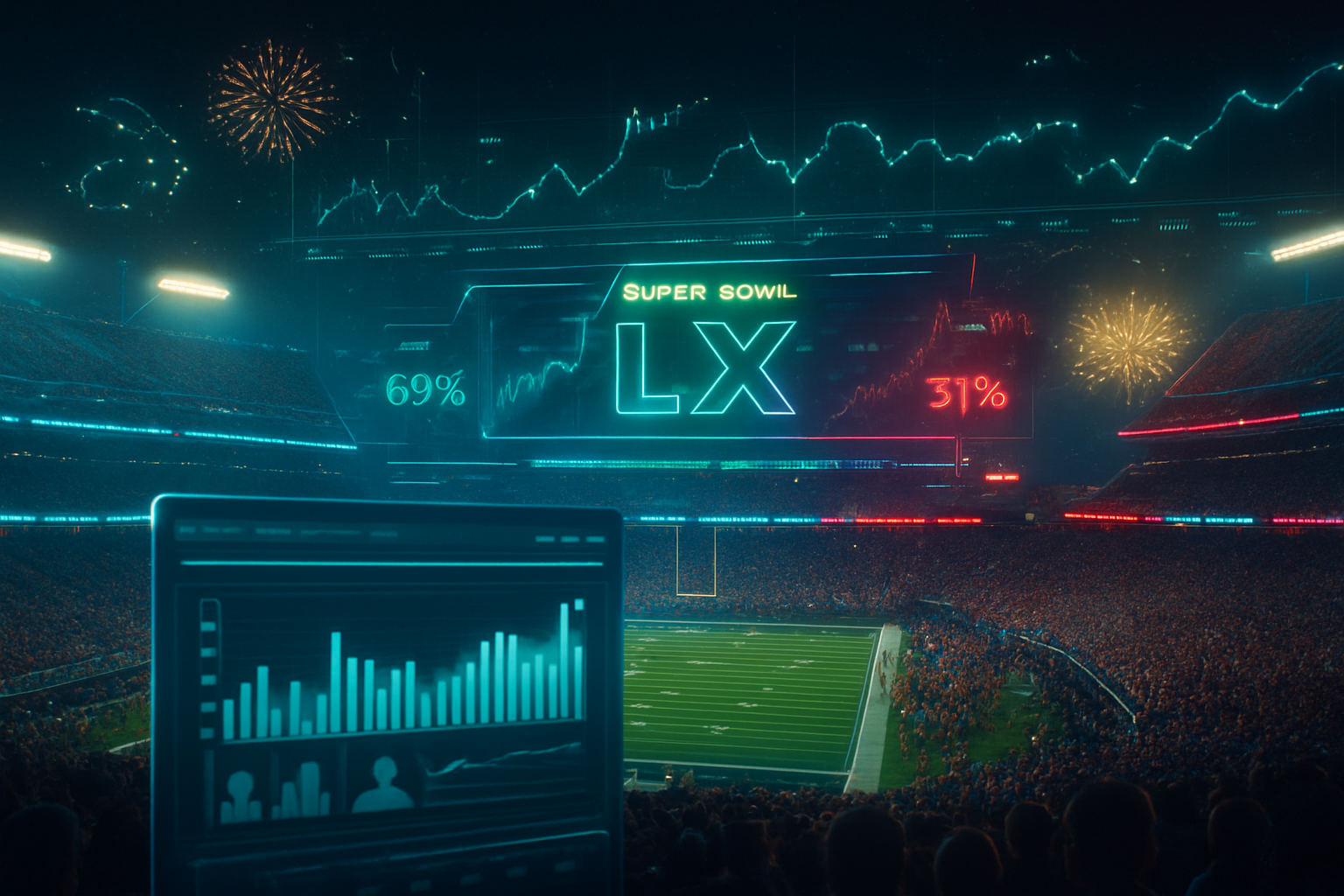
    The central question for traders is simple: Who walks away with the Lombardi Trophy? As of the morning of February 8, 2026, the markets show a rare, high-conviction consensus favoring the Seattle Seahawks. On Kalshi, the Seahawks are trading at a 69% probability of winning, while Polymarket participants are slightly more conservative, pricing them at 68%.

    This divergence, though small, represents millions of dollars in arbitrage opportunity for sophisticated traders. The markets are highly liquid, with "yes" contracts for the Seahawks priced at roughly 69 cents, meaning a $100 bet would return roughly $145 if Seattle triumphs. The resolution criteria are strictly defined by the official NFL score at the end of regulation or overtime, with Kalshi’s contracts clearing through the CFTC-regulated framework that treats these bets as commodity derivatives rather than traditional wagers.

    Why Traders Are Betting

    The massive volume is driven by a compelling narrative: the "Legacy Rematch." Eleven years after the infamous goal-line interception in Super Bowl XLIX, these two franchises meet again with entirely different rosters but equally high stakes. Traders are particularly bullish on Seahawks quarterback Sam Darnold, who has undergone a career-defining renaissance this season. Darnold currently leads the MVP prediction markets with +130 odds, as traders bet that a Seattle win is inextricably linked to his performance.

    On the other side, the New England Patriots, led by the sensational sophomore Drake Maye, are the market’s underdog. Despite the Patriots' superior 17–3 regular-season record, "whales" on Polymarket have been selling New England positions throughout the week. Analysts suggest this is due to concerns over Maye’s youth—he is attempting to become the youngest QB to win a Super Bowl—and the Seahawks’ top-ranked defensive unit.

    Broader Context and Implications

    This Super Bowl marks a defining moment for the prediction market industry. Following a series of landmark legal victories against the CFTC in 2025, Kalshi’s ability to offer "sports event contracts" has been cemented under federal law. This has transformed the Super Bowl from a purely gambling-focused event into a financial one. Institutional players are now using these markets to hedge against regional economic shifts—such as Seattle-based corporations hedging against the productivity dip of a victory parade.

    The regulatory environment has also matured. Under the leadership of the new CFTC Chairman, the federal government has begun treating these markets as essential tools for price discovery. Unlike traditional sportsbooks like DraftKings or FanDuel, which often limit winning players and take a high "vig," prediction markets offer a transparent, peer-to-peer exchange where the "price" is determined solely by supply and demand. This transparency is attracting a new class of "macro-sports" traders who treat the NFL season like the commodities market.

    The presence of public companies in the prop markets further highlights the mainstreaming of this data. Traders are currently moving millions in "novelty props" related to Super Bowl commercials and halftime appearances:

    • Hims & Hers Health, Inc. (NYSE: HIMS): Markets are betting on the reception of their "Rich People Live Longer" ad, which focuses on GLP-1 access.
    • T-Mobile US, Inc. (NASDAQ: TMUS): A highly active market is predicting whether the Backstreet Boys' pink-themed commercial will be ranked in the top three of the post-game "Ad Meter."
    • PepsiCo, Inc. (NASDAQ: PEP): Even as they have stepped back from halftime sponsorship, Pepsi is the subject of high-volume contracts regarding their stadium-wide sustainability initiatives.

    What to Watch Next

    As kickoff approaches, the most volatile markets to monitor will be the Halftime Show props. Current odds suggest a 72% chance that Bad Bunny opens his set with "Tití Me Preguntó." However, a late-breaking rumor about a guest appearance by Lady Gaga (currently at a 61% probability) could send shockwaves through the "Halftime Guest" contracts.

    In-game trading will also be a major factor. For the first time, Kalshi will offer "micro-contracts" during the game, allowing traders to bet on the outcome of individual drives. If the Patriots score an early touchdown, expect the Seahawks' 69% win probability to plummet, creating a "buy the dip" opportunity for Seattle believers.

    Bottom Line

    Super Bowl LX is more than just a championship game; it is the "Proof of Concept" for prediction markets as a global financial infrastructure. With over $180 million on Kalshi and $700 million on Polymarket, the sheer scale of the liquidity proves that the public's appetite for high-stakes, transparent forecasting is insatiable.

    Whether Sam Darnold completes his redemption arc or Drake Maye begins a new dynasty, the real winner today is the market itself. We have moved past the era of the "bookie" and into the era of the "exchange." As the ball is teed up, the world isn't just watching a game—it's watching a billion-dollar live-data experiment unfold in real-time.


    This article is for informational purposes only and does not constitute financial or betting advice. Prediction market participation may be subject to legal restrictions in your jurisdiction.

    PredictStreet focuses on covering the latest developments in prediction markets.
    Visit the PredictStreet website at https://www.predictstreet.ai/.

  • Amazon’s $200 Billion AI “Bombshell”: How Prediction Markets Anticipated the Capex Explosion

    Amazon’s $200 Billion AI “Bombshell”: How Prediction Markets Anticipated the Capex Explosion

    The tech world is still reeling from the announcement made on February 5, 2026, during Amazon.com Inc. (NASDAQ: AMZN) Q4 2025 earnings call. CEO Andy Jassy stunned investors and analysts alike by unveiling a staggering $200 billion capital expenditure (capex) target for the 2026 fiscal year—a nearly 60% jump from the previous year. While traditional analysts were largely caught off-guard by the scale of this spending, prediction markets had been signaling a massive escalation in AI infrastructure investment for weeks.

    In the days surrounding the announcement, traders on platforms like Kalshi and Polymarket shifted from optimism about revenue growth to a cautious, data-driven skepticism regarding near-term margins. As of February 7, 2026, the probability of Amazon maintaining its pre-earnings stock price above $232 has plummeted, with prediction markets now pricing in an "AI Accountability" era where results must finally justify the unprecedented costs of data centers and custom silicon.

    The Market: What's Being Predicted

    Leading up to the earnings release, prediction markets were heavily focused on several key metrics beyond just the share price. On Kalshi, high-volume contracts were trading on whether AWS would reach specific revenue milestones and if the company would confirm a "model-agnostic" overhaul for Alexa. However, the most active markets were those tracking corporate event milestones, specifically focusing on the number of "AI-dedicated data center groundbreakings" and the deployment of Project Rainier, Amazon's massive AI computing cluster.

    At Polymarket, the sentiment was even more granular. Traders had placed millions of dollars in bets on the "Amazon Q4 Earnings Range," with 99.6% conviction that the company would trade above $232 prior to the call. Once the $200 billion capex figure was revealed, the probability for the "higher" price tiers ($248–$268) collapsed from 69% to a mere 18% within minutes of the after-hours session. This rapid re-pricing highlighted the immediate impact of the "capex bombshell" on trader sentiment.

    Liquidity in these markets has been exceptionally high, with tens of millions in trading volume as institutional desks increasingly use prediction markets to hedge against corporate spending shocks. The resolution of these markets is tied to SEC filings and official company press releases, providing a hard timeline that traders have used to time their entries and exits around the earnings volatility.

    Why Traders Are Betting

    The primary driver of the current odds is the tension between Amazon’s impressive cloud growth and its astronomical spending. While AWS revenue grew 24% year-over-year to $35.6 billion—its fastest acceleration in years—the market is now hyper-focused on the "Capex explosion." Traders are weighing the potential of Project Rainier, which utilizes nearly 500,000 in-house Trainium2 chips, against the reality of a shrinking free cash flow, which fell to $11.2 billion as 90% of operating cash was redirected into infrastructure.

    Recent news regarding Amazon's collaboration with Anthropic and rumors of a $50 billion partnership with OpenAI have fueled speculation. Some traders believe this spending is a necessary defensive move to prevent Google, a subsidiary of Alphabet Inc. (NASDAQ: GOOGL), from dominating the GenAI space with its Gemini models. Others view it as an aggressive offensive play to capture the $244 billion AWS backlog, which has grown 40% over the last year.

    Notable "whale" activity has been observed on Kalshi, where large positions were taken in favor of AWS maintaining its 28% market share despite the rise of specialized AI competitors. These positions suggest that while the "capex shock" is real, sophisticated bettors still believe Amazon’s scale will eventually create a wide enough moat to justify the $200 billion price tag. This contrasts with some traditional forecasting methods from firms like Morgan Stanley (NYSE: MS), which, while bullish, did not fully anticipate the severity of the market's negative reaction to the spending guidance.

    Broader Context and Implications

    This event marks a significant shift in how prediction markets interact with Big Tech. We are moving away from simple "up or down" bets on stock prices and toward complex forecasting of "capex-to-revenue" ratios and "infrastructure efficiency." This trend reveals a public sentiment that is becoming increasingly sophisticated; retail traders are no longer just looking at the top line—they are scrutinizing the cost of every H200 and B200 GPU cluster purchased from NVIDIA Corp (NASDAQ: NVDA).

    The real-world implications of these predictions are profound. If the prediction markets are correct in their "Bearish on Margins" sentiment, it could signal a broader cooling of the AI-driven tech rally. As Amazon goes, so goes much of the cloud sector. This market provides a real-time "fear gauge" for how much spending investors are willing to tolerate before demanding a clear return on investment (ROI).

    Furthermore, regulatory considerations are beginning to surface. As prediction markets like Kalshi become more influential in signaling corporate health, there is growing discussion about how "insider sentiment" might manifest in these odds before public disclosures. Historically, these markets have been remarkably accurate at flagging "surprises" in corporate strategy, often moving hours or days before major media outlets pick up on the narrative shift.

    What to Watch Next

    The next major milestone for these markets will be the rumored "Alexa+" launch, expected in late Q1 2026. Traders on Kalshi are already pricing in the success of this voice-assistant overhaul as a "make or break" moment for Amazon’s consumer AI strategy. If the launch is perceived as a failure, prediction markets suggest we could see another 5–10% decline in valuation as the ROI for the massive capex becomes even more questionable.

    Additionally, the rollout speed of Project Kuiper satellites will be a critical data point. Prediction markets are currently split on whether Amazon can meet its deployment targets, with odds fluctuating based on launch schedules and orbital success rates. Any delay in Kuiper would exacerbate concerns about the $200 billion spend, as it represents a significant portion of non-AWS capex.

    Investors should also keep a close eye on the Q1 2026 earnings preview markets, which will begin trading in late March. These will offer the first look at whether the massive infrastructure investments are translating into the 30%+ AWS growth that many "bullish" traders are counting on to save the stock's valuation.

    Bottom Line

    The $200 billion capex target has fundamentally changed the conversation around Amazon. Prediction markets have acted as a vital "shock absorber," allowing traders to navigate the transition from a growth-at-all-costs mindset to one of disciplined AI accountability. The sharp decline in Amazon's stock price to the $216–$222 range serves as a stark reminder that even the largest companies are not immune to the scrutiny of capital efficiency.

    What this tells us is that prediction markets have become an indispensable tool for understanding the "hidden" expectations of the market. They captured the underlying anxiety about Amazon's spending long before the earnings call, providing a more nuanced view of the risks than traditional financial media.

    Ultimately, the odds suggest that while Amazon is building the world's most formidable AI infrastructure, the path to profitability on that $200 billion investment will be long and volatile. For now, the "Show Me the ROI" era is officially here, and the prediction markets will be the first place to look for signs of whether Amazon can deliver on its massive bet.


    This article is for informational purposes only and does not constitute financial or betting advice. Prediction market participation may be subject to legal restrictions in your jurisdiction.

    PredictStreet focuses on covering the latest developments in prediction markets.
    Visit the PredictStreet website at https://www.predictstreet.ai/.

  • Higher for Longer: Polymarket Traders Signal Resignation to Fed Pause in March

    Higher for Longer: Polymarket Traders Signal Resignation to Fed Pause in March

    As of February 7, 2026, the era of aggressive interest rate cuts appears to have hit a significant roadblock. For months, investors had been pricing in a steady glide path toward lower rates, but a recent string of robust economic data and hawkish rhetoric from Federal Reserve officials has fundamentally reshaped the narrative. On the leading decentralized prediction platform Polymarket, the consensus has reached a fever pitch: traders are now placing an 85% probability on "No Change" for the upcoming March 18 FOMC meeting.

    This shift marks a dramatic reversal from the start of the year, when the market was nearly evenly split on whether the Fed would continue its easing cycle or pause to digest late-2025 data. The sudden consolidation around a "higher for longer" stance suggests that the "soft landing" narrative is being replaced by one of "no landing," where growth remains too hot and inflation too sticky for the central bank to risk another move downward.

    The Market: What's Being Predicted

    The primary vehicle for this sentiment is the "Fed Interest Rate – March 2026" contract on Polymarket. This binary market allows participants to bet on whether the FOMC will raise, lower, or hold the federal funds rate at its next meeting. As of this morning, the "No Change" shares are trading at $0.85, effectively pricing in an 85% chance of a pause. This is a staggering climb from the $0.45 (45%) level seen just four weeks ago.

    The activity isn't limited to decentralized platforms. On Kalshi, a regulated prediction market, the March FOMC target rate contracts are showing even more conviction, with some segments pricing a hold as high as 91%. Total open interest across these platforms for the March decision has surged past $450 million, providing a level of liquidity that rivals traditional interest rate futures. The resolution criteria are straightforward: the market settles based on the official target range announced by the Federal Reserve at the conclusion of their March 18 session.

    This surge in trading volume has turned prediction markets into a primary focal point for macro analysts. Unlike traditional surveys of economists, these markets reflect real-time capital allocation, often moving minutes after a Bureau of Labor Statistics release or a speech by a Fed Governor. The current target range of 3.50%–3.75% is now widely expected to remain the benchmark through the first half of the year.

    Why Traders Are Betting

    The 85% conviction rate among traders is rooted in a trifecta of economic resilience, stubborn inflation, and a notable shift in Fed leadership dynamics. The most recent data showed that Q3 2025 GDP grew at a blistering 4.4% annual rate, far exceeding the "moderate" growth the Fed had projected. With the economy on such solid footing, traders argue that there is no urgent need for the Fed to provide further stimulus through rate cuts.

    Furthermore, inflation has proved more difficult to eradicate than previously hoped. Headline CPI for December 2025 clocked in at 2.7%, while the Fed’s preferred gauge, the Core PCE, remains stalled at 2.8%. These figures are uncomfortably above the 2% target, leading many to believe that the Fed has reached its "neutral rate"—the point where policy is neither restrictive nor stimulative. Chair Jerome Powell echoed this sentiment in late January, suggesting it was "hard to argue that policy is significantly restrictive" in the current environment.

    Another factor influencing the "No Change" bet is the political and administrative transition at the central bank. With the nomination of Kevin Warsh to succeed Jerome Powell in May 2026, markets are beginning to price in a "hawkish moderate" approach. Warsh is perceived as a candidate who may prioritize productivity gains and financial stability over aggressive easing, giving the current FOMC cover to remain cautious and wait for his tenure to begin before making further significant moves.

    Broader Context and Implications

    The dominance of the "No Change" outcome on Polymarket mirrors, and in some cases leads, traditional tools like the CME FedWatch Tool, operated by the CME Group (NASDAQ: CME). While the CME FedWatch Tool—which derives its probabilities from 30-Day Fed Funds futures—currently shows an 80% chance of a pause, prediction markets have been more aggressive in pricing in the hawkish shift. This suggests that retail and "whale" traders on prediction platforms may be reacting more swiftly to the qualitative "vibes" of the economy than the purely quantitative futures market.

    This "higher for longer" expectation has immediate real-world implications. Mortgage rates, which had begun to dip in late 2025, have stabilized or even ticked upward in response to the March expectations. For the broader equity markets, the news is a double-edged sword. While it signals a strong economy, it also means that the "discount rate" used to value growth stocks—such as those found in the Invesco QQQ Trust (NASDAQ: QQQ)—will remain higher, potentially capping gains for high-multiple tech companies.

    Historically, prediction markets have been remarkably accurate in forecasting FOMC decisions within a 30-day window. In 2024 and 2025, whenever a specific outcome crossed the 80% threshold on Polymarket or Kalshi three weeks before a meeting, it proved to be the correct call in every instance. This track record is why institutional desks are increasingly monitoring these platforms as a legitimate "wisdom of the crowd" indicator.

    What to Watch Next

    Despite the 85% consensus, the market remains sensitive to upcoming data releases that could disrupt the "No Change" narrative. The most critical milestone is the February Consumer Price Index (CPI) report, scheduled for release in mid-March, just days before the FOMC meeting. If inflation shows a surprise cooling toward the 2.3% or 2.4% range, the 15% minority betting on a 25-basis-point cut could see their shares skyrocket in value.

    Additionally, the "data blackout" caused by the partial government shutdown in late 2025 is finally clearing. As delayed reports on private payrolls and retail sales are released, they will either confirm the "solid growth" thesis or reveal hidden cracks in the labor market. Traders will also be listening intently to any final "Fedspeak" before the official blackout period begins ten days prior to the meeting.

    If the unemployment rate—currently at 4.4%—were to spike toward 4.7% in the next monthly report, the "No Change" bet would likely see a sharp correction. However, as of early February, the momentum is firmly with the hawks.

    Bottom Line

    The 85% probability of a Fed pause in March is a clear signal from the collective intelligence of the prediction markets: the easing cycle has hit a plateau. Traders have weighed the risks of re-igniting inflation against the benefits of lower rates and have concluded that the Federal Reserve will choose the path of caution.

    For prediction markets as a whole, this event demonstrates their growing role as a vital piece of the financial information ecosystem. By providing a clear, tradeable percentage on complex macroeconomic outcomes, platforms like Polymarket and Kalshi are offering a level of clarity that traditional financial commentary often lacks.

    As we move closer to March 18, the "No Change" bet represents more than just a prediction about interest rates; it is a vote of confidence in the underlying strength of the 2026 economy—and a warning that the days of "easy money" are not returning as quickly as many had hoped.


    This article is for informational purposes only and does not constitute financial or betting advice. Prediction market participation may be subject to legal restrictions in your jurisdiction.

    PredictStreet focuses on covering the latest developments in prediction markets.
    Visit the PredictStreet website at https://www.predictstreet.ai/.
  • The “Frozen Gold” Race: Norway Heavily Favored Over Team USA as 2026 Winter Olympics Begin

    The “Frozen Gold” Race: Norway Heavily Favored Over Team USA as 2026 Winter Olympics Begin

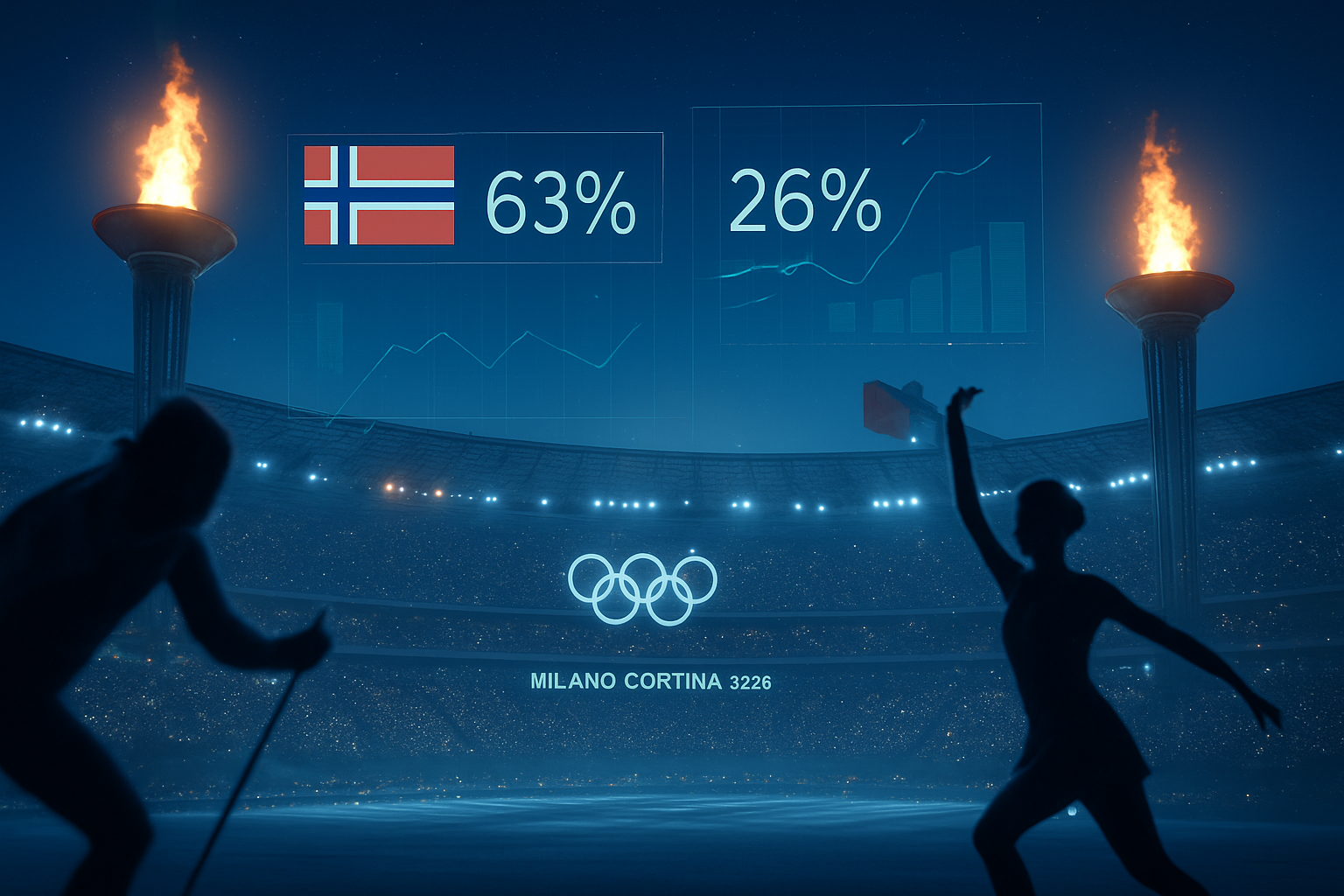
    As the ceremonial fires of the XXV Olympic Winter Games flicker in the dual host cities of Milan and Cortina d'Ampezzo, the world’s attention has shifted from the spectacle of the opening ceremony to the high-stakes reality of the podium. On the world’s leading prediction platform, Polymarket, a clear consensus has emerged: Norway is the overwhelming favorite to lead the 2026 Winter Olympics in total gold medals, commanding a 63% probability of victory.

    Team USA, currently sitting at 26% odds, trails significantly despite a roster packed with high-profile stars. The market reflects a deep-seated belief in Norwegian dominance in the "snow sports" that define the first half of the Games. With the first medals being awarded this weekend, the "Most Gold Medals" market is seeing its highest trading volume of the year, as speculators bet on whether American technical specialists can overcome the sheer depth of the Norwegian cross-country and biathlon machines.

    The Market: What's Being Predicted

    The primary market in focus is the "Most Gold Medals – 2026 Winter Olympics" contract on Polymarket. This "winner-take-all" market asks participants to predict which country will secure the highest number of gold medals by the closing ceremony on February 22, 2026. While the International Olympic Committee (IOC) does not officially recognize a "winning country," the gold medal count is the de facto scoreboard for international prestige.

    At the current 63% mark, shares for Norway are trading at roughly $0.63, while the United States sits at $0.26. Trailing behind are Germany at 9% and Canada at a distant 2%. The liquidity in this market has surged since the torch was lit at San Siro Stadium yesterday, with millions of dollars in volume already recorded. The market resolution is tied to the official final medal standings published by the IOC, meaning any late-stage disqualifications or administrative shifts could potentially affect the outcome, though the market typically settles shortly after the final event—usually the Men’s Ice Hockey final.

    Why Traders Are Betting

    The 63% confidence in Norway isn't just a hunch; it’s backed by a historical track record that bordering on the invincible. Norway set an all-time record at the 2022 Beijing Games with 16 gold medals, and traders believe they are poised to repeat or exceed that performance in Italy. Norway's strength is concentrated in disciplines with multiple medal opportunities: Biathlon and Cross-Country Skiing. With legends like Johannes Thingnes Bø and Johannes Høsflot Klæbo still at the peak of their powers, Norway has a high floor for gold medals that few other nations can match.

    Conversely, the 26% odds for the United States represent a "quality over quantity" gamble. American hopes are pinned on individual dominance in specialized events. Figure skater Ilia Malinin, known as the "God of the Quad," is a heavy favorite for gold, as is speed skater Jordan Stolz, who is eyeing a historic multi-medal haul. However, prediction market traders are skeptical that these individual brilliances can match the sheer volume of gold that Norway typically harvests from the biathlon trails.

    Recent activity on Polymarket suggests that "whales"—large-scale traders—are hedging their bets on the USA following the return of NHL players to the Men's Ice Hockey competition. The inclusion of professional stars has made the USA a co-favorite in hockey, a high-prestige gold that could be the tiebreaker in a close race.

    Broader Context and Implications

    This market highlights the evolving role of prediction markets in sports. Unlike traditional sportsbooks that offer odds on individual games, platforms like Polymarket provide a macro-view of national performance, effectively acting as a real-time sentiment gauge for the "soft power" race of the Olympics. This has significant implications for sponsors and broadcasters. Comcast Corporation (NASDAQ: CMCSA), the parent company of NBCUniversal, is airing over 3,000 hours of coverage, and their advertising rates are often influenced by the perceived success of the home team.

    Furthermore, the "Olympic Large Model" AI infrastructure provided by Alibaba Group Holding Limited (NYSE: BABA) is being used to track athlete performance more granularly than ever before. Traders are increasingly using these data points to find "value" in the market. Major sponsors like Nike, Inc. (NYSE: NKE), Visa Inc. (NYSE: V), and The Coca-Cola Company (NYSE: KO) also have a vested interest in these probabilities, as a "gold rush" for Team USA significantly boosts the marketing value of their sponsored athletes.

    From a regulatory standpoint, the 2026 Games represent a turning point. Prediction markets have faced scrutiny in the past, but their accuracy—often outperforming traditional sports analysts—is making them an indispensable tool for understanding the likely trajectory of global events.

    What to Watch Next

    The next 48 hours are critical for the market’s stability. If Norway sweeps the early Biathlon and Cross-Country events as expected, their odds could climb toward the 75-80% range, effectively pricing out most competitors. However, the Men’s Downhill in Alpine Skiing and the early rounds of the Snowboard Big Air events offer the USA an opportunity to "steal" golds that could narrow the gap.

    Key dates to watch include the Figure Skating finals in the second week and the Speed Skating events at the Fiera di Milano. If Jordan Stolz manages to capture three or more individual golds, the USA’s 26% odds will look like a massive bargain in hindsight. Conversely, if Norway’s "sliding" athletes perform well in the Bobsled and Luge events in Cortina—sports traditionally dominated by Germany—the race for the top spot could be over before the final weekend.

    Bottom Line

    The 2026 Winter Olympics gold medal race is currently Norway’s to lose. The 63% to 26% split on Polymarket reflects a market that respects Norway’s systemic advantages in high-medal-count winter disciplines. While Team USA possesses individual "superstars" capable of securing individual golds, they lack the broad-spectrum dominance across the snow disciplines that Norway has cultivated for decades.

    For prediction market enthusiasts, this market serves as a fascinating case study in "volume vs. volatility." Norway represents the steady, high-volume producer, while the USA represents the volatile, high-upside challenger. As the Games progress through the mountains of Northern Italy, every pole plant and skate stride will be reflected in the fluctuating cents of the Polymarket contract. For now, the "Frozen Gold" belongs to the Norsemen.


    This article is for informational purposes only and does not constitute financial or betting advice. Prediction market participation may be subject to legal restrictions in your jurisdiction.

    PredictStreet focuses on covering the latest developments in prediction markets.
    Visit the PredictStreet website at https://www.predictstreet.ai/.

  • Betting Against ‘Elon Time’: Prediction Markets Hedge on Musk’s 2026 Deadlines

    Betting Against ‘Elon Time’: Prediction Markets Hedge on Musk’s 2026 Deadlines

    As of February 7, 2026, the intersection of aerospace engineering, artificial intelligence, and retail speculation has found a permanent home in prediction markets. With the recent, earth-shaking announcement of a merger between SpaceX and xAI on February 2, traders are no longer just betting on individual rocket launches; they are wagering on the formation of a $1.25 trillion "techno-conglomerate." Yet, while Elon Musk’s long-term visions carry a significant "Musk Premium" in valuation markets, a battle-hardened class of traders is making a fortune by betting against his immediate deadlines—a phenomenon now formally tracked as the "Elon Time" discount.

    Currently, markets on Polymarket and Kalshi show a sharp divergence between belief and reality. While there is an 86% probability that SpaceX will achieve a valuation exceeding $1 trillion by the end of 2026, the odds of Musk meeting his self-imposed deadline for "Unsupervised" Full Self-Driving (FSD) by June have plummeted to 27%. This contrast highlights a growing sophistication among bettors: they believe in the man, but they don’t believe his calendar.

    The Market: What’s Being Predicted

    The "Musk Deadline" markets have become some of the most liquid contracts in the prediction market ecosystem. On Kalshi, a regulated U.S. exchange, and Polymarket, a decentralized global leader, three primary pillars of the "Musk-verse" dominate trading:

    1. SpaceX & Starship Milestones: Following the success of Flight 11 in late 2025, the market for Starship Flight Test 12 is currently at a 64% "Yes" for a successful landing or "catch" of the Super Heavy booster. Traders are also eyes-deep in the "2026 Mars Window" market. Despite Musk’s target of launching five uncrewed ships to Mars between November and December 2024, the market currently only gives a 7% chance to an intact landing on the Red Planet by year-end.
    2. Tesla (NASDAQ:TSLA) FSD and Robotaxis: Tesla markets have shifted from "When will FSD release?" to "When will the safety driver be removed?" Following a limited rollout of "Unsupervised FSD" in Austin late last year, the probability of a wider California launch by June 30, 2026, has dropped to 22%, as traders react to a slower-than-promised data ramp-up.
    3. The xAI-SpaceX Merger Synergy: A new "meta" market emerged this week regarding the SpaceX-xAI merger. Total Musk-related trading volume across all platforms exceeded $6.8 million in the first week of February alone, with millions more locked in speculative bets regarding the upcoming SpaceX IPO ticker (with $X currently leading at 64% odds).

    Why Traders Are Betting

    The driving force behind these markets is the "Elon Time" discount. Professional bettors have realized that Musk’s public statements often serve as "aspirational marketing" rather than "project management reality." Top traders on Polymarket have reportedly netted tens of thousands of dollars by consistently betting "No" on any Musk deadline that is less than six months away.

    However, this skepticism is balanced by the "Musk Premium." Long-term contracts—those looking out two to five years—tend to be aggressively bullish. This reflects a belief that Musk eventually overcomes technical hurdles, even if he is perpetually "two weeks" late. For example, while traders are skeptical of a 2026 Mars landing, they are almost certain (88% odds) that SpaceX will go public by December 31, 2026, reflecting deep confidence in the company’s underlying commercial viability.

    Recent news has further fueled this activity. The January announcement that Tesla would shift to a subscription-only FSD model by February 14, 2026, triggered a massive spike in volume for "FSD Revenue" prediction contracts. Whale activity has also been noted in "AGI by 2027" markets, which ticked up to 34% probability following the merger of Musk’s AI and aerospace interests.

    Broader Context and Implications

    The rise of Musk-deadline markets marks a shift in how the public consumes corporate news. Instead of relying on press releases or earnings calls from Tesla Inc. (NASDAQ:TSLA), many sophisticated observers now look to Kalshi and Polymarket as a more accurate "engineering truth." Prediction markets act as a real-time bullshit detector, aggregating the collective wisdom of thousands of engineers, data scientists, and industry insiders who "put their money where their mouth is."

    This trend has significant real-world implications. Regulatory bodies like the CFTC and SEC are increasingly monitoring these markets to gauge public sentiment and potential insider movements. The historical accuracy of these markets has been remarkably high; in 2025, prediction markets accurately "called" the delay of the Starship Flight 10 booster catch three weeks before SpaceX officially announced the schedule shift.

    Furthermore, these markets reveal a hardening of public sentiment. The "Musk Premium" suggests that while the billionaire’s brand may be polarizing, his perceived ability to execute on "impossible" engineering feats remains the bedrock of his companies' valuations.

    What to Watch Next

    The next 60 days will be a crucible for these markets. All eyes are on March 2026, the current target for Starship Flight 12. If the "Chopstick" arms of the launch tower successfully catch the Super Heavy booster again, we expect to see the "Mars 2026" landing odds double overnight, potentially jumping from 7% to 15-20%.

    Another key milestone is the "4/20" Grok release. xAI is rumored to be preparing Grok 4.20, a meme-coded update aimed at showcasing the integrated compute power of the new "Colossus" supercomputer cluster. Markets currently price this release at a 97% certainty. However, the more technically significant Grok 5—which Musk claims has a 10% chance of achieving AGI—is viewed with more skepticism, with only a 12% probability of a Q1 2026 release.

    Bottom Line

    The Elon Musk prediction markets of 2026 have evolved into a sophisticated financial instrument that separates "vision" from "execution." The data is clear: traders believe in the eventual arrival of a $1.2 trillion Musk-led future, but they are unwilling to trust the billionaire’s calendar. The 2026 "Elon Time" discount remains a profitable strategy for those betting against short-term deadlines, even as long-term bullishness keeps SpaceX IPO odds at record highs.

    Ultimately, these markets serve as a vital tool for price discovery in an era where corporate tweets can move billions of dollars. Whether it’s a rocket landing or a software update, the prediction market "tape" is proving to be a more reliable guide to the future than any social media post. As the SpaceX-xAI merger begins to take shape, the stakes—and the potential payouts—have never been higher.


    This article is for informational purposes only and does not constitute financial or betting advice. Prediction market participation may be subject to legal restrictions in your jurisdiction.

    PredictStreet focuses on covering the latest developments in prediction markets.
    Visit the PredictStreet website at https://www.predictstreet.ai/.

  • Geopolitical Risk Pricing: Iran Strike Odds Surge as Polymarket Volume Hits $188M Milestone

    Geopolitical Risk Pricing: Iran Strike Odds Surge as Polymarket Volume Hits $188M Milestone

    As of February 7, 2026, the intersection of high-stakes diplomacy and military posturing has turned the eyes of the world toward the Persian Gulf. Prediction markets are currently pricing in a significant probability of military conflict between the United States and Iran, with the flagship "U.S. strike on Iran" market on Polymarket seeing its cumulative volume surge to a staggering $188 million. This massive influx of capital comes as the USS Abraham Lincoln carrier strike group takes its position in the Gulf of Oman, creating a visual and strategic catalyst that has sent traders into a frenzy.

    Current odds reflect a complex geopolitical landscape: the probability of a U.S. strike by the mid-February deadline (February 13) stands at 31%, while the odds for a strike by the end of the month (February 28) have climbed to 44%. These figures represent a volatile "truth signal" that often moves faster than traditional news cycles, as participants bet millions on whether the current "maximum pressure" campaign will culminate in kinetic action or de-escalate through high-stakes diplomacy currently unfolding in Oman.

    The Market: What's Being Predicted

    The primary theater for this financial forecasting is Polymarket, a decentralized prediction platform that has dominated the geopolitical betting space throughout late 2025 and into early 2026. The specific contract, "U.S. strikes Iran by…?", has become a focal point for institutional hedgers and retail speculators alike. While Polymarket handles the bulk of the decentralized volume, Kalshi, a U.S.-regulated exchange, has captured over $87 million in volume for related contracts concerning Iranian leadership stability and domestic government shutdown risks, providing a regulated alternative for American participants.

    The resolution criteria for these markets are notoriously strict. For a "Yes" resolution on the February deadlines, the U.S. military must conduct a confirmed kinetic strike—ranging from drone strikes to manned aerial bombardments—within Iranian territory or territorial waters. As of early February, the liquidity in these markets is exceptionally high, with approximately $1 million in standing buy/sell orders, ensuring that even large "whale" trades do not cause irrational price swings without significant conviction.

    Why Traders Are Betting

    The current surge in volume is not occurring in a vacuum. Traders are heavily weighing the precedent set by "Operation Absolute Resolve" on January 3, 2026, which saw the surprise U.S. capture of Nicolás Maduro. This event signaled to the markets that the current administration is willing to authorize high-risk, high-reward operations. Furthermore, the memory of "Operation Midnight Hammer" in June 2025—a massive U.S.-Israeli strike on the Fordow nuclear facility—remains fresh, establishing a baseline expectation for military intervention if diplomatic red lines are crossed.

    Recent movements have also been influenced by the domestic political climate. A fatal Border Patrol shooting in late January led to a U.S. government shutdown on January 31, 2026. Initially, this caused "strike" odds to plummet, as traders assumed a distracted Washington would avoid foreign entanglements. However, the deployment of the USS Abraham Lincoln has reversed that trend. Notably, "Unusual Whales" recently flagged a massive $5 million "No" bet on the February 28 deadline, suggesting that some high-net-worth traders believe the naval buildup is a leverage play for the Oman nuclear talks rather than a precursor to immediate war.

    Broader Context and Implications

    The activity in these prediction markets is mirrored in the traditional equities market, particularly within what analysts are calling the "Security Supercycle." Shares of Lockheed Martin (NYSE: LMT) have surged nearly 28% year-to-date, trading near $628 as investors eye the company’s $194 billion backlog and the prominent role of the F-35 Lightning II in regional deployments. Similarly, Northrop Grumman (NYSE: NOC) has seen increased scrutiny as its B-21 Raider stealth bombers are viewed as the primary assets for any deep-strike mission into fortified Iranian airspace.

    This trend highlights a growing reliance on prediction markets as a more accurate gauge of sentiment than traditional polling or expert punditry. When millions of dollars are on the line, "noise" tends to be filtered out, leaving a raw probability that incorporates everything from troop movements to leaked diplomatic cables. The accuracy of these markets was recently vindicated in January, when "insider" betting patterns correctly predicted the Maduro ouster hours before it was officially announced, leading to increased regulatory scrutiny but also increased public trust in the markets' predictive power.

    What to Watch Next

    The immediate focus for traders is the outcome of the bilateral talks in Muscat, Oman, which began on February 6. If these talks show signs of stalling or if either side issues a formal walk-away statement, the 44% probability for a late-February strike could easily spike above 60%. Conversely, any joint statement regarding a "de-escalation framework" would likely cause the markets to "fade," rewarding the "No" bettors who have recently taken large positions.

    Key milestones to monitor include the February 13 deadline, which serves as a psychological "checkpoint" for the market. If this date passes without incident, attention will shift entirely to the February 28 deadline, which many see as the "breaking point" for the current diplomatic cycle. Beyond the military aspect, watch for movements in the United States Oil Fund (NYSEARCA: USO) and Brent crude futures, which are currently forecasting a $64/bbl floor but remain highly sensitive to "Strait of Hormuz closure" odds, currently sitting at 31%.

    Bottom Line

    The $188 million volume on Polymarket’s Iran contracts is a testament to the maturation of prediction markets as a vital tool for geopolitical risk assessment. By aggregating the collective intelligence of thousands of traders—and the heavy conviction of million-dollar "whales"—these platforms offer a real-time probability of conflict that traditional media simply cannot replicate.

    While the current odds of 44% for a strike by the end of February suggest a "coin-flip" scenario, the underlying data points to a period of unprecedented tension. Whether the USS Abraham Lincoln’s presence in the Gulf of Oman leads to a "kinetic event" or serves as the ultimate diplomatic bargaining chip, the prediction markets will likely be the first to know the outcome. For now, the "smart money" is split, but the massive volume indicates that the world is bracing for a definitive conclusion to this February standoff.


    This article is for informational purposes only and does not constitute financial or betting advice. Prediction market participation may be subject to legal restrictions in your jurisdiction.

    PredictStreet focuses on covering the latest developments in prediction markets.
    Visit the PredictStreet website at https://www.predictstreet.ai/.