
Tag: Polymarket

  • The Great State Divide: Prediction Markets Face a Legislative Reckoning

    The Great State Divide: Prediction Markets Face a Legislative Reckoning

    As of mid-January 2026, the meteoric rise of prediction markets has hit a significant jurisdictional wall. Despite record-breaking daily trading volumes exceeding $700 million, the industry is currently navigating a chaotic "checkerboard" of state-level regulation that threatens to fragment the market. While federal courts have largely cleared a path for political and event-based derivatives, state lawmakers and gambling regulators are fighting back, arguing that these platforms are essentially unlicensed sportsbooks masquerading as financial exchanges.

    The tension reached a boiling point this week with the reintroduction of the Oversight and Regulation of Activity for Contracts Linked to Events (ORACLE) Act in New York. The bill, which seeks to prohibit residents of the Empire State from wagering on everything from local elections to the outcome of military conflicts, represents the most aggressive legislative push against the industry to date. Traders are currently pricing in a high degree of uncertainty, with sentiment on platforms like Manifold showing an 81% confidence in federal preemption in some states, while others, like Nevada, have already successfully shuttered major exchange operations.

    The Market: What's Being Predicted

    The primary "market" currently occupying the minds of industry participants isn't just a single contract, but the legal survival of the industry in the United States' most lucrative jurisdictions. On Manifold and niche regulatory sub-markets on Polymarket, traders are aggressively betting on whether platforms like Kalshi and Interactive Brokers (NASDAQ:IBKR) will be forced to implement permanent "geofencing" to block users in New York, Nevada, and New Jersey.

    Currently, the focus is on two key legal fronts:

    • The New Jersey Preemption Fight: Traders are currently giving Kalshi an 81% probability of winning its lawsuit against New Jersey regulators. This optimism stems from a late-2025 preliminary injunction where a district court suggested that the federal Commodity Exchange Act (CEA) likely overrides state-level gambling laws for CFTC-regulated exchanges.
    • The Ninth Circuit Appeal: In Nevada, the outlook is bleaker. Following a November 2025 ruling by U.S. District Judge Andrew Gordon, which labeled Kalshi’s sports-related contracts as illegal gaming, the exchange has moved to the Ninth Circuit Court of Appeals. Analysts describe this as a "toss-up," with many expecting the court to uphold the state's right to regulate gambling within its borders.

    Trading volume in these regulatory-focused markets has surged, as institutional players look to hedge their exposure to the platforms themselves. Total monthly notional volume for the industry now regularly exceeds $2 billion, even as the threat of state-level bans looms.

    Why Traders Are Betting

    The surge in betting volume is driven by a fundamental disagreement between federal regulators and state gaming commissions. Following the CFTC's decision to drop its appeal against Kalshi in May 2025, the federal path for election and macro-economic markets seemed clear. However, state regulators—often pressured by the traditional gambling lobby—have pivoted to a different strategy: classifying event contracts as "sports wagering" or "contest of chance" under century-old state statutes.

    Pro-market traders point to the Unlawful Internet Gambling Enforcement Act (UIGEA) carve-out for CFTC-regulated exchanges as their primary defense. They argue that if a market is approved at the federal level as a financial derivative, states cannot legally block it. On the other side, figures like former New Jersey Governor Chris Christie, now an advisor to the American Gaming Association, argue that prediction markets are "cannibalizing" the regulated sports betting industry without paying the requisite taxes or adhering to consumer protection standards.

    This conflict has forced major players like Robinhood Markets, Inc. (NASDAQ:HOOD) and Crypto.com to play it safe, with both firms reportedly halting certain "high-risk" event contracts in states with active litigation. The volatility in these markets is no longer just about the outcome of the events themselves, but whether the trade will even be allowed to settle before a state attorney general intervenes.

    Broader Context and Implications

    The regulatory squeeze isn't limited to the United States. In early January 2026, the Ukrainian government officially blocked access to Polymarket via Resolution No. 695. While the official reason was a lack of a local gambling license, the move was largely driven by ethical concerns over "war-related bets." Polymarket had hosted high-liquidity markets predicting the specific dates of city occupations in the Donbas region, which Ukrainian officials characterized as "exploitative" and "detrimental to national morale."

    This international backlash highlights a growing rift in the prediction market philosophy:

    1. The Information-Efficacy School: Proponents argue that markets on war and catastrophe provide the most accurate, real-time data for intelligence and humanitarian efforts.
    2. The Social-Harm School: Regulators argue that profiting from tragedy is inherently "contrary to the public interest," a clause the CFTC has historically used to try and block markets.

    In New York, the ORACLE Act takes the social-harm argument to the extreme, proposing a total ban on markets related to death, terrorism, and "catastrophic events." If passed, it would set a precedent that could see the prediction market industry split into two: a "clean" market for economic data and a "gray" market for everything else.

    What to Watch Next

    The coming weeks will be pivotal for the industry's legal standing. The first major milestone is the decision by the New York Senate Racing, Gaming & Wagering Committee on whether to advance the ORACLE Act. Industry eyes are on Senator Joseph Addabbo Jr., whose support or opposition could determine the bill's fate. If the bill reaches the floor, expect a massive lobbying push from both the "Big Three" exchanges and the traditional gaming industry.

    Secondly, the Ninth Circuit's decision on Kalshi’s emergency stay in Nevada is expected by late February 2026. A loss there would likely trigger a wave of similar cease-and-desist orders from other states, potentially forcing platforms to adopt a "state-by-state" licensing model similar to DraftKings or FanDuel.

    Finally, the industry is watching for any movement toward the U.S. Supreme Court. With conflicting rulings now emerging from different federal circuits regarding state preemption, many legal experts believe a final resolution won't be reached until 2027, leaving the market in a state of high-stakes limbo until then.

    Bottom Line

    The current regulatory landscape for prediction markets is a classic battle of "the new world vs. the old." While the technology has proven its ability to aggregate information more efficiently than traditional polling or expert analysis, it has run headlong into the complex web of American federalism and the entrenched interests of the $100 billion gambling industry.

    The ORACLE Act and the blocks in Ukraine suggest that "unregulated" prediction markets may be a thing of the past. The future likely belongs to platforms that can successfully navigate the transition from "disruptive startup" to "regulated financial utility." For traders, the "alpha" in 2026 isn't just in predicting the next Fed rate cut or election result—it’s in predicting which states will let them keep their winnings.


    This article is for informational purposes only and does not constitute financial or betting advice. Prediction market participation may be subject to legal restrictions in your jurisdiction.

    PredictStreet focuses on covering the latest developments in prediction markets. Visit the PredictStreet website at https://www.predictstreet.ai/.


  • The Accuracy Paradox: New Vanderbilt Study Shines a Light on the Reliability of Prediction Markets

    The Accuracy Paradox: New Vanderbilt Study Shines a Light on the Reliability of Prediction Markets

    The long-debated question of whether massive trading volume leads to superior forecasting accuracy has finally been answered with a treasure trove of data. A groundbreaking study from Vanderbilt University, titled "Prediction Markets? The Accuracy and Efficiency of $2.4 Billion in the 2024 Presidential Election," has sent shockwaves through the financial and political communities. The study analyzed over 2,500 individual prediction markets to determine which platform truly provides the most reliable signal amidst the noise of a high-stakes election cycle.

    The findings have upended the conventional wisdom that the highest liquidity produces the "truth." While the decentralized giant Polymarket dominated headlines and volume, the study revealed a significant performance gap: PredictIt led the pack with a staggering 93% accuracy rate in its contracts, while Polymarket lagged behind at just 67%. As of January 14, 2026, these results are forcing institutional investors and political strategists to rethink how they use these platforms as forecasting tools in an increasingly volatile global landscape.

    The Market: What's Being Predicted

    The Vanderbilt study, led by Professor Joshua D. Clinton and PhD student TzuFeng Huang, represents the most comprehensive post-mortem of the 2024 election cycle’s prediction market performance. Researchers tracked every available political contract across four major platforms: PredictIt, Polymarket, Kalshi, and the Iowa Electronic Markets (IEM). By analyzing the implied probabilities against actual outcomes, the study sought to determine if "the wisdom of the crowd" was actually wise or merely loud.

    PredictIt emerged as the gold standard for accuracy. Despite its historically smaller footprint and regulatory constraints, it correctly predicted the outcome of 93% of the analyzed markets. Kalshi, which has rapidly expanded its presence through data-sharing partnerships with major media outlets like CNBC (Nasdaq: CMCSA) and CNN (Nasdaq: WBD), followed with a respectable 78% accuracy rate. Polymarket, the crypto-native platform that processed billions in volume, fell to the bottom with a 67% accuracy rate across its thousands of niche and down-ballot contracts.

    The disparity is particularly striking when considering the volume. Polymarket was the undisputed "whale" of the 2024 cycle, handling over $2 billion in trades. However, the study suggests that this massive liquidity often acted as a double-edged sword, attracting speculative "noise" and irrational herd behavior that distorted the true odds of many electoral outcomes.

    Why Traders Are Betting

    The research highlights a fundamental tension in prediction markets: the difference between "sober" analysis and "speculative" momentum. PredictIt’s success is attributed in part to its unique structure. For years, the platform operated under a $850 cap on individual bets (a limit that has since been increased to $3,500 following its 2025 settlement with the CFTC). This cap discouraged the massive, market-moving "whale" positions seen on Polymarket, instead favoring a larger number of smaller, more deliberate participants who were often deeply informed about specific local or niche races.

    In contrast, Polymarket’s lack of betting limits allowed for significant price manipulation and "irrational movements." The Vanderbilt study noted instances where mutually exclusive outcomes—such as the probability of a Republican sweep versus a Democratic sweep—moved in the same direction simultaneously. This suggests that many traders were not processing information rationally but were instead reacting to social media trends or platform-wide sentiment.

    Current market dynamics in early 2026 reflect these findings. On January 12, 2026, the industry hit a historic daily trading volume of $701.7 million, with Kalshi commanding a 66.4% market share. Traders are increasingly flocking to regulated platforms like Kalshi and PredictIt, seeking the "cleaner" data that comes from oversight and internal controls against insider trading.

    Broader Context and Implications

    The Vanderbilt study arrives at a critical juncture for the industry. Just last week, Polymarket was embroiled in a major controversy over its resolution of a contract regarding a U.S. mission in Venezuela. When U.S. forces captured Nicolás Maduro, Polymarket initially hesitated to pay out "Yes" bets, sparking accusations of arbitrariness in its role as an "arbiter of truth." This incident, combined with the Vanderbilt findings, has fueled a narrative that decentralized, high-volume markets may be more prone to systemic failure than their regulated counterparts.

    Furthermore, the study's revelation about the lack of "market efficiency" has drawn the eye of federal and state regulators. The researchers found that arbitrage opportunities—the ability to profit by betting on both sides of an event across different platforms—actually peaked in the final weeks of the 2024 campaign. This indicates that information was not being synthesized across the ecosystem, a hallmark of an immature or inefficient market.

    In response, New York lawmakers and federal regulators are currently drafting the "Public Integrity in Financial Prediction Markets Act of 2026." This legislation aims to formalize rules against insider trading, especially as more government officials and corporate insiders are suspected of using these markets to hedge against or profit from non-public information.

    What to Watch Next

    As we move deeper into 2026, the focus will shift to how these platforms adapt to the "accuracy over volume" mandate. PredictIt, now operating as a fully regulated CFTC exchange and clearinghouse as of September 2025, has removed its 5,000-trader cap while raising wager limits to $3,500. This expansion will test whether the platform can maintain its 93% accuracy rate as its liquidity begins to rival that of its larger competitors.

    Kalshi, meanwhile, is fighting a series of "preemption battles" in state courts. Just yesterday, on January 13, 2026, a U.S. District Judge in Tennessee granted Kalshi a Temporary Restraining Order against the Tennessee Sports Wagering Council. The outcome of these state-level legal battles will determine whether prediction markets can legally offer "event contracts" that overlap with traditional sports betting, a move that could potentially triple the industry's total addressable market by the end of the year.

    Investors should also watch for the integration of prediction market data into the broader financial ecosystem. Tech giants like Meta Platforms, Inc. (Nasdaq: META) and Amazon.com, Inc. (Nasdaq: AMZN) are reportedly exploring the use of internal prediction markets to guide project timelines and product launches, further validating the technology as a corporate forecasting tool.

    Bottom Line

    The Vanderbilt study serves as a definitive debunking of the "liquidity equals accuracy" myth. While Polymarket succeeded in creating a global macro-indicator and a massive speculative venue, it was PredictIt’s more constrained, sober environment that consistently provided the more accurate forecast. For those using prediction markets as a "crystal ball" for future events, the message is clear: the most expensive market is not always the most correct.

    As we look toward the 2026 midterms and beyond, the industry is maturing. The transition of PredictIt into a fully regulated powerhouse and Kalshi’s dominance in the regulated daily volume space suggest a future where transparency and oversight are the primary drivers of market trust. Prediction markets remain a powerful tool for aggregating information, but as the Vanderbilt researchers have proven, the quality of the crowd matters just as much as its size.


    This article is for informational purposes only and does not constitute financial or betting advice. Prediction market participation may be subject to legal restrictions in your jurisdiction.

    PredictStreet focuses on covering the latest developments in prediction markets.
    Visit the PredictStreet website at https://www.predictstreet.ai/.
  • Market Odds Surging: Why Traders Are Betting Heavily on the End of the Khamenei Era

    Market Odds Surging: Why Traders Are Betting Heavily on the End of the Khamenei Era

    As of January 14, 2026, prediction markets are flashing a signal that would have been unthinkable just two years ago: a supermajority of traders believe the era of Ayatollah Ali Khamenei is coming to an end. On the decentralized platform Polymarket, the contract for Khamenei to exit office by the end of 2026 has climbed to a 65% probability, while the regulated U.S. exchange Kalshi shows an even more aggressive 66% chance.

    This surge in "Yes" bets is not merely speculative noise; it is backed by tens of millions of dollars in trading volume and a convergence of geopolitical crises that have brought the Islamic Republic to its most precarious position since the 1979 Revolution. Following a devastating regional conflict in mid-2025 and a subsequent domestic economic meltdown, the market is no longer asking if the 86-year-old Supreme Leader will depart, but rather how and how soon.

    The Market: What’s Being Predicted

    The "Khamenei Exit" market has become one of the most liquid political contracts in the world. On Polymarket, the primary contract resolves to "Yes" if Khamenei ceases to be the Supreme Leader for any reason—including death, resignation, or formal removal—by midnight on December 31, 2026. This market alone has seen over $10 million in aggregate volume, driven by high-stakes traders who treat the contract as a hedge against regional instability.

    Meanwhile, Kalshi has introduced a "World Leaders" series that includes more granular timelines. While their year-end 2026 contract sits at 66%, their shorter-term market for an exit before July 2026 is already trading at 56%. One key distinction for traders to watch is Kalshi’s resolution criteria, which often requires official confirmation of a "resignation, removal, or termination." In cases of death, some specialized contracts on these platforms trigger specific payout structures, making the distinction between a peaceful succession and a sudden power vacuum a critical variable for bettors.

    Succession markets are also heating up. Traders are currently pricing in a 53–56% chance that the position of Supreme Leader might be abolished entirely in favor of a governing council or a total regime shift, while Mojtaba Khamenei remains the individual frontrunner for succession with 18–20% odds.

    Why Traders Are Betting

    The 65% probability is the direct result of a "perfect storm" of events that occurred throughout 2025. The most significant was the "12-Day War" in June 2025, a high-intensity conflict involving massive preemptive strikes by Israel on Iranian nuclear and military infrastructure. This conflict decimated the leadership of the Islamic Revolutionary Guard Corps (IRGC) and significantly weakened the regime’s "Axis of Resistance."

    Defense contractors like RTX Corporation (NYSE: RTX) and Lockheed Martin (NYSE: LMT) saw significant stock volatility during this period as regional defense needs shifted, but for prediction market traders, the war’s primary takeaway was the apparent fragility of Iranian command and control. Reports from opposition outlets in late 2025 suggested that Khamenei suffered a physical or nervous breakdown during the strikes, leading to long periods of public absence.

    Domestically, the situation is even more dire. By January 2026, the Iranian rial has collapsed to a staggering 1.4 million to $1 USD, triggering the "Bazaar Revolts"—a series of protests in over 180 cities where even traditional merchant classes have turned against the clerical establishment. The market is pricing in the high likelihood that the security forces may soon find it impossible to maintain order without a significant change at the top.

    Broader Context and Implications

    The pricing of these markets reflects a broader trend in the prediction market industry: the move toward "regime risk" forecasting. Unlike traditional polling, which is nearly impossible to conduct accurately in authoritarian states, prediction markets aggregate "boots-on-the-ground" intelligence, capital flows, and geopolitical analysis. The current 65% odds suggest a consensus among sophisticated actors that the status quo is unsustainable.

    The real-world implications of a Khamenei exit would be seismic for global energy markets. Companies like ExxonMobil (NYSE: XOM) and other global energy giants are closely monitoring these odds, as a regime change or a civil war in Iran could lead to significant fluctuations in the price of Brent crude. Historically, prediction markets have been remarkably prescient in forecasting "black swan" leadership changes, often moving weeks ahead of mainstream media reports as insiders and analysts begin to move capital.

    From a regulatory standpoint, the high volume on these markets has drawn scrutiny. However, for many users, these platforms provide a unique form of "geopolitical insurance." If the regime in Tehran were to collapse, the resulting regional instability could be hedged by holding a "Yes" position on the Supreme Leader’s exit.

    What to Watch Next

    As we move deeper into 2026, several key milestones will likely move the needle. The first is the Assembly of Experts meetings scheduled for the spring. This 88-member body is legally responsible for choosing the next leader, and rumors of secret committees finalizing a successor could cause sudden price spikes in "Exit" contracts.

    Secondly, Khamenei’s 87th birthday in April 2026 will be a focal point for health rumors. Any failure to appear for traditional televised addresses during the spring holidays would likely push the exit probability toward the 80% mark. Conversely, if the regime manages to secure new credit lines or stabilize the rial, we could see a "buy the dip" opportunity for "No" bettors who believe the regime can survive through sheer repression.

    Finally, the international community is watching for a "Plan B" scenario. Intelligence leaks in early 2026 have hinted at contingency plans for top leadership to seek asylum in Moscow should the domestic protests reach a tipping point. Any confirmation of such preparations would likely send "Yes" shares to near-certainty levels.

    Bottom Line

    The 65% odds on Ayatollah Khamenei exiting office by the end of 2026 signal a world in transition. Prediction markets are currently signaling that the combination of 86-year-old leadership, a shattered economy, and a humiliated military has created a terminal environment for the current administration.

    While the Islamic Republic has proven resilient in the past, the current data suggests that the "succession crisis" sparked by the 2024 death of President Ebrahim Raisi was never truly resolved. For traders and geopolitical observers alike, these markets provide the most honest, capital-weighted assessment of a nation on the brink. Whether through a managed transition or a chaotic collapse, the smart money is betting that the Iranian landscape will look very different by 2027.


    This article is for informational purposes only and does not constitute financial or betting advice. Prediction market participation may be subject to legal restrictions in your jurisdiction.

    PredictStreet focuses on covering the latest developments in prediction markets.
    Visit the PredictStreet website at https://www.predictstreet.ai/.
  • The $400,000 “Shadow Bet”: How a Timely Wager on Maduro’s Downfall Ignited an Insider Trading Firestorm

    The $400,000 “Shadow Bet”: How a Timely Wager on Maduro’s Downfall Ignited an Insider Trading Firestorm

    On January 3, 2026, as U.S. Special Forces launched "Operation Absolute Resolve" to apprehend Venezuelan President Nicolás Maduro, the world watched in shock. But on the decentralized prediction platform Polymarket, the shock had already been priced in. Just hours before the first Delta Force boots hit the ground in Caracas, an anonymous user liquidated a massive position, turning a $34,000 wager into a staggering $436,000 windfall. The "impeccable" timing of the trade, executed while the market gave Maduro’s removal a mere 6% probability, has sent shockwaves through the prediction market industry and caught the eye of federal investigators.

    Today, January 14, 2026, the fallout has reached a boiling point. As the U.S. Senate demands an immediate investigation into the payout, the incident has become a lightning rod for critics who argue that prediction markets are becoming high-stakes playgrounds for individuals with access to classified military and diplomatic intelligence. With a $400,000 payout now at the center of a geopolitical scandal, the question is no longer whether prediction markets can forecast the future, but whether they are being used to profit from its secrets.

    The Market: What's Being Predicted

    The controversy centers on a specific contract hosted on Polymarket: "Will Nicolás Maduro be out of power by January 31, 2026?" For much of late 2025, this market was a sleepy corner of the platform, with shares trading at roughly 7 cents (representing a 7% probability). Most geopolitical analysts viewed Maduro’s grip on power as firm, despite ongoing sanctions and internal unrest. However, the liquidity in this market spiked dramatically in the final 48 hours of December 2025, as a newly created account under the handle "Burdensome-Mix" began aggressively buying "Yes" shares.

    While Polymarket operated as the primary hub for this speculative activity, the regulated U.S. exchange Kalshi also hosted a similar market (Series: KXMADUROOUT). On Kalshi, the odds remained relatively stable until the early morning hours of January 3, when prices began to surge just ahead of the official 4:21 a.m. ET announcement from the White House. The discrepancy between the two platforms has highlighted the differences in oversight; Kalshi operates under the watchful eye of the Commodity Futures Trading Commission (CFTC), while Polymarket’s decentralized nature has historically made it more difficult to police for "informed" trading.

    The resolution of the market was not without its own drama. While the "Ouster" contract was settled quickly following Maduro’s appearance in a Manhattan federal court on January 5, a secondary market regarding a potential "U.S. Invasion" of Venezuela became mired in a bitter dispute. Polymarket initially refused to pay out "Yes" bettors for the invasion contract, arguing that a targeted special forces raid did not constitute a full-scale territorial invasion—a technicality that left many retail traders furious and further muddied the platform's reputation.

    Why Traders Are Betting

    The primary driver behind the sudden market movement was not public sentiment, but rather a suspected leak of "material non-public information." Before the raid, traditional forecasting methods—including intelligence briefs from major consultancies and public diplomatic channels—showed no indication that a military strike was imminent. In fact, most experts believed the U.S. was pursuing a policy of containment rather than direct intervention.

    The "Burdensome-Mix" account represents what many in the industry call "whale activity," but with a darker undertone. By investing approximately $34,000 into a high-risk contract that the broader public deemed a "long shot," the user demonstrated a level of confidence that suggests access to the Pentagon’s operational timeline for Operation Absolute Resolve. This has led to a comparison between prediction markets and traditional equity markets; when Maduro was captured, defense giants like Lockheed Martin (NYSE: LMT) and Northrop Grumman (NYSE: NOC) saw immediate stock rallies of 8% and 2.7% respectively, but those moves happened after the news broke. The Polymarket trade, by contrast, happened before.

    Traders on these platforms are often a mix of hobbyist geeks and professional arbitrageurs. However, the Maduro payout has highlighted a third category: the "insider trader." While traditional forecasting focuses on aggregated public data, this event suggests that prediction markets are increasingly being used as a way to "monetize" secrets. The surge in gold prices to over $4,300 per ounce and the rally of energy companies like Valero (NYSE: VLO) and Phillips 66 (PSX) further confirm that the markets were reacting to the raid, but only the prediction markets seemed to have a "tell" in the hours preceding the mission.

    Broader Context and Implications

    The "Maduro Bet" is being viewed as a watershed moment for the regulation of prediction markets. It has exposed a significant "insider information" loophole that current laws are ill-equipped to handle. In response, Congressman Ritchie Torres (D-NY) has introduced the Public Integrity in Financial Prediction Markets Act, which would specifically ban federal officials, political appointees, and military personnel from wagering on outcomes they may have a hand in shaping.

    This event also reveals a paradoxical truth about prediction markets: their greatest strength—their ability to incorporate "all available information"—is also their greatest regulatory liability. If a market is "accurate" because it contains leaked classified data, it loses its status as a public sentiment tool and becomes a national security risk. The CFTC, led by Chair Michael Selig, is now under immense pressure from a bipartisan group of 12 U.S. Senators to determine if Polymarket’s security protocols are sufficient to prevent such manipulation.

    Historically, prediction markets have been praised for their accuracy in elections and corporate mergers. However, the intersection of these markets with kinetic military operations like Operation Absolute Resolve creates a new ethical frontier. If speculators can profit from the movement of troops, the incentive to leak or even influence military strategy increases exponentially. This has led to renewed calls for platforms to adopt the same rigorous anti-manipulation standards as the NYSE or Nasdaq.

    What to Watch Next

    In the coming weeks, all eyes will be on the Department of Justice and the CFTC as they attempt to unmask the owner of the "Burdensome-Mix" account. If the trail leads back to a government or military official, it could lead to the first major criminal prosecution for "prediction market insider trading." This would set a legal precedent that could redefine how these platforms operate globally.

    Furthermore, the "Invasion" versus "Ouster" dispute on Polymarket is expected to go to a formal arbitration or a community vote. The outcome of this dispute will be a major test for the decentralized governance models that many of these platforms use. If the platform is seen as "moving the goalposts" to avoid a large payout, it could lead to a mass exodus of liquidity toward more regulated competitors like Kalshi or ForecastEx.

    Finally, keep a close watch on the legislative progress of the Torres bill. If passed, it would represent the most significant expansion of financial oversight in the prediction market space since the Dodd-Frank Act. The defense sector will also remain volatile; as data analytics firms like Palantir (NASDAQ: PLTR) and hardware providers like Raytheon (NYSE: RTX) and General Dynamics (NYSE: GD) report their quarterly earnings, analysts will be looking for clues as to how much "pattern of life" intelligence was used in the Venezuelan operation—and whether any of that data could have been the source of the Polymarket leak.

    Bottom Line

    The $400,000 Maduro payout is a "smoke alarm" for the prediction market industry. While the capture of a high-profile target like Nicolás Maduro is a significant military achievement for the U.S., the corresponding activity on Polymarket suggests that the "wisdom of the crowd" may sometimes just be the "knowledge of the few." The event has proved that these markets are no longer just a niche interest; they are sensitive instruments that can reflect—and perhaps even compromise—the most sensitive geopolitical operations.

    As a tool, prediction markets remain incredibly powerful, offering a real-time gauge of probability that traditional polls and news outlets cannot match. However, without the guardrails of transparency and strict anti-insider trading enforcement, they risk becoming a tool for corruption rather than a source of truth. The Maduro scandal will likely be the catalyst that finally brings these platforms into the mainstream regulatory fold.

    Ultimately, the capture of Maduro has changed the map of South American politics, but the $400,000 bet may have changed the landscape of global finance forever. Whether this leads to a more transparent era of forecasting or the eventual shutdown of unregulated platforms remains the most important prediction of all.


    This article is for informational purposes only and does not constitute financial or betting advice. Prediction market participation may be subject to legal restrictions in your jurisdiction.

    PredictStreet focuses on covering the latest developments in prediction markets.
    Visit the PredictStreet website at https://www.predictstreet.ai/.
  • Prediction Markets Break Records: $700 Million Day Marks New Era as Kalshi Dominates

    Prediction Markets Break Records: $700 Million Day Marks New Era as Kalshi Dominates

    The prediction market industry reached a historic milestone on January 12, 2026, as total daily trading volume across major platforms surged to a staggering $701.7 million. This record-breaking figure represents the highest single-day turnover in the history of the sector, signaling the definitive arrival of event-based trading as a cornerstone of modern finance. At the heart of this surge was Kalshi, which commanded a massive 66.4% of the market share, processing approximately $466 million in trades within a single 24-hour window.

    The explosion in volume comes as traders increasingly pivot away from traditional sentiment indicators and toward the high-stakes "truth engine" of the prediction markets. The flurry of activity on January 12 was driven by a confluence of high-impact events, including critical macroeconomic data releases and early-cycle positioning for the 2026 U.S. Midterm elections. For an industry that was once relegated to the fringes of the crypto world, this $700 million day serves as a powerful validation of its growing utility and liquidity.

    The Market: What’s Being Predicted

    The record-breaking volume of $701.7 million was distributed across a handful of key players, with Kalshi leading the pack by a wide margin. Following behind were Polymarket and the rapidly ascending Opinion Labs (operating as Opinion.trade). While sports and pop culture remain popular, the bulk of the record day’s volume was concentrated in "hard" markets: Federal Reserve interest rate decisions, quarterly GDP prints, and the first major polls of the 2026 election cycle.

    The liquidity on these platforms has reached a point where institutional-sized positions can be entered and exited with minimal slippage. On Kalshi, the "Will the Fed cut rates in March?" contract saw over $120 million in volume alone, with odds fluctuating wildly as new labor data hit the wires. These contracts are legally structured as derivatives, providing a regulated framework that has attracted a new class of professional arbitrageurs and hedge funds.

    Resolution criteria for these markets remain strictly objective. Most high-volume contracts on Kalshi and Opinion rely on government data or verified SEC filings to determine outcomes. This transparency has been critical in building trust among retail investors, many of whom have moved their speculative capital from volatile memecoins to the more "knowable" outcomes of the prediction markets.

    Why Traders Are Betting

    The momentum leading into the January 12 record was built throughout a transformative 2025. Last year, Kalshi secured its position as the market leader through a series of strategic integrations, most notably with Robinhood Markets, Inc. (NASDAQ: HOOD). This partnership allowed millions of retail traders to access event contracts directly from their primary brokerage accounts, effectively democratizing access to "skin in the game" forecasting.

    Furthermore, the legal landscape shifted dramatically in favor of the industry. Following Kalshi's landmark legal victories against the CFTC in 2024 and 2025, the uncertainty surrounding the legality of election and macro-event trading evaporated. This clarity encouraged massive "whale" activity; on January 12, several eight-figure positions were spotted in the 2026 Congressional control markets, as traders sought to hedge against potential policy shifts.

    Traditional forecasting methods, such as political polling and analyst reports, have also seen their influence wane in favor of these markets. Traders are increasingly betting that the financial incentives of a prediction market produce more accurate "signals" than a standard poll. This "wisdom of the crowd" was on full display as the markets correctly anticipated a series of hawkish comments from central bank officials hours before they were delivered, a move that contributed to the day's record-breaking volatility.

    Broader Context and Implications

    The January 12 surge is part of a broader trend that saw global prediction market volume grow from $9 billion in 2024 to over $44 billion by the end of 2025. This rapid scaling has drawn the attention of traditional financial giants. Intercontinental Exchange (NYSE: ICE), the parent company of the New York Stock Exchange, recently made a significant investment in the infrastructure powering these platforms, recognizing that event contracts are becoming a legitimate asset class.

    However, the rise of these markets has not been without controversy. While federal regulators have largely stepped back, state-level opposition is growing. In late 2025, New York introduced the ORACLE Act, a legislative attempt to curb sports and political betting on prediction platforms. Traders are watching these developments closely, as a potential Supreme Court case looms that could decide whether these markets are federally protected derivatives or state-regulated gambling.

    Historically, prediction markets have proven remarkably accurate, often outperforming professional pundits during the 2024 election and subsequent economic pivots. This track record has transformed them into a vital tool for corporate risk management. Companies now use these markets to hedge against specific regulatory outcomes or geopolitical shifts, treating a "No" vote on a specific piece of legislation with the same financial seriousness as a currency hedge.

    What to Watch Next

    As the industry digests the $701.7 million milestone, all eyes are on the upcoming 2026 Midterm election cycle. Analysts project that if current trends hold, single-day volumes could exceed $1 billion by November. The entry of CME Group Inc. (NASDAQ: CME) and Interactive Brokers Group, Inc. (NASDAQ: IBKR) into the event contract space is expected to further institutionalize the market, bringing even more liquidity to high-stakes contracts.

    Key dates to monitor include the upcoming February inflation report and the formal launch of several new "Opinion" markets focused on emerging technology milestones, such as AI safety certifications. These "tech-native" markets are expected to attract a younger demographic of traders who are more interested in the future of Silicon Valley than the halls of Washington.

    The evolution of the "Opinion" platform will also be a major narrative in 2026. By focusing on real-economy indicators and using AI-powered oracles for resolution, Opinion Labs is positioning itself as a high-tech alternative to the more established players. Whether it can continue to eat into Kalshi’s 66% market share remains the biggest question for the year ahead.

    Bottom Line

    The $701.7 million day of January 12, 2026, is more than just a statistical anomaly; it is a signal that prediction markets have reached a state of maturity. Kalshi’s dominant 66.4% share highlights the value that traders place on a regulated, liquid, and user-friendly interface. With the backing of major financial institutions and a growing track record of accuracy, these platforms are no longer just for "betting"—they are for "knowing."

    As we move deeper into 2026, the intersection of finance, data, and public sentiment will only become more integrated. Prediction markets provide a unique window into the collective mind of the global investor, offering a real-time, financially-backed truth that traditional media and polls simply cannot match. For those looking to understand where the world is headed, the odds on the board are now as important as the news on the screen.


    This article is for informational purposes only and does not constitute financial or betting advice. Prediction market participation may be subject to legal restrictions in your jurisdiction.

    PredictStreet focuses on covering the latest developments in prediction markets.
    Visit the PredictStreet website at https://www.predictstreet.ai/.
  • The Ultimate Tail-Risk Hedge: Why Traders Are Betting Millions on the ‘Second Coming’ of Jesus

    The Ultimate Tail-Risk Hedge: Why Traders Are Betting Millions on the ‘Second Coming’ of Jesus

    As the clock struck midnight on January 1, 2026, a niche but high-volume corner of the prediction markets quietly resolved. The contract "Will Jesus Christ return in 2025?" on the decentralized platform Polymarket closed with a definitive "No," providing a modest 5.5% annualized return for the skeptics who had treated the "No" shares as a high-yield savings account. Within hours, a successor contract was born: "Will Jesus Christ return before 2027?"

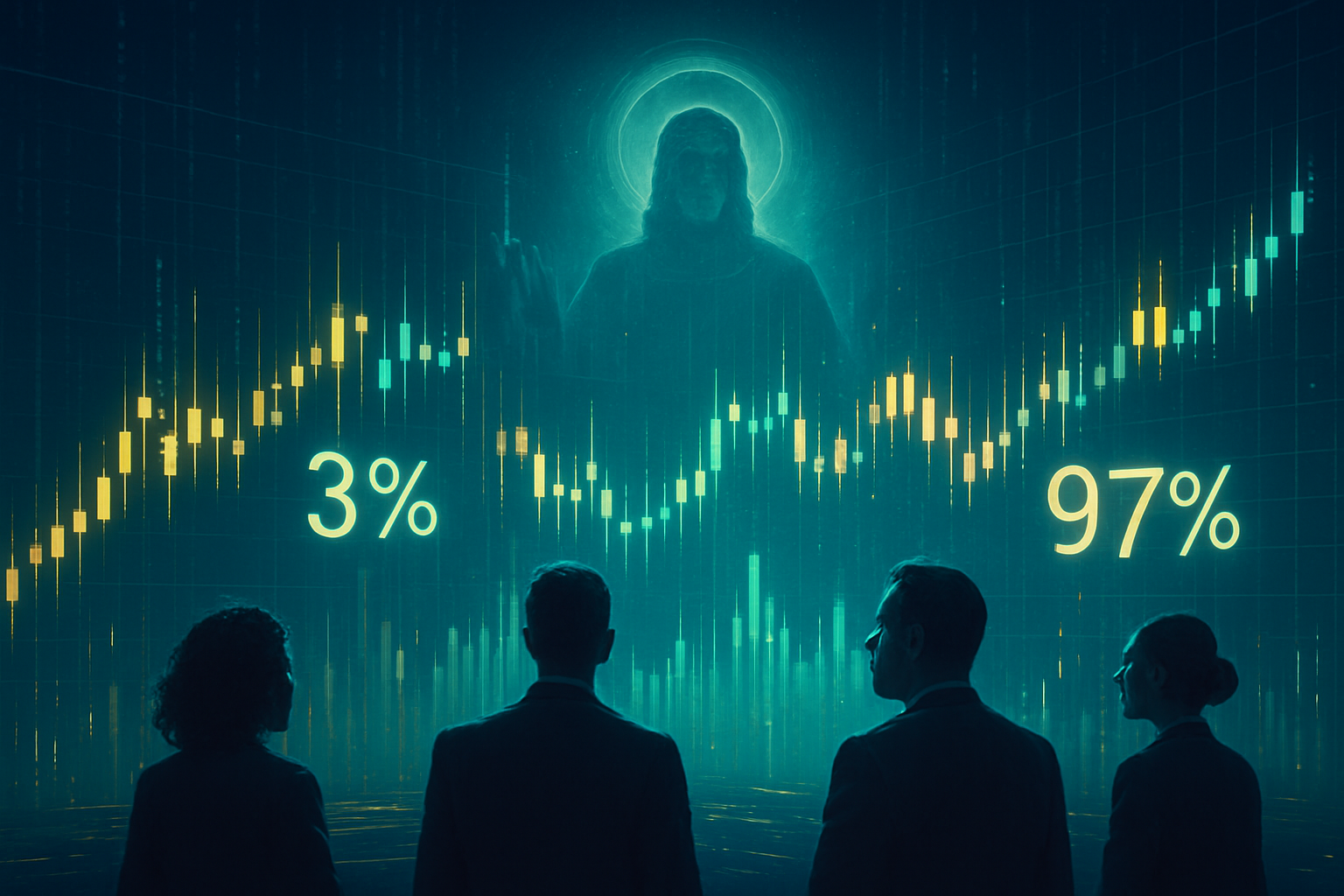
    Despite the theological and scientific impossibility perceived by many, this market is currently trading at a 3% probability. While that may seem negligible, the contract has already attracted hundreds of thousands of dollars in liquidity in the first two weeks of 2026. This trend highlights a growing fascination with "elusive" or "impossible" contracts—markets that predict events so world-altering that their resolution would arguably make the payout irrelevant. From extraterrestrial disclosure to the total eradication of cancer, these markets are no longer just memes; they are becoming significant financial indicators of public sentiment and tail-risk appetite.

    The Market: What's Being Predicted

    The primary market for the "Second Coming" is hosted on Polymarket, a decentralized prediction platform that has surged in popularity alongside the mainstreaming of crypto-based forecasting. As of January 13, 2026, "Yes" shares are priced at $0.03, while "No" shares sit at $0.97. This pricing indicates that the market views the event as a 33-to-1 long shot for the current calendar year.

    The resolution criteria for such a metaphysical event are surprisingly grounded. According to the contract details, the market resolves to "Yes" only if there is a "consensus of credible global news sources" confirming the event. The contract specifically cites organizations such as the Associated Press, Reuters (London Stock Exchange: LSEG), and The New York Times Company (NYSE: NYT) as primary arbiters. Furthermore, a definitive statement from major international bodies like the United Nations or the Vatican would trigger a "Yes" resolution.

    If no such consensus is reached by 11:59 PM ET on December 31, 2026, the market automatically resolves to "No." This binary clarity has turned the contract into a unique financial instrument, with total volume across the 2025 and 2026 iterations exceeding $3.5 million.

    Why Traders Are Betting

    The motivations behind these bets are as varied as the traders themselves. For many institutional and high-net-worth individuals, the "No" side of the Jesus market functions as a "yield play." By purchasing "No" shares at $0.97, a trader is essentially locking in a 3% return over twelve months. In an era where traditional bond yields from entities like the U.S. Treasury may fluctuate, a 3% "guaranteed" return—predicated on the non-occurrence of an apocalyptic event—is seen by some as an attractive alternative to traditional cash management.

    On the other side of the trade, "Yes" bettors are often driven by a mix of religious conviction, "black swan" hedging, and pure speculation. Buying "Yes" shares at 3 cents offers a 3,333% return if the event occurs. While some critics point out that the global financial system would likely collapse upon such an event—making the payout impossible to collect—believers and tail-risk enthusiasts argue that the "Yes" position is the ultimate hedge against a total change in the human paradigm.

    "It’s an arbitrage of belief," says one frequent Polymarket whale. "If you’re a materialist who thinks the probability is zero, you’re essentially taxing the hope of the believers. But the believers are willing to pay that tax for the 33x payout on the off-chance they are right. It’s the only place in the world where you can put a price tag on the divine."

    Broader Context and Implications

    The "Second Coming" market is part of a broader trend of "existential forecasting" that has taken over platforms like Polymarket and Kalshi. Similar markets have seen explosive growth. For instance, a contract regarding the official U.S. government disclosure of extraterrestrial life saw over $16 million in volume in 2025, with odds frequently spiking based on viral clips on platforms like YouTube, owned by Alphabet Inc. (NASDAQ: GOOGL).

    These markets reveal a fundamental shift in how the public processes "impossible" information. Rather than relying solely on opinion polls, which are often skewed by social desirability bias, prediction markets force participants to "put their money where their mouth is." Data suggests that while 20% of a population might tell a pollster they expect a major religious or cosmic event soon, less than 3% are willing to bet on it occurring within a specific 12-month window.

    However, these markets also raise regulatory and ethical questions. Critics argue that gamifying the end of the world or major catastrophes can desensitize the public to actual global risks. Regulators have historically been wary of "event contracts," though recent legal victories by platforms like Kalshi have opened the door for more diverse—and sometimes bizarre—trading pairs.

    What to Watch Next

    As we move through 2026, several factors could shift the 3% probability. Traders typically watch for "volatility catalysts," which in this market include major religious holidays (such as Easter or Passover), geopolitical escalations in the Middle East, or even unexplained astronomical phenomena reported by NASA.

    History shows that these markets are highly sensitive to "cascading news." In 2025, a false report of a UFO sighting briefly sent the "Aliens" market from 5% to 40% in a matter of minutes. Similar spikes are expected in the "Second Coming" market if any major religious leader makes a cryptic or prophetic announcement.

    Traders should also monitor the liquidity. As the end of the year approaches, the "time decay" on "Yes" shares will accelerate. If we reach November 2026 without a resolution, the "No" shares will likely climb toward $0.99, squeezing out any remaining "Yes" holders who aren't in it for the long haul.

    Bottom Line

    The Polymarket "Second Coming" contract is a fascinating intersection of theology, finance, and human psychology. While it may appear absurd on the surface, its multi-million dollar volume proves that there is a significant appetite for trading on the "untradable." It serves as a stark reminder that in the modern era, everything—even the end of the world as we know it—can be reduced to a ticker symbol and a probability curve.

    Whether viewed as a high-yield savings account for skeptics or a lottery ticket for the faithful, the market provides a more honest look at collective expectations than any poll could offer. As 2026 progresses, the 3% probability will remain a silent, fluctuating metric of our global anxiety and hope.


    This article is for informational purposes only and does not constitute financial or betting advice. Prediction market participation may be subject to legal restrictions in your jurisdiction.

    PredictStreet focuses on covering the latest developments in prediction markets.
    Visit the PredictStreet website at https://www.predictstreet.ai/.
  • War Clouds Over Tehran: Polymarket Odds Surge as Traders Bet on 2026 U.S.-Israeli Military Action

    War Clouds Over Tehran: Polymarket Odds Surge as Traders Bet on 2026 U.S.-Israeli Military Action

    As of January 13, 2026, the geopolitical landscape in the Middle East is reaching a boiling point, and nowhere is this tension more visible than in the world’s prediction markets. On platforms like Polymarket, the probability of a U.S. military strike on Iran by mid-year has surged to a staggering 71-80%, reflecting a market consensus that diplomatic avenues have all but vanished. This spike follows a series of escalations that began with the "12-Day War" in the summer of 2025 and has been further fueled by domestic instability within the Islamic Republic.

    Traders are dumping millions of dollars into contracts that speculate on kinetic military action, leadership changes, and the closure of vital shipping lanes. For many observers, these markets are no longer just a niche interest for speculators; they have become the primary real-time sentiment indicator for global conflict, often moving faster than traditional news cycles or intelligence briefings. With rumors of "Operation Iron Strike" circulating in Washington and ongoing nationwide protests in Iran, the "Yes" side of these contracts has seen unprecedented liquidity.

    The Market: What's Being Predicted

    The current focus of the predictive community is split between short-term Israeli actions and medium-term U.S. intervention. On Polymarket, a decentralized platform that has become the de facto home for geopolitical betting, the contract "Israel strikes Iran by January 31, 2026" is currently trading between 34% and 52%. This high volatility reflects daily fluctuations in satellite imagery and rhetoric from the Israeli Defense Forces. The total volume for this specific market has already surpassed $8 million, with liquidity being provided by both retail traders and institutional desks hedging against regional instability.

    Meanwhile, Kalshi (the U.S.-regulated exchange) has seen a surge in volume for leadership-based markets. The contract "Will Ali Khamenei be out as Supreme Leader by July 1, 2026?" is currently priced at a 52% probability. This market is particularly significant because it settles based on official government announcements or confirmations from multiple reputable news agencies. Unlike "war" markets, which have faced regulatory scrutiny, these "leadership" contracts have benefited from recent legal victories that allowed Kalshi to expand its offerings into political and administrative outcomes.

    The resolution criteria for these markets are stringent. For a strike to be confirmed "Yes" on Polymarket, there must be evidence of a kinetic military operation—drones, missiles, or manned aircraft strikes—originating from Israeli or U.S. forces and hitting targets on Iranian soil. Cyberattacks or intercepted missiles that do not cause ground impact typically do not trigger a "Yes" resolution, making these bets high-stakes and focused on overt military conflict.

    Why Traders Are Betting

    The primary driver behind the current 80% probability of U.S. action is the collapse of the Iranian economy and the regime's subsequent "all-in" push for nuclear reconstitution. In late 2025, the Iranian Rial plummeted to a historic low of 1.4 million to the dollar, sparking nationwide protests that have now spread to over 50 cities. Traders are betting that the U.S. administration will view this internal chaos as an opportune moment to degrade Iran's nuclear infrastructure under the guise of "Operation Iron Strike."

    Defense stocks have become a proxy for these bets in traditional markets. Companies like Lockheed Martin (NYSE:LMT) and Northrop Grumman (NYSE:NOC) are seeing record backlogs as the Pentagon replenishes stockpiles used during the limited June 2025 conflict. Similarly, RTX Corporation (NYSE:RTX), the manufacturer of the Iron Dome and Patriot interceptors, has seen its stock price correlate closely with the Polymarket odds; as the probability of an Iranian missile retaliation increases, so does the perceived demand for RTX’s defensive systems.

    Whale activity on Polymarket suggests a "hedged escalation" strategy. Large positions are being taken in "No" contracts for a new nuclear deal (currently trading at <5% probability) alongside "Yes" positions for military strikes. This indicates a market belief that the era of diplomacy is over. Furthermore, the redeployment of U.S. Air Force KC-135 tankers and F-35 fighter jets to the region in the first week of January has served as a "technical indicator" for traders who monitor flight tracking data as part of their due diligence.

    Broader Context and Implications

    The rise of these markets marks a shift in how the public consumes and acts on geopolitical intelligence. During the Cold War, such assessments were the exclusive domain of state actors and elite analysts. Today, the "wisdom of the crowd" provides a 24/7 price signal that incorporates satellite data, social media leaks from Iranian protesters, and shifts in energy markets. For instance, the "geopolitical premium" currently added to the price of Brent crude—monitored via ExxonMobil (NYSE:XOM) and Chevron (NYSE:CVX)—often lags behind the moves on Polymarket by several hours.

    Historically, prediction markets have shown a remarkable ability to discount "noise" and focus on outcomes. During the 2024 and 2025 skirmishes, Polymarket odds often preceded official announcements of military movement by up to 48 hours. However, the ethical and regulatory implications remain a point of contention. Critics argue that betting on war is ghoulish, while proponents argue that it provides a vital service: an honest, unsentimental assessment of risk that can help businesses and governments prepare for the worst.

    Furthermore, these markets reveal a deep public skepticism toward "soft power." In 2026, the market for a "New US-Iran Nuclear Deal" is virtually dead, trading at nearly zero. This suggests that the betting public has moved past the era of the JCPOA, viewing military or internal regime change as the only realistic outcomes remaining on the table.

    What to Watch Next

    The immediate milestone for traders is the January 31st deadline for the Israeli strike market. If the month ends without a confirmed kinetic event, we can expect a temporary "relief rally" in shipping stocks like ZIM Integrated Shipping (NYSE:ZIM) and a potential dip in defense contractors. However, the larger "U.S. Strike by June 30" market will likely remain elevated as long as "Operation Iron Strike" remains a discussed option in Washington.

    The second key date is March 31, the resolution point for several contracts regarding the stability of the Iranian regime. Should the nationwide protests result in a high-level defection or a change in the IRGC's command structure, the odds for an external strike might actually decrease, as the U.S. and Israel may opt to let the internal collapse play out rather than providing the regime with a "rally 'round the flag" moment through an outside attack.

    Finally, keep a close eye on the Strait of Hormuz. While prediction markets currently place the probability of a total closure at single digits, any movement toward maritime blockades would cause a catastrophic spike in energy-related contracts and likely force a "Yes" resolution on U.S. military intervention markets within hours, as the U.S. Navy is doctrinally committed to keeping the waterway open.

    Bottom Line

    Prediction markets in early 2026 are painting a grim picture of the Middle East. With an 80% probability of U.S. military action by mid-year, the "smart money" is no longer betting on if a conflict will occur, but when and how severe it will be. These platforms have effectively democratized intelligence, allowing anyone to see the same risk signals that are likely being discussed in the Situation Room.

    What this tells us about prediction markets as a tool is that they are at their best when information is asymmetric and stakes are high. While they cannot predict the future with 100% certainty, they offer a cold, hard look at reality that is often obscured by political rhetoric. As we move through the first quarter of 2026, the movement of these "war tokens" will remain the most reliable barometer for a world on the brink.

    Whether these bets resolve as "Yes" or "No," the data being generated today will serve as a historical record of what the world expected during one of the most volatile periods of the 21st century. For now, all eyes—and millions of dollars—remain fixed on Tehran.


    This article is for informational purposes only and does not constitute financial or betting advice. Prediction market participation may be subject to legal restrictions in your jurisdiction.

    PredictStreet focuses on covering the latest developments in prediction markets.
    Visit the PredictStreet website at https://www.predictstreet.ai/.
  • The $100,000 Wall: Why Bitcoin Prediction Markets are Cooling in January 2026

    The $100,000 Wall: Why Bitcoin Prediction Markets are Cooling in January 2026

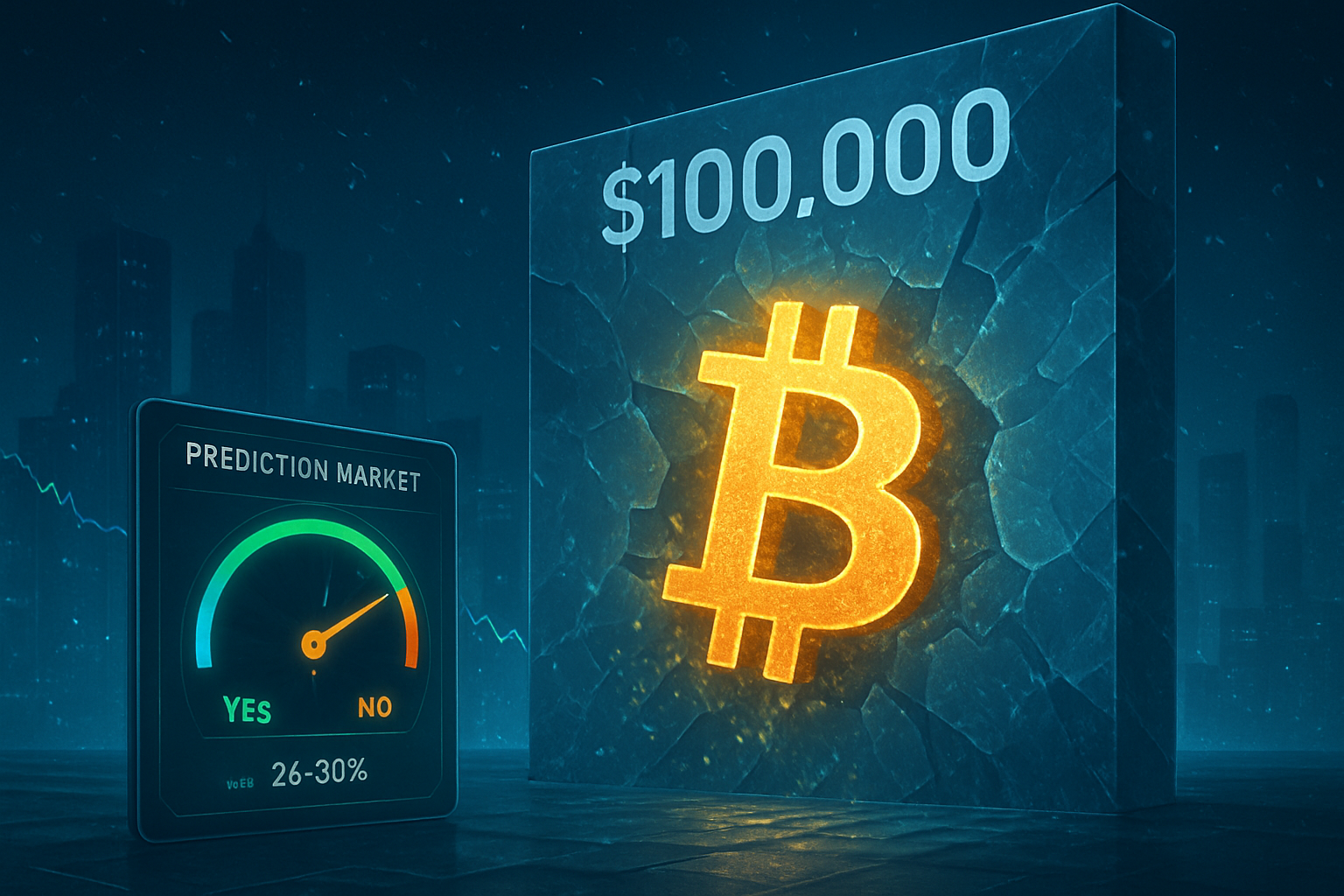
    As of mid-January 2026, the psychological and technical barrier of $100,000 remains the most contested territory in the digital asset space. While Bitcoin (BTC) entered the new year with a wave of euphoria that saw traders pricing in a nearly 80% chance of breaching the six-figure mark, reality has set in with sobering speed. Current data from the world's leading prediction markets shows a dramatic recalibration of expectations, with the probability of Bitcoin hitting $100,000 by the end of the month sliding to a modest 25-30%.

    This shift in sentiment follows a period of intense volatility and a broader "Great Reset" in growth expectations. Despite Bitcoin hovering in a consolidation range between $91,000 and $92,500, the "easy money" narrative of early January has evaporated. Prediction markets are now signaling that the road to $100,000 may be paved with significantly more resistance than bulls had anticipated, reflecting a transition from speculative mania to cautious institutional accumulation.

    The Market: What's Being Predicted

    The focus of the trading community is currently centered on high-liquidity contracts across decentralized and regulated platforms. On Polymarket, the world’s largest decentralized prediction venue, the "Bitcoin Hits $100k in January" market has seen a surge in volume, surpassing $24 million as of January 13, 2026. After starting the year with a dominant "Yes" bias that reached 80% probability, the contract has collapsed to 28-29%. This indicates that the crowd, which was once certain of a historic breakout, is now hedging heavily against that outcome.

    On the CFTC-regulated platform Kalshi, the sentiment is mirrored with striking precision. The "Above $100,000" strike for January is currently trading between 27% and 34%. Interestingly, Kalshi’s tiered strike prices reveal where the true floor of confidence lies: while the $100,000 milestone is in doubt, the $95,000 level still holds a robust 73% probability. This suggests that while traders expect Bitcoin to gain ground from its current $91,000 level, they do not believe it has the momentum to clear the final 10% hurdle before the month concludes.

    The resolution criteria for these markets are strict: Bitcoin must touch or exceed $100,000 on major spot exchanges (usually an aggregate of Coinbase, Binance, and Kraken) at any point before midnight on January 31, 2026. With only half the month remaining, time decay—often referred to as "theta" in options trading—is beginning to work against the bulls.

    Why Traders Are Betting

    The primary driver behind the cooling odds is a combination of technical resistance and a "sticky" macroeconomic environment. After Bitcoin reached an all-time high of approximately $126,210 in late 2025, it entered a sharp 30% correction that bottomed near $84,000 in December. The "New Year's relief rally" that followed initially looked promising, but it has struggled to reclaim the $94,000 to $96,000 resistance zone. Traders on prediction markets are watching these levels closely; failure to break through $96,000 in early January acted as a "sell" signal for those betting on the $100,000 milestone.

    Macro-economic factors have also played a spoiler role. Inflation data (CPI) for the start of 2026 came in at 2.7%, higher than the Federal Reserve's target. This has led to a 97% probability on Kalshi that the Fed will leave interest rates unchanged at its January meeting, effectively ending hopes for a liquidity-driven spike. Furthermore, "OG Whales"—holders from the early Satoshi era—were spotted moving approximately $286 million worth of BTC into exchanges on January 12. This suggests that long-term holders are viewing the approach to $100,000 as an ideal zone to take profits, creating a massive "supply wall" that prediction market participants are wary of.

    Institutional sentiment remains a silver lining, albeit a slow-moving one. On January 13, U.S. spot Bitcoin ETFs saw net inflows of $116.67 million. While significant, this is a far cry from the multi-billion dollar daily surges seen in 2025. Major players like MicroStrategy (NASDAQ: MSTR) continue to double down, with recent reports showing board members buying the dip at $155 per share. Similarly, Coinbase (NASDAQ: COIN) has seen its shares rise as it benefits from its role as the primary custodian for the ETF market, though the stock's 4-6% gains have not been enough to drag the underlying asset past the $100,000 mark.

    Broader Context and Implications

    This market behavior fits into a well-documented historical pattern. Analysts point out that 2026 is the "third year" following the 2024 halving event. Historically, the third year of a Bitcoin cycle is often a period of consolidation or "sideways" movement rather than parabolic growth. The current skepticism in the prediction markets suggests that the "halving effect" may have been front-run in 2025, leaving 2026 as a year of price discovery and institutional absorption.

    The shift in odds also highlights the evolving role of prediction markets as a sentiment gauge. Unlike traditional financial analysts who might maintain "Buy" ratings regardless of short-term volatility, prediction market participants must put capital behind their convictions. The rapid drop from 80% to 28% probability reflects a "wisdom of the crowd" that is highly sensitive to real-time events, such as the aforementioned whale movements and Fed policy shifts. It reveals a public that is optimistic about Bitcoin's long-term value but deeply skeptical of a "vertical" price action in a high-interest-rate environment.

    Furthermore, the regulatory stability of platforms like Kalshi has allowed for more sophisticated hedging strategies. Large-scale miners and institutional holders are likely using these "event contracts" to hedge against the downside of their spot holdings. This professionalization of the market means that "dumb money" hype is increasingly being countered by calculated, risk-managed positions.

    What to Watch Next

    The remainder of January 2026 will likely be defined by two key events: the upcoming Federal Reserve meeting and the "liquidity window" of the third week of the month. If Bitcoin can decisively break and hold above the $96,000 level before January 20, prediction market odds are likely to see a rapid "gamma squeeze" back toward the 50% range. However, every day spent consolidating below $93,000 makes the $100,000 "Yes" contract more expensive and less likely to pay out.

    Investors should also monitor the daily ETF inflow data. If cumulative inflows for the spot ETFs cross the $60 billion mark this month, it could provide the necessary buy-side pressure to overwhelm the profit-taking whales. Conversely, any signs of a "leverage flush"—where over-leveraged long positions are liquidated—could send the $100,000 odds crashing into the single digits.

    Bottom Line

    The current state of the Bitcoin $100,000 prediction markets is a classic case of "rational cooling." The drop in probability from 80% to under 30% is not necessarily a bearish signal for Bitcoin’s fundamental value, but rather a reflection of the formidable technical and macroeconomic hurdles standing in the way of a historic milestone. Traders are no longer betting on a miracle; they are betting on the reality of resistance.

    Ultimately, prediction markets are doing exactly what they were designed to do: stripping away the noise of social media hype and providing a clear, price-weighted probability of a specific outcome. Whether or not Bitcoin hits $100,000 in the next two weeks, the movement of these odds tells us that the market is maturing, with participants placing more value on Federal Reserve policy and on-chain whale activity than on the "Moon" narratives of the past. For now, the $100,000 dream remains just that—a dream deferred to later in 2026.


    This article is for informational purposes only and does not constitute financial or betting advice. Prediction market participation may be subject to legal restrictions in your jurisdiction.

    PredictStreet focuses on covering the latest developments in prediction markets.
    Visit the PredictStreet website at https://www.predictstreet.ai/.
  • The Odds on the Red Carpet: Polymarket’s Golden Globes Partnership Sparks Fierce Backlash

    The Odds on the Red Carpet: Polymarket’s Golden Globes Partnership Sparks Fierce Backlash

    The night of January 11, 2026, marked a turning point for prediction markets as live betting odds from Polymarket were integrated directly into the Golden Globes broadcast on CBS (owned by Paramount Global, NASDAQ: PARA). This partnership with Penske Media Corporation aimed to mainstream "cultural betting," but it instead sparked a massive backlash from viewers who labeled the move "dystopian" and "cringe."

    The Market: What's Being Predicted

    The event saw record-breaking activity for an entertainment market, with roughly $2.5 million wagered across 30 categories on Polymarket. The Best Motion Picture – Drama category was the crown jewel, seeing $244,962 in volume.

    The market was notably efficient—and at times, suspiciously so. Timothy Chalamet (Marty Supreme) was a "lock" with 76% implied probability hours before his win. However, the night's biggest shock came when the 55% favorite Sinners was upset by Hamnet (30% probability), resulting in a significant "burn" for many top bettors.

    Why Traders Are Betting

    The draw of the Golden Globes for traders lies in the perception of "asymmetric information." Because awards shows involve human voters and multiple layers of production, traders often hunt for leaks. On the night of the 11th, several categories saw sharp odds movements seconds before the winners were announced, leading to widespread accusations of "insider trading" by "whales."

    Polymarket CEO Shayne Coplan has positioned the platform as a "truth engine" for cultural trends. For many users, betting on the awards provides a "second-screen" level of engagement that traditional viewership lacks, turning the ceremony into a live-action sportsbook.

    Broader Context and Implications

    The "gamification" of the awards has been met with fierce resistance. Critics on social media compared the live chyrons to the "Hunger Games," arguing that the focus on betting odds undermines the celebration of art. This controversy comes as the Golden Globes transition into a for-profit venture following the dissolution of the Hollywood Foreign Press Association (HFPA) in 2023.

    The partnership also highlights the "gambling creep" in American entertainment. As Polymarket attempts to move beyond politics and finance, its integration into high-profile broadcasts like the Globes (and recently the NHL) suggests a future where every cultural event has an "implied probability" attached.

    What to Watch Next

    The industry is now looking toward the Oscars. If the ratings for the Globes show a "betting bump," The Walt Disney Company (NYSE: DIS) may face pressure to integrate similar data into the Academy Awards broadcast. Additionally, regulatory scrutiny may increase if the "insider trading" optics around awards betting continue to worsen.

    Bottom Line

    Polymarket’s Golden Globes debut was a success for the platform’s metrics but a polarizing moment for the culture. While it proved that there is a million-dollar market for entertainment prediction, the backlash suggests a deep public discomfort with the commodification of award-season prestige. As prediction markets continue their march into the mainstream, the friction between market efficiency and cultural value remains unresolved.


    This article is for informational purposes only and does not constitute financial or betting advice. Prediction market participation may be subject to legal restrictions in your jurisdiction.

    PredictStreet focuses on covering the latest developments in prediction markets.
    Visit the PredictStreet website at https://www.predictstreet.ai/.

  • The ‘Maduro Bet’ Backlash: Will Congress Finally Ban Prediction Market Insider Trading?

    The ‘Maduro Bet’ Backlash: Will Congress Finally Ban Prediction Market Insider Trading?

    The world of prediction markets is facing its most significant legislative reckoning to date. Following a series of suspicious trades linked to high-stakes geopolitical events, Representative Ritchie Torres (D-NY) has introduced the "Public Integrity in Financial Prediction Markets Act of 2026." The bill seeks to explicitly criminalize insider trading on prediction platforms by government employees, political appointees, and elected officials—essentially extending the ethics of the STOCK Act to the digital forecasting age.

    As of January 13, 2026, the legislative push is gaining rapid momentum in Washington, D.C. While there is not yet a direct contract for the bill's passage on major platforms, proxy markets on PredictIt tracking a broader "ban on member stock trading" have seen a surge in volume, though they currently trade at a cautious 12% probability (12 cents). Despite the low odds of passage in a crowded election-year calendar, the market sentiment reflects a growing consensus: the "Wild West" era of government insiders wagering on their own classified briefings may be coming to a close.

    The Market: What's Being Predicted

    While the "Public Integrity in Financial Prediction Markets Act" is the headline, traders are currently forced to bet on its success through secondary markets. On PredictIt, the long-standing market for "Will Congress pass a ban on member stock trading?" has become the primary bellwether for the Torres bill. This contract is currently trading at 12¢, a slight uptick from its 2025 lows, but still reflecting deep skepticism that Congress will police itself during a midterm year.

    On Kalshi (Kalshi Exhange), which operates as a regulated contract market, traders are focusing on broader regulatory outcomes. Markets for "Will the CFTC adopt new insider trading rules in 2026?" are currently pricing in a 20% probability. This suggests that while a full act of Congress might be a long shot, traders believe administrative action from the Commodity Futures Trading Commission (CFTC) or the Securities and Exchange Commission (SEC) is increasingly likely.

    The liquidity in these regulatory markets has spiked since the bill was introduced on January 5. Over $2.5 million has changed hands on related legislative outcomes in the last week alone. The resolution criteria for the Torres bill would require the President to sign the act into law by December 31, 2026—a tight window that explains the current "underdog" odds.

    Why Traders Are Betting

    The sudden urgency for this legislation stems from a "smoking gun" incident on Polymarket involving the January 3, 2026, capture of Venezuelan President Nicolás Maduro. Just hours before the U.S. military raid was made public, a mysterious account named "Burdensome-Mix" placed a $32,000 bet that Maduro would be ousted. When news of the capture broke, the account’s position swelled to over $400,000, a staggering 1,200% return that many analysts believe could only have been achieved through material non-public information (MNPI).

    "The Maduro trade was the 'A-ha!' moment for regulators," says one high-volume trader on Kalshi. "It wasn't just a lucky guess; the timing was too surgical. It looked like someone in the loop decided to treat a classified military operation like a parlay bet."

    Further fueling the fire is the case of "0xafEe," a trader dubbed the "Google Insider." This individual has reportedly netted $1.2 million by correctly predicting search trends and product release dates for Alphabet Inc. (NASDAQ: GOOGL) with near-perfect accuracy. These incidents have created a "perfect storm" for Representative Torres, who has framed his bill as a necessary tool to prevent public service from becoming a "for-profit enterprise."

    Support for the bill has come from an unlikely corner: the industry itself. Tarek Mansour, CEO of Kalshi, has publicly endorsed the Act. Mansour argues that regulated exchanges already adhere to standards similar to those of the New York Stock Exchange (NYSE: ICE) or Nasdaq (NASDAQ: NDAQ), and that the bill would primarily target the "unregulated, offshore" activity that currently tarnishes the industry's reputation.

    Broader Context and Implications

    The "Public Integrity in Financial Prediction Markets Act" represents a pivotal moment in the professionalization of prediction markets. For years, these platforms have been touted as superior forecasting tools, aggregating the "wisdom of the crowd" to predict everything from elections to interest rates. However, the Maduro incident highlights a darker side: when the "crowd" includes individuals who can control the outcome or possess classified intelligence, the market ceases to be a forecasting tool and becomes a vehicle for corruption.

    Historically, prediction markets have been remarkably accurate, often outperforming traditional polling or expert analysis. Yet, if the public perceives these markets as "rigged" by insiders, liquidity will dry up, and their utility as a public sentiment gauge will vanish.

    The bill also touches on a larger trend of increased scrutiny on "political gambling." The CFTC has long sought to ban markets on election outcomes, arguing they threaten the integrity of the democratic process. By focusing on insider trading rather than a total ban, Torres may have found a middle ground that allows the industry to survive while imposing the same rigors faced by traditional finance.

    What to Watch Next

    The immediate hurdle for the bill is its lack of a Republican co-sponsor. While it has over 30 Democratic supporters, including high-profile figures like Nancy Pelosi, it will need a bipartisan coalition to clear the House Financial Services Committee. Analysts will be watching for any GOP members who have previously been vocal about banning congressional stock trading to join the bill.

    Key dates to monitor include:

    • January 25, 2026: The scheduled House Financial Services Committee hearing where the bill is expected to be discussed.
    • February 2026: The release of the CFTC's semi-annual regulatory agenda, which may include new rules for "event contracts" that mirror the Torres bill's language.
    • Mid-2026: The resolution of the Maduro "Invasion" payout dispute on Polymarket, which could trigger further legal action or legislative amendments.

    If a Republican co-sponsor signs on before the end of the month, expect the 12% "Yes" odds on PredictIt to double almost overnight.

    Bottom Line

    The proposed "Public Integrity in Financial Prediction Markets Act of 2026" is a reactive but perhaps necessary piece of legislation in a rapidly evolving financial landscape. The Maduro raid "Burdensome-Mix" trade served as a wake-up call, proving that the threat of insider trading in prediction markets is no longer a theoretical concern—it is a documented reality.

    While current market odds suggest the bill has a difficult path to becoming law in 2026, the rhetoric from leaders like Ritchie Torres and Tarek Mansour suggests that the status quo is no longer an option. Whether through this specific Act or through a series of administrative crackdowns by the CFTC and SEC, the "Wild West" days of prediction markets are being reined in.

    For traders, the message is clear: the market rewards information, but the government is drawing a hard line on how that information is obtained. As these markets mature into mainstream financial instruments, they must adopt the transparency and ethical standards of the institutions they aim to supplement.


    This article is for informational purposes only and does not constitute financial or betting advice. Prediction market participation may be subject to legal restrictions in your jurisdiction.

    PredictStreet focuses on covering the latest developments in prediction markets.
    Visit the PredictStreet website at https://www.predictstreet.ai/.