Tag: Polymarket

  • Betting on the Blue Wave: 2026 Midterm Markets Hit Record $700 Million Daily Volume

    Betting on the Blue Wave: 2026 Midterm Markets Hit Record $700 Million Daily Volume

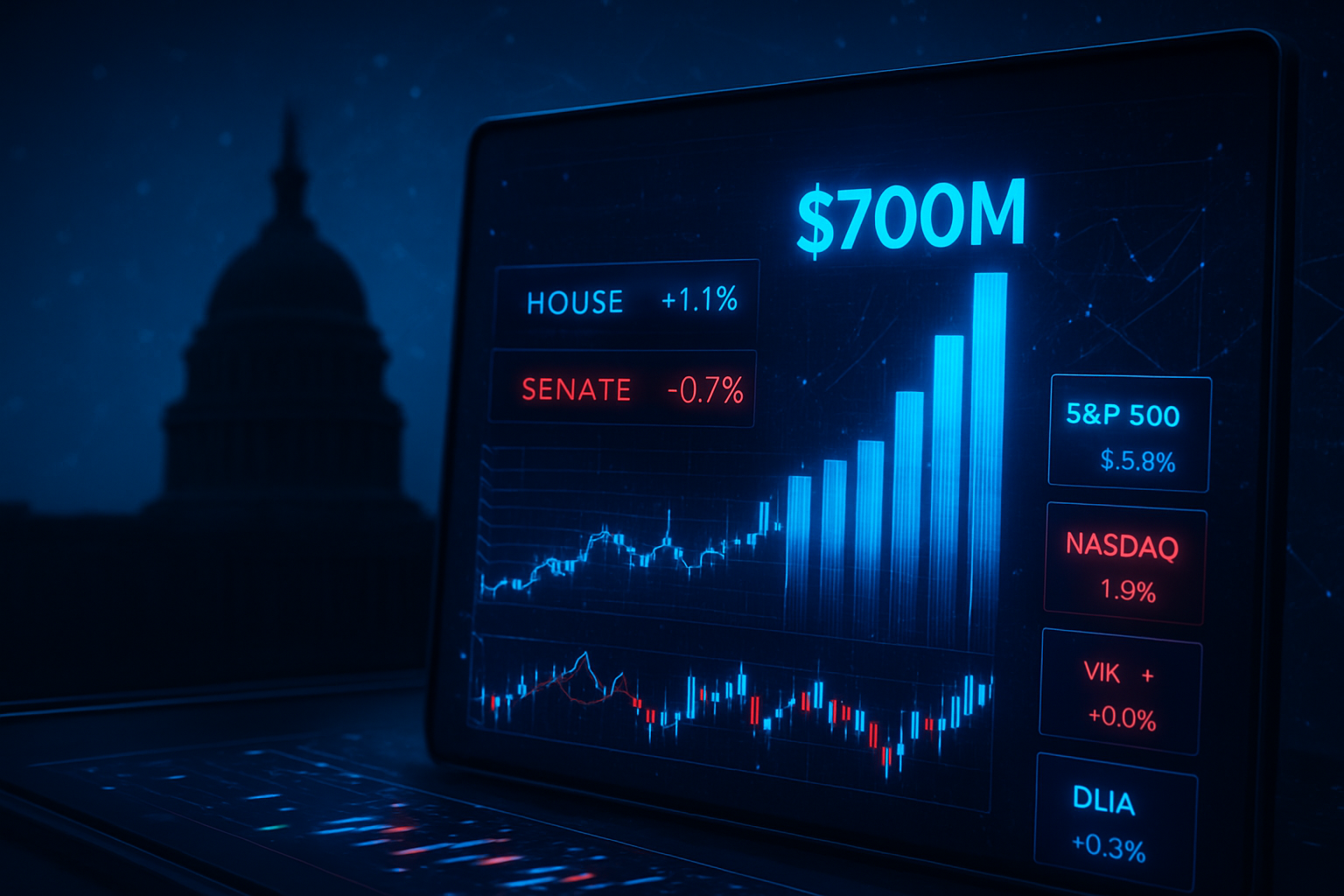
    As the calendar turns to early 2026, the political landscape is already being reshaped not by campaign rallies, but by the rapid-fire clicks of high-stakes traders. Prediction markets have officially entered their "super-cycle," with the 2026 U.S. Midterm elections driving unprecedented liquidity. For the first time in history, daily trading volume across the sector eclipsed the $700 million mark on January 12, signaling that forecasting platforms have moved from the periphery of political discourse to its very epicenter.

    At the heart of this surge is a stark divergence between traditional polling and market sentiment. While early polls suggest a competitive generic ballot, traders on platforms like Kalshi and Polymarket are aggressively pricing in a Democratic takeover of the House of Representatives, with odds hovering near 80%. Simultaneously, Vice President JD Vance has emerged as a paradox: a polarizing figure in public approval ratings, yet the undisputed betting favorite to lead the Republican ticket in 2028.

    The Market: What's Being Predicted

    The primary focus of the early 2026 cycle is the "Balance of Power" contracts, which allow traders to bet on the specific partisan split of the 110th Congress. On Kalshi, the leading regulated exchange in the U.S., the most liquid market currently concerns House control. Democrats are priced at 74–75 cents, implying a roughly 75% chance of retaking the lower chamber. Polymarket, the decentralized heavyweight, shows an even more bullish outlook for the left, with shares trading at 78–79 cents.

    In the Senate, however, the map tells a different story. Despite a national environment that favors Democrats, the 2026 Senate map is structurally difficult for the opposition. Republicans currently hold a 53–47 majority, and prediction markets give them a 66–68% probability of retaining control. The "Split Congress" outcome—a Democratic House and Republican Senate—is currently the "favorite" scenario among institutional traders, priced at 48% on Kalshi.

    Liquidity has reached a tipping point. On January 12, 2026, total daily volume across major platforms hit $701.7 million. Kalshi dominated this record-breaking day, accounting for 66.4% of the volume, largely driven by its "Combos" features which allow users to bet on complex political and economic outcomes simultaneously. This level of liquidity ensures that even "whale" positions of $1 million or more can be absorbed without radical price slippage, attracting a new class of sophisticated market participants.

    Why Traders Are Betting

    The aggressive positioning in favor of a "blue wave" in the House is being driven by what traders call the "Referendum Effect." Historically, the first midterm of a second presidential term is brutal for the incumbent party. However, traders are looking beyond history and focusing on specific policy catalysts. The second Trump administration's aggressive stances on tariffs and immigration, along with a recent tie-breaking vote by Vice President JD Vance to block a war powers resolution regarding Venezuela, have created a volatile political environment that traders believe will provoke a significant voter backlash.

    Furthermore, JD Vance’s standing as the 2028 heir apparent has turned 2026 into a proxy war for his future. On Kalshi, Vance holds a 27–28% chance of being the 2028 Republican nominee—a massive lead over rivals like Marco Rubio (11%). Traders are betting that the 2026 midterms will serve as the ultimate "stress test" for the Vance-led wing of the GOP. If the party loses the House by a wider margin than expected, his 2028 odds are predicted to crater, making these midterm contracts a hedge for 2028 presidential bets.

    The discrepancy between polls and markets is also a major factor in current trading strategies. While Morning Consult shows a modest Democratic lead of +2, markets are pricing in a much more decisive shift. Professional bettors are essentially betting that traditional polling is undercounting "suburban flight" and the impact of recent macroeconomic shifts. This "Knightian risk"—the uncertainty of how a second-term administration's disruptions will manifest at the ballot box—is currently being priced more heavily by markets than by pollsters.

    Broader Context and Implications

    The $700 million daily volume milestone is not just a win for the platforms; it represents a fundamental shift in how the public consumes political intelligence. Institutional players, including hedge funds and data analytics firms, are increasingly using these markets as a real-time sentiment gauge that reacts faster than any 1,000-person phone survey. The rise of these markets has also caught the attention of major financial institutions like Interactive Brokers (NASDAQ: IBKR), which has expanded its forecast market offerings to meet the demand for regulated election trading.

    The real-world implications of these odds are already being felt in Washington. Legislative strategies for the remainder of 2026 are being adjusted based on the high probability of a divided government. If the markets continue to hold at 75% for a Democratic House, we can expect a rush of Republican "legacy" legislation in the first half of the year before the window closes.

    From a regulatory standpoint, the 2026 cycle is the first to operate under a fully clarified legal framework following years of litigation between the CFTC and exchange platforms. This clarity has allowed for the entry of "market makers" who provide the deep liquidity necessary for the $700 million days we are now seeing. The historical accuracy of these markets—which outperformed polls in the 2024 general election—gives these early 2026 numbers a level of perceived authority that is influencing donor behavior and candidate recruitment.

    What to Watch Next

    As we head into the spring of 2026, several "volatility triggers" could shift the current odds. The primary season will be the first major test; if "Vance-aligned" candidates struggle in deep-red districts, expect his 2028 presidential odds to slide and the Democratic House probability to climb even higher. Traders will also be watching the quarterly GDP prints and Federal Reserve decisions closely, as any signs of an economic cooling could cement the "blue wave" narrative.

    Key dates to monitor include the filing deadlines in March and April, which will reveal the quality of the challengers Democrats have recruited for key swing districts. If high-profile "star" candidates jump into races that were previously considered safe Republican seats, the markets will likely react before the first television ad even airs. Additionally, the "Senate Floor" is a critical metric; if Republicans' odds of holding the Senate dip below 60%, it would signal a total collapse of the GOP's defensive map, a scenario not currently priced into the market.

    Bottom Line

    The 2026 midterm cycle is proving that prediction markets are no longer a "niche" interest but a primary pillar of the American political and financial ecosystem. The $700 million daily volume record is a testament to the growing trust in these platforms as accurate aggregators of disparate information. Currently, the "wisdom of the crowd" is betting heavily on a divided government, viewing a Democratic House takeover as a near-certainty while keeping the Senate in Republican hands.

    JD Vance remains the central figure of this drama. As the market's favorite for 2028, his political capital is effectively being "traded" through the 2026 midterm contracts. For observers and participants alike, the message from the markets is clear: the 2026 midterms will not just be a fight for the gavel, but a high-stakes referendum on the future of the Republican party's leadership. As liquidity continues to pour in, these markets will offer the most ruthless and accurate map of the American electorate’s intentions.


    This article is for informational purposes only and does not constitute financial or betting advice. Prediction market participation may be subject to legal restrictions in your jurisdiction.

    PredictStreet focuses on covering the latest developments in prediction markets.
    Visit the PredictStreet website at https://www.predictstreet.ai/.

  • The Mirage of Liquidity: Why Analyst ‘DANNY’ Warns Retail Traders are ‘Exit Liquidity’ in Prediction Markets

    The Mirage of Liquidity: Why Analyst ‘DANNY’ Warns Retail Traders are ‘Exit Liquidity’ in Prediction Markets

    In the high-stakes arena of global prediction markets, where fortunes are made and lost on the blink of a headline, a new and sobering narrative is taking hold. As of January 15, 2026, the meteoric rise of platforms like Polymarket has turned prediction trading into a multi-billion dollar industry. However, a growing chorus of analysts is warning that the "wisdom of the crowd" may actually be a sophisticated trap for the unwary.

    Leading this charge is the prominent, albeit pseudonymous, market analyst known as 'DANNY', whose recent report, "99% Will Lose Everything," has sent shockwaves through the trading community. DANNY’s thesis is simple but devastating: the vast majority of retail participants are not trading against the "crowd," but are instead serving as "exit liquidity" for a class of data-rich insiders and professional "Information Whales" who move prices long before the general public even sees the news.

    The Market: What's Being Predicted

    While prediction markets technically allow users to bet on everything from Federal Reserve interest rate hikes to the winners of the 2026 midterm elections, the real "market" currently under scrutiny is the integrity of the platforms themselves. Polymarket, the decentralized heavyweight in the space, has recently seen its legitimacy challenged by a landmark study from Columbia University.

    The study, published in late 2025, utilized a network-based algorithm to trace linked wallet addresses. The findings were staggering: approximately 25% of Polymarket’s total historical volume was identified as wash trading—the act of traders buying and selling to themselves to create a false appearance of high liquidity and interest. In specific high-volatility sectors like sports and global geopolitical events, that figure reportedly spiked to over 45%.

    Currently, the odds on many major contracts are shifting wildly, but analysts like DANNY argue these are "ghost signals." On Polymarket, where volume often reaches hundreds of millions of dollars per week, the "liquidity" that retail traders rely on to enter and exit positions is often an artificial construct designed to lure in small-time bettors. This creates a dangerous environment where price movements do not represent actual sentiment change, but rather a coordinated manipulation of the order book.

    Why Traders Are Betting

    Despite these warnings, the allure of the "big win" remains stronger than ever. Retail traders are often driven by the success stories of "whales" who seem to possess a prophetic ability to time the market. A notable example frequently cited by DANNY is the trader nicknamed "Alpha Raccoon," who reportedly netted over $1.5 million by predicting Alphabet Inc. (NASDAQ:GOOGL) Year in Search results hours before they were made public.

    Similarly, the capture of Venezuelan leader Nicolás Maduro in early January 2026 saw a single anonymous wallet pocket over $400,000 in a matter of hours. These events drive a massive FOMO (Fear Of Missing Out) among retail participants who believe they can catch the next "alpha" signal.

    However, DANNY points out that these are not lucky guesses. "Information Whales" utilize advanced data-scraping tools, real-time news terminals like Bloomberg (Private), and even military-grade intelligence to front-run the market. By the time a retail trader sees a volume spike and decides to jump in, the professional has often already secured the favorable price and is looking for someone to buy their position—the aforementioned "exit liquidity."

    Broader Context and Implications

    The debate over information asymmetry has sparked a regulatory firestorm in Washington. On January 10, 2026, U.S. Representative Ritchie Torres introduced the Public Integrity in Financial Prediction Markets Act of 2026, which aims to curb the influence of non-public information in these markets. The bill follows a Senate inquiry into offshore platforms that operate outside the purview of the Commodity Futures Trading Commission (CFTC).

    The divide between regulated exchanges like Kalshi (Private) and offshore entities like Polymarket is becoming a central theme of the industry. While Kalshi enforces strict anti-insider trading rules for government officials, Polymarket has historically leaned into the philosophy that "insider trading is a feature, not a bug," arguing that it forces information into the price more efficiently.

    This "feature," however, comes at a high cost to public trust. If 25% to 60% of signals are faked or front-run, the prediction market loses its value as a tool for public sentiment and becomes a playground for a new era of digital high-frequency manipulation.

    What to Watch Next

    Traders should keep a close eye on the upcoming regulatory hearings scheduled for late January, where the CFTC is expected to testify regarding the enforcement of wash-trading bans on decentralized protocols. If the "Torres Bill" gains momentum, we could see a massive migration of volume from unregulated platforms to more transparent, audited exchanges.

    Furthermore, new "transparency tools" are being developed by third-party blockchain forensic firms to help retail traders identify wash-trading patterns in real-time. Monitoring wallet clusters—where multiple accounts send funds back and forth to create volume—will be a critical skill for any trader hoping to survive in 2026.

    The next major test for these markets will be the spring 2026 economic data releases. Watch for sudden, high-volume price shifts that occur minutes before official government reports are published; these are the "smoke" that often precedes the fire of insider activity.

    Bottom Line

    The rise of prediction markets as a mainstream financial tool is undeniable, but the warnings from analysts like DANNY suggest that the industry is in a "Wild West" phase where the house—and the whales—always have the advantage. For the retail trader, high volume should no longer be seen as a sign of health, but as a signal for extreme caution.

    Until platforms implement more robust anti-wash-trading protocols and regulators provide a clearer framework for "fair play," the information gap remains a chasm that few retail participants will successfully cross. As DANNY famously put it in his report, "In a market of information, the person with the fastest cable always wins."

    Skepticism, scrutiny of wallet patterns, and a healthy distrust of volume spikes are the only tools retail traders have to avoid becoming the exit liquidity for the next big whale trade.


    This article is for informational purposes only and does not constitute financial or betting advice. Prediction market participation may be subject to legal restrictions in your jurisdiction.

    PredictStreet focuses on covering the latest developments in prediction markets.
    Visit the PredictStreet website at https://www.predictstreet.ai/.
  • The $60 Billion Revolution: How Prediction Markets Outpaced Projections to Challenge the Sports Betting Throne

    The $60 Billion Revolution: How Prediction Markets Outpaced Projections to Challenge the Sports Betting Throne

    As we cross the midpoint of January 2026, the final tallies for the previous year have confirmed a seismic shift in global finance: prediction markets are no longer a niche curiosity for political junkies and crypto-enthusiasts. In 2025, the industry didn't just meet the ambitious $40 billion volume projection set by analysts—it shattered it, recording a staggering $63.5 billion in total notional volume.

    This 302% year-over-year explosion has placed prediction markets on a direct collision course with the $300 billion global sports betting industry. What was once seen as "gambling for nerds" is now being recognized as a sophisticated "Information Finance" ecosystem. Driven by regulatory breakthroughs in the United States and massive retail distribution via major brokerage apps, the probability of prediction markets becoming a permanent, dominant fixture of the financial landscape has moved from a "maybe" to a near-certainty.

    The Market: What's Being Predicted

    The scope of prediction markets expanded dramatically in 2025. While election cycles traditionally provide the largest volume spikes, the market successfully pivoted to "evergreen" categories including economic data, climate events, and, most notably, sports. Leading the charge are Kalshi, the first regulated U.S. prediction exchange, and Polymarket, the decentralized giant that remains a powerhouse in international and crypto-native circles.

    By the end of 2025, the distribution of volume shifted significantly toward regulated event contracts. Kalshi emerged as the surprise volume leader in the final quarter, finishing the year with $23.8 billion in volume, a more than 1,100% increase from 2024. Much of this growth came from their expansion into sports event contracts, which allowed users to trade on the outcome of NFL and NBA games with the transparency and regulatory oversight of a financial derivative rather than a traditional sportsbook.

    Meanwhile, Polymarket maintained its relevance by recording $22.5 billion in volume. Despite losing its dominant market share to regulated U.S. competitors, Polymarket’s liquidity in non-U.S. political events and "culture" markets remains unmatched. The barrier to entry for the average investor vanished in March 2025 when Robinhood (NASDAQ: HOOD) launched its "Prediction Markets Hub" in partnership with Kalshi, instantly putting event contracts into the pockets of over 24 million retail traders.

    Why Traders Are Betting

    The 2025 surge was fueled by a fundamental realization among participants: prediction markets offer better "yield" on information than almost any other asset class. Unlike the stock market, where a company's price is influenced by thousands of variables from interest rates to management changes, a prediction market contract on the Federal Reserve's next rate hike or a specific legislative vote has a clear, binary resolution.

    Traders are also increasingly using these markets as a hedge. For example, in late 2025, businesses sensitive to hurricane damage used Interactive Brokers (NASDAQ: IBKR) and its ForecastEx platform to hedge against climate risks. By buying "Yes" contracts on specific weather events, they created a form of ad-hoc insurance that was more flexible and faster-paying than traditional policies.

    The "whale" activity has also shifted from anonymous crypto wallets to institutional desks. The strategic $2 billion investment by Intercontinental Exchange (NYSE: ICE) into Polymarket in late 2025 signaled that the world's most powerful financial institutions now view the data generated by these markets as a high-fidelity signal for risk management.

    Broader Context and Implications

    The path to $63.5 billion was paved by a landmark regulatory victory in May 2025. After years of litigation, the CFTC officially dropped its appeal against Kalshi, effectively greenlighting the listing of election and political derivatives in the U.S. This decision removed the "grey market" stigma that had plagued the industry since the early days of Intrade and PredictIt.

    This regulatory clarity has allowed prediction markets to begin eating into the market share of traditional sportsbooks like DraftKings (NASDAQ: DKNG) and Flutter Entertainment (NYSE: FLUT). Because event contracts on exchanges like Kalshi are structured as derivatives with lower "vig" (the house take) than traditional sports betting "juice," savvy bettors are migrating toward prediction markets for better pricing.

    Beyond the money, these markets have proven to be the most accurate "source of truth" in a fragmented media landscape. Throughout 2025, prediction market prices consistently front-ran traditional polling and expert commentary on everything from the European central bank decisions to the success of major film releases.

    What to Watch Next

    As we look toward the rest of 2026, the primary catalyst on the horizon is the U.S. Midterm Elections. Early volume for "Control of the House" and "Control of the Senate" contracts is already outpacing the levels seen at this stage in the 2022 and 2024 cycles. Analysts are now projecting that the industry could surpass the $100 billion annual volume milestone by the end of this year.

    The next major milestone to monitor is the potential integration of event contracts into more mainstream retirement and savings products. There is growing talk on Wall Street about "Event-Linked ETFs" that would allow institutional investors to gain exposure to a basket of prediction market outcomes as a non-correlated asset class.

    Furthermore, keep an eye on the "cross-pollination" between sports betting and prediction markets. As more jurisdictions clarify the rules, expect traditional sportsbooks to launch their own exchange-style interfaces to compete with the low-fee models of Kalshi and Robinhood.

    Bottom Line

    The story of 2025 was the year prediction markets grew up. By surpassing the $40 billion projection and hitting $63.5 billion, the industry has proven that the appetite for "trading on the truth" is massive and globally distributed. The integration into platforms like Robinhood has democratized access, making the act of forecasting as simple as buying a share of stock.

    Ultimately, prediction markets are evolving into the world’s most efficient central nervous system. They don’t just offer a place to bet; they provide a real-time, financially-backed consensus on the direction of our society. As we head deeper into 2026, the question is no longer whether prediction markets will rival sports betting, but how long it will take before they surpass it.


    This article is for informational purposes only and does not constitute financial or betting advice. Prediction market participation may be subject to legal restrictions in your jurisdiction.

    PredictStreet focuses on covering the latest developments in prediction markets.
    Visit the PredictStreet website at https://www.predictstreet.ai/.
  • The New Insurance: Institutional Hedging Transforms Prediction Markets into Essential Risk Management Tools

    The New Insurance: Institutional Hedging Transforms Prediction Markets into Essential Risk Management Tools

    As of January 15, 2026, the global financial landscape has witnessed a paradigm shift in how institutional investors manage tail risk and policy uncertainty. What was once dismissed as a niche domain for retail speculators has matured into a sophisticated layer of market infrastructure. Prediction markets, or event contracts, are now being utilized by top-tier hedge funds and quantitative trading desks to isolate and hedge specific regulatory and legislative outcomes that traditional equity and bond markets are often too blunt to capture.

    Leading this institutional charge is Oldenburg Capital Partners, a firm that has become synonymous with the "selective use" of event contracts to navigate macro volatility. By the start of 2026, Oldenburg and its peers have integrated prediction market data directly into their risk-modeling engines. The logic is simple: while a 10-year Treasury note might react to inflation data, a Kalshi contract on the passage of the Digital Asset Market Clarity Act (the "CLARITY Act") provides a direct, high-conviction hedge for a firm's venture exposure to decentralized finance. With total daily trading volume across major platforms hitting a staggering $701.7 million last week, the era of the "prediction market as insurance" has officially arrived.

    The Market: What's Being Predicted

    The core of the institutional boom lies in the diversification of contracts available on platforms like Kalshi and the newly-relaunched U.S. arm of Polymarket. These platforms have moved far beyond election forecasting, offering deep liquidity in "binary" outcomes for SEC rulings, Federal Reserve pivots, and legislative milestones. For instance, the market for the SEC vs. Coinbase appellate decision, currently trading on Kalshi, has seen its "Yes" contract (predicting a Coinbase victory on the "investment contract" definition) hover at 62 cents, implying a 62% probability of a favorable ruling.

    This liquidity is no longer an accident. Following the massive expansion of Interactive Brokers (NASDAQ: IBKR) and its ForecastEx exchange, institutional participation has been incentivized by high collateral yields. IBKR currently offers an estimated 3.83% incentive coupon on the collateral of open event positions, effectively paying firms to provide liquidity. Meanwhile, CME Group (NASDAQ: CME) has entered the fray with 24/7 swap-based event contracts for GDP and CPI benchmarks, bridging the gap between traditional futures and event-driven binary options. Total monthly notional volume for the industry has now stabilized above $13 billion, a ten-fold increase from early 2024 levels.

    Why Traders Are Betting

    The primary driver for firms like Oldenburg Capital Partners and Saba Capital Management is the ability to hedge "policy cliffs." Traditional derivatives—such as credit default swaps or equity puts—often carry significant "noise" from broader market sentiment. In contrast, an event contract allows a fund manager to hedge the exact moment a regulatory shift occurs.

    Boaz Weinstein’s Saba Capital has reportedly used recession-dated contracts on Polymarket to hedge credit market instruments that may be lagging behind shifting economic narratives. "In the traditional market, you're betting on the reaction to an event," says one senior trader at a high-frequency firm. "In prediction markets, you’re betting on the event itself. For a risk manager, that distinction is worth billions."

    Another key factor is the "conviction gap." Institutional desks often find that prediction markets reflect "on-the-ground" legal and political intelligence faster than the stock market. During the recent debates over the GENIUS Act—a stablecoin regulatory bill—prediction market odds shifted 15 points in favor of a "No" vote a full 48 hours before bank stocks began to sell off, providing a critical window for firms to adjust their exposure.

    Broader Context and Implications

    This institutionalization is the result of a hard-fought regulatory evolution. Following landmark legal victories against the CFTC in late 2024, event contracts were codified as a protected class of derivatives. This provided the legal "moat" necessary for massive capital entry from companies like Intercontinental Exchange (NYSE: ICE), the parent of the New York Stock Exchange, which invested nearly $2 billion into Polymarket’s back-end infrastructure in late 2025.

    The real-world implications are profound. Prediction markets are increasingly viewed as a more accurate "source of truth" than traditional polling or expert pundits. Their historical accuracy—most notably during the 2024 U.S. election and the subsequent 2025 debt ceiling negotiations—has earned them the respect of central bankers and policy makers. However, this success has also invited scrutiny. In early 2026, states like New Jersey and Tennessee have issued cease-and-desist orders against certain "Opinion" markets, triggering a "preemption" legal battle that many expect will eventually be settled by the U.S. Supreme Court.

    What to Watch Next

    The immediate focus for the market is the upcoming Q1 2026 legislative calendar. Two major events are expected to move the needle:

    1. The CLARITY Act Vote: Expected in late February, this will determine the regulatory framework for the next decade of digital asset innovation. Prediction markets currently give it a 45% chance of passage.
    2. The 2026 Midterm "Whale" Activity: Large institutional positions are already being built in "Congressional Control" contracts, as firms seek to hedge against potential shifts in corporate tax rates and defense spending.

    Additionally, the market is monitoring the "collateral war" between Interactive Brokers and CME Group. As these giants compete for liquidity, the cost of hedging through event contracts is expected to drop, further attracting traditional asset managers who have previously stayed on the sidelines.

    Bottom Line

    The emergence of prediction markets as an institutional hedging tool marks the end of their "wild west" era. For firms like Oldenburg Capital Partners, these markets are no longer a curiosity—they are a necessity. By providing a clear, binary way to price risks that were previously "unhedgeable," prediction markets have filled a critical gap in the global financial system.

    As we move further into 2026, expect to see the "prediction premium" become a standard metric in macro analysis. Whether it’s a court ruling, a legislative vote, or a central bank decision, the smart money is no longer just watching the news—they are trading the outcome. In a world of increasing political and regulatory volatility, the ability to turn "what if" into a tradable asset is the ultimate competitive advantage.


    This article is for informational purposes only and does not constitute financial or betting advice. Prediction market participation may be subject to legal restrictions in your jurisdiction.

    PredictStreet focuses on covering the latest developments in prediction markets. Visit the PredictStreet website at https://www.predictstreet.ai/.
  • Empire State vs. Event Contracts: The High-Stakes Battle to Regulate Prediction Markets

    Empire State vs. Event Contracts: The High-Stakes Battle to Regulate Prediction Markets

    As of mid-January 2026, a legal and legislative storm is brewing in Albany that could redefine the future of information finance in the United States. New York, a state traditionally at the center of global finance, has become the primary battleground for a clash between state-level gambling regulators and the emerging asset class of prediction markets. Lawmakers are currently weighing aggressive new legislation that seeks to classify event contracts as unlicensed gambling, even as platforms like Kalshi and Polymarket argue they are essential financial tools for hedging risk and discovering truth.

    The tension has reached a fever pitch following several "high-signal" events in early 2026, most notably a controversial "Maduro trade" on Polymarket where a single user reportedly turned $32,000 into $400,000 just hours before a U.S. military raid in Venezuela. This incident has catalyzed federal and state lawmakers to act, with New York residents now caught in the crosshairs of a jurisdictional tug-of-war. On decentralized platforms like Manifold, traders currently give an 81% probability to the theory that federal preemption will eventually shield these markets from state bans, yet the short-term outlook for New York-based traders remains fraught with legal uncertainty.

    The Market: What's Being Predicted

    The "market" currently under the most intense scrutiny isn't a single election or a sporting event, but the legal survival of the platforms themselves in New York. Two major pieces of legislation have defined the landscape in early 2026. The first, Assembly Bill A9251, known as the ORACLE Act (Oversight and Regulation of Activity for Contracts Linked to Events), was re-referred to the Assembly Committee on Consumer Affairs and Protection on January 7, 2026. Sponsored by Assemblymember Clyde Vanel, the bill is a scorched-earth proposal that would ban New Yorkers from trading on any contracts linked to political outcomes, catastrophic events, or the price of individual securities.

    On the other side of the aisle, the New York Prediction Market Regulation Act (Senate Bill S8889), introduced by Senator Jeremy Cooney on January 13, 2026, offers a more moderate path. This bill would treat prediction markets as financial entities rather than gambling houses, requiring them to obtain a license from the Department of Financial Services (DFS). While the ORACLE Act threatens platforms with fines of up to $1 million per day for non-compliance, the Cooney bill seeks to integrate them into the state’s robust financial oversight system.

    Currently, Kalshi is operating in New York under a "litigation stay" after receiving a cease-and-desist letter from the New York State Gaming Commission in late 2025. Kalshi’s legal team argues that because they are a designated contract market (DCM) regulated by the Commodity Futures Trading Commission (CFTC), federal law preempts state gambling statutes. Polymarket, which recently signed a high-profile marketing partnership with the New York Rangers, owned by Madison Square Garden Sports Corp. (NYSE: MSGS), remains in a more precarious "invite-only" status for U.S. users as it navigates the final hurdles of domestic compliance.

    Why Traders Are Betting

    The surge in regulatory pressure has not dampened trading volume; if anything, it has highlighted the unique utility of these markets. The "Maduro trade" of early January became a lightning rod for the debate. Critics, including Representative Ritchie Torres (D-NY), point to the trade as evidence of potential "insider trading" by individuals with non-public information about government operations. However, proponents argue that the market correctly priced in the high probability of the event, providing a more accurate geopolitical forecast than traditional intelligence agencies or news outlets.

    Traders are increasingly using these platforms not just for speculation, but as a hedge against real-world volatility. For instance, institutional traders are reportedly using Kalshi’s "recession" and "interest rate" markets to offset risks that traditional derivatives, often found on the Intercontinental Exchange (NYSE: ICE), may not cover as efficiently. The ability to "bet" on a catastrophe or a regulatory shift is, in financial terms, no different from buying an insurance policy or a credit default swap.

    The primary factor driving the current 81% "preemption" odds on Manifold is the historical precedent of the Commodity Exchange Act (CEA). Legal experts argue that if the federal government (via the CFTC) has authorized a market, a state cannot unilaterally ban it under the guise of "public morality." This has led to a "whale" strategy where large positions are being taken on the belief that Kalshi will win its lawsuit against the NY Gaming Commission, effectively opening the floodgates for fully regulated event trading across the country.

    Broader Context and Implications

    The fight in New York is the tip of the spear for a broader national conversation regarding the distinction between "financial trading" and "gambling." New York Attorney General Letitia James has been a vocal critic, maintaining that if a product "behaves like a bet," it should be subject to the state's strict gambling laws. This stance ignores the information-aggregation benefits that economists call the "wisdom of the crowd," which has consistently outperformed traditional polling and expert analysis in predicting everything from Fed rate hikes to the 2024 election results.

    Enter Representative Ritchie Torres and the Public Integrity in Financial Prediction Markets Act of 2026, introduced on January 9. Unlike the NY State bills which target the platforms, the Torres bill targets the traders—specifically government insiders. By proposing a ban on federal officials trading on markets where they have "material nonpublic information," Torres is essentially treating prediction markets like the stock market. This is a significant move toward legitimization; it suggests that prediction markets are a permanent fixture of the financial landscape that simply requires the same ethical guardrails as Wall Street.

    If New York successfully bans these markets, it could lead to a fragmented "digital wall" across the U.S., where prediction market access depends on one’s GPS coordinates. This "geofencing" reality is already a point of contention, as traders in New Jersey or Connecticut can access markets that their New York neighbors cannot. The historical accuracy of these markets suggests that such a ban would not only hurt traders but would deprive policymakers of a vital source of real-time data.

    What to Watch Next

    The coming weeks are critical for the New York market. On the legislative front, the ORACLE Act (A9251) currently lacks a Senate sponsor. If Senator Jeremy Cooney’s DFS-focused bill (S8889) gains traction instead, it would signal a victory for the "financial trading" camp and provide a roadmap for other states like California and Illinois to follow.

    In the courts, all eyes are on the Southern District of New York, where a ruling on Kalshi’s motion for a preliminary injunction against the Gaming Commission is expected by late February. A win for Kalshi would effectively freeze the state's ability to enforce gambling-based crackdowns on federal-regulated exchanges. Conversely, a loss would likely embolden AG Letitia James to pursue broader enforcement actions against decentralized platforms like Polymarket.

    Finally, keep a close watch on the progress of Representative Torres’ federal bill. While it seeks to limit who can trade, its passage would be a landmark moment for the industry, officially recognizing event contracts as a legitimate financial instrument under the umbrella of "public integrity."

    Bottom Line

    The regulatory struggle in New York is more than a legal dispute; it is an existential battle over the definition of risk. By attempting to shoehorn prediction markets into 20th-century gambling definitions, New York risk stifling a powerful 21st-century tool for price discovery and information clarity. The high probability assigned to "federal preemption" by the markets themselves suggests that traders believe the future of finance is too big for any single state to stop.

    Ultimately, the "Maduro trade" and the resulting Torres bill highlight a shift in the narrative. The question is no longer if prediction markets should exist, but how to ensure they operate with integrity. As 2026 progresses, the outcome of the Empire State’s war on event contracts will likely determine whether prediction markets remain a niche hobby or become the bedrock of the global information economy.


    This article is for informational purposes only and does not constitute financial or betting advice. Prediction market participation may be subject to legal restrictions in your jurisdiction.

    PredictStreet focuses on covering the latest developments in prediction markets.
    Visit the PredictStreet website at https://www.predictstreet.ai/.
  • The Death of the Pollster: How Prediction Markets Seized Narrative Authority from Pollsters

    The Death of the Pollster: How Prediction Markets Seized Narrative Authority from Pollsters

    The 2024 U.S. Presidential Election will be remembered not just for its political outcome, but as the moment the "narrative authority" in American discourse shifted from traditional polling to prediction markets. For decades, the public relied on poll aggregators and pundits to define the "toss-up" nature of elections. However, as the dust settled on the 2024 cycle, a clear winner emerged in the business of information: the markets. While traditional polls remained frozen in a "dead heat" narrative until Election Day, platforms like Polymarket and Kalshi had already moved to a 60% probability for a Trump victory weeks earlier—a signal that proved far more accurate than the "margin of error" hedging of the legacy media.

    As of January 15, 2026, this shift is no longer a fringe theory. It is a structural reality. Prediction markets have moved from the periphery of the crypto world into the core of the global financial system. Today, the probabilities generated by thousands of traders are treated with the same weight as the S&P 500 or Treasury yields. The 2024 election served as the ultimate proof-of-concept, demonstrating that when "skin in the game" meets real-time data, the resulting "wisdom of the crowd" updates faster and more accurately than any 1,000-person phone survey ever could.

    The Market: What's Being Predicted

    The 2024 Presidential Election market was the largest event contract in history, with Polymarket alone processing over $3.6$ billion in volume. During the final stretch in October 2024, the divergence between markets and polls reached a fever pitch. While the New York Times and other legacy outlets described a race within the margin of error, Trump’s odds on Polymarket and Kalshi climbed steadily, peaking between 57% and 67%. This gap led to accusations of market manipulation, but the resolution of the market—a decisive Trump victory—validated the traders' conviction.

    Today, the prediction market landscape has expanded significantly beyond that single election. Major financial institutions have stepped in to provide liquidity and access. Robinhood Markets, Inc. (NASDAQ: HOOD) launched its "Prediction Markets Hub" in early 2025, which has since become the company's fastest-growing business line. Similarly, Interactive Brokers Group, Inc. (NASDAQ: IBKR) integrated event contracts via its ForecastEx exchange, allowing institutional investors to hedge against geopolitical and economic risks. The market is no longer just predicting "who wins," but is now used for forecasting Fed rate decisions, Supreme Court rulings, and even corporate earnings.

    The shift in liquidity has been transformative. In the 2024 cycle, a "whale" making a $10 million bet could move the needle; in 2026, the participation of retail giants like Robinhood means that millions of smaller participants are providing a much "thicker" and more resilient price signal. These markets resolve instantly upon a verifiable event, such as an Associated Press call or a government data release, providing a definitive settlement that eliminates the weeks of post-game punditry that used to follow major events.

    Why Traders Are Betting

    The primary reason prediction markets outperformed polling in the 2024 cycle was the speed of information processing. Traditional polls often suffer from a "reality gap"—the 7 to 14 days it takes to collect, weight, and publish data. Traders, however, react in seconds. A prime example was the June 2024 debate between Joe Biden and Donald Trump. While pundits spent days debating the "optics," Polymarket odds for Biden’s withdrawal from the race surged from 20% to nearly 70% within hours. The polls didn't reflect this massive shift for nearly two weeks, by which time the political reality had already moved on.

    Traders also utilize granular, real-time data that pollsters often ignore. In the final weeks of 2024, "whales" on these platforms were reportedly monitoring early voting returns and voter registration shifts in key swing states like Pennsylvania and Nevada. By pricing in this hard data—rather than relying on "likely voter" models—the markets were able to identify Trump’s under-polled strength. This "information finance" approach allows participants to synthesize disparate signals, from satellite imagery of parking lots to obscure regulatory filings, into a single, actionable price.

    Comparison to traditional methods shows a stark contrast in incentives. A pollster faces little personal financial risk for being wrong if they stay within the "consensus" margin of error. A trader, however, faces immediate financial loss for inaccuracy. This incentive structure forces market participants to strip away personal bias and focus on the most likely outcome. This is why, despite a heavy media narrative favoring a Harris "momentum" story in late 2024, the markets remained skeptical, correctly identifying that the underlying data did not support the hype.

    Broader Context and Implications

    The success of prediction markets in 2024 has led to a total reconfiguration of media and regulation. In 2025, CNN and CNBC followed the lead of financial terminals by signing landmark data-sharing deals with Kalshi. Now, in early 2026, it is common to see live probability tickers during news broadcasts, replacing the outdated "pundit panels." This marks the official transition of prediction markets into the "truth layer" of the internet—a place where public sentiment is quantified rather than guessed.

    However, this transition hasn't been without conflict. We are currently witnessing a "preemption war" in the legal system. Following the landmark Kalshi v. CFTC ruling that legalized election betting at the federal level, several states including Michigan and Nevada attempted to classify these markets as "illegal gambling" in late 2025. A coalition of companies, including Robinhood (NASDAQ: HOOD) and Kalshi, is currently fighting these state-level bans in federal court, arguing that federal oversight by the Commodity Futures Trading Commission (CFTC) preempts state gambling laws.

    Beyond politics, the real-world implications are profound. Corporations are now using these markets to manage risk. For instance, a tech company might buy "Yes" contracts on a specific regulatory crackdown to hedge the potential drop in their stock price. This creates a more stable economic environment where "unforeseeable" events are actually priced in months in advance. The historical accuracy of these markets, particularly since the 2024 pivot, has turned them into an essential tool for both the C-suite and the kitchen table.

    What to Watch Next

    As we look toward the 2026 midterm elections, the focus has shifted to how these markets will handle even more complex local data. We are seeing the emergence of "hyper-local" markets that predict everything from mayoral races to city-level zoning changes. The key milestone to monitor will be the outcome of the current federal court cases regarding state-level bans. If the courts rule in favor of the Prediction Market Coalition by mid-2026, it will clear the way for a truly national, frictionless market.

    Another factor to watch is the integration of Artificial Intelligence into the trading ecosystem. By January 2026, an estimated 40% of prediction market volume is driven by AI agents that can scan thousands of news sources and data points simultaneously. This could lead to even faster market adjustments, potentially moving odds before a human can even read a headline. The interaction between human intuition and AI data processing will be the next frontier in refining the accuracy of these platforms.

    Finally, keep an eye on how traditional pollsters attempt to "market-ize" their own products. We are already seeing some legacy firms launching their own "expert-only" markets to compete with the retail-driven platforms. Whether these closed systems can compete with the massive liquidity of open platforms like Polymarket remains to be seen, but the competition is healthy for the overall goal: more accurate information.

    Bottom Line

    The shift from polling to prediction markets represents the most significant change in how we measure public opinion in a century. The 2024 election was the "Big Bang" for this industry, proving that financial incentives create a more accurate signal than voluntary surveys. By January 2026, the debate is no longer about whether these markets work, but about how far their influence will reach into every facet of our economic and social lives.

    For the average citizen, this means the end of the "polling rollercoaster." Instead of reacting to a single outlier poll that generates a week of anxiety-inducing headlines, we can now look at a stable, liquid market that aggregates all available information into a single number. While markets are not infallible and can still experience volatility, they have proven to be the most reliable compass in an increasingly complex and noisy information landscape.

    The legacy of the 2024 cycle is clear: in the battle for narrative authority, the crowd with skin in the game has won. As we move deeper into 2026, the question is no longer "What do the polls say?" but "Where is the money moving?" The answer to that question has become the most important signal in the world.


    This article is for informational purposes only and does not constitute financial or betting advice. Prediction market participation may be subject to legal restrictions in your jurisdiction.

    PredictStreet focuses on covering the latest developments in prediction markets.
    Visit the PredictStreet website at https://www.predictstreet.ai/.
  • The Invisible Hand Becomes the Front Page: Prediction Markets Cement Status as Core Financial Infrastructure

    The Invisible Hand Becomes the Front Page: Prediction Markets Cement Status as Core Financial Infrastructure

    As of January 15, 2026, the global financial landscape has undergone a silent but profound transformation. What were once niche platforms for political junkies and crypto enthusiasts have evolved into the bedrock of modern financial decision-making. Prediction markets have officially moved from the periphery to the core, driven by a wave of institutional adoption, high-stakes regulatory wins, and seamless integration into the world's most popular financial apps.

    Today, the "probability of outcome" is no longer just a metric buried in a research report; it is a live ticker price embedded in the wallets and news feeds of hundreds of millions of people. With the recent scaling of partnerships between regulated exchanges like Kalshi and retail giants such as Robinhood Markets, Inc. (NASDAQ: HOOD) and Coinbase Global, Inc. (NASDAQ: COIN), the friction between having an opinion and placing a trade has effectively vanished.

    The Market: A New Asset Class Emerges

    The "market" being predicted is no longer a single event, but the entire trajectory of the global economy. By mid-January 2026, the total daily trading volume across major event contract platforms has surpassed $5 billion. On Kalshi, the CFTC-regulated leader, volume is dominated by macroeconomic hedges. Contracts on the Federal Reserve’s next interest rate move, the monthly Consumer Price Index (CPI) release, and even the likelihood of specific legislative passages have become some of the most liquid instruments in the world.

    The integration with Robinhood (NASDAQ: HOOD), launched in March 2025, has been the primary catalyst for this liquidity explosion. The "Prediction Markets Hub" within the Robinhood app now accounts for over 50% of Kalshi's total volume, boasting over 1 million active daily traders. Meanwhile, on the decentralized side, Polymarket continues to dominate geopolitical and cultural forecasting, with its data now serving as the primary source of truth for global news organizations.

    Currently, the most watched markets involve the Q1 2026 GDP growth projections, where odds have shifted significantly following recent tech sector earnings. These contracts act as a "real-time census," reflecting public and institutional sentiment with a granularity that traditional polling or economic forecasting simply cannot match. Resolution is handled through rigorous, pre-defined data points—such as Bureau of Labor Statistics (BLS) releases—ensuring that traders have absolute clarity on the timeline of their payouts.

    Why Traders Are Betting: Frictionless Intelligence

    The surge in participation is driven by a fundamental shift in user experience. In the past, participating in a prediction market required moving funds across multiple "on-ramps" and navigating complex interfaces. In 2026, that friction is gone. Coinbase (NASDAQ: COIN) has integrated Kalshi’s event contracts directly into its "Unified Dashboard," allowing users to fund their prediction positions with USDC or USD cash balances. This "Everything Exchange" strategy treats an event contract as a legitimate asset class, sitting right next to Bitcoin and blue-chip stocks.

    In the decentralized world, the Phantom wallet has become the dominant gateway. With over 20 million users, Phantom’s native "Predictions" tab—powered by a hybrid of Kalshi and DFlow—allows users to trade on-chain with the same ease as a token swap. The ability to use SOL or even high-liquidity stablecoins as collateral has turned the wallet into a social trading hub, complete with live sentiment feeds.

    Traders are moving into these markets not just for speculation, but for superior data. Traditional news cycles are often 24 to 48 hours behind the price movements of an event contract. By the time a news anchor announces a "surprise" economic shift, the prediction market has usually priced it in hours earlier. This "speed gap" has attracted institutional whales who use these markets to hedge against "black swan" events that traditional options markets are too slow to reflect.

    Broader Context and Implications

    The embedding of probability data into mainstream news marks a turning point for public discourse. News Corp (NASDAQ: NWSA), through its Dow Jones and Wall Street Journal brands, now features live Polymarket and Kalshi odds on its homepages. When readers look at a headline about a pending merger or a government shutdown, they see a "Market Probability" percentage right next to it. This has effectively replaced the "punditry" model with a "price discovery" model.

    Regulatorily, the landscape has stabilized significantly. The CFTC's recognition of event contracts as a valid tool for risk management has allowed US-based platforms like Kalshi to operate with the same legal standing as the CME Group Inc. (NASDAQ: CME). This has paved the way for the "institutionalization" of sentiment. Even Alphabet Inc. (NASDAQ: GOOGL) has integrated these probabilities into Google Finance, prioritizing market-derived data over traditional AI-generated summaries for search queries like "Will the Fed cut rates?"

    Historical data from the 2024 and 2025 cycles showed that prediction markets consistently outperformed traditional polls in terms of accuracy and lead time. This track record has built the trust necessary for them to become "financial infrastructure." We are moving toward a world where every major news event is instantly priced, creating a more transparent, if more volatile, information economy.

    What to Watch Next

    The next frontier for this infrastructure is the expansion of clearing and settlement. Coinbase’s (NASDAQ: COIN) recent acquisition of "The Clearing Company" in late 2025 suggests that the exchange intends to internalize the entire lifecycle of an event contract, potentially reducing fees to near-zero. This would make prediction markets even more competitive against traditional sportsbooks and options desks.

    Investors should also monitor the upcoming "Super Tuesday" of economic data in February 2026. The liquidity in these markets will face a major test as massive institutional hedges are expected to collide with retail sentiment. Furthermore, the integration of prediction data into AI agents—where your personal AI can automatically hedge your portfolio based on shifting event probabilities—is currently in beta at several major fintech firms.

    As we look toward the rest of 2026, the key milestone will be the potential launch of "Exchange Traded Prediction Funds" (ETPFs), which would allow passive investors to gain exposure to a basket of "high-probability" outcomes.

    Bottom Line

    Prediction markets have completed their journey from "online betting" to "core financial infrastructure." The partnerships between Kalshi, Robinhood, and Coinbase have democratized access to the world’s most accurate forecasting tool, while Phantom has ensured that the decentralized future of these markets is just a tap away for millions.

    This shift tells us that the future of finance is inherently probabilistic. We are no longer satisfied with "what might happen" according to an expert; we want to know "what the price is" according to the collective wisdom of the market. As probability data becomes as ubiquitous as the weather report, the value of a prediction market lies not just in the potential for profit, but in its role as the ultimate source of truth in an uncertain world.


    This article is for informational purposes only and does not constitute financial or betting advice. Prediction market participation may be subject to legal restrictions in your jurisdiction.

    PredictStreet focuses on covering the latest developments in prediction markets.
    Visit the PredictStreet website at https://www.predictstreet.ai/.
  • The ‘Perfect’ Bet: Inside the Polymarket Controversy Surrounding the Capture of Nicolás Maduro

    The ‘Perfect’ Bet: Inside the Polymarket Controversy Surrounding the Capture of Nicolás Maduro

    The world of prediction markets is reeling following a sequence of events that has critics questioning the very foundation of market integrity. On January 3, 2026, the geopolitical landscape shifted overnight when U.S. forces reportedly captured Venezuelan leader Nicolás Maduro. While the news sent shockwaves through global capitals, it was a single trade on the decentralized prediction platform Polymarket that sparked a different kind of firestorm: a $32,000 bet placed just hours before the announcement that netted a staggering $436,000 profit.

    This "improbable" timing has reignited a fierce debate over insider trading and the "Alpha Raccoon" phenomenon—a term now synonymous with traders who appear to possess non-public information. With probabilities for Maduro’s exit hovering near 8% just moments before the trade, the market’s sudden movement has caught the attention of federal regulators and Capitol Hill. As of January 15, 2026, Polymarket is facing its most significant existential crisis yet, caught between its promise of "the wisdom of the crowd" and allegations of being a playground for well-connected insiders.

    The Market: What's Being Predicted

    The controversy centers on the "Venezuelan Leadership: Maduro Out of Power?" contract, which traded heavily throughout late 2025. The specific resolution criteria required Nicolás Maduro to no longer hold the office of President of Venezuela by January 31, 2026. While the market had been active for months, trading volume exploded in the first week of January, reaching a record $702 million daily high as rumors of military movements began to circulate.

    On January 2, 2026, the "Yes" shares were trading at a basement-level price of approximately $0.07 to $0.08, reflecting a consensus that Maduro would remain in power through the end of the month. However, at roughly 10:00 PM ET—just 6.5 hours before the official announcement—a newly created account linked to a cluster of sophisticated wallets (often associated with the handle @0xafEe) aggressively purchased shares. This move effectively locked in a massive position at an 8% probability.

    Following the 4:21 AM announcement on Truth Social—the platform owned by Trump Media & Technology Group Corp. (NASDAQ: DJT)—the contract immediately shot to $1.00. The trader's $32,537 investment ballooned to over $436,000 in less than a day, marking one of the most profitable and suspiciously timed trades in the platform's history.

    Why Traders Are Betting

    The Maduro trade is not an isolated incident but rather the latest example of what analysts call the "Alpha Raccoon" effect. Named after a pseudonymous trader who famously turned a five-figure sum into $1.1 million by predicting Alphabet Inc. (NASDAQ: GOOGL) search trends in late 2025, the "Alpha Raccoon" archetype represents the sophisticated actor who leverages information asymmetry.

    Traders are increasingly divided into two camps. On one side are the "Information Whales," who appear to trade on military intelligence, internal corporate data, or advanced data-scraping techniques. On the other are retail traders, whom independent analyst DANNY recently described as "exit liquidity." A December 2025 study found that 99% of retail participants in event-driven contracts lose money, as they are consistently late to price in major news that insiders have already capitalized on.

    Recent market movements suggest that "Alpha Raccoon" style accounts are no longer just betting on outcomes; they are front-running the news cycle. This has led to a "wait-and-see" approach among smaller traders, who are becoming hesitant to enter markets where a sudden, massive bet from a new wallet often signals a massive event is imminent.

    Broader Context and Implications

    The Maduro controversy has landed in the wake of a damning study by Columbia University, published in November 2025, titled "Network-Based Detection of Wash Trading." The study revealed that roughly 25% of Polymarket’s total historical volume was attributable to wash trading—the practice of traders buying and selling to themselves to create the illusion of liquidity. During high-stakes periods, like the 2024 U.S. elections and the recent Venezuelan crisis, that figure reportedly spiked to as high as 60%.

    These findings have provided ammunition for regulators. On January 10, 2026, Representative Ritchie Torres (D-NY) introduced the Public Integrity in Financial Prediction Markets Act of 2026. This legislation aims to explicitly prohibit federal employees and political appointees from participating in prediction markets where they hold material non-public information.

    Furthermore, on January 14, a group of twelve U.S. Senators sent a formal inquiry to the Commodity Futures Trading Commission (CFTC). They are demanding a full investigation into how offshore platforms like Polymarket monitor for manipulation. The core of the issue is the "split model": while platforms like Interactive Brokers Group, Inc. (NASDAQ: IBKR) and Robinhood Markets, Inc. (NASDAQ: HOOD) operate under strict U.S. oversight, the bulk of geopolitical betting still occurs on crypto-native platforms that exist in a regulatory gray area.

    What to Watch Next

    The immediate focus is on the "Public Integrity Act" as it moves through congressional committees. If passed, it could force platforms to implement "Know Your Customer" (KYC) protocols that are far more rigorous than current industry standards, potentially stifling the pseudonymity that many crypto-traders prize.

    Investors should also keep an eye on the resolution of other geopolitical contracts. With Maduro's capture confirmed, the market is now shifting its focus to the "Venezuela Transition" contracts. There is significant speculation regarding who will lead the interim government, and the "Alpha Raccoon" accounts are already active. If another massive, perfectly timed bet appears before a major diplomatic announcement, it could provide the final impetus for a total shutdown of unregulated event contracts.

    Finally, the technical "wash trading" fix is in development. Several blockchain forensics firms are reportedly working with prediction platforms to implement real-time "manipulation scores" for individual markets. Whether these tools can truly level the playing field between insiders and the public remains to be seen.

    Bottom Line

    The Maduro capture was a triumph for U.S. military intelligence, but for prediction markets, it has been a clarifying—and perhaps damning—moment. The "perfect" trade of January 2 highlights the inherent vulnerability of event contracts: they are only as good as the fairness of the information environment they inhabit.

    While prediction markets were once heralded as the ultimate tool for aggregating public sentiment, the "Alpha Raccoon" study and the recent wash-trading revelations suggest they may currently be functioning as a mechanism for transferring wealth from the uninformed to the hyper-informed. Until the "insider" problem is addressed through either technology or regulation, the "wisdom of the crowd" may continue to be drowned out by the "knowledge of the few."


    This article is for informational purposes only and does not constitute financial or betting advice. Prediction market participation may be subject to legal restrictions in your jurisdiction.

    PredictStreet focuses on covering the latest developments in prediction markets.
    Visit the PredictStreet website at https://www.predictstreet.ai/.
  • The Day of the Truth Engine: Prediction Markets Shatter Records with $701.7 Million Surge

    The Day of the Truth Engine: Prediction Markets Shatter Records with $701.7 Million Surge

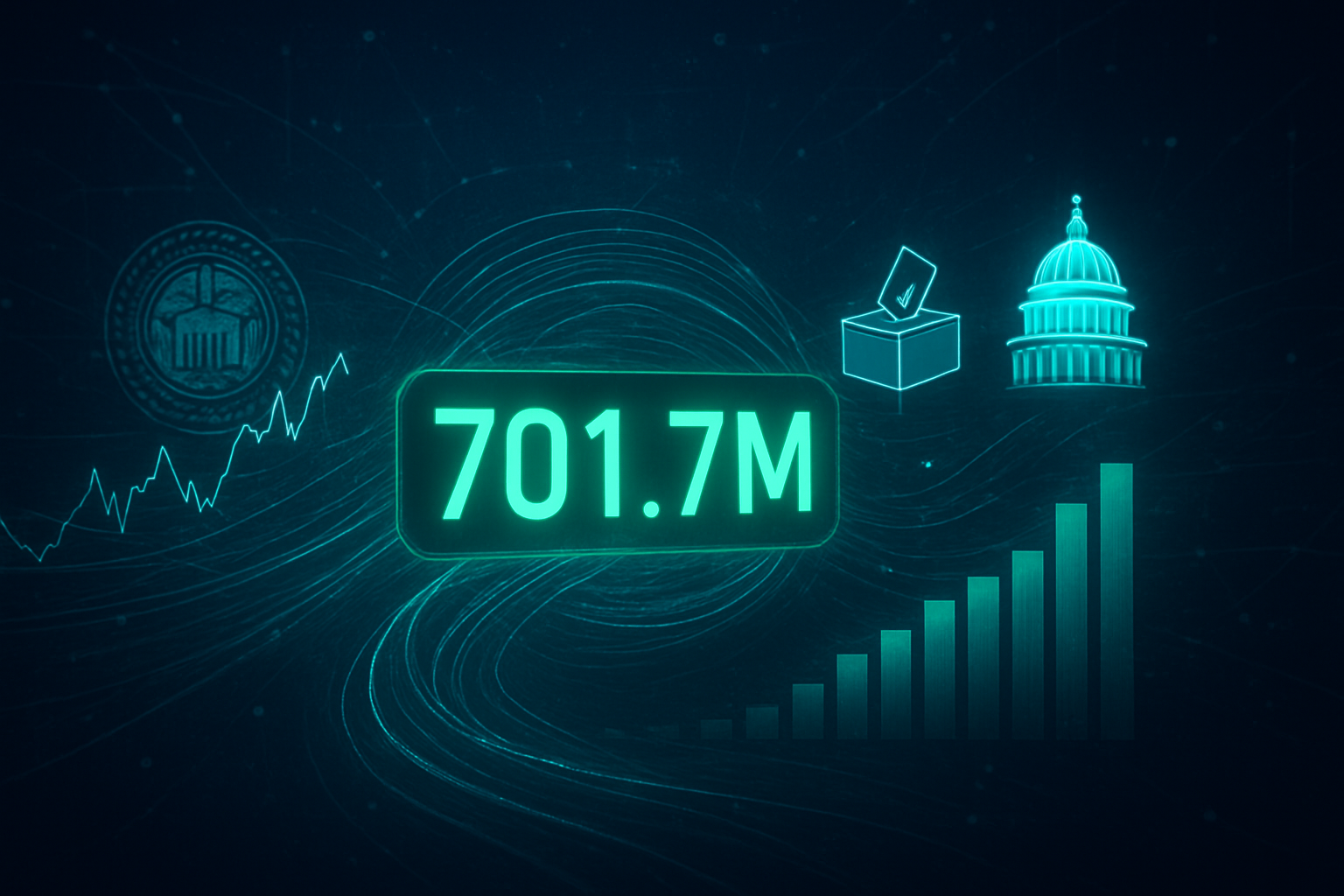
    On January 12, 2026, the financial landscape witnessed a seismic shift as daily trading volume in prediction markets hit a staggering $701.7 million, marking the industry's most prolific 24-hour period in history. What was once dismissed as a niche corner of the internet for political hobbyists has officially transitioned into a primary "truth engine" for global finance. The surge was not merely a spike in speculative interest but a calculated migration of capital toward real-time, high-stakes information during a period of intense macroeconomic and geopolitical volatility.

    The record-breaking day saw a dominant performance by Kalshi, which captured a massive 66.4% of the total market share. This explosion in activity was fueled by a "perfect storm" of data: a slowing labor market, an unprecedented constitutional clash between the executive branch and the Federal Reserve, and early-cycle positioning for the 2026 Midterm elections. As institutional giants and retail traders alike flocked to these platforms, the consensus among analysts is clear: prediction markets are no longer about "betting"—they are about "knowing."

    The Market: What's Being Predicted

    The bulk of the $701.7 million volume was concentrated on the CFTC-regulated exchange Kalshi, which processed approximately $465.9 million in trades. A significant portion of this liquidity flowed through retail gateways, particularly Robinhood (NASDAQ: HOOD), which has integrated Kalshi’s event contracts directly into its "Prediction Markets Hub." Other major players, including Coinbase (NASDAQ: COIN) and the crypto-native Polymarket—now backed by a $2 billion investment from the Intercontinental Exchange (NYSE: ICE)—accounted for the remainder of the day's record-setting activity.

    The most active contracts on January 12 revolved around two pillars: central bank policy and political control. Traders poured over $120 million into a single contract on Kalshi: "Will the Fed cut interest rates in March?" Simultaneously, the market for "Who will control the House in 2027?" saw open interest swell to $150 million. These weren't just long-term wagers; they were highly liquid instruments being traded in real-time as news broke, with bid-ask spreads tightening to levels comparable to major equities.

    Beyond traditional macro data, the day was marked by high-velocity "flash markets." Following the sudden news of a U.S. military operation in Venezuela, volume on contracts related to the capture of Nicolás Maduro spiked instantly. Similarly, a "volatility index" for the 2026 election cycle emerged in the form of Trump impeachment odds, which surged to 57% on the back of escalating domestic political tensions.

    Why Traders Are Betting

    The primary driver behind the January 12 surge was a dramatic escalation in the "Fed Independence" narrative. Following reports that the Department of Justice had issued subpoenas to Federal Reserve Chair Jerome Powell, the markets became the only place to find a real-time probability of a constitutional crisis. Traditional forecasting from institutions like JPMorgan Chase (NYSE: JPM) struggled to keep pace with the headlines, leading traders to use prediction markets to hedge against a potentially compromised central bank.

    Market activity was also heavily influenced by the January 9 labor report, which showed a meager addition of 50,000 jobs. This data point, combined with a 4.4% unemployment rate, created a divide in opinion that only a market could resolve. While some analysts predicted a defensive "hold" by the Fed, the prediction markets moved aggressively toward a 25-basis point cut, providing a "source of truth" that anticipated subsequent movements in S&P 500 futures.

    Institutional participation reached a tipping point as well. Firms like Goldman Sachs (NYSE: GS) and Interactive Brokers (NASDAQ: IBKR) have increasingly acknowledged these markets as vital sentiment indicators. The entry of CME Group (NASDAQ: CME) into the event contract space has provided the regulatory "moat" necessary for large-scale capital to enter. On January 12, this institutional liquidity met a wave of retail enthusiasm from the Robinhood and Coinbase ecosystems, creating a liquidity flywheel that shattered all previous records.

    Broader Context and Implications

    The record volume on January 12 highlights the maturation of prediction markets from "betting platforms" to "information aggregators." In an era of fragmented media and polarized polling, these platforms provide an objective, capital-weighted consensus. Brian Armstrong, CEO of Coinbase, noted that these markets are becoming superior to traditional news outlets because participants have "skin in the game," ensuring that the prevailing odds are the most accurate reflection of available data.

    However, this rapid growth has not come without scrutiny. The massive volume on the Maduro capture contracts prompted U.S. Senators Adam Schiff and Alex Padilla to call for a CFTC investigation into potential insider trading. The concern is that prediction markets may be "too good" at uncovering information, potentially incentivizing the leak of sensitive government or corporate data for profit.

    Historically, prediction markets have shown a remarkable ability to outperform pundits. From the 2024 elections to the 2025 inflation pivots, these platforms have consistently bottomed out ahead of the curve. The $701.7 million day suggests that the broader financial world has finally accepted this reality, integrating event contracts into the standard toolkit of risk management alongside options and futures.

    What to Watch Next

    As the dust settles on this record-breaking day, all eyes are on the January 13 CPI release. Prediction markets are currently pricing in a "sticky" headline inflation rate of 2.7%, and any deviation from this will likely trigger another massive volume day as traders recalibrate their Fed expectations. The market’s reaction to this data will be a crucial test of whether the January 12 volume was a one-time anomaly or the new baseline for the industry.

    Furthermore, the legal battle involving the Federal Reserve and the DOJ is expected to generate a series of "binary events"—subpoena responses, grand jury leaks, and potential executive orders—that are tailor-made for prediction market trading. Traders should also monitor the upcoming primary filing deadlines for the 2026 Midterms, which will begin to lock in the field of candidates and drive the next wave of political liquidity.

    Bottom Line

    The events of January 12, 2026, represent a point of no return for the prediction market industry. With $701.7 million in daily volume and Kalshi commanding a dominant 66.4% share, the infrastructure of "knowing" has been firmly established. These platforms are no longer just a mirror of public opinion; they are a driver of it, influencing how major institutions hedge their bets and how the public interprets breaking news.

    Ultimately, the surge in volume tells us that in an increasingly uncertain world, the value of a clear, market-driven probability is worth hundreds of millions of dollars. As prediction markets continue to integrate with mainstream financial platforms and gain institutional legitimacy, the line between "betting" and "investing" will continue to blur, leaving us with a powerful new tool for navigating the complexities of the 21st-century economy.


    This article is for informational purposes only and does not constitute financial or betting advice. Prediction market participation may be subject to legal restrictions in your jurisdiction.

    PredictStreet focuses on covering the latest developments in prediction markets.
    Visit the PredictStreet website at https://www.predictstreet.ai/.
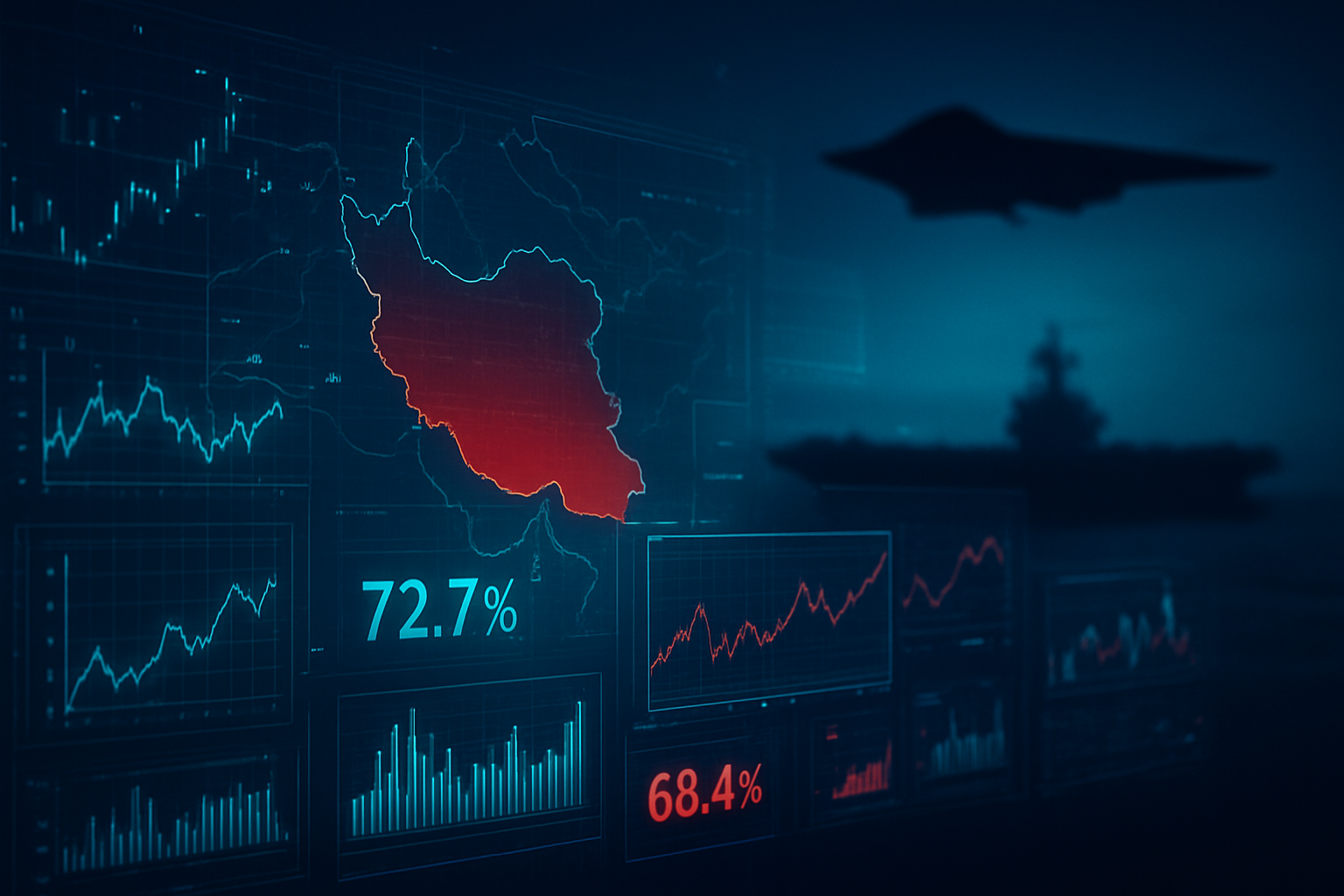
  • The Price of Conflict: Prediction Markets Signal 83% Probability of Iran Strike in 2026

    The Price of Conflict: Prediction Markets Signal 83% Probability of Iran Strike in 2026

    As of January 14, 2026, prediction markets are flashing a severe warning signal for the Middle East, with traders pricing in an overwhelming likelihood of a direct military strike on Iran by the United States or Israel this year. Current odds on major decentralized platforms have surged to a staggering 83% for a U.S. strike by June 2026, marking a significant departure from the more cautious rhetoric seen in traditional diplomatic circles.

    This spike in activity follows a turbulent 2025 that saw regional tensions reach a boiling point, including the "12-Day War" in June and the subsequent collapse of several Iranian-aligned regional proxies. While traditional polling often struggles to capture the nuances of rapidly evolving geopolitical crises, prediction markets are operating as a real-time "war room," aggregating the collective intelligence of global participants who are putting millions of dollars on the line to forecast the next move in a high-stakes game of brinkmanship.

    The Market: What's Being Predicted

    The most liquid markets regarding this conflict are currently hosted on Polymarket, where the "U.S. strikes Iran by June 30, 2026" contract has seen its volume balloon to over $22 million. The odds on this specific outcome have experienced a dramatic climb, rising from 48% in the first week of January to the current 83%. Simultaneously, a shorter-term market on whether Israel will strike Iranian soil by January 31, 2026, is currently hovering around 53%, suggesting that traders believe a multi-national or U.S.-led operation is more likely than a unilateral Israeli action in the immediate future.

    On the regulated U.S. side, Kalshi has seen significant interest in markets related to Iranian leadership stability. The contract for "Ali Khamenei out as Supreme Leader by end of 2026" is trading at a 66% probability. This correlation between military action and regime change suggests that traders aren't just betting on a singular strike, but on a broader campaign designed to fundamentally alter the Iranian political landscape.

    Resolution criteria for these markets are remarkably precise to ensure "truth signals" for participants. A "strike" is typically defined as a kinetic military operation—missiles, drones, or manned aircraft—originating from Israeli or U.S. forces that impacts targets on Iranian soil. Cyberattacks and proxy engagements, while common, are explicitly excluded from the resolution, ensuring that the odds reflect actual direct military escalation.

    Why Traders Are Betting

    The "smart money" is currently reacting to a series of escalatory triggers that defined the late months of 2025. Following the re-implementation of the "Maximum Pressure" campaign by the current U.S. administration, Iran’s nuclear breakout time was reportedly reduced to zero, prompting fears of a nuclear-armed Tehran. Defense contractors like Lockheed Martin (NYSE: LMT) and Northrop Grumman (NYSE: NOC) have seen increased focus as traders monitor the deployment of specialized hardware, such as the B-2 Spirit and B-21 Raider stealth bombers, which were utilized in the limited strikes of June 2025.

    Traders are also closely watching the domestic situation within Iran. In late 2025, the Iranian Rial plummeted to a historic low of 1.4 million to $1 USD, sparking the "Bazaar Revolts." Prediction market participants appear to be betting that the U.S. and Israel will view this internal fragility as a strategic window of opportunity to degrade Iran’s nuclear and military infrastructure while the regime is preoccupied with civil unrest.

    Large-scale "whale" activity has been noted on Polymarket, with several high-net-worth accounts taking six-figure positions in favor of a strike. These moves often precede major news breaks, leading some to speculate that prediction markets are capturing "insider" cues or early-warning signals from intelligence communities that haven't yet been confirmed by mainstream media outlets.

    Broader Context and Implications

    This trend highlights the growing reliance on prediction markets over traditional expert analysis. While a standard political analyst might be hesitant to predict a full-scale war due to reputational risks, prediction market participants are incentivized solely by accuracy. Research from late 2025 indicates that these markets have maintained an accuracy rate of roughly 76% in predicting kinetic actions, outperforming traditional expert panels which often hover around 68%.

    The real-world implications of these odds are profound. When prediction markets hit an 80%+ threshold for military conflict, it often triggers a cascade of economic shifts. Oil futures typically see a "conflict premium," and defense stocks become highly volatile. For the first time, prediction markets are being used by hedge funds and risk managers as a primary hedging tool against geopolitical "black swan" events.

    However, the regulatory environment remains complex. While Kalshi has paved the way for legal event contracts in the U.S., decentralized platforms like Polymarket still operate in a legal gray area for American participants. Despite this, the volume and liquidity of these markets have become too large for regulators or policymakers to ignore, effectively creating a "shadow" intelligence agency that operates in the public eye.

    What to Watch Next

    In the coming weeks, several key milestones could send these odds even higher or cause a sharp correction. The International Atomic Energy Agency (IAEA) is scheduled to release a "special report" on Iranian enrichment levels by January 25. If the report confirms a nuclear weaponization milestone, traders expect the 83% odds to move toward the high 90s.

    Military drills in the Persian Gulf and troop movements across U.S. bases in Qatar and Bahrain are also being tracked via satellite imagery by traders on social platforms. Any sign of "readiness" beyond standard training exercises will likely be priced into the markets within minutes. Furthermore, the upcoming 2026 State of the Union address will be a pivotal moment for participants to gauge the administration's appetite for a prolonged engagement.

    Bottom Line

    Prediction markets are signaling that the era of "strategic patience" with Tehran has likely ended. The high probability of a 2026 military strike reflects a market consensus that the diplomatic and economic escalations of 2025 have failed to resolve the nuclear issue, leaving kinetic action as the perceived "inevitable" next step for the U.S. and Israeli leadership.

    As a tool for geopolitical forecasting, these platforms have proven themselves to be faster and often more accurate than traditional models. By forcing participants to have "skin in the game," prediction markets filter out the noise of partisan rhetoric and media bias, providing a cold, hard look at the probability of conflict. Whether these markets are a self-fulfilling prophecy or a vital early warning system, one thing is clear: the "wisdom of the crowd" is currently betting on a year of unprecedented fire and fury in the Middle East.


    This article is for informational purposes only and does not constitute financial or betting advice. Prediction market participation may be subject to legal restrictions in your jurisdiction.

    PredictStreet focuses on covering the latest developments in prediction markets.
    Visit the PredictStreet website at https://www.predictstreet.ai/.