Tag: Polymarket

  • The Financialization of Truth: Why Prediction Markets Are the New Gold Standard for Forecasting

    The Financialization of Truth: Why Prediction Markets Are the New Gold Standard for Forecasting

    As we cross into 2026, the global information landscape has undergone a radical transformation. The era of relying solely on traditional polling—often criticized for its slow response times and methodological lag—is being eclipsed by the rise of prediction markets. Following their standout performance during the 2024 US Presidential Election, these platforms are no longer viewed as niche betting hubs; they have become the "new gold standard" for real-time data, drawing in billions of dollars from retail and institutional investors alike.

    Currently, the markets are hyper-focused on the 2026 US Midterm elections and the upcoming January FOMC meeting. With daily trading volumes recently surpassing $700 million across major platforms, the "wisdom of the crowd" is being priced into the global economy with unprecedented precision. On Polymarket, traders are currently pricing in a 79% probability of a Democratic takeover of the House of Representatives, while the Senate remains leaning GOP at 67%. These are not just guesses; they are financial positions held by thousands of participants with "skin in the game."

    The Market: What's Being Predicted

    The current landscape is dominated by a "triopoly" of major platforms: the US-regulated exchange Kalshi, the decentralized giant Polymarket, and the rapidly scaling Opinion Labs. Unlike the early days of event wagering, the markets in January 2026 cover a granular spectrum of outcomes. In the political sphere, the "Balance of Power" contracts for the November 2026 Midterms are seeing massive liquidity. Institutional traders are aggressively hedging against a "Divided Government," a scenario that historically leads to market gridlock—often a favorable outcome for equities.

    Beyond politics, macro-economic markets have become essential tools for treasury departments. The January 28 Federal Reserve meeting is currently priced at a near-certain 98% probability of a rate pause. However, the true intrigue lies in the March 2026 meeting, where markets are pricing a 74% chance of a rate cut. These odds have moved significantly in the last 48 hours following rumors of a leadership shift at the Fed.

    The volume and liquidity in these markets are staggering. Robinhood Markets, Inc. (NASDAQ: HOOD) reported that its integrated "Prediction Markets Hub" facilitated over 2.5 billion contracts in late 2025 alone. Similarly, Interactive Brokers Group, Inc. (NASDAQ: IBKR) has seen its ForecastEx affiliate volume explode, treating these contracts more like standardized financial derivatives than speculative bets.

    Why Traders Are Betting

    The shift toward prediction markets as a primary forecasting tool stems from their remarkable accuracy during the 2024 election cycle. While traditional polls and models like FiveThirtyEight struggled to capture the momentum of "low-propensity" voters, Polymarket called the 2024 race with 95% certainty for Donald Trump hours before major news networks. In a world where news travels at the speed of social media, the 14-day lag typical of a high-quality poll is an eternity.

    Traders are betting because markets react to news instantly. During the June 2024 presidential debate, prediction market odds for the Democratic ticket began a vertical descent within 15 minutes of the opening statements. It took traditional polling outfits nearly two weeks to confirm the same sentiment shift. This real-time adaptability is why institutional investors are increasingly looking at market prices rather than survey data.

    Furthermore, the "Wisdom of the Crowd" theory suggests that a diverse group of individuals, each with their own private information and financial incentives, will collectively produce a more accurate forecast than any single expert. When a trader places a $100,000 bet on a SpaceX IPO date, they are incentivized to be right, not to provide a socially desirable answer to a pollster.

    Broader Context and Implications

    The "Financialization of Information" has significant implications for how the public consumes news. We are moving toward a "Truth Layer" where the most probable version of reality is reflected in a price ticker. This trend was solidified in late 2025 when the Intercontinental Exchange, Inc. (NYSE: ICE)—the parent company of the New York Stock Exchange—made a landmark $2 billion investment in Polymarket, valuing the platform at roughly $9 billion.

    Regulatory hurdles that once stifled the industry are also falling. The landmark Kalshi vs. CFTC rulings provided the legal "green light" for US-based political contracts, essentially arguing that these markets do not constitute "gaming" but rather vital economic tools for hedging political risk. The subsequent passage of the Digital Asset Market CLARITY Act of 2025 further legitimized the space by classifying many event contracts as digital commodities under CFTC oversight.

    However, the rapid growth has brought new challenges. In January 2026, Rep. Ritchie Torres introduced the Public Integrity in Financial Prediction Markets Act (H.R. 7004), aimed at preventing "insider trading" by government officials. This followed a controversial surge in volume on a Venezuelan leadership contract just hours before a major US diplomatic announcement, raising questions about who has access to the information moving these markets.

    What to Watch Next

    As we move toward the spring of 2026, several key milestones will determine if prediction markets can maintain their "gold standard" status. The primary focus will be the upcoming US Midterm primaries. If the markets can accurately predict the "unpredictable" primary upsets that often baffle pollsters, their credibility will only strengthen.

    Investors should also watch the "SpaceX IPO" market on Kalshi. Currently, there is a 58% probability that an IPO will be announced before July 1, 2026. Given the massive valuation of SpaceX, this market serves as a proxy for broader sentiment on the private tech sector and interest rate environments.

    Lastly, the ongoing legal battle between the "Coalition for Prediction Markets"—which includes Coinbase Global, Inc. (NASDAQ: COIN) and Robinhood—and several state regulators in Nevada and Tennessee will be critical. A victory for the coalition would likely lead to a unified national standard, potentially opening the door for prediction markets to be included in retirement accounts and traditional portfolios.

    Bottom Line

    Prediction markets have fundamentally changed how we forecast the future. By attaching a price tag to truth, they have created a more resilient, faster, and often more accurate data source than traditional polling could ever hope to be. The 2024 election was the proof of concept; the massive institutional adoption of 2025 and 2026 is the expansion phase.

    For the average observer, these markets offer a clear, un-biased view of what the world actually thinks is going to happen, stripped of partisan spin. As long as participants have "skin in the game," the price will remain one of the most honest indicators we have. Whether you are a retail trader on Robinhood or a hedge fund manager at ICE, prediction markets are no longer a side show—they are the main event.


    This article is for informational purposes only and does not constitute financial or betting advice. Prediction market participation may be subject to legal restrictions in your jurisdiction.

    PredictStreet focuses on covering the latest developments in prediction markets.
    Visit the PredictStreet website at https://www.predictstreet.ai/.
  • The New ‘Day’ Job: Inside the Rise of the Full-Time Prediction Market Trader

    The New ‘Day’ Job: Inside the Rise of the Full-Time Prediction Market Trader

    As the sun sets over Atlanta, Georgia, 25-year-old Logan Sudeith isn't heading home from an office. Instead, he is likely propped up against his headboard, surrounded by glowing monitors and discarded DoorDash containers, preparing for another marathon shift in the world of "Information Finance." Sudeith is a leading figure in a burgeoning class of professionals who have abandoned traditional finance to trade the news in real-time. On platforms like Kalshi and Polymarket, the odds of a geopolitical crisis or a presidential "mention" of a specific keyword are no longer just points of conversation—they are a paycheck.

    Currently, the market for professional event trading is exploding. Monthly volumes across the sector hit a staggering $13.5 billion in December 2025, driven by a post-election hangover that transitioned seamlessly into high-stakes macro-economic and culture-war contracts. Sudeith recently hit a milestone that would make any Wall Street analyst blush: $100,000 in profit in a single month. This trend is drawing thousands of "news-driven" traders away from the 9-to-5 grind, betting that their ability to parse a tweet or analyze a legislative sub-clause is more valuable than any corporate salary.

    The Market: What's Being Predicted

    The landscape of prediction markets has shifted dramatically from niche political betting to a comprehensive financial ecosystem. At the center of this movement are two dominant forces: Kalshi, the federally regulated exchange in the United States, and Polymarket, which recently successfully re-entered the U.S. market after acquiring the CFTC-licensed derivatives exchange QCEX. These platforms offer "event contracts"—binary options that pay out $1 if an event occurs and $0 if it does not.

    Trading on these platforms is no longer a hobby. As of January 22, 2026, the market has seen a massive surge in liquidity for "mention markets"—contracts that pay out based on whether specific figures like Donald Trump use phrases such as "drill, baby, drill" during public addresses. Sudeith has dominated this space, utilizing API integrations to execute trades in milliseconds as soon as a transcript is processed.

    The volume is not limited to politics. The industry processed over $814 million in a single day on January 18, 2026, following the "Maduro Incident" in Venezuela. While the 2024 U.S. Election provided the initial proof of concept, the market has matured into 24/7 coverage of everything from the NYC mayoral race to scientific breakthroughs and even the Time Person of the Year selection.

    Why Traders Are Betting

    For traders like Sudeith, the move from a $75,000-a-year job as a financial risk analyst to a full-time "Professional Event Trader" (PMT) was a matter of simple arithmetic. "The math was clear," Sudeith famously noted, citing his ability to earn a year's salary in a single successful month on Kalshi, where his cumulative profits have surpassed $302,000.

    The strategy behind these bets is rooted in "Information Finance"—a term popularized by Ethereum founder Vitalik Buterin. Unlike traditional stock trading, which relies on earnings reports and P/E ratios, event trading relies on the aggregation of truth. Sudeith and his peers spend upwards of 100 hours a week conducting deep historical analysis and monitoring live sentiment. For his $40,236 win on the Time Person of the Year contract, Sudeith didn't just guess; he meticulously tracked selection patterns and media leaks that the broader market had ignored.

    However, the strategy is not without high-stakes drama. Sudeith recently faced his "biggest loss ever" during the Venezuelan political crisis, where he took a heavy hit betting on the removal of Nicolas Maduro. The volatility of these markets means that a trader can be up six figures one week and fighting for liquidity the next. This has led to the rise of elite communities like the "Crypto Inner Circle" on Discord, where traders share order flow analysis to spot "insidered" activity—bets that suggest someone, somewhere, has non-public information.

    Broader Context and Implications

    The rise of the PMT class has coincided with a massive influx of institutional capital. In late 2025, the Intercontinental Exchange (NYSE: ICE), the parent company of the New York Stock Exchange, invested nearly $2 billion into Polymarket’s infrastructure. Simultaneously, traditional betting giants like DraftKings (Nasdaq: DKNG) and Flutter Entertainment (NYSE: FLUT), via its subsidiary FanDuel, launched dedicated event contract platforms to compete for market share.

    This institutionalization has rebranded "betting" as "InfoFi." Major newsrooms now treat prediction market tickers as more accurate than traditional polling. Yet, this legitimacy comes with new risks. The regulatory environment remains a patchwork; while Kalshi is federally overseen by the CFTC, it faces ongoing legal battles in states like Nevada and Massachusetts over the legality of sports-related contracts.

    Furthermore, the "lifestyle" of the full-time trader is under scrutiny. The 24/7 nature of global news cycles has led to reports of extreme burnout and social isolation. Sudeith’s own "bed-lounging" setup and reliance on delivery apps highlight the physical and mental toll of a career that requires constant vigilance. There is also a looming "tax no-man's land"—many traders are filing under Section 1256 for a 60/40 tax split, but if the IRS reclassifies these earnings as gambling winnings, many could face catastrophic back-tax liabilities.

    What to Watch Next

    The next several weeks will be a crucible for the prediction market industry. In February 2026, a New York court is expected to issue a ruling on the "de facto" legality of political contracts, a decision that could either cement the industry’s future or create a major hurdle for U.S.-based exchanges.

    Traders are also closely watching the "ORACLE Act" currently moving through the New York legislature, which seeks to formally define prediction markets as financial entities rather than gambling venues. If passed, it would likely trigger a fresh wave of TradFi professionals quitting their roles to join the PMT ranks.

    On the market side, liquidity is the key metric to monitor. While headline volumes are high, "slippage"—the difference between the expected price of a trade and the price at which it's executed—remains a significant risk during non-peak hours. As more institutional "market makers" enter the space, this should stabilize, but for now, it remains a dangerous game for those trading with large positions.

    Bottom Line

    The story of Logan Sudeith is the story of a fundamental shift in how we value information. Prediction markets have moved from the periphery of the internet to the heart of the financial world, turning news consumption into a professional skill set. These markets are no longer just about who wins an election; they are "truth engines" that provide a real-time, financialized look at the world’s most pressing questions.

    However, the transition from TradFi to PMT is not for the faint of heart. It requires a tolerance for extreme volatility, a 100-hour work week, and a willingness to navigate a legal and tax landscape that is still being written. For those like Sudeith, the rewards—both financial and intellectual—are worth the risk. For the rest of the world, these markets offer a new way to see the future, one trade at a time.


    This article is for informational purposes only and does not constitute financial or betting advice. Prediction market participation may be subject to legal restrictions in your jurisdiction.

    PredictStreet focuses on covering the latest developments in prediction markets.
    Visit the PredictStreet website at https://www.predictstreet.ai/.

  • The Homecoming: Polymarket’s U.S. Relaunch Signals a New Era for Prediction Markets

    The Homecoming: Polymarket’s U.S. Relaunch Signals a New Era for Prediction Markets

    NEW YORK — Polymarket, the world’s largest decentralized prediction platform, has officially begun its long-awaited homecoming. After years of operating in a regulatory exile that forced it to block American IP addresses, the platform is now aggressively onboarding thousands of users from its domestic waitlist. This strategic pivot follows a landmark regulatory shift under the second Trump administration, effectively ending the adversarial era that defined the platform's relationship with Washington during the Biden years.

    The return isn't just a expansion of geography; it is a fundamental transformation of the industry. As of late January 2026, Polymarket is no longer just a "crypto-native" darling of the offshore world. Through a series of high-stakes acquisitions and a favorable new regime at the Commodity Futures Trading Commission (CFTC), the platform is positioning itself to challenge retail giants like Robinhood Markets, Inc. (NASDAQ: HOOD) and established incumbents like Interactive Brokers Group, Inc. (NASDAQ: IBKR) for the future of "event-based" finance.

    The Market: What's Being Predicted

    The current focus of the prediction market community isn't just the outcomes of elections or sports, but the success of Polymarket itself. On Polymarket’s own global platform, a high-volume contract titled “Will Polymarket hit 1 million active U.S. users by Q3 2026?” is currently trading at a 68% probability. This optimism is fueled by the platform’s official U.S. relaunch, which was catalyzed by its $112 million acquisition of QCX, a CFTC-licensed exchange and clearinghouse, in late 2025.

    This acquisition allowed Polymarket to bypass the years of litigation that have hampered other startups. By operating as a Designated Contract Market (DCM), the platform can now legally offer a wide array of event contracts to American retail investors. Trading volume on the U.S.-specific app has already topped $450 million in its first full month of operation, with significant liquidity flowing into markets surrounding Federal Reserve interest rate cuts and the 2026 midterm election cycles.

    The resolution criteria for these new U.S. markets are strictly tied to verified data feeds, a requirement of their new CFTC status. Unlike the "Wild West" days of 2021, the current iteration of Polymarket features a dual-layered settlement system that combines decentralized oracles with a traditional regulatory oversight board, a move intended to satisfy the stringent transparency demands of the current administration.

    Why Traders Are Betting

    The primary driver behind the surge in activity is the radical shift in the U.S. regulatory climate. Under the previous administration, the CFTC, led by former Chair Rostin Behnam, viewed prediction markets with deep skepticism, often characterizing them as unregulated gambling. In contrast, the current CFTC Chair, Michael Selig, has embraced the concept of prediction markets as "information aggregators" and "truth engines."

    Traders are also reacting to the institutionalization of the space. In October 2025, the Intercontinental Exchange, Inc. (NYSE: ICE), the parent company of the New York Stock Exchange, led a $2 billion investment round in Polymarket, valuing the company at a staggering $9 billion. This "seal of approval" from traditional finance (TradFi) has given whales the confidence to take massive positions, with some individual traders reportedly betting upwards of $10 million on macro-economic outcomes.

    Furthermore, the influence of political figures has not gone unnoticed. With Donald Trump Jr. serving as a strategic advisor to several firms in the prediction market space, including investment through 1789 Capital, the market perceives a "regulatory moat" that protects these platforms from the kind of enforcement actions seen during the Gary Gensler era at the SEC. This perceived safety has led to a massive migration of capital from offshore platforms back to regulated U.S. entities.

    Broader Context and Implications

    Polymarket’s return marks a maturation of the "crypto-to-utility" pipeline. For years, critics argued that blockchain technology lacked a "killer app" beyond speculation. Prediction markets have silenced that critique by providing a service that traditional polling and forecasting have failed to deliver: real-time, skin-in-the-game accuracy. During the 2024 election cycle, Polymarket famously outpaced mainstream media outlets in predicting key swing state outcomes, a feat that cemented its reputation among the political elite.

    The implications of this shift are profound for the broader financial sector. We are witnessing the birth of a new asset class where "knowledge" is the primary currency. The formation of the Coalition for Prediction Markets (CPM) by Polymarket, Coinbase Global, Inc. (NASDAQ: COIN), and Robinhood (NASDAQ: HOOD) in late 2025 highlights a unified front against state-level attempts to tax or ban these markets. These companies are betting that federal oversight will provide a more stable environment for growth than a patchwork of state gambling laws.

    However, the rapid growth has not been without controversy. In early January 2026, Senators Adam Schiff and Alex Padilla called for investigations into potential "information asymmetry" (insider trading) after a series of suspiciously timed trades on Polymarket preceded the news of a major political upheaval in South America. These legislative challenges suggest that while the executive branch is currently friendly, the legislative branch remains a source of potential friction for the industry.

    What to Watch Next

    The immediate milestone to monitor is the conversion of the Polymarket U.S. waitlist into active, funded accounts. Industry analysts expect the platform to hit the 500,000-user mark by the end of Q1 2026, particularly as it expands its offerings into "culture markets"—betting on the Oscars, the Grammys, and high-profile tech product launches.

    Perhaps the most anticipated event is the rumored launch of a native "POLY" governance token. While the company has remained tight-lipped, the integration of a tokenized incentive structure for U.S. users would be a first for a CFTC-regulated DCM. If approved, it could set a precedent for how other crypto-based companies like Kraken or Gemini might approach domestic expansion.

    Investors should also keep a close eye on the "Public Integrity in Financial Prediction Markets Act," a bill recently introduced in the House. If passed, it would ban federal employees from trading on these platforms, a move that could dampen liquidity in political markets but might ultimately enhance the industry's credibility by preventing conflicts of interest.

    Bottom Line

    The return of Polymarket to the United States is the definitive "growing up" moment for the prediction market industry. By aligning with the current administration's pro-innovation stance and securing the backing of TradFi giants like ICE, Polymarket has moved from the periphery of the internet to the center of the financial discourse.

    As the platform clears its waitlist and stabilizes its domestic operations, the divide between "gambling" and "forecasting" will continue to blur. For the average investor, this means access to a powerful new tool for hedging against real-world uncertainty. For the industry at large, it signifies that the most valuable commodity in the 21st century is not oil or gold, but accurate, incentivized information.

    The next six months will determine whether Polymarket can maintain its dominance in a crowded domestic field, or if the weight of regulation will eventually slow the very innovation that made it a global powerhouse. For now, however, the odds are firmly in favor of the prediction market giant.


    This article is for informational purposes only and does not constitute financial or betting advice. Prediction market participation may be subject to legal restrictions in your jurisdiction.

    PredictStreet focuses on covering the latest developments in prediction markets.
    Visit the PredictStreet website at https://www.predictstreet.ai/.
  • The Maduro Raid: $400,000 Prediction Market Payout Sparks Insider Trading Outcry and Legislative Crackdown

    The Maduro Raid: $400,000 Prediction Market Payout Sparks Insider Trading Outcry and Legislative Crackdown

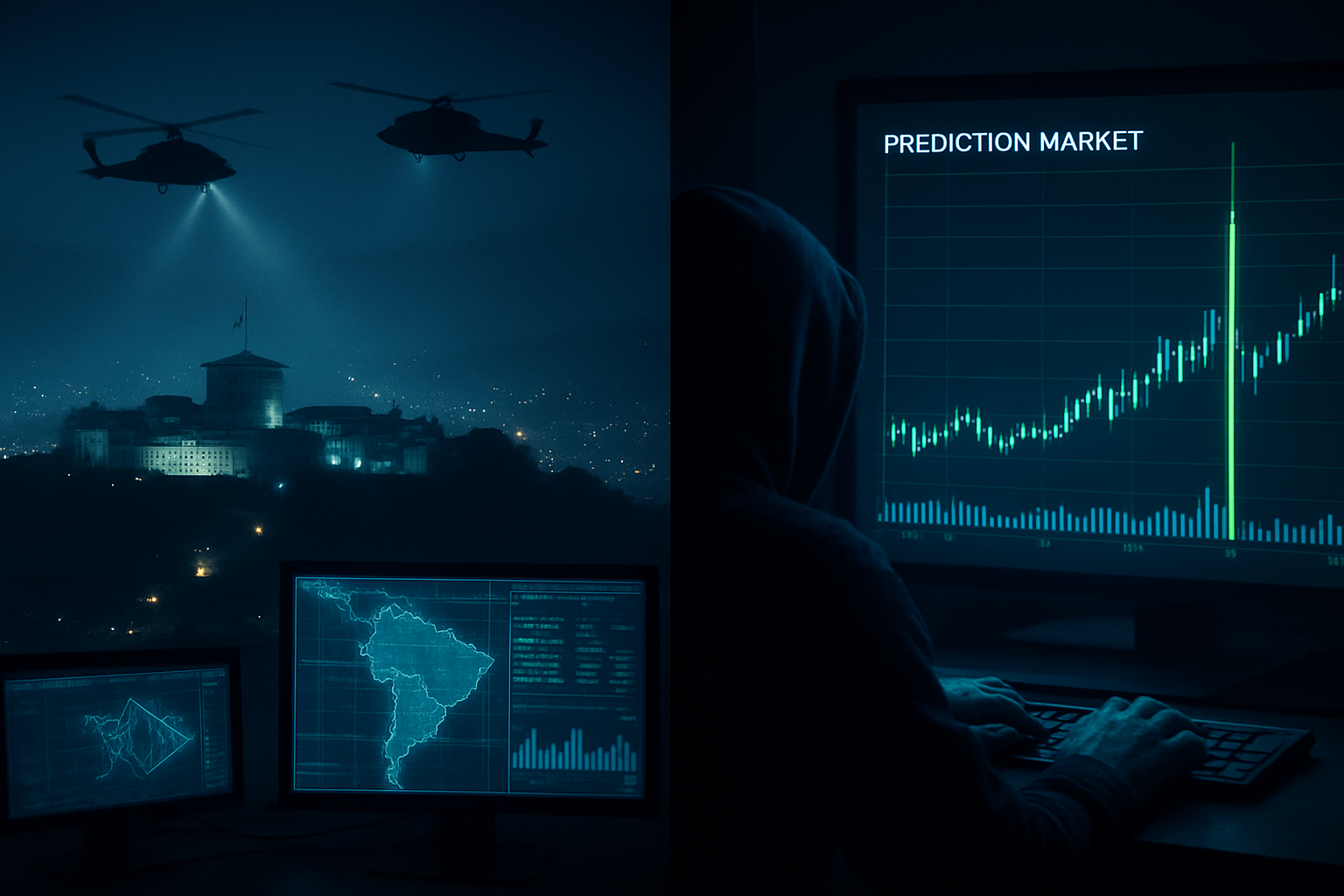
    The early morning of January 3, 2026, will be remembered as one of the most significant geopolitical shifts of the decade. As U.S. Army Delta Force commandos descended upon the Fort Tiuna military complex in Caracas to capture Nicolás Maduro, a parallel drama was unfolding in the digital corridors of decentralized finance. While the world slept, a series of high-stakes trades on Polymarket signaled the impending raid hours before the first explosion echoed through the Venezuelan capital.

    The successful capture of Maduro—now awaiting trial on narco-terrorism charges in New York—triggered a massive payout on one of the most controversial prediction contracts in history. With nearly half a million dollars flowing to a single anonymous trader who appeared to know the "unknowable," the event has ignited a firestorm of debate over the integrity of prediction markets, the potential for state-level insider trading, and the urgent need for new regulatory guardrails.

    The Market: What’s Being Predicted

    The focal point of the controversy was a Polymarket contract titled: "Will Nicolás Maduro be out of office by January 31, 2026?" For much of the latter half of 2025, this market was a quiet corner of the platform, with shares trading between $0.05 and $0.08. This pricing indicated that the broad market assigned less than an 8% probability to Maduro being removed from power, as geopolitical analysts viewed a direct military extraction as a "tail risk" that could destabilize the region.

    The resolution criteria for the contract were specific: Maduro had to be resigned, physically removed, captured by a foreign power, or otherwise rendered unable to exercise the powers of the presidency. Following the announcement of "Operation Absolute Resolve" by President Trump at 4:21 a.m. EST on January 3, the market quickly moved toward a $1.00 valuation. By the time Maduro was confirmed to be in custody aboard the USS Iwo Jima, the total trading volume for Maduro-related ouster markets across platforms had surged past $64 million.

    On the night of the raid, between 9:58 p.m. and 2:58 a.m. EST, the market witnessed an unprecedented anomaly. An anonymous user under the pseudonym "Burdensome-Mix" began aggressively buying "Yes" shares. This trader wagered approximately $32,537 on the low-probability outcome just hours before the Delta Force helicopters crossed the Venezuelan border. When the market resolved, the trader walked away with a staggering profit of $436,759.61—a return of more than 1,242%.

    Why Traders Are Betting

    The timing of the "Burdensome-Mix" trades has led many to believe that the bet was not based on public sentiment, but on classified military intelligence. The bulk of the positions were entered after the final strike authorization was reportedly signed but before the public—or even the Venezuelan military—was aware of the operation. This "pitch-perfect" conviction on a low-probability event has led to widespread allegations of "dark information" usage.

    While some traditional geopolitical analysts were caught off guard, the prediction markets were reacting in real-time. Proponents of these platforms argue that this is exactly how they are supposed to work: by aggregating all available information, including that held by people "in the know," to produce the most accurate forecast possible. Critics, however, argue that when the "information" is a top-secret military operation, the market ceases to be a forecasting tool and becomes a vehicle for laundering government secrets into personal profit.

    Furthermore, a secondary conflict erupted over an "invasion" market. While the ouster market paid out, a separate contract asking if the U.S. would "invade" Venezuela was ruled as "No" by the UMA oracle. The oracle determined that a "snatch-and-extract" mission by special forces did not meet the definition of an invasion, which typically requires a large-scale occupation of territory. This distinction left many "Yes" bettors frustrated, claiming the oracle manipulated the outcome to favor the house or high-volume liquidity providers.

    Broader Context and Implications

    The fallout from the "Maduro Bet" has reached the halls of Congress. Representative Ritchie Torres (D-N.Y.) recently introduced the Public Integrity in Financial Prediction Markets Act of 2026. The bill aims to close what Torres calls the "geopolitical loophole" by prohibiting federal elected officials, political appointees, and executive branch staff from trading on prediction markets if they possess material nonpublic information related to their official duties.

    The event has also highlighted the operational role of defense contractors in modern conflicts. During the raid, high-tech assets from companies like Lockheed Martin (NYSE: LMT), including F-35 stealth fighters used to suppress Venezuelan air defenses, were critical to the mission's success. The intersection of military hardware and digital betting software has created a new paradigm where the success of a $100 million aircraft can directly determine the winner of a $400,000 bet.

    This incident marks a turning point for the credibility of decentralized prediction markets. On one hand, Polymarket correctly "predicted" the event through its pricing mechanism, proving its utility as a leading indicator. On the other hand, the suspicion of insider trading and the semantic disputes over oracle resolutions have provided ammunition for regulators who wish to see these platforms brought under stricter oversight by the Commodity Futures Trading Commission (CFTC).

    What to Watch Next

    In the coming weeks, the focus will shift from the betting floor to the courtroom. The U.S. Department of Justice is reportedly investigating the "Burdensome-Mix" account to determine if the individual behind it has ties to the Department of Defense or the National Security Council. Any evidence linking the trades to a government employee could lead to the first major criminal prosecution for "prediction market insider trading."

    Additionally, the passage of Rep. Torres's bill remains a key milestone. If enacted, it would force platforms like Polymarket and Kalshi to implement more rigorous Know Your Customer (KYC) protocols to identify and block government employees from specific markets. The debate over whether an "extraction" counts as an "invasion" will also likely lead to a standardizing of contract language across the industry to avoid future "oracle disputes."

    Finally, eyes are on the upcoming legal proceedings for Maduro in the Southern District of New York. Markets are already forming around the length of his trial and the eventual verdict. Traders are closely watching for any signs of a plea deal, which could once again send shockwaves through the political prediction markets.

    Bottom Line

    The $400,000 Maduro payout is a watershed moment for prediction markets. It has demonstrated their uncanny ability to capture the "wisdom of the crowds" (or the knowledge of the few) with surgical precision. However, it has also exposed the significant ethical and legal risks inherent in betting on global security events.

    As we move further into 2026, the "Maduro Bet" will serve as the primary case study for the tension between transparency and security. While these markets provide invaluable data to the public, the risk of incentivizing the leak of classified information remains a daunting challenge for lawmakers and platform operators alike. For now, the "Burdensome-Mix" trader remains a symbol of the high stakes—and high suspicions—of the new era of geopolitical forecasting.


    This article is for informational purposes only and does not constitute financial or betting advice. Prediction market participation may be subject to legal restrictions in your jurisdiction.

    PredictStreet focuses on covering the latest developments in prediction markets.
    Visit the PredictStreet website at https://www.predictstreet.ai/.

  • The Rise of Corporate Prediction Markets: Betting on Meta AI, Amazon Layoffs, and Starbucks Strategy

    The Rise of Corporate Prediction Markets: Betting on Meta AI, Amazon Layoffs, and Starbucks Strategy

    As of January 21, 2026, the financial landscape has undergone a seismic shift. While traditional equity analysts still pore over balance sheets, a new breed of institutional and retail traders is looking elsewhere for an informational edge: prediction markets. Once dismissed as a niche interest for political junkies, platforms like Polymarket and Kalshi have evolved into high-volume "truth engines" where billion-dollar corporations are the primary subjects of speculation.

    The market has reached a fever pitch this week, with daily turnover hitting a record $814 million. Traders are no longer just betting on who will win the next election; they are wagering on the internal mechanics of Silicon Valley and the strategic pivots of Fortune 500 giants. From the release date of Meta Platforms, Inc. (NASDAQ:META) next AI model to the exact number of pink slips at Amazon.com, Inc. (NASDAQ:AMZN), the "wisdom of the crowd" is now being priced in real-time, often moving ahead of official press releases.

    The Market: What's Being Predicted

    The current landscape of corporate prediction markets is dominated by two giants: the decentralized powerhouse Polymarket and the CFTC-regulated Kalshi. Polymarket, recently buoyed by a landmark $2 billion investment from the Intercontinental Exchange, Inc. (NYSE:ICE), has become the go-to for speculative tech releases. Currently, the market for "Meta releases Llama 5 in 2025?" has seen substantial volume, while a specialized contract for the Meta "Mango" model is trading at a staggering 88% probability for a June 30 release.

    Meanwhile, Kalshi has leveraged its integration with Robinhood Markets, Inc. (NASDAQ:HOOD) to bring "Event Contracts" to over 10 million retail users. These markets are granular; for instance, traders are currently betting on whether Starbucks Corporation (NASDAQ:SBUX) CEO Brian Niccol will use the phrase "Smart Queue" in the next earnings call (65% probability) or if the company will announce a major international acquisition by the end of Q2.

    The volume in these specific corporate markets has skyrocketed, with combined trading volumes exceeding $37 billion in 2025. This liquidity has turned prediction markets into a viable alternative to traditional derivatives, with some contracts resolving in hours while others track long-term metrics like Amazon's robot-to-human ratio in its fulfillment centers.

    Why Traders Are Betting

    The primary driver behind this surge is the search for "alpha"—the excess return on an investment. Institutional desks at firms like The Goldman Sachs Group, Inc. (NYSE:GS) and Susquehanna International Group are increasingly using these markets to identify what analysts call the "Certainty Gap." This occurs when prediction markets price an event with high confidence while traditional futures or options markets remain sluggish.

    For example, early in 2026, prediction markets showed a 96% certainty of a Federal Reserve pause, while traditional interest-rate futures were only pricing in a 16% chance. Traders who followed the prediction market signal were able to front-run moves in interest-rate-sensitive stocks. In the corporate sector, "information leakage" is a significant factor. On Polymarket, large "whale" positions often appear hours before major corporate news breaks, leading many to believe that insiders are using the platforms to monetize their knowledge anonymously.

    Furthermore, these markets provide a hedge against corporate PR. While a company like Amazon.com, Inc. (NASDAQ:AMZN) might emphasize "workforce optimization," a prediction market contract for "15,000+ additional layoffs by May 2026" provides a cold, hard probability that tells a different story. Traders are betting because the price of a contract is often a more accurate reflection of reality than a sanitized corporate statement.

    Broader Context and Implications

    The rise of these markets marks the institutionalization of collective intelligence. The Digital Asset Market CLARITY Act of 2025 was a turning point, reclassifying many event contracts as commodity swaps and providing a stable regulatory framework in the U.S. This was further bolstered by the CFTC’s "Future-Proof" initiative in early 2026, which officially recognized prediction markets as valid tools for "price discovery" rather than mere gambling.

    However, the implications are not purely financial. These markets serve as a public sentiment gauge that can impact a company's reputation and its stock price. When a market for a Starbucks Corporation (NASDAQ:SBUX) operational failure gains traction, it can force leadership to respond before the issue even hits the mainstream press. This creates a feedback loop where the market doesn't just predict the future—it potentially influences it.

    Despite the progress, the sector faces a "patchwork" of legal challenges. While federal regulators have softened their stance, several U.S. states, including Nevada and Massachusetts, have issued cease-and-desist orders against platforms offering sports-adjacent or "socially detrimental" contracts. These legal battles are expected to reach the Supreme Court later this year, which could determine the ultimate ceiling for the industry.

    What to Watch Next

    As we move further into 2026, the upcoming Q1 earnings season will be the next major catalyst. Watch for a flurry of activity in "keyword" markets—contracts that pay out based on specific phrases used by CEOs during earnings calls. These are often seen as proxies for internal confidence in new initiatives, such as Meta's AGI (Artificial General Intelligence) timeline or Starbucks' turnaround strategy.

    Additionally, keep an eye on the resolution of the Amazon "Automation Blueprint" contracts. As the company pushes toward its goal of replacing 600,000 roles with autonomous models like Proteus by 2033, the prediction markets tracking the deployment of these robots are becoming essential reading for labor analysts and tech investors alike.

    Finally, the potential for a "Black Swan" event—like the sudden geopolitical shift seen earlier this month with the capture of Nicolás Maduro—could trigger massive volatility in these markets. Such events test the liquidity and resilience of decentralized platforms like Polymarket, proving whether they can handle the volume of a true global crisis.

    Bottom Line

    The evolution of corporate prediction markets on platforms like Polymarket and Kalshi represents a fundamental change in how information is valued and traded. No longer are "insider" insights or deep-dive research the sole province of elite hedge funds; the price of a contract now offers a democratized, real-time probability of everything from tech launches to mass layoffs.

    As a tool, these markets are proving to be remarkably accurate, often outperforming traditional forecasting models by cutting through the noise of corporate communications. For companies like Meta, Starbucks, and Amazon, the existence of these markets means they are being watched more closely than ever before—not just by regulators or journalists, but by a global network of traders putting their money where their conviction is.

    Whether you are a retail trader on Robinhood or a portfolio manager at a major bank, the message is clear: the most valuable data point for the future of a company might no longer be in its SEC filings, but on a prediction market dashboard.


    This article is for informational purposes only and does not constitute financial or betting advice. Prediction market participation may be subject to legal restrictions in your jurisdiction.

    PredictStreet focuses on covering the latest developments in prediction markets.
    Visit the PredictStreet website at https://www.predictstreet.ai/.
  • The Nobel Leak: How Prediction Markets Unmasked the 2025 Peace Prize

    The Nobel Leak: How Prediction Markets Unmasked the 2025 Peace Prize

    OSLO — In the high-stakes world of international diplomacy, few secrets are as guarded as the deliberations of the Norwegian Nobel Committee. For over a century, the 50-year seal of secrecy has been considered a fortress. But on October 10, 2025, that fortress was breached not by a disgruntled staffer or a whistleblower, but by the relentless, cold logic of a decentralized prediction market.

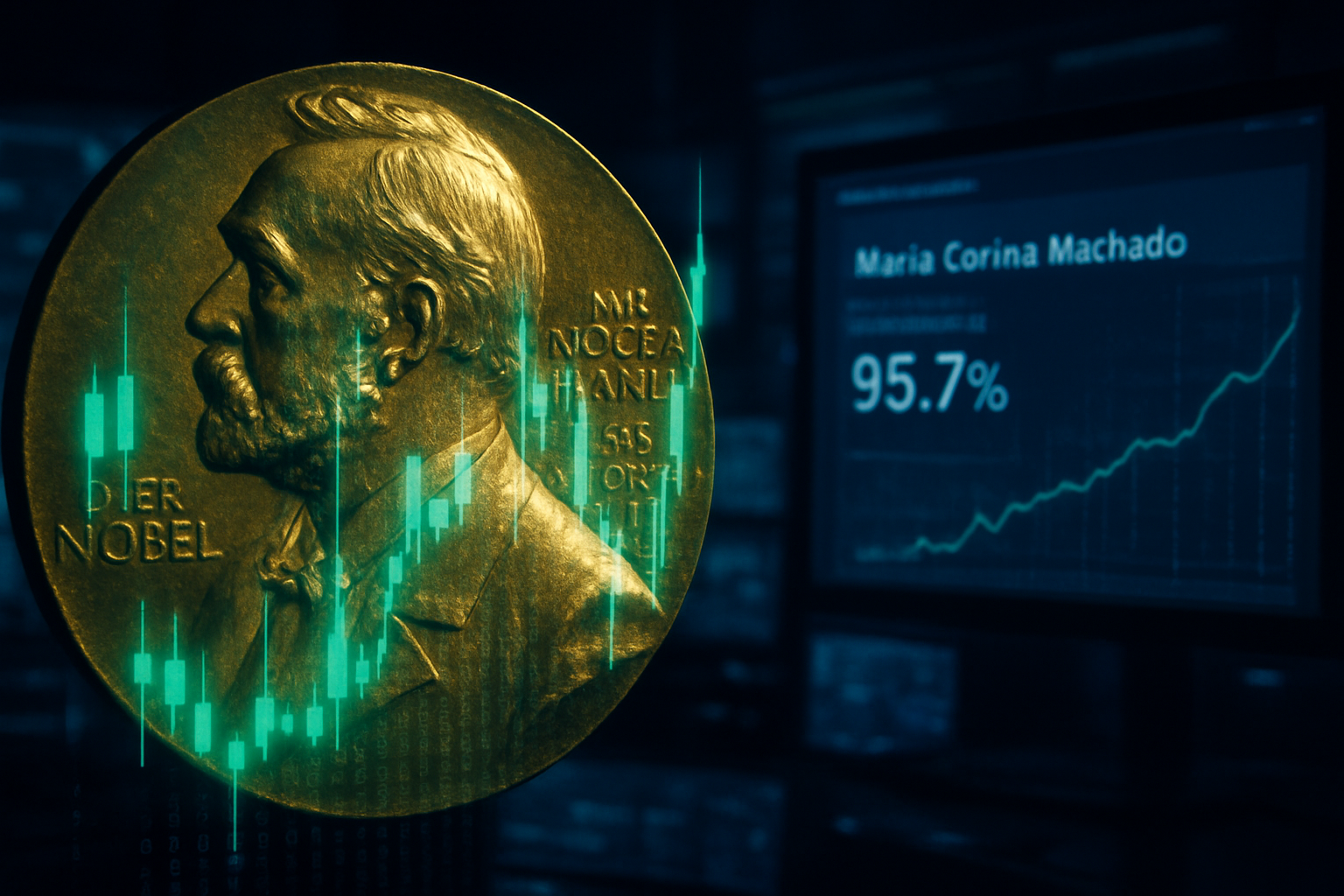
    When Venezuelan opposition leader Maria Corina Machado was announced as the winner of the 2025 Nobel Peace Prize, the world cheered—but prediction market traders had already spent the last 11 hours celebrating. On Polymarket, the world’s largest decentralized forecasting platform, Machado’s odds had undergone a violent, vertical ascent from a 4% long-shot to a 73% mathematical certainty just hours before the official reveal in Oslo. This "leak in the odds" has since triggered a sweeping international investigation into systematic espionage and the future of institutional secrecy in the age of real-time information markets.

    The Market: What's Being Predicted

    The market in question, "Winner of the 2025 Nobel Peace Prize," was one of the most active non-political contracts on Polymarket last year. For months, the market was characterized by low liquidity and high uncertainty, with a diverse field of candidates including the UNRWA, the International Court of Justice, and several climate activists. Up until the evening of October 9, Machado was trading at roughly $0.04, reflecting a measly 4% probability of winning.

    However, the dynamics shifted overnight. A massive influx of buy orders—totaling hundreds of thousands of dollars—slammed the Machado contract. Within a six-hour window, the price per share (which pays out $1.00 if the outcome is correct) soared to $0.73. Trading volume, which had been stagnant for weeks, exploded as "sharp" capital entered the fray. By the time the Norwegian Nobel Committee stepped to the podium, the market had effectively "solved" the prize, leaving the official announcement as a mere formality for the bettors who had already positioned themselves.

    Why Traders Are Betting

    The investigation, led by Nobel Institute Director Kristian Berg Harpviken, has focused on a handful of high-conviction accounts that "front-ran" the news. Forensic blockchain analysis highlighted three specific users: "6741", "dirtycup", and "GayPride".

    Account "6741," a wallet created only 24 hours prior to the surge, successfully turned a $2,000 bet into a $53,000 windfall. "Dirtycup," a more established whale, wagered nearly $70,000 on Machado when her odds were still below 15%, netting a profit of approximately $30,000. These trades were characterized by "toxic flow"—informed capital that moves ahead of public news, usually indicating access to non-public information.

    While initial theories suggested a human "mole" within the Nobel Committee or its small staff, the investigation's focus shifted toward "systematic espionage." Harpviken recently told Norwegian broadcaster TV2 that the Institute likely fell prey to a sophisticated cyber breach. Speculation has grown that intelligence agencies or sophisticated hacking groups may have intercepted digital communications between committee members, subsequently monetizing that intelligence on Polymarket to fund operations or simply capitalize on the breach.

    Broader Context and Implications

    This incident represents a watershed moment for prediction markets. Traditionally, markets like Polymarket have been praised for their ability to aggregate public information more efficiently than polls or pundits. However, the Nobel leak demonstrates that these markets can also act as "whistleblowers of information asymmetry," exposing when a secret has been compromised.

    The real-world implications are unsettling for traditional institutions. If a century-old secret can be decoded by a few anonymous wallets on a blockchain, the "50-year seal" of the Nobel Committee becomes effectively obsolete. Critics argue that prediction markets incentivize corporate and political espionage, while proponents, including those at Alphabet Inc. (NASDAQ: GOOGL) and other data-centric firms, argue that these markets merely reflect an inevitable reality: in 2026, there is no such thing as a digital secret.

    The Nobel Institute has since announced a partnership with cybersecurity firms, including CrowdStrike Holdings, Inc. (NASDAQ: CRWD), to conduct a comprehensive audit of their communication protocols. This move highlights how prediction markets are forcing a radical rethink of security even in non-financial sectors.

    What to Watch Next

    As we look toward the 2026 prize cycle, all eyes will be on the "Price of Secrecy." The Nobel Committee is expected to implement "analog-only" deliberation sessions, banning all digital devices from the room to prevent the kind of signal interception suspected in the Machado case.

    Furthermore, the Norwegian government is under pressure to coordinate with international regulators to determine if this type of "insider trading" on decentralized platforms can be prosecuted. Watch for any movements from the U.S. Securities and Exchange Commission or European equivalents regarding the status of "event contracts" as financial instruments. If the investigation identifies the owners of the "6741" or "dirtycup" accounts, it could lead to a landmark legal battle over the definition of insider trading in a decentralized world.

    Bottom Line

    The 2025 Nobel Peace Prize leak investigation has proven that prediction markets are no longer just a hobby for political junkies—they are a disruptive force capable of shaking the foundations of global institutions. The Machado surge was a "smoking gun" that revealed a breach of secrecy before the victims even knew they had been compromised.

    Ultimately, this saga tells us that prediction markets are the ultimate truth-seekers. They don't care about tradition, seals of secrecy, or diplomatic decorum; they only care about accuracy. While the Nobel Committee struggles to regain its aura of mystery, the traders on Polymarket are already looking toward the next "impossible" secret to solve. For now, the most likely outcome is that the era of the "big reveal" is over, replaced by a world where the odds always know the winner first.


    This article is for informational purposes only and does not constitute financial or betting advice. Prediction market participation may be subject to legal restrictions in your jurisdiction.

    PredictStreet focuses on covering the latest developments in prediction markets.
    Visit the PredictStreet website at https://www.predictstreet.ai/.
  • The Titans Have Arrived: FanDuel and DraftKings Disrupt the Prediction Market Arena

    The Titans Have Arrived: FanDuel and DraftKings Disrupt the Prediction Market Arena

    The landscape of American forecasting shifted fundamentally this winter as the industry's two largest heavyweights, FanDuel and DraftKings, officially entered the prediction market space. Moving beyond point spreads and over-unders, these legacy sportsbooks have launched dedicated "event contract" platforms—FanDuel Predicts and DraftKings Predictions—to capture a share of the exploding interest in political and economic wagering.

    The entry comes as the 2026 midterm election cycle begins to heat up, with markets for House and Senate control already seeing tens of millions in liquidity. While Polymarket dominated the 2024 cycle from offshore and Kalshi fought the legal battles to domesticate the industry, the arrival of the sports betting giants represents a "mass-market moment." Traders are currently pricing the probability of a Republican-held House after the 2026 midterms at roughly 54% on FanDuel Predicts, a figure that has seen a sharp 4% uptick in volatility over the last 48 hours following recent economic data releases.

    The Market: What's Being Predicted

    The primary products on offer are CFTC-regulated event contracts. Unlike traditional sports bets, which are governed by state-level gaming boards, these markets are structured as financial derivatives. FanDuel, owned by Flutter Entertainment (NYSE: FLUT), launched its platform on December 22, 2025, through a strategic partnership with the CME Group. Meanwhile, DraftKings (Nasdaq: DKNG) fast-tracked its entry by acquiring Railbird Technologies, a CFTC-licensed exchange, for $250 million in late 2025.

    These platforms are currently listing a wide array of "Yes/No" binary contracts. While political outcomes—such as the 2026 midterms and early 2028 presidential nominees—are the headline grabbers, the volume is surprisingly high in non-political sectors. Currently, traders are active in markets regarding the Federal Reserve’s March interest rate decision, monthly CPI prints, and even cultural events like the 2026 Academy Award winners.

    The liquidity on these platforms is growing at an unprecedented rate. DraftKings Predictions reported a trading volume of over $120 million in its first month, largely due to its integration with the existing DraftKings ecosystem. This allows millions of casual users to shift their "sports bankroll" into event contracts with a single tap. The resolution criteria are strictly tied to verified data sources, such as official government reports or certified election results, ensuring a level of transparency that mirrors traditional financial markets.

    Why Traders Are Betting

    The sudden migration of capital toward these legacy platforms is driven by a "Trojan horse" strategy. Because event contracts are regulated as derivatives by the Commodity Futures Trading Commission (CFTC), FanDuel and DraftKings are now able to offer "sports-themed" contracts in states where traditional sports betting remains illegal, most notably California and Texas. Traders in these states are flocking to "Predictive Sports" contracts—financial derivatives based on seasonal outcomes rather than individual game lines—which are legally distinct from gambling.

    Institutional players and "whales" are also beginning to favor these legacy platforms over crypto-native alternatives like Polymarket due to the ease of fiat on-ramps and the security of US-based regulation. Analysts note that large-scale positions are being taken by hedge funds using these markets as a hedge against political instability. For example, a significant buy-wall has emerged on FanDuel Predicts for "No" on the passage of a controversial federal tax bill, serving as an insurance policy for corporate entities that would be adversely affected by the legislation.

    This shift marks a departure from traditional polling and forecasting methods. While legacy pollsters struggled with accuracy in the 2024 cycle, prediction markets provided real-time, skin-in-the-game data that proved more resilient. The sportsbooks are capitalizing on this by marketing their platforms as "The Pulse of the Nation," attracting users who view themselves as armchair analysts rather than gamblers.

    Broader Context and Implications

    The entry of legacy sportsbooks is a direct result of the legal precedent set by Kalshi in 2024. After Kalshi successfully sued the CFTC to allow election markets, the floodgates opened for any regulated exchange to follow suit. This has led to a major regulatory evolution under the new market-friendly leadership at the CFTC in early 2026, which has pivoted from trying to ban these markets to establishing a robust framework for their operation.

    However, this expansion has not been without friction. The ability of FanDuel and DraftKings to operate in California and Texas via the "event contract" loophole has sparked intense legal battles with California gaming tribes. These tribes argue that the sportsbooks are bypassing tribal sovereignty by offering what is functionally gambling under the guise of financial trading. The outcome of these challenges could define the future of the industry for decades.

    Historically, the entry of major incumbents into a disruptive space often leads to the "institutionalization" of the asset class. Just as the launch of Bitcoin ETFs by major asset managers signaled a new era for crypto, the entry of Flutter Entertainment and DraftKings has legitimized prediction markets as a mainstream financial tool. This has forced early pioneers like Polymarket to refine their offerings, focusing more on global, decentralized markets that legacy US-regulated firms cannot touch.

    What to Watch Next

    The most immediate milestone to monitor is the "Super Tuesday" of event markets: the 2026 Midterm Primary season. As candidates are finalized, the volatility in "Control of the House" contracts is expected to spike. If the legacy sportsbooks can maintain high liquidity during this period, it will prove their dominance over the niche, retail-heavy platforms that came before them.

    Additionally, keep a close eye on the "2028 Presidential Nomination" markets. Unlike the 2024 cycle, which saw massive volume only in the months leading up to the election, the 2028 markets are already seeing millions in "early bird" trades. DraftKings has hinted at launching a "Candidate Index," a basket of contracts that allows traders to bet on the overall direction of a political party's momentum.

    The legal front also remains critical. A pending decision in the California Supreme Court regarding the "Event Contract vs. Gambling" distinction is expected by late spring 2026. A ruling in favor of the sportsbooks could cement their presence in California indefinitely, while an adverse ruling might force a messy withdrawal from one of the world's largest economies.

    Bottom Line

    The arrival of FanDuel and DraftKings into the prediction market space is the final signal that "betting on the news" has moved from the fringes of the internet to the center of the American economy. By leveraging their massive existing user bases and navigating the complex CFTC regulatory environment, these companies are effectively democratizing sophisticated financial hedging for the average person.

    This evolution confirms that prediction markets are more than just a novelty; they are an essential tool for price discovery in an increasingly volatile world. As liquidity continues to pool into these regulated exchanges, the "wisdom of the crowd" becomes more accurate, providing a real-time sentiment gauge that no poll or pundit can match.

    For the investor and the trader, the takeaway is clear: the distinction between "sports betting" and "financial trading" is blurring. Whether the market is the final score of a game or the final tally of an election, the underlying mechanism is the same—and the giants of the industry are now the ones setting the odds.


    This article is for informational purposes only and does not constitute financial or betting advice. Prediction market participation may be subject to legal restrictions in your jurisdiction.

    PredictStreet focuses on covering the latest developments in prediction markets.
    Visit the PredictStreet website at https://www.predictstreet.ai/.
  • The Greenland Gamble: Polymarket Traders Price in a 20% Chance of U.S. Acquisition Amid Trump Tariff Threats

    The Greenland Gamble: Polymarket Traders Price in a 20% Chance of U.S. Acquisition Amid Trump Tariff Threats

    As of January 21, 2026, the world of prediction markets is fixated on an audacious geopolitical wager: the "Greenland Gamble." On the decentralized platform Polymarket, traders are currently pricing in a 20% to 23% probability that the United States will successfully acquire Greenland by the end of 2026. This surge in betting activity follows a series of aggressive diplomatic and economic maneuvers by the second Trump administration, which has effectively tied the island's sovereignty to the future of transatlantic trade.

    The market has become a focal point for political analysts and investors alike, as it represents a real-time sentiment gauge on President Donald Trump’s "transactional" foreign policy. Just this morning, during a keynote address at the World Economic Forum in Davos, Switzerland, the President reiterated his intent to "once again discuss the acquisition of Greenland," framing it as a necessity for American national security and a hedge against Chinese expansion in the Arctic. With over $13.8 million in trading volume, the Greenland market is no longer a fringe curiosity; it is a high-stakes arena where the future of international borders is being traded in real-time.

    The Market: What's Being Predicted

    The primary vehicle for this speculation is the Polymarket contract titled "Will the U.S. acquire Greenland by the end of 2026?" The rules for resolution are stringent. To trigger a "Yes" payout, there must be a formal transfer of sovereignty—such as a signed treaty, ratified legislation by both the U.S. and Denmark, or a clear legal instrument of sale—on or before December 31, 2026. Notably, the market explicitly excludes scenarios where the U.S. merely secures additional military basing rights, long-term leases, or "joint administration" agreements that do not involve a total change in territorial ownership.

    The odds have undergone a dramatic transformation over the last few months. In late 2025, the market hovered in the low single digits, with most participants viewing the proposal as a relic of Trump’s first term. However, the probability spiked following the January 17, 2026, announcement of a tiered tariff system targeting European nations. Liquidity in the market remains robust, with individual "whale" positions reaching hundreds of thousands of dollars, suggesting that some institutional-level traders believe the Danish government’s resolve may have a price.

    Why Traders Are Betting

    The 20% probability is largely driven by what traders call the "Tariff Bazooka." On January 17, President Trump announced via Truth Social that a 10% tariff would be imposed on eight European nations—including Denmark, France, and Germany—beginning February 1, 2026. He warned that these rates would jump to 25% by June if a "Complete and Total purchase" of Greenland was not finalized. For traders, this creates a binary outcome: either Denmark yields to economic pressure, or the U.S. risks a full-scale trade war with the European Union.

    Beyond trade leverage, the strategic importance of Greenland’s mineral wealth is fueling the "Yes" side of the trade. Companies like Critical Metals Corp (Nasdaq: CRML) have seen their stock prices skyrocket—CRML is up 154% since the start of the year—as the U.S. Export-Import (EXIM) Bank signaled interest in a $120 million loan for the Tanbreez rare-earth project. Similarly, Greenland Resources Inc. (TSX: MOLY) has become a proxy for the island's value, as its Malmbjerg Molybdenum Project is central to the manufacture of high-strength defense steel. Traders betting "Yes" believe that the U.S. administration views Greenland not just as land, but as a critical supply chain asset that is "too big to leave to the Danes."

    Broader Context and Implications

    The "Greenland Gamble" highlights a growing trend in prediction markets: their use as a hedge against radical geopolitical shifts. If the U.S. were to actually acquire the territory, it would be the most significant expansion of American borders since the 1867 purchase of Alaska. However, the obstacles remain formidable. Danish Prime Minister Mette Frederiksen has repeatedly called the proposal "absurd," and the European Union has threatened to trigger its "Anti-Coercion Instrument," which would allow for massive retaliatory tariffs on American goods.

    Historically, prediction markets have often been more accurate than traditional pundits because they force participants to "put their money where their mouth is." In this case, the 20% odds suggest that while the "sale" is unlikely, it is no longer impossible. The market reflects a world where traditional norms of sovereignty are being challenged by economic might. It also underscores a shift in how the public views Greenland—no longer as an autonomous territory of Denmark, but as a "real estate deal" in a new era of Great Power competition.

    What to Watch Next

    The immediate milestone for this market is February 1, 2026, the date the first 10% tariffs are scheduled to go into effect. If the Trump administration follows through with the implementation, traders expect the Polymarket odds to climb toward 30% as the economic pressure on Copenhagen intensifies. Conversely, any joint statement from NATO or a successful EU retaliatory package could send the "Yes" shares tumbling.

    Another key factor is the internal politics of Greenland itself. Greenland’s Prime Minister, Jens-Frederik Nielsen, has maintained that the island is "not for sale." However, the U.S. has been increasing its "soft power" presence in the capital, Nuuk, through increased diplomatic staff and promises of massive infrastructure investment. Any shift in the Greenlandic Parliament’s stance toward "independence followed by a U.S. compact" would be a massive catalyst for market movement.

    Bottom Line

    The 20% probability of a Greenland acquisition represents a significant "Trump Premium"—a belief that the former developer's unorthodox and aggressive negotiating tactics can achieve what traditional diplomacy cannot. While the Danish government remains officially opposed, the massive volume on Polymarket suggests that a sizeable portion of the financial world is taking the threat of a trade-for-territory swap seriously.

    Ultimately, the Greenland market serves as a fascinating case study in the power of prediction markets to quantify geopolitical risk. Whether the "Gamble" pays off or resolves to zero, the 20% odds currently reflect a world that is bracing for a fundamental reorganization of the Arctic. For now, the eyes of the world remain on the February 1st tariff deadline, which will likely serve as the first true test of this extraordinary 21st-century land deal.


    This article is for informational purposes only and does not constitute financial or betting advice. Prediction market participation may be subject to legal restrictions in your jurisdiction.

    PredictStreet focuses on covering the latest developments in prediction markets. Visit the PredictStreet website at https://www.predictstreet.ai/.
  • The Empire State’s Existential Bet: Will New York Shutdown the Prediction Market Boom?

    The Empire State’s Existential Bet: Will New York Shutdown the Prediction Market Boom?

    As the 2026 legislative session kicks off in Albany, the future of the prediction market industry in the United States is being decided not in a courtroom or on a trading floor, but in the halls of the New York State Assembly. The Oversight and Regulation of Activity for Contracts Linked to Events (ORACLE) Act, also known as Assembly Bill A9251, has emerged as the most significant threat to the burgeoning "event contract" sector since its mainstream explosion in 2024.

    Currently, decentralized markets on platforms like Polymarket are pricing in a 64% probability that New York will successfully enact a ban on key prediction categories by the end of 2026. This legislative surge follows a period of rapid growth and high-profile controversy, most notably a series of trades linked to geopolitical events that have lawmakers questioning whether these platforms are "truth machines" or high-stakes casinos for insider trading.

    The Market: What's Being Predicted

    The legislative battle in New York has become a market in its own right. On Polymarket, the world’s largest decentralized prediction platform, tens of millions of dollars are riding on the outcome of "New York Ban" contracts. These markets surged to a 64% "Yes" probability in mid-January 2026, immediately following the re-introduction of the ORACLE Act (A9251) on January 7.

    The bill, sponsored by Assemblymember Clyde Vanel (D-Queens), is often referred to by industry insiders as the "Nuclear Option." If passed, it would classify prediction market trading on politics, sports, and "catastrophic events"—such as wars or mass shootings—as unlicensed gambling. The penalties are draconian: any platform failing to comply with a court-ordered injunction would face a staggering $1 million per day fine.

    While the "ban" side remains the favorite on decentralized platforms, the outlook on regulated exchanges like Kalshi tells a more nuanced story. A proxy market on Kalshi reflecting the state’s regulatory climate saw the probability of a ban drop from 65% to 38% in the third week of January. This volatility is largely attributed to a competing, more moderate piece of legislation: Senate Bill S8889. Introduced by Senator Jeremy Cooney, S8889 seeks to license and tax prediction markets under the New York Department of Financial Services (DFS), treating them as financial derivatives rather than gambling.

    Why Traders Are Betting

    The primary driver behind the ORACLE Act’s momentum is the "insider trading" narrative. Lawmakers in Albany have been fixated on the so-called "Maduro Trade" of early January 2026, where a single Polymarket whale allegedly turned a $32,000 position into $400,000 just hours before a U.S.-led operation in Venezuela. Assemblymember Vanel has used this incident as a rallying cry, arguing that these markets invite "corruption and the gamification of tragedies."

    However, institutional "whales" are increasingly betting on a compromise. Notable large-scale positions have recently been taken on the "No Ban" side, fueled by several key factors:

    • Industry Pushback: A newly formed "Coalition for Prediction Markets," led by Interactive Brokers (NASDAQ: IBKR) and Robinhood (NASDAQ: HOOD), has launched a massive lobbying effort in Albany. They argue that banning these markets would drive innovation out of the world’s financial capital.
    • The "MSG Strategy": In a bold attempt to win over public sentiment, Polymarket recently signed a sponsorship deal with the New York Rangers, displaying live event odds on the scoreboards at Madison Square Garden. Traders believe this "normalization" strategy makes a total ban politically difficult for Governor Kathy Hochul.
    • Federal Preemption: Legal experts betting on the "No" side believe that because platforms like Kalshi are regulated by the Commodity Futures Trading Commission (CFTC), federal law will ultimately override (or "preempt") state-level bans under the Commodity Exchange Act.

    Broader Context and Implications

    The New York battle is a microcosm of a larger national struggle over the definition of "gambling" versus "hedging." For years, prediction markets operated in a gray area, but the recent entry of major public firms has forced the issue. DraftKings (NASDAQ: DKNG) and Flutter Entertainment (NYSE: FLUT), the parent company of FanDuel, have recently split from traditional gaming trade groups to support a regulated prediction market framework, signaling that the line between sports betting and financial forecasting is permanently blurring.

    If the ORACLE Act passes in its current form, it could set a dangerous precedent for other states. New York’s aggressive stance contrasts sharply with states like New Jersey and Illinois, which are exploring ways to tax these markets as a new revenue stream. For the industry, New York is the "must-win" state. A ban here would not only lock out a massive retail market but would also threaten the liquidity and accuracy of global contracts that rely on the participation of New York-based financial professionals.

    The debate also reveals a fundamental shift in how the public consumes information. Proponents, including IBKR Chairman Thomas Peterffy, describe these markets as "Truth Discovery Engines" that outperform traditional polling and expert analysis. Critics, meanwhile, view them as an unregulated "Wild West" that incentivizes bad actors to profit from chaos.

    What to Watch Next

    The next 60 days will be critical for the ORACLE Act. Traders are closely monitoring the Assembly Committee on Consumer Affairs and Protection, where A9251 is currently being debated. A vote to move the bill out of committee would likely send the "Ban" odds back toward the 80% range.

    Key dates to watch:

    • February 24, 2026: A major ruling is expected in the Southern District of New York (SDNY) regarding Kalshi’s ongoing litigation with the New York Gaming Commission. This court case will serve as a bellwether for whether the state has the legal authority to override federal oversight.
    • The Budget Deadline (April 1, 2026): Governor Kathy Hochul has signaled a desire to "safeguard" the public from gamified finance. If she includes language from the ORACLE Act in her executive budget, it would be a near-certain sign that a ban is coming.
    • The Cooney Bill Hearings: Keep an eye on Senator Cooney’s S8889. If this bill gains support from the Department of Financial Services, it could offer a "third way" that keeps prediction markets legal but strictly regulated.

    Bottom Line

    The legislative fight in New York represents a defining moment for prediction markets. On one side, the ORACLE Act seeks to slam the door shut on what it views as a predatory and dangerous new form of gambling. On the other, a coalition of fintech giants and retail traders is fighting to preserve a tool they believe is essential for the 21st-century information economy.

    As of late January 2026, the markets remain split. While the political momentum in the Assembly favors a ban, the sheer weight of the financial and legal arguments from firms like Interactive Brokers (NASDAQ: IBKR) and Robinhood (NASDAQ: HOOD) suggests that a total shutdown is far from guaranteed. For now, the safest bet is that New York’s regulatory landscape is about to get much more complicated, and the "truth" about these markets will be decided by the highest bidder in Albany.


    This article is for informational purposes only and does not constitute financial or betting advice. Prediction market participation may be subject to legal restrictions in your jurisdiction.

    PredictStreet focuses on covering the latest developments in prediction markets.
    Visit the PredictStreet website at https://www.predictstreet.ai/.
  • Betting on the Law: Why the ‘Maduro Trade’ Has Prediction Markets Bracing for Federal Oversight

    Betting on the Law: Why the ‘Maduro Trade’ Has Prediction Markets Bracing for Federal Oversight

    As of January 21, 2026, the fast-evolving world of "Information Finance" is facing its most significant legislative reckoning to date. Congressman Ritchie Torres (D-NY) has officially introduced the Public Integrity in Financial Prediction Markets Act of 2026 (H.R. 7004), a bill designed to bring the ethics of Wall Street to the burgeoning world of event contracts. The move follows a month of intense scrutiny after a series of suspiciously well-timed bets on the platform Polymarket sparked a national conversation about insider trading in geopolitical forecasting.

    Currently, the market's own participants are skeptical about the bill's chances. On PredictIt, the contract for "Will H.R. 7004 pass in 2026?" is trading at a mere 12 cents, implying just a 12% probability of becoming law before the end of the year. Despite the low odds, the bill has become a focal point for traders and regulators alike, as it represents the first major attempt to codify a "STOCK Act" for the prediction market industry.

    The Market: What's Being Predicted

    The PredictIt market tracking the passage of the Torres bill has seen a surge in volume over the last ten days, following the bill's formal introduction on January 9. While the 12% probability suggests a uphill battle, the market is highly liquid, with hundreds of thousands of shares changing hands as traders weigh the legislative appetite for regulation in a midterm election year.

    The bill, backed by high-profile co-sponsors including Speaker Emerita Nancy Pelosi, specifically targets "covered individuals"—which includes federal elected officials, political appointees, and congressional staff. It seeks to prohibit these individuals from trading on event contracts tied to government policy or actions if they possess material non-public information. On the regulated exchange Kalshi, a secondary market has emerged regarding whether the Commodity Futures Trading Commission (CFTC) will independently adopt similar rules by year-end, currently trading at a slightly more optimistic 20% probability.

    Why Traders Are Betting

    The primary catalyst for this legislative push was the so-called "Maduro Trade." On January 3, 2026, just hours before the Trump Administration announced the successful capture of Venezuelan leader Nicolás Maduro, an anonymous account on Polymarket placed a $32,537 bet that Maduro would be out of power by the end of the month. The trade netted over $400,000, fueling allegations that a government or military insider leaked the timing of the raid to profit on the platform.

    Traders are currently split into two camps. The "No" voters (holding the 88% majority) argue that a divided Congress is unlikely to reach a consensus on such a niche issue during an election cycle. They point to the complexity of defining "material non-public information" in the context of global events. Conversely, the "Yes" bulls believe the optics of the "Maduro Trade" are too toxic for politicians to ignore, and that a bipartisan coalition could form to "clean up" the markets before more scandals emerge.

    There is also a significant strategic divide between platforms. Kalshi CEO Tarek Mansour has expressed support for the bill, noting that regulated U.S. platforms already have internal prohibitions on insider trading. By contrast, decentralized and offshore platforms like Polymarket—which have recently faced scrutiny for accurate betting patterns ahead of the Golden Globes—stand to lose the most from federal enforcement.

    Broader Context and Implications

    The Torres bill arrives at a time when prediction markets are transitioning from niche hobbies to mainstream financial tools. Major retail platforms like Robinhood Markets, Inc. (NASDAQ:HOOD) and Interactive Brokers Group, Inc. (NASDAQ:IBKR) through its ForecastEx exchange, have aggressively expanded their event contract offerings throughout 2025. This institutionalization has brought increased pressure from state regulators.

    In just the first three weeks of 2026, Tennessee and Connecticut have issued cease-and-desist orders against several platforms for offering sports-related contracts without gaming licenses. In New York, Assemblymember Clyde Vanel is pushing the ORACLE Act, which would strictly limit the types of events New Yorkers can bet on. The federal Torres bill is seen by some as a way to provide a unified national framework that could preempt a "patchwork" of confusing state laws.

    Historically, prediction markets have been remarkably accurate at forecasting legislative outcomes, often outperforming traditional pundits. If the 12% probability on PredictIt holds steady, it suggests that despite the public outcry over the Maduro incident, the legislative path for H.R. 7004 is fraught with political gridlock.

    What to Watch Next

    The next major hurdle for the bill is a scheduled hearing before the House Financial Services Committee in mid-February. Traders will be listening closely for any signals from committee leadership; if the bill receives a favorable recommendation to move to the House floor, the PredictIt odds could easily double overnight.

    Furthermore, the Trump Administration's stance remains a wildcard. While the administration has been generally hands-off regarding financial deregulation, the embarrassment of a potential military leak leading to a "Maduro Trade" profit could shift the White House's posture toward supporting "integrity measures" for the sector.

    Finally, keep an eye on the CFTC's upcoming open meeting in March. If the Commission indicates it will move forward with its own rulemaking regarding insider trading on event contracts, the legislative urgency for H.R. 7004 may diminish, causing the passage odds to plummet further as administrative action takes the lead.

    Bottom Line

    The Public Integrity in Financial Prediction Markets Act of 2026 is a watershed moment for the "InfoFi" industry. It highlights a fundamental tension: the power of prediction markets to aggregate information versus the risk that they become a vehicle for government corruption.

    While the current 12% probability of passage reflects a skeptical trading community, the very existence of the bill has already changed the industry. Major players like Interactive Brokers (NASDAQ:IBKR) and Robinhood (NASDAQ:HOOD) are likely to tighten their own compliance frameworks in anticipation of eventual oversight. Whether through H.R. 7004 or administrative action, the "wild west" era of unregulated geopolitical betting appears to be drawing to a close.


    This article is for informational purposes only and does not constitute financial or betting advice. Prediction market participation may be subject to legal restrictions in your jurisdiction.

    PredictStreet focuses on covering the latest developments in prediction markets.
    Visit the PredictStreet website at https://www.predictstreet.ai/.