
Tag: Polymarket

  • The “Fennec” Factor: Why Prediction Markets Are Betting on a March Claude 5 Launch

    The “Fennec” Factor: Why Prediction Markets Are Betting on a March Claude 5 Launch

    The race for artificial intelligence supremacy is entering its most volatile phase of the decade. As of February 9, 2026, all eyes are on Anthropic, the San Francisco-based AI safety and research lab, as traders on Polymarket and other prediction platforms scramble to price in the arrival of Claude 5. Currently, a highly active market on Polymarket—the world’s largest decentralized prediction platform—gives a 56% probability that Anthropic will release its next-generation model by the end of March 2026.

    This surge in betting interest isn't just a result of idle speculation. It follows a series of technical breadcrumbs, including a recent "leak" of model identifiers in the cloud logs of Alphabet Inc. (NASDAQ: GOOGL), and a backdrop of intensifying competition from OpenAI and Microsoft Corp. (NASDAQ: MSFT). For prediction market participants, the question isn't just about whether the model is ready, but whether Anthropic can maintain its traditional release cadence in an era of unprecedented developmental speed.

    The Market: What's Being Predicted

    The focal point of the current speculation is the "Claude 5 Released by March 31, 2026" contract on Polymarket. This market has seen its volume swell over the last 48 hours, reflecting a broader trend of "event-driven" trading in the tech sector. While the 56% odds suggest a coin-flip scenario, the distribution of bets reveals a market that is hyper-sensitive to any signal from Anthropic’s headquarters.

    Resolution for these contracts typically requires a public announcement from Anthropic or the availability of the model via its official API or the Claude.ai interface. Traders are specifically looking for the "Sonnet" or "Opus" variants of the fifth generation. Historically, Anthropic has favored a tiered release strategy, and most bettors are wagering that at least one flagship model—codenamed "Fennec" according to recent rumors—will be accessible to developers before the Q1 2026 deadline.

    Comparatively, similar markets on Kalshi and the community-driven platform Manifold are showing slightly more bullish sentiment, with some contracts touching the 60% range. This discrepancy is often attributed to the differing liquidity pools and the demographic of traders; Polymarket typically attracts larger institutional "whales," while Manifold is often viewed as a sentiment gauge for the Silicon Valley developer community.

    Why Traders Are Betting

    The primary driver behind the current 56% odds is a technical leak discovered on February 3, 2026. Developers using Google Vertex AI—the machine learning platform from Alphabet Inc. (NASDAQ: GOOGL)—spotted a previously unseen model ID: claude-sonnet-5@20260203. In the world of prediction markets, such "breadcrumb" evidence often moves the needle more than official corporate PR.

    Beyond the leaks, several other factors are fueling the "Yes" side of the trade:

    • The March Anniversary: Anthropic famously released Claude 3 in March 2024. Traders often look for "anniversary effects" in tech releases, assuming companies like to maintain a consistent annual or semi-annual rhythm for major version jumps.
    • The "Agentic" Pressure: With OpenAI recently transitioning its flagship models to the GPT-5.3 iteration, which features advanced autonomous "agentic" capabilities, the market believes Anthropic must respond quickly to prevent developer churn.
    • CEO Signaling: In a January 2026 essay titled "The Adolescence of Technology," Anthropic CEO Dario Amodei hinted that the transition to more powerful, multi-modal reasoning systems was "accelerating beyond our mid-2025 projections."

    Conversely, the 44% of "No" bettors point to the recent launch of Claude 4.6 Opus on February 5, 2026. These skeptics argue that Anthropic would not want to "cannibalize" its newest release so quickly, suggesting that Claude 5 might be held back until the NVIDIA (NASDAQ: NVDA) GTC conference in mid-March, or even pushed to Q2 to ensure safety alignment protocols are fully met.

    Broader Context and Implications

    The use of prediction markets to forecast tech launches marks a significant shift in how the public consumes industry news. Traditionally, users relied on tech journalists and "leakers" on social media. Today, platforms like Polymarket provide a real-time, financially incentivized consensus that is often more accurate than traditional punditry.

    "Prediction markets are effectively the world's most efficient bullshit detectors," says one prominent trader on the platform. "When a company says 'soon,' the market looks at their API logs, their hiring patterns, and their cloud spend with Amazon.com Inc. (NASDAQ: AMZN) to put a real number on that 'soon.'"

    This trend also has real-world implications for the "AI race." As these markets grow in liquidity, their odds are being watched by venture capitalists and enterprise buyers to decide when to lock in software contracts. If a 56% probability jumps to 90%, it could trigger a wave of migration from competing platforms as businesses prepare for the next leap in capability. However, this also raises regulatory eyebrows, as internal employees with non-public knowledge of release dates could theoretically use these markets for "insider betting," a grey area that regulators like the CFTC are currently scrutinizing.

    What to Watch Next

    As we approach the end of February, several key milestones could swing the odds dramatically. The first is the Gartner Data & Analytics Summit (March 9–11), where Anthropic executives are scheduled to speak. Any mention of "next-generation benchmarks" or "upcoming architecture" could see the 56% odds rocket upward.

    The second major event is the NVIDIA (NASDAQ: NVDA) GTC 2026 conference, starting March 16. If Anthropic is planning a major launch, it would likely be timed to coincide with Jensen Huang’s keynote, especially if Claude 5 is optimized for NVIDIA's latest "Rubin" architecture.

    Finally, traders are monitoring the LMSYS Chatbot Arena. Historically, "mystery models" often appear on the leaderboard under pseudonyms shortly before an official launch. If a model named "Sus-Fennec" or similar starts topping the charts in early March, expect the Polymarket contract to move toward a 90% "Yes" certainty almost instantly.

    Bottom Line

    The current 56% odds for a Claude 5 release by the end of March 2026 reflect a market in "wait-and-see" mode. While the technical leaks provide a strong foundation for a "Yes" bet, the recent success of the Claude 4.6 series gives Anthropic the luxury of timing. Traders are essentially betting on whether Anthropic will prioritize market momentum or product polish.

    This market highlights the evolving role of prediction markets as a vital tool for the tech industry. By aggregating diverse data points—from cloud logs to CEO essays—into a single probability, they offer a level of clarity that corporate marketing departments often obscure.

    Whether Claude 5 arrives on March 31 or June 30, the volatility of this market demonstrates that in the AI era, timing is the most valuable currency. Investors and enthusiasts should keep a close eye on the $1.50 and $0.50 price points on Polymarket; in this high-stakes game of digital chess, the next move is Anthropic’s to make.


    This article is for informational purposes only and does not constitute financial or betting advice. Prediction market participation may be subject to legal restrictions in your jurisdiction.

    PredictStreet focuses on covering the latest developments in prediction markets.
    Visit the PredictStreet website at https://www.predictstreet.ai/.

  • The Race to Singularity: Why Kalshi Traders Are Betting Big on OpenAI Achieving AGI Before 2030

    The Race to Singularity: Why Kalshi Traders Are Betting Big on OpenAI Achieving AGI Before 2030

    The quest for Artificial General Intelligence (AGI) has shifted from the realm of science fiction to a high-stakes financial game. As of early February 2026, the most scrutinized metric in the tech world isn't a quarterly earnings report or a hardware benchmark; it is a probability percentage on a prediction market. Currently, traders on the regulated exchange Kalshi are pricing a 42% probability that OpenAI will achieve AGI before the year 2030, reflecting a significant consolidation of sentiment around a late-decade arrival for transformative AI.

    This surge in betting volume comes amidst a backdrop of rapid-fire technical releases and a shifting regulatory landscape that has bolstered the legitimacy of prediction markets. With billions of dollars at stake, these markets are no longer just niche experiments for futurists; they have become real-time sentiment barometers for the most consequential technological transition in human history. The movement on the "Before 2030" contract highlights a growing consensus that the hurdles to AGI are being cleared faster than critics previously anticipated.

    The Market: What's Being Predicted

    The primary theater for this predictive battle is Kalshi, the first CFTC-regulated prediction market in the United States, alongside the decentralized giant Polymarket. The specific contract attracting the most attention is "When will OpenAI achieve AGI?", which is broken down into several yearly tranches. While the "Before 2027" contract sits at a modest 14%, the cumulative probability for a pre-2030 resolution has climbed steadily, reaching its current 42% mark. This represents a 10% increase from where the market stood just six months ago, following the launch of GPT-5.

    Trading volume for AI-related contracts has exploded, with total weekly volume across all major platforms nearing $6 billion as of February 9, 2026. This liquidity is crucial; it ensures that the prices are not easily manipulated by single actors and instead reflect a "wisdom of the crowds" that includes engineers, venture capitalists, and policy experts. The resolution criteria for these contracts are notoriously strict, often relying on a combination of official announcements from OpenAI, independent third-party audits, and the trigger of the "AGI clause" in the partnership agreement between OpenAI and Microsoft (NASDAQ: MSFT).

    The markets are also bifurcated between "Weak AGI"—defined by passing a comprehensive, multi-modal Turing Test—and "Full AGI," which matches OpenAI's internal Level 5 "Organizers" designation. While the community on Metaculus predicts Full AGI by 2030–2031, the financial markets are slightly more aggressive, fueled by recent breakthroughs in agentic reasoning and the massive infrastructure investments from tech titans like NVIDIA (NASDAQ: NVDA) and Amazon (NASDAQ: AMZN).

    Why Traders Are Betting

    The primary driver of the current 42% probability is the technical acceleration witnessed in late 2025. OpenAI officially confirmed reaching "Level 2" (Reasoning) on its internal AGI roadmap following the deployment of its "o-series" models. These models demonstrated a massive leap in graduate-level science benchmarks (GPQA) and software engineering tasks, jumping from single-digit accuracy to over 87% in less than a year. Traders are betting that the transition from Level 2 reasoning to Level 3 autonomous agents is already underway, a sentiment echoed by the early release of the ChatGPT Agent system.

    Furthermore, recent public comments from OpenAI CEO Sam Altman have acted as a catalyst. In a late January 2026 Q&A session in San Francisco, Altman referred to 2026 as a "threshold year" for systemic transformation. He maintained his long-held projection that AGI could arrive within "a few thousand days," which aligns perfectly with the 2029–2030 window. For traders, these are not just words; they are signals that the path to AGI is becoming a matter of compute and energy scaling rather than unsolved theoretical breakthroughs.

    Whale activity has also been notable, with several large-scale positions appearing on Polymarket from wallets linked to prominent Silicon Valley figures. These "informed" bettors appear to be discounting the likelihood of a "hard wall" in data availability, instead banking on the efficacy of synthetic data and the massive compute expansion supported by a $38 billion strategic deal between OpenAI and Amazon's cloud division. Additionally, Alphabet Inc. (NASDAQ: GOOGL) and Meta Platforms (NASDAQ: META) have intensified the "compute arms race," creating a competitive pressure that traders believe will accelerate OpenAI's timeline to maintain its market-leading position.

    Broader Context and Implications

    The 2030 AGI timeline is more than a technological milestone; it is a financial and regulatory flashpoint. In prediction markets, these contracts represent a new form of "index fund" for the future of the economy. If AGI is achieved, the economic value of human labor in cognitive tasks could be fundamentally rebased, making these bets a hedge against radical economic disruption. The market’s shift to a 42% probability suggests that nearly half of the informed betting public believes we are less than four years away from a world where AI can outperform humans at most economically valuable work.

    Historically, prediction markets have often been more accurate than individual pundits or expert panels. During the 2024 election cycle and the subsequent AI boom of 2025, markets like Kalshi proved remarkably resilient to hype, often cooling down during periods of over-optimism and correcting faster than traditional media. This historical accuracy has led to increased institutional confidence, with the CFTC softening its stance in early 2026. The withdrawal of several 2024 proposals to ban tech event contracts has allowed for the entry of more institutional capital, further deepening the liquidity and signaling power of these bets.

    However, the real-world implications are shadowed by regulatory hurdles. The European Union’s AI Act is set to become fully effective on August 2, 2026, introducing high-risk audit requirements for frontier models. Traders are currently monitoring how these regulations will affect OpenAI's development speed. If the EU begins issuing major audits or fines, the "Before 2030" probability could see a sharp correction as "compliance friction" is factored into the timeline.

    What to Watch Next

    As we move through the first half of 2026, several key milestones will determine if the 42% probability climbs toward a majority or retreats. The most immediate event is the anticipated release of GPT-5.3, which is rumored to focus on "Level 3" agency—the ability for AI to complete multi-step tasks across different software environments without human intervention. If this release succeeds in performing the work of a junior software developer or researcher autonomously, expect the "Before 2028" contracts to see a massive spike in volume.

    Another critical date is August 2, 2026, the deadline for compliance with the first wave of the EU AI Act. The market will be watching closely to see if OpenAI (and its competitors) can navigate these regulatory waters without slowing down their deployment cycles. Any announcement of a delay in "frontier model" training due to safety or regulatory concerns will be immediately priced in by the Kalshi and Polymarket crowds, likely causing a dip in the 2030 probability.

    Finally, keep an eye on the infrastructure side. Any disruptions in the supply chain for advanced semiconductors or a slowdown in the construction of the "Stargate" supercomputer clusters could act as a ceiling for AGI progress. Conversely, if OpenAI’s strategic partnership with Amazon results in a faster-than-expected deployment of specialized AI silicon, the market may begin to price AGI as a certainty for the late 2020s.

    Bottom Line

    The 42% probability assigned to OpenAI achieving AGI before 2030 on Kalshi serves as a powerful testament to the speed of the current AI revolution. While skeptics point to energy constraints and regulatory friction as potential "AI Winters," the collective intelligence of the prediction markets is leaning toward a more aggressive timeline. The transition from GPT-4's conversational abilities to GPT-5's reasoning and agency has fundamentally shifted the betting floor.

    Prediction markets have emerged as perhaps the most honest tool for gauging our collective future. Unlike corporate press releases or academic papers, these markets require participants to "put their money where their mouth is," filtering out noise and rewarding accuracy. The current odds suggest that we are in the middle of a "pre-AGI" era that will likely conclude before the decade is out, transforming the global economy in ways we are only beginning to model.

    Ultimately, the factor that could most drastically change these odds is the definition of AGI itself. As OpenAI moves closer to its goal, the debate over what constitutes "outperforming humans" will intensify. Whether through the lens of a $100 billion profit trigger or a Level 5 organization milestone, the clock is ticking toward 2030, and the markets are betting that the "Singularity" is no longer a distant dream, but a pending event on the calendar.


    This article is for informational purposes only and does not constitute financial or betting advice. Prediction market participation may be subject to legal restrictions in your jurisdiction.

    PredictStreet focuses on covering the latest developments in prediction markets.
    Visit the PredictStreet website at https://www.predictstreet.ai/.
  • The 2028 Shadow Campaign: Vance and Newsom Dominate Early Prediction Markets

    The 2028 Shadow Campaign: Vance and Newsom Dominate Early Prediction Markets

    As the United States settles into the second year of the second Trump administration, the political world is already looking toward the horizon. While the 2026 midterms are the immediate hurdle, prediction markets are buzzing with high-stakes activity surrounding the 2028 Presidential Election. The early favorites have emerged with startling clarity: Vice President JD Vance and California Governor Gavin Newsom have solidified their positions as the frontrunners in a market that is already seeing record-breaking liquidity.

    As of February 9, 2026, JD Vance holds a commanding lead for the Republican nomination, while Gavin Newsom has pulled ahead of a crowded Democratic field. On Polymarket, the world’s largest decentralized prediction platform, Vance is currently trading at a 26% probability of winning the presidency, while Newsom follows at 20%. This early "shadow campaign" is more than just a hobby for political junkies; it is a multi-million dollar forecasting engine that is beginning to influence donor behavior and strategic positioning for both parties.

    The Market: What's Being Predicted

    The 2028 Presidential Market has become the flagship contract for the current election cycle, operating across several major platforms including Polymarket, Kalshi, and the newly rebranded Aristotle Exchange (formerly PredictIt). The scale of these markets is unprecedented for this early in a cycle. On Polymarket alone, the total volume for the "2028 Presidential Election Winner" has surpassed $266 million, while the primary-specific markets have seen a combined turnover of nearly $900 million.

    Liquidity has been bolstered by the entry of institutional-grade infrastructure. Nasdaq (Nasdaq: NDAQ) recently integrated its Eqlipse Clearing technology into several prediction platforms, providing a level of stability that has attracted professional arbitrageurs. Meanwhile, the Intercontinental Exchange (NYSE: ICE) has made strategic investments into prediction market liquidity, treating these political contracts as a legitimate new asset class. The odds have shown significant volatility: Vance’s probability of winning the presidency peaked at 31% in late 2025 before settling into his current mid-20s range, while Newsom has seen a steady climb from 15% to 20% over the last six months.

    The resolution criteria for these markets are straightforward but strictly defined: the market pays out based on the person who is officially inaugurated as President of the United States on January 20, 2029. This long-dated timeline allows traders to bet on "narrative arcs" rather than just immediate news cycles, making the current prices a reflection of long-term viability rather than mere name recognition.

    Why Traders Are Betting

    Traders are currently weighing JD Vance’s incumbency against the historical "vice president’s curse." As the sitting VP, Vance benefits from the endorsement of the Trump base and a clear path to the Republican nomination—currently priced at a staggering 48% probability. However, recent labor market softness and a controversial government data blackout in late 2025 led to a temporary dip in his presidential odds. Large-scale bettors, often referred to as "whales," have been cautious, with some rotating capital into secondary Republican contenders like Marco Rubio as a hedge against potential administration fatigue.

    On the Democratic side, Gavin Newsom’s surge is driven by his "fighter" persona. In late 2025, Newsom successfully championed Proposition 50 in California—dubbed the "Election Rigging Response Act"—which allows the state to adopt temporary congressional maps to counter redistricting in Republican-led states. This move resonated deeply with Democratic donors and prediction market participants, who view Newsom as the most aggressive counterweight to the current administration. Furthermore, his decisive response to the Los Angeles protests in mid-2025—which notably involved the destruction of several autonomous vehicles owned by Waymo, a subsidiary of Alphabet (Nasdaq: GOOGL)—demonstrated an executive readiness that propelled him past former Vice President Kamala Harris in the odds.

    The influence of the 2026 midterms cannot be overstated. Prediction markets are using the upcoming congressional races as a proxy for the 2028 general election. Current sentiment on Kalshi suggests a 78% chance of Democrats reclaiming the House, a scenario that traders believe would significantly boost Newsom’s 2028 prospects by creating a "lame duck" narrative for the current administration.

    Broader Context and Implications

    The 2028 markets represent a maturation of the prediction market industry. Following a favorable regulatory shift at the CFTC under the leadership of Michael Selig, political betting has moved from the legal periphery to the financial mainstream. Major brokerages such as Robinhood (Nasdaq: HOOD) and Interactive Brokers (Nasdaq: IBKR) have expanded access to event contracts, allowing retail investors to trade political outcomes as easily as they trade stocks.

    This mainstreaming has significant real-world implications. Prediction markets are increasingly being used as a real-time sentiment gauge that is often more reactive than traditional polling. For instance, the "Trump Jr. Factor" has become a point of discussion among market analysts; Donald Trump Jr.’s firm, 1789 Capital, made a double-digit million-dollar investment in Polymarket in 2025, highlighting the intersection of political power and forecasting technology.

    Historically, early prediction market favorites have a mixed record, but their accuracy tends to improve as liquidity increases. The current $1 billion+ total volume across the 2028 ecosystem suggests that the "wisdom of the crowd" is being backed by significant financial conviction. Unlike 2016 or 2020, where markets were often fragmented, the 2028 market is a global, 24/7 indicator that politicians themselves are reportedly monitoring to gauge the effectiveness of their messaging.

    What to Watch Next

    The most immediate catalyst for these markets will be the November 2026 midterm results. If Republicans retain control of both chambers, Vance’s odds are expected to skyrocket toward 40%, as he would be viewed as the heir apparent to a successful and popular movement. Conversely, a "Blue Wave" would likely crown Newsom as the definitive 2028 favorite, potentially pushing his odds above 30% for the first time.

    Investors should also keep a close eye on the expanding ecosystem of event contracts. CME Group (Nasdaq: CME) recently partnered with FanDuel, owned by Flutter Entertainment (NYSE: FLUT), to launch a high-frequency political data feed. This partnership is expected to drive even more retail volume into the 2028 contracts, potentially leading to sharper price corrections as new information enters the market.

    Key milestones to monitor include the first 2028 primary debates—expected in late 2027—and any potential shifts in the Trump administration's succession planning. While the President has publicly mentioned Vance as his successor, any sign of a primary challenge from within the MAGA movement could create massive swings in the GOP nomination markets.

    Bottom Line

    The 2028 prediction markets have moved beyond the realm of speculation and into the territory of a legitimate political and financial index. The current dominance of JD Vance and Gavin Newsom reflects a nation bracing for a high-contrast showdown between the "New Right" and the "Progressive Resistance." While Vance holds the lead today, the narrow margin and Newsom’s rising momentum suggest that the market is far from settled.

    As a tool for journalists and analysts, these markets provide a level of transparency that traditional polling cannot match. They force participants to put their money where their mouth is, filtering out noise and focusing on the variables that truly move the needle. Whether you are a trader looking for an edge or a citizen looking for a glimpse into the future, the 2028 election markets are currently the most accurate scoreboard we have.

    The coming year will test the resilience of both frontrunners. Between the economic shifts impacting the incumbent's Vice President and the legislative gambles of California’s Governor, the odds are certain to fluctuate. But for now, the message from the markets is clear: the 2028 race is a two-man contest, and the stakes have never been higher.


    This article is for informational purposes only and does not constitute financial or betting advice. Prediction market participation may be subject to legal restrictions in your jurisdiction.

    PredictStreet focuses on covering the latest developments in prediction markets.
    Visit the PredictStreet website at https://www.predictstreet.ai/.

  • Starmer’s Survival Odds Plummet: Prediction Markets Give UK Prime Minister 68% Chance of Exit by June

    Starmer’s Survival Odds Plummet: Prediction Markets Give UK Prime Minister 68% Chance of Exit by June

    As of February 9, 2026, the political future of Keir Starmer has reached what traders are calling a "terminal trajectory." On the decentralized prediction platform Polymarket, the probability that Starmer will be out of office by June 30, 2026, has surged to a staggering 68%. This represents a dramatic shift from just six months ago, when the Prime Minister’s survival odds were relatively stable despite a difficult first year in power.

    The market has become a focal point for global political speculators, generating massive interest due to its high liquidity and the rapid-fire succession of crises hitting Number 10. While traditional polling from firms like YouGov PLC (LSE: YOU) shows a net favorability rating of -57, the prediction markets are moving faster, pricing in the likelihood of a formal leadership challenge or a forced resignation following a series of high-profile scandals and economic stagnation.

    The Market: What's Being Predicted

    The specific contract on Polymarket, titled "Keir Starmer out of office by June 30, 2026," has become one of the most traded political events outside of the U.S. election cycle. With a total trading volume now surpassing $4 million, the market offers high liquidity for "whales" and retail bettors alike. The odds began the year 2026 at approximately 35%, but they spiked sharply in early February following new revelations regarding the Peter Mandelson-Jeffrey Epstein connection.

    The resolution criteria for this market are binary: if Starmer is no longer the Prime Minister of the United Kingdom at 11:59 PM UTC on June 30, 2026, "Yes" shares pay out at $1.00. If he remains in office, "No" shares pay out. Trading activity has seen a massive influx of "Yes" bets, driven by the belief that the upcoming May local elections will serve as the final "trigger event" for a change in leadership.

    Why Traders Are Betting

    The sentiment driving the 68% probability is rooted in a "perfect storm" of political and economic failures. Primary among these is the "Mandelson-Epstein Scandal," which reached a fever pitch in February 2026. After Starmer appointed Peter Mandelson as the U.S. Ambassador, newly released documents allegedly showed deeper financial ties between Mandelson and Jeffrey Epstein than previously disclosed. The resignation of Starmer's Chief of Staff, Morgan McSweeney, has failed to stem the bleeding, with traders betting that the Prime Minister himself cannot survive the association.

    Beyond scandals, the economic backdrop is grim. GDP growth is projected at a mere 1% for 2026, and the "sluggish" labor market has kept consumer confidence at historic lows. Traders are also eyeing the internal party revolt; Scottish Labour leader Anas Sarwar recently made headlines by publicly distancing himself from Starmer, a move seen by market participants as a signal that the party’s regional wings are ready to abandon the central leadership to save their own electoral prospects in the upcoming Scottish Parliament elections.

    Finally, the collapse of the "China Spy Trial" in October 2025 has left a lasting bruise on Starmer’s national security credentials. Speculators argue that the government’s perceived weakness—from the Chagos Islands sovereignty transfer to the failed prosecution of alleged foreign agents—has alienated the "Red Wall" voters Labour worked so hard to win back.

    Broader Context and Implications

    The $4 million volume on this event highlights the growing dominance of prediction markets as a real-time sentiment gauge, often outperforming traditional pundits. While polls offer a snapshot of public opinion, prediction markets force participants to put "skin in the game," accounting for the likelihood of backroom deals and parliamentary maneuvers that the general public may not yet perceive.

    Historically, when a Prime Minister’s survival odds on betting exchanges cross the 60% threshold, the political "death spiral" is difficult to reverse. We saw similar market movements during the final months of Theresa May’s and Rishi Sunak’s tenures. For the broader market, this volatility reflects a global trend where centrist governments are struggling to maintain authority amidst economic headwinds and populist surges. The rise of Reform UK to 25% in recent polls has further spooked traders, who believe Labour MPs may move against Starmer simply out of a "survival instinct" to prevent a total electoral wipeout.

    What to Watch Next

    The most critical date on the horizon is the May 2026 local elections. If Labour suffers the "catastrophic" losses currently predicted by analysts, the Polymarket odds for June 30 are expected to surge toward 90%. Traders are also monitoring the Bank of England’s next moves; while interest rates were cut to 3.75% in late 2025, any reversal or stall in inflation cooling could provide the final economic nail in the coffin.

    Furthermore, keep a close watch on the "Successor" markets. Currently, Angela Rayner and Wes Streeting are the frontrunners to replace Starmer. If a consensus candidate begins to consolidate support among Labour MPs, the "Yes" shares on Starmer's exit will likely become more expensive as the path to his removal becomes clearer.

    Bottom Line

    The 68% probability of Keir Starmer's exit by June 30, 2026, suggests that the market has moved beyond "if" and is now focused on "how" and "when." The $4 million in volume underscores the conviction of traders that the current administration is reaching a breaking point. Between the Mandelson scandal, internal party fissures, and a stagnant economy, Starmer’s "honeymoon" period has not just ended—it has been replaced by a fight for political survival.

    As a tool for political forecasting, this Polymarket event serves as a warning to the Labour establishment. While the Prime Minister remains in office today, the "smart money" is increasingly betting that he won't be there to see the summer of 2026. For investors and political observers alike, the next 90 days will be the most consequential of Starmer's career.


    This article is for informational purposes only and does not constitute financial or betting advice. Prediction market participation may be subject to legal restrictions in your jurisdiction.

    PredictStreet focuses on covering the latest developments in prediction markets. Visit the PredictStreet website at https://www.predictstreet.ai/.

  • Bitcoin’s Recovery Roadmap: Prediction Markets Weigh $75,000 Rebound Against a Long Road to $150,000

    Bitcoin’s Recovery Roadmap: Prediction Markets Weigh $75,000 Rebound Against a Long Road to $150,000

    As of February 9, 2026, the cryptocurrency market is caught in a high-stakes tug-of-war between a brutal technical correction and a resurgence of institutional "buy-the-dip" conviction. Following a dizzying peak near $126,000 in late 2025, Bitcoin (BTC) endured a flash crash to $60,062 just days ago on February 6. Now, as the price stabilizes between $68,400 and $70,800, prediction markets are providing a real-time thermometer for the asset's recovery prospects.

    Currently, traders on leading platforms are cautiously optimistic about a near-term rebound. On Polymarket, the odds of Bitcoin hitting $75,000 by the end of February have climbed to 54%, making it the most favored outcome for the month. However, the appetite for more aggressive targets has cooled significantly; the probability of reclaiming $80,000 within the next three weeks sits at a more modest 24% to 25%. This divergence highlights a market that is betting on consolidation rather than a return to the parabolic growth seen last year.

    The Market: What's Being Predicted

    The prediction market ecosystem has matured into a multi-million dollar forecasting engine, with two platforms—Kalshi and Polymarket—dominating the narrative. The "Bitcoin price at end of February" market on Polymarket has become a primary liquidity hub, boasting a total volume exceeding $10.2 million. Traders here are largely clustered around the $75,000 level, viewing it as a critical psychological and technical resistance point that must be reclaimed to invalidate the recent "bear market" signals.

    On Kalshi, a regulated U.S. exchange, the focus is split between short-term survival and long-term ambition. The "Above $80,000" contract for February 2026 is currently trading at 24 cents (implied 24% probability), with approximately $347,294 in volume. This reflects a significant drop from late January, when the same contract traded as high as 60 cents before the early February crash. The resolution criteria for these markets typically rely on the CME CF Bitcoin Reference Rate, ensuring a regulated and transparent benchmark for settlement.

    Looking further ahead, the "moon shot" bets for 2026 are facing a reality check. The market for Bitcoin hitting $150,000 by June 2026, which once carried a 40% probability during the 2025 rally, has plummeted to 21% on both Kalshi and Polymarket. Despite this decline in confidence, the June $150,000 contract on Kalshi has still attracted over $670,000 in volume, indicating that a dedicated cohort of "permabulls" is still willing to wager on a massive second-half recovery.

    Why Traders Are Betting

    The primary driver behind the current "Yes" bets for a $75,000 recovery is the aggressive behavior of institutional giants. MicroStrategy (NASDAQ: MSTR), led by Michael Saylor, underscored its commitment to the "HODL" strategy by purchasing an additional 1,142 BTC between February 2 and February 8. Even as the company reported a staggering $12.4 billion quarterly net loss due to fair-value accounting rules following the price drop, the signal to the market was clear: institutional conviction has not wavered.

    Similarly, BlackRock (NYSE: BLK) has seen its IBIT ETF become a focal point of market liquidity. On February 5, during the height of the price plunge, the ETF recorded a record-breaking $10 billion in daily trading volume. While the first week of February saw net outflows, a massive $230 million inflow on February 6—the day Bitcoin hit its local bottom—suggests that large-scale investors are using prediction market volatility to time their entries.

    However, "No" bettors and skeptics point to a shifting macroeconomic landscape. The recent nomination of Kevin Warsh as Federal Reserve Chair has introduced a more "hawkish" tone to monetary policy expectations. Furthermore, Treasury Secretary Scott Bessent’s recent testimony—stating the government would not provide a "backstop" for crypto-related failures—has created a "risk-off" environment. This political cooling, combined with a thinning market depth that now requires only $5 million to move the price by 1%, has made many traders wary of betting on an $80,000 breakout this month.

    Broader Context and Implications

    The activity in these Bitcoin markets is a microcosm of a larger trend: the professionalization of prediction markets as a legitimate financial tool. In early 2026, the sector reached a milestone with record-breaking daily volumes, including a $702 million surge across platforms on January 14. These markets are no longer just for retail speculators; they are increasingly used by hedge funds to hedge spot crypto positions against sudden regulatory shifts or macro shocks.

    Real-world implications of these bets are significant. If Bitcoin fails to hit the $75,000 target by the end of February, it could trigger a "capitulation" event among retail investors who entered the market during the 2025 highs. Prediction markets are currently signaling that the public sentiment is "bruised but not broken," with the 54% probability of a $75,000 rebound suggesting a belief in a "dead cat bounce" or a meaningful recovery.

    Historically, prediction markets have often been more accurate than individual analysts. While institutional desks at firms like Bernstein continue to drum a $150,000 year-end drumbeat, the 21% probability on Kalshi suggests that the collective "wisdom of the crowd" is much more attuned to the technical damage done during the February 6 crash. This skepticism reflects a sophisticated understanding of market cycles that often eludes the more optimistic sell-side research.

    What to Watch Next

    The coming weeks will be defined by two major catalysts: regulatory clarity and liquidity replenishment. Traders should closely monitor the upcoming Senate Banking Committee hearings scheduled for late February, where the "Bessent Doctrine" on crypto regulation is expected to be further detailed. Any hint of a softer stance on stablecoin legislation could provide the fuel needed to push Bitcoin toward the $80,000 mark.

    Key dates for resolution are also approaching. The February monthly contracts on Polymarket will settle on February 28 at midnight. Historically, the final 48 hours before settlement see a massive spike in volume and price volatility as traders "pin" the price to certain levels. Additionally, watch for BlackRock’s weekly inflow data; if the $200M+ daily inflows continue, the probability of a $75,000 close will likely move toward the 70% range.

    The potential for a "short squeeze" remains a high-probability scenario. With market depth currently at a multi-month low of $5 million, a sudden burst of buying from a "whale" or another MicroStrategy-sized purchase could bypass the $75,000 resistance in a matter of hours, catching the 46% of "No" bettors off guard and potentially liquidating millions in short positions on prediction platforms.

    Bottom Line

    The prediction markets for February 2026 paint a picture of a Bitcoin market at a crossroads. The high interest in the $75,000 level suggests that the market believes the worst of the February crash is over, yet the low confidence in an $80,000 reclaim or a $150,000 summer peak indicates that the "easy money" phase of the cycle has concluded.

    Ultimately, these markets reveal that Bitcoin’s trajectory is no longer just about "crypto news," but is deeply intertwined with Federal Reserve policy and institutional balance sheets. Whether Bitcoin resolves at $75,000 or remains bogged down in the $60,000s, the liquidity and volume currently seen on Kalshi and Polymarket prove that prediction markets have become the "new tape" for the digital age—providing a more honest, capital-backed look at the future than any social media trend.


    This article is for informational purposes only and does not constitute financial or betting advice. Prediction market participation may be subject to legal restrictions in your jurisdiction.

    PredictStreet focuses on covering the latest developments in prediction markets.
    Visit the PredictStreet website at https://www.predictstreet.ai/.

  • The Billion-Dollar Bowl: Prediction Markets Shatter Records for Super Bowl LX Rematch

    The Billion-Dollar Bowl: Prediction Markets Shatter Records for Super Bowl LX Rematch

    As the lights dim at Levi’s Stadium for Super Bowl LX, the action on the field is being mirrored by an unprecedented financial frenzy in the digital arena. The "Legacy Rematch" between the Seattle Seahawks and the New England Patriots has officially become the most traded sporting event in the history of prediction markets, with total volume across platforms like Polymarket and Kalshi eclipsing a staggering $1.1 billion.

    The markets are currently pricing a Seattle victory at a 69% probability, reflecting a significant consensus among thousands of global traders. This surge in activity represents a watershed moment for prediction markets, as they transition from niche political forecasting tools into a mainstream rival to traditional sportsbooks like DraftKings Inc. (NASDAQ: DKNG) and FanDuel.

    The Market: What's Being Predicted

    The scale of the markets surrounding Super Bowl LX is vast, covering everything from the final score to minute details of the television broadcast. On Polymarket, the decentralized giant, the championship winner contract alone has seen nearly $700 million in liquidity. Meanwhile, Kalshi, the first regulated exchange of its kind in the U.S., reported over $543 million in total sports-related volume in the 48 hours leading up to kickoff.

    Unlike traditional sports betting, these prediction markets trade like commodities. For instance, the "Seahawks to Win" contract on Kalshi fluctuated between $0.65 and $0.71 all week, allowing traders to buy and sell their positions in real-time as news of injury reports and weather conditions in Santa Clara broke.

    Beyond the game outcome, novelty "prop" markets have reached a fever pitch. The halftime show featuring Bad Bunny has seen over $73 million in volume. Traders are currently betting on the opening song, with "Tití Me Preguntó" holding a commanding 67% probability. Other markets include the color of the Gatorade shower (Blue is the current favorite at 42%) and even the number of times the broadcast cameras will cut to former Patriots legend Tom Brady.

    Why Traders Are Betting

    The primary driver of the massive volume is the compelling narrative of the matchup. The Seahawks-Patriots showdown is a direct callback to Super Bowl XLIX, and traders are heavily weighing the "redemption arc" of Seattle quarterback Sam Darnold. Darnold’s transition from a journeyman to a Super Bowl favorite has been a goldmine for volatility-seeking traders, with his MVP odds currently sitting at +130.

    On the other side of the ball, the New England Patriots, led by young star Drake Maye, are being viewed as a high-value underdog. "Whale" activity—large-scale trades—has been spotted on Polymarket, where several accounts have placed million-dollar bets on a Patriots upset, citing the defensive genius of the New England coaching staff as an undervalued factor.

    Furthermore, the integration of prediction markets into mainstream financial apps like Robinhood Markets, Inc. (NASDAQ: HOOD) has lowered the barrier to entry. Retail investors who typically trade stocks are now treating the Super Bowl as a short-term macro event, hedging their emotional stakes with financial positions.

    Broader Context and Implications

    The explosion of interest in Super Bowl LX marks a significant shift in the regulatory and cultural landscape of forecasting. Kalshi’s hard-fought legal victories in previous years have paved the way for a regulated, US-based ecosystem where betting on sports is framed as "event forecasting." This has attracted institutional capital that previously stayed away from offshore sportsbooks.

    From a sociological perspective, these markets are proving to be remarkably accurate. Historically, prediction markets have often front-run traditional odds by reacting faster to "sharp" information. The high liquidity in the Bad Bunny "Opening Song" market, for example, is often driven by insiders or those with proximity to rehearsals, making the market price a more reliable indicator than a journalist's guess.

    The event also highlights the growing divide between decentralized finance (DeFi) and regulated exchanges. While Polymarket dominates in global volume due to its lack of residency restrictions, Kalshi is capturing the lucrative U.S. institutional market, showing that there is room for both models in the new "prediction economy."

    What to Watch Next

    As the game progresses, all eyes will be on the live-trading volatility. Prediction markets are unique in that they remain open during the event, with prices swinging wildly after every touchdown or turnover. Traders should watch for a "short squeeze" scenario if the Patriots take an early lead, which could send the Seattle "Win" contracts tumbling before a potential late-game rally.

    Post-game, the focus will shift to the resolution of the more controversial "mention" markets. Official transcripts from the NBC broadcast, owned by Comcast (NASDAQ: CMCSA), will be used to settle bets on whether announcers Mike Tirico or Cris Collinsworth utter specific phrases like "dynasty" or "redemption." The resolution of these contracts often sparks as much debate as the game itself.

    Finally, the success of Super Bowl LX will likely serve as a blueprint for the 2026 World Cup markets. If the infrastructure holds up under this billion-dollar pressure test, we can expect prediction markets to become the primary medium for all global sports forecasting by the end of the decade.

    Bottom Line

    Super Bowl LX has proven that prediction markets are no longer just a playground for political junkies or crypto enthusiasts. With over $1.1 billion at stake, the Seattle-New England rematch is a testament to the power of "the wisdom of the crowd" when backed by real financial incentives.

    Whether it’s Sam Darnold’s quest for a ring or the specific beat of a Bad Bunny track, every element of the "Big Game" has been commodified. For the modern fan, the question is no longer just who will win, but at what price you are willing to back them. As the final whistle blows, the real winners may not be on the field, but those who correctly navigated the most liquid sports market in history.


    This article is for informational purposes only and does not constitute financial or betting advice. Prediction market participation may be subject to legal restrictions in your jurisdiction.

    PredictStreet focuses on covering the latest developments in prediction markets.
    Visit the PredictStreet website at https://www.predictstreet.ai/.
  • Anthropic’s ‘Coup’: Claude 4.6 Dominates AI Prediction Markets with 68% Odds

    Anthropic’s ‘Coup’: Claude 4.6 Dominates AI Prediction Markets with 68% Odds

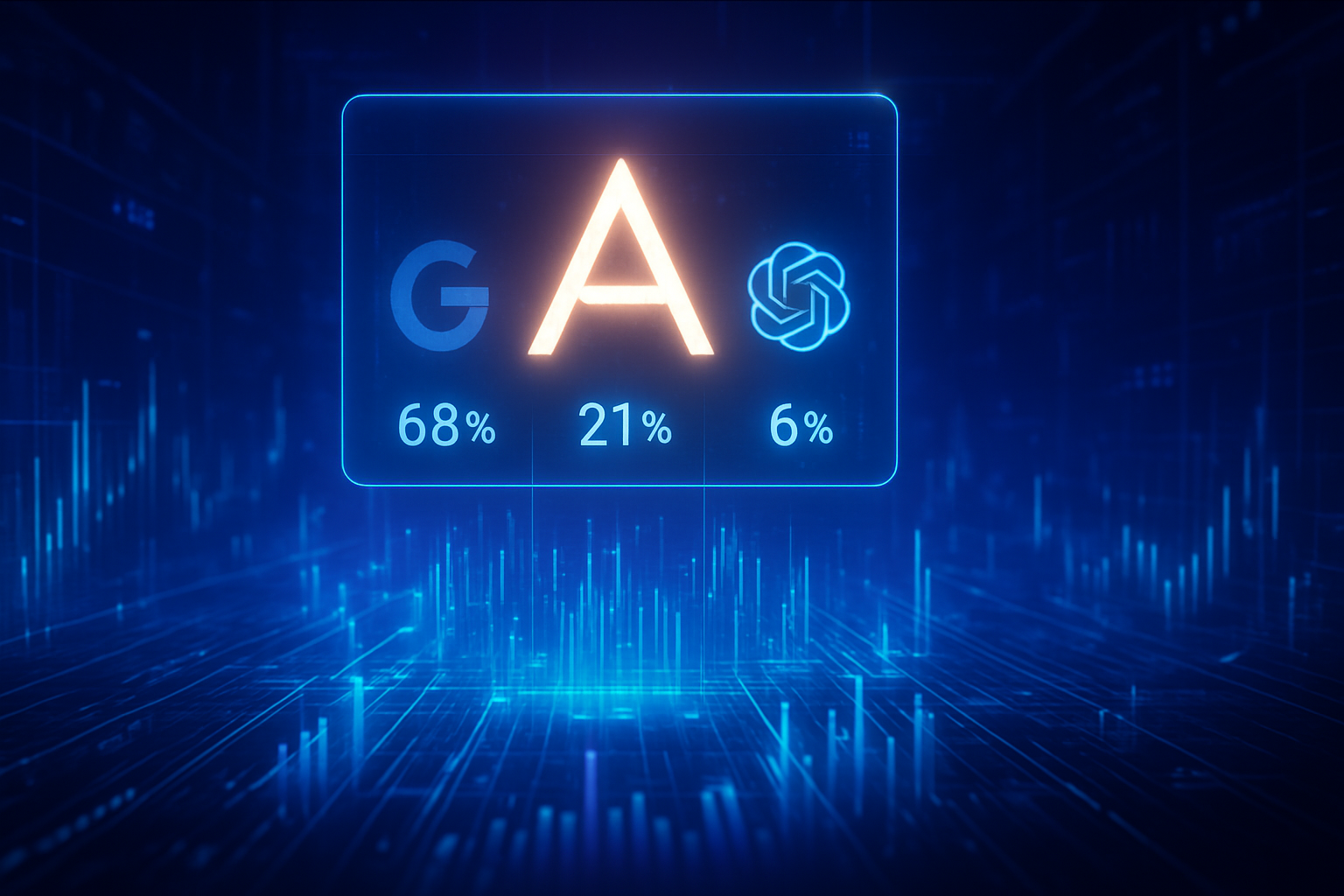
    As of February 9, 2026, the race for artificial intelligence supremacy has reached a fever pitch, but prediction market bettors believe the winner is already clear. Anthropic, the San Francisco-based AI safety and research company, has surged to a commanding 68% probability of holding the title of "Best AI Model" by the end of the month. This represents a staggering lead over long-time industry titans Google and OpenAI, which currently sit at 21% and 6% respectively.

    The market shifted violently last week following a series of high-stakes product launches. While OpenAI was once the undisputed king of the sector, the current sentiment on platforms like Polymarket and Kalshi suggests a regime change. Traders are no longer betting on brand recognition; they are betting on the raw technical performance reflected in the industry’s most respected benchmarks.

    The Market: What's Being Predicted

    The primary vehicle for this speculation is the "Best AI Model by March 2026" contract, which has seen heavy trading volume exceeding $3.6 million on Polymarket alone. Similar contracts are active on Kalshi and Manifold, drawing in thousands of participants ranging from retail enthusiasts to specialized institutional desks.

    The resolution criteria for these markets are remarkably specific, typically tethered to the LMSYS Chatbot Arena Leaderboard. To win, a model must secure the #1 rank in the "Rank (UB)" column on the leaderboard as of February 28, 2026, at 11:59 PM ET. Most markets require the "Style Control" filters to be active, ensuring that the ranking reflects true reasoning capabilities rather than just "vibes" or verbosity.

    In early January, the market was a dead heat, with Google (NASDAQ: GOOGL) and Anthropic both hovering around 35%. However, the launch of Claude Opus 4.6 on February 5 sent Anthropic’s odds skyrocketing from 40% to 68% in a matter of hours. Conversely, OpenAI’s position has collapsed to a mere 6%, its lowest point since the debut of GPT-4 years ago.

    Why Traders Are Betting

    The catalyst for Anthropic’s dominance is the overwhelming reception of Claude Opus 4.6. The model introduced a breakthrough "Agent Teams" architecture, allowing a single prompt to orchestrate multiple specialized sub-agents to complete complex software engineering and research tasks. Currently, Claude 4.6 sits at an Elo score of 1496 on the LMSYS Arena, the highest ever recorded.

    Traders are backing Anthropic—supported by massive investments from Amazon.com Inc (NASDAQ: AMZN) and Microsoft Corp (NASDAQ: MSFT)—because of its perceived "quality over quantity" approach. While Google’s Gemini 3 Pro held the top spot for most of late 2025, it has struggled to maintain its lead against the superior reasoning capabilities of the new Opus variant.

    "The smart money is looking at the 'vibes' vs. 'math' divide," says one high-volume Polymarket trader. "OpenAI's latest release, GPT-5.3-Codex, was incredibly fast, but it didn't move the needle on general-purpose reasoning. Anthropic’s 4.6 isn’t just faster; it’s smarter. That’s why the odds have decoupled from the OpenAI hype machine."

    Furthermore, OpenAI’s strategy of fragmenting its models—releasing specialized versions for coding, reasoning, and creativity—has confused the leaderboard rankings, whereas Anthropic’s unified Opus model provides a single, high-performing target for bettors to rally behind.

    Broader Context and Implications

    This market reflects a broader trend in the 2026 AI landscape: the erosion of first-mover advantage. OpenAI’s early dominance with GPT-4 created a moat that many thought was unassailable. However, the prediction markets are now signaling that the moat has dried up. The 68% vs. 6% spread is a clear indictment of OpenAI’s recent "incremental" update cycle compared to Anthropic’s "generational" leaps.

    The real-world implications of these odds are significant. Companies choosing which API to integrate into their enterprise stacks often look to these markets as a "wisdom of the crowds" indicator of which technology is likely to lead for the coming quarter. For Alphabet Inc. (NASDAQ: GOOGL), the 21% odds represent a resilient but stagnant second place, suggesting that while their data advantage is massive, their model tuning hasn't quite captured the "pro-user" market in the same way Anthropic has.

    Historically, prediction markets have been more accurate at forecasting AI milestones than traditional tech analysts. During the "Gemini 1.5 vs GPT-4 Turbo" wars of 2024, markets correctly anticipated the flip weeks before it was reflected in mainstream tech journalism.

    What to Watch Next

    With only three weeks left in February, the focus shifts to potential "October Surprises" (or in this case, late-February surprises). Rumors are circulating of a "Gemini 3.5 Ultra" update that Google may rush to release before the month ends to reclaim its title. If such a release occurs, Anthropic’s 68% could evaporate instantly.

    Additionally, industry watchers are monitoring the "Vera Rubin" chip platform from Nvidia Corp (NASDAQ: NVDA). As these new chips begin to power the training clusters for the next generation of models, the latency and cost-efficiency of these models could shift, potentially influencing "vibes-based" voting on the Chatbot Arena.

    The key date to watch is February 20. Historically, if a model hasn't appeared on the leaderboard by the 20th of the month, the lag in user voting makes it nearly impossible to reach the #1 spot by the end of the month. If Google or OpenAI doesn't drop a major update within the next 10 days, Anthropic's 68% odds will likely climb into the 80s or 90s.

    Bottom Line

    The current state of the "Best AI Model" market is a testament to the volatility of the frontier AI sector. Anthropic’s Claude 4.6 has currently "broken the scale," convincing bettors that it is the superior intelligence of the moment. The 68% probability represents a high level of confidence in Claude's technical superiority and its ability to maintain that lead through the end of the month.

    This market proves that prediction markets are becoming the definitive scoreboard for the AI arms race. While marketing campaigns and keynote speeches attempt to influence public perception, the cold, hard capital of bettors is flowing toward the model that actually delivers the best results.

    For now, the crown belongs to Anthropic. But in a world where a new model can be trained and deployed in weeks, no lead is ever truly safe.


    This article is for informational purposes only and does not constitute financial or betting advice. Prediction market participation may be subject to legal restrictions in your jurisdiction.

    PredictStreet focuses on covering the latest developments in prediction markets.
    Visit the PredictStreet website at https://www.predictstreet.ai/.
  • Norway’s “Ice Machine” Dominance: Polymarket Bettors Give Norse 79% Edge as Winter Olympics Heat Up

    Norway’s “Ice Machine” Dominance: Polymarket Bettors Give Norse 79% Edge as Winter Olympics Heat Up

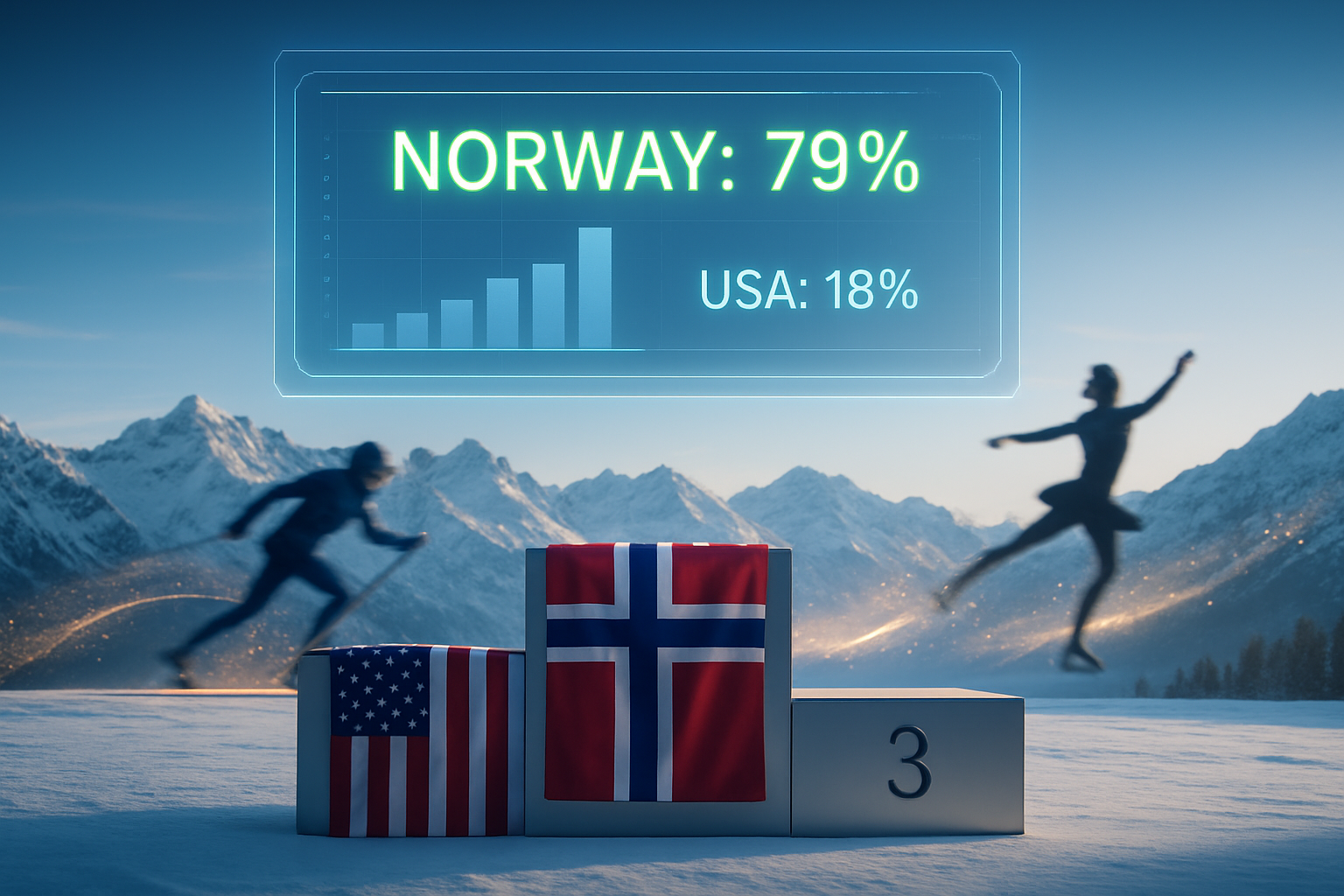
    As the torch burns bright over Milano-Cortina for the 2026 Winter Olympics, the battle for international supremacy is already reaching a fever pitch—not just on the slopes, but in the high-stakes world of prediction markets. Just three days into the official competition, Norway has emerged as a staggering favorite to top the gold medal leaderboard, with the "Most Gold Medals" market on Polymarket giving the Nordic powerhouse a 79% probability of victory. Meanwhile, the United States, once seen as a formidable challenger, has seen its odds slip to a mere 18%.

    The intensity of the competition is mirrored by the liquidity in the markets. Traders have pushed over $4 million in volume into the gold medal category, making it one of the most traded non-political events of the year. This surge in interest follows a weekend of "shock" wins for Norway and a major injury setback for Team USA, forcing bettors to rapidly recalibrate their portfolios as the "Medal Machine" from the north begins to pull away.

    The Market: What's Being Predicted

    The primary theater for this financial speculation is Polymarket, where the "Most Gold Medals" contract has become a focal point for sports analysts and crypto-traders alike. Currently, Norway "Yes" shares are trading at $0.79, reflecting the 79% implied probability, while the United States "Yes" shares languish at $0.18. This represents a massive shift from the pre-Opening Ceremony odds, which saw Norway at a more modest 63% and the U.S. at 26%.

    The market is structured as a winner-take-all contract that settles based on the final official medal tally from the International Olympic Committee (IOC). In the event of a tie in gold medals, Polymarket’s resolution rules state that the winner will be determined by the most silver medals, followed by the most total medals overall. This "tie-break" clause is particularly relevant given the dominance of the Comcast Corporation (NASDAQ:CMCSA)-owned NBCUniversal’s coverage, which often focuses on total medal counts, whereas prediction markets are laser-focused on the specific gold-medal "winner-take-all" outcome.

    Liquidity in the market remains exceptionally high for a sporting event, with the $4 million volume providing tight spreads and allowing "whales" to move large positions. Traders who backed Norway early are already sitting on significant "paper gains," while those betting on a U.S. resurgence are hoping for a heavy-hitting second week dominated by figure skating and snowboarding.

    Why Traders Are Betting

    The 79% confidence in Norway isn't just a result of national bias; it is backed by cold, hard performance. Over the opening weekend, Norway secured three pivotal golds that shattered the "bear case" for the nation. Cross-country legend Johannes Høsflot Klæbo secured his sixth career gold in the men’s 20km skiathlon on February 8, while Anna Odine Strøm delivered a massive upset in women’s ski jumping—a sport where Norway was not the favorite. Perhaps most impressively, Sander Eitrem broke the Olympic record in the men’s 5000m speed skating, proving that Norway's dominance extends beyond the ski trails and into the rinks.

    Conversely, the U.S. market position took a significant hit following the dramatic crash of alpine legend Lindsey Vonn on Day 2. Vonn’s highly publicized comeback was cut short in the downhill race, an event the U.S. had hoped would provide a crucial gold. While Breezy Johnson did secure a gold in the women's downhill for Team USA, the loss of Vonn’s "points" in the projected standings caused a sharp sell-off in U.S. shares.

    Traders are also eyeing the "systemic dominance" of Norway versus the "superstar reliance" of the U.S. "Norway's floor is incredibly high because of their depth in biathlon and cross-country skiing," noted one high-volume Polymarket trader. "The U.S. needs near-perfection from individual stars like Ilia Malinin in figure skating and Chloe Kim in snowboarding. If just one of those stars falters, the U.S. path to most golds effectively evaporates. Norway can afford a few mistakes; the U.S. cannot."

    Broader Context and Implications

    The 2026 Games represent a turning point for how the public consumes Olympic data. While traditional broadcasters like Warner Bros. Discovery (NASDAQ:WBD) and NBCUniversal focus on human interest stories and delayed broadcasts, prediction markets provide a real-time, unsentimental "scoreboard" of expectations. The 79% probability for Norway suggests that the "wisdom of the crowd" has largely written off the competitive nature of the gold medal race, viewing Norway's "Ice Machine" as an inevitability.

    Furthermore, the $4 million volume on a single Olympic market highlights the growing mainstreaming of prediction platforms. Unlike traditional sportsbooks, which often limit winning bettors or offer static odds, decentralized platforms allow for dynamic hedging. For example, sponsors like Nike, Inc. (NYSE:NKE), which outfits many of the top athletes, could theoretically use these markets to hedge against the marketing loss of a "gold-less" Games for their primary sponsored nations.

    Historically, prediction markets have been remarkably accurate in predicting Olympic outcomes, often outperforming traditional statistical models. In the 2022 Beijing Games, the markets correctly identified Norway’s record-breaking run days before the mathematical certainty was achieved. The current 2026 data suggests we are seeing a repeat of that efficiency, as bettors front-run the upcoming biathlon schedule, which is heavily weighted toward the Norwegian roster.

    What to Watch Next

    The coming week offers several "inflection points" that could either cement Norway’s 79% lead or provide the U.S. with a much-needed "moonshot" rally. The most critical event on the horizon is the men's singles figure skating, where American Ilia Malinin—known as the "Quad God"—is the heavy favorite. A gold here is priced in for the U.S., but any mistake could send U.S. shares tumbling toward the single digits.

    Speed skating phenom Jordan Stolz is another "must-watch" for market participants. Stolz is favored in three separate distances (500m, 1000m, and 1500m). If Stolz sweeps these events, the U.S. probability could feasibly jump back above 30%, especially if Norway suffers a rare "bad day" on the biathlon range.

    Finally, traders should keep a close eye on the biathlon mixed relay and the upcoming ski jumping large hill events. These are the "battleground states" of the Winter Olympics. If Norway continues to "steal" golds in events where they are only 20-30% favorites—as they did in the normal hill ski jumping—the market will likely close out, with Norway shares hitting $0.90 or higher before the start of the final weekend.

    Bottom Line

    As it stands on February 9, 2026, the prediction markets are signaling that the race for the most gold medals is Norway's to lose. The 79% to 18% split reflects a fundamental belief in the Nordic nation's specialized "medal factory" system over the American "star power" model. With $4 million in volume already processed, the market is displaying deep conviction that the Norwegian flag will be the one seen most frequently atop the podium in Milano-Cortina.

    For the United States to stage a comeback, they need a "perfect week" from their elite specialists and a series of uncharacteristic failures from the Norwegian endurance squad. In the cold, calculating world of prediction markets, sentiment is a secondary factor; the numbers currently point to a Norse landslide. Whether you are a sports fan or a market speculator, the next seven days will determine if the "Ice Machine" is truly unstoppable or if the U.S. has one more miracle on ice left in the tank.


    This article is for informational purposes only and does not constitute financial or betting advice. Prediction market participation may be subject to legal restrictions in your jurisdiction.

    PredictStreet focuses on covering the latest developments in prediction markets. Visit the PredictStreet website at https://www.predictstreet.ai/.
  • The Fog of War and the Wisdom of Crowds: Traders Price in 56% Chance of U.S. Strike on Iran

    The Fog of War and the Wisdom of Crowds: Traders Price in 56% Chance of U.S. Strike on Iran

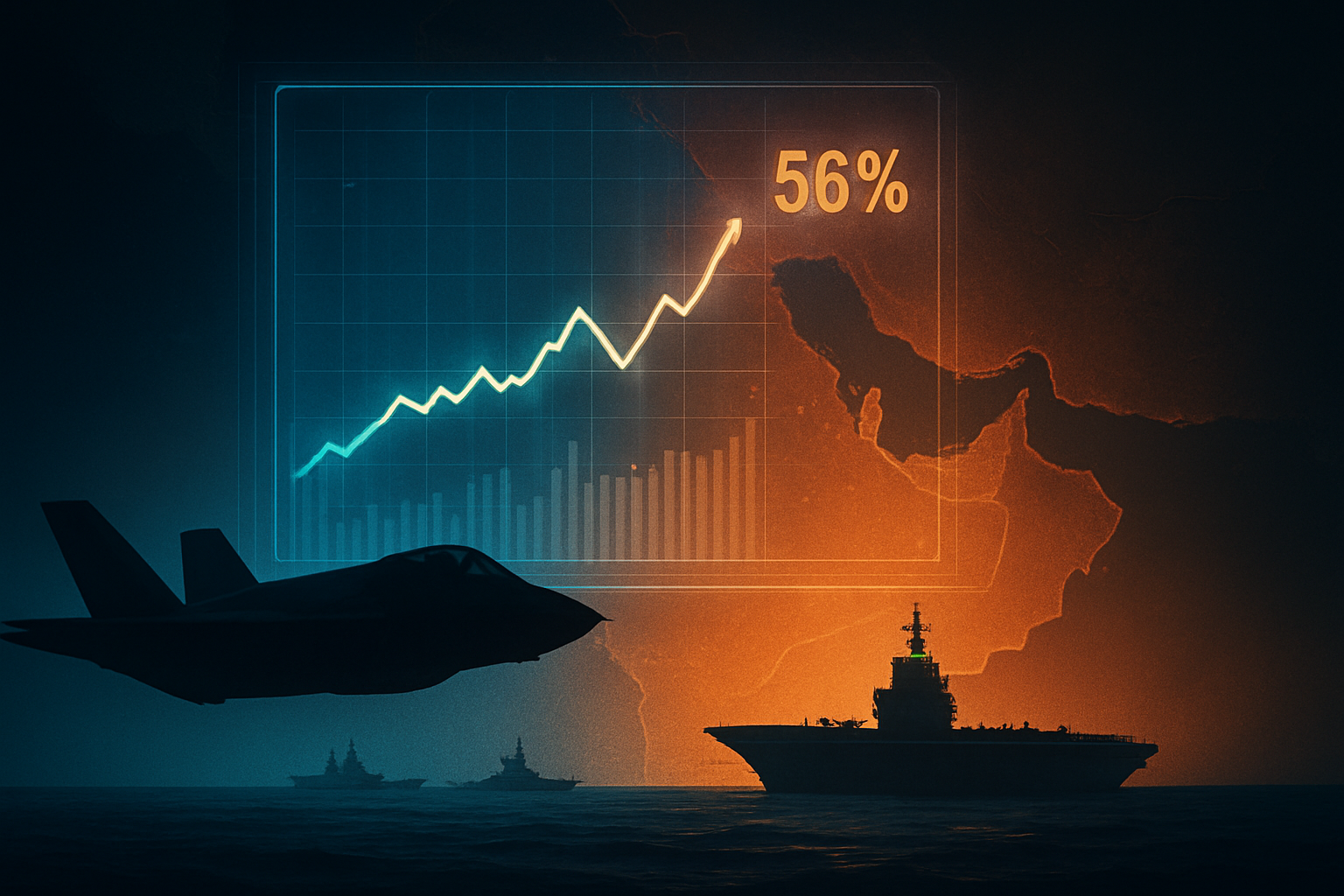
    As the diplomatic thaw of the winter freezes over, the shadow of conflict in the Middle East has lengthened. On the decentralized prediction platform Polymarket, the collective intelligence of thousands of global traders is currently pricing in a staggering 56% probability that the United States will conduct a kinetic strike against Iran by June 30, 2026. This surge in odds reflects a sudden and sharp pivot from the relative optimism seen just weeks ago, signaling a "war risk premium" that is now dominating geopolitical discourse.

    The market has become a focal point for institutional investors, defense analysts, and political junkies alike, amassing a significant $203 million in trading volume. This level of liquidity suggests that the 56% figure is not mere speculation from retail participants, but a calculated assessment from "whales" and informed actors who are effectively betting on the failure of high-stakes diplomacy. With the June deadline approaching, the high volume indicates a rare consensus: the current status quo between Washington and Tehran is increasingly viewed as unsustainable.

    The Market: What’s Being Predicted

    The primary vehicle for this sentiment is the Polymarket contract titled "U.S. strike on Iran by June 30, 2026." The contract is binary, meaning it will resolve to either "Yes" or "No." For the market to resolve as "Yes," the U.S. military must conduct a "kinetic operation"—defined as an aerial, drone, or missile strike—specifically against official Iranian territory or its diplomatic missions. Notably, the criteria exclude cyberattacks or strikes on Iranian proxies in third countries like Syria or Iraq, focusing the bet strictly on direct state-on-state escalation.

    Trading volume on this specific market has exploded to over $203 million, making it one of the most liquid geopolitical contracts in the history of prediction markets. Throughout early February 2026, the price per "Yes" share has fluctuated wildly. After peaking at 69% in early January following domestic unrest in Iran, the odds dipped to 25% during the lead-up to the Oman peace talks. However, the current rebound to 56% represents a "dead cat bounce" in diplomacy that has left traders bracing for a military resolution.

    The liquidity provided by such a high volume allows for large institutional entries, which has historically led to higher accuracy in these markets compared to traditional punditry. On Polymarket, where participants have "skin in the game," the price movement is often seen as a leading indicator, reacting to news cycles minutes—or sometimes hours—before mainstream media outlets can provide a comprehensive analysis.

    Why Traders Are Betting

    The primary driver behind the current 56% odds is the spectacular collapse of the "Oman Round" of indirect negotiations on February 4, 2026. Intended to de-escalate nuclear tensions and provide a framework for a new "Maximum Pressure 2.0" deal, the talks broke down when Tehran refused to include its regional missile program in the scope of the treaty. This diplomatic failure was immediately followed by a series of tactical skirmishes in the Arabian Sea.

    On February 3, 2026, a U.S. Navy F-35C, manufactured by Lockheed Martin (NYSE: LMT), shot down an Iranian surveillance drone that had aggressively approached the USS Abraham Lincoln strike group. This incident, combined with reports of a massive U.S. naval "armada" currently transiting toward the Persian Gulf, has convinced many traders that the Trump administration is seeking a decisive "red line" moment.

    Furthermore, "whale" activity—large-scale bets often exceeding $500,000—has shifted toward the "Yes" side. These large-scale traders appear to be betting that the naval standoff in the Strait of Hormuz will reach a breaking point by mid-summer. Sentiment analysis within the prediction community suggests that while a full-scale invasion is considered unlikely, a targeted "demonstration strike" on Iranian nuclear facilities or IRGC infrastructure is now the baseline expectation for more than half the market.

    Broader Context and Implications

    This market is not operating in a vacuum; it is deeply correlated with the broader defense and energy sectors. As strike odds climbed above the 50% threshold, shares of major defense contractors like Northrop Grumman (NYSE: NOC) saw a "gamma squeeze" effect, with the stock rising 20% year-to-date. Traders are increasingly using Polymarket as a hedging tool for their equity portfolios. If the odds of a strike increase, defense stocks generally rise, allowing investors to offset potential losses in other sectors sensitive to high oil prices or regional instability.

    The U.S.-Iran market also highlights a growing trend where prediction markets act as "truth engines" in an era of fragmented information. The high volume of $203 million serves as a bulwark against manipulation; it would require an immense amount of capital to artificially move the price of the contract for more than a few minutes. This makes the 56% probability a sobering metric for policymakers, as it suggests that the "smart money" sees conflict as more likely than not.

    Historically, markets like these have been remarkably prescient. Similar liquidity was seen in the lead-up to the capture of Nicolás Maduro in Venezuela in early 2026, where prediction markets flagged the operation hours before it was officially announced. However, critics point out that these markets can also create a "feedback loop," where high strike odds in the betting world might embolden hawks in the real world, though the causality of such a relationship remains a subject of intense academic debate.

    What to Watch Next

    As we move closer to the June 30 deadline, several key milestones will likely dictate the next major swing in the odds. First, the International Atomic Energy Agency (IAEA) is scheduled to release a "special report" in late February regarding Iran’s enrichment levels at the Fordow facility. Any indication that Iran has reached "breakout capacity" will likely send the Polymarket "Yes" shares into the 70% to 80% range.

    Second, the movement of the USS Abraham Lincoln and its supporting strike group is being tracked by traders via satellite imagery and maritime transponders. A move into the Persian Gulf proper, rather than staying in the Gulf of Oman, would be viewed as a high-conviction signal for an imminent strike. Traders are also monitoring the legislative progress of the proposed $1.5 trillion U.S. defense budget for FY2027; a fast-tracked approval would provide the fiscal "green light" for prolonged engagement.

    Finally, keep an eye on "insider" signals. In previous high-stakes geopolitical markets, sudden, massive buy orders for "Yes" shares often preceded official military announcements by 4-12 hours. If the volume spikes past the $250 million mark without a corresponding news event, it may indicate that those with proximity to the Pentagon are placing their final bets.

    Bottom Line

    The 56% probability of a U.S. strike on Iran by June 30, 2026, is a chilling reminder of how quickly the geopolitical landscape can deteriorate. With over $203 million at stake, this is no longer a niche curiosity; it is a high-stakes financial instrument that reflects a genuine belief among participants that diplomacy has reached its end.

    The correlation between these market movements and the stock prices of companies like Lockheed Martin (NYSE: LMT) and Northrop Grumman (NYSE: NOC) suggests that the "war risk" is being integrated into the very fabric of the global economy. Whether these traders are right or wrong, the sheer scale of the betting volume indicates that the world is bracing for a summer of high-intensity friction. For now, the "wisdom of the crowd" suggests that the fuse is lit, and the clock is ticking.


    This article is for informational purposes only and does not constitute financial or betting advice. Prediction market participation may be subject to legal restrictions in your jurisdiction.

    PredictStreet focuses on covering the latest developments in prediction markets.
    Visit the PredictStreet website at https://www.predictstreet.ai/.
  • The “Warsh Shock”: Prediction Markets Signal 94.8% Certainty for the Next Fed Chair

    The “Warsh Shock”: Prediction Markets Signal 94.8% Certainty for the Next Fed Chair

    As the countdown to the end of Jerome Powell’s tenure at the Federal Reserve begins, prediction markets have reached a state of near-unanimity. Kevin Warsh, the former Fed Governor and long-time favorite of the Republican establishment, has emerged as the overwhelming frontrunner to be the next Chair of the Federal Reserve. According to data from Polymarket and CoinMarketCap, Warsh currently holds a commanding 94.8% probability of being nominated by President Donald Trump to lead the world’s most powerful central bank.

    This market, which has seen hundreds of millions of dollars in trading volume, is generating intense interest because it signals more than just a personnel change; it represents a fundamental shift in the "Shadow Fed" strategy being deployed by the White House. With Powell’s term set to expire in May 2026, the market’s conviction suggests that the "Warsh era" has effectively begun months ahead of schedule, creating a unique "dual chair" dynamic that is already rippling through global bond and equity markets.

    The Market: What's Being Predicted

    The prediction market for the next Federal Reserve Chair has become one of the most liquid political events of the 2026 calendar. On Polymarket, the primary hub for crypto-native forecasting, the contract "Who will Trump nominate as Fed Chair?" has surpassed $432 million in total trading volume. Kevin Warsh’s "Yes" shares are currently trading at approximately 95 cents, mirroring the 94.8% figure seen on other aggregators.

    While Polymarket dominates the retail and international space, Kalshi, the CFTC-regulated exchange, has seen a massive influx of institutional activity. Kalshi reported record-breaking participation in January 2026, with the Fed Chair contract maintaining a probability as high as 98%. The market is also seeing new liquidity from the Jupiter platform on the Solana blockchain, which recently integrated prediction market tools, allowing a wider range of retail traders to bet on the "Warsh Shock."

    The resolution criteria for these markets are strictly defined: the market pays out once a formal nomination is sent to the U.S. Senate. While Trump announced his intention to nominate Warsh on January 30, 2026, the markets remain active as traders hedge against potential Senate confirmation hurdles or last-minute shifts in the President’s preference.

    Why Traders Are Betting

    The 94.8% probability isn't just a reflection of rumors; it is backed by a sequence of tactical moves from the White House. Traders shifted heavily toward Warsh after the President pivoted away from other high-profile candidates like Kevin Hassett, who was recently tapped to remain at the White House as Director of the National Economic Council, and Marc Rowan, the CEO of Apollo Global Management (NYSE: APO). While Rowan was a favorite for his "titan of industry" profile, prediction markets correctly sniffed out that his private equity ties might create too many conflict-of-interest hurdles in a closely divided Senate.

    Notable "whale" activity has also solidified the odds. On-chain data has identified several multi-million dollar positions, including a legendary "French high-roller" on Polymarket and a strategic "insider" address on the Hyperliquid platform that realized significant gains by front-running the official announcement in late January.

    Furthermore, traditional forecasting tools like the CME FedWatch tool from CME Group (NASDAQ: CME) have indirectly supported the Warsh narrative. As expectations for aggressive rate cuts in late 2026 grew to 94.8% in early January, traders deduced that Trump would want a Chair who—while historically hawkish—is perceived as more "market-sensitive" and "central casting" than the incumbent Powell.

    Broader Context and Implications

    The rise of Kevin Warsh is being interpreted by Wall Street as the beginning of a "Shadow Chair" period. Analysts at Goldman Sachs (NYSE: GS) and JPMorgan Chase (NYSE: JPM) have noted that a 95% market certainty effectively neuters Jerome Powell’s influence for the remainder of his term. JPMorgan (NYSE: JPM) has labeled this a "Shadow Policy Shift," arguing that the FOMC’s voting behavior may begin to tilt toward Warsh’s known preferences—specifically a more aggressive stance on balance sheet reduction—even before he takes the gavel.

    This market also highlights the maturing of prediction markets as a geopolitical tool. Unlike 2020 or 2024, where these markets were often dismissed as "crypto-niche," the 2026 Fed Chair market has been cited by major financial news outlets as a primary source of truth. The high accuracy of these markets in predicting the Rowan-to-Warsh pivot has given them new-found legitimacy among institutional hedgers.

    However, the real-world implications are stark. The "Warsh Shock" has already caused a "Great Metal Flush," with gold and silver prices retreating as investors price in a Fed that might prioritize price stability and a stronger dollar more aggressively than the Powell administration.

    What to Watch Next

    While the 94.8% probability suggests the race is over, two key factors could still inject volatility. First is the ongoing Department of Justice investigation into internal Fed operations. Some Republican Senators, including Thom Tillis, have hinted that Warsh’s confirmation could be delayed until the cloud over the current Fed leadership is cleared. If the confirmation process hits a snag, we could see Warsh’s odds dip back into the 80s as the market considers a "re-opening" of the shortlist.

    Second, the market is closely watching the official Senate Banking Committee hearing schedule. Key dates in late February and early March will be critical milestones. Any sign of friction during the "vettings and greetings" phase on Capitol Hill will be immediately reflected in the contract prices. Traders should also monitor the Interactive Brokers (NASDAQ: IBKR) ForecastEx markets, which often attract the most conservative, professional-grade bets on regulatory outcomes.

    Bottom Line

    The prediction markets have spoken: the "Warsh Era" is no longer a question of "if," but "when." With a 94.8% probability, the markets are effectively treating the nomination as a settled fact, leaving only the logistics of confirmation and the timing of Jerome Powell’s exit to be determined.

    This event serves as a masterclass in how prediction markets can serve as a leading indicator for institutional shifts. By the time traditional media outlets were reporting on the shortlist, Polymarket and Kalshi traders had already moved the needle, pricing in the transition weeks in advance. For investors, the takeaway is clear: the Fed is about to change its "aesthetic authority," and the markets are already trading the reality of a Kevin Warsh-led central bank.


    This article is for informational purposes only and does not constitute financial or betting advice. Prediction market participation may be subject to legal restrictions in your jurisdiction.

    PredictStreet focuses on covering the latest developments in prediction markets.
    Visit the PredictStreet website at https://www.predictstreet.ai/.