Tag: Operation Absolute Resolve

  • The Maduro Payout: How a $33,000 Prediction Market Bet Preceded a Delta Force Raid

    The Maduro Payout: How a $33,000 Prediction Market Bet Preceded a Delta Force Raid

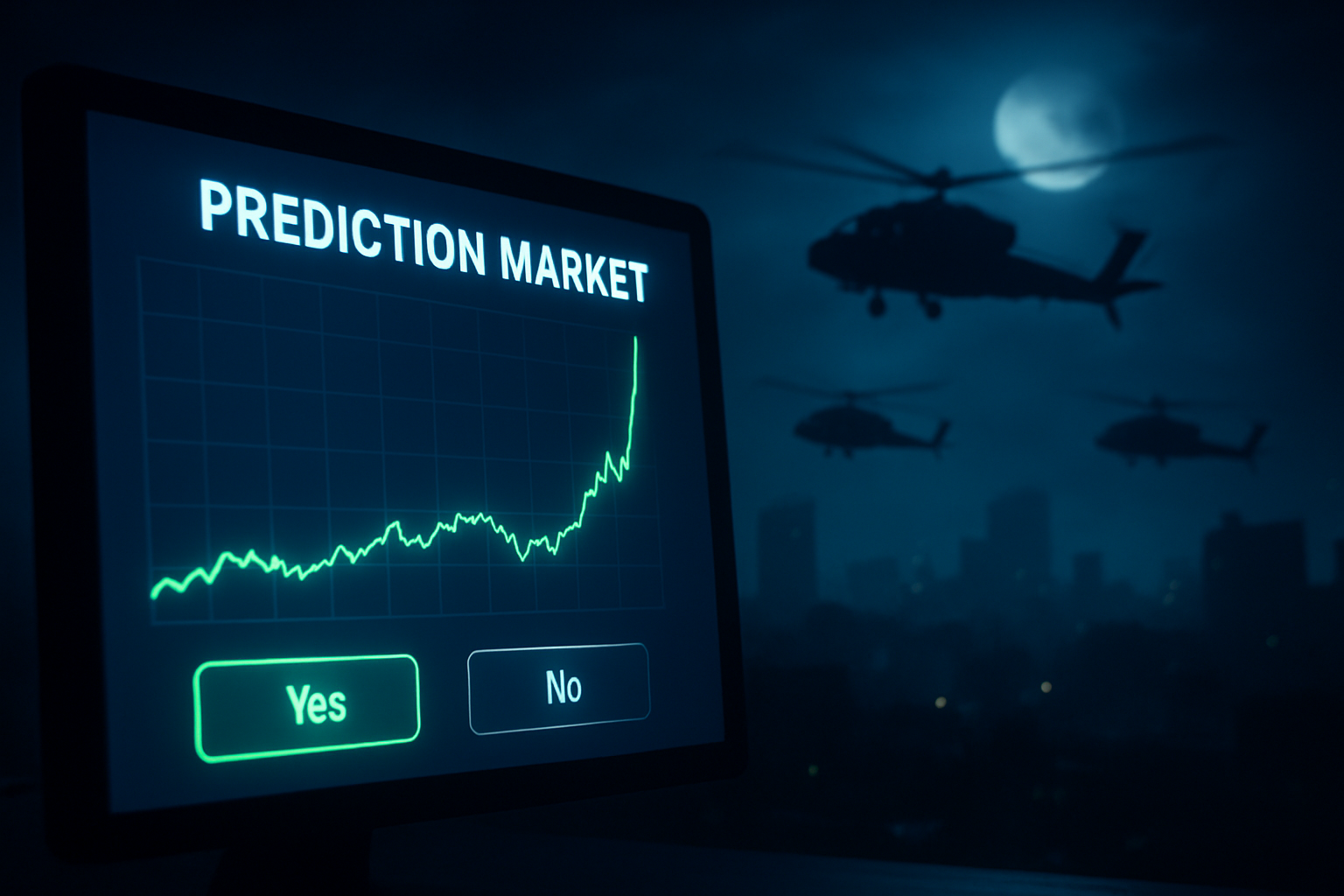
    In the early morning hours of January 3, 2026, the world woke to the stunning news that U.S. Army Delta Force commandos had successfully captured Nicolás Maduro in a daring raid codenamed Operation Absolute Resolve. While the geopolitical shockwaves were immediate, a different kind of explosion was occurring in the world of "InfoFi" or information finance. On the decentralized prediction platform Polymarket, a single anonymous trader had just completed one of the most controversial "perfect" trades in the history of prediction markets.

    The trader, known only by the username "Burdensome-Mix," managed to turn a relatively modest investment of roughly $32,537 into a staggering $436,000. The timing was more than just lucky; the bulk of the "Yes" shares on Maduro’s ouster were purchased on January 2—less than 24 hours before 150 aircraft, many manufactured by defense giants like Lockheed Martin (NYSE: LMT) and Boeing (NYSE: BA), crossed into Venezuelan airspace. As the news of Maduro’s capture in Caracas broke, the market for "Maduro out by January 31, 2026" instantly hit 100%, sparking a firestorm of allegations regarding insider trading and the ethics of profiting from classified military operations.

    The Market: What's Being Predicted

    The specific contract at the center of the controversy was "Maduro out by January 31, 2026." For months, the market had traded at low probabilities, reflecting a general skepticism that the long-standing Venezuelan leader would be unseated anytime soon. Most geopolitical analysts and traders on Polymarket had priced the "Yes" shares between 5¢ and 12¢ throughout late 2025, suggesting a less than 15% chance of his removal.

    Trading volume on the Maduro contract was relatively thin until the final 48 hours. While other political markets, such as those tracking the U.S. midterm elections, saw millions in liquidity, the Maduro market was a niche corner of the platform. However, the sudden influx of capital from "Burdensome-Mix" and a few other newly created accounts on January 2 caused the odds to spike sharply just before the resolution event.

    The resolution criteria for the market were straightforward: the market would resolve to "Yes" if Nicolás Maduro ceased to be the de facto or de jure head of state of Venezuela by the end of January. When Maduro was transported to New York City to face federal charges of narco-terrorism—a story widely covered by major outlets including The New York Times (NYSE: NYT)—the market was settled, and the "Maduro Payout" was officially cemented.

    Why Traders Are Betting

    The "Maduro Trade" has become a case study in the power and peril of prediction markets. Most traders in the weeks leading up to the raid were betting based on public sentiment, sanctions analysis, and diplomatic posturing. Traditional forecasting methods and mainstream news outlets had given no indication that a military intervention of this scale was imminent.

    However, the activity of "Burdensome-Mix" suggests a different strategy entirely. The trader did not gradually build a position; they executed a high-conviction "snipe." Analysis of the blockchain data reveals that the account was funded specifically to make this play, with almost no prior history of trading on Polymarket. This "pitch-perfect" timing led many to conclude that the trader had access to non-public information—potentially as a government official, military contractor, or high-level staffer with knowledge of the January 3 deadline.

    Large "whale" activity in prediction markets often acts as a signal to other participants. In this case, the sudden movement in the Maduro market caused a minor flurry of "follow-the-leader" trades, but the sheer speed of the military operation meant that only those already in the market by midnight on January 2 were able to reap the massive 1,200% returns.

    Broader Context and Implications

    The "Maduro Payout" has pushed prediction markets into the crosshairs of federal regulators and lawmakers. The controversy centers on whether these platforms are providing a valuable public service by aggregating information or if they are simply creating a new, unregulated venue for corruption.

    In response to the scandal, Representative Ritchie Torres (D-NY) introduced H.R. 7004, titled the "Public Integrity in Financial Prediction Markets Act of 2026." Introduced on January 9, just six days after the raid, the bill seeks to apply the ethical guardrails of the 2012 STOCK Act to the prediction market space. If passed, the law would explicitly prohibit federal employees, members of Congress, and military personnel from trading on markets that are directly influenced by their official duties or access to classified data.

    Historically, prediction markets have been praised for their accuracy, often outperforming traditional polling or expert pundits. However, when that accuracy is derived from "insider" knowledge rather than collective intelligence, the "integrity of the signal" is compromised. The debate now raging in Washington is whether a ban on insider participation will make these markets more ethical but less accurate, or if it is a necessary step to prevent the "gamification" of national security.

    What to Watch Next

    The immediate focus for the prediction market community is the movement of H.R. 7004 through the House Committees on Oversight and Government Reform. Supporters of the bill argue it is essential for the long-term legitimacy of the industry. Conversely, some industry leaders at firms like Kalshi—which recently fought its own legal battles with the CFTC—have expressed a cautious willingness to accept "rules of the road" if it means avoiding a total ban on event contracts.

    In the coming weeks, market participants should watch for:

    • Subpoenas and Investigations: There is a strong possibility that the Department of Justice will attempt to identify "Burdensome-Mix." If the trader is found to be a U.S. government employee, it could lead to the first-ever criminal prosecution for "prediction market insider trading."
    • Platform Response: Polymarket and other decentralized platforms may implement more stringent KYC (Know Your Customer) protocols to appease regulators, potentially ending the era of truly anonymous high-stakes political betting.
    • New Defense Markets: In the wake of Maduro’s capture, new markets are already appearing regarding the stability of the transition government in Venezuela and the potential for similar operations in other regions.

    Bottom Line

    The "Maduro Payout" is a landmark moment that proves prediction markets can be the most accurate forecasters in the world—but for all the wrong reasons. While the $400,000 profit for "Burdensome-Mix" is a legendary "win" in the annals of crypto-betting, it has also become a lightning rod for legislative reform that could fundamentally change how these platforms operate.

    Prediction markets are transitionary tools, moving from the fringe of the internet to the center of the financial and political discourse. As H.R. 7004 moves through Congress, the industry faces a choice: embrace regulation and institutionalize "InfoFi," or remain a "Wild West" where the person with the most classified briefcase also has the most profitable portfolio. For now, the Maduro trade remains a stark reminder that in the world of prediction markets, some "predictions" are actually certainties in disguise.


    This article is for informational purposes only and does not constitute financial or betting advice. Prediction market participation may be subject to legal restrictions in your jurisdiction.

    PredictStreet focuses on covering the latest developments in prediction markets.
    Visit the PredictStreet website at https://www.predictstreet.ai/.

  • The Maduro Capture Windfall: How a $33,000 Bet Sparked an Insider Trading Scandal

    The Maduro Capture Windfall: How a $33,000 Bet Sparked an Insider Trading Scandal

    The predawn hours of January 3, 2026, will be remembered for one of the most audacious military operations in modern history: "Operation Absolute Resolve." As U.S. special operations forces descended on Caracas to extract Venezuelan President Nicolás Maduro, the geopolitical landscape shifted in an instant. But while the world watched the tactical execution of the raid, a different kind of drama was unfolding on the digital ledgers of Polymarket, where an anonymous trader turned a modest $32,537 into a staggering $436,760 windfall.

    The trade—executed just hours before the first F-35 fighter jets, manufactured by Lockheed Martin (NYSE: LMT), crossed into Venezuelan airspace—has become the flashpoint for a heated national debate. With the "Maduro Out of Office" contract spiking from a mere 7% probability to near-certainty in a matter of minutes, the "Burdensome-Mix" trader’s suspiciously well-timed bet has prompted federal investigations, new legislation, and a fundamental questioning of whether prediction markets are a "truth machine" or a playground for insiders with access to classified military intelligence.

    The Market: What's Being Predicted

    The primary vehicle for this financial phenomenon was a Polymarket contract titled "Will Nicolás Maduro be out of power by January 31, 2026?" Throughout late 2025, the market had been relatively stagnant, reflecting a skepticism that any U.S. administration would risk a direct kinetic intervention. For months, the odds hovered between 3% and 10%, with trading volumes picking up only slightly as diplomatic tensions rose.

    By the time the operation was launched, the total volume across Maduro-related contracts had swelled to an unprecedented $64.3 million. Polymarket commanded the lion's share of this liquidity, hosting $56.6 million in total wagers. Other platforms, including Kalshi and Interactive Brokers (NASDAQ: IBKR), also saw significant action, as retail and institutional traders sought to hedge against the potential for a localized energy crisis or regional instability.

    The resolution criteria for the Polymarket contract were stringent: Maduro had to be removed from the presidency or effectively unable to exercise power by the end of the month. When news broke at 4:30 a.m. EST that Maduro was in custody and being transported to New York to face narco-terrorism charges, the contract hit its ceiling. For the "Burdensome-Mix" trader, whose final "Yes" shares were purchased at a deep discount, the payout was nearly 13 times their initial investment.

    Why Traders Are Betting

    The surge in betting activity wasn't just driven by geopolitical enthusiasts. In the weeks leading up to the raid, sophisticated traders were monitoring "on-chain" activity and physical movement of military assets. Lockheed Martin (NYSE: LMT) and other defense contractors had seen an uptick in maintenance contracts and logistics deployments, a signal that many "whale" accounts on prediction markets interpreted as a precursor to action.

    However, the "Burdensome-Mix" trade was different. Unlike the gradual accumulation of positions seen by institutional hedgers on platforms like Interactive Brokers (NASDAQ: IBKR), this specific user placed a concentrated series of bets in a six-hour window before the operation was public knowledge. This "information asymmetry" is what separates a smart macro play from a suspected leak. Analysts noted that the odds shifted significantly enough to suggest that someone, somewhere, knew the "go-order" had been given.

    Moreover, the integration of prediction market data into mainstream platforms has changed the betting psychology. Alphabet (NASDAQ: GOOGL) and Meta (NASDAQ: META) have recently begun embedding real-time "Probability Widgets" into search results and social feeds. This democratization of data meant that as soon as the "Burdensome-Mix" whale moved the needle, thousands of retail traders on Robinhood (NASDAQ: HOOD) followed suit, creating a feedback loop that accelerated the price movement before the first official press release from the White House.

    Broader Context and Implications

    The Maduro windfall has effectively ended the "wild west" era of prediction markets. On January 9, 2026, Representative Ritchie Torres (D-NY) introduced the Public Integrity in Financial Prediction Markets Act, a bill designed to extend the insider-trading prohibitions of the STOCK Act to event contracts. The logic is clear: if it is illegal for a Senator to trade stocks based on a classified briefing, it should be equally illegal to bet on the outcome of a military raid they helped oversee.

    The Commodity Futures Trading Commission (CFTC), under the leadership of Chairman Michael S. Selig, has taken a nuanced stance. Rather than banning political contracts—a move the agency considered in 2024—Selig has opted to "plant the flag" as the definitive regulator. The agency is now drafting standards for "market integrity" that would require platforms like Polymarket to implement more robust Know Your Customer (KYC) protocols and report "suspiciously timed" trades directly to federal investigators.

    The event has also highlighted a growing rift in how these platforms settle disputes. While the "Maduro Out" contracts were paid out smoothly, a secondary contract on "U.S. Invasion of Venezuela" remains in a $10.5 million legal limbo. Polymarket’s decentralized oracle initially ruled that a "snatch-and-extract" capture did not qualify as an "invasion," leading to an outcry from traders who argued the spirit of the bet was fulfilled. This dispute highlights the "contract risk" that remains a major hurdle for prediction markets seeking institutional legitimacy.

    What to Watch Next

    The immediate focus for the markets now shifts to the legal proceedings in New York. Prediction markets are already active on whether Maduro will be convicted before the end of 2026 and whether a new Venezuelan election will be held by the fourth quarter. These markets are currently trading at a 65% probability for a conviction, though legal experts warn that the discovery process could be lengthy.

    Investors should also keep a close eye on the legislative progress of the Torres Bill. If it passes, we could see a massive "de-risking" event where government-adjacent traders exit the markets, potentially leading to a temporary drop in liquidity across high-stakes political contracts. Furthermore, the CFTC’s upcoming "integrity standards" will likely dictate whether mainstream brokers like Robinhood (NASDAQ: HOOD) continue to expand their event contract offerings or pull back due to compliance costs.

    Finally, the resolution of the $10.5 million "Invasion" dispute on Polymarket will be a landmark moment for the industry. If the platform's decentralized governance cannot reach a consensus that satisfies the majority of participants, it may accelerate the migration of serious capital toward more traditionally regulated exchanges like Kalshi or those offered by Interactive Brokers (NASDAQ: IBKR).

    Bottom Line

    The "Maduro Capture" windfall is a double-edged sword for the prediction market industry. On one hand, the markets successfully "predicted" the event by showing a massive, albeit suspicious, move in probability hours before the media could report it. This reinforces the idea of prediction markets as the world’s most efficient "truth machine," aggregating information from those with the highest conviction.

    On the other hand, the $436,000 profit for a single anonymous user has laid bare the vulnerabilities of these platforms to insider trading. If prediction markets are to become a permanent fixture of the global financial system—used by companies like Lockheed Martin (NYSE: LMT) to gauge geopolitical risk or by Alphabet (NASDAQ: GOOGL) to verify news—they must survive the regulatory firestorm currently brewing in Washington.

    As Maduro awaits trial, the prediction market for his ultimate fate remains the most liquid geopolitical contract in history. Whether these markets represent the future of intelligence or a new frontier for corruption remains the $64 million question.


    This article is for informational purposes only and does not constitute financial or betting advice. Prediction market participation may be subject to legal restrictions in your jurisdiction.

    PredictStreet focuses on covering the latest developments in prediction markets. Visit the PredictStreet website at https://www.predictstreet.ai/.
  • The $400,000 ‘Sure Thing’: Maduro Capture Sparks Prediction Market Insider Trading Crisis

    The $400,000 ‘Sure Thing’: Maduro Capture Sparks Prediction Market Insider Trading Crisis

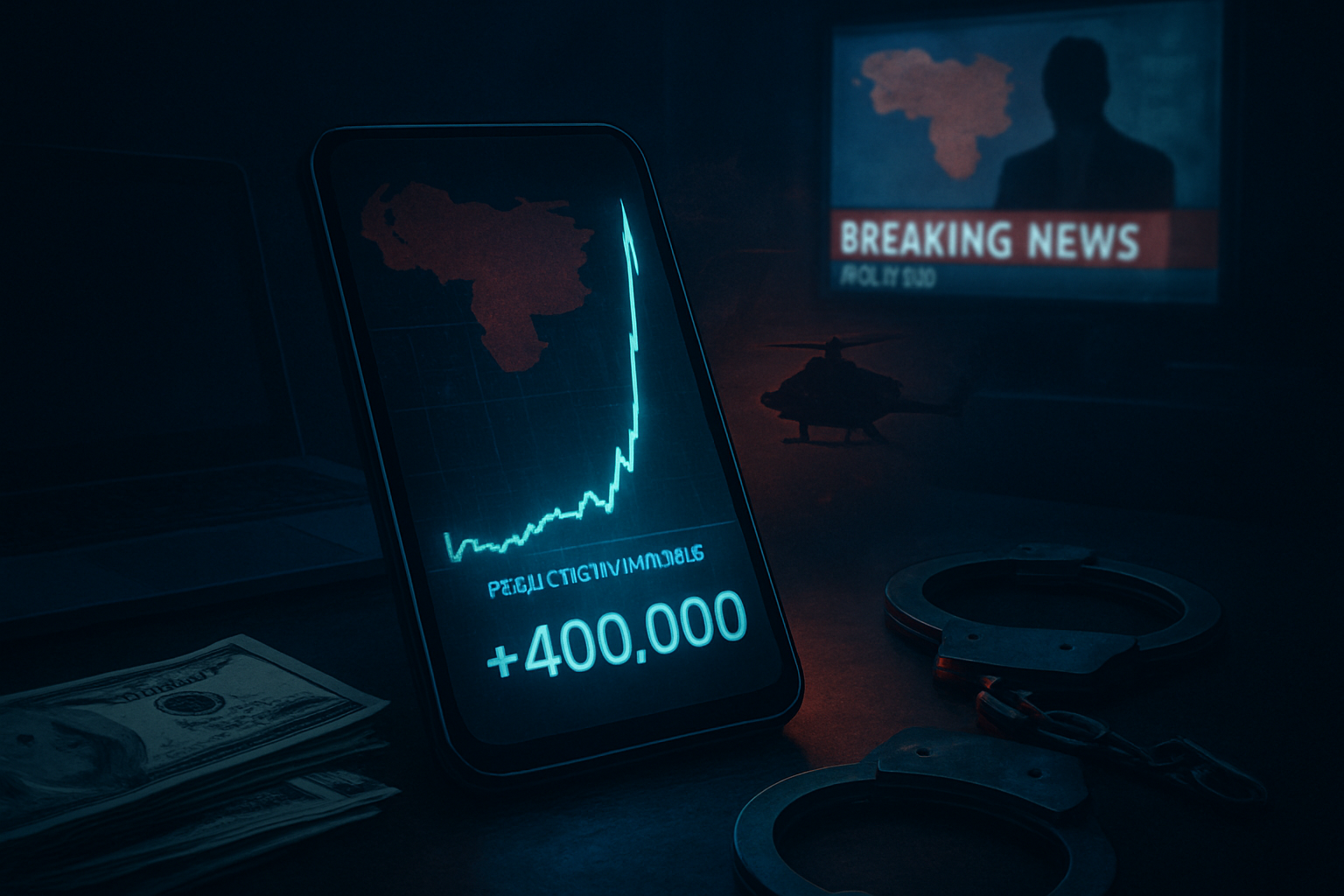
    CARACAS/NEW YORK — On January 3, 2026, at 4:21 a.m. EST, a post on Truth Social, the platform owned by Trump Media & Technology Group (NASDAQ: DJT), sent shockwaves across the globe: Venezuelan strongman Nicolás Maduro had been captured by U.S. special operations forces in "Operation Absolute Resolve." While the world grappled with the geopolitical fallout of the regime's collapse, a more localized explosion was occurring on the blockchain-based prediction platform Polymarket.

    Just hours before the first official confirmation of the capture, a single anonymous trader turned a $32,000 gamble into a staggering $436,000 windfall. The "pitch-perfect" timing of the wager has ignited a firestorm of controversy, with critics alleging that the trade was not a feat of "crowd wisdom," but a blatant case of insider trading using classified military intelligence. As the dust settles on the streets of Caracas, the focus is shifting to Washington, where regulators are facing renewed pressure to police the "Wild West" of geopolitical betting.

    The Market: What's Being Predicted

    The specific contract at the center of the storm was titled "Will Nicolás Maduro be out of office by January 31, 2026?" For months, this market had been a niche corner of Polymarket, with the "Yes" shares trading at a dismal $0.05 to $0.08—implying less than a 10% chance of a transition of power. Trading volume remained steady but unremarkable until the final week of December 2025.

    As the clock ticked toward the New Year, the market's liquidity deepened significantly. Total volume on Maduro-related contracts surpassed $15 million across Polymarket and its regulated competitor Kalshi. However, while Kalshi—which operates under the oversight of the Commodity Futures Trading Commission (CFTC)—saw odds hover around 13% based on public reports of civil unrest, Polymarket experienced a sudden, violent surge in "Yes" buying in the pre-dawn hours of January 3.

    The resolution criteria for the market were straightforward: Maduro had to be physically removed from power, resign, or be captured by a foreign entity. While the "Out of Office" market resolved quickly in favor of "Yes" holders, a sister market regarding a "U.S. Invasion of Venezuela" has remained frozen in a $10.5 million legal limbo. Polymarket’s oracle has so far refused to pay out the "Invasion" contracts, arguing that a "snatch-and-extract" mission does not meet the technical definition of an invasion intended to occupy territory—a move that has left many retail traders feeling cheated by the "house."

    Why Traders Are Betting

    The focus of the investigation is an account originally named "Burdensome-Mix," which was created on December 26, 2025. Blockchain forensics provided by firms such as Chainalysis reveal that the account was funded via a direct transfer from Coinbase Global, Inc. (NASDAQ: COIN), suggesting the trader made little effort to hide their identity behind privacy mixers.

    Between midnight and 2:00 a.m. on the day of the capture, "Burdensome-Mix" aggressively purchased nearly 500,000 "Yes" shares. "This wasn't a hedge or a speculative play," noted one high-volume trader on the platform. "This was someone who knew the helicopters were already in the air." By the time the Truth Social announcement went live, the trader's $32,537 investment had ballooned to nearly half a million dollars.

    Analysts point to the sharp divergence between Polymarket and traditional forecasting as evidence of an information leak. While intelligence agencies and political pundits were still debating the likelihood of a coup, the prediction market "knew" something was coming. This has raised the uncomfortable possibility that U.S. military personnel, intelligence officers, or high-level administration officials may be using prediction markets as a "tax-free bonus" system to profit from secret state actions.

    Broader Context and Implications

    The Maduro windfall has become a defining moment for the prediction market industry. For years, proponents have argued that these markets are the most accurate way to aggregate disparate information and predict the future. However, if that information is sourced from classified briefings rather than public analysis, the "wisdom of the crowd" becomes a mask for corruption.

    The political backlash was instantaneous. On January 9, 2026, Representative Ritchie Torres (D-N.Y.) introduced the Public Integrity in Financial Prediction Markets Act of 2026. The bill aims to close the "geopolitical loophole" by criminalizing the use of non-public material information by federal employees to trade on prediction platforms. "If you have a security clearance, you shouldn't have a Polymarket account," Torres told reporters on Capitol Hill.

    Furthermore, the incident has highlighted the jurisdictional "gray zone" of Polymarket. Because the platform technically bars U.S. users, it often escapes the direct reach of the CFTC. However, the use of U.S.-based exchanges like Coinbase to fund these accounts provides a potential hook for federal investigators. Senate leaders have already sent a formal letter to CFTC Chairman Michael Selig demanding an investigation into whether the platform is being used to facilitate money laundering or insider trading by government actors.

    What to Watch Next

    The immediate future of prediction markets depends on the outcome of two major investigations. First, the CFTC is expected to issue a report on the Maduro trades by the end of Q1 2026. If they find evidence that the "Burdensome-Mix" trader had ties to the U.S. government, it could lead to a permanent ban on geopolitical event contracts in the United States.

    Second, the "Invasion vs. Capture" dispute is headed for a potential class-action lawsuit. The $10.5 million in locked funds represents a significant portion of Polymarket’s current liquidity. If the platform is forced to pay out to "Invasion" bettors, it could face a liquidity crunch; if it refuses, it risks losing the trust of the very community that fuels its growth.

    Traders should also monitor the progress of the Torres Bill in the House Financial Services Committee. If passed, it would represent the first major legislative framework specifically targeting prediction market ethics, potentially forcing platforms to implement "Know Your Customer" (KYC) protocols that check for government employment and security clearances.

    Bottom Line

    The capture of Nicolás Maduro should have been a triumphant moment for prediction markets—proof that they can signal world-changing events before the traditional media. Instead, the "Burdensome-Mix" trade has left the industry defending its very existence. The line between "superior analysis" and "insider information" has blurred to the point of invisibility, creating an existential crisis for decentralized forecasting.

    As we move further into 2026, the Maduro scandal serves as a warning: when the stakes are global and the information is classified, prediction markets may not be reflecting the wisdom of the crowd so much as the secrets of the few. Whether the industry can survive this transition from a niche hobby to a high-stakes geopolitical tool remains to be seen.


    This article is for informational purposes only and does not constitute financial or betting advice. Prediction market participation may be subject to legal restrictions in your jurisdiction.

    PredictStreet focuses on covering the latest developments in prediction markets.
    Visit the PredictStreet website at https://www.predictstreet.ai/.
  • The $400,000 Secret: How an Anonymous Bet on Maduro Exposed the Deep Fault Lines of Prediction Markets

    The $400,000 Secret: How an Anonymous Bet on Maduro Exposed the Deep Fault Lines of Prediction Markets

    The early morning hours of January 3, 2026, will be remembered for the thundering rotors of U.S. special operations forces over Caracas. But for the high-stakes world of decentralized finance, the real "shock and awe" happened hours earlier on a digital scoreboard. As the world slept, an anonymous trader on the prediction platform Polymarket turned a relatively modest $34,000 into a staggering $410,000 windfall. The timing was more than suspicious—it was nearly telepathic.

    Just 48 minutes before President Trump reportedly signed the final execution order for "Operation Absolute Resolve"—the military raid that captured Venezuelan leader Nicolás Maduro—the anonymous account began aggressively buying "Yes" shares on the prospect of Maduro’s downfall. By the time news organizations like The New York Times Co. (NYSE: NYT) confirmed the capture, the market had spiked from a niche 8% probability to a virtual certainty, leaving regulators and the public asking a chilling question: Did a government insider just monetize a military secret?

    The Market: What's Being Predicted

    The controversy centers on several high-liquidity contracts hosted on Polymarket, a decentralized platform built on the Polygon blockchain. The primary market, "Will Nicolás Maduro be out of office by January 31, 2026?", had seen tepid volume throughout the winter, with many analysts assuming the Venezuelan strongman would remain entrenched despite growing international pressure.

    In the final days of December 2025, the "No" side of the trade was dominant, pricing the odds of Maduro's removal at less than 10%. However, blockchain data reveals that between 9:00 PM and 10:00 PM ET on January 2, a single wallet—created only days prior—conducted 13 separate transactions to scoop up nearly all available "Yes" shares at roughly 8 cents on the dollar.

    The liquidity for these trades was deep enough to absorb the $34,000 without immediate price slippage, but the sheer aggression of the buy orders eventually pushed the market to 25% just before the first reports of explosions at Fort Tiuna. While traditional financial markets were closed for the weekend, Polymarket traded 24/7, providing a real-time heatmap of a geopolitical earthquake.

    Why Traders Are Betting

    The debate over the Maduro trade has split the prediction market community into two camps. On one side are the "Oracle" proponents, who argue that prediction markets are doing exactly what they were designed to do: aggregate all available information, including whispers and "soft" signals, into a single, accurate price.

    "The market didn't just predict the raid; it announced it," said one prominent DeFi analyst. Traders point out that movements on Polymarket often precede official announcements because the financial incentive to be first is so high. Some suggest the trader might not have been a high-ranking official, but perhaps a logistical contractor or a staffer who noticed unusual activity at Florida's Southern Command and decided to "bet their hunch."

    However, the "Insider" camp is much more skeptical. The precision of the 9:58 PM ET wager—just minutes before the "go" order—suggests access to the most sensitive of state secrets. This has sparked a secondary controversy regarding a separate contract on whether the U.S. would "invade" Venezuela. While the capture of Maduro was undisputed, Polymarket initially hesitated to resolve the "invasion" contract as "Yes," sparking a backlash from traders who used platforms like Alphabet Inc. (NASDAQ: GOOGL) and Meta Platforms, Inc. (NASDAQ: META) to organize protests against the platform's "arbitrary" definitions of military action.

    Broader Context and Implications

    This event has catapulted prediction markets into the crosshairs of federal regulators. While the Intercontinental Exchange, Inc. (NYSE: ICE) manages traditional commodities and futures with strict insider trading prohibitions, decentralized platforms like Polymarket operate in a legal gray area.

    The Maduro trade has already triggered a legislative firestorm. Democratic Representative Ritchie Torres has introduced the Public Integrity in Financial Prediction Markets Act of 2026, which specifically seeks to criminalize the use of non-public government information on these platforms. "We cannot have a system where the decision to go to war is treated as a tip for a crypto-gambler," Torres stated in a recent press briefing.

    Historically, prediction markets have been praised for their accuracy in elections, but the Maduro trade represents a "dark frontier." It suggests that as these markets grow in liquidity, they may become unintended "leaks" for intelligence, where the price of a contract becomes a proxy for classified briefings. This creates a perverse incentive structure where those with the power to make events happen—politicians and generals—could theoretically profit from their own decisions.

    What to Watch Next

    In the coming weeks, all eyes will be on the Commodity Futures Trading Commission (CFTC) as they investigate the source of the funds used in the $34,000 trade. If the agency can trace the wallet to a U.S. person with security clearance, it could lead to the first major criminal prosecution for "event contract" insider trading.

    Furthermore, the resolution of the "invasion" contract remains a flashpoint. Polymarket's internal "Umpire" or decentralized governance mechanisms must decide if a targeted snatch-and-grab extraction by special forces constitutes a "invasion" of a sovereign nation. The outcome of this dispute will likely set the precedent for how future military and geopolitical contracts are phrased and resolved.

    Finally, keep a close watch on the "Maduro Trial" markets. Contracts are already appearing regarding the likelihood of a conviction in the Southern District of New York and the potential for a plea deal. These markets are currently seeing heavy volume as legal experts and political junkies weigh the strength of the narco-terrorism evidence against the complexities of international law.

    Bottom Line

    The "Maduro Trade" is a watershed moment for prediction markets. It proved that these platforms can indeed function as a "super-oracle," identifying events before they happen with uncanny accuracy. Yet, it also exposed a massive ethical and regulatory vacuum. If the public loses faith in the "fairness" of these markets—fearing they are playing against insiders with a 20/20 view of the future—liquidity could dry up just as the industry is reaching the mainstream.

    For now, the anonymous trader sits on a $410,000 profit, and the world has a new, albeit controversial, way to monitor the secrets of the state. Whether this remains a legitimate tool for forecasting or becomes a "black market for secrets" will depend on the regulatory actions taken in the wake of Operation Absolute Resolve.


    This article is for informational purposes only and does not constitute financial or betting advice. Prediction market participation may be subject to legal restrictions in your jurisdiction.

    PredictStreet focuses on covering the latest developments in prediction markets.
    Visit the PredictStreet website at https://www.predictstreet.ai/.