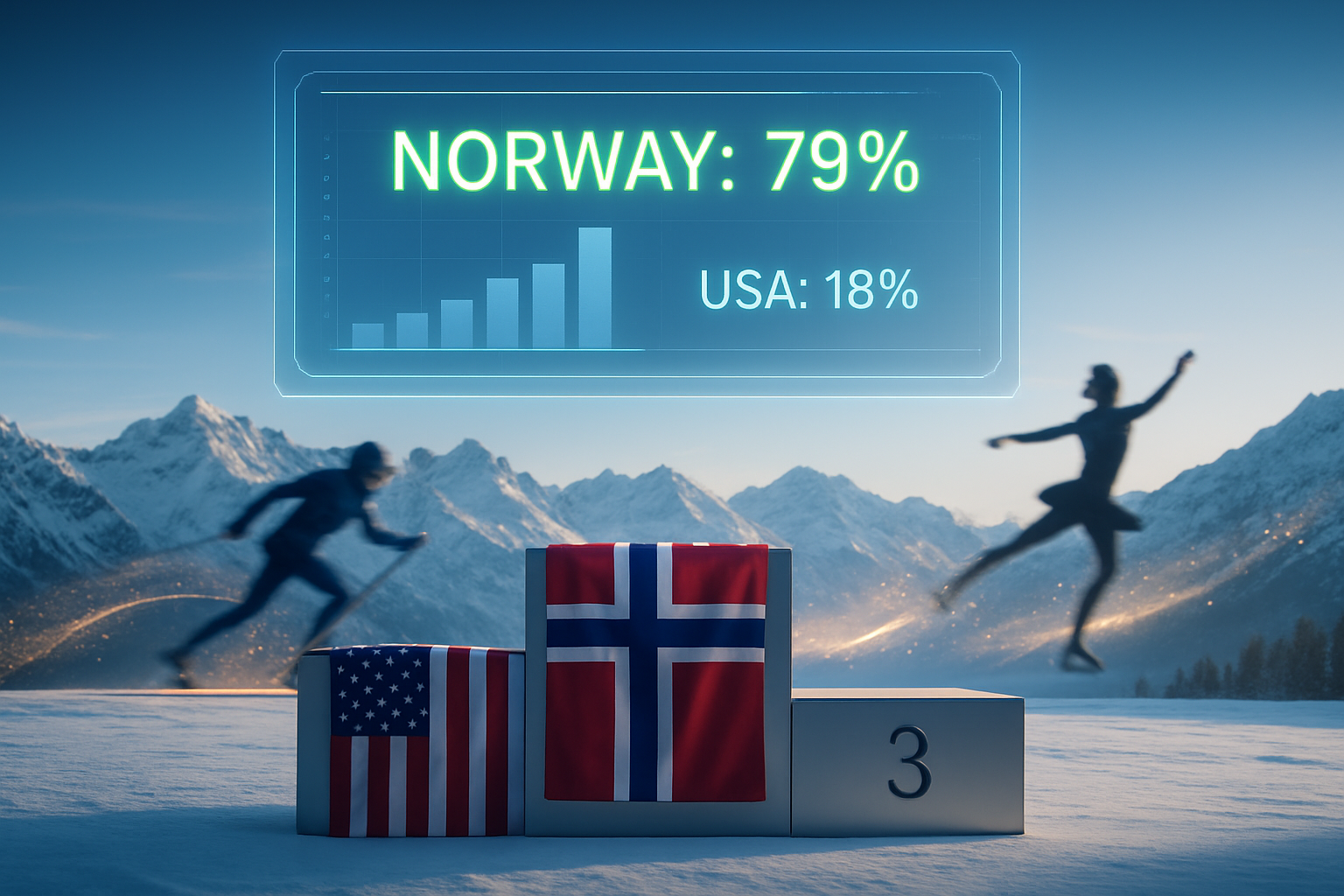
As the torch burns bright over Milano-Cortina for the 2026 Winter Olympics, the battle for international supremacy is already reaching a fever pitch—not just on the slopes, but in the high-stakes world of prediction markets. Just three days into the official competition, Norway has emerged as a staggering favorite to top the gold medal leaderboard, with the "Most Gold Medals" market on Polymarket giving the Nordic powerhouse a 79% probability of victory. Meanwhile, the United States, once seen as a formidable challenger, has seen its odds slip to a mere 18%.
The intensity of the competition is mirrored by the liquidity in the markets. Traders have pushed over $4 million in volume into the gold medal category, making it one of the most traded non-political events of the year. This surge in interest follows a weekend of "shock" wins for Norway and a major injury setback for Team USA, forcing bettors to rapidly recalibrate their portfolios as the "Medal Machine" from the north begins to pull away.
The Market: What's Being Predicted
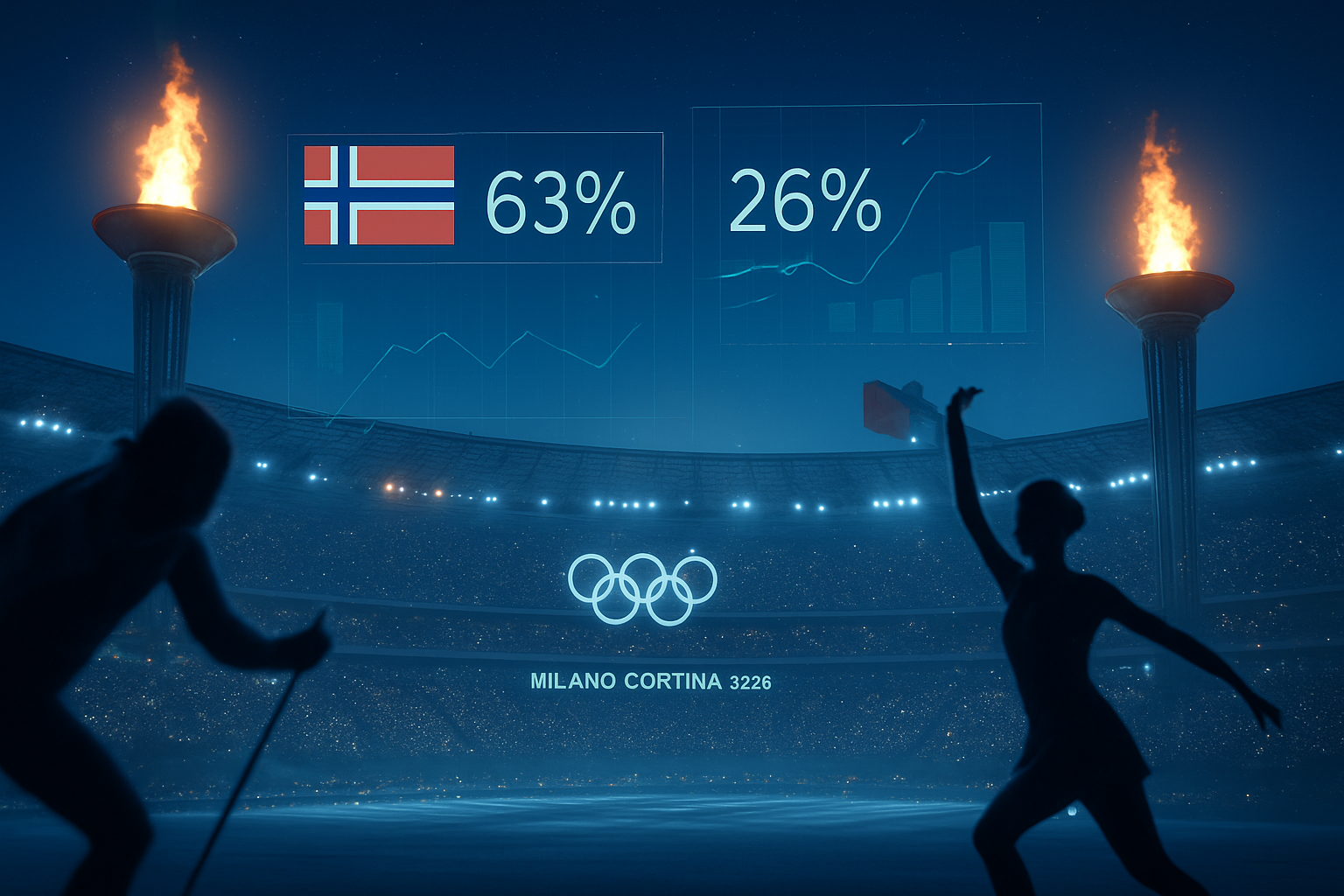
The primary theater for this financial speculation is Polymarket, where the "Most Gold Medals" contract has become a focal point for sports analysts and crypto-traders alike. Currently, Norway "Yes" shares are trading at $0.79, reflecting the 79% implied probability, while the United States "Yes" shares languish at $0.18. This represents a massive shift from the pre-Opening Ceremony odds, which saw Norway at a more modest 63% and the U.S. at 26%.
The market is structured as a winner-take-all contract that settles based on the final official medal tally from the International Olympic Committee (IOC). In the event of a tie in gold medals, Polymarket’s resolution rules state that the winner will be determined by the most silver medals, followed by the most total medals overall. This "tie-break" clause is particularly relevant given the dominance of the Comcast Corporation (NASDAQ:CMCSA)-owned NBCUniversal’s coverage, which often focuses on total medal counts, whereas prediction markets are laser-focused on the specific gold-medal "winner-take-all" outcome.
Liquidity in the market remains exceptionally high for a sporting event, with the $4 million volume providing tight spreads and allowing "whales" to move large positions. Traders who backed Norway early are already sitting on significant "paper gains," while those betting on a U.S. resurgence are hoping for a heavy-hitting second week dominated by figure skating and snowboarding.
Why Traders Are Betting
The 79% confidence in Norway isn't just a result of national bias; it is backed by cold, hard performance. Over the opening weekend, Norway secured three pivotal golds that shattered the "bear case" for the nation. Cross-country legend Johannes Høsflot Klæbo secured his sixth career gold in the men’s 20km skiathlon on February 8, while Anna Odine Strøm delivered a massive upset in women’s ski jumping—a sport where Norway was not the favorite. Perhaps most impressively, Sander Eitrem broke the Olympic record in the men’s 5000m speed skating, proving that Norway's dominance extends beyond the ski trails and into the rinks.
Conversely, the U.S. market position took a significant hit following the dramatic crash of alpine legend Lindsey Vonn on Day 2. Vonn’s highly publicized comeback was cut short in the downhill race, an event the U.S. had hoped would provide a crucial gold. While Breezy Johnson did secure a gold in the women's downhill for Team USA, the loss of Vonn’s "points" in the projected standings caused a sharp sell-off in U.S. shares.
Traders are also eyeing the "systemic dominance" of Norway versus the "superstar reliance" of the U.S. "Norway's floor is incredibly high because of their depth in biathlon and cross-country skiing," noted one high-volume Polymarket trader. "The U.S. needs near-perfection from individual stars like Ilia Malinin in figure skating and Chloe Kim in snowboarding. If just one of those stars falters, the U.S. path to most golds effectively evaporates. Norway can afford a few mistakes; the U.S. cannot."
Broader Context and Implications
The 2026 Games represent a turning point for how the public consumes Olympic data. While traditional broadcasters like Warner Bros. Discovery (NASDAQ:WBD) and NBCUniversal focus on human interest stories and delayed broadcasts, prediction markets provide a real-time, unsentimental "scoreboard" of expectations. The 79% probability for Norway suggests that the "wisdom of the crowd" has largely written off the competitive nature of the gold medal race, viewing Norway's "Ice Machine" as an inevitability.
Furthermore, the $4 million volume on a single Olympic market highlights the growing mainstreaming of prediction platforms. Unlike traditional sportsbooks, which often limit winning bettors or offer static odds, decentralized platforms allow for dynamic hedging. For example, sponsors like Nike, Inc. (NYSE:NKE), which outfits many of the top athletes, could theoretically use these markets to hedge against the marketing loss of a "gold-less" Games for their primary sponsored nations.
Historically, prediction markets have been remarkably accurate in predicting Olympic outcomes, often outperforming traditional statistical models. In the 2022 Beijing Games, the markets correctly identified Norway’s record-breaking run days before the mathematical certainty was achieved. The current 2026 data suggests we are seeing a repeat of that efficiency, as bettors front-run the upcoming biathlon schedule, which is heavily weighted toward the Norwegian roster.
What to Watch Next
The coming week offers several "inflection points" that could either cement Norway’s 79% lead or provide the U.S. with a much-needed "moonshot" rally. The most critical event on the horizon is the men's singles figure skating, where American Ilia Malinin—known as the "Quad God"—is the heavy favorite. A gold here is priced in for the U.S., but any mistake could send U.S. shares tumbling toward the single digits.
Speed skating phenom Jordan Stolz is another "must-watch" for market participants. Stolz is favored in three separate distances (500m, 1000m, and 1500m). If Stolz sweeps these events, the U.S. probability could feasibly jump back above 30%, especially if Norway suffers a rare "bad day" on the biathlon range.
Finally, traders should keep a close eye on the biathlon mixed relay and the upcoming ski jumping large hill events. These are the "battleground states" of the Winter Olympics. If Norway continues to "steal" golds in events where they are only 20-30% favorites—as they did in the normal hill ski jumping—the market will likely close out, with Norway shares hitting $0.90 or higher before the start of the final weekend.
Bottom Line
As it stands on February 9, 2026, the prediction markets are signaling that the race for the most gold medals is Norway's to lose. The 79% to 18% split reflects a fundamental belief in the Nordic nation's specialized "medal factory" system over the American "star power" model. With $4 million in volume already processed, the market is displaying deep conviction that the Norwegian flag will be the one seen most frequently atop the podium in Milano-Cortina.
For the United States to stage a comeback, they need a "perfect week" from their elite specialists and a series of uncharacteristic failures from the Norwegian endurance squad. In the cold, calculating world of prediction markets, sentiment is a secondary factor; the numbers currently point to a Norse landslide. Whether you are a sports fan or a market speculator, the next seven days will determine if the "Ice Machine" is truly unstoppable or if the U.S. has one more miracle on ice left in the tank.
This article is for informational purposes only and does not constitute financial or betting advice. Prediction market participation may be subject to legal restrictions in your jurisdiction.
PredictStreet focuses on covering the latest developments in prediction markets. Visit the PredictStreet website at https://www.predictstreet.ai/.