Tag: NFL 2026

  • A Billion-Dollar Kickoff: Super Bowl LX Prediction Markets Hit Record $1B in Trading Volume

    A Billion-Dollar Kickoff: Super Bowl LX Prediction Markets Hit Record $1B in Trading Volume

    As the Seattle Seahawks and New England Patriots prepare to take the field for Super Bowl LX at Levi’s Stadium, the real action is happening on digital ledger boards and order books. In a historic first for the industry, the 2026 Super Bowl has become the most heavily traded sporting event in the history of prediction markets, signaling a fundamental shift in how Americans and global observers hedge against—and profit from—the "Big Game."

    Leading the charge are the two titans of the space: Kalshi and Polymarket. On Kalshi, the first U.S.-regulated exchange to legally offer sports event contracts, trading volume for the game-winner market has surged past $180 million. Meanwhile, Polymarket, the decentralized heavyweight operating internationally, has seen its Super Bowl LX championship market swell to nearly $700 million. Together with smaller niche platforms, the total liquidity poured into this single Sunday matchup has eclipsed the $1 billion mark, dwarfing the volume seen just two years ago.

    The Market: What's Being Predicted

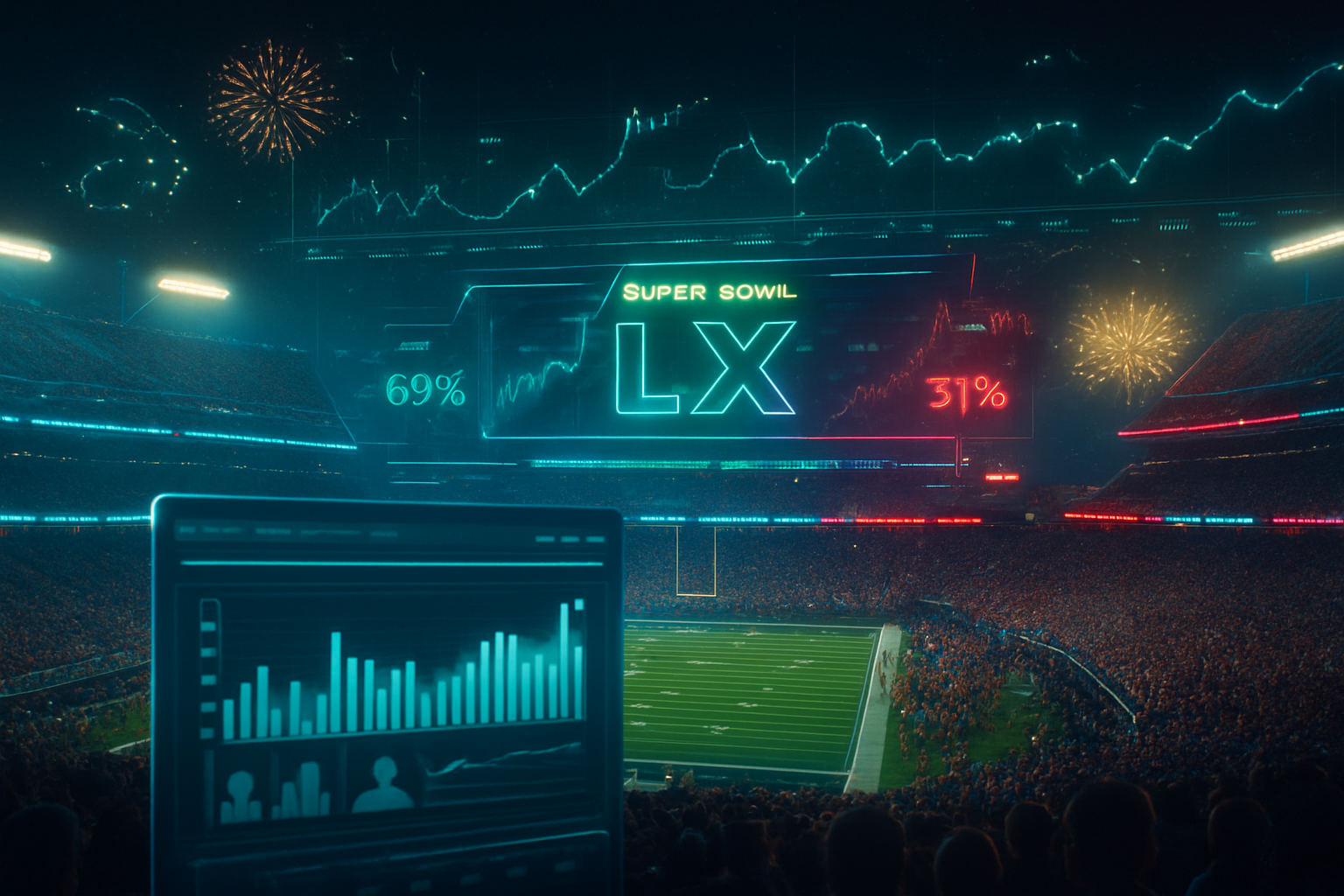
    The central question for traders is simple: Who walks away with the Lombardi Trophy? As of the morning of February 8, 2026, the markets show a rare, high-conviction consensus favoring the Seattle Seahawks. On Kalshi, the Seahawks are trading at a 69% probability of winning, while Polymarket participants are slightly more conservative, pricing them at 68%.

    This divergence, though small, represents millions of dollars in arbitrage opportunity for sophisticated traders. The markets are highly liquid, with "yes" contracts for the Seahawks priced at roughly 69 cents, meaning a $100 bet would return roughly $145 if Seattle triumphs. The resolution criteria are strictly defined by the official NFL score at the end of regulation or overtime, with Kalshi’s contracts clearing through the CFTC-regulated framework that treats these bets as commodity derivatives rather than traditional wagers.

    Why Traders Are Betting

    The massive volume is driven by a compelling narrative: the "Legacy Rematch." Eleven years after the infamous goal-line interception in Super Bowl XLIX, these two franchises meet again with entirely different rosters but equally high stakes. Traders are particularly bullish on Seahawks quarterback Sam Darnold, who has undergone a career-defining renaissance this season. Darnold currently leads the MVP prediction markets with +130 odds, as traders bet that a Seattle win is inextricably linked to his performance.

    On the other side, the New England Patriots, led by the sensational sophomore Drake Maye, are the market’s underdog. Despite the Patriots' superior 17–3 regular-season record, "whales" on Polymarket have been selling New England positions throughout the week. Analysts suggest this is due to concerns over Maye’s youth—he is attempting to become the youngest QB to win a Super Bowl—and the Seahawks’ top-ranked defensive unit.

    Broader Context and Implications

    This Super Bowl marks a defining moment for the prediction market industry. Following a series of landmark legal victories against the CFTC in 2025, Kalshi’s ability to offer "sports event contracts" has been cemented under federal law. This has transformed the Super Bowl from a purely gambling-focused event into a financial one. Institutional players are now using these markets to hedge against regional economic shifts—such as Seattle-based corporations hedging against the productivity dip of a victory parade.

    The regulatory environment has also matured. Under the leadership of the new CFTC Chairman, the federal government has begun treating these markets as essential tools for price discovery. Unlike traditional sportsbooks like DraftKings or FanDuel, which often limit winning players and take a high "vig," prediction markets offer a transparent, peer-to-peer exchange where the "price" is determined solely by supply and demand. This transparency is attracting a new class of "macro-sports" traders who treat the NFL season like the commodities market.

    The presence of public companies in the prop markets further highlights the mainstreaming of this data. Traders are currently moving millions in "novelty props" related to Super Bowl commercials and halftime appearances:

    • Hims & Hers Health, Inc. (NYSE: HIMS): Markets are betting on the reception of their "Rich People Live Longer" ad, which focuses on GLP-1 access.
    • T-Mobile US, Inc. (NASDAQ: TMUS): A highly active market is predicting whether the Backstreet Boys' pink-themed commercial will be ranked in the top three of the post-game "Ad Meter."
    • PepsiCo, Inc. (NASDAQ: PEP): Even as they have stepped back from halftime sponsorship, Pepsi is the subject of high-volume contracts regarding their stadium-wide sustainability initiatives.

    What to Watch Next

    As kickoff approaches, the most volatile markets to monitor will be the Halftime Show props. Current odds suggest a 72% chance that Bad Bunny opens his set with "Tití Me Preguntó." However, a late-breaking rumor about a guest appearance by Lady Gaga (currently at a 61% probability) could send shockwaves through the "Halftime Guest" contracts.

    In-game trading will also be a major factor. For the first time, Kalshi will offer "micro-contracts" during the game, allowing traders to bet on the outcome of individual drives. If the Patriots score an early touchdown, expect the Seahawks' 69% win probability to plummet, creating a "buy the dip" opportunity for Seattle believers.

    Bottom Line

    Super Bowl LX is more than just a championship game; it is the "Proof of Concept" for prediction markets as a global financial infrastructure. With over $180 million on Kalshi and $700 million on Polymarket, the sheer scale of the liquidity proves that the public's appetite for high-stakes, transparent forecasting is insatiable.

    Whether Sam Darnold completes his redemption arc or Drake Maye begins a new dynasty, the real winner today is the market itself. We have moved past the era of the "bookie" and into the era of the "exchange." As the ball is teed up, the world isn't just watching a game—it's watching a billion-dollar live-data experiment unfold in real-time.


    This article is for informational purposes only and does not constitute financial or betting advice. Prediction market participation may be subject to legal restrictions in your jurisdiction.

    PredictStreet focuses on covering the latest developments in prediction markets.
    Visit the PredictStreet website at https://www.predictstreet.ai/.
  • The Wisdom of Play-Money: How Manifold Markets Nailed the NFL Wild Card Chaos

    The Wisdom of Play-Money: How Manifold Markets Nailed the NFL Wild Card Chaos

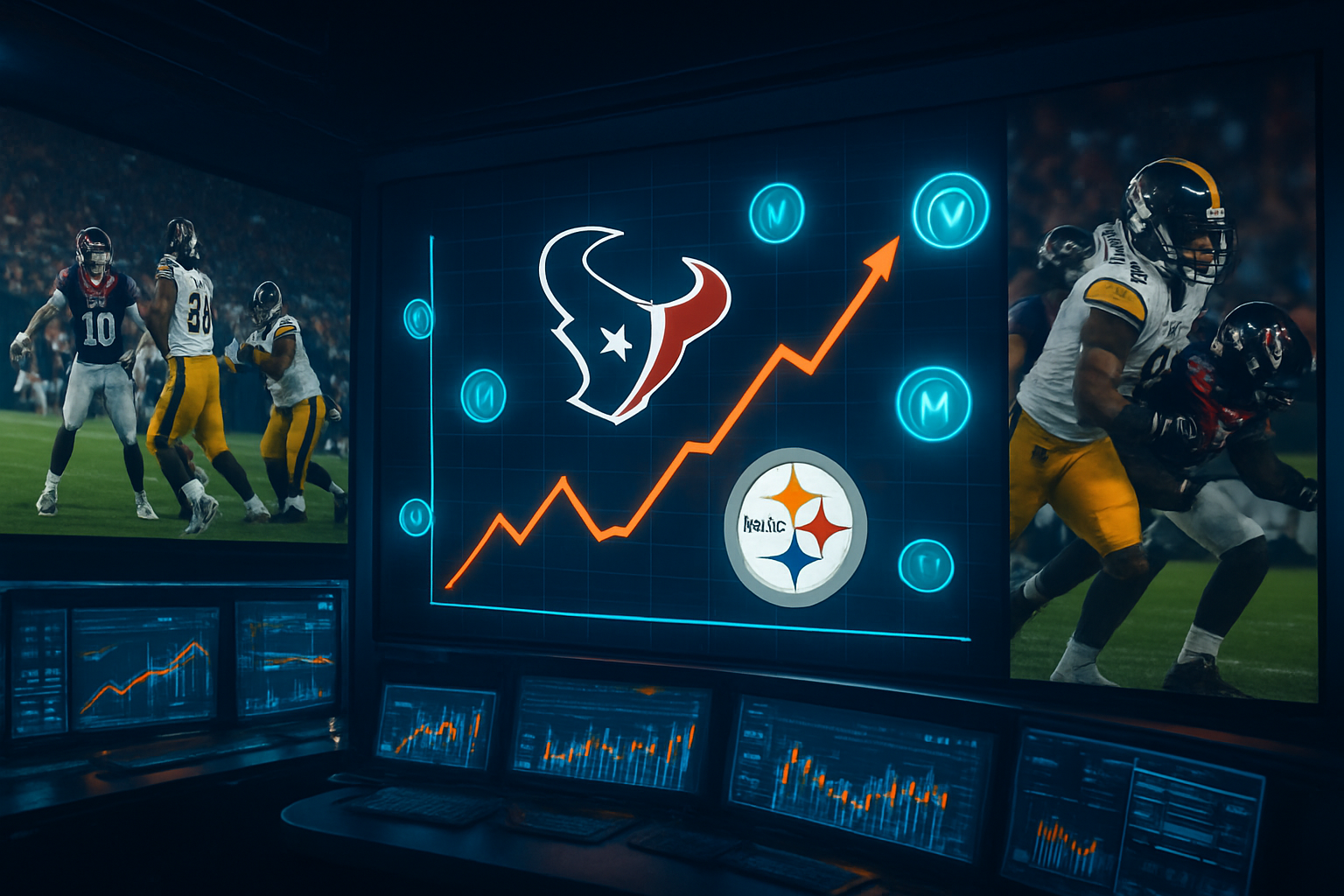
    As the smoke clears from one of the most unpredictable NFL Wild Card weekends in modern history, the biggest winner isn’t just a team on the field, but a unique prediction model in the cloud. While traditional sportsbooks and Vegas sharps scrambled to adjust lines for veteran-heavy favorites, Manifold Markets, a play-money social prediction platform, correctly tracked a groundswell of sentiment that pointed toward the weekend's most shocking upset: the Houston Texans’ 30–6 dismantling of the Pittsburgh Steelers.

    On Monday, January 12, 2026, the Texans didn't just win; they dominated a Steelers squad led by a struggling 42-year-old Aaron Rodgers. While real-money markets like DraftKings (Nasdaq: DKNG) and FanDuel (Flutter Entertainment – NYSE: FLUT) held the Steelers as firm favorites throughout the week, Manifold’s "Mana" traders—using the platform’s proprietary play-money currency—were already bidding up the Texans’ win probability, signaling a shift in sentiment that traditional data models missed.

    The Market: What's Being Predicted

    The Houston vs. Pittsburgh matchup was the center of a "high-mana" storm on Manifold Markets. Early in the week, the Texans were viewed as a long shot, with the market pricing them at a mere 18% probability to win on the road at Acrisure Stadium. However, unlike traditional books that are bound by balancing liability and managing professional "sharps," Manifold functions as a decentralized social network. Users trade "Mana" to express their conviction, and the platform’s order-book model allows for rapid price discovery based on news, rumors, and qualitative analysis.

    By the time kickoff arrived, the Texans' probability on Manifold had surged to 31%, with several "whales"—traders with massive Mana balances accumulated through accurate historical forecasting—taking massive long positions on Houston. This trend was echoed on Polymarket, a crypto-based prediction platform, but the movement on Manifold was uniquely driven by its social features. The Texans market alone saw over 150,000 Mana traded, a record for a non-championship game, with the resolution criteria based on the official NFL score.

    Why Traders Are Betting

    The shift toward the Texans was fueled by a convergence of "social signals" that traditional algorithms often overlook. In the comment sections of Manifold Markets, traders aggregated reports regarding Aaron Rodgers’ mobility and his reported difficulties with the Steelers' offensive scheme. While official injury reports from Disney’s ESPN (NYSE: DIS) remained vague, the "wisdom of the crowd" on Manifold correctly identified that the Texans’ "S.W.A.R.M." defense, led by head coach DeMeco Ryans, was perfectly built to exploit a stationary veteran quarterback.

    Furthermore, Manifold’s structure allows for "mini-markets" to be embedded within larger events. Traders weren't just betting on the win; they were betting on micro-events like "Will C.J. Stroud have 2+ turnovers?" and "Will the Texans defense outscore the Steelers offense?" The latter market saw a massive spike in "Yes" bets just 24 hours before the game. This granular betting behavior served as a real-time sentiment analysis tool, revealing that the crowd wasn't just predicting a win, but a specific type of defensive-driven blowout.

    Broader Context and Implications

    The accuracy of Manifold’s play-money crowd during the 2026 Wild Card round highlights a growing trend: social prediction as a legitimate form of information discovery. Because Mana has no inherent cash value (though it can be used for charitable donations or platform status), it attracts a different demographic of forecasters—often data scientists and sports nerds who are more interested in being "right" than winning a payout. This removes the "risk-aversion" bias often seen in real-money gambling.

    This phenomenon is increasingly being studied by tech giants like Alphabet (Nasdaq: GOOGL) as a way to filter noise from actual signal in public discourse. If a play-money crowd can outperform a multi-billion dollar gambling industry in predicting a sports upset, the implications for political and economic forecasting are profound. The 2026 Wild Card round proved that when people are incentivized by reputation and social standing, the resulting "wisdom" can be more agile than markets weighed down by massive institutional liquidity.

    What to Watch Next

    As we move into the Divisional Round on January 17–18, 2026, all eyes are on the Texans as they travel to face the #2 seed New England Patriots. Early Manifold data shows that the "crowd" is not yet ready to hop off the Houston bandwagon. Despite the Patriots being favored by 3 points in Vegas, Manifold traders have already bid the Texans up to a 44% win probability.

    Another key market to watch is the Buffalo Bills vs. Denver Broncos matchup. The Bills are currently a narrow favorite on Manifold (51%), despite the Broncos holding the #1 seed and the home-field advantage. Traders are citing the "Josh Allen factor" and recent injuries to the Denver secondary as key drivers. If the "wisdom of the play-money crowd" holds true for a second consecutive week, we could be looking at one of the most chaotic AFC Championship matchups in history.

    Bottom Line

    The 2026 NFL playoffs are proving that the line between "play" and "prediction" is blurring. Manifold Markets’ ability to correctly track the Texans’ rise wasn't a fluke; it was the result of a platform that encourages the rapid sharing of information and rewards accuracy over luck. For prediction market enthusiasts, the lesson is clear: don't ignore the play-money markets.

    As the Texans prepare for Foxborough and the Rams head to Chicago, the Mana-rich traders of Manifold will be the first to move when the next piece of news breaks. Whether it's a minor injury update or a shift in weather conditions, the "social prediction" model is proving to be the most responsive tool in the modern forecasting kit.


    This article is for informational purposes only and does not constitute financial or betting advice. Prediction market participation may be subject to legal restrictions in your jurisdiction.

    PredictStreet focuses on covering the latest developments in prediction markets.
    Visit the PredictStreet website at https://www.predictstreet.ai/.