
Tag: NFL

  • The New Casino-Bank: How Robinhood is Democratizing Truth and Risk with Event Contracts

    The New Casino-Bank: How Robinhood is Democratizing Truth and Risk with Event Contracts

    In the world of retail finance, the "meme stock" era has officially been replaced by the "event contract" era. Leading this charge is Robinhood (NASDAQ: HOOD), which has successfully pivoted its massive user base from speculative equity trading toward the rapidly expanding frontier of prediction markets. As of early February 2026, the platform has moved far beyond its origins, transforming into a one-stop-shop where a user can buy Bitcoin, trade S&P 500 options, and now, hedge their weekend plans against an NFL upset—all within the same interface.

    The timing could not be more critical. With Super Bowl LX between the Seattle Seahawks and the New England Patriots just days away, Robinhood’s prediction markets are seeing unprecedented liquidity. Unlike traditional sportsbooks that operate on a "house vs. player" model, Robinhood’s partnership with Kalshi allows users to trade directly against one another. This "peer-to-peer" (P2P) structure has driven the cumulative volume of event contracts on Robinhood to over 11 billion, creating a "truth engine" that many analysts believe is more accurate than any traditional polling or punditry.

    The Market: What's Being Predicted

    The current centerpiece of Robinhood's prediction ecosystem is its comprehensive suite of football event contracts, launched in partnership with the CFTC-regulated exchange Kalshi in August 2025. This market covers every NFL regular-season game and the "Power Four" college football conferences. Unlike the opaque odds of Las Vegas, these contracts trade between $0.00 and $1.00. If you buy a "Seattle Seahawks to Win" contract at $0.60, the market is effectively giving them a 60% chance of victory; if they win, your contract settles at $1.00, netting a $0.40 profit.

    Since its inception, the platform has rapidly expanded its "menu" of outcomes. Traders can now speculate on point spreads, over/under totals, and as of December 2025, highly specific player props like anytime touchdowns or quarterback passing yards. The liquidity is staggering: the Super Bowl LX winner market alone has seen over $166 million in volume across the Robinhood-Kalshi ecosystem. This represents a nearly six-fold increase over the volume seen just one year ago, signaling a massive shift in how the public engages with major cultural events.

    Why Traders Are Betting

    The primary driver behind this retail migration is the introduction of "Custom Combos," a sophisticated feature that mimics traditional sports betting parlays but functions through a financial Request-for-Quote (RFQ) mechanism. When a user bundles up to 10 different outcomes—such as a Seahawks win, a Federal Reserve rate cut, and a specific movie’s opening weekend performance—Robinhood’s system polls market makers, led by Susquehanna International Group, to provide a real-time price.

    Traders are also drawn to the efficiency of the "bid-ask spread" compared to the "vig" of a traditional sportsbook. While companies like DraftKings (NASDAQ: DKNG) or FanDuel typically bake a 5% to 10% margin into their odds, Robinhood's peer-to-peer model often sees spreads as thin as a single penny. "I'm not betting against a bookie who wants me to lose," says one high-volume trader on the platform. "I'm trading a financial instrument against someone who simply has a different view of the future."

    Furthermore, the ability to "day trade" these contracts has revolutionized the experience. In a traditional bet, your money is locked until the final whistle. On Robinhood, if the Seahawks take a 14-point lead in the first quarter, the price of a "Yes" contract might jump from $0.60 to $0.85, allowing traders to exit early and lock in gains—a mechanic that feels much more like trading stocks than placing a wager.

    Broader Context and Implications

    Robinhood’s aggressive expansion into this space is part of a larger strategic vision that CEO Vlad Tenev calls the "Prediction Market Supercycle." By framing these as "truth futures" rather than gambling, Robinhood is navigating a complex regulatory landscape. Because the trades are routed through the CFTC-regulated Kalshi—and soon through Robinhood's newly acquired MIAXdx (formerly LedgerX) exchange—the platform can offer these products in states where traditional sports betting remains illegal, such as California and Texas.

    This vertical integration is a game-changer. In January 2026, Robinhood completed its 90% acquisition of MIAXdx, giving it its own Designated Contract Market (DCM) and clearinghouse. This move reduces the company's reliance on third-party partners and paves the way for "Robinhood-exclusive" contracts that could range from hyper-local weather events to corporate earnings outcomes.

    The move is also paying off on the balance sheet. Prediction markets have become Robinhood’s fastest-growing revenue stream, currently on a trajectory to contribute over $300 million in annual revenue. It has effectively turned "news" into a tradable asset class, competing not just with sportsbooks, but with traditional derivatives exchanges like the CME Group (NASDAQ: CME) and Interactive Brokers (NASDAQ: IBKR), which has also launched its own "ForecastEx" platform.

    What to Watch Next

    As we move past the Super Bowl, the next major test for Robinhood’s infrastructure will be the 2026 mid-term election cycle and the integration of AI-assisted trading tools. Tenev has hinted at a future where users can use "AI Hedging Agents" to automatically buy event contracts that protect them against real-world risks, such as a rise in gas prices or a drop in their local housing market.

    Additionally, the industry is closely watching for potential regulatory pushback. While the CFTC has currently allowed these "event contracts" to flourish, a shift in the political or legal winds could result in tighter restrictions on what qualifies as a "financial event." Robinhood’s ownership of MIAXdx is a defensive moat in this regard, providing it with the legal standing of a registered exchange rather than just a brokerage.

    Bottom Line

    Robinhood's pivot to prediction markets represents the final evolution of the "everything app" for the retail investor. By blurring the lines between sports, politics, and finance, the platform has created a high-engagement ecosystem that thrives on the 24-hour news cycle. The sheer volume seen in the 2025-2026 football season suggests that the public's appetite for "trading the truth" is only beginning to grow.

    Ultimately, Robinhood (NASDAQ: HOOD) is betting that prediction markets will eventually be viewed as a core pillar of a modern portfolio. Whether it’s hedging a mortgage or speculating on a touchdown, the message to retail traders is clear: the future is no longer something to just watch—it’s something to trade.


    This article is for informational purposes only and does not constitute financial or betting advice. Prediction market participation may be subject to legal restrictions in your jurisdiction.

    PredictStreet focuses on covering the latest developments in prediction markets.
    Visit the PredictStreet website at https://www.predictstreet.ai/.
  • The California End-Run: How Kalshi is Disrupting the Super Bowl LX Betting Map

    The California End-Run: How Kalshi is Disrupting the Super Bowl LX Betting Map

    As the Seattle Seahawks and New England Patriots prepare to take the field for Super Bowl LX at Levi’s Stadium in Santa Clara, California, a quiet financial revolution is unfolding in the stands and across the Golden State. Despite California’s long-standing and contentious ban on traditional sports betting, residents are currently pouring millions of dollars into a "legal loophole" that the state’s powerful gambling interests never saw coming.

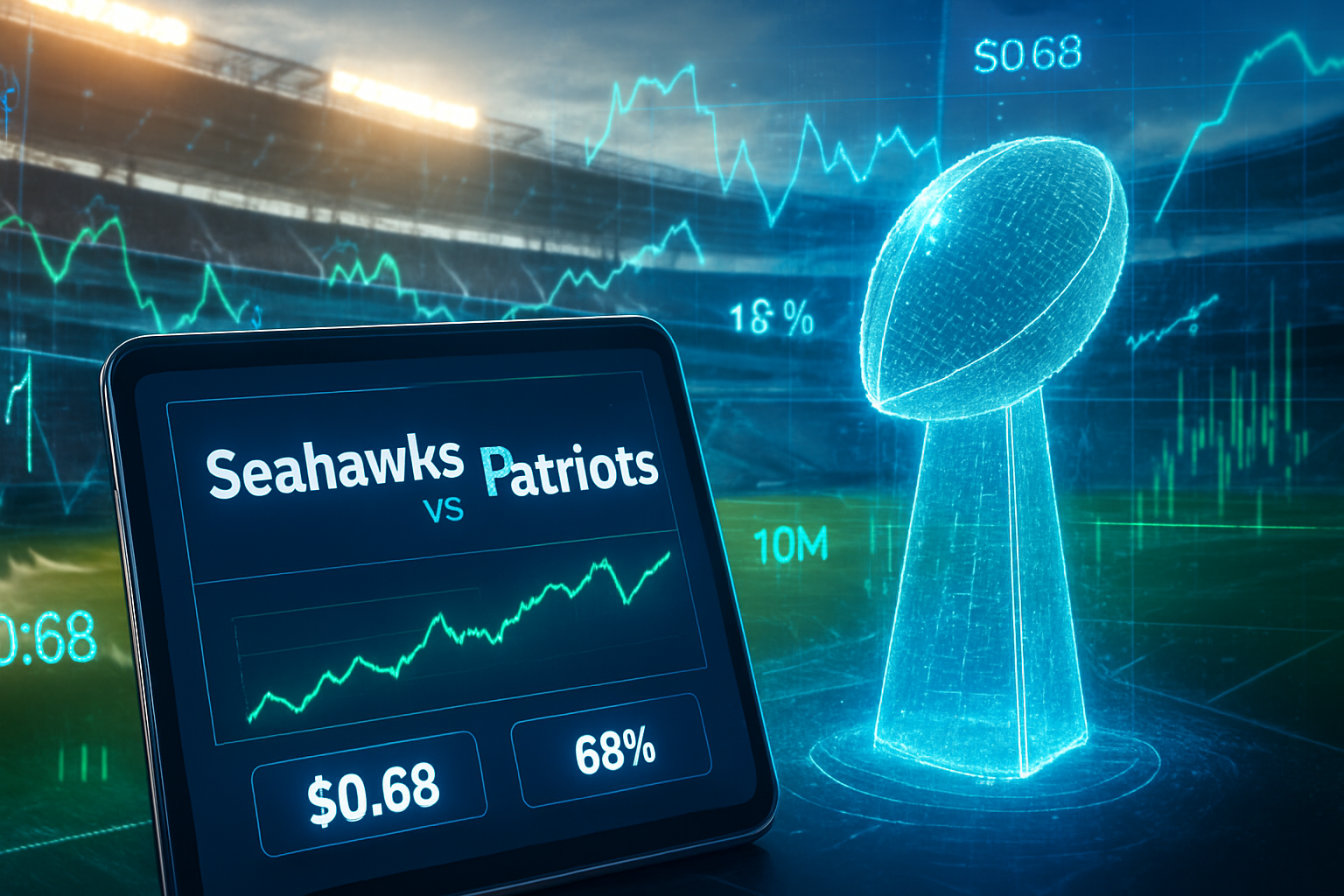
    The focal point of this activity is Kalshi, a federally regulated prediction market that has effectively bypassed state prohibitions by offering "event contracts" rather than traditional wagers. As of February 1, 2026, market data shows the Seahawks favored with a 68% probability of victory, with shares trading at approximately $0.68. This market isn't just a niche hobby; it has become a massive financial engine, signaling a paradigm shift in how Americans interact with sporting outcomes in states where sportsbooks remain illegal.

    The Market: What's Being Predicted

    The headline event on Kalshi is the "Winner of Super Bowl LX" contract, which has seen its liquidity explode over the final weeks of the postseason. Trading volume for the Seahawks vs. Patriots matchup has officially surpassed $150 million, a staggering 450% increase from the volume recorded during Super Bowl LIX just one year ago. Unlike traditional sportsbooks like DraftKings Inc. (NASDAQ: DKNG) or Flutter Entertainment plc (NYSE: FLUT)—which are geofenced out of California—Kalshi’s status as a Designated Contract Market (DCM) allows it to operate under the oversight of the Commodity Futures Trading Commission (CFTC).

    The market functions as a binary "Yes/No" proposition: will the Seattle Seahawks win? If a trader buys a "Yes" share at $0.68 and the Seahawks win, the contract pays out $1.00. If they lose, the contract expires at $0.00. Beyond the game-winner, the platform has expanded into hyper-specific prop markets, including:

    • Super Bowl MVP: Significant volume has shifted toward Seahawks quarterback Sam Darnold and Patriots rookie sensation Drake Maye.
    • Halftime Show Logistics: Markets are currently trading on whether Bad Bunny will perform specific hits or bring out unannounced guests.
    • Economic Impact: Contracts predicting the local tax revenue generated for the city of Santa Clara and the stock performance of stadium sponsor Levi Strauss & Co. (NYSE: LEVI) on the Monday following the game.

    Why Traders Are Betting

    The surge in betting activity is driven by a unique confluence of fan enthusiasm and sophisticated hedging strategies. Because these are technically "derivatives" rather than "bets," they have attracted a different class of market participant. Institutional traders and "whales" are using the Seahawks-Patriots market to hedge against economic shifts related to the NFL’s $13 billion annual revenue stream.

    The current odds—giving the Seahawks a clear edge—are being influenced by Seattle’s dominant defensive metrics and the "home-coast advantage." However, the Patriots' odds saw a 5% jump last week following news of a minor injury to Seattle’s starting left tackle. For Californians, the appeal is simpler: Kalshi represents the only legal, regulated avenue to have "skin in the game" without turning to offshore black-market sites or driving across the border to Arizona or Nevada. This "gray window" has turned prediction markets into a primary source of truth for real-time sentiment, often reacting faster to injury news than traditional sports media outlets.

    Broader Context and Implications

    The "California Loophole" is the result of a landmark shift in federal regulatory policy. Historically, the CFTC fought to keep sports out of prediction markets, but the tide turned in early 2026 under the leadership of newly appointed CFTC Chairman Michael Selig. Selig’s decision to withdraw proposed bans on sports event contracts has effectively signaled a "hands-off" approach from the federal government, arguing that the Commodity Exchange Act (CEA) grants the CFTC exclusive jurisdiction that preempts state gambling laws.

    This has infuriated both state lawmakers and the NFL. The league, which has long guarded its intellectual property and integrity standards, has officially banned Kalshi and its competitor Polymarket from purchasing ad space during the Super Bowl LX broadcast on Comcast Corporation's (NASDAQ: CMCSA) NBC. Representative Salud Carbajal (D-CA) has been a vocal critic, arguing that these markets undermine California's sovereignty and lack the consumer protections mandated by state-regulated gaming commissions. Furthermore, California’s influential gaming tribes have filed multiple lawsuits, alleging that Kalshi is infringing on their exclusive rights to offer gaming in the state—a legal battle that is currently winding its way through the appellate courts.

    What to Watch Next

    All eyes are now on the 9th Circuit Court of Appeals, which is scheduled to hear a pivotal case regarding "federal preemption" in April 2026. This ruling will determine if California has the right to shut down Kalshi's operations despite its federal DCM status. If the court rules in favor of the state, the $150 million Seahawks-Patriots market could be the last of its kind in California. If it rules for Kalshi, it could force California to finally legalize and tax traditional sports betting to compete with the "federal loophole."

    In the immediate term, traders should monitor the "Super Bowl MVP" markets. Historically, these markets are highly volatile in the 48 hours preceding kickoff as "insider" sentiment regarding game plans begins to leak. Additionally, any late-breaking news regarding the Levi’s Stadium turf conditions—a recurring theme in Santa Clara—could cause a 2-3% swing in the win-probability contracts.

    Bottom Line

    The $150 million pouring into the Seahawks vs. Patriots market is more than just a series of wagers; it is a live-fire test of the American regulatory framework. Kalshi has successfully utilized its federal status to crack open one of the most protected markets in the world, proving that where there is a demand for forecasting, capital will find a way to flow.

    While the NFL and California lawmakers remain in a defensive crouch, the sheer volume of participation suggests that the public has already voted with their wallets. Whether Super Bowl LX ends with a Seahawks victory or a Patriots upset, the real winner may be the prediction market industry, which has finally moved from the fringes of political "election betting" into the heart of the American cultural mainstream.


    This article is for informational purposes only and does not constitute financial or betting advice. Prediction market participation may be subject to legal restrictions in your jurisdiction.

    PredictStreet focuses on covering the latest developments in prediction markets.
    Visit the PredictStreet website at https://www.predictstreet.ai/.
  • The $100 Million Play: How Kalshi’s Regulated Sports Markets are Rewriting the Playbook for Institutional Bettors

    The $100 Million Play: How Kalshi’s Regulated Sports Markets are Rewriting the Playbook for Institutional Bettors

    In the week following the NCAA Football Championship, the dust is settling on more than just the gridiron. On January 20, 2026, the championship game did more than crown a college football king; it solidified Kalshi as a financial juggernaut. The platform recorded a staggering $111 million in trading volume for the single event, a figure that signals a tectonic shift in how Americans—and increasingly, Wall Street—engage with sports.

    Currently, the markets for the upcoming Super Bowl LX are already seeing nearly $150 million in open interest, with odds fluctuating as professional trading desks move multi-million dollar positions. This is no longer just "betting" in the traditional sense; it is the financialization of sports outcomes through federally regulated event contracts. Driven by a landmark regulatory victory and integration into major retail brokerages, Kalshi has transformed sports results into a legitimate asset class, attracting institutional-scale liquidity that was previously confined to offshore exchanges or private bookmakers.

    The Market: What's Being Predicted

    The core of Kalshi’s explosion lies in its "event contracts," which are binary options that pay out $1 if an event occurs and $0 if it does not. Unlike traditional sportsbooks where you "place a bet" against the house, Kalshi operates a peer-to-peer exchange where traders buy and sell contracts from one another. In the lead-up to the 2025-2026 NFL playoffs, this model allowed for unprecedented liquidity. For instance, the final day of the NFL regular season on January 4, 2026, saw a single-day volume record of $403 million.

    While Polymarket continues to dominate the decentralized, crypto-native space, Kalshi has carved out a massive lead in the regulated U.S. domestic market. By the third week of January 2026, total trading volume for the NFL playoffs reached nearly $2 billion. The resolution criteria for these markets are strictly defined by official league data, ensuring that contracts settle instantly upon the final whistle. This transparency has allowed Kalshi to list complex derivatives, including point spreads and player performance metrics, all under the watchful eye of federal regulators.

    Why Traders Are Betting

    The migration of capital toward Kalshi is driven by one primary factor: regulatory certainty. Following the 2024 court victory in KalshiEX LLC v. CFTC, and the subsequent decision by the Commodity Futures Trading Commission (CFTC) to drop its appeal in May 2025, Kalshi’s status as a Designated Contract Market (DCM) became unassailable. This regulatory "seal of approval" has opened the floodgates for institutional participants.

    Unlike traditional sportsbooks—which are notorious for limiting or banning "sharp" bettors who win too consistently—Kalshi’s exchange model welcomes winners. Large-scale proprietary trading firms and hedge funds now treat touchdowns and game wins as "Zero Days to Expiration" (0DTE) derivatives. They use these contracts to hedge macro risks or to capitalize on high-frequency data models that traditional books cannot accommodate. Furthermore, the integration of Kalshi markets into platforms like Robinhood (NASDAQ: HOOD) and Coinbase (NASDAQ: COIN) has brought institutional-level liquidity into the hands of over 24 million retail users, creating a deeper, more stable market than any sportsbook could offer.

    Broader Context and Implications

    The success of Kalshi represents a pivotal moment in the "Prediction Market vs. Gambling" debate. By framing sports outcomes as event contracts under the Commodity Exchange Act (CEA), Kalshi has managed a feat that traditional sports betting apps like DraftKings or FanDuel could not: federal preemption. Recent rulings in federal courts have suggested that the CEA preempts state-level gaming restrictions, allowing Kalshi to legally offer sports trading in all 50 U.S. states, including major markets like California and Texas where traditional online sports betting remains prohibited.

    This shift reveals a growing public appetite for transparent, low-fee alternatives to the "vig-heavy" model of traditional gambling. It also highlights a change in public sentiment; sports are increasingly viewed through the lens of data and probability rather than just loyalty and luck. However, this growth has not come without friction. The NCAA has voiced significant concerns regarding the integrity of college sports, particularly around "player prop" markets. In response, Kalshi has had to balance its aggressive expansion with "market design" concessions, such as pulling controversial transfer portal markets in late 2025 to maintain its standing with federal regulators.

    What to Watch Next

    All eyes are now turned toward Super Bowl LX on February 8, 2026. Early trading suggests the championship winner market could surpass $300 million in volume before kickoff. This will be the ultimate test of Kalshi’s infrastructure and its ability to handle "Black Swan" events or massive late-game volatility without the "suspension of play" issues that often plague traditional sportsbooks during high-volume periods.

    Beyond the Super Bowl, the next major milestone is March Madness 2026. Following the $350 million trading week in mid-January for NCAA basketball, analysts expect the tournament to break all previous records for prediction market engagement. Traders will be watching closely for any new regulatory guidance from the CFTC regarding "micro-trading" or live in-game contracts, which represent the next frontier for the platform.

    Bottom Line

    Kalshi’s rise marks the end of the era where sports betting was a sidelined, "sin-taxed" activity and the beginning of its life as a legitimate financial instrument. The $111 million NCAA Championship volume is not an outlier; it is the new baseline for a world where sports data is as tradable as oil or gold.

    For the broader prediction market ecosystem, Kalshi’s success proves that regulation, rather than being a hindrance, can be a massive catalyst for liquidity when paired with a superior exchange model. As institutional capital continues to pour into these markets, the line between "trader" and "fan" will continue to blur, forever changing the landscape of both Wall Street and the stadium.


    This article is for informational purposes only and does not constitute financial or betting advice. Prediction market participation may be subject to legal restrictions in your jurisdiction.

    PredictStreet focuses on covering the latest developments in prediction markets.
    Visit the PredictStreet website at https://www.predictstreet.ai/.
  • From Elections to End Zones: How Kalshi’s ‘Sports Trading’ is Disrupting the $120 Billion Betting Industry

    From Elections to End Zones: How Kalshi’s ‘Sports Trading’ is Disrupting the $120 Billion Betting Industry

    As the NFL enters the Divisional Round of the playoffs, a quiet revolution is taking place in how fans engage with the gridiron. While traditional sportsbooks are flooded with standard wagers, a new breed of market participant is flocking to Kalshi, the federally regulated event contract exchange. Since its aggressive expansion into sports in early 2025, Kalshi has effectively rebranded sports betting as "sports trading," turning every touchdown and turnover into a liquid financial asset.

    Currently, the market for the Super Bowl LX champion has seen massive volume, with the Seattle Seahawks holding a 25% probability of victory as of January 16, 2026. This shift is more than just a change in terminology; it represents a fundamental move away from the "house-banked" model of traditional gambling toward a peer-to-peer exchange model. In just one year, sports contracts have grown to account for over 85% of Kalshi’s total trading volume, generating hundreds of millions in revenue and challenging the dominance of established giants like DraftKings Inc. (NASDAQ: DKNG).

    The Market: What's Being Predicted

    The core of Kalshi’s sports offering is the "event contract." Unlike a traditional bet at a sportsbook like FanDuel—owned by Flutter Entertainment plc (NYSE: FLUT)—where a bettor faces off against a bookmaker's "vig" or margin, Kalshi users trade directly with one another. Each contract is structured as a binary "Yes" or "No" outcome, where the price ranges from $0.01 to $0.99. A price of $0.25 implies a 25% market-implied probability that the event will occur. If the prediction is correct, the contract pays out exactly $1.00.

    Trading is currently concentrated on the road to Super Bowl LX. The liquidity in these markets has reached unprecedented levels for a prediction platform. During the 2026 NFL Wild Card weekend, a single matchup between the Chicago Bears and Green Bay Packers saw over $112 million in notional volume. Traders aren't just betting on winners; they are trading contracts for "Total Points," "Passing Yards," and even "First Touchdown Scorer" in real-time. Because these are exchange-traded products, the "odds" (or prices) are determined entirely by supply and demand on the order book, often resulting in tighter spreads than those found at traditional sportsbooks.

    Why Traders Are Betting

    The migration of "sharps"—professional and highly successful bettors—from traditional books to Kalshi is driven by one major factor: the exchange doesn't ban winners. Traditional sportsbooks are notorious for limiting or outright banning accounts that consistently turn a profit. On Kalshi, high-volume traders provide liquidity, and the platform profits from small transaction fees regardless of who wins, creating a hospitable environment for sophisticated mathematical models.

    Additionally, the tax implications are a significant draw. Many traders are treating these contracts as financial derivatives rather than gambling winnings. In many cases, these trades are reported via 1099-B forms, allowing for more favorable capital gains treatment compared to the W-2G forms issued by casinos. Furthermore, Kalshi’s introduction of "Combos" in late 2025—a peer-to-peer version of a parlay—allows traders to request quotes for custom, multi-leg outcomes, bringing the complexity of Wall Street "structured products" to the Sunday afternoon football slate.

    Broader Context and Implications

    Kalshi’s expansion into sports is the direct result of a landmark legal battle. Following the KalshiEX LLC v. CFTC decision in late 2024, the platform secured a ruling that election and event contracts do not constitute "gaming" under the Commodity Exchange Act. This established a federal precedent that has allowed Kalshi to operate as a Designated Contract Market (DCM) regulated by the Commodity Futures Trading Commission (CFTC). This federal oversight provides a layer of institutional trust that offshore or state-regulated sites struggle to match.

    The success of these markets also signals a shift in public sentiment toward "Information Finance." The prices on Kalshi are increasingly being used by sports analysts as the "true" probability of an event, free from the bias of bookmaker-adjusted lines. However, the move has not been without controversy. The NCAA has recently petitioned the CFTC to halt trading on collegiate sports, arguing that the high-stakes environment of an exchange could compromise the integrity of student-athletes.

    What to Watch Next

    The immediate focus is the Super Bowl LX champion market. With the Seattle Seahawks (25%) and the Los Angeles Rams (21%) leading the pack, the NFC West is currently viewed as the powerhouse of the league. However, the Buffalo Bills (15%) and New England Patriots (14%) remain high-volume favorites in the AFC. Any injury reports or practice updates during the upcoming Divisional Round are expected to cause immediate, sharp volatility in these prices.

    Beyond the current season, the industry is watching for Kalshi’s potential move into "Micro-Trading." There are rumors that the platform may soon launch play-by-play contracts—allowing traders to buy or sell the probability of a specific third-down conversion being successful. This would require ultra-low latency technology and could potentially push Kalshi’s daily volume into the billions, firmly placing it alongside the largest financial exchanges in the world.

    Bottom Line

    Kalshi has successfully bridged the gap between the trading floor and the stadium. By stripping away the "house" and replacing it with a transparent, regulated order book, they have fundamentally changed the incentives of sports forecasting. The fact that sports now dominate their revenue proves that there is a massive appetite for a financialized approach to athletic competition.

    As we move toward the Super Bowl in February, these markets will serve as the ultimate test of the "wisdom of the crowd." For the average fan, Kalshi offers a fairer price and a more flexible way to engage with the game. For the broader financial world, it is the clearest evidence yet that prediction markets are no longer a niche hobby—they are a core pillar of the modern data economy.


    This article is for informational purposes only and does not constitute financial or betting advice. Prediction market participation may be subject to legal restrictions in your jurisdiction.

    PredictStreet focuses on covering the latest developments in prediction markets.
    Visit the PredictStreet website at https://www.predictstreet.ai/.

  • The House Always Loses: How Kalshi’s $100 Million ‘Combos’ Launch is Revolutionizing Prediction Markets

    The House Always Loses: How Kalshi’s $100 Million ‘Combos’ Launch is Revolutionizing Prediction Markets

    As of mid-January 2026, the landscape of digital wagering has undergone a fundamental shift. What was once a niche world of political "event contracts" has been swallowed by the behemoth of American sports. Kalshi, the leading CFTC-regulated prediction market, has officially completed its metamorphosis into a financialized sports powerhouse. The catalyst? The late 2025 launch of "Combos," a peer-to-peer parlay feature that processed over $100 million in trading volume during its first week of full operation.

    Currently, sports markets—primarily centered on the NFL and NBA—now account for a staggering 90% of weekend trading volume on the platform. During the most recent NFL Wild Card weekend (January 10–12, 2026), the platform reached a fever pitch, with a single matchup between the Bears and Packers (NYSE: GME, just kidding – no ticker for NFL teams) generating $112 million in volume alone. For the first time, prediction markets aren't just predicting the news; they are competing directly for the multi-billion dollar sports betting throne.

    The Market: What's Being Predicted

    The central engine of Kalshi’s recent growth is the "Combos" feature, which allows traders to build custom, multi-leg event contracts. Unlike traditional sportsbooks where users bet against a "house" that sets the price, Kalshi uses a Request for Quote (RFQ) system. When a trader wants to bet on a "Combo"—such as the Lakers winning and LeBron James scoring over 25 points—the platform generates a live order book where other market participants can provide liquidity and take the opposite side.

    This peer-to-peer structure has led to unprecedented liquidity in sports prediction markets. While traditional sportsbooks like DraftKings (NASDAQ: DKNG) or FanDuel, owned by Flutter Entertainment (NYSE: FLUT), use centralized algorithms to manage risk, Kalshi’s market is entirely driven by supply and demand. Currently, the most active markets are the NFL Divisional Round matchups and NBA mid-season props, with individual contracts seeing tens of millions of dollars in open interest.

    The resolution of these markets is strictly tied to official league data, but the "event contract" wrapper allows for a level of transparency that traditional betting lacks. Because Kalshi is a regulated exchange, every trade is recorded on a public ledger, providing a level of "real-time truth" regarding where the money is actually flowing—a stark contrast to the opaque "handle" reports released by traditional sportsbooks weeks after the games end.

    Why Traders Are Betting

    The migration of "sharps" and institutional traders from sportsbooks to Kalshi is driven by three primary factors: pricing, limits, and taxes. In the traditional sports betting world, "winning players" are frequently limited or outright banned by sportsbooks to protect the house’s margin. On Kalshi, there is no house; winning is encouraged because the exchange earns its revenue from transaction fees, not from the losses of its users.

    Furthermore, the tax implications have become a major draw for high-volume traders. Many Kalshi contracts are treated as Section 1256 contracts, which qualify for a 60/40 tax split (60% long-term capital gains, 40% short-term). This is significantly more favorable than the ordinary income tax rates applied to standard sportsbook winnings. Traders are also leveraging the platform’s integration with Robinhood (NASDAQ: HOOD), which has democratized access to event contracts for millions of retail stock traders who view an NFL game through the same lens as a tech stock’s earnings report.

    Market sentiment is currently favoring "high-probability combos" as a way to hedge against broader economic volatility. With the S&P 500 showing signs of stagnation in early 2026, the short-term, high-liquidity nature of sports contracts offers an attractive alternative for capital. Large "whale" positions have been spotted in the NFL Super Bowl winner markets, where institutional-sized bets are being placed at odds that are often 2–3% better than what is available at traditional books due to the lack of a "vig" or overround.

    Broader Context and Implications

    The success of Kalshi’s sports pivot represents a broader "financialization of everything." Prediction markets are no longer just tools for political junkies or economists; they have become a mainstream asset class. This shift has not gone unnoticed by regulators. While Kalshi operates under the oversight of the Commodity Futures Trading Commission (CFTC), several states, including New York and Massachusetts, have recently filed lawsuits arguing that these "event contracts" are merely a loophole for illegal gambling.

    Historically, prediction markets have been praised for their "wisdom of the crowd" accuracy. By applying this to sports, Kalshi is providing a more accurate reflection of true probability than traditional odds. When a sportsbook moves a line, it is often a reaction to a liability shift; when Kalshi moves a line, it is a reaction to new information being priced into the market by thousands of competing traders.

    The implications for the industry are profound. As prediction markets gain market share, traditional sportsbooks are being forced to innovate. DraftKings has recently piloted its own "exchange-style" platform to compete with the transparency and pricing of Kalshi. We are witnessing the end of the "house" era and the beginning of the "exchange" era in American wagering.

    What to Watch Next

    All eyes are now on Super Bowl LXI. Analysts expect Kalshi to see its first-ever $500 million single-day trading event during the championship game. The "Combos" feature is expected to expand into more granular player props, including "micro-betting" contracts that resolve after every drive or quarter.

    Beyond the field, the legal battles in New York and Massachusetts will be the "Super Bowl" for the platform's regulatory future. A favorable ruling for Kalshi would effectively green-light the expansion of prediction markets into every state in the U.S., potentially siphoning billions more away from the "gray market" of offshore books. Additionally, keep a close watch on the NBA trade deadline in February; Kalshi is expected to launch "Trade Prediction" contracts, further blurring the line between sports news and financial markets.

    Bottom Line

    The transformation of Kalshi from a political prediction site into a $100 million-per-week sports powerhouse is the most significant development in the wagering industry since the repeal of PASPA in 2018. By treating a touchdown as a commodity rather than a gamble, Kalshi has cracked the code for institutional and retail engagement alike.

    Ultimately, the rise of sports on prediction markets tells us that the modern investor craves transparency and fairness. The days of being limited for winning or paying a 10% "juice" to a sportsbook are numbered. As we move further into 2026, the question is no longer whether prediction markets will survive, but how much of the $100 billion sports betting industry they will eventually own.


    This article is for informational purposes only and does not constitute financial or betting advice. Prediction market participation may be subject to legal restrictions in your jurisdiction.

    PredictStreet focuses on covering the latest developments in prediction markets.
    Visit the PredictStreet website at https://www.predictstreet.ai/.