
Tag: Manifold Markets

  • The Agentic Spring: Why Prediction Markets Are Betting Big on Claude 5 and the AI Agent Revolution

    The Agentic Spring: Why Prediction Markets Are Betting Big on Claude 5 and the AI Agent Revolution

    As of February 8, 2026, the artificial intelligence sector is moving at a pace that traditional tech journalism can barely track. On Manifold Markets, a leading prediction platform known for its real-time crowdsourced intelligence, a feverish surge of betting activity has centered on the "Agentic Spring." The most watched contract on the site currently gives an 82% probability that Anthropic will release Claude 5 (Sonnet) before the end of March 2026. This surge follows a chaotic first week of February that saw major product launches from both OpenAI and Anthropic, signaling a definitive shift in the industry from passive chatbots to autonomous agentic systems.

    The interest isn't just academic; it’s a reflection of a high-stakes arms race among the "Big Three"—Anthropic, Meta (NASDAQ: META), and OpenAI. While markets for a unified "Agent App" release in February remain cautiously priced at 27%, recent maneuvers by these companies have already begun to fulfill the spirit of these predictions. With traders reacting to technical leaks and internal platform logs, prediction markets have become the de facto front-runner for identifying the next major shift in the AI landscape.

    The Market: What's Being Predicted

    The primary focus for traders right now is the "Claude 5 Release" market on Manifold. Unlike traditional binary options, this market operates as a play-money forecasting tool that has historically sniffed out Anthropic’s product cycles with uncanny accuracy. The odds for a Claude Sonnet 5 release before March 1st skyrocketed from 45% in late January to its current 82% peak. This movement has been accompanied by high trading volume, with thousands of unique participants betting on various granular outcomes, including the model’s performance on software engineering benchmarks.

    Specifically, the resolution criteria for the lead market require an official announcement or public API availability of a model branded as "Claude 5" or "Claude 5 Sonnet." A secondary market is tracking the likelihood of an "Agent App" from the major players, currently at a 43% probability for a launch before the end of Q1. These markets are heavily influenced by recent activity on developer platforms like Alphabet’s (NASDAQ: GOOGL) Google Vertex AI, where traders monitor for new model identifiers.

    Why Traders Are Betting

    The 82% confidence in an imminent Claude 5 release is not based on vibes alone. On February 3, 2026, a technical leak on a cloud provider's error log revealed a model identifier: claude-sonnet-5@20260203. Codenamed "Fennec" internally, this model is rumored to be the successor to the highly successful Claude 4 line. Traders are betting that Anthropic is preparing a "spoiler" release to counter the momentum of Microsoft-backed (NASDAQ: MSFT) OpenAI, which just launched its Frontier platform on February 5.

    Furthermore, the competitive pressure is immense. OpenAI’s recent release of GPT-5.3 Codex—optimized for long-running agentic tasks—has set a new bar for what "AI Agents" should be able to do. Anthropic’s response has already begun with the February 5th rollout of Claude Opus 4.6, which introduced "Agent Teams." Traders are viewing Sonnet 5 as the "efficiency play"—a model that can match the reasoning of the heavyweights while being significantly cheaper to run, making it the perfect engine for mass-market autonomous agents.

    Broader Context and Implications

    This surge in Manifold activity highlights how prediction markets are evolving into an essential tool for the tech sector. While traditional analysts wait for press releases, prediction markets synthesize rumors, GitHub commits, and cloud log leaks into a single, tradable probability. This "real-time gauge" is particularly valuable during the current shift toward the Agentic Era, where the goal is no longer just generating text but performing complex, multi-step actions like managing a legal review or building a full software application autonomously.

    The implications of an 82% probability for Claude 5 are significant for the broader economy. If Anthropic delivers on these expectations, it signals that the cost of "reasoning" is dropping faster than anticipated. This trend is mirrored in Meta’s strategy; Mark Zuckerberg recently highlighted "agentic commerce" as a core pillar of Meta’s 2026 roadmap, aiming to integrate autonomous shopping concierges into WhatsApp and Instagram. Prediction markets are essentially forecasting the death of the "chat box" and the birth of the "AI employee."

    What to Watch Next

    The next three weeks are critical for these markets. The most significant upcoming milestone is the rumored release of Meta’s Llama 4 "Behemoth" in late February. If Meta releases a flagship open-weights model that rivals Claude 5, it could force Anthropic to accelerate its rollout, potentially pushing the March 1st release odds even higher. Traders are also closely watching for any "o-series" updates from OpenAI, specifically an o2 full-scale reasoning engine that could serve as the backbone for more advanced agents.

    Investors and tech enthusiasts should also keep an eye on performance benchmarks. A key Manifold market is currently trading at a 79% chance that Sonnet 5 will outperform the current Opus 4.6 in coding tasks. If early developer previews of Sonnet 5 (under NDAs) begin to leak, expect these odds to consolidate toward 95% or higher. Conversely, if February ends without an Anthropic announcement, we could see one of the largest "market crashes" in recent AI forecasting history.

    Bottom Line

    The 82% odds on Manifold Markets for a Claude 5 release by March suggest that the AI industry is entering its most aggressive competitive phase yet. These markets have moved beyond mere speculation, acting as a sophisticated processing unit for disparate pieces of technical data. Whether it is the "Fennec" leak or the competitive pressure from OpenAI's Frontier, the signal is clear: the wait for the next generation of AI is nearly over.

    As prediction markets continue to outperform traditional forecasting in the tech space, they provide a vital service for those trying to navigate the "Agentic Spring." If the crowd is right, the next few weeks will redefine our relationship with AI—from tools we talk to, to agents that work for us.


    This article is for informational purposes only and does not constitute financial or betting advice. Prediction market participation may be subject to legal restrictions in your jurisdiction.

    PredictStreet focuses on covering the latest developments in prediction markets.
    Visit the PredictStreet website at https://www.predictstreet.ai/.

  • The Prediction Market ‘Civil War’: Polymarket and Kalshi Battle for 2026 Dominance

    The Prediction Market ‘Civil War’: Polymarket and Kalshi Battle for 2026 Dominance

    As the prediction market industry enters its most volatile and high-stakes year to date, the internal rivalry between the sector’s two largest titans has spilled over into the markets themselves. On Manifold Markets, a high-liquidity "meta-market" titled "Top 1 prediction market by volume in 2026?" has become the primary scoreboard for what insiders are calling the "Civil War" of forecasting platforms. This contract allows traders to bet on which platform—the decentralized, crypto-native Polymarket or the CFTC-regulated Kalshi—will emerge as the undisputed volume leader by the end of the year.

    As of February 8, 2026, Polymarket holds a commanding 47% lead in the odds, while Kalshi trails at 34%. This 13-point gap reflects a significant shift in market sentiment over the last month, driven by a series of massive institutional investments and regulatory pivots that have fundamentally altered the landscape. For industry watchers, this market is more than just a bet; it is a real-time proxy for the future of information finance, pitting the speed of blockchain-based markets against the institutional legitimacy of regulated exchanges.

    The Market: What's Being Predicted

    The "Civil War" contract on Manifold Markets focuses on one primary metric: total USD-equivalent trading volume for the 2026 calendar year. While Manifold is technically a play-money platform, the market has attracted significant liquidity, with over $50 million in notional value traded on this specific question. The resolution criteria are strict, requiring the winner to be determined by verified third-party data from sources like The Block or CoinGecko, as well as official transparency reports from the platforms themselves.

    Currently, the market favors Polymarket at 47%. This lead is bolstered by Polymarket’s massive international reach and its dominance in "high-signal" event contracts—specifically geopolitics, tech milestones, and global macroeconomics. Meanwhile, Kalshi’s 34% probability reflects its growing but narrower focus on the U.S. retail sector. Interestingly, the market excludes "pure sports betting" from the volume count to maintain a focus on event-based forecasting. This is a critical distinction, as recent reports indicate that roughly 91% of Kalshi’s raw volume in early 2026 has been driven by its new sports-integrated contracts.

    Trading volume on this meta-market has spiked following the announcement of a $2 billion institutional investment in Polymarket by Intercontinental Exchange (NYSE: ICE). This move signalized to traders that Polymarket is no longer a niche crypto experiment but a serious contender for global financial infrastructure. The liquidity in the "Civil War" market is so high that several hedge funds are reportedly using it as a hedge against their equity positions in traditional exchange stocks.

    Why Traders Are Betting

    The 47-to-34 split in odds represents a fundamental debate over the "on-ramp" of the future. Polymarket bulls point to the platform's recent partnership with Circle, which transitioned the exchange to native USDC. This move provided institution-grade settlement infrastructure, making it easier for large-scale traders to move millions into prediction markets without the friction of bridging assets. The inclusion of native dollar-denominated stability has neutralized one of Kalshi’s biggest historical advantages: ease of use for non-crypto users.

    Conversely, those backing Kalshi argue that its integration with popular apps like Sleeper, which has over 10 million users, will eventually swamp Polymarket’s volume. By routing prediction market orders directly through a popular fantasy sports interface, Kalshi is tapping into a retail base that Polymarket, currently restricted in many jurisdictions, cannot easily access. "Kalshi is building the pipes for the average person," noted one high-volume Manifold trader. "Polymarket is building the engine for the global elite. Historically, volume follows the pipes."

    Whale activity has also moved the needle. Several large positions were opened in early February following a CFTC "innovation-first" agenda announcement, which withdrew several 2024 proposals that sought to ban certain event contracts. This regulatory softening was initially seen as a win for Kalshi, but the market reacted in favor of Polymarket, as traders speculated that a friendlier U.S. environment would eventually allow Polymarket to relaunch a fully regulated U.S. arm, potentially through its partnership with Coinbase Global, Inc. (NASDAQ: COIN).

    Broader Context and Implications

    This "Civil War" meta-market is playing out against a backdrop of intense regulatory scrutiny and a shift in how the public consumes news. Prediction markets are increasingly being used as the primary source of truth for major events, often moving faster than traditional news wires. The outcome of this volume battle will likely dictate which platform becomes the "Bloomberg Terminal of the masses." If Polymarket wins, it validates the decentralized, borderless model of forecasting. If Kalshi wins, it proves that regulatory compliance and traditional financial plumbing are the only way to achieve true scale.

    The stakes are also high for traditional brokerages. Robinhood Markets, Inc. (NASDAQ: HOOD) and Interactive Brokers (NASDAQ: IBKR), via its ForecastEx subsidiary, have been watching the volume growth of these specialized platforms with wary eyes. A dominant victory for either Polymarket or Kalshi could lead to an acquisition spree as traditional firms look to integrate these high-engagement tools into their existing suites.

    However, a new "jurisdictional civil war" is brewing at the state level. While federal regulators have cooled their opposition, state gaming commissions in Massachusetts and Nevada have recently issued cease-and-desist orders to Kalshi, attempting to reclassify event contracts as unlicensed gambling. This legal friction is a major reason why Kalshi’s odds haven’t overtaken Polymarket's, as traders fear a fragmented U.S. market could stifle Kalshi’s growth while Polymarket thrives globally.

    What to Watch Next

    The upcoming week is expected to be a major catalyst for the market. Super Bowl LX on February 8, 2026, will serve as a massive stress test for Kalshi’s infrastructure and its integration with retail apps. While "pure sports" volume is excluded from the Manifold contract, the halo effect of millions of new users joining the platform to bet on the game could lead to a surge in political and economic volume—areas that do count toward the resolution.

    Beyond the Super Bowl, the next major milestone is the Q1 2026 earnings season. While neither platform is currently public, their volume reports will be scrutinized by the traders on Manifold. Any sign that Polymarket’s $2 billion injection from ICE is being used to subsidize trading fees or launch a massive marketing campaign could see its 47% lead expand toward a 60% "super-majority."

    Finally, rumors of a native prediction market launch from Coinbase (NASDAQ: COIN) in late Q1 have pushed the "Other" category in the Manifold market to a 19% probability. If Coinbase enters the fray, the "Civil War" could quickly become a three-way battle, potentially diluting the volume of both leaders and forcing a massive re-pricing of the current odds.

    Bottom Line

    The "Civil War" on Manifold Markets has transformed from a curiosity into a vital industry benchmark. Polymarket’s current 47% lead suggests that the market currently values global reach and institutional backing over Kalshi’s 34% bet on U.S. retail dominance and regulatory alignment. However, with the year only just beginning, the gap remains bridgeable.

    This market reveals that the prediction market industry has matured beyond its experimental phase. We are now in an era of "Info-Finance," where the platforms themselves are the subjects of intense speculation. For traders, the key will be monitoring whether Kalshi can overcome its current state-level legal hurdles or if Polymarket’s crypto-native efficiency will continue to outpace its regulated rival.

    Ultimately, the 2026 volume winner will likely set the standard for the entire industry for the next decade. Whether it is the decentralized giant or the regulated incumbent, the outcome will signal how the world’s information is priced and who owns the "real-time scoreboard" of human knowledge.


    This article is for informational purposes only and does not constitute financial or betting advice. Prediction market participation may be subject to legal restrictions in your jurisdiction.

    PredictStreet focuses on covering the latest developments in prediction markets.
    Visit the PredictStreet website at https://www.predictstreet.ai/.

  • The Great Prediction War of 2026: Polymarket and Kalshi Battle for Dominance as ICE Enters the Fray

    The Great Prediction War of 2026: Polymarket and Kalshi Battle for Dominance as ICE Enters the Fray

    As of February 6, 2026, the prediction market landscape has officially transitioned from a niche corner of the internet into a high-stakes battleground for global financial supremacy. Dubbed "The Great Prediction War of 2026," the industry is currently witnessing an unprecedented clash between the decentralized heavyweight Polymarket and the federally regulated Kalshi. At the center of this conflict is a high-profile meta-contract on Manifold Markets, where the world’s most sophisticated "info-traders" are wagering on which platform will claim the 2026 volume crown.

    Currently, Polymarket holds a steady lead in the meta-market with a 47% probability of taking the top spot, while Kalshi trails at 34%. This three-horse race (including "Other") has been electrified by the recent entry of Intercontinental Exchange (NYSE: ICE), which late last year injected a staggering $2 billion into Polymarket. This massive institutional backing has shifted the narrative from a battle of startups to a fundamental reorganization of how the world prices information.

    The Market: What's Being Predicted

    The Manifold Markets meta-contract is the definitive scoreboard for the industry. Unlike traditional volume trackers, this market asks a binary question: "Which prediction market platform will record the highest total USD trading volume for the 2026 calendar year?" The stakes are more than just bragging rights; the winner of this market likely signals the future standard for global sentiment data.

    Early in 2025, Kalshi appeared to be the frontrunner after its deep integration with retail trading apps like Robinhood fueled a massive surge in high-frequency event trading. However, the tide turned in late 2025 following Polymarket’s strategic acquisition of QCEX, a CFTC-licensed exchange and clearinghouse. This move allowed Polymarket to legally re-enter the U.S. market, a development that saw its Manifold odds jump from 28% to its current 47%.

    Trading volume in these meta-contracts has reached record highs, with over $50 million in "play money" and real-money proxies being moved as traders react to every regulatory filing and platform update. The resolution criteria are strictly defined: total reported volume as of midnight on December 31, 2026, excluding wash trading and specific "zero-fee" promotional pairs that some platforms have used to pad their stats.

    Why Traders Are Betting

    The 13-point lead held by Polymarket is primarily attributed to its recent $2 billion windfall from Intercontinental Exchange (NYSE: ICE). This investment was a watershed moment, valuing Polymarket at $9 billion and providing the platform with the institutional plumbing necessary to compete with traditional finance. Traders view the ICE partnership as a signal that Polymarket’s data will soon be integrated into the same terminals used by hedge fund managers and central banks.

    In contrast, Kalshi’s 34% probability reflects a period of "regulatory indigestion." While Kalshi led the charge for federal legitimacy, it has recently hit significant roadblocks at the state level. In January 2026, a Massachusetts judge issued a preliminary injunction against Kalshi’s sports-related contracts, ruling they constituted "unlicensed gambling." This has forced a pivot in strategy, as Kalshi’s volume was heavily reliant on its "pure sports" offerings, which accounted for a significant portion of its 2025 growth.

    Whale activity on Manifold suggests that "smart money" is betting on the durability of Polymarket’s "Information Finance" (InfoFi) model. Large positions have been taken on Polymarket’s ability to capture "global event volume"—high-stakes wagers on geopolitical shifts, Federal Reserve decisions, and international elections—which are viewed as less susceptible to the state-by-state legal challenges currently plaguing sports-heavy markets.

    Broader Context and Implications

    The "Great Prediction War" is forcing a legal and conceptual distinction between sports betting and true event markets. Industry leaders now frequently distinguish between "pure sports" (betting on who wins the Super Bowl) and "Information Finance" (betting on the impact of a trade tariff). Polymarket has leaned heavily into the latter, positioning itself as a "truth engine" for the digital age.

    The involvement of Intercontinental Exchange (NYSE: ICE) suggests that prediction markets are being viewed as a new asset class. ICE CEO Jeffrey Sprecher has hinted at the development of tokenized securities that would trade alongside prediction contracts, effectively merging the "if" (prediction) with the "what" (equities). This integration would allow a trader to hedge their exposure to a specific company by betting on the regulatory outcome that affects its bottom line, all within the same ecosystem.

    Furthermore, this war reveals a significant shift in public sentiment toward data. Instead of relying on traditional polling, which was largely discredited during the mid-2020s election cycles, the public and the media are increasingly looking to the "Wisdom of the Crowds" provided by these platforms. The platform that wins the volume war in 2026 will likely become the de facto source for "real-time truth" in the global news cycle.

    What to Watch Next

    The next three months are critical for both platforms. All eyes are on the federal appeals court, which is expected to rule on whether state-level gaming commissions have the authority to override CFTC-approved event contracts. A win for Kalshi here could see their Manifold odds skyrocket back toward the 50% mark as their sports volume returns to full capacity.

    Meanwhile, Polymarket is preparing for a massive "Phase 2" rollout of its ICE-backed infrastructure. Watch for announcements regarding the integration of Polymarket data into institutional trading platforms. If Polymarket can successfully bridge the gap between "crypto-native" traders and institutional "legacy" capital, their lead may become insurmountable before the summer.

    Key dates to monitor include:

    • March 15, 2026: Deadline for the CFTC’s new "Event Contract Rule" comments, which will define the boundaries of sports vs. information.
    • April 2026: The expected launch of the NYSE-Polymarket tokenized data feed.
    • June 2026: Semi-annual volume reports, which will serve as the first major reality check for the Manifold meta-contract.

    Bottom Line

    The Great Prediction War of 2026 is more than a corporate rivalry; it is a battle for the soul of the "truth economy." Polymarket’s current lead reflects the market’s belief in the power of institutional backing and the global appeal of information-driven markets. However, Kalshi’s regulatory pedigree and retail-friendly approach keep them firmly in the hunt, especially if they can navigate the current thicket of state-level litigation.

    As of today, the 47-to-34 split suggests that while Polymarket has the momentum, the "war" is far from over. For traders, the real opportunity lies in the volatility of these meta-contracts. As prediction markets become the primary way we price the future, the platforms themselves have become the most important "events" of all.


    This article is for informational purposes only and does not constitute financial or betting advice. Prediction market participation may be subject to legal restrictions in your jurisdiction.

    PredictStreet focuses on covering the latest developments in prediction markets.
    Visit the PredictStreet website at https://www.predictstreet.ai/.

  • The January 2nd Shockwave: How Institutional ‘Whales’ and the ICE-Polymarket Alliance Rewrote the Prediction Playbook

    The January 2nd Shockwave: How Institutional ‘Whales’ and the ICE-Polymarket Alliance Rewrote the Prediction Playbook

    The prediction market landscape was forever altered on January 2, 2026, by what traders are now calling the "January 2nd Shockwave." While the industry has long flirted with mainstream relevance, this single day of unprecedented institutional-sized trades—triggered by a geopolitical "black swan" and a massive injection of Wall Street capital—has cemented prediction markets as the global "truth engine." At the center of the storm was a staggering payout on a high-stakes geopolitical event that proved these platforms could price information faster than the world’s most sophisticated intelligence agencies.

    Currently, the probability of prediction markets being classified as a "systemically important financial infrastructure" has surged to 78%, up from just 15% a year ago. This surge in interest is not merely retail speculation; it is the result of deep-pocketed "whales" and institutional giants finally moving the needle. Following a landmark investment by the Intercontinental Exchange (NYSE: ICE), the same entity that owns the New York Stock Exchange, the wall between "betting" and "finance" has effectively collapsed, ushering in an era where market-implied probabilities are traded with the same rigor as treasury yields.

    The Market: What's Being Predicted

    The "Shockwave" was ignited by the "Maduro Trade" on Polymarket, where an anonymous trader turned a $32,000 position into a $436,000 windfall by betting on the capture of Venezuelan President Nicolás Maduro. On January 2nd, mere hours before the U.S.-led "Operation Absolute Resolve" took place, millions of dollars in "Yes" contracts flooded the market, causing the odds to spike from 12% to 85% in a matter of minutes. This move signaled to the world that someone, somewhere, had access to actionable intelligence and chose to monetize it via a prediction market rather than traditional outlets.

    While Polymarket dominated the geopolitical headlines with a cumulative volume of $33.4 billion for the previous year, Kalshi has been leading in terms of Open Interest (OI), which hit $355.9 million by late January. This growth has been fueled by a strategic retail partnership with Robinhood Markets, Inc. (NASDAQ: HOOD), allowing millions of everyday investors to hedge their portfolios against event-driven risks. The resolution of these contracts is no longer a niche event; for the Maduro Trade, the resolution was finalized within 12 hours of the capture, providing a liquidity event that dwarfed many mid-cap equity trades on the same day.

    The liquidity on these platforms has matured significantly. In early 2026, monthly activity on the "Big Two" exchanges—Polymarket and Kalshi—has stabilized at a combined $25 billion. This scale has allowed for institutional-sized positions to be entered and exited without the massive slippage that plagued the markets in 2024 and 2025. The transition from "play money" or small-cap betting to a legitimate multi-billion-dollar liquidity pool has been the primary driver of the current market structure.

    Why Traders Are Betting

    The primary driver of this new institutional confidence is the $2 billion strategic investment made by the Intercontinental Exchange (NYSE: ICE) into Polymarket in late 2025. By valuing the platform at $9 billion and becoming the exclusive global distributor of its real-time data, ICE has provided the "Seal of Approval" that risk-averse hedge funds were waiting for. For the first time, market-implied probabilities for Federal Reserve policy, election outcomes, and geopolitical shifts are being streamed directly into institutional terminals alongside S&P 500 and Brent Crude data.

    Furthermore, a unique synergy has developed between the decentralized "whales" on Manifold Markets and the institutional desks at firms like Interactive Brokers Group, Inc. (NASDAQ: IBKR). Whales on Manifold, such as the prolific traders 'pixel' and 'Ziddletwix,' often act as early warning systems. Because Manifold allows for meta-forecasting—betting on the success or regulatory hurdles of other platforms—these "info-whales" move the needle on retail sentiment days before the capital actually shifts on the real-money exchanges.

    This "Information Finance" (InfoFi) strategy has become a standard part of the Wall Street toolkit. Traders are no longer just betting on an outcome; they are betting on the speed of information dissemination. The Maduro Trade showed that prediction markets are the first place that "private information" becomes "public price." Institutional trust is growing because these markets have proven to be more resilient and accuracy than traditional polling or expert pundits, who were largely caught off guard by the January 2nd events.

    Broader Context and Implications

    The "Shockwave" has forced a reckoning among global regulators. In the United States, the tide appears to be turning. On January 29, 2026, the new CFTC Chairman, Michael S. Selig, announced a pivot toward "clear rules of the road," withdrawing several restrictive staff advisories that had previously hampered the growth of sports and political contracts. This regulatory thaw is a direct response to the market’s utility during the Maduro crisis, where the market provided a clearer picture of reality than any news network.

    However, the rapid professionalization of the space has not been without its hurdles. On January 20, 2026, a Massachusetts judge issued a preliminary injunction barring Kalshi from offering certain contracts in the state, citing concerns over the "gamification" of sensitive events. This has led to the introduction of the Torres Bill (H.R. 7004) by Representative Ritchie Torres, which seeks to ban government insiders from trading on these markets while simultaneously legitimizing the exchanges as "Truth Machines" for the broader public.

    Historically, prediction markets were criticized as "unregulated gambling." In 2026, that narrative has shifted toward "decentralized intelligence." The integration of these markets into the broader financial system suggests that event-driven contracts will soon be as common as commodity futures. When a major public company like CME Group Inc. (NASDAQ: CME) or ICE gets involved, it signals that the accuracy of these markets is now a valuable commodity in its own right.

    What to Watch Next

    The coming months will be critical for the continued expansion of this asset class. The "Post-Shockwave" volatility has settled, but all eyes are now on the potential IPO of Kalshi, which current markets price at a 62% probability for late 2026. If Kalshi successfully goes public, it will provide a second major institutional bridge for "InfoFi" capital. Traders should also monitor the upcoming Federal Reserve meetings, as the "Fed-Watch" contracts on Kalshi have recently seen their highest volume ever, surpassing traditional Eurodollar futures in terms of predictive accuracy.

    Another key milestone is the resolution of the Massachusetts injunction. If Kalshi can successfully overturn this ruling, it will set a legal precedent that could open the floodgates for other states to adopt "Event-Based Trading" frameworks. Additionally, keep a close watch on Manifold Markets’ whale activity regarding the 2026 mid-term election cycles; their early movements have historically been a leading indicator for the billions that eventually flow into Polymarket.

    Finally, the impact of the Torres Bill (H.R. 7004) will be the ultimate litmus test for the industry. If passed, it would provide the federal oversight necessary for pension funds and insurance companies to begin using prediction markets as a standard hedging tool against geopolitical instability.

    Bottom Line

    The January 2nd Shockwave was the "Big Bang" moment for prediction markets. What began as a tool for hobbyists and political junkies has matured into a sophisticated financial ecosystem backed by the world’s most powerful exchange operators. The Maduro Trade didn’t just make a few traders wealthy; it proved that prediction markets are the fastest, most accurate way to price the unknown.

    For the modern investor, prediction markets are no longer an alternative asset—they are a primary source of truth. As institutional trust grows and regulatory clarity emerges, the line between information and finance will continue to blur. Whether you are a retail trader on Robinhood (NASDAQ: HOOD) or a hedge fund manager using ICE (NYSE: ICE) data, the January 2nd Shockwave has made one thing clear: the future is being priced in real-time, and the markets are never wrong for long.


    This article is for informational purposes only and does not constitute financial or betting advice. Prediction market participation may be subject to legal restrictions in your jurisdiction.

    PredictStreet focuses on covering the latest developments in prediction markets. Visit the PredictStreet website at https://www.predictstreet.ai/.

  • Forecasting the Forecasters: Manifold’s Meta-Markets Signal a 2026 Industry Shakeup

    Forecasting the Forecasters: Manifold’s Meta-Markets Signal a 2026 Industry Shakeup

    As the prediction market industry enters its most ambitious year to date, a single contract on Manifold Markets has emerged as the definitive "North Star" for traders, regulators, and venture capitalists alike. The contract—"Which Prediction Market will have the highest total USD-equivalent trading volume in 2026?"—is currently trading with Polymarket as the 47% favorite, followed closely by Kalshi at 34%.

    This "meta-contract" has become more than a simple wager; it is a live barometer for the "Information Finance" (InfoFi) era. With the industry coming off a record-breaking 2025 that saw over $40 billion in total notional volume, the 2026 race represents a battle for total dominance between crypto-native platforms, regulated U.S. exchanges, and traditional brokerage giants that have finally entered the fray.

    The Market: What's Being Predicted

    The Manifold Markets contract is a winner-take-all prediction on which platform will facilitate the most trading volume by the end of the 2026 calendar year. Unlike typical markets that track elections or weather, this is a meta-market—a forecast about the industry itself. While Manifold is the primary venue for this specific "play money" meta-prediction, the implications are being tracked by high-stakes desks across the globe.

    As of January 30, 2026, the odds are stratified into four primary contenders:

    • Polymarket (47%): The global, crypto-native leader continues to hold the pole position, bolstered by its reputation as the world's premier "truth engine."
    • Kalshi (34%): The CFTC-regulated heavyweight is the primary challenger, benefiting from deep integration with domestic financial news networks.
    • ForecastEx (12%): The platform owned by Interactive Brokers (NASDAQ: IBKR) has seen its odds triple since November 2025, following a surge in institutional macro-hedging.
    • Robinhood (7%): Since its 2025 expansion into event contracts, Robinhood Markets, Inc. (NASDAQ: HOOD) has become the dark horse of retail volume.

    The resolution criteria for the contract are strict, requiring audited or publicly verifiable volume data. Total volume is calculated as the USD-equivalent of all trades made across all categories, including politics, economics, and sports, through December 31, 2026.

    Why Traders Are Betting

    The volatility in this meta-contract is being driven by a fundamental shift in how the world consumes information. In the wake of the 2024 U.S. election—frequently cited as the "Netscape moment" for prediction markets—traders are no longer just betting on outcomes; they are betting on which infrastructure will capture the most liquidity.

    Institutional players like Susquehanna International Group and Jane Street are reportedly using these meta-contracts to hedge their platform-specific exposure. For example, if a trader is heavily positioned in Kalshi’s recession markets, they might buy "Polymarket" shares on the meta-contract as a hedge against a potential regulatory squeeze on Kalshi's operations.

    Furthermore, the recent $2 billion investment by Intercontinental Exchange (NYSE: ICE)—the parent company of the New York Stock Exchange—into Polymarket has fundamentally altered the math. Traders are betting that this massive capital injection will allow Polymarket to scale its liquidity to levels previously unthinkable, potentially moving the platform from a "prediction market" to a core global financial utility.

    Broader Context and Implications

    The rise of the meta-contract reflects the maturing of the prediction market industry into a legitimate asset class. In 2025, the sector proved it could survive and thrive without a U.S. Presidential election to anchor it. By pivoting to "perpetual" markets—tracking Federal Reserve interest rate decisions, corporate M&A, and high-stakes sporting events—platforms have seen monthly volumes consistently top $5 billion in early 2026.

    This trend is also a reflection of public sentiment regarding traditional media. As trust in conventional polling continues to erode, the "wisdom of the crowd" as expressed through liquid markets has become the primary source of truth for major corporations. Alphabet Inc. (NASDAQ: GOOGL) and other tech giants have even begun integrating these market probabilities directly into their search and AI results, further driving retail volume toward the platforms that win the meta-race.

    However, regulatory friction remains the "X-factor." A recent January 2026 ruling in a Massachusetts court regarding Kalshi’s sports-related contracts has temporarily slowed its momentum, a move that was immediately reflected by a 5% drop in its Manifold odds. These meta-contracts effectively price in the risk of regulatory "whack-a-mole" across different jurisdictions.

    What to Watch Next

    The coming months feature several catalysts that could dramatically shift the odds in the 2026 volume race. First and foremost is the expected launch of a native prediction market product from Coinbase Global, Inc. (NASDAQ: COIN) in late Q1 2026. Should Coinbase successfully integrate event contracts into its existing app for its 100+ million users, it could leapfrog the current leaders in retail volume overnight.

    Investors are also closely watching the monthly "Volume Prints" from ForecastEx. If Interactive Brokers (NASDAQ: IBKR) continues to see double-digit month-over-month growth in its institutional macro-contracts, the market may begin to price in a "Wall Street takeover" of the prediction space, potentially dethroning the crypto-native incumbents.

    Key dates to monitor include the mid-year regulatory review by the CFTC and the performance of these markets during the upcoming 2026 World Cup, which many analysts predict will be the single highest-volume event in the history of the industry.

    Bottom Line

    The "Top 1 Prediction Market by Volume in 2026" contract is more than just a contest of numbers; it is a forecast of the future of information itself. Manifold’s meta-contracts show us that the market believes the industry is no longer in a "niche" phase. We are seeing a consolidation where the winner will likely become a permanent fixture of the global financial landscape.

    As of today, the battle is a toss-up between Polymarket’s global reach and Kalshi’s regulatory compliance. But with retail giants like Robinhood (NASDAQ: HOOD) and Interactive Brokers (NASDAQ: IBKR) scaling rapidly, the 2026 volume crown is far from decided. For the prediction market enthusiast, the meta-contract remains the best way to watch the world’s most exciting financial race in real-time.


    This article is for informational purposes only and does not constitute financial or betting advice. Prediction market participation may be subject to legal restrictions in your jurisdiction.

    PredictStreet focuses on covering the latest developments in prediction markets.
    Visit the PredictStreet website at https://www.predictstreet.ai/.
  • The Meta-Forecast: Betting on the Future of Information Finance in 2026

    The Meta-Forecast: Betting on the Future of Information Finance in 2026

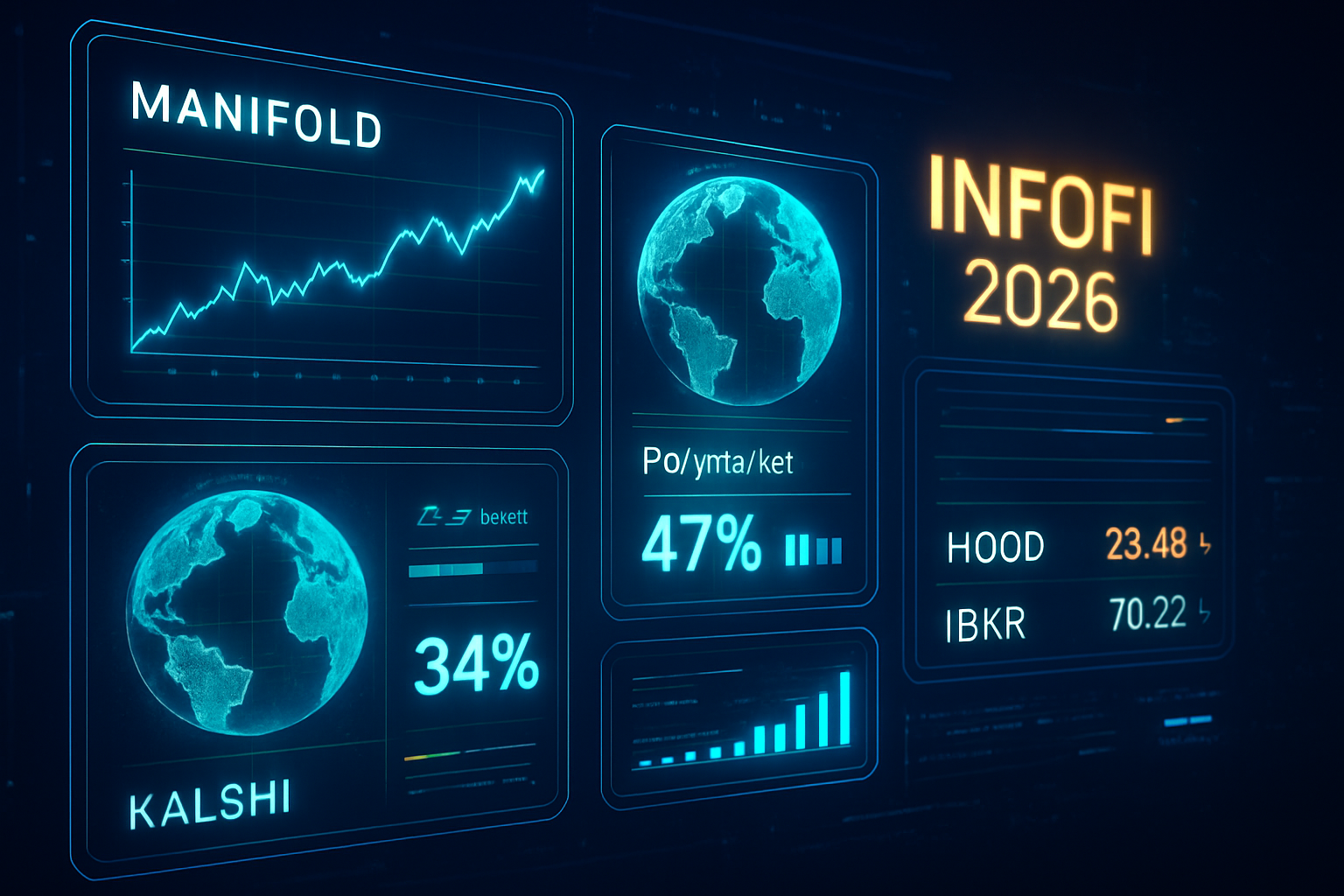
    As of January 27, 2026, the prediction market industry is no longer a fringe hobby for statistics nerds or a seasonal interest for election cycles; it has evolved into a multi-billion dollar pillar of the global financial system known as "InfoFi" (Information Finance). On Manifold Markets, the industry's self-appointed "meta-layer," traders are currently obsessed with a high-stakes question: who will win the "Great Prediction War" of 2026?

    With total industry volume reaching a staggering $13 billion per month in late 2025, meta-markets on Manifold are currently pricing a 47% probability that Polymarket will maintain its crown as the volume leader through the end of the year. However, the regulated giants are closing in. Interest in these meta-markets has skyrocketed as institutional liquidity from firms like Susquehanna International Group and Jane Street begins to treat event contracts not as "bets," but as sophisticated hedging tools for geopolitical and macroeconomic risk.

    The Market: What's Being Predicted

    The primary battleground for industry observers is the Manifold market titled "Top 1 Prediction Market by Volume in 2026." This contract tracks the total notional volume across the major players: Polymarket, Kalshi, and the rapidly ascending ForecastEx, owned by Interactive Brokers (NASDAQ: IBKR).

    As of today, the odds stand at:

    • Polymarket (47%): The crypto-native giant continues to lead, fueled by its role as the global "truth engine" for international events.
    • Kalshi (34%): Despite facilitating over $43 billion in trades in 2025, Kalshi’s odds have softened following a recent regulatory speed bump in Massachusetts regarding sports contracts.
    • ForecastEx (12%): A dark horse that recently surpassed $1 billion in cumulative notional volume, drawing in traditional finance (TradFi) users through the existing IBKR ecosystem.
    • Robinhood (7%): Following its high-profile joint venture with Susquehanna, Robinhood (NASDAQ: HOOD) has become the fastest-growing retail entrant, though its 2026 volume is still playing catch-up.

    Trading on these markets is characterized by high liquidity and a unique "insider" feel, as many participants are employees of these very platforms or professional market makers who provide the liquidity for the industry.

    Why Traders Are Betting

    The volatility in these meta-markets is being driven by three primary factors: regulatory arbitrage, the "InfoFi" narrative, and institutional product integration. Traders are currently reacting to a January 2026 preliminary injunction in Massachusetts that temporary banned "event contracts related to sports" on regulated exchanges. Since nearly 90% of Kalshi's record-breaking 2025 volume was derived from sports-adjacent markets, the "No" side of their dominance contract saw a massive 15% spike in volume this week.

    Meanwhile, the concept of Information Finance (InfoFi)—the idea that prediction markets are the most efficient way to price the probability of truth—is moving from theory to reality. Projects like Intuition, which launched its mainnet in late 2025, have convinced Manifold traders that the industry's growth is "non-linear." There is currently a 53% probability on Manifold that a major bank CEO, such as Jamie Dimon of JPMorgan Chase & Co. (NYSE: JPM), will publicly endorse prediction markets as a legitimate asset class before the end of Q3 2026.

    Finally, the entry of Coinbase (NASDAQ: COIN) into the space via its acquisition of The Clearing Company has signaled to traders that the infrastructure for a $10 trillion annual volume rate—the "bull case" for 2026—is finally being built.

    Broader Context and Implications

    This meta-forecasting trend reveals a fundamental shift in how the public views information. In 2024, prediction markets were used to "fact-check" polls; in 2026, they are being used to price the very future of the platforms themselves. This represents the ultimate "skin in the game" for an industry built on the premise that financial incentives lead to better forecasting.

    The regulatory implications are particularly significant. A dominant market on Manifold currently gives an 81% chance that federal preemption will eventually protect Designated Contract Markets (DCMs) from varying state-level bans. If this "Yes" outcome triggers, it would effectively create a unified national market for event contracts in the U.S., similar to the equity markets.

    Historically, Manifold's meta-markets have been eerily accurate. In late 2024, Manifold traders correctly predicted the exact quarter that Kalshi would achieve its first $1 billion month, months before it happened. The current betting activity suggests that 2026 will be the year where regulated (Kalshi, IBKR) and decentralized (Polymarket) volumes finally begin to converge as the legal "grey areas" evaporate.

    What to Watch Next

    The most immediate catalyst for these markets is the resolution of the "Public Integrity in Financial Prediction Markets Act" (H.R. 7004), currently making its way through Congress. If passed, it would formalize the rules around insider trading on event contracts—a move that sounds restrictive but is actually viewed as "bullish" by traders because it provides the legal framework necessary for pension funds and insurance companies to enter the market.

    Key dates to monitor include:

    • February 15, 2026: The deadline for the CFTC to respond to the Massachusetts injunction, which will likely decide Kalshi’s volume trajectory for the first half of the year.
    • Q2 2026 Earnings: Watch for Robinhood (NASDAQ: HOOD) to report its first full quarter of "Event Derivatives" revenue, which many expect will surprise to the upside.

    Traders should also keep an eye on the "Social-to-Market" pipeline. There is an active market on whether a major social media platform like X (formerly Twitter) or Reddit will integrate native prediction market widgets, a move that would likely push the "InfoFi" adoption probability toward 90%.

    Bottom Line

    The meta-markets on Manifold suggest that the prediction market industry is entering its "scaling phase." While Polymarket remains the volume king due to its global reach and crypto integration, the institutional weight behind ForecastEx and the retail power of Robinhood make the 2026 volume lead a closer race than most realize.

    The rise of InfoFi represents a paradigm shift where information is no longer just consumed—it is priced, traded, and verified through financial incentives. Whether the industry hits the predicted $10 trillion annual volume target by the end of 2026 remains to be seen, but the "smart money" on Manifold is betting that the search for truth has finally found its business model.

    In 2026, we aren't just predicting the news; we are betting on the machines that predict the news.


    This article is for informational purposes only and does not constitute financial or betting advice. Prediction market participation may be subject to legal restrictions in your jurisdiction.

    PredictStreet focuses on covering the latest developments in prediction markets.
    Visit the PredictStreet website at https://www.predictstreet.ai/.

  • The Great Prediction War of 2026: Polymarket and Kalshi Battle for Dominance

    The Great Prediction War of 2026: Polymarket and Kalshi Battle for Dominance

    As of January 26, 2026, the landscape of global finance is being reshaped not by interest rate swaps or traditional equities, but by the "Great Prediction War." On the popular meta-forecasting platform Manifold Markets, a high-stakes contract titled "Top 1 Prediction Market by Volume in 2026" has become the industry's most-watched barometer. Currently, Polymarket holds a 47% chance of leading the year in trading volume, while its chief rival, Kalshi, sits at 34%.

    This market is generating unprecedented interest because it represents more than a corporate rivalry; it is a battle for the soul of "Information Finance." In the last few weeks, the odds have fluctuated wildly following a series of regulatory rulings and massive institutional investments. While Kalshi dominated 2025 in raw notional volume, a recent crackdown on sports-related contracts has shifted momentum toward Polymarket, which is currently preparing for a landmark return to the United States market.

    The Market: What's Being Predicted

    The Manifold Markets meta-contract focuses on which platform will facilitate the highest total trading volume (measured in USD equivalent) for the 2026 calendar year. For resolution purposes, the contract strictly excludes "pure sports betting" to distinguish prediction markets from traditional gambling operations. This distinction is critical: in 2025, Kalshi cleared a staggering $43.1 billion in notional volume, but nearly 90% of that was derived from sports event contracts. Polymarket, meanwhile, recorded $33.4 billion, almost entirely through geopolitical, macroeconomic, and cultural markets.

    Currently, the odds reflect a "mindshare" premium for Polymarket at 47%. Traders are betting that as the 2026 U.S. midterm elections approach, the demand for non-sports "truth pricing" will outpace the retail sports volume that Kalshi has historically relied upon. Liquidity in this meta-market has surged, with over $5 million in play on Manifold alone, as whales from both the crypto and traditional finance sectors hedge their bets on the future of the industry.

    Why Traders Are Betting

    The 13-point lead held by Polymarket is largely driven by its recent institutional pivot. In October 2025, the platform secured a $2 billion strategic investment from the Intercontinental Exchange (NYSE: ICE), the parent company of the New York Stock Exchange. This partnership signaled that prediction markets are no longer "fringe" crypto projects but are being integrated into the plumbing of global markets.

    Conversely, Kalshi—which is heavily integrated with Robinhood Markets, Inc. (NASDAQ: HOOD)—has hit a regulatory speed bump. On January 20, 2026, a Massachusetts judge issued a preliminary injunction requiring Kalshi to cease offering sports-related contracts in the state. This legal friction has caused a 10% drop in Kalshi's 2026 volume odds, as traders fear more states may follow suit, strangling the platform’s primary volume driver.

    Furthermore, the "Maduro Trade" in early January—where a whistleblower allegedly profited $400,000 on a contract regarding the capture of Nicolás Maduro just hours before the news broke—has reinforced Polymarket's reputation as a "truth engine" that can price in information faster than any traditional news wire or intelligence agency.

    Broader Context and Implications

    The "Great Prediction War" coincides with the rise of "Information as an Asset Class." In 2026, information is no longer just something you consume; it is something you trade. Major market makers like Susquehanna International Group and DRW have officially entered the space, treating event contracts as legitimate financial derivatives used to hedge against "black swan" events.

    This shift has moved prediction markets away from the "speculative casino" label that plagued them in 2024. Today, corporations use these markets to hedge against specific geopolitical risks, such as semiconductor trade deals or the "Greenland Acquisition" negotiations. The historical accuracy of these markets during the 2024 election cycle has given them a "gold standard" status, often leading mainstream media polls by 48 to 72 hours in identifying shifts in public sentiment.

    What to Watch Next

    The next major catalyst for this market is Polymarket's anticipated re-entry into the U.S. market. Currently, there is a 90% priced-in probability that the CFTC will grant Polymarket full operational status in the U.S. by Q2 2026. If this occurs, a massive influx of domestic liquidity could solidify Polymarket’s lead over Kalshi.

    Investors should also keep a close eye on the 2026 midterm election cycles. If the volume for political "control of the house" markets exceeds the volume for the 2026 World Cup, Polymarket is almost certain to win the volume war. However, if Kalshi can successfully pivot its Robinhood user base toward macroeconomic contracts—such as CPI or Fed rate hike predictions—the 34% underdog could see a rapid resurgence.

    Bottom Line

    The battle between Polymarket and Kalshi is the defining economic conflict of 2026. While Kalshi has the advantage of existing U.S. infrastructure and a massive retail partnership with Robinhood, Polymarket’s backing by the NYSE’s parent company and its dominance in "truth-based" geopolitical markets give it the current edge.

    Ultimately, the "Great Prediction War" tells us that the world has entered the era of Information Finance. Whether the winner is the platform that masters sports and retail or the one that dominates geopolitical intelligence, the real victor is the market itself. Prediction markets are no longer just tools for bettors; they are the most accurate sensors we have for a volatile, fast-moving world.


    This article is for informational purposes only and does not constitute financial or betting advice. Prediction market participation may be subject to legal restrictions in your jurisdiction.

    PredictStreet focuses on covering the latest developments in prediction markets.
    Visit the PredictStreet website at https://www.predictstreet.ai/.

  • The Great Prediction War of 2026: Polymarket and Kalshi Battle for Dominance as “Information Finance” Goes Mainstream

    The Great Prediction War of 2026: Polymarket and Kalshi Battle for Dominance as “Information Finance” Goes Mainstream

    As the first month of 2026 draws to a close, the prediction market industry is no longer a niche corner of the internet; it has evolved into a foundational pillar of global finance. On Manifold Markets, a high-stakes meta-contract titled "Top 1 Prediction Market by Volume in 2026" has become the definitive barometer for the sector’s future. Currently, traders are pricing in a two-horse race that reflects a massive shift in how the world consumes information and hedges against uncertainty.

    As of January 23, 2026, Polymarket holds a slight lead with approximately 47% odds of finishing the year as the volume leader, while Kalshi follows closely at 34%. The "Other" category—comprising newcomers like Robinhood Markets Inc. (NASDAQ:HOOD) and established institutional players—is capturing a significant 20% of the market share. This intense competition follows a record-breaking 2025 that saw the industry transition from "speculative casinos" to what experts now call "Information as an Asset Class."

    The Market: What’s Being Predicted

    The Manifold Markets contract is a multi-choice prediction asking which platform will record the highest total trading volume (USD equivalent) during the calendar year 2026. The resolution criteria are strict: the total must include all event contracts but specifically excludes "pure sports betting" platforms to distinguish prediction markets from traditional gambling. This distinction has become a major point of contention among traders, as Kalshi currently leads in raw notional volume—clearing over $43 billion—but derives roughly 90% of that from sports-related event contracts.

    Polymarket, by contrast, remains the "mindshare leader" for global events. Following a landmark $2 billion investment from Intercontinental Exchange (NYSE:ICE), the parent company of the New York Stock Exchange, Polymarket has seen its cumulative volume soar to $33.4 billion. While Kalshi has the raw numbers, Manifold traders are betting that Polymarket's dominance in geopolitical and macroeconomic markets will carry the day when "pure sports" are stripped from the final tally. Other notable contenders included in the contract are Interactive Brokers Group (NASDAQ:IBKR) via its ForecastX platform and PredictIt, though they currently trail the two giants.

    Why Traders Are Betting

    The current market sentiment is being driven by a "Supercycle" of events and massive institutional backing. The late 2025 investment by Intercontinental Exchange (NYSE:ICE) acted as a "institutional seal of approval," providing Polymarket with a liquidity backstop that has finally won the trust of traditional finance (TradFi) firms. Traders on Manifold, such as high-profile "whales" like pixel and Ziddletwix, have been aggressively moving the market based on these infrastructure developments.

    Recent volatility in the contract was sparked by the "January 2nd Shockwave," where a series of massive institutional-sized trades caused the odds of smaller platforms like Manifold itself to crash, while bolstering the "Big Two." Traders are also looking at the upcoming 2026 U.S. Midterm Elections as the primary volume driver. Historical data shows that political cycles are the lifeblood of prediction market growth; with the Midterms approaching, the community expects Polymarket’s global reach and decentralized nature to capture the lion's share of high-intent political volume.

    Furthermore, the recent acquisition of a 90% stake in MIAXdx by Robinhood (NASDAQ:HOOD) has introduced a "wildcard" element. Traders are watching to see if Robinhood’s massive retail user base can pivot from stock trading to event contracts quickly enough to challenge the incumbents before the year’s end.

    Broader Context and Implications

    The "Top Prediction Market of 2026" contract is more than a simple leaderboard; it represents the maturation of the entire sector. In early January 2026, Alphabet Inc. (NASDAQ:GOOGL) officially updated its advertising policies to allow prediction market promotions, and rumors are swirling that Meta Platforms Inc. (NASDAQ:META) is testing prediction widgets for its news feeds. This mainstreaming has shifted the regulatory conversation.

    While the Commodity Futures Trading Commission (CFTC) has adopted a more "forward-looking" approach under recent leadership, a new "regulatory design problem" has emerged. State gaming authorities in Nevada and Connecticut have begun issuing cease-and-desist orders against platforms like Kalshi, arguing that sports-event contracts overlap too heavily with unlicensed gambling. This legal friction is a key reason why many Manifold traders are cautious about Kalshi's chances; a significant legal setback in a major state could throttle their volume overnight.

    What to Watch Next

    The next few months will be critical for determining the winner of the 2026 volume crown. Market participants should keep a close eye on the Democratic and Republican primary season for the Midterms. If Polymarket maintains its lead in political "liquidity depth" during these early contests, its odds on Manifold are likely to climb above the 50% mark.

    Key dates to monitor include the March 2026 FOMC meeting, where prediction markets are now used as the primary data feed for algorithmic trading bots, and any potential announcements from X regarding the integration of live prediction data. Additionally, the resolution of the state-level legal challenges against Kalshi will be a massive "binary event" for the platform's 2026 volume outlook.

    Bottom Line

    The battle for the top spot in 2026 is a testament to the resilience and utility of prediction markets. No longer a hobby for "degens," these platforms are now essential tools for institutional hedging and real-time sentiment analysis. The Manifold contract suggests that while Kalshi has the technological throughput, Polymarket possesses the global brand and "event purity" that traders value most.

    As we move deeper into 2026, the real winner may not just be one platform, but the concept of Information Finance itself. Whether it is a crypto-native giant backed by the NYSE (ICE) or a retail powerhouse like Robinhood (NASDAQ:HOOD), the fact that billions of dollars are now being wagered on the accuracy of world events suggests that the era of "guesswork" in news and finance is rapidly coming to an end.


    This article is for informational purposes only and does not constitute financial or betting advice. Prediction market participation may be subject to legal restrictions in your jurisdiction.

    PredictStreet focuses on covering the latest developments in prediction markets.
    Visit the PredictStreet website at https://www.predictstreet.ai/.
  • The Great Preemption Bet: ‘Shadow Market’ Traders Brace for Federal Sovereignty Over Prediction Markets

    The Great Preemption Bet: ‘Shadow Market’ Traders Brace for Federal Sovereignty Over Prediction Markets

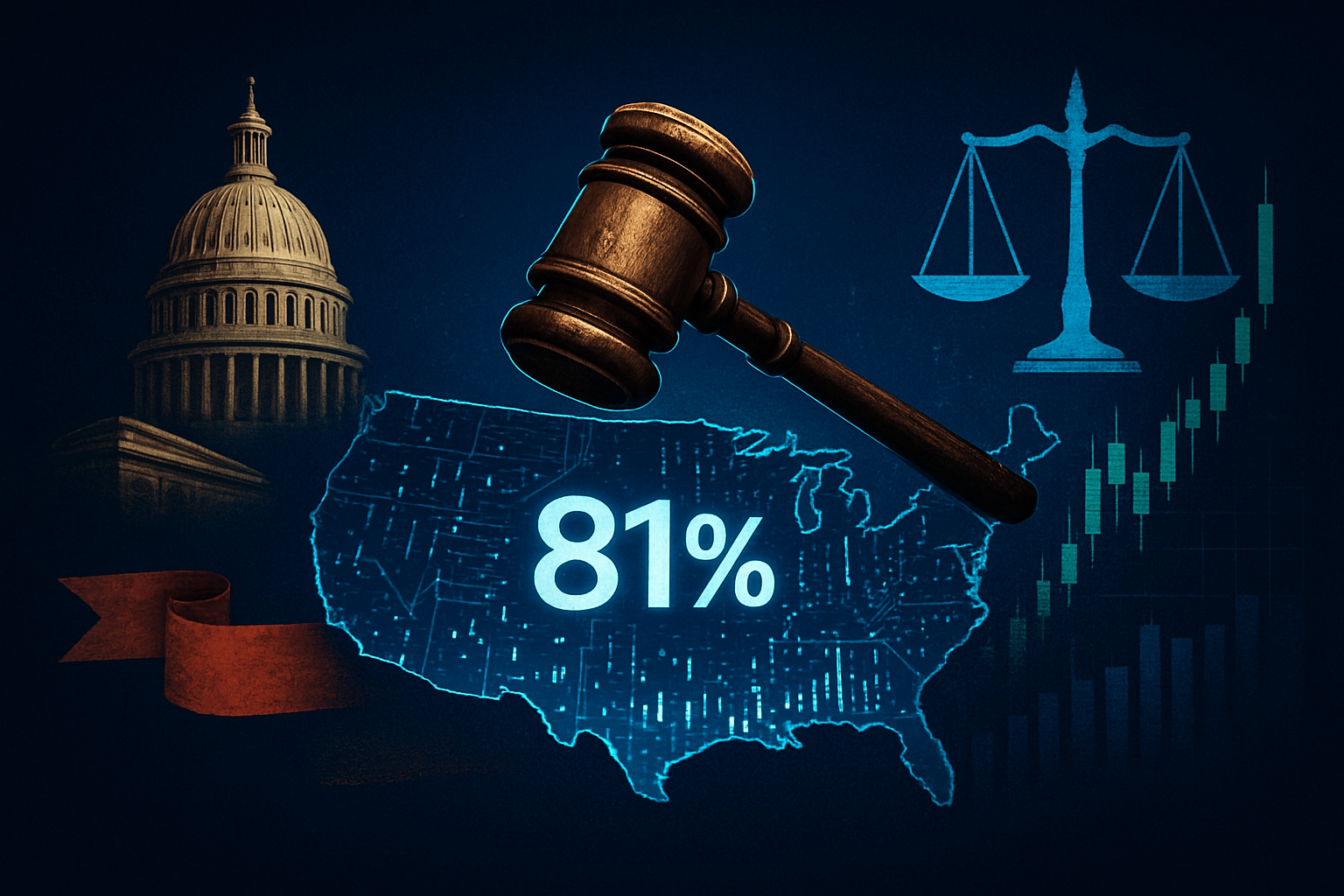
    As the legal landscape for prediction markets enters its most volatile phase yet, a "Shadow Market" on the forecasting platform Manifold Markets has become the ultimate barometer for the industry's survival. Traders are currently placing an overwhelming 81% probability on a scenario where federal preemption—the legal doctrine that federal law overrides state law—will shield prediction markets from a growing wave of state-level bans.

    This surge in confidence comes at a critical juncture. While state regulators in New York and Massachusetts have launched aggressive campaigns to shutter "event contract" trading, the market sentiment suggests a "knockout blow" from the federal judiciary is imminent. With a landmark ruling expected from the Third Circuit and a newly reformulated Commodity Futures Trading Commission (CFTC) taking a hands-off approach, the "Shadow Market" is signaling that the era of the state-by-state "gambling" label for prediction markets may be nearing its end.

    The Market: What's Being Predicted

    The specific contract driving this conversation is hosted on Manifold Markets, titled "Will Federal Preemption Protect DCMs from State Bans by End of 2026?" Because regulated exchanges like Kalshi and Interactive Brokers Group, Inc. (NASDAQ:IBKR) are legally restricted from listing contracts that speculate on their own regulatory status—to avoid self-referential conflicts of interest—Manifold has filled the void. This "Shadow Market" allows participants to trade on the legal fate of the entire industry using Manifold’s "Mana" currency, which often serves as a leading indicator for real-money sentiment.

    Currently trading at 81%, the odds have climbed significantly from just 55% in late 2024. The market has seen a spike in volume over the last 48 hours, following a series of conflicting rulings in state courts. The resolution criteria for this market are strict: it requires either a definitive U.S. Supreme Court ruling or a federal appellate court decision that explicitly invokes the Supremacy Clause to strike down a state-level ban on a federally registered Designated Contract Market (DCM).

    Liquidity in this Shadow Market has reached record highs, with over 1.5 million Mana traded. Professional "arbs" and legal analysts are increasingly using this market to hedge their exposure on regulated platforms. If the 81% probability holds true, it suggests that the industry is one court case away from achieving the same national regulatory status enjoyed by the stock and options markets.

    Why Traders Are Betting

    The bullish sentiment is largely driven by a pivot in federal strategy. Under the leadership of Chairman Michael Selig, who was confirmed in December 2025, the CFTC has abandoned the adversarial stance of the previous administration. In a historic move in mid-2025, the CFTC dropped its appeal in the Kalshi v. CFTC case, effectively conceding that the agency does not have a blanket mandate to ban political election markets. This federal "truce" has left state regulators as the primary antagonists, and traders believe the states are overplaying their hand.

    Recent events have only strengthened this conviction. While a Massachusetts judge issued a preliminary injunction against Kalshi on January 20, 2026, many traders viewed this as a "last gasp" for state-level resistance. The logic among the "81% crowd" is that a DCM—a federally licensed entity—cannot be subjected to 50 different sets of state gambling laws. They argue that once a contract is approved at the federal level, the Supremacy Clause of the U.S. Constitution prevents states from "de-authorizing" it.

    Furthermore, the entry of major retail players into the space has changed the political calculus. Companies like Robinhood Markets, Inc. (NASDAQ:HOOD) and Coinbase Global, Inc. (NASDAQ:COIN) have joined the Coalition for Prediction Markets, lobbying for the "Safe Harbor Act of 2026." This proposed legislation would provide permanent federal protection from state-level interference, and traders are betting heavily that the bill will find a path through Congress given the bipartisan interest in the data these markets provide.

    Broader Context and Implications

    This battle mirrors the historical struggle of the sports betting industry following the repeal of PASPA, but with a crucial difference: prediction markets are being framed as financial hedging tools rather than gambling. If federal preemption is upheld, it will treat a contract on the Consumer Price Index or a presidential election the same way the law treats a soybean future or a share of Apple stock.

    The real-world implications of an 81% probability are staggering. A victory for federal preemption would likely trigger a massive influx of institutional capital. Currently, many hedge funds are sidelined by the "patchwork" of state laws, fearing that a position legal in Delaware might be deemed an "illegal wager" in New York. A unified federal standard would clear the path for prediction markets to become a standard asset class in diversified portfolios.

    Moreover, this market reveals a profound shift in public sentiment. The "Shadow Market" traders are not just betting on the law; they are betting against the ability of state "vice laws" to contain digital, borderless financial innovation. The historical accuracy of Manifold’s legal shadow markets has been remarkably high, correctly predicting the outcome of the Loper Bright decision and the initial Kalshi victory in 2024 long before traditional pundits caught on.

    What to Watch Next

    The most immediate catalyst for this market is the pending ruling from the Third Circuit Court of Appeals regarding a New Jersey challenge to federal jurisdiction. A pro-preemption ruling there would likely push the Manifold odds into the 90% range, as New Jersey is a traditionally influential venue for gaming and financial law.

    Investors should also keep a close eye on the "ORACLE Act" in New York. Introduced on January 7, 2026, this bill is a "scorched-earth" attempt to ban all prediction market trading within the state. If the bill passes but is immediately stayed by a federal judge, it will serve as the perfect "test case" for the preemption doctrine. Any movement on this bill in the Albany legislature will cause immediate volatility in the Shadow Market.

    Finally, the role of the Supreme Court cannot be ignored. While traders are currently betting that the appellate courts will resolve the issue, any signal that SCOTUS intends to take up a case on the "DCM vs. State Gambling Law" conflict would create a massive liquidity event. Legal experts are monitoring the docket for any "Certiorari" filings that could redefine federalism for the 21st-century digital economy.

    Bottom Line

    The 81% probability on Manifold’s Shadow Market represents a high-conviction bet that the federal government—not the states—will ultimately hold the keys to the prediction market industry. It reflects a growing consensus that these markets are essential pieces of financial infrastructure that cannot be governed by the fragmented, archaic rules of state-level gaming commissions.

    As a tool for insight, the Shadow Market has proven that "skin in the game" offers a clearer view of the legal horizon than partisan commentary. While the "resistance" from states like New York and Massachusetts remains a headwind, the markets suggest that the legal foundation for a unified, national prediction market is being laid in real-time.

    Ultimately, if the traders are right, the resolution of this conflict will mark the beginning of a new era for American finance—one where the collective intelligence of the crowd is protected by the highest laws of the land.


    This article is for informational purposes only and does not constitute financial or betting advice. Prediction market participation may be subject to legal restrictions in your jurisdiction.

    PredictStreet focuses on covering the latest developments in prediction markets.
    Visit the PredictStreet website at https://www.predictstreet.ai/.

  • The Mana Lab: Why Manifold Markets Is the Engine Room of the Global Forecasting Boom

    The Mana Lab: Why Manifold Markets Is the Engine Room of the Global Forecasting Boom

    As of January 18, 2026, the world of prediction markets is no longer a niche hobby for economists and crypto-enthusiasts—it is a multi-billion dollar information industry. While real-money giants like Polymarket and Kalshi capture the headlines with massive handles on geopolitical events, a quieter, play-money revolution is happening at Manifold Markets. Despite using a proprietary, non-redeemable currency called "Mana" (Ṁ), Manifold has emerged as the critical "R&D lab" for the entire forecasting ecosystem.

    Currently, Manifold’s markets on the "Quantum Inflection Point" and the upcoming 2026 U.S. Midterm elections are generating intense interest, often serving as leading indicators for real-money exchanges. While the platform sunsetted its "Sweepcash" real-money redemptions in early 2025 to focus on its social mission, its volume of active forecasters has reached record highs. Traders are flocking to the platform not for a payout, but for the "reputation capital" and the refined Bayesian training that turns amateurs into professional-grade market makers.

    The Market: What's Being Predicted

    Unlike the highly regulated contracts found on Kalshi or the high-stakes liquidity of Polymarket, Manifold Markets specializes in the "long tail" of human knowledge. The platform’s unique market-creation tool allows any user to launch a prediction on virtually any topic, leading to a density of technical and scientific markets that are commercially non-viable elsewhere.

    In the first weeks of 2026, the most active markets on Manifold involve high-level science and technology. Traders are currently pricing the probability of "unambiguous quantum advantage"—a calculation performed by a quantum computer that is impossible for a classical supercomputer—at 14% for the 2026 calendar year. This specific market has become a benchmark for researchers at companies like IBM (NYSE: IBM) and Alphabet Inc. (NASDAQ: GOOGL), as it aggregates the intuition of thousands of independent researchers.

    Other notable markets currently trading on Manifold include:

    • The 2026 Midterm "Blue Wave": Manifold currently places the odds of Democrats retaking the House at 87%, a more aggressive stance than traditional polling outlets.
    • Legislative Hurdles: Traders are betting on the specific sub-clauses of the "ORACLE Act" in New York, a bill that could redefine the legality of prediction market operations in the state.
    • Particle Physics: Long-term markets on the discovery of new elementary particles at the Future Circular Collider (FCC) by 2075 allow for a "generational forecast" that real-money platforms simply cannot sustain due to the decades-long settlement timeline.

    Why Traders Are Betting

    The primary driver for Manifold’s success is the unique psychology of play-money forecasting. Because "Mana" has no direct fiat value, traders exhibit a lower level of risk-aversion compared to those on real-money platforms. This leads to a faster "price discovery" process. When new information breaks—such as the capture of Venezuelan leaders earlier this month—Manifold’s odds often shift 5 to 10 minutes before real-money markets, as traders are more willing to update their beliefs without the paralyzing fear of losing significant capital.

    Furthermore, Manifold has become the unofficial "AA League" for professional traders. Many of the top-ranked individuals on Kalshi today started their careers by amassing millions in Mana. This "training ground" effect allows users to develop a track record of accuracy (measured by a Brier Score) which they then use to solicit backing or to move into high-stakes environments.

    There is also a significant social element. "Mana Whales"—users who have accumulated massive balances through accurate forecasting—hold immense status within the community. They use their wealth to "boost" niche science markets, effectively subsidizing the search for truth in areas that are traditionally underfunded or ignored by mainstream media.

    Broader Context and Implications

    The rise of Manifold underscores a growing trend in the 2026 information economy: the decentralization of expertise. As traditional polling and expert punditry continue to face credibility crises, play-money markets provide a transparent, meritocratic alternative. The platform’s historical accuracy, particularly in niche tech and obscure geopolitical events, has begun to attract interest from institutional players looking for early warning signals.

    However, the platform faces a complex regulatory landscape. Even though it operates as a play-money social game, the "ORACLE Act" in New York represents a broader push by some legislators to curb the influence of prediction markets. Critics argue that even play-money markets can influence public sentiment in ways that are difficult to regulate. Proponents, meanwhile, point to Manifold as a "public good" that provides free, high-quality data to the world.

    Historically, Manifold’s science markets have been remarkably prescient. During the LK-99 superconductivity hype of 2023 and the subsequent advancements in fusion energy in 2024, Manifold’s collective "wisdom of the crowd" was among the first to correctly discount hype and identify legitimate breakthroughs.

    What to Watch Next

    The most immediate event for Manifold traders is the "Quantum Inflection" threshold. As tech giants release their Q1 2026 roadmaps, the volatility in quantum computing markets is expected to spike. Additionally, the market regarding whether Manifold itself will be acquired by a real-money giant like Polymarket or Kalshi is currently one of the most liquid on the site, with rumors of a merger circulating since late 2025.

    Investors and political junkies should also keep a close eye on Manifold’s 2026 Midterm markets. If Manifold’s 87% "Blue Wave" prediction holds true while traditional polls remain at a "toss-up," it will further cement play-money forecasting as a superior tool for aggregating diverse information sets.

    Finally, keep an eye on the "Mana-to-Charity" pipelines. Manifold’s unique system where play-money profits can be converted into actual charitable donations by the platform's foundation has become a major incentive for high-accuracy traders, effectively turning "being right" into a philanthropic act.

    Bottom Line

    Manifold Markets represents a fascinating paradox: a platform where the currency is "fake," but the information is incredibly real. By removing the barrier of financial loss, Manifold has created a sandbox for the world’s most curious minds to test their intuitions, refine their logic, and contribute to a global knowledge base.

    As we move deeper into 2026, the distinction between "play-money" and "real-money" forecasting is blurring. While the payouts differ, the signal remains the same. Manifold is not just a game; it is the training ground for the next generation of professional analysts and a vital source of truth for niche areas like particle physics and emerging technology. Whether it remains an independent community or is absorbed by the larger financial giants, its role as the "engine room" of the prediction market world is undeniable.


    This article is for informational purposes only and does not constitute financial or betting advice. Prediction market participation may be subject to legal restrictions in your jurisdiction.

    PredictStreet focuses on covering the latest developments in prediction markets. Visit the PredictStreet website at https://www.predictstreet.ai/.