Tag: Mainstream Media

  • Betting on the News: How Prediction Markets Are Redefining Mainstream Media

    Betting on the News: How Prediction Markets Are Redefining Mainstream Media

    The traditional news ticker is undergoing a radical transformation. As of February 1, 2026, the familiar crawl of stock prices and weather updates has been joined—and in some cases replaced—by a far more dynamic metric: real-time "wisdom of the crowd" probabilities. From the halls of the U.S. Congress to the red carpets of Hollywood, prediction markets have officially breached the mainstream, becoming the primary "source of truth" for major news networks.

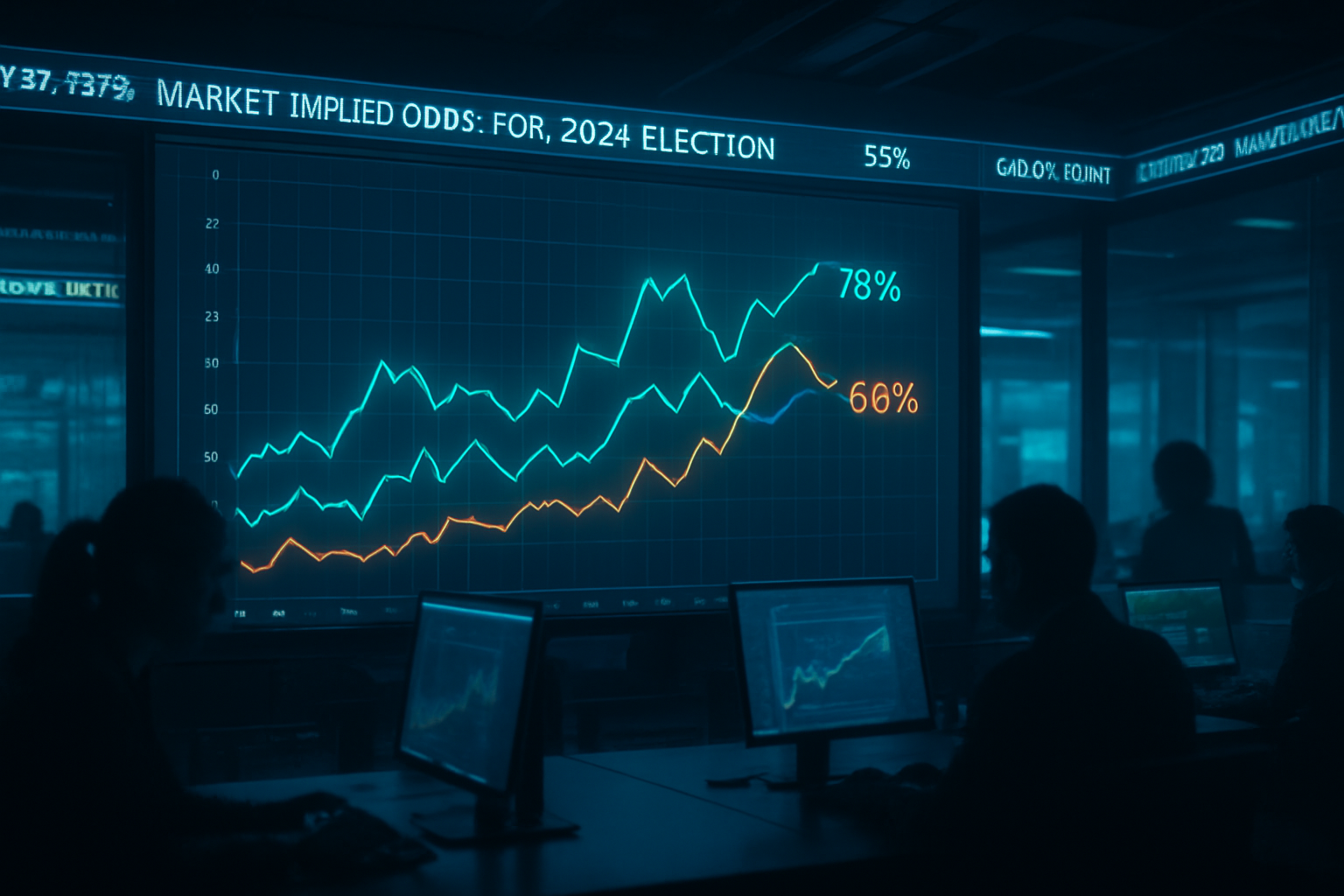
    Currently, all eyes are on the 2026 U.S. Midterm Elections, where prediction markets on platforms like Polymarket and Kalshi are processing tens of billions of dollars in volume. Traders are pricing in a 78% probability that Democrats will flip the House of Representatives, while Republicans maintain a 66-68% chance of holding the Senate. This shift toward market-based forecasting is generating massive interest because it offers a real-time, financially incentivized alternative to traditional polling, which has struggled with lag times and declining response rates. Recent movement suggests the "Midterm Correction" narrative is strengthening, as markets react instantly to shifts in consumer sentiment and legislative gridlock.

    The Market: What's Being Predicted

    The integration of prediction market data into mainstream media is no longer experimental; it is structural. In late 2025 and early 2026, the landscape shifted through a series of landmark partnerships. CNN (Warner Bros. Discovery, Inc. – NASDAQ: WBD) designated Kalshi as its exclusive prediction data provider, with Chief Data Analyst Harry Enten now using real-time market odds to "fact-check" traditional polling data during live broadcasts. Similarly, CNBC (Comcast Corporation – NASDAQ: CMCSA) has launched a dedicated "Kalshi Hub," integrating economic and financial forecasts directly into flagship shows like Squawk Box and Fast Money.

    On the decentralized side, Polymarket has secured an expansive deal with Dow Jones (News Corp – NASDAQ: NWSA), embedding market-implied probabilities across The Wall Street Journal, Barron’s, and MarketWatch. One of the most visible results of this deal is a custom "Earnings Calendar" that displays the probability of an EPS beat for companies like NVIDIA Corporation (NASDAQ: NVDA) alongside traditional analyst estimates. Even entertainment hasn't been spared; Polymarket served as the official prediction partner for the 83rd Annual Golden Globes on CBS (Paramount Global – NASDAQ: PARA) last month, where market odds accurately predicted 26 out of 28 winners.

    Trading volume has scaled alongside this media exposure. In January 2026 alone, the industry hit a record-breaking $12 billion in total trading volume. Kalshi, which operates as a U.S.-regulated exchange, has seen a surge in "notional volume" from institutional players, while Polymarket continues to dominate the "event-pure" categories like global politics and cultural milestones.

    Why Traders Are Betting

    The fundamental driver behind the surge in prediction market participation is the concept of "Skin in the Game." Unlike traditional survey respondents who provide opinions for free, prediction market participants must back their views with capital. This financial incentive creates a powerful filtering mechanism that prioritizes accuracy over partisanship or social desirability bias.

    Traders are currently reacting to several high-impact catalysts:

    • Monetary Policy: With the Federal Reserve's March meeting approaching, Kalshi traders are pricing a 62% probability of a 25-basis-point rate cut, a figure that fluctuates in real-time as new labor and inflation data is released.
    • Political Appointments: The market has already "priced in" a shift in central bank leadership, with Kevin Warsh holding a 99% probability on Polymarket to be the next Fed Chair nominee.
    • Corporate Moves: High-conviction betting is occurring around the potential IPO of OpenAI (Private, backed by Microsoft Corp – NASDAQ: MSFT), with markets currently leaning toward a "No" for a 2026 debut at 52%.

    Mainstream media outlets are gravitating toward this data because it is more sensitive to "signal" than traditional methods. While a poll might take a week to conduct and process, a prediction market reacts to a breaking news headline or a leaked memo in seconds. This speed has made markets the preferred tool for "Sharps"—a new class of professional event traders who treat news as a tradable financial asset, often referred to as "Information Finance" or InfoFi.

    Broader Context and Implications

    The 2024 U.S. Presidential Election served as the definitive "proof-of-concept" for this shift. While legacy models and media pundits described the race as a "toss-up" until the final hours, prediction markets on Polymarket and Kalshi moved to a decisive ~60% probability for a Donald Trump victory weeks in advance. This historical accuracy has significantly diminished the "gambling" stigma that once plagued the industry.

    The regulatory landscape has also stabilized. Kalshi’s landmark legal victory against the CFTC in late 2024 cleared the way for political event contracts to be regulated as legitimate financial derivatives in the United States. This legal clarity has allowed institutional firms to use these markets as hedging tools, protecting their portfolios against geopolitical shocks or sudden policy shifts.

    However, the rise of "InfoFi" is not without controversy. Critics argue that the "gamblification" of news and awards shows could lead to market manipulation or a loss of journalistic nuance. Despite these concerns, the efficiency of the "wisdom of the crowd" continues to outperform individual experts. By turning public sentiment into a tradable price, these markets are providing a level of transparency into collective expectations that was previously impossible to quantify.

    What to Watch Next

    As we move deeper into 2026, the primary focus will remain on the Midterm Elections. Any significant legislative breakthroughs or failures in Washington will cause immediate volatility in the "Control of the House" and "Control of the Senate" markets. Analysts will be watching to see if the current 78% Democratic favoritism for the House holds firm as campaign season intensifies.

    In the corporate world, watch for the resolution of the OpenAI IPO markets and the impact of Amazon.com, Inc. (NASDAQ: AMZN) and its reported multi-billion dollar investment talks on the startup's valuation. These markets often front-run official corporate announcements by days. Additionally, the 2026 FIFA World Cup markets are already beginning to see "early-bird" liquidity, marking the first time a major sporting event will have deep, multi-year prediction markets integrated into the pre-tournament coverage.

    Finally, keep an eye on the evolving nature of media graphics. If current trends continue, the "Market Probability" may soon become the standard lead for every political and economic headline, effectively retiring the phrase "too close to call."

    Bottom Line

    The partnership between prediction platforms and mainstream media marks a turning point in the information age. By integrating data from Kalshi and Polymarket, networks like CNN, CNBC, and the WSJ are acknowledging that markets are often better at synthesizing complex information than humans are. The rise of InfoFi has turned news consumption from a passive experience into a probabilistic exercise.

    For the average viewer, this means "the news" is no longer just a series of events that have happened, but a real-time dashboard of what is likely to happen. Whether you are a trader looking for an edge or a citizen trying to cut through the noise, the "wisdom of the crowd" has become the most important signal in the room. As 2026 progresses, the line between the trading floor and the newsroom will only continue to blur.


    This article is for informational purposes only and does not constitute financial or betting advice. Prediction market participation may be subject to legal restrictions in your jurisdiction.

    PredictStreet focuses on covering the latest developments in prediction markets.
    Visit the PredictStreet website at https://www.predictstreet.ai/.
  • The End of the Pundit Era: How ‘Information Finance’ Took Over Your News Feed

    The End of the Pundit Era: How ‘Information Finance’ Took Over Your News Feed

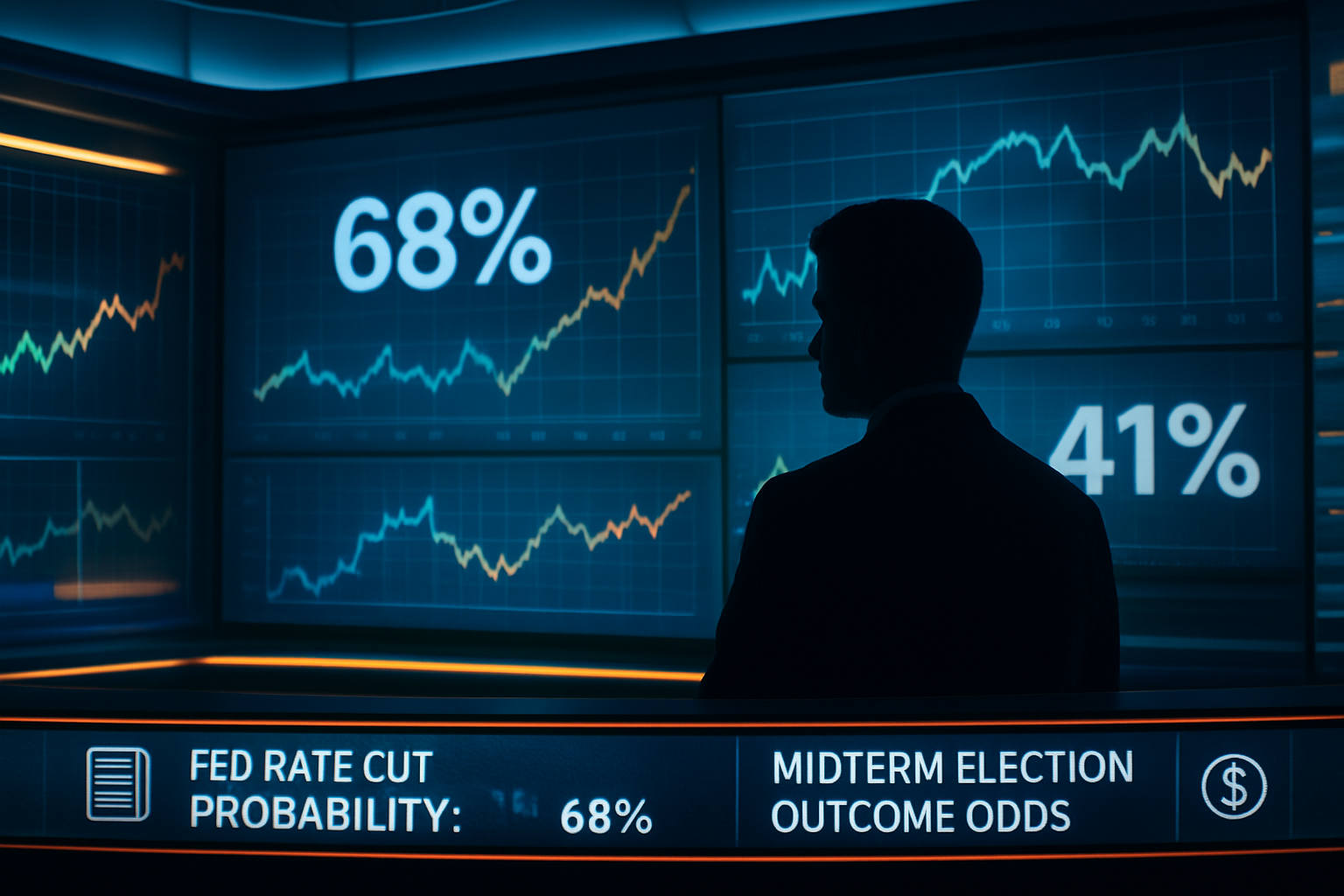
    On any given night in early 2026, a viewer tuning into prime-time news is less likely to see a panel of political consultants arguing over "vibes" and more likely to see a glowing, fluctuating percentage at the bottom of the screen. As of January 16, 2026, the traditional news ticker has been permanently altered. The price of Brent Crude and the S&P 500 now share screen real estate with the "Probability of a Fed Rate Cut in March" and the "Odds of the 2026 Midterm House Flip," powered by real-money prediction markets like Kalshi and Polymarket.

    This seismic shift represents the mainstreaming of "Information Finance"—a term coined to describe the use of financial incentives to aggregate truth. Currently, prediction markets are pricing the likelihood of a major legislative breakthrough on AI regulation at 64%, a figure that has surged 15% in the last 48 hours following a series of closed-door committee meetings. This "market-driven signal" is no longer a fringe curiosity; it has become the definitive barometer for reality, treated by networks with the same institutional weight as the Nielsen ratings or the morning's jobs report.

    The Market: What's Being Predicted

    The integration of prediction market data into mainstream news has reached a fever pitch. In late 2025, CNBC, owned by Comcast (NASDAQ:CMCSA), signed a landmark multi-year deal with Kalshi to serve as its exclusive data provider for on-air prediction widgets. This partnership has birthed the "CNBC Prediction Hub," where viewers can track live probabilities on everything from corporate merger approvals to the likelihood of the next CEO of Apple (NASDAQ:AAPL). These markets are currently seeing record volumes, with the "March Fed Meeting" contract alone regularly exceeding $500 million in open interest.

    Meanwhile, CNN, a subsidiary of Warner Bros. Discovery (NASDAQ:WBD), has completely overhauled its data segments. Chief Data Analyst Harry Enten’s famous "Poll of Polls" has been largely replaced by a segment titled "Market Signals." On these broadcasts, the "price" of an event is treated as the consensus probability. If a contract for a specific candidate to win an election is trading at $0.62, the network reports a "62% probability of victory," providing a real-time, 24/7 pulse that traditional polling—which often takes weeks to conduct and release—simply cannot match.

    The primary platforms driving this data are Kalshi, the first CFTC-regulated prediction market exchange in the U.S., and Polymarket, the decentralized giant that recently secured a $2 billion investment from the Intercontinental Exchange (NYSE:ICE). While Kalshi focuses on U.S.-regulated financial and political events, Polymarket provides a broader look at global geopolitical shifts and cultural milestones. Together, they have created a dual-engine of "Consensus Pricing" that newsrooms now use to fact-check their own reporting.

    Why Traders Are Betting

    The migration of news media toward market data was born out of a crisis of confidence in traditional forecasting. The 2024 election cycle served as the ultimate proof of concept: while traditional pollsters often showed a "dead heat" or slight lead for various candidates, prediction markets consistently priced in a Donald Trump victory with 60%+ confidence throughout October 2024. More importantly, markets called the "swing state sweep" on election night by 10:00 PM ET, hours before network pundits were willing to commit to the data.

    Traders are putting their money where their mouths are because prediction markets reward accuracy and punish "cheap talk." Unlike a pundit who retains their salary regardless of the accuracy of their predictions, a trader on Kalshi or Polymarket faces a direct financial penalty for being wrong. This "skin in the game" creates a high-fidelity signal that filters out noise. Recent surges in the probability of a "Soft Landing" for the U.S. economy, currently trading at 78% on Kalshi, are being driven by institutional desks at firms like Interactive Brokers (NASDAQ:IBKR), which integrated Kalshi's API for its professional clients in 2025.

    Furthermore, the rise of "Information Finance" has attracted a new class of "news-traders." These individuals use advanced sentiment analysis and real-time social media scraping to identify information asymmetries before they hit the wire services. When a major news event breaks—such as the recent Golden Globes, where Polymarket correctly predicted 26 out of 28 winners—the market often moves seconds before the host opens the envelope, providing a "spoiler effect" that has made live prediction trackers must-watch television.

    Broader Context and Implications

    The institutionalization of prediction markets marks the end of the "polling industrial complex" as we knew it. For decades, media organizations relied on statistical sampling that struggled with declining response rates and "shy voter" syndromes. In 2026, the industry has embraced the philosophy that a market of 100,000 incentivized participants is a more accurate "truth engine" than a survey of 1,000 disengaged households. This shift was accelerated by the CFTC’s 2025 legal defeat in the Ninth Circuit Court of Appeals, which permanently legalized election and event betting in the United States, removing the final regulatory shadow over the industry.

    This trend has profound real-world implications for how corporate America operates. Companies like Robinhood (NASDAQ:HOOD) and Coinbase (NASDAQ:COIN) have launched their own "Prediction Hubs," allowing retail investors to hedge against political or economic outcomes. If a trader believes a new tax bill will hurt their tech stocks, they can now "buy" the probability of that bill passing as a form of insurance. Prediction markets have effectively turned the news into a tradable asset class.

    Historically, prediction markets have boasted a significantly lower "Brier Score"—a measure of the accuracy of probabilistic forecasts—than expert panels. As this data becomes more pervasive, it is revealing a new type of public sentiment: one that is pragmatic and forward-looking rather than ideological. However, critics argue that this "commodification of truth" could lead to market manipulation or "prediction loops," where the market's high probability of an event actually helps cause that event to happen.

    What to Watch Next

    As we move deeper into 2026, the next major milestone for the integration of prediction markets into media will be the "Local News Expansion." Several regional news groups are reportedly in talks with Kalshi to launch localized markets on state-level legislation and local mayoral races. This would bring "Information Finance" to the grassroots level, potentially providing a more accurate look at community sentiment than the dwindling number of local political reporters can provide.

    The 2026 Midterm Elections will also serve as the next "Super Bowl" for these platforms. Expect to see networks like CNN and CNBC debut fully interactive "Probability Maps," where viewers can see the live market-cap of each congressional race in real-time. Additionally, the role of AI in these markets is expected to grow. We are already seeing the emergence of "AI Traders" that can process legislative text and court filings in milliseconds, often moving the markets before a human reporter can even finish reading the headline.

    Finally, keep an eye on the potential for a "National Prediction Exchange" ticker to be added to the NYSE floor. With the Intercontinental Exchange’s heavy backing of the sector, the boundary between a "stock" and an "event contract" is blurring. By the end of this year, we may see a world where the "Probability of World Peace" is a standard index listed right next to the Dow Jones Industrial Average.

    Bottom Line

    The transition from traditional punditry to "Information Finance" represents one of the most significant shifts in the history of journalism. By replacing subjective opinions with real-money probabilities, news organizations like CNN and CNBC are attempting to reclaim their role as "arbiters of truth" in a fragmented media landscape. The success of these markets in 2024 and 2025 has proven that when money is on the line, the "wisdom of the crowd" usually outweighs the "wisdom of the expert."

    As a tool, prediction markets are now indispensable for anyone trying to navigate a volatile world. They provide a clear, quantified signal amidst the noise of the 24-hour news cycle. While they are not infallible, their track record for speed and accuracy has made them the gold standard for forecasting the future.

    In this new era, the question for the average news consumer is no longer "What do you think will happen?" but "What does the market say?" As of early 2026, the market is speaking louder than ever, and for the first time, the entire world is finally listening.


    This article is for informational purposes only and does not constitute financial or betting advice. Prediction market participation may be subject to legal restrictions in your jurisdiction.

    PredictStreet focuses on covering the latest developments in prediction markets. Visit the PredictStreet website at https://www.predictstreet.ai/.