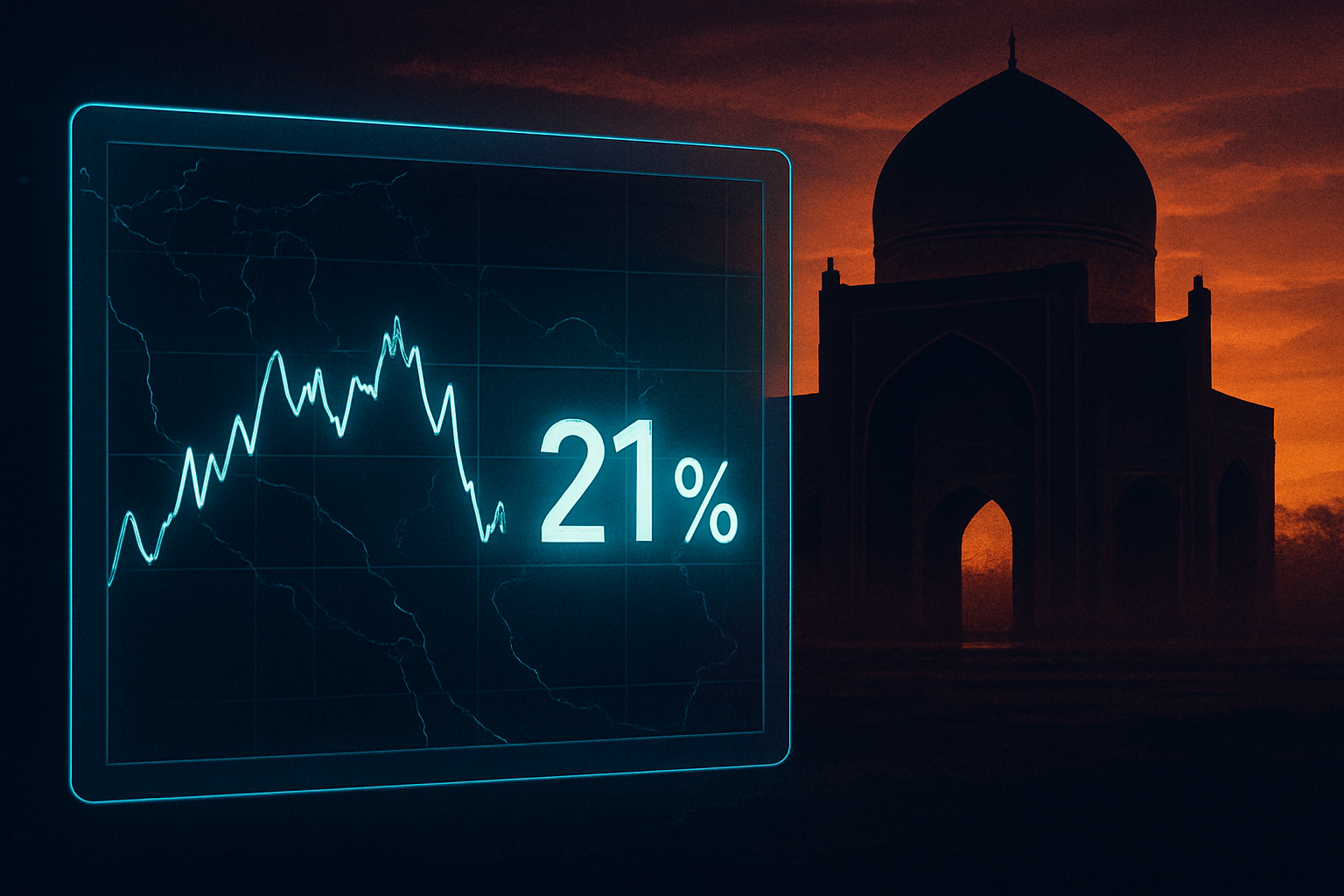
As of January 24, 2026, the geopolitical landscape of the Middle East is being distilled into a single, high-stakes number on the world’s leading prediction markets. Traders on Polymarket are currently pricing in a 21% probability that Ali Khamenei will be out as the Supreme Leader of Iran by February 28, 2026. This surge in betting activity comes as Tehran faces its most existential crisis since the 1979 Revolution, driven by a combination of internal domestic uprising and intensifying external military pressure.
The market has captured the attention of both retail speculators and institutional analysts, with trading volume recently surpassing the $1.25 million mark. In a region where official state media often masks the truth, many are looking to these decentralized platforms as a more accurate barometer of the regime's stability. The 21% chance reflects a significant uptick in volatility; just weeks ago, the odds of a transition before March were in the low single digits.
The Market: What's Being Predicted
The primary contract driving this conversation is Polymarket’s "Khamenei out as Supreme Leader by February 28?" This binary market allows participants to buy "Yes" or "No" shares, with the price of a "Yes" share representing the market-implied probability of the event. The resolution criteria are explicit: the market will resolve to "Yes" if Ali Khamenei ceases to be the Supreme Leader for any reason—including death, resignation, or removal—at any point before the February 28 deadline.
Liquidity in the market has been robust, sustained by over $1 million in total volume. This depth allows for large "whale" positions to enter without immediately destabilizing the price, suggesting that the 21% figure is a settled consensus rather than a fluke of low-volume trading. While Polymarket is the epicenter of this activity, similar shadow markets and private forecasting circles have seen comparable spikes in "regime change" sentiment.
The contract’s expiration date is particularly noteworthy. February 28 marks the end of a critical winter window where Iranian infrastructure is traditionally strained and geopolitical tensions often peak around the anniversary of the 1979 Revolution. If Khamenei remains in power through 11:59 PM ET on that date, the market resolves to "No," rewarding the current 79% majority of skeptics.
Why Traders Are Betting
The sudden interest in this market is driven by a convergence of "Black Swan" events. Chief among them are credible reports concerning the 86-year-old leader’s health. Intelligence suggests Khamenei has been suffering from "advanced cognitive impairment" and has experienced several "coma-like episodes" over the last quarter. As of late January, reports indicate he has moved into a fortified bunker in Tehran, with his son, Masoud Khamenei, reportedly managing the day-to-day operations of the Office of the Supreme Leader.
Furthermore, Iran is currently in the grip of the "Economic Uprising" that began on December 28, 2025. Sparked by a total collapse of the Iranian rial, protests have spread to over 180 cities. Unlike previous movements, this unrest has seen a brutal state response, with human rights groups estimating deaths in the thousands. The use of live ammunition by security forces has only galvanized the protesters, many of whom are calling for the return of Prince Reza Pahlavi to lead a transitional government.
Traders are also closely monitoring the movement of U.S. military assets. A massive carrier strike group, led by the USS Abraham Lincoln, is currently positioned in the Persian Gulf. The Trump administration has issued stern "red lines" regarding the execution of protesters, and the market is pricing in the possibility that a U.S. or Israeli kinetic action could serve as the final catalyst for a leadership collapse. Defense contractors like Lockheed Martin (NYSE: LMT) and Raytheon (NYSE: RTX) are seeing increased scrutiny from investors as the likelihood of a major regional escalation climbs.
Broader Context and Implications
The existence of a million-dollar market on the life or death of a world leader highlights the evolving role of prediction markets in international relations. While critics argue that these markets can be macabre or even incentivize "assassination markets," proponents argue they provide an invaluable "wisdom of the crowds" that traditional intelligence often misses. For companies with significant exposure to global energy markets or shipping, such as ExxonMobil (NYSE: XOM) or Maersk, these odds act as a real-time risk hedge.
Historically, prediction markets have been remarkably prescient at identifying the "breaking point" of autocratic regimes before they are officially acknowledged. The 21% probability is not just a bet on a person’s health; it is a bet on the failure of a 47-year-old political system under extreme duress. If the market continues to climb toward 50%, it could trigger a "reflexive" effect, where the belief in the regime's fall becomes a self-fulfilling prophecy, discouraging security forces from defending a leader they believe is already gone.
Moreover, the regulatory environment for such markets remains complex. While platforms like Kalshi operate under CFTC oversight in the U.S., Polymarket’s decentralized nature allows global participants—including those inside Iran using VPNs—to cast their "vote" with their capital. This provides a rare, unfiltered look at Iranian sentiment that social media platforms like those owned by Meta Platforms (NASDAQ: META) struggle to provide due to government-imposed internet blackouts.
What to Watch Next
As we move toward the February 28 resolution date, several key milestones will likely move the needle. The most significant is the February 11 anniversary of the Islamic Revolution. Traditionally a day of state-sponsored rallies, this year it is expected to be a flashpoint for the opposition. If the regime fails to mobilize its base or if the security forces show signs of defection during the anniversary, the "Yes" odds could easily double overnight.
The status of the nationwide internet blackout, which began on January 8, is another critical variable. If the blackout is lifted and footage of the scale of the uprising reaches the international community, the pressure on the U.S. and its allies to intervene will increase. Conversely, a sudden televised appearance by Khamenei—if he is cognitively and physically able—would likely cause the "Yes" shares to crater as the market recalibrates for a longer survival timeline.
Finally, traders are keeping a close eye on the U.S. Treasury's new 25% tariff on countries continuing to trade with Iran. If China (NYSE: BABA) or India-based firms begin to pull back from Iranian oil contracts in response to these tariffs, the resulting economic "asphyxiation" could trigger a palace coup before the month is out.
Bottom Line
The 21% probability on Polymarket is a stark reminder that the status quo in Iran is more fragile than it has been in decades. While a one-in-five chance is far from a certainty, the $1.25 million in volume suggests this is more than mere speculation; it is an aggregation of geopolitical anxiety and whispered intelligence.
Prediction markets are proving to be a ruthless but efficient tool for cutting through state propaganda. Whether Khamenei remains in power on March 1 or not, the "Khamenei Exit" market has already succeeded in quantifying the unquantifiable. It tells us that the "invincibility" of the Islamic Republic is currently being questioned by the most honest metric we have: the willingness of people to put their money where their mouth is.
In the coming weeks, the movements of the USS Abraham Lincoln and the resilience of the protesters in the streets of Tehran will dictate whether that 21% was a high-water mark or merely the beginning of the end.
This article is for informational purposes only and does not constitute financial or betting advice. Prediction market participation may be subject to legal restrictions in your jurisdiction.
PredictStreet focuses on covering the latest developments in prediction markets.
Visit the PredictStreet website at https://www.predictstreet.ai/.