Tag: Kalshi

  • Betting on the Law: Why the ‘Maduro Trade’ Has Prediction Markets Bracing for Federal Oversight

    Betting on the Law: Why the ‘Maduro Trade’ Has Prediction Markets Bracing for Federal Oversight

    As of January 21, 2026, the fast-evolving world of "Information Finance" is facing its most significant legislative reckoning to date. Congressman Ritchie Torres (D-NY) has officially introduced the Public Integrity in Financial Prediction Markets Act of 2026 (H.R. 7004), a bill designed to bring the ethics of Wall Street to the burgeoning world of event contracts. The move follows a month of intense scrutiny after a series of suspiciously well-timed bets on the platform Polymarket sparked a national conversation about insider trading in geopolitical forecasting.

    Currently, the market's own participants are skeptical about the bill's chances. On PredictIt, the contract for "Will H.R. 7004 pass in 2026?" is trading at a mere 12 cents, implying just a 12% probability of becoming law before the end of the year. Despite the low odds, the bill has become a focal point for traders and regulators alike, as it represents the first major attempt to codify a "STOCK Act" for the prediction market industry.

    The Market: What's Being Predicted

    The PredictIt market tracking the passage of the Torres bill has seen a surge in volume over the last ten days, following the bill's formal introduction on January 9. While the 12% probability suggests a uphill battle, the market is highly liquid, with hundreds of thousands of shares changing hands as traders weigh the legislative appetite for regulation in a midterm election year.

    The bill, backed by high-profile co-sponsors including Speaker Emerita Nancy Pelosi, specifically targets "covered individuals"—which includes federal elected officials, political appointees, and congressional staff. It seeks to prohibit these individuals from trading on event contracts tied to government policy or actions if they possess material non-public information. On the regulated exchange Kalshi, a secondary market has emerged regarding whether the Commodity Futures Trading Commission (CFTC) will independently adopt similar rules by year-end, currently trading at a slightly more optimistic 20% probability.

    Why Traders Are Betting

    The primary catalyst for this legislative push was the so-called "Maduro Trade." On January 3, 2026, just hours before the Trump Administration announced the successful capture of Venezuelan leader Nicolás Maduro, an anonymous account on Polymarket placed a $32,537 bet that Maduro would be out of power by the end of the month. The trade netted over $400,000, fueling allegations that a government or military insider leaked the timing of the raid to profit on the platform.

    Traders are currently split into two camps. The "No" voters (holding the 88% majority) argue that a divided Congress is unlikely to reach a consensus on such a niche issue during an election cycle. They point to the complexity of defining "material non-public information" in the context of global events. Conversely, the "Yes" bulls believe the optics of the "Maduro Trade" are too toxic for politicians to ignore, and that a bipartisan coalition could form to "clean up" the markets before more scandals emerge.

    There is also a significant strategic divide between platforms. Kalshi CEO Tarek Mansour has expressed support for the bill, noting that regulated U.S. platforms already have internal prohibitions on insider trading. By contrast, decentralized and offshore platforms like Polymarket—which have recently faced scrutiny for accurate betting patterns ahead of the Golden Globes—stand to lose the most from federal enforcement.

    Broader Context and Implications

    The Torres bill arrives at a time when prediction markets are transitioning from niche hobbies to mainstream financial tools. Major retail platforms like Robinhood Markets, Inc. (NASDAQ:HOOD) and Interactive Brokers Group, Inc. (NASDAQ:IBKR) through its ForecastEx exchange, have aggressively expanded their event contract offerings throughout 2025. This institutionalization has brought increased pressure from state regulators.

    In just the first three weeks of 2026, Tennessee and Connecticut have issued cease-and-desist orders against several platforms for offering sports-related contracts without gaming licenses. In New York, Assemblymember Clyde Vanel is pushing the ORACLE Act, which would strictly limit the types of events New Yorkers can bet on. The federal Torres bill is seen by some as a way to provide a unified national framework that could preempt a "patchwork" of confusing state laws.

    Historically, prediction markets have been remarkably accurate at forecasting legislative outcomes, often outperforming traditional pundits. If the 12% probability on PredictIt holds steady, it suggests that despite the public outcry over the Maduro incident, the legislative path for H.R. 7004 is fraught with political gridlock.

    What to Watch Next

    The next major hurdle for the bill is a scheduled hearing before the House Financial Services Committee in mid-February. Traders will be listening closely for any signals from committee leadership; if the bill receives a favorable recommendation to move to the House floor, the PredictIt odds could easily double overnight.

    Furthermore, the Trump Administration's stance remains a wildcard. While the administration has been generally hands-off regarding financial deregulation, the embarrassment of a potential military leak leading to a "Maduro Trade" profit could shift the White House's posture toward supporting "integrity measures" for the sector.

    Finally, keep an eye on the CFTC's upcoming open meeting in March. If the Commission indicates it will move forward with its own rulemaking regarding insider trading on event contracts, the legislative urgency for H.R. 7004 may diminish, causing the passage odds to plummet further as administrative action takes the lead.

    Bottom Line

    The Public Integrity in Financial Prediction Markets Act of 2026 is a watershed moment for the "InfoFi" industry. It highlights a fundamental tension: the power of prediction markets to aggregate information versus the risk that they become a vehicle for government corruption.

    While the current 12% probability of passage reflects a skeptical trading community, the very existence of the bill has already changed the industry. Major players like Interactive Brokers (NASDAQ:IBKR) and Robinhood (NASDAQ:HOOD) are likely to tighten their own compliance frameworks in anticipation of eventual oversight. Whether through H.R. 7004 or administrative action, the "wild west" era of unregulated geopolitical betting appears to be drawing to a close.


    This article is for informational purposes only and does not constitute financial or betting advice. Prediction market participation may be subject to legal restrictions in your jurisdiction.

    PredictStreet focuses on covering the latest developments in prediction markets.
    Visit the PredictStreet website at https://www.predictstreet.ai/.
  • The Rhetoric Jackpot: Inside the Multi-Billion Dollar Culture of Betting on the Trump Dialect

    The Rhetoric Jackpot: Inside the Multi-Billion Dollar Culture of Betting on the Trump Dialect

    WASHINGTON, D.C. — January 20, 2026 — Exactly one year after Donald Trump was sworn in as the 47th President of the United States, a new kind of ticker tape is dominating the financial landscape. It isn't tracking the S&P 500 or the price of gold, but rather the specific syllables spoken by the Commander-in-Chief. As President Trump arrives in Davos, Switzerland, today for the World Economic Forum, thousands of traders are glued to their screens, wagering millions on whether he will utter his signature catchphrase: "drill, baby, drill."

    On leading prediction platforms like Polymarket and Kalshi, these "rhetoric markets" have evolved from niche political curiosities into high-volume financial instruments. As of this morning, the probability of Trump saying "drill, baby, drill" during his Davos address tomorrow stands at a steady 54%, while more aggressive bets on his first-year anniversary comments have seen nearly $1.5 billion in weekly volume. What started as a "prop bet" culture has transformed into a sophisticated ecosystem where linguistic patterns are traded with the same intensity as tech stocks.

    The Market: What’s Being Predicted

    The mechanics of betting on presidential speech have become remarkably granular. While traditional markets focus on policy outcomes—such as the likelihood of a Fed Chair appointment—the "mention markets" track the specific vocabulary used in public addresses, tweets (now officially integrated into Truth Social and X), and press conferences. These contracts are typically structured as binary "Yes/No" outcomes: “Will Trump say ‘Drill Baby Drill’ by Jan 31?”

    Currently, the epicenter of this activity is Kalshi, which has seen its total volume skyrocket to over $23.8 billion in 2025 following a landmark regulatory year. For the upcoming 2026 State of the Union, the "Drill Baby Drill" contract is one of the most liquid on the platform, attracting professional market makers and retail "vibe traders" alike. These markets are joined by other high-stakes linguistic wagers, including the odds of Trump mentioning "Bitcoin" (currently 53%) or using the term "Trump Derangement Syndrome" (trading at 47%).

    The resolution criteria for these bets are handled with judicial precision. Platforms employ dedicated verification teams to scan official White House transcripts and high-fidelity audio recordings. On Polymarket, which recently normalized its U.S. operations through a partnership with a CFTC-licensed exchange, these contracts often resolve within minutes of a speech's conclusion, triggering massive liquidity flows.

    Why Traders Are Betting

    The surge in rhetoric betting is driven by the unique predictability of Donald Trump’s linguistic "greatest hits." Unlike traditional politicians whose speeches are vetted by committees of speechwriters for nuance, Trump’s reliance on branding and repetition—what some analysts call "The Billboard Effect"—makes him the perfect subject for event contracts.

    "It’s about sentiment analysis and pattern recognition," says Logan Sudeith, a professional trader who has reportedly earned six figures annually by tracking the President's frequency of specific adjectives. Traders are not just guessing; they are using sophisticated AI tools, often powered by Alphabet Inc. (NASDAQ: GOOGL) and other tech giants, to analyze the President's recent Truth Social posts as leading indicators for his verbal speeches. If "drill" appears in a 3:00 AM post, the "Yes" contracts on Kalshi usually see a 10-15% bump by dawn.

    There is also a significant "whale" presence in these markets. Famous accounts like "Freddy9999," who netted an estimated $50 million during the 2024 election cycle, continue to move the needle. These large-scale positions often act as a hedge; energy sector investors may buy "Yes" contracts on "drill, baby, drill" to offset potential volatility in oil prices, using the President's rhetoric as a proxy for upcoming deregulation.

    Broader Context and Implications

    The institutionalization of these markets marks a paradigm shift in how the public consumes political news. Major media outlets like CNBC, owned by Comcast Corp. (NASDAQ: CMCSA), and CNN now incorporate prediction market odds directly into their chyrons, viewing the "wisdom of the crowd" as a more accurate "truth signal" than traditional polling or punditry.

    The entry of retail powerhouses like Robinhood Markets, Inc. (NASDAQ: HOOD) and Interactive Brokers Group, Inc. (NASDAQ: IBKR) into the event-contract space has further democratized this "culture of the bet." Even the Intercontinental Exchange, Inc. (NYSE: ICE), the parent company of the New York Stock Exchange, has moved into the infrastructure of these markets, reflecting a belief that event-based hedging is the next frontier of finance.

    However, this trend raises significant questions about the "gamification" of governance. Critics argue that when millions of dollars are riding on a single phrase, it creates an incentive for the President to intentionally move markets—or for staff to leak speech drafts to favored traders. Despite these concerns, the CFTC has largely pivoted toward a "regulated expansion" model, acknowledging that these markets provide valuable data on public expectations.

    What to Watch Next

    The immediate focus is the President's Davos address on Wednesday, January 21, 2026. While "drill, baby, drill" is the legacy bet, "Greenland" has become the dark horse of the week. Following reports of renewed interest in the island’s natural resources, "mention markets" for the word "Greenland" have climbed to near 100% certainty for the Davos trip.

    Beyond the vocabulary, the market is awaiting the nomination of the next Federal Reserve Chair. Currently, Kevin Warsh leads the prediction pools with a 61% probability, and traders are listening for specific keywords—like "sound money" or "interest rate cuts"—that might signal his official appointment during tomorrow's speech.

    Investors should also monitor the growing influence of AI trading agents. By early 2026, an estimated 40% of the volume in rhetoric markets is driven by bots that execute trades faster than human speech can be processed by the ear. This "high-frequency linguistics" is expected to create extreme volatility in the seconds after the President approaches a microphone.

    Bottom Line

    The culture of betting on "drill, baby, drill" is more than just a political gimmick; it is the birth of a new asset class. By turning presidential rhetoric into a tradable commodity, prediction markets have provided a real-time, financially-backed sentiment gauge that traditional media can no longer ignore.

    As we cross the one-year mark of the 47th presidency, the lesson for investors is clear: in the modern era, a politician's words are no longer just "talk"—they are a price point. Whether this leads to a more informed electorate or simply a more volatile one remains to be seen, but for now, the markets are waiting with bated breath for the next "drill."


    This article is for informational purposes only and does not constitute financial or betting advice. Prediction market participation may be subject to legal restrictions in your jurisdiction.

    PredictStreet focuses on covering the latest developments in prediction markets. Visit the PredictStreet website at https://www.predictstreet.ai/.
  • The Odds of Governance: How Prediction Markets Redefined the NYC Mayoral Race

    The Odds of Governance: How Prediction Markets Redefined the NYC Mayoral Race

    As New York City enters the first weeks of the Zohran Mamdani administration, political analysts and financial traders alike are looking back at the 2025 mayoral race not just for its ideological shift, but as a watershed moment for the prediction market industry. For the first time in a major U.S. municipal election, real-time betting data from platforms like Kalshi and Polymarket moved from the fringes of political nerd-dom into the center of campaign strategy, social media warfare, and high-budget television advertisements.

    By the time the polls closed on November 4, 2025, prediction markets were showing a staggering 95% probability of victory for Mamdani, the 34-year-old Democratic Socialist. This high-conviction forecast stood in stark contrast to traditional polling, which suggested a much tighter "margin of error" race against former Governor Andrew Cuomo. The markets’ aggressive stance—and the candidates' reactions to it—has ignited a fierce debate over whether these financial instruments are tools for clarity or weapons of psychological voter suppression.

    The Market: What's Being Predicted

    The 2025 NYC Mayoral market was the largest municipal betting event in history, facilitated by a significant regulatory expansion earlier in the year. Leading the charge were Kalshi, a regulated exchange, and Polymarket, the decentralized giant. Together, these platforms saw hundreds of millions of dollars in trading volume, providing a liquidity depth that allowed for sophisticated price discovery throughout the turbulent campaign cycle.

    The market narrative was defined by the "Cuomo Collapse." In early 2025, markets assigned Andrew Cuomo an 80–90% chance of returning to the governor’s mansion’s city-level equivalent. However, the price of "Mamdani Yes" contracts began a meteoric rise in June 2025, surging from a mere 7 cents to over 50 cents in a matter of weeks. By late October, as the general election approached, the markets were effectively "locked," with Mamdani trading at nearly 94 cents on Kalshi, implying a nearly certain victory that traditional pollsters were hesitant to call.

    The resolution criteria for these markets were strictly tied to the official certification of results by the NYC Board of Elections. However, the sheer volume of "event contracts" allowed traders to hedge against specific outcomes, such as a ranked-choice voting upset or even the likelihood of a legal challenge to the results—a market that spiked briefly after Cuomo supporters alleged voter fraud in early November.

    Why Traders Are Betting

    The divergence between market odds and traditional polling was the primary driver of the year's heavy trading volume. While polls often struggled with the complexities of New York’s ranked-choice voting and the enthusiasm of younger demographics, traders were quick to price in the "ground game" advantage of Mamdani’s progressive coalition.

    "The markets weren't just looking at who people said they would vote for; they were looking at the momentum of the donor base and the collapse of the centrist vote after Eric Adams' indictment," said one high-frequency trader who specialized in political contracts. Notable "whale" activity also influenced the boards. Billionaire Bill Ackman, a frequent commentator on market integrity, publicly questioned the odds on social media, suggesting that large positions were being taken to create a "mirage of inevitability" for the Mamdani campaign.

    In response, the Mamdani campaign did something unprecedented: they weaponized the odds. At "NYC Is Not For Sale" rallies, Mamdani frequently pointed to Kalshi odds on large screens to warn his base against complacency. By showing how the "smart money" had shifted from Cuomo to him, he argued that the power of grassroots organizing was literally changing the financial forecast of the city. This feedback loop—where market data influences the very events it is trying to predict—has become a central point of study for political scientists.

    Broader Context and Implications

    The NYC race served as a proof-of-concept for the mainstreaming of prediction markets. Public companies like Robinhood Markets, Inc. (NASDAQ: HOOD) and Interactive Brokers Group, Inc. (NASDAQ: IBKR) had expanded their "Election Event" offerings throughout 2025, allowing retail investors to trade on political outcomes with the same ease as buying a share of Apple Inc. (NASDAQ: AAPL). This accessibility brought political betting into the living rooms of average New Yorkers, but not without significant controversy.

    The most heated debate involved "victory ads" run by Kalshi. On the morning of Election Day, the platform ran digital billboards in Times Square and ads on Meta Platforms, Inc. (NASDAQ: META) and Alphabet Inc. (NASDAQ: GOOGL) properties that effectively "called" the race for Mamdani based on their 93% probability data. Critics, including the Cuomo campaign, argued that declaring a winner while people were still standing in line to vote was a dangerous new form of voter suppression.

    Furthermore, the post-election "Deportation Market"—which allowed users to bet on the odds of the Ugandan-born, naturalized Mamdani being deported under a potential future federal administration—showed the darker side of these platforms. The existence of such a market drew condemnation from civil rights groups, highlighting the regulatory vacuum regarding "distasteful" or "unethical" contracts that nonetheless meet the technical criteria for being a predictable event.

    What to Watch Next

    As the Mamdani administration begins its first 100 days, the focus of prediction markets has shifted from "who will win" to "what will they do." Currently, active markets are tracking whether the new Mayor can successfully implement his promised citywide rent freeze by July 2026. Traders are currently pricing that outcome at a cautious 42% probability, reflecting skepticism over the legal hurdles in the State Legislature.

    Another key milestone is the upcoming FY 2026 budget. With a projected $2 billion deficit, markets on the "NYC Credit Rating Downgrade" are seeing increased activity. Investors should also keep an eye on federal-city relations; contracts regarding federal funding cuts for "Sanctuary Cities" are already trading on Polymarket, with significant implications for Mamdani’s ambitious social programs.

    Bottom Line

    The 2025 NYC Mayoral race proved that prediction markets are no longer a niche hobby for economists; they are a potent political force. By accurately forecasting the "Mamdani Wave" long before it was reflected in mainstream media narratives, these markets provided a level of real-time insight that traditional methods failed to capture.

    However, the controversy over campaign-led "odds ads" and the ethical questions surrounding sensitive contracts suggest that the industry is at a crossroads. While platforms like Kalshi and Polymarket offer a more efficient way to aggregate information, the "commodification of expectations" can have real-world consequences on voter turnout and political stability. As we look toward the 2028 presidential cycle, the lessons of New York City will serve as the primary case study for how—or if—prediction markets should be regulated in the heat of a democratic contest.


    This article is for informational purposes only and does not constitute financial or betting advice. Prediction market participation may be subject to legal restrictions in your jurisdiction.

    PredictStreet focuses on covering the latest developments in prediction markets.
    Visit the PredictStreet website at https://www.predictstreet.ai/.
  • The New Tape: Why Wall Street Is Obsessed with Prediction Market Alpha

    The New Tape: Why Wall Street Is Obsessed with Prediction Market Alpha

    As of January 20, 2026, a fundamental shift has occurred in the plumbing of global finance. For decades, the "tape"—the real-time feed of stock and bond prices—was the undisputed source of truth for traders. Today, that tape has a rival. Professional desks at major banks and hedge funds are increasingly turning to prediction markets like Kalshi and Polymarket not just to hedge, but for "Information Discovery"—identifying market-moving signals before they hit the Bloomberg terminal.

    This week, the "Information Discovery" trend reached a fever pitch. While traditional interest rate futures at CME Group (NASDAQ: CME) showed a lingering 16% chance of a rate cut at the upcoming January FOMC meeting, prediction markets had already moved to a 96% "certainty" of a pause. This 12-point "certainty gap" allowed savvy traders to front-run moves in the USD/EUR forex pairs and adjust positions in interest-rate-sensitive stocks before the broader market caught on. With daily trading volumes in the sector hitting a record $701.7 million this month, prediction markets have officially graduated from political novelties to essential financial infrastructure.

    The Market: What's Being Predicted

    The current landscape of prediction markets is dominated by two primary forces: the regulated U.S. powerhouse Kalshi and the decentralized giant Polymarket, which recently finalized its re-entry into the U.S. via the $112 million acquisition of QCX. These platforms host thousands of "event contracts" ranging from the mundane (monthly CPI prints) to the tectonic (geopolitical regime changes).

    Unlike traditional derivatives, which are often tied to the underlying price of an asset, event contracts settle based on the binary outcome of a real-world event. For instance, the "Will the Fed raise rates in January?" contract on Kalshi has seen massive liquidity, with over 2.5 billion contracts traded across integrated platforms like Robinhood Markets, Inc. (NASDAQ: HOOD) in the final quarter of 2025 alone. Current odds on Kalshi show a stagnant 4% probability for a hike, a signal that has remained remarkably stable even as traditional bond yields fluctuated wildly last week.

    The speed of resolution is also a key factor. While traditional markets often wait for official government reports or press releases, prediction markets react to "boots on the ground" data in real-time. This has created a high-velocity environment where liquidity and volume have skyrocketed, with the total notional value of the prediction market sector exceeding $13 billion in late 2025.

    Why Traders Are Betting

    The move toward prediction markets is driven by a simple realization: these markets are often more accurate and faster than professional surveys or analyst consensus. Institutional traders are using these platforms to find "alpha"—the elusive market-beating edge.

    A prime example occurred earlier this month on January 3, 2026. Hours before U.S. forces announced the capture of Venezuelan President Nicolás Maduro, specific geopolitical contracts on Polymarket began to swing violently toward a "Yes" outcome. A handful of anonymous traders netted over $400,000 on the move. More importantly, this signal preceded a 10% intraday surge in Chevron (NYSE: CVX) and other Latin American-exposed energy stocks when the NYSE opened the following Monday. Traders who monitored the Polymarket signal were able to position themselves in Chevron before the news was fully digested by traditional equity desks.

    Large-scale "whale" activity is also becoming more transparent. Boaz Weinstein of Saba Capital recently highlighted a divergence where prediction markets priced recession risk at 50%, while traditional credit markets implied only a 2% chance. This allowed hedge funds to construct "paired trades"—effectively using the cheap "No Recession" contracts as a hedge while shorting expensive credit instruments. This sophisticated arbitrage is why firms like Susquehanna International Group (SIG) have stepped in as official market makers for Kalshi, and why JPMorgan Chase & Co. (NYSE: JPM) has reportedly integrated real-time prediction market feeds into its internal research dashboards.

    Broader Context and Implications

    The "Information Discovery" trend is the crown jewel of the "Information Finance" era. It represents a shift from guessing what will happen to pricing what is actually happening in the collective consciousness of the most informed participants. Historically, prediction markets have outperformed pundits and polls in nearly every major election and economic cycle since 2020.

    The regulatory environment has finally provided the tailwinds necessary for this institutional adoption. The passage of the Digital Asset Market CLARITY Act of 2025 provided a federal framework that reclassified many event-related assets as commodities, ending years of legal limbo between the SEC and the CFTC. While state-level challenges remain—with New Jersey and Nevada recently issuing cease-and-desist orders against certain sports-related contracts—the federal path for economic and political markets is clearer than ever.

    For the broader public, these markets provide a "bullshit detector" for the 24-hour news cycle. When a politician makes a claim or a CEO issues a vague guidance, the market price on a corresponding event contract serves as an immediate, incentivized truth-check.

    What to Watch Next

    As we move through the first quarter of 2026, the primary focus will be on the "Macro Trifecta": the February CPI print, the Q1 earnings season for "Magnificent Seven" stocks like Microsoft (NASDAQ: MSFT), and the implementation of the CLARITY Act’s secondary market rules.

    Traders should specifically watch for discrepancies between the "Earnings Surprise" contracts on ForecastEx—the platform run by Interactive Brokers Group (NASDAQ: IBKR)—and the implied volatility in the options market. If prediction markets begin to signal an earnings beat for big tech 48 hours before the release, we could see significant pre-market moves in the underlying stocks.

    Additionally, the battle between state and federal regulators will reach the Supreme Court later this year. The outcome of these cases will determine if prediction markets can expand into more granular, localized events, or if they will remain focused on high-level macro and geopolitical shifts.

    Bottom Line

    The rise of "Information Discovery" marks the end of the analyst-survey era and the beginning of the market-signal era. As Goldman Sachs Group, Inc. (NYSE: GS) executives noted in their latest earnings call, prediction markets are no longer a "side-show"; they are a fundamental data layer that informs how the world's largest banks price risk.

    The key takeaway for any investor is that the "truth" is now priced in real-time, 24/7, by people with skin in the game. Whether you are trading stocks, currencies, or commodities, ignoring the signals from Kalshi and Polymarket is becoming a luxury that professional traders can no longer afford. As liquidity continues to pool in these markets, their ability to predict the future—and move the present—will only grow.


    This article is for informational purposes only and does not constitute financial or betting advice. Prediction market participation may be subject to legal restrictions in your jurisdiction.

    PredictStreet focuses on covering the latest developments in prediction markets.
    Visit the PredictStreet website at https://www.predictstreet.ai/.
  • The Maduro Trade Fallout: Markets Brace for Federal Crackdown on “Government Insiders”

    The Maduro Trade Fallout: Markets Brace for Federal Crackdown on “Government Insiders”

    As of January 20, 2026, the prediction market world is grappling with a new reality: the prospect of a federal ban on government employees and politicians trading the very outcomes they influence. Prompted by a suspicious $400,000 windfall on the offshore platform Polymarket, Congressman Ritchie Torres (D-NY) has formally introduced the Public Integrity in Financial Prediction Markets Act of 2026 (H.R. 7004). The bill aims to codify "insider trading" rules for the burgeoning world of "Information Finance," marking the most significant legislative attempt to regulate the space since the 2012 STOCK Act.

    Currently, proxy markets on PredictIt and Kalshi suggest that while the public is outraged, the path to legislative victory remains steep. A PredictIt contract tracking the passage of a general ban on congressional trading is currently hovering at a 12% probability, reflecting deep-seated skepticism that a divided Congress will move quickly in a midterm election year. However, interest in the bill is surging as major retail platforms like Robinhood (NASDAQ:HOOD) and Interactive Brokers (NASDAQ:IBKR) pivot to support the legislation, hoping that federal guardrails will finally provide the regulatory certainty needed to fend off aggressive state-level bans.

    The Market: What's Being Predicted

    The "Torres Bill" market is less a single contract and more a cluster of interconnected wagers across multiple platforms. On PredictIt, the "Will Congress pass a ban on member stock trading?" contract—long used as a barometer for ethics legislation—saw a 4-cent spike following the introduction of H.R. 7004 on January 9, 2026. Meanwhile, on Kalshi, a contract focused on whether the Commodity Futures Trading Commission (CFTC) will adopt new insider trading rules by the end of 2026 has climbed to 20%, suggesting traders believe administrative action may be more likely than a full act of Congress.

    Trading volume has been particularly heavy in the "Federal Preemption" markets on Manifold, where the probability that federal law will override state-level bans (like New York’s proposed ORACLE Act) is trading at a staggering 81%. This reflects a consensus that the Torres Bill is being used as a bargaining chip: the industry will accept a ban on "government insiders" in exchange for a federal "safe harbor" that protects platforms from being labeled as illegal gambling by state attorneys general.

    The resolution criteria for most of these markets depend on H.R. 7004 being signed into law by December 31, 2026. If the bill stalls in committee or fails to find Republican co-sponsors by the summer recess, the "No" side of these contracts is expected to become the dominant play.

    Why Traders Are Betting

    The primary driver of the current "No" sentiment (88% on PredictIt) is the historical difficulty of passing any legislation that limits the financial freedom of lawmakers. Traders cite the original STOCK Act’s long gestation period and subsequent weakening as evidence that the Torres Bill faces an uphill battle. "Washington moves at a snail’s pace, but these markets move at the speed of light," says one high-volume trader on Kalshi. "The odds are low not because people hate the bill, but because they don't believe this Congress can agree on what day of the week it is."

    However, a "whale" position recently emerged on the "Yes" side, betting that the scandalous nature of the "Maduro Trade" provides a unique political catalyst. In early January 2026, an anonymous Polymarket user bet $32,000 on the capture of Venezuelan President Nicolás Maduro just hours before a U.S.-led operation was announced, netting a nearly 1,200% return. This event has unified public sentiment against "information asymmetry" in a way that dry policy debates never could.

    Furthermore, the strategic support from Interactive Brokers (NASDAQ:IBKR) has changed the math. IBKR’s ForecastEx exchange has been a vocal proponent of the bill, arguing that banning insiders is essential for prediction markets to be viewed as "Truth Machines" rather than casinos. This institutional backing suggests that the bill isn't just a progressive pet project, but a necessary step for the industry's survival.

    Broader Context and Implications

    The Torres Bill represents a pivotal moment in the evolution of prediction markets. For years, these platforms have existed in a legal gray area, frequently clashing with the CFTC. The introduction of H.R. 7004 signals that prediction markets have finally reached a level of cultural and financial significance where they require their own equivalent of the SEC’s Rule 10b-5.

    This bill isn't just about ethics; it's about the "financialization" of information. If passed, it would treat political outcomes as material nonpublic information, putting a US Senator on the same legal footing as a corporate CEO. This would likely increase institutional trust in the data produced by these markets, as the fear of "insider manipulation" would be mitigated by the threat of federal prosecution.

    The bill also highlights a growing rift between regulated U.S. platforms and offshore entities. While Kalshi and Robinhood (NASDAQ:HOOD) have integrated surveillance tools to identify suspicious activity, offshore platforms like Polymarket remain harder to police. By pushing for federal legislation, U.S. platforms are effectively attempting to "standardize" the market in a way that favors compliant, regulated exchanges.

    What to Watch Next

    The next 60 days will be critical for the Torres Bill and the associated markets. Traders should monitor the House Committee on Oversight and Government Reform for any scheduled hearings. Testimony from the CEOs of major exchanges or from CFTC officials could cause immediate 10-20% swings in the probability of the bill's passage.

    Key dates to watch:

    • February 15, 2026: The deadline for the first round of committee reports.
    • March 2026: The expected release of the CFTC's semi-annual regulatory agenda, which may indicate if the commission plans to act independently of Congress.
    • Summer 2026: The point at which midterm election campaigning traditionally freezes non-essential legislation.

    If the bill fails to gain at least five Republican co-sponsors by the end of Q1, the probability of passage will likely crater to the low single digits. Conversely, any new "smoking gun" evidence linking the Maduro Trade to a specific government official would likely send "Yes" odds skyrocketing.

    Bottom Line

    The Public Integrity in Financial Prediction Markets Act of 2026 is a "growing pain" for a trillion-dollar industry in the making. While the current 12% probability of passage reflects a cynical view of congressional efficiency, the underlying movement suggests that the era of the "unregulated wild west" for prediction markets is drawing to a close.

    Whether the Torres Bill passes or the CFTC implements similar rules by fiat, the message from the markets is clear: for prediction platforms to serve as the ultimate "Truth Machine," they must first be purged of the insiders who hold the levers of power. For now, the smartest bet may not be on the bill itself, but on the continued shift of prediction markets toward the regulated, institutionalized core of the American financial system.


    This article is for informational purposes only and does not constitute financial or betting advice. Prediction market participation may be subject to legal restrictions in your jurisdiction.

    PredictStreet focuses on covering the latest developments in prediction markets.
    Visit the PredictStreet website at https://www.predictstreet.ai/.
  • The New Yield Curve: Why Wall Street is Now Following Prediction Markets for Fed and CPI Guidance

    The New Yield Curve: Why Wall Street is Now Following Prediction Markets for Fed and CPI Guidance

    As the Federal Reserve prepares for its first policy meeting of 2026 on January 27–28, a significant shift has occurred in how the financial world anticipates interest rate decisions. The traditional dominance of professional economic surveys and even standard bond-market derivatives is being challenged by prediction markets like Kalshi and Polymarket. For the upcoming January FOMC meeting, prediction markets are currently pricing a "no change" decision with an overwhelming 96% probability, firmly pegging the federal funds rate at its current 3.50%–3.75% range.

    This decisive certainty stands in subtle contrast to traditional instruments. While the CME FedWatch tool, operated by CME Group (NASDAQ: CME), reflects a still-significant 16% chance of a rate cut, prediction market traders have almost entirely written off the possibility of a January move. This divergence is not an anomaly; over the past eighteen months, prediction markets have consistently outpaced institutional forecasts in both speed and accuracy, forcing major players like Goldman Sachs (NYSE: GS) and JPMorgan Chase (NYSE: JPM) to integrate these platforms into their primary research dashboards.

    The Market: What's Being Predicted

    The focus of the current forecasting cycle centers on the "Fed Path" and monthly Consumer Price Index (CPI) data. On Kalshi, a federally regulated exchange, the "January Fed Meeting" contract has seen record-breaking participation from institutional traders. Meanwhile, the decentralized platform Polymarket has seen its January Fed decision volume exceed $425 million, as global participants bet on everything from the specific basis point move to the exact wording used in Chair Jerome Powell’s final few press conferences before his term expires in May.

    Unlike traditional surveys, which provide a "snapshot" of economist sentiment once a month, these markets trade 24/7. This allows them to react instantaneously to breaking news—such as the early January 2026 labor data that showed unemployment stabilizing at 4.5%. While traditional analysts were still revising their notes, prediction market odds for a January "hold" surged from 85% to 96% within minutes of the data release. These markets don't just predict the outcome; they predict the brackets of the outcome, with contracts available for specific CPI increments (e.g., "Will CPI be between 2.6% and 2.7%?").

    Why Traders Are Betting

    The migration of capital toward prediction markets is driven by the concept of "Information Finance." Traders argue that these platforms offer a "truth engine" fueled by "skin in the game." Unlike a bank economist whose compensation is rarely tied directly to the accuracy of a single CPI forecast, a prediction market participant faces an immediate financial loss if they are wrong. This financial incentive filters out the "herding" behavior often seen in institutional forecasts, where analysts are frequently hesitant to deviate too far from the consensus.

    Recent history has validated this approach. In late 2024, Kalshi research demonstrated that their market-based CPI forecasts had a 40.1% lower Mean Absolute Error (MAE) than the Wall Street consensus. When "inflation shocks" occurred—moments where data deviated significantly from expectations—the prediction markets' error was nearly 67% lower than that of professional economists. Wall Street has taken note; firms like Jane Street and Susquehanna International Group have established dedicated desks to arbitrage discrepancies between prediction market odds and traditional interest rate swaps.

    Broader Context and Implications

    The institutionalization of these markets reached a fever pitch in late 2025 when the Intercontinental Exchange (NYSE: ICE), the parent company of the New York Stock Exchange, announced a landmark $2 billion investment in Polymarket. This move signaled that prediction markets are no longer considered "niche betting sites" but are essential financial infrastructure. The utility of these markets extends beyond interest rates; they have become the premier venue for pricing geopolitical risk.

    A recent example of this was the "Maduro Incident" in early January 2026. While mainstream news wires were still verifying reports of a political shift in Venezuela, prediction markets were already repricing global energy costs and interest rate expectations. By the time the news hit the Bloomberg (Private) terminals, the odds of a "hawkish hold" by the Fed had already moved, as traders anticipated the inflationary impact of potential oil supply disruptions. This ability to aggregate disparate, global information in real-time is what makes these platforms indispensable in 2026.

    What to Watch Next

    As we move toward the January 28 FOMC announcement, all eyes remain on the "sticky" PCE inflation data, currently hovering around 2.7%. If the prediction markets hold their 96% conviction of a "pause," any deviation by the Fed would trigger a massive "repricing event" across all asset classes. Traders are also looking toward the March 17-18 meeting, where the odds are currently split: a 79% probability of another hold versus a growing sentiment for a 25-basis-point cut if labor markets show further cooling.

    Beyond the immediate rate decisions, the next major milestone is the nomination of the next Federal Reserve Chair. Prediction markets currently give a 61% probability that the administration will nominate a candidate with a "higher-for-longer" bias, a sentiment that is already beginning to flatten the yield curve in the prediction space for the latter half of 2026. These leadership markets are moving with more fluidity than any political punditry, reflecting real-time shifts in the Washington, D.C. power dynamic.

    Bottom Line

    Prediction markets have fundamentally changed the "alpha" equation for economic forecasting. By providing a 24/7, high-liquidity environment where information is priced instantly, they have exposed the lag inherent in traditional economic models. The 40% accuracy advantage over Wall Street consensus is no longer a statistical fluke—it is a testament to the power of decentralized, incentivized data aggregation.

    For the retail investor and the institutional titan alike, the message is clear: the most accurate "yield curve" in 2026 is no longer found solely in the bond market. It is found in the fluctuating odds of the prediction exchanges. As we approach the end of January, the 96% "hold" consensus on Kalshi and Polymarket suggests that the Fed’s path is already priced in, leaving the "surprises" to those who are still relying on yesterday’s surveys.


    This article is for informational purposes only and does not constitute financial or betting advice. Prediction market participation may be subject to legal restrictions in your jurisdiction.

    PredictStreet focuses on covering the latest developments in prediction markets.
    Visit the PredictStreet website at https://www.predictstreet.ai/.
  • The Emerald City Renaissance: Seattle Seahawks Emerge as Super Bowl LX Favorites as Prediction Market Volume Explodes

    The Emerald City Renaissance: Seattle Seahawks Emerge as Super Bowl LX Favorites as Prediction Market Volume Explodes

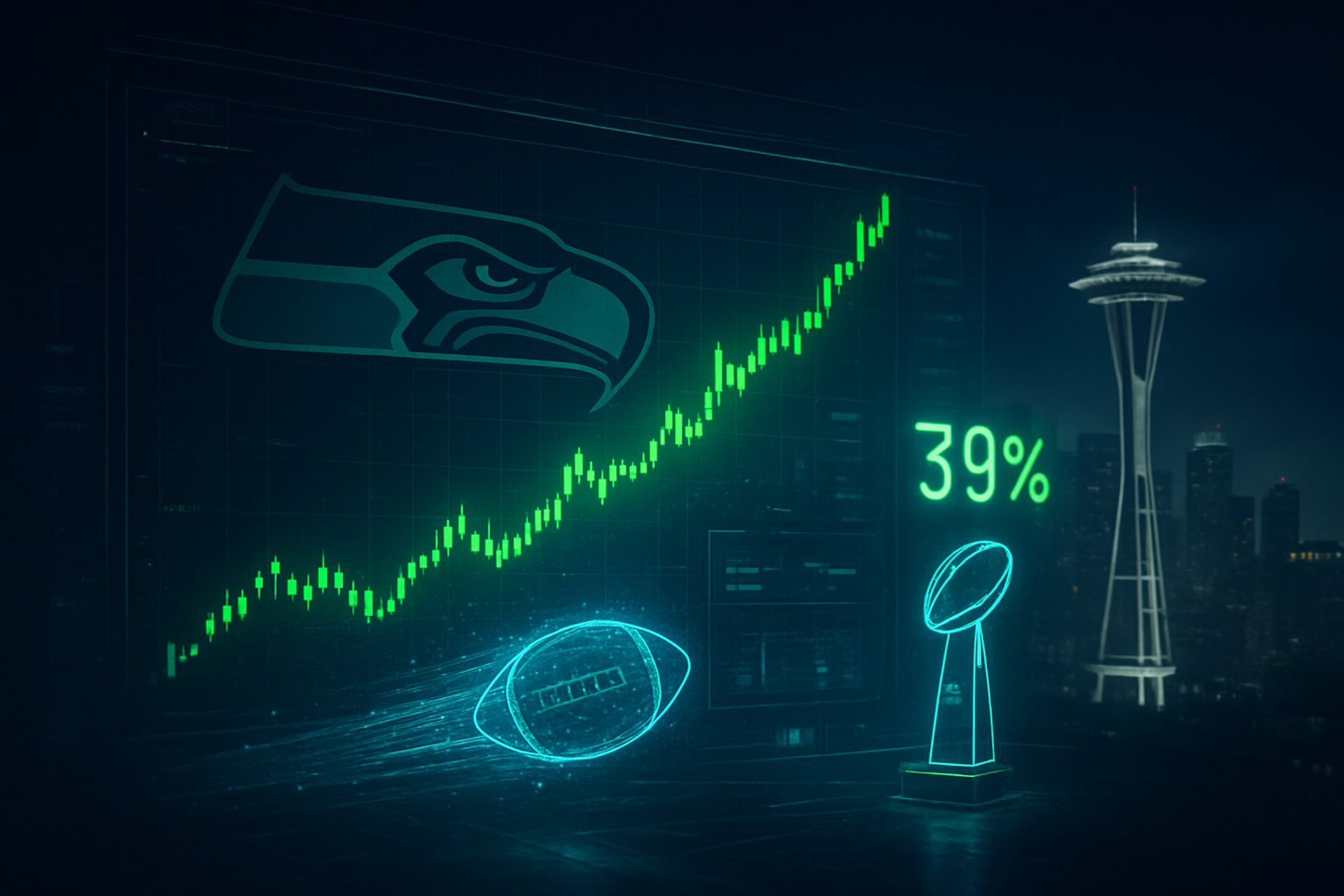
    As the NFL post-season reaches its fever pitch, the prediction market landscape is signaling a seismic shift in the professional football hierarchy. With Super Bowl LX just weeks away, the Seattle Seahawks have defied preseason expectations to become the definitive favorites to lift the Lombardi Trophy. According to the latest data from the regulated prediction exchange Kalshi, the Seahawks currently command a staggering 39% implied probability of winning the championship, trading at $0.39 per contract.

    The surge in Seattle’s odds follows a dominant regular season and a brutalizing performance in the Divisional Round that has captivated both casual fans and sophisticated "sports traders." For a team that many expected to be in a transition year under second-year head coach Mike Macdonald, the Seahawks’ ascension represents one of the most significant market movements in the history of sports-based prediction contracts.

    The Market: What's Being Predicted

    The primary vehicle for this speculation is the "Super Bowl LX Winner" market on Kalshi. Unlike traditional sportsbooks, these markets operate as a binary exchange where contracts pay out $1.00 if the event occurs and $0.00 if it does not. The current price of $0.39 reflects a market consensus that Seattle is significantly more likely to win it all than any other remaining contender.

    The liquidity in this market has reached historic levels. As of January 20, 2026, the Super Bowl winner market has seen over $45 million in total trading volume. In the 24 hours following Seattle’s 41-6 dismantling of the San Francisco 49ers, more than $800,000 in notional volume was traded on the Seahawks' "Yes" contracts alone. This high level of liquidity allows for "whale" positions—trades worth hundreds of thousands of dollars—to be executed without causing the extreme price slippage often seen in lower-volume markets.

    The resolution criteria are straightforward: the market will settle based on the official results of Super Bowl LX, scheduled for February 8, 2026, at Levi’s Stadium. While other platforms like Polymarket have seen similar trends, the domestic, regulated nature of Kalshi has made it the preferred venue for institutional-sized bets on the 2025-2026 NFL season.

    Why Traders Are Betting

    The bullish sentiment surrounding Seattle is backed by a combination of statistical dominance and favorable situational factors. The Seahawks finished the regular season with a franchise-record 14-3 record, securing the No. 1 seed in the NFC. Traders are particularly focused on the "Macdonald Effect." In his second year, head coach Mike Macdonald has successfully installed a defensive scheme that analysts are calling a "reimagined Legion of Boom," with the unit finishing the season ranked No. 1 in both points allowed (17.2 per game) and defensive DVOA.

    On the offensive side, the "Darnold Redemption" arc has provided the necessary volatility for high-upside betting. Quarterback Sam Darnold, playing under a one-year deal, finished second in the NFL in yards per attempt (8.5). While he remains a high-variance player, his chemistry with Jaxon Smith-Njigba—who shattered franchise records with 1,793 receiving yards—has made Seattle’s offense nearly impossible to stop when clicking.

    Market dynamics were also heavily influenced by the collapse of the traditional AFC powers. The Kansas City Chiefs, perennial favorites, were eliminated from playoff contention in December after a season-ending ACL injury to Patrick Mahomes. This "power vacuum" in the AFC, combined with the Seattle defense's ability to shut down high-powered offenses, has funneled capital toward the Seahawks as the safest "long" position in the field.

    Broader Context and Implications

    The rise of the Seahawks as a prediction market darling highlights the growing intersection of sports and fintech. As regulated exchanges like Kalshi continue to gain traction, the "wisdom of the crowd" is increasingly viewed as a more accurate barometer of team strength than traditional polling or even Elo ratings. The speed at which Seattle's odds adjusted after the Mahomes injury and the subsequent 49ers blowout demonstrates the efficiency of these markets in processing real-world news.

    From a corporate perspective, the Seahawks’ success is a boon for the Pacific Northwest economy and its major stakeholders. While the team is owned by the Paul G. Allen Trust, the region’s economic heavyweights, including Microsoft (NASDAQ: MSFT) and Amazon (NASDAQ: AMZN), often see indirect benefits from the increased national spotlight and tourism associated with a deep playoff run. Furthermore, the high viewership expected for the upcoming games is a major driver for Comcast (NASDAQ: CMCSA), whose NBC subsidiary will broadcast Super Bowl LX.

    This market also underscores a shift in how fans engage with the NFL. Rather than placing a one-time wager at a sportsbook, traders are now "hedging" their fandom, buying and selling "shares" of teams as if they were tech stocks. This provides a continuous feedback loop of public sentiment that was previously unavailable to the general public.

    What to Watch Next

    The most immediate catalyst for the market will be the NFC Championship game on January 25, 2026. Seattle is set to host the Los Angeles Rams at Lumen Field. While the Seahawks are favored, the Rams (currently at 27% on Kalshi) have a veteran quarterback and a history of playing Seattle close, having split their regular-season series. A Seahawks win would likely send their Super Bowl contract price soaring toward the $0.55 – $0.60 range.

    Traders should also monitor the health of key Seahawks players. The mid-season acquisition of return specialist Rashid Shaheed from the New Orleans Saints has been a game-changer; any injury to Shaheed or defensive anchors like Devon Witherspoon could cause a sharp correction in the "Yes" contract price.

    Finally, the AFC Championship between the New England Patriots and the Denver Broncos will determine Seattle's ultimate opponent. If the Patriots and their breakout star Drake Maye (currently at 27% probability) advance, the market may tighten, as Maye’s dual-threat capability is seen as the only viable "kryptonite" to Mike Macdonald’s defensive scheme.

    Bottom Line

    The Seattle Seahawks have transitioned from a "surprise contender" to a "market-certified juggernaut." The $0.39 price tag on Kalshi reflects more than just home-field advantage; it reflects a belief in a complete team built on an elite defense and a high-efficiency offense.

    For the prediction market industry, Super Bowl LX represents a milestone in maturity. The tens of millions of dollars in volume and the rapid price discovery seen in the Seahawks’ market suggest that these platforms are no longer just niches for political junkies—they are becoming the definitive scoreboard for the sports world. Whether the Seahawks can fulfill the market's high expectations remains to be seen, but for now, the smart money is firmly planted in the Pacific Northwest.


    This article is for informational purposes only and does not constitute financial or betting advice. Prediction market participation may be subject to legal restrictions in your jurisdiction.

    PredictStreet focuses on covering the latest developments in prediction markets.
    Visit the PredictStreet website at https://www.predictstreet.ai/.
  • Betting on the Ban: New York Lawmakers Propose $1M Daily Fines for “Reckless” Prediction Markets

    Betting on the Ban: New York Lawmakers Propose $1M Daily Fines for “Reckless” Prediction Markets

    As the 2026 legislative session kicks off in Albany, a high-stakes battle is unfolding over the future of decentralized and regulated forecasting in the Empire State. New York lawmakers are currently scrambling to pass legislation that could either legitimize prediction markets as the next frontier of finance or crush them under the weight of "reckless gambling" labels and million-dollar penalties. At the center of the storm is a series of competing bills aimed at platforms like Kalshi and Polymarket, with traders now betting heavily on whether New York will ultimately pull the plug on the industry.

    Currently, a prominent contract on Kalshi—"Will New York pass a bill to ban political event contracts in 2026?"—is trading at a 38% probability. While this reflects a significant drop from the 65% "panic" highs seen in late 2025, the market remains volatile as two distinct legislative paths emerge. The interest is driven by a unique convergence of financial technology, political anxiety, and a massive tax disparity that has traditional sports betting giants like DraftKings (NASDAQ: DKNG) and Flutter Entertainment (NYSE: FLUT), the parent company of FanDuel, re-evaluating their entire business models.

    The Market: What's Being Predicted

    The primary market under the microscope is the legislative outcome of the 2025–2026 New York session. Traders are specifically weighing the chances of Assembly Bill A9251, colloquially known as the ORACLE Act. Sponsored by Assemblymember Clyde Vanel, the bill is the most aggressive anti-prediction market measure in the country. It seeks to categorize these platforms as "unlicensed gambling" and would impose civil fines of up to $50,000 for persistent violations, escalating to a staggering $1 million per day for platforms that continue to offer contracts on "sensitive" categories like elections, war, or securities prices.

    The ORACLE Act is currently being challenged by a more moderate proposal: Senate Bill S8889, the New York Prediction Market Regulation Act. Introduced on January 13, 2026, by Senator Jeremy Cooney, this rival bill suggests a licensing framework under the New York Department of Financial Services (DFS), treating event contracts as financial instruments rather than bets. Trading volume on these outcomes has surged across Kalshi and Interactive Brokers (NASDAQ: IBKR), which operates the ForecastEx exchange. On Manifold Markets, "shadow markets" are even pricing in an 81% probability that federal law will eventually preempt any state-level ban, citing the Supremacy Clause and the Commodity Futures Trading Commission's (CFTC) oversight.

    Why Traders Are Betting

    The sudden legislative urgency in Albany was catalyzed by a controversial event known among traders as the "Maduro Trade." In early January 2026, a single trader on Polymarket reportedly turned a $32,000 position into more than $400,000 just hours before a U.S.-led raid in Venezuela. New York lawmakers have seized on this as a smoking gun for "insider trading," arguing that prediction markets provide a lucrative outlet for individuals with material non-public information to profit from state secrets or geopolitical instability.

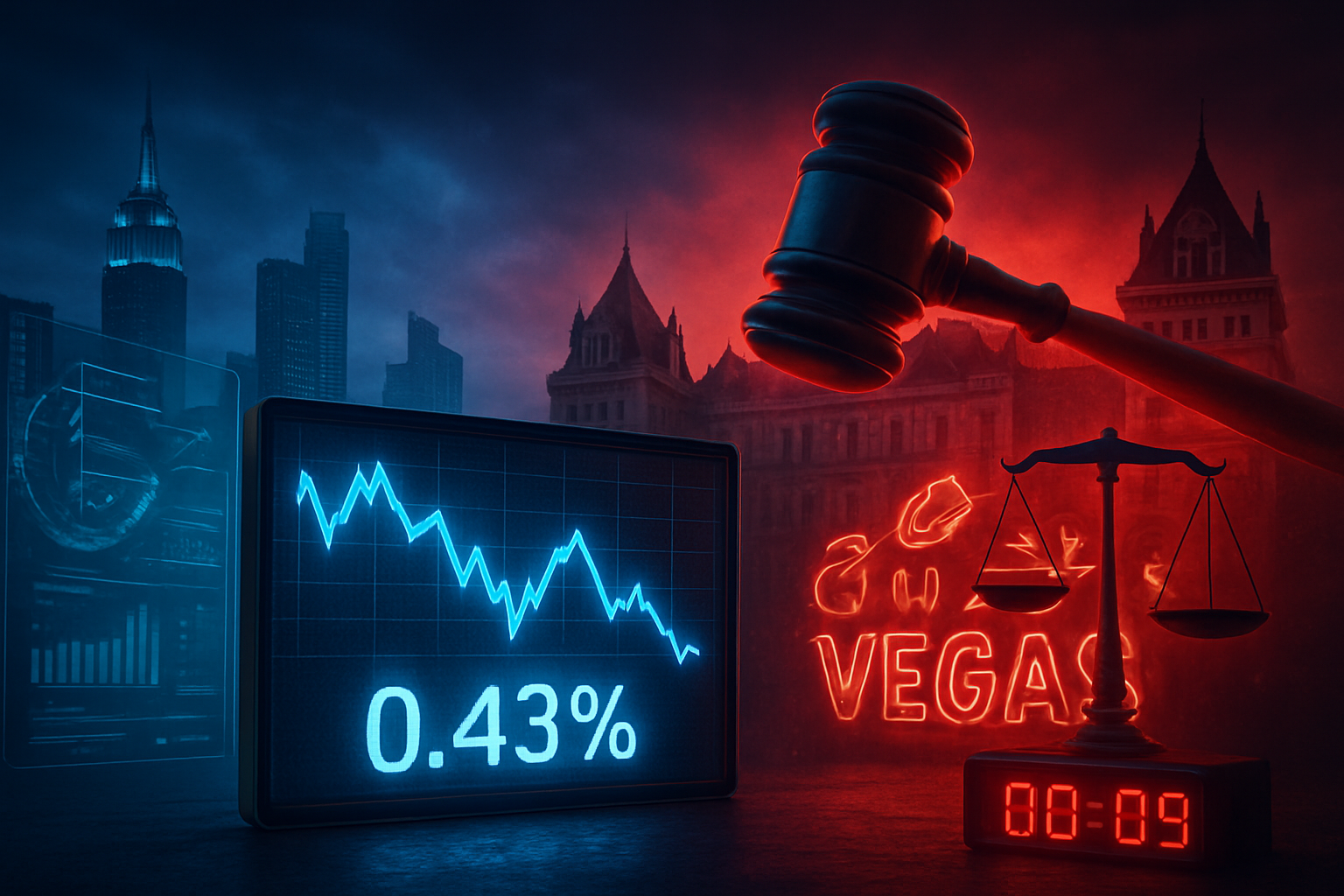
    Beyond insider trading fears, there is a massive financial incentive driving the legislative friction: taxes. In New York, traditional sportsbooks like FanDuel and DraftKings are hit with a punitive 51% tax on gross gaming revenue. Prediction markets, which operate as financial exchanges, currently bypass this tax, offering a "loophole" that allows for "sports-like" wagering under a much lighter tax burden. This has created a "Wall Street vs. Vegas" narrative. Traders are betting that the powerful gambling lobby will eventually force the state to either tax prediction markets at the 51% rate or ban them entirely to protect the state's lucrative sports-betting revenue stream.

    Notable "whale" activity has been spotted on Kalshi, where several institutional-sized positions have recently moved the "Ban" probability downward. These traders appear to be betting that the Cooney Bill (S8889) will provide a "middle path" that satisfies regulators' demands for anti-money laundering (AML) and consumer protections without a total shutdown.

    Broader Context and Implications

    This battle is about more than just a single state's laws; it is a referendum on whether prediction markets are "truth machines" or "reckless gambling" dens. For years, proponents have argued that these markets provide the most accurate real-time data on everything from Fed rate hikes to election results. However, New York’s ORACLE Act explicitly targets the "truth machine" claim, with sponsors arguing that the "social utility" of a market does not exempt it from gambling regulations.

    The real-world implications of a New York ban would be catastrophic for the industry’s domestic growth. As a global financial hub, New York's stance often dictates the regulatory appetite of other states. If the ORACLE Act passes, it could trigger a "regulatory winter," forcing platforms to geofence New Yorkers—a difficult task given the prevalence of VPNs, as seen with Polymarket's previous struggles.

    Furthermore, the pivot of companies like DraftKings (NASDAQ: DKNG) is telling. After years of lobbying against prediction markets, they are now launching their own "event contract" products to capture the lower-tax financial model. Their involvement suggests that the future of prediction markets might not be a total ban, but rather a "corporate capture" where only the largest, most established gaming and financial firms are granted licenses to operate.

    What to Watch Next

    Traders should circle late February 2026 on their calendars. This is when a critical ruling is expected in the federal case Kalshi v. New York State Gaming Commission. If a federal judge grants a preliminary injunction against the state’s current restrictive stance, it could effectively render the ORACLE Act moot before it even reaches the Assembly floor.

    In the immediate term, the next major milestone is the Assembly Committee on Consumer Affairs and Protection vote on the ORACLE Act. If the bill moves out of committee with its $1 million daily fine provision intact, the probability of a "Ban" on Kalshi is expected to spike back above 50%. Conversely, if the Cooney Bill gains traction in the Senate Banks Committee, the market will likely continue its downward trend as a regulated "Financial Exchange" model becomes the more probable outcome.

    Bottom Line

    The legislative scramble in New York represents the ultimate "identity crisis" for prediction markets. Are they the next evolution of the NASDAQ, or are they a high-tech version of a sportsbook? The 38% probability of a ban suggests that while the "ban-heavy" rhetoric is loud, the market believes a more nuanced, regulated future is the likely winner.

    For prediction markets to survive in New York, they will likely have to accept a "Vegas-lite" regulatory package: strict 21+ age verification, robust AML protocols, and perhaps a new "event contract tax" that bridges the gap between financial capital gains and the 51% sportsbook rate. As the "Maduro Trade" showed, the transparency of the blockchain is a double-edged sword; it proves the market's accuracy, but it also provides the evidence regulators need to cry foul.

    Ultimately, the battle in Albany is a test of the industry's resilience. If prediction markets can survive the ORACLE Act's $1 million daily fines, they will have proven their status as a permanent fixture of the modern financial landscape.


    This article is for informational purposes only and does not constitute financial or betting advice. Prediction market participation may be subject to legal restrictions in your jurisdiction.

    PredictStreet focuses on covering the latest developments in prediction markets.
    Visit the PredictStreet website at https://www.predictstreet.ai/.
  • JD Vance Emerges as the 2028 Betting Favorite: Why Prediction Markets Are Frontrunning the ‘Heir Apparent’ Narrative

    JD Vance Emerges as the 2028 Betting Favorite: Why Prediction Markets Are Frontrunning the ‘Heir Apparent’ Narrative

    As the second year of the second Trump administration begins on this January 20, 2026, the political world is already looking toward the horizon of 2028. While traditional pundits often wait for the midterm results to declare favorites, prediction market traders have already reached a consensus. Vice President JD Vance has solidified his position as the early frontrunner to succeed Donald Trump, commanding a significant lead on regulated exchanges like Kalshi.

    Currently, Vance is trading at a 48% probability to secure the Republican nomination and a 27% probability to win the presidency outright. These figures represent a massive consolidation of "MAGA" sentiment around the Vice President, who has spent the last year positioning himself as the primary defender and legislative enforcer of the administration’s "America First" agenda. This early betting activity is generating intense interest because it suggests a level of field-clearing dominance rarely seen this far out from an open election cycle.

    The Market: What's Being Predicted

    The 2028 Presidential market has become a centerpiece of the burgeoning "information finance" sector. On Kalshi, the first regulated event contract exchange in the U.S., volume for the "Next President" market has surged as traders react to Vance's increasing visibility. Unlike the crypto-native Polymarket, which also shows Vance as the leader with a 26% win probability, Kalshi’s audience consists of U.S.-based retail and institutional traders who are increasingly using these markets as a hedge against political volatility.

    The market's growth has been fueled by major retail integrations. Robinhood Markets (NASDAQ: HOOD) recently launched its "Prediction Markets Hub," which has simplified access to these contracts for millions of investors, while Interactive Brokers (NASDAQ: IBKR) continues to see high institutional engagement through its ForecastEx exchange. This increased liquidity means that the 27% probability assigned to Vance is backed by hundreds of millions of dollars in traded volume, making it a more robust signal than a typical early-cycle poll.

    The resolution criteria for these markets are straightforward: the candidate must be sworn in as President on January 20, 2029. While the timeline is long, the markets are highly active, with daily fluctuations driven by Senate tie-breaking votes, cabinet maneuvers, and the perceived health of the current President.

    Why Traders Are Betting

    Traders are backing Vance primarily due to his "heir apparent" status, which was cemented by President Trump’s explicit public endorsements during the 2025 legislative session. Vance’s stock rose sharply following his decisive tie-breaking vote in the Senate on January 15, 2026, which defeated a War Powers Resolution regarding operations in Venezuela. This moment signaled to traders that Vance is not just a figurehead but a functional "enforcer" of the administration’s foreign policy.

    Furthermore, Vance has been the face of the "DOGE AI" regulatory rollout, a massive initiative led by the Department of Government Efficiency. By championing a tool aimed at cutting federal regulations by 50%, Vance has appealed to the tech-optimist and deregulation-focused wings of the GOP. This has effectively sidelined potential primary rivals like Marco Rubio—currently serving as Secretary of State—and Ron DeSantis, who both trail Vance by over 30 points in nomination probability.

    Compared to traditional forecasting, prediction markets are often more sensitive to "insider" sentiment and the reality of incumbency. While a voter might tell a pollster they are "undecided" because they don't like Vance’s personal favorability ratings, a trader on DraftKings (NASDAQ: DKNG) or FanDuel, owned by Flutter Entertainment (NYSE: FLUT), is more likely to bet on the structural advantage of the sitting Vice President in a party that has largely consolidated under one banner.

    Broader Context and Implications

    The divergence between market odds and traditional polling is a key trend in early 2026. A recent Quinnipiac University poll placed Vance’s approval rating "underwater" at 41% approval and 49% disapproval. However, prediction markets tend to ignore favorability in favor of "electability" and institutional support. Traders are betting that Vance’s unpopularity with the general public may not matter if the Democratic field remains fragmented among figures like Governor Gavin Newsom (20% win probability) and Governor Josh Shapiro (4% win probability).

    This market also reveals a significant shift in how public sentiment is measured. With the Intercontinental Exchange (NYSE: ICE) reportedly investing $2 billion to help regulated exchanges expand their political offerings, prediction markets are becoming a "source of truth" for major corporations. Companies are no longer just looking at polls; they are looking at where the money is moving to hedge against tax changes or regulatory shifts that would accompany a Vance presidency.

    Historically, early favorites in prediction markets have a mixed record, but the "incumbent VP" status provides a unique historical tailwind. Similar markets in the early 2000s correctly identified Al Gore and George W. Bush as favorites years before their respective nominations, though they famously underestimated the rise of outsiders like Barack Obama in 2008.

    What to Watch Next

    The upcoming 2026 midterm elections will be the first major test for Vance’s standing. Markets currently suggest that if the GOP maintains control of the Senate, Vance’s odds will likely climb toward 35-40%. Conversely, a "Blue Wave" that puts a Democrat in the Speaker's chair would likely see Vance’s odds tumble as traders look for a more "moderate" alternative to lead the 2028 ticket.

    Key dates to monitor include the upcoming nomination for the next Chair of the Federal Reserve. With Jerome Powell’s term ending in May, Vance’s public support for a "supply-side" candidate like Kevin Warsh could move markets significantly. Additionally, any major movement in the Democratic primary markets—specifically if Gavin Newsom officially forms an exploratory committee—could tighten the spread between the two frontrunners.

    Traders should also watch for the potential IPO of Kalshi later this year. A successful public listing for the exchange would likely bring even more liquidity and institutional "whales" into the 2028 Presidential market, further refining the odds as more sophisticated capital enters the fray.

    Bottom Line

    The 2028 Presidential market on Kalshi and other platforms currently paints a picture of a race that is JD Vance’s to lose. By successfully navigating his role as the administration’s legislative point man and avoiding a serious primary challenge, Vance has convinced the betting public that the MAGA succession plan is firmly in place.

    While his favorability ratings remain a concern for the general election, prediction markets are currently prioritizing his institutional advantages over his personal popularity. As we move deeper into 2026, these markets will serve as a high-stakes barometer for the durability of the Trump-Vance coalition and the ability of the Democratic Party to find a singular challenger to disrupt the current "heir apparent" narrative.


    This article is for informational purposes only and does not constitute financial or betting advice. Prediction market participation may be subject to legal restrictions in your jurisdiction.

    PredictStreet focuses on covering the latest developments in prediction markets. Visit the PredictStreet website at https://www.predictstreet.ai/.

  • The $112 Million Regulatory Heist: Polymarket’s QCX Acquisition and the Battle for America’s Prediction Market

    The $112 Million Regulatory Heist: Polymarket’s QCX Acquisition and the Battle for America’s Prediction Market

    In a move that has sent shockwaves through the burgeoning "information economy," Polymarket has officially staged its return to the United States. Following a multi-year exile by federal regulators, the world’s largest prediction market platform successfully bypassed the typical years-long licensing process by executing a strategic $112 million acquisition of QCX, a Commodity Futures Trading Commission (CFTC)-regulated derivatives exchange and clearinghouse. As of January 20, 2026, this "regulatory shortcut" has transformed the competitive landscape, setting the stage for a high-stakes showdown with its chief rival, Kalshi.

    Traders are currently pricing in a high probability that Polymarket’s U.S. arm will achieve parity with its global volume by the end of Q3 2026. This market sentiment is driven by the platform's aggressive integration with traditional financial infrastructure and its recent high-profile partnerships. However, the move has ignited a fierce rivalry with Kalshi, which has spent years building its brand as the "compliant" alternative. As prediction markets transition from niche crypto-products to mainstream financial tools, the battle between these two giants represents more than just a fight for market share; it is a battle for the soul of the predictive era.

    The Market: What's Being Predicted

    The central focus of traders today is the rapid expansion of Polymarket US, the platform’s domestic, regulated entity. Unlike the crypto-native global site, Polymarket US operates as a registered Designated Contract Market (DCM) and Derivatives Clearing Organization (DCO)—licenses it inherited through the acquisition of QCX (collectively QCX, LLC and QC Clearing LLC). This structure allows Polymarket to list event contracts that are cleared and settled within the U.S. financial system, providing a degree of legitimacy that was once its greatest weakness.

    Currently, the primary "meta-market" being traded across platforms involves the comparative volume growth of Polymarket US versus Kalshi. In early 2026, Kalshi remains the leader in regulated U.S. volume, holding approximately 66.4% of the market, largely due to its deep integration with Robinhood (NASDAQ: HOOD). However, Polymarket’s volume has surged by 40% month-over-month since its limited December 2025 relaunch. Liquidity on the new platform is being bolstered by institutional market makers like Susquehanna International Group (SIG), which has expanded its operations to support Polymarket’s new regulated order books.

    The resolution criteria for these competition markets typically hinge on official CFTC quarterly reports or verified third-party data providers like ElectionBettingOdds or VolumeWatch. Traders are closely monitoring the "Self-Certification" filings Polymarket submitted in late 2025, which include contracts for athletic point spreads, Federal Reserve interest rate hikes, and even the outcomes of specific state-level legislative sessions.

    Why Traders Are Betting

    The sudden shift in the prediction market hierarchy is being driven by a "perfect storm" of regulatory clarity and massive capital infusion. Polymarket’s acquisition of QCX was not just a legal maneuver; it was backed by a landmark $2 billion strategic investment from the Intercontinental Exchange (NYSE: ICE), the parent company of the New York Stock Exchange. This partnership has given Polymarket a seat at the table with the world’s largest institutional investors, many of whom are betting that prediction markets will eventually replace traditional polling and even some forms of weather and economic forecasting.

    Furthermore, traders are reacting to the divergent strategies of the two platforms. While Kalshi has doubled down on sports-centric "event parlays" to attract the retail betting crowd, Polymarket is positioning itself as the "Bloomberg of Truth," focusing on geopolitical risk and macroeconomic indicators. Notable "whale" activity has been observed in markets related to the 2026 midterm elections, where Polymarket’s historical accuracy in 2024 has given it a reputational edge over traditional media outlets like CNN or the New York Times.

    Public sentiment is also heavily influenced by the high-profile figures backing these platforms. Polymarket has strengthened its domestic ties by adding Donald Trump Jr. (via 1789 Capital) to its advisory board, while Kalshi has aligned itself with the traditional Wall Street guard, securing endorsements from veterans at Charles Schwab (NYSE: SCHW) and Sequoia Capital. This political and financial polarization is creating unique trading opportunities for those who believe one "camp" has a superior information network.

    Broader Context and Implications

    The Polymarket-QCX deal marks the end of the "Wild West" era for prediction markets. By choosing to buy their way into compliance, Polymarket has acknowledged that the path to global dominance must run through the U.S. regulatory framework. This has massive implications for the broader fintech sector. We are seeing a "convergence" where prediction markets are becoming indistinguishable from traditional derivatives exchanges like those operated by the CME Group (NASDAQ: CME).

    However, this newfound legitimacy has brought about a new theater of conflict: state-level regulation. In just the last week of January 2026, the Nevada Gaming Control Board filed a lawsuit against Polymarket to halt its sports-related contracts, arguing they constitute unlicensed gambling. This mirrors a broader trend where federal approval (via the CFTC) is being challenged by state gaming commissions who fear a loss of tax revenue and oversight.

    Historically, prediction markets have been more accurate than pundits because they require participants to "put their money where their mouth is." The current rivalry is essentially a stress test for this theory. If Polymarket can maintain its predictive accuracy while scaling within a regulated framework, it could fundamentally change how corporations hedge risk. For example, airline companies might use these markets to hedge against geopolitical instability in specific regions, rather than just relying on fuel futures.

    What to Watch Next

    The immediate focus for the market is the progression of the Public Integrity in Financial Prediction Markets Act of 2026, also known as the "Torres Bill." If passed, this legislation would ban federal employees from trading on prediction markets, a move that Kalshi supports to increase market "integrity" but which Polymarket critics argue is a veiled attempt to limit the platform's information advantage.

    Key dates to watch include:

    • February 12, 2026: The deadline for Polymarket to respond to the Nevada cease-and-desist order. A loss here could force a temporary withdrawal from several "gaming-heavy" states.
    • March 2026: The expected launch of Polymarket’s full integration into the Intercontinental Exchange (NYSE: ICE) trading terminals, which would allow hedge funds to trade event contracts directly alongside equities and bonds.
    • Q2 2026 Earnings: Watch for Interactive Brokers (NASDAQ: IBKR) and its subsidiary ForecastEx to report whether they have gained ground against the two market leaders, as they offer the lowest-fee alternative for institutional traders.

    Bottom Line

    The return of Polymarket to the U.S. via the QCX acquisition represents a pivotal moment in financial history. It signifies that prediction markets are no longer a "niche" interest for crypto enthusiasts but a core pillar of the modern financial system. The rivalry with Kalshi has created a competitive "arms race" that is driving innovation, lowering fees, and increasing the depth of these markets.

    For the average observer, the takeaway is clear: the "Information Economy" is here to stay. Whether Polymarket’s aggressive "legalization via acquisition" strategy ultimately triumphs over Kalshi’s "compliance-first" pedigree remains to be seen, but the real winner is the market itself. As these platforms grow in liquidity and legitimacy, the world gains a more transparent, data-driven way to look into the future.

    The odds favor a split market—one where Kalshi dominates the retail sports-betting crossover and Polymarket reigns supreme as the institutional engine for geopolitical and economic forecasting. But in a world where everything is a market, the only certain bet is that the volatility is just beginning.


    This article is for informational purposes only and does not constitute financial or betting advice. Prediction market participation may be subject to legal restrictions in your jurisdiction.

    PredictStreet focuses on covering the latest developments in prediction markets.
    Visit the PredictStreet website at https://www.predictstreet.ai/.