Tag: JD Vance

  • The 2028 Shadow Campaign: Vance and Newsom Dominate Early Prediction Markets

    The 2028 Shadow Campaign: Vance and Newsom Dominate Early Prediction Markets

    As the United States settles into the second year of the second Trump administration, the political world is already looking toward the horizon. While the 2026 midterms are the immediate hurdle, prediction markets are buzzing with high-stakes activity surrounding the 2028 Presidential Election. The early favorites have emerged with startling clarity: Vice President JD Vance and California Governor Gavin Newsom have solidified their positions as the frontrunners in a market that is already seeing record-breaking liquidity.

    As of February 9, 2026, JD Vance holds a commanding lead for the Republican nomination, while Gavin Newsom has pulled ahead of a crowded Democratic field. On Polymarket, the world’s largest decentralized prediction platform, Vance is currently trading at a 26% probability of winning the presidency, while Newsom follows at 20%. This early "shadow campaign" is more than just a hobby for political junkies; it is a multi-million dollar forecasting engine that is beginning to influence donor behavior and strategic positioning for both parties.

    The Market: What's Being Predicted

    The 2028 Presidential Market has become the flagship contract for the current election cycle, operating across several major platforms including Polymarket, Kalshi, and the newly rebranded Aristotle Exchange (formerly PredictIt). The scale of these markets is unprecedented for this early in a cycle. On Polymarket alone, the total volume for the "2028 Presidential Election Winner" has surpassed $266 million, while the primary-specific markets have seen a combined turnover of nearly $900 million.

    Liquidity has been bolstered by the entry of institutional-grade infrastructure. Nasdaq (Nasdaq: NDAQ) recently integrated its Eqlipse Clearing technology into several prediction platforms, providing a level of stability that has attracted professional arbitrageurs. Meanwhile, the Intercontinental Exchange (NYSE: ICE) has made strategic investments into prediction market liquidity, treating these political contracts as a legitimate new asset class. The odds have shown significant volatility: Vance’s probability of winning the presidency peaked at 31% in late 2025 before settling into his current mid-20s range, while Newsom has seen a steady climb from 15% to 20% over the last six months.

    The resolution criteria for these markets are straightforward but strictly defined: the market pays out based on the person who is officially inaugurated as President of the United States on January 20, 2029. This long-dated timeline allows traders to bet on "narrative arcs" rather than just immediate news cycles, making the current prices a reflection of long-term viability rather than mere name recognition.

    Why Traders Are Betting

    Traders are currently weighing JD Vance’s incumbency against the historical "vice president’s curse." As the sitting VP, Vance benefits from the endorsement of the Trump base and a clear path to the Republican nomination—currently priced at a staggering 48% probability. However, recent labor market softness and a controversial government data blackout in late 2025 led to a temporary dip in his presidential odds. Large-scale bettors, often referred to as "whales," have been cautious, with some rotating capital into secondary Republican contenders like Marco Rubio as a hedge against potential administration fatigue.

    On the Democratic side, Gavin Newsom’s surge is driven by his "fighter" persona. In late 2025, Newsom successfully championed Proposition 50 in California—dubbed the "Election Rigging Response Act"—which allows the state to adopt temporary congressional maps to counter redistricting in Republican-led states. This move resonated deeply with Democratic donors and prediction market participants, who view Newsom as the most aggressive counterweight to the current administration. Furthermore, his decisive response to the Los Angeles protests in mid-2025—which notably involved the destruction of several autonomous vehicles owned by Waymo, a subsidiary of Alphabet (Nasdaq: GOOGL)—demonstrated an executive readiness that propelled him past former Vice President Kamala Harris in the odds.

    The influence of the 2026 midterms cannot be overstated. Prediction markets are using the upcoming congressional races as a proxy for the 2028 general election. Current sentiment on Kalshi suggests a 78% chance of Democrats reclaiming the House, a scenario that traders believe would significantly boost Newsom’s 2028 prospects by creating a "lame duck" narrative for the current administration.

    Broader Context and Implications

    The 2028 markets represent a maturation of the prediction market industry. Following a favorable regulatory shift at the CFTC under the leadership of Michael Selig, political betting has moved from the legal periphery to the financial mainstream. Major brokerages such as Robinhood (Nasdaq: HOOD) and Interactive Brokers (Nasdaq: IBKR) have expanded access to event contracts, allowing retail investors to trade political outcomes as easily as they trade stocks.

    This mainstreaming has significant real-world implications. Prediction markets are increasingly being used as a real-time sentiment gauge that is often more reactive than traditional polling. For instance, the "Trump Jr. Factor" has become a point of discussion among market analysts; Donald Trump Jr.’s firm, 1789 Capital, made a double-digit million-dollar investment in Polymarket in 2025, highlighting the intersection of political power and forecasting technology.

    Historically, early prediction market favorites have a mixed record, but their accuracy tends to improve as liquidity increases. The current $1 billion+ total volume across the 2028 ecosystem suggests that the "wisdom of the crowd" is being backed by significant financial conviction. Unlike 2016 or 2020, where markets were often fragmented, the 2028 market is a global, 24/7 indicator that politicians themselves are reportedly monitoring to gauge the effectiveness of their messaging.

    What to Watch Next

    The most immediate catalyst for these markets will be the November 2026 midterm results. If Republicans retain control of both chambers, Vance’s odds are expected to skyrocket toward 40%, as he would be viewed as the heir apparent to a successful and popular movement. Conversely, a "Blue Wave" would likely crown Newsom as the definitive 2028 favorite, potentially pushing his odds above 30% for the first time.

    Investors should also keep a close eye on the expanding ecosystem of event contracts. CME Group (Nasdaq: CME) recently partnered with FanDuel, owned by Flutter Entertainment (NYSE: FLUT), to launch a high-frequency political data feed. This partnership is expected to drive even more retail volume into the 2028 contracts, potentially leading to sharper price corrections as new information enters the market.

    Key milestones to monitor include the first 2028 primary debates—expected in late 2027—and any potential shifts in the Trump administration's succession planning. While the President has publicly mentioned Vance as his successor, any sign of a primary challenge from within the MAGA movement could create massive swings in the GOP nomination markets.

    Bottom Line

    The 2028 prediction markets have moved beyond the realm of speculation and into the territory of a legitimate political and financial index. The current dominance of JD Vance and Gavin Newsom reflects a nation bracing for a high-contrast showdown between the "New Right" and the "Progressive Resistance." While Vance holds the lead today, the narrow margin and Newsom’s rising momentum suggest that the market is far from settled.

    As a tool for journalists and analysts, these markets provide a level of transparency that traditional polling cannot match. They force participants to put their money where their mouth is, filtering out noise and focusing on the variables that truly move the needle. Whether you are a trader looking for an edge or a citizen looking for a glimpse into the future, the 2028 election markets are currently the most accurate scoreboard we have.

    The coming year will test the resilience of both frontrunners. Between the economic shifts impacting the incumbent's Vice President and the legislative gambles of California’s Governor, the odds are certain to fluctuate. But for now, the message from the markets is clear: the 2028 race is a two-man contest, and the stakes have never been higher.


    This article is for informational purposes only and does not constitute financial or betting advice. Prediction market participation may be subject to legal restrictions in your jurisdiction.

    PredictStreet focuses on covering the latest developments in prediction markets.
    Visit the PredictStreet website at https://www.predictstreet.ai/.
  • The ‘Liquid Truth’ of 2028: JD Vance and Gavin Newsom Emerge as Early Favorites in the Information Finance Era

    The ‘Liquid Truth’ of 2028: JD Vance and Gavin Newsom Emerge as Early Favorites in the Information Finance Era

    While the dust of the 2024 election cycle has barely settled, the financial world is already placing its bets on the next battle for the White House. As of February 2026, prediction markets—the once-niche platforms that successfully forecasted the 2024 outcome with surgical precision—are signaling a clear trajectory for the 2028 U.S. Presidential Election. Vice President JD Vance has solidified his position as the GOP frontrunner, while California Governor Gavin Newsom has emerged as the clear favorite to lead the Democratic ticket.

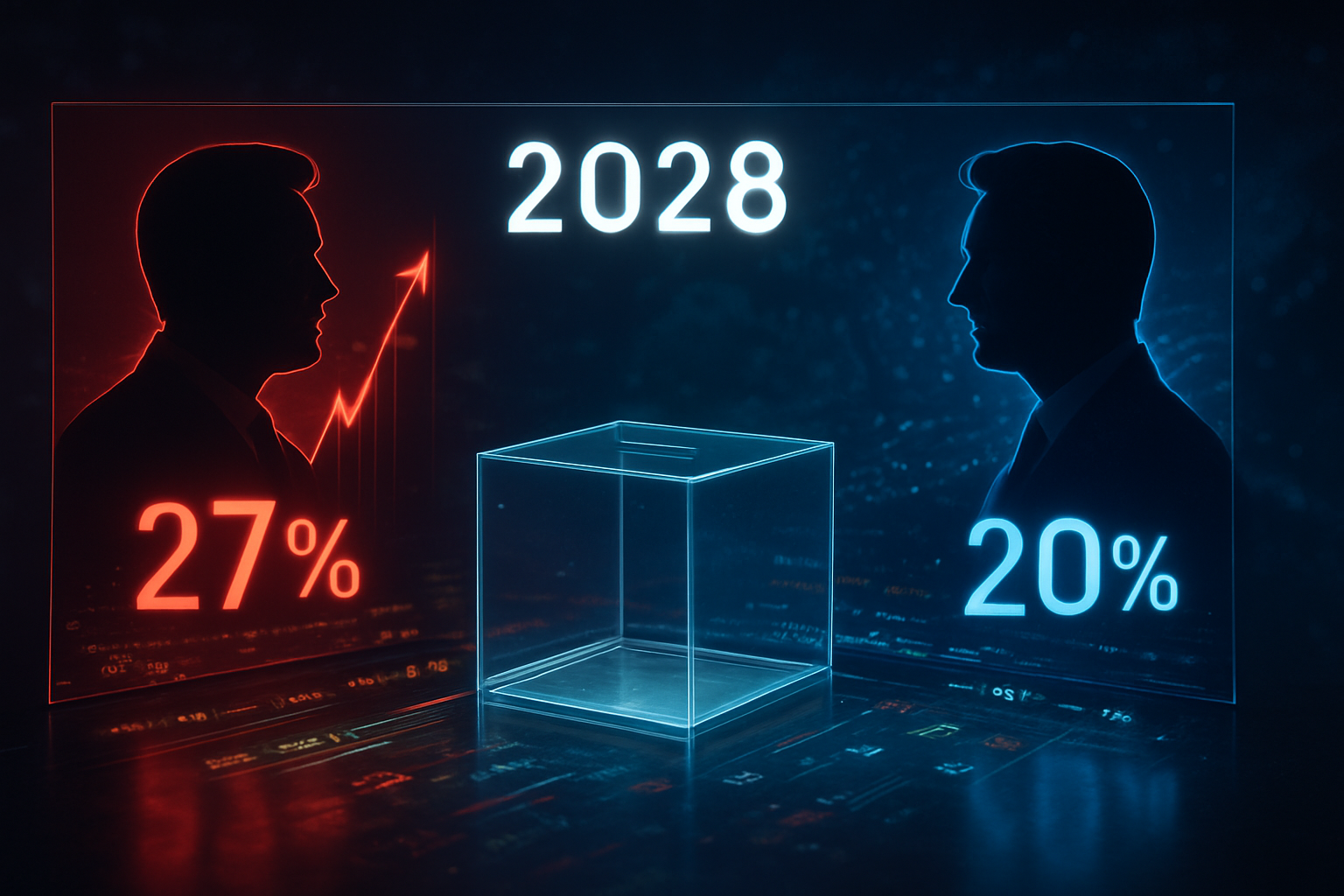
    Traders on Kalshi and Polymarket are currently pricing a Vance presidency at a 27% probability, a striking figure for a race still nearly three years away. Newsom follows closely at approximately 20%, reflecting a market that is increasingly viewing the 2028 cycle as a high-stakes clash between the incumbent "America First" successor and the West Coast’s most prominent Democratic "fighter." This early activity is not merely speculative; it is the cornerstone of what analysts are calling "Information Finance," where these markets serve as long-term sentiment indicators that influence everything from corporate hedging to legislative strategy.

    The Market: What’s Being Predicted

    The 2028 Presidential election is no longer just a political conversation; it is a high-liquidity financial market. On Polymarket, the world’s largest decentralized prediction platform, the "2028 Presidential Winner" contract has already surpassed $250 million in total trading volume. Meanwhile, Kalshi—the first federally regulated exchange to offer such contracts—has seen over $12.5 million in its GOP nomination market alone. These platforms allow participants to buy and sell "shares" in a candidate, with prices fluctuating between $0.01 and $0.99 based on the perceived probability of the outcome.

    The current odds reflect a significant consolidation within both parties. JD Vance’s nomination odds are currently trading at nearly 50%, a level of dominance that suggests traders view him as the undisputed heir to the MAGA movement. His primary competition, according to the markets, remains at a distance: Florida’s political heavyweights and other GOP rising stars are trading in the low double digits. On the Democratic side, Gavin Newsom has pulled away from a crowded field that includes figures like Representative Alexandria Ocasio-Cortez (7%) and Pennsylvania Governor Josh Shapiro (8%), with Newsom’s nomination odds hovering around 32%.

    This surge in liquidity has been bolstered by the entry of mainstream financial institutions. Robinhood Markets, Inc. (NASDAQ: HOOD) and Interactive Brokers Group, Inc. (NASDAQ: IBKR) have integrated event contracts into their retail platforms, bringing millions of new participants into the ecosystem. The resolution of these markets is straightforward: a "yes" contract pays out $1.00 if the candidate is inaugurated as President in January 2029, while all other contracts expire at zero.

    Why Traders Are Betting

    The market’s favoritism toward JD Vance is largely driven by his performance during the first year of his vice presidency. Traders point to his role as the administration’s "legislative enforcer" and his deep ties to the domestic manufacturing and trade policy sectors as evidence of his entrenched power within the party. Unlike traditional polling, which often measures "favorability," prediction markets measure "electability" and "institutional momentum." The markets are effectively "pricing in" the consolidation of the Republican base behind Vance.

    For Gavin Newsom, the momentum is tied to his aggressive stance against federal policies in late 2025. Specifically, his successful push for California’s "Prop 50"—a measure that allowed the state to redraw its congressional maps mid-decade—is viewed by traders as a signal that he is willing to engage in the "bare-knuckle" politics required for a national campaign. When the federal courts upheld these maps in January 2026, Newsom’s odds of winning the Democratic nomination saw a 15% jump in a single week.

    Traders are also heavily influenced by the "Nate Silver Effect"—the retrospective realization that prediction markets were far more accurate than traditional polls in 2024. While many pollsters described the 2024 race as a 50/50 toss-up until Election Night, markets on Polymarket and Kalshi consistently priced a 60% probability for the eventual winner weeks in advance. This track record has transformed "liquid truth" into a preferred metric for hedge funds and institutional investors looking to mitigate political risk.

    Broader Context and Implications

    The 2028 markets are the primary evidence for the rise of "Information Finance" (InfoFi), a term increasingly used to describe the transition of truth into a tradable asset. The Intercontinental Exchange, Inc. (NYSE: ICE), the parent company of the New York Stock Exchange, recently finalized a strategic investment in prediction infrastructure, recognizing that political futures are now critical utilities for the global economy. Major firms like Susquehanna International Group (SIG) have become primary market makers, ensuring that these markets have the depth and liquidity required for institutional participation.

    This shift has been aided by a dramatic change in the regulatory climate. In January 2026, under new leadership, the Commodity Futures Trading Commission (CFTC) withdrew several long-standing proposals that sought to ban political event contracts. The agency's new "pro-innovation" stance treats these markets as vital tools for price discovery, allowing platforms like Kalshi to operate with greater legal certainty and partner with media giants like Warner Bros. Discovery, Inc. (NASDAQ: WBD) and Comcast Corporation (NASDAQ: CMCSA) to provide real-time probability data.

    Historically, early-cycle markets have been criticized for their volatility, but the 2028 cycle is different. The sheer volume of capital involved has compressed bid-ask spreads and reduced the impact of "noise" traders. These markets are now acting as early-warning systems for corporations, which use the JD Vance or Gavin Newsom odds to hedge against future tax reforms, environmental regulations, or changes in international trade agreements.

    What to Watch Next

    As we move through the remainder of 2026, several key milestones are expected to shift the 2028 odds. The first major hurdle will be the 2026 Midterm Elections. If the GOP maintains or expands its control of Congress, Vance’s odds are expected to climb further, potentially breaking the 30% mark for the presidency. Conversely, a Democratic "Blue Wave" would likely see Newsom’s odds surge as he would be credited as the party’s most effective surrogate and strategist.

    Legislative battles in the summer of 2026 regarding the renewal of major tax provisions will also be a catalyst for market movement. Traders will be watching how Vance navigates these negotiations as the tie-breaking vote in the Senate. On the Democratic side, the upcoming primary debates for various governorships and Senate seats will provide a platform for Newsom to further consolidate his "leader of the opposition" status.

    Additionally, the integration of prediction market data into mainstream financial terminals like Bloomberg and Refinitiv is expected to bring a second wave of institutional liquidity. As more quantitative trading firms—such as DRW and Jane Street—establish dedicated InfoFi desks, we expect the 2028 Presidential market to become one of the most stable and scrutinized assets in the world.

    Bottom Line

    The early 2028 presidential markets represent more than just a bet on a candidate; they are a sophisticated real-time analysis of the American political landscape. The current lead held by JD Vance reflects a market that sees his incumbency and party consolidation as a formidable barrier to any challenger. At the same time, Gavin Newsom’s steady rise illustrates a Democratic base—and a donor class—that is increasingly rallying behind a candidate perceived as a media-savvy fighter.

    These markets have successfully moved from the fringes of the internet to the core of Wall Street. By treating political outcomes as financial risks that can be hedged, the prediction market ecosystem has created a more accurate, or at least more responsive, indicator of public sentiment than traditional methods.

    As the 2028 cycle progresses, the "liquid truth" provided by these exchanges will likely become the primary lens through which the world views the future of American leadership. While 2028 remains far on the horizon, the markets are already telling us that the battle for the next decade has already begun.


    This article is for informational purposes only and does not constitute financial or betting advice. Prediction market participation may be subject to legal restrictions in your jurisdiction.

    PredictStreet focuses on covering the latest developments in prediction markets.
    Visit the PredictStreet website at https://www.predictstreet.ai/.
  • JD Vance Emerges as the 2028 Betting Favorite: Why Prediction Markets Are Frontrunning the ‘Heir Apparent’ Narrative

    JD Vance Emerges as the 2028 Betting Favorite: Why Prediction Markets Are Frontrunning the ‘Heir Apparent’ Narrative

    As the second year of the second Trump administration begins on this January 20, 2026, the political world is already looking toward the horizon of 2028. While traditional pundits often wait for the midterm results to declare favorites, prediction market traders have already reached a consensus. Vice President JD Vance has solidified his position as the early frontrunner to succeed Donald Trump, commanding a significant lead on regulated exchanges like Kalshi.

    Currently, Vance is trading at a 48% probability to secure the Republican nomination and a 27% probability to win the presidency outright. These figures represent a massive consolidation of "MAGA" sentiment around the Vice President, who has spent the last year positioning himself as the primary defender and legislative enforcer of the administration’s "America First" agenda. This early betting activity is generating intense interest because it suggests a level of field-clearing dominance rarely seen this far out from an open election cycle.

    The Market: What's Being Predicted

    The 2028 Presidential market has become a centerpiece of the burgeoning "information finance" sector. On Kalshi, the first regulated event contract exchange in the U.S., volume for the "Next President" market has surged as traders react to Vance's increasing visibility. Unlike the crypto-native Polymarket, which also shows Vance as the leader with a 26% win probability, Kalshi’s audience consists of U.S.-based retail and institutional traders who are increasingly using these markets as a hedge against political volatility.

    The market's growth has been fueled by major retail integrations. Robinhood Markets (NASDAQ: HOOD) recently launched its "Prediction Markets Hub," which has simplified access to these contracts for millions of investors, while Interactive Brokers (NASDAQ: IBKR) continues to see high institutional engagement through its ForecastEx exchange. This increased liquidity means that the 27% probability assigned to Vance is backed by hundreds of millions of dollars in traded volume, making it a more robust signal than a typical early-cycle poll.

    The resolution criteria for these markets are straightforward: the candidate must be sworn in as President on January 20, 2029. While the timeline is long, the markets are highly active, with daily fluctuations driven by Senate tie-breaking votes, cabinet maneuvers, and the perceived health of the current President.

    Why Traders Are Betting

    Traders are backing Vance primarily due to his "heir apparent" status, which was cemented by President Trump’s explicit public endorsements during the 2025 legislative session. Vance’s stock rose sharply following his decisive tie-breaking vote in the Senate on January 15, 2026, which defeated a War Powers Resolution regarding operations in Venezuela. This moment signaled to traders that Vance is not just a figurehead but a functional "enforcer" of the administration’s foreign policy.

    Furthermore, Vance has been the face of the "DOGE AI" regulatory rollout, a massive initiative led by the Department of Government Efficiency. By championing a tool aimed at cutting federal regulations by 50%, Vance has appealed to the tech-optimist and deregulation-focused wings of the GOP. This has effectively sidelined potential primary rivals like Marco Rubio—currently serving as Secretary of State—and Ron DeSantis, who both trail Vance by over 30 points in nomination probability.

    Compared to traditional forecasting, prediction markets are often more sensitive to "insider" sentiment and the reality of incumbency. While a voter might tell a pollster they are "undecided" because they don't like Vance’s personal favorability ratings, a trader on DraftKings (NASDAQ: DKNG) or FanDuel, owned by Flutter Entertainment (NYSE: FLUT), is more likely to bet on the structural advantage of the sitting Vice President in a party that has largely consolidated under one banner.

    Broader Context and Implications

    The divergence between market odds and traditional polling is a key trend in early 2026. A recent Quinnipiac University poll placed Vance’s approval rating "underwater" at 41% approval and 49% disapproval. However, prediction markets tend to ignore favorability in favor of "electability" and institutional support. Traders are betting that Vance’s unpopularity with the general public may not matter if the Democratic field remains fragmented among figures like Governor Gavin Newsom (20% win probability) and Governor Josh Shapiro (4% win probability).

    This market also reveals a significant shift in how public sentiment is measured. With the Intercontinental Exchange (NYSE: ICE) reportedly investing $2 billion to help regulated exchanges expand their political offerings, prediction markets are becoming a "source of truth" for major corporations. Companies are no longer just looking at polls; they are looking at where the money is moving to hedge against tax changes or regulatory shifts that would accompany a Vance presidency.

    Historically, early favorites in prediction markets have a mixed record, but the "incumbent VP" status provides a unique historical tailwind. Similar markets in the early 2000s correctly identified Al Gore and George W. Bush as favorites years before their respective nominations, though they famously underestimated the rise of outsiders like Barack Obama in 2008.

    What to Watch Next

    The upcoming 2026 midterm elections will be the first major test for Vance’s standing. Markets currently suggest that if the GOP maintains control of the Senate, Vance’s odds will likely climb toward 35-40%. Conversely, a "Blue Wave" that puts a Democrat in the Speaker's chair would likely see Vance’s odds tumble as traders look for a more "moderate" alternative to lead the 2028 ticket.

    Key dates to monitor include the upcoming nomination for the next Chair of the Federal Reserve. With Jerome Powell’s term ending in May, Vance’s public support for a "supply-side" candidate like Kevin Warsh could move markets significantly. Additionally, any major movement in the Democratic primary markets—specifically if Gavin Newsom officially forms an exploratory committee—could tighten the spread between the two frontrunners.

    Traders should also watch for the potential IPO of Kalshi later this year. A successful public listing for the exchange would likely bring even more liquidity and institutional "whales" into the 2028 Presidential market, further refining the odds as more sophisticated capital enters the fray.

    Bottom Line

    The 2028 Presidential market on Kalshi and other platforms currently paints a picture of a race that is JD Vance’s to lose. By successfully navigating his role as the administration’s legislative point man and avoiding a serious primary challenge, Vance has convinced the betting public that the MAGA succession plan is firmly in place.

    While his favorability ratings remain a concern for the general election, prediction markets are currently prioritizing his institutional advantages over his personal popularity. As we move deeper into 2026, these markets will serve as a high-stakes barometer for the durability of the Trump-Vance coalition and the ability of the Democratic Party to find a singular challenger to disrupt the current "heir apparent" narrative.


    This article is for informational purposes only and does not constitute financial or betting advice. Prediction market participation may be subject to legal restrictions in your jurisdiction.

    PredictStreet focuses on covering the latest developments in prediction markets. Visit the PredictStreet website at https://www.predictstreet.ai/.

  • The “Vance Heir” Trade: JD Vance Emerges as 2028 Frontrunner as Prediction Markets Take Center Stage in 2026

    The “Vance Heir” Trade: JD Vance Emerges as 2028 Frontrunner as Prediction Markets Take Center Stage in 2026

    As the calendar turns to January 16, 2026, the political landscape is already vibrating with the energy of the next race for the White House. While the 2024 inauguration feels like a recent memory, prediction markets are signaling that the 2028 cycle has effectively begun. Vice President JD Vance has solidified his position as the early betting favorite to succeed Donald Trump, commanding a dominant lead on the regulated exchange Kalshi. Traders are currently pricing in a 28% probability that Vance will win the 2028 Presidency, a figure that has remained resilient despite a turbulent first year for the second Trump administration.

    The surge in interest isn't just about the 2028 horizon; it's about the immediate reality of 2026. With markets like "Who will be President on December 31, 2026?" seeing millions in volume, prediction platforms have evolved into a real-time sentiment gauge for the stability of the current administration. The convergence of high-stakes politics and liquid trading has turned JD Vance into a "blue-chip" asset for political bettors, reflecting both his consolidated power within the MAGA movement and the market's expectation of a smooth succession.

    The Market: What's Being Predicted

    The primary theater for this speculation is Kalshi, the first federally regulated prediction market under the Commodity Futures Trading Commission (CFTC). On Kalshi, the "2028 Presidential Election" market has become one of the most liquid contracts in the history of the platform, which recently reported a staggering $4.5 billion in monthly trading volume for late 2025. Vance’s current price of 28 cents (representing a 28% probability) puts him significantly ahead of his nearest Republican rival, Secretary of State Marco Rubio, who sits at 15%.

    Meanwhile, on Polymarket, the decentralized platform that recently gained legal visibility in the U.S. via a landmark 2025 CFTC agreement, Vance holds a similar 27% lead. Interestingly, these markets aren't just tracking the eventual winner. They are segmented into "Who will be the 2028 Republican Nominee?" where Vance is currently trading at a 48% implied probability. The resolution criteria for these contracts are strictly defined: the person who is inaugurated on January 20, 2029, or the individual who officially secures the party nomination at the 2028 convention.

    The liquidity in these markets has reached a "super-cycle" phase. Since Alphabet Inc. (NASDAQ: GOOGL) integrated Kalshi and Polymarket data into Google Finance in late 2025, retail participation has skyrocketed. This has narrowed the spreads and made the odds increasingly sensitive to daily news cycles, turning the 2028 race into a live, fluctuating scoreboard long before a single ballot is cast.

    Why Traders Are Betting

    The market’s confidence in Vance is driven by a combination of "muscular" foreign policy successes and his role as the administration's primary domestic messenger. The early January 2026 capture of Venezuelan leader Nicolás Maduro by U.S. forces provided a massive "strength" narrative that benefited the entire ticket. While Secretary Rubio managed the diplomatic fallout, traders viewed Vance’s oversight of regional stabilization as proof of his executive readiness.

    However, the "Vance Trade" is also a bet on internal party dynamics. The recent appointment of Donald Trump Jr. to the advisory boards of both Kalshi and Polymarket has been interpreted by some traders as a signal of the family's blessing for Vance as the "heir apparent." This has stifled the odds for other potential challengers like Florida Governor Ron DeSantis, who has seen his 2028 probability languish in the single digits throughout early 2026.

    Contrarian traders, however, point to Vance’s approval ratings as a reason to "sell" his current high. While he enjoys an 89% favorability rating with the GOP base, his net disapproval among independents remains high at -12 points. Some whales on Polymarket have been taking large positions on California Governor Gavin Newsom (currently at 21%), wagering that Vance’s hardline stance on the "TrumpRx" healthcare plan—the administration's proposed successor to the Affordable Care Act—will eventually alienate swing voters as the 2026 midterm elections approach.

    Broader Context and Implications

    The rise of JD Vance in the 2026 markets highlights a broader shift in how the public consumes political news. Prediction markets are no longer fringe hobbies; they are becoming the primary lens through which political viability is measured. This shift was accelerated when News Corp (NASDAQ: NWSA), the parent company of the Wall Street Journal, named Polymarket its exclusive prediction partner for political coverage. The market is now seen as more reactive—and often more accurate—than traditional polling, which struggled to capture the nuances of the 2024 electorate.

    This real-time sentiment gauge also provides a fascinating look at presidential succession. The market * "Trump out as President before 2027?"* has seen over $2 million in volume on Polymarket. While the probability remains low (roughly 12%), the existence of the market forces a level of transparency regarding the President's health and the Vice President's role that was previously confined to whispered rumors in D.C.

    Regulators are watching closely. The CFTC's decision to allow these markets to flourish has created a new data point for economic stability. Because political outcomes in 2026 and 2028 are tied to tax policy and trade tariffs, the "Vance odds" are increasingly used by hedge funds to hedge against potential shifts in the American regulatory environment.

    What to Watch Next

    The immediate future of the Vance market depends on the 2026 midterm elections. If the GOP holds the House and Senate under the "Trump-Vance" banner, Vance’s 2028 odds are expected to climb above 35%. Conversely, a "renegade" faction of the House recently voted to extend ACA subsidies against the administration's wishes; if Vance cannot corral his own party on this signature issue by the summer of 2026, his "executive competence" premium may evaporate.

    Key dates to monitor include the upcoming March 2026 release of the administration's "TrumpRx" details and the quarterly health disclosures from the White House. Any movement in the "President in 2026" markets will immediately spill over into the 2028 winner markets. Additionally, keep an eye on Marco Rubio’s travel schedule; if the Secretary of State begins making frequent stops in Iowa or New Hampshire, expect a "Rubio Rally" that could compress Vance's lead.

    Bottom Line

    As of mid-January 2026, JD Vance is the undisputed heavyweight of the prediction market world. His 28% probability on Kalshi reflects a market that sees him not just as a Vice President, but as the inevitable successor to the most dominant political movement of the 21st century. The integration of these markets into mainstream financial tools like Google Finance suggests that the "wisdom of the crowd" is now the definitive metric for political momentum.

    Ultimately, Vance’s position as the favorite is a testament to the "MAGA consolidation" trade. While traditional polls show a divided country, the betting markets show a party that has largely decided on its next leader. However, as any seasoned political trader knows, 2028 is an eternity away in market terms. While Vance holds the "pole position" today, the high-volume succession markets of 2026 remind us that in politics, the only certainty is the next fluctuation in the price.


    This article is for informational purposes only and does not constitute financial or betting advice. Prediction market participation may be subject to legal restrictions in your jurisdiction.

    PredictStreet focuses on covering the latest developments in prediction markets.
    Visit the PredictStreet website at https://www.predictstreet.ai/.
  • Betting on the Blue Wave: 2026 Midterm Markets Hit Record $700 Million Daily Volume

    Betting on the Blue Wave: 2026 Midterm Markets Hit Record $700 Million Daily Volume

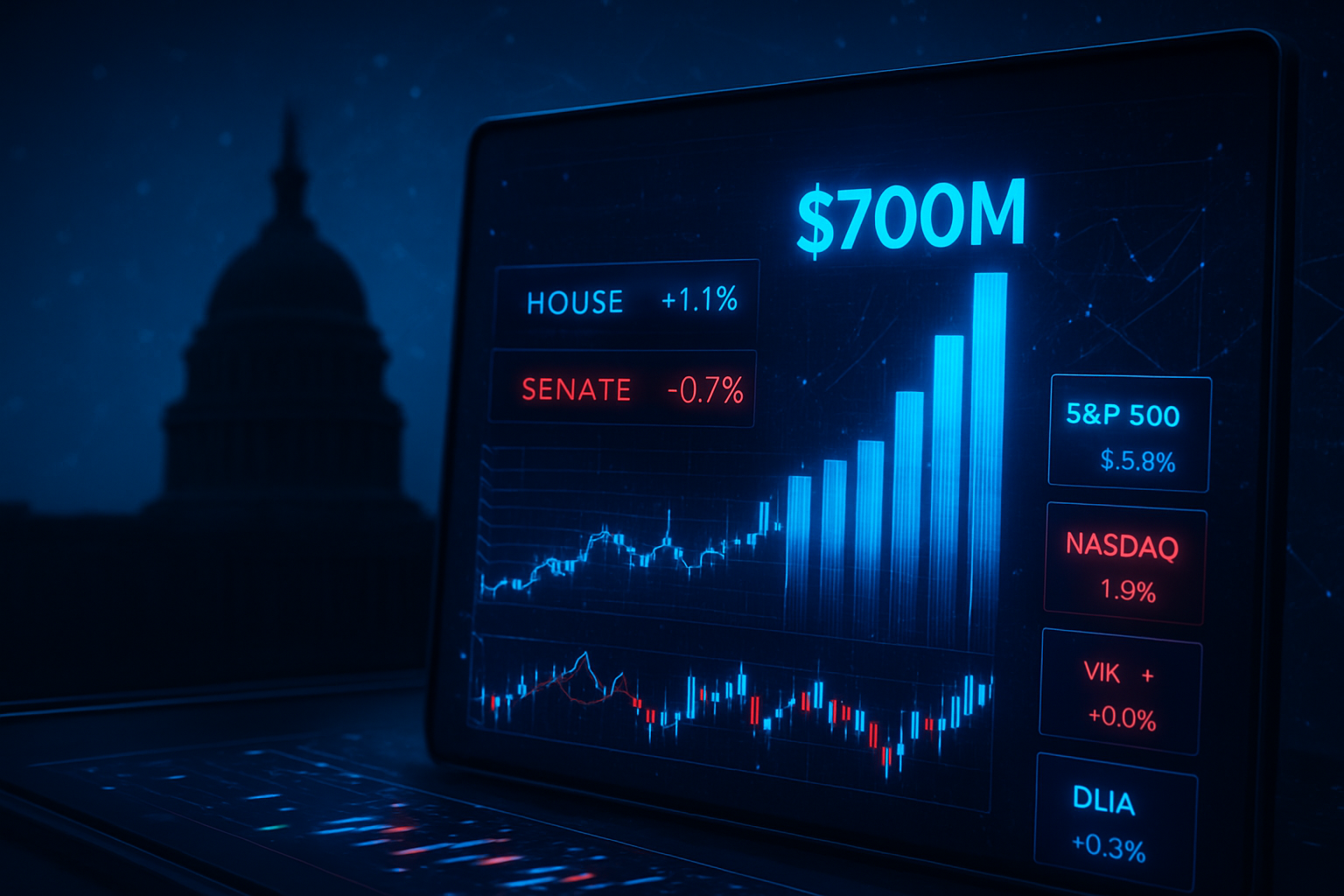
    As the calendar turns to early 2026, the political landscape is already being reshaped not by campaign rallies, but by the rapid-fire clicks of high-stakes traders. Prediction markets have officially entered their "super-cycle," with the 2026 U.S. Midterm elections driving unprecedented liquidity. For the first time in history, daily trading volume across the sector eclipsed the $700 million mark on January 12, signaling that forecasting platforms have moved from the periphery of political discourse to its very epicenter.

    At the heart of this surge is a stark divergence between traditional polling and market sentiment. While early polls suggest a competitive generic ballot, traders on platforms like Kalshi and Polymarket are aggressively pricing in a Democratic takeover of the House of Representatives, with odds hovering near 80%. Simultaneously, Vice President JD Vance has emerged as a paradox: a polarizing figure in public approval ratings, yet the undisputed betting favorite to lead the Republican ticket in 2028.

    The Market: What's Being Predicted

    The primary focus of the early 2026 cycle is the "Balance of Power" contracts, which allow traders to bet on the specific partisan split of the 110th Congress. On Kalshi, the leading regulated exchange in the U.S., the most liquid market currently concerns House control. Democrats are priced at 74–75 cents, implying a roughly 75% chance of retaking the lower chamber. Polymarket, the decentralized heavyweight, shows an even more bullish outlook for the left, with shares trading at 78–79 cents.

    In the Senate, however, the map tells a different story. Despite a national environment that favors Democrats, the 2026 Senate map is structurally difficult for the opposition. Republicans currently hold a 53–47 majority, and prediction markets give them a 66–68% probability of retaining control. The "Split Congress" outcome—a Democratic House and Republican Senate—is currently the "favorite" scenario among institutional traders, priced at 48% on Kalshi.

    Liquidity has reached a tipping point. On January 12, 2026, total daily volume across major platforms hit $701.7 million. Kalshi dominated this record-breaking day, accounting for 66.4% of the volume, largely driven by its "Combos" features which allow users to bet on complex political and economic outcomes simultaneously. This level of liquidity ensures that even "whale" positions of $1 million or more can be absorbed without radical price slippage, attracting a new class of sophisticated market participants.

    Why Traders Are Betting

    The aggressive positioning in favor of a "blue wave" in the House is being driven by what traders call the "Referendum Effect." Historically, the first midterm of a second presidential term is brutal for the incumbent party. However, traders are looking beyond history and focusing on specific policy catalysts. The second Trump administration's aggressive stances on tariffs and immigration, along with a recent tie-breaking vote by Vice President JD Vance to block a war powers resolution regarding Venezuela, have created a volatile political environment that traders believe will provoke a significant voter backlash.

    Furthermore, JD Vance’s standing as the 2028 heir apparent has turned 2026 into a proxy war for his future. On Kalshi, Vance holds a 27–28% chance of being the 2028 Republican nominee—a massive lead over rivals like Marco Rubio (11%). Traders are betting that the 2026 midterms will serve as the ultimate "stress test" for the Vance-led wing of the GOP. If the party loses the House by a wider margin than expected, his 2028 odds are predicted to crater, making these midterm contracts a hedge for 2028 presidential bets.

    The discrepancy between polls and markets is also a major factor in current trading strategies. While Morning Consult shows a modest Democratic lead of +2, markets are pricing in a much more decisive shift. Professional bettors are essentially betting that traditional polling is undercounting "suburban flight" and the impact of recent macroeconomic shifts. This "Knightian risk"—the uncertainty of how a second-term administration's disruptions will manifest at the ballot box—is currently being priced more heavily by markets than by pollsters.

    Broader Context and Implications

    The $700 million daily volume milestone is not just a win for the platforms; it represents a fundamental shift in how the public consumes political intelligence. Institutional players, including hedge funds and data analytics firms, are increasingly using these markets as a real-time sentiment gauge that reacts faster than any 1,000-person phone survey. The rise of these markets has also caught the attention of major financial institutions like Interactive Brokers (NASDAQ: IBKR), which has expanded its forecast market offerings to meet the demand for regulated election trading.

    The real-world implications of these odds are already being felt in Washington. Legislative strategies for the remainder of 2026 are being adjusted based on the high probability of a divided government. If the markets continue to hold at 75% for a Democratic House, we can expect a rush of Republican "legacy" legislation in the first half of the year before the window closes.

    From a regulatory standpoint, the 2026 cycle is the first to operate under a fully clarified legal framework following years of litigation between the CFTC and exchange platforms. This clarity has allowed for the entry of "market makers" who provide the deep liquidity necessary for the $700 million days we are now seeing. The historical accuracy of these markets—which outperformed polls in the 2024 general election—gives these early 2026 numbers a level of perceived authority that is influencing donor behavior and candidate recruitment.

    What to Watch Next

    As we head into the spring of 2026, several "volatility triggers" could shift the current odds. The primary season will be the first major test; if "Vance-aligned" candidates struggle in deep-red districts, expect his 2028 presidential odds to slide and the Democratic House probability to climb even higher. Traders will also be watching the quarterly GDP prints and Federal Reserve decisions closely, as any signs of an economic cooling could cement the "blue wave" narrative.

    Key dates to monitor include the filing deadlines in March and April, which will reveal the quality of the challengers Democrats have recruited for key swing districts. If high-profile "star" candidates jump into races that were previously considered safe Republican seats, the markets will likely react before the first television ad even airs. Additionally, the "Senate Floor" is a critical metric; if Republicans' odds of holding the Senate dip below 60%, it would signal a total collapse of the GOP's defensive map, a scenario not currently priced into the market.

    Bottom Line

    The 2026 midterm cycle is proving that prediction markets are no longer a "niche" interest but a primary pillar of the American political and financial ecosystem. The $700 million daily volume record is a testament to the growing trust in these platforms as accurate aggregators of disparate information. Currently, the "wisdom of the crowd" is betting heavily on a divided government, viewing a Democratic House takeover as a near-certainty while keeping the Senate in Republican hands.

    JD Vance remains the central figure of this drama. As the market's favorite for 2028, his political capital is effectively being "traded" through the 2026 midterm contracts. For observers and participants alike, the message from the markets is clear: the 2026 midterms will not just be a fight for the gavel, but a high-stakes referendum on the future of the Republican party's leadership. As liquidity continues to pour in, these markets will offer the most ruthless and accurate map of the American electorate’s intentions.


    This article is for informational purposes only and does not constitute financial or betting advice. Prediction market participation may be subject to legal restrictions in your jurisdiction.

    PredictStreet focuses on covering the latest developments in prediction markets.
    Visit the PredictStreet website at https://www.predictstreet.ai/.