
Tag: interest rates

  • Higher for Longer: Polymarket Traders Signal Resignation to Fed Pause in March

    Higher for Longer: Polymarket Traders Signal Resignation to Fed Pause in March

    As of February 7, 2026, the era of aggressive interest rate cuts appears to have hit a significant roadblock. For months, investors had been pricing in a steady glide path toward lower rates, but a recent string of robust economic data and hawkish rhetoric from Federal Reserve officials has fundamentally reshaped the narrative. On the leading decentralized prediction platform Polymarket, the consensus has reached a fever pitch: traders are now placing an 85% probability on "No Change" for the upcoming March 18 FOMC meeting.

    This shift marks a dramatic reversal from the start of the year, when the market was nearly evenly split on whether the Fed would continue its easing cycle or pause to digest late-2025 data. The sudden consolidation around a "higher for longer" stance suggests that the "soft landing" narrative is being replaced by one of "no landing," where growth remains too hot and inflation too sticky for the central bank to risk another move downward.

    The Market: What's Being Predicted

    The primary vehicle for this sentiment is the "Fed Interest Rate – March 2026" contract on Polymarket. This binary market allows participants to bet on whether the FOMC will raise, lower, or hold the federal funds rate at its next meeting. As of this morning, the "No Change" shares are trading at $0.85, effectively pricing in an 85% chance of a pause. This is a staggering climb from the $0.45 (45%) level seen just four weeks ago.

    The activity isn't limited to decentralized platforms. On Kalshi, a regulated prediction market, the March FOMC target rate contracts are showing even more conviction, with some segments pricing a hold as high as 91%. Total open interest across these platforms for the March decision has surged past $450 million, providing a level of liquidity that rivals traditional interest rate futures. The resolution criteria are straightforward: the market settles based on the official target range announced by the Federal Reserve at the conclusion of their March 18 session.

    This surge in trading volume has turned prediction markets into a primary focal point for macro analysts. Unlike traditional surveys of economists, these markets reflect real-time capital allocation, often moving minutes after a Bureau of Labor Statistics release or a speech by a Fed Governor. The current target range of 3.50%–3.75% is now widely expected to remain the benchmark through the first half of the year.

    Why Traders Are Betting

    The 85% conviction rate among traders is rooted in a trifecta of economic resilience, stubborn inflation, and a notable shift in Fed leadership dynamics. The most recent data showed that Q3 2025 GDP grew at a blistering 4.4% annual rate, far exceeding the "moderate" growth the Fed had projected. With the economy on such solid footing, traders argue that there is no urgent need for the Fed to provide further stimulus through rate cuts.

    Furthermore, inflation has proved more difficult to eradicate than previously hoped. Headline CPI for December 2025 clocked in at 2.7%, while the Fed’s preferred gauge, the Core PCE, remains stalled at 2.8%. These figures are uncomfortably above the 2% target, leading many to believe that the Fed has reached its "neutral rate"—the point where policy is neither restrictive nor stimulative. Chair Jerome Powell echoed this sentiment in late January, suggesting it was "hard to argue that policy is significantly restrictive" in the current environment.

    Another factor influencing the "No Change" bet is the political and administrative transition at the central bank. With the nomination of Kevin Warsh to succeed Jerome Powell in May 2026, markets are beginning to price in a "hawkish moderate" approach. Warsh is perceived as a candidate who may prioritize productivity gains and financial stability over aggressive easing, giving the current FOMC cover to remain cautious and wait for his tenure to begin before making further significant moves.

    Broader Context and Implications

    The dominance of the "No Change" outcome on Polymarket mirrors, and in some cases leads, traditional tools like the CME FedWatch Tool, operated by the CME Group (NASDAQ: CME). While the CME FedWatch Tool—which derives its probabilities from 30-Day Fed Funds futures—currently shows an 80% chance of a pause, prediction markets have been more aggressive in pricing in the hawkish shift. This suggests that retail and "whale" traders on prediction platforms may be reacting more swiftly to the qualitative "vibes" of the economy than the purely quantitative futures market.

    This "higher for longer" expectation has immediate real-world implications. Mortgage rates, which had begun to dip in late 2025, have stabilized or even ticked upward in response to the March expectations. For the broader equity markets, the news is a double-edged sword. While it signals a strong economy, it also means that the "discount rate" used to value growth stocks—such as those found in the Invesco QQQ Trust (NASDAQ: QQQ)—will remain higher, potentially capping gains for high-multiple tech companies.

    Historically, prediction markets have been remarkably accurate in forecasting FOMC decisions within a 30-day window. In 2024 and 2025, whenever a specific outcome crossed the 80% threshold on Polymarket or Kalshi three weeks before a meeting, it proved to be the correct call in every instance. This track record is why institutional desks are increasingly monitoring these platforms as a legitimate "wisdom of the crowd" indicator.

    What to Watch Next

    Despite the 85% consensus, the market remains sensitive to upcoming data releases that could disrupt the "No Change" narrative. The most critical milestone is the February Consumer Price Index (CPI) report, scheduled for release in mid-March, just days before the FOMC meeting. If inflation shows a surprise cooling toward the 2.3% or 2.4% range, the 15% minority betting on a 25-basis-point cut could see their shares skyrocket in value.

    Additionally, the "data blackout" caused by the partial government shutdown in late 2025 is finally clearing. As delayed reports on private payrolls and retail sales are released, they will either confirm the "solid growth" thesis or reveal hidden cracks in the labor market. Traders will also be listening intently to any final "Fedspeak" before the official blackout period begins ten days prior to the meeting.

    If the unemployment rate—currently at 4.4%—were to spike toward 4.7% in the next monthly report, the "No Change" bet would likely see a sharp correction. However, as of early February, the momentum is firmly with the hawks.

    Bottom Line

    The 85% probability of a Fed pause in March is a clear signal from the collective intelligence of the prediction markets: the easing cycle has hit a plateau. Traders have weighed the risks of re-igniting inflation against the benefits of lower rates and have concluded that the Federal Reserve will choose the path of caution.

    For prediction markets as a whole, this event demonstrates their growing role as a vital piece of the financial information ecosystem. By providing a clear, tradeable percentage on complex macroeconomic outcomes, platforms like Polymarket and Kalshi are offering a level of clarity that traditional financial commentary often lacks.

    As we move closer to March 18, the "No Change" bet represents more than just a prediction about interest rates; it is a vote of confidence in the underlying strength of the 2026 economy—and a warning that the days of "easy money" are not returning as quickly as many had hoped.


    This article is for informational purposes only and does not constitute financial or betting advice. Prediction market participation may be subject to legal restrictions in your jurisdiction.

    PredictStreet focuses on covering the latest developments in prediction markets.
    Visit the PredictStreet website at https://www.predictstreet.ai/.
  • The FOMC Disconnect: Kalshi Traders Signal March Rate Cut as Macro Prediction Markets Explode

    The FOMC Disconnect: Kalshi Traders Signal March Rate Cut as Macro Prediction Markets Explode

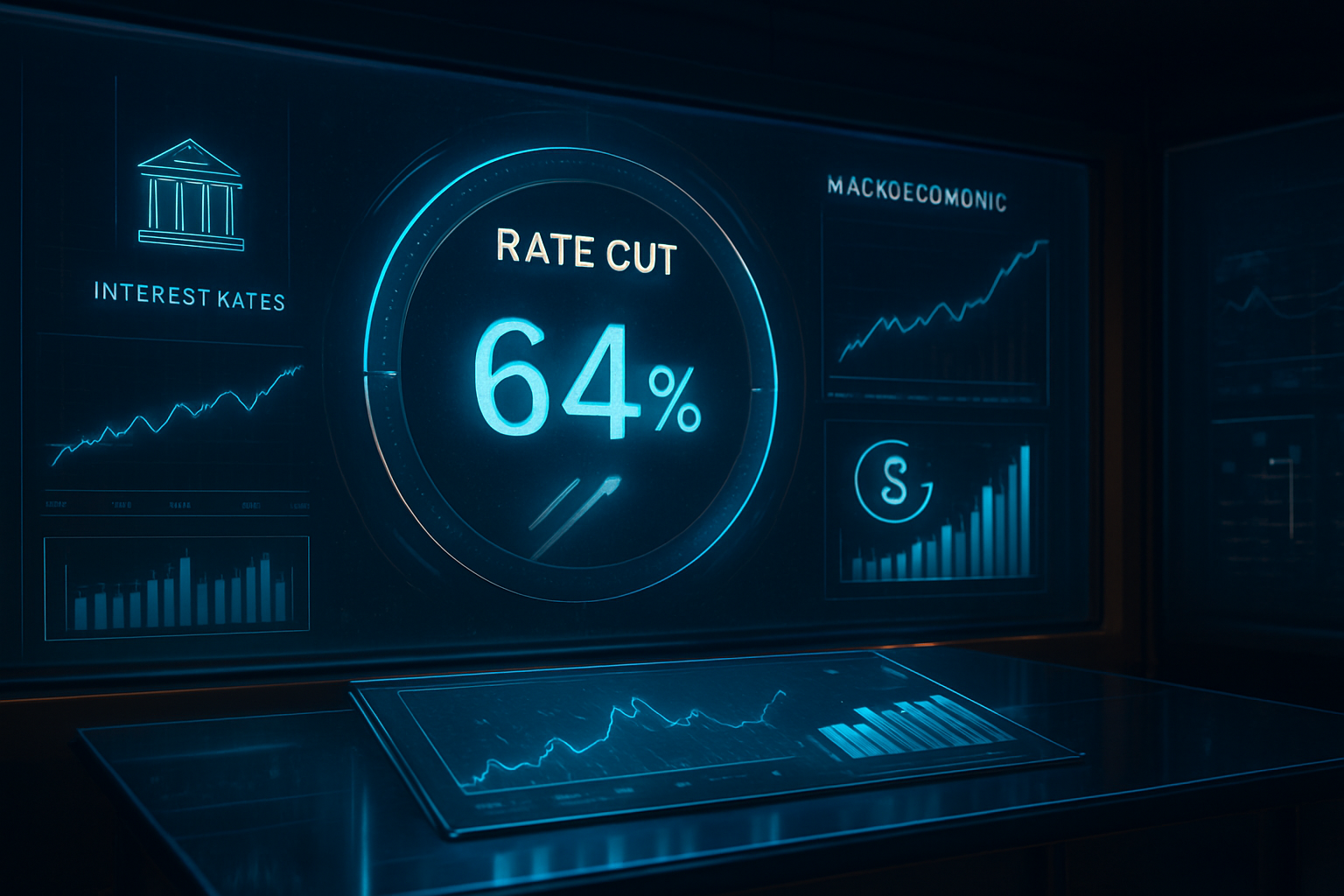
    As the Federal Reserve's March 2026 meeting approaches, a striking divergence has emerged between traditional financial instruments and the burgeoning world of "Information Finance." On Kalshi, the federally regulated prediction market, traders are increasingly convinced that the central bank will pivot toward easing. Currently, 64% of participants on the platform are betting on a 25-basis-point rate cut for the March 17-18 session, a stark contrast to the more conservative stance reflected in the broader bond market.

    This surge in activity is not merely speculative retail interest; it represents a fundamental shift in how macroeconomic risk is priced. With open interest on Kalshi’s Federal Reserve contracts exceeding $450 million as of February 5, 2026, these markets are no longer a sideshow. They have become a primary source of truth for hedge funds and high-frequency trading (HFT) firms, which are increasingly using these event contracts to hedge against policy shifts that traditional models often fail to capture in real-time.

    The Market: What's Being Predicted

    The focus of the financial world is currently fixed on the "March 2026 FOMC Target Rate" contract. Trading on Kalshi, the first CFTC-regulated prediction exchange, the market allows participants to buy "Yes" or "No" contracts on specific interest rate ranges. At the current 64% probability for a 25-basis-point cut, the price of a "Yes" contract sits at approximately $0.64, aiming for a $1.00 payout if the Fed lowers the target range from its current 3.5%–3.75% level.

    This volume is part of a broader explosion in prediction market liquidity. While Kalshi leads the regulated US space with its $450 million in open interest, Polymarket—which recently re-entered the US market after acquiring a CFTC-licensed clearinghouse—is seeing similar enthusiasm, with its March rate-cut contracts trading at an even more aggressive 71% probability. The scale of these markets is now rivaling the daily turnover of mid-cap equities, providing a level of depth that allows institutional players like Jump Trading and Susquehanna Government Products to execute large-scale positions without massive slippage.

    In comparison, the CME Group (NASDAQ: CME) FedWatch Tool, which derives its data from 30-Day Fed Funds Futures, is currently pricing in a much higher 90% probability that the Fed will hold rates steady. This massive 54% "spread" between prediction markets and traditional futures has created a lucrative arbitrage opportunity for algorithmic traders, who are using the Kalshi "oracle" to front-run movements in the Treasury market.

    Why Traders Are Betting

    The conviction among Kalshi traders is driven by a weakening labor market that has yet to be fully acknowledged by official Fed rhetoric. While Federal Reserve Chair Jerome Powell characterized economic activity as "solid" during the January 28 press conference, January’s employment data showed a significant cooling in job gains. Prediction market participants, who often prioritize "nowcasting" data over lagging government reports, are betting that the Fed will be forced to act to prevent a harder landing.

    Furthermore, the "Warsh Factor" is looming large over the market. President Trump’s nomination of Kevin Warsh to succeed Powell in May 2026 has introduced a new variable. Many traders believe the current board may want to "clear the deck" with a preemptive cut before the leadership transition begins, or that they are responding to subtle political pressure for more aggressive easing. Analysts at firms like JPMorgan Chase & Co. (NYSE: JPM) and Goldman Sachs (NYSE: GS) have remained cautious in their public notes, but the "skin-in-the-game" nature of Kalshi is telling a different story.

    Another factor is the rise of the "Synthetic Straddle." Institutional desks are reportedly buying "No" on a rate cut on Kalshi while simultaneously going long on interest-rate futures at the CME Group. This allows them to profit if the prediction market’s aggressive forecast proves correct, while hedging their exposure with traditional derivatives.

    Broader Context and Implications

    The surge in macroeconomic betting reflects the maturation of "InfoFi"—the intersection of information and finance. Major news networks have fully embraced this shift; CNBC (NASDAQ: CMCSA) recently integrated a live "Kalshi Ticker" into its daily broadcasts, acknowledging that these markets often move faster than the Bloomberg terminal in the wake of breaking news. When a probability shifts on Kalshi, it now frequently triggers multi-billion dollar trades in the S&P 500 (NYSEARCA: SPY) within milliseconds.

    The entry of major infrastructure players has also lent the sector a new level of legitimacy. The Intercontinental Exchange (NYSE: ICE), the parent company of the New York Stock Exchange, recently made a landmark $2 billion investment in prediction market infrastructure. This move signals that traditional exchanges view event contracts as a permanent and essential part of the modern financial stack, rather than a fleeting trend.

    However, regulatory hurdles remain. While Kalshi operates under federal oversight, Polymarket continues to face state-level challenges, including a recent temporary restraining order in Nevada. These legal battles highlight the ongoing tension between federal deregulation and state-level gaming concerns, even as the markets themselves become indispensable for risk management.

    What to Watch Next

    The primary catalyst for the next major movement in these odds will be the upcoming Consumer Price Index (CPI) release for January, scheduled for mid-February. If inflation continues its "sticky" trend near 2.7%, the 64% probability for a cut may retreat as traders fear the Fed will prioritize price stability over labor market support. Conversely, a sub-2.5% print could send the Kalshi odds north of 80%.

    Traders should also monitor the public appearances of Fed governors over the next three weeks. Any shift in tone toward a "risk-management" approach—a common euphemism for preemptive cuts—will likely be priced into Kalshi hours before it is reflected in the CME futures.

    Finally, the transition of the "Warsh nomination" through the Senate will be a key milestone. Any delays or complications in the confirmation process could inject volatility into the May and June 2026 contracts, which currently anticipate a rapid easing cycle once the new Chair takes the helm.

    Bottom Line

    The March 2026 FOMC meeting is shaping up to be a watershed moment for prediction markets. With $450 million at stake on Kalshi, the "wisdom of the crowd" is directly challenging the established wisdom of Wall Street’s largest banks and the CME Group’s traditional futures. The fact that 64% of traders are leaning toward a cut suggests a deeper anxiety about the labor market than official figures currently show.

    What we are witnessing is the birth of a more democratic, real-time economic forecasting tool. As hedge funds and HFT bots continue to bridge the gap between prediction markets and traditional assets, the distinction between "betting" and "investing" continues to blur. Whether or not the Fed actually cuts in March, the prediction markets have already won by providing a level of transparency and responsiveness that the financial world has never seen before.


    This article is for informational purposes only and does not constitute financial or betting advice. Prediction market participation may be subject to legal restrictions in your jurisdiction.

    PredictStreet focuses on covering the latest developments in prediction markets.
    Visit the PredictStreet website at https://www.predictstreet.ai/.
  • The 99% Consensus: Why Prediction Markets Are Calling the Fed’s Bluff on Interest Rates

    The 99% Consensus: Why Prediction Markets Are Calling the Fed’s Bluff on Interest Rates

    As the Federal Open Market Committee (FOMC) convenes for its first meeting of 2026, the financial world is witnessing a rare moment of absolute conviction. On Polymarket, the world’s largest decentralized prediction market, the probability of the Federal Reserve maintaining interest rates at their current target of 3.50%–3.75% has surged to a staggering 99%. This near-certainty reflects a dramatic shift from late 2025, when traders were still debating the possibility of a fourth consecutive rate cut.

    The "No Change" consensus isn't just a hunch; it represents hundreds of millions of dollars in "skin in the game" betting that Chair Jerome Powell will opt for a "wait-and-see" approach. While traditional bank analysts at firms like Goldman Sachs (NYSE: GS) and JPMorgan (NYSE: JPM) were still debating the nuances of "sticky inflation" just weeks ago, prediction markets have been pricing in this pause with cold, mathematical precision. This 99% certainty has transformed the FOMC meeting from a high-stakes guessing game into a validation exercise for the burgeoning field of event-based forecasting.

    The Market: What's Being Predicted

    The specific market in question focuses on the outcome of the January 27–28, 2026, FOMC meeting. On Polymarket, the "Fed Interest Rate Decision: January 2026" contract has become one of the most liquid markets on the platform, with cumulative trading volume exceeding $471 million. As of this morning, the "No Change" contract is trading at $0.99, meaning a bettor must risk $99 to win a single dollar in profit—a level of confidence rarely seen in macro-economic forecasting.

    Other platforms tell a similar story. Kalshi, the federally regulated exchange, shows its "Fed maintains rate" contract trading between 98.5% and 99%. Even the CME Group’s (NASDAQ: CME) FedWatch Tool, which derives its data from 30-day Fed Funds futures, mirrors this sentiment with a 97.2% to 99% probability of a hold. The consistency across decentralized, regulated, and traditional futures markets suggests that the era of "Fed surprises" may be drawing to a close as prediction market liquidity deepens.

    The resolution criteria for these contracts are straightforward: the official press release from the Federal Reserve Board of Governors. If the target range remains at 3.50%–3.75% when the statement is released tomorrow afternoon, the "No" contracts will expire at $1.00, rewarding the massive pool of traders who have bet on stability.

    Why Traders Are Betting

    The 99% certainty is anchored in a trifecta of robust economic data that emerged in early January. First, the December 2025 jobs report showed the unemployment rate ticking down to 4.4%, easing fears of a labor market "hard landing." Second, the Atlanta Fed’s GDPNow tool estimated a blistering 5.4% annualized growth for Q4 2025. Finally, headline CPI has remained stubbornly fixed at 3.0%, well above the Fed's 2% target.

    Traders are also employing sophisticated "bonding" strategies. By betting on an outcome with a 99% probability, institutional "whales" are effectively using prediction markets as a high-yield savings account. A 1% return over the 48-hour duration of an FOMC meeting, when compounded throughout the year, represents an annualized return that dwarfs traditional fixed-income products. This "smart money" activity has been bolstered by the Intercontinental Exchange (NYSE: ICE), which recently finalized a $2 billion strategic investment in Polymarket, signaling that the institutional world now views these odds as a primary data source.

    Furthermore, a "lame duck" dynamic is influencing the market. Chair Jerome Powell’s term ends in May 2026, and reports of a Department of Justice investigation into the Fed's recent internal protocols have surfaced. Traders believe the Fed will stay the course to maintain a veneer of institutional stability and independence during this period of heightened political and legal scrutiny.

    Broader Context and Implications

    The shift toward prediction markets marks a fundamental change in how the public and institutions digest economic news. Historically, the "analyst consensus" from major banks like Morgan Stanley (NYSE: MS) or Nomura (NYSE: NMR) was the gold standard. However, data from 2024 and 2025 has begun to flip the script. During the December 2025 "pivot," prediction markets assigned a 95% probability to a rate cut while several major brokerages were still forecasting a hold. The markets were right; the analysts were late.

    This trend highlights the "wisdom of the crowd" in absorbing "statistical noise." A late-2025 government shutdown disrupted Bureau of Labor Statistics data, creating confusion for traditional models. Prediction market participants, however, successfully looked past the noisy data to the underlying economic strength, providing a cleaner signal than traditional economist surveys.

    Regulatory milestones have also fueled this growth. In November 2025, Polymarket officially returned to the U.S. market after acquiring the licensed exchange QCEX. While Kalshi continues to fight state-level battles in places like Massachusetts and Nevada, the overall trend is toward a regulated, liquid environment where event contracts are treated as legitimate hedging tools rather than mere gambling.

    What to Watch Next

    While the January "hold" is essentially priced to perfection, the real volatility lies in the "Dot Plot" and Powell’s post-meeting press conference. Traders will be looking for clues regarding the March 2026 meeting. Currently, prediction markets are split, with a 60% chance of a 25-basis-point cut in March, diverging from JPMorgan’s (NYSE: JPM) forecast that the Fed will hold rates steady through the entirety of 2026.

    Key milestones to monitor include:

    • The February Employment Situation Report: Any spike in unemployment could rapidly shift the March odds.
    • The "Shadow Chair" Race: As Powell's term winds down, markets on Kalshi for the next Fed Chair—with names like Rick Rieder and Kevin Warsh leading—will likely begin to correlate with interest rate expectations.
    • Inflation Print (Feb 12, 2026): If CPI remains at 3% or higher, the current 60% probability for a March cut may evaporate.

    Bottom Line

    The 99% certainty on Polymarket and Kalshi regarding the January FOMC decision is more than just a bet; it is a declaration of the new economic order. Prediction markets have evolved from niche experimental platforms into high-fidelity mirrors of reality, often moving faster and more accurately than the most prestigious research desks on Wall Street.

    As we move into 2026, the convergence of institutional capital from the likes of ICE (NYSE: ICE) and the regulatory "thaw" for platforms like Polymarket suggests that the "Fed Watch" of the future will happen on a blockchain or a regulated exchange, rather than in a bank's quarterly report. For now, the message from the markets is clear: Jerome Powell has found a level he likes, and he isn't moving until the data forces his hand.


    This article is for informational purposes only and does not constitute financial or betting advice. Prediction market participation may be subject to legal restrictions in your jurisdiction.

    PredictStreet focuses on covering the latest developments in prediction markets.
    Visit the PredictStreet website at https://www.predictstreet.ai/.
  • Betting on the Pause: Prediction Markets Signal 99% Certainty for Fed Hold in January as Polymarket Volume Nears $500 Million

    Betting on the Pause: Prediction Markets Signal 99% Certainty for Fed Hold in January as Polymarket Volume Nears $500 Million

    With the first Federal Reserve meeting of 2026 just days away, prediction markets have reached a state of near-total consensus. Traders are placing massive bets that the Federal Open Market Committee (FOMC) will opt to keep interest rates steady at its January 27–28 meeting, halting the cycle of rate cuts that defined the latter half of 2025.

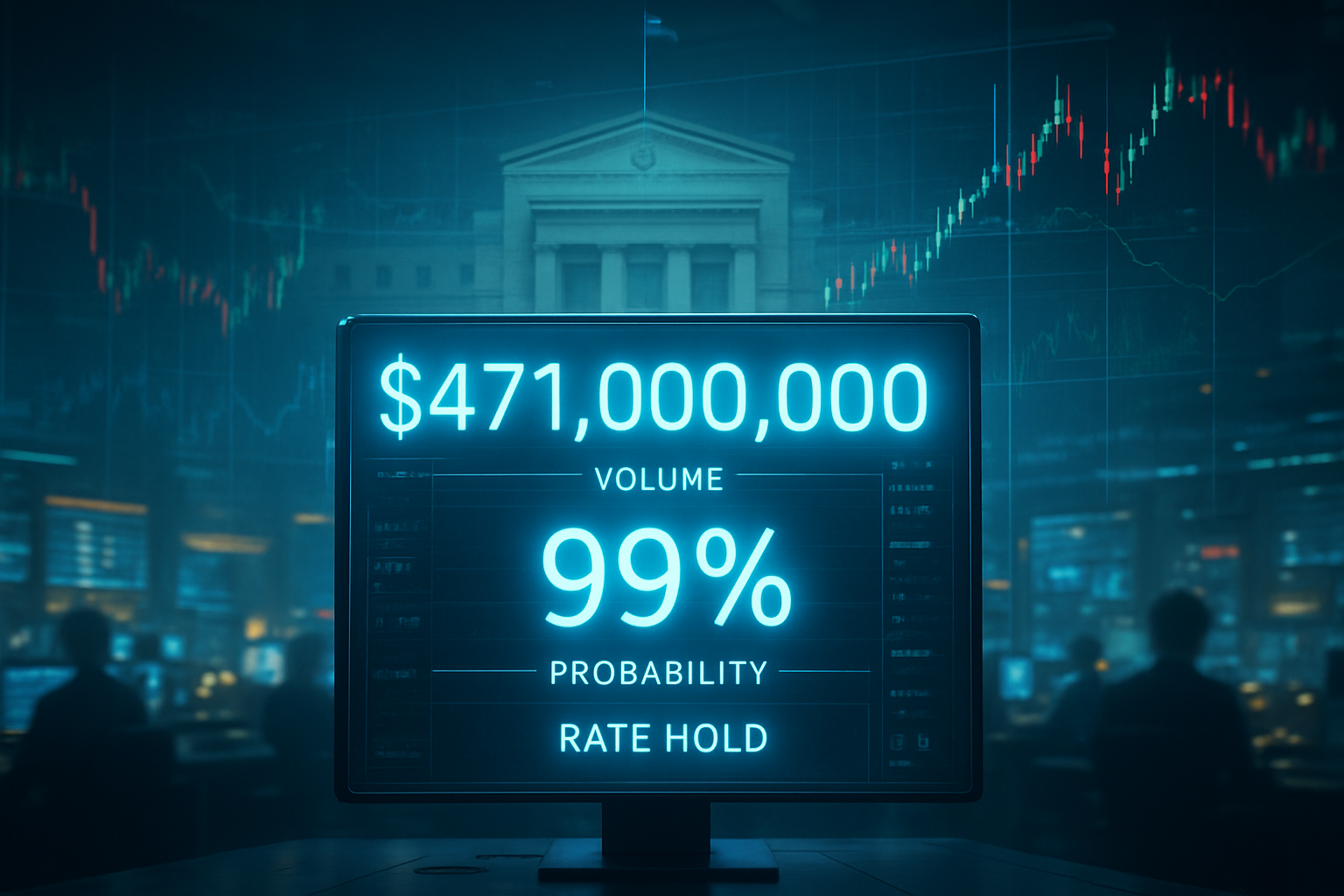
    The scale of the "hold" prediction is staggering, not just in its probability but in the capital backing it. On Polymarket, the world’s largest decentralized prediction platform, the volume for the January interest rate decision has surged to a massive $471 million. As of January 24, 2026, the market assigns a 99% probability to a "No Change" outcome, effectively pricing out any chance of a 25 or 50 basis point decrease, both of which are currently trading at 1% or less.

    The Market: What's Being Predicted

    The central question facing traders is whether the Fed will maintain the federal funds rate at its current range of 3.50%–3.75%. While traditional financial instruments like Fed Funds Futures have long been the gold standard for these forecasts, the rise of prediction markets has shifted the landscape. On Polymarket, the "Fed Interest Rate Decision: January 2026" contract has become one of the most liquid markets on the platform, drawing in hundreds of millions in volume from a global pool of retail and crypto-native participants.

    The conviction on Polymarket is slightly higher than that of institutional tools. For comparison, the FedWatch tool provided by the CME Group (NASDAQ: CME) currently shows a 95.4% chance of a hold and a 4.6% chance of a 25 basis point cut. While both indicate a high degree of certainty, the "99% club" on prediction markets suggests that speculators are even more convinced than the professional hedgers using CME’s futures contracts.

    Meanwhile, on the U.S.-regulated exchange Kalshi, the odds tell a similar story. Contracts for the Fed maintaining the current rate are trading at roughly 99 cents, reflecting a 99% implied probability. The liquidity on these platforms has become so deep that even large "whale" trades struggle to move the needle against the overwhelming tide of the "hold" consensus.

    Why Traders Are Betting

    The shift toward a definitive pause is driven by a complex "data-dependent" narrative that has become increasingly muddled. Throughout late 2025, the Fed enacted three consecutive rate cuts to support a cooling labor market. However, by the start of 2026, the economic picture began to blur. Core Personal Consumption Expenditures (PCE), the Fed’s preferred inflation metric, remains "sticky" at 2.8%—well above the 2% target.

    Traders are also reacting to the "data holes" created by a brief but disruptive government shutdown in late 2025. This shutdown delayed several key economic reports, leaving the Fed with incomplete information. Most market participants believe Chair Jerome Powell will prefer a "wait-and-see" approach rather than risk another cut while inflation remains stubborn and official data is unreliable.

    Furthermore, political risk is looming large over the central bank. With Jerome Powell’s term as Chair set to expire in May 2026, and rumors of potential replacements swirling in Washington, the FOMC is perceived to be in a defensive crouch. Traders are betting that the committee will avoid any bold policy moves that could be interpreted as politically motivated or overly aggressive during a sensitive transition period.

    Broader Context and Implications

    The $471 million volume on Polymarket is a testament to the growing institutionalization of prediction markets as a serious financial forecasting tool. These markets are often praised for their "wisdom of the crowd" effect, which can sometimes process breaking news—such as leaked political rumors or localized economic indicators—faster than traditional banking models.

    Historically, when prediction markets hit a 99% probability for a Fed decision this close to the meeting date, they are rarely wrong. However, the real-world implications of a hold are significant. A pause in January signals to the broader economy that the "easy money" era of late 2025 is over for now. This has direct consequences for mortgage rates, corporate borrowing costs, and the overall performance of the S&P 500 (NYSE: SPY).

    This market also highlights the regulatory evolution of the space. Following Kalshi’s legal victories against the CFTC in 2024 and 2025, prediction markets have moved from the fringe to the mainstream of political and economic forecasting. The fact that nearly half a billion dollars is being wagered on a single Fed meeting underscores the massive appetite for these direct-betting instruments.

    What to Watch Next

    As we approach the January 28 announcement, any sudden "Fed leak" or unexpected comment from a committee member could cause a late-stage tremor in the markets. Traders should keep a close eye on the "Statement" language. Even if the rate remains unchanged as expected, the "hawkish" or "dovish" tone of the accompanying text will set the odds for the next meeting in March.

    The most critical date to monitor is Wednesday, January 28, at 2:00 PM EST. The release of the FOMC statement will provide the ultimate resolution for these multi-million dollar contracts. Immediately following, at 2:30 PM, Chair Powell’s press conference will be scrutinized for clues regarding the Fed's stance on the 2.8% inflation floor and the upcoming leadership transition in May.

    Bottom Line

    The prediction markets have spoken: the January 2026 FOMC meeting is expected to be a non-event in terms of rate movements. The 99% probability of a hold across Polymarket and Kalshi represents a rare moment of total market unity, backed by nearly $500 million in skin-in-the-game.

    This level of certainty suggests that traders have fully absorbed the impact of sticky inflation and the data distortions from the recent government shutdown. While the "hold" itself may be predictable, the true value of these markets lies in their ability to quantify sentiment in real-time. As the Fed enters its "blackout period" before the meeting, these prediction markets remain the only living, breathing indicator of where the money is moving.


    This article is for informational purposes only and does not constitute financial or betting advice. Prediction market participation may be subject to legal restrictions in your jurisdiction.

    PredictStreet focuses on covering the latest developments in prediction markets. Visit the PredictStreet website at https://www.predictstreet.ai/.
  • The New Yield Curve: Why Wall Street is Now Following Prediction Markets for Fed and CPI Guidance

    The New Yield Curve: Why Wall Street is Now Following Prediction Markets for Fed and CPI Guidance

    As the Federal Reserve prepares for its first policy meeting of 2026 on January 27–28, a significant shift has occurred in how the financial world anticipates interest rate decisions. The traditional dominance of professional economic surveys and even standard bond-market derivatives is being challenged by prediction markets like Kalshi and Polymarket. For the upcoming January FOMC meeting, prediction markets are currently pricing a "no change" decision with an overwhelming 96% probability, firmly pegging the federal funds rate at its current 3.50%–3.75% range.

    This decisive certainty stands in subtle contrast to traditional instruments. While the CME FedWatch tool, operated by CME Group (NASDAQ: CME), reflects a still-significant 16% chance of a rate cut, prediction market traders have almost entirely written off the possibility of a January move. This divergence is not an anomaly; over the past eighteen months, prediction markets have consistently outpaced institutional forecasts in both speed and accuracy, forcing major players like Goldman Sachs (NYSE: GS) and JPMorgan Chase (NYSE: JPM) to integrate these platforms into their primary research dashboards.

    The Market: What's Being Predicted

    The focus of the current forecasting cycle centers on the "Fed Path" and monthly Consumer Price Index (CPI) data. On Kalshi, a federally regulated exchange, the "January Fed Meeting" contract has seen record-breaking participation from institutional traders. Meanwhile, the decentralized platform Polymarket has seen its January Fed decision volume exceed $425 million, as global participants bet on everything from the specific basis point move to the exact wording used in Chair Jerome Powell’s final few press conferences before his term expires in May.

    Unlike traditional surveys, which provide a "snapshot" of economist sentiment once a month, these markets trade 24/7. This allows them to react instantaneously to breaking news—such as the early January 2026 labor data that showed unemployment stabilizing at 4.5%. While traditional analysts were still revising their notes, prediction market odds for a January "hold" surged from 85% to 96% within minutes of the data release. These markets don't just predict the outcome; they predict the brackets of the outcome, with contracts available for specific CPI increments (e.g., "Will CPI be between 2.6% and 2.7%?").

    Why Traders Are Betting

    The migration of capital toward prediction markets is driven by the concept of "Information Finance." Traders argue that these platforms offer a "truth engine" fueled by "skin in the game." Unlike a bank economist whose compensation is rarely tied directly to the accuracy of a single CPI forecast, a prediction market participant faces an immediate financial loss if they are wrong. This financial incentive filters out the "herding" behavior often seen in institutional forecasts, where analysts are frequently hesitant to deviate too far from the consensus.

    Recent history has validated this approach. In late 2024, Kalshi research demonstrated that their market-based CPI forecasts had a 40.1% lower Mean Absolute Error (MAE) than the Wall Street consensus. When "inflation shocks" occurred—moments where data deviated significantly from expectations—the prediction markets' error was nearly 67% lower than that of professional economists. Wall Street has taken note; firms like Jane Street and Susquehanna International Group have established dedicated desks to arbitrage discrepancies between prediction market odds and traditional interest rate swaps.

    Broader Context and Implications

    The institutionalization of these markets reached a fever pitch in late 2025 when the Intercontinental Exchange (NYSE: ICE), the parent company of the New York Stock Exchange, announced a landmark $2 billion investment in Polymarket. This move signaled that prediction markets are no longer considered "niche betting sites" but are essential financial infrastructure. The utility of these markets extends beyond interest rates; they have become the premier venue for pricing geopolitical risk.

    A recent example of this was the "Maduro Incident" in early January 2026. While mainstream news wires were still verifying reports of a political shift in Venezuela, prediction markets were already repricing global energy costs and interest rate expectations. By the time the news hit the Bloomberg (Private) terminals, the odds of a "hawkish hold" by the Fed had already moved, as traders anticipated the inflationary impact of potential oil supply disruptions. This ability to aggregate disparate, global information in real-time is what makes these platforms indispensable in 2026.

    What to Watch Next

    As we move toward the January 28 FOMC announcement, all eyes remain on the "sticky" PCE inflation data, currently hovering around 2.7%. If the prediction markets hold their 96% conviction of a "pause," any deviation by the Fed would trigger a massive "repricing event" across all asset classes. Traders are also looking toward the March 17-18 meeting, where the odds are currently split: a 79% probability of another hold versus a growing sentiment for a 25-basis-point cut if labor markets show further cooling.

    Beyond the immediate rate decisions, the next major milestone is the nomination of the next Federal Reserve Chair. Prediction markets currently give a 61% probability that the administration will nominate a candidate with a "higher-for-longer" bias, a sentiment that is already beginning to flatten the yield curve in the prediction space for the latter half of 2026. These leadership markets are moving with more fluidity than any political punditry, reflecting real-time shifts in the Washington, D.C. power dynamic.

    Bottom Line

    Prediction markets have fundamentally changed the "alpha" equation for economic forecasting. By providing a 24/7, high-liquidity environment where information is priced instantly, they have exposed the lag inherent in traditional economic models. The 40% accuracy advantage over Wall Street consensus is no longer a statistical fluke—it is a testament to the power of decentralized, incentivized data aggregation.

    For the retail investor and the institutional titan alike, the message is clear: the most accurate "yield curve" in 2026 is no longer found solely in the bond market. It is found in the fluctuating odds of the prediction exchanges. As we approach the end of January, the 96% "hold" consensus on Kalshi and Polymarket suggests that the Fed’s path is already priced in, leaving the "surprises" to those who are still relying on yesterday’s surveys.


    This article is for informational purposes only and does not constitute financial or betting advice. Prediction market participation may be subject to legal restrictions in your jurisdiction.

    PredictStreet focuses on covering the latest developments in prediction markets.
    Visit the PredictStreet website at https://www.predictstreet.ai/.

  • The Rise of the Economic Oracle: Fed Decision Markets Top $360M as Wall Street Pivots to Prediction Odds

    The Rise of the Economic Oracle: Fed Decision Markets Top $360M as Wall Street Pivots to Prediction Odds

    As the Federal Reserve prepares for its first policy meeting of 2026, the global financial community is looking past traditional bank reports and focusing on a new, high-speed indicator: the prediction market. With over $360 million in trading volume now concentrated on the outcome of the January 28, 2026, FOMC meeting, these platforms have officially transitioned from niche betting arenas into what analysts are calling the "Economic Oracle."

    Current market odds reflect a decisive consensus, with a 95.1% probability of a "pause" (no change in rates). This surge in volume and precision comes as hedge funds and institutional liquidity providers increasingly use event-based contracts to hedge against macro volatility. What was once dismissed as a "prediction game" is now a cornerstone of the modern financial infrastructure, providing real-time sentiment that often moves faster than traditional federal funds futures.

    The Market: What's Being Predicted

    The focus of the financial world is currently fixed on the "Fed Decision: January 2026" contract. On Polymarket, the decentralized heavyweight, the specific contract for a rate hold has seen a staggering $363.2 million in volume. Parallel to this, Kalshi—the CFTC-regulated exchange—has reported record-breaking activity, with daily volumes across its broader suite of macro contracts reaching $465.9 million earlier this week.

    Traders are specifically betting on whether the Federal Open Market Committee (FOMC) will maintain the current target rate, cut by 25 basis points, or—in a tail-risk scenario—hike rates. The liquidity in these markets has been bolstered by the entry of major brokerage firms. Interactive Brokers (NASDAQ: IBKR), through its ForecastEx exchange, has played a pivotal role by offering a "yield-enhanced" structure, where participants earn an incentive coupon of up to 3.8% APY on the collateral of their open positions, effectively paying institutions to provide market depth.

    The resolution criteria are straightforward: the market settles based on the official target range announced by the Federal Reserve at the conclusion of its January 28 meeting. Unlike traditional futures, which can be influenced by complex technical factors and term premiums, these binary contracts offer a "pure" expression of probability that is easily digestible for retail and institutional investors alike.

    Why Traders Are Betting

    The primary driver behind the current 95% "pause" consensus is a string of "sticky" economic data released in early January. The December Consumer Price Index (CPI) printed at 2.7%, which, while stable, failed to show the continued cooling that would have justified a fourth consecutive rate cut. Furthermore, the January labor report showed non-farm payrolls adding a modest 66,000 jobs—just enough to keep the Fed from feeling an urgent need to stimulate the economy despite a 4.6% unemployment rate.

    The shift in market participation is also a major factor. Quant-heavy firms such as Susquehanna International Group (SIG) and Jane Street have reportedly established dedicated prediction market desks. These "whales" are not just betting on the Fed; they are performing sophisticated arbitrage between prediction market odds and the CME Group (NASDAQ: CME) FedWatch tool.

    "Prediction markets are the ultimate truth engine," says one macro trader at a Tier-1 hedge fund. "During the Fed's 10-day blackout period, when officials cannot speak to the press, these markets continue to process new global data in real-time. They aren't just predicting the Fed; they are front-running the Fed's own data-dependency."

    Broader Context and Implications

    The emergence of the "Economic Oracle" marks a significant evolution in how public sentiment and institutional risk are measured. Historically, economists relied on surveys or lagged data. Today, the aggregate wisdom of thousands of traders—incentivized by profit and loss—is proving to be a more accurate and responsive barometer.

    This trend has not escaped the eyes of regulators. In New York, the introduction of the ORACLE Act (Oversight and Regulation of Activity for Contracts Linked to Events) represents a milestone in the legitimization of the sector. The bill seeks to formalize the role of these platforms as "utility" engines for the broader financial system, rather than mere gambling sites.

    Furthermore, the historical accuracy of these markets has been impressive. Throughout 2025, prediction markets successfully anticipated three out of three Fed pivots several weeks before the mainstream financial press caught up. This "speed gap" is why firms like Saba Capital Management are now using Kalshi's CPI contracts to hedge inflation directly, bypassing the complexities of bond-market proxies.

    What to Watch Next

    As we approach the January 28 resolution date, volatility is expected to remain low unless a major exogenous shock occurs. However, the market will be hypersensitive to any "leaks" or late-breaking commentary from secondary Fed signals. The key milestone to watch is the January 22nd release of regional manufacturing data, which could provide a last-minute nudge to the odds if the numbers deviate significantly from expectations.

    Beyond the January meeting, traders are already shifting their gaze to the March 2026 outlook. Early betting on Polymarket suggests a return to the "cut" cycle, with a 42% probability of a 25-basis-point reduction currently priced in for the spring. This suggests that while the market expects a pause now, the long-term trend remains focused on normalization.

    Bottom Line

    The $360 million volume in the January Fed market is more than just a number; it is a signal that the financial world has embraced a new way of processing information. Prediction markets have solved the "noise" problem of traditional forecasting by forcing participants to back their opinions with capital.

    For the Federal Reserve, these markets provide a transparent feedback loop. For hedge funds, they provide a surgical tool for hedging macro risks. As we head toward the end of January, the 95% certainty of a pause serves as a testament to the efficiency of the "Economic Oracle." While the Fed remains data-dependent, the market has already crunched that data and rendered its verdict.


    This article is for informational purposes only and does not constitute financial or betting advice. Prediction market participation may be subject to legal restrictions in your jurisdiction.

    PredictStreet focuses on covering the latest developments in prediction markets.
    Visit the PredictStreet website at https://www.predictstreet.ai/.
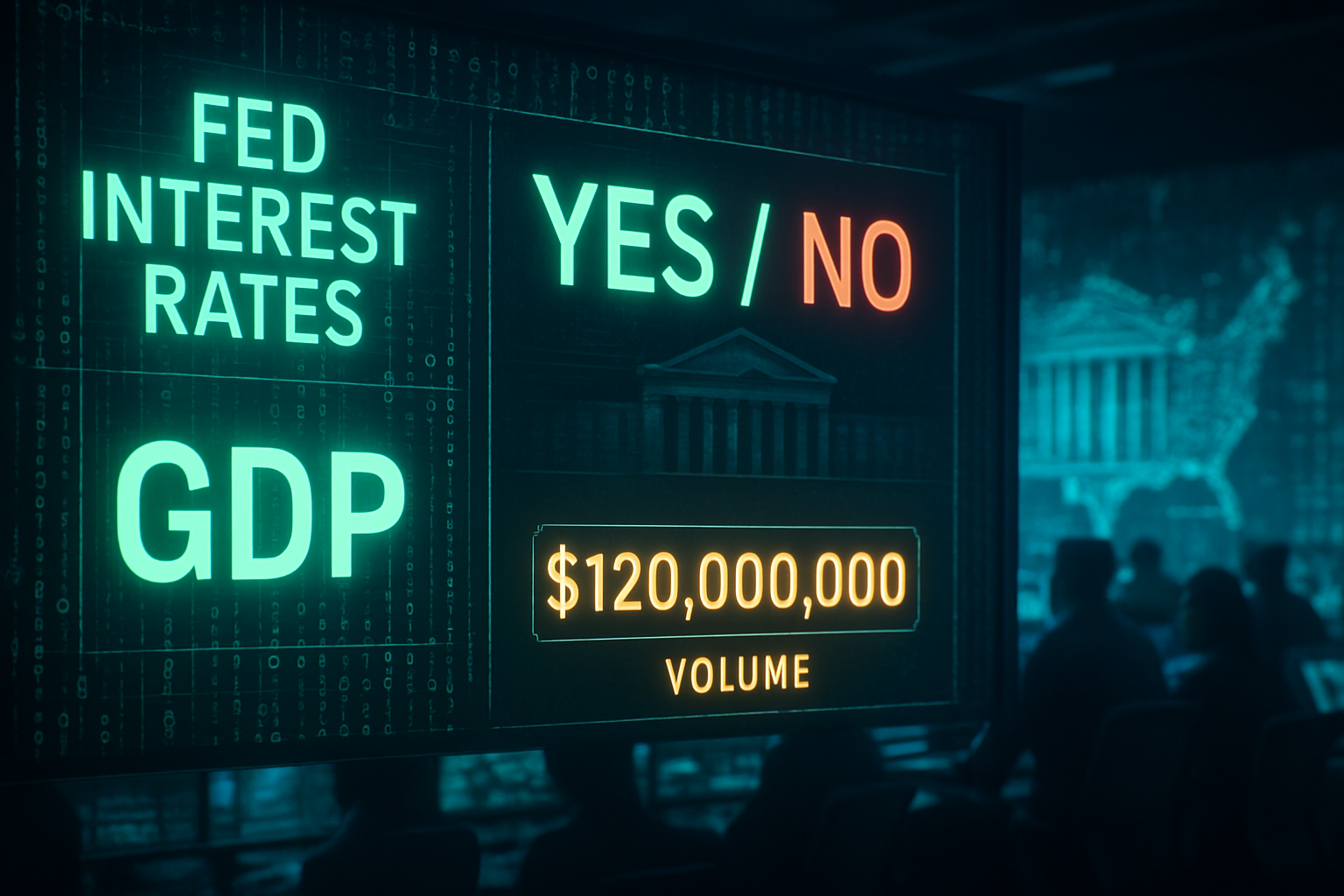
  • The $120 Million Bet: Why ‘Hard’ Economic Markets are Dominating Kalshi’s Order Books

    The $120 Million Bet: Why ‘Hard’ Economic Markets are Dominating Kalshi’s Order Books

    As of January 15, 2026, the global prediction market landscape has evolved from a speculative niche into a $20 billion pillar of institutional finance. While political elections once provided the primary fuel for these platforms, the focus has shifted decisively toward "hard" macroeconomic data. The centerpiece of this shift is Kalshi’s blockbuster contract, "Will the Fed cut rates in March 2026?", which has just crossed a staggering $120 million in trading volume.

    Currently, the market reflects a cautious consensus. Traders are pricing in a 95% probability that the Federal Reserve will maintain current rates during the upcoming January 28 meeting, but the March contract is where the real battle is being fought. With professional desks and retail investors alike pouring capital into these binary options, prediction markets are no longer just guessing games—they are serving as the "truth engine" for the modern economy.

    The Market: What's Being Predicted

    The headline event for the first quarter of 2026 is the Federal Reserve’s interest rate trajectory. On Kalshi, the flagship "Will the Fed cut rates in March?" contract has become one of the most liquid financial instruments in the event-trading space. Unlike traditional interest rate futures traded on the CME Group (NASDAQ: CME), which involve complex calculations of the effective federal funds rate, Kalshi’s contracts are legally structured binary derivatives. They pay out $1 if the event occurs and $0 if it does not, making the trading price a direct proxy for the market-implied probability.

    The liquidity in this market is unprecedented. The $120 million volume in the March contract is supported by a mix of institutional "whales" and a massive influx of retail traders following the platform's 2025 integration with Robinhood Markets (NASDAQ: HOOD). Resolution is straightforward: the market settles based on the official post-meeting statement from the Federal Open Market Committee (FOMC). If the Fed announces a cut of at least 25 basis points, "Yes" contracts pay out; if they hold or hike, "No" contracts take the pot.

    Why Traders Are Betting

    The surge in volume isn't just driven by retail enthusiasm; it is powered by professional firms like Susquehanna and DRW, alongside hedge funds such as Saba Capital. These entities use Kalshi to hedge "tail risk"—extreme events that traditional bond or equity hedges might fail to cover. For instance, if a portfolio is heavily exposed to high-duration Treasuries, a surprise "no cut" in March could be devastating. By buying "No" contracts on Kalshi, these firms create a direct, linear hedge against a hawkish Fed.

    Furthermore, these markets are proving to be more agile than traditional forecasting. While the Atlanta Fed’s GDPNow model recently estimated Q4 2025 growth at a robust 5.3%, Kalshi’s "GDP Print" markets have consistently traded at a more conservative 45-52% probability for a high-growth outcome. Professional traders are betting on this divergence, using prediction markets to exploit what they see as "model lag" in traditional economic indicators. In 2025, Kalshi traders outperformed Wall Street consensus on inflation data by nearly 40%, cementing the platform's reputation for accuracy during periods of high volatility.

    Broader Context and Implications

    The dominance of "hard" economic markets on Kalshi reflects a broader trend: the institutionalization of prediction markets. Because Kalshi is a CFTC-regulated exchange, its contracts are treated as legally structured derivatives, allowing large-scale asset managers like BNY (NYSE: BK) to participate without the regulatory hurdles associated with offshore or decentralized platforms. This legal clarity has allowed prediction markets to steal market share from the traditional CME FedWatch tool, which many traders now view as slower and more volatile.

    This shift also reveals a fundamental change in how public sentiment is measured. Unlike surveys or "nowcasts," prediction markets require participants to put real capital at risk, filtering out noise and focusing on the most likely outcomes. The historical accuracy of these markets throughout late 2025 has turned them into a primary source of data for newsrooms and policy makers. When the "hard" markets speak, the financial world now listens with the same intensity it once reserved for Bloomberg terminals or Federal Reserve minutes.

    What to Watch Next

    The immediate focus for traders is the January 28 FOMC meeting. While a "pause" is almost entirely priced in, the language used by the Fed Chair will cause immediate, violent swings in the March cut contract. Every word regarding labor market cooling or stubborn service-sector inflation will be instantly reflected in the Kalshi price.

    Additionally, the release of the final Q4 2025 GDP print in late January will be a major catalyst. If the GDP data aligns with the more cautious prediction market view rather than the optimistic "nowcasts," it could trigger a massive migration of capital away from traditional economic models and into event-based derivatives. Traders should also keep an eye on February’s CPI (Consumer Price Index) release, which will serve as the final major data point before the March Fed decision.

    Bottom Line

    The transition of prediction markets from political novelties to essential macroeconomic tools is now complete. The $120 million volume in Kalshi’s March rate cut contract is a testament to the platform's liquidity and its growing role in the global financial infrastructure. By providing a regulated, binary way to trade on the most important economic indicators, Kalshi has effectively democratized sophisticated hedging strategies.

    As we move toward the March decision, these markets will likely remain the most accurate barometer of economic reality. Whether the Fed cuts or holds, the real winner in 2026 is the prediction market itself, which has finally proven that the "wisdom of the crowd"—when backed by $120 million—is a force that even the most established financial institutions can no longer ignore.


    This article is for informational purposes only and does not constitute financial or betting advice. Prediction market participation may be subject to legal restrictions in your jurisdiction.

    PredictStreet focuses on covering the latest developments in prediction markets.
    Visit the PredictStreet website at https://www.predictstreet.ai/.