Tag: Interactive Brokers

  • States Launch “Guerrilla War” Against Kalshi: The Legal Battle Reshaping the 2026 Prediction Market Landscape

    States Launch “Guerrilla War” Against Kalshi: The Legal Battle Reshaping the 2026 Prediction Market Landscape

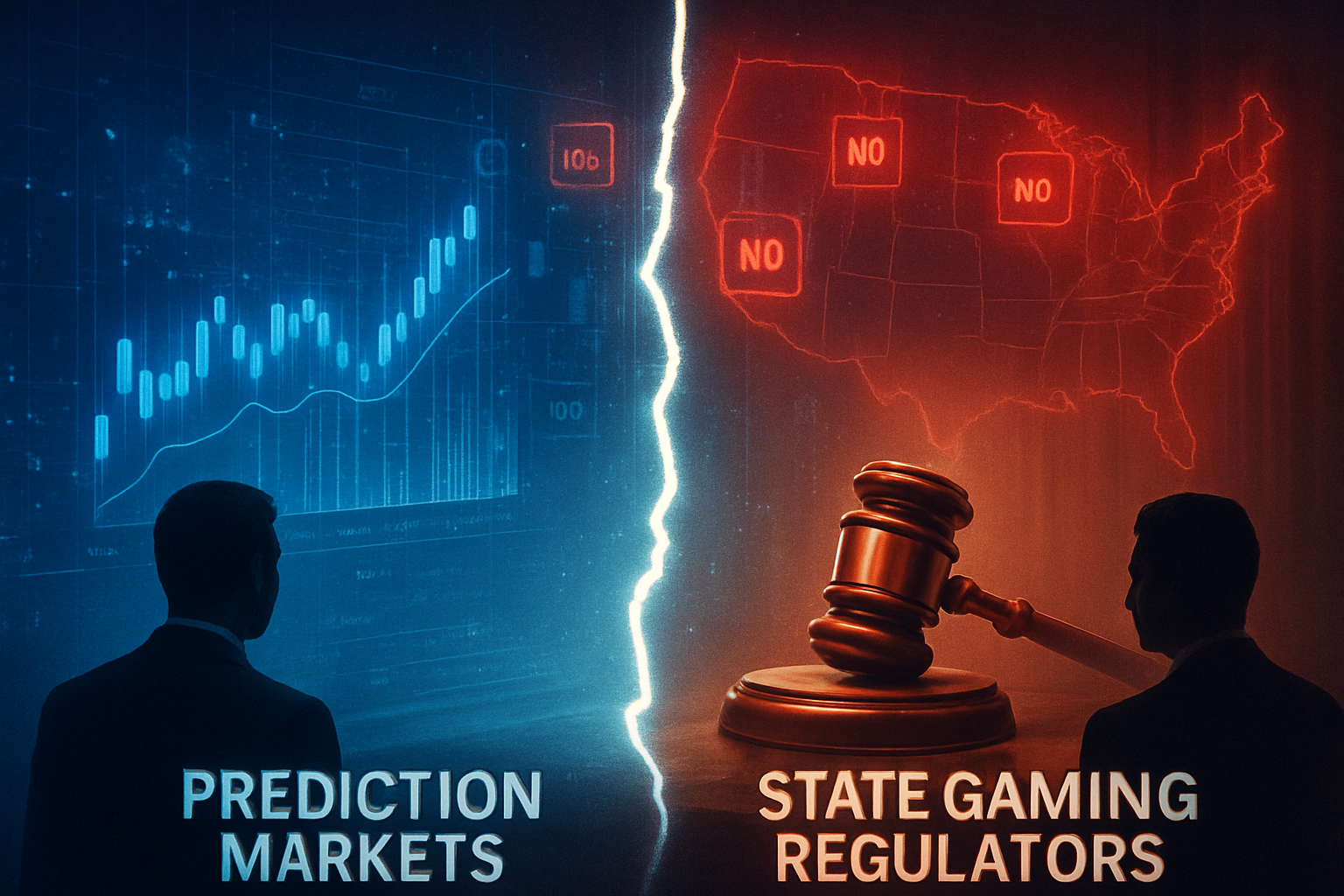
    The high-stakes world of prediction markets is currently facing its most existential threat since the landmark 2024 election cycle. As of February 8, 2026, Kalshi—the first federally regulated prediction market—is locked in what legal scholars are calling a "guerrilla war" with state gaming regulators in Massachusetts, Nevada, and Connecticut. At the heart of the conflict is a fundamental disagreement over the definition of a "contract": Is an event-based prediction a federally protected financial derivative, or is it simply unlicensed gambling?

    Traders are closely watching the fallout, with current market sentiment on peer-to-peer forecasting platforms shifting rapidly. While Kalshi dominated the late 2024 and early 2025 volume cycles, the threat of state-mandated geofencing has caused its probability of maintaining volume leadership for 2026 to slip. For the first time in two years, decentralized rival Polymarket has overtaken Kalshi in "Total 2026 Volume" odds, with traders pricing in a 47% chance for the offshore platform to lead the year, compared to Kalshi’s 34%, as regulatory "indigestion" begins to take its toll on domestic liquidity.

    The Market: What’s Being Predicted

    The primary market under the microscope isn't just a single event contract, but the survival and growth of the regulated prediction market industry itself. Specifically, traders are betting on whether Kalshi can successfully maintain its dominance in the "Sports Event Contract" sector—a category that accounted for a staggering 91.1% of its $9.1 billion trading volume in January 2026.

    On Kalshi’s own platform and institutional dashboards like those offered by Interactive Brokers (NASDAQ: IBKR), liquidity has become fragmented as state-level injunctions take effect. The resolution of this legal friction hinges on several key criteria: the ability of Kalshi to overturn state-level cease-and-desist orders and whether the federal government will intervene to assert preemption over state "police powers." If Kalshi is forced to geofence more than 10 states by the end of Q3 2026, analysts expect a "liquidity crater" that could permanently hand the crown to decentralized competitors.

    Why Traders Are Betting

    The sudden bearishness on Kalshi’s 2026 outlook stems from a series of legal setbacks in early 2026. In late January, Judge Christopher K. Barry-Smith of the Suffolk County Superior Court granted a preliminary injunction in Commonwealth of Massachusetts v. KalshiEX LLC, ruling that Kalshi’s sports-related contracts constitute "unlicensed gambling." The judge’s observation that the interface "mirrors digital gambling experiences" has terrified bulls who believed federal CFTC regulation provided a "bulletproof vest" against state gaming commissions.

    Whale activity has notably shifted toward defensive positions. Large-scale traders are hedging their domestic exposure by moving capital into macro-focused exchanges like ForecastEx, operated by Interactive Brokers (NASDAQ: IBKR), which focuses on non-sports contracts like CPI and interest rates to avoid the "gambling" label. Meanwhile, Robinhood (NASDAQ: HOOD), which previously partnered with Kalshi to offer event markets to its retail base, has seen its stock price face volatility as it weighs the risks of its own upcoming proprietary exchange launch, LedgerX.

    Broader Context and Implications

    This "guerrilla war" represents a classic clash between federal and state authority. While Kalshi remains a Designated Contract Market (DCM) under the oversight of the Commodity Futures Trading Commission (CFTC), states are utilizing the "Gaming Clause" of the Commodity Exchange Act to argue that federal law does not extinguish their right to regulate wagering. This has created a "phantom liquidity" scenario—where national price discovery exists in theory, but is physically blocked for millions of Americans via geofencing.

    The real-world implications are profound. If state regulators succeed in reclassifying these markets as gambling, the dream of a unified, high-liquidity national prediction market may die. Instead, the industry would be forced into the fragmented, state-by-state licensing model used by sportsbooks like DraftKings or FanDuel. Furthermore, Coinbase (NASDAQ: COIN) has entered the fray, proactively suing regulators in Connecticut and Illinois to defend the federal preemption of blockchain-based prediction products, signaling that the entire crypto and fintech ecosystem sees this as a do-or-die moment for digital assets.

    What to Watch Next

    The most immediate catalyst for the market is a high-stakes hearing in Connecticut scheduled for February 12, 2026. Traders view this as a pivotal test for the "federal preemption" defense; a defeat for Kalshi here is expected to trigger a domino effect of geofencing across the Northeast.

    Beyond February, the Ninth Circuit Court of Appeals is scheduled to hear oral arguments in KalshiEX LLC v. Nevada Gaming Control Board in April 2026. This case is particularly significant because Nevada is the epicenter of American gambling regulation. If Kalshi wins in the Ninth Circuit, it could provide the legal precedent needed to halt the state-level "guerrilla war" and restore investor confidence. Conversely, a loss would likely cement Kalshi's status as a regional, rather than national, player for the remainder of the year.

    Bottom Line

    The legal friction between Kalshi and state gaming commissions has transformed the prediction market landscape from a "blue ocean" of growth into a jurisdictional battlefield. While Kalshi’s $9.1 billion volume in January shows the massive appetite for regulated event contracts, the 91.1% concentration in sports contracts has left the platform uniquely vulnerable to state regulators who view any "win-loss" outcome as their exclusive domain.

    Ultimately, the 2026 volume leadership race is no longer just about who has the better app or more markets—it is about who can navigate the complex web of American federalism. If Kalshi cannot secure a "preemption victory" in the coming months, the prediction market industry may face a Great Bifurcation: a regulated, institutional market for macro events, and a decentralized, offshore market for everything else. For now, the "guerrilla war" continues, and the odds of a Kalshi-dominated 2026 are narrowing by the day.


    This article is for informational purposes only and does not constitute financial or betting advice. Prediction market participation may be subject to legal restrictions in your jurisdiction.

    PredictStreet focuses on covering the latest developments in prediction markets.
    Visit the PredictStreet website at https://www.predictstreet.ai/.
  • The 2026 Volume War: Polymarket and Kalshi Battle for the Future of ‘InfoFi’

    The 2026 Volume War: Polymarket and Kalshi Battle for the Future of ‘InfoFi’

    As of late January 2026, the prediction market landscape has officially transitioned from a niche fascination into a multi-billion dollar pillar of global finance. The industry, now frequently referred to as "Information Finance" or "InfoFi," hit a staggering record of $5.23 billion in combined weekly trading volume earlier this month. At the heart of this explosion is an intense "volume war" between the decentralized giant Polymarket and the CFTC-regulated Kalshi, with the two platforms currently locked in a struggle for absolute market dominance.

    On the meta-forecasting platform Manifold Markets, a high-stakes contract titled "Top 1 Prediction Market by Volume in 2026" has become the definitive scoreboard for industry insiders. Currently, Polymarket leads the field with 47% odds of finishing the year as the volume king, while Kalshi trails at 34%. This 13-point gap highlights a growing sentiment among professional traders: while Kalshi may have the raw numbers today thanks to a heavy pivot into sports, Polymarket’s "event-pure" dominance in politics and global news makes it the more resilient long-term bet.

    The Market: What's Being Predicted

    The central question for 2026 is whether the "notional volume" generated by sports bettors can outpace the "information volume" generated by political and economic speculators. The Manifold Markets contract has seen significant volatility over the last thirty days. In December 2025, Kalshi held a slight lead as the NFL and NCAA seasons reached their peak. However, January 2026 has seen a sharp reversal, with Polymarket's odds surging from 38% to 47% in just three weeks.

    While Kalshi is currently on pace to facilitate roughly $9.1 billion in volume for January alone, much of this is concentrated in high-frequency sports wagers. In contrast, Polymarket has seen a massive influx of liquidity following its late-2025 acquisition of QCEX, a CFTC-licensed exchange. This strategic move allowed Polymarket to relaunch legally in the United States as a Designated Contract Market (DCM), tapping into a massive domestic waitlist that has existed since its 2022 regulatory settlement.

    Other competitors are also entering the fray, though they remain in the shadow of the Big Two. ForecastEx, the native platform of Interactive Brokers (NASDAQ: IBKR), currently holds 12% odds on Manifold, while Robinhood (NASDAQ: HOOD) sits at 7%. The resolution of these markets typically hinges on publicly reported audited volume, which has become a key metric for equity analysts tracking the fintech sector.

    Why Traders Are Betting

    The primary driver behind Polymarket’s current lead in the meta-contract is the perceived fragility of Kalshi’s sports-heavy volume. As of January 2026, an estimated 91.1% of Kalshi's volume is derived from sports contracts. While the NCAA Championship game on January 20 alone generated $111 million in activity, Kalshi hit a major regulatory speed bump last week. A Massachusetts judge issued a preliminary injunction barring the platform from offering sports contracts in the state, ruling they constitute illegal gambling under state law. With other states like New York and New Jersey reportedly considering similar moves, traders are fleeing Kalshi’s volume odds.

    Polymarket, meanwhile, has doubled down on its status as a "global truth engine." Its volume is significantly more diversified, with sports accounting for only 39.9% of its activity. The rest is driven by high-stakes geopolitical and financial events. Recent notable activity includes:

    • The "Maduro Trade": Massive wagers on the political future of Nicolás Maduro, which spiked to over $150 million in volume this month.
    • Fed Chair Nominations: Markets regarding the second Trump administration's potential Federal Reserve appointments have surpassed $329 million in cumulative volume.
    • Military Conflict: Markets on Iran-related military escalations saw $107 million in liquidity in a single weekend.

    Whale activity has also shifted. Institutional desks that previously used Interactive Brokers (NASDAQ: IBKR) for hedging are increasingly seen providing liquidity on Polymarket’s new US-regulated arm, attracted by the platform's superior depth in non-sports categories.

    Broader Context and Implications

    The "Volume War" of 2026 represents the final validation of prediction markets as a legitimate asset class. This shift has been accelerated by a friendlier regulatory environment in Washington. The new CFTC Chair, Michael Selig—appointed in December 2025—has publicly characterized prediction markets as "essential federally regulated derivatives," effectively providing a legal shield against the more aggressive state-level bans that have plagued Kalshi’s sports expansion.

    Furthermore, the integration of these markets into mainstream financial "plumbing" is nearly complete. Polymarket now provides real-time forecast data to major media outlets owned by News Corp (NASDAQ: NWSA), including The Wall Street Journal and Barron’s. Similarly, Coinbase (NASDAQ: COIN) has officially integrated prediction market feeds into its "Everything Exchange," allowing retail users to trade event contracts alongside traditional crypto assets.

    What this reveals about public sentiment is a profound distrust in traditional polling. In 2026, the "Polymarket Price" is often cited by news anchors as more reliable than data from traditional research firms. The market is no longer just a place to bet; it is the primary source of truth for the probability of future events.

    What to Watch Next

    The upcoming 2026 Midterm Elections will likely be the single largest volume event in the history of prediction markets. Traders are watching to see if Polymarket can maintain its momentum as the go-to destination for political junkies. Additionally, the 2026 FIFA World Cup, hosted across North America, will be a massive test for Polymarket’s new exclusive partnership with Major League Soccer (MLS). If Polymarket can capture a significant slice of World Cup volume while maintaining its political dominance, Kalshi will find it nearly impossible to reclaim the lead.

    Key dates to monitor include the February 15 CFTC hearing on cross-margining for event contracts, which could allow traders to use their equity or crypto portfolios as collateral for prediction market positions. Any further state-level injunctions against Kalshi will also serve as a "buy" signal for Polymarket's 2026 volume odds.

    Bottom Line

    The battle between Polymarket and Kalshi is more than a corporate rivalry; it is a test of what prediction markets are actually for. Kalshi is currently winning the battle of raw numbers by catering to the sports-betting public through its integration with Robinhood (NASDAQ: HOOD). However, Polymarket is winning the battle of "relevance" by dominating the markets that matter to global decision-makers.

    As of January 30, 2026, the 47% to 34% split on Manifold Markets suggests that the "smart money" favors the platform that prioritizes information over entertainment. Whether Kalshi can pivot back to its roots in economic forecasting or Polymarket can successfully navigate the complexities of US regulation remains the multi-billion dollar question. For now, the "Volume War" shows no signs of cooling down, and the ultimate winner will likely define the future of how the world processes information.


    This article is for informational purposes only and does not constitute financial or betting advice. Prediction market participation may be subject to legal restrictions in your jurisdiction.

    PredictStreet focuses on covering the latest developments in prediction markets.
    Visit the PredictStreet website at https://www.predictstreet.ai/.

  • The Financialization of Truth: Why Prediction Markets Are the New Gold Standard for Forecasting

    The Financialization of Truth: Why Prediction Markets Are the New Gold Standard for Forecasting

    As we cross into 2026, the global information landscape has undergone a radical transformation. The era of relying solely on traditional polling—often criticized for its slow response times and methodological lag—is being eclipsed by the rise of prediction markets. Following their standout performance during the 2024 US Presidential Election, these platforms are no longer viewed as niche betting hubs; they have become the "new gold standard" for real-time data, drawing in billions of dollars from retail and institutional investors alike.

    Currently, the markets are hyper-focused on the 2026 US Midterm elections and the upcoming January FOMC meeting. With daily trading volumes recently surpassing $700 million across major platforms, the "wisdom of the crowd" is being priced into the global economy with unprecedented precision. On Polymarket, traders are currently pricing in a 79% probability of a Democratic takeover of the House of Representatives, while the Senate remains leaning GOP at 67%. These are not just guesses; they are financial positions held by thousands of participants with "skin in the game."

    The Market: What's Being Predicted

    The current landscape is dominated by a "triopoly" of major platforms: the US-regulated exchange Kalshi, the decentralized giant Polymarket, and the rapidly scaling Opinion Labs. Unlike the early days of event wagering, the markets in January 2026 cover a granular spectrum of outcomes. In the political sphere, the "Balance of Power" contracts for the November 2026 Midterms are seeing massive liquidity. Institutional traders are aggressively hedging against a "Divided Government," a scenario that historically leads to market gridlock—often a favorable outcome for equities.

    Beyond politics, macro-economic markets have become essential tools for treasury departments. The January 28 Federal Reserve meeting is currently priced at a near-certain 98% probability of a rate pause. However, the true intrigue lies in the March 2026 meeting, where markets are pricing a 74% chance of a rate cut. These odds have moved significantly in the last 48 hours following rumors of a leadership shift at the Fed.

    The volume and liquidity in these markets are staggering. Robinhood Markets, Inc. (NASDAQ: HOOD) reported that its integrated "Prediction Markets Hub" facilitated over 2.5 billion contracts in late 2025 alone. Similarly, Interactive Brokers Group, Inc. (NASDAQ: IBKR) has seen its ForecastEx affiliate volume explode, treating these contracts more like standardized financial derivatives than speculative bets.

    Why Traders Are Betting

    The shift toward prediction markets as a primary forecasting tool stems from their remarkable accuracy during the 2024 election cycle. While traditional polls and models like FiveThirtyEight struggled to capture the momentum of "low-propensity" voters, Polymarket called the 2024 race with 95% certainty for Donald Trump hours before major news networks. In a world where news travels at the speed of social media, the 14-day lag typical of a high-quality poll is an eternity.

    Traders are betting because markets react to news instantly. During the June 2024 presidential debate, prediction market odds for the Democratic ticket began a vertical descent within 15 minutes of the opening statements. It took traditional polling outfits nearly two weeks to confirm the same sentiment shift. This real-time adaptability is why institutional investors are increasingly looking at market prices rather than survey data.

    Furthermore, the "Wisdom of the Crowd" theory suggests that a diverse group of individuals, each with their own private information and financial incentives, will collectively produce a more accurate forecast than any single expert. When a trader places a $100,000 bet on a SpaceX IPO date, they are incentivized to be right, not to provide a socially desirable answer to a pollster.

    Broader Context and Implications

    The "Financialization of Information" has significant implications for how the public consumes news. We are moving toward a "Truth Layer" where the most probable version of reality is reflected in a price ticker. This trend was solidified in late 2025 when the Intercontinental Exchange, Inc. (NYSE: ICE)—the parent company of the New York Stock Exchange—made a landmark $2 billion investment in Polymarket, valuing the platform at roughly $9 billion.

    Regulatory hurdles that once stifled the industry are also falling. The landmark Kalshi vs. CFTC rulings provided the legal "green light" for US-based political contracts, essentially arguing that these markets do not constitute "gaming" but rather vital economic tools for hedging political risk. The subsequent passage of the Digital Asset Market CLARITY Act of 2025 further legitimized the space by classifying many event contracts as digital commodities under CFTC oversight.

    However, the rapid growth has brought new challenges. In January 2026, Rep. Ritchie Torres introduced the Public Integrity in Financial Prediction Markets Act (H.R. 7004), aimed at preventing "insider trading" by government officials. This followed a controversial surge in volume on a Venezuelan leadership contract just hours before a major US diplomatic announcement, raising questions about who has access to the information moving these markets.

    What to Watch Next

    As we move toward the spring of 2026, several key milestones will determine if prediction markets can maintain their "gold standard" status. The primary focus will be the upcoming US Midterm primaries. If the markets can accurately predict the "unpredictable" primary upsets that often baffle pollsters, their credibility will only strengthen.

    Investors should also watch the "SpaceX IPO" market on Kalshi. Currently, there is a 58% probability that an IPO will be announced before July 1, 2026. Given the massive valuation of SpaceX, this market serves as a proxy for broader sentiment on the private tech sector and interest rate environments.

    Lastly, the ongoing legal battle between the "Coalition for Prediction Markets"—which includes Coinbase Global, Inc. (NASDAQ: COIN) and Robinhood—and several state regulators in Nevada and Tennessee will be critical. A victory for the coalition would likely lead to a unified national standard, potentially opening the door for prediction markets to be included in retirement accounts and traditional portfolios.

    Bottom Line

    Prediction markets have fundamentally changed how we forecast the future. By attaching a price tag to truth, they have created a more resilient, faster, and often more accurate data source than traditional polling could ever hope to be. The 2024 election was the proof of concept; the massive institutional adoption of 2025 and 2026 is the expansion phase.

    For the average observer, these markets offer a clear, un-biased view of what the world actually thinks is going to happen, stripped of partisan spin. As long as participants have "skin in the game," the price will remain one of the most honest indicators we have. Whether you are a retail trader on Robinhood or a hedge fund manager at ICE, prediction markets are no longer a side show—they are the main event.


    This article is for informational purposes only and does not constitute financial or betting advice. Prediction market participation may be subject to legal restrictions in your jurisdiction.

    PredictStreet focuses on covering the latest developments in prediction markets.
    Visit the PredictStreet website at https://www.predictstreet.ai/.
  • The Empire State’s Existential Bet: Will New York Shutdown the Prediction Market Boom?

    The Empire State’s Existential Bet: Will New York Shutdown the Prediction Market Boom?

    As the 2026 legislative session kicks off in Albany, the future of the prediction market industry in the United States is being decided not in a courtroom or on a trading floor, but in the halls of the New York State Assembly. The Oversight and Regulation of Activity for Contracts Linked to Events (ORACLE) Act, also known as Assembly Bill A9251, has emerged as the most significant threat to the burgeoning "event contract" sector since its mainstream explosion in 2024.

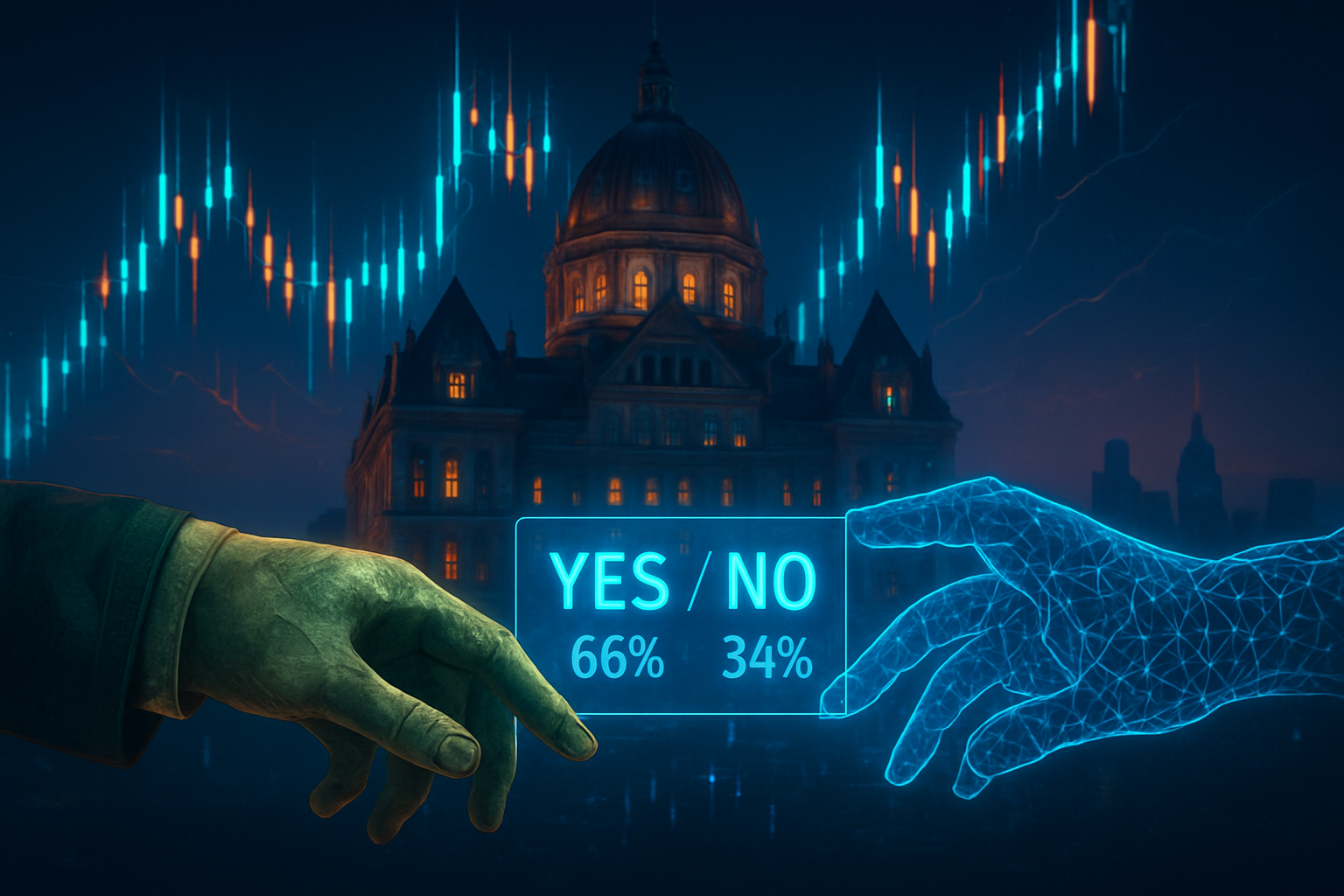
    Currently, decentralized markets on platforms like Polymarket are pricing in a 64% probability that New York will successfully enact a ban on key prediction categories by the end of 2026. This legislative surge follows a period of rapid growth and high-profile controversy, most notably a series of trades linked to geopolitical events that have lawmakers questioning whether these platforms are "truth machines" or high-stakes casinos for insider trading.

    The Market: What's Being Predicted

    The legislative battle in New York has become a market in its own right. On Polymarket, the world’s largest decentralized prediction platform, tens of millions of dollars are riding on the outcome of "New York Ban" contracts. These markets surged to a 64% "Yes" probability in mid-January 2026, immediately following the re-introduction of the ORACLE Act (A9251) on January 7.

    The bill, sponsored by Assemblymember Clyde Vanel (D-Queens), is often referred to by industry insiders as the "Nuclear Option." If passed, it would classify prediction market trading on politics, sports, and "catastrophic events"—such as wars or mass shootings—as unlicensed gambling. The penalties are draconian: any platform failing to comply with a court-ordered injunction would face a staggering $1 million per day fine.

    While the "ban" side remains the favorite on decentralized platforms, the outlook on regulated exchanges like Kalshi tells a more nuanced story. A proxy market on Kalshi reflecting the state’s regulatory climate saw the probability of a ban drop from 65% to 38% in the third week of January. This volatility is largely attributed to a competing, more moderate piece of legislation: Senate Bill S8889. Introduced by Senator Jeremy Cooney, S8889 seeks to license and tax prediction markets under the New York Department of Financial Services (DFS), treating them as financial derivatives rather than gambling.

    Why Traders Are Betting

    The primary driver behind the ORACLE Act’s momentum is the "insider trading" narrative. Lawmakers in Albany have been fixated on the so-called "Maduro Trade" of early January 2026, where a single Polymarket whale allegedly turned a $32,000 position into $400,000 just hours before a U.S.-led operation in Venezuela. Assemblymember Vanel has used this incident as a rallying cry, arguing that these markets invite "corruption and the gamification of tragedies."

    However, institutional "whales" are increasingly betting on a compromise. Notable large-scale positions have recently been taken on the "No Ban" side, fueled by several key factors:

    • Industry Pushback: A newly formed "Coalition for Prediction Markets," led by Interactive Brokers (NASDAQ: IBKR) and Robinhood (NASDAQ: HOOD), has launched a massive lobbying effort in Albany. They argue that banning these markets would drive innovation out of the world’s financial capital.
    • The "MSG Strategy": In a bold attempt to win over public sentiment, Polymarket recently signed a sponsorship deal with the New York Rangers, displaying live event odds on the scoreboards at Madison Square Garden. Traders believe this "normalization" strategy makes a total ban politically difficult for Governor Kathy Hochul.
    • Federal Preemption: Legal experts betting on the "No" side believe that because platforms like Kalshi are regulated by the Commodity Futures Trading Commission (CFTC), federal law will ultimately override (or "preempt") state-level bans under the Commodity Exchange Act.

    Broader Context and Implications

    The New York battle is a microcosm of a larger national struggle over the definition of "gambling" versus "hedging." For years, prediction markets operated in a gray area, but the recent entry of major public firms has forced the issue. DraftKings (NASDAQ: DKNG) and Flutter Entertainment (NYSE: FLUT), the parent company of FanDuel, have recently split from traditional gaming trade groups to support a regulated prediction market framework, signaling that the line between sports betting and financial forecasting is permanently blurring.

    If the ORACLE Act passes in its current form, it could set a dangerous precedent for other states. New York’s aggressive stance contrasts sharply with states like New Jersey and Illinois, which are exploring ways to tax these markets as a new revenue stream. For the industry, New York is the "must-win" state. A ban here would not only lock out a massive retail market but would also threaten the liquidity and accuracy of global contracts that rely on the participation of New York-based financial professionals.

    The debate also reveals a fundamental shift in how the public consumes information. Proponents, including IBKR Chairman Thomas Peterffy, describe these markets as "Truth Discovery Engines" that outperform traditional polling and expert analysis. Critics, meanwhile, view them as an unregulated "Wild West" that incentivizes bad actors to profit from chaos.

    What to Watch Next

    The next 60 days will be critical for the ORACLE Act. Traders are closely monitoring the Assembly Committee on Consumer Affairs and Protection, where A9251 is currently being debated. A vote to move the bill out of committee would likely send the "Ban" odds back toward the 80% range.

    Key dates to watch:

    • February 24, 2026: A major ruling is expected in the Southern District of New York (SDNY) regarding Kalshi’s ongoing litigation with the New York Gaming Commission. This court case will serve as a bellwether for whether the state has the legal authority to override federal oversight.
    • The Budget Deadline (April 1, 2026): Governor Kathy Hochul has signaled a desire to "safeguard" the public from gamified finance. If she includes language from the ORACLE Act in her executive budget, it would be a near-certain sign that a ban is coming.
    • The Cooney Bill Hearings: Keep an eye on Senator Cooney’s S8889. If this bill gains support from the Department of Financial Services, it could offer a "third way" that keeps prediction markets legal but strictly regulated.

    Bottom Line

    The legislative fight in New York represents a defining moment for prediction markets. On one side, the ORACLE Act seeks to slam the door shut on what it views as a predatory and dangerous new form of gambling. On the other, a coalition of fintech giants and retail traders is fighting to preserve a tool they believe is essential for the 21st-century information economy.

    As of late January 2026, the markets remain split. While the political momentum in the Assembly favors a ban, the sheer weight of the financial and legal arguments from firms like Interactive Brokers (NASDAQ: IBKR) and Robinhood (NASDAQ: HOOD) suggests that a total shutdown is far from guaranteed. For now, the safest bet is that New York’s regulatory landscape is about to get much more complicated, and the "truth" about these markets will be decided by the highest bidder in Albany.


    This article is for informational purposes only and does not constitute financial or betting advice. Prediction market participation may be subject to legal restrictions in your jurisdiction.

    PredictStreet focuses on covering the latest developments in prediction markets.
    Visit the PredictStreet website at https://www.predictstreet.ai/.
  • The 11 Billion Contract Explosion: How Robinhood and Interactive Brokers Mainstreamed Prediction Markets

    The 11 Billion Contract Explosion: How Robinhood and Interactive Brokers Mainstreamed Prediction Markets

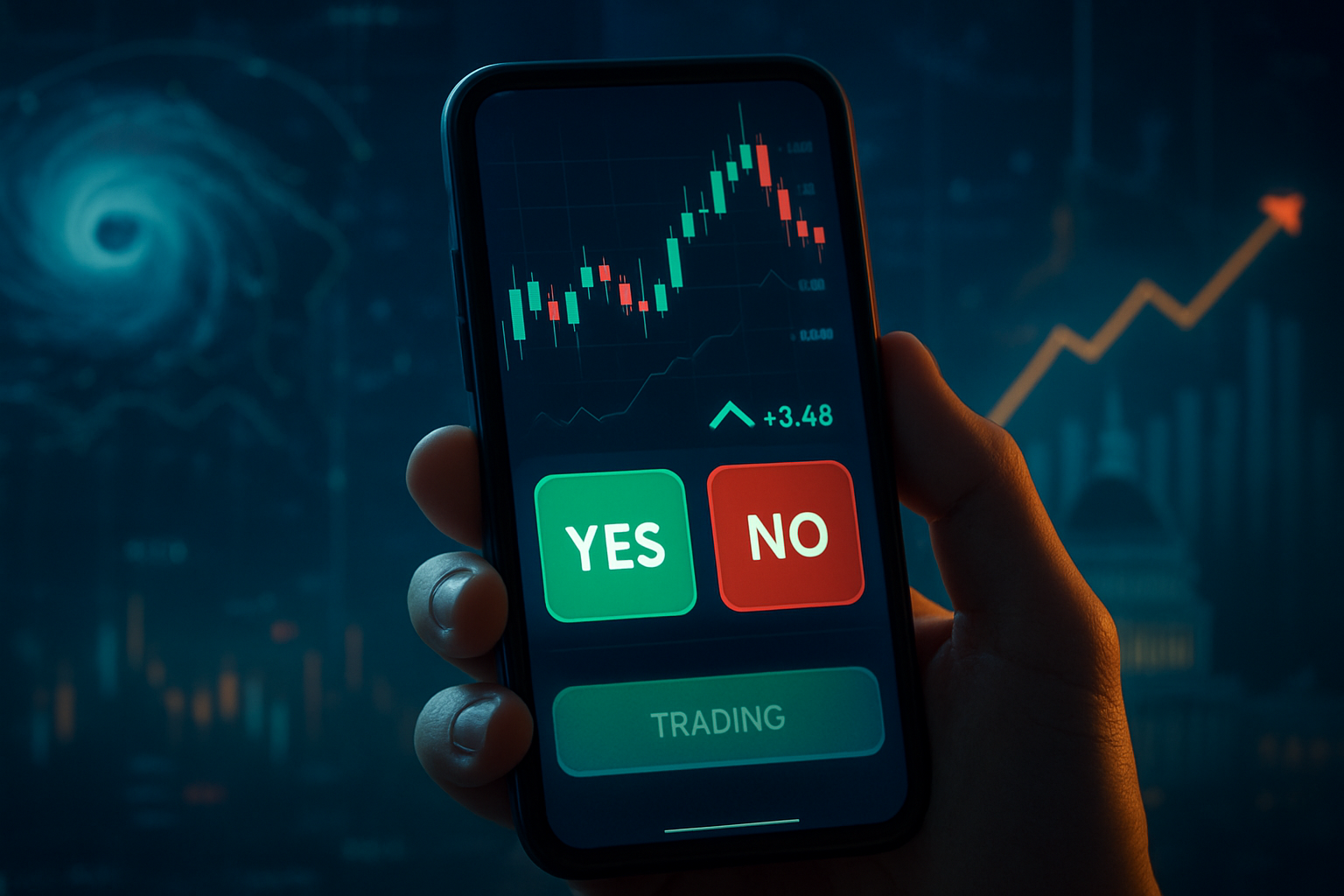
    In the span of just ten months, prediction markets have transitioned from a niche obsession of political junkies and crypto-enthusiasts to a cornerstone of the modern retail brokerage experience. As of January 18, 2026, the industry is reeling from a staggering milestone: Robinhood Markets, Inc. (NASDAQ: HOOD) has processed over 11 billion contracts through its "Prediction Markets Hub" since its debut in March 2025. This volume represents more than just a successful product launch; it signals a fundamental shift in how the public perceives information, risk, and the "truth" of future events.

    The surge is fueled by a combination of regulatory clarity and the gamification of macroeconomic and climate data. While Robinhood captures the mass retail audience with sports and pop culture "Combos," Interactive Brokers Group, Inc. (NASDAQ: IBKR) has carved out a sophisticated niche with its ForecastEx platform, where businesses are now bypassing traditional insurance to hedge against the increasing volatility of climate change. With current odds on the platform suggesting a 68% probability of a record-breaking 2026 hurricane season, the market has become a real-time barometer for global anxiety and anticipation.

    The Market: What's Being Predicted

    The current landscape is dominated by Robinhood’s "Prediction Markets Hub," which launched on March 17, 2025. What began as a platform for trading the Federal Funds Rate and NCAA tournament outcomes has expanded into a comprehensive "everything-market." Traders are currently placing massive bets on the timing of the next Federal Reserve rate cut (currently trading at a 42% probability for March 2026) and the outcome of the upcoming 2026 midterm elections. The liquidity in these markets is unprecedented; bid-ask spreads on major political and economic events have narrowed to less than a cent, rivaling the efficiency of blue-chip equities.

    On the more specialized front, Interactive Brokers' ForecastEx has become the go-to exchange for "Economic and Environmental Hedging." ForecastEx utilizes a "Yes/No" contract structure that pays out $1 upon resolution. Unlike the more speculative "meme-heavy" trades found elsewhere, ForecastEx features high-volume contracts on hyper-local weather events, such as the probability of a Category 3 hurricane making landfall in Miami-Dade County. This market saw a massive spike in October 2025 during the approach of Hurricane Melissa, with trading volume reaching $500 million in a single week.

    The resolution criteria for these markets have become increasingly standardized. Robinhood recently announced its "Cortex" AI, an assistant that monitors verified data feeds—from NOAA for weather to the Bureau of Labor Statistics for CPI—to ensure near-instantaneous settlement. This speed has turned prediction markets into a high-frequency trading environment, with over 3 billion contracts traded in November 2025 alone.

    Why Traders Are Betting

    The primary driver of the current retail frenzy is the "democratization of the hedge." Traditionally, only large corporations could afford complex derivatives to protect against economic shifts or weather disasters. Today, a small business owner in Florida can use ForecastEx to buy "Yes" contracts on a local hurricane landfall. If the storm hits, the payout provides immediate liquidity to cover damages—often weeks before a traditional insurance claim would be processed. During the Hurricane Melissa event in October 2025, market participants correctly predicted the landfall location in the Bahamas four days before major meteorological models reached a consensus.

    For the Robinhood crowd, the motivation is often a blend of entertainment and "Information Finance." The platform’s introduction of "Custom Combos" in late 2025—which allow users to parlay NFL player statistics with economic indicators—has blurred the lines between sports betting and traditional investing. Analysts note that retail traders are increasingly using prediction markets as a "hedge against their own lives." For instance, someone worried about rising gas prices might buy "Yes" contracts on Brent Crude hitting $100, effectively using the profit to offset their costs at the pump.

    Large "whale" activity has also moved from shadow offshore platforms like Polymarket to these regulated US exchanges. Notable positions have been spotted in the 2026 Midterm "Control of the House" markets, where several anonymous accounts have built eight-figure positions. Unlike traditional polling, which has struggled with declining response rates, these markets are being hailed as the "Truth Machine" because they require participants to put real capital behind their convictions.

    Broader Context and Implications

    The explosion of retail event trading marks a pivotal moment in regulatory history. The formation of the Coalition for Prediction Markets (CPM) in December 2025—led by Kalshi, Robinhood, and Interactive Brokers—has successfully lobbied for a "pro-innovation" framework under the CFTC. With newly confirmed CFTC Chairman Michael Selig taking a permissive stance on "event contracts," the legal clouds that hung over the industry in 2024 have largely dissipated. Prediction markets are now viewed legally as derivatives, rather than gambling, provided they serve a "public interest" or hedging function.

    This shift has profound implications for how the public consumes news. Major media outlets now lead their broadcasts with "Market Probabilities" rather than expert opinions. When the market prices in an event, it creates a feedback loop that can influence real-world behavior. Critics, however, warn about the potential for market manipulation, particularly in low-liquidity "niche" markets, though the massive volume on Robinhood has made "cornering" the market on major events increasingly difficult.

    Historically, the accuracy of these markets has been remarkably high. In the 2024 election cycle, prediction markets were often the first to signal shifts in momentum, a trend that has only accelerated in 2025. By Jan 2026, the consensus among financial historians is that we are witnessing the birth of a "Prediction Market Economy," where the price of every future event is constantly being discovered in real-time.

    What to Watch Next

    The next major catalyst for the sector is the upcoming "YES/NO" summit in February 2026, where Robinhood is rumored to be announcing the finalization of its acquisition of MIAXdx (formerly LedgerX). This move would allow Robinhood to move its entire clearing and execution infrastructure in-house, potentially lowering fees and further increasing trading velocity. Additionally, the industry is bracing for a potential Google ad policy shift that could allow regulated prediction markets to advertise globally, potentially bringing in another wave of retail liquidity.

    On the event side, all eyes are on the March 2026 Federal Reserve meeting. The prediction markets currently show a volatile "flip-flop" between a 25-basis point cut and a "hold" scenario. Given the 11 billion contracts already in the books, the volume surrounding this single economic event is expected to break all previous records for a non-election trade.

    Finally, as we enter the first quarter of 2026, the "Climate Hedging" trend will be tested. If ForecastEx’s hurricane contracts continue to provide more accurate and faster relief than traditional insurance, we may see a massive migration of institutional capital into these markets, further legitimizing the asset class for long-term "risk-linked" returns.

    Bottom Line

    The rise of Robinhood’s Prediction Markets Hub and Interactive Brokers' ForecastEx represents the final bridge being crossed between speculative gambling and sophisticated financial hedging. With 11 billion contracts traded, the sheer scale of participation proves that there is a massive appetite for an "exchange for everything."

    Prediction markets have proven to be more than a novelty; they are an essential tool for price discovery in an increasingly uncertain world. Whether it is a business owner hedging against a hurricane or a retail trader betting on a Fed pivot, the ability to put a price on the future has changed the financial landscape forever. As we move deeper into 2026, the "Truth Machine" is only getting louder, and the markets are suggesting that the volatility—and the opportunity—is just beginning.


    This article is for informational purposes only and does not constitute financial or betting advice. Prediction market participation may be subject to legal restrictions in your jurisdiction.

    PredictStreet focuses on covering the latest developments in prediction markets. Visit the PredictStreet website at https://www.predictstreet.ai/.
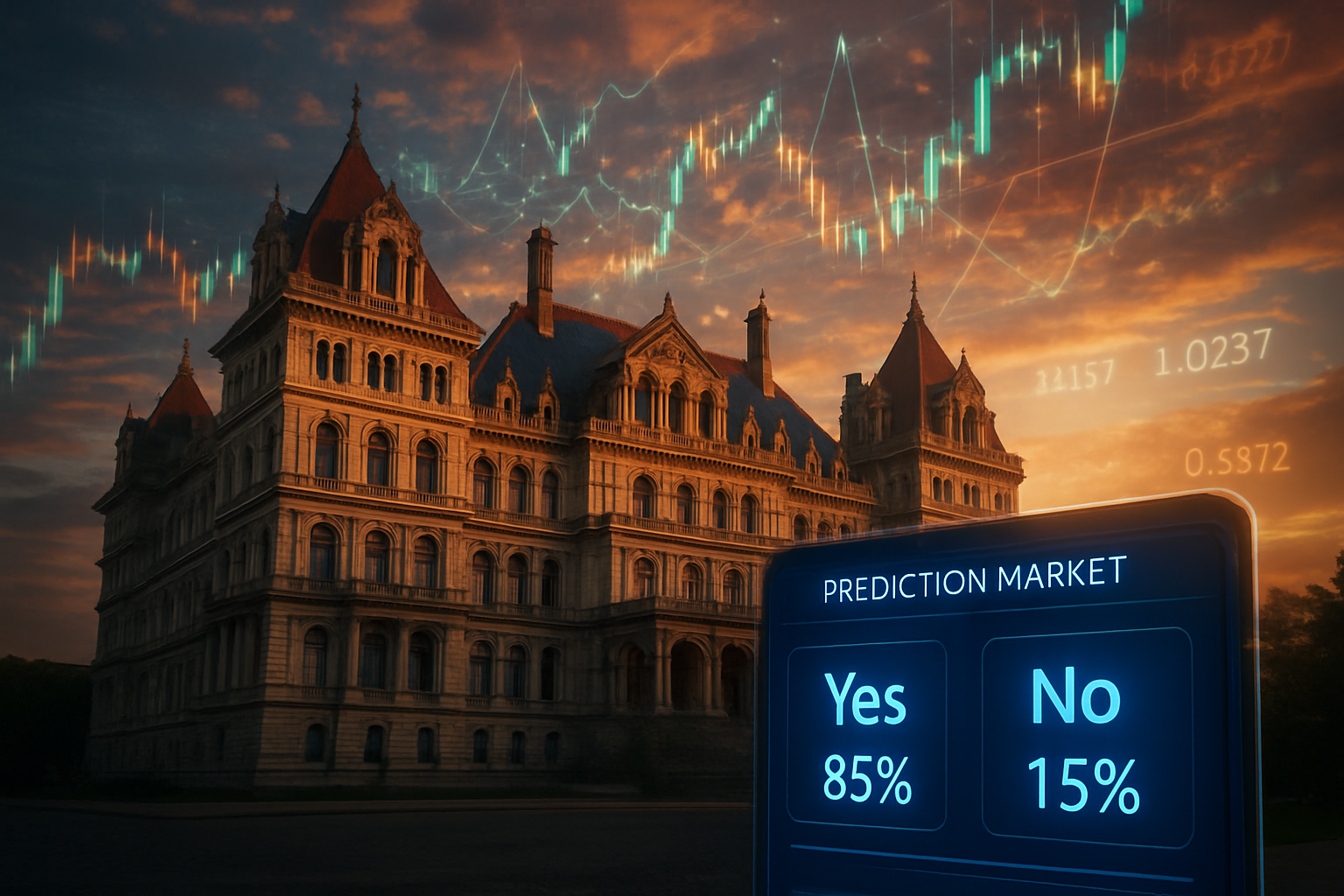
  • The Battle for Albany: New York’s $700 Million Showdown Over the Future of Prediction Markets

    The Battle for Albany: New York’s $700 Million Showdown Over the Future of Prediction Markets

    In the corridors of power in Albany, a legislative storm is brewing that could redefine the boundaries between Wall Street and Las Vegas. Just four days ago, on January 12, 2026, the prediction market industry hit a staggering milestone: $701.7 million in total daily trading volume. This explosion in liquidity, fueled by the 2026 midterm election cycle and high-stakes geopolitical events, has transformed a once-niche sector into a financial powerhouse that New York regulators are now desperate to contain.

    At the heart of the conflict is the "Oversight and Regulation of Activity for Contracts Linked to Events" (ORACLE) Act, also known as Assembly Bill A9251. Reintroduced on January 7, 2026, the bill seeks to classify prediction markets—specifically event contracts—as "unlicensed gambling," threatening to shut down some of the industry’s most prominent players in the Empire State. As the industry fights for "federal preemption," claiming that these markets are financial tools regulated at the federal level, the outcome of this battle will likely set the legal precedent for the rest of the United States.

    The Market: What's Being Predicted

    While the legislative fight rages in the Assembly, the prediction markets themselves are betting on the outcome. On platforms like Kalshi and Interactive Brokers (NASDAQ:IBKR) through its ForecastEx exchange, traders are putting millions of dollars behind contracts predicting the survival of event contracts in New York. The primary market in question—"Will New York pass a bill to ban political event contracts in 2026?"—has seen its odds fluctuate wildly in the first two weeks of the year.

    As of January 16, 2026, the probability of the ORACLE Act (A9251) passing in its current, restrictive form has dropped from 65% to 38%. This shift followed the introduction of a rival piece of legislation, Senate Bill S8889, on January 13. Sponsored by Senator Jeremy Cooney, S8889 offers a friendlier path, proposing that prediction markets be regulated as financial derivatives under the New York Department of Financial Services (DFS) rather than the State Gaming Commission.

    Liquidity in these "regulatory outcome" markets is at an all-time high. Major platforms are seeing tens of millions in open interest as hedge funds and political operatives use these contracts to hedge against potential regulatory shifts. The resolution criteria are clear: if any version of the ORACLE Act that classifies event contracts as unlicensed gambling is signed into law by Governor Kathy Hochul before the end of the 2026 legislative session, the "Yes" contracts pay out.

    Why Traders Are Betting

    The sudden surge in betting activity is driven by a clash of philosophies. Assemblymember Clyde Vanel, the architect of the ORACLE Act, views prediction markets as "gamified sportsbooks" that prey on retail investors. "Wall Street stays on Wall Street and Vegas stays in Vegas," Vanel famously stated earlier this month. His bill proposes existential fines of up to $1 million per day for platforms that allow New Yorkers to trade on "sensitive" categories like politics, catastrophes, or sports.

    Traders, however, are increasingly betting that the industry’s heavy hitters will win the day. The recent $700 million volume milestone was significantly aided by Robinhood Markets, Inc. (NASDAQ:HOOD), which has integrated event contracts into its "Prediction Markets Hub." This influx of retail liquidity has made the markets more accurate and harder to ignore. Notable "whales" in the space argue that the ORACLE Act is technologically unenforceable and legally flawed due to the doctrine of federal preemption.

    Furthermore, the industry has found an unlikely ally in the sports world. On January 8, 2026, Madison Square Garden Sports Corp (NYSE:MSGS) announced a landmark partnership making Polymarket the "Official Prediction Market Partner" of the New York Rangers. With Polymarket branding now appearing on the dasherboards of the historic arena, traders believe the "normalization" of these markets makes it politically difficult for Albany to categorize them as illicit activity.

    Broader Context and Implications

    The "Battle for Albany" is a microcosm of a larger national struggle over the classification of "information finance." Prediction markets have proven to be more accurate than traditional polling in predicting election results and more responsive than news outlets in signaling geopolitical shifts—such as the "Maduro trade" on Polymarket, where traders accurately predicted a major Venezuelan policy announcement hours before it happened.

    The industry’s primary defense is federal preemption under the Commodity Exchange Act (CEA). Kalshi, a platform regulated by the Commodity Futures Trading Commission (CFTC), is currently suing the New York State Gaming Commission in the Southern District of New York (SDNY). They argue that as a "Designated Contract Market" (DCM), they are subject to federal oversight that overrides state-level gambling statutes. If Kalshi wins this legal fight, the ORACLE Act could be rendered dead on arrival, regardless of whether it passes the Assembly.

    This conflict reveals a deep-seated anxiety among state regulators about losing control over tax revenue. Currently, New York generates significant income from mobile sports betting. If prediction markets are classified as financial products, they would be subject to federal capital gains taxes rather than state-level gambling levies, potentially leaving a hole in Albany’s budget—a concern frequently raised by powerful Assembly broker J. Gary Pretlow.

    What to Watch Next

    The next 45 days will be critical for the future of the industry. The most immediate catalyst to watch is a pending ruling from the Southern District of New York in the Kalshi vs. NY State Gaming Commission case, expected in late February. A ruling in favor of Kalshi would solidify the federal preemption argument and likely force the NY Assembly to pivot toward Senator Cooney’s DFS-regulated model (S8889).

    Investors should also keep a close eye on the "Prediction Market Regulation Act" (S8889) as it moves through the Senate Racing, Gaming and Wagering Committee, chaired by Senator Joseph Addabbo Jr. If this bill gains a companion in the Assembly, it would signal a move away from the prohibitive ORACLE Act and toward a compromise that allows New York to remain the financial capital of the world while adopting these new "truth machines."

    Finally, the 2026 Midterm elections will continue to drive volume. If the industry can maintain daily volumes above the $500 million mark consistently, the pressure on legislators to provide a clear, legal framework will become overwhelming.

    Bottom Line

    The Battle for Albany is no longer just about whether New Yorkers can bet on the news; it is about whether "information finance" will be recognized as a legitimate pillar of the modern economy. The record-breaking $700 million daily volume milestone reached this month proves that public demand for these markets is vast and growing, despite the legislative hurdles.

    The ORACLE Act represents the "old guard" of regulation attempting to apply 20th-century gambling laws to 21st-century financial technology. However, the momentum currently favors the industry. Between the federal preemption lawsuits and the mainstream commercial partnerships like the one with the Rangers, the walls are closing in on those who wish to ban these markets.

    For prediction market participants, New York is the "final boss." If the industry can secure a victory here—either through the courts or via Senator Cooney’s regulatory bill—it will signal the end of the "unlicensed gambling" era and the beginning of a new age where every major event in the world has a liquid, transparent, and legally protected market behind it.


    This article is for informational purposes only and does not constitute financial or betting advice. Prediction market participation may be subject to legal restrictions in your jurisdiction.

    PredictStreet focuses on covering the latest developments in prediction markets. Visit the PredictStreet website at https://www.predictstreet.ai/.
  • The Death of the Toss-Up: How Polymarket’s $19B Election Bet Vindicated Prediction Markets

    The Death of the Toss-Up: How Polymarket’s $19B Election Bet Vindicated Prediction Markets

    When the dust finally settled on the 2024 U.S. Presidential Election, the biggest winner wasn't just on the ballot; it was the platform that saw the outcome coming long before the first cable news network called a single swing state. Polymarket, the decentralized prediction platform, didn't just participate in the election cycle—it dominated the narrative, processing nearly $19 billion in cumulative volume across its various election-related contracts and correctly calling the outcome in all 50 states.

    While traditional polling aggregators and mainstream media outlets spent the final weeks of the campaign describing the race as a "dead heat" or a "coin flip," Polymarket’s traders were already pricing in a decisive shift. The platform reached a staggering 95% probability for a Donald Trump victory at 11:43 p.m. ET on Election Night—nearly six hours before the Associated Press made its official call at 5:34 a.m. ET. This massive divergence has fundamentally altered how political outcomes are forecasted, moving the needle from subjective opinion polling toward the "liquid truth" of incentivized markets.

    The Market: What's Being Predicted

    At the heart of the 2024 frenzy was a suite of over 50 individual state-level markets and a flagship "Presidential Election Winner 2024" contract. This primary market alone saw a cumulative volume of approximately $3.7 billion, but when including markets for House and Senate control, popular vote margins, and candidate-specific milestones, the total ecosystem volume surged toward the $19 billion mark. This liquidity provided a level of stability and signal clarity that smaller, regulated U.S. competitors were only beginning to match at the time.

    The resolution criteria were binary: which candidate would secure the majority of electoral votes as certified by the states. Throughout October 2024, as polls showed the candidates within the margin of error, Polymarket consistently priced Trump as a 60/40 favorite. This "spread" represented a significant departure from traditional forecasting models, which stayed locked in a 50/50 toss-up narrative until the early hours of Wednesday morning.

    The success of these markets caught the attention of major financial players. Robinhood Markets, Inc. (NASDAQ: HOOD) and Interactive Brokers Group, Inc. (NASDAQ: IBKR) both launched their own "event contracts" in late October 2024, following a landmark court ruling involving the exchange Kalshi. However, Polymarket’s early lead in liquidity and its crypto-native user base allowed it to remain the primary reference point for "real-time" probability during the most critical hours of the election.

    Why Traders Were Right

    The accuracy of Polymarket in 2024 is largely attributed to the "Wisdom of Crowds" and the concept of "skin in the game." Unlike poll respondents, who may experience "social desirability bias"—telling pollsters what they think is the "correct" or "polite" answer—prediction market traders face immediate financial consequences for being wrong. This financial incentive filters out noise and forces participants to find the most accurate information available, including obscure county-level data and early voting trends that traditional models often lag behind.

    A significant factor in the market’s movements was the presence of high-conviction "whales." One notable trader, a French national identified as "Théo," reportedly bet upwards of $30 million on a Trump victory. While critics initially feared this was a "market manipulation" attempt to skew perception, post-election analysis revealed it was a sophisticated data-driven play based on "neighbor polls"—a method that asks respondents who they think their neighbors will vote for, which historically captures hidden support more accurately.

    Furthermore, the markets were faster to react to major campaign catalysts. For instance, when President Joe Biden withdrew from the race in July 2024, Polymarket odds had already priced the probability of his exit at over 70% weeks in advance, while many political pundits were still dismissing the possibility. This speed allowed institutions like Bloomberg to integrate Polymarket data directly into their terminals, providing professional traders with a faster volatility gauge than any poll could offer.

    Broader Context and Implications

    The 2024 cycle has marked a permanent shift in the relationship between prediction markets and the financial sector. Since the election, the "event contract" asset class has exploded. By early 2026, Intercontinental Exchange, Inc. (NYSE: ICE), the parent company of the New York Stock Exchange, made a landmark investment in the sector, signaling that prediction data is now viewed as an essential alternative data set for hedging political and economic risk.

    The regulatory landscape has also shifted dramatically. Following the success of the 2024 markets, the CFTC has faced increased pressure to provide a clearer framework for event contracts. This has paved the way for more mainstream adoption, with Coinbase Global, Inc. (NASDAQ: COIN) acquiring prediction-infrastructure firms to scale these offerings to their millions of retail users. Even the sports betting giants DraftKings Inc. (NASDAQ: DKNG) and Flutter Entertainment plc (NYSE: FLUT) have launched dedicated "prediction" verticals to capture the growing demand for non-sports wagering.

    Historically, prediction markets were seen as a niche interest for crypto enthusiasts. However, the 2024 results—specifically the Brier score of 0.0296, which significantly outperformed Nate Silver’s "Silver Bulletin" model—have validated them as a superior forecasting tool. This success has sparked a broader debate about the "death of polling," as organizations like the New York Times face questions about why their sophisticated polling models failed to capture the "clean sweep" that the markets were already pricing in.

    What to Watch Next

    As we look toward the 2026 midterm elections, prediction markets are no longer a "side-show" but the main event. Analysts expect cumulative volumes for the 2026 cycle to exceed $25 billion, as institutional participation grows and more brokerages offer direct access to political contracts. The focus is now shifting toward "Micro-Prediction Markets," where traders can bet on specific policy outcomes, such as the likelihood of corporate tax rate changes or the passage of specific healthcare legislation.

    Key milestones to monitor include the upcoming SEC and CFTC rulings on the cross-listing of event contracts on traditional equity exchanges. If approved, we could see a future where political "odds" are traded as easily as shares of Alphabet Inc. (NASDAQ: GOOGL) or Meta Platforms, Inc. (NASDAQ: META). Furthermore, the integration of AI-driven trading bots into these markets is expected to increase liquidity even further, though it may also introduce new challenges regarding market manipulation and flash volatility.

    Bottom Line

    Polymarket’s performance in the 2024 election was a watershed moment for decentralized finance and political science. By correctly calling every state and providing a high-certainty victory signal hours before official media calls, the platform proved that markets can process complex, disparate information more efficiently than traditional institutions. The $19 billion in volume wasn't just a figure of speculation; it was a figure of participation in a new era of "liquid democracy."

    As we move into 2026, the era of the "unpredictable" election may be coming to an end. While polling remains a useful tool for understanding voter sentiment, prediction markets have established themselves as the definitive tool for understanding voter outcomes. For investors and political observers alike, the lesson of 2024 is clear: follow the money, not the polls.


    This article is for informational purposes only and does not constitute financial or betting advice. Prediction market participation may be subject to legal restrictions in your jurisdiction.

    PredictStreet focuses on covering the latest developments in prediction markets.
    Visit the PredictStreet website at https://www.predictstreet.ai/.
  • The New Insurance: Institutional Hedging Transforms Prediction Markets into Essential Risk Management Tools

    The New Insurance: Institutional Hedging Transforms Prediction Markets into Essential Risk Management Tools

    As of January 15, 2026, the global financial landscape has witnessed a paradigm shift in how institutional investors manage tail risk and policy uncertainty. What was once dismissed as a niche domain for retail speculators has matured into a sophisticated layer of market infrastructure. Prediction markets, or event contracts, are now being utilized by top-tier hedge funds and quantitative trading desks to isolate and hedge specific regulatory and legislative outcomes that traditional equity and bond markets are often too blunt to capture.

    Leading this institutional charge is Oldenburg Capital Partners, a firm that has become synonymous with the "selective use" of event contracts to navigate macro volatility. By the start of 2026, Oldenburg and its peers have integrated prediction market data directly into their risk-modeling engines. The logic is simple: while a 10-year Treasury note might react to inflation data, a Kalshi contract on the passage of the Digital Asset Market Clarity Act (the "CLARITY Act") provides a direct, high-conviction hedge for a firm's venture exposure to decentralized finance. With total daily trading volume across major platforms hitting a staggering $701.7 million last week, the era of the "prediction market as insurance" has officially arrived.

    The Market: What's Being Predicted

    The core of the institutional boom lies in the diversification of contracts available on platforms like Kalshi and the newly-relaunched U.S. arm of Polymarket. These platforms have moved far beyond election forecasting, offering deep liquidity in "binary" outcomes for SEC rulings, Federal Reserve pivots, and legislative milestones. For instance, the market for the SEC vs. Coinbase appellate decision, currently trading on Kalshi, has seen its "Yes" contract (predicting a Coinbase victory on the "investment contract" definition) hover at 62 cents, implying a 62% probability of a favorable ruling.

    This liquidity is no longer an accident. Following the massive expansion of Interactive Brokers (NASDAQ: IBKR) and its ForecastEx exchange, institutional participation has been incentivized by high collateral yields. IBKR currently offers an estimated 3.83% incentive coupon on the collateral of open event positions, effectively paying firms to provide liquidity. Meanwhile, CME Group (NASDAQ: CME) has entered the fray with 24/7 swap-based event contracts for GDP and CPI benchmarks, bridging the gap between traditional futures and event-driven binary options. Total monthly notional volume for the industry has now stabilized above $13 billion, a ten-fold increase from early 2024 levels.

    Why Traders Are Betting

    The primary driver for firms like Oldenburg Capital Partners and Saba Capital Management is the ability to hedge "policy cliffs." Traditional derivatives—such as credit default swaps or equity puts—often carry significant "noise" from broader market sentiment. In contrast, an event contract allows a fund manager to hedge the exact moment a regulatory shift occurs.

    Boaz Weinstein’s Saba Capital has reportedly used recession-dated contracts on Polymarket to hedge credit market instruments that may be lagging behind shifting economic narratives. "In the traditional market, you're betting on the reaction to an event," says one senior trader at a high-frequency firm. "In prediction markets, you’re betting on the event itself. For a risk manager, that distinction is worth billions."

    Another key factor is the "conviction gap." Institutional desks often find that prediction markets reflect "on-the-ground" legal and political intelligence faster than the stock market. During the recent debates over the GENIUS Act—a stablecoin regulatory bill—prediction market odds shifted 15 points in favor of a "No" vote a full 48 hours before bank stocks began to sell off, providing a critical window for firms to adjust their exposure.

    Broader Context and Implications

    This institutionalization is the result of a hard-fought regulatory evolution. Following landmark legal victories against the CFTC in late 2024, event contracts were codified as a protected class of derivatives. This provided the legal "moat" necessary for massive capital entry from companies like Intercontinental Exchange (NYSE: ICE), the parent of the New York Stock Exchange, which invested nearly $2 billion into Polymarket’s back-end infrastructure in late 2025.

    The real-world implications are profound. Prediction markets are increasingly viewed as a more accurate "source of truth" than traditional polling or expert pundits. Their historical accuracy—most notably during the 2024 U.S. election and the subsequent 2025 debt ceiling negotiations—has earned them the respect of central bankers and policy makers. However, this success has also invited scrutiny. In early 2026, states like New Jersey and Tennessee have issued cease-and-desist orders against certain "Opinion" markets, triggering a "preemption" legal battle that many expect will eventually be settled by the U.S. Supreme Court.

    What to Watch Next

    The immediate focus for the market is the upcoming Q1 2026 legislative calendar. Two major events are expected to move the needle:

    1. The CLARITY Act Vote: Expected in late February, this will determine the regulatory framework for the next decade of digital asset innovation. Prediction markets currently give it a 45% chance of passage.
    2. The 2026 Midterm "Whale" Activity: Large institutional positions are already being built in "Congressional Control" contracts, as firms seek to hedge against potential shifts in corporate tax rates and defense spending.

    Additionally, the market is monitoring the "collateral war" between Interactive Brokers and CME Group. As these giants compete for liquidity, the cost of hedging through event contracts is expected to drop, further attracting traditional asset managers who have previously stayed on the sidelines.

    Bottom Line

    The emergence of prediction markets as an institutional hedging tool marks the end of their "wild west" era. For firms like Oldenburg Capital Partners, these markets are no longer a curiosity—they are a necessity. By providing a clear, binary way to price risks that were previously "unhedgeable," prediction markets have filled a critical gap in the global financial system.

    As we move further into 2026, expect to see the "prediction premium" become a standard metric in macro analysis. Whether it’s a court ruling, a legislative vote, or a central bank decision, the smart money is no longer just watching the news—they are trading the outcome. In a world of increasing political and regulatory volatility, the ability to turn "what if" into a tradable asset is the ultimate competitive advantage.


    This article is for informational purposes only and does not constitute financial or betting advice. Prediction market participation may be subject to legal restrictions in your jurisdiction.

    PredictStreet focuses on covering the latest developments in prediction markets. Visit the PredictStreet website at https://www.predictstreet.ai/.