Tag: institutional trading

  • The $100 Million Play: How Kalshi’s Regulated Sports Markets are Rewriting the Playbook for Institutional Bettors

    The $100 Million Play: How Kalshi’s Regulated Sports Markets are Rewriting the Playbook for Institutional Bettors

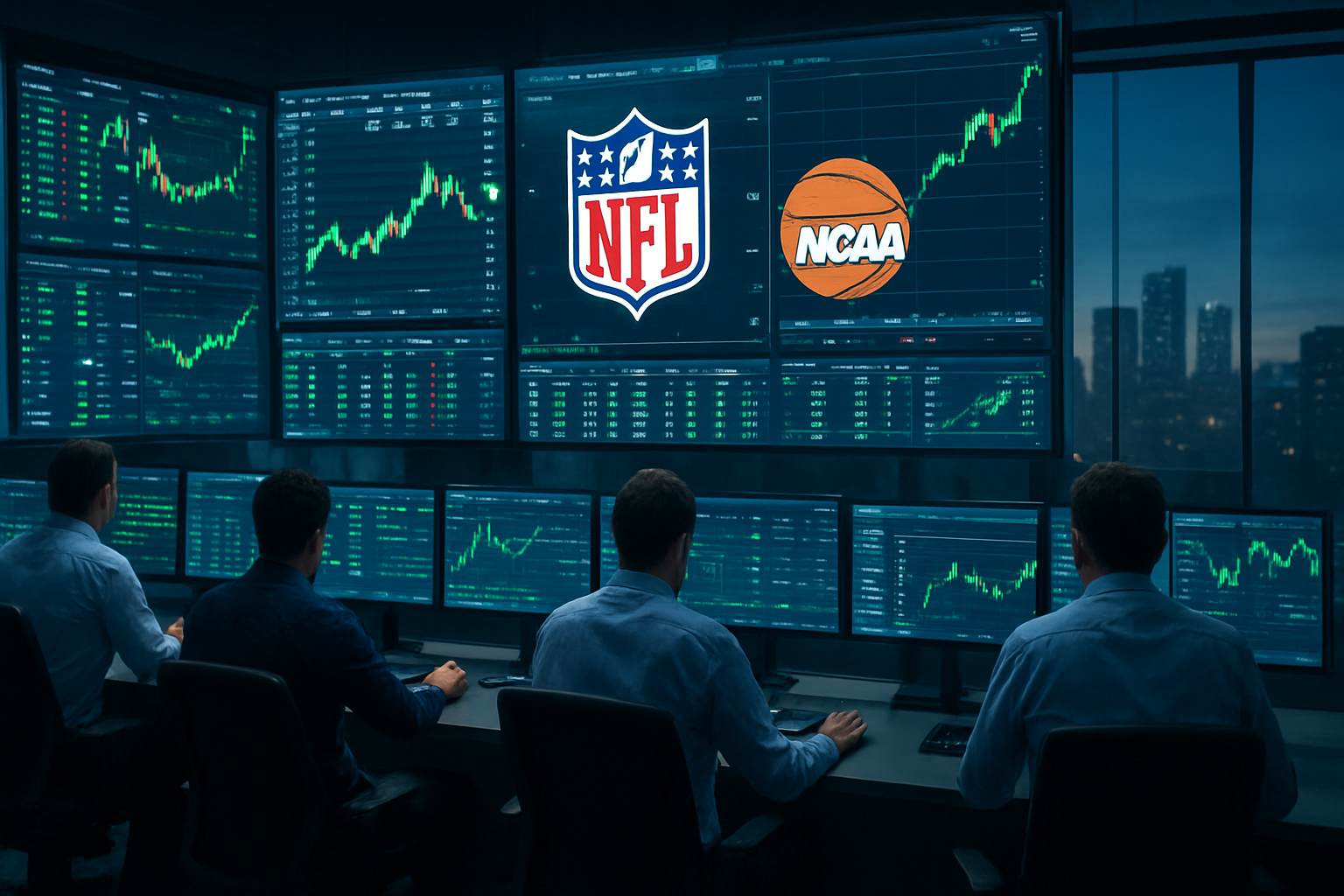
    In the week following the NCAA Football Championship, the dust is settling on more than just the gridiron. On January 20, 2026, the championship game did more than crown a college football king; it solidified Kalshi as a financial juggernaut. The platform recorded a staggering $111 million in trading volume for the single event, a figure that signals a tectonic shift in how Americans—and increasingly, Wall Street—engage with sports.

    Currently, the markets for the upcoming Super Bowl LX are already seeing nearly $150 million in open interest, with odds fluctuating as professional trading desks move multi-million dollar positions. This is no longer just "betting" in the traditional sense; it is the financialization of sports outcomes through federally regulated event contracts. Driven by a landmark regulatory victory and integration into major retail brokerages, Kalshi has transformed sports results into a legitimate asset class, attracting institutional-scale liquidity that was previously confined to offshore exchanges or private bookmakers.

    The Market: What's Being Predicted

    The core of Kalshi’s explosion lies in its "event contracts," which are binary options that pay out $1 if an event occurs and $0 if it does not. Unlike traditional sportsbooks where you "place a bet" against the house, Kalshi operates a peer-to-peer exchange where traders buy and sell contracts from one another. In the lead-up to the 2025-2026 NFL playoffs, this model allowed for unprecedented liquidity. For instance, the final day of the NFL regular season on January 4, 2026, saw a single-day volume record of $403 million.

    While Polymarket continues to dominate the decentralized, crypto-native space, Kalshi has carved out a massive lead in the regulated U.S. domestic market. By the third week of January 2026, total trading volume for the NFL playoffs reached nearly $2 billion. The resolution criteria for these markets are strictly defined by official league data, ensuring that contracts settle instantly upon the final whistle. This transparency has allowed Kalshi to list complex derivatives, including point spreads and player performance metrics, all under the watchful eye of federal regulators.

    Why Traders Are Betting

    The migration of capital toward Kalshi is driven by one primary factor: regulatory certainty. Following the 2024 court victory in KalshiEX LLC v. CFTC, and the subsequent decision by the Commodity Futures Trading Commission (CFTC) to drop its appeal in May 2025, Kalshi’s status as a Designated Contract Market (DCM) became unassailable. This regulatory "seal of approval" has opened the floodgates for institutional participants.

    Unlike traditional sportsbooks—which are notorious for limiting or banning "sharp" bettors who win too consistently—Kalshi’s exchange model welcomes winners. Large-scale proprietary trading firms and hedge funds now treat touchdowns and game wins as "Zero Days to Expiration" (0DTE) derivatives. They use these contracts to hedge macro risks or to capitalize on high-frequency data models that traditional books cannot accommodate. Furthermore, the integration of Kalshi markets into platforms like Robinhood (NASDAQ: HOOD) and Coinbase (NASDAQ: COIN) has brought institutional-level liquidity into the hands of over 24 million retail users, creating a deeper, more stable market than any sportsbook could offer.

    Broader Context and Implications

    The success of Kalshi represents a pivotal moment in the "Prediction Market vs. Gambling" debate. By framing sports outcomes as event contracts under the Commodity Exchange Act (CEA), Kalshi has managed a feat that traditional sports betting apps like DraftKings or FanDuel could not: federal preemption. Recent rulings in federal courts have suggested that the CEA preempts state-level gaming restrictions, allowing Kalshi to legally offer sports trading in all 50 U.S. states, including major markets like California and Texas where traditional online sports betting remains prohibited.

    This shift reveals a growing public appetite for transparent, low-fee alternatives to the "vig-heavy" model of traditional gambling. It also highlights a change in public sentiment; sports are increasingly viewed through the lens of data and probability rather than just loyalty and luck. However, this growth has not come without friction. The NCAA has voiced significant concerns regarding the integrity of college sports, particularly around "player prop" markets. In response, Kalshi has had to balance its aggressive expansion with "market design" concessions, such as pulling controversial transfer portal markets in late 2025 to maintain its standing with federal regulators.

    What to Watch Next

    All eyes are now turned toward Super Bowl LX on February 8, 2026. Early trading suggests the championship winner market could surpass $300 million in volume before kickoff. This will be the ultimate test of Kalshi’s infrastructure and its ability to handle "Black Swan" events or massive late-game volatility without the "suspension of play" issues that often plague traditional sportsbooks during high-volume periods.

    Beyond the Super Bowl, the next major milestone is March Madness 2026. Following the $350 million trading week in mid-January for NCAA basketball, analysts expect the tournament to break all previous records for prediction market engagement. Traders will be watching closely for any new regulatory guidance from the CFTC regarding "micro-trading" or live in-game contracts, which represent the next frontier for the platform.

    Bottom Line

    Kalshi’s rise marks the end of the era where sports betting was a sidelined, "sin-taxed" activity and the beginning of its life as a legitimate financial instrument. The $111 million NCAA Championship volume is not an outlier; it is the new baseline for a world where sports data is as tradable as oil or gold.

    For the broader prediction market ecosystem, Kalshi’s success proves that regulation, rather than being a hindrance, can be a massive catalyst for liquidity when paired with a superior exchange model. As institutional capital continues to pour into these markets, the line between "trader" and "fan" will continue to blur, forever changing the landscape of both Wall Street and the stadium.


    This article is for informational purposes only and does not constitute financial or betting advice. Prediction market participation may be subject to legal restrictions in your jurisdiction.

    PredictStreet focuses on covering the latest developments in prediction markets.
    Visit the PredictStreet website at https://www.predictstreet.ai/.
  • From Gambling to Gauges: Wall Street Embraces Prediction Markets as the New Macro Hedge

    From Gambling to Gauges: Wall Street Embraces Prediction Markets as the New Macro Hedge

    As of mid-January 2026, the global financial landscape is witnessing a profound shift in how risk is priced and managed. Long dismissed as the domain of political junkies and speculators, prediction markets have officially entered the "Institutional Era." This morning, January 19, 2026, trading desks at major investment banks are no longer just looking at the Bloomberg Terminal for yields; they are looking at the live odds on Kalshi and Polymarket to determine the true probability of a 25-basis-point Fed rate cut in March.

    The interest is driven by a staggering surge in liquidity. On January 12, the prediction market industry processed a record $701.7 million in a single 24-hour session, fueled by the "Maduro Incident"—a geopolitical shock involving the capture of the Venezuelan leader that was priced into prediction markets hours before it hit mainstream news wires. This "information edge" has transformed these platforms from niche betting sites into what Wall Street now calls "Information Finance."

    The Market: What's Being Predicted

    While the 2024 U.S. presidential election served as the "proof of concept" for prediction markets, the focus in 2026 has shifted toward sophisticated economic and finance-related hedging tools. On Kalshi, the flagship regulated U.S. exchange, the "Federal Reserve Target Rate" contracts have become the new gold standard for interest rate forecasting. In December 2025 alone, Kalshi’s Fed contracts saw $394 million in volume, frequently outpacing the predictive accuracy of the NY Fed’s own Nowcast models.

    Beyond interest rates, institutional traders are increasingly using "CPI-Linked Contracts" and "GDP Growth Caps" to hedge against specific macro-economic outcomes. Polymarket, which transitioned into a fully licensed U.S. exchange in late 2025 after its parent company, Intercontinental Exchange (NYSE:ICE), made a landmark $2 billion investment, now offers global "Tail Risk" contracts. These allow firms to hedge against low-probability, high-impact events like a sudden sovereign default or a localized conflict affecting shipping lanes. The liquidity is now deep enough that a firm can move $50 million in or out of a macro position without the massive slippage that plagued these markets just two years ago.

    Why Traders Are Betting

    The migration of Wall Street firms to prediction markets is driven by the search for "directness." Unlike traditional options or futures, which can be influenced by Greeks like theta or vega, a prediction market contract is a binary representation of an event occurring. Goldman Sachs Group Inc (NYSE:GS) recently established a dedicated "Event Desk" within its Global Banking & Markets segment to facilitate these trades for clients. According to CEO David Solomon in a recent earnings call, these contracts are now viewed as "sophisticated derivative activities" rather than speculative bets.

    Quant shops like Susquehanna International Group (SIG) and Jane Street have also become dominant players, acting as market makers to ensure deep liquidity. These firms use prediction markets to capture "basis" differences—the gap between what a prediction market says an event is worth and what traditional derivatives say. Furthermore, the "Truth Engine" effect—where prediction markets aggregate non-public or "gray" information into a single price—provides a real-time risk gauge that traditional forecasting methods simply cannot match. For instance, during the Maduro capture in early January, the "odds of a regime change" on Polymarket spiked to 85% nearly two hours before the official military announcement, allowing savvy hedgers to adjust their oil-exposed positions in real-time.

    Broader Context and Implications

    This cultural shift was cemented by the CLARITY Act of 2025, a landmark piece of legislation that officially classified event contracts as "digital commodities" under the oversight of the Commodity Futures Trading Commission (CFTC). This regulatory "green light" solved the compliance hurdles that had previously kept major banks on the sidelines. The 2024 election was the catalyst, as prediction markets correctly predicted the outcome of key swing states while traditional pollsters struggled with high margins of error.

    The implications go far beyond finance. Prediction markets are now being used as a public policy tool. By 2026, the odds for a "Soft Landing" or "Recession in 2026" are cited in Congressional testimony as a measure of public and market confidence. However, the growth has not been without controversy. The "Public Integrity in Financial Prediction Markets Act of 2026" is currently being debated in the House, aiming to prevent government employees with inside information on policy shifts from trading on these platforms. Despite these regulatory growing pains, the historical accuracy of these markets has proven that they are superior at distilling complex global data into actionable prices.

    What to Watch Next

    The immediate focus for institutional traders is the upcoming 2026 U.S. Midterm Elections. Unlike previous cycles, firms are setting up "Election Hedging Wraps" that combine prediction market contracts with traditional S&P 500 hedges to protect against the volatility of a potential shift in House control. Watch for the volume on these mid-term contracts to hit new highs by mid-summer as firms begin their quarterly risk assessments.

    Additionally, keep a close eye on the rollout of "Event-Linked Notes" (ELNs) by major banks. These products will allow pension funds and insurance companies to gain exposure to prediction market yields without directly trading on Kalshi or Polymarket. This "securitization" of event risk is expected to bring billions in new capital into the space by the end of 2026. Finally, the integration of event contracts into retail platforms like Robinhood Markets Inc (NASDAQ:HOOD) will continue to bridge the gap between institutional hedging and retail sentiment, potentially creating a feedback loop that increases price accuracy.

    Bottom Line

    The transformation of prediction markets from a fringe curiosity to a vital piece of the global financial infrastructure is complete. In 2026, "hedging an event" has become as standard as "hedging a currency." Wall Street’s adoption of platforms like Kalshi and Polymarket represents more than just a search for new profits; it represents a fundamental shift toward "Information Finance," where the most valuable asset is not capital, but the ability to accurately predict the future.

    While regulatory scrutiny will continue to evolve, the underlying utility of these markets as a "truth engine" is undeniable. For institutional traders, the question is no longer whether prediction markets are legitimate, but how much of their risk profile they can afford not to hedge on them. As we look toward the remainder of 2026, expect prediction markets to become the primary barometer for the global economy, providing a clearer view of what's coming than any model or poll ever could.


    This article is for informational purposes only and does not constitute financial or betting advice. Prediction market participation may be subject to legal restrictions in your jurisdiction.

    PredictStreet focuses on covering the latest developments in prediction markets.
    Visit the PredictStreet website at https://www.predictstreet.ai/.