Tag: Information Finance

  • Hedging the Real World: How Traders are Using ‘Information Finance’ to Insure Against Economic Shocks

    Hedging the Real World: How Traders are Using ‘Information Finance’ to Insure Against Economic Shocks

    As of January 16, 2026, the global financial landscape has undergone a silent revolution. The speculative fever that once characterized prediction markets during election cycles has matured into a sophisticated infrastructure for risk management. Today, traders are no longer just betting on outcomes; they are using platforms like Kalshi and Polymarket to hedge against the very economic forces that threaten their livelihoods—from the Federal Reserve’s interest rate decisions to the recurring threat of a U.S. government shutdown.

    The current market sentiment reflects a high-stakes waiting game. With a critical Federal Open Market Committee (FOMC) meeting less than two weeks away and a looming "shutdown cliff" on January 31, volume in economic event contracts has surged to record highs. On Kalshi, the flagship "Fed Rate Decision" market has become a primary liquidity pool for retail and institutional traders alike, offering a real-time, 24/7 alternative to the traditional CME FedWatch Tool.

    The Market: What's Being Predicted

    The focus of the prediction market community has sharpened on three primary economic pillars. First is the Federal Reserve's January 28 meeting. Traders on Kalshi currently place a 95% probability on a "Pause," keeping rates steady. However, the real action is in the March 2026 meeting contract, which has seen over $120 million in volume. This market currently prices a 42% chance of a 25-basis-point cut, a significant shift from just two weeks ago when odds favored a continued hold.

    Inflation remains the second major battleground. Following the December 2025 CPI print of 2.7%, Polymarket users are actively trading 2026 inflation caps. Currently, there is a 30% probability being priced in for inflation to rebound and stay above 3% for the duration of the year. Unlike traditional inflation swaps, these contracts are accessible with as little as $1, allowing individual investors to lock in "inflation insurance" for their cost-of-living expenses.

    Finally, the political risk of a government shutdown has returned to the forefront. As the January 31 funding deadline approaches, the "Will the government shut down?" contract on Kalshi is trading at 37 cents (37% probability). This market has gained immense credibility after traders accurately predicted the exact 43-day duration of the late 2025 shutdown, providing a more reliable signal than the conflicting reports coming out of Washington D.C.

    Why Traders Are Betting

    The surge in participation is driven by a fundamental shift in how markets perceive "Information Finance." This concept, championed by Ethereum co-founder Vitalik Buterin, posits that prediction markets are more than just betting hubs; they are "truth engines." Because participants have "skin in the game," the price of a contract reflects a distilled, incentivized consensus that often cuts through the noise of partisan pundits and TV economists.

    Traders are utilizing these markets for practical, real-world hedging. For example:

    • Mortgage Protection: Homeowners looking to refinance in the spring are buying "No" contracts on a March rate cut. If the Fed remains hawkish and rates stay high, the payout from the prediction market helps offset the higher monthly mortgage interest.
    • Business Liquidity: Government contractors and retailers like Albertsons Companies, Inc. (NYSE: ACI), which can see fluctuations in SNAP-related revenue during fiscal disruptions, are using shutdown contracts as a form of "business interruption insurance."
    • Portfolio Insurance: Investors holding tech-heavy portfolios—highly sensitive to interest rates—are hedging their exposure through CPI contracts. If inflation comes in "hot," the gains from their prediction market positions cushion the blow to their equity holdings in companies like Robinhood Markets, Inc. (NASDAQ: HOOD) or Interactive Brokers Group, Inc. (NASDAQ: IBKR).

    Broader Context and Implications

    This trend represents the mainstreaming of event contracts as a legitimate asset class. The institutional validation of these markets reached a milestone in late 2025 when the Intercontinental Exchange (NYSE: ICE)—the parent company of the New York Stock Exchange—announced significant infrastructure investments into prediction market data feeds. This has allowed for "conditional markets" to flourish, where traders can hedge complex scenarios, such as "What will the S&P 500 do if the CPI exceeds 3%?"

    Furthermore, the regulatory environment has stabilized. Following years of legal skirmishes, prediction markets are now largely viewed as a necessary tool for price discovery. The historical accuracy of these platforms—often leading traditional polling and economic models by days or weeks—has made them indispensable for corporate treasurers and risk managers. In 2026, the consensus is clear: if you want to know what the Fed will do, don’t watch the press conference; watch the Kalshi order book.

    What to Watch Next

    The next 15 days will be a crucible for these markets. The January 28 FOMC meeting will be the first major test of 2026. If the "Pause" holds as predicted, all eyes will immediately pivot to the March contract, where any deviation from the current 42% probability for a cut will signal a major shift in the Fed's "neutral rate" philosophy.

    Following closely is the January 31 government funding deadline. If the odds of a shutdown climb toward 50% in the final 72 hours, expect a spike in volatility across broader equity markets. Traders should also monitor the release of the next CPI "teaser" data, as the prediction markets for inflation are currently very sensitive to any signs of a "second wave" of price increases.

    Bottom Line

    The rise of prediction markets in early 2026 marks the end of an era where economic forecasting was the exclusive domain of elite institutions and academic models. Through "Information Finance," the collective intelligence of thousands of traders is providing a real-time, high-fidelity map of our economic future.

    For the average participant, these markets have transitioned from a hobby into a utility. Whether it is a federal employee hedging their paycheck against a shutdown or a retail investor protecting their savings from inflation, the ability to trade directly on the outcomes of world events has changed the nature of financial security. As we head into a pivotal February, these markets won't just be predicting the news—they will be the most important financial news on the ticker.


    This article is for informational purposes only and does not constitute financial or betting advice. Prediction market participation may be subject to legal restrictions in your jurisdiction.

    PredictStreet focuses on covering the latest developments in prediction markets.
    Visit the PredictStreet website at https://www.predictstreet.ai/.
  • The End of the Pundit Era: How ‘Information Finance’ Took Over Your News Feed

    The End of the Pundit Era: How ‘Information Finance’ Took Over Your News Feed

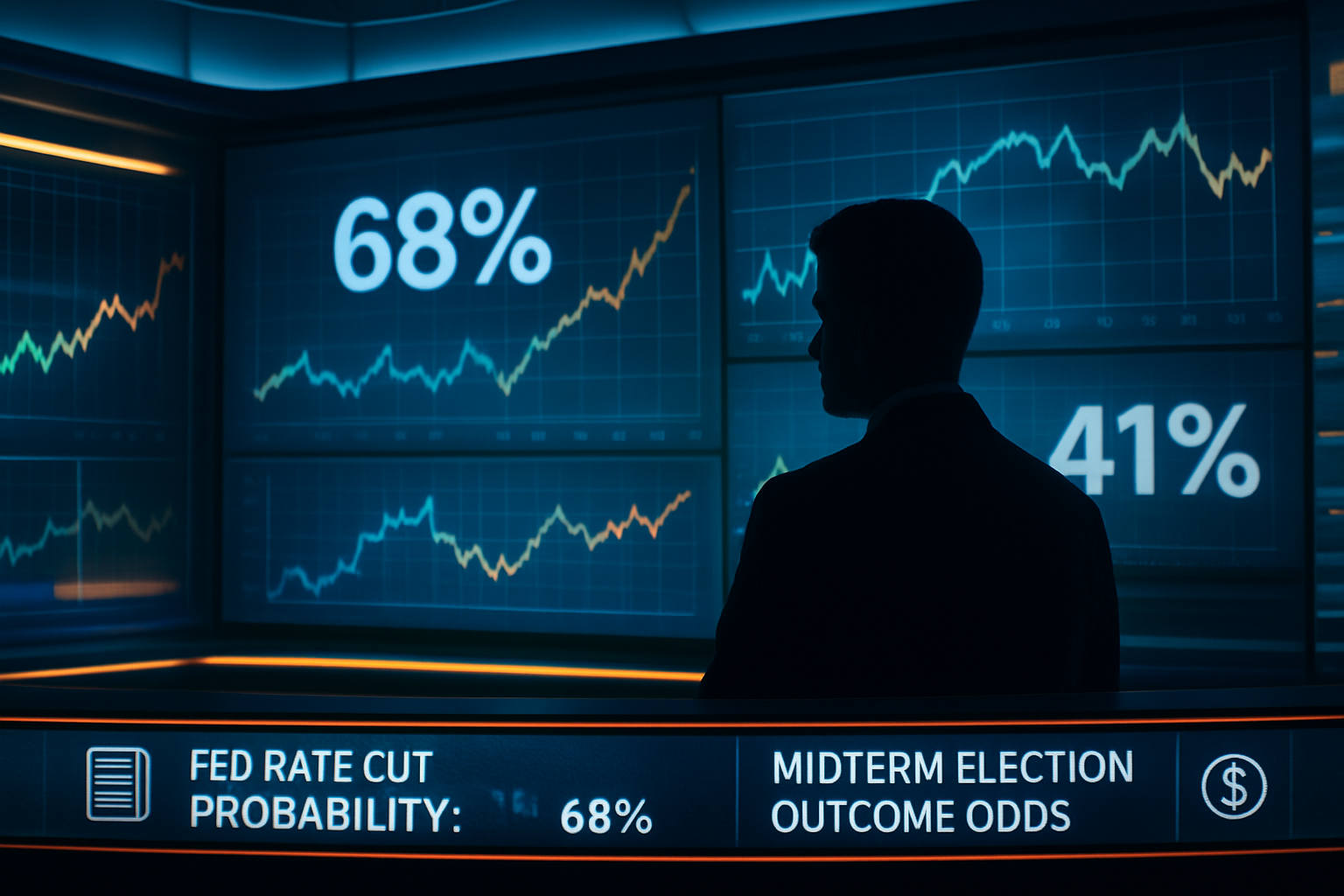
    On any given night in early 2026, a viewer tuning into prime-time news is less likely to see a panel of political consultants arguing over "vibes" and more likely to see a glowing, fluctuating percentage at the bottom of the screen. As of January 16, 2026, the traditional news ticker has been permanently altered. The price of Brent Crude and the S&P 500 now share screen real estate with the "Probability of a Fed Rate Cut in March" and the "Odds of the 2026 Midterm House Flip," powered by real-money prediction markets like Kalshi and Polymarket.

    This seismic shift represents the mainstreaming of "Information Finance"—a term coined to describe the use of financial incentives to aggregate truth. Currently, prediction markets are pricing the likelihood of a major legislative breakthrough on AI regulation at 64%, a figure that has surged 15% in the last 48 hours following a series of closed-door committee meetings. This "market-driven signal" is no longer a fringe curiosity; it has become the definitive barometer for reality, treated by networks with the same institutional weight as the Nielsen ratings or the morning's jobs report.

    The Market: What's Being Predicted

    The integration of prediction market data into mainstream news has reached a fever pitch. In late 2025, CNBC, owned by Comcast (NASDAQ:CMCSA), signed a landmark multi-year deal with Kalshi to serve as its exclusive data provider for on-air prediction widgets. This partnership has birthed the "CNBC Prediction Hub," where viewers can track live probabilities on everything from corporate merger approvals to the likelihood of the next CEO of Apple (NASDAQ:AAPL). These markets are currently seeing record volumes, with the "March Fed Meeting" contract alone regularly exceeding $500 million in open interest.

    Meanwhile, CNN, a subsidiary of Warner Bros. Discovery (NASDAQ:WBD), has completely overhauled its data segments. Chief Data Analyst Harry Enten’s famous "Poll of Polls" has been largely replaced by a segment titled "Market Signals." On these broadcasts, the "price" of an event is treated as the consensus probability. If a contract for a specific candidate to win an election is trading at $0.62, the network reports a "62% probability of victory," providing a real-time, 24/7 pulse that traditional polling—which often takes weeks to conduct and release—simply cannot match.

    The primary platforms driving this data are Kalshi, the first CFTC-regulated prediction market exchange in the U.S., and Polymarket, the decentralized giant that recently secured a $2 billion investment from the Intercontinental Exchange (NYSE:ICE). While Kalshi focuses on U.S.-regulated financial and political events, Polymarket provides a broader look at global geopolitical shifts and cultural milestones. Together, they have created a dual-engine of "Consensus Pricing" that newsrooms now use to fact-check their own reporting.

    Why Traders Are Betting

    The migration of news media toward market data was born out of a crisis of confidence in traditional forecasting. The 2024 election cycle served as the ultimate proof of concept: while traditional pollsters often showed a "dead heat" or slight lead for various candidates, prediction markets consistently priced in a Donald Trump victory with 60%+ confidence throughout October 2024. More importantly, markets called the "swing state sweep" on election night by 10:00 PM ET, hours before network pundits were willing to commit to the data.

    Traders are putting their money where their mouths are because prediction markets reward accuracy and punish "cheap talk." Unlike a pundit who retains their salary regardless of the accuracy of their predictions, a trader on Kalshi or Polymarket faces a direct financial penalty for being wrong. This "skin in the game" creates a high-fidelity signal that filters out noise. Recent surges in the probability of a "Soft Landing" for the U.S. economy, currently trading at 78% on Kalshi, are being driven by institutional desks at firms like Interactive Brokers (NASDAQ:IBKR), which integrated Kalshi's API for its professional clients in 2025.

    Furthermore, the rise of "Information Finance" has attracted a new class of "news-traders." These individuals use advanced sentiment analysis and real-time social media scraping to identify information asymmetries before they hit the wire services. When a major news event breaks—such as the recent Golden Globes, where Polymarket correctly predicted 26 out of 28 winners—the market often moves seconds before the host opens the envelope, providing a "spoiler effect" that has made live prediction trackers must-watch television.

    Broader Context and Implications

    The institutionalization of prediction markets marks the end of the "polling industrial complex" as we knew it. For decades, media organizations relied on statistical sampling that struggled with declining response rates and "shy voter" syndromes. In 2026, the industry has embraced the philosophy that a market of 100,000 incentivized participants is a more accurate "truth engine" than a survey of 1,000 disengaged households. This shift was accelerated by the CFTC’s 2025 legal defeat in the Ninth Circuit Court of Appeals, which permanently legalized election and event betting in the United States, removing the final regulatory shadow over the industry.

    This trend has profound real-world implications for how corporate America operates. Companies like Robinhood (NASDAQ:HOOD) and Coinbase (NASDAQ:COIN) have launched their own "Prediction Hubs," allowing retail investors to hedge against political or economic outcomes. If a trader believes a new tax bill will hurt their tech stocks, they can now "buy" the probability of that bill passing as a form of insurance. Prediction markets have effectively turned the news into a tradable asset class.

    Historically, prediction markets have boasted a significantly lower "Brier Score"—a measure of the accuracy of probabilistic forecasts—than expert panels. As this data becomes more pervasive, it is revealing a new type of public sentiment: one that is pragmatic and forward-looking rather than ideological. However, critics argue that this "commodification of truth" could lead to market manipulation or "prediction loops," where the market's high probability of an event actually helps cause that event to happen.

    What to Watch Next

    As we move deeper into 2026, the next major milestone for the integration of prediction markets into media will be the "Local News Expansion." Several regional news groups are reportedly in talks with Kalshi to launch localized markets on state-level legislation and local mayoral races. This would bring "Information Finance" to the grassroots level, potentially providing a more accurate look at community sentiment than the dwindling number of local political reporters can provide.

    The 2026 Midterm Elections will also serve as the next "Super Bowl" for these platforms. Expect to see networks like CNN and CNBC debut fully interactive "Probability Maps," where viewers can see the live market-cap of each congressional race in real-time. Additionally, the role of AI in these markets is expected to grow. We are already seeing the emergence of "AI Traders" that can process legislative text and court filings in milliseconds, often moving the markets before a human reporter can even finish reading the headline.

    Finally, keep an eye on the potential for a "National Prediction Exchange" ticker to be added to the NYSE floor. With the Intercontinental Exchange’s heavy backing of the sector, the boundary between a "stock" and an "event contract" is blurring. By the end of this year, we may see a world where the "Probability of World Peace" is a standard index listed right next to the Dow Jones Industrial Average.

    Bottom Line

    The transition from traditional punditry to "Information Finance" represents one of the most significant shifts in the history of journalism. By replacing subjective opinions with real-money probabilities, news organizations like CNN and CNBC are attempting to reclaim their role as "arbiters of truth" in a fragmented media landscape. The success of these markets in 2024 and 2025 has proven that when money is on the line, the "wisdom of the crowd" usually outweighs the "wisdom of the expert."

    As a tool, prediction markets are now indispensable for anyone trying to navigate a volatile world. They provide a clear, quantified signal amidst the noise of the 24-hour news cycle. While they are not infallible, their track record for speed and accuracy has made them the gold standard for forecasting the future.

    In this new era, the question for the average news consumer is no longer "What do you think will happen?" but "What does the market say?" As of early 2026, the market is speaking louder than ever, and for the first time, the entire world is finally listening.


    This article is for informational purposes only and does not constitute financial or betting advice. Prediction market participation may be subject to legal restrictions in your jurisdiction.

    PredictStreet focuses on covering the latest developments in prediction markets. Visit the PredictStreet website at https://www.predictstreet.ai/.
  • The Rise of the Truth Engine: How Prediction Markets Are Front-Running Geopolitical Chaos

    The Rise of the Truth Engine: How Prediction Markets Are Front-Running Geopolitical Chaos

    As of January 16, 2026, the global intelligence community is no longer looking solely at satellite imagery or diplomatic cables to gauge the risk of war in the Middle East. Instead, they are watching the order books. The concept of "Operation Iron Strike"—a rumored Israeli military operation against Iranian strategic sites—has moved from classified briefings to the most liquid trading pits on the internet. With a critical January 31 deadline looming for high-stakes strike contracts, prediction markets have officially transitioned from speculative hobbies to "Truth Engines" for global risk.

    Currently, the probability of an Israeli strike on Iran before the end of the month is fluctuating wildly between 34% and 52% on Polymarket. This volatility isn't just noise; it represents the collective intelligence of thousands of traders processing real-time data from the ground in Tehran and Tel Aviv. The surge in interest is driven by a unique combination of "Information Finance" (InfoFi) and a breakdown in traditional news speed, where prediction platforms are now consistently outperforming major terminals by as much as 15 minutes.

    The Market: What's Being Predicted

    The focal point of the current geopolitical trading frenzy is the "Operation Iron Strike" contract series. These markets, primarily hosted on the decentralized platform Polymarket and the regulated U.S. exchange Kalshi, task traders with a binary outcome: Will Israel conduct a military strike against Iran by January 31, 2026?

    As we cross the mid-month mark, the liquidity in these specific contracts has reached unprecedented levels. The "Israel Strike" contract on Polymarket has seen over $8 million in monthly volume, while related markets regarding Iranian regime stability and the potential ouster of Supreme Leader Ayatollah Ali Khamenei have attracted upwards of $32 million.

    The resolution criteria for these markets are stringent. For the "strike" contract to resolve "Yes," there must be verified reports of kinetic military action—airstrikes, drone swarms, or special operations—conducted by the Israel Defense Forces (IDF) against Iranian soil. The January 31 deadline is particularly significant, as it marks the end of a period of intense military exercises and follows the "Bazaar Revolts" that have destabilized the Iranian domestic front throughout late 2025.

    Why Traders Are Betting

    The primary driver of the current odds is a divergence between "official" expert analysis and "on-the-ground" data signals. While traditional media outlets like Thomson Reuters (NYSE: TRI) and Bloomberg have cited analysts suggesting a strike is more likely in March 2026, the markets have shifted focus to January. This shift was triggered by a five-hour Israeli security cabinet meeting on January 5, which traders interpreted as a definitive "go" signal.

    Furthermore, markets are being influenced by the hyper-devaluation of the Iranian Rial, which recently hit 1.4 million to the USD. Traders use "Information Finance" to hedge against this instability. Large positions—colloquially known as "whale" moves—have been spotted moving into "Yes" positions shortly after localized unrest in Tehran, often before Western media can verify the reports.

    The most striking evidence of this "Truth Engine" effect occurred on January 3, 2026, during the capture of Nicolás Maduro in Venezuela. A single Polymarket wallet correctly front-ran the U.S. military announcement by nearly six hours, turning a $32,500 bet into a $400,000 payout. This ability to synthesize "hidden" information into a public probability has made these platforms essential for those looking to avoid being blindsided by "black swan" events.

    Broader Context and Implications

    The evolution of prediction markets into institutional-grade tools is no longer a fringe theory. Intercontinental Exchange (NYSE: ICE), the parent company of the New York Stock Exchange, recently made a strategic $2 billion investment in prediction market infrastructure, signaling that "InfoFi" is the next frontier of the financial sector. Even mainstream fintech is leaning in; Robinhood (NASDAQ: HOOD) recently launched a dedicated "Prediction Markets Hub," allowing retail users to trade geopolitical outcomes alongside traditional stocks.

    This shift has profound implications for how the public consumes news. If a market moves 15 minutes before a Comcast (NASDAQ: CMCSA)-owned CNBC broadcast can confirm a headline, the market becomes the headline. This has led to the introduction of the "Public Integrity in Financial Prediction Markets Act of 2026" by U.S. lawmakers, aimed at preventing government officials with "inside" geopolitical knowledge from profiting on these platforms.

    Historically, prediction markets have proven more accurate than individual pundits because they force participants to "put their money where their mouth is." In 2026, this is becoming the primary mechanism for filtering out "diplomatic spin" from the hard reality of impending conflict.

    What to Watch Next

    As we approach the January 31 deadline, several key milestones will dictate the movement of the "Iron Strike" markets. First, any movement of U.S. carrier strike groups in the Persian Gulf will likely cause immediate spikes in "Yes" probabilities. Second, the internal stability of the Iranian regime during the "Winter Uprising" remains a wildcard; if the regime appears to be losing control of the IRGC, the probability of a foreign intervention may increase as a means of securing nuclear sites.

    Market participants should also monitor the News Corp (NASDAQ: NWSA)-owned Wall Street Journal’s live integration of prediction data, which has begun to feature "market-implied probabilities" in its geopolitical coverage. These feeds will likely be the first to reflect any 11th-hour diplomatic breakthroughs or sudden escalations.

    Bottom Line

    Prediction markets have moved beyond the realm of "betting" and into the realm of "sensing." They have become a decentralized intelligence agency for the common investor and the institutional desk alike. The January 31 contract represents more than just a military deadline; it is a test of the market’s ability to price the most complex and secretive risks in the world.

    Whether the outcome is peace or "Operation Iron Strike," the real winner in 2026 is the democratization of information. By transforming speculation into a structured, liquid, and transparent probability, prediction markets are proving to be the most reliable "Truth Engines" in an era of unprecedented geopolitical uncertainty.


    This article is for informational purposes only and does not constitute financial or betting advice. Prediction market participation may be subject to legal restrictions in your jurisdiction.

    PredictStreet focuses on covering the latest developments in prediction markets.
    Visit the PredictStreet website at https://www.predictstreet.ai/.
  • The Information Finance Revolution: How Robinhood and Kalshi Mainstreamed the Global Truth Engine

    The Information Finance Revolution: How Robinhood and Kalshi Mainstreamed the Global Truth Engine

    As of January 16, 2026, the landscape of retail finance has been irrevocably altered. What began as a high-stakes legal battle between Kalshi and federal regulators in late 2024 has blossomed into a multi-billion dollar industry, with Robinhood Markets, Inc. (NASDAQ: HOOD) standing at the center of the storm. The integration of prediction markets—once a niche hobby for policy wonks and crypto enthusiasts—into the pockets of millions of retail traders has transformed "event contracts" from a speculative novelty into a foundational asset class.

    Current market data shows that trading volume for event contracts on Robinhood is reaching new heights, with participation in Federal Reserve interest rate markets and geopolitical "yes/no" contracts rivaling traditional options volume. This shift is not merely about betting; it is the realization of a new era of "Information Finance," where the collective wisdom of the crowd is priced in real-time, providing a "truth engine" that often outpaces traditional news media and polling.

    The Market: What's Being Predicted

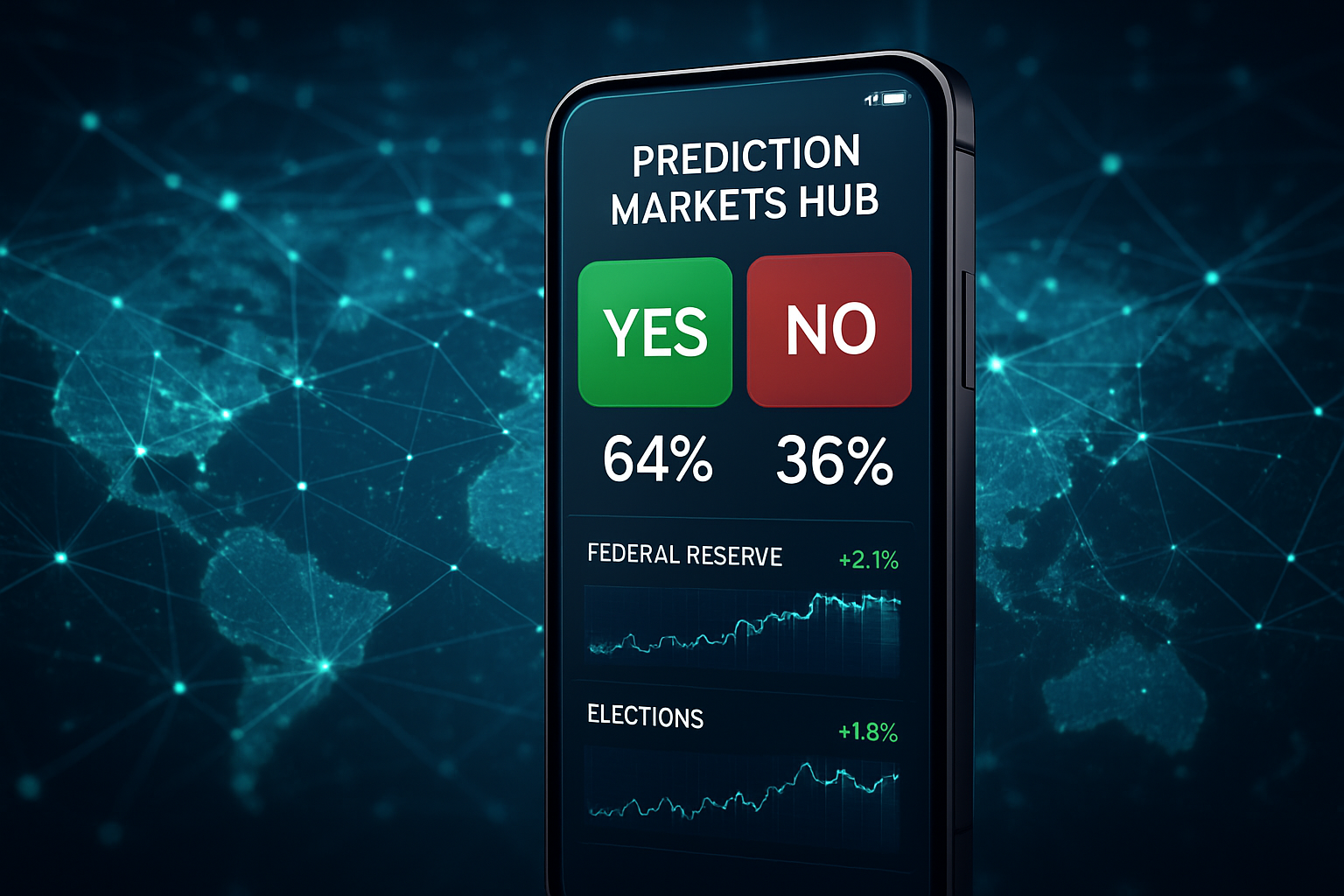
    The current prediction market ecosystem on Robinhood is a far cry from its humble beginnings during the 2024 election cycle. Through its strategic partnership with Kalshi, Robinhood launched its "Prediction Markets Hub" in March 2025, which has since expanded to include thousands of daily contracts. While the 2024 U.S. Presidential Election served as the definitive "proof of concept," today's traders are focused on a more diverse array of outcomes.

    Currently, the most liquid markets center on macroeconomic indicators. Traders are currently pricing in a 68% probability that the Federal Reserve will hold interest rates steady at its next meeting, a figure that has fluctuated wildly following recent CPI data releases. Beyond the Fed, the "Hub" offers contracts on everything from the outcome of the 2026 midterm primaries to the winner of the upcoming Super Bowl and even the year-end closing price of Brent Crude oil.

    These contracts are structured as binary options, typically trading between $0.02 and $0.99. A "Yes" contract that settles correctly pays out $1.00, while an incorrect prediction goes to zero. This simplicity has been the key to Robinhood’s success, allowing retail investors to trade on their beliefs with the same ease they buy a fractional share of a tech stock.

    Why Traders Are Betting

    The surge in prediction market activity is driven by a fundamental shift in how retail investors perceive information. Robinhood CEO Vlad Tenev has championed the concept of "Information Finance," arguing that putting "skin in the game" is the most effective way to filter through the noise of the modern news cycle. For many, these markets are not just about profit; they are about accuracy and hedging.

    Traders are increasingly using event contracts to protect their broader portfolios. For example, an investor heavily weighted in real estate might buy "Yes" contracts on a Fed rate hike as a direct hedge against mortgage rate volatility. "In a world of deepfakes and biased media, the market is the only unbiased source of truth," says one high-volume trader on the platform. "The price doesn't have an agenda; it only has an incentive to be right."

    Notable "whale" activity has also been observed, with large positions being taken by institutional players who use Robinhood’s liquidity to signal their conviction on policy outcomes. This "wisdom of the crowd" has proven remarkably resilient; during the 2024 election, Robinhood and Kalshi's prices often stabilized and predicted state-level outcomes hours before major networks called them, cementing the platform's reputation as a leading indicator.

    Broader Context and Implications

    The mainstreaming of prediction markets represents a major victory for Kalshi, which fought a grueling legal battle against the Commodity Futures Trading Commission (CFTC) to prove that election contracts were not "gaming" but legitimate financial instruments. The court's decision in late 2024 paved the way for the current environment, where event contracts are regulated with the same rigor as futures and options.

    This evolution has significant real-world implications. Governments and corporations are now looking to prediction market data as a more reliable metric than traditional sentiment surveys. If a market gives a 90% chance of a specific regulatory change, businesses can begin adjusting their capital expenditures months in advance.

    However, the rapid growth has not been without controversy. Regulators continue to scrutinize the potential for market manipulation, particularly in lower-liquidity cultural markets. In response, Robinhood recently co-founded the Coalition for Prediction Markets alongside other industry leaders like Coinbase Global, Inc. (NASDAQ: COIN), aimed at establishing self-regulatory standards and lobbying for federal frameworks that protect participants while fostering innovation.

    What to Watch Next

    The next major milestone for Robinhood is the full transition to its proprietary derivatives exchange. Following the 2025 acquisition of a majority stake in LedgerX (now operating as MIAXdx), Robinhood is moving to bring the clearing and hosting of event contracts in-house. This move is expected to significantly reduce transaction costs and allow for even more exotic contract types, such as "bracket-style" betting on multi-candidate elections or tournament outcomes.

    Investors should also keep an eye on the upcoming 2026 midterm elections. This will be the first major political cycle where prediction markets are fully integrated into the retail trading experience from the start of the primary season. The liquidity expected for these markets is predicted to dwarf the 2024 cycle, potentially reaching tens of billions in total volume.

    Additionally, keep a close watch on international expansion. While currently centered in the U.S., Robinhood has signaled intentions to bring its "Information Finance" hub to the U.K. and EU markets, pending local regulatory approvals. A global, 24/7 truth engine could redefine how geopolitical risk is priced worldwide.

    Bottom Line

    The partnership between Robinhood and Kalshi has successfully moved prediction markets from the fringes of the internet to the center of the financial world. By framing these markets as "Information Finance" rather than "betting," Robinhood has tapped into a deep-seated desire among retail traders for more transparency and direct participation in the events that shape their lives.

    As of January 2026, it is clear that prediction markets are no longer a fad. They have become an essential tool for price discovery and risk management in an increasingly volatile world. While the risks of binary "all-or-nothing" trading remain, the utility of a real-time, incentivized forecasting tool is proving too valuable for the market to ignore.

    Ultimately, the success of this integration suggests that the future of finance is not just about what you own, but what you know—and how much you’re willing to back that knowledge with capital.


    This article is for informational purposes only and does not constitute financial or betting advice. Prediction market participation may be subject to legal restrictions in your jurisdiction.

    PredictStreet focuses on covering the latest developments in prediction markets.
    Visit the PredictStreet website at https://www.predictstreet.ai/.
  • The New Newsroom: Why Real-Time Prediction Odds Are Replacing Traditional Punditry

    The New Newsroom: Why Real-Time Prediction Odds Are Replacing Traditional Punditry

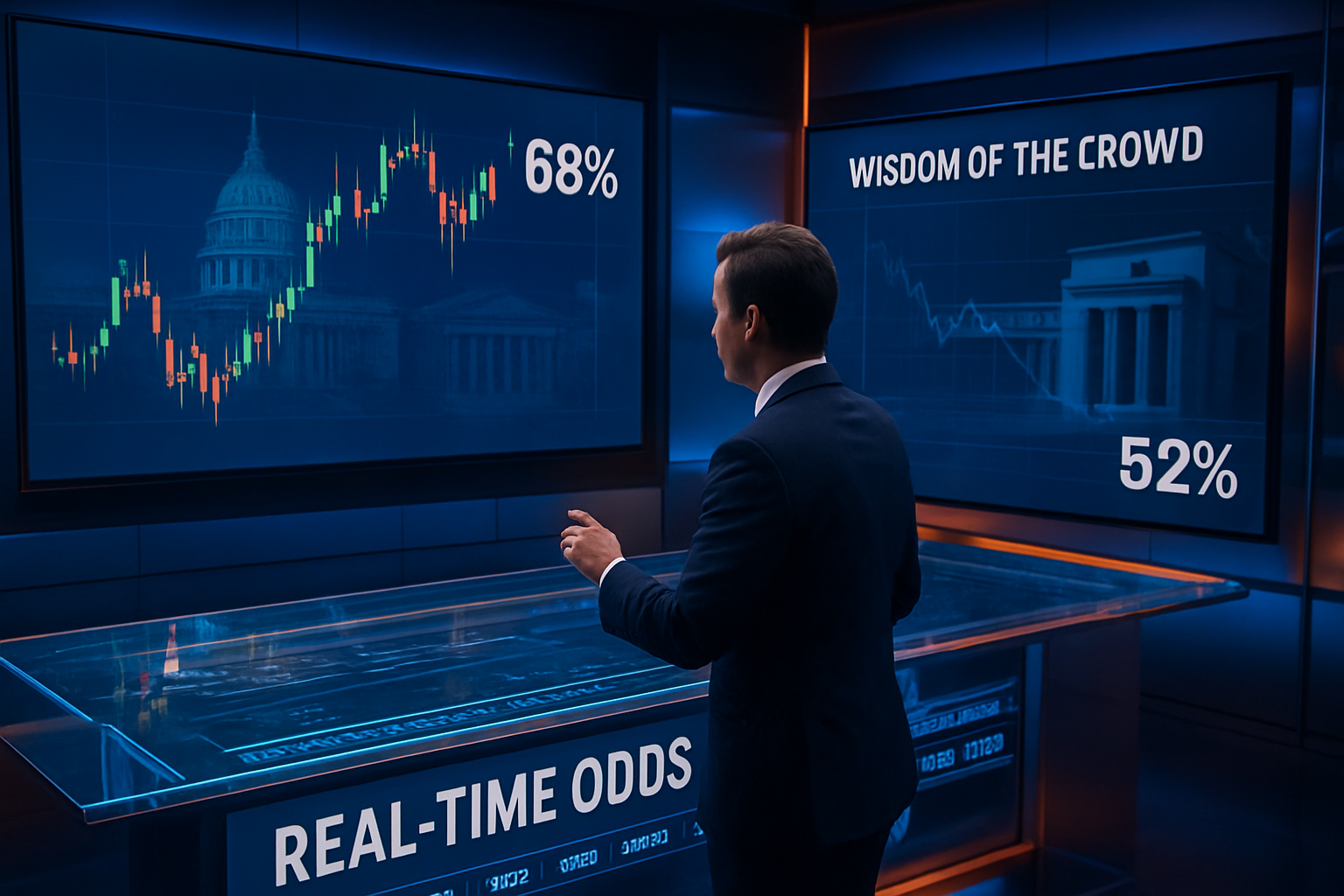
    The landscape of American news has undergone a radical transformation over the past twelve months. As of January 15, 2026, the once-sharp divide between financial speculation and civic journalism has effectively collapsed. Today, when viewers tune into major news networks, they are no longer just seeing poll results or expert opinions; they are seeing live, fluctuating probabilities powered by real-money prediction markets.

    At the center of this shift is the "Information Finance" revolution. Currently, major market-implied probabilities—such as the 68% chance of a federal interest rate cut in March or the 52% probability of a specific legislative package passing the Senate—are being treated with more gravity than traditional surveys. This shift is driven by the massive success of prediction markets during the 2024 election cycle and a series of landmark regulatory victories that have rebranded "gambling" as "the ultimate data-driven insight."

    The Market: What's Being Predicted

    The primary vehicle for this integration has been Kalshi, the first federally regulated prediction market in the U.S. Throughout 2025, Kalshi moved aggressively to colonize the mainstream media landscape. In December 2025, Kalshi announced a historic partnership with CNN, owned by Warner Bros. Discovery (NASDAQ: WBD), establishing the exchange as the network's "Official Prediction Market Partner." This deal introduced a live on-screen ticker during prime-time broadcasts, providing viewers with "market-driven signals" on everything from geopolitical conflicts to domestic policy shifts.

    Simultaneously, CNBC, a subsidiary of Comcast Corporation (NASDAQ: CMCSA), fully integrated Kalshi’s data API into its financial news suite. This wasn't merely a citation of odds; it was a structural integration. CNBC launched a dedicated "Prediction Hub" where viewers could watch a segment on Squawk Box and immediately click through to trade on the outcome being discussed. By the end of 2025, Kalshi reported that its weekly trading volume had eclipsed $1 billion, fueled largely by these mainstream media funnels and the high liquidity of its event contracts.

    The resolution criteria for these markets are strictly defined by verifiable real-world outcomes. Whether it is a Bureau of Labor Statistics report or a confirmed vote in the House of Representatives, the binary nature of these contracts—paying out $1 if the event occurs and $0 if it does not—creates a transparent probability that is updated in micro-seconds as new information hits the wire.

    Why Traders Are Betting

    The migration of traders to these platforms is fueled by a growing distrust in traditional forecasting methods. The 2024 U.S. Presidential Election served as a watershed moment; while many traditional polls suggested a "dead heat" until the final days, prediction markets on Kalshi and other platforms like Polymarket consistently maintained a 55% to 60% probability for the eventual winner weeks in advance.

    Traders are not just "betting"; they are participating in a decentralized intelligence gathering process. The core philosophy driving this activity is the "Incentive to be Right." Unlike a political pundit who faces little personal cost for a wrong prediction, a trader on Kalshi loses capital. This financial accountability creates a more rigorous filter for information.

    Recent activity in January 2026 shows a heavy concentration of volume in "Policy Pivot" markets. As the new administration settles in, traders are aggressively positioning themselves in contracts related to trade tariffs and regulatory rollbacks. The sheer volume of these trades provides a "wisdom of the crowd" effect that news networks are now leveraging to provide context that traditional reporting often misses.

    Broader Context and Implications

    The transition of prediction markets from the fringes of the internet to the center of CNN’s "Election Center" is the result of a hard-fought legal battle. In late 2024, a federal court ruling by Judge Jia Cobb stripped away the Commodity Futures Trading Commission's (CFTC) ability to block election markets, a decision the agency officially stopped appealing in May 2025. This legal clarity opened the floodgates for institutional participation.

    This shift reveals a significant change in public sentiment. The term "gambling" is rapidly being replaced in the public lexicon by "Information Finance." This terminology highlights the belief that prediction markets are a way of pricing the future, much like the stock market prices the value of a company.

    Historically, prediction markets have proven more accurate than experts in various fields, from Oscar winners to scientific breakthroughs. By 2026, this historical accuracy has finally been institutionalized. The implications are profound: when the "market" says an event has a 90% chance of happening, it changes how corporations plan their budgets, how politicians frame their speeches, and how the public perceives the inevitability of change.

    What to Watch Next

    The coming weeks represent another potential leap forward for the industry. Rumors are circulating that Alphabet Inc. (NASDAQ: GOOGL) is prepared to update its global advertising policies as early as next week, potentially allowing federally regulated prediction markets to advertise across its entire network. Such a move would allow Kalshi and its peers to reach billions of users directly, further democratizing access to event trading.

    Key dates to monitor include the upcoming Federal Reserve meeting in late January and the rollout of several high-stakes "Supreme Court Ruling" contracts on Kalshi. These markets are expected to see record liquidity as the CNN and CNBC integrations continue to mature, bringing in a new wave of retail participants who see these markets as a more reliable news source than the articles they are reading.

    The industry is also bracing for potential new legislation. With the 2024 "proof of concept" complete, some lawmakers are calling for a formal "Prediction Market Act" to provide a permanent regulatory framework, ensuring that these markets remain transparent and free from manipulation as they become a core part of the American information diet.

    Bottom Line

    The integration of prediction market data into mainstream news marks the end of the era of the "opinion-based" news cycle. By 2026, the data has won. The partnerships between Kalshi, CNN, and CNBC have validated a new form of journalism—one that prioritizes skin-in-the-game probabilities over speculative punditry.

    Prediction markets are no longer viewed as a "side show" for enthusiasts; they are the scoreboard for reality. As the $1 billion weekly volume suggests, the public is increasingly willing to vote with their wallets on what they believe the future holds. While risks regarding market manipulation and volatility remain, the sheer transparency of a price-discovery mechanism for truth is a tool that the 2026 newsroom simply cannot live without.


    This article is for informational purposes only and does not constitute financial or betting advice. Prediction market participation may be subject to legal restrictions in your jurisdiction.

    PredictStreet focuses on covering the latest developments in prediction markets.
    Visit the PredictStreet website at https://www.predictstreet.ai/.