Tag: InfoFi

  • Betting on the News: How Prediction Markets Are Redefining Mainstream Media

    Betting on the News: How Prediction Markets Are Redefining Mainstream Media

    The traditional news ticker is undergoing a radical transformation. As of February 1, 2026, the familiar crawl of stock prices and weather updates has been joined—and in some cases replaced—by a far more dynamic metric: real-time "wisdom of the crowd" probabilities. From the halls of the U.S. Congress to the red carpets of Hollywood, prediction markets have officially breached the mainstream, becoming the primary "source of truth" for major news networks.

    Currently, all eyes are on the 2026 U.S. Midterm Elections, where prediction markets on platforms like Polymarket and Kalshi are processing tens of billions of dollars in volume. Traders are pricing in a 78% probability that Democrats will flip the House of Representatives, while Republicans maintain a 66-68% chance of holding the Senate. This shift toward market-based forecasting is generating massive interest because it offers a real-time, financially incentivized alternative to traditional polling, which has struggled with lag times and declining response rates. Recent movement suggests the "Midterm Correction" narrative is strengthening, as markets react instantly to shifts in consumer sentiment and legislative gridlock.

    The Market: What's Being Predicted

    The integration of prediction market data into mainstream media is no longer experimental; it is structural. In late 2025 and early 2026, the landscape shifted through a series of landmark partnerships. CNN (Warner Bros. Discovery, Inc. – NASDAQ: WBD) designated Kalshi as its exclusive prediction data provider, with Chief Data Analyst Harry Enten now using real-time market odds to "fact-check" traditional polling data during live broadcasts. Similarly, CNBC (Comcast Corporation – NASDAQ: CMCSA) has launched a dedicated "Kalshi Hub," integrating economic and financial forecasts directly into flagship shows like Squawk Box and Fast Money.

    On the decentralized side, Polymarket has secured an expansive deal with Dow Jones (News Corp – NASDAQ: NWSA), embedding market-implied probabilities across The Wall Street Journal, Barron’s, and MarketWatch. One of the most visible results of this deal is a custom "Earnings Calendar" that displays the probability of an EPS beat for companies like NVIDIA Corporation (NASDAQ: NVDA) alongside traditional analyst estimates. Even entertainment hasn't been spared; Polymarket served as the official prediction partner for the 83rd Annual Golden Globes on CBS (Paramount Global – NASDAQ: PARA) last month, where market odds accurately predicted 26 out of 28 winners.

    Trading volume has scaled alongside this media exposure. In January 2026 alone, the industry hit a record-breaking $12 billion in total trading volume. Kalshi, which operates as a U.S.-regulated exchange, has seen a surge in "notional volume" from institutional players, while Polymarket continues to dominate the "event-pure" categories like global politics and cultural milestones.

    Why Traders Are Betting

    The fundamental driver behind the surge in prediction market participation is the concept of "Skin in the Game." Unlike traditional survey respondents who provide opinions for free, prediction market participants must back their views with capital. This financial incentive creates a powerful filtering mechanism that prioritizes accuracy over partisanship or social desirability bias.

    Traders are currently reacting to several high-impact catalysts:

    • Monetary Policy: With the Federal Reserve's March meeting approaching, Kalshi traders are pricing a 62% probability of a 25-basis-point rate cut, a figure that fluctuates in real-time as new labor and inflation data is released.
    • Political Appointments: The market has already "priced in" a shift in central bank leadership, with Kevin Warsh holding a 99% probability on Polymarket to be the next Fed Chair nominee.
    • Corporate Moves: High-conviction betting is occurring around the potential IPO of OpenAI (Private, backed by Microsoft Corp – NASDAQ: MSFT), with markets currently leaning toward a "No" for a 2026 debut at 52%.

    Mainstream media outlets are gravitating toward this data because it is more sensitive to "signal" than traditional methods. While a poll might take a week to conduct and process, a prediction market reacts to a breaking news headline or a leaked memo in seconds. This speed has made markets the preferred tool for "Sharps"—a new class of professional event traders who treat news as a tradable financial asset, often referred to as "Information Finance" or InfoFi.

    Broader Context and Implications

    The 2024 U.S. Presidential Election served as the definitive "proof-of-concept" for this shift. While legacy models and media pundits described the race as a "toss-up" until the final hours, prediction markets on Polymarket and Kalshi moved to a decisive ~60% probability for a Donald Trump victory weeks in advance. This historical accuracy has significantly diminished the "gambling" stigma that once plagued the industry.

    The regulatory landscape has also stabilized. Kalshi’s landmark legal victory against the CFTC in late 2024 cleared the way for political event contracts to be regulated as legitimate financial derivatives in the United States. This legal clarity has allowed institutional firms to use these markets as hedging tools, protecting their portfolios against geopolitical shocks or sudden policy shifts.

    However, the rise of "InfoFi" is not without controversy. Critics argue that the "gamblification" of news and awards shows could lead to market manipulation or a loss of journalistic nuance. Despite these concerns, the efficiency of the "wisdom of the crowd" continues to outperform individual experts. By turning public sentiment into a tradable price, these markets are providing a level of transparency into collective expectations that was previously impossible to quantify.

    What to Watch Next

    As we move deeper into 2026, the primary focus will remain on the Midterm Elections. Any significant legislative breakthroughs or failures in Washington will cause immediate volatility in the "Control of the House" and "Control of the Senate" markets. Analysts will be watching to see if the current 78% Democratic favoritism for the House holds firm as campaign season intensifies.

    In the corporate world, watch for the resolution of the OpenAI IPO markets and the impact of Amazon.com, Inc. (NASDAQ: AMZN) and its reported multi-billion dollar investment talks on the startup's valuation. These markets often front-run official corporate announcements by days. Additionally, the 2026 FIFA World Cup markets are already beginning to see "early-bird" liquidity, marking the first time a major sporting event will have deep, multi-year prediction markets integrated into the pre-tournament coverage.

    Finally, keep an eye on the evolving nature of media graphics. If current trends continue, the "Market Probability" may soon become the standard lead for every political and economic headline, effectively retiring the phrase "too close to call."

    Bottom Line

    The partnership between prediction platforms and mainstream media marks a turning point in the information age. By integrating data from Kalshi and Polymarket, networks like CNN, CNBC, and the WSJ are acknowledging that markets are often better at synthesizing complex information than humans are. The rise of InfoFi has turned news consumption from a passive experience into a probabilistic exercise.

    For the average viewer, this means "the news" is no longer just a series of events that have happened, but a real-time dashboard of what is likely to happen. Whether you are a trader looking for an edge or a citizen trying to cut through the noise, the "wisdom of the crowd" has become the most important signal in the room. As 2026 progresses, the line between the trading floor and the newsroom will only continue to blur.


    This article is for informational purposes only and does not constitute financial or betting advice. Prediction market participation may be subject to legal restrictions in your jurisdiction.

    PredictStreet focuses on covering the latest developments in prediction markets.
    Visit the PredictStreet website at https://www.predictstreet.ai/.

  • The Great Prediction War: Polymarket and Kalshi Battle for the Soul of Information Finance

    The Great Prediction War: Polymarket and Kalshi Battle for the Soul of Information Finance

    The prediction market landscape has officially entered its most volatile and high-stakes era yet. Following a staggering 2025 that saw over $40 billion in total trading volume, the industry is now locked in what analysts are calling the "Great Prediction War." This isn't just a race for market share; it is a fundamental clash between two visions of the future: the decentralized, crypto-native "truth engine" of Polymarket and the regulated, Wall Street-compliant exchange model of Kalshi.

    As of February 1, 2026, the "meta-market" on Manifold Markets—where traders bet on the success of other platforms—paints a picture of a tightening race. Polymarket currently leads the odds at 47% to be the top platform by volume in 2026, while Kalshi holds a strong 34% share. The stakes have never been higher, as these platforms compete to fulfill the promise of "Information Finance," a concept where markets aren't just for gambling, but serve as the definitive source of truth for a world drowning in misinformation.

    The Market: What's Being Predicted

    The primary metric of success in the Great Prediction War is notional trading volume, and the numbers are staggering. In 2025, the industry hit a record-breaking $40 billion in volume, a nearly 400% increase from the previous year. This growth was fueled by a perfect storm of global events, ranging from hyper-local sports betting to high-stakes geopolitical conflicts. On Manifold Markets, the "Top Prediction Market by Volume in 2026" contract has become one of the most liquid markets on the site, serving as a real-time scoreboard for the industry's civil war.

    Polymarket’s 47% favorite status is largely driven by its dominance in "high-signal" events. During 2025, the platform processed over $33 billion in trades, much of it concentrated in areas where traditional media often lags: Federal Reserve policy shifts, the nuances of the Russia-Ukraine conflict, and major cultural milestones. Traders favor its decentralized infrastructure, which allows for rapid market creation and a global user base that brings diverse, often "insider" perspectives to the pricing.

    Kalshi, meanwhile, is the heavy-hitting incumbent of the regulated space. While it trails Polymarket in the Manifold odds at 34%, its 2025 performance was technically superior in raw notional volume, clocking in at $43.1 billion. However, much of this volume was derived from high-frequency sports contracts—a sector currently under fire from state regulators. The market is currently pricing in the risk that Kalshi’s legal battles over sports betting might stunt its growth, allowing Polymarket’s broader, global event catalog to take the lead in 2026.

    Why Traders Are Betting

    The divergence in odds between Polymarket and Kalshi reflects a deeper debate over the utility of "insider" information. A recent flashpoint occurred during the so-called "Maduro Trade," where a Polymarket user reportedly netted $400,000 by betting on the capture of Nicolás Maduro just hours before the news was officially broken by international wires. This incident has reinforced the belief among "Information Finance" advocates that decentralized markets are superior "truth engines" precisely because they incentivize those with privileged information to reveal it through their trades.

    Conversely, the "regulated" camp argues that long-term institutional adoption requires the safeguards that only a platform like Kalshi can provide. Goldman Sachs (NYSE: GS) CEO David Solomon recently noted that institutional clients are looking for "event-contract derivatives" that are cleared through regulated exchanges to hedge against macro risks. For these players, the transparency and compliance of Kalshi are more valuable than the raw speed of a crypto-native platform.

    Furthermore, the integration of prediction markets into mainstream retail apps has changed the game. Robinhood (Nasdaq: HOOD) and Interactive Brokers (Nasdaq: IBKR) have both moved to offer event contracts directly to their millions of users. This influx of retail "dumb money" has created massive liquidity, allowing professional traders to execute sophisticated arbitrage strategies between the decentralized prices on Polymarket and the regulated prices on Kalshi or ForecastEx.

    Broader Context and Implications

    The "Great Prediction War" is occurring against a backdrop of intense regulatory scrutiny. In January 2026, a Massachusetts judge issued a preliminary injunction against Kalshi, halting its sports-related contracts on the grounds that they constitute unlicensed gambling. This ruling has sent ripples through the industry, raising questions about whether the "regulated" path is actually more perilous than the decentralized one. Meanwhile, in Washington, U.S. Representative Ritchie Torres has introduced the "Public Integrity in Financial Prediction Markets Act of 2026," aimed at preventing government officials from trading on policy-related markets.

    These developments highlight the central tension of Information Finance: how to maintain the accuracy of the market without allowing it to become a "cesspool of insider trading," as some critics claim. The industry's massive 2025 volume proved that there is an insatiable appetite for these markets, but the legal framework is still struggling to catch up. The outcome of the Polymarket vs. Kalshi rivalry will likely dictate the regulatory template for the next decade.

    The validation of these markets is also coming from the highest levels of traditional finance. Intercontinental Exchange (NYSE: ICE), the parent company of the New York Stock Exchange, recently took a strategic stake in the sector, signaling that prediction markets are no longer a niche curiosity but a legitimate asset class. As these markets become more integrated with the global financial system, their ability to "predict" the future will increasingly be used by corporations to guide multi-billion dollar investment decisions.

    What to Watch Next

    The next six months will be a decisive period in the Great Prediction War. The most significant upcoming milestone is the full U.S. rollout of "Polymarket US." Following its 2025 acquisition of the CFTC-licensed exchange QCEX, Polymarket is preparing to launch a hybrid model that combines its popular interface with a fully compliant U.S. clearinghouse. If successful, this could neutralize Kalshi’s primary advantage and send Polymarket’s Manifold odds soaring past 60%.

    Simultaneously, the market is watching the moves of Robinhood (Nasdaq: HOOD). The platform recently announced a joint venture with Susquehanna International Group (SIG) to build its own in-house exchange for event contracts. If Robinhood decides to bypass both Kalshi and Polymarket to keep its users within its own ecosystem, it could disrupt the current duopoly and create a third front in the prediction war.

    Finally, keep a close eye on the "Torres Bill" in Congress. If the legislation passes with strict anti-insider trading provisions, it could paradoxically hurt the "accuracy" of the markets by removing the very people—government insiders—who have the most signal to provide. The debate over whether a market should be "fair" or "accurate" will be the defining philosophical struggle of 2026.

    Bottom Line

    The Great Prediction War of 2026 is more than a competition for trading fees; it is a battle to define how humanity aggregates truth in the digital age. Polymarket’s current lead in the Manifold meta-market suggests that traders value the platform's global reach and "pure" information signal, despite the regulatory clouds hanging over the crypto space. However, Kalshi’s 34% probability remains a formidable threat, backed by the weight of Wall Street and a "compliance-first" philosophy that may ultimately win over the world’s largest institutional hedgers.

    As we move deeper into 2026, the $40 billion volume of the previous year will likely be eclipsed as Information Finance becomes a standard feature of every retail brokerage account and corporate treasury. Whether the winner is a decentralized protocol or a regulated exchange, the real victor is the concept of the prediction market itself. We are moving toward a world where the "market price" of an event is seen as more reliable than a news headline or a political poll.

    For participants, the message is clear: the volatility in these platforms' odds reflects the volatility of our times. The Great Prediction War is just beginning, and the prize is nothing less than the authority to tell the world what will happen next.


    This article is for informational purposes only and does not constitute financial or betting advice. Prediction market participation may be subject to legal restrictions in your jurisdiction.

    PredictStreet focuses on covering the latest developments in prediction markets. Visit the PredictStreet website at https://www.predictstreet.ai/.

  • The Financialization of Truth: How X’s Integration of Live Prediction Markets is Rewiring Global News

    The Financialization of Truth: How X’s Integration of Live Prediction Markets is Rewiring Global News

    As of January 30, 2026, the way we consume news on X (formerly Twitter) has undergone a fundamental shift. No longer just a scroll of opinions and viral clips, the platform has transformed into what analysts are calling an "Information Finance" (InfoFi) engine. The cornerstone of this transformation is the seamless integration of live prediction market data, where every major news event—from Federal Reserve rate decisions to the capture of foreign leaders—is accompanied by a "Probability Bar" showing the real-time consensus of the betting public.

    Currently, the market for "X’s Proprietary Prediction Exchange" is trading at a 31% probability of launching by year-end, reflecting intense speculation that Elon Musk will soon move beyond his current partnership with Polymarket to build a native betting ecosystem. This integration has moved prediction markets from a niche hobby for "superforecasters" to a primary layer of "consensus reality" for millions of users. The result is a surge in market liquidity, with single-day volumes on platforms like Kalshi and Polymarket recently hitting a record $701.7 million, driven largely by the "social-to-market" pipeline established on X.

    The Market: What's Being Predicted

    The most actively watched market currently integrated into the X ecosystem is the "2026 Midterm Election Control" series, which has already seen over $8 billion in open interest across both Polymarket and Kalshi. These odds are now natively displayed in the X search bar. When a user searches for "Senate Majority," the top result is no longer a poll or a news article, but a live widget showing a 58% implied probability for a Republican-controlled Senate.

    Beyond politics, the integration has birthed "Mindshare Markets," where traders bet on the viral potential of creators or the success of specific X-exclusive shows. The primary platform for these trades remains Polymarket, which became X’s "Official Prediction Market Partner" in June 2025. However, the regulated U.S. side of the volume is increasingly captured by Kalshi, following its massive partnership with Coinbase Global (NASDAQ: COIN) that brought prediction trading to all 50 states earlier this month.

    Liquidity has reached a tipping point. By late 2025, major market makers began providing deep liquidity to these event contracts, treating them as legitimate financial hedges. The resolution criteria for these markets are now often tied to "Grok-verified" outcomes—where X’s AI, Grok, synthesizes data from multiple news agencies and government filings to provide a definitive settlement trigger, a move that has significantly reduced "dispute" wait times on decentralized platforms.

    Why Traders Are Betting

    The primary driver of the current betting frenzy is the discovery of "alpha" within the social feed. The capture of Nicolás Maduro on January 3, 2026, serves as the ultimate case study. Hours before President Trump announced the operation on Truth Social, an anonymous trader on Polymarket placed a $32,000 bet that Maduro would be out of power by the end of the month. The odds were a mere 5.5% at the time; the trader walked away with a profit of over $436,000.

    This incident highlighted the "insider" nature of prediction markets—where those with unique information or superior data-processing capabilities can profit before the news hits the mainstream. For the average X user, these markets are becoming a more trusted source than traditional polling. While traditional pollsters were still debating "margin of error" during the recent special elections, prediction markets accurately moved in real-time as precincts reported, often leading the news cycle by 15 to 20 minutes.

    Institutional interest has also spiked. Firms that once viewed these platforms as "gambling" are now using them for risk management. For example, airline companies are using "Travel Demand" event contracts on Interactive Brokers (NASDAQ: IBKR) to hedge against fuel price volatility, while retail traders are using Robinhood Markets (NASDAQ: HOOD) to bet on everything from FDA approvals to box office numbers, treating event contracts as a high-leverage alternative to traditional options.

    Broader Context and Implications

    The integration of prediction data on X is a symptom of a larger trend: the "Financialization of Truth." In an era of AI-generated misinformation and deepfakes, prediction markets provide a financial incentive for accuracy. If a viral video is faked, the market odds for the related event typically don't move, or they move against the fake, acting as a "real-time truth widget" for the public.

    However, this transition has not been without controversy. The Maduro incident sparked a regulatory firestorm, leading Representative Ritchie Torres to introduce the "Public Integrity in Financial Prediction Markets Act" in January 2026. This bill aims to prohibit federal officials and their staff from trading on these markets, citing the risk of "information-based frontrunning."

    The competitive landscape is also heating up. Alphabet Inc. (NASDAQ: GOOGL) has integrated Kalshi data directly into Google Finance and Search "Probability Widgets," while Meta Platforms, Inc. (NASDAQ: META) is reportedly testing its own "Truth Widgets" for Instagram and Threads. Even gaming giants like DraftKings (NASDAQ: DKNG) have entered the fray, launching standalone prediction apps to capture the "sports-adjacent" market of cultural events. This suggests that the "wisdom of the crowd" is becoming the standard metric for news validation across the entire tech industry.

    What to Watch Next

    The coming months will be a stress test for the "InfoFi" ecosystem. The primary milestone to monitor is the potential IPO of Kalshi, which is currently trading at a 62% probability for a 2026 debut. A successful IPO would signal that regulators and institutional investors have fully embraced event derivatives as a permanent fixture of the U.S. financial system.

    Investors should also watch the "X Coin" or "X Stablecoin" rumors. There is a 10% probability on Polymarket that X will launch its own USD-pegged stablecoin by the end of 2026. If this occurs, it could allow X to bypass third-party payment processors and create a closed-loop betting ecosystem, potentially increasing its market share against decentralized competitors.

    Finally, keep an eye on the "Grok-3" rollout scheduled for later this quarter. If the next iteration of the AI can execute trades autonomously based on news sentiment, we could see a massive spike in "algorithmic forecasting," further increasing liquidity but also increasing the risk of "flash crashes" in specific event contracts.

    Bottom Line

    The integration of live prediction data into X has fundamentally changed the relationship between information and value. We are no longer just passive observers of the news; we are active participants in its valuation. By attaching a price tag to the "truth," prediction markets have created a more efficient, albeit more volatile, information ecosystem.

    For prediction markets, this is the "mainstream moment" many have forecasted for a decade. The partnership between X and Polymarket, coupled with the institutional backing from companies like Intercontinental Exchange (NYSE: ICE), has provided the infrastructure needed for these markets to scale. While regulatory hurdles like the Torres Bill remain, the momentum of "InfoFi" appears irreversible.

    Ultimately, the probability widgets on our feeds are telling us more than just the "odds"—they are reflecting a new world where "consensus reality" is determined not by what we say, but by where we are willing to put our money.


    This article is for informational purposes only and does not constitute financial or betting advice. Prediction market participation may be subject to legal restrictions in your jurisdiction.

    PredictStreet focuses on covering the latest developments in prediction markets.
    Visit the PredictStreet website at https://www.predictstreet.ai/.
  • Big Tech’s ‘Truth Engine’ Pivot: Alphabet and Meta Fuel the Prediction Market Revolution

    Big Tech’s ‘Truth Engine’ Pivot: Alphabet and Meta Fuel the Prediction Market Revolution

    As of January 30, 2026, the global financial landscape is witnessing the official dawn of "InfoFi"—Information Finance. Prediction markets, once relegated to the fringes of the internet and academic white papers, have shattered the glass ceiling of mainstream adoption. This shift is being driven by a historic pivot from Silicon Valley’s titans, most notably Alphabet Inc. (NASDAQ:GOOGL), which recently overhauled its decades-long stance on advertising for event contracts, and Meta Platforms (NASDAQ:META), which is reportedly preparing to integrate real-time market probabilities directly into the social feeds of billions.

    The momentum is staggering. On January 12, 2026, the industry recorded a record-breaking single-day trading volume of $701.7 million, signaling that the public is no longer just reading the news—they are trading it. With the 2026 U.S. Midterm elections looming and the Federal Reserve navigating a complex "soft landing" sequel, the appetite for probabilistic clarity has never been higher. Traders are no longer looking to pundits for what happens next; they are looking at the order books of Kalshi and the newly U.S.-regulated Polymarket.

    The Market: What's Being Predicted

    The primary catalyst for this month’s market euphoria was Alphabet’s decision on January 21, 2026, to update its Google Ads policies. For the first time, prediction markets are being classified alongside traditional financial instruments rather than gambling. This policy change allows Commodity Futures Trading Commission (CFTC)-authorized Designated Contract Markets (DCMs) and NFA-certified brokerages to run search and display ads globally. The impact was immediate: Kalshi's monthly trading volume is currently pacing toward $16.4 billion for January, a 38% increase from December 2025.

    Parallel to this, the "Meta Rumor Mill" has set prediction markets on fire. Insiders suggest Meta Platforms is in the final stages of testing "Truth Widgets"—interactive modules for Facebook, Instagram, and Threads that display real-time odds for major news events. These widgets are expected to draw data from platforms like Polymarket, which recently gained a U.S. foothold via its acquisition of the exchange QCEX. While Meta has not officially confirmed the launch date, the "Meta Widget Integration" market on Polymarket is currently trading at a 74% probability for a Q1 2026 rollout, with over $150 million in position value.

    Why Traders Are Betting

    The institutionalization of prediction markets is the primary driver behind the current betting frenzy. On January 7, 2026, News Corp (NASDAQ:NWSA) announced a landmark partnership with Polymarket to integrate event data into the Wall Street Journal and Dow Jones feeds. This followed a similar move by CNBC, effectively creating a "Prediction Hub" that validates market data as a legitimate alternative to traditional polling. Analysts at Piper Sandler (NYSE:PIPR) have revised their 2026 forecasts, projecting that the industry will trade over 445 billion contracts this year, representing a notional volume of approximately $222.5 billion.

    Large-scale "whale" activity has also been noted in the "Federal Preemption" markets. Traders are heavily betting on the outcome of a legal standoff in Massachusetts, where a state court recently issued a preliminary injunction against Kalshi regarding sports-related event contracts. High-net-worth traders are positioning for a Supreme Court showdown that could finally settle whether federal CFTC oversight overrides state-level gambling commissions. The "Federal Preemption Confirmed" contract is currently trading at 0.62, reflecting a cautious but optimistic outlook on federal authority.

    Broader Context and Implications

    This mainstreaming represents the birth of "Truth Engines." In an era of AI-generated content and deepfakes, prediction markets provide a financial incentive for accuracy. When Alphabet allows these platforms to advertise, it isn't just a business move; it is a recognition that market-implied probabilities are a critical utility for the modern internet user. The transition from "betting" to "hedging real-world risk" is nearly complete, with retail users now using Kalshi to hedge against mortgage rate hikes or local property tax increases.

    However, the rapid expansion has hit a regulatory "speed bump" at the state level. While the CFTC has stabilized its federal stance—dropping its long-standing appeal against election markets in 2025—states like New York and Massachusetts are fighting to retain their "police powers" over what they classify as gaming. This tension highlights the primary conflict of 2026: Is a prediction market a financial tool for price discovery, or is it a derivative of sports betting? The market sentiment, as seen in the rising valuations of Kalshi (now at $11 billion) and Polymarket, suggests the financial tool argument is winning.

    What to Watch Next

    The immediate focus for February 2026 will be Meta’s potential announcement. If the "Truth Widgets" go live on Instagram, it would represent the single largest onboarding event in the history of prediction markets, potentially bringing hundreds of millions of retail users into the ecosystem. Furthermore, keep a close watch on the Trump Media & Technology Group (NASDAQ:DJT). Rumors are circulating that Truth Social plans to launch its own proprietary prediction market service, potentially advised by Donald Trump Jr., who has become a vocal advocate for the "InfoFi" movement.

    On the legal front, the February 15 hearing in the New York State Gaming Commission vs. Kalshi case will be a pivotal moment. A victory for Kalshi would likely trigger a massive "green candle" across all event contract markets, as it would effectively neutralize the most significant remaining barrier to a unified U.S. market. Traders should also monitor the "First 100 Days of 2026" markets, which are seeing record liquidity as the geopolitical landscape shifts.

    Bottom Line

    The events of January 2026 have proven that prediction markets are no longer a subculture; they are the new infrastructure of information. Alphabet’s policy shift and Meta’s rumored integration signify that the world’s most powerful gatekeepers of information have accepted the "Wisdom of the Crowd" as a commercial and social necessity.

    As we move further into 2026, the line between social media, news, and financial markets will continue to blur. Whether you view these platforms as a "Truth Engine" or a "Global Casino," their influence on public sentiment and capital allocation is undeniable. For the prediction market trader, the message is clear: the markets are finally open, and the world is watching.


    This article is for informational purposes only and does not constitute financial or betting advice. Prediction market participation may be subject to legal restrictions in your jurisdiction.

    PredictStreet focuses on covering the latest developments in prediction markets.
    Visit the PredictStreet website at https://www.predictstreet.ai/.
  • The 2026 Volume War: Polymarket and Kalshi Battle for the Future of ‘InfoFi’

    The 2026 Volume War: Polymarket and Kalshi Battle for the Future of ‘InfoFi’

    As of late January 2026, the prediction market landscape has officially transitioned from a niche fascination into a multi-billion dollar pillar of global finance. The industry, now frequently referred to as "Information Finance" or "InfoFi," hit a staggering record of $5.23 billion in combined weekly trading volume earlier this month. At the heart of this explosion is an intense "volume war" between the decentralized giant Polymarket and the CFTC-regulated Kalshi, with the two platforms currently locked in a struggle for absolute market dominance.

    On the meta-forecasting platform Manifold Markets, a high-stakes contract titled "Top 1 Prediction Market by Volume in 2026" has become the definitive scoreboard for industry insiders. Currently, Polymarket leads the field with 47% odds of finishing the year as the volume king, while Kalshi trails at 34%. This 13-point gap highlights a growing sentiment among professional traders: while Kalshi may have the raw numbers today thanks to a heavy pivot into sports, Polymarket’s "event-pure" dominance in politics and global news makes it the more resilient long-term bet.

    The Market: What's Being Predicted

    The central question for 2026 is whether the "notional volume" generated by sports bettors can outpace the "information volume" generated by political and economic speculators. The Manifold Markets contract has seen significant volatility over the last thirty days. In December 2025, Kalshi held a slight lead as the NFL and NCAA seasons reached their peak. However, January 2026 has seen a sharp reversal, with Polymarket's odds surging from 38% to 47% in just three weeks.

    While Kalshi is currently on pace to facilitate roughly $9.1 billion in volume for January alone, much of this is concentrated in high-frequency sports wagers. In contrast, Polymarket has seen a massive influx of liquidity following its late-2025 acquisition of QCEX, a CFTC-licensed exchange. This strategic move allowed Polymarket to relaunch legally in the United States as a Designated Contract Market (DCM), tapping into a massive domestic waitlist that has existed since its 2022 regulatory settlement.

    Other competitors are also entering the fray, though they remain in the shadow of the Big Two. ForecastEx, the native platform of Interactive Brokers (NASDAQ: IBKR), currently holds 12% odds on Manifold, while Robinhood (NASDAQ: HOOD) sits at 7%. The resolution of these markets typically hinges on publicly reported audited volume, which has become a key metric for equity analysts tracking the fintech sector.

    Why Traders Are Betting

    The primary driver behind Polymarket’s current lead in the meta-contract is the perceived fragility of Kalshi’s sports-heavy volume. As of January 2026, an estimated 91.1% of Kalshi's volume is derived from sports contracts. While the NCAA Championship game on January 20 alone generated $111 million in activity, Kalshi hit a major regulatory speed bump last week. A Massachusetts judge issued a preliminary injunction barring the platform from offering sports contracts in the state, ruling they constitute illegal gambling under state law. With other states like New York and New Jersey reportedly considering similar moves, traders are fleeing Kalshi’s volume odds.

    Polymarket, meanwhile, has doubled down on its status as a "global truth engine." Its volume is significantly more diversified, with sports accounting for only 39.9% of its activity. The rest is driven by high-stakes geopolitical and financial events. Recent notable activity includes:

    • The "Maduro Trade": Massive wagers on the political future of Nicolás Maduro, which spiked to over $150 million in volume this month.
    • Fed Chair Nominations: Markets regarding the second Trump administration's potential Federal Reserve appointments have surpassed $329 million in cumulative volume.
    • Military Conflict: Markets on Iran-related military escalations saw $107 million in liquidity in a single weekend.

    Whale activity has also shifted. Institutional desks that previously used Interactive Brokers (NASDAQ: IBKR) for hedging are increasingly seen providing liquidity on Polymarket’s new US-regulated arm, attracted by the platform's superior depth in non-sports categories.

    Broader Context and Implications

    The "Volume War" of 2026 represents the final validation of prediction markets as a legitimate asset class. This shift has been accelerated by a friendlier regulatory environment in Washington. The new CFTC Chair, Michael Selig—appointed in December 2025—has publicly characterized prediction markets as "essential federally regulated derivatives," effectively providing a legal shield against the more aggressive state-level bans that have plagued Kalshi’s sports expansion.

    Furthermore, the integration of these markets into mainstream financial "plumbing" is nearly complete. Polymarket now provides real-time forecast data to major media outlets owned by News Corp (NASDAQ: NWSA), including The Wall Street Journal and Barron’s. Similarly, Coinbase (NASDAQ: COIN) has officially integrated prediction market feeds into its "Everything Exchange," allowing retail users to trade event contracts alongside traditional crypto assets.

    What this reveals about public sentiment is a profound distrust in traditional polling. In 2026, the "Polymarket Price" is often cited by news anchors as more reliable than data from traditional research firms. The market is no longer just a place to bet; it is the primary source of truth for the probability of future events.

    What to Watch Next

    The upcoming 2026 Midterm Elections will likely be the single largest volume event in the history of prediction markets. Traders are watching to see if Polymarket can maintain its momentum as the go-to destination for political junkies. Additionally, the 2026 FIFA World Cup, hosted across North America, will be a massive test for Polymarket’s new exclusive partnership with Major League Soccer (MLS). If Polymarket can capture a significant slice of World Cup volume while maintaining its political dominance, Kalshi will find it nearly impossible to reclaim the lead.

    Key dates to monitor include the February 15 CFTC hearing on cross-margining for event contracts, which could allow traders to use their equity or crypto portfolios as collateral for prediction market positions. Any further state-level injunctions against Kalshi will also serve as a "buy" signal for Polymarket's 2026 volume odds.

    Bottom Line

    The battle between Polymarket and Kalshi is more than a corporate rivalry; it is a test of what prediction markets are actually for. Kalshi is currently winning the battle of raw numbers by catering to the sports-betting public through its integration with Robinhood (NASDAQ: HOOD). However, Polymarket is winning the battle of "relevance" by dominating the markets that matter to global decision-makers.

    As of January 30, 2026, the 47% to 34% split on Manifold Markets suggests that the "smart money" favors the platform that prioritizes information over entertainment. Whether Kalshi can pivot back to its roots in economic forecasting or Polymarket can successfully navigate the complexities of US regulation remains the multi-billion dollar question. For now, the "Volume War" shows no signs of cooling down, and the ultimate winner will likely define the future of how the world processes information.


    This article is for informational purposes only and does not constitute financial or betting advice. Prediction market participation may be subject to legal restrictions in your jurisdiction.

    PredictStreet focuses on covering the latest developments in prediction markets.
    Visit the PredictStreet website at https://www.predictstreet.ai/.
  • The Meta-Forecast: Betting on the Future of Information Finance in 2026

    The Meta-Forecast: Betting on the Future of Information Finance in 2026

    As of January 27, 2026, the prediction market industry is no longer a fringe hobby for statistics nerds or a seasonal interest for election cycles; it has evolved into a multi-billion dollar pillar of the global financial system known as "InfoFi" (Information Finance). On Manifold Markets, the industry's self-appointed "meta-layer," traders are currently obsessed with a high-stakes question: who will win the "Great Prediction War" of 2026?

    With total industry volume reaching a staggering $13 billion per month in late 2025, meta-markets on Manifold are currently pricing a 47% probability that Polymarket will maintain its crown as the volume leader through the end of the year. However, the regulated giants are closing in. Interest in these meta-markets has skyrocketed as institutional liquidity from firms like Susquehanna International Group and Jane Street begins to treat event contracts not as "bets," but as sophisticated hedging tools for geopolitical and macroeconomic risk.

    The Market: What's Being Predicted

    The primary battleground for industry observers is the Manifold market titled "Top 1 Prediction Market by Volume in 2026." This contract tracks the total notional volume across the major players: Polymarket, Kalshi, and the rapidly ascending ForecastEx, owned by Interactive Brokers (NASDAQ: IBKR).

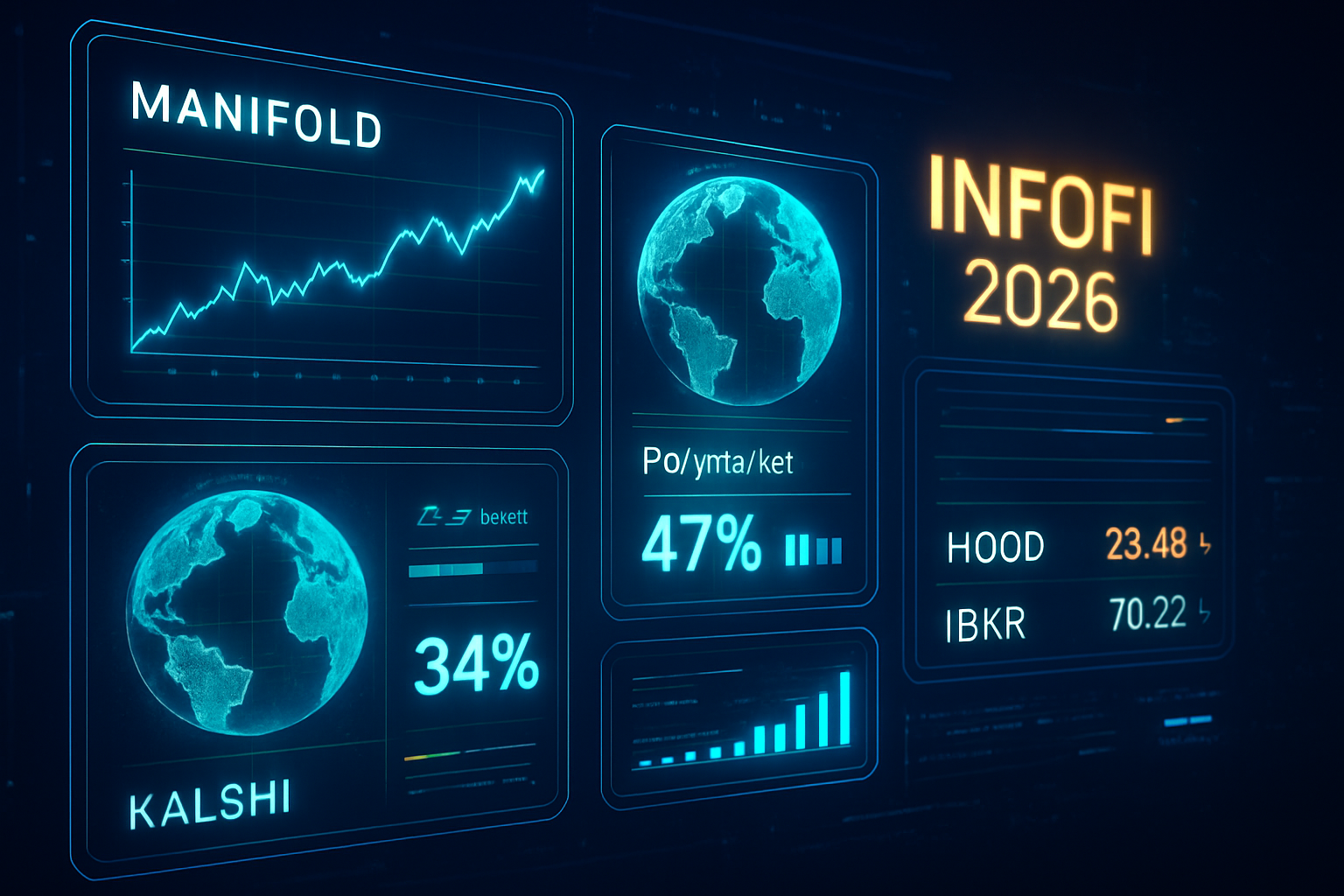
    As of today, the odds stand at:

    • Polymarket (47%): The crypto-native giant continues to lead, fueled by its role as the global "truth engine" for international events.
    • Kalshi (34%): Despite facilitating over $43 billion in trades in 2025, Kalshi’s odds have softened following a recent regulatory speed bump in Massachusetts regarding sports contracts.
    • ForecastEx (12%): A dark horse that recently surpassed $1 billion in cumulative notional volume, drawing in traditional finance (TradFi) users through the existing IBKR ecosystem.
    • Robinhood (7%): Following its high-profile joint venture with Susquehanna, Robinhood (NASDAQ: HOOD) has become the fastest-growing retail entrant, though its 2026 volume is still playing catch-up.

    Trading on these markets is characterized by high liquidity and a unique "insider" feel, as many participants are employees of these very platforms or professional market makers who provide the liquidity for the industry.

    Why Traders Are Betting

    The volatility in these meta-markets is being driven by three primary factors: regulatory arbitrage, the "InfoFi" narrative, and institutional product integration. Traders are currently reacting to a January 2026 preliminary injunction in Massachusetts that temporary banned "event contracts related to sports" on regulated exchanges. Since nearly 90% of Kalshi's record-breaking 2025 volume was derived from sports-adjacent markets, the "No" side of their dominance contract saw a massive 15% spike in volume this week.

    Meanwhile, the concept of Information Finance (InfoFi)—the idea that prediction markets are the most efficient way to price the probability of truth—is moving from theory to reality. Projects like Intuition, which launched its mainnet in late 2025, have convinced Manifold traders that the industry's growth is "non-linear." There is currently a 53% probability on Manifold that a major bank CEO, such as Jamie Dimon of JPMorgan Chase & Co. (NYSE: JPM), will publicly endorse prediction markets as a legitimate asset class before the end of Q3 2026.

    Finally, the entry of Coinbase (NASDAQ: COIN) into the space via its acquisition of The Clearing Company has signaled to traders that the infrastructure for a $10 trillion annual volume rate—the "bull case" for 2026—is finally being built.

    Broader Context and Implications

    This meta-forecasting trend reveals a fundamental shift in how the public views information. In 2024, prediction markets were used to "fact-check" polls; in 2026, they are being used to price the very future of the platforms themselves. This represents the ultimate "skin in the game" for an industry built on the premise that financial incentives lead to better forecasting.

    The regulatory implications are particularly significant. A dominant market on Manifold currently gives an 81% chance that federal preemption will eventually protect Designated Contract Markets (DCMs) from varying state-level bans. If this "Yes" outcome triggers, it would effectively create a unified national market for event contracts in the U.S., similar to the equity markets.

    Historically, Manifold's meta-markets have been eerily accurate. In late 2024, Manifold traders correctly predicted the exact quarter that Kalshi would achieve its first $1 billion month, months before it happened. The current betting activity suggests that 2026 will be the year where regulated (Kalshi, IBKR) and decentralized (Polymarket) volumes finally begin to converge as the legal "grey areas" evaporate.

    What to Watch Next

    The most immediate catalyst for these markets is the resolution of the "Public Integrity in Financial Prediction Markets Act" (H.R. 7004), currently making its way through Congress. If passed, it would formalize the rules around insider trading on event contracts—a move that sounds restrictive but is actually viewed as "bullish" by traders because it provides the legal framework necessary for pension funds and insurance companies to enter the market.

    Key dates to monitor include:

    • February 15, 2026: The deadline for the CFTC to respond to the Massachusetts injunction, which will likely decide Kalshi’s volume trajectory for the first half of the year.
    • Q2 2026 Earnings: Watch for Robinhood (NASDAQ: HOOD) to report its first full quarter of "Event Derivatives" revenue, which many expect will surprise to the upside.

    Traders should also keep an eye on the "Social-to-Market" pipeline. There is an active market on whether a major social media platform like X (formerly Twitter) or Reddit will integrate native prediction market widgets, a move that would likely push the "InfoFi" adoption probability toward 90%.

    Bottom Line

    The meta-markets on Manifold suggest that the prediction market industry is entering its "scaling phase." While Polymarket remains the volume king due to its global reach and crypto integration, the institutional weight behind ForecastEx and the retail power of Robinhood make the 2026 volume lead a closer race than most realize.

    The rise of InfoFi represents a paradigm shift where information is no longer just consumed—it is priced, traded, and verified through financial incentives. Whether the industry hits the predicted $10 trillion annual volume target by the end of 2026 remains to be seen, but the "smart money" on Manifold is betting that the search for truth has finally found its business model.

    In 2026, we aren't just predicting the news; we are betting on the machines that predict the news.


    This article is for informational purposes only and does not constitute financial or betting advice. Prediction market participation may be subject to legal restrictions in your jurisdiction.

    PredictStreet focuses on covering the latest developments in prediction markets.
    Visit the PredictStreet website at https://www.predictstreet.ai/.

  • The New Wall Street: Intercontinental Exchange’s $2 Billion Bet Cements Polymarket as the Global “Truth Engine”

    The New Wall Street: Intercontinental Exchange’s $2 Billion Bet Cements Polymarket as the Global “Truth Engine”

    The landscape of global finance has been fundamentally reshaped this week as Intercontinental Exchange (NYSE: ICE), the powerhouse owner of the New York Stock Exchange, finalized a landmark $2 billion strategic investment into Polymarket. This massive capital injection, which values the decentralized prediction platform at a staggering $9 billion, marks a definitive turning point in the institutionalization of "Information Finance."

    By backing a platform once viewed as a niche corner of the crypto world, ICE is betting that the ability to price the probability of future events is not just a form of betting, but the next major asset class. In a world increasingly saturated with deepfakes and narrative-driven media, markets that force participants to "put their money where their mouth is" are emerging as the most reliable arbiters of truth.

    The Market: From Niche Crypto Site to a $9 Billion Powerhouse

    The scale of Polymarket’s ascent is unprecedented. Just two years ago, the platform was a breakout success of the 2024 election cycle; today, it is a foundational piece of the global financial infrastructure. The $2 billion investment from Intercontinental Exchange (NYSE: ICE) has allowed Polymarket to scale its liquidity to levels that rival traditional commodities markets.

    Current trading volumes on Polymarket have surged to over $5 billion monthly as of January 2026, with liquidity across thousands of markets—from Federal Reserve interest rate pivots to the outcome of corporate mergers and geopolitical conflicts. Under the terms of the deal, ICE has become the exclusive global distributor of Polymarket’s data. This means that real-time "market-implied probabilities" are now streamed directly into institutional trading terminals alongside traditional benchmarks like the S&P 500 and Brent Crude.

    The platform's resolution criteria, which rely on decentralized oracles and a growing partnership with ZK-verified (Zero-Knowledge) data sources, have become the gold standard for accuracy. This transparency was a key prerequisite for ICE’s involvement, ensuring that the platform’s "wisdom of the crowd" is resistant to manipulation and meets the stringent audit requirements of institutional investors.

    Why Traders Are Betting: The Rise of "Information Finance" (InfoFi)

    The driving force behind this valuation isn't just a passion for gambling—it is the birth of "Information Finance," or InfoFi. Popularized by Ethereum co-founder Vitalik Buterin, InfoFi posits that market mechanisms are the most efficient way to distill human judgment into actionable data. Unlike traditional finance, where information is often a byproduct of price action, Polymarket is designed specifically to elicit the truth.

    Traders are increasingly moving capital into prediction markets to hedge against "black swan" events that traditional derivatives cannot cover. For instance, supply chain managers are using Polymarket to hedge against the risk of specific regulatory changes in Southeast Asia, while institutional desks are betting on the success of clinical trials as a more accurate alternative to analyst reports.

    Recent whale activity on the platform suggests a shift in strategy. Large positions are no longer just speculative; they are often part of complex multi-leg trades where a prediction market position serves as an insurance policy for a traditional equity portfolio. As institutional players like Robinhood (NASDAQ: HOOD) and Coinbase (NASDAQ: COIN) integrate these markets directly into their retail interfaces, the liquidity gap between "betting" and "investing" continues to evaporate.

    Broader Context and Implications

    The institutional backing of Polymarket represents a total surrender by traditional polling and forecasting industries. After the 2024 and 2025 election cycles, where prediction markets consistently outperformed traditional pundits in accuracy, the "market-implied probability" has become the default metric for public sentiment.

    This shift has significant regulatory implications. In late 2025, Polymarket successfully navigated its way back into the U.S. market by acquiring QCEX, a CFTC-licensed derivatives exchange. This move, combined with the ICE partnership, has largely pacified regulatory concerns regarding market integrity and consumer protection. It has also sparked a "two-horse race" with Kalshi, which recently reached an $11 billion valuation by focusing on regulated U.S. domestic financial and sports contracts.

    Furthermore, the adoption of InfoFi is changing how corporations plan for the future. Companies are no longer relying solely on "expert" consultants; they are looking at where the money is moving on prediction platforms. If a market shows an 80% probability of a specific carbon tax passing, companies begin restructuring their operations months before the first vote is even cast in a legislature.

    What to Watch Next

    As we look toward the remainder of 2026, the next phase of this evolution will be the rise of AI-moderated "micro-markets." Both Polymarket and ICE have hinted at a new layer of the platform that will allow for the creation of millions of small-scale markets—governed by AI and settled automatically via smart contracts—to provide high-fidelity information on niche scientific and social questions.

    Key dates to monitor include the upcoming "Global InfoFi Summit" in March, where several major central banks are expected to discuss the use of prediction market data in setting monetary policy. Additionally, keep a close eye on the full integration of Polymarket data into the Robinhood (NASDAQ: HOOD) app, which is expected to bring tens of millions of new retail participants into the "truth economy."

    The most critical milestone, however, will be the first "Information-Linked Bond" issuance expected by a G20 nation later this year—a debt instrument where interest rates are tied directly to the achievement of specific social or environmental outcomes as measured by prediction market consensus.

    Bottom Line

    The $2 billion investment from Intercontinental Exchange is more than a capital raise; it is a coronation. It signals that prediction markets have graduated from the fringes of the internet to the center of the financial universe. By treating information as a tradable commodity, Polymarket has created a "Truth Engine" that the world's most powerful financial institutions now find indispensable.

    What this tells us is that in 2026, the most valuable currency is no longer just capital—it is accuracy. As prediction markets continue to mature, they will likely become the primary tool for how humanity navigates an increasingly complex and uncertain future. For investors, the message is clear: if you aren't looking at the markets to see what's coming, you aren't looking at the whole picture.


    This article is for informational purposes only and does not constitute financial or betting advice. Prediction market participation may be subject to legal restrictions in your jurisdiction.

    PredictStreet focuses on covering the latest developments in prediction markets.
    Visit the PredictStreet website at https://www.predictstreet.ai/.
  • The $700 Million Tipping Point: Prediction Markets Hit Record Volume as ‘Information Finance’ Goes Mainstream

    The $700 Million Tipping Point: Prediction Markets Hit Record Volume as ‘Information Finance’ Goes Mainstream

    On January 12, 2026, the global financial landscape reached a watershed moment that many analysts are calling the "death of the pundit and the birth of the market." Total daily trading volume across prediction platforms skyrocketed to a record-breaking $701.7 million, shattering the previous day's record and signaling a fundamental shift in how the world processes breaking news. As traditional news cycles struggled to keep pace with a rapidly unfolding geopolitical crisis and a domestic constitutional standoff, traders turned to event-based contracts to find the "price of truth."

    The surge was led by Kalshi, the U.S.-regulated powerhouse, which commanded a staggering 66.4% of the market share, processing over $465 million in trades within a single 24-hour window. This explosion in volume isn't just a flash in the pan; it represents the culmination of a year-long growth trajectory that began in 2025. With probabilities now shifting in real-time on everything from Federal Reserve policy to international conflicts, prediction markets have officially transitioned from niche speculative hobbies to the primary "truth engines" for the modern global economy.

    The Market: What’s Being Predicted

    The record-shattering volume on January 12 was primarily driven by a "perfect storm" of high-stakes contracts. At the center of the frenzy was the "March Fed Rate Cut" market. Following a series of contradictory economic signals, including a December jobs report that showed a mere 50,000 positions added, the market for a 25-basis-point cut in March saw massive inflows. Liquidity on Kalshi and the decentralized platform Polymarket reached levels comparable to mid-cap equity markets, with the probability of a cut swinging wildly between 60% and 74% as traders parsed live data.

    Beyond macroeconomics, the market proved its mettle in the face of geopolitical chaos. The sudden reported capture of Venezuelan President Nicolás Maduro by U.S. forces sent "flash markets" into overdrive. While mainstream news outlets were still waiting for official government confirmation, prediction markets were already repricing global energy costs and regional stability. Within minutes, over $120 million was wagered on the outcome of the incident and its immediate aftermath, providing a real-time sentiment gauge that preceded traditional reporting by nearly an hour.

    The infrastructure facilitating these bets has matured significantly. Robinhood (NASDAQ: HOOD) played a pivotal role as the primary retail gateway, utilizing Kalshi’s back-end to allow millions of users to trade event contracts directly alongside their stock portfolios. Meanwhile, Interactive Brokers (NASDAQ: IBKR), through its ForecastEx affiliate, catered to institutional hedgers who used these markets to offset risks associated with the burgeoning "Fed Independence" constitutional crisis. This combination of retail accessibility and institutional depth has created a liquidity flywheel that was unthinkable just two years ago.

    Why Traders Are Betting

    The primary driver of the current betting frenzy is the unprecedented level of regulatory and institutional clarity. In 2025, a landmark legal victory for Kalshi in the Ninth Circuit Court of Appeals paved the way for the permanent legalization of election and event betting in the United States. This "regulatory green light" encouraged major Wall Street players to enter the fray. Intercontinental Exchange (NYSE: ICE) signaled the industry's total acceptance with a landmark $2 billion investment into Polymarket, treating event-based contracts as a legitimate and essential asset class.

    Traders are also being drawn by the sheer speed of information discovery. In a world of deepfakes and fragmented media, the "skin in the game" requirement of prediction markets acts as a powerful filter for noise. On January 12, as rumors of a standoff between the U.S. Department of Justice and Federal Reserve Chair Jerome Powell circulated, the markets provided a clear-eyed assessment of the situation’s gravity. While social media was rife with speculation, the "Fed Chair Ouster" contract on Kalshi remained remarkably stable, correctly signaling to traders that the crisis, while serious, was unlikely to lead to an immediate resignation.

    This shift has also been bolstered by the emergence of "Superforecasters" and professional arbitrageurs. Firms like Goldman Sachs (NASDAQ: GS) have reportedly begun exploring the integration of prediction market data into their broader derivative and risk-management desks. By treating these markets as a superior alternative to traditional polling or expert intuition, traders are finding that they can hedge against "black swan" events with much higher precision than was previously possible.

    Broader Context and Implications

    The record-breaking volume on January 12 marks the official arrival of "Information Finance," or InfoFi—a concept popularized by Ethereum co-founder Vitalik Buterin. InfoFi posits that market mechanisms are the most efficient way to distill human judgment and aggregate unbiased information. We are no longer just betting on outcomes; we are participating in a decentralized system that assigns a financial value to the accuracy of information. This has profound implications for how public sentiment is measured and how policy is made.

    Historically, prediction markets have demonstrated a remarkable ability to outperform traditional polling, particularly during the 2024 and 2025 election cycles. This accuracy has turned them into a vital tool for corporate planning. When a company can see a 70% market-priced probability of a specific regulatory change, they can adjust their strategy months in advance. The fact that major news tickers like CNBC and CNN now display live prediction market probabilities alongside the S&P 500 is a testament to this newfound cultural and financial authority.

    However, the rise of InfoFi also brings new challenges. Regulatory scrutiny remains intense, especially regarding the potential for "manipulation via information"—where a trader might attempt to influence a real-world event to profit from a contract. Platforms like Kalshi have invested heavily in surveillance technology to combat this, but as volumes hit the billion-dollar-a-day mark, the stakes for maintaining market integrity have never been higher.

    What to Watch Next

    As we look toward the remainder of 2026, the focus will shift to the upcoming midterm elections and the resolution of the "Fed Independence" debate. These events are expected to provide the next major liquidity tests for the industry. If daily volumes continue their current trajectory, $1 billion days could become the standard by the end of the year. Investors should keep a close eye on the integration of prediction markets into broader fintech apps, as further partnerships between platforms like Robinhood and event exchanges could bring tens of millions of new participants into the ecosystem.

    Another key milestone will be the potential launch of "Corporate Intelligence" markets, where companies might offer internal prediction markets to employees to forecast project deadlines or sales targets. This internal use of InfoFi could provide a secondary growth engine for the industry. Additionally, the role of Dr. Philip Tetlock, recently appointed to the board of Interactive Brokers' ForecastEx, will be crucial in bridging the gap between academic "superforecasting" and high-frequency event trading.

    Bottom Line

    The $701.7 million day on January 12 was not just a record; it was a proof of concept. It proved that prediction markets can handle massive volume, provide high-velocity information in times of crisis, and attract a diverse range of participants from retail traders to institutional hedgers. Kalshi’s 66.4% market share demonstrates the power of a regulated, user-friendly interface in a maturing market, while the broader InfoFi movement suggests that our relationship with information is changing forever.

    Prediction markets are no longer the "fringe" of finance; they are the new tape. They provide a transparent, objective, and financially-backed look at the future, offering a clarity that traditional media often lacks. As we move deeper into 2026, the question is no longer whether prediction markets are accurate, but how quickly the rest of the financial world will adapt to the reality they present.


    This article is for informational purposes only and does not constitute financial or betting advice. Prediction market participation may be subject to legal restrictions in your jurisdiction.

    PredictStreet focuses on covering the latest developments in prediction markets.
    Visit the PredictStreet website at https://www.predictstreet.ai/.
  • The New ‘Day’ Job: Inside the Rise of the Full-Time Prediction Market Trader

    The New ‘Day’ Job: Inside the Rise of the Full-Time Prediction Market Trader

    As the sun sets over Atlanta, Georgia, 25-year-old Logan Sudeith isn't heading home from an office. Instead, he is likely propped up against his headboard, surrounded by glowing monitors and discarded DoorDash containers, preparing for another marathon shift in the world of "Information Finance." Sudeith is a leading figure in a burgeoning class of professionals who have abandoned traditional finance to trade the news in real-time. On platforms like Kalshi and Polymarket, the odds of a geopolitical crisis or a presidential "mention" of a specific keyword are no longer just points of conversation—they are a paycheck.

    Currently, the market for professional event trading is exploding. Monthly volumes across the sector hit a staggering $13.5 billion in December 2025, driven by a post-election hangover that transitioned seamlessly into high-stakes macro-economic and culture-war contracts. Sudeith recently hit a milestone that would make any Wall Street analyst blush: $100,000 in profit in a single month. This trend is drawing thousands of "news-driven" traders away from the 9-to-5 grind, betting that their ability to parse a tweet or analyze a legislative sub-clause is more valuable than any corporate salary.

    The Market: What's Being Predicted

    The landscape of prediction markets has shifted dramatically from niche political betting to a comprehensive financial ecosystem. At the center of this movement are two dominant forces: Kalshi, the federally regulated exchange in the United States, and Polymarket, which recently successfully re-entered the U.S. market after acquiring the CFTC-licensed derivatives exchange QCEX. These platforms offer "event contracts"—binary options that pay out $1 if an event occurs and $0 if it does not.

    Trading on these platforms is no longer a hobby. As of January 22, 2026, the market has seen a massive surge in liquidity for "mention markets"—contracts that pay out based on whether specific figures like Donald Trump use phrases such as "drill, baby, drill" during public addresses. Sudeith has dominated this space, utilizing API integrations to execute trades in milliseconds as soon as a transcript is processed.

    The volume is not limited to politics. The industry processed over $814 million in a single day on January 18, 2026, following the "Maduro Incident" in Venezuela. While the 2024 U.S. Election provided the initial proof of concept, the market has matured into 24/7 coverage of everything from the NYC mayoral race to scientific breakthroughs and even the Time Person of the Year selection.

    Why Traders Are Betting

    For traders like Sudeith, the move from a $75,000-a-year job as a financial risk analyst to a full-time "Professional Event Trader" (PMT) was a matter of simple arithmetic. "The math was clear," Sudeith famously noted, citing his ability to earn a year's salary in a single successful month on Kalshi, where his cumulative profits have surpassed $302,000.

    The strategy behind these bets is rooted in "Information Finance"—a term popularized by Ethereum founder Vitalik Buterin. Unlike traditional stock trading, which relies on earnings reports and P/E ratios, event trading relies on the aggregation of truth. Sudeith and his peers spend upwards of 100 hours a week conducting deep historical analysis and monitoring live sentiment. For his $40,236 win on the Time Person of the Year contract, Sudeith didn't just guess; he meticulously tracked selection patterns and media leaks that the broader market had ignored.

    However, the strategy is not without high-stakes drama. Sudeith recently faced his "biggest loss ever" during the Venezuelan political crisis, where he took a heavy hit betting on the removal of Nicolas Maduro. The volatility of these markets means that a trader can be up six figures one week and fighting for liquidity the next. This has led to the rise of elite communities like the "Crypto Inner Circle" on Discord, where traders share order flow analysis to spot "insidered" activity—bets that suggest someone, somewhere, has non-public information.

    Broader Context and Implications

    The rise of the PMT class has coincided with a massive influx of institutional capital. In late 2025, the Intercontinental Exchange (NYSE: ICE), the parent company of the New York Stock Exchange, invested nearly $2 billion into Polymarket’s infrastructure. Simultaneously, traditional betting giants like DraftKings (Nasdaq: DKNG) and Flutter Entertainment (NYSE: FLUT), via its subsidiary FanDuel, launched dedicated event contract platforms to compete for market share.

    This institutionalization has rebranded "betting" as "InfoFi." Major newsrooms now treat prediction market tickers as more accurate than traditional polling. Yet, this legitimacy comes with new risks. The regulatory environment remains a patchwork; while Kalshi is federally overseen by the CFTC, it faces ongoing legal battles in states like Nevada and Massachusetts over the legality of sports-related contracts.

    Furthermore, the "lifestyle" of the full-time trader is under scrutiny. The 24/7 nature of global news cycles has led to reports of extreme burnout and social isolation. Sudeith’s own "bed-lounging" setup and reliance on delivery apps highlight the physical and mental toll of a career that requires constant vigilance. There is also a looming "tax no-man's land"—many traders are filing under Section 1256 for a 60/40 tax split, but if the IRS reclassifies these earnings as gambling winnings, many could face catastrophic back-tax liabilities.

    What to Watch Next

    The next several weeks will be a crucible for the prediction market industry. In February 2026, a New York court is expected to issue a ruling on the "de facto" legality of political contracts, a decision that could either cement the industry’s future or create a major hurdle for U.S.-based exchanges.

    Traders are also closely watching the "ORACLE Act" currently moving through the New York legislature, which seeks to formally define prediction markets as financial entities rather than gambling venues. If passed, it would likely trigger a fresh wave of TradFi professionals quitting their roles to join the PMT ranks.

    On the market side, liquidity is the key metric to monitor. While headline volumes are high, "slippage"—the difference between the expected price of a trade and the price at which it's executed—remains a significant risk during non-peak hours. As more institutional "market makers" enter the space, this should stabilize, but for now, it remains a dangerous game for those trading with large positions.

    Bottom Line

    The story of Logan Sudeith is the story of a fundamental shift in how we value information. Prediction markets have moved from the periphery of the internet to the heart of the financial world, turning news consumption into a professional skill set. These markets are no longer just about who wins an election; they are "truth engines" that provide a real-time, financialized look at the world’s most pressing questions.

    However, the transition from TradFi to PMT is not for the faint of heart. It requires a tolerance for extreme volatility, a 100-hour work week, and a willingness to navigate a legal and tax landscape that is still being written. For those like Sudeith, the rewards—both financial and intellectual—are worth the risk. For the rest of the world, these markets offer a new way to see the future, one trade at a time.


    This article is for informational purposes only and does not constitute financial or betting advice. Prediction market participation may be subject to legal restrictions in your jurisdiction.

    PredictStreet focuses on covering the latest developments in prediction markets.
    Visit the PredictStreet website at https://www.predictstreet.ai/.

  • The Truth Engine: How Prediction Markets Became the New Foundation for Global Capital

    The Truth Engine: How Prediction Markets Became the New Foundation for Global Capital

    In early 2026, the global financial landscape is undergoing a silent but profound restructuring. What were once dismissed as niche "betting" sites for political junkies have transformed into the "truth engine" of the modern economy. Prediction markets are no longer just speculative sideshows; they have emerged as core financial infrastructure, providing a real-time, incentivized layer of ground-truth data that traditional equity and debt markets are increasingly relying upon to price risk.

    As of January 16, 2026, the total notional trading volume across major event contract platforms has stabilized above $13 billion monthly. This surge is driven by a fundamental shift in perception: institutional investors and corporate treasurers are no longer "betting" on outcomes; they are "hedging" against uncertainty. From the probability of a specific AI breakthrough to the timing of Federal Reserve rate cuts, prediction markets are now the primary venue where the world’s collective intelligence is priced in real-time.

    The Market: What’s Being Predicted

    The prediction market ecosystem has coalesced around two dominant titans: Polymarket and Kalshi. While Polymarket remains the leader in global geopolitical and cultural forecasting, Kalshi has solidified its position as the premier federally regulated exchange for institutional players in the United States. Current market data shows that nearly 40% of all volume is now concentrated in "Economic Infrastructure" contracts—markets that predict regulatory approvals, corporate earnings beats, and technological milestones.

    The valuations of these platforms reflect their newfound status as the "CME of Event Contracts." Polymarket recently reached a staggering $9 billion valuation following its pivotal role in providing more accurate sentiment data than traditional polling during the 2024 and 2025 global election cycles. Meanwhile, Kalshi has hit an $11 billion valuation, bolstered by its integration into mainstream retail platforms. The liquidity in these markets is now deep enough to support "whale" positions exceeding $50 million without moving the needle more than a few percentage points, a level of maturity that was unthinkable just 24 months ago.

    Why Traders Are Betting

    The primary driver behind this explosive growth is the entry of institutional capital. In a landmark move for the industry, the Intercontinental Exchange (NYSE: ICE), the parent company of the New York Stock Exchange, recently committed $2 billion to Polymarket. This investment isn't just about equity; it’s a strategic play to distribute Polymarket’s event-driven data through ICE’s global terminals. Institutions now view prediction market odds as "sentiment factors" that are as essential to their models as bond yields or consumer price indices.

    Beyond institutional giants, the startup ecosystem has pioneered a new use case for event contracts: capital formation and risk mitigation. Early-stage tech firms are now using prediction markets to "pre-market" their products. By launching or seeding markets on platforms like Manifold or Polymarket, startups can gauge the real-world probability of consumer adoption or technical feasibility before a single line of code is written. Furthermore, companies are increasingly using "Yes" contracts on specific regulatory crackdowns to hedge against the downside risk of their own stock prices—essentially creating a customized insurance policy against political or legal volatility.

    Broader Context and Implications

    This shift into the mainstream was facilitated by a series of regulatory breakthroughs throughout 2025. The passing of the GENIUS Act (Guiding and Establishing National Innovation for U.S. Stablecoin Act) provided the legal certainty needed for the stablecoin-based settlement layers that power Polymarket. Additionally, the "CLARITY Act" officially codified event contracts as a protected class of financial derivatives under the CFTC, effectively ending the era of "gambling" classifications that had long hindered American expansion.

    The integration of these markets into traditional finance is now nearly seamless. Robinhood Markets (NASDAQ: HOOD) and Coinbase Global (NASDAQ: COIN) have both launched dedicated prediction market hubs, allowing retail investors to swap between stocks and event contracts with one click. This has created a feedback loop where prediction market data influences equity prices in real-time. For example, when a prediction market on a pharmaceutical company's FDA approval shifts from 40% to 70%, the company's stock price often moves in tandem within seconds, as high-frequency trading (HFT) firms bridge the two markets.

    What to Watch Next

    As we look toward the remainder of 2026, the next frontier for prediction markets is their direct integration into the venture capital (VC) stack. Several Tier-1 VC firms are reportedly experimenting with "Prediction-Linked Funding," where a startup’s next tranche of capital is automatically unlocked based on their success probabilities in a dedicated prediction market. This would effectively decentralize the "milestone" process, moving it from a private board room to a public, incentivized market.

    The second major milestone to monitor is the upcoming Public Integrity Act of 2026, currently being debated in the U.S. Congress. This legislation aims to create standardized self-regulatory measures for prediction markets to prevent insider trading and ensure that these platforms remain robust "truth engines" as they scale toward $50 billion in annual volume. The outcome of this debate will determine if prediction markets can maintain their reputation for accuracy as they become increasingly central to global finance.

    Bottom Line

    Prediction markets have completed their journey from the fringes of the internet to the center of the financial world. By providing a mechanism to price the "unpriceable," they have filled a massive gap in the traditional capital markets. The multi-billion dollar valuations of Polymarket and Kalshi, coupled with the $2 billion vote of confidence from Intercontinental Exchange (NYSE: ICE), signal that "Information Finance" is here to stay.

    In the future, we may look back at 2026 as the year the world stopped guessing and started pricing. As these markets become more liquid and regulated, they will likely serve as the primary hedge against the binary uncertainties of a volatile global landscape—transforming how companies are built, how risks are managed, and how the world discovers the truth.


    This article is for informational purposes only and does not constitute financial or betting advice. Prediction market participation may be subject to legal restrictions in your jurisdiction.

    PredictStreet focuses on covering the latest developments in prediction markets.
    Visit the PredictStreet website at https://www.predictstreet.ai/.