As of January 8, 2026, the global technology sector finds itself in the midst of a fundamental shift. While the early years of the current decade were defined by the "compute" race—dominated by high-performance GPUs—the focus has now shifted to the "storage bottleneck." At the heart of this transition is Seagate Technology (NASDAQ: STX), a company that has transformed itself from a legacy hardware manufacturer into the essential architect of the AI data lake. After a period of significant stock price volatility driven by cyclical downturns in 2023 and 2024, Seagate has emerged as a high-margin leader in mass-capacity storage, capturing the market’s attention as it leads the charge in next-generation recording technologies.
Historical Background
Seagate Technology was founded in 1979 by Al Shugart and Finis Conner, originally under the name Shugart Technology. The company played a pivotal role in the microcomputer revolution by developing the ST-506, the first 5.25-inch hard disk drive (HDD). Throughout the 1980s and 1990s, Seagate navigated a cutthroat landscape of hardware consolidation, surviving by vertically integrating its supply chain and focusing on the manufacturing of the two most critical components of a drive: the recording heads and the media disks.
The 2010s marked a difficult transition as Solid State Drives (SSDs) began to replace HDDs in consumer electronics like laptops and gaming consoles. Many analysts predicted the "death of the spinning disk." However, Seagate pivoted aggressively toward the enterprise and cloud markets. Rather than trying to compete in the commodity flash memory market, the company doubled down on "Mass Capacity" storage, betting that the world’s exponential data growth would eventually outpace the affordability of SSDs for large-scale storage.
Business Model
Seagate’s modern business model is a study in specialization. Approximately 80–90% of its revenue now stems from its Mass Capacity segment, which provides high-density HDDs to hyperscale cloud providers (Amazon, Microsoft, Google) and large enterprises.
A key evolution in their model since 2024 is the shift to a Build-to-Order (BTO) strategy. By moving away from the "spot market" and toward long-term volume agreements with major customers, Seagate has significantly reduced the historical "boom-and-bust" cycle of the storage industry. This provides the company with approximately 9 to 12 months of demand visibility, allowing for more efficient manufacturing and capital allocation. Additionally, the company has expanded its Lyve Cloud services—a storage-as-a-service offering designed to help enterprises manage "edge" data without the high egress fees charged by major cloud incumbents.
Stock Performance Overview
The performance of Seagate stock (NASDAQ: STX) has been a tale of two eras.
- 1-Year Performance: Over the past twelve months, STX has surged roughly 220%. This reflects a massive re-rating by the market as investors recognized the "AI Storage Supercycle."
- 5-Year Performance: On a five-year horizon, the stock has gained approximately 550%, representing a 44% CAGR. Much of this gain occurred in the 2024–2025 window as the company successfully commercialized its HAMR (Heat-Assisted Magnetic Recording) technology.
- 10-Year Performance: For long-term shareholders, the return has been spectacular, with a total return exceeding 1,400% (including dividends), vastly outperforming the S&P 500 and the broader Nasdaq.
Financial Performance
Seagate entered early 2026 on a high financial note. In its most recent quarterly report (FY Q1 2026, ending late 2025), the company reported revenue of $2.63 billion, a 21% increase year-over-year. The standout metric was the non-GAAP gross margin, which hit a record 40.1%.
This margin expansion is directly tied to the transition to higher-capacity drives (30TB+), which command a price premium while offering a lower cost-per-terabyte to the customer. The company has also been aggressive in its debt management, reducing its total debt from over $6 billion in 2023 to $5.0 billion by the end of 2025. With a market capitalization now hovering around $59 billion, Seagate is no longer viewed as a "legacy" value stock but as a growth-oriented infrastructure play.
Leadership and Management
Dr. Dave Mosley, who has served as CEO since 2017 and was recently elected Board Chair in October 2025, is the primary architect of Seagate’s current success. Mosley’s tenure has been defined by his "operational discipline" and his refusal to abandon HDD technology in the face of the SSD surge.
Under Mosley, the leadership team—including CFO Gianluca Romano and CTO John Morris—has focused on "structural improvements" to the business. This includes shutting down less profitable product lines (like low-capacity consumer drives) and focusing R&D exclusively on areal density breakthroughs. The governance reputation of the company is strong, characterized by a commitment to returning capital to shareholders through a consistent (though occasionally volatile) dividend policy.
Products, Services, and Innovations
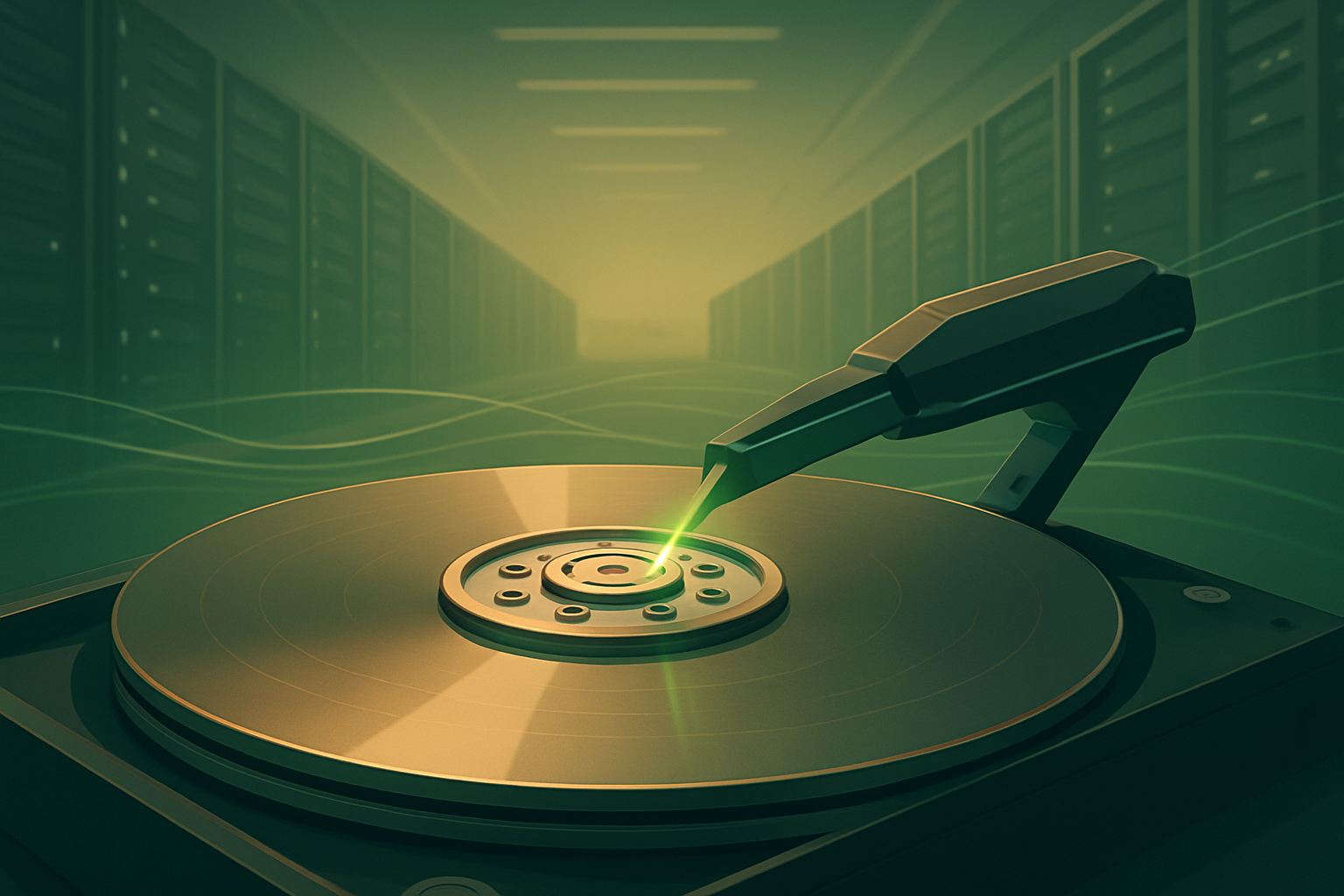
The "crown jewel" of Seagate’s innovation pipeline is HAMR (Heat-Assisted Magnetic Recording), marketed under the Mozaic brand. HAMR uses a tiny laser to heat the disk surface for a nanosecond before writing data, allowing for much smaller bit sizes and, consequently, higher capacity.
- Mozaic 3+: Currently shipping in volume, these drives offer 30TB to 36TB of storage.
- Mozaic 4+: These 40TB+ drives are currently in the qualification phase with major cloud service providers, with volume shipments expected to commence in the first half of 2026.
- Future Roadmap: Seagate has outlined a clear path to 50TB drives by 2027 and targets 100TB by 2030. This technological moat is significant; it allows Seagate to store roughly 6 to 8 times more data per dollar than enterprise-grade SSDs.
Competitive Landscape
The HDD industry is essentially a duopoly between Seagate and Western Digital (NASDAQ: WDC), with Toshiba holding a minor third-place position.
As of early 2026, Seagate holds a clear technological lead. While Western Digital split its flash (SSD) and HDD businesses into two separate entities in February 2025, it remains behind Seagate in the transition to HAMR technology. Western Digital currently relies on "Energy-Assisted Magnetic Recording" (ePMR), which struggles to reach the 30TB+ threshold as efficiently as Seagate's laser-based approach. Analysts estimate Seagate has a 1.5 to 2-year head start in the HAMR volume manufacturing curve.
Industry and Market Trends
The "Storage Supercycle" is being driven by two main macro factors:
- Generative AI Output: AI models generate staggering amounts of unstructured data. A single minute of AI-generated video is thousands of times larger than the text prompt that created it. This data must be stored somewhere, and HDDs remain the only cost-effective medium for this "warm" storage.
- The "Data Lake" Philosophy: Modern enterprises no longer delete data; they store everything to train future proprietary AI models. This "save-everything" mentality has led to an explosion in Exabyte shipments.
Risks and Challenges
Despite the current optimism, Seagate faces notable risks:
- Geopolitical Concentration: Seagate does much of its manufacturing in Singapore, Thailand, and Malaysia. Any escalation in regional tensions or disruptions to the supply chain could be catastrophic.
- SSD Cost Erosion: If breakthroughs in 3D NAND (SSD) layering occur faster than expected, the cost-per-terabyte gap between HDDs and SSDs could narrow, potentially allowing SSDs to eat into Seagate’s mass-capacity territory.
- Capex Cycles: Hyperscale providers are known for "digesting" their capacity. If companies like Meta or Google pause their AI infrastructure spending in late 2026, Seagate could face a temporary but sharp revenue contraction.
Opportunities and Catalysts
- The 40TB Milestone: The successful volume launch of Mozaic 4+ drives in mid-2026 is the most immediate catalyst. If Seagate hits its production yields, margins could expand toward the 50% mark.
- The 2026 Refresh Cycle: Much of the cloud infrastructure built during the 2020 pandemic boom is reaching its 5-year end-of-life. A massive replacement cycle of older 12TB/16TB drives with new 30TB+ HAMR drives is expected throughout 2026.
- M&A Potential: With its strengthened balance sheet, Seagate may look to acquire smaller software companies to bolster its Lyve Cloud storage-as-a-service ecosystem.
Investor Sentiment and Analyst Coverage
Wall Street sentiment toward Seagate is currently at its highest point in a decade. Most analysts have "Buy" or "Overweight" ratings, citing the "pure-play" nature of Seagate’s HDD business following the Western Digital split. Hedge funds have increased their positions in STX throughout 2025, viewing it as a "undervalued AI play" compared to the high-multiple chipmakers like Nvidia or AMD. Retail sentiment on platforms like Reddit and X (formerly Twitter) has also turned bullish, focusing on the company's dividend yield and its role as the "world's hard drive."
Regulatory, Policy, and Geopolitical Factors
Seagate operates in a sensitive regulatory environment. In 2023, the company faced a $300 million fine from the U.S. Bureau of Industry and Security (BIS) regarding shipments to Huawei. Today, the company maintains a rigorous compliance framework but remains at the mercy of U.S.-China trade relations. As a significant portion of its end-demand comes from Chinese data centers, any further tightening of export controls on high-capacity storage could impact its long-term growth projections in the Asia-Pacific region.
Conclusion
Seagate Technology has successfully navigated the "trough of disillusionment" regarding hard disk technology. By January 2026, the company has proven that the HDD is not a relic of the past, but the bedrock of the AI future. With a dominant technological lead in HAMR, record-breaking margins, and a streamlined business model, Seagate is well-positioned to capitalize on the global storage supercycle.
However, investors should remain mindful of the cyclical nature of the industry and the geopolitical risks inherent in high-tech manufacturing. While the stock has seen a meteoric rise, its future will depend on whether it can maintain its areal density advantage and successfully manage the transition to 40TB and 50TB capacities. For now, Seagate stands as a formidable "pure-play" on the world’s insatiable hunger for data.
This content is intended for informational purposes only and is not financial advice.