Tag: Government Shutdown

  • Betting on the Brink: Geopolitical Supercycle Drives Record $230M+ into Prediction Markets

    Betting on the Brink: Geopolitical Supercycle Drives Record $230M+ into Prediction Markets

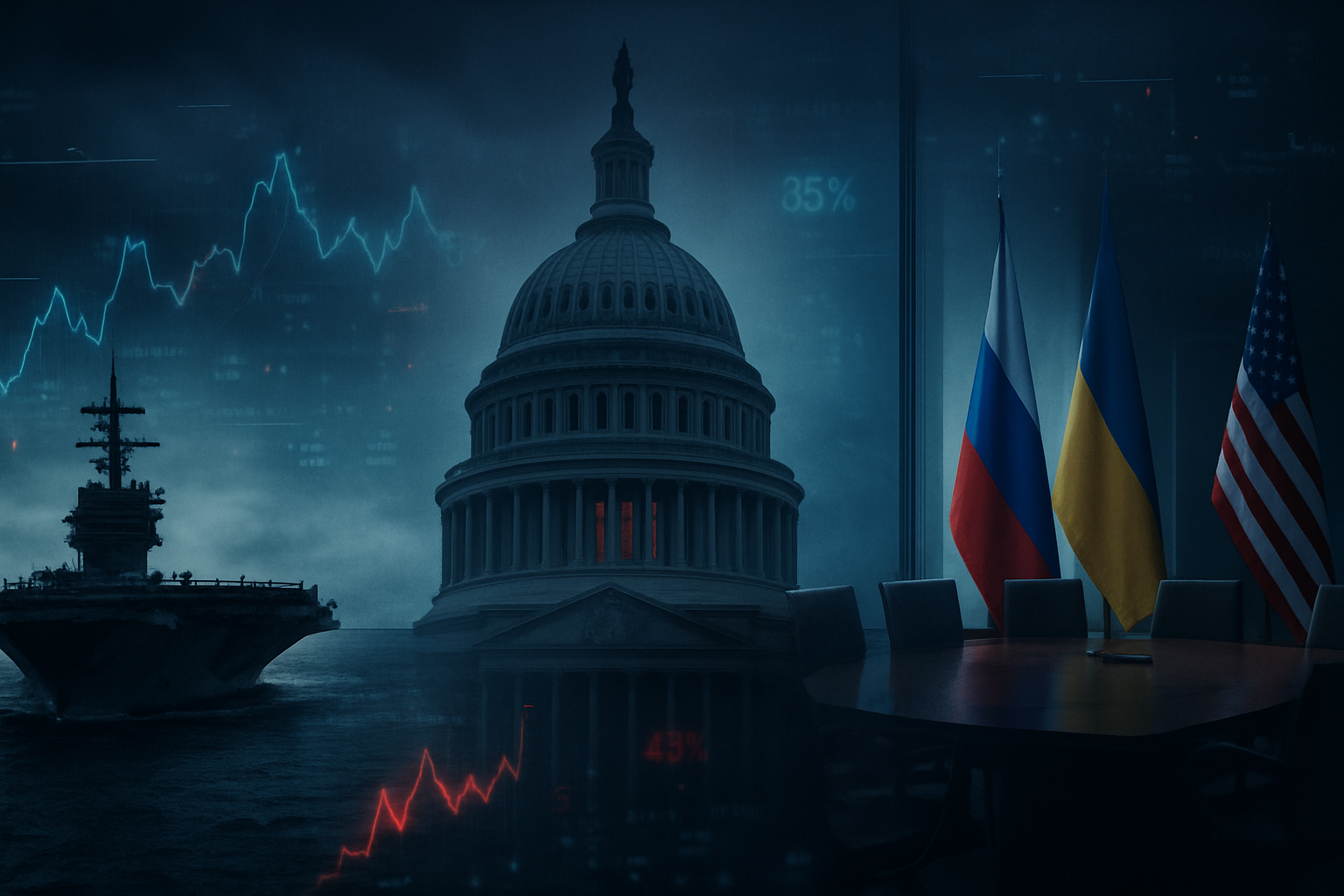
    As the world wakes up on February 1, 2026, the traditional tools of diplomacy and statecraft are increasingly being viewed through a new, high-resolution lens: the prediction market. In a year already defined by unprecedented volatility, three major geopolitical flashpoints have emerged as the primary drivers of global speculation. Traders are currently navigating a landscape where the United States is locked in a high-stakes naval standoff with Iran, the federal government has just entered a partial shutdown, and a fragile hope for peace in Eastern Europe hangs in the balance.

    The numbers are staggering. As of this morning, over $147 million has been wagered on whether the U.S. will launch a direct military strike against Iran, while a separate $87 million market tracks the fallout of the current domestic budget crisis. Meanwhile, the most watched contract of the year—the prospect of a Russia-Ukraine ceasefire—is currently hovering at a 45% probability. These markets are no longer just hobbies for the "pundit class"; they have become essential "truth events," providing a cold, hard-money assessment of global stability that often moves faster than official government briefings.

    The Market: What's Being Predicted

    The geopolitical "Big Three" of 2026 are primarily concentrated on Polymarket and Kalshi, with the former hosting the lion's share of international military speculation. The "US strikes Iran" market, which has seen its volume swell to $147 million, is specifically trading on whether the U.S. military will conduct a kinetic operation against Iranian territory or its assets by the end of the second quarter. Current odds have fluctuated wildly, spiking recently as the USS Abraham Lincoln carrier strike group reached its station off the Iranian coast.

    On the domestic front, Kalshi has become the epicenter for the $87 million "Government Shutdown" contracts. These markets are uniquely designed for U.S. participants to hedge against the economic disruption caused by the current partial shutdown that began yesterday, January 31, 2026. Unlike military markets, these contracts are highly technical, resolving based on official Congressional funding status for specific departments, including the Department of Homeland Security (DHS).

    Finally, the Russia-Ukraine ceasefire market has become the definitive sentiment barometer for the ongoing Abu Dhabi peace talks. Trading at a 45% probability for a signed agreement by March, the market reflects a "coin-flip" reality despite the optimistic rhetoric from the State Department. Liquidity in this market is at an all-time high, with major institutional players using the 45% mark to price risk in European energy and defense stocks, such as Lockheed Martin (NYSE: LMT) and Northrop Grumman (NYSE: NOC).

    Why Traders Are Betting

    The 83% implied probability of a U.S. strike on Iran—despite the 45% ceasefire odds in Ukraine—is fueled by the traumatic military escalations of 2025. Traders vividly remember "Operation Midnight Hammer" in June 2025, when the U.S. bombed the Fordow nuclear facility. The recent 2026 surge in betting volume was triggered by Iran's brutal crackdown on internal dissent earlier this month, leading to a "MIGA" (Make Iran Great Again) posture from the Trump administration. Large-scale "whales" in these markets are betting that the U.S. cannot afford to let its 2025 momentum dissipate without achieving total regime concessions.

    In the "Government Shutdown" market, the driving force is a specific domestic flashpoint: the Minneapolis Shooting. In early January 2026, federal agents were involved in a fatal encounter with U.S. citizens, causing a massive rift in the Senate. Traders who correctly predicted the January 31 shutdown (then a 15% longshot) focused on the intransigence of House leadership regarding DHS funding reforms. Many high-volume traders are currently betting that the shutdown will be short-lived—less than 72 hours—expecting a stopgap measure to pass by Monday evening.

    Regarding the Russia-Ukraine conflict, the 45% ceasefire probability represents a cautious optimism born from the "Energy Truce" brokered by President Trump in mid-January. While traditional diplomats cite "unreconcilable differences" regarding occupied territories, prediction market traders are looking at secondary signals: the massive reduction in artillery fire and the repositioning of General Dynamics (NYSE: GD) equipment away from the front lines. The market suggests that while a full "peace treaty" is unlikely, a formal cessation of hostilities is a near-even bet.

    Broader Context and Implications

    This surge in volume represents a maturation of prediction markets as a vital component of the global intelligence architecture. For years, skeptics dismissed these platforms as "gambling for geeks," but in 2026, they serve as a real-time sanity check against propaganda. When the Russian Foreign Ministry claims talks are failing, but the ceasefire market stays steady at 45%, global observers look to the market for the underlying "truth." This has created a feedback loop where even officials at companies like Palantir (NYSE: PLTR) and RTX Corporation (NYSE: RTX) are rumored to monitor these odds to assess operational risk.

    Furthermore, the $87 million shutdown market highlights the regulatory evolution of platforms like Kalshi. By providing a legal, regulated venue for U.S. traders to hedge against legislative failure, these markets have effectively democratized "political insurance." However, the sheer scale of the $147 million Iran market has also drawn the attention of the Commodity Futures Trading Commission (CFTC), which remains concerned about the ethics of profiting from kinetic warfare.

    Historically, these markets have outperformed traditional polling and expert panels. During the 43-day shutdown of late 2025, prediction markets correctly identified the resolution date three days before a deal was announced to the press. This track record is exactly why we are seeing such massive capital inflows today; traders believe the collective "wisdom of the crowd" can pierce the fog of war more effectively than a single analyst at a think tank.

    What to Watch Next

    The next 48 hours will be critical for all three markets. For the "US strikes Iran" contract, all eyes are on the Persian Gulf. Any reports of Iranian naval provocation or a "freedom of navigation" exercise by the U.S. Navy will likely send the 83% probability toward the 95% range. Conversely, any last-minute diplomatic outreach from Tehran could see a sharp "crash" in the contract price, creating a high-volatility environment for intraday traders.

    In Washington, the "Shutdown" market will react to the House's Monday session. If a vote on the stopgap funding bill fails to materialize by 4:00 PM EST tomorrow, the probability of a "long-term shutdown" (defined as >14 days) will likely double. Traders should watch for any movement on DHS funding reforms, as this remains the primary "poison pill" in current negotiations.

    Finally, the Abu Dhabi peace talks entering their second round today (February 1) is the "make-or-break" moment for the 45% ceasefire probability. If the parties agree to an extension of the Energy Truce by tomorrow evening, expect the ceasefire odds to jump to 60%. If the talks break down without a scheduled Round 3, the market will likely plummet toward 10%, signaling a return to full-scale winter offensive operations.

    Bottom Line

    As we enter February 2026, prediction markets have become the "central nervous system" of geopolitical risk. The $147 million volume in Iran-related markets and the $87 million shutdown bets prove that participants are no longer just guessing; they are aggressively pricing the future. The 45% ceasefire probability for Russia and Ukraine is perhaps the most telling figure of all—it is a clear-eyed rejection of both total war and total peace, signaling a "frozen conflict" scenario that markets are uniquely equipped to navigate.

    Ultimately, these markets tell us that the world is currently in a state of precarious equilibrium. Whether it is the tension in the Strait of Hormuz or the legislative gridlock in D.C., the odds reflect a global community that is bracing for impact while simultaneously looking for an exit ramp. For observers and investors alike, the primary takeaway is clear: in the "truth economy" of 2026, the most reliable signal is not what world leaders say, but where the money is moving.


    This article is for informational purposes only and does not constitute financial or betting advice. Prediction market participation may be subject to legal restrictions in your jurisdiction.

    PredictStreet focuses on covering the latest developments in prediction markets.
    Visit the PredictStreet website at https://www.predictstreet.ai/.
  • The $17 Million Truth Signal: Prediction Markets Brace for 80% Chance of U.S. Government Shutdown

    The $17 Million Truth Signal: Prediction Markets Brace for 80% Chance of U.S. Government Shutdown

    As the clock ticks toward a midnight deadline on January 31, 2026, the traditional halls of power in Washington D.C. are being outpaced by a different kind of authority: the collective intelligence of prediction markets. For weeks, political pundits maintained a cautious optimism that a funding deal would be reached, but the "smart money" has decisively pivoted. On major forecasting platforms, the probability of a federal government shutdown has surged to a staggering 80%, reflecting a bleak reality that many news outlets are only now beginning to acknowledge.

    This sudden spike in odds—climbing from a mere 10% just days ago—comes amid a high-stakes standoff over Department of Homeland Security (DHS) funding. With over $17 million already wagered across regulated and decentralized exchanges, the market's conviction is serving as a real-time "truth signal," cutting through the partisan rhetoric to reveal the high likelihood of a significant lapse in federal operations.

    The Market: What's Being Predicted

    The current volatility is concentrated in two primary venues: Kalshi, a U.S.-regulated prediction market, and Polymarket, a decentralized platform that has seen a massive influx of global capital. On Kalshi, the contract asking "Will the government be shut down on Saturday?" has seen more than 880,000 active positions, with "Yes" shares currently trading at $0.79, implying a 79% probability. Polymarket shows an even higher conviction, with volumes on its shutdown contract crossing the $11 million mark and odds hovering around 80%.

    The resolution criteria for these markets are specific: the federal government must experience a funding gap that lasts for at least 24 hours starting at 12:01 a.m. ET on February 1, 2026. While the primary market focuses on the "if," secondary markets are already debating the "how long." On Kalshi, the favored outcome in the "duration" market is currently "7+ days," suggesting that traders expect a protracted battle rather than a brief weekend "glitch."

    This level of liquidity—exceeding $17 million in combined volume—is a testament to the maturation of the industry. Large-scale institutional hedging is now visible, as firms look to protect themselves against the "Data Fog" that occurs during a shutdown. When the government closes, agencies like the Bureau of Labor Statistics (BLS) and the Bureau of Economic Analysis (BEA) stop releasing critical economic indicators, such as CPI and employment reports, leaving investors blind.

    Why Traders Are Betting

    The catalyst for this market panic was a tragic and polarizing event: the fatal shooting of Alex Jeffrey Pretti, a U.S. citizen and nurse, by federal DHS agents during an enforcement operation in Minneapolis on January 24. This incident sparked domestic unrest and triggered an immediate legislative blockade. Senate Minority Leader Chuck Schumer and top Democratic appropriators have vowed to block any spending package that includes DHS funding without "radical" oversight reforms.

    Republicans, led by Senate Majority Leader John Thune, have refused to decouple DHS funding from the broader $1.2 trillion appropriations package. The legislative math is currently impossible:

    • The Recess Factor: The House of Representatives is currently in recess and not scheduled to return until February, making it nearly impossible to pass a last-minute compromise.
    • The "Weather" Variable: A severe winter storm in the D.C. area has already delayed Senate proceedings, further compressing an already tight timeline.
    • The Consensus Collapse: On January 23, markets saw only a 9% chance of a shutdown. The 70-point jump in four days represents a "violent repricing" of risk as the gravity of the DHS standoff became clear.

    While cable news networks like CNN or Fox Business (operated by Fox Corporation, (NASDAQ: FOXA)) were still reporting on "ongoing negotiations" early this week, prediction markets were already cratering. Traders saw the combination of a House recess and a Senate stalemate as a mathematical dead end, leading to the current high-conviction "Yes" positions.

    Broader Context and Implications

    The 2026 shutdown market marks a turning point for prediction platforms as a tool for public information. We are seeing what some analysts call the "Financialization of Truth." In an era of deep political polarization and "fake news," prediction markets provide a neutral, incentive-compatible metric. Unlike a pundit who loses nothing by being wrong, a trader on Kalshi or Polymarket loses their principal. This "skin in the game" creates a more reliable forecast than traditional polling or expert analysis.

    The real-world implications of an 80% shutdown signal are already being felt in the broader financial markets. Defense contractors such as Lockheed Martin (NYSE: LMT) and Raytheon Technologies (NYSE: RTX) often see short-term stock volatility during funding gaps due to payment delays. Similarly, financial services firms like Interactive Brokers Group, Inc. (NASDAQ: IBKR) are seeing increased activity as retail investors use these prediction markets to hedge their portfolios against a potential market-wide dip.

    Regulatory scrutiny is also evolving. The success of Kalshi in operating a regulated U.S. market for such high-stakes political events shows a shifting tide at the Commodity Futures Trading Commission (CFTC). By allowing these markets to function, regulators are implicitly acknowledging their value as an "early warning system" for the economy.

    What to Watch Next

    Over the next 72 hours, three key milestones will determine if the 80% probability holds or if a "black swan" compromise emerges. First, monitor any emergency "pro forma" sessions in the House. If leadership calls members back to D.C. despite the recess, the "No" shares on Kalshi will likely skyrocket as a deal becomes feasible.

    Second, keep an eye on the "Minneapolis Reform Rider." There are whispers of a stripped-down Continuing Resolution (CR) that would fund the government for 14 days while specifically sequestering DHS funds. If this gains traction in the Senate, expect a rapid sell-off in "Yes" shares.

    Finally, the weather in the capital remains a literal and figurative cooling factor. If the winter storm prevents a quorum in the Senate on Friday, the shutdown becomes a procedural certainty. Traders are currently monitoring NOAA weather feeds with as much intensity as they are monitoring C-SPAN.

    Bottom Line

    The 2026 DHS funding standoff has proven that prediction markets are no longer a niche hobby for "crypto bros" or math nerds; they are a vital piece of the global information infrastructure. The 80% probability currently priced into the market is a sobering "truth signal" that a federal shutdown is the most likely path forward.

    While politicians continue to trade barbs on social media, the $17 million committed to these markets tells a more honest story: the legislative process has broken down. For the average citizen and the sophisticated investor alike, the lesson is clear: when the rhetoric of Washington clashes with the cold hard cash of the markets, follow the money. As of late January 2026, the money is betting on a very quiet—and very closed—federal government.


    This article is for informational purposes only and does not constitute financial or betting advice. Prediction market participation may be subject to legal restrictions in your jurisdiction.

    PredictStreet focuses on covering the latest developments in prediction markets. Visit the PredictStreet website at https://www.predictstreet.ai/.
  • Betting Against the Brink: Why Prediction Markets See Only an 11% Chance of a January Shutdown

    Betting Against the Brink: Why Prediction Markets See Only an 11% Chance of a January Shutdown

    As the January 31 deadline for federal funding rapidly approaches, the high-stakes political drama usually associated with Capitol Hill budget battles appears to be fizzling out—at least according to the collective intelligence of the world’s most active traders. On the leading decentralized prediction platform Polymarket, the probability of a U.S. government shutdown has plummeted to just 11%, a stark contrast to the coin-flip odds seen just months ago.

    This low-probability signal comes despite the looming expiration of several funding measures, suggesting that the "shutdown fatigue" following 2025’s record-breaking 43-day funding lapse has fundamentally altered the legislative landscape. With over $3 million in trading volume on this specific outcome, the market isn't just guessing; it is pricing in a high degree of confidence that a deal is already effectively done.

    The Market: What's Being Predicted

    The primary theater for this financial forecasting is Polymarket, where the contract "Will there be another US government shutdown by January 31?" has become a focal point for political speculators. Currently, the "Yes" shares are trading at approximately 11 cents, implying an 11% chance of a funding lapse. This represents a significant collapse in odds from late December, when the same contract touched 45% amid fears of a renewed partisan deadlock.

    Parallel activity is occurring on the U.S.-regulated exchange Kalshi, which has seen even higher engagement levels. Kalshi’s shutdown market has recorded over 1.66 million transactions, with a massive liquidity pool of more than 28 million contracts. While Kalshi’s implied probability sat slightly higher at 24% earlier in the month, live order book activity has rapidly converged with Polymarket’s sub-15% levels as news of legislative progress reached the floor.

    The resolution criteria for these markets are strict: a shutdown is typically defined as a lapse in appropriations that results in the issuance of "furlough notices" to federal employees. With the clock ticking toward midnight on January 30, the narrow window for failure is what's driving the current 11% floor, as any minor procedural hiccup in the Senate could still theoretically trigger a weekend lapse.

    Why Traders Are Betting

    The overwhelming sentiment for a "No" resolution is rooted in the unique political composition of early 2026. Following the 2024 elections, Republicans maintain control of the White House, the House of Representatives, and the Senate. This unified government has streamlined the appropriations process, moving away from the chaotic "continuing resolution" (CR) cycles of the previous year.

    Traders are specifically reacting to the passage of two massive funding bills. On January 22, the House passed H.R. 7148, the Consolidated Appropriations Act of 2026, with a bipartisan 341–88 vote. This followed the enactment of the "One Big Beautiful Bill" (OBBB) Act late last year, which pre-funded nearly 90% of federal operations. Markets are also closely monitoring the influence of the Department of Government Efficiency (DOGE), whose cost-cutting recommendations have provided fiscal hawks with enough "wins" to support the broader spending packages without resorting to shutdown tactics.

    Furthermore, the memory of the 43-day shutdown in late 2025—the longest in American history—acts as a powerful deterrent. That event caused significant volatility for major defense contractors like Lockheed Martin (NYSE: LMT) and Northrop Grumman (NYSE: NOC), and traders believe leadership is desperate to avoid a repeat that could spook the broader markets or the SPDR S&P 500 ETF Trust (NYSE Arca: SPY).

    Broader Context and Implications

    The divergence between traditional media narratives and prediction markets has never been clearer. While some cable news outlets continue to highlight the "looming deadline" and "partisan friction," prediction markets have been steadily pricing in a resolution for over two weeks. This suggests that these platforms are increasingly serving as a "truth machine," filtering out political posturing to focus on the mechanical realities of bill drafting and vote counts.

    Real-world implications of these odds are significant. A low shutdown probability allows federal agencies and private sector partners to maintain normal operations without the costly preparation for a work stoppage. Historically, prediction markets have been remarkably accurate in forecasting budget resolutions, often moving ahead of official announcements from leadership.

    From a regulatory perspective, the high volume on these markets—now totaling millions across platforms—underscores the growing appetite for "event hedging." For institutional investors, these markets are no longer just a curiosity; they are a vital tool for managing the political risk associated with government contracts and Treasury yields.

    What to Watch Next

    The final hurdle remains the U.S. Senate. While the House has cleared the necessary legislation, the market will be watching for any "poison pill" amendments or filibuster threats that could delay the final vote past the January 30 deadline. Traders should monitor the Senate floor schedule on January 28 and 29; if a "cloture" vote is successfully called, the 11% probability will likely crash toward zero.

    Another factor to watch is the specific language regarding the Department of Homeland Security funding (H.R. 7147). This remains the most contentious piece of the puzzle. If the Senate decides to split this bill from the broader "minibus" package, we could see a "partial shutdown" scenario, which might still trigger a "Yes" resolution depending on the specific wording of the Polymarket and Kalshi contracts.

    Bottom Line

    The 11% probability of a government shutdown on January 31 is a testament to the current era of unified government and a collective desire to avoid the economic scars of 2025. With $3 million in volume backing this sentiment on Polymarket, the "smart money" is clearly betting that the era of the frequent "shutdown cliff" is, at least for now, in the rearview mirror.

    As a tool for public insight, these markets suggest that despite the loud rhetoric often found in Washington, the underlying legislative machinery is functioning with surprising efficiency. For those holding "No" positions, the next few days will be about watching the Senate clock. For everyone else, it’s a sign that the federal government is likely to stay open for business through the remainder of the fiscal year.


    This article is for informational purposes only and does not constitute financial or betting advice. Prediction market participation may be subject to legal restrictions in your jurisdiction.

    PredictStreet focuses on covering the latest developments in prediction markets. Visit the PredictStreet website at https://www.predictstreet.ai/.
  • Shutdown Showdown: Markets Signal 30% Chance of a January 31 Federal Furlough

    Shutdown Showdown: Markets Signal 30% Chance of a January 31 Federal Furlough

    As the calendar turns toward late January 2026, a familiar sense of dread has returned to the halls of Congress and the screens of global investors. After the record-breaking 43-day shutdown that paralyzed the federal government in late 2025, a new "funding cliff" is fast approaching on January 31. This time, however, the uncertainty is being quantified in real-time by a surging prediction market on Kalshi, where traders are currently pricing the odds of a government shutdown at a precarious 30%.

    The market is not just a niche interest for political junkies; it has become a high-stakes arena for institutional hedging and retail speculation. With over $1.6M in total volume traded and more than 880,000 open positions, the Kalshi contract "Will the government shut down on January 31?" has become a primary barometer for the success—or failure—of high-stakes budget negotiations between the White House and a divided Congress.

    The Market: What’s Being Predicted

    The specific market in question focuses on the midnight deadline of January 30, 2026. If a new funding agreement is not reached, the federal government will enter a partial shutdown on January 31. On Kalshi, the leading regulated prediction market in the U.S., the "Yes" contracts are currently trading at approximately 30 cents, implying a 30% probability of a shutdown. This represents a significant bounce from early January, when odds dipped to 20% following the passage of a bipartisan "minibus" spending package.

    Unlike traditional polling, the Kalshi market provides a 24/7 liquidity pool that reacts instantly to legislative maneuvers. The resolution of the contract is tied specifically to the official website of the U.S. Office of Personnel Management (OPM). If the OPM site displays a notice of a lapse in appropriations at 10:00 AM ET on January 31, the market resolves to "Yes." Interestingly, Jan 31, 2026, falls on a Saturday—a detail that has led to a fascinating "technicality" gap between regulated platforms and decentralized ones like Polymarket, where traders are debating whether a weekend lapse without a formal Monday furlough notice counts as a "shutdown."

    Why Traders Are Betting

    The volatility in the odds is driven by three primary legislative "poison pills." First is the expiration of the Enhanced Premium Tax Credits for the Affordable Care Act (ACA), which officially lapsed on December 31, 2025. Democrats have signaled they will block any further funding bills unless these subsidies are restored, while Senate Republicans are demanding strict eligibility reforms. This "subsidy cliff" has already caused healthcare premiums to spike, and traders are watching the healthcare sector, particularly UnitedHealth Group (NYSE: UNH), for signals on how much pressure the industry is putting on lawmakers.

    Second, the market is reacting to the shadow of the "One Big Beautiful Bill Act" (OBBBA), the massive tax and spending law passed in mid-2025. While that bill funded some agencies through late 2026, nine major appropriations bills—including those for Defense, Homeland Security, and Justice—remain on the chopping block for January 31.

    Finally, the market has been influenced by "whale" activity. On decentralized platforms, a trader known by the pseudonym "Burdensome-Mix" has reportedly taken a massive "Yes" position, leading to rumors of insider information regarding the breakdown of Senate negotiations. This activity has been so pronounced that it spurred the introduction of the "Public Integrity in Financial Prediction Markets Act of 2026," a proposed bill by Rep. Ritchie Torres aimed at preventing federal officials from trading on non-public legislative timelines.

    Broader Context and Implications

    The 30% odds reflect a market that is skeptical but not yet panicked. For defense titans like Lockheed Martin (NYSE: LMT) and RTX Corporation (NYSE: RTX), the market serves as a "payment risk" index. Recent executive orders from the Trump administration have already restricted stock buybacks and dividends for defense contractors until production targets are met. A shutdown on January 31 would halt progress payments on major weapon systems, creating a liquidity crunch that these firms are desperate to avoid.

    Historically, prediction markets have been remarkably accurate at front-running Congressional "deals." In the 2025 shutdown, the Kalshi market predicted the resolution four days before the final bill was signed. Today, the 30% probability suggests that while the rhetoric on Capitol Hill is heated, "smart money" still believes there is a 70% chance that a last-minute Continuing Resolution (CR) or a second "minibus" will be hammered out.

    Furthermore, the divergence between Kalshi and Polymarket—where a "funding lapse" is priced at 56% but a "shutdown" at 29%—highlights the nuance of these markets. Traders expect the funding to technically expire, but many believe a deal will be reached over the weekend of January 31 before the "furlough" reality hits federal workers on Monday morning.

    What to Watch Next

    The most immediate catalyst for the market is scheduled for January 22, 2026, when the CEO of UnitedHealth Group is set to testify before a Senate committee regarding the expiration of ACA subsidies. If the testimony results in a breakthrough or a "hardening" of partisan lines, expect the 30% odds to move violently in either direction.

    Another key milestone is the progress of the "Homeland Security and Border Security" funding bill. This has remained the most contentious piece of the appropriations puzzle. If a "clean" funding bill for this department fails to advance by January 25, the "Yes" odds on Kalshi will likely surge toward 50%. Traders are also keeping a close eye on the Senate's "minibus" package; its failure to clear a 60-vote threshold this week would be a clear signal that a lapse is imminent.

    Bottom Line

    The Kalshi market for the January 31 shutdown is more than just a betting pool; it is a sophisticated data point in an era of extreme political polarization. The current 30% probability suggests a "cautious optimism" among traders, but the $1.6M in volume indicates that the stakes could not be higher. For the first time, prediction markets are acting as a real-time check on Congressional grandstanding, forcing lawmakers to contend with a public and transparent probability of their own failure.

    As we approach the January 30 deadline, the intersection of healthcare subsidies, defense spending restrictions, and prediction market transparency will define the start of 2026. Whether the government remains open or shutters its doors, the message from the markets is clear: the era of "wait and see" politics is being replaced by the era of "price it in."


    This article is for informational purposes only and does not constitute financial or betting advice. Prediction market participation may be subject to legal restrictions in your jurisdiction.

    PredictStreet focuses on covering the latest developments in prediction markets.
    Visit the PredictStreet website at https://www.predictstreet.ai/.