Tag: Forecasting

  • Betting on the News: How Prediction Markets Are Redefining Mainstream Media

    Betting on the News: How Prediction Markets Are Redefining Mainstream Media

    The traditional news ticker is undergoing a radical transformation. As of February 1, 2026, the familiar crawl of stock prices and weather updates has been joined—and in some cases replaced—by a far more dynamic metric: real-time "wisdom of the crowd" probabilities. From the halls of the U.S. Congress to the red carpets of Hollywood, prediction markets have officially breached the mainstream, becoming the primary "source of truth" for major news networks.

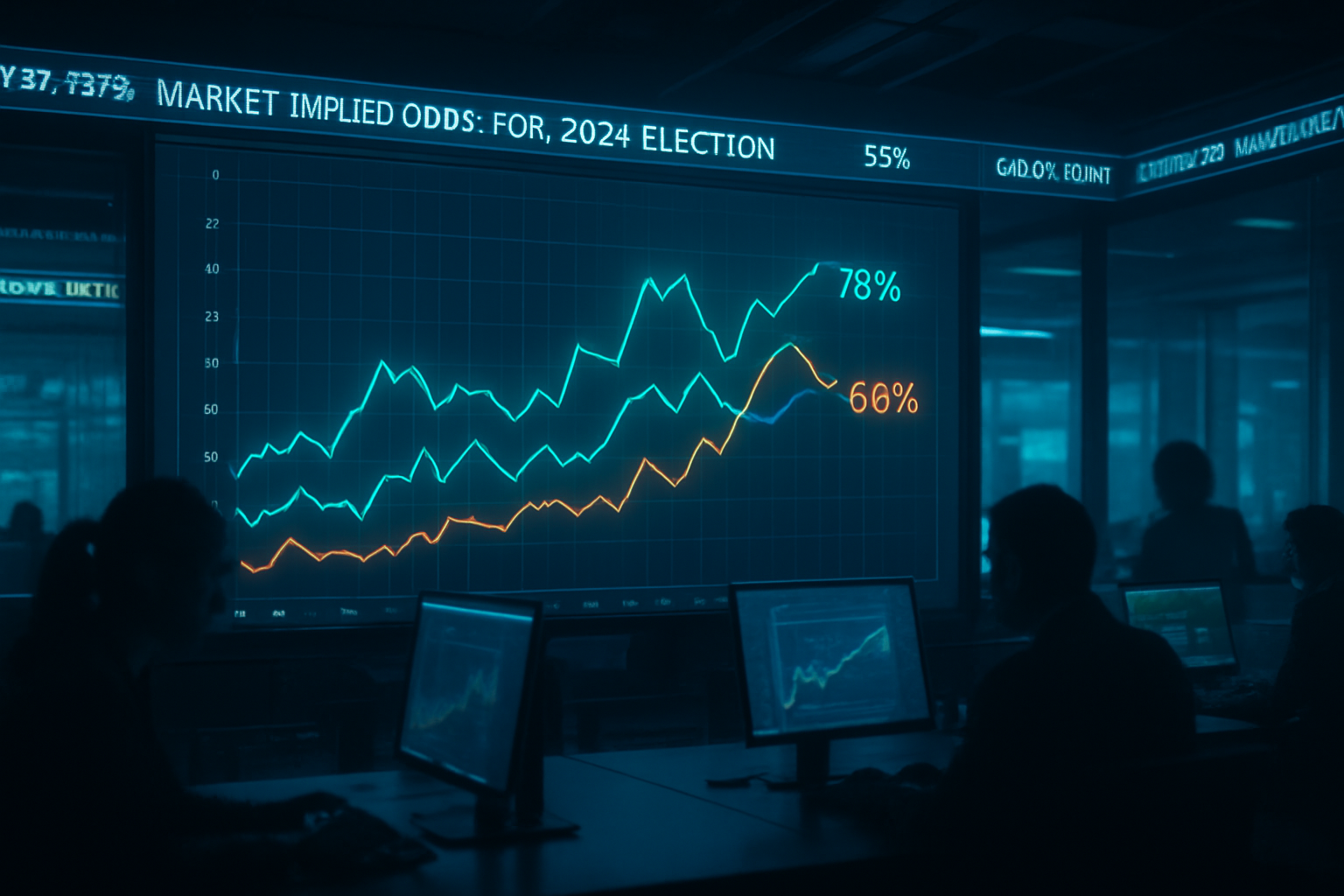
    Currently, all eyes are on the 2026 U.S. Midterm Elections, where prediction markets on platforms like Polymarket and Kalshi are processing tens of billions of dollars in volume. Traders are pricing in a 78% probability that Democrats will flip the House of Representatives, while Republicans maintain a 66-68% chance of holding the Senate. This shift toward market-based forecasting is generating massive interest because it offers a real-time, financially incentivized alternative to traditional polling, which has struggled with lag times and declining response rates. Recent movement suggests the "Midterm Correction" narrative is strengthening, as markets react instantly to shifts in consumer sentiment and legislative gridlock.

    The Market: What's Being Predicted

    The integration of prediction market data into mainstream media is no longer experimental; it is structural. In late 2025 and early 2026, the landscape shifted through a series of landmark partnerships. CNN (Warner Bros. Discovery, Inc. – NASDAQ: WBD) designated Kalshi as its exclusive prediction data provider, with Chief Data Analyst Harry Enten now using real-time market odds to "fact-check" traditional polling data during live broadcasts. Similarly, CNBC (Comcast Corporation – NASDAQ: CMCSA) has launched a dedicated "Kalshi Hub," integrating economic and financial forecasts directly into flagship shows like Squawk Box and Fast Money.

    On the decentralized side, Polymarket has secured an expansive deal with Dow Jones (News Corp – NASDAQ: NWSA), embedding market-implied probabilities across The Wall Street Journal, Barron’s, and MarketWatch. One of the most visible results of this deal is a custom "Earnings Calendar" that displays the probability of an EPS beat for companies like NVIDIA Corporation (NASDAQ: NVDA) alongside traditional analyst estimates. Even entertainment hasn't been spared; Polymarket served as the official prediction partner for the 83rd Annual Golden Globes on CBS (Paramount Global – NASDAQ: PARA) last month, where market odds accurately predicted 26 out of 28 winners.

    Trading volume has scaled alongside this media exposure. In January 2026 alone, the industry hit a record-breaking $12 billion in total trading volume. Kalshi, which operates as a U.S.-regulated exchange, has seen a surge in "notional volume" from institutional players, while Polymarket continues to dominate the "event-pure" categories like global politics and cultural milestones.

    Why Traders Are Betting

    The fundamental driver behind the surge in prediction market participation is the concept of "Skin in the Game." Unlike traditional survey respondents who provide opinions for free, prediction market participants must back their views with capital. This financial incentive creates a powerful filtering mechanism that prioritizes accuracy over partisanship or social desirability bias.

    Traders are currently reacting to several high-impact catalysts:

    • Monetary Policy: With the Federal Reserve's March meeting approaching, Kalshi traders are pricing a 62% probability of a 25-basis-point rate cut, a figure that fluctuates in real-time as new labor and inflation data is released.
    • Political Appointments: The market has already "priced in" a shift in central bank leadership, with Kevin Warsh holding a 99% probability on Polymarket to be the next Fed Chair nominee.
    • Corporate Moves: High-conviction betting is occurring around the potential IPO of OpenAI (Private, backed by Microsoft Corp – NASDAQ: MSFT), with markets currently leaning toward a "No" for a 2026 debut at 52%.

    Mainstream media outlets are gravitating toward this data because it is more sensitive to "signal" than traditional methods. While a poll might take a week to conduct and process, a prediction market reacts to a breaking news headline or a leaked memo in seconds. This speed has made markets the preferred tool for "Sharps"—a new class of professional event traders who treat news as a tradable financial asset, often referred to as "Information Finance" or InfoFi.

    Broader Context and Implications

    The 2024 U.S. Presidential Election served as the definitive "proof-of-concept" for this shift. While legacy models and media pundits described the race as a "toss-up" until the final hours, prediction markets on Polymarket and Kalshi moved to a decisive ~60% probability for a Donald Trump victory weeks in advance. This historical accuracy has significantly diminished the "gambling" stigma that once plagued the industry.

    The regulatory landscape has also stabilized. Kalshi’s landmark legal victory against the CFTC in late 2024 cleared the way for political event contracts to be regulated as legitimate financial derivatives in the United States. This legal clarity has allowed institutional firms to use these markets as hedging tools, protecting their portfolios against geopolitical shocks or sudden policy shifts.

    However, the rise of "InfoFi" is not without controversy. Critics argue that the "gamblification" of news and awards shows could lead to market manipulation or a loss of journalistic nuance. Despite these concerns, the efficiency of the "wisdom of the crowd" continues to outperform individual experts. By turning public sentiment into a tradable price, these markets are providing a level of transparency into collective expectations that was previously impossible to quantify.

    What to Watch Next

    As we move deeper into 2026, the primary focus will remain on the Midterm Elections. Any significant legislative breakthroughs or failures in Washington will cause immediate volatility in the "Control of the House" and "Control of the Senate" markets. Analysts will be watching to see if the current 78% Democratic favoritism for the House holds firm as campaign season intensifies.

    In the corporate world, watch for the resolution of the OpenAI IPO markets and the impact of Amazon.com, Inc. (NASDAQ: AMZN) and its reported multi-billion dollar investment talks on the startup's valuation. These markets often front-run official corporate announcements by days. Additionally, the 2026 FIFA World Cup markets are already beginning to see "early-bird" liquidity, marking the first time a major sporting event will have deep, multi-year prediction markets integrated into the pre-tournament coverage.

    Finally, keep an eye on the evolving nature of media graphics. If current trends continue, the "Market Probability" may soon become the standard lead for every political and economic headline, effectively retiring the phrase "too close to call."

    Bottom Line

    The partnership between prediction platforms and mainstream media marks a turning point in the information age. By integrating data from Kalshi and Polymarket, networks like CNN, CNBC, and the WSJ are acknowledging that markets are often better at synthesizing complex information than humans are. The rise of InfoFi has turned news consumption from a passive experience into a probabilistic exercise.

    For the average viewer, this means "the news" is no longer just a series of events that have happened, but a real-time dashboard of what is likely to happen. Whether you are a trader looking for an edge or a citizen trying to cut through the noise, the "wisdom of the crowd" has become the most important signal in the room. As 2026 progresses, the line between the trading floor and the newsroom will only continue to blur.


    This article is for informational purposes only and does not constitute financial or betting advice. Prediction market participation may be subject to legal restrictions in your jurisdiction.

    PredictStreet focuses on covering the latest developments in prediction markets.
    Visit the PredictStreet website at https://www.predictstreet.ai/.
  • Traders Betting on ‘Snowmageddon’ in NYC: Markets Price in Major Accumulation for Winter Storm Fern

    Traders Betting on ‘Snowmageddon’ in NYC: Markets Price in Major Accumulation for Winter Storm Fern

    As Winter Storm Fern barrels toward the Northeast, New York City is bracing for its most significant snowfall in years, and prediction markets are reflecting the high stakes. On Kalshi, the CFTC-regulated exchange, traders have aggressively bid up the probability of a major event, with the consensus now pointing toward a heavy accumulation that could shut down the city through Monday, January 26, 2026.

    Current market data indicates a staggering 92% probability that New York City will see more than 6 inches of snow by the time the storm concludes. Perhaps more surprisingly, the "long tail" of the forecast—the chance of a true blizzard scenario—is seeing significant action. Traders are currently pricing in a 77% chance that snowfall exceeds 10 inches, a sharp increase from just 48 hours ago as meteorological models began to align. This surge in betting activity has turned the weather into one of the most liquid and volatile markets on the platform this week.

    The Market: What's Being Predicted

    The primary hub for this activity is Kalshi, where the "Snow in NYC this month?" markets have seen a massive influx of capital. Total monthly volume for NYC snowfall contracts has surpassed $720,000, driven largely by the high-conviction trades surrounding this specific weekend window. The market is structured around tiered thresholds, allowing participants to hedge or speculate on specific accumulation levels as measured by the National Weather Service (NWS) at Central Park.

    As of Saturday morning, January 24, the odds for various thresholds are:

    • Above 6.0 inches: 92% ($0.92)
    • Above 8.0 inches: 86% ($0.86)
    • Above 10.0 inches: 77% ($0.77)
    • Above 12.0 inches: 65% ($0.65)

    The specific "6 to 10 inch" bracket has become a focal point for conservative bettors, though the implied probability for the storm stalling in this range is actually shrinking (now at approximately 15%) because traders are increasingly "over-betting" the higher totals. If the storm exceeds 10 inches, the "Above 6" and "Above 10" contracts both pay out, but the rapid appreciation of the "Above 12" contract—now at 65%—suggests that the market anticipates a historic over-performance rather than a moderate dusting.

    Why Traders Are Betting

    The primary driver for the recent market movement is the rare convergence of the two major global forecasting systems: the American GFS and the European ECMWF. Early in the week, the models were divided, with the European model suggesting a "glancing blow" of light snow and sleet. However, as of the 18z runs on January 23, the models have harmonized, both showing a powerful coastal low-pressure system deepening rapidly as it moves past the Jersey Shore.

    Beyond pure speculation, there is evidence of significant hedging activity. Large positions have been observed from entities likely tied to the logistics and service industries. For example, snow removal contractors and local logistics hubs often use these markets to offset the increased operational costs—such as overtime pay and salt procurement—that a major storm triggers.

    Public companies are already reacting to the forecast. The Home Depot (NYSE: HD) has reported a surge in emergency preparedness sales in the Tri-State area, while logistics giants like FedEx (NYSE: FDX) and UPS (NYSE: UPS) have issued service disruption alerts. For a professional trader or a business owner, a $0.77 contract on a "10-inch plus" event acts as an insurance policy against the inevitable economic slowdown that follows a city-wide standstill.

    Broader Context and Implications

    This flurry of activity highlights a growing trend: the shift of weather forecasting from a public service announcement to a high-stakes financial instrument. While traditional meteorology provides the "what" and "where," prediction markets provide a "wisdom of the crowd" assessment of the "how likely." The $720,000 monthly volume on Kalshi for a single city's snowfall suggests that these markets are moving past their niche origins and becoming essential tools for local economic planning.

    Historically, weather prediction markets have shown a remarkable ability to filter out the "hype" often found in sensationalist media coverage. Because traders have real capital at risk, they tend to react only to hard data—such as model shifts or barometric pressure changes—rather than the "doom-scrolling" narratives often seen on social media. In this case, the fact that the "Above 12 inches" market is trading as high as 65% serves as a louder warning to city officials than a standard weather advisory might.

    Furthermore, the regulatory environment for these markets has matured. Kalshi’s oversight by the CFTC provides a level of security and transparency that encourages larger institutions to participate. This liquidity, in turn, makes the market's "price" more accurate, creating a feedback loop where the market price becomes a reliable data point for emergency management and retail supply chain adjustments.

    What to Watch Next

    The most critical window for the market occurs between 1:00 AM on Sunday, January 25, and Monday afternoon. The New York City Department of Sanitation (DSNY) has already issued a high-level "Snow Alert," deploying over 2,000 workers and 700 salt spreaders. Traders should monitor the "warm nose" phenomenon—a layer of warm air that the ECMWF model suggests could sneak into the city center. If this happens, snow could turn to sleet, causing the "Above 12 inch" contracts to crash while the "6 to 10 inch" bracket potentially pays out.

    Another key milestone is the official measurement at Central Park. Because prediction markets resolve based on specific, verifiable data sources, any discrepancy between localized neighborhood totals and the Central Park reading can lead to late-stage market volatility. Traders will be glued to the NWS hourly updates throughout the night on Sunday to see if the rate of accumulation matches the aggressive 1-to-2-inches-per-hour rates currently being priced in.

    Bottom Line

    The NYC snowfall market for January 24-26, 2026, is a textbook example of how prediction markets can aggregate complex scientific data into a single, actionable price. With over $720,000 in monthly volume, the "crowd" is signaling a high-conviction belief that Winter Storm Fern will be a transformative event for the city. The 77% probability of exceeding 10 inches is a clear indicator that the market is leaning toward a severe scenario.

    For residents and businesses, these odds are more than just numbers; they are a signal to finish preparations. Whether it’s Walmart (NYSE: WMT) prepping its supply chain or a local delivery service bracing for delays, the market’s aggressive pricing of the 10-to-12-inch range suggests that the window for "hoping for the best" has closed. As the first flakes begin to fall late Saturday, the markets have already spoken: New York should prepare for a long, white weekend.


    This article is for informational purposes only and does not constitute financial or betting advice. Prediction market participation may be subject to legal restrictions in your jurisdiction.

    PredictStreet focuses on covering the latest developments in prediction markets.
    Visit the PredictStreet website at https://www.predictstreet.ai/.

  • The New Oracle: Prediction Markets Emerge as Global ‘Early Warning Systems’

    The New Oracle: Prediction Markets Emerge as Global ‘Early Warning Systems’

    As we move into early 2026, the global information landscape has undergone a radical transformation. No longer are political analysts and corporate strategists solely reliant on slow-moving surveys or expert panels to gauge the future. Instead, they are turning to the real-time, high-stakes data of prediction markets. These platforms, once viewed as niche betting hubs, have matured into what many are now calling the world’s most accurate "Early Warning Systems" (EWS).

    In January 2026, the evidence of this shift is undeniable. While traditional polling data often lags behind reality by days or even weeks, prediction markets are responding to geopolitical tremors and economic shifts in mere seconds. From the capture of international fugitives to the timing of Federal Reserve interest rate cuts, these markets are providing a level of foresight that traditional media is struggling to match.

    The Market: What's Being Predicted

    The scope of what can be traded on prediction markets has expanded dramatically since the landmark 2024 election cycle. Platforms like Polymarket and Kalshi have moved far beyond simple "Who will win the presidency?" contracts. Today, traders are betting on everything from the success of SpaceX's Starship Flight 12 to the number of confirmed measles cases in specific Texas counties.

    The scale of these markets is equally impressive. In late 2025, total weekly notional volume across major platforms frequently exceeded $5 billion. Kalshi alone recorded its highest-ever weekly volume of $1.98 billion in the first week of January 2026, largely driven by NFL-related event contracts. Meanwhile, Polymarket, following its successful U.S. relaunch via the acquisition of a CFTC-licensed exchange, reported over $21.5 billion in total nominal volume through December 2025.

    These platforms rely on binary outcome contracts—where a share pays out $1 if the event occurs and $0 if it doesn't—providing a clear, percentage-based probability for any given event. This "price discovery" for future events has become an essential tool for institutional investors and news organizations alike.

    Why Traders Are Betting

    The 2024 U.S. Presidential Election was the ultimate proof of concept for the "Early Warning" theory. Throughout October 2024, traditional pollsters like The New York Times (NYSE: NYT) and 538 described the race as a "dead heat." However, prediction markets told a different story. By late October, the price of a Donald Trump "win" share on Polymarket and Kalshi had moved decisively toward 67%, signaling a shift in momentum that polls didn't capture until it was too late.

    Traders are driven by the "financial incentive for accuracy." Unlike a survey respondent who may give a socially desirable answer, or a television pundit who faces no financial penalty for a wrong prediction, prediction market participants must put capital at risk. This filters out noise and prioritizes "hidden" information.

    A prime example occurred in early January 2026. Hours before the Trump administration announced the capture of Venezuelan leader Nicolás Maduro, a single trader on Polymarket placed a $32,000 bet on his downfall, eventually netting a $400,000 profit. This instance of "information finance" sparked debates about insider information, but it also proved that markets can act as a sensor for events long before they hit the headlines.

    Broader Context and Implications

    The evolution of these markets has been bolstered by significant regulatory victories. Following the CFTC vs. Kalshi legal battle, which concluded in May 2025 when the government dropped its appeal, political event contracts are now legally traded on federally regulated exchanges in the U.S. This has cleared the path for mainstream integration, with Warner Bros. Discovery (NASDAQ: WBD) and its subsidiary CNN, as well as Comcast’s (NASDAQ: CMCSA) CNBC, now featuring live prediction market odds as a standard part of their election and economic coverage.

    Furthermore, traditional finance players like Robinhood Markets, Inc. (NASDAQ: HOOD) and Interactive Brokers Group, Inc. (NASDAQ: IBKR) have integrated these markets into their platforms, bringing prediction contracts to millions of retail investors. This influx of liquidity has reduced the influence of "whales" and increased the "wisdom of crowds," making the signals more stable and reliable.

    Historically, prediction markets have shown a remarkable ability to process complex news faster than experts. In 2025, economic contracts on the CME Group (NASDAQ: CME) FedWatch tool and Kalshi correctly priced in a June rate cut months in advance, even as many bank analysts remained skeptical of a cooling labor market.

    What to Watch Next

    As we look toward the remainder of 2026, the 2026 Midterm Elections (November 3, 2026) are already the highest-liquidity markets in the world. Currently, markets are pricing a 79% probability of a Democratic House takeover and a 67% chance of the GOP maintaining control of the Senate. These odds are expected to shift rapidly as the primary season begins in March.

    Outside of politics, the 2026 Winter Olympics in Milan-Cortina (February 6–22) and the 2026 FIFA World Cup in June will provide massive volume for sports-related event contracts. In the tech sector, all eyes are on the anticipated IPO of SpaceX. Rumors of a mid-2026 public offering have already created a highly active market, with traders currently betting on a debut valuation exceeding $1 trillion.

    Bottom Line

    The rise of prediction markets as "Early Warning Systems" represents a fundamental shift in how we perceive and process the future. By attaching a financial value to truth, these platforms have successfully bypassed the biases of traditional polling and the lag of institutional reporting. They are no longer just betting platforms; they are the new infrastructure of information.

    As we head into the 2026 midterms and beyond, the most important signal won't be found in a pundit's monologue or a "margin of error" poll—it will be found in the fluctuating price of a contract on an exchange. For the first time in history, the collective wisdom of the crowd isn't just a theory; it’s a tradable asset.


    This article is for informational purposes only and does not constitute financial or betting advice. Prediction market participation may be subject to legal restrictions in your jurisdiction.

    PredictStreet focuses on covering the latest developments in prediction markets.
    Visit the PredictStreet website at https://www.predictstreet.ai/.
  • The Financialization of Truth: Why Prediction Markets Are the New Gold Standard for Forecasting

    The Financialization of Truth: Why Prediction Markets Are the New Gold Standard for Forecasting

    As we cross into 2026, the global information landscape has undergone a radical transformation. The era of relying solely on traditional polling—often criticized for its slow response times and methodological lag—is being eclipsed by the rise of prediction markets. Following their standout performance during the 2024 US Presidential Election, these platforms are no longer viewed as niche betting hubs; they have become the "new gold standard" for real-time data, drawing in billions of dollars from retail and institutional investors alike.

    Currently, the markets are hyper-focused on the 2026 US Midterm elections and the upcoming January FOMC meeting. With daily trading volumes recently surpassing $700 million across major platforms, the "wisdom of the crowd" is being priced into the global economy with unprecedented precision. On Polymarket, traders are currently pricing in a 79% probability of a Democratic takeover of the House of Representatives, while the Senate remains leaning GOP at 67%. These are not just guesses; they are financial positions held by thousands of participants with "skin in the game."

    The Market: What's Being Predicted

    The current landscape is dominated by a "triopoly" of major platforms: the US-regulated exchange Kalshi, the decentralized giant Polymarket, and the rapidly scaling Opinion Labs. Unlike the early days of event wagering, the markets in January 2026 cover a granular spectrum of outcomes. In the political sphere, the "Balance of Power" contracts for the November 2026 Midterms are seeing massive liquidity. Institutional traders are aggressively hedging against a "Divided Government," a scenario that historically leads to market gridlock—often a favorable outcome for equities.

    Beyond politics, macro-economic markets have become essential tools for treasury departments. The January 28 Federal Reserve meeting is currently priced at a near-certain 98% probability of a rate pause. However, the true intrigue lies in the March 2026 meeting, where markets are pricing a 74% chance of a rate cut. These odds have moved significantly in the last 48 hours following rumors of a leadership shift at the Fed.

    The volume and liquidity in these markets are staggering. Robinhood Markets, Inc. (NASDAQ: HOOD) reported that its integrated "Prediction Markets Hub" facilitated over 2.5 billion contracts in late 2025 alone. Similarly, Interactive Brokers Group, Inc. (NASDAQ: IBKR) has seen its ForecastEx affiliate volume explode, treating these contracts more like standardized financial derivatives than speculative bets.

    Why Traders Are Betting

    The shift toward prediction markets as a primary forecasting tool stems from their remarkable accuracy during the 2024 election cycle. While traditional polls and models like FiveThirtyEight struggled to capture the momentum of "low-propensity" voters, Polymarket called the 2024 race with 95% certainty for Donald Trump hours before major news networks. In a world where news travels at the speed of social media, the 14-day lag typical of a high-quality poll is an eternity.

    Traders are betting because markets react to news instantly. During the June 2024 presidential debate, prediction market odds for the Democratic ticket began a vertical descent within 15 minutes of the opening statements. It took traditional polling outfits nearly two weeks to confirm the same sentiment shift. This real-time adaptability is why institutional investors are increasingly looking at market prices rather than survey data.

    Furthermore, the "Wisdom of the Crowd" theory suggests that a diverse group of individuals, each with their own private information and financial incentives, will collectively produce a more accurate forecast than any single expert. When a trader places a $100,000 bet on a SpaceX IPO date, they are incentivized to be right, not to provide a socially desirable answer to a pollster.

    Broader Context and Implications

    The "Financialization of Information" has significant implications for how the public consumes news. We are moving toward a "Truth Layer" where the most probable version of reality is reflected in a price ticker. This trend was solidified in late 2025 when the Intercontinental Exchange, Inc. (NYSE: ICE)—the parent company of the New York Stock Exchange—made a landmark $2 billion investment in Polymarket, valuing the platform at roughly $9 billion.

    Regulatory hurdles that once stifled the industry are also falling. The landmark Kalshi vs. CFTC rulings provided the legal "green light" for US-based political contracts, essentially arguing that these markets do not constitute "gaming" but rather vital economic tools for hedging political risk. The subsequent passage of the Digital Asset Market CLARITY Act of 2025 further legitimized the space by classifying many event contracts as digital commodities under CFTC oversight.

    However, the rapid growth has brought new challenges. In January 2026, Rep. Ritchie Torres introduced the Public Integrity in Financial Prediction Markets Act (H.R. 7004), aimed at preventing "insider trading" by government officials. This followed a controversial surge in volume on a Venezuelan leadership contract just hours before a major US diplomatic announcement, raising questions about who has access to the information moving these markets.

    What to Watch Next

    As we move toward the spring of 2026, several key milestones will determine if prediction markets can maintain their "gold standard" status. The primary focus will be the upcoming US Midterm primaries. If the markets can accurately predict the "unpredictable" primary upsets that often baffle pollsters, their credibility will only strengthen.

    Investors should also watch the "SpaceX IPO" market on Kalshi. Currently, there is a 58% probability that an IPO will be announced before July 1, 2026. Given the massive valuation of SpaceX, this market serves as a proxy for broader sentiment on the private tech sector and interest rate environments.

    Lastly, the ongoing legal battle between the "Coalition for Prediction Markets"—which includes Coinbase Global, Inc. (NASDAQ: COIN) and Robinhood—and several state regulators in Nevada and Tennessee will be critical. A victory for the coalition would likely lead to a unified national standard, potentially opening the door for prediction markets to be included in retirement accounts and traditional portfolios.

    Bottom Line

    Prediction markets have fundamentally changed how we forecast the future. By attaching a price tag to truth, they have created a more resilient, faster, and often more accurate data source than traditional polling could ever hope to be. The 2024 election was the proof of concept; the massive institutional adoption of 2025 and 2026 is the expansion phase.

    For the average observer, these markets offer a clear, un-biased view of what the world actually thinks is going to happen, stripped of partisan spin. As long as participants have "skin in the game," the price will remain one of the most honest indicators we have. Whether you are a retail trader on Robinhood or a hedge fund manager at ICE, prediction markets are no longer a side show—they are the main event.


    This article is for informational purposes only and does not constitute financial or betting advice. Prediction market participation may be subject to legal restrictions in your jurisdiction.

    PredictStreet focuses on covering the latest developments in prediction markets.
    Visit the PredictStreet website at https://www.predictstreet.ai/.

  • The Great Forecast Convergence: AI Closing the 20% Gap on Human Superforecasters

    The Great Forecast Convergence: AI Closing the 20% Gap on Human Superforecasters

    The long-standing wall between artificial intelligence and elite human intuition is beginning to crumble. For years, the "superforecaster"—a subset of humans with extraordinary cognitive flexibility and statistical rigor—was considered the gold standard for predicting global events. However, data from the October 2025 ForecastBench report suggests that the "human edge" is evaporating at an accelerating rate. As of January 18, 2026, the delta between the world’s most advanced Large Language Models (LLMs) and top-tier human prediction teams has reached its narrowest point in history.

    The bridge toward "Forecasting Parity" is no longer a theoretical debate but a live market event. On platforms like Metaculus and Polymarket, traders are increasingly betting that silicon will match synapse in predictive accuracy before the end of the current calendar year. With GPT-4.5 showing a Brier score of 0.101 against the superforecaster benchmark of 0.081, the machines are now officially more accurate than the median human forecaster, leaving only the "top 1%" of humanity left to defend the crown.

    The Market: What's Being Predicted

    The primary battleground for this competition is the AI Forecasting Parity Market, which tracks whether a standardized AI agent can achieve a Brier score (a measure of predictive accuracy where 0 is perfect and 0.25 is random guessing) equal to or better than a consensus of elite human forecasters. On Metaculus, the "AI-Human Parity" contract is currently trading at a median predicted resolution date of November 2026. This represents a significant pull-forward from late 2024, when the consensus date was mid-2028.

    On Polymarket, liquidity has surged in "AI vs. Human" tournament markets. Current odds give a 74% probability that an AI model will win a major sanctioned forecasting tournament—such as the Forecasting Research Institute's (FRI) annual challenge—by December 31, 2026. Trading volume in these specific technology-accuracy markets has surpassed $15 million this month, driven by the release of performance data for GPT-4.5 and specialized agentic frameworks like the "AIA Forecaster."

    The resolution criteria for these markets are rigorous. They typically require the AI to participate in a "blind" tournament where it must forecast a minimum of 50 discrete real-world events across geopolitics, economics, and science. To achieve "parity," the AI's aggregate Brier score must fall within a statistically insignificant margin of the top 5% of human participants.

    Why Traders Are Betting

    The bullish sentiment regarding AI forecasting is largely driven by the shift from simple LLM queries to "agentic" forecasting workflows. Traders are betting on the success of Retrieval-Augmented Generation (RAG) and multi-agent reasoning. Unlike early versions of GPT-4, which relied on static training data, the newest models from Microsoft (NASDAQ: MSFT) and OpenAI utilize recursive search patterns—effectively "thinking out loud" by searching for conflicting evidence and weighting sources before issuing a probability.

    However, the "Superforecaster" community remains the underdog favorite for some "whale" traders. The 20% performance gap (0.081 vs 0.101) is notoriously difficult to close. Human superforecasters excel at "Black Swan" events and "causal reasoning"—the ability to understand why a historical trend might break. AI models, conversely, are often accused of "hallucinating" trends based on historical correlation. Short-sellers of the AI-parity markets argue that as we enter a volatile 2026 election cycle in multiple nations, AI's reliance on past data will be its downfall.

    Notable activity has also been spotted in markets tied to Alphabet (NASDAQ: GOOGL). Google’s DeepMind has reportedly been testing a proprietary "Decision-Support AI" that integrates internal Google Trends data with real-time news feeds, leading many to believe that the next leap in Brier scores will come from the Gemini ecosystem rather than OpenAI.

    Broader Context and Implications

    This trend mirrors a larger shift in prediction markets toward "Hybrid Forecasting." We are moving away from a world where humans and AI compete, and toward one where they collaborate. Companies like Meta (NASDAQ: META) have already integrated "Prophet"—their open-source forecasting tool—with Llama-based reasoning agents to manage supply chain logistics and server demand.

    The real-world implications of AI-human parity are profound. If an AI can reliably out-predict a human expert, the cost of high-quality intelligence drops to near zero. This would democratize institutional-grade forecasting for small businesses and individuals, but it also raises regulatory concerns. Regulators in the EU and the U.S. are already debating whether AI-driven prediction should be classified as "financial advice" or "algorithmic trading," especially if these models begin to influence market prices autonomously.

    Historically, prediction markets have been more accurate than individual pundits because they aggregate the "Wisdom of the Crowd." If AI becomes the most accurate "member" of that crowd, the very nature of a market could change from a psychological arena to a computational one.

    What to Watch Next

    The most immediate milestone is the release of the Q2 2026 ForecastBench update. If the AI Brier score drops below 0.090, the market will likely price in parity as a certainty for late 2026. Traders should also monitor the development of NVIDIA (NASDAQ: NVDA)'s specialized inference chips, which are rumored to be optimized for the "long-reasoning" tokens required for complex forecasting.

    Key dates to watch include:

    • May 2026: The FRI Mid-Year Update on model performance.
    • September 2026: The expected launch window for "GPT-5" (or its successor), which many believe will be the model that finally crosses the 0.081 threshold.
    • November 2026: The resolution of the Metaculus "Parity" contract.

    Bottom Line

    The data from October 2025 sent a clear signal: the AI forecasting "laggard" phase is over. While humans still hold a narrow 20-point Brier score advantage, the rate of AI improvement is nearly three times faster than human cognitive evolution. We are witnessing the final months of undisputed human superiority in the realm of high-stakes prediction.

    Prediction markets are acting as the ultimate scoreboard for this race. As AI models become "superforecasters" in their own right, the markets they trade in will become faster, more efficient, and perhaps more difficult for unassisted humans to navigate. Whether this leads to a new era of global stability through better planning, or a more volatile world of algorithmic "flash-crashes" in sentiment, remains the most important forecast of all.


    This article is for informational purposes only and does not constitute financial or betting advice. Prediction market participation may be subject to legal restrictions in your jurisdiction.

    PredictStreet focuses on covering the latest developments in prediction markets.
    Visit the PredictStreet website at https://www.predictstreet.ai/.