Tag: Financial Regulation

  • The 81% Gamble: Prediction Markets Fight for Survival Under Federal Shield

    The 81% Gamble: Prediction Markets Fight for Survival Under Federal Shield

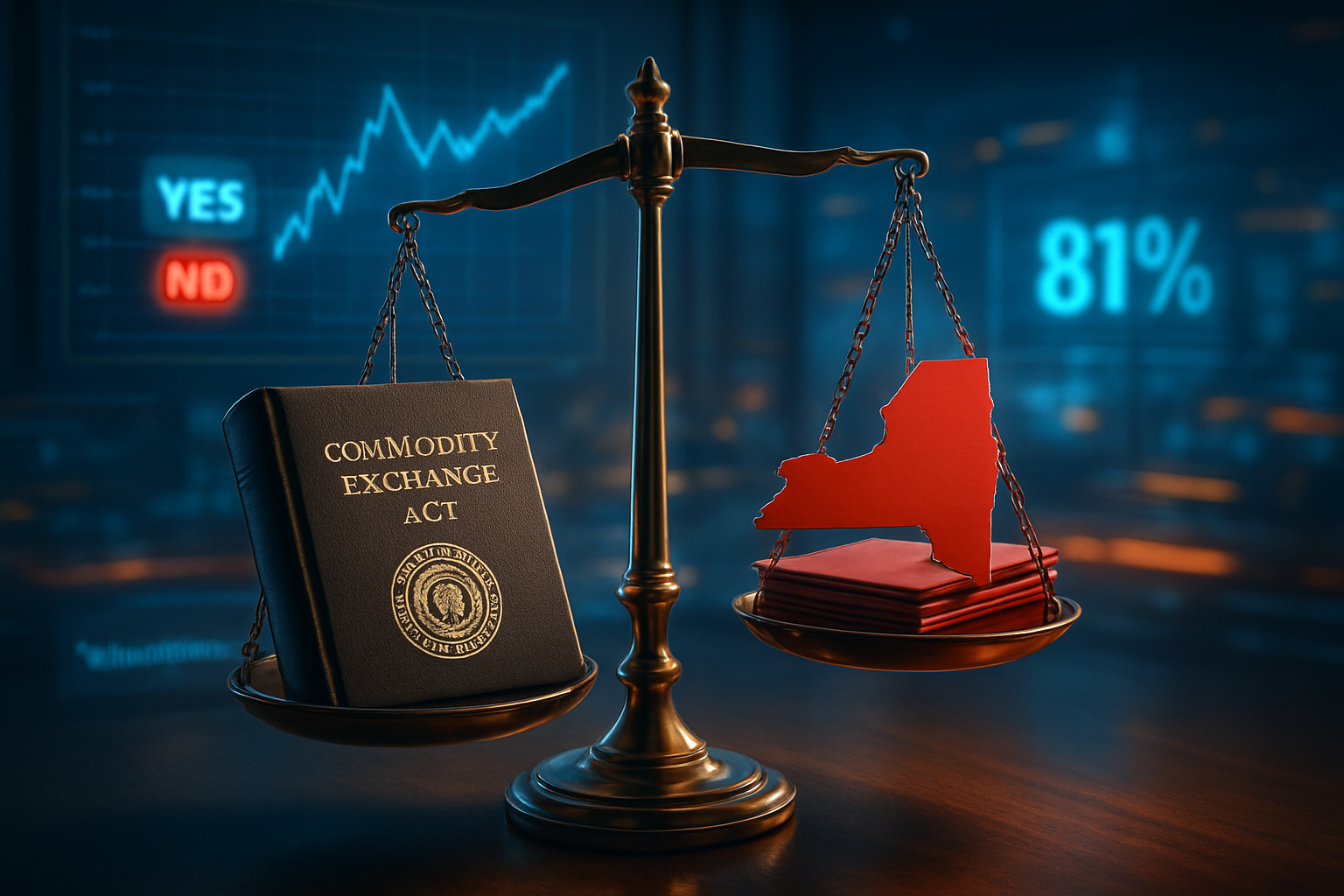
    As the prediction market industry enters a pivotal 2026, a high-stakes legal battle is unfolding that will determine whether these platforms are treated as sophisticated financial exchanges or local gambling dens. At the heart of the conflict is a strategy known as "Federal Preemption," where platforms argue that federal oversight by the Commodity Futures Trading Commission (CFTC) overrides the power of individual states to shut them down.

    Currently, decentralized forecasting platform Manifold shows that professional predictors are heavily favoring the industry's legal defenses. Traders have pushed the probability of federal preemption succeeding to a commanding 81%, reflecting a belief that the momentum of institutional adoption and federal law will eventually crush state-level bans. This surge in confidence comes despite a legislative assault from states like New York, making the upcoming judicial rulings some of the most anticipated events in the history of decentralized finance.

    The Market: What’s Being Predicted

    The central question facing traders on Manifold and other platforms is whether the federal Commodity Exchange Act (CEA) grants the CFTC "exclusive jurisdiction" over event contracts. Platforms like Kalshi and Interactive Brokers (Nasdaq: IBKR) argue that because they are registered as Designated Contract Markets (DCMs), their "yes/no" contracts are financial derivatives—not wagers.

    On Manifold, the contract titled "Will Federal Preemption Protect DCMs from State Bans by End of 2026?" has seen its volume spike in early January. The 81% probability currently assigned to a "Yes" outcome suggests that the market views state-level interference as a temporary hurdle rather than a permanent barrier. This odds-on favorite status has remained resilient even as New York moves forward with its controversial "ORACLE Act," which seeks to impose fines of up to $1 million per day on platforms offering contracts on elections or government actions.

    Resolution for these markets is tied to a series of pending court cases, most notably a motion for a preliminary injunction in the Southern District of New York. A final ruling, expected by late February 2026, will likely serve as the primary catalyst for these odds to either move toward 100% or collapse into uncertainty.

    Why Traders Are Betting

    The bullishness among traders regarding federal preemption is driven by several key factors. First is the "institutionalization" of the asset class. Major players like Robinhood Markets (Nasdaq: HOOD) and Goldman Sachs (NYSE: GS) have signaled significant interest in "yes/no" derivatives, with Robinhood already integrating event contracts into its core app. Traders believe that as these markets become more intertwined with the traditional financial system, courts will be increasingly hesitant to allow a "checkerboard" of state laws to dismantle a federally regulated exchange.

    Furthermore, the introduction of the "Public Integrity in Financial Prediction Markets Act" by Representative Ritchie Torres has provided a legislative North Star. This bill seeks to codify federal protections for prediction markets while adding strict insider-trading guardrails. Traders are betting that the existence of this bill—and the broader success of prediction markets in forecasting the 2024 and 2025 economic shifts—proves their social utility, making them "too big to ban."

    There is also a strategic legal perspective: the CEA has historically been interpreted to provide a uniform national market for commodities and futures. If a state like New York can ban a CFTC-approved contract, it sets a precedent that could allow states to interfere with traditional oil, gold, or interest rate futures—a scenario that many legal experts believe the federal judiciary will work hard to avoid.

    Broader Context and Implications

    The fight for federal preemption is more than a legal technicality; it is a battle against a "regulatory domino effect." If states like New York successfully classify prediction markets as gambling, the industry faces an existential threat. A state-by-state licensing model—similar to the one used by DraftKings (Nasdaq: DKNG) and Flutter Entertainment (NYSE: FLUT) for sports betting—would require platforms to "geofence" their users, effectively splitting a single national market into 50 tiny, illiquid pools.

    For a prediction market to be accurate, it requires deep liquidity. If a New Yorker cannot trade against a Californian on the outcome of a federal election, the market’s predictive power diminishes. Moreover, a "gambling" classification would subject these platforms to higher tax rates and prevent institutional firms from using them for hedging, as many corporate charters prohibit participation in "gaming" but allow "derivatives."

    We are also seeing a shift in corporate alliances. MSG Sports Corp (NYSE: MSGS) recently signed a marketing partnership with Polymarket, signaling that even traditional sports and entertainment giants are betting on the long-term legality of these exchanges. This broader acceptance suggests that the public and corporate sentiment has already shifted toward viewing these as information tools rather than casinos.

    What to Watch Next

    The immediate horizon is dominated by the New York judicial system. By late February 2026, the Southern District of New York is expected to rule on whether the New York Gaming Commission can enforce its proposed bans. A victory for Kalshi or its allies in this venue would likely send the Manifold odds into the 90% range.

    Additionally, industry watchers are keeping a close eye on the "Cooney Bill" (SB S8889) in the New York State Senate. This rival legislation offers a middle ground, proposing that prediction markets be regulated by the Department of Financial Services (DFS) as financial products rather than by the Gaming Commission. If this industry-friendly bill gains traction, it could provide a legislative "off-ramp" that resolves the preemption conflict without a Supreme Court showdown.

    Finally, the activity of Interactive Brokers (Nasdaq: IBKR) and their ForecastEx exchange remains a key bellwether. As one of the most conservative and regulated firms in the space, their continued expansion into event contracts serves as a "real-money" bet that federal law will ultimately prevail over state-level objections.

    Bottom Line

    The 81% probability of federal preemption succeeding is a testament to the industry's growing confidence that prediction markets have crossed the Rubicon into mainstream finance. The Commodity Exchange Act was designed to prevent a patchwork of state laws from disrupting national commerce, and platforms are betting their entire business models on that protection holding firm.

    If the 19% "tail risk" materializes and states win the right to ban these markets, the industry will likely be forced into a costly and fragmented sports-betting style model. However, for now, the smart money is betting that the federal government—not the states—will remain the sole arbiter of this new financial frontier. As we approach the critical February rulings, the stakes for the "ORACLE" of the markets have never been higher.


    This article is for informational purposes only and does not constitute financial or betting advice. Prediction market participation may be subject to legal restrictions in your jurisdiction.

    PredictStreet focuses on covering the latest developments in prediction markets.
    Visit the PredictStreet website at https://www.predictstreet.ai/.
  • The Year the ‘Truth Machine’ Won: How Kalshi’s Legal Victory Remade US Finance

    The Year the ‘Truth Machine’ Won: How Kalshi’s Legal Victory Remade US Finance

    As we enter 2026, the American financial landscape has been permanently altered by a revolution that didn't happen on Wall Street, but in a federal courtroom in Washington D.C. Late 2024 marked the "Big Bang" for prediction markets, spearheaded by Kalshi’s landmark legal victory against the Commodity Futures Trading Commission (CFTC). The fallout from that decision has been nothing short of explosive, with Kalshi reporting a staggering 1,680% surge in transaction volume throughout 2025.

    Currently, the probability of prediction markets becoming a standard feature in major retail brokerage apps stands at nearly 100%, following the successful integration of Kalshi's order book into platforms like Robinhood Markets, Inc. (NASDAQ: HOOD). Traders are no longer just betting on stocks; they are "hedging their lives" by trading on everything from the 2026 midterm elections to the Federal Reserve's next interest rate hike, with liquidity reaching levels that rival traditional mid-cap equity markets.

    The Market: What's Being Predicted

    The core of this transformation was the "Congressional Control Contract," a derivative product that allows traders to speculate on which political party will hold the gavel in the U.S. House and Senate. While offshore, crypto-based platforms like Polymarket had long offered similar products to non-U.S. residents, Kalshi became the first U.S.-regulated exchange to bring these "event contracts" to the domestic mainstream.

    Trading volume on Kalshi reached a fever pitch in late 2024, with over $1 billion flowing through election-related contracts in just a few weeks. By the end of 2025, the exchange had recorded over 97 million transactions and a total notional trading volume of $23.8 billion. The resolution criteria for these markets are strict: for Congressional control, the result is determined by the official certification of election results, ensuring a "hard" settlement that eliminates the ambiguity often found in traditional political polling.

    The market has since evolved far beyond simple "Red vs. Blue" binaries. Today, Kalshi offers hundreds of granular contracts on specific legislative outcomes, judicial appointments, and even the performance of specific news segments on networks like CNN, owned by Warner Bros. Discovery, Inc. (NASDAQ: WBD), and CNBC, owned by Comcast Corporation (NASDAQ: CMCSA).

    Why Traders Are Betting

    The 1,680% volume surge in 2025 was driven by a fundamental shift in how Americans perceive "betting." Traders are increasingly using prediction markets as a superior form of news and insurance. For instance, small business owners in 2025 used Congressional control contracts to hedge against potential changes in corporate tax rates, while tech investors traded on the probability of specific AI regulations passing the Senate.

    The factors driving the current odds are no longer just public opinion polls, which many traders now view as lagging indicators. Instead, the market responds in real-time to "whale" activity—large institutional positions from hedge funds that use Kalshi as a proxy for political risk. Notable shifts in volume are often seen minutes before major news breaks, as the "truth machine" aggregates private information into a public price.

    Strategic shifts have also played a role. By Q4 2025, sports prediction contracts accounted for nearly 90% of Kalshi's weekly volume during the NFL season. This move into sports allowed the platform to maintain the momentum it gained during the 2024 election cycle, converting "political junkies" into year-round event traders who prefer the transparent, exchange-cleared nature of Kalshi over traditional sportsbooks.

    Broader Context and Implications

    The catalyst for this entire movement was Judge Jia Cobb’s September 2024 ruling. In a decision that stunned the CFTC, Cobb ruled that "gaming" should be defined as playing a game, not the act of wagering on a real-world event. This legal distinction effectively neutered the CFTC’s primary argument that election betting was "contrary to the public interest."

    Furthermore, the ruling was one of the first to apply the Supreme Court’s Loper Bright precedent, which ended "Chevron deference." This prevented the CFTC from simply inventing its own definitions of "public interest" to block new financial products. The regulatory clarity was so profound that by May 2025, the CFTC officially withdrew its appeal, acknowledging that regulated prediction markets are here to stay.

    This shift has profound real-world implications. Prediction markets are now widely cited as "The Truth Machine" by major news outlets. When a market gives a candidate an 80% chance of winning, it carries more weight in the 2026 political discourse than a dozen pundit opinions. This has forced traditional pollsters to adapt or face irrelevance in a world where "putting your money where your mouth is" is the ultimate metric of confidence.

    What to Watch Next

    As we look toward the remainder of 2026, the primary focus is the 2026 Midterm Election cycle. Markets for the "2026 Senate Majority" are already showing significant liquidity, with traders beginning to price in the historical "midterm slump" for the incumbent party. We are also seeing the emergence of more complex "conditional markets"—for example, betting on the price of gold if a specific party wins a specific number of seats.

    Key dates to monitor include the upcoming quarterly earnings reports from Robinhood and other retail brokers who have integrated Kalshi's API. Their transaction fees from event contracts are expected to be a major growth driver in 2026. Additionally, watch for any legislative attempts to "codify" the CFTC's oversight power in a way that might circumvent Judge Cobb’s ruling, though current political appetite for such a move appears low.

    Finally, keep an eye on the potential for "Cross-Exchange Arbitrage" between Kalshi and the now-expanding prediction market arms of traditional players like Interactive Brokers Group, Inc. (NASDAQ: IBKR). As more institutions enter the space, we expect spreads to tighten and liquidity to rival the S&P 500 E-mini futures.

    Bottom Line

    The 2024 legal victory was more than just a win for one company; it was the birth of a new asset class. Kalshi’s ability to withstand federal scrutiny and subsequently deliver a 1,680% growth rate in 2025 proves that there is a massive, untapped demand for regulated "truth markets" in the United States.

    What this tells us is that prediction markets are no longer a niche curiosity for mathematicians and political nerds. They are a core pillar of the modern financial system, providing a unique combination of risk management and high-fidelity information. As we move deeper into 2026, the question is no longer whether prediction markets are legal, but how long it will take for them to become the primary way the world anticipates the future.

    The odds of a reversal in this trend are currently trading near zero. The "Truth Machine" is on, and it isn't turning off anytime soon.


    This article is for informational purposes only and does not constitute financial or betting advice. Prediction market participation may be subject to legal restrictions in your jurisdiction.

    PredictStreet focuses on covering the latest developments in prediction markets.
    Visit the PredictStreet website at https://www.predictstreet.ai/.