Tag: Finance

  • Prediction Markets Shatter Records: $700 Million Trading Day Signals a New Era for Global Finance

    Prediction Markets Shatter Records: $700 Million Trading Day Signals a New Era for Global Finance

    On January 12, 2026, the prediction market industry reached a historic milestone, processing a staggering $701.7 million in a single 24-hour trading session. This unprecedented volume represents a watershed moment for the sector, effectively transitioning event-based contracts from a niche curiosity into a primary "truth engine" for institutional and retail investors alike. The surge was fueled by a volatile combination of macroeconomic uncertainty, high-stakes political maneuvering, and a geopolitical shock in South America, proving that markets can price real-world outcomes with more agility than traditional polling or economic forecasting.

    Leading the charge was Kalshi, which commanded a dominant 66.4% of the market share, facilitating over $465.9 million in trades. The record-breaking day was not merely a fluke of liquidity but the result of a "perfect storm" of events: a high-stakes standoff between the Department of Justice and the Federal Reserve, an aggressive early-cycle positioning for the 2026 U.S. Midterm Elections, and the sudden capture of Venezuelan President Nicolás Maduro. As traders recalibrated their portfolios in real-time, the day's activity cemented prediction markets as the go-to destination for hedging against systemic risk.

    The Market: What's Being Predicted

    The bulk of the day's record volume was concentrated on high-impact economic and political outcomes. On Kalshi, the regulated leader in the U.S. market, the most liquid contracts centered on Federal Reserve policy and the 2026 Midterm Election landscape. Specifically, traders were obsessively pricing the odds of a March 2026 interest rate cut, which fluctuated wildly throughout the day, peaking at a 74% probability. This was complemented by the platform's "Combos" feature, which allowed users to bet on multi-layered outcomes—such as the simultaneous occurrence of a "sticky" CPI print and a specific Fed reaction—generating over $100 million in positioning alone.

    While Kalshi dominated the U.S. domestic scene, Polymarket and Opinion Labs each processed approximately $100 million in volume, focusing on global geopolitical stability. Polymarket’s liquidity was driven by its "Operation Iron Strike" contracts regarding Middle Eastern military outcomes and the immediate aftermath of the capture of Nicolás Maduro. This event created a massive liquidity vacuum, with one savvy trader reportedly turning a $30,000 bet into a $400,000 windfall in just hours. These markets are no longer just binary "yes/no" propositions; they have evolved into complex instruments with deep liquidity, often resolving within hours of major news breaks.

    Why Traders Are Betting

    The record volume was catalyzed by a breakdown in traditional institutional trust and a series of high-stakes domestic developments. Tensions between the U.S. Department of Justice (DOJ) and Federal Reserve Chair Jerome Powell reached a boiling point on January 12. Reports surfaced that the DOJ had issued grand jury subpoenas to Powell regarding renovations at the Fed’s headquarters, a move interpreted by many as an assault on the central bank’s independence. This constitutional friction sent traders to prediction markets to hedge against a potential leadership crisis at the Fed, driving massive volume into "Fed Chair Stability" and "Interest Rate" contracts.

    Further driving the frenzy was a tactical move by the executive branch. President Trump’s directive for Fannie Mae and Freddie Mac to purchase $200 billion in mortgage bonds was seen as a direct attempt to stimulate the housing market outside the purview of the Federal Reserve. This "fiscal-monetary decoupling" led to intense positioning on the January 13 CPI (Inflation) release. Simultaneously, the 2026 Midterms moved into the spotlight as institutional traders began placing heavy bets on a "Split Congress" outcome. Current odds on Kalshi suggest a 66–68% probability that Republicans will retain control of the Senate, while the House remains a toss-up, forcing hedge funds to use these markets to price in future legislative gridlock.

    Broader Context and Implications

    The January 12 record is a testament to the successful integration of prediction markets into the broader financial ecosystem. A significant portion of Kalshi’s volume was facilitated through its deep integration with Robinhood Markets (NASDAQ: HOOD), which gave over 24 million retail traders direct access to event contracts through its "Prediction Markets Hub." This democratization of access has allowed retail sentiment to collide with institutional hedging, creating a more robust and accurate pricing mechanism. Additionally, the Intercontinental Exchange (NYSE: ICE) has fueled the sector's growth by providing a $2 billion liquidity injection into platforms like Polymarket, signaling that the traditional financial establishment now views these markets as a legitimate asset class.

    Historically, prediction markets have often been more accurate than pundits or polls. A Vanderbilt University study released on the same day noted that PredictIt—despite its regulatory size limits—maintained a 93% accuracy rate on political outcomes compared to traditional forecasting. This "wisdom of the crowd" effect is now being scaled to hundreds of millions of dollars. As these platforms grow, they are also facing increased regulatory scrutiny, yet their ability to provide real-time, incentivized data makes them indispensable for policy makers and investors trying to navigate an increasingly unpredictable global landscape.

    What to Watch Next

    The immediate focus for traders is the fallout from the January 13 CPI release and the escalating legal drama surrounding the Federal Reserve. If the CPI print comes in higher than the anticipated 2.7%, expect the probability of a March rate cut to plummet, potentially triggering another high-volume day as traders unwind their positions. Furthermore, the capture of Maduro has opened up a vacuum in South American political markets, with new contracts already appearing on the future of Venezuelan governance and oil production quotas.

    In the political arena, the 2026 Midterm markets are just beginning to heat up. Watch for the first major primary challenges in late Q1 2026, which will likely shift the "Split Congress" odds. As more public companies begin to report Q4 2025 earnings in the coming weeks, we may also see a surge in "Earnings Triple-Play" contracts, where traders bet on a company’s revenue, EPS, and guidance simultaneously.

    Bottom Line

    The $701.7 million trading day on January 12, 2026, marks the end of the experimental phase for prediction markets. With Kalshi’s $466 million performance proving the viability of regulated U.S. exchanges and Polymarket’s dominance in global geopolitics, the industry has reached a level of maturity that demands the attention of every serious investor. These markets are no longer just for "betting" on the news; they are becoming the news themselves, providing the most accurate, real-time data available on everything from inflation to international coups.

    As the intersection of finance, politics, and technology continues to blur, prediction markets will likely become the primary venue for price discovery in the 21st century. The ability to hedge against a constitutional crisis or a missed jobs report with the click of a button—aided by giants like Robinhood Markets (NASDAQ: HOOD)—has changed the rules of the game. For those watching the numbers, January 12 was not just a record day; it was a glimpse into the future of global markets.


    This article is for informational purposes only and does not constitute financial or betting advice. Prediction market participation may be subject to legal restrictions in your jurisdiction.

    PredictStreet focuses on covering the latest developments in prediction markets.
    Visit the PredictStreet website at https://www.predictstreet.ai/.
  • From Elections to End Zones: How Kalshi’s ‘Sports Trading’ is Disrupting the $120 Billion Betting Industry

    From Elections to End Zones: How Kalshi’s ‘Sports Trading’ is Disrupting the $120 Billion Betting Industry

    As the NFL enters the Divisional Round of the playoffs, a quiet revolution is taking place in how fans engage with the gridiron. While traditional sportsbooks are flooded with standard wagers, a new breed of market participant is flocking to Kalshi, the federally regulated event contract exchange. Since its aggressive expansion into sports in early 2025, Kalshi has effectively rebranded sports betting as "sports trading," turning every touchdown and turnover into a liquid financial asset.

    Currently, the market for the Super Bowl LX champion has seen massive volume, with the Seattle Seahawks holding a 25% probability of victory as of January 16, 2026. This shift is more than just a change in terminology; it represents a fundamental move away from the "house-banked" model of traditional gambling toward a peer-to-peer exchange model. In just one year, sports contracts have grown to account for over 85% of Kalshi’s total trading volume, generating hundreds of millions in revenue and challenging the dominance of established giants like DraftKings Inc. (NASDAQ: DKNG).

    The Market: What's Being Predicted

    The core of Kalshi’s sports offering is the "event contract." Unlike a traditional bet at a sportsbook like FanDuel—owned by Flutter Entertainment plc (NYSE: FLUT)—where a bettor faces off against a bookmaker's "vig" or margin, Kalshi users trade directly with one another. Each contract is structured as a binary "Yes" or "No" outcome, where the price ranges from $0.01 to $0.99. A price of $0.25 implies a 25% market-implied probability that the event will occur. If the prediction is correct, the contract pays out exactly $1.00.

    Trading is currently concentrated on the road to Super Bowl LX. The liquidity in these markets has reached unprecedented levels for a prediction platform. During the 2026 NFL Wild Card weekend, a single matchup between the Chicago Bears and Green Bay Packers saw over $112 million in notional volume. Traders aren't just betting on winners; they are trading contracts for "Total Points," "Passing Yards," and even "First Touchdown Scorer" in real-time. Because these are exchange-traded products, the "odds" (or prices) are determined entirely by supply and demand on the order book, often resulting in tighter spreads than those found at traditional sportsbooks.

    Why Traders Are Betting

    The migration of "sharps"—professional and highly successful bettors—from traditional books to Kalshi is driven by one major factor: the exchange doesn't ban winners. Traditional sportsbooks are notorious for limiting or outright banning accounts that consistently turn a profit. On Kalshi, high-volume traders provide liquidity, and the platform profits from small transaction fees regardless of who wins, creating a hospitable environment for sophisticated mathematical models.

    Additionally, the tax implications are a significant draw. Many traders are treating these contracts as financial derivatives rather than gambling winnings. In many cases, these trades are reported via 1099-B forms, allowing for more favorable capital gains treatment compared to the W-2G forms issued by casinos. Furthermore, Kalshi’s introduction of "Combos" in late 2025—a peer-to-peer version of a parlay—allows traders to request quotes for custom, multi-leg outcomes, bringing the complexity of Wall Street "structured products" to the Sunday afternoon football slate.

    Broader Context and Implications

    Kalshi’s expansion into sports is the direct result of a landmark legal battle. Following the KalshiEX LLC v. CFTC decision in late 2024, the platform secured a ruling that election and event contracts do not constitute "gaming" under the Commodity Exchange Act. This established a federal precedent that has allowed Kalshi to operate as a Designated Contract Market (DCM) regulated by the Commodity Futures Trading Commission (CFTC). This federal oversight provides a layer of institutional trust that offshore or state-regulated sites struggle to match.

    The success of these markets also signals a shift in public sentiment toward "Information Finance." The prices on Kalshi are increasingly being used by sports analysts as the "true" probability of an event, free from the bias of bookmaker-adjusted lines. However, the move has not been without controversy. The NCAA has recently petitioned the CFTC to halt trading on collegiate sports, arguing that the high-stakes environment of an exchange could compromise the integrity of student-athletes.

    What to Watch Next

    The immediate focus is the Super Bowl LX champion market. With the Seattle Seahawks (25%) and the Los Angeles Rams (21%) leading the pack, the NFC West is currently viewed as the powerhouse of the league. However, the Buffalo Bills (15%) and New England Patriots (14%) remain high-volume favorites in the AFC. Any injury reports or practice updates during the upcoming Divisional Round are expected to cause immediate, sharp volatility in these prices.

    Beyond the current season, the industry is watching for Kalshi’s potential move into "Micro-Trading." There are rumors that the platform may soon launch play-by-play contracts—allowing traders to buy or sell the probability of a specific third-down conversion being successful. This would require ultra-low latency technology and could potentially push Kalshi’s daily volume into the billions, firmly placing it alongside the largest financial exchanges in the world.

    Bottom Line

    Kalshi has successfully bridged the gap between the trading floor and the stadium. By stripping away the "house" and replacing it with a transparent, regulated order book, they have fundamentally changed the incentives of sports forecasting. The fact that sports now dominate their revenue proves that there is a massive appetite for a financialized approach to athletic competition.

    As we move toward the Super Bowl in February, these markets will serve as the ultimate test of the "wisdom of the crowd." For the average fan, Kalshi offers a fairer price and a more flexible way to engage with the game. For the broader financial world, it is the clearest evidence yet that prediction markets are no longer a niche hobby—they are a core pillar of the modern data economy.


    This article is for informational purposes only and does not constitute financial or betting advice. Prediction market participation may be subject to legal restrictions in your jurisdiction.

    PredictStreet focuses on covering the latest developments in prediction markets.
    Visit the PredictStreet website at https://www.predictstreet.ai/.

  • The Truth Engine: How Prediction Markets Became the New Foundation for Global Capital

    The Truth Engine: How Prediction Markets Became the New Foundation for Global Capital

    In early 2026, the global financial landscape is undergoing a silent but profound restructuring. What were once dismissed as niche "betting" sites for political junkies have transformed into the "truth engine" of the modern economy. Prediction markets are no longer just speculative sideshows; they have emerged as core financial infrastructure, providing a real-time, incentivized layer of ground-truth data that traditional equity and debt markets are increasingly relying upon to price risk.

    As of January 16, 2026, the total notional trading volume across major event contract platforms has stabilized above $13 billion monthly. This surge is driven by a fundamental shift in perception: institutional investors and corporate treasurers are no longer "betting" on outcomes; they are "hedging" against uncertainty. From the probability of a specific AI breakthrough to the timing of Federal Reserve rate cuts, prediction markets are now the primary venue where the world’s collective intelligence is priced in real-time.

    The Market: What’s Being Predicted

    The prediction market ecosystem has coalesced around two dominant titans: Polymarket and Kalshi. While Polymarket remains the leader in global geopolitical and cultural forecasting, Kalshi has solidified its position as the premier federally regulated exchange for institutional players in the United States. Current market data shows that nearly 40% of all volume is now concentrated in "Economic Infrastructure" contracts—markets that predict regulatory approvals, corporate earnings beats, and technological milestones.

    The valuations of these platforms reflect their newfound status as the "CME of Event Contracts." Polymarket recently reached a staggering $9 billion valuation following its pivotal role in providing more accurate sentiment data than traditional polling during the 2024 and 2025 global election cycles. Meanwhile, Kalshi has hit an $11 billion valuation, bolstered by its integration into mainstream retail platforms. The liquidity in these markets is now deep enough to support "whale" positions exceeding $50 million without moving the needle more than a few percentage points, a level of maturity that was unthinkable just 24 months ago.

    Why Traders Are Betting

    The primary driver behind this explosive growth is the entry of institutional capital. In a landmark move for the industry, the Intercontinental Exchange (NYSE: ICE), the parent company of the New York Stock Exchange, recently committed $2 billion to Polymarket. This investment isn't just about equity; it’s a strategic play to distribute Polymarket’s event-driven data through ICE’s global terminals. Institutions now view prediction market odds as "sentiment factors" that are as essential to their models as bond yields or consumer price indices.

    Beyond institutional giants, the startup ecosystem has pioneered a new use case for event contracts: capital formation and risk mitigation. Early-stage tech firms are now using prediction markets to "pre-market" their products. By launching or seeding markets on platforms like Manifold or Polymarket, startups can gauge the real-world probability of consumer adoption or technical feasibility before a single line of code is written. Furthermore, companies are increasingly using "Yes" contracts on specific regulatory crackdowns to hedge against the downside risk of their own stock prices—essentially creating a customized insurance policy against political or legal volatility.

    Broader Context and Implications

    This shift into the mainstream was facilitated by a series of regulatory breakthroughs throughout 2025. The passing of the GENIUS Act (Guiding and Establishing National Innovation for U.S. Stablecoin Act) provided the legal certainty needed for the stablecoin-based settlement layers that power Polymarket. Additionally, the "CLARITY Act" officially codified event contracts as a protected class of financial derivatives under the CFTC, effectively ending the era of "gambling" classifications that had long hindered American expansion.

    The integration of these markets into traditional finance is now nearly seamless. Robinhood Markets (NASDAQ: HOOD) and Coinbase Global (NASDAQ: COIN) have both launched dedicated prediction market hubs, allowing retail investors to swap between stocks and event contracts with one click. This has created a feedback loop where prediction market data influences equity prices in real-time. For example, when a prediction market on a pharmaceutical company's FDA approval shifts from 40% to 70%, the company's stock price often moves in tandem within seconds, as high-frequency trading (HFT) firms bridge the two markets.

    What to Watch Next

    As we look toward the remainder of 2026, the next frontier for prediction markets is their direct integration into the venture capital (VC) stack. Several Tier-1 VC firms are reportedly experimenting with "Prediction-Linked Funding," where a startup’s next tranche of capital is automatically unlocked based on their success probabilities in a dedicated prediction market. This would effectively decentralize the "milestone" process, moving it from a private board room to a public, incentivized market.

    The second major milestone to monitor is the upcoming Public Integrity Act of 2026, currently being debated in the U.S. Congress. This legislation aims to create standardized self-regulatory measures for prediction markets to prevent insider trading and ensure that these platforms remain robust "truth engines" as they scale toward $50 billion in annual volume. The outcome of this debate will determine if prediction markets can maintain their reputation for accuracy as they become increasingly central to global finance.

    Bottom Line

    Prediction markets have completed their journey from the fringes of the internet to the center of the financial world. By providing a mechanism to price the "unpriceable," they have filled a massive gap in the traditional capital markets. The multi-billion dollar valuations of Polymarket and Kalshi, coupled with the $2 billion vote of confidence from Intercontinental Exchange (NYSE: ICE), signal that "Information Finance" is here to stay.

    In the future, we may look back at 2026 as the year the world stopped guessing and started pricing. As these markets become more liquid and regulated, they will likely serve as the primary hedge against the binary uncertainties of a volatile global landscape—transforming how companies are built, how risks are managed, and how the world discovers the truth.


    This article is for informational purposes only and does not constitute financial or betting advice. Prediction market participation may be subject to legal restrictions in your jurisdiction.

    PredictStreet focuses on covering the latest developments in prediction markets.
    Visit the PredictStreet website at https://www.predictstreet.ai/.
  • Size vs. Science: How PredictIt’s Small-Scale Market Outpaced Global Giants in Accuracy

    Size vs. Science: How PredictIt’s Small-Scale Market Outpaced Global Giants in Accuracy

    As the dust settles on the hyper-active forecasting cycles of the last two years, a landmark study from Vanderbilt University has sent shockwaves through the prediction market industry. For years, the prevailing wisdom was that "liquidity is king"—that the more money and participants a market has, the more accurate its "crowdsourced wisdom" becomes. However, according to research led by Professor Joshua D. Clinton and TzuFeng Huang, the reality is far more nuanced.

    Analyzing over 2,500 individual markets during the peak of the 2024 election season, the Vanderbilt study revealed a startling hierarchy of accuracy. PredictIt, the long-standing "academic" platform often criticized for its strict trade limits, emerged as the victor with a staggering 93% accuracy rate. Meanwhile, the regulated U.S. exchange Kalshi followed with 78%, and the high-volume, crypto-based behemoth Polymarket trailed at 67%. As of January 16, 2026, these findings are forcing a massive rethink of how we value market signals over raw trading volume.

    The Market: What’s Being Predicted

    The study focused on the efficiency and predictive power of four major platforms: PredictIt, Kalshi, Polymarket, and the Iowa Electronic Markets (IEM). Researchers tracked 2,500 political contracts, specifically focusing on down-ballot races and niche "event contracts" that are often ignored by mainstream polls but are vital for professional hedgers and political strategists.

    While Polymarket captured the world's attention by processing billions of dollars in volume, the Vanderbilt data suggests that this volume may have been a double-edged sword. PredictIt, which historically capped individual bets at $850 (a limit recently adjusted following its 2025 regulatory victory), maintained a "purer" information signal. Because traders on PredictIt couldn't simply "move" the market with millions of dollars, the price discovery was driven by a broader consensus of smaller, highly informed participants.

    In contrast, Kalshi—the first CFTC-regulated exchange for election contracts in the U.S.—has seen its market share explode in early 2026. By January 12, 2026, Kalshi commanded over 66% of the daily regulated volume, yet even its robust, institutional-grade infrastructure couldn't match the pinpoint accuracy of PredictIt's more restricted environment in the Vanderbilt analysis.

    Why Traders Are Betting

    The discrepancy in accuracy has largely been attributed to "whale" activity and the resulting herd behavior. The most famous example cited in the study is "Théo," the so-called "French Whale" who famously bet over $30 million on a Donald Trump victory on Polymarket. While Théo’s specific bet proved profitable, the Vanderbilt researchers argue that such massive, concentrated positions create "noise" that distorts the market for everyone else.

    When a single actor holds 20% of the "Yes" shares in a major contract, it creates a feedback loop. Other traders, seeing the price rise, assume there is new, secret information and follow the trend—a classic case of herd behavior. This "social media hype" led to what researchers identified as "negative serial correlation," where prices would spike based on momentum rather than data, only to crash or correct shortly after.

    This phenomenon has sparked intense interest from retail platforms like Robinhood Markets, Inc. (NASDAQ: HOOD) and Interactive Brokers Group, Inc. (NASDAQ: IBKR), both of which have integrated event contracts into their suites. Traders on these platforms are now increasingly looking for "alpha" by identifying when a market is being moved by a "whale" versus when it is being moved by genuine information.

    Broader Context and Implications

    The Vanderbilt study’s findings come at a pivotal moment for the industry's reputation. Throughout 2025, the narrative was that prediction markets were the "new polls," offering a real-time, incentivized alternative to traditional survey data. However, the 67% accuracy rate of the largest player, Polymarket, suggests that "crowdsourced wisdom" can easily devolve into the "madness of crowds" when unregulated or dominated by high-net-worth individuals.

    This has led to a shift in how institutional players, such as Flutter Entertainment PLC (NYSE: FLUT)—the parent company of FanDuel—view the space. While prediction markets are a powerful tool for sentiment analysis, the Vanderbilt data proves that size does not always equal smarts. The regulatory landscape has shifted accordingly; following its full compliance status in late 2025, PredictIt has leaned into its "accuracy-first" branding, even launching an AI-driven mascot named "Itoldyousaurus" to highlight its superior track record over its more capitalized rivals.

    Furthermore, the entry of traditional betting companies like DraftKings Inc. (NASDAQ: DKNG) into the event contract space has introduced more sophisticated risk management tools designed to prevent the kind of market distortion seen with the "French Whale" incident.

    What to Watch Next

    As we move deeper into 2026, the industry is watching how Polymarket will respond to these accuracy critiques. The platform recently announced a high-profile partnership with the Golden Globes to be their "exclusive prediction partner," signaling a pivot toward entertainment and culture markets where "whale" distortion might be less politically sensitive but equally profitable.

    The next major milestone for the industry will be the 2026 midterm election cycle. Analysts are watching to see if Kalshi’s dominance in market share (now valued at roughly $11 billion) will finally translate into the top spot for accuracy, or if the "PredictIt Effect"—where small, capped markets produce better data—will hold true once again.

    Additionally, keep an eye on the integration of "neighbor polling" techniques into market strategies. After "Théo" successfully used this method to justify his $30 million bet, several new hedge funds are reportedly building proprietary algorithms to scan prediction markets for "whale-driven" vs. "consensus-driven" price movements.

    Bottom Line

    The Vanderbilt study serves as a sobering reminder that prediction markets are not infallible oracles; they are tools that are only as good as the incentives and participants within them. PredictIt’s 93% accuracy rate suggests that when you limit the ability of individuals to "buy" the narrative, the resulting price is far more likely to reflect reality.

    For the average investor or observer, the lesson is clear: volume is a measure of interest, not necessarily truth. While Polymarket may have the most "noise" and Kalshi the most "institutional backing," the "quiet" markets of PredictIt have, for now, proven to be the most reliable indicators of the future. As prediction markets become a mainstream fixture on platforms like Robinhood, the battle between "big money" and "broad data" is only just beginning.


    This article is for informational purposes only and does not constitute financial or betting advice. Prediction market participation may be subject to legal restrictions in your jurisdiction.

    PredictStreet focuses on covering the latest developments in prediction markets.
    Visit the PredictStreet website at https://www.predictstreet.ai/.

  • Wall Street’s “Information Gold Rush”: Quantitative Giants Build Out Prediction Market Desks as Volume Shatters Records

    Wall Street’s “Information Gold Rush”: Quantitative Giants Build Out Prediction Market Desks as Volume Shatters Records

    The barrier between the "casino" and the "exchange" has officially collapsed. On January 12, 2026, the prediction market industry hit a staggering milestone, recording a single-day trading volume of $701.7 million. This record-shattering activity was not driven by casual retail speculation, but by the entry of some of the most sophisticated quantitative trading firms in the world. As prediction markets transition from niche political betting pools to legitimate financial instruments, Wall Street’s biggest players are no longer watching from the sidelines—they are moving in.

    Led by firms like DRW and Susquehanna International Group (SIG), the financial industry is currently in the midst of a massive hiring spree. These firms are building dedicated "Information Finance" desks, seeking to apply the same high-frequency, algorithmic rigor to "event contracts" that they have used for decades in equities and options. The result is a fundamental transformation of the market structure, shifting the focus from retail "gambling" to systemic arbitrage and the detection of "incorrect fair values."

    The Market: What's Being Predicted

    The current prediction market landscape in early 2026 is dominated by two distinct ecosystems: the federally regulated Kalshi and the decentralized heavyweight Polymarket. According to recent data, Kalshi captured approximately 66.4% of the volume on the record-breaking January 12, thanks in large part to its recent integration into the "Prediction Markets Hub" of Robinhood Markets, Inc. (NASDAQ: HOOD). This partnership has funneled massive liquidity from retail investors, which in turn has attracted the "sharks"—institutional market makers.

    The record volume was propelled by a "perfect storm" of geopolitical and macroeconomic uncertainty. Two major contracts served as the primary liquidity sinks:

    • The Federal Reserve Standoff: Following a Department of Justice probe into Federal Reserve Chair Jerome Powell, volume on "Will the Fed cut rates in March?" contracts exceeded $120 million in a single day.
    • The Venezuela Crisis: The capture of President Nicolás Maduro by U.S. forces triggered massive volatility in "regime change" contracts on Polymarket, where institutional traders utilized 24/7 liquidity to hedge against broader emerging market risks.

    As of mid-January 2026, these markets are no longer just about binary outcomes; they are being traded as probability curves. High-frequency traders are now providing continuous two-sided quotes, compressing bid-ask spreads from the 5–10% levels seen two years ago to less than 0.5% today.

    Why Traders Are Betting

    The sudden influx of institutional capital is being driven by the realization that prediction markets are the most efficient "truth engines" for pricing non-financial data. For firms like DRW, which recently posted job listings for a "Prediction Markets Desk" with base salaries reaching $200,000, the goal is simple: capture "alpha" by identifying when the market's collective probability is mathematically inconsistent with real-world data.

    Susquehanna (SIG), a long-time market maker for Interactive Brokers Group, Inc. (NASDAQ: IBKR) and other traditional exchanges, has expanded its dedicated "Sports and Event Trading Team." Their focus is not on who wins an election or a football game, but on cross-venue arbitrage. If a "Fed Cut" contract is trading at 65¢ on Kalshi but 68¢ on the emerging decentralized platform Opinion Labs, SIG’s algorithms can instantly trade the gap, locking in risk-free profit while tightening the prices on both venues.

    Tyr Capital, an alternative asset manager, is also aggressively hiring for "complex, multi-market strategies." These institutional desks are treating prediction markets as a hedge. For example, a hedge fund might buy "No Recession" contracts to offset a short position in credit instruments. This "cross-asset hedging" allows firms to protect their portfolios against specific "black swan" events that are traditionally difficult to price using standard stock or bond derivatives.

    Broader Context and Implications

    The professionalization of these markets is a direct result of the maturation of the regulatory landscape. Under the leadership of CFTC Chair Michael Selig, the agency has adopted a "self-certification" framework, allowing platforms to launch contracts on almost any event—from economic data to the results of the Oscars—as long as they are treated as financial derivatives. This has provided the legal certainty necessary for Goldman Sachs Group, Inc. (NYSE: GS) and Morgan Stanley (NYSE: MS) to begin exploring client-facing event-trading products.

    However, the rapid growth has also brought increased scrutiny. The record volume on January 12 sparked a fierce debate over "Information Insider Trading." Following the Maduro capture, one anonymous trader reportedly netted over $400,000, raising concerns that individuals with non-public government information may be using these markets to monetize their knowledge. In response, U.S. legislators have introduced bills to bar federal officials from participating in these markets.

    Furthermore, state-level resistance remains a hurdle. In New York, the proposed ORACLE Act seeks to ban residents from trading on politics and "catastrophic events," proposing massive fines for non-compliant platforms. This tension between federal permission and state prohibition is expected to create a "checkerboard" of legality that firms like Coinbase Global, Inc. (NASDAQ: COIN) and other crypto-adjacent entities must navigate as they integrate prediction market APIs.

    What to Watch Next

    The coming weeks will be a critical test for the stability of this professionalized market. Traders are closely monitoring the Federal Reserve "DOJ probe" contracts, as any new leaks or legal filings could trigger another nine-figure volume day. If the market continues to accurately front-run official announcements, it will further cement the "Information Finance" thesis, potentially leading to the first Prediction Market ETF later this year.

    Investors should also watch for the entry of more traditional high-frequency trading firms like Flow Traders (Euronext: FLOW) and Jump Trading. As these firms bring more liquidity to the market, the cost of trading will continue to drop, making these platforms even more attractive to retail users. The upcoming Supreme Court session in 2027 is also looming large, as it may finally resolve whether the CFTC has the authority to preempt state-level bans on event contracts.

    Bottom Line

    The hiring spree at DRW and Susquehanna signals that prediction markets have reached their "institutional era." These firms are not coming to the table to bet; they are coming to build the infrastructure of a new asset class. The $701.7 million volume record set on January 12 is likely just the beginning of a trend where "truth" becomes a tradable commodity.

    For the average investor, this means prediction markets will become more liquid, more accurate, and more integrated into the apps they already use. However, it also means that the "easy money" found in retail inefficiencies is disappearing. As Wall Street quants take over the order books, the prediction market is evolving from a curiosity into a corner-stone of the global financial system—a "truth engine" that prices the future in real-time.


    This article is for informational purposes only and does not constitute financial or betting advice. Prediction market participation may be subject to legal restrictions in your jurisdiction.

    PredictStreet focuses on covering the latest developments in prediction markets.
    Visit the PredictStreet website at https://www.predictstreet.ai/.

  • Wall Street’s Giant Wakes: Goldman Sachs CEO David Solomon Signals Institutional Pivot into Prediction Markets

    Wall Street’s Giant Wakes: Goldman Sachs CEO David Solomon Signals Institutional Pivot into Prediction Markets

    On January 15, 2026, during the Goldman Sachs Group, Inc. (NYSE: GS) fourth-quarter earnings call, the high-finance world received a jolt that few saw coming so soon. CEO David Solomon, usually measured in his assessment of emerging retail trends, threw his weight behind the burgeoning prediction market industry. Solomon characterized the sector as "super interesting" and confirmed that he has personally spent hours in meetings with the leadership of the industry’s two titans—Kalshi and Polymarket—within the last two weeks.

    The market reaction was immediate, with analysts shifting their focus from whether prediction markets are a passing fad to how the world’s most powerful investment bank plans to commoditize them. Solomon’s comments suggest a pivot away from viewing these platforms as "betting sites" and toward treating them as "derivative contract activities," a semantic shift that signals Goldman’s intent to integrate event-based trading into its institutional machinery.

    The Market: What's Being Predicted

    While prediction markets have historically been dominated by political outcomes, the "market" being discussed by Solomon is the infrastructure of the asset class itself. The current trend is the rapid institutionalization of event contracts. By January 2026, prediction markets have moved far beyond the 2024 election cycle that initially vaulted them into the mainstream. They are now used to hedge against macroeconomic shifts, geopolitical flare-ups, and even corporate earnings surprises.

    On platforms like Kalshi (the CFTC-regulated U.S. exchange) and Polymarket (the decentralized global leader), trading volumes have reached record highs. Solomon’s specific mention of "derivative contract activities" aligns with the regulatory framework Kalshi has fought for in the U.S. courts. Traders are currently pricing in a high probability that major investment banks will begin offering "Event-Linked Notes" or direct access to prediction market liquidity for their high-net-worth clients by the end of 2026.

    The liquidity in these markets has deepened significantly; daily trading volume across the top three platforms has routinely exceeded $1.5 billion in early 2026, driven by a mix of retail speculators and a growing contingent of sophisticated quantitative hedge funds.

    Why Traders Are Betting

    The surge in interest—and Solomon’s subsequent endorsement—is driven by the unprecedented accuracy and real-time data provided by these markets. Traditional forecasting methods, such as polling and economic modeling, have struggled to keep pace with the volatility of the mid-2020s. Prediction markets, by contrast, offer a "truth machine" backed by cold, hard cash.

    Investors are betting on the "Goldman Effect." Historically, when Goldman Sachs enters a new asset class, it brings a flood of institutional liquidity and a stamp of regulatory legitimacy. Solomon revealed that a dedicated internal team at Goldman is "spending a lot of time" analyzing how the firm can serve or partner with these platforms. This has led traders to speculate on a looming partnership or even a minority stake in a major exchange.

    Furthermore, the "retail-to-institutional" bridge is being built by the massive success of Robinhood Markets, Inc. (NASDAQ: HOOD), which has become the primary conduit for retail prediction trading. With over 1 million active daily traders in its "Prediction Markets Hub," Robinhood has proven that there is a massive appetite for event-based derivatives. Goldman’s entry would represent the other side of that coin: providing the institutional "top-down" liquidity to match Robinhood’s "bottom-up" volume.

    Broader Context and Implications

    Solomon’s comments highlight a significant competitive tension with Robinhood. As of early 2026, Robinhood has moved to vertically integrate its prediction business, recently moving to acquire the CFTC-licensed exchange and clearinghouse MIAXdx (formerly LedgerX). This move is designed to allow Robinhood to bypass third-party exchanges and keep the entire ecosystem in-house.

    Goldman’s interest indicates that the "Big Banks" are not willing to let Robinhood and Coinbase own the prediction market space. By framing these trades as "derivatives," Solomon is positioning Goldman to treat event contracts similarly to interest rate swaps or credit default swaps. This would bring prediction markets under the oversight of existing institutional compliance and clearing frameworks, potentially resolving the "reputational risk" that has historically kept the 150-year-old firm at arm's length.

    Regulatory clarity has also played a massive role. Following several landmark legal victories for Kalshi against the CFTC in late 2024 and 2025, the path has been cleared for event contracts to be treated as legitimate financial instruments rather than "gaming." This legal certainty is the prerequisite Solomon needed to confirm his meetings with industry leaders.

    What to Watch Next

    The immediate next step for the market is a formal announcement of a pilot program or partnership. Analysts are closely watching for any SEC or CFTC filings from Goldman Sachs that mention "event-linked derivatives" or "binary option clearing."

    Key dates to monitor include:

    • Late Q1 2026: The expected closing of Robinhood’s acquisition of MIAXdx, which will force Goldman’s hand in deciding whether to build their own exchange or partner with an existing one like Kalshi.
    • The March FOMC Meeting: This will likely be the first major "macro" event where institutional liquidity from a firm like Goldman could be tested in the prediction markets, as traders look to hedge against interest rate decisions.
    • Goldman’s Investor Day: Expected in early spring, where Solomon will likely be pressed for more details on the firm’s digital assets and derivatives roadmap.

    Bottom Line

    David Solomon’s comments mark the formal arrival of the "Institutional Era" for prediction markets. By validating these platforms as "super interesting" and practically defining them as derivatives, Goldman Sachs has signaled that the asset class is no longer a peripheral experiment. It is now a core component of the modern financial toolkit.

    The "Goldman stamp of approval" typically precedes a period of rapid consolidation and professionalization in an industry. For prediction markets, this likely means better liquidity, tighter spreads, and more complex financial products. While Robinhood currently leads in retail volume, Goldman Sachs is preparing to dominate the institutional plumbing.

    As we move further into 2026, the question is no longer whether prediction markets will survive, but which Wall Street titan will ultimately control the flow of this "new oil" of the information economy.


    This article is for informational purposes only and does not constitute financial or betting advice. Prediction market participation may be subject to legal restrictions in your jurisdiction.

    PredictStreet focuses on covering the latest developments in prediction markets. Visit the PredictStreet website at https://www.predictstreet.ai/.

  • Hedging the Apocalypse: Inside the 29.7% Geopolitical Surge on Prediction Markets

    Hedging the Apocalypse: Inside the 29.7% Geopolitical Surge on Prediction Markets

    As of mid-January 2026, a seismic shift has occurred in the landscape of global finance. Prediction markets, once relegated to the fringes of political punditry and sports betting, have officially matured into what many are calling "Information Finance." Nowhere is this more evident than in the "Geopolitical Surge"—a phenomenon that has seen geopolitical risk markets become the fastest-growing segment on Polymarket, currently boasting a 29.7% activity rate. This spike represents a massive migration of capital away from traditional asset classes and toward event-based contracts that track the world’s most volatile flashpoints.

    The surge reached a fever pitch on January 12, 2026, when total daily trading volume across the industry hit a record $701.7 million. Traders are no longer just betting on who will win an election; they are pricing the probability of "Operation Iron Strike" in the Middle East and the stability of the Iranian regime. With markets moving up to 15 minutes ahead of traditional news wires like Bloomberg or Reuters, prediction platforms have become the ultimate "truth engine" for institutional desks looking to navigate a world increasingly defined by kinetic conflict.

    The Market: What's Being Predicted

    The core of the current geopolitical surge is centered on high-stakes military outcomes in the Middle East. On Polymarket, the most heavily traded contract is "Israel to strike Iran by January 31, 2026," which has seen over $8 million in volume this month alone. As of January 15, the odds are fluctuating wildly between 34% and 52%, following intelligence reports of Israeli security cabinet meetings regarding retaliatory measures. Meanwhile, a broader contract on whether the U.S. will strike Iran by mid-year has seen its probability surge to 83%, with over $22 million in liquidity.

    While Polymarket leads in geopolitical variety, Kalshi has dominated the volume charts, capturing 66.4% of the market share on peak days. Much of this growth is attributed to its integration with Robinhood (NASDAQ: HOOD), which has opened the door for over 100 million retail users to trade economic and political event contracts. This massive influx of liquidity has stabilized bid-ask spreads, making it possible for larger institutional players to enter and exit positions without massive slippage, even in high-tension "global conflict" categories.

    The resolution criteria for these markets have become increasingly sophisticated. Rather than simple "Yes/No" outcomes, many markets now use multi-layered triggers. For instance, the "Ali Khamenei out as Supreme Leader" contract is tied to official state announcements or verified reports from three international news agencies. By mid-January 2026, the probability of a leadership change in Tehran by year-end has reached a startling 66%, driven by the ongoing "Bazaar Revolts" and the hyper-devaluation of the Iranian Rial.

    Why Traders Are Betting

    The 29.7% activity rate isn't just driven by speculators; it is being propelled by institutional "macro-political hedging." Sophisticated firms, such as Oldenburg Capital Partners, have pioneered strategies that treat prediction markets as insurance policies against physical world disruptions. For example, a fund with heavy exposure to defense contractors like Lockheed Martin (NYSE: LMT) or Northrop Grumman (NYSE: NOC) might buy "Yes" contracts on a Middle East escalation. If a conflict breaks out, the "Yes" contract pays out, offsetting the potential broader market volatility or supply chain disruptions that could hurt their equity portfolio.

    Specific defense stocks are now acting as proxies for these prediction markets. Traders have noted a nearly perfect correlation between the price of RTX Corporation (NYSE: RTX)—the manufacturer of the Iron Dome interceptors—and the "Israel Strike" contract. When the prediction market probability of a strike increases, RTX stock often follows as investors price in the inevitable demand for defensive systems. This "Hedged Escalation" strategy has become a standard playbook for navigating the early 2026 conflict cycle.

    Beyond institutional hedging, the markets are absorbing "insider signal leakage." The early January capture of Venezuelan President Nicolás Maduro by U.S.-backed forces served as a landmark proof-of-concept. Hours before the official Pentagon announcement, the probability of Maduro's downfall on Polymarket spiked from 12% to 85%. One anonymous trader reportedly turned $32,000 into $400,000 by acting on the "signal" before it hit the mainstream news. This speed advantage—often 10 to 15 minutes ahead of traditional media—is a primary driver for high-frequency traders.

    Broader Context and Implications

    The "Geopolitical Surge" signifies a fundamental change in how the public and the financial sector consume information. We are moving away from an era of "expert analysis" and into an era of "incentivized accuracy." In a world of deepfakes and propaganda, the prediction market offers a cold, hard number backed by real capital. If the probability of a conflict is 80%, it doesn't matter what a talking head on television says; the collective intelligence of the market has reached a consensus that carries financial weight.

    Historically, these markets have shown remarkable accuracy compared to traditional polling or diplomatic forecasting. During the 2024 cycles, prediction markets were often the first to correctly price in legislative stalemates. Now, in 2026, they are being used to navigate even more complex hurdles, such as the passage of the CLARITY Act for digital asset regulation. The regulatory environment has also shifted; as the CFTC and other bodies grapple with the rise of event contracts, the massive retail adoption through platforms like Robinhood has made these markets "too big to ignore."

    Furthermore, these markets reveal a deep public cynicism—or perhaps realism—about global stability. The high activity rate in "World War III" or "Regime Collapse" markets suggests that the public is using these platforms to process and price their anxieties. By turning a global crisis into a tradable asset, prediction markets provide a way for individuals to gain a sense of agency, or at least financial protection, in an increasingly unpredictable world.

    What to Watch Next

    The immediate focus for the market is the January 31 deadline for the Israel-Iran strike contract. Any movement in the diplomatic sphere or localized skirmishes in the Levant will cause massive swings in these odds. Traders should also keep a close eye on the "Bazaar Revolts" in Iran; if the internal unrest leads to a significant crack in the military's loyalty to the Supreme Leader, the "Regime Stability" markets will likely be the first to signal a historic shift in Persian politics.

    Looking further ahead, the June 30, 2026, U.S.-Iran strike contract remains a high-liquidity "whale" market. This contract is expected to become the centerpiece of geopolitical trading for the first half of the year. Additionally, watch for the emergence of "Cyber-Conflict" markets, which are predicted to be the next sub-sector to experience a surge as state-sponsored hacking incidents become more frequent and impactful on global trade.

    Finally, the intersection of these markets with the 2026 U.S. Midterm Elections will be critical. If the geopolitical situation continues to deteriorate, expect to see "Cross-Market" hedging where traders bet on congressional control as a way to predict future defense spending authorizations. The feedback loop between the battlefield, the ballot box, and the betting slip has never been tighter.

    Bottom Line

    The 29.7% activity rate in geopolitical markets is not a fluke; it is the new baseline for 2026. As traditional news sources struggle to keep pace with the speed of global events, Polymarket and Kalshi have stepped in to provide a real-time, financially incentivized map of the world's risks. For the modern investor, "Information Finance" is no longer optional—it is the primary tool for survival in a volatile macro environment.

    Whether it is hedging a position in Northrop Grumman (NYSE: NOC) or simply looking for the most accurate news on Iranian stability, the message from the markets is clear: the most valuable commodity in 2026 is a "Yes" or "No" contract that settles on the truth. As we move deeper into this year of global transition, the "Geopolitical Surge" will likely continue to define the frontier of the global economy.


    This article is for informational purposes only and does not constitute financial or betting advice. Prediction market participation may be subject to legal restrictions in your jurisdiction.

    PredictStreet focuses on covering the latest developments in prediction markets.
    Visit the PredictStreet website at https://www.predictstreet.ai/.
  • The $2 Billion Bet: How ICE’s Investment in Polymarket Ended the Era of Traditional Polling

    The $2 Billion Bet: How ICE’s Investment in Polymarket Ended the Era of Traditional Polling

    On October 7, 2025, the landscape of global finance and political forecasting shifted permanently. Intercontinental Exchange (NYSE: ICE), the owner of the New York Stock Exchange, announced a staggering $2 billion strategic investment in Polymarket, the world’s leading decentralized prediction platform. By January 15, 2026, the effects of this "institutional seal of approval" are no longer just visible—they are transformative.

    What was once viewed as a niche haven for crypto-enthusiasts and political junkies has become a $15 billion juggernaut. Currently, prediction markets are outperforming traditional polling data in accuracy by a significant margin, with traders pricing a Democratic House takeover in the upcoming 2026 Midterms at a 79% probability, even as traditional pollsters remain mired in margin-of-error uncertainty. This massive influx of capital from ICE has effectively merged the world of "Information Finance" with the backbone of global equity markets.

    The Market: What's Being Predicted

    The scale of Polymarket today is a far cry from its early days of peer-to-peer betting. Following the ICE investment, Polymarket’s daily trading volume has stabilized at over $700 million, frequently peaking above $1 billion during major geopolitical events. The platform is currently dominated by high-stakes contracts regarding the 2026 U.S. Midterm Elections and Federal Reserve interest rate paths.

    On Polymarket and its licensed competitor, Kalshi, the "House Control" market is the most liquid contract on the board. Traders are currently betting heavily on a Democratic flip of the House of Representatives, with odds sitting at a robust 79%. Conversely, the Senate market shows a 68% probability of Republican retention, signaling a high-conviction forecast for a split Congress.

    Beyond politics, the Federal Reserve’s January 2026 rate decision is seeing unprecedented institutional volume. Markets currently price an 81% probability that the Fed will hold rates steady at 3.50%–3.75%, a sharp contrast to the fragmented predictions seen in traditional bank research notes. These markets resolve based on official government data or election certifications, providing a clear, immutable timeline for settlement that ICE has helped standardize through its own data distribution networks.

    Why Traders Are Betting

    The primary driver behind the current market frenzy is the death of the "polling premium." Throughout late 2024 and 2025, traditional polling continued to struggle with non-response bias and social desirability effects. In contrast, prediction markets have maintained a superior Brier score—a measure of forecasting accuracy—of 0.18, compared to 0.25 for traditional consensus models.

    Traders are not just betting on outcomes; they are hedging real-world risks. Institutional players, including firms like Point72 Ventures and Founders Fund, are using these markets to protect against "tail risks" in a way that traditional derivatives cannot. For instance, the market for a "U.S. Strike on Iran" by mid-2026 is currently trading at a 74% probability. This high-conviction signal has led many hedge funds to adjust their energy sector portfolios, using the prediction market as a leading indicator for oil price volatility.

    The "whale" activity on these platforms has also shifted. While early 2024 was defined by individual crypto-traders, the post-ICE era is defined by proprietary trading firms. These institutions treat "probability of outcome" as a tradable asset class. With ICE (NYSE: ICE) acting as the exclusive global distributor of Polymarket’s sentiment data, the "wisdom of the crowd" is now being fed directly into terminal screens alongside stock prices and bond yields.

    Broader Context and Implications

    The ICE investment was more than a financial injection; it was a regulatory masterstroke. In July 2025, Polymarket acquired QCX, a CFTC-licensed derivatives exchange, for $112 million. This move, facilitated by ICE’s deep regulatory expertise, allowed the platform to relaunch legally in the United States just as the second Trump administration began its tenure.

    This integration signals a broader trend: the "Mainstreamization" of prediction markets. We are seeing a fundamental shift where news organizations like CNN and CNBC have replaced their "Poll of Polls" segments with real-time prediction market widgets. This has democratized access to high-quality information, allowing retail investors on platforms like Robinhood (NASDAQ: HOOD) and Coinbase (NASDAQ: COIN) to see the same probability data as Wall Street elites.

    Historically, prediction markets like those on the Iowa Electronic Markets showed promise, but they lacked the liquidity to be truly predictive on a global scale. The ICE-Polymarket nexus has solved the liquidity problem. By providing a $2 billion liquidity backstop and institutional infrastructure, ICE has turned a forecasting experiment into a foundational pillar of the global economy.

    What to Watch Next

    As we move toward the 2026 Midterms, the most critical date on the horizon is the January 28 Federal Reserve meeting. If the market’s 81% "Hold" prediction is correct, it will further cement the platform’s status as the definitive source for macro forecasting. Any sudden shift in these odds will likely trigger immediate volatility in the broader S&P 500 (INDEXSP: .INX), as algorithmic trading bots are now programmed to react to Polymarket shifts in real-time.

    Additionally, the geopolitical "Gray Zone" markets—tracking potential naval incidents in the South China Sea—are beginning to heat up. While the probability of a full-scale invasion of Taiwan remains low at 13%, the volatility in these secondary markets is a key indicator of regional tension. Traders should also monitor the potential for a "tokenization" announcement from ICE, which could see event contracts traded directly on the NYSE floor by the end of 2026.

    Bottom Line

    The $2 billion investment by Intercontinental Exchange has done for prediction markets what the launch of the first Bitcoin ETF did for digital assets: it took a radical idea and made it an institutional necessity. The platform’s $15 billion valuation reflects a new reality where data is no longer something you collect via phone calls to undecided voters, but something you discover through the cold, hard incentives of the market.

    Ultimately, the rise of Polymarket under the ICE umbrella tells us that the future of information is financialized. When people are forced to "put their money where their mouth is," the truth tends to emerge much faster than a pollster can dial a landline. Whether you are a politician, a CEO, or a retail trader, the odds on the screen are now the only numbers that truly matter.


    This article is for informational purposes only and does not constitute financial or betting advice. Prediction market participation may be subject to legal restrictions in your jurisdiction.

    PredictStreet focuses on covering the latest developments in prediction markets. Visit the PredictStreet website at https://www.predictstreet.ai/.
  • The New Wall Street: Prediction Markets Smash Records with $701.7 Million Day

    The New Wall Street: Prediction Markets Smash Records with $701.7 Million Day

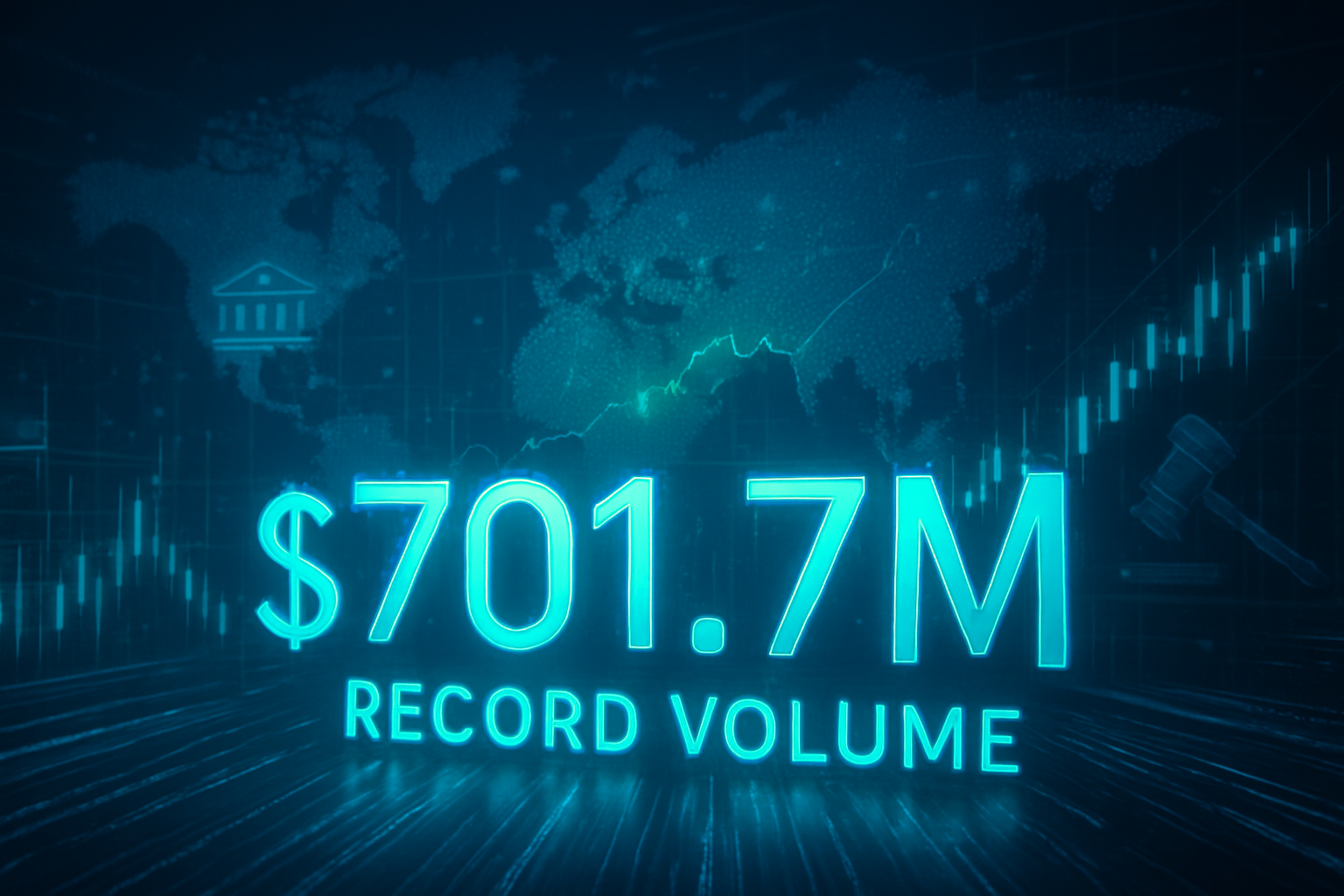
    The world of finance shifted on its axis this week. On Monday, January 12, 2026, prediction markets achieved a staggering, record-breaking $701.7 million in single-day trading volume. This milestone represents more than just a spike in activity; it marks the definitive arrival of "information finance" as a primary pillar of the global economy. For years, skeptics dismissed these platforms as glorified sportsbooks, but as of early 2026, they have transformed into what many are calling the world’s most accurate "truth engines."

    The surge was driven by a perfect storm of constitutional crises, geopolitical shocks, and the institutionalization of retail trading. At the center of the frenzy was a high-stakes standoff between the U.S. Department of Justice (DOJ) and Federal Reserve Chair Jerome Powell, alongside the sudden capture of Venezuelan President Nicolás Maduro. With millions of dollars moving by the second, the probability of a March interest rate cut fluctuated wildly, peaking at 74% as traders digested real-time updates that outpaced traditional news cycles by minutes.

    The Market: What's Being Predicted

    The $701.7 million daily volume was dominated by a "triopoly" of platforms that have spent the last year racing for market share. Kalshi solidified its position as the industry leader, capturing 66.4% of the volume with $465.9 million in trades. Much of this dominance is credited to Kalshi’s deep integration with Robinhood Markets, Inc. (NASDAQ:HOOD), which launched its dedicated "Prediction Markets Hub" last year, putting event contracts into the hands of over 100 million retail investors.

    While Kalshi owned the domestic macro markets, Polymarket and Opinion battled for the remaining share. Polymarket recorded $100.04 million in volume, buoyed by a $2 billion liquidity injection from the Intercontinental Exchange, Inc. (NYSE:ICE). Meanwhile, the relative newcomer Opinion (Opinion Labs) matched that figure with $100 million, specializing in high-frequency, AI-driven macro indicators.

    The most traded contracts on January 12 included:

    • The Federal Reserve Standoff: Contracts on whether Jerome Powell will resign or be removed before the March FOMC meeting.
    • The Maduro Aftermath: Predictions on the stability of a transitional government in Venezuela following Maduro’s capture.
    • NFL Postseason "Combos": A new feature on Kalshi that allows users to parlay economic outcomes with sports results—for instance, "CPI under 2.5% AND the Kansas City Chiefs win."

    Why Traders Are Betting

    The primary driver for this week’s massive volume was the unprecedented constitutional friction involving the Federal Reserve. On the evening of January 11, Chair Jerome Powell revealed that the DOJ had served the Fed with subpoenas regarding a massive headquarters renovation—a move Powell labeled a "pretext" for political interference. This sent traders into a frenzy. On Kalshi, the "Will the Fed cut rates in March?" contract saw over $120 million in volume on Monday alone as institutions used the market to hedge against a potential central bank decapitation.

    Geopolitical "insider" activity also fueled the surge. Following the U.S. military raid that captured Nicolás Maduro, a single anonymous trader on Polymarket turned a $32,000 bet into $400,000. The bet, placed just hours before the news broke, has sparked intense debate about the role of prediction markets in surfacing non-public information. Traders are no longer just betting on what they think will happen; they are betting on what they know is happening in the shadows.

    Furthermore, the "Mainstreet-ing" of these markets through Robinhood (NASDAQ:HOOD) has changed the trader profile. No longer restricted to crypto-enthusiasts, the January 12 record saw a massive influx of traditional retail investors treating "The Fed" or "The Greenland Declaration" as if they were tech stocks.

    Broader Context and Implications

    This record volume occurs against a backdrop of intense regulatory friction. While the federal courts largely cleared the way for election betting in 2025, a new "second front" has opened at the state level. Just this past week, the Tennessee Sports Wagering Council issued cease-and-desist orders to Kalshi and Polymarket, claiming their event contracts infringe on state gambling monopolies. However, on January 15, 2026, a federal judge granted a temporary restraining order (TRO) protecting Kalshi, suggesting that federal Commodity Futures Trading Commission (CFTC) oversight may preempt state law.

    The massive volume is also forcing Congress's hand. On January 9, Rep. Ritchie Torres (D-NY) introduced the "Public Integrity in Financial Prediction Markets Act of 2026." The bill aims to ban federal officials from trading on these platforms to prevent the very "information leakage" seen in the Maduro case.

    Despite these hurdles, the historical accuracy of these markets remains their greatest defense. Throughout the early 2026 geopolitical turmoil, prediction market odds have consistently moved 10 to 15 minutes ahead of major news wires like Bloomberg or Reuters. For many hedge funds, these markets are no longer a side-show—they are the primary signal.

    What to Watch Next

    The immediate focus for traders is the "Powell Pivot." With the DOJ investigation ongoing, any sign of Powell’s resignation will likely trigger another $500 million+ day. Markets are currently pricing a 35% chance of a leadership change at the Fed by February 1.

    On the regulatory front, keep an eye on the Ninth Circuit Court of Appeals. A ruling is expected by early February regarding Nevada’s attempt to shutter prediction market operations. If the court sides with Kalshi, it will effectively create a "green zone" for event contracts across the Western United States. Additionally, the finalization of the ICE (NYSE:ICE)-Polymarket integration is expected to bring a wave of institutional liquidity that could make $700 million days the new normal.

    Bottom Line

    The record-breaking volume of January 12 is a watershed moment for finance. It proves that prediction markets have solved the "liquidity trap" that previously kept them in the shadow of the New York Stock Exchange. By providing a clear, numerical probability for events that traditional markets struggle to price—like constitutional crises or military raids—platforms like Kalshi and Polymarket have become indispensable.

    For investors, the message is clear: the most valuable commodity in 2026 is no longer just data, but the synthesis of that data into tradable odds. As long as the world remains volatile, these "truth engines" will continue to grow, regulatory pressure notwithstanding.


    This article is for informational purposes only and does not constitute financial or betting advice. Prediction market participation may be subject to legal restrictions in your jurisdiction.

    PredictStreet focuses on covering the latest developments in prediction markets.
    Visit the PredictStreet website at https://www.predictstreet.ai/.
  • The $60 Billion Revolution: How Prediction Markets Outpaced Projections to Challenge the Sports Betting Throne

    The $60 Billion Revolution: How Prediction Markets Outpaced Projections to Challenge the Sports Betting Throne

    As we cross the midpoint of January 2026, the final tallies for the previous year have confirmed a seismic shift in global finance: prediction markets are no longer a niche curiosity for political junkies and crypto-enthusiasts. In 2025, the industry didn't just meet the ambitious $40 billion volume projection set by analysts—it shattered it, recording a staggering $63.5 billion in total notional volume.

    This 302% year-over-year explosion has placed prediction markets on a direct collision course with the $300 billion global sports betting industry. What was once seen as "gambling for nerds" is now being recognized as a sophisticated "Information Finance" ecosystem. Driven by regulatory breakthroughs in the United States and massive retail distribution via major brokerage apps, the probability of prediction markets becoming a permanent, dominant fixture of the financial landscape has moved from a "maybe" to a near-certainty.

    The Market: What's Being Predicted

    The scope of prediction markets expanded dramatically in 2025. While election cycles traditionally provide the largest volume spikes, the market successfully pivoted to "evergreen" categories including economic data, climate events, and, most notably, sports. Leading the charge are Kalshi, the first regulated U.S. prediction exchange, and Polymarket, the decentralized giant that remains a powerhouse in international and crypto-native circles.

    By the end of 2025, the distribution of volume shifted significantly toward regulated event contracts. Kalshi emerged as the surprise volume leader in the final quarter, finishing the year with $23.8 billion in volume, a more than 1,100% increase from 2024. Much of this growth came from their expansion into sports event contracts, which allowed users to trade on the outcome of NFL and NBA games with the transparency and regulatory oversight of a financial derivative rather than a traditional sportsbook.

    Meanwhile, Polymarket maintained its relevance by recording $22.5 billion in volume. Despite losing its dominant market share to regulated U.S. competitors, Polymarket’s liquidity in non-U.S. political events and "culture" markets remains unmatched. The barrier to entry for the average investor vanished in March 2025 when Robinhood (NASDAQ: HOOD) launched its "Prediction Markets Hub" in partnership with Kalshi, instantly putting event contracts into the pockets of over 24 million retail traders.

    Why Traders Are Betting

    The 2025 surge was fueled by a fundamental realization among participants: prediction markets offer better "yield" on information than almost any other asset class. Unlike the stock market, where a company's price is influenced by thousands of variables from interest rates to management changes, a prediction market contract on the Federal Reserve's next rate hike or a specific legislative vote has a clear, binary resolution.

    Traders are also increasingly using these markets as a hedge. For example, in late 2025, businesses sensitive to hurricane damage used Interactive Brokers (NASDAQ: IBKR) and its ForecastEx platform to hedge against climate risks. By buying "Yes" contracts on specific weather events, they created a form of ad-hoc insurance that was more flexible and faster-paying than traditional policies.

    The "whale" activity has also shifted from anonymous crypto wallets to institutional desks. The strategic $2 billion investment by Intercontinental Exchange (NYSE: ICE) into Polymarket in late 2025 signaled that the world's most powerful financial institutions now view the data generated by these markets as a high-fidelity signal for risk management.

    Broader Context and Implications

    The path to $63.5 billion was paved by a landmark regulatory victory in May 2025. After years of litigation, the CFTC officially dropped its appeal against Kalshi, effectively greenlighting the listing of election and political derivatives in the U.S. This decision removed the "grey market" stigma that had plagued the industry since the early days of Intrade and PredictIt.

    This regulatory clarity has allowed prediction markets to begin eating into the market share of traditional sportsbooks like DraftKings (NASDAQ: DKNG) and Flutter Entertainment (NYSE: FLUT). Because event contracts on exchanges like Kalshi are structured as derivatives with lower "vig" (the house take) than traditional sports betting "juice," savvy bettors are migrating toward prediction markets for better pricing.

    Beyond the money, these markets have proven to be the most accurate "source of truth" in a fragmented media landscape. Throughout 2025, prediction market prices consistently front-ran traditional polling and expert commentary on everything from the European central bank decisions to the success of major film releases.

    What to Watch Next

    As we look toward the rest of 2026, the primary catalyst on the horizon is the U.S. Midterm Elections. Early volume for "Control of the House" and "Control of the Senate" contracts is already outpacing the levels seen at this stage in the 2022 and 2024 cycles. Analysts are now projecting that the industry could surpass the $100 billion annual volume milestone by the end of this year.

    The next major milestone to monitor is the potential integration of event contracts into more mainstream retirement and savings products. There is growing talk on Wall Street about "Event-Linked ETFs" that would allow institutional investors to gain exposure to a basket of prediction market outcomes as a non-correlated asset class.

    Furthermore, keep an eye on the "cross-pollination" between sports betting and prediction markets. As more jurisdictions clarify the rules, expect traditional sportsbooks to launch their own exchange-style interfaces to compete with the low-fee models of Kalshi and Robinhood.

    Bottom Line

    The story of 2025 was the year prediction markets grew up. By surpassing the $40 billion projection and hitting $63.5 billion, the industry has proven that the appetite for "trading on the truth" is massive and globally distributed. The integration into platforms like Robinhood has democratized access, making the act of forecasting as simple as buying a share of stock.

    Ultimately, prediction markets are evolving into the world’s most efficient central nervous system. They don’t just offer a place to bet; they provide a real-time, financially-backed consensus on the direction of our society. As we head deeper into 2026, the question is no longer whether prediction markets will rival sports betting, but how long it will take before they surpass it.


    This article is for informational purposes only and does not constitute financial or betting advice. Prediction market participation may be subject to legal restrictions in your jurisdiction.

    PredictStreet focuses on covering the latest developments in prediction markets.
    Visit the PredictStreet website at https://www.predictstreet.ai/.