
Tag: Finance

  • The $112 Million Regulatory Heist: Polymarket’s QCX Acquisition and the Battle for America’s Prediction Market

    The $112 Million Regulatory Heist: Polymarket’s QCX Acquisition and the Battle for America’s Prediction Market

    In a move that has sent shockwaves through the burgeoning "information economy," Polymarket has officially staged its return to the United States. Following a multi-year exile by federal regulators, the world’s largest prediction market platform successfully bypassed the typical years-long licensing process by executing a strategic $112 million acquisition of QCX, a Commodity Futures Trading Commission (CFTC)-regulated derivatives exchange and clearinghouse. As of January 20, 2026, this "regulatory shortcut" has transformed the competitive landscape, setting the stage for a high-stakes showdown with its chief rival, Kalshi.

    Traders are currently pricing in a high probability that Polymarket’s U.S. arm will achieve parity with its global volume by the end of Q3 2026. This market sentiment is driven by the platform's aggressive integration with traditional financial infrastructure and its recent high-profile partnerships. However, the move has ignited a fierce rivalry with Kalshi, which has spent years building its brand as the "compliant" alternative. As prediction markets transition from niche crypto-products to mainstream financial tools, the battle between these two giants represents more than just a fight for market share; it is a battle for the soul of the predictive era.

    The Market: What's Being Predicted

    The central focus of traders today is the rapid expansion of Polymarket US, the platform’s domestic, regulated entity. Unlike the crypto-native global site, Polymarket US operates as a registered Designated Contract Market (DCM) and Derivatives Clearing Organization (DCO)—licenses it inherited through the acquisition of QCX (collectively QCX, LLC and QC Clearing LLC). This structure allows Polymarket to list event contracts that are cleared and settled within the U.S. financial system, providing a degree of legitimacy that was once its greatest weakness.

    Currently, the primary "meta-market" being traded across platforms involves the comparative volume growth of Polymarket US versus Kalshi. In early 2026, Kalshi remains the leader in regulated U.S. volume, holding approximately 66.4% of the market, largely due to its deep integration with Robinhood (NASDAQ: HOOD). However, Polymarket’s volume has surged by 40% month-over-month since its limited December 2025 relaunch. Liquidity on the new platform is being bolstered by institutional market makers like Susquehanna International Group (SIG), which has expanded its operations to support Polymarket’s new regulated order books.

    The resolution criteria for these competition markets typically hinge on official CFTC quarterly reports or verified third-party data providers like ElectionBettingOdds or VolumeWatch. Traders are closely monitoring the "Self-Certification" filings Polymarket submitted in late 2025, which include contracts for athletic point spreads, Federal Reserve interest rate hikes, and even the outcomes of specific state-level legislative sessions.

    Why Traders Are Betting

    The sudden shift in the prediction market hierarchy is being driven by a "perfect storm" of regulatory clarity and massive capital infusion. Polymarket’s acquisition of QCX was not just a legal maneuver; it was backed by a landmark $2 billion strategic investment from the Intercontinental Exchange (NYSE: ICE), the parent company of the New York Stock Exchange. This partnership has given Polymarket a seat at the table with the world’s largest institutional investors, many of whom are betting that prediction markets will eventually replace traditional polling and even some forms of weather and economic forecasting.

    Furthermore, traders are reacting to the divergent strategies of the two platforms. While Kalshi has doubled down on sports-centric "event parlays" to attract the retail betting crowd, Polymarket is positioning itself as the "Bloomberg of Truth," focusing on geopolitical risk and macroeconomic indicators. Notable "whale" activity has been observed in markets related to the 2026 midterm elections, where Polymarket’s historical accuracy in 2024 has given it a reputational edge over traditional media outlets like CNN or the New York Times.

    Public sentiment is also heavily influenced by the high-profile figures backing these platforms. Polymarket has strengthened its domestic ties by adding Donald Trump Jr. (via 1789 Capital) to its advisory board, while Kalshi has aligned itself with the traditional Wall Street guard, securing endorsements from veterans at Charles Schwab (NYSE: SCHW) and Sequoia Capital. This political and financial polarization is creating unique trading opportunities for those who believe one "camp" has a superior information network.

    Broader Context and Implications

    The Polymarket-QCX deal marks the end of the "Wild West" era for prediction markets. By choosing to buy their way into compliance, Polymarket has acknowledged that the path to global dominance must run through the U.S. regulatory framework. This has massive implications for the broader fintech sector. We are seeing a "convergence" where prediction markets are becoming indistinguishable from traditional derivatives exchanges like those operated by the CME Group (NASDAQ: CME).

    However, this newfound legitimacy has brought about a new theater of conflict: state-level regulation. In just the last week of January 2026, the Nevada Gaming Control Board filed a lawsuit against Polymarket to halt its sports-related contracts, arguing they constitute unlicensed gambling. This mirrors a broader trend where federal approval (via the CFTC) is being challenged by state gaming commissions who fear a loss of tax revenue and oversight.

    Historically, prediction markets have been more accurate than pundits because they require participants to "put their money where their mouth is." The current rivalry is essentially a stress test for this theory. If Polymarket can maintain its predictive accuracy while scaling within a regulated framework, it could fundamentally change how corporations hedge risk. For example, airline companies might use these markets to hedge against geopolitical instability in specific regions, rather than just relying on fuel futures.

    What to Watch Next

    The immediate focus for the market is the progression of the Public Integrity in Financial Prediction Markets Act of 2026, also known as the "Torres Bill." If passed, this legislation would ban federal employees from trading on prediction markets, a move that Kalshi supports to increase market "integrity" but which Polymarket critics argue is a veiled attempt to limit the platform's information advantage.

    Key dates to watch include:

    • February 12, 2026: The deadline for Polymarket to respond to the Nevada cease-and-desist order. A loss here could force a temporary withdrawal from several "gaming-heavy" states.
    • March 2026: The expected launch of Polymarket’s full integration into the Intercontinental Exchange (NYSE: ICE) trading terminals, which would allow hedge funds to trade event contracts directly alongside equities and bonds.
    • Q2 2026 Earnings: Watch for Interactive Brokers (NASDAQ: IBKR) and its subsidiary ForecastEx to report whether they have gained ground against the two market leaders, as they offer the lowest-fee alternative for institutional traders.

    Bottom Line

    The return of Polymarket to the U.S. via the QCX acquisition represents a pivotal moment in financial history. It signifies that prediction markets are no longer a "niche" interest for crypto enthusiasts but a core pillar of the modern financial system. The rivalry with Kalshi has created a competitive "arms race" that is driving innovation, lowering fees, and increasing the depth of these markets.

    For the average observer, the takeaway is clear: the "Information Economy" is here to stay. Whether Polymarket’s aggressive "legalization via acquisition" strategy ultimately triumphs over Kalshi’s "compliance-first" pedigree remains to be seen, but the real winner is the market itself. As these platforms grow in liquidity and legitimacy, the world gains a more transparent, data-driven way to look into the future.

    The odds favor a split market—one where Kalshi dominates the retail sports-betting crossover and Polymarket reigns supreme as the institutional engine for geopolitical and economic forecasting. But in a world where everything is a market, the only certain bet is that the volatility is just beginning.


    This article is for informational purposes only and does not constitute financial or betting advice. Prediction market participation may be subject to legal restrictions in your jurisdiction.

    PredictStreet focuses on covering the latest developments in prediction markets.
    Visit the PredictStreet website at https://www.predictstreet.ai/.
  • The Great Unlocking: How Regulatory Thaw Fueled a 1,000% Surge in Prediction Markets

    The Great Unlocking: How Regulatory Thaw Fueled a 1,000% Surge in Prediction Markets

    As of January 19, 2026, the landscape of American finance looks fundamentally different than it did just two years ago. The once-fringe world of prediction markets has exploded into a mainstream powerhouse, driven by a radical shift in federal oversight. What began as a high-stakes legal battle between Kalshi and the Commodity Futures Trading Commission (CFTC) has transformed into a government-endorsed "Information Finance" revolution. Today, traders are no longer just betting on the weather or the next Fed rate cut; they are participating in a massive, real-time data engine that is reshaping how we understand public sentiment.

    The primary catalyst for this boom has been the current administration’s decision to abandon the aggressive, restrictive posture of the Biden era. By dropping long-standing legal appeals and appointing market-friendly leadership at the CFTC, the federal government has effectively signaled that the "barriers to entry" are down. This regulatory green light has allowed the industry leader, Kalshi, to report a staggering 1,000% surge in trading volume over the last 14 months, signaling that the era of prediction markets as a "legal gray area" is officially over.

    The Market: What's Being Predicted

    The current market focus has moved far beyond the binary "win/loss" contracts of the 2024 election. On Kalshi, the primary US-regulated exchange, the volume is now dominated by a mix of high-frequency economic data and professional sports. Current odds on the platform suggest a 68% probability of a 25-basis-point interest rate cut by the Federal Reserve in March, a figure that is now cited by major news outlets alongside traditional polling and analyst forecasts.

    While Kalshi remains the dominant dedicated exchange, the market has seen massive liquidity injections from retail giants. Robinhood Markets, Inc. (NASDAQ: HOOD) launched its "Prediction Markets Hub" in early 2025, quickly becoming a central node for retail traders betting on everything from box office numbers to the outcome of the 2026 midterm primaries. Simultaneously, Interactive Brokers Group, Inc. (NASDAQ: IBKR) has utilized its ForecastEx platform to cater to institutional clients, offering contracts that allow corporations to hedge against climate-related disasters and supply chain disruptions.

    The liquidity in these markets has reached unprecedented levels. In December 2025 alone, the industry-wide monthly volume exceeded $13 billion. Kalshi’s internal data shows that its weekly volume now regularly tops $2 billion, a 10x increase from its pre-2024 levels when the CFTC was still actively attempting to block its election-related contracts. These markets typically resolve based on hard data—official government reports, league statistics, or verified election results—ensuring a level of transparency that traditional "opinion-based" forecasting lacks.

    Why Traders Are Betting

    The 1,000% surge in volume is not merely a product of curiosity; it is the result of a "perfect storm" of legal clarity and institutional adoption. Under the Biden administration, the CFTC viewed prediction markets through the lens of "gaming" and "gambling," leading to years of litigation that suppressed volume and scared away institutional capital. However, the landmark 2024 court ruling in Kalshi v. CFTC—which the current administration chose not to overturn or further contest—legitimized these contracts as "event derivatives."

    Traders are also flocking to these markets because they are proving to be more accurate than traditional methods. During the 2024 election cycle, prediction markets famously reacted to shifts in voter sentiment faster than traditional polling, which often suffered from a "lag" of 72 hours or more. This "real-time truth" has attracted "whales"—high-net-worth individuals and hedge funds—who use prediction markets as a sophisticated alternative to traditional hedging.

    The recent movement in the 2026 Midterm "Control of the House" market is a prime example. While traditional analysts remain split, the Kalshi market has seen a heavy lean toward the incumbent party retaining control (currently at 62%), driven by several multi-million dollar positions from traders who specialize in district-level demographics. This shift from "opinion" to "financial stake" has created a more disciplined and accurate forecasting environment.

    Broader Context and Implications

    The "breakdown of barriers" is more than just a regulatory shift; it represents the birth of a new asset class. The current administration's "hands-off" approach, spearheaded by the new CFTC leadership, has allowed for the development of the "Safe Harbor Act." This proposed legislation, heavily lobbied for by a coalition including Robinhood (HOOD) and Coinbase Global, Inc. (NASDAQ: COIN), aims to provide a permanent federal framework that would prevent future administrations from re-imposing the scrutiny seen in 2023.

    Real-world implications are already manifesting. Insurance companies are now looking at Interactive Brokers’ (IBKR) climate contracts as a secondary market for risk. If a prediction market shows an 80% chance of a Category 4 hurricane hitting Florida, the pricing of that contract provides a more immediate, market-driven "risk premium" than traditional actuarial tables.

    However, this growth hasn't been without friction. While federal barriers have crumbled, a new battle is emerging at the state level. States like Nevada and Massachusetts have issued cease-and-desist orders against some platforms, arguing that these markets infringe upon state-regulated gambling and tax revenues. This "War of Federalism" is likely the next major hurdle for the industry, as platforms fight to ensure that a federal "green light" isn't extinguished by state-level "red tape."

    What to Watch Next

    The coming months will be a litmus test for the sustainability of this growth. The most significant upcoming milestone is the potential passage of the Safe Harbor Act in Congress. If signed into law, it would effectively "bulletproof" the industry against regulatory whiplash, likely triggering another massive influx of institutional capital from traditional Wall Street firms that are currently waiting on the sidelines.

    Investors should also monitor the expansion of "Sports Event Contracts" on Kalshi and Robinhood (HOOD). With sports betting already a multi-billion dollar industry in the US, the transition of sports fans into "event derivative traders" could push volumes even higher. The NFL playoffs and the upcoming 2026 World Cup are expected to be the largest non-political events in the history of prediction markets, with some analysts predicting single-event volumes exceeding $500 million.

    Finally, keep an eye on the "State vs. Federal" legal challenges. A Supreme Court petition regarding whether federal commodities law preempts state gambling statutes is widely expected by mid-2026. The outcome of such a case would define the geographic boundaries of the market for the next decade.

    Bottom Line

    The 1,000% volume surge reported by Kalshi is the loudest signal yet that prediction markets have graduated from a niche hobby to a structural component of the US financial system. The shift from the restrictive, "scrutiny-first" mindset of the previous administration to the current era of "Information Finance" has unlocked a level of liquidity and public participation that was once unthinkable.

    What this tells us is that the public has a massive appetite for "skin in the game" truth-seeking. In an era of deepfakes and polarized media, prediction markets provide a rare, objective scoreboard. While state-level regulatory battles and the need for permanent federal legislation remain, the momentum is undeniably in favor of growth.

    The likely outcome for 2026 is a continued "institutionalization" of the space. As Robinhood (HOOD) and Interactive Brokers (IBKR) further integrate these markets into their core apps, the line between "investing" and "predicting" will continue to blur, eventually making the "price" of an event as common a metric as the price of a stock.


    This article is for informational purposes only and does not constitute financial or betting advice. Prediction market participation may be subject to legal restrictions in your jurisdiction.

    PredictStreet focuses on covering the latest developments in prediction markets.
    Visit the PredictStreet website at https://www.predictstreet.ai/.
  • Betting on the Brink: Inside the Explosive Rise of Geopolitical Disaster Markets

    Betting on the Brink: Inside the Explosive Rise of Geopolitical Disaster Markets

    As of January 19, 2026, the global financial landscape is increasingly dominated by a controversial new asset class: geopolitical instability. Following the chaotic start to the year—marked by the capture of Nicolás Maduro in Venezuela on January 3 and a subsequent hypersonic missile test by Pyongyang on January 4—prediction markets have seen an unprecedented surge in activity. These "disaster markets," which allow traders to bet on everything from nuclear tests to regime changes, are no longer just niche corners of the internet; they have become a multi-billion-dollar "parallel intelligence" infrastructure.

    On platforms like Polymarket and Kalshi, the volume of bets regarding North Korean aggression and potential U.S. diplomatic breakthroughs has reached a fever pitch. Currently, the market for a face-to-face summit between Donald Trump and Kim Jong-un in 2026 is trading at a robust 42% probability, while more extreme "invasion" contracts are seeing high-frequency fluctuations as traders attempt to price in the risk of a global kinetic conflict. This shift has transformed prediction markets into a leading indicator of real-world volatility, often moving faster than traditional news cycles.

    The Market: What's Being Predicted

    The focus of the early 2026 trading season has been the Korean Peninsula. On the decentralized platform Polymarket, cumulative volume for 2025 reached nearly $40 billion, with a significant portion dedicated to "North Korean provocation" contracts. Specifically, the market for "North Korea to launch a ballistic missile by January 31, 2026" saw a massive spike in liquidity following the January 4 test. Before the launch was even officially confirmed by the Pentagon, "Yes" contracts reached near-parity, suggesting that traders with localized intelligence or advanced satellite monitoring were front-running the official news.

    On the regulated U.S. exchange Kalshi, the focus is more diplomatic but no less high-stakes. Traders are currently eyeing the "Kim Jong-un to visit the U.S. in 2026" contract. While the odds remain lower at 18%, the volume has increased tenfold since the start of the year. Unlike the "wild west" markets on offshore platforms, Kalshi’s contracts are strictly defined, requiring a physical presence in the 50 U.S. states to resolve.

    In Asia, a new Binance-backed platform named Opinion has gained massive traction, specifically targeting South Korean retail investors. This platform hosts hyper-local markets, such as "DMZ skirmish before March" and "Cyberattack on Seoul infrastructure." Weekly volumes on Opinion have reportedly exceeded 2 trillion won ($1.5 billion), highlighting a regional obsession with hedging against the very real possibility of local disaster.

    Why Traders Are Betting

    The motivations for these bets are shifting from speculative gambling to strategic hedging. Institutional players, once wary of the "death pool" optics, are now the primary drivers of volume. Goldman Sachs (NYSE: GS) recently acknowledged that it tracks a "Basket of Geopolitical Risk Stocks" that directly correlates with the odds seen on these prediction platforms. For a hedge fund manager, a "Yes" bet on a North Korean missile launch acts as a protective hedge against their long positions in South Korean equities or global tech manufacturing.

    "We aren't just looking at what CNN says anymore," noted one anonymous high-volume trader on Polymarket. "We are looking at where the $500,000 'whale' positions are moving at 3:00 AM. When a whale bets $30,000 at 7-cent odds on a regime change and wins, like we saw with the Maduro removal in early January, you realize these markets are being fed by people with boots-on-the-ground information."

    Furthermore, the "Trump Factor" remains a primary catalyst. The market's 42% odds for a Trump-Kim summit reflect a belief in the return of "personal diplomacy" and the President's penchant for grand, televised summits. Traders are betting on the President's unpredictability, using historical patterns from the 2018-2019 period to gauge the likelihood of a sudden de-escalation that would see Kim Jong-un on U.S. soil.

    Broader Context and Implications

    The rise of these markets has ignited a firestorm of ethical debate. Critics argue that allowing individuals to profit from war and suffering is inherently "ghoulish." In response, Representative Ritchie Torres introduced the Public Integrity in Financial Prediction Markets Act of 2026 earlier this month. The bill aims to prevent federal officials from trading on outcomes they might influence, treating prediction markets with the same scrutiny as the equities market to prevent "government insider trading."

    The ethical concern extends to moral hazard: could a high-stakes bet on an assassination or a terrorist attack actually incentivize the event? While no such link has been proven, the sheer amount of money—over $10 billion in monthly volume in late 2025—makes the possibility a central concern for regulators at the CFTC.

    Despite the controversy, the accuracy of these markets is difficult to ignore. Throughout 2025, prediction markets consistently outperformed traditional think tanks and intelligence agencies in forecasting regional skirmishes. The correlation between these markets and the stock prices of major defense contractors is now nearly 1:1. For instance, Hanwha Aerospace (KRX: 000880) and LIG Nex1 (KRX: 079550) saw their stock prices surge by 25.4% and 15.2% respectively in the first week of 2026, perfectly mirroring the rising "conflict odds" on Polymarket. Similar movements were seen in U.S. giants like Lockheed Martin (NYSE: LMT) and Northrop Grumman (NYSE: NOC).

    What to Watch Next

    The coming weeks will be a critical litmus test for these disaster markets. All eyes are on the upcoming vote for the 2026 U.S. defense budget, which President Trump has proposed at a record $1.5 trillion. If the budget passes with its current focus on "Pacific Deterrence," expect the odds for a diplomatic summit to drop while "Missile Launch" and "Satellite Deployment" contracts see increased action.

    Key dates to monitor include the late-February anniversary of the founding of the Korean People’s Army. Traditionally a time for military parades, traders are already positioning themselves for a "spectacular" missile demonstration. Additionally, any movement in the stock of Korea Aerospace Industries (KRX: 047810) will be closely watched; the company’s stock has recently moved in tandem with markets predicting the detection of new North Korean submarine-launched ballistic missile (SLBM) capabilities.

    Bottom Line

    The emergence of "geopolitical disaster" markets represents a fundamental shift in how the world processes risk. What was once considered a morally questionable hobby has matured into a vital instrument for financial hedging and information aggregation. Whether it is the 42% chance of a Trump-Kim summit or the split-second reaction to a missile launch, these markets provide a raw, unfiltered look at public and institutional sentiment that traditional polls cannot match.

    However, the legal landscape is shifting. As the Torres Bill makes its way through Congress and the ethical debate over "profiting from chaos" intensifies, the future of these platforms may depend on their ability to self-regulate. For now, they remain the most accurate—and perhaps the most unsettling—barometer of a world on the edge.


    This article is for informational purposes only and does not constitute financial or betting advice. Prediction market participation may be subject to legal restrictions in your jurisdiction.

    PredictStreet focuses on covering the latest developments in prediction markets. Visit the PredictStreet website at https://www.predictstreet.ai/.

  • The $9 Billion “Truth Engine”: How ICE’s $2B Bet on Polymarket Redefined Wall Street

    The $9 Billion “Truth Engine”: How ICE’s $2B Bet on Polymarket Redefined Wall Street

    The financial landscape shifted permanently in October 2025 when the Intercontinental Exchange (NYSE: ICE), the powerhouse parent of the New York Stock Exchange, announced a staggering $2 billion strategic investment into Polymarket. This move didn't just inject capital; it effectively minted prediction markets as the new "truth engine" of global finance. At the time of the announcement, Polymarket’s valuation skyrocketed to a projected $9 billion, a nearly ten-fold increase from its status just months earlier.

    The investment arrived on the heels of a historic 2024 election cycle where Polymarket outpaced traditional pollsters in both speed and accuracy. By the time the deal was inked on October 7, 2025, the narrative around prediction markets had evolved from "on-chain betting" to "essential financial infrastructure." This partnership signaled to the world that the "implied probability" of an event is now as valuable a commodity as the price of West Texas Intermediate crude or a share of blue-chip stock.

    The Market: What's Being Predicted

    The primary "market" being traded here is no longer just a single event, but the institutionalization of event-driven data itself. Following the ICE investment, Polymarket transitioned from a decentralized platform primarily used by crypto-natives into a professional-grade exchange integrated with the world's most sophisticated trading terminals. Under the terms of the deal, ICE became the exclusive global distributor of Polymarket’s data, feeding real-time odds into the workstations of hedge funds, central banks, and institutional desks across the globe.

    Currently, the liquidity on Polymarket has reached unprecedented levels, with monthly volumes consistently exceeding $5 billion as of January 2026. The platform’s "Election 2024" markets served as the proof of concept, but the new frontier involves corporate-specific event contracts. For instance, traders are now actively betting on the "Market-Implied Earnings Calendar," where the probability of an earnings beat for companies like Apple Inc. (NASDAQ: AAPL) or Tesla (NASDAQ: TSLA) is traded with higher volume than some mid-cap equities.

    This maturation was further solidified by Polymarket’s acquisition of QCX, a CFTC-registered derivatives exchange, for $112 million in mid-2025. This move provided the necessary legal bridge to relaunch fully regulated services in the United States, allowing for a seamless integration of "event contracts" alongside traditional derivatives.

    Why Traders Are Betting

    The massive valuation jump to $9 billion is driven by a fundamental realization: prediction markets provide a superior signal-to-noise ratio compared to any other forecasting method. Institutional traders are moving away from traditional political polling and expert "punditry," which proved increasingly unreliable throughout the early 2020s. Instead, they are putting capital behind the "wisdom of the crowd," where every participant has "skin in the game."

    The 2025 investment was also heavily influenced by a favorable shift in the U.S. regulatory environment. The passage of the CLARITY Act (Digital Asset Market Clarity Act) earlier in 2025 provided the legal safe harbor that massive institutional players like ICE required. By codifying event contracts as a protected class of financial derivatives, the Act removed the "gambling" stigma that had previously hampered growth.

    Furthermore, the introduction of the GENIUS Act (Guiding and Establishing National Innovation for U.S. Stablecoins Act) allowed Polymarket to settle its massive volumes in regulated stablecoins with full legal certainty. Whale activity has followed this regulatory clarity, with multi-million dollar positions now common in markets ranging from Federal Reserve interest rate hikes to the outcome of high-stakes antitrust trials.

    Broader Context and Implications

    The ICE-Polymarket tie-up is the crowning achievement in a broader trend toward the "prediction-fication" of everything. It places Polymarket in direct competition—and sometimes collaboration—with other major players like Kalshi, which recently saw its own valuation climb to $11 billion following a deep integration with Robinhood Markets Inc. (NASDAQ: HOOD).

    For the New York Stock Exchange and its parent ICE, the integration of prediction data serves as a "sentiment overlay" for the broader market. When a major regulatory decision is pending in Washington, NYSE traders no longer wait for the news break; they watch the Polymarket odds shift in real-time. This has created a new layer of the financial stack, where the probability of an event is traded as a leading indicator for the underlying asset's price.

    This trend also reveals a profound shift in public sentiment. There is a growing distrust in traditional media and polling institutions, leading the public to trust markets—where people must back their opinions with money—over surveys. Even mainstream entertainment has caught the bug; during the January 2026 Golden Globes, real-time Polymarket odds were displayed on-screen, treating the awards ceremony with the same analytical rigour as a presidential primary.

    What to Watch Next

    As we move through the first quarter of 2026, the industry is bracing for the official launch of the POLY token. Polymarket CMO Matthew Modabber has hinted at a retroactive airdrop for long-term users, a move intended to decentralize governance and further incentivize liquidity. Market analysts are watching closely to see if the token launch will trigger another wave of retail interest similar to the "DeFi Summer" of years past.

    The next major milestone is the full integration of Polymarket data into the ICE "Data Services" suite. Once institutional traders can hedge against "event risk" as easily as they hedge against interest rate risk, the volume on these platforms could easily double. Additionally, keep an eye on the burgeoning "Corporate Event" category, where contracts tied to FDA approvals and merger clearances are expected to become standard hedging tools for biotech and M&A desks.

    Bottom Line

    The $2 billion investment by ICE into Polymarket is more than just a successful funding round; it is the "Big Bang" moment for prediction markets. By bringing the parent of the NYSE into the fold, Polymarket has transitioned from a fringe experiment into a foundational piece of the global financial architecture. The $9 billion valuation reflects the enormous value of having a reliable, real-time "truth engine" in an era of deepfakes and partisan misinformation.

    As we look toward the rest of 2026, the line between "investing" and "predicting" will continue to blur. For the modern trader, an event contract is no longer a bet; it is a sophisticated instrument for managing risk in an increasingly volatile world. The "wisdom of the crowd" has finally been professionalized, and with the backing of ICE, the era of the prediction market is officially here.


    This article is for informational purposes only and does not constitute financial or betting advice. Prediction market participation may be subject to legal restrictions in your jurisdiction.

    PredictStreet focuses on covering the latest developments in prediction markets.
    Visit the PredictStreet website at https://www.predictstreet.ai/.

  • The Trillion-Dollar Horizon: Prediction Markets Set to Eclipse the Global Sports Betting Industry

    The Trillion-Dollar Horizon: Prediction Markets Set to Eclipse the Global Sports Betting Industry

    The era of prediction markets has officially shifted from a niche experimental phase into a primary pillar of global finance. As of January 17, 2026, the industry is no longer just a "truth machine" for political cycles; it has become a high-velocity financial engine. Recent data shows the total prediction market industry hit an all-time daily high of $701.7 million in trading volume this past week, fueled by a convergence of the NFL playoffs, macroeconomic shifts, and the early positioning for the 2026 midterm elections.

    This surge is not a fluke. A landmark joint analysis by Citizens Financial Group (NYSE: CFG) and Eilers & Krejcik Gaming (EKG) suggests that prediction markets are on a direct path to a "Trillion-Dollar Horizon." These reports project that the sector will exceed $1 trillion in annual trading volume by 2030, effectively eating into the market share of the $300 billion global sports betting industry and providing a more efficient venue for hedging real-world risks.

    The Market: What’s Being Predicted

    Today's prediction markets are broader and deeper than ever before. While the 2024 U.S. election was the "supercycle" that brought these platforms into the mainstream, the current liquidity is driven by daily institutional-grade contracts. On Kalshi, which currently commands a 66% market share of the regulated U.S. ecosystem, the most active contracts revolve around the Federal Reserve's upcoming January 28 meeting. Traders are currently pricing in a 95% probability that the Fed will hold interest rates steady, a contract that has seen over $390 million in cumulative volume.

    Meanwhile, on Polymarket, the leading crypto-native platform with over $44.8 billion in cumulative volume, the focus has shifted toward the 2026 midterm elections. With the midterms less than ten months away, markets are already seeing massive "early cycle" liquidity. Current odds favor a Democratic takeover of the House of Representatives at a 76% probability, while Republicans are favored to retain control of the Senate at 67%.

    These markets are not just binary "Yes/No" bets; they have evolved into sophisticated instruments. For example, Kalshi’s new "Combos"—peer-to-peer sports parlays—have allowed it to compete directly with traditional sportsbooks, with sports now accounting for over 90% of the platform’s weekend volume. The current Super Bowl LX favorite, the Seattle Seahawks, is trading at a 25% win probability, attracting tens of millions in localized liquidity.

    Why Traders Are Betting

    The migration of capital into prediction markets is being driven by three primary factors: regulatory clarity, institutional integration, and superior forecasting accuracy. Following a series of favorable court rulings against the CFTC, platforms like Kalshi have been able to offer federally regulated contracts in all 50 states—a feat that online sports betting, which remains a patchwork of state-by-state laws, has yet to achieve.

    Institutional players are also entering the fray. Robinhood (NASDAQ: HOOD) and Coinbase (NASDAQ: COIN) have successfully integrated prediction market products into their retail apps, providing millions of users with one-click access to event contracts. This has drastically lowered the barrier to entry, moving the "whale" activity from offshore accounts to domestic, transparent order books.

    Furthermore, the "accuracy gap" between prediction markets and traditional methods has widened. During the 2024 election and recent macro pivots, prediction markets frequently moved hours—sometimes days—ahead of traditional polling and cable news analysis. Traders are essentially "voting with their wallets," creating a feedback loop where higher liquidity leads to more accurate prices, which in turn attracts more institutional capital seeking a "pure" hedge against event risk.

    Broader Context and Implications

    The "Trillion-Dollar Horizon" represents a fundamental shift in how society values information. According to the Citizens Financial Group (NYSE: CFG) report, prediction markets address a core inefficiency in capital markets by allowing investors to express views on specific events without the "basis risk" of using traditional ETFs or index options. If an investor is worried about a specific regulatory change or an interest rate hike, they can now bet directly on that event rather than shorting a broad index like the S&P 500.

    This growth is beginning to disrupt the $300 billion sports betting industry. While giants like DraftKings (NASDAQ: DKNG) and Flutter Entertainment (NYSE: FLUT) have dominated the gambling space, prediction markets offer a lower "vig" (house take) because they function as peer-to-peer exchanges rather than playing against a bookmaker. EKG estimates that mature sports prediction markets could support a handle equivalent to 80% of today’s regulated online sports betting market by 2030.

    However, this rapid expansion has not come without scrutiny. Regulatory considerations remain at the forefront, as the CFTC continues to monitor the impact of "political betting" on election integrity. Despite these concerns, the historical accuracy of these markets has acted as a powerful shield, with many proponents arguing that they provide a more honest assessment of public sentiment than biased media or opaque polling data.

    What to Watch Next

    As we move deeper into 2026, several key milestones will determine if the $1 trillion projection remains on track. First is the resolution of the "Fed Chair" speculation. Markets on Polymarket currently show Kevin Warsh as the frontrunner at 56% to be the next Fed Chair nominee, an event that will trigger massive volume in both prediction markets and traditional bond markets.

    Second is the "Midterm Pivot." Historically, volume on political contracts peaks in the three months leading up to an election. If the current early-cycle volume is any indication, the 2026 midterms could see double the trading activity of the 2024 presidential cycle. Watch for the $5 billion weekly volume milestone on Kalshi; traders are currently betting with a 74% probability that the platform hits this mark by December.

    Finally, keep an eye on the entry of traditional "Social" platforms. Rumors persist that Meta (NASDAQ: META) or X (formerly Twitter) may integrate prediction widgets to capitalize on their massive real-time news audiences. Such a move would be the final catalyst needed to move the industry from the "financial fringe" to the center of the global internet economy.

    Bottom Line

    The rise of prediction markets to a trillion-dollar industry is no longer a matter of "if," but "when." The infrastructure provided by platforms like Kalshi and Polymarket, combined with the distribution power of Robinhood (NASDAQ: HOOD) and Coinbase (NASDAQ: COIN), has created a permanent new asset class.

    For the average observer, these markets offer a clearer window into the future than any pundit or pollster. For the trader, they represent the ultimate tool for hedging the uncertainties of a volatile world. As the "Trillion-Dollar Horizon" approaches, the line between betting, investing, and forecasting continues to blur, permanently changing the face of global finance.


    This article is for informational purposes only and does not constitute financial or betting advice. Prediction market participation may be subject to legal restrictions in your jurisdiction.

    PredictStreet focuses on covering the latest developments in prediction markets.
    Visit the PredictStreet website at https://www.predictstreet.ai/.

  • The Day Information Finance Went Mainstream: Inside the $700 Million Prediction Market Explosion

    The Day Information Finance Went Mainstream: Inside the $700 Million Prediction Market Explosion

    January 12, 2026, will be remembered as the day the "invisible hand" of the market finally grew a voice. In a historic 24-hour window, global prediction markets processed a staggering $701.7 million in daily trading volume, a milestone that effectively signals the end of the industry's experimental phase. This surge wasn't just a win for speculators; it represented a fundamental shift in how the public consumes and prices information.

    At the center of this whirlwind was Kalshi, which solidified its position as the undisputed heavyweight of the space. Capturing a dominant 66.4% market share, Kalshi processed approximately $465.9 million in trades. This unprecedented liquidity was fueled by a "perfect storm" of geopolitical shocks and a groundbreaking integration with Robinhood Markets, Inc. (NASDAQ: HOOD), which has turned millions of retail brokerage accounts into real-time sentiment gauges.

    The Market: What's Being Predicted

    While prediction markets were once the domain of niche political junkies and crypto-natives, the January 12 record was built on a diversified portfolio of high-stakes event contracts. The volume was split across a variety of platforms, with Kalshi leading the pack, followed by Polymarket and Opinion Labs (Opinion), which each captured roughly 14.3% of the daily share (approximately $100 million each). Smaller entrants like Predict Fun and Probable also saw record activity, though they remained in the shadow of the "Big Three."

    The primary driver of Kalshi’s dominance has been its status as a CFTC-regulated exchange, which allowed for its seamless integration into the Robinhood (NASDAQ: HOOD) ecosystem. Since the 2025 launch of the "Prediction Markets Hub," over 24 million retail traders have gained the ability to trade "Yes/No" outcomes as easily as they buy shares of an ETF. On January 12, Robinhood users reportedly accounted for over 50% of Kalshi’s total volume, transforming complex event derivatives into a standard retail asset class.

    Liquidity on these platforms has reached a critical mass where institutional-sized positions can now be entered with minimal slippage. This has attracted major quantitative firms like Susquehanna International Group (SIG) and DRW, who have reportedly established dedicated "Information Finance" desks to arbitrage discrepancies between prediction markets and traditional financial instruments.

    Why Traders Are Betting

    The massive volume spike on January 12 was triggered by several high-impact events that occurred simultaneously. The most dramatic was a sudden geopolitical shock in South America: the capture of Venezuelan leader Nicolás Maduro. While traditional news outlets scrambled to verify reports, prediction markets moved in milliseconds. One trader on Polymarket famously turned a $30,000 position into $400,000 by betting on the capture just hours before it was officially confirmed, a feat that drew thousands of new users to the platform in a "gold rush" of reactionary trading.

    Domestically, a high-stakes constitutional standoff between the U.S. Department of Justice and Federal Reserve Chair Jerome Powell became a massive liquidity sink. Traders poured over $120 million into contracts regarding a potential March 2026 interest rate cut. As rumors of a Fed "rebellion" against DOJ directives swirled, the odds of a rate cut fluctuated wildly between 34% and 74%, providing a real-time heat map of institutional anxiety that traditional polling could never capture.

    Furthermore, the early positioning for the 2026 Midterm elections saw significant "whale" activity. Large-scale traders used the markets to hedge against potential legislative gridlock, with a heavy concentration of volume on "Split Congress" outcomes. For many institutional players, these bets are no longer seen as gambles but as essential hedges against political risk that could impact their broader equity portfolios.

    Broader Context and Implications

    This record-breaking day marks a turning point for "Information Finance"—the concept that prices are the most accurate way to aggregate disparate pieces of information. For years, skeptics argued that prediction markets were too thin and prone to manipulation. However, the $701.7 million volume suggests that the markets have finally reached a level of maturity where they can serve as a "source of truth" that rivals or even exceeds traditional news wires like Bloomberg.

    The "Robinhood Effect" cannot be overstated. By demystifying event contracts and placing them alongside traditional stocks, Robinhood (NASDAQ: HOOD) has effectively democratized the ability to profit from being right about the world. This has not gone unnoticed by regulators. In the wake of the January 12 surge, lawmakers in New York have expedited discussions around the ORACLE Act, a proposed regulatory framework intended to clarify the legal boundaries between event trading and gambling.

    Historically, prediction markets have shown a remarkable ability to outperform expert pundits. By requiring participants to "put their money where their mouth is," these platforms filter out the noise of partisan bias and social media echo chambers. The January 12 milestone confirms that the public is increasingly looking to these markets to understand what is actually happening, rather than what people hope is happening.

    What to Watch Next

    As the dust settles from this record day, all eyes are on the Federal Reserve standoff. The volatility in interest rate contracts suggests that the market expects a major resolution before the end of the first quarter. Traders should monitor the liquidity in these contracts; if the $700 million daily volume becomes a new baseline, we could see even more aggressive price discovery in the coming weeks.

    Additionally, the expansion of Robinhood's (NASDAQ: HOOD) prediction offerings will be a key metric for the industry's growth. There are rumors that the platform may soon offer "Cross-Exchange" liquidity, allowing users to tap into multiple prediction market backends from a single interface. Such a move would likely push daily volumes past the $1 billion mark before the end of the year.

    Finally, keep a close watch on the legislative front. The success of January 12 has painted a target on the industry's back. How Kalshi and its peers navigate the impending ORACLE Act and potential CFTC challenges will determine whether this $700 million day was a one-time peak or the beginning of a new era in global finance.

    Bottom Line

    The record-shattering performance of January 12, 2026, proves that prediction markets are no longer a sideshow—they are the main event. With Kalshi and Robinhood (NASDAQ: HOOD) leading the charge, the barrier to entry for "Information Finance" has been permanently lowered. The ability of these markets to price in a presidential capture and a Federal Reserve crisis in real-time demonstrates an efficiency that traditional institutions are struggling to match.

    Ultimately, this milestone tells us that in an era of "alternative facts" and fragmented media, the world is hungry for a decentralized, incentive-aligned source of truth. As liquidity continues to grow and institutional players deepen their involvement, the odds found on prediction markets will likely become the primary lens through which we view future global events. The $701.7 million day wasn't just about the money; it was about the markets finally proving they can handle the weight of the world's most important questions.


    This article is for informational purposes only and does not constitute financial or betting advice. Prediction market participation may be subject to legal restrictions in your jurisdiction.

    PredictStreet focuses on covering the latest developments in prediction markets.
    Visit the PredictStreet website at https://www.predictstreet.ai/.
  • The “Volume Trap”: Why PredictIt’s 93% Accuracy Is Shaking the Prediction Market Foundation

    The “Volume Trap”: Why PredictIt’s 93% Accuracy Is Shaking the Prediction Market Foundation

    A landmark study from Vanderbilt University has sent shockwaves through the burgeoning prediction market industry, delivering a rigorous autopsy of the 2024 election cycle that fundamentally challenges the "liquidity equals truth" dogma of modern finance. As of January 17, 2026, the findings are reshaping how institutional investors, political strategists, and retail traders view the reliability of real-time forecasting platforms.

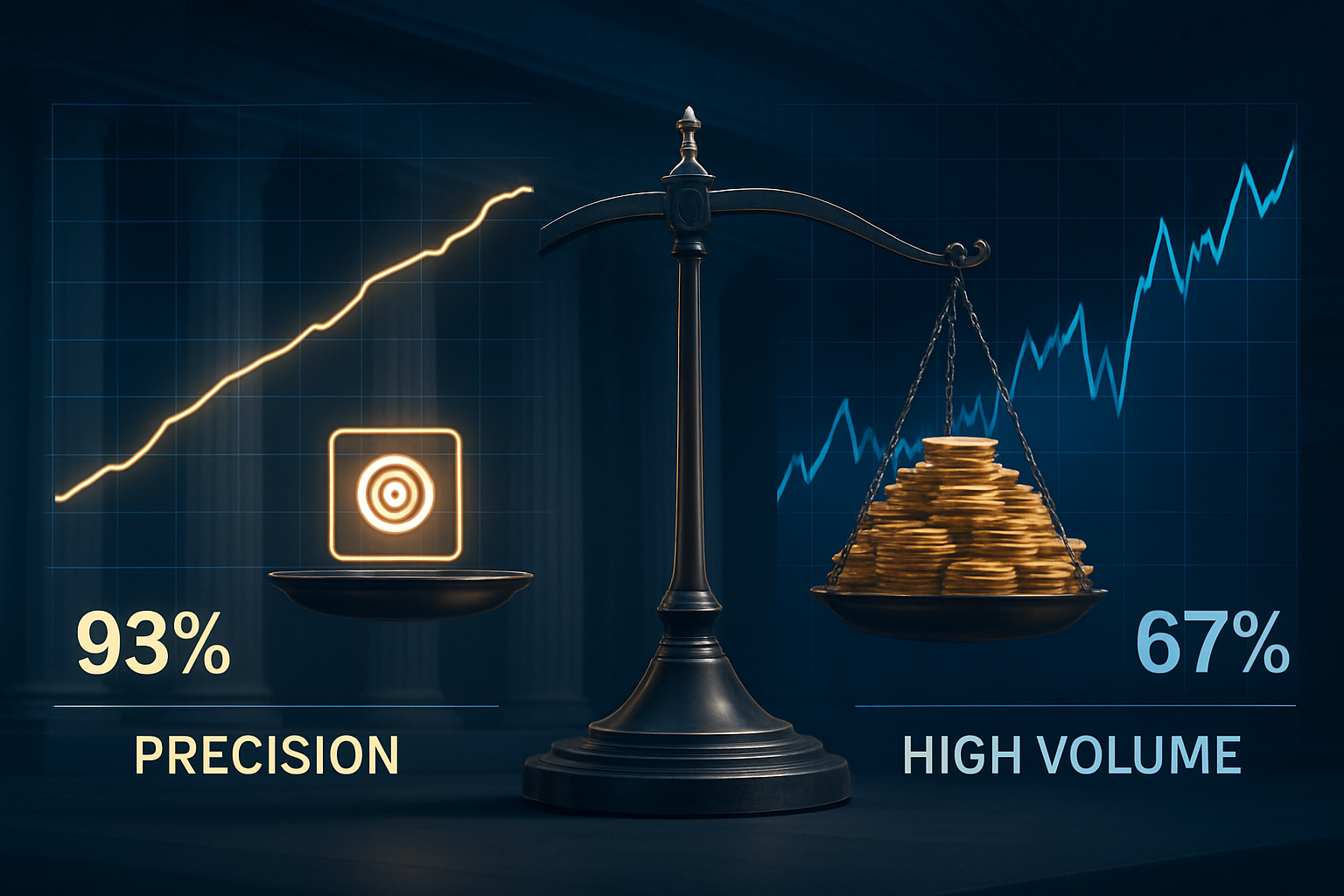
    The study, titled "Prediction Markets? The Accuracy and Efficiency of $2.4 Billion in the 2024 Presidential Election," revealed a surprising hierarchy of precision: PredictIt, the oldest and most restricted of the major platforms, achieved a staggering 93% accuracy rate in correctly forecasting election outcomes. Meanwhile, the regulated U.S. exchange Kalshi (NYSE: KLS) trailed at 78%, and the crypto-native heavyweight Polymarket—despite processing billions in volume—languished at a 67% accuracy rate. This data has sparked a heated debate over the "Volume Trap," a phenomenon where massive liquidity may actually degrade the quality of the information signal.

    The Market: What's Being Predicted

    The Vanderbilt researchers, led by Professor Joshua D. Clinton and TzuFeng Huang, analyzed more than 2,500 political contracts spanning the 2024 U.S. election cycle. The focus was not merely on the top-line Presidential winner but also on a granular level: battleground state margins, House and Senate control, and down-ballot races. While all three platforms—PredictIt, Kalshi, and Polymarket—traded identical outcomes, their price discovery mechanisms behaved in fundamentally different ways.

    PredictIt, which has historically operated under a Commodity Futures Trading Commission (CFTC) no-action letter with strict $850-per-contract limits (raised to $3,500 by late 2025), showed the highest resilience to volatility. In contrast, Kalshi, a federally regulated exchange, and Polymarket, which operates on the Polygon blockchain, saw massive influxes of "whale" capital. Polymarket, in particular, recorded a historic $2.4 billion handle for the 2024 election, yet its prices frequently diverged from the eventual reality, especially in state-level contests.

    The study used "log-loss" and Brier scores to measure how "confidently wrong" markets were. A Brier score rewards markets that are 90% certain of an outcome that occurs, while heavily penalizing those that are 90% certain of an outcome that fails. The results showed that while Polymarket had the most liquidity, it suffered from "mutual exclusivity errors," where the sum of probabilities for competing outcomes often exceeded 100%, indicating a lack of internal logic among its high-volume traders.

    Why Traders Are Betting

    The disparity in accuracy between these platforms can be attributed to the type of traders each platform attracts and the incentives created by their respective architectures. According to the Vanderbilt study, PredictIt’s success is a direct result of its restrictive "retail-only" model. Because no single trader can bet millions of dollars to "move the needle," the price is driven by a diverse crowd of "super-forecasters"—political staffers, data scientists, and wonks who trade on nuanced information rather than momentum.

    Conversely, the "Volume Trap" identified in the study describes a feedback loop seen on high-volume platforms like Polymarket. When high-net-worth "whales"—such as the widely reported "Théo" account that bet over $30 million on a Trump victory—place massive positions, it creates a "narrative gravitational pull." Smaller traders often follow the price movement (herding) rather than the underlying polling data or ground-game metrics. This creates "artificial confidence," where the market price reflects the conviction of a few wealthy individuals rather than the collective intelligence of the crowd.

    Institutional players are now taking notice of these findings. Companies like Interactive Brokers Group, Inc. (Nasdaq: IBKR), through their ForecastEx exchange, and Robinhood Markets, Inc. (Nasdaq: HOOD) have begun refining their contract offerings to prioritize "cleaner" data signals. Traders on these platforms are increasingly looking for ways to arbitrage the gap between the "pure" signal of PredictIt and the "noisy" sentiment of crypto-driven markets.

    Broader Context and Implications

    The Vanderbilt study arrives at a critical juncture for the industry. For years, proponents of prediction markets argued that the more money at stake, the more accurate the forecast would be. The 2024 data suggests the opposite may be true for political events: that concentrated capital can act as a pollutant to price discovery. This has significant regulatory implications, as the CFTC has long expressed concerns that high-stakes political betting could be used to manipulate public perception.

    PredictIt’s 93% accuracy provides a powerful defense for the "limited-stake" model, suggesting that such markets function more like a refined intelligence tool than a gambling venue. This distinction is vital as prediction markets move toward becoming a mainstream financial asset class. If the market's primary value is its "signal" for decision-makers, then accuracy—not volume—is the most valuable metric.

    Furthermore, the study highlights a "State-Level Disconnect." While Polymarket was highly accurate on the national "binary" outcome (who wins the Presidency), it was notably poor at predicting the specific electoral college math. This suggests that global speculators (the "whales") are good at broad sentiment but lack the "on-the-ground" knowledge that smaller, regional traders on PredictIt possess.

    What to Watch Next

    As we enter the 2026 Midterm election cycle, the industry is pivoting. Watch for a "flight to quality" among professional bettors. We are likely to see the emergence of "Aggregator Platforms" that weight prices based on the Vanderbilt accuracy rankings—giving a 93% weight to PredictIt signals and a lower weight to high-volume, low-accuracy sources.

    Key dates to monitor include the upcoming CFTC hearings on contract limits, where the Vanderbilt study is expected to be cited as "Exhibit A" for maintaining position caps. Additionally, look for the performance of new "Expert-Only" markets being developed by traditional financial firms that aim to replicate PredictIt’s success by restricting participation to verified domain experts rather than the highest bidder.

    The next major test for these platforms will be the 2026 Congressional primaries. If the "Volume Trap" holds true, we should expect to see Polymarket prices swing wildly based on social media trends, while PredictIt remains a more boring, but ultimately more accurate, barometer of political reality.

    Bottom Line

    The Vanderbilt University study has shattered the myth that the biggest market is always the smartest market. In the world of political forecasting, it appears that "less is more." PredictIt’s 93% accuracy rate proves that a well-regulated, capped-limit market can outperform a multi-billion dollar crypto giant by filtering out noise and focusing on high-quality, diverse information sources.

    For the prediction market industry, this is a "growing pain" moment. It forces a realization that liquidity is a double-edged sword. While volume provides the profit that sustains exchanges, it can simultaneously degrade the very "wisdom of the crowd" that makes these markets valuable to society in the first place.

    Ultimately, the Vanderbilt findings suggest that for those looking to see the future of American politics, the smartest move isn't to follow the money—it’s to follow the signal. As the 2026 Midterms loom, the "PredictIt Model" stands as the gold standard for anyone who values truth over hype.


    This article is for informational purposes only and does not constitute financial or betting advice. Prediction market participation may be subject to legal restrictions in your jurisdiction.

    PredictStreet focuses on covering the latest developments in prediction markets.
    Visit the PredictStreet website at https://www.predictstreet.ai/.

  • The $52K Floor: Why Prediction Markets are Hedging Against a Bitcoin ‘Black Swan’ in Early 2026

    The $52K Floor: Why Prediction Markets are Hedging Against a Bitcoin ‘Black Swan’ in Early 2026

    As Bitcoin (BTC) hovers near the $95,600 mark this January 16, 2026, a curious divergence is emerging between the exuberant headlines of traditional finance and the cold, calculated skepticism of prediction markets. While retail investors celebrate a recovery from the volatile "Year of the Snake" in 2025, a growing segment of traders on platforms like Polymarket and Kalshi are placing heavy bets on a catastrophic reversal. Specifically, a niche but high-stakes market tracking whether Bitcoin will fall below $52,000 before March 31, 2026, has become a focal point for those hedging against a global macro "black swan."

    Currently, prediction markets are pricing the probability of a sub-$52,000 move by the end of Q1 at approximately 8%, a figure that has tripled since the start of the year. While the spot price remains strong, the "tail risk" demand suggests that professional speculators are increasingly worried about a "liquidity vacuum" similar to the 30% crash witnessed in late 2025. This market is generating intense interest because it represents the ultimate "line in the sand"—the level where institutional conviction meets the reality of a looming U.S. recession.

    The Market: What's Being Predicted

    The specific contract in question—"Bitcoin Below $52,000 by March 31, 2026"—is primarily trading on Polymarket, the decentralized platform that dominated the 2024 election cycle and has since become the de facto source for crypto sentiment. Unlike traditional futures on the CME Group (NASDAQ: CME), which often reflect institutional "long-only" momentum, these prediction contracts act as a binary insurance policy. If Bitcoin touches or closes below the $52,000 mark before the expiration date, the "Yes" shares pay out a full dollar, providing a massive windfall for those who bought in at current "penny" levels.

    Trading volume for this specific downside target has surged to over $12 million across various platforms. On Kalshi, the regulated U.S. exchange, a broader "How low will Bitcoin go?" market shows that while the consensus "floor" is expected to be around $75,000 (with a 63% probability), the $50k–$55k bucket has seen the highest percentage increase in open interest over the last 14 days. This indicates that while few expect a crash to happen, many are willing to pay for the protection if it does.

    The resolution criteria are strict: the market typically uses a 24-hour Volume Weighted Average Price (VWAP) across major exchanges like Coinbase (NASDAQ: COIN) to prevent "flash crash" manipulation from triggering a payout. The timeline is tight, with only ten weeks remaining until the March 31 deadline, making every macro headline a potential market mover.

    Why Traders Are Betting

    The primary driver behind these bearish bets is the "Sahm Rule," a recession indicator that was officially triggered in early January 2026 as U.S. unemployment climbed to 4.6%. For the first time in years, Bitcoin is facing a true "recession trade," where high-beta assets are the first to be sold during a dash for cash. Traders betting on the $52,000 level are essentially betting that the U.S. economy is entering a hard landing, which would force even the most diamond-handed institutions to liquidate.

    Furthermore, the "Saylor Risk" has re-entered the conversation. MicroStrategy (NASDAQ: MSTR), which continued its aggressive acquisition strategy throughout 2025, now holds an average purchase price of roughly $74,972. Analysts warn that if Bitcoin drops below $80,000, the "Saylor Premium"—the amount the stock trades above its net asset value—could evaporate, potentially leading to forced selling or debt-servicing issues. Traders in the prediction markets are watching the MSTR discount to NAV closely; it recently hit 0.95x, suggesting the market is already pricing in a period of underperformance.

    Technical analysts also point to the $52,000 level as the "61.8% Fibonacci golden ratio" and the primary consolidation floor from 2024. Proponents of the "Bear Flag" theory argue that the drop from the October 2025 high of $126,272 has yet to find its true bottom. For these traders, $52,000 isn't just a random number; it is the ultimate "value zone" where the 2026 bull market will either be reborn or buried.

    Broader Context and Implications

    This market reveals a fascinating psychological split in the 2026 financial landscape. Traditional analysts at firms like Standard Chartered (LSE: STAN) and Fundstrat continue to issue price targets of $150,000 to $200,000 for the end of the year. However, prediction markets are far more skeptical, with Polymarket bettors giving only a 21% chance of Bitcoin hitting $150,000 at any point in 2026. This "Crowd Wisdom" often serves as a more accurate gauge of actual risk appetite than the aspirational targets of sell-side research.

    The real-world implications of a drop to $52,000 would be catastrophic for the burgeoning "Crypto-Policy" ecosystem in Washington. With the GENIUS Act (regulating stablecoins) and the CLARITY Act (defining market structure) currently moving through the Senate, a price collapse could stall legislative progress. Lawmakers often use price action as a proxy for industry legitimacy; a 50% drawdown from the 2025 highs would likely embolden critics who argue the asset class is too volatile for sovereign-level adoption.

    Historically, prediction markets have been remarkably accurate at sniffing out "black swan" events before they appear in spot prices. During the 2022 FTX collapse and the 2024 regional banking crisis, prediction market odds moved hours—and sometimes days—before the broader market realized the extent of the damage. The current buildup of "Yes" positions on the $52k contract suggests that while the surface looks calm, the underlying plumbing of the crypto market is bracing for a surge in pressure.

    What to Watch Next

    The most immediate hurdle for the market is the January 31 U.S. government funding deadline. A potential shutdown is viewed as a volatility catalyst that could disrupt the regulatory "guardrails" the market has come to rely on. If a shutdown occurs and the dollar strengthens in a flight to safety, the odds of the $52,000 target being hit will likely jump instantly.

    Investors should also monitor the Supreme Court’s upcoming ruling on President Trump’s "Liberation Day" tariffs. A ruling that upholds broad executive power to levy tariffs could trigger a "higher-for-longer" inflation scenario, potentially forcing the Federal Reserve to pause its planned rate cuts. Since prediction markets currently price a 91.7% chance of a dovish Fed replacement in early 2026, any hawkish surprise would be a "reset" event for Bitcoin's valuation.

    Finally, keep an eye on the BlackRock (NYSE: BLK) IBIT ETF flows. Despite the bearish sentiment in prediction markets, IBIT saw over $750 million in net inflows in the first two weeks of January. If these institutional inflows begin to taper off or turn negative, the "black swan" bets on the $52,000 floor will shift from a low-probability hedge to a high-probability reality.

    Bottom Line

    The Bitcoin market of early 2026 is a tale of two realities. In one, institutional giants like BlackRock (NYSE: BLK) and MSCI (NYSE: MSCI) are finalizing the infrastructure to make Bitcoin a permanent fixture in global portfolios. In the other, prediction market traders are looking at the Sahm Rule, MSTR’s leverage, and a cooling macro environment and seeing a recipe for a 45% correction.

    The "Bitcoin below $52,000" market is the ultimate expression of this tension. While it remains a "tail risk" event with low single-digit odds for a Q1 resolution, the rising volume and shifting probabilities suggest that the market’s "bullish bias" is being tested by a cold front of economic data.

    Whether $52,000 acts as a doomsday scenario or the buying opportunity of a lifetime depends on the Fed's next move and the resilience of the U.S. consumer. For now, prediction markets are sending a clear signal: the path to $100,000 is not as clear as the headlines suggest, and the "floor" may be much further down than most are prepared for.


    This article is for informational purposes only and does not constitute financial or betting advice. Prediction market participation may be subject to legal restrictions in your jurisdiction.

    PredictStreet focuses on covering the latest developments in prediction markets. Visit the PredictStreet website at https://www.predictstreet.ai/.

  • The Trillion-Dollar Horizon: Why Prediction Markets are the Next Great Asset Class

    The Trillion-Dollar Horizon: Why Prediction Markets are the Next Great Asset Class

    As of January 16, 2026, the United States prediction market ecosystem has shifted from a speculative niche into a cornerstone of the modern financial landscape. Once defined by the volatility of election cycles, the sector is now witnessing an institutional-grade transformation. According to a landmark analysis by Citizens Financial Group (NYSE: CFG) and a detailed sector report from Eilers & Krejcik Gaming (EKG), the industry is no longer just "growing"—it is on a direct flight path toward exceeding $1 trillion in annual trading activity as it matures into a universal tool for hedging and entertainment.

    Current market data shows that the industry's annual trading volume has already surged to an estimated $13 billion to $15 billion in late 2025, representing a staggering tenfold increase from 2024 levels. This "exponential scaling" phase has been ignited by a confluence of regulatory clarity, the entry of major retail brokerages, and a massive shift in consumer behavior that prizes peer-to-peer event contracts over traditional sports betting or static financial derivatives.

    The Market: What's Being Predicted

    The central "prediction" being tracked by analysts is the timeline for the U.S. ecosystem to hit the $1 trillion mark in annual volume. EKG’s research, titled “U.S. Prediction Markets: How Big, How Fast, What’s Next?”, identifies the end of the decade as the "plausible ceiling" for this milestone. For context, the industry is currently operating at a revenue run-rate of approximately $2 billion annually, a figure Citizens Financial Group (NYSE: CFG) projects will quintuple to over $10 billion by 2030.

    The dominant player in this space is currently Kalshi, which has secured a commanding 66% market share as of early 2026. Kalshi’s dominance is largely attributed to its status as a federally regulated exchange under the CFTC and its high-profile integration with Robinhood (NASDAQ: HOOD). This partnership has effectively democratized event trading, allowing millions of retail investors to swap event contracts with the same ease as they trade stocks.

    While Kalshi leads on the domestic regulated front, Polymarket remains a titan in the global and on-chain sectors. Despite sitting at second place in total U.S. volume, Polymarket boasts a valuation near $12 billion and continues to dominate the "crypto-native" and international markets. The competition between these platforms has created a liquidity-rich environment, where weekly volumes on Kalshi alone have recently topped $2 billion.

    The resolution criteria for this "trillion-dollar" forecast depend on three main factors: continued federal regulatory support, the successful integration of sports event contracts into peer-to-peer formats, and the expansion of prediction markets into corporate finance and M&A hedging.

    Why Traders Are Betting

    The massive capital flows into prediction markets are no longer just "political betting." EKG’s analysis reveals that Sports has become the primary engine of the market, projected to account for 44% (~$435 billion) of the eventual trillion-dollar volume. Traders are fleeing traditional sportsbooks—operated by the likes of DraftKings (NASDAQ: DKNG) and Flutter Entertainment (NYSE: FLUT), the parent of FanDuel—in favor of prediction markets because event contracts offer superior odds and lower "juice" (the vigorish) by allowing users to bet against each other rather than a house.

    Finance and macroeconomics have emerged as the second-largest pillar, accounting for 31% (~$310 billion) of projected volume. In early 2026, it is common practice for hedge funds and retail traders to use Kalshi or Polymarket to hedge against CPI prints, Federal Reserve rate decisions, and even the daily flows of Bitcoin ETFs. These "macro-mini" contracts provide a more precise tool for hedging specific news risks than traditional equity options.

    The "financialization of everything" is the primary driver here. As Robinhood (NASDAQ: HOOD) recently reported, event contracts have become their fastest-scaling product line in history, now accounting for 10% of the firm's total revenue. Traders are betting on prediction markets because they provide a "truth machine" that aggregates information more efficiently than traditional media or polling, offering a clear, real-time probability for any event.

    Broader Context and Implications

    This shift represents a fundamental "blurring of the lines" between gambling, finance, and social media. The rise of prediction markets has forced a re-evaluation of how the public consumes information. In 2025, during several high-stakes geopolitical events, prediction market odds were cited more frequently by news outlets than traditional expert commentary, as the "money on the line" was viewed as a more reliable indicator of reality.

    However, this growth has not been without friction. While the CFTC has largely accepted event contracts at the federal level, a "regulatory split" has emerged. In early 2026, states like Connecticut and Nevada issued cease-and-desist orders against platforms offering sports-based event contracts, arguing they constitute unlicensed gambling. This jurisdictional battle is the most significant hurdle on the road to the $1 trillion milestone.

    The broader implication is the birth of an "Information Economy" where news is not just consumed, but traded. The historical accuracy of these markets—which outperformed traditional polls by a wide margin in the 2024 and 2025 cycles—has given them a level of institutional credibility that was unthinkable five years ago. This has led companies to explore internal prediction markets for forecasting project deadlines and supply chain disruptions.

    What to Watch Next

    The most critical milestone to watch in the coming months is the outcome of the state-level legal challenges. If Kalshi and Robinhood (NASDAQ: HOOD) can successfully argue that their contracts are financial instruments rather than gambling products in state courts, it will clear the way for a massive influx of liquidity from states that have previously banned online sports betting.

    Additionally, the expansion of "Combos"—peer-to-peer parlay products—is expected to be a major volume driver throughout 2026. Watch for traditional sportsbooks like DraftKings (NASDAQ: DKNG) to respond; many analysts expect the legacy operators to launch their own exchange-style products by the end of the year to combat the drain on their user bases.

    Finally, keep an eye on institutional adoption. As more Fortune 500 companies begin using event contracts to hedge against specific regulatory or weather-related risks, the "Finance & Crypto" segment of the market could grow even faster than EKG’s current projections.

    Bottom Line

    The transition of prediction markets from a fringe curiosity to a trillion-dollar ecosystem is the defining financial story of the mid-2020s. The EKG and Citizens Financial reports underscore a reality that is already visible on the screens of millions of traders: the world is increasingly viewing "events" as an asset class.

    Whether it is a Fed rate hike, the outcome of the Super Bowl, or the success of a blockbuster movie, the ability to trade these outcomes in a transparent, peer-to-peer environment is a revolutionary shift. While regulatory hurdles at the state level remain a significant variable, the momentum behind the "truth machine" suggests that the $1 trillion annual volume mark is not a matter of if, but when.

    PredictStreet focuses on covering the latest developments in prediction markets. Visit the PredictStreet website at https://www.predictstreet.ai/.

    This article is for informational purposes only and does not constitute financial or betting advice. Prediction market participation may be subject to legal restrictions in your jurisdiction.

  • The Robinhood Effect: How Kalshi and HOOD Rewrote the Rules of Retail Speculation

    The Robinhood Effect: How Kalshi and HOOD Rewrote the Rules of Retail Speculation

    As of January 16, 2026, the financial landscape has been permanently altered by a transition that many traditionalists once thought impossible: the full-scale integration of prediction markets into the daily habits of retail investors. What began as a high-stakes legal gamble in late 2024 has matured into a multi-billion dollar industry, with Robinhood Markets, Inc. (NASDAQ: HOOD) and the regulated exchange Kalshi leading the charge. Today, the "market-implied probability" of an event is no longer a niche metric for political junkies; it is the headline figure for news organizations and the "third pillar" of the modern brokerage account.

    The synergy between these two firms has democratized "Information Finance," allowing millions of users to trade on the outcome of everything from Federal Reserve rate hikes to the winner of the Super Bowl. Currently, prediction market volume is at an all-time high, with major event contracts seeing hundreds of millions of dollars in liquidity. The recent surge in activity is largely attributed to the seamless integration within the Robinhood app, which has translated the complex world of event derivatives into a simple "Yes/No" proposition for the average smartphone user.

    The Market: What's Being Predicted

    The core of this revolution is the Robinhood Prediction Markets Hub, powered primarily by Kalshi’s regulated exchange infrastructure. While the 2024 U.S. Presidential Election served as the massive proof-of-concept—drawing over $250 million in volume on Kalshi alone in its final weeks—the scope of prediction has since expanded dramatically. As we move into early 2026, the most active markets include the timing of the next interest rate cut, the outcome of the 2026 Midterm elections, and hyper-local weather events.

    Trading occurs directly within the Robinhood interface, using Kalshi’s backend to ensure all contracts are fully collateralized and regulated by the Commodity Futures Trading Commission (CFTC). Unlike offshore platforms like Polymarket, which operate in a legal gray area for U.S. residents and utilize cryptocurrency, the Robinhood-Kalshi partnership offers a U.S. dollar-based, fully compliant environment. This has led to a significant shift in liquidity; while Polymarket still boasts high volumes globally, the domestic retail "whale" activity has moved toward the HOOD-Kalshi ecosystem.

    Current odds for major contracts, such as the "Will the Fed lower rates in March?" market, are trading at a 64% "Yes" probability. This market alone has seen a 40% increase in trading volume over the last quarter, totaling over $1.2 billion in notional value. The resolution of these contracts is strictly defined by predetermined data sources, such as official government reports or specific league scoring, providing a level of transparency that traditional sportsbooks often lack.

    Why Traders Are Betting

    The primary driver of the current betting frenzy is the unprecedented accessibility afforded by Robinhood (NASDAQ: HOOD). By removing the friction of setting up a separate crypto wallet or navigating complex exchange interfaces, the partnership has tapped into the same retail energy that fueled the meme-stock era. However, the motivations have shifted toward hedging and information discovery. Retail traders are increasingly using event contracts as a form of "personal insurance." For example, homeowners in hurricane-prone regions are buying "Yes" contracts on storm landfalls to hedge against potential insurance deductibles.

    Beyond personal hedging, the "skin in the game" philosophy has become a major draw. Traders are finding that prediction markets offer a more honest assessment of reality than cable news pundits or traditional polling. Recent movement in the "2026 Senate Control" markets shows a sharp divergence from mainstream media narratives, often pricing in legislative shifts weeks before they are reflected in the polls. This has created a self-fulfilling cycle where the markets become the news, which in turn drives more trading volume as users react to the shifting probabilities.

    Furthermore, the participation of institutional players has provided the liquidity necessary for large-scale trading. Unlike the early days of prediction markets, which were plagued by thin order books, the current partnership allows for trades of up to $100,000 to be executed with minimal slippage. This institutional involvement, often facilitated through Interactive Brokers Group, Inc. (NASDAQ: IBKR) and its ForecastEx exchange in conjunction with Kalshi, has stabilized the markets and narrowed bid-ask spreads to near-zero.

    Broader Context and Implications

    The success of the Robinhood-Kalshi integration marks the end of a decade-long regulatory struggle. The turning point was the landmark legal victory in Kalshi v. CFTC, where federal courts ruled that event contracts do not constitute "gaming." In May 2025, the CFTC officially dropped its remaining appeals, signaling a white-flag moment for regulators who had previously sought to block election-based trading. This legal clarity has rebranded the sector from "gambling" to "Information Finance," a term now widely used by financial analysts and major news outlets.

    The real-world implications of this shift are profound. We are witnessing the "death of the pundit," as market-based forecasts consistently outperform subjective analysis. Major networks like CNN, owned by Warner Bros. Discovery, Inc. (NASDAQ: WBD), and CNBC, owned by Comcast Corporation (NASDAQ: CMCSA), now feature live "Kalshi-Robinhood" tickers alongside traditional stock quotes. This has fundamentally changed public sentiment, as the collective intelligence of thousands of traders is viewed as more reliable than the opinion of a single expert.

    Historically, prediction markets have shown a remarkable degree of accuracy, famously outperforming polls in the 2024 election cycle. However, the regulatory landscape remains a patchwork. While federal hurdles have been cleared, some state-level challenges persist. Nevertheless, the sheer volume of capital—over $13 billion in monthly notional volume across all major platforms—suggests that the industry has reached an "escape velocity" where total prohibition is no longer feasible.

    What to Watch Next

    The next major milestone for the partnership is the expected launch of Robinhood’s own proprietary clearinghouse. Following reports of its interest in acquiring MIAXdx, Robinhood (NASDAQ: HOOD) is positioned to verticalize its prediction market offerings, potentially reducing fees further and increasing the speed of contract resolution. This move would likely coincide with an expansion into more "social" markets, such as entertainment awards and box office totals, aiming to capture the Gen Z demographic.

    Investors should also keep a close eye on the upcoming 2026 Midterm elections. This will be the first major election cycle where prediction markets are fully integrated into a major retail brokerage from the start of the primary season. The influx of "political hedging" capital could dwarf the numbers seen in 2024, potentially pushing daily active users on the Prediction Markets Hub past the 2 million mark.

    Finally, the potential for "cross-margining" between stocks and event contracts is on the horizon. If Robinhood allows users to use their stock holdings as collateral for event contracts, it would unlock a massive amount of dormant capital, further accelerating the growth of the sector.

    Bottom Line

    The partnership between Robinhood and Kalshi has done more than just create a new asset class; it has validated the idea that every piece of information has a price. By giving retail investors the tools to trade on real-world outcomes with the same ease as buying a share of a tech company, the two firms have established a new paradigm in finance. Prediction markets are no longer a curiosity for economists; they are a fundamental utility for the digital-native investor.

    As we look toward the rest of 2026, the data suggests that this is not a passing fad. The high accuracy, deep liquidity, and regulatory seal of approval have created a robust ecosystem. While volatility remains a constant and the risks of event-based trading are real, the "Information Finance" movement is here to stay. For the retail investor, the message is clear: the world is no longer just something to watch—it is something you can trade.


    This article is for informational purposes only and does not constitute financial or betting advice. Prediction market participation may be subject to legal restrictions in your jurisdiction.

    PredictStreet focuses on covering the latest developments in prediction markets.
    Visit the PredictStreet website at https://www.predictstreet.ai/.