
Tag: Finance

  • The TradFi Tipping Point: ICE’s $2 Billion Bet Transforms Polymarket into a Global Liquidity Powerhouse

    The TradFi Tipping Point: ICE’s $2 Billion Bet Transforms Polymarket into a Global Liquidity Powerhouse

    In a move that has effectively ended the "Wild West" era of decentralized forecasting, Intercontinental Exchange (NYSE: ICE) has finalized a landmark $2 billion strategic investment in Polymarket. This massive capital injection, completed in January 2026, values the platform at $9 billion and serves as an institutional "seal of approval" that has fundamentally rewired the relationship between traditional finance (TradFi) and the prediction market ecosystem.

    As of late January 2026, the results of this institutional pivot are staggering. Polymarket has reported a cumulative trading volume of $33.4 billion for the previous year, proving that the appetite for "Information Finance" has moved far beyond crypto-native speculators. With a massive liquidity backstop now in place, Wall Street's largest firms are no longer just watching these markets from the sidelines; they are using them to hedge macro risks with the same frequency they use the S&P 500 or Treasury futures.

    The Market: What's Being Predicted

    The $2 billion investment from Intercontinental Exchange is more than a mere cash infusion; it is a structural integration of prediction markets into the global financial plumbing. As part of the deal, ICE—the parent company of the New York Stock Exchange—has become the exclusive global distributor of Polymarket’s real-time data. This means that "market-implied probabilities" for everything from Federal Reserve pivots to geopolitical conflicts are now streamed directly into institutional terminals alongside traditional benchmarks.

    While the platform’s cumulative volume reached $33.4 billion, its monthly activity has stabilized at a robust $19 billion. The market depth has improved exponentially. Previously, a million-dollar trade could significantly "move the needle" on an outcome's probability, creating volatility that deterred institutional desks. With the ICE-backed liquidity backstop, the order books now possess the depth to handle nine-figure positions with minimal slippage.

    Currently, the most liquid market on the platform revolves around the Federal Reserve’s upcoming policy meeting. Traders are pricing in an 81% probability that the Fed will "Hold" rates, a figure that is being cited by major outlets like CNBC and Bloomberg as the definitive "source of truth," superseding traditional economist surveys.

    Why Traders Are Betting

    The surge in volume is being driven by a fundamental shift in how "information" is valued. TradFi firms now treat the "probability of outcome" as a distinct, tradeable asset class. Proprietary trading firms are utilizing Polymarket to hedge against "Black Swan" events that traditional insurance or equity derivatives cannot adequately cover.

    "The liquidity provided by the ICE partnership changed the game," says one head of macro trading at a Tier-1 bank. "Before, prediction markets were a curiosity. Now, when we see a 15% move in a geopolitical contract, we treat it with the same seriousness as a 15% move in Brent Crude."

    Recent high-profile successes have further fueled this betting frenzy. For instance, traders on Polymarket accurately signaled the capture of Nicolás Maduro hours before official confirmation, with one savvy participant netting a $436,000 profit. Such "alpha" is drawing in sophisticated players who specialize in alternative data and investigative research, moving the market closer to perfect information.

    Broader Context and Implications

    This mainstream explosion comes amid a radical shift in the regulatory climate. In early January 2026, the new Commodity Futures Trading Commission (CFTC) Chair, Michael Selig, launched the "Selig Initiative." This policy pivot directed the agency to withdraw older proposals that sought to ban event contracts, signaling a new era of federal support for "lawful innovation" in prediction markets.

    However, the rapid growth has not been without friction. The sheer amount of money flowing through these markets has caught the attention of Capitol Hill. Representative Ritchie Torres recently introduced the "Public Integrity in Financial Prediction Markets Act," aimed at preventing federal employees from trading on contracts where they might possess non-public information. This move highlights the growing concern that prediction markets are becoming so accurate that they could incentivize insider trading by those within the government.

    Furthermore, the "mainstreamization" of these markets is being accelerated by tech giants. On January 21, 2026, Alphabet (NASDAQ: GOOGL) updated its Google ads policy to allow federally regulated prediction markets to advertise, sparking a massive user acquisition race between Polymarket and its rivals.

    What to Watch Next

    As we move deeper into 2026, the battle for dominance is shifting from liquidity to accessibility. While Polymarket holds the "mindshare" for macro and geopolitical events, its regulated rival Kalshi has seen a "sports flywheel" effect that pushed its own volume to $43.1 billion. The next major milestone will be the integration of prediction market data into consumer-facing fintech apps like Robinhood (NASDAQ: HOOD) and Coinbase (NASDAQ: COIN), which are rumored to be exploring direct trading interfaces for event contracts.

    The immediate focus for traders, however, remains the ongoing legal battle between federal regulators and individual states. While the CFTC has signaled a "hands-off" approach under the Selig Initiative, several states—including Massachusetts and New York—are pursuing injunctions to protect their local gaming monopolies. How these state vs. federal jurisdictional disputes are resolved will determine whether prediction markets can maintain their current growth trajectory.

    Bottom Line

    The Intercontinental Exchange investment marks the moment prediction markets grew up. By providing a $2 billion liquidity backstop and integrating event data into the world’s most important financial terminals, ICE has effectively canonized Polymarket as a permanent fixture of the global economy.

    With $33.4 billion in cumulative volume and a regulatory environment that is finally trending toward clarity, the industry is no longer a speculative experiment. It is a sophisticated engine for price discovery that turns collective intelligence into actionable financial data. As we head toward the 2026 midterm elections and more economic uncertainty, the world will likely spend less time looking at polls and more time looking at the "truth" reflected in the order books of Polymarket.


    This article is for informational purposes only and does not constitute financial or betting advice. Prediction market participation may be subject to legal restrictions in your jurisdiction.

    PredictStreet focuses on covering the latest developments in prediction markets.
    Visit the PredictStreet website at https://www.predictstreet.ai/.
  • The Meta-Forecast: Betting on the Future of Information Finance in 2026

    The Meta-Forecast: Betting on the Future of Information Finance in 2026

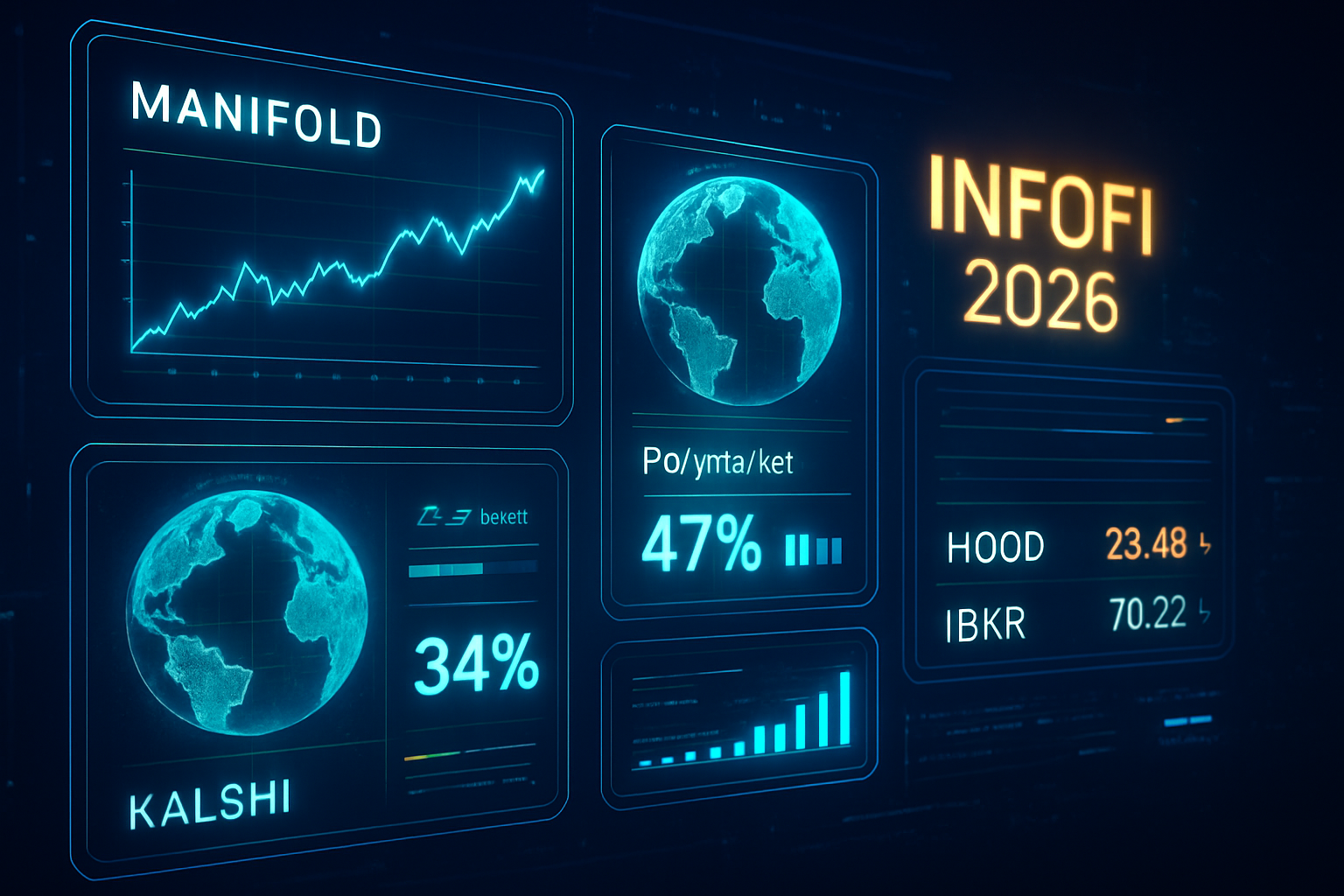
    As of January 27, 2026, the prediction market industry is no longer a fringe hobby for statistics nerds or a seasonal interest for election cycles; it has evolved into a multi-billion dollar pillar of the global financial system known as "InfoFi" (Information Finance). On Manifold Markets, the industry's self-appointed "meta-layer," traders are currently obsessed with a high-stakes question: who will win the "Great Prediction War" of 2026?

    With total industry volume reaching a staggering $13 billion per month in late 2025, meta-markets on Manifold are currently pricing a 47% probability that Polymarket will maintain its crown as the volume leader through the end of the year. However, the regulated giants are closing in. Interest in these meta-markets has skyrocketed as institutional liquidity from firms like Susquehanna International Group and Jane Street begins to treat event contracts not as "bets," but as sophisticated hedging tools for geopolitical and macroeconomic risk.

    The Market: What's Being Predicted

    The primary battleground for industry observers is the Manifold market titled "Top 1 Prediction Market by Volume in 2026." This contract tracks the total notional volume across the major players: Polymarket, Kalshi, and the rapidly ascending ForecastEx, owned by Interactive Brokers (NASDAQ: IBKR).

    As of today, the odds stand at:

    • Polymarket (47%): The crypto-native giant continues to lead, fueled by its role as the global "truth engine" for international events.
    • Kalshi (34%): Despite facilitating over $43 billion in trades in 2025, Kalshi’s odds have softened following a recent regulatory speed bump in Massachusetts regarding sports contracts.
    • ForecastEx (12%): A dark horse that recently surpassed $1 billion in cumulative notional volume, drawing in traditional finance (TradFi) users through the existing IBKR ecosystem.
    • Robinhood (7%): Following its high-profile joint venture with Susquehanna, Robinhood (NASDAQ: HOOD) has become the fastest-growing retail entrant, though its 2026 volume is still playing catch-up.

    Trading on these markets is characterized by high liquidity and a unique "insider" feel, as many participants are employees of these very platforms or professional market makers who provide the liquidity for the industry.

    Why Traders Are Betting

    The volatility in these meta-markets is being driven by three primary factors: regulatory arbitrage, the "InfoFi" narrative, and institutional product integration. Traders are currently reacting to a January 2026 preliminary injunction in Massachusetts that temporary banned "event contracts related to sports" on regulated exchanges. Since nearly 90% of Kalshi's record-breaking 2025 volume was derived from sports-adjacent markets, the "No" side of their dominance contract saw a massive 15% spike in volume this week.

    Meanwhile, the concept of Information Finance (InfoFi)—the idea that prediction markets are the most efficient way to price the probability of truth—is moving from theory to reality. Projects like Intuition, which launched its mainnet in late 2025, have convinced Manifold traders that the industry's growth is "non-linear." There is currently a 53% probability on Manifold that a major bank CEO, such as Jamie Dimon of JPMorgan Chase & Co. (NYSE: JPM), will publicly endorse prediction markets as a legitimate asset class before the end of Q3 2026.

    Finally, the entry of Coinbase (NASDAQ: COIN) into the space via its acquisition of The Clearing Company has signaled to traders that the infrastructure for a $10 trillion annual volume rate—the "bull case" for 2026—is finally being built.

    Broader Context and Implications

    This meta-forecasting trend reveals a fundamental shift in how the public views information. In 2024, prediction markets were used to "fact-check" polls; in 2026, they are being used to price the very future of the platforms themselves. This represents the ultimate "skin in the game" for an industry built on the premise that financial incentives lead to better forecasting.

    The regulatory implications are particularly significant. A dominant market on Manifold currently gives an 81% chance that federal preemption will eventually protect Designated Contract Markets (DCMs) from varying state-level bans. If this "Yes" outcome triggers, it would effectively create a unified national market for event contracts in the U.S., similar to the equity markets.

    Historically, Manifold's meta-markets have been eerily accurate. In late 2024, Manifold traders correctly predicted the exact quarter that Kalshi would achieve its first $1 billion month, months before it happened. The current betting activity suggests that 2026 will be the year where regulated (Kalshi, IBKR) and decentralized (Polymarket) volumes finally begin to converge as the legal "grey areas" evaporate.

    What to Watch Next

    The most immediate catalyst for these markets is the resolution of the "Public Integrity in Financial Prediction Markets Act" (H.R. 7004), currently making its way through Congress. If passed, it would formalize the rules around insider trading on event contracts—a move that sounds restrictive but is actually viewed as "bullish" by traders because it provides the legal framework necessary for pension funds and insurance companies to enter the market.

    Key dates to monitor include:

    • February 15, 2026: The deadline for the CFTC to respond to the Massachusetts injunction, which will likely decide Kalshi’s volume trajectory for the first half of the year.
    • Q2 2026 Earnings: Watch for Robinhood (NASDAQ: HOOD) to report its first full quarter of "Event Derivatives" revenue, which many expect will surprise to the upside.

    Traders should also keep an eye on the "Social-to-Market" pipeline. There is an active market on whether a major social media platform like X (formerly Twitter) or Reddit will integrate native prediction market widgets, a move that would likely push the "InfoFi" adoption probability toward 90%.

    Bottom Line

    The meta-markets on Manifold suggest that the prediction market industry is entering its "scaling phase." While Polymarket remains the volume king due to its global reach and crypto integration, the institutional weight behind ForecastEx and the retail power of Robinhood make the 2026 volume lead a closer race than most realize.

    The rise of InfoFi represents a paradigm shift where information is no longer just consumed—it is priced, traded, and verified through financial incentives. Whether the industry hits the predicted $10 trillion annual volume target by the end of 2026 remains to be seen, but the "smart money" on Manifold is betting that the search for truth has finally found its business model.

    In 2026, we aren't just predicting the news; we are betting on the machines that predict the news.


    This article is for informational purposes only and does not constitute financial or betting advice. Prediction market participation may be subject to legal restrictions in your jurisdiction.

    PredictStreet focuses on covering the latest developments in prediction markets.
    Visit the PredictStreet website at https://www.predictstreet.ai/.
  • The Six-Figure Ceiling: Why Prediction Markets Are Cooling on Bitcoin’s $100,000 Breakout

    The Six-Figure Ceiling: Why Prediction Markets Are Cooling on Bitcoin’s $100,000 Breakout

    As the final week of January 2026 unfolds, the euphoric "Bitcoin $100K" mantra that dominated New Year’s headlines is meeting a harsh reality check. Just two weeks ago, Bitcoin (BTC) stood on the precipice of history, peaking at a breathtaking $97,900 on January 14. Since then, the momentum has stalled, and the prediction markets—often the most sober indicators of financial outcomes—have undergone a dramatic repricing.

    Current odds on leading platforms now suggest a less than 10% chance that Bitcoin will cross the $100,000 threshold before February 1. This shift marks a significant transition in market psychology: the speculative "moon" missions of early January have given way to a disciplined focus on capital preservation. With the price currently oscillating between $86,000 and $89,000, traders are no longer betting on a last-minute miracle; they are positioning for a period of cautious consolidation.

    The Market: What's Being Predicted

    The "Bitcoin to $100k" trade has been one of the highest-volume events in the prediction market space this month. On Polymarket, the world’s largest decentralized prediction platform, the contract for "Bitcoin to hit $100,000 by Feb 1" is currently trading at just 6 cents (representing a 6% probability). This is a staggering collapse from mid-month, when the same contract was trading as high as 35 cents.

    On the regulated U.S. exchange Kalshi, sentiment is similarly bearish. Their price contracts for the $100,000 milestone are currently priced between 7% and 9%. The volume on these specific outcomes has surged, with nearly $6 million in 24-hour turnover recorded on January 26 alone. However, the majority of this volume is now dominated by "No" bettors and institutional hedgers who are liquidating their "Yes" positions to lock in whatever value remains before the February 1 resolution.

    The resolution criteria for these markets are strict: Bitcoin must touch or exceed $100,000 on major exchanges (usually an aggregate of Coinbase, Binance, and Kraken) at any point before the clock strikes midnight on February 1. With less than five days remaining and a $12,000 gap to close, the market's verdict is increasingly definitive.

    Why Traders Are Betting

    Several factors have contributed to this rapid cooling of sentiment. After the $97,900 peak on January 14, Bitcoin encountered a "wall of supply" that even the most bullish institutions couldn't overcome.

    • ETF Inflow Fatigue: Early January saw record-breaking inflows into spot ETFs, led by the iShares Bitcoin Trust from BlackRock (NYSE: BLK). On January 14, inflows hit a staggering $760 million in a single day. However, since the price rejection at $97.9k, those inflows have slowed to a trickle, suggesting that retail and institutional "FOMO" (fear of missing out) has been exhausted for the time being.
    • Macro Headwinds: Sentiment has been dampened by broader economic uncertainty. News of potential new tariffs and a "wait-and-see" approach from the Federal Reserve regarding interest rates have pushed investors toward a "risk-off" stance.
    • Whale Hedging: On-chain data indicates that while large holders (whales) are not necessarily dumping their spot positions, they are aggressively opening leveraged shorts to protect against a potential drop toward the $85,000 support level. This "hedged" behavior is being reflected in prediction markets as whales use these platforms to offset potential losses in their portfolio.

    Broader Context and Implications

    The shift from $100,000 optimism to capital preservation reflects a maturing crypto market. In previous cycles, a move toward $100,000 might have triggered a parabolic, irrational "blow-off top." In 2026, however, the presence of institutional giants like MicroStrategy (NASDAQ: MSTR) and major Wall Street funds has introduced a more calculated approach to price discovery.

    This market movement also highlights the rising utility of prediction markets as a sentiment gauge. While social media "influencers" may continue to call for $100k, the cold, hard cash on Polymarket and Kalshi provides a more accurate reflection of where the smart money is moving. The decline in odds suggests that traders are prioritizing the safety of USD-backed stablecoins and yield-generating assets over the slim chance of a 15% price spike in four days.

    Regulatory considerations also loom large. As prediction markets grow in liquidity, their ability to forecast major financial milestones is being watched closely by regulators. The accuracy of these markets in predicting the mid-month rejection at $97.9k has only bolstered their reputation as essential tools for modern price discovery.

    What to Watch Next

    As we approach the February 1 deadline, the primary focus for traders will be the $85,000 support level. If Bitcoin can hold this floor, the path to $100,000 in the spring remains wide open. Prediction markets are already pricing in an 80% chance of Bitcoin reaching six figures at some point in 2026—just not this week.

    Key dates to monitor include the upcoming month-end options expiry and the next round of institutional ETF reporting. Any surprise increase in inflows from Fidelity (NYSE: FNF) or other major issuers could provide a short-term bump, but a rally to $100,000 by February 1 would now require an unprecedented catalyst.

    Bottom Line

    The current state of the Bitcoin prediction markets serves as a sobering reminder that psychological barriers like $100,000 are rarely broken on the first attempt. The fall from 35% odds to under 10% in just two weeks illustrates how quickly sentiment can pivot from greed to preservation when a key technical level is rejected.

    For prediction market participants, the lesson is clear: follow the liquidity, not the hype. While the "six-figure" dream is far from dead, the "No" bets for February 1 have become the dominant trade of the season. As Bitcoin stabilizes in the high $80,000s, the market is effectively taking a breath, waiting for the next fundamental driver to push it over the finish line later this year.


    This article is for informational purposes only and does not constitute financial or betting advice. Prediction market participation may be subject to legal restrictions in your jurisdiction.

    PredictStreet focuses on covering the latest developments in prediction markets. Visit the PredictStreet website at https://www.predictstreet.ai/.

  • The New Wall Street: Intercontinental Exchange’s $2 Billion Bet Cements Polymarket as the Global “Truth Engine”

    The New Wall Street: Intercontinental Exchange’s $2 Billion Bet Cements Polymarket as the Global “Truth Engine”

    The landscape of global finance has been fundamentally reshaped this week as Intercontinental Exchange (NYSE: ICE), the powerhouse owner of the New York Stock Exchange, finalized a landmark $2 billion strategic investment into Polymarket. This massive capital injection, which values the decentralized prediction platform at a staggering $9 billion, marks a definitive turning point in the institutionalization of "Information Finance."

    By backing a platform once viewed as a niche corner of the crypto world, ICE is betting that the ability to price the probability of future events is not just a form of betting, but the next major asset class. In a world increasingly saturated with deepfakes and narrative-driven media, markets that force participants to "put their money where their mouth is" are emerging as the most reliable arbiters of truth.

    The Market: From Niche Crypto Site to a $9 Billion Powerhouse

    The scale of Polymarket’s ascent is unprecedented. Just two years ago, the platform was a breakout success of the 2024 election cycle; today, it is a foundational piece of the global financial infrastructure. The $2 billion investment from Intercontinental Exchange (NYSE: ICE) has allowed Polymarket to scale its liquidity to levels that rival traditional commodities markets.

    Current trading volumes on Polymarket have surged to over $5 billion monthly as of January 2026, with liquidity across thousands of markets—from Federal Reserve interest rate pivots to the outcome of corporate mergers and geopolitical conflicts. Under the terms of the deal, ICE has become the exclusive global distributor of Polymarket’s data. This means that real-time "market-implied probabilities" are now streamed directly into institutional trading terminals alongside traditional benchmarks like the S&P 500 and Brent Crude.

    The platform's resolution criteria, which rely on decentralized oracles and a growing partnership with ZK-verified (Zero-Knowledge) data sources, have become the gold standard for accuracy. This transparency was a key prerequisite for ICE’s involvement, ensuring that the platform’s "wisdom of the crowd" is resistant to manipulation and meets the stringent audit requirements of institutional investors.

    Why Traders Are Betting: The Rise of "Information Finance" (InfoFi)

    The driving force behind this valuation isn't just a passion for gambling—it is the birth of "Information Finance," or InfoFi. Popularized by Ethereum co-founder Vitalik Buterin, InfoFi posits that market mechanisms are the most efficient way to distill human judgment into actionable data. Unlike traditional finance, where information is often a byproduct of price action, Polymarket is designed specifically to elicit the truth.

    Traders are increasingly moving capital into prediction markets to hedge against "black swan" events that traditional derivatives cannot cover. For instance, supply chain managers are using Polymarket to hedge against the risk of specific regulatory changes in Southeast Asia, while institutional desks are betting on the success of clinical trials as a more accurate alternative to analyst reports.

    Recent whale activity on the platform suggests a shift in strategy. Large positions are no longer just speculative; they are often part of complex multi-leg trades where a prediction market position serves as an insurance policy for a traditional equity portfolio. As institutional players like Robinhood (NASDAQ: HOOD) and Coinbase (NASDAQ: COIN) integrate these markets directly into their retail interfaces, the liquidity gap between "betting" and "investing" continues to evaporate.

    Broader Context and Implications

    The institutional backing of Polymarket represents a total surrender by traditional polling and forecasting industries. After the 2024 and 2025 election cycles, where prediction markets consistently outperformed traditional pundits in accuracy, the "market-implied probability" has become the default metric for public sentiment.

    This shift has significant regulatory implications. In late 2025, Polymarket successfully navigated its way back into the U.S. market by acquiring QCEX, a CFTC-licensed derivatives exchange. This move, combined with the ICE partnership, has largely pacified regulatory concerns regarding market integrity and consumer protection. It has also sparked a "two-horse race" with Kalshi, which recently reached an $11 billion valuation by focusing on regulated U.S. domestic financial and sports contracts.

    Furthermore, the adoption of InfoFi is changing how corporations plan for the future. Companies are no longer relying solely on "expert" consultants; they are looking at where the money is moving on prediction platforms. If a market shows an 80% probability of a specific carbon tax passing, companies begin restructuring their operations months before the first vote is even cast in a legislature.

    What to Watch Next

    As we look toward the remainder of 2026, the next phase of this evolution will be the rise of AI-moderated "micro-markets." Both Polymarket and ICE have hinted at a new layer of the platform that will allow for the creation of millions of small-scale markets—governed by AI and settled automatically via smart contracts—to provide high-fidelity information on niche scientific and social questions.

    Key dates to monitor include the upcoming "Global InfoFi Summit" in March, where several major central banks are expected to discuss the use of prediction market data in setting monetary policy. Additionally, keep a close eye on the full integration of Polymarket data into the Robinhood (NASDAQ: HOOD) app, which is expected to bring tens of millions of new retail participants into the "truth economy."

    The most critical milestone, however, will be the first "Information-Linked Bond" issuance expected by a G20 nation later this year—a debt instrument where interest rates are tied directly to the achievement of specific social or environmental outcomes as measured by prediction market consensus.

    Bottom Line

    The $2 billion investment from Intercontinental Exchange is more than a capital raise; it is a coronation. It signals that prediction markets have graduated from the fringes of the internet to the center of the financial universe. By treating information as a tradable commodity, Polymarket has created a "Truth Engine" that the world's most powerful financial institutions now find indispensable.

    What this tells us is that in 2026, the most valuable currency is no longer just capital—it is accuracy. As prediction markets continue to mature, they will likely become the primary tool for how humanity navigates an increasingly complex and uncertain future. For investors, the message is clear: if you aren't looking at the markets to see what's coming, you aren't looking at the whole picture.


    This article is for informational purposes only and does not constitute financial or betting advice. Prediction market participation may be subject to legal restrictions in your jurisdiction.

    PredictStreet focuses on covering the latest developments in prediction markets.
    Visit the PredictStreet website at https://www.predictstreet.ai/.
  • The ‘Truth Machine’ vs. The Insider: Kalshi CEO Backs Federal Ban on Political Insider Trading

    The ‘Truth Machine’ vs. The Insider: Kalshi CEO Backs Federal Ban on Political Insider Trading

    As prediction markets move from the fringes of the internet to the center of the American financial landscape, a new battle is brewing over the integrity of the information they produce. On January 9, 2026, Representative Ritchie Torres (D-NY) introduced the Public Integrity in Financial Prediction Markets Act of 2026 (H.R. 7004), a landmark bill designed to prohibit federal officials from trading on non-public information. The legislation has found an enthusiastic, if strategic, ally in Tarek Mansour, the CEO of Kalshi, who views the bill not just as a regulatory necessity, but as a crucial step in fulfilling the industry's destiny as an "antidote" to misinformation.

    Despite the high-profile support from tech leaders and over 30 Democratic co-sponsors—including Speaker Emerita Nancy Pelosi—traders remain deeply skeptical that the bill will clear a divided Congress during a tumultuous midterm election year. On the political forecasting platform PredictIt, the market for "Will H.R. 7004 pass in 2026?" is currently trading at just 12 cents, implying a meager 12% probability of success. Nevertheless, the debate surrounding the bill has ignited a conversation about the "InfoFi" (Information Finance) sector’s ability to serve as a definitive source of unbiased truth.

    The Market: What's Being Predicted

    The primary market under the microscope is the legislative fate of H.R. 7004. While the bill itself is the subject of intense lobbying, traders are using multiple platforms to hedge their bets on the future of prediction market regulation.

    • PredictIt: The "Will H.R. 7004 pass in 2026?" contract has seen steady volume since the bill’s introduction, but prices have struggled to break above the 15-cent mark.
    • Kalshi: While Kalshi does not host a contract on the specific bill (avoiding a potential conflict of interest), it has listed a proxy market: "Will the CFTC adopt new insider trading rules by year-end?" This contract is currently trading at a 20% probability, suggesting that traders see administrative action by the Commodity Futures Trading Commission as more likely than a formal act of Congress.
    • Manifold: On the decentralized front, traders are betting on "Federal Preemption," with an 81% probability that federal law will eventually override state-level bans. This suggests that while H.R. 7004 might fail, some form of federal legitimization is viewed as an inevitability.

    The resolution criteria for these markets typically require the bill to be signed into law by the President or for the CFTC to finalize a rule in the Federal Register by December 31, 2026.

    Why Traders Are Betting

    The sudden urgency for H.R. 7004 was triggered by what has become known in trading circles as the "Maduro Trade." In early January 2026, an anonymous account on the decentralized platform Polymarket placed a $32,000 bet that Venezuelan President Nicolás Maduro would be ousted. Hours later, a U.S.-led special forces operation resulted in his capture. The trader netted over $400,000, sparking a firestorm of allegations that the bet was placed with material non-public information.

    "This was the smoking gun," says one high-volume trader on PredictIt. "If someone can bet on a military raid before the public knows about it, the market isn't a forecast—it's a leak. That’s what is driving the 12% odds. People want the ban, but they don't think Congress can move fast enough to stop the 'leakers' who might be sitting in the very rooms where these decisions are made."

    Public companies are also entering the fray. Interactive Brokers (NASDAQ: IBKR), through its affiliate exchange ForecastEx, has emerged as a vocal proponent of the legislation. By establishing federal guardrails, IBKR aims to transition prediction markets from "casinos" to "Truth Machines" that institutional investors can trust. Similarly, Robinhood (NASDAQ: HOOD) has voiced support for the bill as it expands its own "Prediction Markets Hub," seeking a stable regulatory environment to compete with offshore giants.

    Broader Context and Implications

    Tarek Mansour’s support for the bill is central to his vision for Kalshi. He has repeatedly described prediction markets as the ultimate "antidote to misinformation." In his view, the "skin in the game" required to trade forces a level of honesty that traditional polling and media narratives cannot replicate. By supporting a ban on political insider trading, Mansour is attempting to shield the "purity" of the data.

    "Kalshi is supportive of the bill Ritchie Torres is looking to introduce… because we already implement it," Mansour stated in a recent public address. He argues that for prediction markets to serve as a source of unbiased truth, they must be free from the distortion of "governing for profit."

    This push for regulation marks a significant divide in the industry. While regulated U.S. exchanges like Kalshi and ForecastEx seek to align with federal law, decentralized platforms have historically operated in a gray area. However, even the broader crypto ecosystem is leaning toward cooperation. Coinbase (NASDAQ: COIN) is currently lobbying for the Digital Asset Market CLARITY Act, which shares many of the same goals as H.R. 7004: providing a clear federal framework that would legitimize the sector. Even Intercontinental Exchange (NYSE: ICE), the parent company of the New York Stock Exchange, is watching closely after making a significant investment in the sector late last year.

    What to Watch Next

    The next major milestone for H.R. 7004 will be its first hearing in the House Financial Services Committee, expected in late February. Traders will be looking for signs of bipartisan support; if the bill picks up Republican co-sponsors, the PredictIt odds could see a significant "step up" toward the 30-40 cent range.

    Additionally, keep a close eye on the CFTC’s upcoming open meetings. If the Commission moves to preemptively issue a "Notice of Proposed Rulemaking" regarding event contracts and insider trading, it could effectively render H.R. 7004 redundant, causing those legislative markets to collapse while the "CFTC Rules" proxy markets on Kalshi spike.

    Finally, the behavior of "whales"—large-volume traders—on platforms like Polymarket will continue to serve as a catalyst. Any further "suspicious" windfalls tied to government action will likely increase the political pressure on Congress to act, potentially turning H.R. 7004 from a 12% long shot into a front-burner priority.

    Bottom Line

    The battle over H.R. 7004 represents a maturation point for the prediction market industry. Whether the bill passes or not, the "Truth Machine" narrative championed by Tarek Mansour is winning the cultural war. The market’s 12% probability of passage isn't a reflection of the bill's popularity, but rather a cynical (and often accurate) assessment of Congressional gridlock.

    Ultimately, the support from CEOs like Mansour and major financial players like Interactive Brokers (NASDAQ: IBKR) suggests that the era of the "unregulated wild west" in prediction markets is drawing to a close. If these platforms are to fulfill their promise as an antidote to misinformation, they must first prove they can keep the insiders out of the game.


    This article is for informational purposes only and does not constitute financial or betting advice. Prediction market participation may be subject to legal restrictions in your jurisdiction.

    PredictStreet focuses on covering the latest developments in prediction markets. Visit the PredictStreet website at https://www.predictstreet.ai/.

  • The Great Prediction War of 2026: Polymarket and Kalshi Battle for Dominance

    The Great Prediction War of 2026: Polymarket and Kalshi Battle for Dominance

    As of January 26, 2026, the landscape of global finance is being reshaped not by interest rate swaps or traditional equities, but by the "Great Prediction War." On the popular meta-forecasting platform Manifold Markets, a high-stakes contract titled "Top 1 Prediction Market by Volume in 2026" has become the industry's most-watched barometer. Currently, Polymarket holds a 47% chance of leading the year in trading volume, while its chief rival, Kalshi, sits at 34%.

    This market is generating unprecedented interest because it represents more than a corporate rivalry; it is a battle for the soul of "Information Finance." In the last few weeks, the odds have fluctuated wildly following a series of regulatory rulings and massive institutional investments. While Kalshi dominated 2025 in raw notional volume, a recent crackdown on sports-related contracts has shifted momentum toward Polymarket, which is currently preparing for a landmark return to the United States market.

    The Market: What's Being Predicted

    The Manifold Markets meta-contract focuses on which platform will facilitate the highest total trading volume (measured in USD equivalent) for the 2026 calendar year. For resolution purposes, the contract strictly excludes "pure sports betting" to distinguish prediction markets from traditional gambling operations. This distinction is critical: in 2025, Kalshi cleared a staggering $43.1 billion in notional volume, but nearly 90% of that was derived from sports event contracts. Polymarket, meanwhile, recorded $33.4 billion, almost entirely through geopolitical, macroeconomic, and cultural markets.

    Currently, the odds reflect a "mindshare" premium for Polymarket at 47%. Traders are betting that as the 2026 U.S. midterm elections approach, the demand for non-sports "truth pricing" will outpace the retail sports volume that Kalshi has historically relied upon. Liquidity in this meta-market has surged, with over $5 million in play on Manifold alone, as whales from both the crypto and traditional finance sectors hedge their bets on the future of the industry.

    Why Traders Are Betting

    The 13-point lead held by Polymarket is largely driven by its recent institutional pivot. In October 2025, the platform secured a $2 billion strategic investment from the Intercontinental Exchange (NYSE: ICE), the parent company of the New York Stock Exchange. This partnership signaled that prediction markets are no longer "fringe" crypto projects but are being integrated into the plumbing of global markets.

    Conversely, Kalshi—which is heavily integrated with Robinhood Markets, Inc. (NASDAQ: HOOD)—has hit a regulatory speed bump. On January 20, 2026, a Massachusetts judge issued a preliminary injunction requiring Kalshi to cease offering sports-related contracts in the state. This legal friction has caused a 10% drop in Kalshi's 2026 volume odds, as traders fear more states may follow suit, strangling the platform’s primary volume driver.

    Furthermore, the "Maduro Trade" in early January—where a whistleblower allegedly profited $400,000 on a contract regarding the capture of Nicolás Maduro just hours before the news broke—has reinforced Polymarket's reputation as a "truth engine" that can price in information faster than any traditional news wire or intelligence agency.

    Broader Context and Implications

    The "Great Prediction War" coincides with the rise of "Information as an Asset Class." In 2026, information is no longer just something you consume; it is something you trade. Major market makers like Susquehanna International Group and DRW have officially entered the space, treating event contracts as legitimate financial derivatives used to hedge against "black swan" events.

    This shift has moved prediction markets away from the "speculative casino" label that plagued them in 2024. Today, corporations use these markets to hedge against specific geopolitical risks, such as semiconductor trade deals or the "Greenland Acquisition" negotiations. The historical accuracy of these markets during the 2024 election cycle has given them a "gold standard" status, often leading mainstream media polls by 48 to 72 hours in identifying shifts in public sentiment.

    What to Watch Next

    The next major catalyst for this market is Polymarket's anticipated re-entry into the U.S. market. Currently, there is a 90% priced-in probability that the CFTC will grant Polymarket full operational status in the U.S. by Q2 2026. If this occurs, a massive influx of domestic liquidity could solidify Polymarket’s lead over Kalshi.

    Investors should also keep a close eye on the 2026 midterm election cycles. If the volume for political "control of the house" markets exceeds the volume for the 2026 World Cup, Polymarket is almost certain to win the volume war. However, if Kalshi can successfully pivot its Robinhood user base toward macroeconomic contracts—such as CPI or Fed rate hike predictions—the 34% underdog could see a rapid resurgence.

    Bottom Line

    The battle between Polymarket and Kalshi is the defining economic conflict of 2026. While Kalshi has the advantage of existing U.S. infrastructure and a massive retail partnership with Robinhood, Polymarket’s backing by the NYSE’s parent company and its dominance in "truth-based" geopolitical markets give it the current edge.

    Ultimately, the "Great Prediction War" tells us that the world has entered the era of Information Finance. Whether the winner is the platform that masters sports and retail or the one that dominates geopolitical intelligence, the real victor is the market itself. Prediction markets are no longer just tools for bettors; they are the most accurate sensors we have for a volatile, fast-moving world.


    This article is for informational purposes only and does not constitute financial or betting advice. Prediction market participation may be subject to legal restrictions in your jurisdiction.

    PredictStreet focuses on covering the latest developments in prediction markets.
    Visit the PredictStreet website at https://www.predictstreet.ai/.

  • The Great Prediction War of 2026: Polymarket and Kalshi Battle for Dominance as “Information Finance” Goes Mainstream

    The Great Prediction War of 2026: Polymarket and Kalshi Battle for Dominance as “Information Finance” Goes Mainstream

    As the first month of 2026 draws to a close, the prediction market industry is no longer a niche corner of the internet; it has evolved into a foundational pillar of global finance. On Manifold Markets, a high-stakes meta-contract titled "Top 1 Prediction Market by Volume in 2026" has become the definitive barometer for the sector’s future. Currently, traders are pricing in a two-horse race that reflects a massive shift in how the world consumes information and hedges against uncertainty.

    As of January 23, 2026, Polymarket holds a slight lead with approximately 47% odds of finishing the year as the volume leader, while Kalshi follows closely at 34%. The "Other" category—comprising newcomers like Robinhood Markets Inc. (NASDAQ:HOOD) and established institutional players—is capturing a significant 20% of the market share. This intense competition follows a record-breaking 2025 that saw the industry transition from "speculative casinos" to what experts now call "Information as an Asset Class."

    The Market: What’s Being Predicted

    The Manifold Markets contract is a multi-choice prediction asking which platform will record the highest total trading volume (USD equivalent) during the calendar year 2026. The resolution criteria are strict: the total must include all event contracts but specifically excludes "pure sports betting" platforms to distinguish prediction markets from traditional gambling. This distinction has become a major point of contention among traders, as Kalshi currently leads in raw notional volume—clearing over $43 billion—but derives roughly 90% of that from sports-related event contracts.

    Polymarket, by contrast, remains the "mindshare leader" for global events. Following a landmark $2 billion investment from Intercontinental Exchange (NYSE:ICE), the parent company of the New York Stock Exchange, Polymarket has seen its cumulative volume soar to $33.4 billion. While Kalshi has the raw numbers, Manifold traders are betting that Polymarket's dominance in geopolitical and macroeconomic markets will carry the day when "pure sports" are stripped from the final tally. Other notable contenders included in the contract are Interactive Brokers Group (NASDAQ:IBKR) via its ForecastX platform and PredictIt, though they currently trail the two giants.

    Why Traders Are Betting

    The current market sentiment is being driven by a "Supercycle" of events and massive institutional backing. The late 2025 investment by Intercontinental Exchange (NYSE:ICE) acted as a "institutional seal of approval," providing Polymarket with a liquidity backstop that has finally won the trust of traditional finance (TradFi) firms. Traders on Manifold, such as high-profile "whales" like pixel and Ziddletwix, have been aggressively moving the market based on these infrastructure developments.

    Recent volatility in the contract was sparked by the "January 2nd Shockwave," where a series of massive institutional-sized trades caused the odds of smaller platforms like Manifold itself to crash, while bolstering the "Big Two." Traders are also looking at the upcoming 2026 U.S. Midterm Elections as the primary volume driver. Historical data shows that political cycles are the lifeblood of prediction market growth; with the Midterms approaching, the community expects Polymarket’s global reach and decentralized nature to capture the lion's share of high-intent political volume.

    Furthermore, the recent acquisition of a 90% stake in MIAXdx by Robinhood (NASDAQ:HOOD) has introduced a "wildcard" element. Traders are watching to see if Robinhood’s massive retail user base can pivot from stock trading to event contracts quickly enough to challenge the incumbents before the year’s end.

    Broader Context and Implications

    The "Top Prediction Market of 2026" contract is more than a simple leaderboard; it represents the maturation of the entire sector. In early January 2026, Alphabet Inc. (NASDAQ:GOOGL) officially updated its advertising policies to allow prediction market promotions, and rumors are swirling that Meta Platforms Inc. (NASDAQ:META) is testing prediction widgets for its news feeds. This mainstreaming has shifted the regulatory conversation.

    While the Commodity Futures Trading Commission (CFTC) has adopted a more "forward-looking" approach under recent leadership, a new "regulatory design problem" has emerged. State gaming authorities in Nevada and Connecticut have begun issuing cease-and-desist orders against platforms like Kalshi, arguing that sports-event contracts overlap too heavily with unlicensed gambling. This legal friction is a key reason why many Manifold traders are cautious about Kalshi's chances; a significant legal setback in a major state could throttle their volume overnight.

    What to Watch Next

    The next few months will be critical for determining the winner of the 2026 volume crown. Market participants should keep a close eye on the Democratic and Republican primary season for the Midterms. If Polymarket maintains its lead in political "liquidity depth" during these early contests, its odds on Manifold are likely to climb above the 50% mark.

    Key dates to monitor include the March 2026 FOMC meeting, where prediction markets are now used as the primary data feed for algorithmic trading bots, and any potential announcements from X regarding the integration of live prediction data. Additionally, the resolution of the state-level legal challenges against Kalshi will be a massive "binary event" for the platform's 2026 volume outlook.

    Bottom Line

    The battle for the top spot in 2026 is a testament to the resilience and utility of prediction markets. No longer a hobby for "degens," these platforms are now essential tools for institutional hedging and real-time sentiment analysis. The Manifold contract suggests that while Kalshi has the technological throughput, Polymarket possesses the global brand and "event purity" that traders value most.

    As we move deeper into 2026, the real winner may not just be one platform, but the concept of Information Finance itself. Whether it is a crypto-native giant backed by the NYSE (ICE) or a retail powerhouse like Robinhood (NASDAQ:HOOD), the fact that billions of dollars are now being wagered on the accuracy of world events suggests that the era of "guesswork" in news and finance is rapidly coming to an end.


    This article is for informational purposes only and does not constitute financial or betting advice. Prediction market participation may be subject to legal restrictions in your jurisdiction.

    PredictStreet focuses on covering the latest developments in prediction markets.
    Visit the PredictStreet website at https://www.predictstreet.ai/.
  • The $700 Million Tipping Point: Prediction Markets Hit Record Volume as ‘Information Finance’ Goes Mainstream

    The $700 Million Tipping Point: Prediction Markets Hit Record Volume as ‘Information Finance’ Goes Mainstream

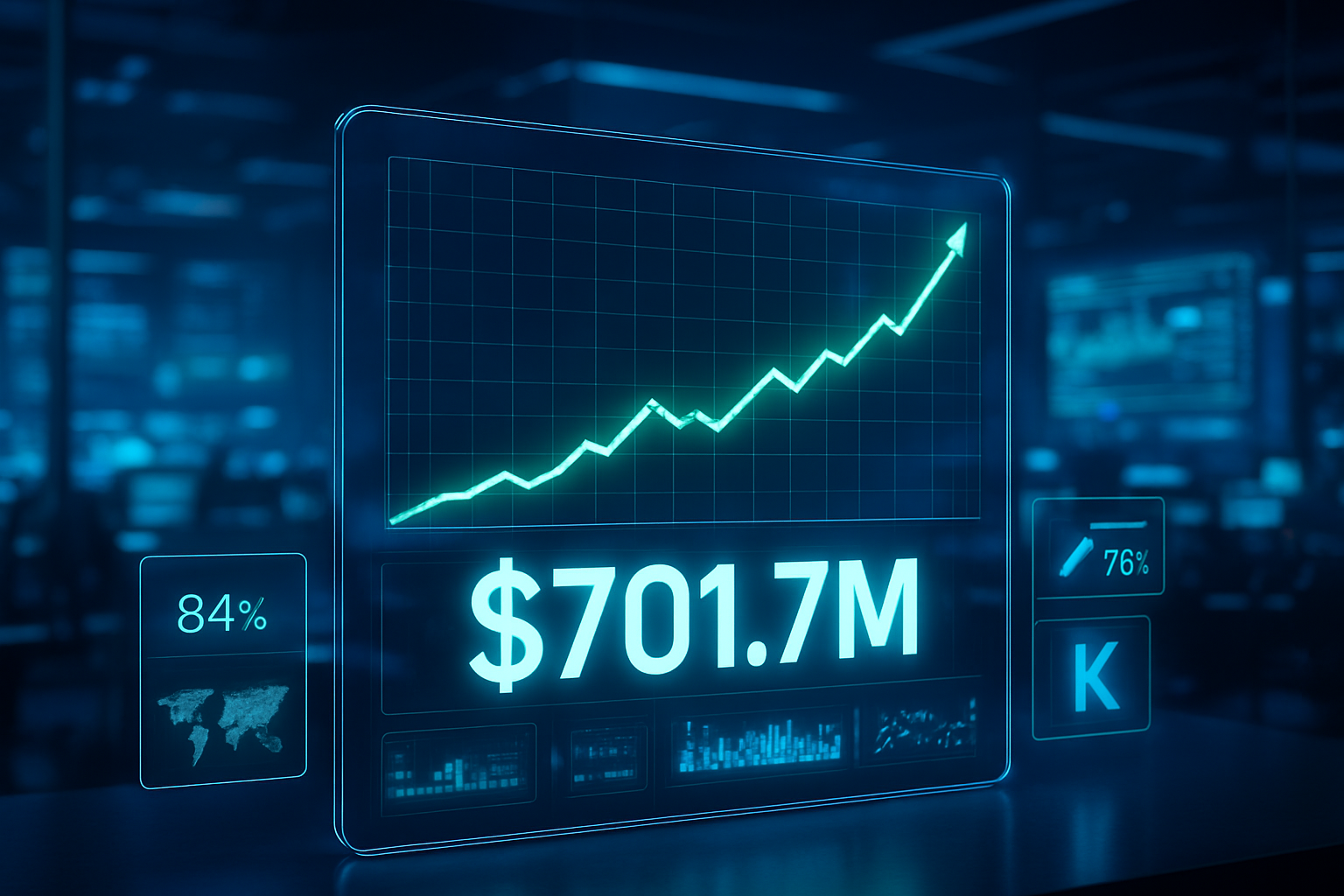
    On January 12, 2026, the global financial landscape reached a watershed moment that many analysts are calling the "death of the pundit and the birth of the market." Total daily trading volume across prediction platforms skyrocketed to a record-breaking $701.7 million, shattering the previous day's record and signaling a fundamental shift in how the world processes breaking news. As traditional news cycles struggled to keep pace with a rapidly unfolding geopolitical crisis and a domestic constitutional standoff, traders turned to event-based contracts to find the "price of truth."

    The surge was led by Kalshi, the U.S.-regulated powerhouse, which commanded a staggering 66.4% of the market share, processing over $465 million in trades within a single 24-hour window. This explosion in volume isn't just a flash in the pan; it represents the culmination of a year-long growth trajectory that began in 2025. With probabilities now shifting in real-time on everything from Federal Reserve policy to international conflicts, prediction markets have officially transitioned from niche speculative hobbies to the primary "truth engines" for the modern global economy.

    The Market: What’s Being Predicted

    The record-shattering volume on January 12 was primarily driven by a "perfect storm" of high-stakes contracts. At the center of the frenzy was the "March Fed Rate Cut" market. Following a series of contradictory economic signals, including a December jobs report that showed a mere 50,000 positions added, the market for a 25-basis-point cut in March saw massive inflows. Liquidity on Kalshi and the decentralized platform Polymarket reached levels comparable to mid-cap equity markets, with the probability of a cut swinging wildly between 60% and 74% as traders parsed live data.

    Beyond macroeconomics, the market proved its mettle in the face of geopolitical chaos. The sudden reported capture of Venezuelan President Nicolás Maduro by U.S. forces sent "flash markets" into overdrive. While mainstream news outlets were still waiting for official government confirmation, prediction markets were already repricing global energy costs and regional stability. Within minutes, over $120 million was wagered on the outcome of the incident and its immediate aftermath, providing a real-time sentiment gauge that preceded traditional reporting by nearly an hour.

    The infrastructure facilitating these bets has matured significantly. Robinhood (NASDAQ: HOOD) played a pivotal role as the primary retail gateway, utilizing Kalshi’s back-end to allow millions of users to trade event contracts directly alongside their stock portfolios. Meanwhile, Interactive Brokers (NASDAQ: IBKR), through its ForecastEx affiliate, catered to institutional hedgers who used these markets to offset risks associated with the burgeoning "Fed Independence" constitutional crisis. This combination of retail accessibility and institutional depth has created a liquidity flywheel that was unthinkable just two years ago.

    Why Traders Are Betting

    The primary driver of the current betting frenzy is the unprecedented level of regulatory and institutional clarity. In 2025, a landmark legal victory for Kalshi in the Ninth Circuit Court of Appeals paved the way for the permanent legalization of election and event betting in the United States. This "regulatory green light" encouraged major Wall Street players to enter the fray. Intercontinental Exchange (NYSE: ICE) signaled the industry's total acceptance with a landmark $2 billion investment into Polymarket, treating event-based contracts as a legitimate and essential asset class.

    Traders are also being drawn by the sheer speed of information discovery. In a world of deepfakes and fragmented media, the "skin in the game" requirement of prediction markets acts as a powerful filter for noise. On January 12, as rumors of a standoff between the U.S. Department of Justice and Federal Reserve Chair Jerome Powell circulated, the markets provided a clear-eyed assessment of the situation’s gravity. While social media was rife with speculation, the "Fed Chair Ouster" contract on Kalshi remained remarkably stable, correctly signaling to traders that the crisis, while serious, was unlikely to lead to an immediate resignation.

    This shift has also been bolstered by the emergence of "Superforecasters" and professional arbitrageurs. Firms like Goldman Sachs (NASDAQ: GS) have reportedly begun exploring the integration of prediction market data into their broader derivative and risk-management desks. By treating these markets as a superior alternative to traditional polling or expert intuition, traders are finding that they can hedge against "black swan" events with much higher precision than was previously possible.

    Broader Context and Implications

    The record-breaking volume on January 12 marks the official arrival of "Information Finance," or InfoFi—a concept popularized by Ethereum co-founder Vitalik Buterin. InfoFi posits that market mechanisms are the most efficient way to distill human judgment and aggregate unbiased information. We are no longer just betting on outcomes; we are participating in a decentralized system that assigns a financial value to the accuracy of information. This has profound implications for how public sentiment is measured and how policy is made.

    Historically, prediction markets have demonstrated a remarkable ability to outperform traditional polling, particularly during the 2024 and 2025 election cycles. This accuracy has turned them into a vital tool for corporate planning. When a company can see a 70% market-priced probability of a specific regulatory change, they can adjust their strategy months in advance. The fact that major news tickers like CNBC and CNN now display live prediction market probabilities alongside the S&P 500 is a testament to this newfound cultural and financial authority.

    However, the rise of InfoFi also brings new challenges. Regulatory scrutiny remains intense, especially regarding the potential for "manipulation via information"—where a trader might attempt to influence a real-world event to profit from a contract. Platforms like Kalshi have invested heavily in surveillance technology to combat this, but as volumes hit the billion-dollar-a-day mark, the stakes for maintaining market integrity have never been higher.

    What to Watch Next

    As we look toward the remainder of 2026, the focus will shift to the upcoming midterm elections and the resolution of the "Fed Independence" debate. These events are expected to provide the next major liquidity tests for the industry. If daily volumes continue their current trajectory, $1 billion days could become the standard by the end of the year. Investors should keep a close eye on the integration of prediction markets into broader fintech apps, as further partnerships between platforms like Robinhood and event exchanges could bring tens of millions of new participants into the ecosystem.

    Another key milestone will be the potential launch of "Corporate Intelligence" markets, where companies might offer internal prediction markets to employees to forecast project deadlines or sales targets. This internal use of InfoFi could provide a secondary growth engine for the industry. Additionally, the role of Dr. Philip Tetlock, recently appointed to the board of Interactive Brokers' ForecastEx, will be crucial in bridging the gap between academic "superforecasting" and high-frequency event trading.

    Bottom Line

    The $701.7 million day on January 12 was not just a record; it was a proof of concept. It proved that prediction markets can handle massive volume, provide high-velocity information in times of crisis, and attract a diverse range of participants from retail traders to institutional hedgers. Kalshi’s 66.4% market share demonstrates the power of a regulated, user-friendly interface in a maturing market, while the broader InfoFi movement suggests that our relationship with information is changing forever.

    Prediction markets are no longer the "fringe" of finance; they are the new tape. They provide a transparent, objective, and financially-backed look at the future, offering a clarity that traditional media often lacks. As we move deeper into 2026, the question is no longer whether prediction markets are accurate, but how quickly the rest of the financial world will adapt to the reality they present.


    This article is for informational purposes only and does not constitute financial or betting advice. Prediction market participation may be subject to legal restrictions in your jurisdiction.

    PredictStreet focuses on covering the latest developments in prediction markets.
    Visit the PredictStreet website at https://www.predictstreet.ai/.
  • Prediction Powerhouse: Kalshi Hits $11 Billion Valuation as Sports Surge Drives $1 Billion Weekly Volume

    Prediction Powerhouse: Kalshi Hits $11 Billion Valuation as Sports Surge Drives $1 Billion Weekly Volume

    The rapid evolution of prediction markets has reached a fever pitch as Kalshi, the first federally regulated exchange for event contracts, officially reached "decacorn" status this month. With a fresh $11 billion valuation and weekly trading volumes consistently surpassing the $1 billion mark, the platform has transformed from a niche economic forecasting tool into a dominant force in the global wagering landscape. However, this meteoric rise has placed Kalshi directly in the crosshairs of state regulators, sparking a legal battle that could redefine the boundaries between financial commodities and sports gambling.

    The surge in activity marks a significant shift in the prediction market ecosystem. While the 2024 U.S. elections served as the initial catalyst for mainstream adoption, Kalshi’s sustained growth into early 2026 is being driven by a strategic pivot into sports event contracts. Traders are no longer just betting on interest rate hikes or election outcomes; they are high-frequency trading the point spreads of NFL games and the over/under of NBA totals, all through a platform regulated by the Commodity Futures Trading Commission (CFTC).

    The Market: Kalshi’s Explosive Growth and Dominance

    In December 2025, Kalshi solidified its position as a market leader by closing a massive $1.1 billion Series E funding round. This capital injection, led by the crypto-focused venture firm Paradigm and supported by heavyweights like Sequoia Capital and Alphabet Inc. (NASDAQ: GOOGL) via its growth fund CapitalG, valued the exchange at a staggering $11 billion. Other participants included Andreessen Horowitz, ARK Invest (NYSE Arca: ARKK), and IVP, signaling broad institutional confidence in the "everything market" model.

    The valuation is backed by eye-popping performance metrics. By the final week of December 2025, Kalshi reported a record-breaking $1.7 billion in notional trading volume. Daily volumes have also seen a dramatic uptick, with the platform recording approximately $291 million on January 1, 2026, alone. This represents an 1,100% year-over-year increase, largely fueled by the platform's expansion into sports. Unlike traditional sportsbooks, Kalshi’s contracts are structured as binary options, allowing for unique hedging strategies and price discovery that mimic traditional financial markets.

    Why Traders Are Betting: The Retail Revolution

    The primary driver behind Kalshi’s volume explosion is its aggressive integration with retail trading platforms and media giants. Kalshi has successfully moved beyond its own app by embedding its markets into the interfaces of Robinhood Markets, Inc. (NASDAQ: HOOD) and Coinbase Global, Inc. (NASDAQ: COIN). This "brokerage-as-a-service" model allows millions of retail investors to trade event contracts alongside their stocks and cryptocurrencies, lowering the barrier to entry for a new generation of traders.

    Furthermore, Kalshi has effectively institutionalized prediction market data through exclusive partnerships with major news networks. Starting in January 2026, live market odds from Kalshi have become a staple on Warner Bros. Discovery (NASDAQ: WBD)'s CNN and Comcast Corporation (NASDAQ: CMCSA)'s CNBC. These integrations provide real-time, market-based sentiment on everything from corporate earnings to playoff outcomes, creating a self-reinforcing loop of visibility and trading activity. For many traders, the transparency of an order-book-based exchange offers a more "fair" alternative to the opaque "vig" of traditional sportsbooks.

    Broader Context and Implications: The 38-State Legal Firestorm

    Despite its commercial success, Kalshi is facing an existential legal challenge. A coalition of 38 states and the District of Columbia recently filed a joint amicus brief in the ongoing case of Maryland vs. Kalshi. The states argue that Kalshi’s sports contracts are "functionally indistinguishable" from sports wagering and should therefore fall under state-level gambling regulations rather than federal CFTC oversight. This coalition, which includes major markets like California and New York, contends that Kalshi is bypassing state taxes and consumer protection laws.

    The tension reached a breaking point on January 20, 2026, when a Massachusetts judge granted a preliminary injunction against the exchange. The ruling effectively bans Kalshi from offering sports event contracts in the state starting January 23, 2026. This is the first major state-level ban to take effect, creating a fragmented legal landscape where Kalshi may be legal in New Jersey (where it recently won a stay against a cease-and-desist) but prohibited in neighboring states. The outcome of these battles will determine if prediction markets can coexist with the traditional gaming industry or if they will be relegated back to strictly economic and political events.

    What to Watch Next

    The coming months will be pivotal for Kalshi's $11 billion valuation. Investors and traders are closely watching the Maryland vs. Kalshi case, as a final ruling there could set a precedent for other states in the 38-member coalition. If Maryland successfully argues that state gaming laws supersede CFTC regulation for sports contracts, Kalshi could face a wave of "geofencing" requirements, significantly impacting its liquidity and volume.

    Another key milestone is the potential for further integration with daily fantasy sports (DFS) platforms. Kalshi’s existing partnership with PrizePicks has already expanded its reach, and rumors of a deeper tie-up with other major DFS operators could further bolster volumes. However, these moves will likely attract even more scrutiny from powerful tribal gaming groups and established casino operators who view Kalshi’s growth as a direct threat to their regulated monopolies.

    Bottom Line

    Kalshi has successfully proven that there is a massive appetite for a "market for everything," bridging the gap between Wall Street and Main Street through the gamification of real-world outcomes. Reaching an $11 billion valuation and $1 billion in weekly volume is a testament to the platform's technical scale and the public's desire for transparent, high-liquidity prediction markets.

    However, the "State vs. Federal" jurisdictional battle looms large. While Kalshi has the backing of Silicon Valley and the federal oversight of the CFTC, the combined weight of 38 state attorneys general and the established gaming lobby presents a formidable obstacle. For now, Kalshi remains the undisputed king of prediction markets, but its path to long-term stability depends on whether it can convince the legal system that its contracts are tools for risk management, not just another way to bet on the big game.


    This article is for informational purposes only and does not constitute financial or betting advice. Prediction market participation may be subject to legal restrictions in your jurisdiction.

    PredictStreet focuses on covering the latest developments in prediction markets.
    Visit the PredictStreet website at https://www.predictstreet.ai/.

  • The Rhetoric Jackpot: Inside the Multi-Billion Dollar Culture of Betting on the Trump Dialect

    The Rhetoric Jackpot: Inside the Multi-Billion Dollar Culture of Betting on the Trump Dialect

    WASHINGTON, D.C. — January 20, 2026 — Exactly one year after Donald Trump was sworn in as the 47th President of the United States, a new kind of ticker tape is dominating the financial landscape. It isn't tracking the S&P 500 or the price of gold, but rather the specific syllables spoken by the Commander-in-Chief. As President Trump arrives in Davos, Switzerland, today for the World Economic Forum, thousands of traders are glued to their screens, wagering millions on whether he will utter his signature catchphrase: "drill, baby, drill."

    On leading prediction platforms like Polymarket and Kalshi, these "rhetoric markets" have evolved from niche political curiosities into high-volume financial instruments. As of this morning, the probability of Trump saying "drill, baby, drill" during his Davos address tomorrow stands at a steady 54%, while more aggressive bets on his first-year anniversary comments have seen nearly $1.5 billion in weekly volume. What started as a "prop bet" culture has transformed into a sophisticated ecosystem where linguistic patterns are traded with the same intensity as tech stocks.

    The Market: What’s Being Predicted

    The mechanics of betting on presidential speech have become remarkably granular. While traditional markets focus on policy outcomes—such as the likelihood of a Fed Chair appointment—the "mention markets" track the specific vocabulary used in public addresses, tweets (now officially integrated into Truth Social and X), and press conferences. These contracts are typically structured as binary "Yes/No" outcomes: “Will Trump say ‘Drill Baby Drill’ by Jan 31?”

    Currently, the epicenter of this activity is Kalshi, which has seen its total volume skyrocket to over $23.8 billion in 2025 following a landmark regulatory year. For the upcoming 2026 State of the Union, the "Drill Baby Drill" contract is one of the most liquid on the platform, attracting professional market makers and retail "vibe traders" alike. These markets are joined by other high-stakes linguistic wagers, including the odds of Trump mentioning "Bitcoin" (currently 53%) or using the term "Trump Derangement Syndrome" (trading at 47%).

    The resolution criteria for these bets are handled with judicial precision. Platforms employ dedicated verification teams to scan official White House transcripts and high-fidelity audio recordings. On Polymarket, which recently normalized its U.S. operations through a partnership with a CFTC-licensed exchange, these contracts often resolve within minutes of a speech's conclusion, triggering massive liquidity flows.

    Why Traders Are Betting

    The surge in rhetoric betting is driven by the unique predictability of Donald Trump’s linguistic "greatest hits." Unlike traditional politicians whose speeches are vetted by committees of speechwriters for nuance, Trump’s reliance on branding and repetition—what some analysts call "The Billboard Effect"—makes him the perfect subject for event contracts.

    "It’s about sentiment analysis and pattern recognition," says Logan Sudeith, a professional trader who has reportedly earned six figures annually by tracking the President's frequency of specific adjectives. Traders are not just guessing; they are using sophisticated AI tools, often powered by Alphabet Inc. (NASDAQ: GOOGL) and other tech giants, to analyze the President's recent Truth Social posts as leading indicators for his verbal speeches. If "drill" appears in a 3:00 AM post, the "Yes" contracts on Kalshi usually see a 10-15% bump by dawn.

    There is also a significant "whale" presence in these markets. Famous accounts like "Freddy9999," who netted an estimated $50 million during the 2024 election cycle, continue to move the needle. These large-scale positions often act as a hedge; energy sector investors may buy "Yes" contracts on "drill, baby, drill" to offset potential volatility in oil prices, using the President's rhetoric as a proxy for upcoming deregulation.

    Broader Context and Implications

    The institutionalization of these markets marks a paradigm shift in how the public consumes political news. Major media outlets like CNBC, owned by Comcast Corp. (NASDAQ: CMCSA), and CNN now incorporate prediction market odds directly into their chyrons, viewing the "wisdom of the crowd" as a more accurate "truth signal" than traditional polling or punditry.

    The entry of retail powerhouses like Robinhood Markets, Inc. (NASDAQ: HOOD) and Interactive Brokers Group, Inc. (NASDAQ: IBKR) into the event-contract space has further democratized this "culture of the bet." Even the Intercontinental Exchange, Inc. (NYSE: ICE), the parent company of the New York Stock Exchange, has moved into the infrastructure of these markets, reflecting a belief that event-based hedging is the next frontier of finance.

    However, this trend raises significant questions about the "gamification" of governance. Critics argue that when millions of dollars are riding on a single phrase, it creates an incentive for the President to intentionally move markets—or for staff to leak speech drafts to favored traders. Despite these concerns, the CFTC has largely pivoted toward a "regulated expansion" model, acknowledging that these markets provide valuable data on public expectations.

    What to Watch Next

    The immediate focus is the President's Davos address on Wednesday, January 21, 2026. While "drill, baby, drill" is the legacy bet, "Greenland" has become the dark horse of the week. Following reports of renewed interest in the island’s natural resources, "mention markets" for the word "Greenland" have climbed to near 100% certainty for the Davos trip.

    Beyond the vocabulary, the market is awaiting the nomination of the next Federal Reserve Chair. Currently, Kevin Warsh leads the prediction pools with a 61% probability, and traders are listening for specific keywords—like "sound money" or "interest rate cuts"—that might signal his official appointment during tomorrow's speech.

    Investors should also monitor the growing influence of AI trading agents. By early 2026, an estimated 40% of the volume in rhetoric markets is driven by bots that execute trades faster than human speech can be processed by the ear. This "high-frequency linguistics" is expected to create extreme volatility in the seconds after the President approaches a microphone.

    Bottom Line

    The culture of betting on "drill, baby, drill" is more than just a political gimmick; it is the birth of a new asset class. By turning presidential rhetoric into a tradable commodity, prediction markets have provided a real-time, financially-backed sentiment gauge that traditional media can no longer ignore.

    As we cross the one-year mark of the 47th presidency, the lesson for investors is clear: in the modern era, a politician's words are no longer just "talk"—they are a price point. Whether this leads to a more informed electorate or simply a more volatile one remains to be seen, but for now, the markets are waiting with bated breath for the next "drill."


    This article is for informational purposes only and does not constitute financial or betting advice. Prediction market participation may be subject to legal restrictions in your jurisdiction.

    PredictStreet focuses on covering the latest developments in prediction markets. Visit the PredictStreet website at https://www.predictstreet.ai/.