Tag: Finance

  • The $45 Billion Truth Engine: How Prediction Markets Became Wall Street’s New Standard

    The $45 Billion Truth Engine: How Prediction Markets Became Wall Street’s New Standard

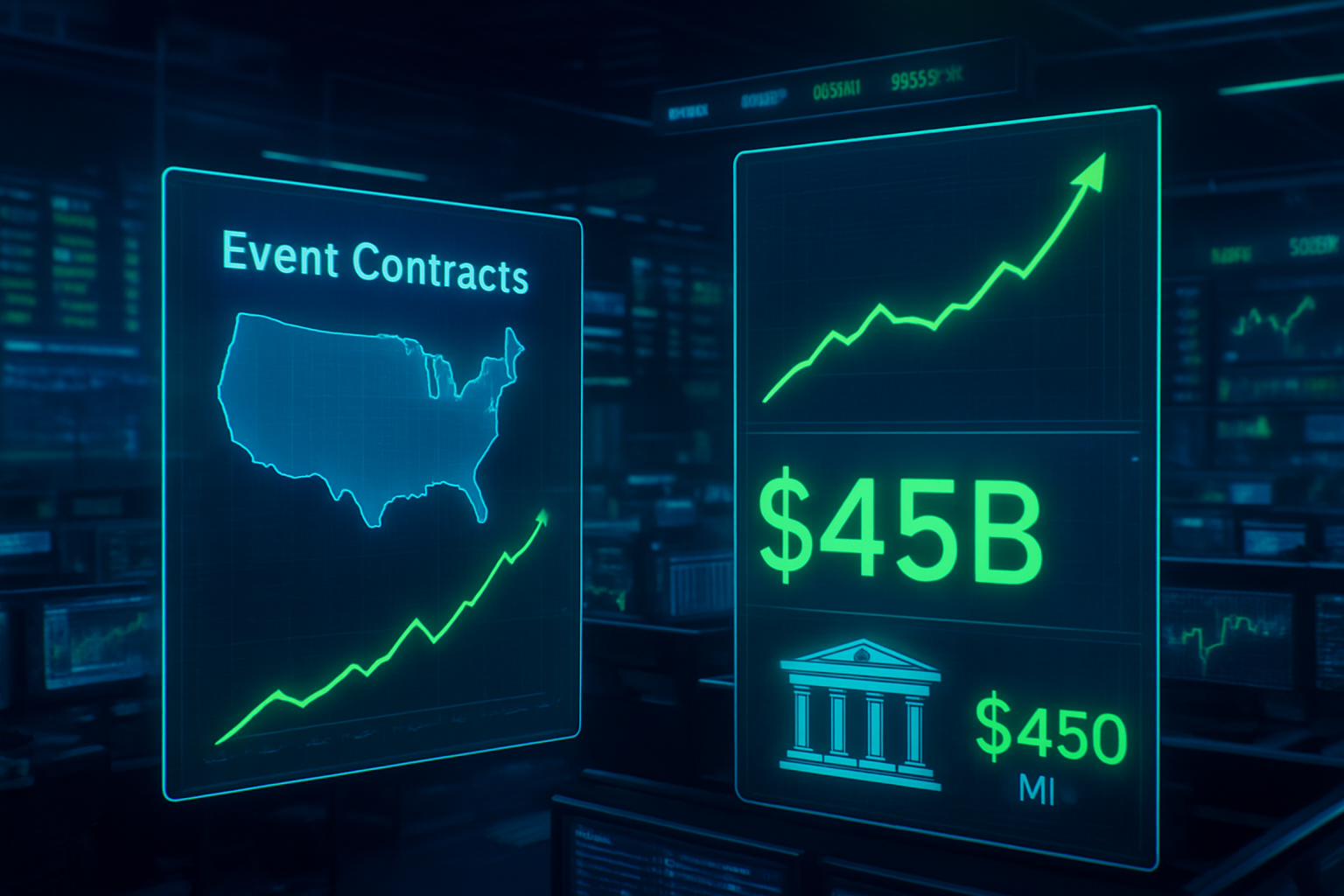
    The prediction market industry has officially shed its label as a niche corner of the internet for political junkies and sports bettors. As of early February 2026, the sector is celebrating a watershed moment: total trading volume surpassed a staggering $45 billion in 2025, a nearly five-fold increase from the previous year. This momentum shows no signs of slowing, with February 2026 on track to set a new monthly record for trading activity as retail and institutional investors pour into the space.

    At the heart of this explosion is the rise of the "Event Contract," a structured derivative that allows participants to trade directly on the outcome of real-world events. No longer viewed as mere gambling, these contracts have become a standard asset class. The primary driver of this month’s record volume is the Federal Reserve’s interest rate path, where the market for a potential March rate cut has ballooned to over $450 million in open interest. For many, these markets are no longer just a side bet—they are the most accurate real-time indicator of economic reality available.

    The Market: From $9 Billion to $45 Billion

    The scale of the prediction market industry has undergone a total transformation over the last 24 months. In 2024, the industry aggregate volume sat at approximately $9 billion, largely buoyed by the U.S. presidential election. However, 2025 proved that the appetite for event-based trading was not a one-off phenomenon. Total volumes for 2025 topped $44 billion, led by the regulated U.S. exchange Kalshi and the decentralized giant Polymarket.

    Kalshi, the first CFTC-regulated prediction market, saw its 2025 volume soar to $23.8 billion, representing an 1,108% increase year-over-year. Meanwhile, Polymarket, which saw Intercontinental Exchange (NYSE:ICE) take a 20% strategic stake late last year, contributed roughly $21.5 billion to the global total. These platforms have moved beyond political "who-will-win" scenarios into complex macro-economic hedging tools.

    Currently, the highest-liquidity market involves the Federal Open Market Committee (FOMC) meeting scheduled for March 17–18, 2026. After the Fed held rates steady at 3.5%–3.75% during their January 28 meeting, the prediction markets are now pricing in a 64% probability of a 25-basis-point cut in March. With nearly half a billion dollars at stake in this single contract, the liquidity now rivals that of traditional interest rate swaps.

    Why Traders Are Betting: The Search for "Settlement Certainty"

    The migration of capital into event contracts is driven by a fundamental shift in how traders perceive "truth." Unlike traditional equities or commodities, which can be influenced by sentiment, stock buybacks, or accounting nuances, event contracts settle based on objective, immutable data points—such as a press release from the Federal Reserve or a report from the Bureau of Labor Statistics.

    Professional traders are increasingly using these markets for macro hedging. For example, a portfolio manager heavily weighted in regional banks might buy "Yes" contracts on a Fed rate cut to hedge against the risk of prolonged high interest rates. This strategy has been validated by the entry of major financial institutions. Goldman Sachs Group Inc. (NYSE:GS) and CME Group Inc. (NASDAQ:CME) have both begun integrating event contract data into their proprietary trading stacks, treating them as "real-time truth engines."

    The current flurry of activity in February is fueled by a "data-heavy" calendar. While there is no FOMC meeting this month, the market is reacting violently to January’s employment data and CPI figures. Traders are no longer waiting for analyst notes from big banks; they are watching the shifting odds on Kalshi to see how the "wisdom of the crowd" interprets a hot inflation print in real-time.

    Broader Context and Implications

    The legitimization of prediction markets is the result of a hard-fought regulatory battle. The turning point occurred in late 2024 when a federal court ruled in favor of Kalshi, determining that election-based event contracts did not constitute "gaming" under the Commodity Exchange Act. This ruling paved the way for the CFTC, now under the pro-innovation leadership of Chairman Michael Selig, to withdraw its previous proposals to ban these markets.

    The implications of this shift are profound. Prediction markets are increasingly being used as the primary source of truth by mainstream media outlets. Partnerships between platforms and news giants like Bloomberg and CNBC have brought live probability tickers to millions of viewers. Furthermore, the integration of event contracts into retail platforms like Robinhood Markets Inc. (NASDAQ:HOOD) and Coinbase Global Inc. (NASDAQ:COIN) has democratized access to institutional-grade hedging tools.

    However, the path forward is not without friction. While federal regulators have eased their stance, several states continue to issue cease-and-desist orders, arguing that these contracts infringe on state-regulated gaming laws. The resolution of this state-versus-federal conflict will likely be the next major hurdle for the industry's expansion.

    What to Watch Next

    As we move through the remainder of February 2026, several key milestones will dictate whether the industry hits its projected record-breaking monthly volume. The release of the FOMC Minutes on February 18 will be a critical volatility catalyst, providing the "why" behind the January hold and potentially shifting the 64% probability of a March cut.

    Additionally, the Producer Price Index (PPI) data on February 27 will serve as the final major piece of the inflation puzzle before the Fed enters its pre-meeting blackout period in March. Market participants should also monitor the increasing "whale" activity on decentralized platforms, where single positions in the tens of millions are becoming more common, often signaling institutional repositioning.

    Bottom Line

    The rise of the prediction market industry from $9 billion to $45 billion in just two years marks one of the fastest adoption curves in the history of financial derivatives. By turning "information" into a tradable asset, these platforms have provided a level of price discovery that traditional markets often struggle to match.

    The $450 million currently sitting in Fed rate cut markets is a testament to the fact that "Event Contracts" are no longer an experiment; they are an essential component of the modern financial ecosystem. As more professional traders and retail investors embrace the transparency and settlement certainty of these markets, the $45 billion milestone of 2025 may soon look like just the beginning.


    This article is for informational purposes only and does not constitute financial or betting advice. Prediction market participation may be subject to legal restrictions in your jurisdiction.

    PredictStreet focuses on covering the latest developments in prediction markets.
    Visit the PredictStreet website at https://www.predictstreet.ai/.

  • The Rise of InfoFi: How Prediction Markets Became the World’s ‘Truth Machine’

    The Rise of InfoFi: How Prediction Markets Became the World’s ‘Truth Machine’

    The concept of "Information Finance," or InfoFi, has transitioned from a niche crypto-economic theory into a foundational pillar of global finance and media. As of February 2, 2026, prediction markets are no longer viewed as mere platforms for speculation; they have been repositioned as sophisticated data-transmission mechanisms that assign a market price to the accuracy of information itself. This shift is most visible in the current pricing of the Federal Reserve’s next moves, where the market is currently pricing in a 64% probability of a 25-basis-point rate cut in March, a signal that traditional economists are now using to calibrate their own models.

    The surge in interest surrounding InfoFi is driven by a fundamental realization: financial stakes force an honesty that social media algorithms and traditional polling lack. This "Truth Machine" philosophy, championed by industry leaders, has been validated by a massive influx of institutional capital and a landmark shift in how the world’s largest tech companies treat the sector. With total weekly trading volumes across major platforms recently hitting a record $6.32 billion, the era of purely speculative "betting" is being replaced by a disciplined quest for the "Truth Premium."

    The Market: What's Being Predicted

    At the heart of the InfoFi movement are two dominant platforms: the federally regulated Kalshi and the globally expansive Polymarket. These exchanges have moved beyond simple "yes/no" binaries on pop culture to become the primary clearinghouses for high-stakes geopolitical and macroeconomic data. On Kalshi, the "March 2026 Fed Rate Decision" contract has seen over $450 million in open interest, effectively functioning as a real-time shadow FOMC.

    Meanwhile, on Polymarket, traders are currently fixated on the 2026 U.S. Midterm Elections. The market currently prices a 78% probability that Democrats will flip the House, while Republicans maintain a 66% chance of holding the Senate. These odds are being cited by major news networks as a more reliable indicator than traditional polls, which many argue have failed to account for the "incentivized accuracy" that comes when traders have "skin in the game."

    The liquidity in these markets has reached a tipping point. On January 21, 2026, Alphabet Inc. (NASDAQ: GOOGL) updated its global advertising policies to officially permit prediction market advertisements in the United States for the first time. This regulatory "blessing" from Google has allowed platforms like Kalshi to tap into the world’s largest advertising network, provided they are federally regulated as Designated Contract Markets (DCMs). This move effectively reclassified these markets from "gambling" to "financial products," placing them in the same category as options or futures.

    Why Traders Are Betting

    Traders are flocking to InfoFi because it offers a "pure" play on information that is often obscured by institutional bias or media spin. Kalshi CEO Tarek Mansour has frequently described his platform as a "Truth Machine," arguing that "people don't lie with their money." This sentiment is the driving force behind the current market movements. Traders are not just betting on an outcome; they are betting that they have discovered a piece of information—whether it’s a shift in voter sentiment or a supply chain delay at NVIDIA (NASDAQ: NVDA)—before the rest of the market does.

    The incentive structure is simple: if you are right, you profit; if you are wrong, you lose. This Darwinian environment has given rise to a new professional class of "Prediction Market Traders." These individuals use specialized expertise, such as tracking FDA approval timelines or analyzing semiconductor shipment data (specifically the NVIDIA Blackwell Ultra B300 shipments, which are currently a hot-button InfoFi contract), to generate alpha.

    Furthermore, the integration of prediction markets into mainstream financial tools has lowered the barrier to entry. Robinhood Markets, Inc. (NASDAQ: HOOD) and Coinbase Global, Inc. (NASDAQ: COIN) have both integrated "Prediction Market Hubs" directly into their apps, reaching over 25 million combined users. This has brought a "flywheel" effect to the market: more users lead to better liquidity, which leads to sharper price signals, which in turn attracts even more institutional traders.

    Broader Context and Implications

    The rise of InfoFi represents a paradigm shift in how society processes truth. Historically, we have relied on "experts" and "institutions" to tell us what is likely to happen. However, the consistent accuracy of prediction markets during the 2024 elections and the subsequent AI boom has eroded trust in traditional forecasting. In late 2025, Mansour stated that Kalshi’s mission is about "replacing debate and subjectivity with markets and accuracy."

    This trend is also being reflected in the legislative halls of Washington D.C. In January 2026, the Public Integrity in Financial Prediction Markets Act (H.R. 7004) was introduced to ensure the "purity of data" in these markets by banning federal officials from trading on non-public information. This suggests that the government now views these markets not as a nuisance to be regulated out of existence, but as a critical piece of national financial infrastructure that must be protected.

    The broader implication is a world where "truth" is a tradable asset. When Intercontinental Exchange (NYSE: ICE), the parent company of the New York Stock Exchange, backed Polymarket with a $2 billion investment in 2025, it signaled that the old guard of finance had finally accepted InfoFi. These markets are now used to hedge against "event risk"—situations like a government shutdown or a sudden geopolitical conflict—where traditional stocks and bonds may not provide an adequate shield.

    What to Watch Next

    As we move through the first quarter of 2026, several key milestones will determine if InfoFi can maintain its momentum. First and foremost is the Federal Reserve’s March meeting. If the market’s 64% prediction of a rate cut proves accurate, it will further solidify the "Truth Machine" narrative. Conversely, a significant miss would give ammunition to critics who still view these markets as volatile and prone to manipulation.

    Another critical area to monitor is the "AI Release Cycle." On Polymarket, the contract for "GPT-5.3 released by February 28, 2026" is currently trading at 82% odds. This market serves as a proxy for the entire tech sector's health. If OpenAI misses this window, it could trigger a broader sell-off in AI-related stocks, proving how deeply intertwined InfoFi has become with the traditional Nasdaq.

    Finally, the expansion of Google’s ad program will be a major catalyst. As more regulated platforms enter the space, the cost of customer acquisition is expected to drop, potentially bringing hundreds of millions of new retail dollars into the prediction ecosystem. This liquidity surge will be the ultimate test of the platforms' stability and their ability to remain "un-manipulatable."

    Bottom Line

    The emergence of Information Finance (InfoFi) marks the end of the era where truth was a matter of opinion. By attaching a price tag to accuracy, prediction markets have created a global, real-time feedback loop that is increasingly difficult for traditional institutions to ignore. Tarek Mansour’s vision of a "Truth Machine" is no longer a theoretical goal; it is a multi-billion-dollar reality that is being indexed by Google and traded on Robinhood.

    For the average observer, these markets provide a level of clarity that was previously impossible. Whether you are looking at the probability of a 2026 House flip or the release date of the next major AI model, the "wisdom of the crowd"—when backed by billions of dollars—is proving to be the most reliable compass in an uncertain world.

    As we look toward the remainder of 2026, the question is no longer whether prediction markets are legal or moral, but rather: how much is the truth worth to you?


    This article is for informational purposes only and does not constitute financial or betting advice. Prediction market participation may be subject to legal restrictions in your jurisdiction.

    PredictStreet focuses on covering the latest developments in prediction markets. Visit the PredictStreet website at https://www.predictstreet.ai/.
  • From Election Machine to Financial Powerhouse: Polymarket’s Pivot to Fees and Real Estate

    From Election Machine to Financial Powerhouse: Polymarket’s Pivot to Fees and Real Estate

    Polymarket, the prediction market platform that dominated the 2024 global news cycle, has officially entered its next act. In a bold strategic shift finalized in January 2026, the platform has transitioned from a fee-free information hub into a revenue-generating financial infrastructure. This move is headlined by the introduction of up to 3% "taker fees" on its high-frequency 15-minute crypto up/down markets and a major expansion into the multi-trillion-dollar real estate sector.

    As of early February 2026, these strategic shifts are already bearing fruit. Following its regulated relaunch in the United States and a massive $2 billion strategic investment from Intercontinental Exchange (NYSE: ICE), Polymarket saw a record-breaking $12 billion in monthly volume for January. The platform is no longer just a place to bet on the next president; it is increasingly becoming a primary venue for "Information Finance" (InfoFi), where traders hedge against real-world price fluctuations in real-time.

    The Market: What's Being Predicted

    The most significant change for retail traders is the implementation of a variable taker fee for Polymarket’s popular short-duration markets. These markets allow users to predict whether the price of major assets like Bitcoin or Ethereum will be higher or lower in the next 15 minutes. The new fee structure is a variable curve based on probability: fees are capped at 3% when a market is at a 50/50 toss-up—where trading volume is typically highest—and scale down toward zero as the outcome becomes more certain.

    Simultaneously, Polymarket has moved aggressively into the housing market. By partnering with the on-chain data provider Parcl, the platform now offers prediction markets on residential real estate prices in major metropolitan areas, including New York City, Los Angeles, Miami, San Francisco, and Austin. Unlike traditional real estate indices like the S&P CoreLogic Case-Shiller—managed by S&P Global (NYSE: SPGI)—which can suffer from a two-month reporting lag, Polymarket’s new markets settle against Parcl’s daily updated price indices.

    Current activity in these real estate markets is robust. In the final week of January, the NYC housing index market saw over $60,000 in volume for a single monthly contract. Traders are currently pricing in a 62% probability that median home prices in the U.S. will exceed $420,000 by the end of Q1 2026, reflecting a cautious but optimistic outlook on the spring buying season.

    Why Traders Are Betting

    The introduction of fees has not deterred activity; rather, it has institutionalized it. Polymarket is using the 3% taker fees to fund a "Maker Rebate Program," which pays out USDC to liquidity providers who maintain tight spreads. This has attracted sophisticated algorithmic trading firms that previously stayed on the sidelines due to thin liquidity. For these firms, the rebate program makes Polymarket a viable destination for high-frequency market making.

    In the real estate sector, the motivation for betting is largely driven by a desire for hedging. Homeowners and prospective buyers are using these markets to lock in price expectations or hedge against the risk of a local market downturn. "For the first time, a first-time homebuyer in Austin can effectively 'short' their local housing market to protect their down payment savings," noted one prominent DeFi analyst.

    Furthermore, the integration of Polymarket data into institutional terminals via the ICE partnership has added a layer of credibility. When a market like the NVIDIA (NASDAQ: NVDA) quarterly earnings beat prediction shows high conviction, it now moves traditional equity prices. Traders are betting on Polymarket because the odds are increasingly viewed as a leading indicator for "traditional" markets.

    Broader Context and Implications

    This pivot marks the end of the "Wild West" era for prediction markets. By acquiring QCEX and obtaining CFTC-licensed status in late 2025, Polymarket has moved out of the regulatory shadows. The platform's decision to charge fees on high-frequency crypto markets while keeping long-term political and macro-economic markets largely fee-free suggests a two-tiered strategy: monetize the "gamblers" and high-frequency traders to subsidize the platform's role as a public truth-seeking utility.

    The expansion into real estate is perhaps the most significant test of the "InfoFi" thesis. If Polymarket can successfully provide a more accurate, real-time reflection of housing values than the lagging government or private sector reports, it could fundamentally change how mortgages are priced and how property is appraised. It represents a shift where the "wisdom of the crowd" competes directly with legacy statistical modeling.

    Historically, prediction markets have outperformed traditional polling and expert analysis in areas like election results and box office performance. However, applying this to the complex, illiquid world of real estate is a new frontier. The success of these markets will depend on whether they can attract enough local "insider" knowledge to provide a superior signal to traditional indices.

    What to Watch Next

    The immediate focus for the market is how the new fee structure affects long-term liquidity. If the Maker Rebate Program successfully narrows spreads, we can expect Polymarket to roll out these fees to other high-volume categories, potentially including commodities like Gold and Silver or volatility indices.

    Regulatory milestones also loom large. While the acquisition of QCEX provided a path to legal operation in the U.S., the CFTC remains vigilant. Any indication that the "15-minute" markets are being classified as "gaming" rather than "hedging" could lead to further policy shifts or fee adjustments. Traders should also watch for the launch of OpenAI’s rumored 2026 IPO markets, which are expected to be the highest-volume equity-related predictions in the platform’s history.

    Finally, keep an eye on the "Parcl vs. Case-Shiller" divergence. If Polymarket’s daily-settled real estate markets consistently front-run the official monthly reports from S&P Global, it will solidify the platform's status as the world’s fastest economic sensor.

    Bottom Line

    Polymarket’s transition in early 2026 signals the maturation of the prediction market industry. By introducing a sustainable monetization model and expanding into "sticky" asset classes like real estate, the platform is moving toward becoming a comprehensive financial dashboard for the modern era.

    This tells us that prediction markets are no longer just a niche interest for political junkies; they are becoming essential tools for price discovery in opaque markets. While the introduction of fees might irk some retail purists, the resulting increase in professional liquidity and institutional integration suggests that the "information" being produced is becoming more valuable than ever.

    As we move through 2026, the success of these strategic shifts will likely determine whether Polymarket remains the dominant force in the space or if legacy financial players will successfully launch their own competing "truth-discovery" platforms.


    This article is for informational purposes only and does not constitute financial or betting advice. Prediction market participation may be subject to legal restrictions in your jurisdiction.

    PredictStreet focuses on covering the latest developments in prediction markets.
    Visit the PredictStreet website at https://www.predictstreet.ai/.

  • The “Mainstream Moment”: Prediction Markets Evolve Into Wall Street’s New Favorite Asset Class

    The “Mainstream Moment”: Prediction Markets Evolve Into Wall Street’s New Favorite Asset Class

    As of early February 2026, the financial world has officially crossed the Rubicon. Prediction markets, once relegated to the fringes of internet forums and academic theory, have fully integrated into the DNA of the global financial system. The tipping point arrived not with a single event, but through a series of massive institutional migrations that have turned "Event Contracts" into a standard fixture on the screens of retail investors and professional traders alike.

    Currently, the market for Federal Reserve policy shifts serves as the most potent example of this transformation. On Kalshi, the probability of a 25-basis-point rate cut at the March 2026 meeting is currently trading at 64%, with over $450 million in open interest across the curve. This isn't just a niche bet anymore; it is the "real-time truth engine" being cited by major networks and used by hedge funds to hedge macro risk. The surge in interest is driven by a unprecedented level of accessibility, with prediction market data now flowing through the same pipelines as the S&P 500.

    The Market: What's Being Predicted

    While the 2024 election was the catalyst, the "Market" in early 2026 is no longer just about politics. The focus has shifted toward high-frequency economic indicators and corporate events. On Kalshi, the "Fed Funds Rate" contracts remain the liquidity kings, but new categories are exploding. Traders are now actively betting on quarterly earnings beats for companies like Apple Inc. (NASDAQ:AAPL) and NVIDIA Corporation (NASDAQ:NVDA), as well as the monthly Consumer Price Index (CPI) prints.

    These markets are primarily trading on two dominant domestic platforms: Kalshi and the recently expanded event contract suite from Robinhood Markets, Inc. (NASDAQ:HOOD). Since Robinhood’s January 2026 launch of "Custom Combos," liquidity has reached record highs. Trading volume across the industry topped an estimated $45 billion in 2025, and February 2026 is already on track to break monthly records. The resolution criteria for these contracts are now strictly standardized, typically relying on official government data or audited corporate filings, providing a level of "settlement certainty" that was missing in the early days of the industry.

    Why Traders Are Betting

    The migration of traders into prediction markets is being fueled by three major technological and strategic shifts. First is the integration of Coinbase Global, Inc. (NASDAQ:COIN) into the Kalshi ecosystem. By leveraging Coinbase Custody and USDC for settlement, institutional players can now move millions of dollars into event contracts with the same speed and security they expect from the crypto or equity markets. This has eliminated the "on-ramp friction" that previously kept large capital on the sidelines.

    Second, the introduction of Robinhood's "Custom Combos" has revolutionized how retail speculators interact with the news. Similar to a parlay in sports betting but structured as a CFTC-regulated financial instrument, Custom Combos allow users to bundle up to 10 different outcomes—such as a Fed rate cut, a specific CPI print, and a tech earnings beat—into a single high-payout contract. This "gamification of macroeconomics" has brought a younger, more aggressive demographic of traders into the space.

    Finally, the narrative has shifted because the data has become unavoidable. When CNBC (subsidiary of Comcast Corporation (NASDAQ:CMCSA)) and CNN (subsidiary of Warner Bros. Discovery, Inc. (NASDAQ:WBD)) began featuring live Kalshi tickers on-air in late 2025, it created a feedback loop. Traders are betting because they see the "market odds" mentioned in every major news cycle, treating the probability percentages as more reliable than traditional expert punditry or lagging opinion polls.

    Broader Context and Implications

    The mainstreaming of these platforms represents the birth of what Ethereum founder Vitalik Buterin famously termed "Information Finance" (InfoFi). By 2026, prediction markets are no longer just places to gamble; they are seen as the most accurate sensors of public and private information available. The Intercontinental Exchange, Inc. (NYSE:ICE), the parent company of the New York Stock Exchange, essentially validated this in late 2025 by investing $2 billion in the space and integrating prediction data into its professional terminals (ICE Connect).

    This integration has profound implications for public sentiment. Unlike polls, which can be influenced by social desirability bias, prediction markets require "skin in the game." The resulting data is cleaner, faster, and less partisan. This has forced regulatory bodies, particularly the CFTC, to move from a posture of skepticism to one of structured oversight. The 2026 landscape is defined by a rigorous regulatory framework that treats event contracts as a legitimate asset class, alongside futures and options.

    What to Watch Next

    As we move toward the middle of 2026, the next major milestone is the full vertical integration of these platforms. Robinhood’s acquisition of a 90% stake in MIAXdx in January 2026 suggests that the firm will soon launch its own dedicated clearinghouse for event contracts, potentially cutting out middlemen and lowering fees even further. This could trigger a "fee war" that benefits retail traders.

    The upcoming 2026 Midterm Elections will be the next "Stress Test" for these integrated systems. We should expect to see the first multi-platform "Election Night" where CNN and CNBC use real-time market data to call states or predict shifts in Congressional control before traditional models have enough data to do so. Watch for the emergence of "Cross-Platform Arbitrage," where traders exploit price differences between the crypto-native Polymarket and the regulated domestic exchanges like Kalshi.

    Bottom Line

    The mainstreaming of prediction markets via major financial platform integrations is the definitive financial story of 2026. By embedding event contracts into the tools that 100 million Americans already use—like Robinhood and Coinbase—the industry has moved past the "early adopter" phase. These markets are now a vital piece of the global information infrastructure, providing a hedge against uncertainty in an increasingly volatile world.

    Ultimately, the rise of prediction markets tells us that in the digital age, market-based consensus is more valuable than ever. Whether you are a retail trader using Robinhood to bet on a "Custom Combo" of tech news or an institutional investor using Kalshi to hedge interest rate risk on a CNBC-branded dashboard, the message is clear: the future is not just something we wait for—it is something we price.


    This article is for informational purposes only and does not constitute financial or betting advice. Prediction market participation may be subject to legal restrictions in your jurisdiction.

    PredictStreet focuses on covering the latest developments in prediction markets.
    Visit the PredictStreet website at https://www.predictstreet.ai/.
  • The Great Prediction War of 2026: Polymarket and Kalshi Battle for the Volume Crown

    The Great Prediction War of 2026: Polymarket and Kalshi Battle for the Volume Crown

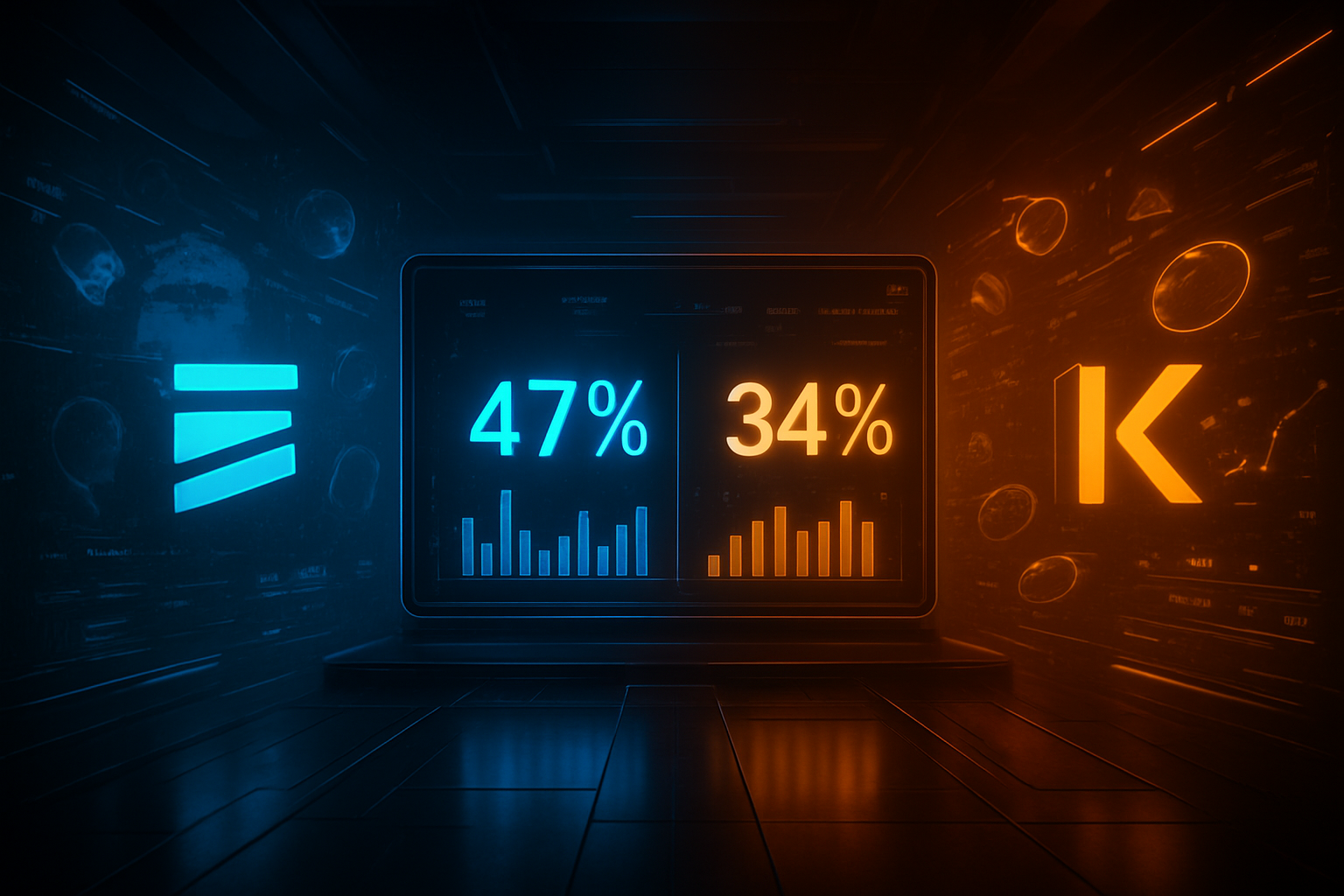
    As of early February 2026, the prediction market landscape has transformed from a niche hobby for "superforecasters" into a multi-billion dollar pillar of the global financial system. At the heart of this explosion is a titanic struggle for dominance between the two undisputed heavyweights: Polymarket and Kalshi. The stakes are nothing less than the title of the world’s primary "truth engine." Currently, a high-traffic contract on Manifold Markets, which serves as a meta-layer for industry sentiment, gives Polymarket a 47% chance of claiming the 2026 volume crown, while Kalshi trails at 34%.

    This rivalry has divided the trading community into two distinct camps. While Kalshi has leveraged its regulatory compliance to become the "Robinhood of events," Polymarket has maintained its status as the "Bloomberg of the blockchain," dominating the high-stakes world of geopolitical and macroeconomic forecasting. The current betting activity on Manifold reflects a growing debate: will the raw mass-market appeal of sports propel Kalshi to the top, or will Polymarket’s dominance in "high-signal" global events prove more lucrative?

    The Market: What's Being Predicted

    The central point of contention is the definition of "volume leadership." The Manifold Markets contract, which has seen heavy participation from industry insiders and "whales," specifically tracks which platform will handle the most notional volume for the calendar year 2026. However, there is a critical caveat in the resolution criteria: the contract excludes "pure sports betting" volume to focus on "event-based information finance." This distinction is vital because, in 2025, Kalshi cleared a staggering $43.1 billion in total volume, but over 90% of that was tied to sports contracts through its integration with Robinhood Markets, Inc. (NASDAQ:HOOD).

    Polymarket, which ended 2025 with $33.4 billion in volume, is currently the favorite on Manifold because of its perceived monopoly on "pure" prediction markets. Traders are pricing in the fact that while Kalshi attracts millions of small-dollar sports bettors, Polymarket attracts massive institutional liquidity on "high-alpha" events. The odds have shifted significantly since January 1st, when the two were nearly neck-and-neck. Polymarket’s recent surge to 47% follows a series of high-volume geopolitical events in January that saw over $5 billion in monthly activity on the platform.

    Why Traders Are Betting

    The divergence in odds is driven by the vastly different "moats" each platform has built. Kalshi’s strength lies in its "sports flywheel." By partnering with the NHL and other major leagues, Kalshi has turned prediction markets into a regulated alternative to traditional sportsbooks. This has created a massive influx of retail traders, but it also makes the platform vulnerable to regional regulatory shifts. For example, a recent preliminary injunction in Massachusetts has barred Kalshi from offering sports contracts in the state, a move that traders fear could be replicated in other high-volume states like New York or Nevada.

    Conversely, Polymarket’s 47% lead is fueled by its "Geopolitical/Macro" dominance. In January 2026, the platform famously outperformed every major news outlet during "Operation Absolute Resolve" in Venezuela. While traditional media struggled to verify reports on the ground, the "Maduro Trade" on Polymarket saw $56.6 million in volume, accurately pricing the regime's collapse hours before official confirmation. Similarly, markets regarding the nomination of Kevin Warsh as the next Federal Reserve Chair saw over $368 million in volume, with the "Yes" side hitting 94% probability just before the official announcement from the White House.

    Traders are also closely watching the "whale" activity. Large institutional firms like Susquehanna and DRW have reportedly been shifting more liquidity into Polymarket’s macro markets, viewing them as a superior hedging tool compared to traditional derivatives. This "institutionalization" of the truth is a major factor driving the Manifold odds in Polymarket's favor.

    Broader Context and Implications

    This rivalry represents a pivotal moment for "Information Finance" (InfoFi). The 2024 US Election was the "Big Bang" for this industry, proving that prediction markets could act as a more accurate barometer of reality than traditional polling. Now, in 2026, the question is no longer if these markets work, but how they will be regulated and integrated into the broader economy.

    The regulatory environment has shifted dramatically under the new CFTC Chairman, Michael Selig. His "pro-market" stance has been a boon for both platforms, but a new conflict has emerged: the war between federal pre-emption and state-level gaming commissions. While Selig has expressed support for a federal framework for prediction markets, states like New Jersey and Nevada are fighting to classify these platforms as "gambling," which would subject them to high taxes and restrictive licensing.

    Furthermore, Polymarket’s successful re-entry into the US market—via its $112 million acquisition of QCEX, a CFTC-licensed exchange—has leveled the playing field. This move stripped Kalshi of its "only legal US option" advantage, forcing the competition to be fought purely on the quality of the markets and the depth of liquidity.

    What to Watch Next

    The coming months will provide several "stress tests" for these platforms. The first major milestone is the resolution of the Massachusetts legal challenge against Kalshi. If the court upholds the ban on sports contracts, Kalshi’s volume could take a significant hit, likely causing its Manifold odds to plummet further. On the other hand, if Kalshi successfully defends its model as "economic hedging" rather than gambling, it could reclaim its momentum.

    For Polymarket, the key will be maintaining its edge in "breaking news" markets. Watch for the upcoming "Global Climate Accord" negotiations in March; if Polymarket can once again provide a faster, more accurate signal than traditional diplomacy observers, it will cement its status as the world’s premier information source. Additionally, the potential for a "super-app" launch from Polymarket later this year could further bridge the gap with Kalshi’s retail-friendly interface.

    Bottom Line

    The battle for the 2026 volume crown is more than just a competition between two apps; it is a fight to define the future of how humanity consumes information. Kalshi is betting on the ubiquity of sports and the power of mainstream financial integrations. Polymarket is betting on the value of "pure" truth and the global demand for geopolitical clarity.

    The Manifold Markets odds—47% for Polymarket and 34% for Kalshi—suggest that while sports volume is impressive, traders believe the real future of prediction markets lies in the "Macro" niche. As we move deeper into 2026, the platform that can best navigate the regulatory minefield while maintaining deep liquidity on world-changing events will likely emerge victorious. For now, the "Truth Engine" of Polymarket holds the lead, but in a market where everything is a bet, nothing is guaranteed.


    This article is for informational purposes only and does not constitute financial or betting advice. Prediction market participation may be subject to legal restrictions in your jurisdiction.

    PredictStreet focuses on covering the latest developments in prediction markets.
    Visit the PredictStreet website at https://www.predictstreet.ai/.
  • The InfoFi Revolution: How Prediction Markets Became the World’s Fastest Financial Data Feed

    The InfoFi Revolution: How Prediction Markets Became the World’s Fastest Financial Data Feed

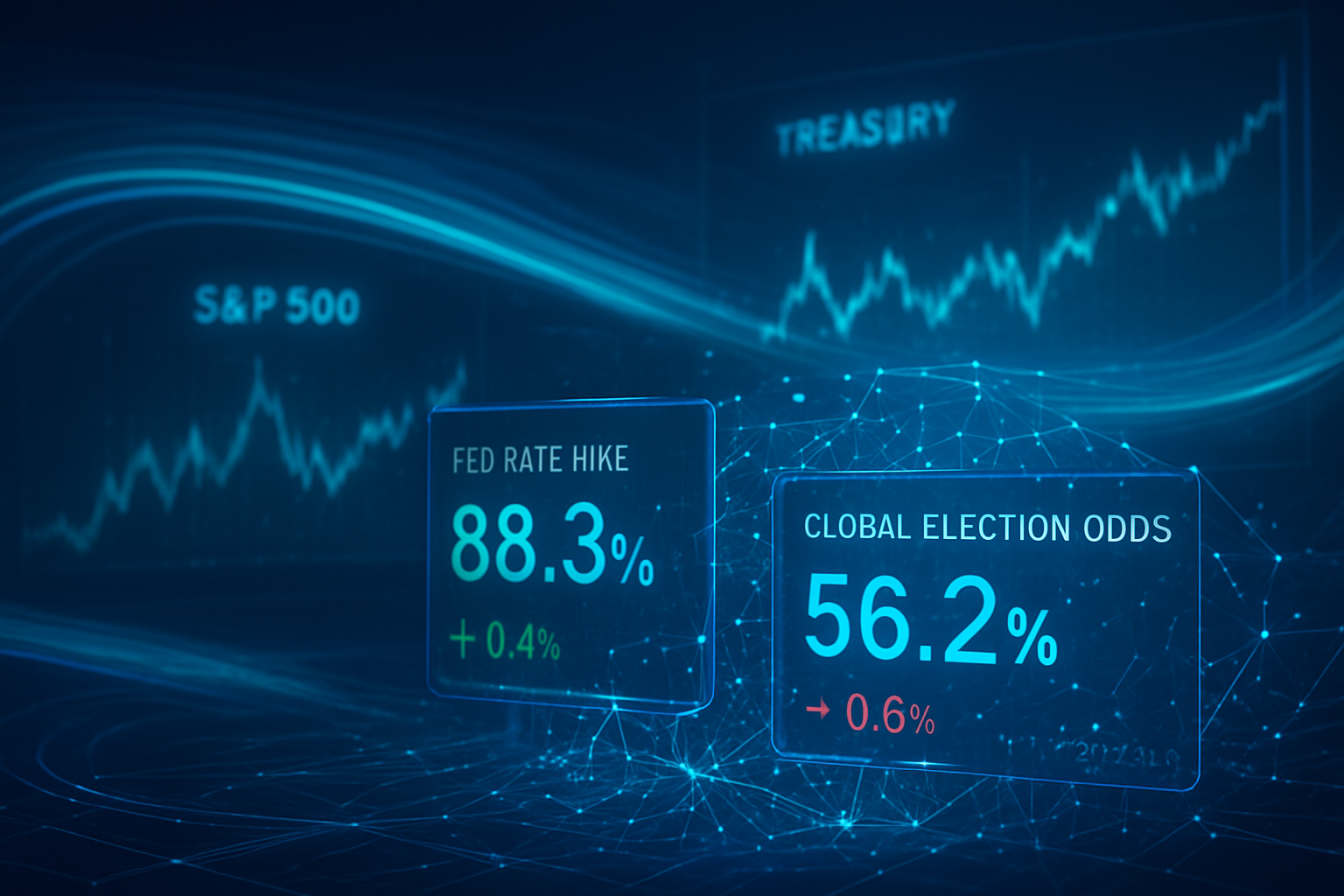
    As of February 1, 2026, the global financial landscape has been fundamentally rewired by a concept once relegated to the fringes of crypto-economic theory: Information Finance, or "InfoFi." What began as a tool for political junkies to hedge election risks has evolved into the world’s most potent data transmission mechanism. Prediction markets have transitioned from "betting parlors" to the "source of truth" for the global financial machine, with liquidity across major platforms now exceeding $50 billion annually.

    The most profound shift, however, is not in who is trading, but what is trading. Today, algorithmic bots—not humans—are the primary participants in prediction markets. These AI agents treat shifts in event probabilities as "truth events," using them as high-speed triggers to execute multi-billion dollar trades in traditional markets like the S&P 500 (NYSEARCA: SPY) and U.S. Treasuries. In this new era, the prediction market moves first, and the rest of the world follows in milliseconds.

    The Market: What's Being Predicted

    The prediction market landscape in early 2026 is dominated by two giants: the decentralized Polymarket and the federally regulated Kalshi. While these platforms still offer markets on everything from the Oscars to weather events, the high-volume activity is concentrated in macro-economic and geopolitical "nexus events." Currently, the most liquid markets center on Federal Reserve policy, specifically the "March 2026 Rate Cut" and "Year-End Inflation" contracts.

    Liquidity has reached a critical mass where "whale" positions—often exceeding $50 million—are common. On Kalshi, the "Federal Reserve Target Rate" contracts have seen their daily volume rival that of traditional interest-rate futures at the CME Group (NASDAQ: CME). The resolution criteria for these markets are ironclad, often tied to official government releases or blockchain-verified data, providing the "clean" data sets that algorithmic models crave.

    The speed of price discovery is now staggering. On Feb 1, 2026, a 4% shift in the probability of a "Government Shutdown" on Kalshi was reflected in the market price within 400 milliseconds of a leaked Congressional memo, whereas traditional news wires took nearly three minutes to report the same information. This delta—the "InfoFi Premium"—is where the new generation of traders makes their fortunes.

    Why Traders Are Betting

    The rise of "Information Arbitrage" is the primary driver behind current market movements. Traditional hedge funds and high-frequency trading (HFT) firms have deployed specialized AI agents, such as the widely discussed "Alphascope" and "Polybro" bots, to scan these markets 24/7. These bots do not just bet on the outcome; they use the outcome as a leading indicator for traditional assets.

    For instance, when a prediction market on Polymarket shows an uptick in the probability of a specific regulatory change, bots immediately execute trades in the affected sectors. If a contract for "SEC Leadership Change" moves toward "Yes," bots may preemptively buy or sell the Bitcoin Trust (NASDAQ: IBIT) or shares of Coinbase Global, Inc. (NASDAQ: COIN). Traders are no longer waiting for the news to break; they are trading on the collective intelligence of the "skin-in-the-game" participants who are incentivized to find the truth first.

    Furthermore, the introduction of the CLARITY Act of 2026 (Digital Asset Market Clarity Act) has legitimized these strategies. The Act provides a clear regulatory framework for "event contracts," allowing institutional giants like Apollo Global Management (NYSE: APO) and BlackRock, Inc. (NYSE: BLK) to treat prediction market positions as legitimate hedges against systemic risk. This institutional inflow has compressed spreads and made prediction market signals more reliable than ever.

    Broader Context and Implications

    The "feedback loop" between prediction markets and traditional finance has created a self-reinforcing cycle. When a prediction market shifts, it triggers automated selling in the S&P 500 (NYSEARCA: SPY). This market movement is then picked up by other algorithms as a "momentum signal," which in turn causes more traders to enter the prediction market to hedge their newfound exposure. This loop has effectively turned prediction markets into the world’s fastest financial data feed.

    This phenomenon reveals a deepening skepticism of traditional media and analyst reports. In the 2026 economy, a "buy" rating from a major bank carries less weight than a 10-cent move in a prediction market. The public sentiment captured here is cold and calculated; it is the sentiment of people willing to lose money if they are wrong, which distinguishes it from the "cheap talk" of social media or cable news.

    Historically, prediction markets have shown a remarkable ability to outperform "expert" consensus. During the 2024 election cycle and the subsequent economic shifts of 2025, markets like Kalshi consistently priced in outcomes weeks before traditional polling or economic forecasting firms. This accuracy has forced regulators at the CFTC to pivot from a stance of hostility to one of integration, recognizing that these markets provide a vital "early warning system" for the financial stability of the United States.

    What to Watch Next

    As we move further into 2026, the next major milestone is the full integration of prediction market APIs into mainstream brokerage platforms. Rumors persist that platforms like Charles Schwab (NYSE: SCHW) and Robinhood Markets, Inc. (NASDAQ: HOOD) are preparing to offer "Event Hedging" tabs, allowing retail investors to buy "No" on a recession as easily as they buy an ETF.

    The upcoming March FOMC meeting will be the ultimate test of the InfoFi feedback loop. Currently, Kalshi is pricing a 62% chance of a 25-basis-point cut, while traditional Fed Fund Futures are lagging at 54%. If the prediction market proves correct again, it may mark the moment when "Event Contracts" officially replace "Futures" as the primary tool for interest rate discovery.

    Additionally, the expansion of "Synthetic Straddles"—where traders hedge physical assets against event outcomes—is expected to grow. Watch for how high-tech firms like NVIDIA Corporation (NASDAQ: NVDA) see their stock volatility correlate with "Taiwan Conflict" or "AI Regulation" contracts. The tighter this correlation becomes, the more the prediction market acts as the "shadow price" for the world's most valuable companies.

    Bottom Line

    Prediction markets have evolved from a niche curiosity into the central nervous system of global finance. By 2026, "InfoFi" has proven that information is not just something you read—it is something you price. The rise of algorithmic bot trading has eliminated the latency between a "truth event" and a market reaction, making the world more efficient but also more volatile for those who cannot keep pace with the machines.

    This shift tells us that the most valuable commodity in the modern economy is no longer oil or even data, but accuracy. Prediction markets provide a ruthless mechanism for filtering noise and surfacing reality. For the modern investor, ignoring these signals is no longer an option; the bots have already integrated them, and the feedback loop is only getting faster.

    Whether we are looking at interest rates, election results, or corporate mergers, the prediction market is now the first place the "truth" appears. As institutional adoption continues and regulatory clarity deepens, the line between "betting" and "investing" will continue to blur until it disappears entirely.


    This article is for informational purposes only and does not constitute financial or betting advice. Prediction market participation may be subject to legal restrictions in your jurisdiction.

    PredictStreet focuses on covering the latest developments in prediction markets. Visit the PredictStreet website at https://www.predictstreet.ai/.

  • The Billion-Dollar Pivot: How ICE and Wall Street Giants Transformed Prediction Markets into a Global Utility

    The Billion-Dollar Pivot: How ICE and Wall Street Giants Transformed Prediction Markets into a Global Utility

    The landscape of global finance reached a definitive turning point in late 2025, as prediction markets shed their reputation as "crypto-native niches" to become a cornerstone of the institutional financial stack. This transformation was signaled most loudly by the Intercontinental Exchange (NYSE: ICE), the parent company of the New York Stock Exchange, which finalized a staggering $2 billion strategic investment in Polymarket in October 2025. The deal, which valued the platform at $9 billion, effectively signaled to the world that "Information Finance" (InfoFi) is no longer a speculative experiment but a critical utility for the 21st-century economy.

    As of February 1, 2026, prediction markets are no longer just about calling election winners or sporting results; they are being utilized as real-time "truth engines" for everything from Federal Reserve policy shifts to corporate merger success rates. With liquidity exploding and institutional heavyweights like Susquehanna International Group (SIG) and Jane Street taking massive positions, the market-implied probability is now often cited alongside the S&P 500 as a primary indicator of global sentiment.

    The Market: What's Being Predicted

    The sheer scale of prediction market activity has reached levels that were unimaginable just two years ago. In 2024, the industry celebrated a cumulative volume of $9 billion, largely driven by the U.S. presidential cycle. By the end of 2025, that figure had skyrocketed to $63.5 billion—a massive 302% year-over-year increase. In January 2026 alone, Polymarket recorded over $5 billion in trading volume, cementing its position as the world's largest event-based liquidity pool.

    This growth is anchored by two primary platforms: Polymarket and Kalshi. While Polymarket dominated international and crypto-settled volume, its mid-2025 acquisition of QCEX—a CFTC-licensed exchange and clearinghouse—allowed it to legally re-enter the U.S. market under a regulated framework. Meanwhile, Kalshi has seen its own surge in institutional volume, particularly in "macro-contracts" where traders bet on inflation prints, GDP growth, and interest rate decisions. The average trade size has evolved from a retail-centric $300 in early 2024 to nearly $4,800 today, reflecting the heavy participation of algorithmic funds and high-net-worth desks.

    Resolution criteria have also become more sophisticated. Gone are the days of ambiguous headlines; most institutional contracts now settle against hard data feeds from government agencies or agreed-upon third-party auditors. The integration of these markets into platforms like ICE Connect means that a trader in London can now see a real-time probability of a corporate acquisition failing as easily as they can see a stock price, with settlement timelines often occurring within minutes of a verifiable event.

    Why Traders Are Betting

    The institutionalization of this space is being led by the "big three" of market making: Susquehanna International Group (SIG), Jane Street, and Jump Trading. SIG, in particular, has become the primary institutional market maker for Kalshi, ensuring deep liquidity for contracts that were once too thin for professional use. These firms aren't just betting on outcomes; they are engaging in complex "cross-platform arbitrage." By exploiting the 4–6 cent price gaps between Polymarket’s crypto-settled contracts and Kalshi’s fiat-settled contracts, they provide the friction-reducing liquidity that has stabilized these markets.

    Beyond arbitrage, a new strategy known as "Meta-Contract Hedging" has emerged among firms like Jane Street. These desks reportedly use prediction markets to hedge platform-specific or systemic risks. For example, if a firm has a large directional exposure to a specific commodity, it may take an offsetting position in a prediction market contract regarding geopolitical stability in a key producing region. This allows for a more granular form of insurance than traditional options or futures might provide.

    Traditional forecasting methods—such as political polling or expert analyst consensus—are increasingly viewed as "lagging indicators" compared to the prediction market "lead." In the recent January 2026 Federal Open Market Committee (FOMC) cycle, prediction markets accurately priced in a "hawkish pause" three days before the leading Wall Street analysts updated their client notes. This speed and accuracy have made these markets an irresistible tool for any desk seeking an informational edge.

    Broader Context and Implications

    The shift toward prediction markets marks the birth of "InfoFi," a term coined by industry insiders to describe the financialization of information. This trend suggests that the most valuable commodity in the modern economy is not capital, but accurate, real-time data. By putting a price on the truth, these markets create a financial incentive for individuals with "hidden information" to bring it to the public square, effectively Air-dropping the role of the expert analyst.

    Regulatory clarity has played a pivotal role in this evolution. In January 2026, the newly appointed CFTC Chairman, Michael Selig, officially withdrew previous proposals to ban event contracts. Selig’s "Planting the Flag" announcement characterized prediction markets as vital for "price discovery and aggregating dispersed information." This federal endorsement has largely silenced the legal uncertainty that plagued the sector in 2022 and 2023, though some state-level friction persists in jurisdictions like Nevada and Connecticut regarding sports-related event contracts.

    Real-world implications are already being felt in corporate boardrooms. Companies are now using prediction markets as a form of "decision support." A major logistics firm might monitor the "Suez Canal Blockage Risk" market to decide whether to reroute ships, while tech giants are using internally-run prediction markets to gauge whether a product will launch on schedule. This represents a fundamental shift in how organizations manage risk and allocate resources.

    What to Watch Next

    The next major milestone is the full integration of prediction market data into consumer-facing technology. Alphabet Inc. (NASDAQ: GOOGL) has already begun testing "Market Probabilities" within its search results, treating prediction market odds as more authoritative than traditional news headlines for breaking events. If this goes wide, the "Wisdom of the Crowds" will become the default lens through which the average person views the future.

    We are also anticipating a wave of further consolidation and public offerings. Following the ICE-Polymarket deal, rumors are circulating that Robinhood Markets, Inc. (NASDAQ: HOOD), in partnership with SIG, may look to spin off its recently acquired prediction exchange (formerly MIAXdx) into a standalone public entity by late 2026. This would provide retail investors with a direct way to play the growth of the infrastructure itself, rather than just the individual contracts.

    Finally, keep an eye on "Climate Prediction Markets." As global weather patterns become more volatile, insurance companies are looking to these platforms to create "Parametric Climate Contracts." These would allow farmers or coastal businesses to hedge against specific weather events (like a Category 4 hurricane hitting a specific zip code) with near-instant payouts, bypassing the months-long claims process of traditional insurance.

    Bottom Line

    Prediction markets have officially crossed the chasm from a hobbyist fascination to a core global financial utility. The entry of Intercontinental Exchange (NYSE: ICE) and the active participation of firms like Jane Street and Susquehanna have provided the capital and credibility necessary to turn these platforms into "truth engines." What we are witnessing is the democratization of forecasting—a world where the collective intelligence of the market is more powerful than any single institution.

    As we move deeper into 2026, the distinction between a "financial market" and a "prediction market" will continue to blur. Whether you are a hedge fund manager protecting a billion-dollar portfolio or a retail trader looking for the most accurate news, the "market-implied probability" is now the gold standard of truth. The institutionalization of this space is not just a win for traders; it is a win for clarity in an increasingly uncertain world.


    This article is for informational purposes only and does not constitute financial or betting advice. Prediction market participation may be subject to legal restrictions in your jurisdiction.

    PredictStreet focuses on covering the latest developments in prediction markets.
    Visit the PredictStreet website at https://www.predictstreet.ai/.

  • Forecasting the Forecasters: Manifold’s Meta-Markets Signal a 2026 Industry Shakeup

    Forecasting the Forecasters: Manifold’s Meta-Markets Signal a 2026 Industry Shakeup

    As the prediction market industry enters its most ambitious year to date, a single contract on Manifold Markets has emerged as the definitive "North Star" for traders, regulators, and venture capitalists alike. The contract—"Which Prediction Market will have the highest total USD-equivalent trading volume in 2026?"—is currently trading with Polymarket as the 47% favorite, followed closely by Kalshi at 34%.

    This "meta-contract" has become more than a simple wager; it is a live barometer for the "Information Finance" (InfoFi) era. With the industry coming off a record-breaking 2025 that saw over $40 billion in total notional volume, the 2026 race represents a battle for total dominance between crypto-native platforms, regulated U.S. exchanges, and traditional brokerage giants that have finally entered the fray.

    The Market: What's Being Predicted

    The Manifold Markets contract is a winner-take-all prediction on which platform will facilitate the most trading volume by the end of the 2026 calendar year. Unlike typical markets that track elections or weather, this is a meta-market—a forecast about the industry itself. While Manifold is the primary venue for this specific "play money" meta-prediction, the implications are being tracked by high-stakes desks across the globe.

    As of January 30, 2026, the odds are stratified into four primary contenders:

    • Polymarket (47%): The global, crypto-native leader continues to hold the pole position, bolstered by its reputation as the world's premier "truth engine."
    • Kalshi (34%): The CFTC-regulated heavyweight is the primary challenger, benefiting from deep integration with domestic financial news networks.
    • ForecastEx (12%): The platform owned by Interactive Brokers (NASDAQ: IBKR) has seen its odds triple since November 2025, following a surge in institutional macro-hedging.
    • Robinhood (7%): Since its 2025 expansion into event contracts, Robinhood Markets, Inc. (NASDAQ: HOOD) has become the dark horse of retail volume.

    The resolution criteria for the contract are strict, requiring audited or publicly verifiable volume data. Total volume is calculated as the USD-equivalent of all trades made across all categories, including politics, economics, and sports, through December 31, 2026.

    Why Traders Are Betting

    The volatility in this meta-contract is being driven by a fundamental shift in how the world consumes information. In the wake of the 2024 U.S. election—frequently cited as the "Netscape moment" for prediction markets—traders are no longer just betting on outcomes; they are betting on which infrastructure will capture the most liquidity.

    Institutional players like Susquehanna International Group and Jane Street are reportedly using these meta-contracts to hedge their platform-specific exposure. For example, if a trader is heavily positioned in Kalshi’s recession markets, they might buy "Polymarket" shares on the meta-contract as a hedge against a potential regulatory squeeze on Kalshi's operations.

    Furthermore, the recent $2 billion investment by Intercontinental Exchange (NYSE: ICE)—the parent company of the New York Stock Exchange—into Polymarket has fundamentally altered the math. Traders are betting that this massive capital injection will allow Polymarket to scale its liquidity to levels previously unthinkable, potentially moving the platform from a "prediction market" to a core global financial utility.

    Broader Context and Implications

    The rise of the meta-contract reflects the maturing of the prediction market industry into a legitimate asset class. In 2025, the sector proved it could survive and thrive without a U.S. Presidential election to anchor it. By pivoting to "perpetual" markets—tracking Federal Reserve interest rate decisions, corporate M&A, and high-stakes sporting events—platforms have seen monthly volumes consistently top $5 billion in early 2026.

    This trend is also a reflection of public sentiment regarding traditional media. As trust in conventional polling continues to erode, the "wisdom of the crowd" as expressed through liquid markets has become the primary source of truth for major corporations. Alphabet Inc. (NASDAQ: GOOGL) and other tech giants have even begun integrating these market probabilities directly into their search and AI results, further driving retail volume toward the platforms that win the meta-race.

    However, regulatory friction remains the "X-factor." A recent January 2026 ruling in a Massachusetts court regarding Kalshi’s sports-related contracts has temporarily slowed its momentum, a move that was immediately reflected by a 5% drop in its Manifold odds. These meta-contracts effectively price in the risk of regulatory "whack-a-mole" across different jurisdictions.

    What to Watch Next

    The coming months feature several catalysts that could dramatically shift the odds in the 2026 volume race. First and foremost is the expected launch of a native prediction market product from Coinbase Global, Inc. (NASDAQ: COIN) in late Q1 2026. Should Coinbase successfully integrate event contracts into its existing app for its 100+ million users, it could leapfrog the current leaders in retail volume overnight.

    Investors are also closely watching the monthly "Volume Prints" from ForecastEx. If Interactive Brokers (NASDAQ: IBKR) continues to see double-digit month-over-month growth in its institutional macro-contracts, the market may begin to price in a "Wall Street takeover" of the prediction space, potentially dethroning the crypto-native incumbents.

    Key dates to monitor include the mid-year regulatory review by the CFTC and the performance of these markets during the upcoming 2026 World Cup, which many analysts predict will be the single highest-volume event in the history of the industry.

    Bottom Line

    The "Top 1 Prediction Market by Volume in 2026" contract is more than just a contest of numbers; it is a forecast of the future of information itself. Manifold’s meta-contracts show us that the market believes the industry is no longer in a "niche" phase. We are seeing a consolidation where the winner will likely become a permanent fixture of the global financial landscape.

    As of today, the battle is a toss-up between Polymarket’s global reach and Kalshi’s regulatory compliance. But with retail giants like Robinhood (NASDAQ: HOOD) and Interactive Brokers (NASDAQ: IBKR) scaling rapidly, the 2026 volume crown is far from decided. For the prediction market enthusiast, the meta-contract remains the best way to watch the world’s most exciting financial race in real-time.


    This article is for informational purposes only and does not constitute financial or betting advice. Prediction market participation may be subject to legal restrictions in your jurisdiction.

    PredictStreet focuses on covering the latest developments in prediction markets.
    Visit the PredictStreet website at https://www.predictstreet.ai/.
  • The Billion-Dollar Ballot: Why the 2026 Midterms are the New Engine of Prediction Markets

    The Billion-Dollar Ballot: Why the 2026 Midterms are the New Engine of Prediction Markets

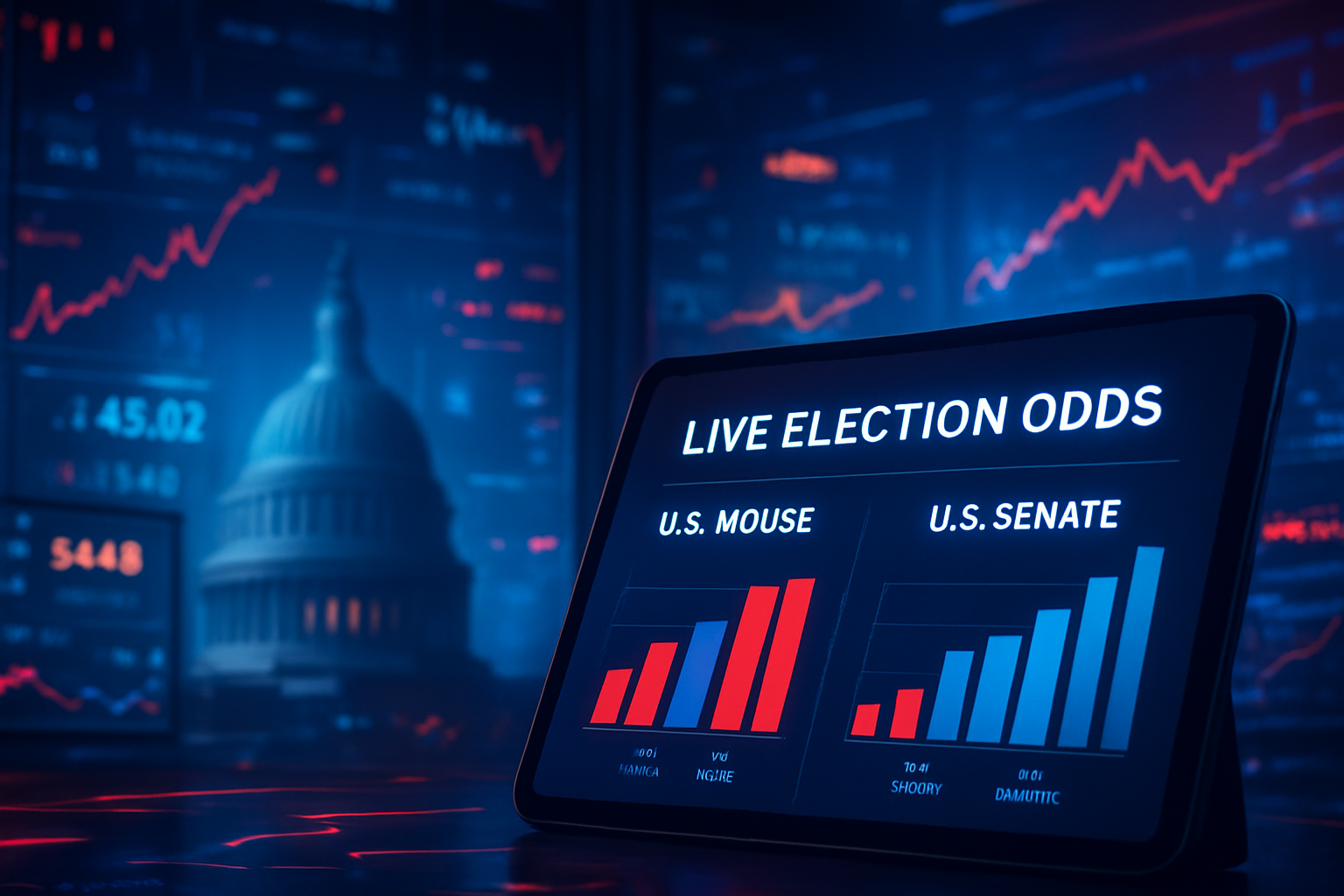
    As the calendar turns to January 30, 2026, the global financial eye has shifted from the traditional exchanges of Wall Street to the high-stakes digital arenas of prediction markets. The primary catalyst is the 2026 U.S. Midterm Elections, which have rapidly ascended to become the most significant volume driver in the history of the forecasting industry. With the first year of the second Trump administration in the rearview mirror, traders are now aggressively pricing the likelihood of a "midterm correction," with current odds on major platforms like Polymarket showing a 78% probability of Democrats flipping the House of Representatives, while Republicans maintain a 66% chance of holding the Senate.

    This surge in activity isn't just a political curiosity; it is a financial phenomenon. The prediction market sector has transformed into a $44 billion powerhouse, representing a staggering 130-fold growth in monthly volume compared to the same point in the 2024 cycle. Driven by institutional entry and a newfound regulatory "green light" from the Commodity Futures Trading Commission (CFTC), the 2026 midterms are serving as the ultimate stress test and growth engine for a burgeoning asset class that treats political outcomes as tradable commodities.

    The Market: What's Being Predicted

    The 2026 midterm markets are characterized by unprecedented liquidity and a diverse array of contract types. On Polymarket, the primary contract for House control has already surpassed $2 million in trading volume, an unheard-of figure for a race still nine months away. Similarly, Kalshi—a regulated U.S. exchange—has seen its political event contracts contribute to a record-breaking 2025 where it processed over $23.8 billion in total volume. These platforms have moved beyond simple "who will win" bets to offer more granular instruments, such as the number of seats gained or lost, the performance of specific incumbents, and even the margin of victory in key swing districts.

    Currently, the most liquid market across all platforms is the "Congressional Control" parlay. On Kalshi, the "Split Congress" outcome (Democratic House, Republican Senate) is trading at 46%, making it the consensus favorite among high-volume traders. Meanwhile, PredictIt, which remains a staple for retail political enthusiasts, shows Republican shares for "Winning 192 or fewer House seats" trading at 26¢, suggesting a significant portion of the market expects a substantial "blue wave" in the lower chamber.

    The resolution criteria for these markets are strictly defined by the certification of election results by the respective state secretaries of state and the convening of the 119th Congress in January 2027. This long lead time has allowed for the development of complex hedging strategies, where institutional investors use these markets to offset potential policy risks associated with shifts in legislative power.

    Why Traders Are Betting

    The primary driver of the current odds is the historical "midterm penalty" that typically plagues the party holding the White House. However, traders are also reacting to specific 2026 variables, most notably the public response to the second Trump administration’s economic and trade policies. The potential for renewed trade tensions has led many to bet on a Democratic House as a legislative "brake" on executive action. Sentiment is also closely tied to macro indicators; when the Consumer Price Index (CPI) shows signs of cooling or heating, the odds for the incumbent party fluctuate in real-time.

    Another major factor is the upcoming appointment of a new Federal Reserve Chair. With names like Kevin Warsh and Kevin Hassett circulating, the market is pricing in how a more hawkish or dovish Fed will impact the electoral prospects of Republicans. Significant "whale" activity has been spotted on Polymarket, where large positions—some exceeding $500,000—have been taken on a Democratic House flip, often coinciding with major policy announcements from the White House regarding government spending and a narrow brush with a government shutdown earlier this month.

    Furthermore, these markets are increasingly viewed as more reliable than traditional polling. While polls have struggled with non-response bias and the "shy voter" effect, prediction markets require participants to put capital at risk, creating a "wisdom of the crowds" effect that many institutional players now prefer. The inclusion of institutional capital, such as the reported $2 billion investment from Intercontinental Exchange (NYSE: ICE) into the prediction market infrastructure, has provided the depth necessary for these markets to reflect nuanced political realities faster than a telephone survey ever could.

    Broader Context and Implications

    The 2026 cycle marks a turning point in the regulatory status of prediction markets. In late January 2026, the new CFTC Chairman, Michael Selig, announced a major policy reversal, withdrawing the previous year's proposal to ban political event contracts. By treating these contracts as legitimate derivatives rather than gambling, the federal government has opened the floodgates for mainstream adoption. This shift has been bolstered by partnerships with major data providers like Yahoo Finance, owned by Apollo Global Management (NYSE: APO), which now integrates prediction market odds alongside traditional stock tickers.

    However, the rapid growth has not been without friction. State-level regulators remain cautious; Nevada recently launched enforcement actions against certain decentralized platforms, and Massachusetts has sought to maintain a temporary ban on specific event markets. Additionally, the industry is grappling with integrity concerns. Allegations of "insider trading" involving the timing of White House press conferences led to a brief period of volatility in mid-January, sparking calls for the "Torres Bill," a legislative proposal aimed at establishing strict non-public information rules for political staffers.

    Historically, prediction markets have shown a remarkable ability to predict midterm outcomes, often outperforming the "generic ballot" polls in the final months of a campaign. In 2022 and 2024, these markets correctly identified key shifts in the Senate long before mainstream media outlets updated their projections. The 2026 cycle is proving that political cycles are not just a distraction for these platforms—they are their lifeblood, providing the high-stakes, binary outcomes that drive the liquidity needed to sustain a global exchange.

    What to Watch Next

    The immediate future of the 2026 markets hinges on several key milestones. The upcoming primary season will be the next major volatility event, particularly in districts where "MAGA" incumbents face challenges from more moderate wings of the party, or vice versa for the Democrats. Traders will be looking for signs of candidate quality, as "electability" often shifts the odds in the Senate more than national trends.

    Economic data releases in the second and third quarters of 2026 will also be pivotal. If the "trade war" dynamics lead to a noticeable spike in consumer prices, expect the odds for a Democratic House flip to climb into the 85-90% range. Conversely, if the administration manages to secure a significant legislative win or a major foreign policy breakthrough—such as a resolution to tensions in Venezuela—the "Republican Sweep" odds, currently at 21%, could see a rapid resurgence.

    Finally, the progress of the "Torres Bill" in Congress will be a significant indicator for the industry's health. If the market can move toward a more transparent, regulated framework for handling political information, it will likely attract even more conservative institutional capital that has so far remained on the sidelines.

    Bottom Line

    The 2026 U.S. Midterm Elections have solidified prediction markets as the "new polling," providing a real-time, capital-backed pulse on the American electorate. As platforms like Polymarket and Kalshi continue to shatter volume records, it is clear that political cycles are the essential engine of growth for this sector. The markets currently tell a story of a nation leaning toward a divided government, with a clear preference for a Democratic House to act as a check on the current administration.

    For the prediction market industry, 2026 is the year of maturity. The combination of massive liquidity, regulatory softening at the federal level, and institutional backing from giants like Intercontinental Exchange (NYSE: ICE) has moved these platforms from the fringes of the internet to the center of the global financial conversation. Whether the markets' current 78% certainty regarding a House flip holds true remains to be seen, but one thing is certain: the world is watching the odds, not the polls.


    This article is for informational purposes only and does not constitute financial or betting advice. Prediction market participation may be subject to legal restrictions in your jurisdiction.

    PredictStreet focuses on covering the latest developments in prediction markets.
    Visit the PredictStreet website at https://www.predictstreet.ai/.
  • The New Financial Oracle: How Algorithmic Bots Turned Prediction Markets into the World’s Fastest Data Feed

    The New Financial Oracle: How Algorithmic Bots Turned Prediction Markets into the World’s Fastest Data Feed

    As we enter the first quarter of 2026, a fundamental shift is occurring in the architecture of global finance. For decades, institutional trading desks relied on the "terminal" model—terminal data from legacy providers, consensus surveys, and government reports—to price risk. Today, that hierarchy has been inverted. Algorithmic trading bots are no longer just participants in prediction markets; they are using platforms like Kalshi and Polymarket as their primary, high-fidelity data feeds to trade trillions of dollars in the legacy stock and bond markets.

    The current landscape is defined by a "prediction-first" reality. With the March 2026 Federal Open Market Committee (FOMC) meeting fast approaching, the probability shifts on decentralized and regulated prediction exchanges are moving markets minutes—sometimes hours—before traditional headlines hit the tape. As of January 30, 2026, the discrepancy between "skin-in-the-game" prediction data and traditional forecasting has become the most profitable spread for high-frequency trading (HFT) firms globally.

    The Market: What's Being Predicted

    At the center of this technological revolution is the March 2026 FOMC meeting, scheduled for March 17–18. Traders are currently wrestling with a volatile economic outlook that has split the consensus. On Kalshi, the regulated exchange that recently saw its volume surge following a successful regulatory expansion, the "March Fed Rate" contracts are seeing record liquidity. Simultaneously, Polymarket has become the de facto venue for international and crypto-native liquidity, offering a decentralized counter-narrative to domestic expectations.

    As of today, January 30, Kalshi's markets reflect a 62% probability of a 25-basis-point cut, while Polymarket—driven by a broader global user base—is pricing that same outcome at a more aggressive 71%. This 9% spread is a playground for algorithmic bots. Total trading volume across these interest-rate markets has surpassed $120 billion this cycle, a staggering figure that rivals the liquidity of some mid-cap equity sectors.

    The resolution criteria are razor-sharp: the markets settle based on the official target range announced by the Federal Reserve at the conclusion of their March meeting. However, the secondary market for these "Yes/No" contracts has become so liquid that the Intercontinental Exchange (NYSE: ICE) and CME Group (NASDAQ: CME) are now reportedly exploring direct API hooks to these prediction venues to stabilize their own interest-rate futures volatility.

    Why Traders Are Betting

    The primary driver of this activity is "Information Arbitrage." In 2026, bots are programmed to treat a price move on a prediction market as a "truth event." When a major "whale" on Polymarket moves the needle on the March FOMC cut probability, bots instantly execute corresponding trades on the 10-year Treasury note or the S&P 500. This has created a feedback loop where prediction markets act as the leading indicator, and the broader market follows.

    Recent volatility has been fueled by a series of "hot" labor reports that contradicted earlier dovish sentiment. While traditional analysts at firms like Goldman Sachs (NYSE: GS) or JPMorgan Chase & Co. (NYSE: JPM) may take hours to release a revised research note, a prediction market reacts in milliseconds. Bots can detect the immediate capital flow from insiders or sophisticated macro traders who are "betting their conviction" rather than just providing an opinion to a journalist.

    Notable large positions, or "whales," have also been spotted using "synthetic straddles." A trader might buy "No" on a rate cut on Kalshi while simultaneously going long on interest-rate futures at CME Group. This allows them to hedge their regulatory and platform risk while betting on the underlying economic reality. This convergence of sophisticated hedging strategies has propelled prediction markets from the fringes of "DeFi" into the core of the institutional "Information Finance" stack.

    Broader Context and Implications

    This trend signals a broader shift in how society prices the future. We are moving away from the "Expert Era," where we trusted a panel of economists, toward the "Incentive Era," where we trust the aggregate wisdom of people with money on the line. The historical accuracy of these markets over the past two years has been remarkable; in the 2024 elections and the 2025 energy crisis, prediction markets outperformed traditional polling and expert models by an average of 14% in terms of lead time and accuracy.

    The regulatory environment has also matured significantly. The legal victories won by Kalshi against the CFTC in previous years have paved the way for institutional giants like Interactive Brokers Group, Inc. (NASDAQ: IBKR) to offer prediction market access directly to their retail and professional clients. This has brought "normie" capital into the mix, providing the exit liquidity that algorithmic bots require to operate at scale.

    Furthermore, the rise of "Oracle Integration" means that smart contracts on various blockchains are now using these market results to auto-execute insurance payouts, supply chain orders, and even corporate governance decisions. If a prediction market says a strike is 90% likely, a bot-controlled logistics firm might automatically reroute shipments before the strike even begins.

    What to Watch Next

    The next 45 days will be a stress test for this new financial architecture. Between now and the March 18 FOMC decision, several key data releases—including the February Non-Farm Payrolls and CPI reports—will act as "volatility triggers." Watch for how quickly the prediction market price moves relative to the data release time. In late 2025, we saw "pre-emptive spikes" where prediction markets began moving 30 seconds before the official Bureau of Labor Statistics website updated, suggesting that bots are now successfully scraping or predicting government data releases with terrifying efficiency.

    Another key milestone is the expected launch of "Event-Based ETFs." Rumors are circulating that several major asset managers are filing with the SEC to create funds that track the "aggregate probability" of various macro events. If approved, this would provide a massive influx of passive capital into these markets, further narrowing the spreads and increasing the gravity prediction markets hold over the traditional NYSE and NASDAQ exchanges.

    Bottom Line

    The integration of algorithmic trading bots with prediction market data feeds represents the "Final Frontier" of market efficiency. By turning future events into tradable assets with real-time price discovery, we have created a global "sensing layer" for the economy. The March 2026 FOMC meeting is no longer just a date on a calendar; it is a live, fluctuating number that dictates the movement of billions of dollars in real-time.

    For the average investor, this means the "consensus" is now visible in a way it never was before. However, it also means that the window to act on new information is shrinking. As bots continue to dominate these feeds, the "human" element of trading is being pushed further out the risk curve. Ultimately, prediction markets are proving that the most accurate way to forecast the future is not to ask what people think will happen, but to see what they are willing to bet on.


    This article is for informational purposes only and does not constitute financial or betting advice. Prediction market participation may be subject to legal restrictions in your jurisdiction.

    PredictStreet focuses on covering the latest developments in prediction markets.
    Visit the PredictStreet website at https://www.predictstreet.ai/.