Tag: Federal Reserve

  • The “Warsh Shock”: Prediction Markets Signal 94.8% Certainty for the Next Fed Chair

    The “Warsh Shock”: Prediction Markets Signal 94.8% Certainty for the Next Fed Chair

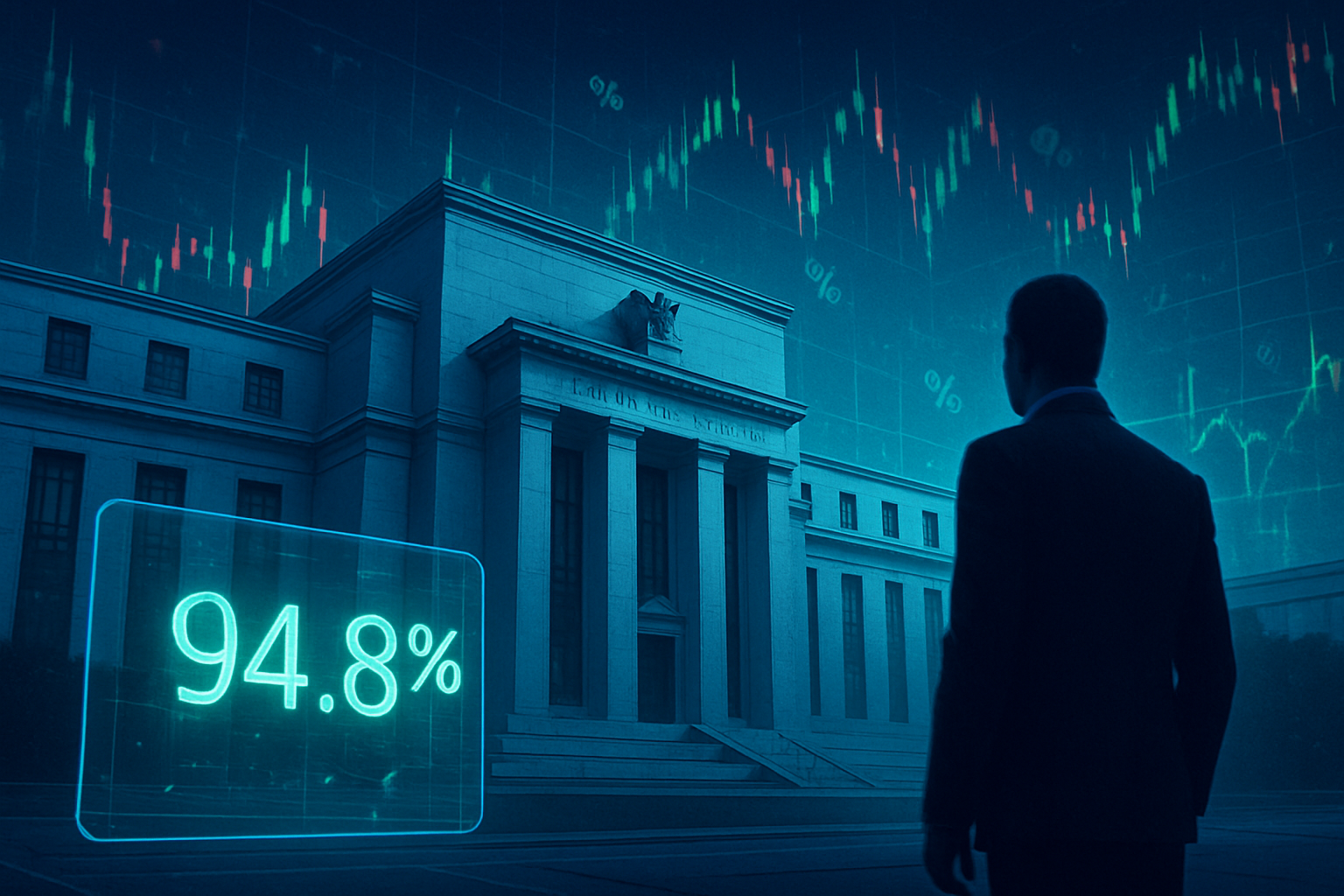
    As the countdown to the end of Jerome Powell’s tenure at the Federal Reserve begins, prediction markets have reached a state of near-unanimity. Kevin Warsh, the former Fed Governor and long-time favorite of the Republican establishment, has emerged as the overwhelming frontrunner to be the next Chair of the Federal Reserve. According to data from Polymarket and CoinMarketCap, Warsh currently holds a commanding 94.8% probability of being nominated by President Donald Trump to lead the world’s most powerful central bank.

    This market, which has seen hundreds of millions of dollars in trading volume, is generating intense interest because it signals more than just a personnel change; it represents a fundamental shift in the "Shadow Fed" strategy being deployed by the White House. With Powell’s term set to expire in May 2026, the market’s conviction suggests that the "Warsh era" has effectively begun months ahead of schedule, creating a unique "dual chair" dynamic that is already rippling through global bond and equity markets.

    The Market: What's Being Predicted

    The prediction market for the next Federal Reserve Chair has become one of the most liquid political events of the 2026 calendar. On Polymarket, the primary hub for crypto-native forecasting, the contract "Who will Trump nominate as Fed Chair?" has surpassed $432 million in total trading volume. Kevin Warsh’s "Yes" shares are currently trading at approximately 95 cents, mirroring the 94.8% figure seen on other aggregators.

    While Polymarket dominates the retail and international space, Kalshi, the CFTC-regulated exchange, has seen a massive influx of institutional activity. Kalshi reported record-breaking participation in January 2026, with the Fed Chair contract maintaining a probability as high as 98%. The market is also seeing new liquidity from the Jupiter platform on the Solana blockchain, which recently integrated prediction market tools, allowing a wider range of retail traders to bet on the "Warsh Shock."

    The resolution criteria for these markets are strictly defined: the market pays out once a formal nomination is sent to the U.S. Senate. While Trump announced his intention to nominate Warsh on January 30, 2026, the markets remain active as traders hedge against potential Senate confirmation hurdles or last-minute shifts in the President’s preference.

    Why Traders Are Betting

    The 94.8% probability isn't just a reflection of rumors; it is backed by a sequence of tactical moves from the White House. Traders shifted heavily toward Warsh after the President pivoted away from other high-profile candidates like Kevin Hassett, who was recently tapped to remain at the White House as Director of the National Economic Council, and Marc Rowan, the CEO of Apollo Global Management (NYSE: APO). While Rowan was a favorite for his "titan of industry" profile, prediction markets correctly sniffed out that his private equity ties might create too many conflict-of-interest hurdles in a closely divided Senate.

    Notable "whale" activity has also solidified the odds. On-chain data has identified several multi-million dollar positions, including a legendary "French high-roller" on Polymarket and a strategic "insider" address on the Hyperliquid platform that realized significant gains by front-running the official announcement in late January.

    Furthermore, traditional forecasting tools like the CME FedWatch tool from CME Group (NASDAQ: CME) have indirectly supported the Warsh narrative. As expectations for aggressive rate cuts in late 2026 grew to 94.8% in early January, traders deduced that Trump would want a Chair who—while historically hawkish—is perceived as more "market-sensitive" and "central casting" than the incumbent Powell.

    Broader Context and Implications

    The rise of Kevin Warsh is being interpreted by Wall Street as the beginning of a "Shadow Chair" period. Analysts at Goldman Sachs (NYSE: GS) and JPMorgan Chase (NYSE: JPM) have noted that a 95% market certainty effectively neuters Jerome Powell’s influence for the remainder of his term. JPMorgan (NYSE: JPM) has labeled this a "Shadow Policy Shift," arguing that the FOMC’s voting behavior may begin to tilt toward Warsh’s known preferences—specifically a more aggressive stance on balance sheet reduction—even before he takes the gavel.

    This market also highlights the maturing of prediction markets as a geopolitical tool. Unlike 2020 or 2024, where these markets were often dismissed as "crypto-niche," the 2026 Fed Chair market has been cited by major financial news outlets as a primary source of truth. The high accuracy of these markets in predicting the Rowan-to-Warsh pivot has given them new-found legitimacy among institutional hedgers.

    However, the real-world implications are stark. The "Warsh Shock" has already caused a "Great Metal Flush," with gold and silver prices retreating as investors price in a Fed that might prioritize price stability and a stronger dollar more aggressively than the Powell administration.

    What to Watch Next

    While the 94.8% probability suggests the race is over, two key factors could still inject volatility. First is the ongoing Department of Justice investigation into internal Fed operations. Some Republican Senators, including Thom Tillis, have hinted that Warsh’s confirmation could be delayed until the cloud over the current Fed leadership is cleared. If the confirmation process hits a snag, we could see Warsh’s odds dip back into the 80s as the market considers a "re-opening" of the shortlist.

    Second, the market is closely watching the official Senate Banking Committee hearing schedule. Key dates in late February and early March will be critical milestones. Any sign of friction during the "vettings and greetings" phase on Capitol Hill will be immediately reflected in the contract prices. Traders should also monitor the Interactive Brokers (NASDAQ: IBKR) ForecastEx markets, which often attract the most conservative, professional-grade bets on regulatory outcomes.

    Bottom Line

    The prediction markets have spoken: the "Warsh Era" is no longer a question of "if," but "when." With a 94.8% probability, the markets are effectively treating the nomination as a settled fact, leaving only the logistics of confirmation and the timing of Jerome Powell’s exit to be determined.

    This event serves as a masterclass in how prediction markets can serve as a leading indicator for institutional shifts. By the time traditional media outlets were reporting on the shortlist, Polymarket and Kalshi traders had already moved the needle, pricing in the transition weeks in advance. For investors, the takeaway is clear: the Fed is about to change its "aesthetic authority," and the markets are already trading the reality of a Kevin Warsh-led central bank.


    This article is for informational purposes only and does not constitute financial or betting advice. Prediction market participation may be subject to legal restrictions in your jurisdiction.

    PredictStreet focuses on covering the latest developments in prediction markets.
    Visit the PredictStreet website at https://www.predictstreet.ai/.

  • Higher for Longer: Polymarket Traders Signal Resignation to Fed Pause in March

    Higher for Longer: Polymarket Traders Signal Resignation to Fed Pause in March

    As of February 7, 2026, the era of aggressive interest rate cuts appears to have hit a significant roadblock. For months, investors had been pricing in a steady glide path toward lower rates, but a recent string of robust economic data and hawkish rhetoric from Federal Reserve officials has fundamentally reshaped the narrative. On the leading decentralized prediction platform Polymarket, the consensus has reached a fever pitch: traders are now placing an 85% probability on "No Change" for the upcoming March 18 FOMC meeting.

    This shift marks a dramatic reversal from the start of the year, when the market was nearly evenly split on whether the Fed would continue its easing cycle or pause to digest late-2025 data. The sudden consolidation around a "higher for longer" stance suggests that the "soft landing" narrative is being replaced by one of "no landing," where growth remains too hot and inflation too sticky for the central bank to risk another move downward.

    The Market: What's Being Predicted

    The primary vehicle for this sentiment is the "Fed Interest Rate – March 2026" contract on Polymarket. This binary market allows participants to bet on whether the FOMC will raise, lower, or hold the federal funds rate at its next meeting. As of this morning, the "No Change" shares are trading at $0.85, effectively pricing in an 85% chance of a pause. This is a staggering climb from the $0.45 (45%) level seen just four weeks ago.

    The activity isn't limited to decentralized platforms. On Kalshi, a regulated prediction market, the March FOMC target rate contracts are showing even more conviction, with some segments pricing a hold as high as 91%. Total open interest across these platforms for the March decision has surged past $450 million, providing a level of liquidity that rivals traditional interest rate futures. The resolution criteria are straightforward: the market settles based on the official target range announced by the Federal Reserve at the conclusion of their March 18 session.

    This surge in trading volume has turned prediction markets into a primary focal point for macro analysts. Unlike traditional surveys of economists, these markets reflect real-time capital allocation, often moving minutes after a Bureau of Labor Statistics release or a speech by a Fed Governor. The current target range of 3.50%–3.75% is now widely expected to remain the benchmark through the first half of the year.

    Why Traders Are Betting

    The 85% conviction rate among traders is rooted in a trifecta of economic resilience, stubborn inflation, and a notable shift in Fed leadership dynamics. The most recent data showed that Q3 2025 GDP grew at a blistering 4.4% annual rate, far exceeding the "moderate" growth the Fed had projected. With the economy on such solid footing, traders argue that there is no urgent need for the Fed to provide further stimulus through rate cuts.

    Furthermore, inflation has proved more difficult to eradicate than previously hoped. Headline CPI for December 2025 clocked in at 2.7%, while the Fed’s preferred gauge, the Core PCE, remains stalled at 2.8%. These figures are uncomfortably above the 2% target, leading many to believe that the Fed has reached its "neutral rate"—the point where policy is neither restrictive nor stimulative. Chair Jerome Powell echoed this sentiment in late January, suggesting it was "hard to argue that policy is significantly restrictive" in the current environment.

    Another factor influencing the "No Change" bet is the political and administrative transition at the central bank. With the nomination of Kevin Warsh to succeed Jerome Powell in May 2026, markets are beginning to price in a "hawkish moderate" approach. Warsh is perceived as a candidate who may prioritize productivity gains and financial stability over aggressive easing, giving the current FOMC cover to remain cautious and wait for his tenure to begin before making further significant moves.

    Broader Context and Implications

    The dominance of the "No Change" outcome on Polymarket mirrors, and in some cases leads, traditional tools like the CME FedWatch Tool, operated by the CME Group (NASDAQ: CME). While the CME FedWatch Tool—which derives its probabilities from 30-Day Fed Funds futures—currently shows an 80% chance of a pause, prediction markets have been more aggressive in pricing in the hawkish shift. This suggests that retail and "whale" traders on prediction platforms may be reacting more swiftly to the qualitative "vibes" of the economy than the purely quantitative futures market.

    This "higher for longer" expectation has immediate real-world implications. Mortgage rates, which had begun to dip in late 2025, have stabilized or even ticked upward in response to the March expectations. For the broader equity markets, the news is a double-edged sword. While it signals a strong economy, it also means that the "discount rate" used to value growth stocks—such as those found in the Invesco QQQ Trust (NASDAQ: QQQ)—will remain higher, potentially capping gains for high-multiple tech companies.

    Historically, prediction markets have been remarkably accurate in forecasting FOMC decisions within a 30-day window. In 2024 and 2025, whenever a specific outcome crossed the 80% threshold on Polymarket or Kalshi three weeks before a meeting, it proved to be the correct call in every instance. This track record is why institutional desks are increasingly monitoring these platforms as a legitimate "wisdom of the crowd" indicator.

    What to Watch Next

    Despite the 85% consensus, the market remains sensitive to upcoming data releases that could disrupt the "No Change" narrative. The most critical milestone is the February Consumer Price Index (CPI) report, scheduled for release in mid-March, just days before the FOMC meeting. If inflation shows a surprise cooling toward the 2.3% or 2.4% range, the 15% minority betting on a 25-basis-point cut could see their shares skyrocket in value.

    Additionally, the "data blackout" caused by the partial government shutdown in late 2025 is finally clearing. As delayed reports on private payrolls and retail sales are released, they will either confirm the "solid growth" thesis or reveal hidden cracks in the labor market. Traders will also be listening intently to any final "Fedspeak" before the official blackout period begins ten days prior to the meeting.

    If the unemployment rate—currently at 4.4%—were to spike toward 4.7% in the next monthly report, the "No Change" bet would likely see a sharp correction. However, as of early February, the momentum is firmly with the hawks.

    Bottom Line

    The 85% probability of a Fed pause in March is a clear signal from the collective intelligence of the prediction markets: the easing cycle has hit a plateau. Traders have weighed the risks of re-igniting inflation against the benefits of lower rates and have concluded that the Federal Reserve will choose the path of caution.

    For prediction markets as a whole, this event demonstrates their growing role as a vital piece of the financial information ecosystem. By providing a clear, tradeable percentage on complex macroeconomic outcomes, platforms like Polymarket and Kalshi are offering a level of clarity that traditional financial commentary often lacks.

    As we move closer to March 18, the "No Change" bet represents more than just a prediction about interest rates; it is a vote of confidence in the underlying strength of the 2026 economy—and a warning that the days of "easy money" are not returning as quickly as many had hoped.


    This article is for informational purposes only and does not constitute financial or betting advice. Prediction market participation may be subject to legal restrictions in your jurisdiction.

    PredictStreet focuses on covering the latest developments in prediction markets.
    Visit the PredictStreet website at https://www.predictstreet.ai/.
  • The $140M Fed Chair War: Kevin Warsh Nears 94% Odds as Trump Era Reshapes the Central Bank

    The $140M Fed Chair War: Kevin Warsh Nears 94% Odds as Trump Era Reshapes the Central Bank

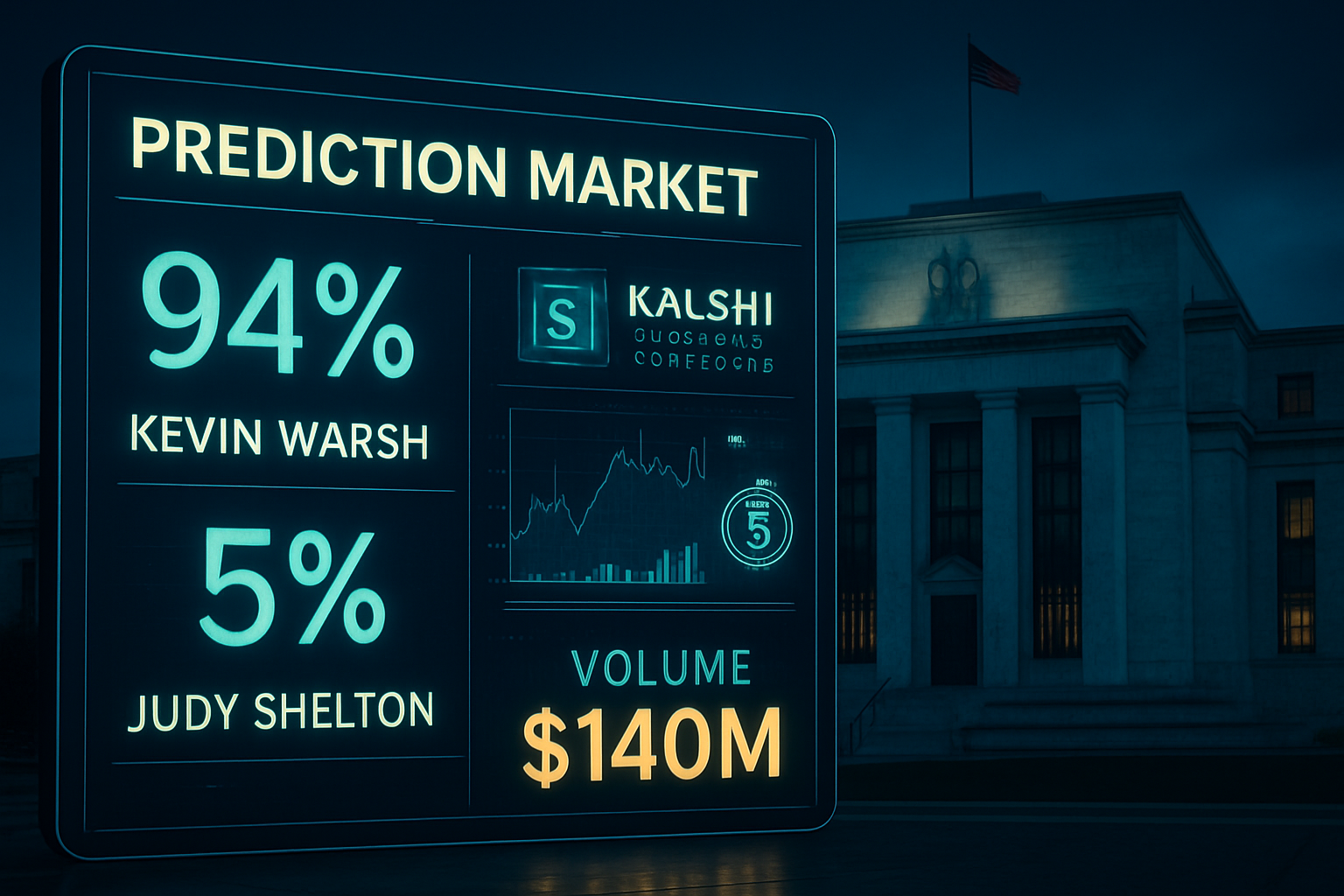
    The race to lead the world’s most powerful financial institution has moved from the boardrooms of Washington to the high-stakes arena of prediction markets. As of February 7, 2026, Kevin Warsh has emerged as the overwhelming favorite to succeed Jerome Powell as Chair of the Federal Reserve, commanding a staggering 94% probability on the prediction platform Kalshi. Meanwhile, the once-buzzy candidacy of sound-money advocate Judy Shelton has collapsed to a mere 5%, reflecting a market that is increasingly pricing in a "traditional-but-aligned" transition for the U.S. central bank.

    This market has become a focal point for institutional investors and political junkies alike, generating an unprecedented $140.8 million in total volume. The surge in activity underscores a growing reliance on event contracts to navigate the volatile intersection of monetary policy and presidential politics. With Jerome Powell’s term as Chair officially set to expire on May 15, 2026, the betting action is no longer just about who gets the job, but how quickly they can navigate a contentious Senate confirmation process.

    The Market: What's Being Predicted

    The primary battleground for this financial forecasting is Kalshi, the federally regulated prediction market that has seen its volume explode following its successful legal challenges against the CFTC. The specific contract, "Who will Trump nominate as Fed Chair?", has seen its liquidity deepen as the administration’s plans became clearer. While Robinhood Markets, Inc. (Nasdaq: HOOD) and Interactive Brokers Group, Inc. (Nasdaq: IBKR) have expanded their own event-trading offerings, Kalshi remains the epicenter for this specific $140.8 million pool of capital.

    The odds have undergone a dramatic shift over the last month. In late 2025, the market was a fragmented field with candidates like Kevin Hassett and Rick Rieder of BlackRock, Inc. (NYSE: BLK) holding significant shares. However, following President Trump’s official announcement on January 30, 2026, Kevin Warsh’s odds catapulted from 65% to the current 94%. Conversely, Judy Shelton, who traded as high as 20% in early January, saw her shares crater as the administration signaled a preference for Warsh’s "central casting" appeal.

    The resolution criteria for these contracts are tied to the formal nomination and, in secondary markets, the successful confirmation by the U.S. Senate. With the nomination now official, the focus of traders has shifted to the "Confirmation" contracts, which are currently trading at a slight discount to the nomination odds due to potential legislative friction.

    Why Traders Are Betting

    The 94% conviction in Warsh is driven by a combination of presidential endorsement and strategic political maneuvering. President Trump has publicly praised Warsh, stating he is a leader who "will never let you down." This endorsement was reportedly heavily influenced by Treasury Secretary Scott Bessent, who favored Warsh’s ability to maintain market stability while remaining more receptive to the administration's economic vision than the incumbent Powell.

    Traders are also closely watching the "shadow" surrounding Jerome Powell’s exit. A public DOJ investigation into Powell regarding alleged cost overruns in the $2.5 billion renovation of the Fed’s headquarters has provided significant tailwinds for the "Change" side of the market. Critics, including several prominent Democratic senators, have characterized the investigation as a political tool to pressure Powell, but for prediction market participants, the controversy simply hardens the reality that the Powell era is concluding.

    Meanwhile, Judy Shelton’s decline is attributed to a "flight to credibility" by the administration. While Shelton’s advocacy for the gold standard resonates with a specific segment of the base, institutional players—many of whom hedge their interest-rate exposure on these platforms—viewed her nomination as a potential source of "market jitters." The 5% odds remaining for her represent a "black swan" hedge in case the Warsh confirmation hits a fatal snag in the Senate Banking Committee.

    Broader Context and Implications

    The $140 million volume in the Fed Chair market represents a watershed moment for the prediction market industry. It proves that these platforms are no longer just for predicting election winners but are vital tools for pricing "policy risk." The sheer size of the pool suggests that major financial institutions are likely using these contracts to hedge against different interest rate regimes. If Warsh is seen as more "dovish" or more "aligned" with the White House, the prediction market acts as a leading indicator for the bond market.

    This market also reveals a shift in public sentiment regarding the independence of the Federal Reserve. By betting so heavily on a candidate praised for being "aligned" with the executive branch, traders are implicitly pricing in a future where the Fed’s "political independence" is more fluid than it has been in decades. This has significant real-world implications for the S&P 500 (SPX) and the broader global economy, as the Fed’s posture on inflation and employment is the primary driver of capital costs.

    Historically, prediction markets have often outpaced traditional pundits in identifying presidential favorites. In the 2024 cycle, these markets were significantly more sensitive to shift in momentum than traditional polling. The high confidence in Warsh suggests that despite potential Senate "holds," the market views his path to the 20th floor of the Eccles Building as nearly inevitable.

    What to Watch Next

    The next major catalyst for this market will be the Senate Banking Committee hearings, expected to begin in late February 2026. While Warsh has the numbers on paper, Senator Thom Tillis (R-NC) and several key Democrats have signaled they may place a "hold" on the nomination until more clarity is provided regarding the DOJ’s investigation into Powell. Any delay in the committee vote could see Warsh’s 94% odds dip toward the 80s as "process risk" increases.

    Key dates to monitor include:

    • Late February 2026: Opening of Senate Banking Committee hearings.
    • April 2026: The administration's target window for a full Senate confirmation vote.
    • May 15, 2026: The official expiration of Jerome Powell’s term as Chair.

    Should the DOJ investigation take an unexpected turn—either exonerating Powell or revealing deeper issues—the volatility in the "Confirmation" market will likely spike. Additionally, any public comments from Warsh regarding the "neutral rate" of interest will be scrutinized by traders looking to front-run the first FOMC meeting of the post-Powell era.

    Bottom Line

    The $140 million battle for the Fed Chairmanship has effectively been won by Kevin Warsh, at least in the eyes of the market. The 94% odds reflect a belief that the Trump administration has successfully cleared the path for its preferred candidate, combining political loyalty with a profile that the financial markets can digest. The collapse of Judy Shelton’s odds further suggests that while the administration seeks change, it is not yet ready for the radical structural shifts Shelton represents.

    As a tool, this market has demonstrated remarkable maturity. The high volume and tight spreads show that prediction markets are becoming a primary source of truth for high-stakes political appointments. For investors, the message is clear: the transition to "Warsh’s Fed" is the base case for the global economy in 2026.

    Whether Warsh can maintain the Fed’s delicate balance between fighting inflation and supporting the administration’s growth agenda remains to be seen. But for now, the "smart money" is betting $140 million that he is the man who will be tasked with trying.


    This article is for informational purposes only and does not constitute financial or betting advice. Prediction market participation may be subject to legal restrictions in your jurisdiction.

    PredictStreet focuses on covering the latest developments in prediction markets. Visit the PredictStreet website at https://www.predictstreet.ai/.
  • The FOMC Disconnect: Kalshi Traders Signal March Rate Cut as Macro Prediction Markets Explode

    The FOMC Disconnect: Kalshi Traders Signal March Rate Cut as Macro Prediction Markets Explode

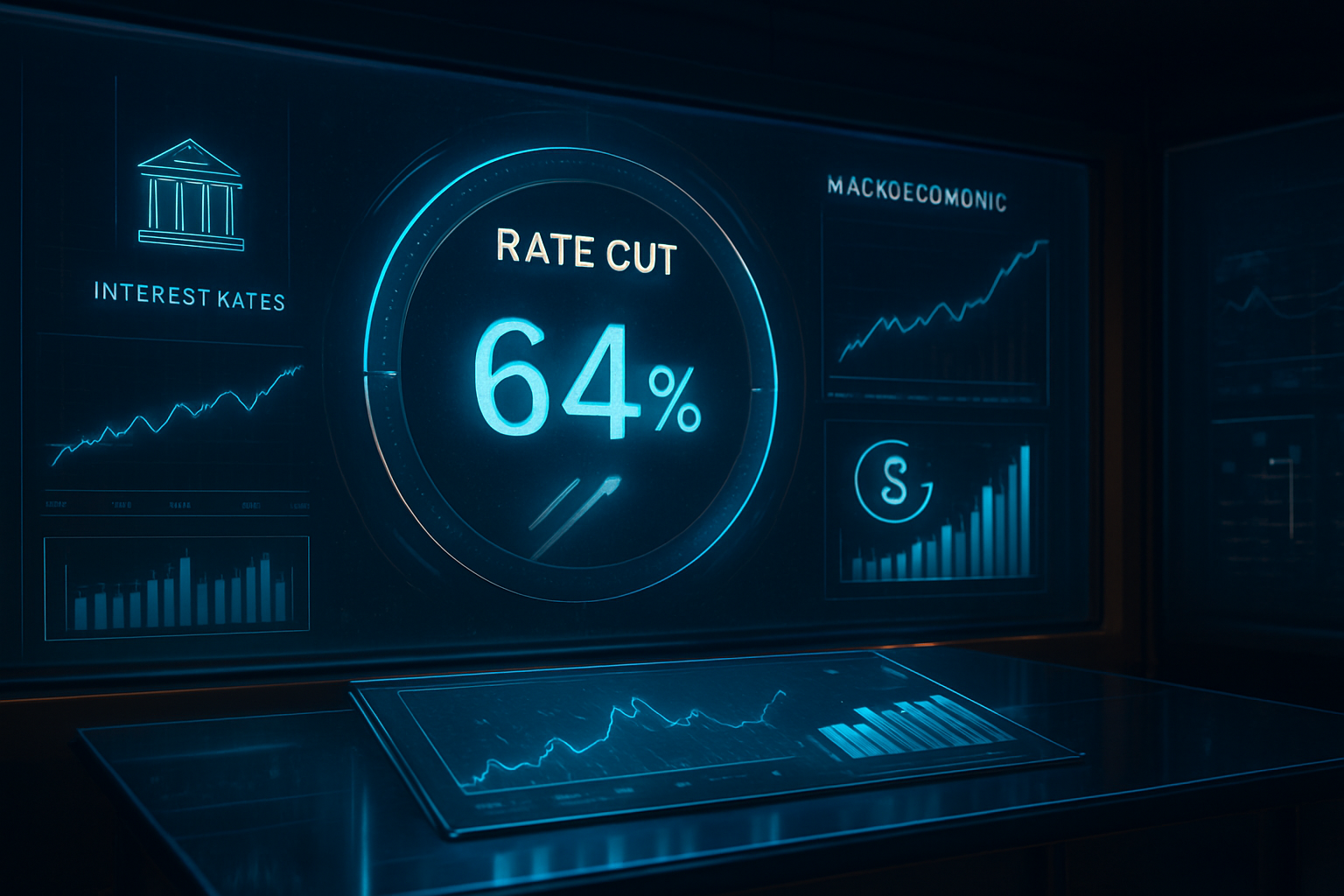
    As the Federal Reserve's March 2026 meeting approaches, a striking divergence has emerged between traditional financial instruments and the burgeoning world of "Information Finance." On Kalshi, the federally regulated prediction market, traders are increasingly convinced that the central bank will pivot toward easing. Currently, 64% of participants on the platform are betting on a 25-basis-point rate cut for the March 17-18 session, a stark contrast to the more conservative stance reflected in the broader bond market.

    This surge in activity is not merely speculative retail interest; it represents a fundamental shift in how macroeconomic risk is priced. With open interest on Kalshi’s Federal Reserve contracts exceeding $450 million as of February 5, 2026, these markets are no longer a sideshow. They have become a primary source of truth for hedge funds and high-frequency trading (HFT) firms, which are increasingly using these event contracts to hedge against policy shifts that traditional models often fail to capture in real-time.

    The Market: What's Being Predicted

    The focus of the financial world is currently fixed on the "March 2026 FOMC Target Rate" contract. Trading on Kalshi, the first CFTC-regulated prediction exchange, the market allows participants to buy "Yes" or "No" contracts on specific interest rate ranges. At the current 64% probability for a 25-basis-point cut, the price of a "Yes" contract sits at approximately $0.64, aiming for a $1.00 payout if the Fed lowers the target range from its current 3.5%–3.75% level.

    This volume is part of a broader explosion in prediction market liquidity. While Kalshi leads the regulated US space with its $450 million in open interest, Polymarket—which recently re-entered the US market after acquiring a CFTC-licensed clearinghouse—is seeing similar enthusiasm, with its March rate-cut contracts trading at an even more aggressive 71% probability. The scale of these markets is now rivaling the daily turnover of mid-cap equities, providing a level of depth that allows institutional players like Jump Trading and Susquehanna Government Products to execute large-scale positions without massive slippage.

    In comparison, the CME Group (NASDAQ: CME) FedWatch Tool, which derives its data from 30-Day Fed Funds Futures, is currently pricing in a much higher 90% probability that the Fed will hold rates steady. This massive 54% "spread" between prediction markets and traditional futures has created a lucrative arbitrage opportunity for algorithmic traders, who are using the Kalshi "oracle" to front-run movements in the Treasury market.

    Why Traders Are Betting

    The conviction among Kalshi traders is driven by a weakening labor market that has yet to be fully acknowledged by official Fed rhetoric. While Federal Reserve Chair Jerome Powell characterized economic activity as "solid" during the January 28 press conference, January’s employment data showed a significant cooling in job gains. Prediction market participants, who often prioritize "nowcasting" data over lagging government reports, are betting that the Fed will be forced to act to prevent a harder landing.

    Furthermore, the "Warsh Factor" is looming large over the market. President Trump’s nomination of Kevin Warsh to succeed Powell in May 2026 has introduced a new variable. Many traders believe the current board may want to "clear the deck" with a preemptive cut before the leadership transition begins, or that they are responding to subtle political pressure for more aggressive easing. Analysts at firms like JPMorgan Chase & Co. (NYSE: JPM) and Goldman Sachs (NYSE: GS) have remained cautious in their public notes, but the "skin-in-the-game" nature of Kalshi is telling a different story.

    Another factor is the rise of the "Synthetic Straddle." Institutional desks are reportedly buying "No" on a rate cut on Kalshi while simultaneously going long on interest-rate futures at the CME Group. This allows them to profit if the prediction market’s aggressive forecast proves correct, while hedging their exposure with traditional derivatives.

    Broader Context and Implications

    The surge in macroeconomic betting reflects the maturation of "InfoFi"—the intersection of information and finance. Major news networks have fully embraced this shift; CNBC (NASDAQ: CMCSA) recently integrated a live "Kalshi Ticker" into its daily broadcasts, acknowledging that these markets often move faster than the Bloomberg terminal in the wake of breaking news. When a probability shifts on Kalshi, it now frequently triggers multi-billion dollar trades in the S&P 500 (NYSEARCA: SPY) within milliseconds.

    The entry of major infrastructure players has also lent the sector a new level of legitimacy. The Intercontinental Exchange (NYSE: ICE), the parent company of the New York Stock Exchange, recently made a landmark $2 billion investment in prediction market infrastructure. This move signals that traditional exchanges view event contracts as a permanent and essential part of the modern financial stack, rather than a fleeting trend.

    However, regulatory hurdles remain. While Kalshi operates under federal oversight, Polymarket continues to face state-level challenges, including a recent temporary restraining order in Nevada. These legal battles highlight the ongoing tension between federal deregulation and state-level gaming concerns, even as the markets themselves become indispensable for risk management.

    What to Watch Next

    The primary catalyst for the next major movement in these odds will be the upcoming Consumer Price Index (CPI) release for January, scheduled for mid-February. If inflation continues its "sticky" trend near 2.7%, the 64% probability for a cut may retreat as traders fear the Fed will prioritize price stability over labor market support. Conversely, a sub-2.5% print could send the Kalshi odds north of 80%.

    Traders should also monitor the public appearances of Fed governors over the next three weeks. Any shift in tone toward a "risk-management" approach—a common euphemism for preemptive cuts—will likely be priced into Kalshi hours before it is reflected in the CME futures.

    Finally, the transition of the "Warsh nomination" through the Senate will be a key milestone. Any delays or complications in the confirmation process could inject volatility into the May and June 2026 contracts, which currently anticipate a rapid easing cycle once the new Chair takes the helm.

    Bottom Line

    The March 2026 FOMC meeting is shaping up to be a watershed moment for prediction markets. With $450 million at stake on Kalshi, the "wisdom of the crowd" is directly challenging the established wisdom of Wall Street’s largest banks and the CME Group’s traditional futures. The fact that 64% of traders are leaning toward a cut suggests a deeper anxiety about the labor market than official figures currently show.

    What we are witnessing is the birth of a more democratic, real-time economic forecasting tool. As hedge funds and HFT bots continue to bridge the gap between prediction markets and traditional assets, the distinction between "betting" and "investing" continues to blur. Whether or not the Fed actually cuts in March, the prediction markets have already won by providing a level of transparency and responsiveness that the financial world has never seen before.


    This article is for informational purposes only and does not constitute financial or betting advice. Prediction market participation may be subject to legal restrictions in your jurisdiction.

    PredictStreet focuses on covering the latest developments in prediction markets.
    Visit the PredictStreet website at https://www.predictstreet.ai/.
  • The $45 Billion Truth Engine: How Prediction Markets Became Wall Street’s New Standard

    The $45 Billion Truth Engine: How Prediction Markets Became Wall Street’s New Standard

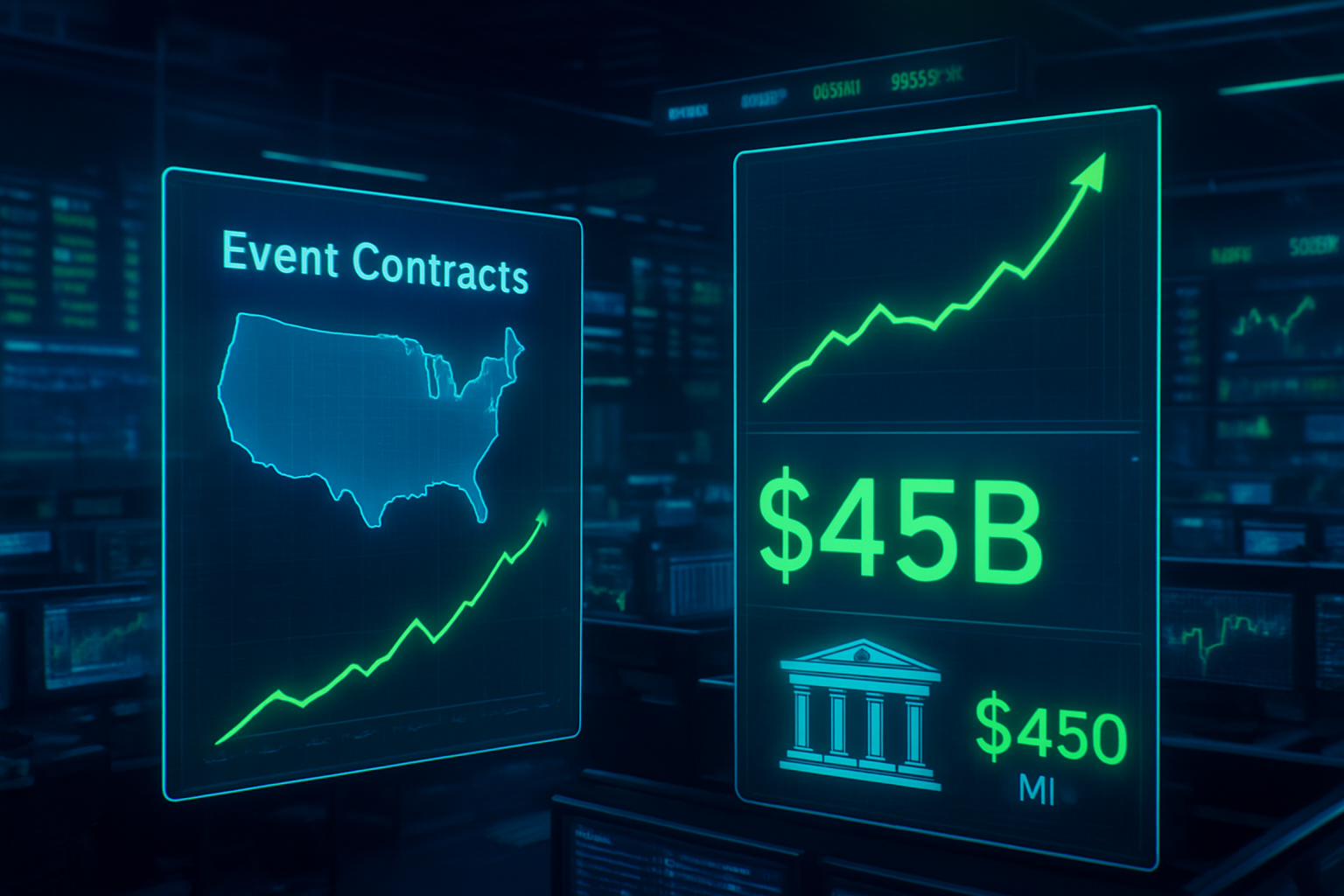
    The prediction market industry has officially shed its label as a niche corner of the internet for political junkies and sports bettors. As of early February 2026, the sector is celebrating a watershed moment: total trading volume surpassed a staggering $45 billion in 2025, a nearly five-fold increase from the previous year. This momentum shows no signs of slowing, with February 2026 on track to set a new monthly record for trading activity as retail and institutional investors pour into the space.

    At the heart of this explosion is the rise of the "Event Contract," a structured derivative that allows participants to trade directly on the outcome of real-world events. No longer viewed as mere gambling, these contracts have become a standard asset class. The primary driver of this month’s record volume is the Federal Reserve’s interest rate path, where the market for a potential March rate cut has ballooned to over $450 million in open interest. For many, these markets are no longer just a side bet—they are the most accurate real-time indicator of economic reality available.

    The Market: From $9 Billion to $45 Billion

    The scale of the prediction market industry has undergone a total transformation over the last 24 months. In 2024, the industry aggregate volume sat at approximately $9 billion, largely buoyed by the U.S. presidential election. However, 2025 proved that the appetite for event-based trading was not a one-off phenomenon. Total volumes for 2025 topped $44 billion, led by the regulated U.S. exchange Kalshi and the decentralized giant Polymarket.

    Kalshi, the first CFTC-regulated prediction market, saw its 2025 volume soar to $23.8 billion, representing an 1,108% increase year-over-year. Meanwhile, Polymarket, which saw Intercontinental Exchange (NYSE:ICE) take a 20% strategic stake late last year, contributed roughly $21.5 billion to the global total. These platforms have moved beyond political "who-will-win" scenarios into complex macro-economic hedging tools.

    Currently, the highest-liquidity market involves the Federal Open Market Committee (FOMC) meeting scheduled for March 17–18, 2026. After the Fed held rates steady at 3.5%–3.75% during their January 28 meeting, the prediction markets are now pricing in a 64% probability of a 25-basis-point cut in March. With nearly half a billion dollars at stake in this single contract, the liquidity now rivals that of traditional interest rate swaps.

    Why Traders Are Betting: The Search for "Settlement Certainty"

    The migration of capital into event contracts is driven by a fundamental shift in how traders perceive "truth." Unlike traditional equities or commodities, which can be influenced by sentiment, stock buybacks, or accounting nuances, event contracts settle based on objective, immutable data points—such as a press release from the Federal Reserve or a report from the Bureau of Labor Statistics.

    Professional traders are increasingly using these markets for macro hedging. For example, a portfolio manager heavily weighted in regional banks might buy "Yes" contracts on a Fed rate cut to hedge against the risk of prolonged high interest rates. This strategy has been validated by the entry of major financial institutions. Goldman Sachs Group Inc. (NYSE:GS) and CME Group Inc. (NASDAQ:CME) have both begun integrating event contract data into their proprietary trading stacks, treating them as "real-time truth engines."

    The current flurry of activity in February is fueled by a "data-heavy" calendar. While there is no FOMC meeting this month, the market is reacting violently to January’s employment data and CPI figures. Traders are no longer waiting for analyst notes from big banks; they are watching the shifting odds on Kalshi to see how the "wisdom of the crowd" interprets a hot inflation print in real-time.

    Broader Context and Implications

    The legitimization of prediction markets is the result of a hard-fought regulatory battle. The turning point occurred in late 2024 when a federal court ruled in favor of Kalshi, determining that election-based event contracts did not constitute "gaming" under the Commodity Exchange Act. This ruling paved the way for the CFTC, now under the pro-innovation leadership of Chairman Michael Selig, to withdraw its previous proposals to ban these markets.

    The implications of this shift are profound. Prediction markets are increasingly being used as the primary source of truth by mainstream media outlets. Partnerships between platforms and news giants like Bloomberg and CNBC have brought live probability tickers to millions of viewers. Furthermore, the integration of event contracts into retail platforms like Robinhood Markets Inc. (NASDAQ:HOOD) and Coinbase Global Inc. (NASDAQ:COIN) has democratized access to institutional-grade hedging tools.

    However, the path forward is not without friction. While federal regulators have eased their stance, several states continue to issue cease-and-desist orders, arguing that these contracts infringe on state-regulated gaming laws. The resolution of this state-versus-federal conflict will likely be the next major hurdle for the industry's expansion.

    What to Watch Next

    As we move through the remainder of February 2026, several key milestones will dictate whether the industry hits its projected record-breaking monthly volume. The release of the FOMC Minutes on February 18 will be a critical volatility catalyst, providing the "why" behind the January hold and potentially shifting the 64% probability of a March cut.

    Additionally, the Producer Price Index (PPI) data on February 27 will serve as the final major piece of the inflation puzzle before the Fed enters its pre-meeting blackout period in March. Market participants should also monitor the increasing "whale" activity on decentralized platforms, where single positions in the tens of millions are becoming more common, often signaling institutional repositioning.

    Bottom Line

    The rise of the prediction market industry from $9 billion to $45 billion in just two years marks one of the fastest adoption curves in the history of financial derivatives. By turning "information" into a tradable asset, these platforms have provided a level of price discovery that traditional markets often struggle to match.

    The $450 million currently sitting in Fed rate cut markets is a testament to the fact that "Event Contracts" are no longer an experiment; they are an essential component of the modern financial ecosystem. As more professional traders and retail investors embrace the transparency and settlement certainty of these markets, the $45 billion milestone of 2025 may soon look like just the beginning.


    This article is for informational purposes only and does not constitute financial or betting advice. Prediction market participation may be subject to legal restrictions in your jurisdiction.

    PredictStreet focuses on covering the latest developments in prediction markets.
    Visit the PredictStreet website at https://www.predictstreet.ai/.
  • Betting on the Pause: Prediction Markets Signal 99% Certainty for Fed Hold in January as Polymarket Volume Nears $500 Million

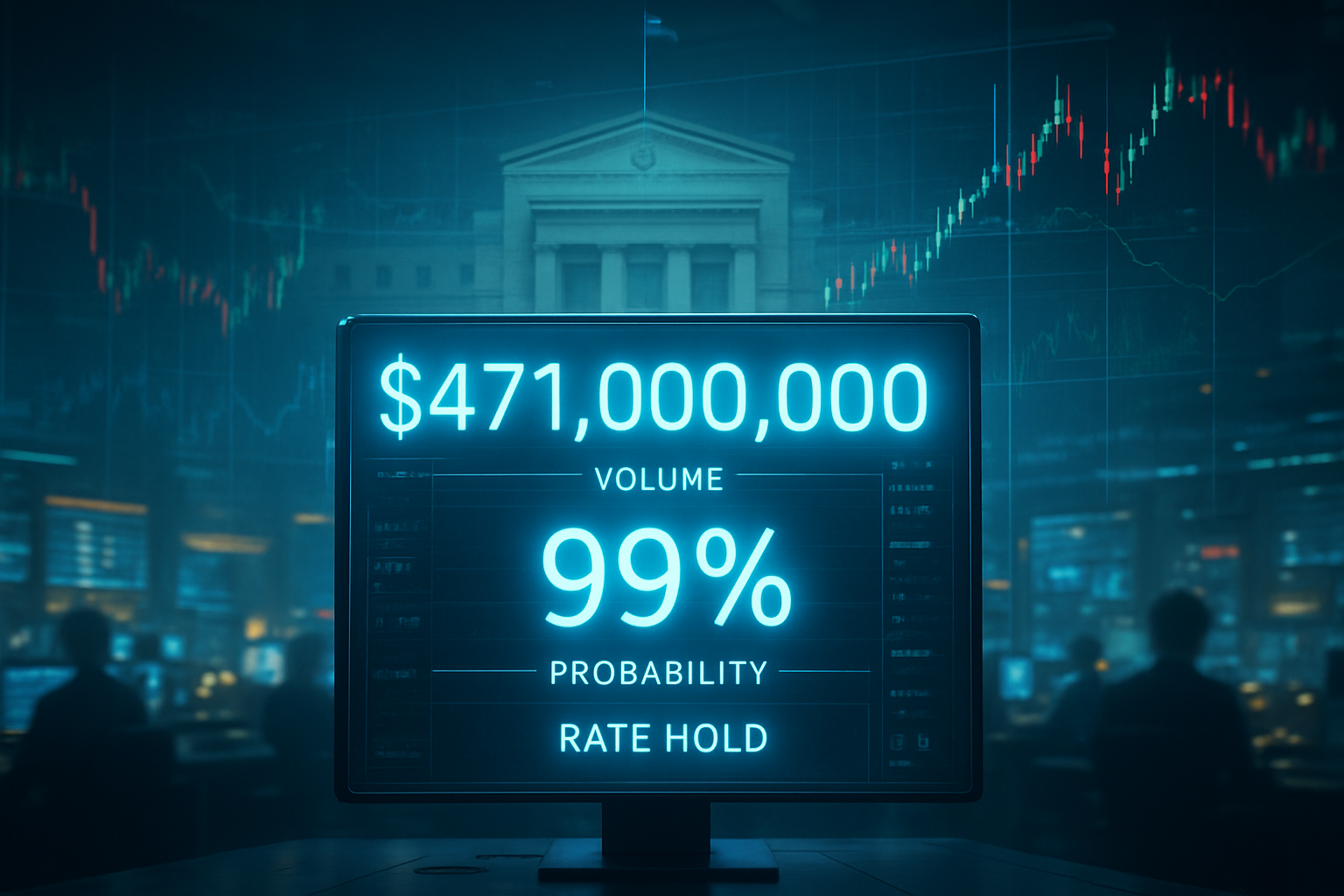
    Betting on the Pause: Prediction Markets Signal 99% Certainty for Fed Hold in January as Polymarket Volume Nears $500 Million

    With the first Federal Reserve meeting of 2026 just days away, prediction markets have reached a state of near-total consensus. Traders are placing massive bets that the Federal Open Market Committee (FOMC) will opt to keep interest rates steady at its January 27–28 meeting, halting the cycle of rate cuts that defined the latter half of 2025.

    The scale of the "hold" prediction is staggering, not just in its probability but in the capital backing it. On Polymarket, the world’s largest decentralized prediction platform, the volume for the January interest rate decision has surged to a massive $471 million. As of January 24, 2026, the market assigns a 99% probability to a "No Change" outcome, effectively pricing out any chance of a 25 or 50 basis point decrease, both of which are currently trading at 1% or less.

    The Market: What's Being Predicted

    The central question facing traders is whether the Fed will maintain the federal funds rate at its current range of 3.50%–3.75%. While traditional financial instruments like Fed Funds Futures have long been the gold standard for these forecasts, the rise of prediction markets has shifted the landscape. On Polymarket, the "Fed Interest Rate Decision: January 2026" contract has become one of the most liquid markets on the platform, drawing in hundreds of millions in volume from a global pool of retail and crypto-native participants.

    The conviction on Polymarket is slightly higher than that of institutional tools. For comparison, the FedWatch tool provided by the CME Group (NASDAQ: CME) currently shows a 95.4% chance of a hold and a 4.6% chance of a 25 basis point cut. While both indicate a high degree of certainty, the "99% club" on prediction markets suggests that speculators are even more convinced than the professional hedgers using CME’s futures contracts.

    Meanwhile, on the U.S.-regulated exchange Kalshi, the odds tell a similar story. Contracts for the Fed maintaining the current rate are trading at roughly 99 cents, reflecting a 99% implied probability. The liquidity on these platforms has become so deep that even large "whale" trades struggle to move the needle against the overwhelming tide of the "hold" consensus.

    Why Traders Are Betting

    The shift toward a definitive pause is driven by a complex "data-dependent" narrative that has become increasingly muddled. Throughout late 2025, the Fed enacted three consecutive rate cuts to support a cooling labor market. However, by the start of 2026, the economic picture began to blur. Core Personal Consumption Expenditures (PCE), the Fed’s preferred inflation metric, remains "sticky" at 2.8%—well above the 2% target.

    Traders are also reacting to the "data holes" created by a brief but disruptive government shutdown in late 2025. This shutdown delayed several key economic reports, leaving the Fed with incomplete information. Most market participants believe Chair Jerome Powell will prefer a "wait-and-see" approach rather than risk another cut while inflation remains stubborn and official data is unreliable.

    Furthermore, political risk is looming large over the central bank. With Jerome Powell’s term as Chair set to expire in May 2026, and rumors of potential replacements swirling in Washington, the FOMC is perceived to be in a defensive crouch. Traders are betting that the committee will avoid any bold policy moves that could be interpreted as politically motivated or overly aggressive during a sensitive transition period.

    Broader Context and Implications

    The $471 million volume on Polymarket is a testament to the growing institutionalization of prediction markets as a serious financial forecasting tool. These markets are often praised for their "wisdom of the crowd" effect, which can sometimes process breaking news—such as leaked political rumors or localized economic indicators—faster than traditional banking models.

    Historically, when prediction markets hit a 99% probability for a Fed decision this close to the meeting date, they are rarely wrong. However, the real-world implications of a hold are significant. A pause in January signals to the broader economy that the "easy money" era of late 2025 is over for now. This has direct consequences for mortgage rates, corporate borrowing costs, and the overall performance of the S&P 500 (NYSE: SPY).

    This market also highlights the regulatory evolution of the space. Following Kalshi’s legal victories against the CFTC in 2024 and 2025, prediction markets have moved from the fringe to the mainstream of political and economic forecasting. The fact that nearly half a billion dollars is being wagered on a single Fed meeting underscores the massive appetite for these direct-betting instruments.

    What to Watch Next

    As we approach the January 28 announcement, any sudden "Fed leak" or unexpected comment from a committee member could cause a late-stage tremor in the markets. Traders should keep a close eye on the "Statement" language. Even if the rate remains unchanged as expected, the "hawkish" or "dovish" tone of the accompanying text will set the odds for the next meeting in March.

    The most critical date to monitor is Wednesday, January 28, at 2:00 PM EST. The release of the FOMC statement will provide the ultimate resolution for these multi-million dollar contracts. Immediately following, at 2:30 PM, Chair Powell’s press conference will be scrutinized for clues regarding the Fed's stance on the 2.8% inflation floor and the upcoming leadership transition in May.

    Bottom Line

    The prediction markets have spoken: the January 2026 FOMC meeting is expected to be a non-event in terms of rate movements. The 99% probability of a hold across Polymarket and Kalshi represents a rare moment of total market unity, backed by nearly $500 million in skin-in-the-game.

    This level of certainty suggests that traders have fully absorbed the impact of sticky inflation and the data distortions from the recent government shutdown. While the "hold" itself may be predictable, the true value of these markets lies in their ability to quantify sentiment in real-time. As the Fed enters its "blackout period" before the meeting, these prediction markets remain the only living, breathing indicator of where the money is moving.


    This article is for informational purposes only and does not constitute financial or betting advice. Prediction market participation may be subject to legal restrictions in your jurisdiction.

    PredictStreet focuses on covering the latest developments in prediction markets. Visit the PredictStreet website at https://www.predictstreet.ai/.
  • Rick Rieder Surges to 60% Odds as Trump’s Preference for Next Fed Chair Crystallizes

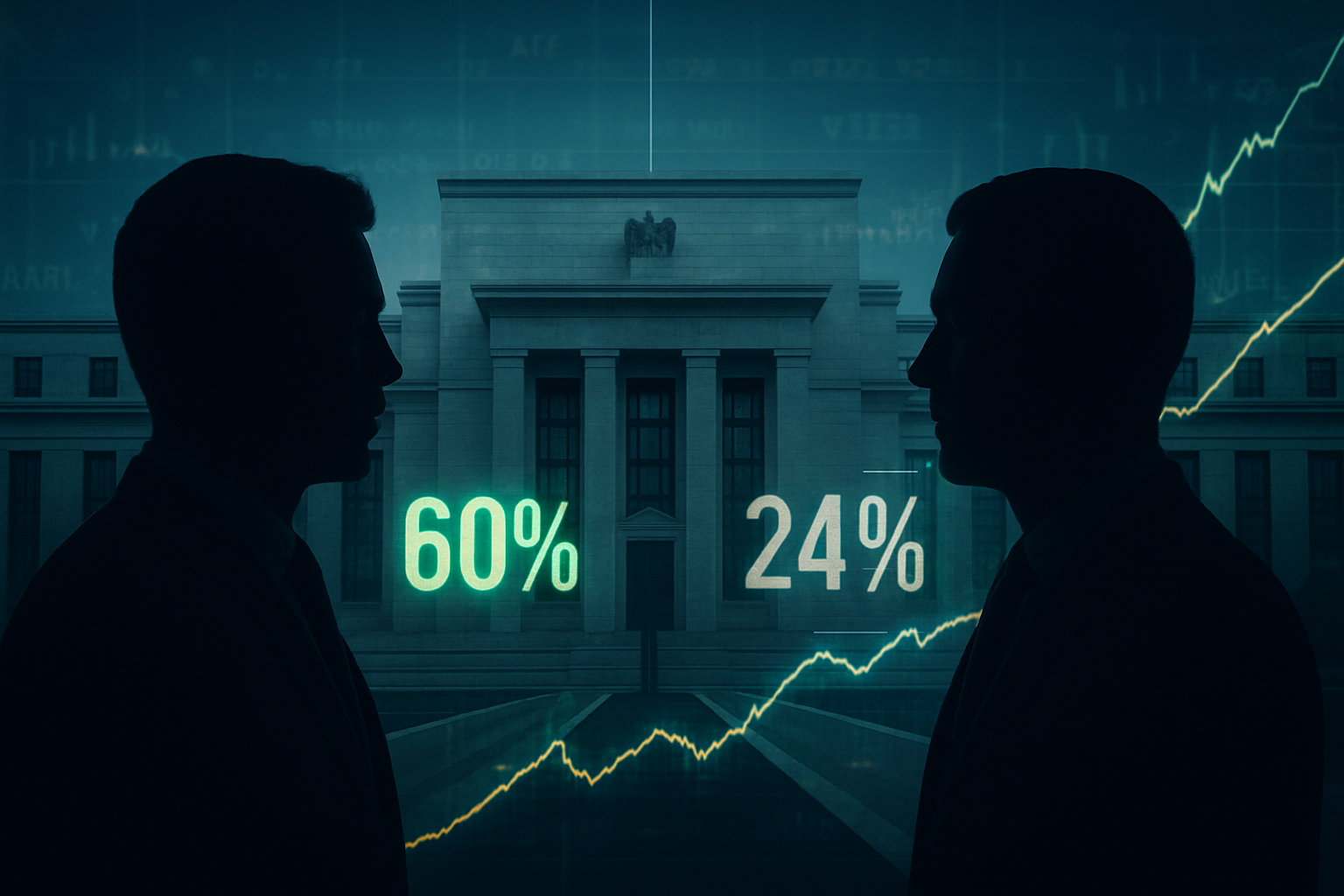
    Rick Rieder Surges to 60% Odds as Trump’s Preference for Next Fed Chair Crystallizes

    The race to lead the world’s most powerful central bank has reached a fever pitch in prediction markets, with a decisive shift in sentiment favoring Wall Street veteran Rick Rieder. As of January 24, 2026, Rieder, the Chief Investment Officer of Global Fixed Income at BlackRock Inc. (NYSE: BLK), has emerged as the clear frontrunner to succeed Jerome Powell, whose term is set to expire in May. While the race was previously a dead heat between various conservative economists, Rieder now commands a dominant 60% probability on major forecasting platforms, leaving former Federal Reserve Governor Kevin Warsh trailing in a distant second.

    This market movement reflects more than just speculation; it is the culmination of high-stakes political signaling from the White House. The surge in Rieder’s odds coincides with a massive influx of capital into these markets, as traders scramble to position themselves ahead of a formal announcement. With over $300 million in combined volume between decentralized and regulated platforms, the "Next Fed Chair" market has become the focal point of global macro trading in early 2026.

    The Market: What's Being Predicted

    The prediction markets for the next Federal Reserve Chair have seen unprecedented liquidity this cycle. On Polymarket, the leading decentralized prediction platform, total volume for the Fed Chair contract has surpassed $250 million. Simultaneously, Kalshi, the U.S.-regulated exchange, has seen its volume climb to $55 million. The sheer scale of these markets suggests that institutional players and professional "political hunters" are using these contracts to hedge against potential shifts in monetary policy.

    Current odds across both platforms are remarkably aligned:

    • Rick Rieder: 60%
    • Kevin Warsh: 23-24%
    • Christopher Waller: 10%
    • Kevin Hassett: 5-7%

    The contract resolution is tied specifically to the official nomination by President Trump and subsequent confirmation or a formal announcement designated as the "intended nominee." Historically, these markets have traded with high volatility, but the recent consolidation around Rieder represents the first time a single candidate has held a supermajority probability since the speculation began in late 2025.

    Why Traders Are Betting

    The primary catalyst for the "Rieder Rally" was a strategic pivot by President Trump regarding his economic team. For much of late 2025, Kevin Hassett, the Director of the National Economic Council (NEC), was the betting favorite. However, Trump’s public insistence that Hassett is "too good on television" to be moved from the NEC essentially eliminated him from the running.

    Traders jumped on this "Hassett Pivot" to find the President's next preferred candidate. While Kevin Warsh briefly surged to 60% odds last week, the momentum shifted toward Rieder following a series of high-profile signals:

    1. Trump’s CNBC Endorsement: In a mid-January interview, the President praised Rieder’s "market-based judgment" and labeled him a "reformer" who understands the "true cost of debt."
    2. The Housing Factor: Rieder has been vocal about the need for the Fed to aggressively target mortgage rates to stimulate housing affordability—a key pillar of the current administration’s economic rhetoric.
    3. Hassett’s "Kingmaker" Move: Kevin Hassett himself recently described Rieder as "the best bond guy in the world," signaling that the President’s inner circle has reached a consensus.

    Whale activity on Polymarket suggests that several large-scale bettors moved seven-figure positions out of Warsh and into Rieder following these endorsements, viewing Rieder as the "outsider" candidate that Trump typically favors over "Washington insiders" like Warsh or Waller.

    Broader Context and Implications

    The dominance of Rick Rieder in these markets marks a potential shift in the Federal Reserve’s philosophy. Unlike previous chairs, Rieder would come directly from the heart of the private sector, specifically from BlackRock Inc. (NYSE: BLK), rather than from academia or a long-standing legal career. Prediction market participants are effectively betting that the Fed under Rieder would be more reactive to market conditions and perhaps more aggressive in cutting rates to accommodate fiscal expansion.

    Furthermore, this market highlights the increasing utility of prediction platforms like Kalshi and Polymarket as real-time barometers for political appointments. Traditional news outlets have been slower to catch the shift, often still reporting Warsh as the "likely" pick based on 2017-era precedents. However, the "wisdom of the crowd" in prediction markets has proven highly sensitive to the specific populist and market-driven rhetoric emerging from the Trump administration in 2026.

    The legal and regulatory backdrop also looms large. As Kalshi and other platforms fight to maintain their status in the U.S. regulatory landscape, the high volume and accuracy of the Fed Chair market serve as a powerful case study for their role in price discovery for political risk.

    What to Watch Next

    The window for a formal nomination is narrowing. With Jerome Powell’s term ending in May, President Trump is expected to make an announcement by the end of January or early February to allow for a smooth Senate confirmation process. Traders should keep a close eye on any "trial balloon" tweets or comments regarding the ongoing DOJ investigations into the Fed’s internal operations, which Trump has used as a justification for an early transition.

    A sudden drop in Rieder’s odds would likely only occur if a "dark horse" candidate—such as a surprise pick from a different major financial institution—emerges during one of the President's weekend meetings at Mar-a-Lago. Conversely, if the administration confirms that Rieder has met with the Senate Finance Committee, his odds could easily climb toward 80% or 90% before the official press release.

    Bottom Line

    As of January 24, 2026, the prediction markets have spoken: the "Warsh Era" that many expected has been eclipsed by the "Rieder Surge." With 60% odds and massive volume backing him, Rick Rieder is the clear market favorite to become the next Chair of the Federal Reserve.

    This shift tells us that traders are prioritizing "outsider" status and market expertise over traditional central banking credentials. While Kevin Warsh remains a viable backup at 24%, the alignment of Trump’s public praise and Hassett’s endorsement has created a powerful narrative that Rieder is the intended nominee. For those watching the future of American monetary policy, the prediction markets aren't just reflecting reality—they are increasingly the most reliable signal we have.


    This article is for informational purposes only and does not constitute financial or betting advice. Prediction market participation may be subject to legal restrictions in your jurisdiction.

    PredictStreet focuses on covering the latest developments in prediction markets.
    Visit the PredictStreet website at https://www.predictstreet.ai/.
  • The New Yield Curve: Why Wall Street is Now Following Prediction Markets for Fed and CPI Guidance

    The New Yield Curve: Why Wall Street is Now Following Prediction Markets for Fed and CPI Guidance

    As the Federal Reserve prepares for its first policy meeting of 2026 on January 27–28, a significant shift has occurred in how the financial world anticipates interest rate decisions. The traditional dominance of professional economic surveys and even standard bond-market derivatives is being challenged by prediction markets like Kalshi and Polymarket. For the upcoming January FOMC meeting, prediction markets are currently pricing a "no change" decision with an overwhelming 96% probability, firmly pegging the federal funds rate at its current 3.50%–3.75% range.

    This decisive certainty stands in subtle contrast to traditional instruments. While the CME FedWatch tool, operated by CME Group (NASDAQ: CME), reflects a still-significant 16% chance of a rate cut, prediction market traders have almost entirely written off the possibility of a January move. This divergence is not an anomaly; over the past eighteen months, prediction markets have consistently outpaced institutional forecasts in both speed and accuracy, forcing major players like Goldman Sachs (NYSE: GS) and JPMorgan Chase (NYSE: JPM) to integrate these platforms into their primary research dashboards.

    The Market: What's Being Predicted

    The focus of the current forecasting cycle centers on the "Fed Path" and monthly Consumer Price Index (CPI) data. On Kalshi, a federally regulated exchange, the "January Fed Meeting" contract has seen record-breaking participation from institutional traders. Meanwhile, the decentralized platform Polymarket has seen its January Fed decision volume exceed $425 million, as global participants bet on everything from the specific basis point move to the exact wording used in Chair Jerome Powell’s final few press conferences before his term expires in May.

    Unlike traditional surveys, which provide a "snapshot" of economist sentiment once a month, these markets trade 24/7. This allows them to react instantaneously to breaking news—such as the early January 2026 labor data that showed unemployment stabilizing at 4.5%. While traditional analysts were still revising their notes, prediction market odds for a January "hold" surged from 85% to 96% within minutes of the data release. These markets don't just predict the outcome; they predict the brackets of the outcome, with contracts available for specific CPI increments (e.g., "Will CPI be between 2.6% and 2.7%?").

    Why Traders Are Betting

    The migration of capital toward prediction markets is driven by the concept of "Information Finance." Traders argue that these platforms offer a "truth engine" fueled by "skin in the game." Unlike a bank economist whose compensation is rarely tied directly to the accuracy of a single CPI forecast, a prediction market participant faces an immediate financial loss if they are wrong. This financial incentive filters out the "herding" behavior often seen in institutional forecasts, where analysts are frequently hesitant to deviate too far from the consensus.

    Recent history has validated this approach. In late 2024, Kalshi research demonstrated that their market-based CPI forecasts had a 40.1% lower Mean Absolute Error (MAE) than the Wall Street consensus. When "inflation shocks" occurred—moments where data deviated significantly from expectations—the prediction markets' error was nearly 67% lower than that of professional economists. Wall Street has taken note; firms like Jane Street and Susquehanna International Group have established dedicated desks to arbitrage discrepancies between prediction market odds and traditional interest rate swaps.

    Broader Context and Implications

    The institutionalization of these markets reached a fever pitch in late 2025 when the Intercontinental Exchange (NYSE: ICE), the parent company of the New York Stock Exchange, announced a landmark $2 billion investment in Polymarket. This move signaled that prediction markets are no longer considered "niche betting sites" but are essential financial infrastructure. The utility of these markets extends beyond interest rates; they have become the premier venue for pricing geopolitical risk.

    A recent example of this was the "Maduro Incident" in early January 2026. While mainstream news wires were still verifying reports of a political shift in Venezuela, prediction markets were already repricing global energy costs and interest rate expectations. By the time the news hit the Bloomberg (Private) terminals, the odds of a "hawkish hold" by the Fed had already moved, as traders anticipated the inflationary impact of potential oil supply disruptions. This ability to aggregate disparate, global information in real-time is what makes these platforms indispensable in 2026.

    What to Watch Next

    As we move toward the January 28 FOMC announcement, all eyes remain on the "sticky" PCE inflation data, currently hovering around 2.7%. If the prediction markets hold their 96% conviction of a "pause," any deviation by the Fed would trigger a massive "repricing event" across all asset classes. Traders are also looking toward the March 17-18 meeting, where the odds are currently split: a 79% probability of another hold versus a growing sentiment for a 25-basis-point cut if labor markets show further cooling.

    Beyond the immediate rate decisions, the next major milestone is the nomination of the next Federal Reserve Chair. Prediction markets currently give a 61% probability that the administration will nominate a candidate with a "higher-for-longer" bias, a sentiment that is already beginning to flatten the yield curve in the prediction space for the latter half of 2026. These leadership markets are moving with more fluidity than any political punditry, reflecting real-time shifts in the Washington, D.C. power dynamic.

    Bottom Line

    Prediction markets have fundamentally changed the "alpha" equation for economic forecasting. By providing a 24/7, high-liquidity environment where information is priced instantly, they have exposed the lag inherent in traditional economic models. The 40% accuracy advantage over Wall Street consensus is no longer a statistical fluke—it is a testament to the power of decentralized, incentivized data aggregation.

    For the retail investor and the institutional titan alike, the message is clear: the most accurate "yield curve" in 2026 is no longer found solely in the bond market. It is found in the fluctuating odds of the prediction exchanges. As we approach the end of January, the 96% "hold" consensus on Kalshi and Polymarket suggests that the Fed’s path is already priced in, leaving the "surprises" to those who are still relying on yesterday’s surveys.


    This article is for informational purposes only and does not constitute financial or betting advice. Prediction market participation may be subject to legal restrictions in your jurisdiction.

    PredictStreet focuses on covering the latest developments in prediction markets.
    Visit the PredictStreet website at https://www.predictstreet.ai/.
  • The Death of the Lagging Indicator: How Prediction Markets Became the Fed’s New Crystal Ball

    The Death of the Lagging Indicator: How Prediction Markets Became the Fed’s New Crystal Ball

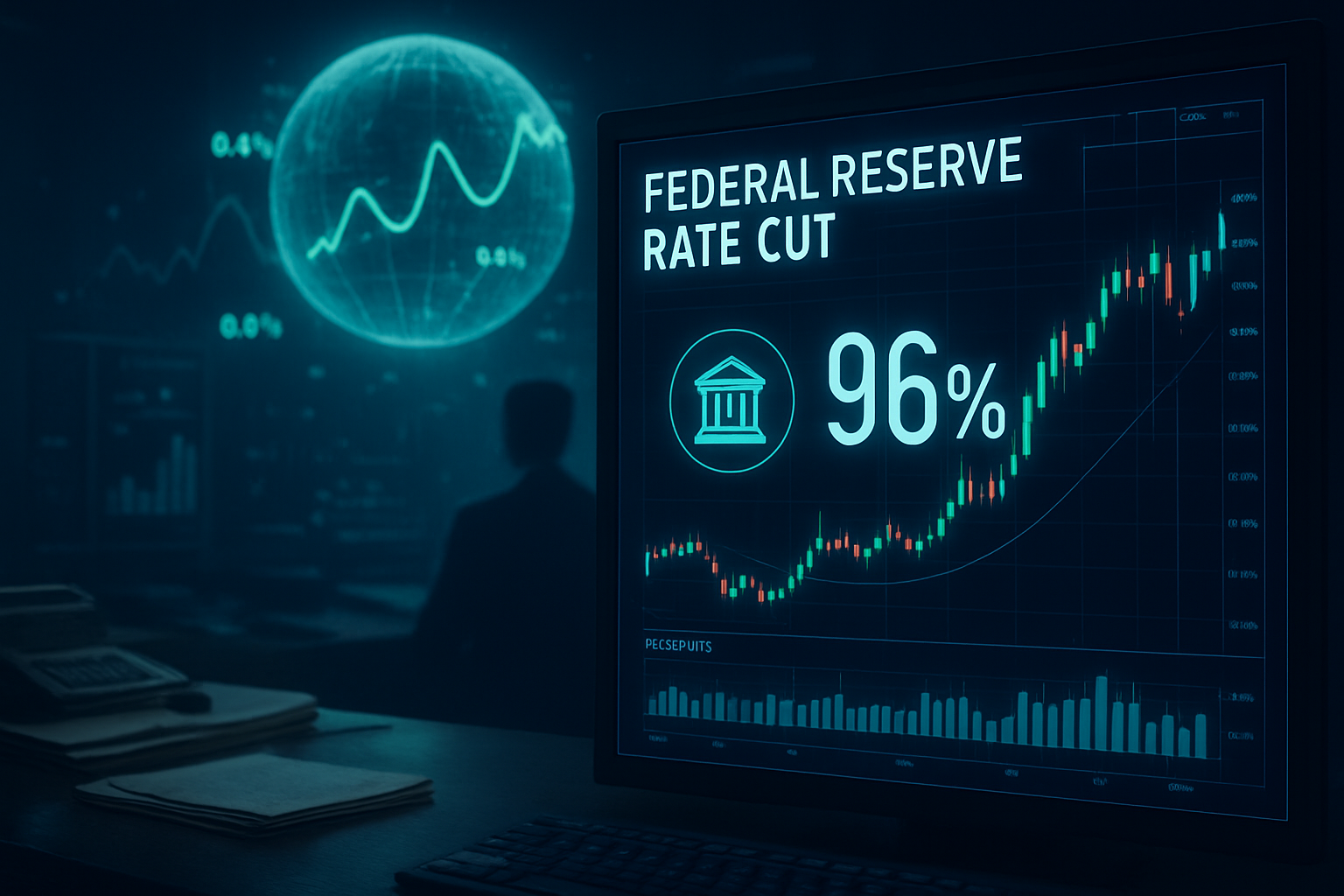
    As of mid-January 2026, a fundamental shift has occurred in how Wall Street and Main Street digest economic reality. For decades, the Federal Reserve Bank of New York’s "Nowcast" and other lagging indicators were the gold standard for tracking the economy in real-time. But as the dust settles on the Federal Reserve's December 2025 meeting, it is clear that the torch has been passed to prediction markets. On the morning of the rate decision, while traditional models were still debating the nuances of "sticky inflation," the crowd on Kalshi and Polymarket had already priced in a 25-basis-point cut with a staggering 96% and 97% probability, respectively.

    This isn't just about a single rate cut; it's about the emergence of "Information Finance." Traders are no longer waiting for the Bureau of Labor Statistics (BLS) or the Fed’s Summary of Economic Projections to tell them where the economy is—they are using prediction markets to tell the Fed what the economy needs. With daily volumes on platforms like Kalshi hitting record highs of $700 million this month, these markets have evolved from speculative curiosities into the most sensitive macro indicators in the global financial toolkit.

    The Market: What's Being Predicted

    The focal point of macro forecasting in late 2025 was the FOMC meeting on December 10. While the Federal Reserve had already initiated a cutting cycle earlier in the year, the "higher for longer" narrative still had its adherents among traditional bank analysts. However, the prediction markets told a different story. On Kalshi, a federally regulated exchange, the "Will the Fed cut rates in December?" market saw liquid interest that eventually consolidated into a 96% "Yes" conviction. Simultaneously, the decentralized giant Polymarket saw its odds for a 25-basis-point cut climb from 70% in mid-November to 97% by the morning of the announcement.

    The scale of this activity is unprecedented. Total wagering on the December Fed outcome exceeded $348 million on Polymarket alone, while Kalshi reported $15.8 million in volume specifically for its Fed decision contracts. These markets are settled based on the official announcement from the Federal Reserve Board of Governors. Unlike the CME FedWatch tool, operated by CME Group (NASDAQ: CME), which is derived from Fed Funds futures and often reflects the hedging needs of large institutions, prediction markets like Kalshi allow a more diverse set of participants—from retail speculators to economic researchers—to express a "pure" directional view on policy.

    Why Traders Are Betting

    The primary driver behind the 96% conviction for a December cut was the "wisdom of the crowd" reacting to real-time labor data. While the NY Fed’s Nowcast model was projecting a resilient Q4 GDP growth of 2.7%, prediction market traders focused on the "cracks in the foundation"—specifically a tick upward in unemployment to 4.5% in November. Traders betting on these platforms are often processing information 15 to 30 minutes faster than traditional news wires like Reuters, as every new data point, from jobless claims to retail sales, is immediately reflected in the contract price.

    Furthermore, the strategy has shifted from speculation to institutional hedging. Large funds are now using prediction markets to "de-risk" their portfolios ahead of Fed meetings. Because these contracts are binary (either the Fed cuts or it doesn't), they offer a more precise hedge than Treasury futures or the S&P 500. This has led to massive "whale" activity; in the final week of 2025, several multi-million dollar positions were spotted on Polymarket, betting that the Fed would prioritize labor stability over the final inch of the 2% inflation goal. This collective intelligence proved superior to traditional models, which remained "data-dependent" and arguably too slow to catch the dovish pivot.

    Broader Context and Implications

    The success of prediction markets in 2025 has led to their formal integration into the financial establishment. In a landmark move, both Google Finance, owned by Alphabet Inc. (NASDAQ: GOOGL), and Bloomberg Terminals began incorporating real-time odds from Kalshi and Polymarket into their macro dashboards in early 2026. This mainstreaming follows a banner year for Kalshi, which reported a staggering $23.8 billion in total volume for 2025—a 1,100% increase year-over-year. Even traditional brokerages like Interactive Brokers (NASDAQ: IBKR) have entered the fray with their own forecasting platforms, signaling that the demand for "event-based" trading is here to stay.

    However, the regulatory landscape remains a complex patchwork. While Kalshi won a major legal victory in January 2026, securing emergency relief against state-level cease-and-desist orders in Tennessee, the broader federal framework is still in limbo. The Digital Asset Market Clarity Act (CLARITY Act), intended to define the jurisdiction of the CFTC and SEC over these markets, has stalled in the U.S. Senate. According to current Polymarket odds, there is only a 41% chance the bill passes in 2026. This regulatory uncertainty hasn't dampened volume, but it has created a "fragmented battleground" where some states attempt to classify these markets as unregulated gambling, while federal courts increasingly view them as vital economic tools.

    What to Watch Next

    As we move into the first quarter of 2026, the market has shifted its focus to the "Sahm Rule"—a historically reliable indicator that a recession has begun when the three-month moving average of the unemployment rate rises by 0.50 percentage points or more relative to its low during the previous 12 months. With unemployment hitting 4.6% in January, prediction markets are currently pricing in a 65% chance of a formal recession declaration by the NBER before the end of the year. This is significantly more bearish than the "soft landing" consensus still held by many traditional bank economists.

    Investors should also keep a close eye on the February 2026 FOMC meeting. Current odds on Kalshi suggest a 55% probability of a "pause," as the Fed assesses the impact of its 2025 cuts. Any deviation in these odds following the next Consumer Price Index (CPI) release will be the first signal of whether the Fed intends to continue its dovish trajectory or if the "last mile" of inflation will force a defensive stance. The ability of these markets to front-run official policy will be tested yet again as the CLARITY Act's fate in the Senate becomes clearer by mid-year.

    Bottom Line

    The events of the past year have proven that prediction markets are no longer just a "side show" for political junkies. By accurately nailing the 96% probability of the December 2025 rate cut while traditional models were still lagging, these platforms have established themselves as the ultimate macro indicators. They provide something that a GDP Nowcast cannot: a real-time, incentivized consensus on the future, rather than a polished report on the past.

    For the modern investor, ignoring prediction market data is becoming as risky as ignoring the 10-year Treasury yield. As volume continues to migrate from traditional futures to these transparent, binary markets, the "wisdom of the crowd" is becoming the primary driver of price discovery in the global economy. Whether the Fed likes it or not, the market isn't just watching them anymore—it’s frequently one step ahead of them.


    This article is for informational purposes only and does not constitute financial or betting advice. Prediction market participation may be subject to legal restrictions in your jurisdiction.

    PredictStreet focuses on covering the latest developments in prediction markets.
    Visit the PredictStreet website at https://www.predictstreet.ai/.
  • Hedging the Real World: How Traders are Using ‘Information Finance’ to Insure Against Economic Shocks

    Hedging the Real World: How Traders are Using ‘Information Finance’ to Insure Against Economic Shocks

    As of January 16, 2026, the global financial landscape has undergone a silent revolution. The speculative fever that once characterized prediction markets during election cycles has matured into a sophisticated infrastructure for risk management. Today, traders are no longer just betting on outcomes; they are using platforms like Kalshi and Polymarket to hedge against the very economic forces that threaten their livelihoods—from the Federal Reserve’s interest rate decisions to the recurring threat of a U.S. government shutdown.

    The current market sentiment reflects a high-stakes waiting game. With a critical Federal Open Market Committee (FOMC) meeting less than two weeks away and a looming "shutdown cliff" on January 31, volume in economic event contracts has surged to record highs. On Kalshi, the flagship "Fed Rate Decision" market has become a primary liquidity pool for retail and institutional traders alike, offering a real-time, 24/7 alternative to the traditional CME FedWatch Tool.

    The Market: What's Being Predicted

    The focus of the prediction market community has sharpened on three primary economic pillars. First is the Federal Reserve's January 28 meeting. Traders on Kalshi currently place a 95% probability on a "Pause," keeping rates steady. However, the real action is in the March 2026 meeting contract, which has seen over $120 million in volume. This market currently prices a 42% chance of a 25-basis-point cut, a significant shift from just two weeks ago when odds favored a continued hold.

    Inflation remains the second major battleground. Following the December 2025 CPI print of 2.7%, Polymarket users are actively trading 2026 inflation caps. Currently, there is a 30% probability being priced in for inflation to rebound and stay above 3% for the duration of the year. Unlike traditional inflation swaps, these contracts are accessible with as little as $1, allowing individual investors to lock in "inflation insurance" for their cost-of-living expenses.

    Finally, the political risk of a government shutdown has returned to the forefront. As the January 31 funding deadline approaches, the "Will the government shut down?" contract on Kalshi is trading at 37 cents (37% probability). This market has gained immense credibility after traders accurately predicted the exact 43-day duration of the late 2025 shutdown, providing a more reliable signal than the conflicting reports coming out of Washington D.C.

    Why Traders Are Betting

    The surge in participation is driven by a fundamental shift in how markets perceive "Information Finance." This concept, championed by Ethereum co-founder Vitalik Buterin, posits that prediction markets are more than just betting hubs; they are "truth engines." Because participants have "skin in the game," the price of a contract reflects a distilled, incentivized consensus that often cuts through the noise of partisan pundits and TV economists.

    Traders are utilizing these markets for practical, real-world hedging. For example:

    • Mortgage Protection: Homeowners looking to refinance in the spring are buying "No" contracts on a March rate cut. If the Fed remains hawkish and rates stay high, the payout from the prediction market helps offset the higher monthly mortgage interest.
    • Business Liquidity: Government contractors and retailers like Albertsons Companies, Inc. (NYSE: ACI), which can see fluctuations in SNAP-related revenue during fiscal disruptions, are using shutdown contracts as a form of "business interruption insurance."
    • Portfolio Insurance: Investors holding tech-heavy portfolios—highly sensitive to interest rates—are hedging their exposure through CPI contracts. If inflation comes in "hot," the gains from their prediction market positions cushion the blow to their equity holdings in companies like Robinhood Markets, Inc. (NASDAQ: HOOD) or Interactive Brokers Group, Inc. (NASDAQ: IBKR).

    Broader Context and Implications

    This trend represents the mainstreaming of event contracts as a legitimate asset class. The institutional validation of these markets reached a milestone in late 2025 when the Intercontinental Exchange (NYSE: ICE)—the parent company of the New York Stock Exchange—announced significant infrastructure investments into prediction market data feeds. This has allowed for "conditional markets" to flourish, where traders can hedge complex scenarios, such as "What will the S&P 500 do if the CPI exceeds 3%?"

    Furthermore, the regulatory environment has stabilized. Following years of legal skirmishes, prediction markets are now largely viewed as a necessary tool for price discovery. The historical accuracy of these platforms—often leading traditional polling and economic models by days or weeks—has made them indispensable for corporate treasurers and risk managers. In 2026, the consensus is clear: if you want to know what the Fed will do, don’t watch the press conference; watch the Kalshi order book.

    What to Watch Next

    The next 15 days will be a crucible for these markets. The January 28 FOMC meeting will be the first major test of 2026. If the "Pause" holds as predicted, all eyes will immediately pivot to the March contract, where any deviation from the current 42% probability for a cut will signal a major shift in the Fed's "neutral rate" philosophy.

    Following closely is the January 31 government funding deadline. If the odds of a shutdown climb toward 50% in the final 72 hours, expect a spike in volatility across broader equity markets. Traders should also monitor the release of the next CPI "teaser" data, as the prediction markets for inflation are currently very sensitive to any signs of a "second wave" of price increases.

    Bottom Line

    The rise of prediction markets in early 2026 marks the end of an era where economic forecasting was the exclusive domain of elite institutions and academic models. Through "Information Finance," the collective intelligence of thousands of traders is providing a real-time, high-fidelity map of our economic future.

    For the average participant, these markets have transitioned from a hobby into a utility. Whether it is a federal employee hedging their paycheck against a shutdown or a retail investor protecting their savings from inflation, the ability to trade directly on the outcomes of world events has changed the nature of financial security. As we head into a pivotal February, these markets won't just be predicting the news—they will be the most important financial news on the ticker.


    This article is for informational purposes only and does not constitute financial or betting advice. Prediction market participation may be subject to legal restrictions in your jurisdiction.

    PredictStreet focuses on covering the latest developments in prediction markets.
    Visit the PredictStreet website at https://www.predictstreet.ai/.