Tag: Fed

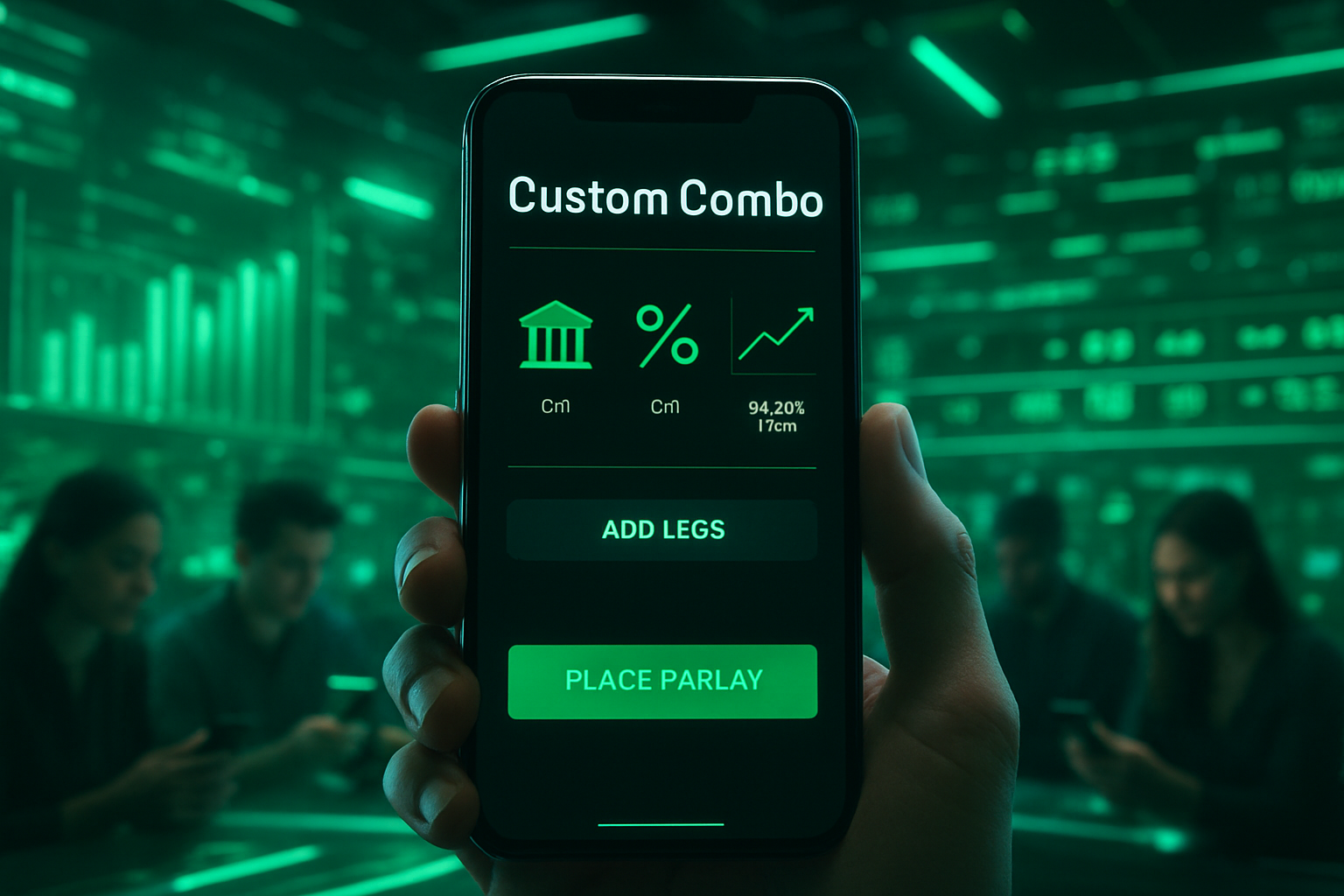
  • Gamifying the Fed: Robinhood’s ‘Custom Combos’ Turn Macroeconomics into the Ultimate Parlay

    Gamifying the Fed: Robinhood’s ‘Custom Combos’ Turn Macroeconomics into the Ultimate Parlay

    As the clock ticks toward the February Consumer Price Index (CPI) release, a new kind of "game day" ritual is taking over the morning routines of young investors. Forget the NFL playoffs or the NBA finals—for the 24 million active users on Robinhood (NASDAQ: HOOD), the most exciting play of the season is the "Macro Stack."

    In January 2026, Robinhood officially launched its "Custom Combos" feature, a revolutionary addition to its Prediction Markets Hub that allows users to bundle up to 10 different event outcomes into a single, high-leverage contract. With the potential for payouts exceeding 40-to-1 on "Goldilocks" economic scenarios, the feature is effectively gamifying macroeconomics for a demographic that treats Jerome Powell’s press conferences with the same fervor as a Super Bowl halftime show. Currently, the market is pricing in a 91% probability that the Federal Reserve will hold rates steady in March, but the real action lies in the "long-shot parlays" where traders are betting on a surprise rate cut paired with a core inflation miss.

    The Market: What's Being Predicted

    At the heart of this frenzy is the Robinhood Prediction Markets Hub, which has rapidly evolved since the platform’s first foray into election contracts in late 2024. The "Custom Combos" feature operates on a Request for Quote (RFQ) system powered by MIAXdx, the CFTC-regulated exchange in which Robinhood (NASDAQ: HOOD) acquired a 90% stake in early 2026. This vertical integration allows Robinhood to offer seamless, near-instant settlement on complex, multi-leg event contracts.

    Unlike traditional prediction platforms like Polymarket or Kalshi, which typically focus on single binary outcomes, Custom Combos allow for "horizontal betting" across categories. A typical high-volume combo in early February 2026 might include:

    • The CPI Leg: Predicting February YoY CPI falls below 2.3%.
    • The Fed Leg: Predicting a "Pause" at the March 18 FOMC meeting.
    • The Tech Leg: Predicting that Nvidia (NASDAQ: NVDA) will close the month above $1,800.
    • The Political Leg: Predicting a specific outcome in a 2026 U.S. Midterm primary.

    Because every "leg" of the parlay must hit for the contract to pay out at its full $1-per-share value, the cost of entry is remarkably low—often just pennies per share—creating the "lotto ticket" appeal that has long driven the success of sports betting parlays. Trading volume on the Hub has already surpassed 11 billion cumulative contracts, with "Custom Combos" accounting for an estimated 30% of new activity.

    Why Traders Are Betting

    The surge in "Macro Parlay" activity is driven by a cultural shift Robinhood executives call "Information Finance." For Gen Z and Millennial traders, the traditional 60/40 portfolio feels antiquated. Instead, they are using Custom Combos to express complex views on how the world works, often using these markets to "hedge their lives."

    "I'm long on tech stocks, so if the Fed hikes and the market crashes, my portfolio takes a hit," explains one viral trader on X whose 5-leg "Recession Hedge" combo recently turned $200 into $8,500. "By betting on a 'Triple Threat'—high CPI, a Fed hike, and an unemployment spike—I'm basically buying insurance that pays out if my day job or my stocks are in trouble."

    This "hedging life" mentality is frequently augmented by Robinhood’s "Cortex AI" assistant, which suggests "Optimal Combos" based on real-time news sentiment. If a major retailer like Walmart (NYSE: WMT) reports sluggish guidance, Cortex might prompt a user to "add a leg" predicting a dip in retail sales data, further increasing the potential payout. This creates a feedback loop where news consumption is immediately monetized, shifting the investor's role from a passive observer to an active, high-velocity speculator.

    Broader Context and Implications

    The timing of the "Custom Combo" craze is no coincidence. On February 4, 2026, the Commodity Futures Trading Commission (CFTC) made a landmark policy reversal, withdrawing a 2024 proposal that sought to ban "gaming" and sports-related event contracts. This move has been hailed as a "Green Light" for the prediction economy, signaling that federal regulators now view event contracts as legitimate financial derivatives rather than prohibited gambling.

    However, the rise of these markets has reignited the debate over the "gamification" of finance. Critics argue that by mimicking the structure of sports betting—complete with "boosted odds" and viral "gain porn" screenshots—Robinhood is encouraging risky behavior among inexperienced traders. Proponents, meanwhile, argue that these markets serve as a "truth engine," providing more accurate forecasts than traditional pundits or polling.

    Historically, prediction markets have shown remarkable accuracy in forecasting FOMC decisions and election outcomes. By aggregating the "wisdom of the crowd" into a tradable price, Robinhood is creating a real-time sentiment gauge that institutional players are beginning to watch closely. The convergence of sports betting mechanics with macroeconomic data is not just a feature; it’s the birth of a new asset class where "knowledge of the world" is the primary currency.

    What to Watch Next

    The immediate focus for the market is the February 13 CPI print. "Nowcast" models from the Cleveland Fed currently project a 2.34% YoY headline increase, but the spread on Robinhood suggests retail traders are split between a "cool-down" and a "sticky inflation" narrative. Any significant deviation from the 2.34% mark will likely trigger massive payouts—or liquidations—for thousands of "Macro Stacks."

    Looking further ahead, the March 18 FOMC meeting remains the "Anchor Leg" for most custom combos. While a "Hold" is the overwhelming consensus at 91%, the 9% of traders betting on a cut are looking at astronomical payouts if the Fed pivots early. Additionally, as the 2026 Midterm election cycle heats up, expect Robinhood to introduce "Political-Economic Combos," where users can bet on how specific election results might impact localized economic data or sector-specific stock prices.

    Bottom Line

    Robinhood’s "Custom Combos" represent a fundamental evolution in how retail investors engage with the world. By lowering the barrier to entry for complex derivative trading and wrapping it in the familiar, high-adrenaline interface of a sportsbook, Robinhood has successfully turned the "dismal science" of economics into a viral entertainment product.

    While the risks of high-leverage parlays are real, the success of the Prediction Markets Hub suggests that the demand for "Information Finance" is here to stay. As the CFTC moves toward a more permissive framework and MIAXdx provides the institutional-grade plumbing, the "Macro Parlay" may soon become as common in the American household as the Sunday night football bet. In this new era, the Federal Reserve isn't just a regulatory body—it’s the most watched team in the league.


    This article is for informational purposes only and does not constitute financial or betting advice. Prediction market participation may be subject to legal restrictions in your jurisdiction.

    PredictStreet focuses on covering the latest developments in prediction markets.
    Visit the PredictStreet website at https://www.predictstreet.ai/.
  • The New Macro Insurance: How Traders are Using Kalshi to Hedge the ‘OBBBA’ Economy

    The New Macro Insurance: How Traders are Using Kalshi to Hedge the ‘OBBBA’ Economy

    As the Federal Reserve prepares for its first policy meeting of 2026 on January 28, a quiet revolution is taking place on the trading floors of Manhattan and Chicago. While traditional bond traders scramble to interpret yield curve shifts, a growing cohort of institutional and retail investors is turning to Kalshi to buy direct protection against macroeconomic volatility. Current market odds on Kalshi place a 98% probability on the Fed holding rates steady next week, but the real action is in the March 2026 contracts, where a 74% chance of a 25-basis-point cut has created a high-stakes hedging ground for those fearing a growth slowdown.

    This surge in interest follows the implementation of the One Big Beautiful Bill (OBBBA) Act, a massive fiscal package that has injected fresh capital into the economy while simultaneously stoking fears of a secondary inflation wave. For investors holding diversified portfolios, the traditional "60/40" hedge is no longer enough. Instead, they are using Kalshi’s event contracts to "isolate" specific risks—like a surprise CPI print or a hawkish Fed dissent—acting as a more surgical tool than the blunt instruments of the options or bond markets.

    The Market: What's Being Predicted

    At the center of this movement is Kalshi, the first U.S. regulated exchange dedicated solely to "event contracts." Unlike traditional exchanges like the CME Group (NASDAQ: CME), which offer complex interest rate futures, Kalshi allows participants to trade directly on the outcome of economic data releases. The most active markets currently involve the Fed Target Rate (March 2026) and the January CPI Inflation print.

    Trading volume in these macro-economic categories has exploded. In late 2025, Kalshi's total notional volume for the year was estimated to be between $23.8 billion and $40 billion, representing a staggering 1,200% year-over-year increase. On January 12, 2026, the industry saw a record $701.7 million in daily volume, with Kalshi commanding over 66% of that activity. This liquidity has turned these markets from speculative curiosities into legitimate financial benchmarks.

    The resolution criteria for these contracts are crystal clear: they settle based on the official press releases from the Federal Reserve or the Bureau of Labor Statistics (BLS). A contract on a "March Rate Cut" pays out exactly $1.00 if the Fed lowers the target range and $0 if they do not. This binary structure eliminates the "noise" of interest rate math, allowing a price of $0.74 to represent a clean 74% market-implied probability.

    Why Traders Are Betting

    The primary driver for this shift is the concept of "risk isolation." Traditional hedging tools are often "muddied" by multiple variables. For example, an investor buying put options on the SPDR S&P 500 ETF Trust (NYSE: SPY) to hedge against inflation might find that even if inflation rises, the hedge fails because the stock market rallies on better-than-expected corporate earnings. Kalshi contracts remove this correlation risk.

    Institutional whales, including high-frequency trading firms like Jane Street and specialized hedge funds like Saba Capital, are reportedly using these contracts to hedge "hawkish surprises." If a firm holds high-duration Treasury bonds that lose value when rates rise, they can purchase "No" contracts on a Fed rate cut. If the Fed stays "higher for longer," the payout from the Kalshi contract provides a direct cash infusion to offset the losses in their bond portfolio.

    Furthermore, the integration of Kalshi into major retail platforms like Robinhood Markets, Inc. (NASDAQ: HOOD) has democratized access to these tools. Previously, sophisticated macro-hedging was the playground of those with access to ISDA agreements and complex derivative desks. Today, a retail investor concerned about the inflationary impact of the OBBBA Act can buy a contract on "CPI exceeds 3.1%" for a few cents, effectively buying "inflation insurance" for their cost of living or their stock portfolio.

    Broader Context and Implications

    This trend signals the rise of what industry experts call "Information Finance." By January 2026, prediction markets have frequently outperformed traditional economic models, including the New York Fed’s "Nowcasts." Because real money is on the line, these markets aggregate information faster than academic or government surveys, providing a real-time "truth engine" for the U.S. economy.

    The regulatory landscape has also stabilized significantly following the 2024 elections, with the CFTC and major exchanges reaching a detente that favors the growth of regulated event markets. This clarity has allowed firms like Interactive Brokers Group, Inc. (NASDAQ: IBKR) to expand their own event-trading offerings, though Kalshi remains the dominant force in the domestic macro space.

    Historically, prediction markets have shown a remarkable ability to sniff out "black swan" events before they appear in traditional data. In 2025, Kalshi traders successfully anticipated the "sticky" inflation prints of the third quarter weeks before the BLS release, as participants tracked real-time shipping data and energy price fluctuations to inform their bets.

    What to Watch Next

    The immediate focus for all macro traders is the January 28 FOMC meeting. While a "pause" is nearly certain, the language in the Fed's statement regarding the OBBBA Act's fiscal impact will be the primary market mover. Traders will be looking for any sign of a "hawkish pause"—where the Fed keeps rates steady but suggests that future cuts might be delayed if the deficit-fueled growth continues to overheat.

    Key dates to monitor include:

    • January 28, 2026: Federal Reserve interest rate decision.
    • February 13, 2026: The release of the January CPI data, which will confirm if the OBBBA-related spending is translating into immediate price hikes.
    • March 18, 2026: The highly anticipated FOMC meeting where Kalshi currently predicts the first cut of the year.

    If the CPI print on February 13 comes in significantly higher than the anticipated 2.7%, expect the odds for a March rate cut to tumble instantly on Kalshi, providing an early warning signal for the broader equity and bond markets.

    Bottom Line

    As we move deeper into 2026, the line between "betting" and "hedging" continues to blur. Kalshi has successfully carved out a niche as a more direct, transparent, and efficient way to manage macroeconomic risk than the centuries-old bond and options markets. For the modern investor, an event contract is no longer a gamble—it is a strategic necessity.

    The insights gleaned from these markets suggest that while the consensus expects a "soft landing," there is a significant undercurrent of concern regarding fiscal-driven inflation. By providing a platform where these concerns can be priced in real-time, prediction markets are not just predicting the future; they are helping the financial system survive it.


    This article is for informational purposes only and does not constitute financial or betting advice. Prediction market participation may be subject to legal restrictions in your jurisdiction.

    PredictStreet focuses on covering the latest developments in prediction markets.
    Visit the PredictStreet website at https://www.predictstreet.ai/.