Tag: FanDuel

  • The Billion-Dollar Pivot: How Super Bowl LX and Prediction Markets Are Redefining Sports Wagering

    The Billion-Dollar Pivot: How Super Bowl LX and Prediction Markets Are Redefining Sports Wagering

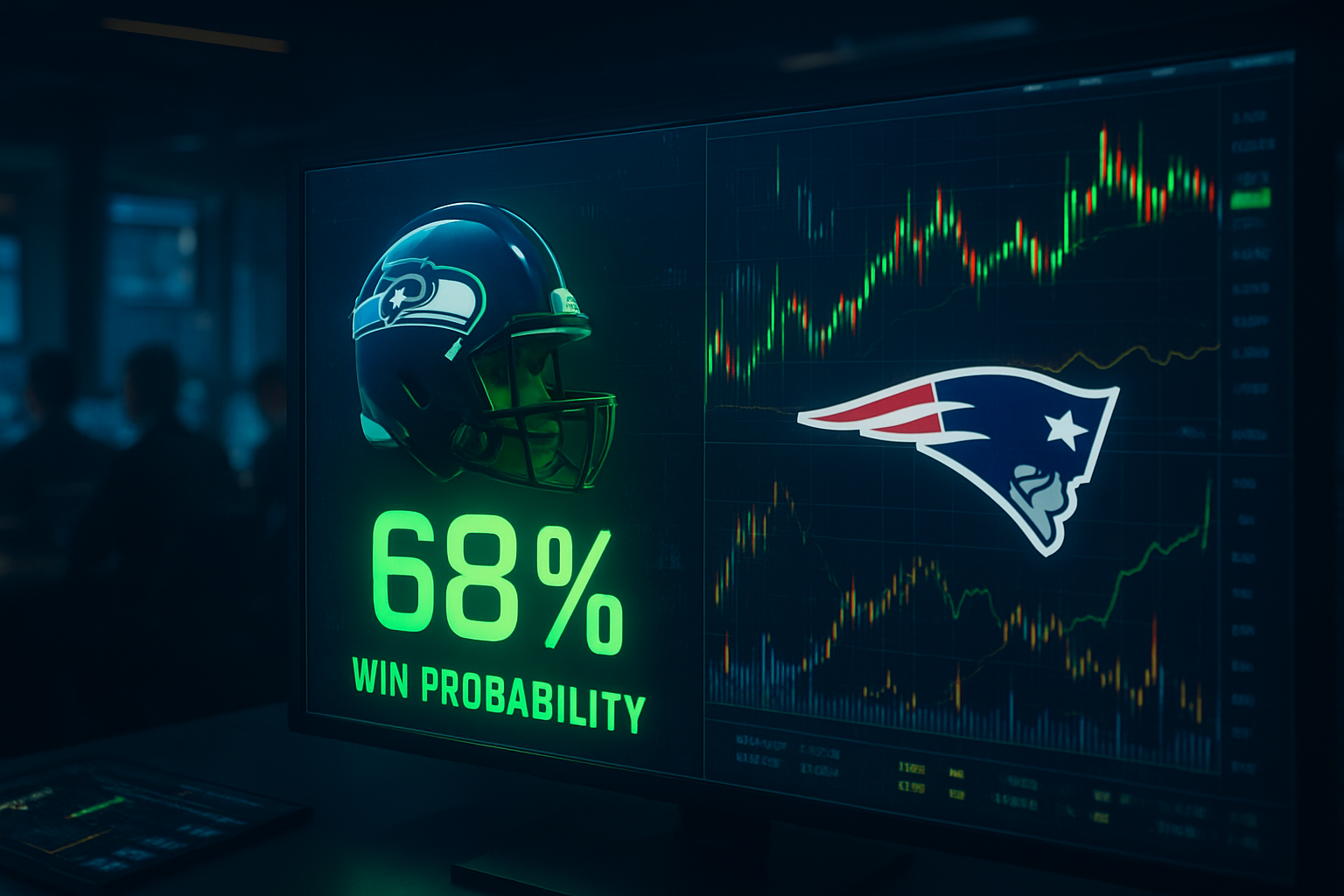
    The primary market under the microscope is Kalshi’s "Pro Football Champion" contract, which specifically tracks the winner of Super Bowl LX. Unlike a traditional bet where a bookmaker sets a line and takes a margin (the "vig"), these event contracts allow users to trade shares of an outcome in a peer-to-peer fashion. At the current price of $0.68, traders are betting that the Seahawks have a nearly 7-in-10 chance of winning. Meanwhile, the New England Patriots are trading as the underdog at $0.33, or a 33% probability.

    The liquidity in this market is unprecedented. Kalshi has reported over $161 million in total trading volume for this single Super Bowl contract, a 450% increase over the previous year. This growth is part of a broader trend: in 2025, Kalshi processed a staggering $23.8 billion in total notional trading volume, with sports event contracts accounting for approximately 75% of that activity. The contract is scheduled for final resolution immediately following the game’s conclusion, with payouts processed shortly after the final whistle.

    Why Traders Are Betting

    The market’s overwhelming favor for the Seahawks is rooted in a historic 14-3 regular season and the "Darnold Renaissance." Quarterback Sam Darnold, who signed with Seattle in the off-season, delivered a career-defining performance in 2025, throwing for over 4,500 yards and 35 touchdowns. This offensive explosion, combined with a defense nicknamed "Legion of Boom 2.0" under head coach Mike Macdonald, has made Seattle a statistical juggernaut.

    Traders are also eyeing the geographic and situational advantages. Although the game is at a neutral site, the proximity of the San Francisco Bay Area to Seattle has created a "home-field" sentiment in the market, as Seahawks fans have reportedly snapped up a majority of the available tickets. Conversely, some "whale" traders have taken large positions on the Patriots ($0.33), citing New England’s veteran poise and the potential for a market overcorrection on the Seahawks’ dominance. These contrarian positions have prevented the Seahawks' price from climbing even higher, as savvy traders look for value in the underdog's potential to disrupt Seattle’s defensive schemes.

    Broader Context and Implications

    The rise of these markets has created a palpable tension with traditional sports betting giants. In response to the migration of users toward event contracts, Flutter Entertainment (NYSE: FLUT), the parent company of FanDuel, launched "FanDuel Predicts" in December 2025. Similarly, DraftKings (NASDAQ: DKNG) introduced "DraftKings Predictions" just weeks later. Both companies are now framing sports outcomes as financial derivatives to tap into markets where traditional sports betting remains legally murky, such as California and Texas.

    This shift is driven by the regulatory clarity provided by the Commodity Futures Trading Commission (CFTC), which has increasingly recognized event contracts as legitimate financial tools. By classifying these trades as derivatives rather than bets, platforms like Kalshi have successfully circumvented the "gambling" stigma, attracting a new demographic of retail investors who view the Seahawks' victory as a high-probability trade rather than a "sucker's bet." This evolution suggests that the line between the New York Stock Exchange and the local sportsbook is blurring permanently.

    What to Watch Next

    As we count down the final 72 hours until kickoff, market volatility is expected to reach a fever pitch. Traders should watch for any late-breaking injury news, particularly regarding Seattle’s star running back Kenneth Walker III, whose limited participation in practice earlier this week caused a temporary price dip to $0.64. Any confirmation of his full health could see the Seahawks' price rally toward $0.72 before the game begins.

    Post-game, the focus will immediately shift to the "2027 Champion" contracts. Early look-ahead markets are already live, and the performance of both teams on Sunday will dictate the opening prices for next season. Furthermore, the industry will be watching the quarterly earnings reports from DraftKings (NASDAQ: DKNG) and Flutter Entertainment (NYSE: FLUT) to see if their new prediction services are successfully clawing back market share from dedicated platforms like Kalshi and Polymarket.

    Bottom Line

    The Super Bowl LX market on Kalshi has proven that prediction markets are no longer a niche interest for policy wonks and tech enthusiasts; they are now a primary engine for sports discourse and financial activity. The Seahawks’ 68% probability reflects a season of utter dominance, but the real story lies in the $161 million traded by individuals who view the game through the lens of a balance sheet.

    As traditional sportsbooks pivot to become "prediction services," the competition for the consumer's dollar will only intensify. Whether Seattle wins or New England pulls off the upset, the ultimate winner of Super Bowl LX appears to be the event contract model itself. The accuracy of these markets on Sunday will serve as a high-stakes litmus test for the future of forecasting in the sports world.


    This article is for informational purposes only and does not constitute financial or betting advice. Prediction market participation may be subject to legal restrictions in your jurisdiction.

    PredictStreet focuses on covering the latest developments in prediction markets.
    Visit the PredictStreet website at https://www.predictstreet.ai/.
  • The Titans Have Arrived: FanDuel and DraftKings Disrupt the Prediction Market Arena

    The Titans Have Arrived: FanDuel and DraftKings Disrupt the Prediction Market Arena

    The landscape of American forecasting shifted fundamentally this winter as the industry's two largest heavyweights, FanDuel and DraftKings, officially entered the prediction market space. Moving beyond point spreads and over-unders, these legacy sportsbooks have launched dedicated "event contract" platforms—FanDuel Predicts and DraftKings Predictions—to capture a share of the exploding interest in political and economic wagering.

    The entry comes as the 2026 midterm election cycle begins to heat up, with markets for House and Senate control already seeing tens of millions in liquidity. While Polymarket dominated the 2024 cycle from offshore and Kalshi fought the legal battles to domesticate the industry, the arrival of the sports betting giants represents a "mass-market moment." Traders are currently pricing the probability of a Republican-held House after the 2026 midterms at roughly 54% on FanDuel Predicts, a figure that has seen a sharp 4% uptick in volatility over the last 48 hours following recent economic data releases.

    The Market: What's Being Predicted

    The primary products on offer are CFTC-regulated event contracts. Unlike traditional sports bets, which are governed by state-level gaming boards, these markets are structured as financial derivatives. FanDuel, owned by Flutter Entertainment (NYSE: FLUT), launched its platform on December 22, 2025, through a strategic partnership with the CME Group. Meanwhile, DraftKings (Nasdaq: DKNG) fast-tracked its entry by acquiring Railbird Technologies, a CFTC-licensed exchange, for $250 million in late 2025.

    These platforms are currently listing a wide array of "Yes/No" binary contracts. While political outcomes—such as the 2026 midterms and early 2028 presidential nominees—are the headline grabbers, the volume is surprisingly high in non-political sectors. Currently, traders are active in markets regarding the Federal Reserve’s March interest rate decision, monthly CPI prints, and even cultural events like the 2026 Academy Award winners.

    The liquidity on these platforms is growing at an unprecedented rate. DraftKings Predictions reported a trading volume of over $120 million in its first month, largely due to its integration with the existing DraftKings ecosystem. This allows millions of casual users to shift their "sports bankroll" into event contracts with a single tap. The resolution criteria are strictly tied to verified data sources, such as official government reports or certified election results, ensuring a level of transparency that mirrors traditional financial markets.

    Why Traders Are Betting

    The sudden migration of capital toward these legacy platforms is driven by a "Trojan horse" strategy. Because event contracts are regulated as derivatives by the Commodity Futures Trading Commission (CFTC), FanDuel and DraftKings are now able to offer "sports-themed" contracts in states where traditional sports betting remains illegal, most notably California and Texas. Traders in these states are flocking to "Predictive Sports" contracts—financial derivatives based on seasonal outcomes rather than individual game lines—which are legally distinct from gambling.

    Institutional players and "whales" are also beginning to favor these legacy platforms over crypto-native alternatives like Polymarket due to the ease of fiat on-ramps and the security of US-based regulation. Analysts note that large-scale positions are being taken by hedge funds using these markets as a hedge against political instability. For example, a significant buy-wall has emerged on FanDuel Predicts for "No" on the passage of a controversial federal tax bill, serving as an insurance policy for corporate entities that would be adversely affected by the legislation.

    This shift marks a departure from traditional polling and forecasting methods. While legacy pollsters struggled with accuracy in the 2024 cycle, prediction markets provided real-time, skin-in-the-game data that proved more resilient. The sportsbooks are capitalizing on this by marketing their platforms as "The Pulse of the Nation," attracting users who view themselves as armchair analysts rather than gamblers.

    Broader Context and Implications

    The entry of legacy sportsbooks is a direct result of the legal precedent set by Kalshi in 2024. After Kalshi successfully sued the CFTC to allow election markets, the floodgates opened for any regulated exchange to follow suit. This has led to a major regulatory evolution under the new market-friendly leadership at the CFTC in early 2026, which has pivoted from trying to ban these markets to establishing a robust framework for their operation.

    However, this expansion has not been without friction. The ability of FanDuel and DraftKings to operate in California and Texas via the "event contract" loophole has sparked intense legal battles with California gaming tribes. These tribes argue that the sportsbooks are bypassing tribal sovereignty by offering what is functionally gambling under the guise of financial trading. The outcome of these challenges could define the future of the industry for decades.

    Historically, the entry of major incumbents into a disruptive space often leads to the "institutionalization" of the asset class. Just as the launch of Bitcoin ETFs by major asset managers signaled a new era for crypto, the entry of Flutter Entertainment and DraftKings has legitimized prediction markets as a mainstream financial tool. This has forced early pioneers like Polymarket to refine their offerings, focusing more on global, decentralized markets that legacy US-regulated firms cannot touch.

    What to Watch Next

    The most immediate milestone to monitor is the "Super Tuesday" of event markets: the 2026 Midterm Primary season. As candidates are finalized, the volatility in "Control of the House" contracts is expected to spike. If the legacy sportsbooks can maintain high liquidity during this period, it will prove their dominance over the niche, retail-heavy platforms that came before them.

    Additionally, keep a close eye on the "2028 Presidential Nomination" markets. Unlike the 2024 cycle, which saw massive volume only in the months leading up to the election, the 2028 markets are already seeing millions in "early bird" trades. DraftKings has hinted at launching a "Candidate Index," a basket of contracts that allows traders to bet on the overall direction of a political party's momentum.

    The legal front also remains critical. A pending decision in the California Supreme Court regarding the "Event Contract vs. Gambling" distinction is expected by late spring 2026. A ruling in favor of the sportsbooks could cement their presence in California indefinitely, while an adverse ruling might force a messy withdrawal from one of the world's largest economies.

    Bottom Line

    The arrival of FanDuel and DraftKings into the prediction market space is the final signal that "betting on the news" has moved from the fringes of the internet to the center of the American economy. By leveraging their massive existing user bases and navigating the complex CFTC regulatory environment, these companies are effectively democratizing sophisticated financial hedging for the average person.

    This evolution confirms that prediction markets are more than just a novelty; they are an essential tool for price discovery in an increasingly volatile world. As liquidity continues to pool into these regulated exchanges, the "wisdom of the crowd" becomes more accurate, providing a real-time sentiment gauge that no poll or pundit can match.

    For the investor and the trader, the takeaway is clear: the distinction between "sports betting" and "financial trading" is blurring. Whether the market is the final score of a game or the final tally of an election, the underlying mechanism is the same—and the giants of the industry are now the ones setting the odds.


    This article is for informational purposes only and does not constitute financial or betting advice. Prediction market participation may be subject to legal restrictions in your jurisdiction.

    PredictStreet focuses on covering the latest developments in prediction markets.
    Visit the PredictStreet website at https://www.predictstreet.ai/.
  • Betting on the Ban: New York Lawmakers Propose $1M Daily Fines for “Reckless” Prediction Markets

    Betting on the Ban: New York Lawmakers Propose $1M Daily Fines for “Reckless” Prediction Markets

    As the 2026 legislative session kicks off in Albany, a high-stakes battle is unfolding over the future of decentralized and regulated forecasting in the Empire State. New York lawmakers are currently scrambling to pass legislation that could either legitimize prediction markets as the next frontier of finance or crush them under the weight of "reckless gambling" labels and million-dollar penalties. At the center of the storm is a series of competing bills aimed at platforms like Kalshi and Polymarket, with traders now betting heavily on whether New York will ultimately pull the plug on the industry.

    Currently, a prominent contract on Kalshi—"Will New York pass a bill to ban political event contracts in 2026?"—is trading at a 38% probability. While this reflects a significant drop from the 65% "panic" highs seen in late 2025, the market remains volatile as two distinct legislative paths emerge. The interest is driven by a unique convergence of financial technology, political anxiety, and a massive tax disparity that has traditional sports betting giants like DraftKings (NASDAQ: DKNG) and Flutter Entertainment (NYSE: FLUT), the parent company of FanDuel, re-evaluating their entire business models.

    The Market: What's Being Predicted

    The primary market under the microscope is the legislative outcome of the 2025–2026 New York session. Traders are specifically weighing the chances of Assembly Bill A9251, colloquially known as the ORACLE Act. Sponsored by Assemblymember Clyde Vanel, the bill is the most aggressive anti-prediction market measure in the country. It seeks to categorize these platforms as "unlicensed gambling" and would impose civil fines of up to $50,000 for persistent violations, escalating to a staggering $1 million per day for platforms that continue to offer contracts on "sensitive" categories like elections, war, or securities prices.

    The ORACLE Act is currently being challenged by a more moderate proposal: Senate Bill S8889, the New York Prediction Market Regulation Act. Introduced on January 13, 2026, by Senator Jeremy Cooney, this rival bill suggests a licensing framework under the New York Department of Financial Services (DFS), treating event contracts as financial instruments rather than bets. Trading volume on these outcomes has surged across Kalshi and Interactive Brokers (NASDAQ: IBKR), which operates the ForecastEx exchange. On Manifold Markets, "shadow markets" are even pricing in an 81% probability that federal law will eventually preempt any state-level ban, citing the Supremacy Clause and the Commodity Futures Trading Commission's (CFTC) oversight.

    Why Traders Are Betting

    The sudden legislative urgency in Albany was catalyzed by a controversial event known among traders as the "Maduro Trade." In early January 2026, a single trader on Polymarket reportedly turned a $32,000 position into more than $400,000 just hours before a U.S.-led raid in Venezuela. New York lawmakers have seized on this as a smoking gun for "insider trading," arguing that prediction markets provide a lucrative outlet for individuals with material non-public information to profit from state secrets or geopolitical instability.

    Beyond insider trading fears, there is a massive financial incentive driving the legislative friction: taxes. In New York, traditional sportsbooks like FanDuel and DraftKings are hit with a punitive 51% tax on gross gaming revenue. Prediction markets, which operate as financial exchanges, currently bypass this tax, offering a "loophole" that allows for "sports-like" wagering under a much lighter tax burden. This has created a "Wall Street vs. Vegas" narrative. Traders are betting that the powerful gambling lobby will eventually force the state to either tax prediction markets at the 51% rate or ban them entirely to protect the state's lucrative sports-betting revenue stream.

    Notable "whale" activity has been spotted on Kalshi, where several institutional-sized positions have recently moved the "Ban" probability downward. These traders appear to be betting that the Cooney Bill (S8889) will provide a "middle path" that satisfies regulators' demands for anti-money laundering (AML) and consumer protections without a total shutdown.

    Broader Context and Implications

    This battle is about more than just a single state's laws; it is a referendum on whether prediction markets are "truth machines" or "reckless gambling" dens. For years, proponents have argued that these markets provide the most accurate real-time data on everything from Fed rate hikes to election results. However, New York’s ORACLE Act explicitly targets the "truth machine" claim, with sponsors arguing that the "social utility" of a market does not exempt it from gambling regulations.

    The real-world implications of a New York ban would be catastrophic for the industry’s domestic growth. As a global financial hub, New York's stance often dictates the regulatory appetite of other states. If the ORACLE Act passes, it could trigger a "regulatory winter," forcing platforms to geofence New Yorkers—a difficult task given the prevalence of VPNs, as seen with Polymarket's previous struggles.

    Furthermore, the pivot of companies like DraftKings (NASDAQ: DKNG) is telling. After years of lobbying against prediction markets, they are now launching their own "event contract" products to capture the lower-tax financial model. Their involvement suggests that the future of prediction markets might not be a total ban, but rather a "corporate capture" where only the largest, most established gaming and financial firms are granted licenses to operate.

    What to Watch Next

    Traders should circle late February 2026 on their calendars. This is when a critical ruling is expected in the federal case Kalshi v. New York State Gaming Commission. If a federal judge grants a preliminary injunction against the state’s current restrictive stance, it could effectively render the ORACLE Act moot before it even reaches the Assembly floor.

    In the immediate term, the next major milestone is the Assembly Committee on Consumer Affairs and Protection vote on the ORACLE Act. If the bill moves out of committee with its $1 million daily fine provision intact, the probability of a "Ban" on Kalshi is expected to spike back above 50%. Conversely, if the Cooney Bill gains traction in the Senate Banks Committee, the market will likely continue its downward trend as a regulated "Financial Exchange" model becomes the more probable outcome.

    Bottom Line

    The legislative scramble in New York represents the ultimate "identity crisis" for prediction markets. Are they the next evolution of the NASDAQ, or are they a high-tech version of a sportsbook? The 38% probability of a ban suggests that while the "ban-heavy" rhetoric is loud, the market believes a more nuanced, regulated future is the likely winner.

    For prediction markets to survive in New York, they will likely have to accept a "Vegas-lite" regulatory package: strict 21+ age verification, robust AML protocols, and perhaps a new "event contract tax" that bridges the gap between financial capital gains and the 51% sportsbook rate. As the "Maduro Trade" showed, the transparency of the blockchain is a double-edged sword; it proves the market's accuracy, but it also provides the evidence regulators need to cry foul.

    Ultimately, the battle in Albany is a test of the industry's resilience. If prediction markets can survive the ORACLE Act's $1 million daily fines, they will have proven their status as a permanent fixture of the modern financial landscape.


    This article is for informational purposes only and does not constitute financial or betting advice. Prediction market participation may be subject to legal restrictions in your jurisdiction.

    PredictStreet focuses on covering the latest developments in prediction markets.
    Visit the PredictStreet website at https://www.predictstreet.ai/.