Tag: Dow Jones

  • Divided Mandate: Prediction Markets Signal Blue House and Red Senate for 2026 Midterms

    Divided Mandate: Prediction Markets Signal Blue House and Red Senate for 2026 Midterms

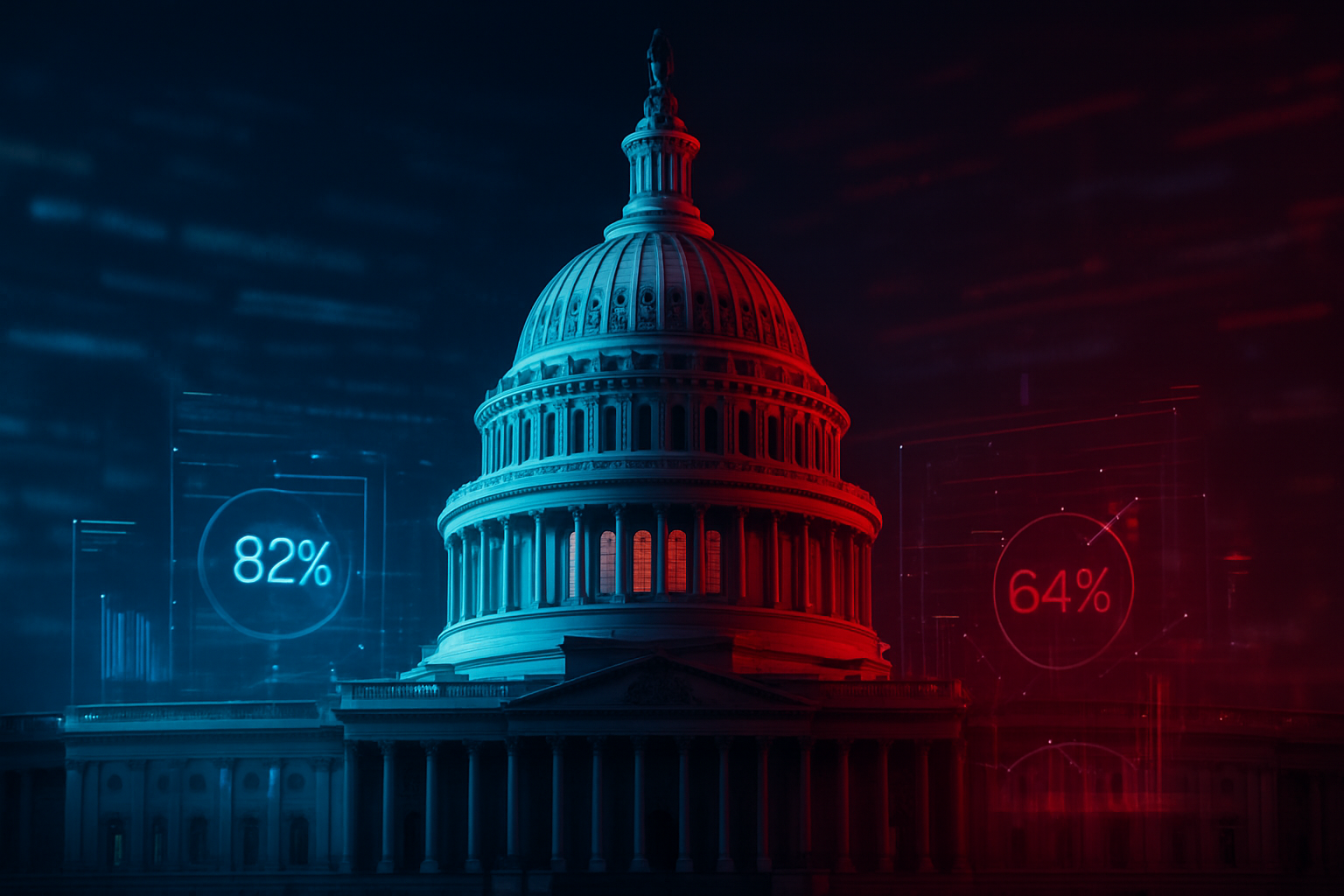
    As the 2026 midterm election cycle enters its most volatile phase, prediction markets have coalesced around a startlingly clear vision of the future: a deeply divided Washington. According to the latest data from Polymarket and Kalshi, the probability of Democrats retaking the House of Representatives has surged to a dominant 82%, while Republicans maintain a resilient 64% chance of holding the Senate. This "split-decision" forecast has become the primary benchmark for political strategists and financial analysts alike.

    The widening gap between the two chambers reflects a unique political landscape in February 2026. While national sentiment has shifted toward the "Blue Wave" in the lower house—fueled by recent Supreme Court rulings on redistricting and a series of federal immigration controversies—the Senate’s structural map remains a formidable "red firewall." For the first time in a midterm cycle, these probabilities aren't just being discussed in niche forums; they are being broadcast as real-time truth by the world's largest media conglomerates.

    The Market: What's Being Predicted

    The "Balance of Power" markets on Polymarket, a decentralized prediction platform, have seen record-breaking liquidity this quarter, with hundreds of millions of dollars now backing the current 82/64 split. The House contract, which pays out if Democrats secure a simple majority, has climbed steadily from 72% in late 2025 to its current 82% high. Conversely, the Senate market has seen more friction, with Republican odds softening slightly from 68% to 64% over the last thirty days, yet remaining the clear favorite.

    On Kalshi, a platform regulated by the Commodity Futures Trading Commission (CFTC), trading volume has similarly spiked. The resolution criteria for these markets are tied to the official certification of the 2026 election results. Unlike traditional polling, which often suffers from a "non-response" bias, these markets are "prediction-incentivized," meaning every percentage point represents real capital moving in response to new information. This has created a highly efficient price discovery mechanism that reacts in minutes to breaking news.

    Why Traders Are Betting

    Traders are pointing to two primary catalysts for the 82% House probability. First, a landmark U.S. Supreme Court decision in January 2026 regarding California’s redistricting has effectively "unlocked" several previously competitive seats for the Democratic party. Second, what has been dubbed the "Minnesota ICE Scandal"—a series of controversial federal enforcement actions in the Midwest—has significantly energized the Democratic base, a trend captured instantly by the markets well before it appeared in traditional suburban polling.

    The Republican "Senate Firewall" at 64% is driven by a starkly different set of data. The 2026 Senate map is historically favorable to the GOP, featuring difficult defensive battles for incumbent Democrats in states like Georgia and Alaska. Institutional traders argue that while the national "generic ballot" mood favors Democrats, the individual state-level math makes a Republican Senate hold the most likely outcome. Large "whale" positions on Polymarket have been observed "hedging" their House bets by doubling down on GOP Senate control, a strategy that anticipates a gridlocked legislative environment through 2028.

    Broader Context and Implications

    The 2026 cycle marks the official "Institutionalization Phase" of prediction markets. Warner Bros. Discovery (NASDAQ: WBD), the parent company of CNN, recently announced an exclusive partnership with Kalshi to integrate real-time "Market-Implied Probability" tickers into their live broadcasts. CNN’s chief data analyst, Harry Enten, now uses these odds to fact-check traditional polls, arguing that the 80% market confidence in candidates like Jon Ossoff is a more reliable indicator of voter sentiment than 400-person phone surveys.

    Similarly, News Corp (NASDAQ: NWSA), through its Dow Jones division, has embedded Polymarket data across the digital platforms of The Wall Street Journal and MarketWatch. These outlets now feature a "Market-Implied Earnings Calendar," which correlates the 82% chance of a Democratic House with projected volatility in the defense and healthcare sectors. This integration signals that prediction markets are no longer a "fringe" tool but are now viewed with the same authority as the S&P 500 or the Treasury yield curve.

    What to Watch Next

    As we move toward the primary season in late spring, several events could disrupt the current 82/64 equilibrium. Key milestones include the March 2026 jobs report and the first set of "swing-district" primaries in Pennsylvania and Virginia. Should Democrats underperform in these early contests, the 82% House probability could see a "correction" back toward the mid-70s.

    Conversely, the Republican Senate odds are highly sensitive to candidate quality. Traders are closely monitoring whether the GOP nominates "moderate-leaning" candidates in states like Michigan and Arizona. If the party leans into more polarizing figures, the 64% Senate "firewall" could collapse, potentially moving the market toward a "Blue Sweep" scenario, which currently sits at a modest 44% probability.

    Bottom Line

    The 2026 Midterm markets represent a paradigm shift in how we understand political outcomes. The 82% probability of a Democratic House and a 64% chance of a Republican Senate suggest that traders are pricing in a return to legislative gridlock. For investors, this data is a crucial signal to prepare for a "status quo" environment where major policy shifts—such as tax code overhauls or massive infrastructure spending—become significantly more difficult to pass.

    Ultimately, the adoption of these markets by giants like Warner Bros. Discovery (NASDAQ: WBD) and News Corp (NASDAQ: NWSA) confirms that prediction markets have become the new "Gold Standard" for real-time probability. As we head into the summer, the "Wisdom of the Crowd" will likely remain a step ahead of the pundits, providing a cold, capital-backed look at the future of American governance.


    This article is for informational purposes only and does not constitute financial or betting advice. Prediction market participation may be subject to legal restrictions in your jurisdiction.

    PredictStreet focuses on covering the latest developments in prediction markets.
    Visit the PredictStreet website at https://www.predictstreet.ai/.

  • The Wisdom of the Ticker: How the Dow Jones-Polymarket Alliance is Mainstreaming Market-Based Truth

    The Wisdom of the Ticker: How the Dow Jones-Polymarket Alliance is Mainstreaming Market-Based Truth

    On January 7, 2026, a tectonic shift occurred in the landscape of global media. Dow Jones & Co. (NASDAQ: NWSA), the parent company of The Wall Street Journal, announced an exclusive multi-year partnership with Polymarket, the world’s largest decentralized prediction market. This deal formally integrates real-time, blockchain-based prediction data across the Dow Jones consumer ecosystem, including Barron’s, MarketWatch, and Investor’s Business Daily. By treating prediction market probabilities as a core financial data layer alongside the S&P 500 and Treasury yields, the partnership signals the ultimate graduation of the sector from a crypto-native curiosity to a critical tool for institutional risk assessment.

    Currently, the markets are flashing a clear, albeit complex, signal for the 2026 U.S. Midterm elections. Traders on Polymarket are pricing in a 79% probability of the Democratic Party regaining control of the House of Representatives, while giving the Republican Party a 66% chance of maintaining the Senate. These odds, which have remained remarkably stable despite a flurry of early-year legislative maneuvering, are now being viewed by millions of WSJ readers through embedded real-time widgets—a move that Almar Latour, CEO of Dow Jones, describes as providing "real-time insight into collective beliefs" and a "leading indicator" for global risk.

    The Market: What's Being Predicted

    The partnership focuses on two primary categories of data: geopolitical/electoral outcomes and "market-implied" financial events. On the political front, the 2026 Midterm markets are the primary engine of volume. Traders are betting on the "Balance of Power" in the 110th Congress, with the most likely scenario currently being a "Split Congress" (44% probability). This market has seen its daily volume swell to over $700 million in mid-January alone, as the Dow Jones integration brings a wave of traditional retail and institutional interest to the platform.

    Beyond the ballot box, the integration features a new "Market-Implied Earnings Calendar" on MarketWatch. This tool provides probabilities for upcoming corporate results for companies like Apple (NASDAQ: AAPL) and Nvidia (NASDAQ: NVDA). For instance, as Apple prepares to report its Q1 2026 results on January 29, prediction markets are showing a 100% conviction that the stock will maintain its current support level above $275 through the end of the month, despite an options-implied move of ±4.8%.

    The data isn't just restricted to digital sidebars; it has even begun appearing in the print edition of The Wall Street Journal. Key resolution criteria for these markets are strictly managed by UMA (Universal Market Access) and integrated through Polymarket’s recent U.S. relaunch following its acquisition of the regulated exchange QCEX. This regulatory clearance was the necessary precursor for a legacy firm like News Corp (NASDAQ: NWSA) to bridge the gap between decentralization and the mainstream press.

    Why Traders Are Betting

    The primary driver of the current odds is the "speed gap" between traditional polling and market action. While traditional surveys might take days to reflect the impact of a breaking scandal or an economic report, prediction markets react in seconds. Traders are incentivized by "skin in the game," a concept often cited by Polymarket CEO Shayne Coplan. This financial incentive creates a more accurate filter for truth than sentiment-based polling, which has faced significant accuracy challenges in recent years.

    Institutional adoption is also a massive tailwind. Firms like Goldman Sachs (NYSE: GS) and JPMorgan Chase & Co. (NYSE: JPM) have reportedly begun using Polymarket’s data as a secondary check against their own internal models. For the upcoming March 2026 Federal Reserve meeting, for instance, Barclays (NYSE: BCS) analysts are forecasting a 25 basis point cut, but the Polymarket "No Change" contract is trading at 81%. This divergence suggests that traders see a higher risk of "sticky" inflation from new fiscal policies than the sell-side analysts are currently modeling.

    Furthermore, "whale" activity has become more transparent through the WSJ’s reporting. Large positions—often exceeding $10 million in a single contract—are now tracked like insider trades in a corporate stock. This level of transparency has changed trading strategies, as retail participants often follow the "smart money" moving into specific midterm battleground districts or rate-cut probabilities.

    Broader Context and Implications

    The Dow Jones-Polymarket alliance marks the arrival of "probability-based news." In a world of deepfakes and polarized media, prediction markets provide a neutral, quantitative counterweight to descriptive reporting. This trend isn't isolated; it mirrors similar moves by competitors like Kalshi, which recently partnered with CNN and CNBC to provide electoral data. However, the Dow Jones deal is notably more expansive, embedding these signals directly into the financial tools used by professional traders and retail investors alike.

    This shift has profound implications for the legitimacy of the sector. For years, prediction markets were derided as "gambling for nerds." By integrating them into the WSJ terminal and MarketWatch homepages, they are being rebranded as a sophisticated asset class. This institutionalization is also pushing regulators to provide more clarity. While some states like Tennessee have challenged the platforms, the weight of a Dow Jones partnership suggests that the federal trend is moving toward regulated, exchange-based prediction trading.

    Historically, markets like Polymarket have outperformed traditional polls in every major election cycle since 2020. This track record of accuracy is exactly what the traditional media is seeking to leverage. By offering "market-based truth," outlets like the WSJ are essentially outsourcing their forecasting to the most efficient machine ever built: the global market.

    What to Watch Next

    The next major milestone for the partnership—and the broader sector—will be the January 29 earnings call from Apple (NASDAQ: AAPL). This will be the first "Big Tech" earnings event where the Dow Jones "Market-Implied Earnings Calendar" will be fully operational for its massive subscriber base. Analysts at Evercore ISI (NYSE: EVR) have set high targets for tech in 2026, and any sharp divergence between analyst consensus and Polymarket probabilities will be a key test of the data's utility.

    On the geopolitical front, watchers should monitor the Federal Reserve’s March meeting. If the market’s 81% "No Change" bet holds true against the calls for a rate cut from major investment banks, it will solidify the status of prediction markets as the superior prognosticator for macro events. Any upcoming volatility in the 2026 Midterm markets following the first quarter’s primary filing deadlines will also serve as a barometer for how "sticky" the current Democratic House advantage (79%) really is.

    Bottom Line

    The partnership between Dow Jones and Polymarket is more than just a data-sharing agreement; it is a validation of the "wisdom of the crowd" as a fundamental pillar of modern journalism. By providing real-time, financially incentivized probabilities to the world’s most influential readers, the alliance is effectively ending the era of the "pundit" and ushering in the era of the "price signal."

    As we look toward the 2026 Midterms and the Fed decisions of the first half of the year, the primary takeaway is clear: the most accurate news of the future may not be found in a headline, but in a contract price. While regulatory challenges remain at the state level, the momentum behind prediction markets as a "financialized truth machine" has never been stronger. For investors and readers alike, the ticker is no longer just about where we are—it's about exactly where we’re going.


    This article is for informational purposes only and does not constitute financial or betting advice. Prediction market participation may be subject to legal restrictions in your jurisdiction.

    PredictStreet focuses on covering the latest developments in prediction markets.
    Visit the PredictStreet website at https://www.predictstreet.ai/.

  • The ‘Truth Engine’ Ascendant: How the Dow Jones-Polymarket Alliance is Redefining Reality

    The ‘Truth Engine’ Ascendant: How the Dow Jones-Polymarket Alliance is Redefining Reality

    On January 7, 2026, the global media landscape underwent a seismic shift that few traditional pundits saw coming. News Corp (Nasdaq: NWSA), the parent company of Dow Jones, announced an exclusive multi-year partnership with Polymarket, the world’s leading decentralized prediction platform. This alliance does more than just share data; it signals the definitive arrival of the "Truth Engine" era—a period where market-implied probabilities are beginning to supersede editorial narratives and traditional polling as the public's primary source of truth.

    The collaboration has already integrated real-time prediction widgets across the digital homepages of The Wall Street Journal, Barron’s, and MarketWatch. Within days of the announcement, the industry witnessed a record-breaking single-day trading volume of $701.7 million on January 12, 2026. As participants put billions of dollars on the line to forecast everything from Federal Reserve interest rate cuts to the outcome of the 2026 Midterm elections, the message is clear: the era of the "expert" opinion is being challenged by the collective intelligence of the market.

    The Market: What's Being Predicted

    The partnership between Dow Jones and Polymarket has introduced a suite of new financial and political instruments that have quickly become essential reading for institutional investors. At the heart of this integration is the "Market-Implied Earnings Calendar," now a permanent fixture on the WSJ terminal. This tool allows users to view the real-time probability of a corporate earnings beat or miss, often moving hours or days before traditional equity analysts at firms like Goldman Sachs or JPMorgan can update their models.

    Currently, the most liquid markets on Polymarket and its regulated competitor Kalshi revolve around the 2026 U.S. Midterm elections. Traders are currently pricing in a "Blue Wave" for the House of Representatives, with Democrats holding a staggering 78% chance of victory on Polymarket and 74% on Kalshi. Conversely, the Senate remains a Republican stronghold in the eyes of the market, with a 66% probability of GOP control. This "split congress" scenario has become the most heavily traded outcome, attracting over $5.23 billion in notional volume in the first two weeks of January alone.

    Beyond politics, the "Truth Engine" is being applied to corporate milestones. New "mentions markets" allow users to bet on whether specific keywords will be used in earnings calls or by public figures. For instance, after Coinbase (Nasdaq: COIN) CEO Brian Armstrong intentionally triggered specific markets during a 2025 earnings call, these contracts have evolved into a sophisticated way to hedge against corporate messaging shifts.

    Why Traders Are Betting

    The surge in participation is driven by a philosophical shift led by figures like Brian Armstrong, who has long championed prediction markets as a superior alternative to traditional media outlets like The New York Times Company (NYSE: NYT). Armstrong’s vision centers on "skin in the game." In his view, a journalist at a legacy publication faces little personal consequence for an incorrect forecast, whereas a prediction market participant faces an immediate financial loss.

    "The market is the 99% versus the 1%," Armstrong noted during a recent industry summit. "While 1% of the users are professional traders looking for an edge, the other 99% are using these platforms as a 'Truth Engine' to see what the world actually thinks is going to happen, unburdened by editorial bias."

    This sentiment is echoed by institutional players. The Intercontinental Exchange (NYSE: ICE), which led a $2 billion investment round into Polymarket in late 2025, views prediction markets as a necessary evolution of price discovery. Traders are no longer just betting on the price of a stock; they are betting on the underlying reality that drives that price. This "financialization of truth" provides a hedging mechanism against misinformation, as the cost of attempting to manipulate a $9 billion market like Polymarket is prohibitively high for almost any bad actor.

    Broader Context and Implications

    The Dow Jones-Polymarket deal represents the "institutionalization" phase of prediction markets. In previous years, these platforms were often dismissed as "crypto gambling." However, the integration of Kalshi into Robinhood Markets (Nasdaq: HOOD) has brought prediction trading to millions of retail brokerage accounts, providing the liquidity needed for these markets to remain accurate. In 2026, Kalshi captured 66.4% of the industry’s record-breaking volume, largely due to its accessibility for the average American investor.

    This shift reveals a growing public skepticism toward traditional forecasting methods. In the 2024 and 2025 cycles, traditional polling consistently lagged behind market odds, which were quicker to react to real-time events like debate performances and economic reports. By 2026, the historical accuracy of these markets has become a self-fulfilling prophecy; as more people trust the odds, more capital flows in, making the signals even more robust.

    Regulatory considerations have also stabilized. The successful defense of election betting by platforms like Kalshi in U.S. courts throughout 2024 and 2025 has provided a legal "green light" for major media conglomerates to form partnerships. The SEC and CFTC have moved from a stance of opposition to one of observation, recognizing that prediction markets provide valuable data on systemic risk that traditional financial instruments cannot capture.

    What to Watch Next

    As we move toward the 2026 Midterms, the most critical development to monitor will be the integration of Artificial Intelligence (AI) into these "Truth Engines." Several hedge funds are reportedly developing AI agents that trade prediction markets autonomously, which could increase liquidity even further but also lead to unprecedented "flash crashes" in the odds if a major piece of news is misinterpreted by the algorithms.

    Key dates to watch include the upcoming Federal Reserve meeting in March 2026. Polymarket’s Fed-tracking contracts are currently showing a 42% chance of a "hawkish pause," a figure that has diverged sharply from the consensus of mainstream economists. If the market proves correct once again, it may permanently cement the "Truth Engine" as the primary oracle for the global economy.

    Furthermore, keep an eye on the "Everything Exchange" roadmap from Coinbase. There are persistent rumors that Armstrong’s company may attempt to acquire a secondary prediction platform or launch its own native integration to compete directly with the Polymarket-Dow Jones alliance, potentially sparking a "truth war" between different market-based data providers.

    Bottom Line

    The partnership between Dow Jones and Polymarket is more than a business deal; it is a concession by legacy media that the old ways of reporting the "news" are no longer sufficient in a high-velocity, information-saturated world. By embedding market probabilities into the Wall Street Journal, News Corp is admitting that the collective wisdom of thousands of traders is a more reliable metric than a single editorial board.

    This tells us that prediction markets have officially graduated from a niche curiosity to a fundamental pillar of modern information infrastructure. While they are not perfect—and remain subject to the same irrational exuberance as any other market—they offer a transparency and accountability that traditional punditry lacks.

    As we look toward the remainder of 2026, the "Truth Engine" will likely become the standard by which all public discourse is measured. Whether you are a retail trader on Robinhood or a corporate executive reading the WSJ, the question is no longer "What do the experts say?" but rather, "Where is the money moving?"


    This article is for informational purposes only and does not constitute financial or betting advice. Prediction market participation may be subject to legal restrictions in your jurisdiction.

    PredictStreet focuses on covering the latest developments in prediction markets.
    Visit the PredictStreet website at https://www.predictstreet.ai/.

  • News Corp (NWS) Deep Dive: Deciphering the Valuation Gap in a Digital-First Era

    News Corp (NWS) Deep Dive: Deciphering the Valuation Gap in a Digital-First Era

    Date: January 9, 2026

    Introduction

    In the rapidly evolving landscape of global media and digital information services, News Corp (NASDAQ: NWSA, NWS) stands as a unique conglomerate that has successfully navigated the treacherous transition from the "Gutenberg era" to a data-driven, AI-integrated future. As of early 2026, the company is no longer defined solely by its storied newspapers like The Wall Street Journal or The Times, but rather by its high-margin professional information services and its commanding presence in global digital real estate.

    Under the persistent gaze of activist investors and the strategic leadership of CEO Robert Thomson, News Corp has spent the last 24 months aggressively simplifying its portfolio—most notably through the 2025 divestiture of its Australian subscription video unit, Foxtel. This research deep dive explores how the company is leveraging its premium intellectual property to extract record licensing fees from AI developers while fighting a multi-front war for market share in the U.S. residential real estate portal space.

    Historical Background

    The modern iteration of News Corp was born in June 2013, following the corporate "split" from 21st Century Fox. While the entertainment assets went one way (eventually being sold to Disney), the publishing and Australian assets remained under the News Corp banner. This "new" News Corp inherited a legacy of print journalism that many analysts initially viewed as a declining liability.

    However, the last decade has been a story of radical reinvention. Founder Rupert Murdoch’s decision to appoint Robert Thomson as CEO proved pivotal; Thomson shifted the focus from scale for scale's sake toward premium "proprietary" data. Key milestones include the acquisition of the OPIS energy data business and Base Chemicals in 2021/2022, which transformed the Dow Jones segment into a professional information powerhouse. In late 2023, Lachlan Murdoch became the sole Chair, marking a generational shift in governance that coincided with a renewed focus on shareholder returns and digital-first growth.

    Business Model

    News Corp’s current business model is structured around five primary pillars, with a clear tilt toward recurring digital revenue:

    1. Dow Jones: Comprising The Wall Street Journal, Barron’s, and a burgeoning Professional Information Business (PIB). This segment focuses on high-value corporate subscriptions and specialized data for risk, compliance, and energy markets.
    2. Digital Real Estate Services: This includes a 61.4% stake in Australia’s REA Group (ASX: REA) and an 80% stake in Move, Inc. (the operator of realtor.com). These platforms generate revenue through premium listings and lead generation.
    3. Book Publishing: HarperCollins, the world’s second-largest consumer book publisher, operates across all genres and formats, including a significant and growing audio and e-book segment.
    4. News Media: A global portfolio of news brands including The New York Post, The Times, The Sunday Times, and The Sun in the UK, as well as News Corp Australia. Revenue is driven by a mix of digital subscriptions and advertising.
    5. Divested/Simplified Assets: In early 2025, the company completed the sale of its Subscription Video Services (Foxtel) to DAZN, a move that significantly improved the company’s margin profile and simplified the balance sheet.

    Stock Performance Overview

    As of January 9, 2026, the performance of NWSA shares reflects a company in the middle of a valuation re-rating.

    • 1-Year Performance: Shares have traded relatively flat, down roughly 3.7% over the last 12 months. This underperformance relative to the S&P 500 (+17%) is largely attributed to the "wait and see" approach investors took during the Foxtel sale and the ongoing litigation regarding AI copyright.
    • 5-Year Performance: The stock has delivered a compounded annual growth rate (CAGR) of approximately 5%. This period was marked by the post-pandemic advertising slump followed by a surge in digital real estate valuations.
    • 10-Year Performance: Since 2016, the stock has mirrored the company’s digital transformation, seeing steady but volatile growth as the market gradually recognized the value of the REA Group stake, which often trades at a higher multiple than the consolidated News Corp entity.

    Financial Performance

    News Corp’s FY 2025 (ended June 30, 2025) was described by management as a "sterling" year, and the momentum has carried into Q1 of FY 2026.

    • Revenue & Income: For the full year 2025, revenue hit $8.45 billion, with net income surging 71% to $648 million.
    • EBITDA Margins: Total segment EBITDA reached a record $1.42 billion in FY 2025, a 14% increase year-over-year. This expansion was driven by the high-margin Professional Information Business within Dow Jones.
    • Q1 2026 Update: In the quarter ended September 30, 2025, the company reported revenues of $2.14 billion (+2%). Adjusted EPS of $0.22 beat analyst consensus, largely due to a 67% surge in News Media EBITDA following aggressive cost-cutting and pricing power in digital subscriptions.
    • Balance Sheet: With the proceeds from the Foxtel sale, News Corp has significantly reduced its debt and accelerated its stock buyback program, purchasing shares at four times the pace of the previous year.

    Leadership and Management

    The leadership duo of CEO Robert Thomson and Chair Lachlan Murdoch has maintained a remarkably consistent strategy. Thomson, recently extended through June 2030, is the architect of the "digital-first" pivot. Under his tenure, digital revenues have grown from 20% to over 50% of the company total.

    Governance, however, remains a point of contention. The Murdoch family’s dual-class share structure (controlling ~39% of the voting power) has been a primary target for activist investors. Despite this, the board has made concessions, including a $1 billion share repurchase program and the disposal of non-core assets, which has helped quiet some institutional dissent while maintaining the current leadership’s strategic autonomy.

    Products, Services, and Innovations

    Innovation at News Corp is currently centered on the intersection of premium content and Artificial Intelligence.

    • The OpenAI Partnership: In mid-2024, News Corp signed a landmark five-year deal with OpenAI worth over $250 million. This allows ChatGPT and other products to access current and archived content from the company's major publications.
    • Dow Jones PIB: The Professional Information Business is the company’s most advanced technical arm. Innovations in AI-driven risk and compliance tools have led to a 16% revenue growth in this sub-segment, as corporations seek automated solutions for regulatory monitoring.
    • REA Group Dominance: In Australia, REA Group continues to out-innovate competitors with AI-driven property valuation tools and an integrated mortgage broking service, maintaining its position as the clear market leader.

    Competitive Landscape

    News Corp competes in three distinct but overlapping arenas:

    1. Financial Information: The Wall Street Journal faces fierce competition from The New York Times (NYSE: NYT) in the general news and subscription space. While NYT has more total subscribers (11.8M+), Dow Jones leads in the business-critical B2B space, competing more directly with Bloomberg LP and Refinitiv.
    2. Digital Real Estate: In the U.S., realtor.com is currently fighting a "portal war" with Zillow Group (NASDAQ: Z) and CoStar Group (NASDAQ: CSGP). While Zillow remains the traffic leader, realtor.com has focused on higher-intent leads and rental syndication deals to improve profitability.
    3. Book Publishing: HarperCollins competes with Penguin Random House for top-tier manuscripts. The market remains consolidated, though the growth of AI-generated content and self-publishing platforms poses a long-term structural threat.

    Industry and Market Trends

    Three macro trends are currently defining News Corp’s trajectory:

    • AI Licensing Arbitrage: As Large Language Models (LLMs) hungry for high-quality data run out of public internet content, the value of "behind-the-paywall" premium journalism has skyrocketed. News Corp is leading the charge in monetizing this "intellectual property goldmine."
    • The Death of the "Free" Internet: The shift toward subscription models is accelerating as ad-supported models struggle with privacy regulations and AI-driven search changes.
    • The "Flight to Quality" in Real Estate: High interest rates in 2024-2025 led to a lower volume of home sales, but a higher reliance on premium digital platforms for lead generation. This has benefited established players like REA and realtor.com who provide verified data.

    Risks and Challenges

    Despite strong financials, News Corp faces significant hurdles:

    • Dual-Class Share Structure: The control held by the Murdoch family remains a "valuation discount" in the eyes of many institutional investors.
    • Advertising Volatility: While digital subscriptions are growing, the print and digital advertising markets remain sensitive to macro cycles and the dominance of Google and Meta.
    • AI "Pillaging": Despite the OpenAI deal, News Corp is in active litigation with other AI companies (like Perplexity) over alleged copyright infringement. A legal loss could undermine the company’s IP valuation.
    • U.S. Housing Market: Any prolonged downturn in the U.S. residential market directly impacts Move (realtor.com) revenues, which are already under pressure from CoStar's aggressive marketing spend.

    Opportunities and Catalysts

    Investors are looking toward several key events in 2026:

    • Portfolio Breakup: Activist Starboard Value continues to push for a spin-off of the digital real estate assets. Many analysts believe the "sum of the parts" valuation of News Corp is significantly higher than its current market cap.
    • New LLM Deals: News Corp is currently in negotiations with other tech giants (Google, Meta, Anthropic). Each new multi-million dollar licensing deal acts as a direct catalyst for EBITDA growth.
    • Realtor.com Market Share: With CoStar (Homes.com) signaling a 35% cut in marketing spend in early 2026, realtor.com has a strategic opening to reclaim the #2 spot in the U.S. market.

    Investor Sentiment and Analyst Coverage

    Sentiment toward News Corp is currently "Constructive to Bullish."

    • Wall Street Consensus: The consensus rating is a "Strong Buy," with an average price target of $37.63, suggesting significant upside from current levels in the mid-$20s.
    • Hedge Fund Activity: Beyond Starboard Value, institutional interest has increased following the sale of Foxtel, as the company’s "cleaner" P&L makes it an easier target for quantitative analysis.
    • Retail Sentiment: While often overshadowed by high-growth tech stocks, NWSA has seen a resurgence in retail interest due to its aggressive share buybacks, which are viewed as a floor for the stock price.

    Regulatory, Policy, and Geopolitical Factors

    The geopolitical landscape of 2026 is complex for a global media entity:

    • The Trump Administration: The administration's "AI Action Plan" favors federal deregulation. News Corp must navigate this to ensure that federal copyright protections are not weakened in the name of "unfettered AI development."
    • Australian News Code: The Australian government continues to tighten the News Media Bargaining Code. As original agreements with Meta and Google expire, News Corp’s Australian assets remain at the heart of a trade tension between the U.S. and Australia.
    • UK Competition Law: The UK’s Digital Markets, Competition and Consumers (DMCC) Act, which became fully active in 2025, provides News Corp with additional leverage when negotiating with Big Tech platforms operating in the British market.

    Conclusion

    News Corp in 2026 is a study in calculated adaptation. By pivoting away from traditional broadcast (Foxtel) and doubling down on digital real estate and professional data (Dow Jones), the company has built a resilient, high-margin foundation. The "woo and sue" strategy regarding AI ensures that its legacy assets are treated as modern intellectual property rather than dying print relics.

    For investors, the central thesis remains the "valuation gap." The market currently values the consolidated company at a discount compared to the sum of its parts—specifically the REA Group stake and the high-growth Dow Jones PIB segment. Whether the company finally chooses to unlock this value through a spin-off or continues to narrow the gap through aggressive buybacks and AI royalties will be the defining story for the remainder of 2026.


    Disclaimer: This content is intended for informational purposes only and is not financial advice. The author has no position in the securities mentioned as of the time of writing.