Tag: Defense Stocks

  • Geopolitical Risk Pricing: Iran Strike Odds Surge as Polymarket Volume Hits $188M Milestone

    Geopolitical Risk Pricing: Iran Strike Odds Surge as Polymarket Volume Hits $188M Milestone

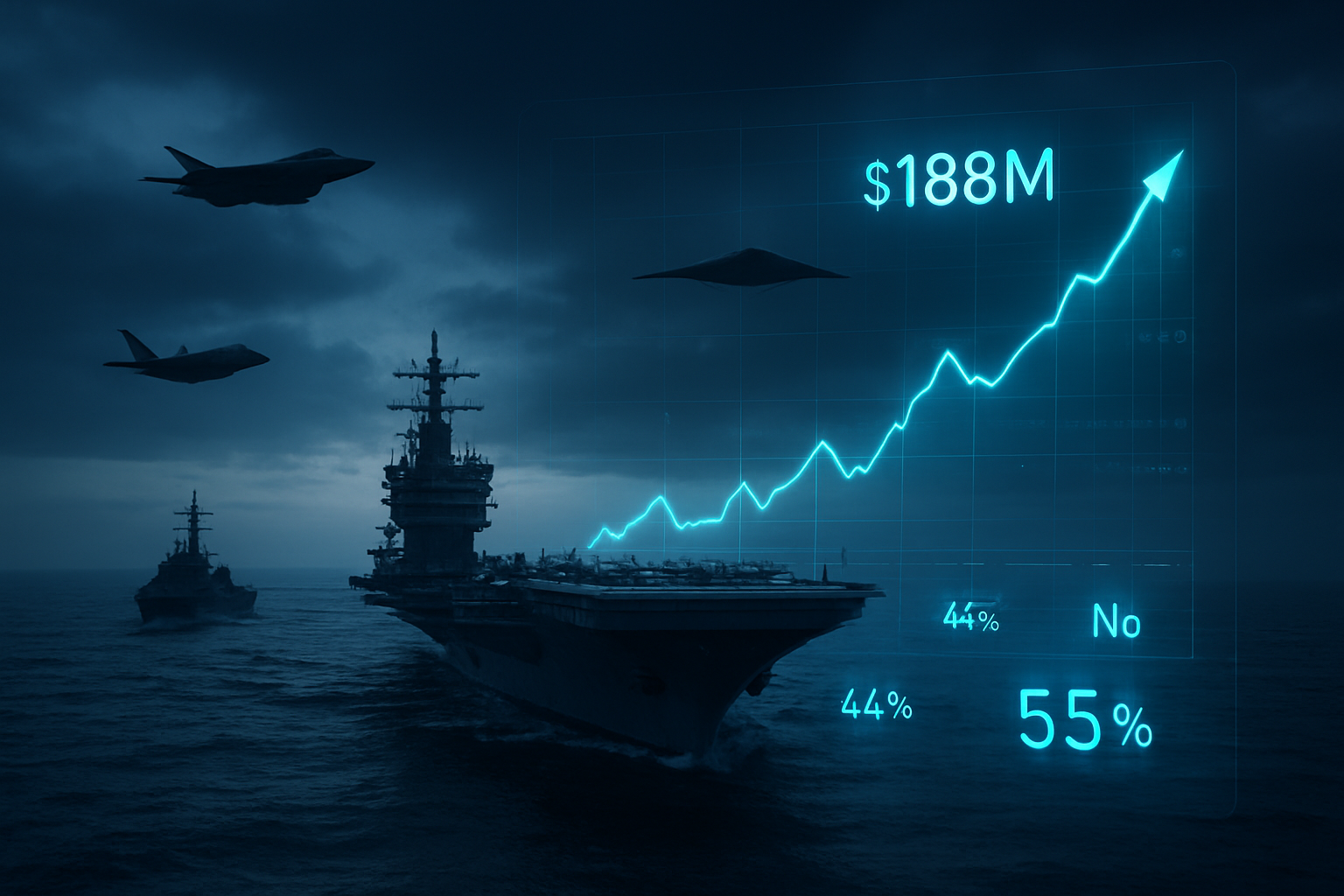
    As of February 7, 2026, the intersection of high-stakes diplomacy and military posturing has turned the eyes of the world toward the Persian Gulf. Prediction markets are currently pricing in a significant probability of military conflict between the United States and Iran, with the flagship "U.S. strike on Iran" market on Polymarket seeing its cumulative volume surge to a staggering $188 million. This massive influx of capital comes as the USS Abraham Lincoln carrier strike group takes its position in the Gulf of Oman, creating a visual and strategic catalyst that has sent traders into a frenzy.

    Current odds reflect a complex geopolitical landscape: the probability of a U.S. strike by the mid-February deadline (February 13) stands at 31%, while the odds for a strike by the end of the month (February 28) have climbed to 44%. These figures represent a volatile "truth signal" that often moves faster than traditional news cycles, as participants bet millions on whether the current "maximum pressure" campaign will culminate in kinetic action or de-escalate through high-stakes diplomacy currently unfolding in Oman.

    The Market: What's Being Predicted

    The primary theater for this financial forecasting is Polymarket, a decentralized prediction platform that has dominated the geopolitical betting space throughout late 2025 and into early 2026. The specific contract, "U.S. strikes Iran by…?", has become a focal point for institutional hedgers and retail speculators alike. While Polymarket handles the bulk of the decentralized volume, Kalshi, a U.S.-regulated exchange, has captured over $87 million in volume for related contracts concerning Iranian leadership stability and domestic government shutdown risks, providing a regulated alternative for American participants.

    The resolution criteria for these markets are notoriously strict. For a "Yes" resolution on the February deadlines, the U.S. military must conduct a confirmed kinetic strike—ranging from drone strikes to manned aerial bombardments—within Iranian territory or territorial waters. As of early February, the liquidity in these markets is exceptionally high, with approximately $1 million in standing buy/sell orders, ensuring that even large "whale" trades do not cause irrational price swings without significant conviction.

    Why Traders Are Betting

    The current surge in volume is not occurring in a vacuum. Traders are heavily weighing the precedent set by "Operation Absolute Resolve" on January 3, 2026, which saw the surprise U.S. capture of Nicolás Maduro. This event signaled to the markets that the current administration is willing to authorize high-risk, high-reward operations. Furthermore, the memory of "Operation Midnight Hammer" in June 2025—a massive U.S.-Israeli strike on the Fordow nuclear facility—remains fresh, establishing a baseline expectation for military intervention if diplomatic red lines are crossed.

    Recent movements have also been influenced by the domestic political climate. A fatal Border Patrol shooting in late January led to a U.S. government shutdown on January 31, 2026. Initially, this caused "strike" odds to plummet, as traders assumed a distracted Washington would avoid foreign entanglements. However, the deployment of the USS Abraham Lincoln has reversed that trend. Notably, "Unusual Whales" recently flagged a massive $5 million "No" bet on the February 28 deadline, suggesting that some high-net-worth traders believe the naval buildup is a leverage play for the Oman nuclear talks rather than a precursor to immediate war.

    Broader Context and Implications

    The activity in these prediction markets is mirrored in the traditional equities market, particularly within what analysts are calling the "Security Supercycle." Shares of Lockheed Martin (NYSE: LMT) have surged nearly 28% year-to-date, trading near $628 as investors eye the company’s $194 billion backlog and the prominent role of the F-35 Lightning II in regional deployments. Similarly, Northrop Grumman (NYSE: NOC) has seen increased scrutiny as its B-21 Raider stealth bombers are viewed as the primary assets for any deep-strike mission into fortified Iranian airspace.

    This trend highlights a growing reliance on prediction markets as a more accurate gauge of sentiment than traditional polling or expert punditry. When millions of dollars are on the line, "noise" tends to be filtered out, leaving a raw probability that incorporates everything from troop movements to leaked diplomatic cables. The accuracy of these markets was recently vindicated in January, when "insider" betting patterns correctly predicted the Maduro ouster hours before it was officially announced, leading to increased regulatory scrutiny but also increased public trust in the markets' predictive power.

    What to Watch Next

    The immediate focus for traders is the outcome of the bilateral talks in Muscat, Oman, which began on February 6. If these talks show signs of stalling or if either side issues a formal walk-away statement, the 44% probability for a late-February strike could easily spike above 60%. Conversely, any joint statement regarding a "de-escalation framework" would likely cause the markets to "fade," rewarding the "No" bettors who have recently taken large positions.

    Key milestones to monitor include the February 13 deadline, which serves as a psychological "checkpoint" for the market. If this date passes without incident, attention will shift entirely to the February 28 deadline, which many see as the "breaking point" for the current diplomatic cycle. Beyond the military aspect, watch for movements in the United States Oil Fund (NYSEARCA: USO) and Brent crude futures, which are currently forecasting a $64/bbl floor but remain highly sensitive to "Strait of Hormuz closure" odds, currently sitting at 31%.

    Bottom Line

    The $188 million volume on Polymarket’s Iran contracts is a testament to the maturation of prediction markets as a vital tool for geopolitical risk assessment. By aggregating the collective intelligence of thousands of traders—and the heavy conviction of million-dollar "whales"—these platforms offer a real-time probability of conflict that traditional media simply cannot replicate.

    While the current odds of 44% for a strike by the end of February suggest a "coin-flip" scenario, the underlying data points to a period of unprecedented tension. Whether the USS Abraham Lincoln’s presence in the Gulf of Oman leads to a "kinetic event" or serves as the ultimate diplomatic bargaining chip, the prediction markets will likely be the first to know the outcome. For now, the "smart money" is split, but the massive volume indicates that the world is bracing for a definitive conclusion to this February standoff.


    This article is for informational purposes only and does not constitute financial or betting advice. Prediction market participation may be subject to legal restrictions in your jurisdiction.

    PredictStreet focuses on covering the latest developments in prediction markets.
    Visit the PredictStreet website at https://www.predictstreet.ai/.

  • $89 Million Wagered on US Strike on Iran as January Deadline Approaches

    $89 Million Wagered on US Strike on Iran as January Deadline Approaches

    As January 2026 enters its final week, the digital landscape of prediction markets is flashing a warning sign that global intelligence communities and defense analysts are watching closely. On Polymarket, a decentralized prediction platform, the collective "wisdom of the crowd" is currently pricing in a significant possibility of a direct United States military strike on Iranian targets before the month concludes.

    With a staggering $89 million in total volume now flowing through Iran-related conflict contracts, the markets are currently reflecting a volatile probability range between 10% and 26% for a strike to occur by January 31. This surge in betting activity comes amidst the "January Uprising" in Iran and a massive naval redeployment by the Trump administration, turning what was once a geopolitical tail-risk into the most liquid and debated market of the year.

    The Market: What’s Being Predicted

    The primary theater for this financial forecasting is Polymarket, though similar contracts have seen increased liquidity on other platforms. The specific market in question—“US Strike on Iran by Jan 31, 2026”—has become a focal point for traders, with resolution criteria strictly defined as any kinetic military action (missile strikes, drone attacks, or manned aircraft sorties) officially acknowledged by the Pentagon or the White House as directed against Iranian territory or military assets.

    Current odds have been highly sensitive to real-time events. After a mid-month spike that saw probabilities climb as high as 37% following reports of mass casualties in Tehran protests, the odds have settled into a "wait-and-see" range of 10% to 26% as of January 24. This pricing suggests that while traders view a strike as a tail-risk, they believe the window for immediate action is rapidly narrowing. The liquidity in these markets is unprecedented for a geopolitical event; the $89 million volume represents a massive shift toward "conflict betting" as a form of alternative data for hedge funds and political analysts alike.

    Why Traders Are Betting

    The primary driver behind the sudden influx of capital into these contracts is the deteriorating internal situation within Iran. Since late December 2025, the nation has been gripped by the "January Uprising," a series of nationwide protests triggered by economic collapse and harsh internet blackouts. Reports from human rights agencies suggest a death toll exceeding 5,000 people as of January 23, 2026. The White House's pivot from negotiation to "maximum pressure" has provided the fundamental catalyst for the market's movement.

    Traders are also tracking physical military movements. The USS Abraham Lincoln Carrier Strike Group is currently transiting the Indian Ocean, expected to reach the Arabian Sea by the end of the month. Furthermore, the defense sector has signaled a shift toward readiness. Companies like Northrop Grumman (NYSE: NOC) and Lockheed Martin (NYSE: LMT) are trading near record highs, buoyed by the administration’s proposed $1.5 trillion defense budget for FY2026.

    Notably, some market volatility has been attributed to potential "insider" activity. On January 8, several newly created wallets placed synchronized bets on a strike when odds were below 18%. This follows a pattern seen earlier this month during U.S. operations in Venezuela, leading many to believe that traders with access to logistical or diplomatic intelligence are using these markets to hedge or profit from upcoming escalations.

    Broader Context and Implications

    The sheer volume of the Iran markets underscores a transformative trend: prediction markets are increasingly being treated as a more accurate, or at least more responsive, indicator than traditional diplomatic cables or cable news punditry. In an era where "black box" intelligence is often delayed or politicized, the real-time financial commitment of thousands of traders provides a raw sentiment analysis that is difficult to ignore.

    This market also reveals a grim public sentiment regarding regional stability. While defense stocks like RTX (NYSE: RTX) have seen a 7% year-to-date increase due to a record $251 billion backlog in missile defense systems, the prediction markets suggest that the public views defense as more than just a deterrent. The heavy betting on a kinetic strike indicates a belief that the "red lines" of 2024 and 2025 are being redrawn in early 2026.

    Historically, markets of this nature have a mixed record. While they successfully predicted the timing of recent tactical shifts in South America, they often over-index on "noise" from high-profile political rhetoric. However, the regulatory gaze is intensifying. The massive payouts—such as a $400,000 win for a single trader earlier this month—have prompted calls for Congressional oversight, specifically regarding the ethics of profiting from kinetic warfare.

    What to Watch Next

    As we approach the January 31 deadline, several key milestones could send the odds toward the 50% mark or crashing toward zero. The most critical factor is the positioning of the USS Abraham Lincoln. Should the carrier strike group begin launch-cycle preparations or be joined by additional assets from the Mediterranean, the market is likely to see a massive spike in "Yes" shares.

    Furthermore, the diplomatic rhetoric from regional players is a key indicator. Iran has warned that any strike launched from neighboring territories like Qatar or the UAE would result in immediate retaliation. Traders should watch for any movement of U.S. personnel from regional airbases, similar to the recent withdrawal from Ain al-Asad Airbase in Iraq, which some analysts interpreted as a move to clear the deck for offshore naval operations.

    Bottom Line

    The $89 million currently sitting in the US-Iran prediction market is more than just a series of bets; it is a high-stakes aggregation of global anxiety and intelligence. As of January 24, the 10% to 26% odds reflect a world that is bracing for a "spark" but hasn't yet seen the flame. Whether these markets are providing a true signal of impending conflict or merely reflecting the chaotic rhetoric of the new year remains to be seen.

    What is clear, however, is that prediction markets have officially entered the "War Room." As investors and world leaders alike look toward the January 31 deadline, the fluctuating percentages on Polymarket may offer the most honest assessment of where the line between diplomacy and conflict truly lies. For now, the world waits to see if the crowd is right—or if the end of the month will bring a de-escalation that the markets have not yet priced in.


    This article is for informational purposes only and does not constitute financial or betting advice. Prediction market participation may be subject to legal restrictions in your jurisdiction.

    PredictStreet focuses on covering the latest developments in prediction markets. Visit the PredictStreet website at https://www.predictstreet.ai/.

  • RTX Deep Dive: Navigating the $1.5 Trillion Defense Frontier and the Buyback Ultimatum

    RTX Deep Dive: Navigating the $1.5 Trillion Defense Frontier and the Buyback Ultimatum

    As of January 8, 2026, RTX Corporation (NYSE: RTX) finds itself at the epicenter of a geopolitical and fiscal storm that could redefine the American defense industry for a generation. On the heels of a historic $1.5 trillion defense budget proposal for fiscal year 2027—a staggering 50% increase over recent baselines—RTX has become the primary subject of a high-stakes tug-of-war between federal ambition and corporate strategy.

    While the headline figure of $1.5 trillion suggests a gold rush for defense contractors, the proposal arrived with an unprecedented ultimatum from the White House: a demand that major primes like RTX halt stock buybacks and pivot profits into massive capital expenditures to accelerate weapons production. This "production-first" policy has sent tremors through Wall Street, causing RTX shares to experience heightened volatility as investors weigh a record $251 billion backlog against the prospect of restricted capital returns. Today, RTX stands as a proxy for the broader industrial base—essential to national security, yet under intense scrutiny to deliver more, faster, and more efficiently.

    Historical Background

    The RTX we recognize today is the product of one of the largest industrial mergers in history. Formed in April 2020 through the "merger of equals" between Raytheon Company and United Technologies Corporation (UTC), the entity was designed to be a balanced aerospace and defense powerhouse.

    The history of its components is legendary. Raytheon, founded in 1922, pioneered the cavity magnetron (crucial for radar) and became the world leader in missile defense. United Technologies brought with it Pratt & Whitney (founded in 1925), the engine maker that powered the Allied victory in WWII, and Collins Aerospace, a leader in avionics.

    The merger's timing was uniquely challenging, closing just as the COVID-19 pandemic decimated commercial aviation. However, the strategic rationale—combining UTC’s commercial aerospace cash flows with Raytheon’s stable defense contracts—has proven resilient. Over the last six years, the company has streamlined its structure, moving from four segments to three in 2023, and survived a major technical crisis involving its Geared Turbofan (GTF) engines to emerge as a consolidated global leader.

    Business Model

    RTX operates a diversified business model that spans the entire lifecycle of aerospace and defense, from basic research to aftermarket services. Its revenue is roughly balanced between commercial and government customers, providing a natural hedge against sector-specific downturns. The company is organized into three primary segments:

    • Collins Aerospace: The world's most technologically advanced provider of aerospace systems. Collins provides everything from flight controls and avionics to interiors and power systems. It is a major player in the commercial aftermarket, where high-margin spare parts and repairs drive significant cash flow.
    • Pratt & Whitney: A "Big Three" global engine manufacturer. It powers the F-35 Lightning II (the world’s most advanced fighter) and thousands of commercial aircraft via the GTF engine family. Its business model relies heavily on long-term service agreements (LTSAs) that generate recurring revenue over decades.
    • Raytheon: The defense-focused arm, specializing in integrated air and missile defense, electronic warfare, and space systems. Raytheon is the prime contractor for the Patriot missile system and the NASAMS (National Advanced Surface-to-Air Missile System), both of which have seen surging demand due to conflicts in Eastern Europe and the Middle East.

    Stock Performance Overview

    Over the last decade, RTX (and its predecessor UTC) has delivered significant value, though the journey has been marked by distinct phases.

    • 1-Year Performance: RTX has been a standout performer, up approximately 61% since early 2025. This rally reflects the market's relief as the "powder metal" crisis (which grounded hundreds of Airbus A320neo jets) was finally contained and costed out.
    • 5-Year Performance: The stock is up approximately 174% from its early 2021 lows of ~$70. This period represents the successful integration of the Raytheon-UTC merger and the realization of cost synergies exceeding $1 billion.
    • 10-Year & Long-Term: Adjusted for the 2020 merger and spin-offs of Otis and Carrier, long-term shareholders have seen the company transform from a sprawling conglomerate into a focused aerospace pure-play. As of January 8, 2026, RTX trades near $185.73, just off its all-time high of $190.40.

    Financial Performance

    RTX entered 2026 with a robust balance sheet and a record-breaking pipeline. In its most recent Q3 2025 reporting, the company posted sales of $22.5 billion, a 12% year-over-year increase.

    Key financial metrics include:

    • Backlog: A record $251 billion, providing nearly three years of revenue visibility.
    • Free Cash Flow (FCF): RTX generated $4.0 billion in FCF in a single quarter (Q3 2025), a testament to its operational recovery.
    • Margins: Adjusted operating margins have expanded to approximately 12.5%, driven by commercial aftermarket strength and defense pricing power.
    • Debt: The company has been aggressive in deleveraging, paying down $2.9 billion in long-term debt in late 2025, bringing its total debt to roughly $38.3 billion.

    However, the "Trump ultimatum" regarding the $1.5 trillion budget introduces a variable: if the company is forced to shift from buybacks to R&D and capital expenditure (CapEx), the EPS growth profile may change in the near term in exchange for higher production capacity.

    Leadership and Management

    Christopher Calio assumed the role of CEO in May 2024 and became Chairman in April 2025, succeeding Greg Hayes. Calio is widely seen as an operational specialist, a profile that fits RTX's current needs.

    Under Calio, the strategic focus has shifted from "being a prime for everything" to "winning where we are best." Notably, he led the pivot to pull back from competing as a lead "space prime" for massive satellite constellations, choosing instead to be the premier supplier of the sensors and components that power them. This high-margin, lower-risk strategy has been well-received by analysts. Calio’s current challenge is navigating the political pressure to expand industrial capacity while maintaining the financial discipline that shareholders expect.

    Products, Services, and Innovations

    RTX is at the forefront of several "next-generation" technologies that are critical to the 2026 defense landscape:

    • The "Golden Dome": Raytheon's air defense portfolio is the backbone of the U.S. and allied "Golden Dome" initiative—a layered defense system designed to intercept everything from low-cost drones to hypersonic missiles.
    • Hypersonics: RTX is a leader in scramjet technology and hypersonic interceptors, areas that are expected to receive a significant share of the new $1.5 trillion budget.
    • Next-Gen Engines: Pratt & Whitney is currently developing the Engine Core Upgrade (ECU) for the F-135, ensuring the F-35 remains viable through 2050.
    • Digital Airspace: Collins Aerospace recently secured a $438 million FAA contract to modernize the U.S. National Airspace System, integrating AI to optimize flight paths and reduce fuel burn.

    Competitive Landscape

    RTX operates in an oligopolistic market dominated by a few "Primes."

    • Lockheed Martin (NYSE: LMT): The largest rival. While Lockheed leads in stealth aircraft (F-35), RTX is a major supplier to Lockheed, creating a "co-opetition" dynamic.
    • Northrop Grumman (NYSE: NOC): Leads in the nuclear triad and stealth bombers (B-21). RTX competes more directly with Northrop in the sensors and electronics space.
    • The Boeing Company (NYSE: BA): While Boeing remains a titan, its ongoing struggles with its commercial segment and defense margins have allowed RTX to capture more "mindshare" and valuation premium from investors seeking stability.

    RTX’s competitive advantage lies in its diversification. Unlike Lockheed, which is heavily reliant on the F-35 program, RTX’s revenue is spread across thousands of platforms and a massive commercial aftermarket.

    Industry and Market Trends

    The aerospace and defense sector in 2026 is defined by Global Rearmament. The war in Ukraine and tensions in the Indo-Pacific have shifted the DoD's focus from "just-in-time" procurement to "just-in-case" inventory.

    Furthermore, the Commercial Aerospace Super-Cycle continues. Despite concerns about a global slowdown, the demand for narrow-body aircraft (Airbus A320neo and Boeing 737 MAX) remains at historic highs. RTX’s Pratt & Whitney and Collins segments are direct beneficiaries of this decade-long backlog in commercial aviation.

    Risks and Challenges

    Despite its strengths, RTX faces several headwinds:

    1. Political Interference: The current administration’s pressure to limit stock buybacks could cap short-term shareholder returns and force the company into low-margin capital investments.
    2. The "Powder Metal" Tail: While the crisis is mostly contained, the financial impact of compensating airlines for grounded GTF-powered planes will persist through late 2026, costing roughly $1.2 billion annually.
    3. Supply Chain Fragility: Lead times for specialized materials like titanium remain double pre-pandemic levels. Any disruption in global trade, particularly involving China, could stall production lines.
    4. Labor Shortage: Finding high-skilled engineers and machinists remains a bottleneck for the 50% production ramp-up requested by the government.

    Opportunities and Catalysts

    The primary catalyst for RTX is the $1.5 Trillion Budget Proposal. If even a portion of this expansion is codified, the orders for Patriot missiles, AMRAAMs, and Javelins could double.

    Other catalysts include:

    • Q4 2025 Earnings: Scheduled for January 27, 2026. A strong guide for 2026 FCF could propel the stock toward the $200 mark.
    • Vertical Integration: RTX is investing $600 million to bring more casting and forging capabilities in-house, which should expand margins by 2027.
    • M&A: With a strong cash position, RTX may look to acquire niche AI or autonomous systems firms to bolster its electronic warfare portfolio.

    Investor Sentiment and Analyst Coverage

    Wall Street remains largely bullish on RTX, with a Moderate Buy consensus rating. As of January 2026, the median price target stands at $200.00, with some aggressive bulls eyeing $222.

    Institutional investors, including Vanguard and BlackRock, remain the largest holders, attracted by the company's defensive moat and 2%+ dividend yield. However, "retail chatter" has turned cautious following the White House's rhetoric on buybacks, with many retail investors watching to see if the company’s capital allocation strategy undergoes a fundamental shift.

    Regulatory, Policy, and Geopolitical Factors

    The geopolitical environment is the strongest tailwind for RTX in decades. The U.S. and its allies are in a period of rapid missile defense expansion. However, policy risks are rising. New regulations introduced in early 2026 have placed stricter caps on executive compensation for contractors receiving massive federal windfalls. Furthermore, the potential for tariffs on aerospace-grade aluminum and titanium remains a wildcard that could increase the cost of goods sold (COGS) and squeeze margins if contracts aren't structured with inflationary protections.

    Conclusion

    RTX Corporation stands at a historic crossroads on January 8, 2026. The company has successfully navigated the technical and financial turbulence of the early 2020s, emerging as a streamlined, high-performing aerospace giant with a $251 billion backlog.

    The $1.5 trillion defense budget proposal represents a generational opportunity for growth, but it comes with strings attached. Investors must balance the undeniable demand for RTX’s products with the rising political pressure on how the company spends its profits. For the long-term investor, RTX remains a cornerstone holding in a volatile world, offering a unique blend of commercial growth and defense stability. The key to the next 12 months will be how CEO Christopher Calio manages the "ultimatum"—delivering the increased production the government demands without sacrificing the returns shareholders have come to expect.


    This content is intended for informational purposes only and is not financial advice.

  • The Silent Sentinel: A Deep-Dive Research Feature on Northrop Grumman (NYSE: NOC)

    The Silent Sentinel: A Deep-Dive Research Feature on Northrop Grumman (NYSE: NOC)

    The defense industry has reached a historic inflection point. As of January 8, 2026, the landscape for aerospace and defense contractors has been permanently reshaped by the unveiling of a staggering $1.5 trillion U.S. defense budget proposal. Among the "Big Prime" contractors, few are as uniquely positioned to capitalize on this fiscal surge as Northrop Grumman (NYSE: NOC).

    With a portfolio that serves as the literal backbone of the U.S. nuclear triad and a pioneer in next-generation stealth technology, Northrop Grumman finds itself at the intersection of massive government spending and heightened geopolitical urgency. This deep-dive research explores the company’s trajectory, financial health, and the risks inherent in the most ambitious defense buildup since the Cold War.

    Introduction

    Northrop Grumman is a titan of the global security industry, specializing in aeronautics, space systems, and mission-critical defense electronics. While peers like Lockheed Martin (NYSE: LMT) dominate tactical aviation and General Dynamics (NYSE: GD) lead in naval dominance, Northrop Grumman has carved out an indispensable niche: the modernization of American strategic deterrence.

    The company is currently in focus due to its dual roles in the B-21 Raider stealth bomber and the Sentinel Intercontinental Ballistic Missile (ICBM) program. Today’s news of a $1.5 trillion budget proposal—a nearly 50% increase from levels seen just two years ago—validates the company’s "pure-play" defense strategy. As the Pentagon shifts focus toward "Great Power Competition" with China and Russia, Northrop Grumman's high-tech, digital-first approach to warfare has made it a favorite among defense hawks and institutional investors alike.

    Historical Background

    The Northrop Grumman story is one of consolidation and technical audacity. The company in its current form was forged in 1994 when Northrop Corporation acquired the Grumman Corporation for $2.1 billion. Northrop, founded in 1939, was a pioneer in "flying wing" designs, a legacy that eventually birthed the B-2 Spirit stealth bomber. Grumman, meanwhile, was the legendary "Iron Works" of Long Island, famous for the F-14 Tomcat and the Apollo Lunar Module.

    Throughout the late 1990s and early 2000s, the company continued to absorb critical tech players, including Litton Industries and TRW Inc., which provided the foundation for its massive Mission Systems and Space segments. In 2018, Northrop acquired Orbital ATK, a move that secured its dominance in solid rocket motors and solidified its role in the revival of the U.S. space program. These transformations shifted the company from a traditional aircraft manufacturer into a diversified technology powerhouse capable of managing the world's most complex "system-of-systems" programs.

    Business Model

    Northrop Grumman operates a diversified but highly integrated business model organized into four primary reporting segments:

    1. Aeronautics Systems: The home of the B-21 Raider and the Global Hawk/Triton autonomous systems. This segment focuses on stealth, survivability, and long-range strike capabilities.
    2. Defense Systems: Responsible for the Sentinel ICBM program and advanced tactical weapons. This segment focuses on the "Nuclear Triad" and integrated battle command.
    3. Mission Systems: The "intelligence" of the company, producing advanced sensors, electronic warfare tools, and cyber solutions. It provides the electronic infrastructure for nearly every major U.S. military platform.
    4. Space Systems: Specializes in satellites and launch vehicles. This is currently the company’s fastest-growing segment, driven by the U.S. Space Force’s push for resilient orbital networks.

    The company’s revenue is almost entirely derived from government contracts (roughly 85% from the U.S. government). This provides high revenue visibility through a massive backlog, which reached a record $93 billion in early 2025.

    Stock Performance Overview

    Northrop Grumman has historically been a standout performer for long-term shareholders, characterized by resilience during market downturns.

    • 1-Year Performance: As of January 8, 2026, NOC is trading near $577.01, representing a roughly 36% return over the past year. This outperformance was fueled by the successful flight tests of the B-21 Raider and the subsequent production acceleration.
    • 5-Year Performance: Investors have seen a total return of approximately 124%. The stock benefited from a flight to safety during the 2022–2024 inflationary period and a global re-armament trend following the invasion of Ukraine.
    • 10-Year Performance: Over the last decade, NOC has nearly tripled in value (up ~273%), significantly outperforming the broader S&P 500. This decade was defined by aggressive dividend growth and massive stock buybacks, though recent regulatory shifts have tempered the latter.

    Financial Performance

    In fiscal year 2025, Northrop Grumman reported revenues between $41.7 billion and $42.5 billion. While the top line showed healthy mid-single-digit growth, the bottom line was pressured by a $477 million pre-tax loss provision taken early in the year on the B-21 Raider’s Low-Rate Initial Production (LRIP). This "learning curve" charge is common in fixed-price defense contracts but initially spooked some value investors.

    By Q4 2025, however, the financial narrative shifted. The company raised its full-year EPS guidance to a range of $25.65 to $26.05 as production efficiencies improved. The company’s balance sheet remains solid, though it carries roughly $14 billion in long-term debt. Free cash flow has lagged slightly behind peers as the company reinvests heavily into capital expenditures for the Sentinel and B-21 production lines, but the $1.5 trillion budget proposal suggests a massive cash infusion is on the horizon.

    Leadership and Management

    Since January 2019, Northrop Grumman has been led by Kathy Warden, Chair, CEO, and President. Warden is widely regarded as one of the most effective leaders in the defense sector, known for her "Digital Engineering" mandate. This strategy uses advanced modeling and simulation to design platforms in a virtual environment before cutting metal, a process credited for bringing the B-21 Raider to flight status faster than any previous stealth aircraft.

    Warden’s leadership style emphasizes operational excellence and human capital. Under her tenure, the company has navigated a "critical" cost breach on the Sentinel program by working transparently with the Pentagon, eventually securing a restructured "Milestone B" that kept the program alive. Her focus on "speed and capacity" is now the company’s rallying cry in the face of the $1.5 trillion budget windfall.

    Products, Services, and Innovations

    Northrop Grumman’s portfolio is a roster of the most advanced technology on (and off) the planet:

    • B-21 Raider: The world’s first sixth-generation aircraft. It is designed to be the "backbone" of the Air Force's long-range strike capability, capable of penetrating the most advanced air defenses.
    • Sentinel (LGM-35A): The replacement for the aging Minuteman III ICBM. This $141 billion program is the largest land-based nuclear modernization effort in history.
    • Integrated Battle Command System (IBCS): A software-defined system that connects "any sensor to any shooter," allowing diverse defense systems to talk to each other on the battlefield.
    • Space Assets: Northrop is a lead developer of the "Proliferated Warfighter Space Architecture," a network of low-earth orbit satellites designed to track hypersonic missiles.

    Competitive Landscape

    In the high-stakes world of defense primes, Northrop Grumman competes primarily with Lockheed Martin (NYSE: LMT), Boeing (NYSE: BA), and General Dynamics (NYSE: GD).

    Unlike Lockheed, which relies heavily on the F-35 program, Northrop is more specialized in "strategic" assets. While Boeing has struggled with commercial quality issues and cost overruns on the KC-46 tanker, Northrop has managed to maintain a "pure-play" defense reputation that has largely avoided commercial contagion. Its primary competitive edge lies in Stealth and Mission Electronics, where it frequently acts as a subcontractor even to its rivals, providing the "brains" (sensors and radar) for their platforms.

    Industry and Market Trends

    The aerospace and defense sector in 2026 is driven by three macro trends:

    1. The Pacific Pivot: The need to counter China’s rapid naval and aerial expansion has shifted funding toward long-range bombers and space-based surveillance.
    2. Digital Warfare: Modern combat is increasingly defined by software, AI, and cyber capabilities rather than just "metal and engines." Northrop's digital-first design process is the new industry standard.
    3. Nuclear Modernization: After decades of neglect, the U.S. is in the midst of a total refresh of its nuclear triad, a cycle that will last into the 2040s.

    Risks and Challenges

    Despite the bullish budget news, Northrop Grumman faces significant risks:

    • Fixed-Price Contract Inflation: Many of its large programs were signed under fixed-price terms. If labor or material costs spike, the company must absorb the losses, as seen with the B-21 charges in 2025.
    • Sentinel Execution: The Sentinel program remains technically and politically fragile. Any further cost overruns could lead to renewed calls in Congress to cancel the program in favor of sea-based deterrents.
    • Regulatory Caps: New executive orders in 2026 have targeted defense contractor payouts, threatening to cap stock buybacks if companies do not meet specific R&D reinvestment targets.
    • Labor Shortages: The demand for high-clearance aerospace engineers exceeds supply, driving up wage expenses.

    Opportunities and Catalysts

    The $1.5 trillion budget proposal is the ultimate catalyst. Specifically, the proposed $25 billion "Golden Dome" missile shield represents a massive new market for Northrop’s Mission Systems segment. Additionally, the B-21 program is moving from development (low margin) to production (higher margin). As the Air Force targets a fleet of at least 100 Raiders, the "tail" of sustainment and upgrades will provide decades of high-margin recurring revenue.

    Investor Sentiment and Analyst Coverage

    Wall Street sentiment remains "Moderately Bullish." As of early 2026, approximately 70% of analysts covering NOC have a "Buy" or "Strong Buy" rating, with price targets ranging from $620 to $685. Institutional ownership is high at 83%, with major positions held by Vanguard, State Street, and Capital Group.

    While some "growth" funds have trimmed positions due to the buyback caps, "value" and "macro" funds have increased stakes, viewing Northrop as a sovereign-backed tech play with a nearly impenetrable moat.

    Regulatory, Policy, and Geopolitical Factors

    The geopolitical environment is the primary tailwind for NOC. The ongoing stalemate in Ukraine, coupled with tensions in the South China Sea, has created a bipartisan consensus in Washington for sustained high defense spending.

    However, policy risk is rising. The current administration has signaled a "tough on contractors" stance, demanding more transparency in pricing and higher quality standards. Investors must watch for "The One Big Beautiful Bill Act" (OBBBA), a 2026 supplemental funding bill that includes specific clauses requiring contractors to prioritize "domestic sourcing" over profit margins.

    Conclusion

    Northrop Grumman (NYSE: NOC) stands as a pivotal architect of 21st-century national security. The $1.5 trillion budget proposal released today serves as a powerful validation of the company's long-term strategy to dominate the "strategic" and "space" domains of modern warfare.

    While the company must navigate the treacherous waters of fixed-price contract risks and increasing regulatory scrutiny of shareholder returns, its technological "moat"—built on decades of stealth and electronic warfare expertise—is nearly impossible for competitors to bridge. For investors, Northrop Grumman offers a rare combination of government-backed stability and high-tech growth potential. As the B-21 Raider takes to the skies in greater numbers, NOC is not just a defense company; it is a critical component of the American strategic posture in an increasingly uncertain world.


    This content is intended for informational purposes only and is not financial advice.