
Tag: Crypto

  • Bitcoin’s Recovery Roadmap: Prediction Markets Weigh $75,000 Rebound Against a Long Road to $150,000

    Bitcoin’s Recovery Roadmap: Prediction Markets Weigh $75,000 Rebound Against a Long Road to $150,000

    As of February 9, 2026, the cryptocurrency market is caught in a high-stakes tug-of-war between a brutal technical correction and a resurgence of institutional "buy-the-dip" conviction. Following a dizzying peak near $126,000 in late 2025, Bitcoin (BTC) endured a flash crash to $60,062 just days ago on February 6. Now, as the price stabilizes between $68,400 and $70,800, prediction markets are providing a real-time thermometer for the asset's recovery prospects.

    Currently, traders on leading platforms are cautiously optimistic about a near-term rebound. On Polymarket, the odds of Bitcoin hitting $75,000 by the end of February have climbed to 54%, making it the most favored outcome for the month. However, the appetite for more aggressive targets has cooled significantly; the probability of reclaiming $80,000 within the next three weeks sits at a more modest 24% to 25%. This divergence highlights a market that is betting on consolidation rather than a return to the parabolic growth seen last year.

    The Market: What's Being Predicted

    The prediction market ecosystem has matured into a multi-million dollar forecasting engine, with two platforms—Kalshi and Polymarket—dominating the narrative. The "Bitcoin price at end of February" market on Polymarket has become a primary liquidity hub, boasting a total volume exceeding $10.2 million. Traders here are largely clustered around the $75,000 level, viewing it as a critical psychological and technical resistance point that must be reclaimed to invalidate the recent "bear market" signals.

    On Kalshi, a regulated U.S. exchange, the focus is split between short-term survival and long-term ambition. The "Above $80,000" contract for February 2026 is currently trading at 24 cents (implied 24% probability), with approximately $347,294 in volume. This reflects a significant drop from late January, when the same contract traded as high as 60 cents before the early February crash. The resolution criteria for these markets typically rely on the CME CF Bitcoin Reference Rate, ensuring a regulated and transparent benchmark for settlement.

    Looking further ahead, the "moon shot" bets for 2026 are facing a reality check. The market for Bitcoin hitting $150,000 by June 2026, which once carried a 40% probability during the 2025 rally, has plummeted to 21% on both Kalshi and Polymarket. Despite this decline in confidence, the June $150,000 contract on Kalshi has still attracted over $670,000 in volume, indicating that a dedicated cohort of "permabulls" is still willing to wager on a massive second-half recovery.

    Why Traders Are Betting

    The primary driver behind the current "Yes" bets for a $75,000 recovery is the aggressive behavior of institutional giants. MicroStrategy (NASDAQ: MSTR), led by Michael Saylor, underscored its commitment to the "HODL" strategy by purchasing an additional 1,142 BTC between February 2 and February 8. Even as the company reported a staggering $12.4 billion quarterly net loss due to fair-value accounting rules following the price drop, the signal to the market was clear: institutional conviction has not wavered.

    Similarly, BlackRock (NYSE: BLK) has seen its IBIT ETF become a focal point of market liquidity. On February 5, during the height of the price plunge, the ETF recorded a record-breaking $10 billion in daily trading volume. While the first week of February saw net outflows, a massive $230 million inflow on February 6—the day Bitcoin hit its local bottom—suggests that large-scale investors are using prediction market volatility to time their entries.

    However, "No" bettors and skeptics point to a shifting macroeconomic landscape. The recent nomination of Kevin Warsh as Federal Reserve Chair has introduced a more "hawkish" tone to monetary policy expectations. Furthermore, Treasury Secretary Scott Bessent’s recent testimony—stating the government would not provide a "backstop" for crypto-related failures—has created a "risk-off" environment. This political cooling, combined with a thinning market depth that now requires only $5 million to move the price by 1%, has made many traders wary of betting on an $80,000 breakout this month.

    Broader Context and Implications

    The activity in these Bitcoin markets is a microcosm of a larger trend: the professionalization of prediction markets as a legitimate financial tool. In early 2026, the sector reached a milestone with record-breaking daily volumes, including a $702 million surge across platforms on January 14. These markets are no longer just for retail speculators; they are increasingly used by hedge funds to hedge spot crypto positions against sudden regulatory shifts or macro shocks.

    Real-world implications of these bets are significant. If Bitcoin fails to hit the $75,000 target by the end of February, it could trigger a "capitulation" event among retail investors who entered the market during the 2025 highs. Prediction markets are currently signaling that the public sentiment is "bruised but not broken," with the 54% probability of a $75,000 rebound suggesting a belief in a "dead cat bounce" or a meaningful recovery.

    Historically, prediction markets have often been more accurate than individual analysts. While institutional desks at firms like Bernstein continue to drum a $150,000 year-end drumbeat, the 21% probability on Kalshi suggests that the collective "wisdom of the crowd" is much more attuned to the technical damage done during the February 6 crash. This skepticism reflects a sophisticated understanding of market cycles that often eludes the more optimistic sell-side research.

    What to Watch Next

    The coming weeks will be defined by two major catalysts: regulatory clarity and liquidity replenishment. Traders should closely monitor the upcoming Senate Banking Committee hearings scheduled for late February, where the "Bessent Doctrine" on crypto regulation is expected to be further detailed. Any hint of a softer stance on stablecoin legislation could provide the fuel needed to push Bitcoin toward the $80,000 mark.

    Key dates for resolution are also approaching. The February monthly contracts on Polymarket will settle on February 28 at midnight. Historically, the final 48 hours before settlement see a massive spike in volume and price volatility as traders "pin" the price to certain levels. Additionally, watch for BlackRock’s weekly inflow data; if the $200M+ daily inflows continue, the probability of a $75,000 close will likely move toward the 70% range.

    The potential for a "short squeeze" remains a high-probability scenario. With market depth currently at a multi-month low of $5 million, a sudden burst of buying from a "whale" or another MicroStrategy-sized purchase could bypass the $75,000 resistance in a matter of hours, catching the 46% of "No" bettors off guard and potentially liquidating millions in short positions on prediction platforms.

    Bottom Line

    The prediction markets for February 2026 paint a picture of a Bitcoin market at a crossroads. The high interest in the $75,000 level suggests that the market believes the worst of the February crash is over, yet the low confidence in an $80,000 reclaim or a $150,000 summer peak indicates that the "easy money" phase of the cycle has concluded.

    Ultimately, these markets reveal that Bitcoin’s trajectory is no longer just about "crypto news," but is deeply intertwined with Federal Reserve policy and institutional balance sheets. Whether Bitcoin resolves at $75,000 or remains bogged down in the $60,000s, the liquidity and volume currently seen on Kalshi and Polymarket prove that prediction markets have become the "new tape" for the digital age—providing a more honest, capital-backed look at the future than any social media trend.


    This article is for informational purposes only and does not constitute financial or betting advice. Prediction market participation may be subject to legal restrictions in your jurisdiction.

    PredictStreet focuses on covering the latest developments in prediction markets.
    Visit the PredictStreet website at https://www.predictstreet.ai/.
  • Bitcoin’s $70,000 Tug-of-War: Polymarket Traders Recalibrate as $85,000 Dreams Fade

    Bitcoin’s $70,000 Tug-of-War: Polymarket Traders Recalibrate as $85,000 Dreams Fade

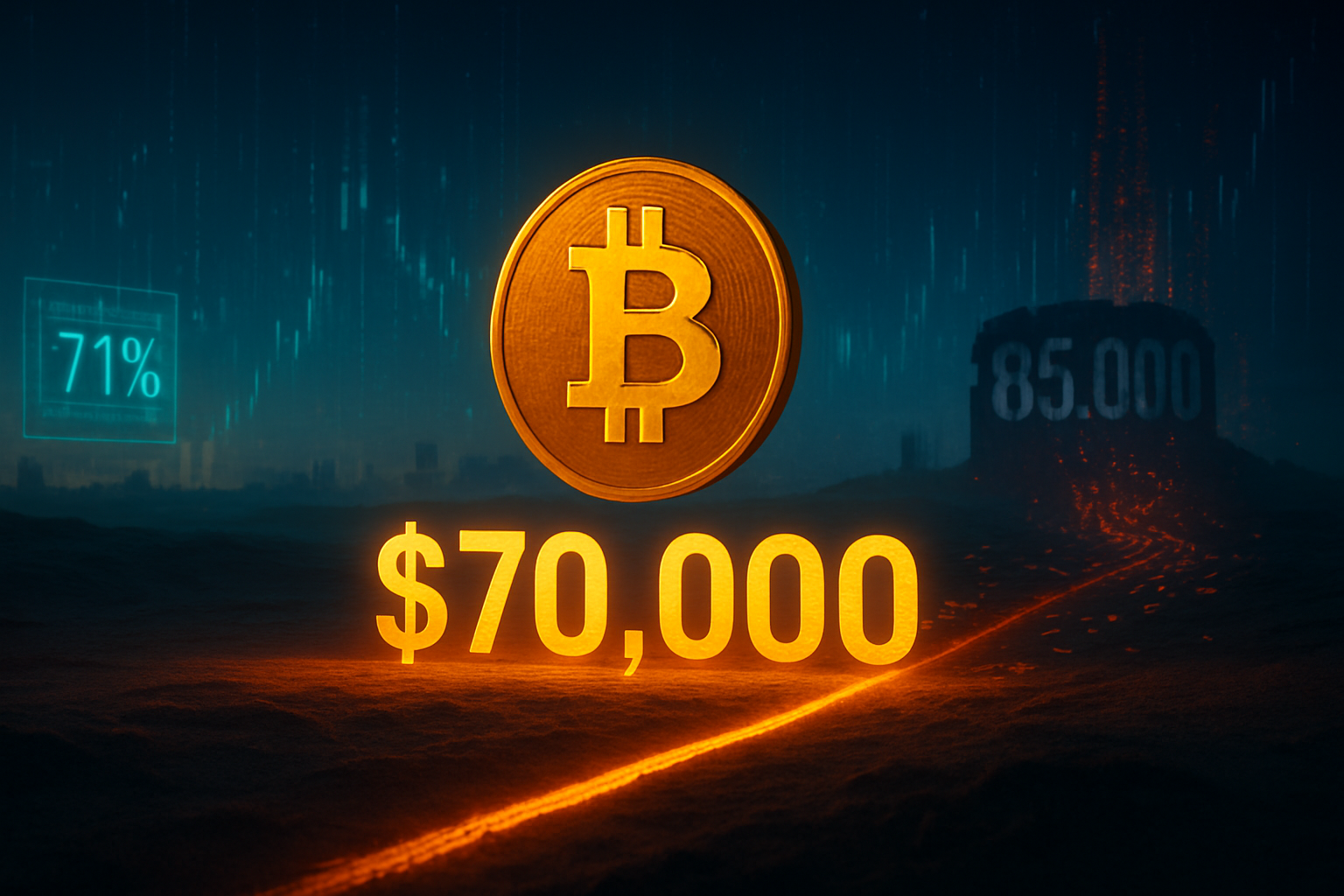
    As of February 8, 2026, Bitcoin is locked in a fierce battle around the $70,000 mark, a level that has become the definitive "line in the sand" for traders on decentralized prediction platforms. On Polymarket, the world’s leading prediction market, the probability of Bitcoin touching $70,000 this month has surged to a commanding 71%, up significantly from 62% just a week ago. This shift signals a consolidation phase after a turbulent start to the year, as the market pivots from aggressive moonshot targets to a more grounded reality.

    The surge in confidence for the $70,000 floor comes at a cost, however. Just weeks ago, traders were pricing in a rapid ascent to $85,000 and beyond. Those upside expectations have since collapsed, with odds for an $85,000 target cratering from nearly 60% in late January to a mere 12-32% today. This dramatic repricing reflects a growing consensus that the "bull-run fever" of late 2025 has cooled, replaced by a range-bound environment dominated by institutional cooling and shifting liquidity.

    The Market: What's Being Predicted

    The current focus of the crypto prediction space is centered on Bitcoin’s February 2026 price action. On Polymarket and its regulated competitor Kalshi, hundreds of millions in volume are being traded across various price-point contracts. The primary contract—"Will Bitcoin touch $70,000 in February?"—is currently the most liquid, with its 71% probability serving as a benchmark for the broader market’s sentiment.

    While the "touch" probability is high, the "settle" probability tells a more nuanced story. Traders are only pricing in a 54% chance that Bitcoin ends the month at or above $75,000, suggesting that while the market expects a push upward, it doesn't necessarily expect a sustained rally. On Kalshi, shorter-term weekly contracts for the mid-February period show even tighter odds, with most participants betting on a price range that keeps the asset pinned between $65,000 and $75,000 through the next ten days.

    Trading volume has spiked as the $70,000 barrier approaches. Liquidity on these platforms has deepened significantly compared to 2024, allowing "whales" to hedge massive spot positions. These markets will resolve based on the price feeds from major exchanges like Coinbase Global, Inc. (NASDAQ: COIN), ensuring a transparent and objective conclusion to the bets at the stroke of midnight on February 28.

    Why Traders Are Betting

    The primary catalyst for this bearish repricing is the unexpected wave of redemptions hitting U.S. Spot Bitcoin ETFs. After a record-breaking 2025, institutional giants like BlackRock, Inc. (NYSE: BLK) are seeing their first sustained period of net outflows. Total assets in these ETFs have plummeted from $128 billion to $97 billion in less than a month, with over $2.8 billion in net redemptions recorded in the last two weeks of January alone.

    This "mechanical" selling pressure has changed the game for prediction market traders. Analysts note that the average purchase price for many institutional entrants sits between $84,000 and $88,000. With Bitcoin trading well below those levels, many of these positions are currently "underwater," triggering automated risk-management protocols that dump supply back onto the market. This explains the "collapse" of the $85,000 upside odds; traders realize that any push toward $80k will likely be met with a massive wall of institutional selling.

    Furthermore, the absence of aggressive "dip buying" during the brief slide to $60,000 in early February has signaled a tactical retreat by Wall Street. Unlike the retail-driven pumps of the past, the current market is heavily influenced by the balance sheets of companies like MicroStrategy Incorporated (NASDAQ: MSTR). When these major players go quiet, prediction market odds quickly reflect the lack of upward momentum, leading to the current $65,000-$85,000 implied range.

    Broader Context and Implications

    This shift in Polymarket sentiment highlights the evolution of prediction markets as a leading indicator for the broader financial world. Traditionally, investors looked to the futures and options markets on the CME to gauge sentiment. However, the "wisdom of the crowd" on Polymarket has often been faster to price in the impact of ETF flows than traditional analysts. The 71% probability for a $70,000 touch acts as a psychological anchor, potentially creating a self-fulfilling prophecy as retail traders align their strategies with the "prediction market consensus."

    Real-world implications are significant. The failure to reclaim the $85,000 level could signal a broader "cooling off" period for the entire digital asset class. If Bitcoin cannot maintain the $70,000 support, it may validate the fears of skeptics who argue that the 2025 rally was overextended. This market sentiment also affects the regulatory landscape, as agencies monitor these prediction markets for signs of manipulation or as gauges of financial stability in the crypto ecosystem.

    Historically, Polymarket has been remarkably accurate in predicting Bitcoin "floors" during periods of high volatility. In mid-2025, the platform correctly priced in a 15% correction three weeks before it hit the mainstream news. Traders now view these markets not just as a place to bet, but as a crucial data point for risk management in a world where crypto and traditional finance are increasingly intertwined.

    What to Watch Next

    As we move toward mid-February, several key milestones will determine if the $70,000 "line in the sand" holds. Traders are keeping a close eye on the next round of 13F filings and weekly ETF flow reports. If redemptions from funds like the Grayscale Bitcoin Trust (OTC: GBTC) begin to slow, the 71% probability of hitting $70,000 could quickly transform into a bet on a $75,000 breakout.

    Key dates to monitor include the February 15 "options expiry," which often brings heightened volatility. If Bitcoin is still hovering near $68,000 by that date, the probability of a late-month surge will likely drop, and we could see the $65,000 support tested once again. Polymarket traders are currently pricing a 57% chance of a retest of $65,000 before the month is out, making the next 10 days critical for the asset's short-term trajectory.

    Bottom Line

    The current state of the Bitcoin prediction markets on Polymarket reflects a market in transition. The exuberant $85,000 targets of last month have vanished, replaced by a calculated focus on the $70,000 pivot point. With a 71% probability of touching that mark, the crowd is betting on resilience, but the underlying data—fueled by massive ETF outflows—suggests that any recovery will be a slow, arduous climb.

    This episode serves as a powerful reminder of the utility of prediction markets. While traditional price targets often remain static, prediction market odds are dynamic, reacting in real-time to every billion-dollar outflow and every shift in institutional sentiment. For now, the "line in the sand" is drawn at $70,000, and the coming weeks will reveal whether that line is built on stone or shifting sand.


    This article is for informational purposes only and does not constitute financial or betting advice. Prediction market participation may be subject to legal restrictions in your jurisdiction.

    PredictStreet focuses on covering the latest developments in prediction markets.
    Visit the PredictStreet website at https://www.predictstreet.ai/.

  • The Prediction Market ‘Civil War’: Polymarket and Kalshi Battle for 2026 Dominance

    The Prediction Market ‘Civil War’: Polymarket and Kalshi Battle for 2026 Dominance

    As the prediction market industry enters its most volatile and high-stakes year to date, the internal rivalry between the sector’s two largest titans has spilled over into the markets themselves. On Manifold Markets, a high-liquidity "meta-market" titled "Top 1 prediction market by volume in 2026?" has become the primary scoreboard for what insiders are calling the "Civil War" of forecasting platforms. This contract allows traders to bet on which platform—the decentralized, crypto-native Polymarket or the CFTC-regulated Kalshi—will emerge as the undisputed volume leader by the end of the year.

    As of February 8, 2026, Polymarket holds a commanding 47% lead in the odds, while Kalshi trails at 34%. This 13-point gap reflects a significant shift in market sentiment over the last month, driven by a series of massive institutional investments and regulatory pivots that have fundamentally altered the landscape. For industry watchers, this market is more than just a bet; it is a real-time proxy for the future of information finance, pitting the speed of blockchain-based markets against the institutional legitimacy of regulated exchanges.

    The Market: What's Being Predicted

    The "Civil War" contract on Manifold Markets focuses on one primary metric: total USD-equivalent trading volume for the 2026 calendar year. While Manifold is technically a play-money platform, the market has attracted significant liquidity, with over $50 million in notional value traded on this specific question. The resolution criteria are strict, requiring the winner to be determined by verified third-party data from sources like The Block or CoinGecko, as well as official transparency reports from the platforms themselves.

    Currently, the market favors Polymarket at 47%. This lead is bolstered by Polymarket’s massive international reach and its dominance in "high-signal" event contracts—specifically geopolitics, tech milestones, and global macroeconomics. Meanwhile, Kalshi’s 34% probability reflects its growing but narrower focus on the U.S. retail sector. Interestingly, the market excludes "pure sports betting" from the volume count to maintain a focus on event-based forecasting. This is a critical distinction, as recent reports indicate that roughly 91% of Kalshi’s raw volume in early 2026 has been driven by its new sports-integrated contracts.

    Trading volume on this meta-market has spiked following the announcement of a $2 billion institutional investment in Polymarket by Intercontinental Exchange (NYSE: ICE). This move signalized to traders that Polymarket is no longer a niche crypto experiment but a serious contender for global financial infrastructure. The liquidity in the "Civil War" market is so high that several hedge funds are reportedly using it as a hedge against their equity positions in traditional exchange stocks.

    Why Traders Are Betting

    The 47-to-34 split in odds represents a fundamental debate over the "on-ramp" of the future. Polymarket bulls point to the platform's recent partnership with Circle, which transitioned the exchange to native USDC. This move provided institution-grade settlement infrastructure, making it easier for large-scale traders to move millions into prediction markets without the friction of bridging assets. The inclusion of native dollar-denominated stability has neutralized one of Kalshi’s biggest historical advantages: ease of use for non-crypto users.

    Conversely, those backing Kalshi argue that its integration with popular apps like Sleeper, which has over 10 million users, will eventually swamp Polymarket’s volume. By routing prediction market orders directly through a popular fantasy sports interface, Kalshi is tapping into a retail base that Polymarket, currently restricted in many jurisdictions, cannot easily access. "Kalshi is building the pipes for the average person," noted one high-volume Manifold trader. "Polymarket is building the engine for the global elite. Historically, volume follows the pipes."

    Whale activity has also moved the needle. Several large positions were opened in early February following a CFTC "innovation-first" agenda announcement, which withdrew several 2024 proposals that sought to ban certain event contracts. This regulatory softening was initially seen as a win for Kalshi, but the market reacted in favor of Polymarket, as traders speculated that a friendlier U.S. environment would eventually allow Polymarket to relaunch a fully regulated U.S. arm, potentially through its partnership with Coinbase Global, Inc. (NASDAQ: COIN).

    Broader Context and Implications

    This "Civil War" meta-market is playing out against a backdrop of intense regulatory scrutiny and a shift in how the public consumes news. Prediction markets are increasingly being used as the primary source of truth for major events, often moving faster than traditional news wires. The outcome of this volume battle will likely dictate which platform becomes the "Bloomberg Terminal of the masses." If Polymarket wins, it validates the decentralized, borderless model of forecasting. If Kalshi wins, it proves that regulatory compliance and traditional financial plumbing are the only way to achieve true scale.

    The stakes are also high for traditional brokerages. Robinhood Markets, Inc. (NASDAQ: HOOD) and Interactive Brokers (NASDAQ: IBKR), via its ForecastEx subsidiary, have been watching the volume growth of these specialized platforms with wary eyes. A dominant victory for either Polymarket or Kalshi could lead to an acquisition spree as traditional firms look to integrate these high-engagement tools into their existing suites.

    However, a new "jurisdictional civil war" is brewing at the state level. While federal regulators have cooled their opposition, state gaming commissions in Massachusetts and Nevada have recently issued cease-and-desist orders to Kalshi, attempting to reclassify event contracts as unlicensed gambling. This legal friction is a major reason why Kalshi’s odds haven’t overtaken Polymarket's, as traders fear a fragmented U.S. market could stifle Kalshi’s growth while Polymarket thrives globally.

    What to Watch Next

    The upcoming week is expected to be a major catalyst for the market. Super Bowl LX on February 8, 2026, will serve as a massive stress test for Kalshi’s infrastructure and its integration with retail apps. While "pure sports" volume is excluded from the Manifold contract, the halo effect of millions of new users joining the platform to bet on the game could lead to a surge in political and economic volume—areas that do count toward the resolution.

    Beyond the Super Bowl, the next major milestone is the Q1 2026 earnings season. While neither platform is currently public, their volume reports will be scrutinized by the traders on Manifold. Any sign that Polymarket’s $2 billion injection from ICE is being used to subsidize trading fees or launch a massive marketing campaign could see its 47% lead expand toward a 60% "super-majority."

    Finally, rumors of a native prediction market launch from Coinbase (NASDAQ: COIN) in late Q1 have pushed the "Other" category in the Manifold market to a 19% probability. If Coinbase enters the fray, the "Civil War" could quickly become a three-way battle, potentially diluting the volume of both leaders and forcing a massive re-pricing of the current odds.

    Bottom Line

    The "Civil War" on Manifold Markets has transformed from a curiosity into a vital industry benchmark. Polymarket’s current 47% lead suggests that the market currently values global reach and institutional backing over Kalshi’s 34% bet on U.S. retail dominance and regulatory alignment. However, with the year only just beginning, the gap remains bridgeable.

    This market reveals that the prediction market industry has matured beyond its experimental phase. We are now in an era of "Info-Finance," where the platforms themselves are the subjects of intense speculation. For traders, the key will be monitoring whether Kalshi can overcome its current state-level legal hurdles or if Polymarket’s crypto-native efficiency will continue to outpace its regulated rival.

    Ultimately, the 2026 volume winner will likely set the standard for the entire industry for the next decade. Whether it is the decentralized giant or the regulated incumbent, the outcome will signal how the world’s information is priced and who owns the "real-time scoreboard" of human knowledge.


    This article is for informational purposes only and does not constitute financial or betting advice. Prediction market participation may be subject to legal restrictions in your jurisdiction.

    PredictStreet focuses on covering the latest developments in prediction markets.
    Visit the PredictStreet website at https://www.predictstreet.ai/.

  • The Great Prediction War: Polymarket vs. Kalshi

    The Great Prediction War: Polymarket vs. Kalshi

    The global financial landscape has shifted into a new era of "Information Finance," or InfoFi, where the most valuable commodity is not gold or oil, but the "truth." As of February 5, 2026, the battle for dominance in this sector has narrowed down to two titans: Polymarket, the decentralized, crypto-native pioneer, and Kalshi, the regulated, Wall Street-compliant exchange. This rivalry, often dubbed "The Great Prediction War," has evolved from a niche betting experiment into a multi-billion-dollar infrastructure that now dictates the narrative of global politics and economics.

    Current sentiment on Manifold Markets reflects the high stakes of this struggle. Traders are currently pricing Polymarket at a 47% probability to hold the title of the world’s leading prediction engine by the end of 2026, while Kalshi trails at 34%. This divergence highlights a fundamental debate among forecasters: whether the future of prediction markets lies in the permissionless liquidity of the blockchain or the structured safety of regulated finance.

    The Market: What's Being Predicted

    The central question currently captivating traders is which platform will claim the "Volume Crown" for 2026. For the week ending February 1, 2026, the combined trading volume across both platforms hit a staggering $6.32 billion, a record high that reflects the growing mainstream adoption of event contracts. While the market share is currently split nearly down the middle—with Kalshi holding a slight 51/49 edge in raw volume—the composition of that volume tells a different story.

    Kalshi’s volume is heavily bolstered by its expansion into the sports betting sector, where it cleared over $43.1 billion in 2025. Conversely, Polymarket, which ended 2025 with $33.4 billion in volume, remains the undisputed king of "high-signal" events. Its markets on geopolitics, macroeconomic shifts, and scientific breakthroughs attract a different class of high-conviction traders. The Manifold Markets contract specifically excludes "pure sports betting" from its resolution criteria, which explains why Polymarket remains the favorite despite Kalshi’s larger total footprint.

    Why Traders Are Betting

    The 2024 U.S. Presidential Election was the "Netscape moment" for this industry, proving that prediction markets could provide more accurate, real-time data than traditional polling. Polymarket famously outpaced mainstream media in 2024, handling $3.7 billion on the election outcome alone. Since then, the platform has sought to solidify its lead by aggressively expanding its reach. In a major strategic move in late 2025, Polymarket completed a $112 million acquisition of QCEX, a CFTC-licensed exchange, allowing it to legally re-enter the U.S. market and compete head-to-head with Kalshi on American soil.

    Meanwhile, Kalshi has leveraged its status as the "regulated incumbent" to integrate with mainstream brokerage giants like Robinhood (NASDAQ: HOOD). By early 2026, the Robinhood "Prediction Markets Hub" has become a massive funnel for Kalshi, processing billions of contracts for retail users who prefer the simplicity of a bank transfer over the complexities of crypto wallets. However, Kalshi has faced its own hurdles, most notably a recent preliminary injunction in Massachusetts that effectively banned it from offering sports-related contracts in the state, labeling them unlicensed gambling.

    Broader Context and Implications

    The prediction war is no longer confined to the platforms themselves; it has drawn in the largest players on Wall Street. The Intercontinental Exchange (NYSE: ICE), the parent company of the New York Stock Exchange, signaled its endorsement of the sector with a $2 billion investment into Polymarket in late 2025. Simultaneously, Interactive Brokers (NASDAQ: IBKR) has captured a significant portion of the institutional hedging market through its ForecastEx platform, which offers yield on open positions—a feature that attracts corporate treasurers looking to hedge against interest rate fluctuations or climate risks.

    Regulatory sentiment has also shifted dramatically under the new leadership of the CFTC. The focus has moved from "prevention" to "oversight," as policymakers realize that these markets offer a public utility: an unbiased, real-time gauge of public sentiment. This "truth engine" model is increasingly seen as a necessary antidote to misinformation and the decline of traditional media credibility. However, the legal landscape remains a patchwork, with Polymarket facing recent bans in France and Singapore, highlighting the ongoing tension between global, decentralized protocols and national jurisdictions.

    What to Watch Next

    As we move toward the 2026 midterm elections, all eyes will be on how these platforms handle the influx of political volume. A key milestone to watch is the anticipated launch of a native prediction market by Coinbase (NASDAQ: COIN) in late Q1 2026. Coinbase’s entry could potentially disrupt the duopoly, as it possesses both the crypto-native user base of Polymarket and the regulatory licenses to operate within the U.S.

    Additionally, traders are monitoring the "Nevada Restraining Order" against Polymarket, which was issued by the state's Gaming Control Board in late January. The resolution of this legal skirmish will likely set a precedent for how individual states interact with federally licensed prediction exchanges. If Polymarket can navigate these state-level challenges as effectively as it has the national ones, its path to the 2026 Volume Crown seems increasingly secure.

    Bottom Line

    The battle between Polymarket and Kalshi is more than a fight for market share; it is a clash of philosophies. Polymarket represents the "Bloomberg of the Blockchain"—a global, high-signal network that rewards conviction and expertise. Kalshi, meanwhile, is the "Robinhood of Events," aiming to democratize event trading by making it as safe and accessible as buying a share of stock.

    While Kalshi currently holds the lead in raw numbers due to its sports-heavy volume, the market’s betting odds favor Polymarket’s dominance in the "Information Finance" space. As we approach the mid-point of 2026, the real winner may be the public at large, who now have access to a sophisticated, real-time mirror of the world's collective expectations. Whether the future is decentralized or strictly regulated, the prediction market has officially become the world's most vital source of truth.


    This article is for informational purposes only and does not constitute financial or betting advice. Prediction market participation may be subject to legal restrictions in your jurisdiction.

    PredictStreet focuses on covering the latest developments in prediction markets.
    Visit the PredictStreet website at https://www.predictstreet.ai/.

  • From Election Machine to Financial Powerhouse: Polymarket’s Pivot to Fees and Real Estate

    From Election Machine to Financial Powerhouse: Polymarket’s Pivot to Fees and Real Estate

    Polymarket, the prediction market platform that dominated the 2024 global news cycle, has officially entered its next act. In a bold strategic shift finalized in January 2026, the platform has transitioned from a fee-free information hub into a revenue-generating financial infrastructure. This move is headlined by the introduction of up to 3% "taker fees" on its high-frequency 15-minute crypto up/down markets and a major expansion into the multi-trillion-dollar real estate sector.

    As of early February 2026, these strategic shifts are already bearing fruit. Following its regulated relaunch in the United States and a massive $2 billion strategic investment from Intercontinental Exchange (NYSE: ICE), Polymarket saw a record-breaking $12 billion in monthly volume for January. The platform is no longer just a place to bet on the next president; it is increasingly becoming a primary venue for "Information Finance" (InfoFi), where traders hedge against real-world price fluctuations in real-time.

    The Market: What's Being Predicted

    The most significant change for retail traders is the implementation of a variable taker fee for Polymarket’s popular short-duration markets. These markets allow users to predict whether the price of major assets like Bitcoin or Ethereum will be higher or lower in the next 15 minutes. The new fee structure is a variable curve based on probability: fees are capped at 3% when a market is at a 50/50 toss-up—where trading volume is typically highest—and scale down toward zero as the outcome becomes more certain.

    Simultaneously, Polymarket has moved aggressively into the housing market. By partnering with the on-chain data provider Parcl, the platform now offers prediction markets on residential real estate prices in major metropolitan areas, including New York City, Los Angeles, Miami, San Francisco, and Austin. Unlike traditional real estate indices like the S&P CoreLogic Case-Shiller—managed by S&P Global (NYSE: SPGI)—which can suffer from a two-month reporting lag, Polymarket’s new markets settle against Parcl’s daily updated price indices.

    Current activity in these real estate markets is robust. In the final week of January, the NYC housing index market saw over $60,000 in volume for a single monthly contract. Traders are currently pricing in a 62% probability that median home prices in the U.S. will exceed $420,000 by the end of Q1 2026, reflecting a cautious but optimistic outlook on the spring buying season.

    Why Traders Are Betting

    The introduction of fees has not deterred activity; rather, it has institutionalized it. Polymarket is using the 3% taker fees to fund a "Maker Rebate Program," which pays out USDC to liquidity providers who maintain tight spreads. This has attracted sophisticated algorithmic trading firms that previously stayed on the sidelines due to thin liquidity. For these firms, the rebate program makes Polymarket a viable destination for high-frequency market making.

    In the real estate sector, the motivation for betting is largely driven by a desire for hedging. Homeowners and prospective buyers are using these markets to lock in price expectations or hedge against the risk of a local market downturn. "For the first time, a first-time homebuyer in Austin can effectively 'short' their local housing market to protect their down payment savings," noted one prominent DeFi analyst.

    Furthermore, the integration of Polymarket data into institutional terminals via the ICE partnership has added a layer of credibility. When a market like the NVIDIA (NASDAQ: NVDA) quarterly earnings beat prediction shows high conviction, it now moves traditional equity prices. Traders are betting on Polymarket because the odds are increasingly viewed as a leading indicator for "traditional" markets.

    Broader Context and Implications

    This pivot marks the end of the "Wild West" era for prediction markets. By acquiring QCEX and obtaining CFTC-licensed status in late 2025, Polymarket has moved out of the regulatory shadows. The platform's decision to charge fees on high-frequency crypto markets while keeping long-term political and macro-economic markets largely fee-free suggests a two-tiered strategy: monetize the "gamblers" and high-frequency traders to subsidize the platform's role as a public truth-seeking utility.

    The expansion into real estate is perhaps the most significant test of the "InfoFi" thesis. If Polymarket can successfully provide a more accurate, real-time reflection of housing values than the lagging government or private sector reports, it could fundamentally change how mortgages are priced and how property is appraised. It represents a shift where the "wisdom of the crowd" competes directly with legacy statistical modeling.

    Historically, prediction markets have outperformed traditional polling and expert analysis in areas like election results and box office performance. However, applying this to the complex, illiquid world of real estate is a new frontier. The success of these markets will depend on whether they can attract enough local "insider" knowledge to provide a superior signal to traditional indices.

    What to Watch Next

    The immediate focus for the market is how the new fee structure affects long-term liquidity. If the Maker Rebate Program successfully narrows spreads, we can expect Polymarket to roll out these fees to other high-volume categories, potentially including commodities like Gold and Silver or volatility indices.

    Regulatory milestones also loom large. While the acquisition of QCEX provided a path to legal operation in the U.S., the CFTC remains vigilant. Any indication that the "15-minute" markets are being classified as "gaming" rather than "hedging" could lead to further policy shifts or fee adjustments. Traders should also watch for the launch of OpenAI’s rumored 2026 IPO markets, which are expected to be the highest-volume equity-related predictions in the platform’s history.

    Finally, keep an eye on the "Parcl vs. Case-Shiller" divergence. If Polymarket’s daily-settled real estate markets consistently front-run the official monthly reports from S&P Global, it will solidify the platform's status as the world’s fastest economic sensor.

    Bottom Line

    Polymarket’s transition in early 2026 signals the maturation of the prediction market industry. By introducing a sustainable monetization model and expanding into "sticky" asset classes like real estate, the platform is moving toward becoming a comprehensive financial dashboard for the modern era.

    This tells us that prediction markets are no longer just a niche interest for political junkies; they are becoming essential tools for price discovery in opaque markets. While the introduction of fees might irk some retail purists, the resulting increase in professional liquidity and institutional integration suggests that the "information" being produced is becoming more valuable than ever.

    As we move through 2026, the success of these strategic shifts will likely determine whether Polymarket remains the dominant force in the space or if legacy financial players will successfully launch their own competing "truth-discovery" platforms.


    This article is for informational purposes only and does not constitute financial or betting advice. Prediction market participation may be subject to legal restrictions in your jurisdiction.

    PredictStreet focuses on covering the latest developments in prediction markets.
    Visit the PredictStreet website at https://www.predictstreet.ai/.

  • The Six-Figure Ceiling: Why Prediction Markets Are Cooling on Bitcoin’s $100,000 Breakout

    The Six-Figure Ceiling: Why Prediction Markets Are Cooling on Bitcoin’s $100,000 Breakout

    As the final week of January 2026 unfolds, the euphoric "Bitcoin $100K" mantra that dominated New Year’s headlines is meeting a harsh reality check. Just two weeks ago, Bitcoin (BTC) stood on the precipice of history, peaking at a breathtaking $97,900 on January 14. Since then, the momentum has stalled, and the prediction markets—often the most sober indicators of financial outcomes—have undergone a dramatic repricing.

    Current odds on leading platforms now suggest a less than 10% chance that Bitcoin will cross the $100,000 threshold before February 1. This shift marks a significant transition in market psychology: the speculative "moon" missions of early January have given way to a disciplined focus on capital preservation. With the price currently oscillating between $86,000 and $89,000, traders are no longer betting on a last-minute miracle; they are positioning for a period of cautious consolidation.

    The Market: What's Being Predicted

    The "Bitcoin to $100k" trade has been one of the highest-volume events in the prediction market space this month. On Polymarket, the world’s largest decentralized prediction platform, the contract for "Bitcoin to hit $100,000 by Feb 1" is currently trading at just 6 cents (representing a 6% probability). This is a staggering collapse from mid-month, when the same contract was trading as high as 35 cents.

    On the regulated U.S. exchange Kalshi, sentiment is similarly bearish. Their price contracts for the $100,000 milestone are currently priced between 7% and 9%. The volume on these specific outcomes has surged, with nearly $6 million in 24-hour turnover recorded on January 26 alone. However, the majority of this volume is now dominated by "No" bettors and institutional hedgers who are liquidating their "Yes" positions to lock in whatever value remains before the February 1 resolution.

    The resolution criteria for these markets are strict: Bitcoin must touch or exceed $100,000 on major exchanges (usually an aggregate of Coinbase, Binance, and Kraken) at any point before the clock strikes midnight on February 1. With less than five days remaining and a $12,000 gap to close, the market's verdict is increasingly definitive.

    Why Traders Are Betting

    Several factors have contributed to this rapid cooling of sentiment. After the $97,900 peak on January 14, Bitcoin encountered a "wall of supply" that even the most bullish institutions couldn't overcome.

    • ETF Inflow Fatigue: Early January saw record-breaking inflows into spot ETFs, led by the iShares Bitcoin Trust from BlackRock (NYSE: BLK). On January 14, inflows hit a staggering $760 million in a single day. However, since the price rejection at $97.9k, those inflows have slowed to a trickle, suggesting that retail and institutional "FOMO" (fear of missing out) has been exhausted for the time being.
    • Macro Headwinds: Sentiment has been dampened by broader economic uncertainty. News of potential new tariffs and a "wait-and-see" approach from the Federal Reserve regarding interest rates have pushed investors toward a "risk-off" stance.
    • Whale Hedging: On-chain data indicates that while large holders (whales) are not necessarily dumping their spot positions, they are aggressively opening leveraged shorts to protect against a potential drop toward the $85,000 support level. This "hedged" behavior is being reflected in prediction markets as whales use these platforms to offset potential losses in their portfolio.

    Broader Context and Implications

    The shift from $100,000 optimism to capital preservation reflects a maturing crypto market. In previous cycles, a move toward $100,000 might have triggered a parabolic, irrational "blow-off top." In 2026, however, the presence of institutional giants like MicroStrategy (NASDAQ: MSTR) and major Wall Street funds has introduced a more calculated approach to price discovery.

    This market movement also highlights the rising utility of prediction markets as a sentiment gauge. While social media "influencers" may continue to call for $100k, the cold, hard cash on Polymarket and Kalshi provides a more accurate reflection of where the smart money is moving. The decline in odds suggests that traders are prioritizing the safety of USD-backed stablecoins and yield-generating assets over the slim chance of a 15% price spike in four days.

    Regulatory considerations also loom large. As prediction markets grow in liquidity, their ability to forecast major financial milestones is being watched closely by regulators. The accuracy of these markets in predicting the mid-month rejection at $97.9k has only bolstered their reputation as essential tools for modern price discovery.

    What to Watch Next

    As we approach the February 1 deadline, the primary focus for traders will be the $85,000 support level. If Bitcoin can hold this floor, the path to $100,000 in the spring remains wide open. Prediction markets are already pricing in an 80% chance of Bitcoin reaching six figures at some point in 2026—just not this week.

    Key dates to monitor include the upcoming month-end options expiry and the next round of institutional ETF reporting. Any surprise increase in inflows from Fidelity (NYSE: FNF) or other major issuers could provide a short-term bump, but a rally to $100,000 by February 1 would now require an unprecedented catalyst.

    Bottom Line

    The current state of the Bitcoin prediction markets serves as a sobering reminder that psychological barriers like $100,000 are rarely broken on the first attempt. The fall from 35% odds to under 10% in just two weeks illustrates how quickly sentiment can pivot from greed to preservation when a key technical level is rejected.

    For prediction market participants, the lesson is clear: follow the liquidity, not the hype. While the "six-figure" dream is far from dead, the "No" bets for February 1 have become the dominant trade of the season. As Bitcoin stabilizes in the high $80,000s, the market is effectively taking a breath, waiting for the next fundamental driver to push it over the finish line later this year.


    This article is for informational purposes only and does not constitute financial or betting advice. Prediction market participation may be subject to legal restrictions in your jurisdiction.

    PredictStreet focuses on covering the latest developments in prediction markets. Visit the PredictStreet website at https://www.predictstreet.ai/.

  • The Homecoming: Polymarket’s U.S. Relaunch Signals a New Era for Prediction Markets

    The Homecoming: Polymarket’s U.S. Relaunch Signals a New Era for Prediction Markets

    NEW YORK — Polymarket, the world’s largest decentralized prediction platform, has officially begun its long-awaited homecoming. After years of operating in a regulatory exile that forced it to block American IP addresses, the platform is now aggressively onboarding thousands of users from its domestic waitlist. This strategic pivot follows a landmark regulatory shift under the second Trump administration, effectively ending the adversarial era that defined the platform's relationship with Washington during the Biden years.

    The return isn't just a expansion of geography; it is a fundamental transformation of the industry. As of late January 2026, Polymarket is no longer just a "crypto-native" darling of the offshore world. Through a series of high-stakes acquisitions and a favorable new regime at the Commodity Futures Trading Commission (CFTC), the platform is positioning itself to challenge retail giants like Robinhood Markets, Inc. (NASDAQ: HOOD) and established incumbents like Interactive Brokers Group, Inc. (NASDAQ: IBKR) for the future of "event-based" finance.

    The Market: What's Being Predicted

    The current focus of the prediction market community isn't just the outcomes of elections or sports, but the success of Polymarket itself. On Polymarket’s own global platform, a high-volume contract titled “Will Polymarket hit 1 million active U.S. users by Q3 2026?” is currently trading at a 68% probability. This optimism is fueled by the platform’s official U.S. relaunch, which was catalyzed by its $112 million acquisition of QCX, a CFTC-licensed exchange and clearinghouse, in late 2025.

    This acquisition allowed Polymarket to bypass the years of litigation that have hampered other startups. By operating as a Designated Contract Market (DCM), the platform can now legally offer a wide array of event contracts to American retail investors. Trading volume on the U.S.-specific app has already topped $450 million in its first full month of operation, with significant liquidity flowing into markets surrounding Federal Reserve interest rate cuts and the 2026 midterm election cycles.

    The resolution criteria for these new U.S. markets are strictly tied to verified data feeds, a requirement of their new CFTC status. Unlike the "Wild West" days of 2021, the current iteration of Polymarket features a dual-layered settlement system that combines decentralized oracles with a traditional regulatory oversight board, a move intended to satisfy the stringent transparency demands of the current administration.

    Why Traders Are Betting

    The primary driver behind the surge in activity is the radical shift in the U.S. regulatory climate. Under the previous administration, the CFTC, led by former Chair Rostin Behnam, viewed prediction markets with deep skepticism, often characterizing them as unregulated gambling. In contrast, the current CFTC Chair, Michael Selig, has embraced the concept of prediction markets as "information aggregators" and "truth engines."

    Traders are also reacting to the institutionalization of the space. In October 2025, the Intercontinental Exchange, Inc. (NYSE: ICE), the parent company of the New York Stock Exchange, led a $2 billion investment round in Polymarket, valuing the company at a staggering $9 billion. This "seal of approval" from traditional finance (TradFi) has given whales the confidence to take massive positions, with some individual traders reportedly betting upwards of $10 million on macro-economic outcomes.

    Furthermore, the influence of political figures has not gone unnoticed. With Donald Trump Jr. serving as a strategic advisor to several firms in the prediction market space, including investment through 1789 Capital, the market perceives a "regulatory moat" that protects these platforms from the kind of enforcement actions seen during the Gary Gensler era at the SEC. This perceived safety has led to a massive migration of capital from offshore platforms back to regulated U.S. entities.

    Broader Context and Implications

    Polymarket’s return marks a maturation of the "crypto-to-utility" pipeline. For years, critics argued that blockchain technology lacked a "killer app" beyond speculation. Prediction markets have silenced that critique by providing a service that traditional polling and forecasting have failed to deliver: real-time, skin-in-the-game accuracy. During the 2024 election cycle, Polymarket famously outpaced mainstream media outlets in predicting key swing state outcomes, a feat that cemented its reputation among the political elite.

    The implications of this shift are profound for the broader financial sector. We are witnessing the birth of a new asset class where "knowledge" is the primary currency. The formation of the Coalition for Prediction Markets (CPM) by Polymarket, Coinbase Global, Inc. (NASDAQ: COIN), and Robinhood (NASDAQ: HOOD) in late 2025 highlights a unified front against state-level attempts to tax or ban these markets. These companies are betting that federal oversight will provide a more stable environment for growth than a patchwork of state gambling laws.

    However, the rapid growth has not been without controversy. In early January 2026, Senators Adam Schiff and Alex Padilla called for investigations into potential "information asymmetry" (insider trading) after a series of suspiciously timed trades on Polymarket preceded the news of a major political upheaval in South America. These legislative challenges suggest that while the executive branch is currently friendly, the legislative branch remains a source of potential friction for the industry.

    What to Watch Next

    The immediate milestone to monitor is the conversion of the Polymarket U.S. waitlist into active, funded accounts. Industry analysts expect the platform to hit the 500,000-user mark by the end of Q1 2026, particularly as it expands its offerings into "culture markets"—betting on the Oscars, the Grammys, and high-profile tech product launches.

    Perhaps the most anticipated event is the rumored launch of a native "POLY" governance token. While the company has remained tight-lipped, the integration of a tokenized incentive structure for U.S. users would be a first for a CFTC-regulated DCM. If approved, it could set a precedent for how other crypto-based companies like Kraken or Gemini might approach domestic expansion.

    Investors should also keep a close eye on the "Public Integrity in Financial Prediction Markets Act," a bill recently introduced in the House. If passed, it would ban federal employees from trading on these platforms, a move that could dampen liquidity in political markets but might ultimately enhance the industry's credibility by preventing conflicts of interest.

    Bottom Line

    The return of Polymarket to the United States is the definitive "growing up" moment for the prediction market industry. By aligning with the current administration's pro-innovation stance and securing the backing of TradFi giants like ICE, Polymarket has moved from the periphery of the internet to the center of the financial discourse.

    As the platform clears its waitlist and stabilizes its domestic operations, the divide between "gambling" and "forecasting" will continue to blur. For the average investor, this means access to a powerful new tool for hedging against real-world uncertainty. For the industry at large, it signifies that the most valuable commodity in the 21st century is not oil or gold, but accurate, incentivized information.

    The next six months will determine whether Polymarket can maintain its dominance in a crowded domestic field, or if the weight of regulation will eventually slow the very innovation that made it a global powerhouse. For now, however, the odds are firmly in favor of the prediction market giant.


    This article is for informational purposes only and does not constitute financial or betting advice. Prediction market participation may be subject to legal restrictions in your jurisdiction.

    PredictStreet focuses on covering the latest developments in prediction markets.
    Visit the PredictStreet website at https://www.predictstreet.ai/.

  • The $52K Floor: Why Prediction Markets are Hedging Against a Bitcoin ‘Black Swan’ in Early 2026

    The $52K Floor: Why Prediction Markets are Hedging Against a Bitcoin ‘Black Swan’ in Early 2026

    As Bitcoin (BTC) hovers near the $95,600 mark this January 16, 2026, a curious divergence is emerging between the exuberant headlines of traditional finance and the cold, calculated skepticism of prediction markets. While retail investors celebrate a recovery from the volatile "Year of the Snake" in 2025, a growing segment of traders on platforms like Polymarket and Kalshi are placing heavy bets on a catastrophic reversal. Specifically, a niche but high-stakes market tracking whether Bitcoin will fall below $52,000 before March 31, 2026, has become a focal point for those hedging against a global macro "black swan."

    Currently, prediction markets are pricing the probability of a sub-$52,000 move by the end of Q1 at approximately 8%, a figure that has tripled since the start of the year. While the spot price remains strong, the "tail risk" demand suggests that professional speculators are increasingly worried about a "liquidity vacuum" similar to the 30% crash witnessed in late 2025. This market is generating intense interest because it represents the ultimate "line in the sand"—the level where institutional conviction meets the reality of a looming U.S. recession.

    The Market: What's Being Predicted

    The specific contract in question—"Bitcoin Below $52,000 by March 31, 2026"—is primarily trading on Polymarket, the decentralized platform that dominated the 2024 election cycle and has since become the de facto source for crypto sentiment. Unlike traditional futures on the CME Group (NASDAQ: CME), which often reflect institutional "long-only" momentum, these prediction contracts act as a binary insurance policy. If Bitcoin touches or closes below the $52,000 mark before the expiration date, the "Yes" shares pay out a full dollar, providing a massive windfall for those who bought in at current "penny" levels.

    Trading volume for this specific downside target has surged to over $12 million across various platforms. On Kalshi, the regulated U.S. exchange, a broader "How low will Bitcoin go?" market shows that while the consensus "floor" is expected to be around $75,000 (with a 63% probability), the $50k–$55k bucket has seen the highest percentage increase in open interest over the last 14 days. This indicates that while few expect a crash to happen, many are willing to pay for the protection if it does.

    The resolution criteria are strict: the market typically uses a 24-hour Volume Weighted Average Price (VWAP) across major exchanges like Coinbase (NASDAQ: COIN) to prevent "flash crash" manipulation from triggering a payout. The timeline is tight, with only ten weeks remaining until the March 31 deadline, making every macro headline a potential market mover.

    Why Traders Are Betting

    The primary driver behind these bearish bets is the "Sahm Rule," a recession indicator that was officially triggered in early January 2026 as U.S. unemployment climbed to 4.6%. For the first time in years, Bitcoin is facing a true "recession trade," where high-beta assets are the first to be sold during a dash for cash. Traders betting on the $52,000 level are essentially betting that the U.S. economy is entering a hard landing, which would force even the most diamond-handed institutions to liquidate.

    Furthermore, the "Saylor Risk" has re-entered the conversation. MicroStrategy (NASDAQ: MSTR), which continued its aggressive acquisition strategy throughout 2025, now holds an average purchase price of roughly $74,972. Analysts warn that if Bitcoin drops below $80,000, the "Saylor Premium"—the amount the stock trades above its net asset value—could evaporate, potentially leading to forced selling or debt-servicing issues. Traders in the prediction markets are watching the MSTR discount to NAV closely; it recently hit 0.95x, suggesting the market is already pricing in a period of underperformance.

    Technical analysts also point to the $52,000 level as the "61.8% Fibonacci golden ratio" and the primary consolidation floor from 2024. Proponents of the "Bear Flag" theory argue that the drop from the October 2025 high of $126,272 has yet to find its true bottom. For these traders, $52,000 isn't just a random number; it is the ultimate "value zone" where the 2026 bull market will either be reborn or buried.

    Broader Context and Implications

    This market reveals a fascinating psychological split in the 2026 financial landscape. Traditional analysts at firms like Standard Chartered (LSE: STAN) and Fundstrat continue to issue price targets of $150,000 to $200,000 for the end of the year. However, prediction markets are far more skeptical, with Polymarket bettors giving only a 21% chance of Bitcoin hitting $150,000 at any point in 2026. This "Crowd Wisdom" often serves as a more accurate gauge of actual risk appetite than the aspirational targets of sell-side research.

    The real-world implications of a drop to $52,000 would be catastrophic for the burgeoning "Crypto-Policy" ecosystem in Washington. With the GENIUS Act (regulating stablecoins) and the CLARITY Act (defining market structure) currently moving through the Senate, a price collapse could stall legislative progress. Lawmakers often use price action as a proxy for industry legitimacy; a 50% drawdown from the 2025 highs would likely embolden critics who argue the asset class is too volatile for sovereign-level adoption.

    Historically, prediction markets have been remarkably accurate at sniffing out "black swan" events before they appear in spot prices. During the 2022 FTX collapse and the 2024 regional banking crisis, prediction market odds moved hours—and sometimes days—before the broader market realized the extent of the damage. The current buildup of "Yes" positions on the $52k contract suggests that while the surface looks calm, the underlying plumbing of the crypto market is bracing for a surge in pressure.

    What to Watch Next

    The most immediate hurdle for the market is the January 31 U.S. government funding deadline. A potential shutdown is viewed as a volatility catalyst that could disrupt the regulatory "guardrails" the market has come to rely on. If a shutdown occurs and the dollar strengthens in a flight to safety, the odds of the $52,000 target being hit will likely jump instantly.

    Investors should also monitor the Supreme Court’s upcoming ruling on President Trump’s "Liberation Day" tariffs. A ruling that upholds broad executive power to levy tariffs could trigger a "higher-for-longer" inflation scenario, potentially forcing the Federal Reserve to pause its planned rate cuts. Since prediction markets currently price a 91.7% chance of a dovish Fed replacement in early 2026, any hawkish surprise would be a "reset" event for Bitcoin's valuation.

    Finally, keep an eye on the BlackRock (NYSE: BLK) IBIT ETF flows. Despite the bearish sentiment in prediction markets, IBIT saw over $750 million in net inflows in the first two weeks of January. If these institutional inflows begin to taper off or turn negative, the "black swan" bets on the $52,000 floor will shift from a low-probability hedge to a high-probability reality.

    Bottom Line

    The Bitcoin market of early 2026 is a tale of two realities. In one, institutional giants like BlackRock (NYSE: BLK) and MSCI (NYSE: MSCI) are finalizing the infrastructure to make Bitcoin a permanent fixture in global portfolios. In the other, prediction market traders are looking at the Sahm Rule, MSTR’s leverage, and a cooling macro environment and seeing a recipe for a 45% correction.

    The "Bitcoin below $52,000" market is the ultimate expression of this tension. While it remains a "tail risk" event with low single-digit odds for a Q1 resolution, the rising volume and shifting probabilities suggest that the market’s "bullish bias" is being tested by a cold front of economic data.

    Whether $52,000 acts as a doomsday scenario or the buying opportunity of a lifetime depends on the Fed's next move and the resilience of the U.S. consumer. For now, prediction markets are sending a clear signal: the path to $100,000 is not as clear as the headlines suggest, and the "floor" may be much further down than most are prepared for.


    This article is for informational purposes only and does not constitute financial or betting advice. Prediction market participation may be subject to legal restrictions in your jurisdiction.

    PredictStreet focuses on covering the latest developments in prediction markets. Visit the PredictStreet website at https://www.predictstreet.ai/.
  • The Ultimate Tail-Risk Hedge: Why Traders Are Betting Millions on the ‘Second Coming’ of Jesus

    The Ultimate Tail-Risk Hedge: Why Traders Are Betting Millions on the ‘Second Coming’ of Jesus

    As the clock struck midnight on January 1, 2026, a niche but high-volume corner of the prediction markets quietly resolved. The contract "Will Jesus Christ return in 2025?" on the decentralized platform Polymarket closed with a definitive "No," providing a modest 5.5% annualized return for the skeptics who had treated the "No" shares as a high-yield savings account. Within hours, a successor contract was born: "Will Jesus Christ return before 2027?"

    Despite the theological and scientific impossibility perceived by many, this market is currently trading at a 3% probability. While that may seem negligible, the contract has already attracted hundreds of thousands of dollars in liquidity in the first two weeks of 2026. This trend highlights a growing fascination with "elusive" or "impossible" contracts—markets that predict events so world-altering that their resolution would arguably make the payout irrelevant. From extraterrestrial disclosure to the total eradication of cancer, these markets are no longer just memes; they are becoming significant financial indicators of public sentiment and tail-risk appetite.

    The Market: What's Being Predicted

    The primary market for the "Second Coming" is hosted on Polymarket, a decentralized prediction platform that has surged in popularity alongside the mainstreaming of crypto-based forecasting. As of January 13, 2026, "Yes" shares are priced at $0.03, while "No" shares sit at $0.97. This pricing indicates that the market views the event as a 33-to-1 long shot for the current calendar year.

    The resolution criteria for such a metaphysical event are surprisingly grounded. According to the contract details, the market resolves to "Yes" only if there is a "consensus of credible global news sources" confirming the event. The contract specifically cites organizations such as the Associated Press, Reuters (London Stock Exchange: LSEG), and The New York Times Company (NYSE: NYT) as primary arbiters. Furthermore, a definitive statement from major international bodies like the United Nations or the Vatican would trigger a "Yes" resolution.

    If no such consensus is reached by 11:59 PM ET on December 31, 2026, the market automatically resolves to "No." This binary clarity has turned the contract into a unique financial instrument, with total volume across the 2025 and 2026 iterations exceeding $3.5 million.

    Why Traders Are Betting

    The motivations behind these bets are as varied as the traders themselves. For many institutional and high-net-worth individuals, the "No" side of the Jesus market functions as a "yield play." By purchasing "No" shares at $0.97, a trader is essentially locking in a 3% return over twelve months. In an era where traditional bond yields from entities like the U.S. Treasury may fluctuate, a 3% "guaranteed" return—predicated on the non-occurrence of an apocalyptic event—is seen by some as an attractive alternative to traditional cash management.

    On the other side of the trade, "Yes" bettors are often driven by a mix of religious conviction, "black swan" hedging, and pure speculation. Buying "Yes" shares at 3 cents offers a 3,333% return if the event occurs. While some critics point out that the global financial system would likely collapse upon such an event—making the payout impossible to collect—believers and tail-risk enthusiasts argue that the "Yes" position is the ultimate hedge against a total change in the human paradigm.

    "It’s an arbitrage of belief," says one frequent Polymarket whale. "If you’re a materialist who thinks the probability is zero, you’re essentially taxing the hope of the believers. But the believers are willing to pay that tax for the 33x payout on the off-chance they are right. It’s the only place in the world where you can put a price tag on the divine."

    Broader Context and Implications

    The "Second Coming" market is part of a broader trend of "existential forecasting" that has taken over platforms like Polymarket and Kalshi. Similar markets have seen explosive growth. For instance, a contract regarding the official U.S. government disclosure of extraterrestrial life saw over $16 million in volume in 2025, with odds frequently spiking based on viral clips on platforms like YouTube, owned by Alphabet Inc. (NASDAQ: GOOGL).

    These markets reveal a fundamental shift in how the public processes "impossible" information. Rather than relying solely on opinion polls, which are often skewed by social desirability bias, prediction markets force participants to "put their money where their mouth is." Data suggests that while 20% of a population might tell a pollster they expect a major religious or cosmic event soon, less than 3% are willing to bet on it occurring within a specific 12-month window.

    However, these markets also raise regulatory and ethical questions. Critics argue that gamifying the end of the world or major catastrophes can desensitize the public to actual global risks. Regulators have historically been wary of "event contracts," though recent legal victories by platforms like Kalshi have opened the door for more diverse—and sometimes bizarre—trading pairs.

    What to Watch Next

    As we move through 2026, several factors could shift the 3% probability. Traders typically watch for "volatility catalysts," which in this market include major religious holidays (such as Easter or Passover), geopolitical escalations in the Middle East, or even unexplained astronomical phenomena reported by NASA.

    History shows that these markets are highly sensitive to "cascading news." In 2025, a false report of a UFO sighting briefly sent the "Aliens" market from 5% to 40% in a matter of minutes. Similar spikes are expected in the "Second Coming" market if any major religious leader makes a cryptic or prophetic announcement.

    Traders should also monitor the liquidity. As the end of the year approaches, the "time decay" on "Yes" shares will accelerate. If we reach November 2026 without a resolution, the "No" shares will likely climb toward $0.99, squeezing out any remaining "Yes" holders who aren't in it for the long haul.

    Bottom Line

    The Polymarket "Second Coming" contract is a fascinating intersection of theology, finance, and human psychology. While it may appear absurd on the surface, its multi-million dollar volume proves that there is a significant appetite for trading on the "untradable." It serves as a stark reminder that in the modern era, everything—even the end of the world as we know it—can be reduced to a ticker symbol and a probability curve.

    Whether viewed as a high-yield savings account for skeptics or a lottery ticket for the faithful, the market provides a more honest look at collective expectations than any poll could offer. As 2026 progresses, the 3% probability will remain a silent, fluctuating metric of our global anxiety and hope.


    This article is for informational purposes only and does not constitute financial or betting advice. Prediction market participation may be subject to legal restrictions in your jurisdiction.

    PredictStreet focuses on covering the latest developments in prediction markets.
    Visit the PredictStreet website at https://www.predictstreet.ai/.
  • The $100,000 Wall: Why Bitcoin Prediction Markets are Cooling in January 2026

    The $100,000 Wall: Why Bitcoin Prediction Markets are Cooling in January 2026

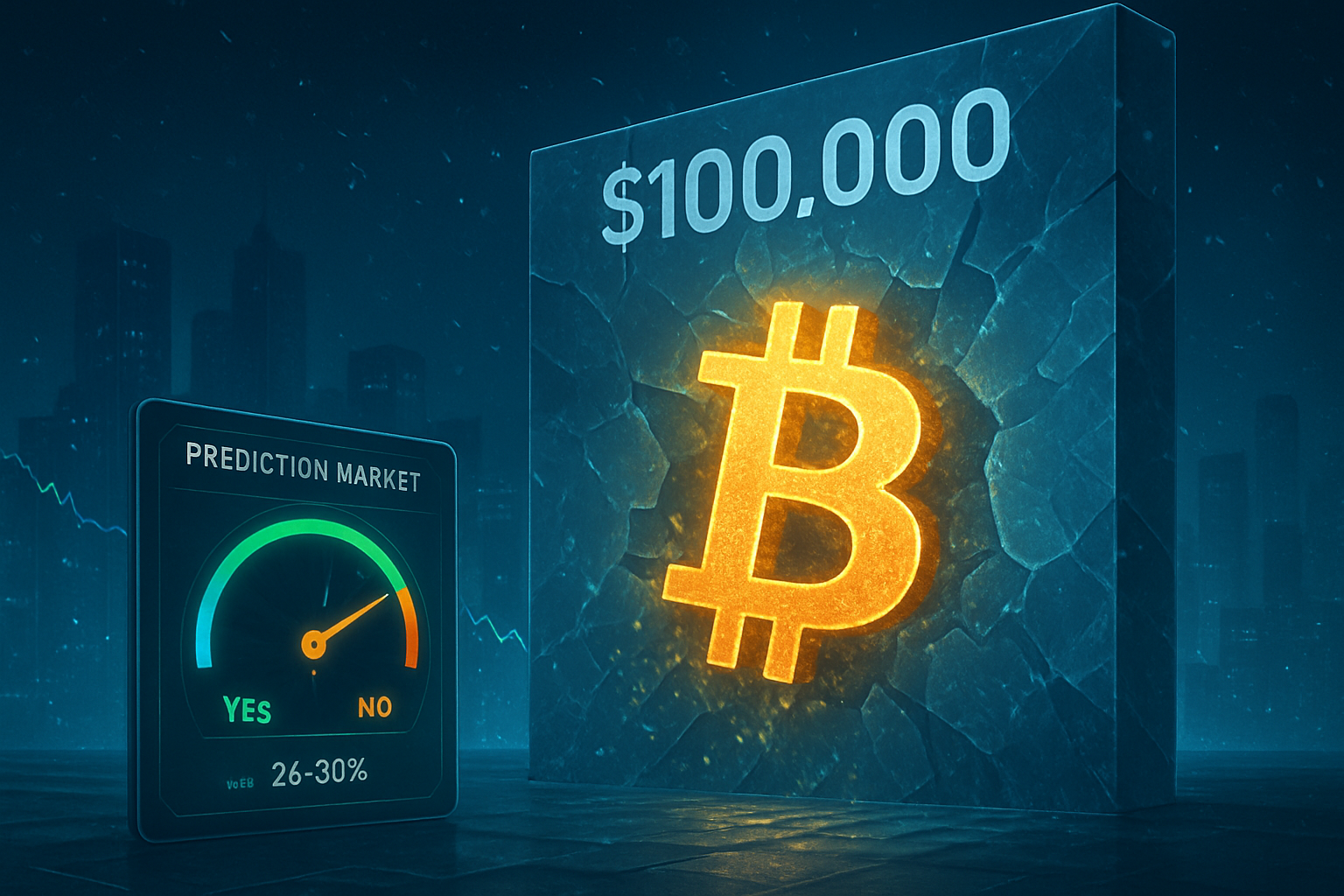
    As of mid-January 2026, the psychological and technical barrier of $100,000 remains the most contested territory in the digital asset space. While Bitcoin (BTC) entered the new year with a wave of euphoria that saw traders pricing in a nearly 80% chance of breaching the six-figure mark, reality has set in with sobering speed. Current data from the world's leading prediction markets shows a dramatic recalibration of expectations, with the probability of Bitcoin hitting $100,000 by the end of the month sliding to a modest 25-30%.

    This shift in sentiment follows a period of intense volatility and a broader "Great Reset" in growth expectations. Despite Bitcoin hovering in a consolidation range between $91,000 and $92,500, the "easy money" narrative of early January has evaporated. Prediction markets are now signaling that the road to $100,000 may be paved with significantly more resistance than bulls had anticipated, reflecting a transition from speculative mania to cautious institutional accumulation.

    The Market: What's Being Predicted

    The focus of the trading community is currently centered on high-liquidity contracts across decentralized and regulated platforms. On Polymarket, the world’s largest decentralized prediction venue, the "Bitcoin Hits $100k in January" market has seen a surge in volume, surpassing $24 million as of January 13, 2026. After starting the year with a dominant "Yes" bias that reached 80% probability, the contract has collapsed to 28-29%. This indicates that the crowd, which was once certain of a historic breakout, is now hedging heavily against that outcome.

    On the CFTC-regulated platform Kalshi, the sentiment is mirrored with striking precision. The "Above $100,000" strike for January is currently trading between 27% and 34%. Interestingly, Kalshi’s tiered strike prices reveal where the true floor of confidence lies: while the $100,000 milestone is in doubt, the $95,000 level still holds a robust 73% probability. This suggests that while traders expect Bitcoin to gain ground from its current $91,000 level, they do not believe it has the momentum to clear the final 10% hurdle before the month concludes.

    The resolution criteria for these markets are strict: Bitcoin must touch or exceed $100,000 on major spot exchanges (usually an aggregate of Coinbase, Binance, and Kraken) at any point before midnight on January 31, 2026. With only half the month remaining, time decay—often referred to as "theta" in options trading—is beginning to work against the bulls.

    Why Traders Are Betting

    The primary driver behind the cooling odds is a combination of technical resistance and a "sticky" macroeconomic environment. After Bitcoin reached an all-time high of approximately $126,210 in late 2025, it entered a sharp 30% correction that bottomed near $84,000 in December. The "New Year's relief rally" that followed initially looked promising, but it has struggled to reclaim the $94,000 to $96,000 resistance zone. Traders on prediction markets are watching these levels closely; failure to break through $96,000 in early January acted as a "sell" signal for those betting on the $100,000 milestone.

    Macro-economic factors have also played a spoiler role. Inflation data (CPI) for the start of 2026 came in at 2.7%, higher than the Federal Reserve's target. This has led to a 97% probability on Kalshi that the Fed will leave interest rates unchanged at its January meeting, effectively ending hopes for a liquidity-driven spike. Furthermore, "OG Whales"—holders from the early Satoshi era—were spotted moving approximately $286 million worth of BTC into exchanges on January 12. This suggests that long-term holders are viewing the approach to $100,000 as an ideal zone to take profits, creating a massive "supply wall" that prediction market participants are wary of.

    Institutional sentiment remains a silver lining, albeit a slow-moving one. On January 13, U.S. spot Bitcoin ETFs saw net inflows of $116.67 million. While significant, this is a far cry from the multi-billion dollar daily surges seen in 2025. Major players like MicroStrategy (NASDAQ: MSTR) continue to double down, with recent reports showing board members buying the dip at $155 per share. Similarly, Coinbase (NASDAQ: COIN) has seen its shares rise as it benefits from its role as the primary custodian for the ETF market, though the stock's 4-6% gains have not been enough to drag the underlying asset past the $100,000 mark.

    Broader Context and Implications

    This market behavior fits into a well-documented historical pattern. Analysts point out that 2026 is the "third year" following the 2024 halving event. Historically, the third year of a Bitcoin cycle is often a period of consolidation or "sideways" movement rather than parabolic growth. The current skepticism in the prediction markets suggests that the "halving effect" may have been front-run in 2025, leaving 2026 as a year of price discovery and institutional absorption.

    The shift in odds also highlights the evolving role of prediction markets as a sentiment gauge. Unlike traditional financial analysts who might maintain "Buy" ratings regardless of short-term volatility, prediction market participants must put capital behind their convictions. The rapid drop from 80% to 28% probability reflects a "wisdom of the crowd" that is highly sensitive to real-time events, such as the aforementioned whale movements and Fed policy shifts. It reveals a public that is optimistic about Bitcoin's long-term value but deeply skeptical of a "vertical" price action in a high-interest-rate environment.

    Furthermore, the regulatory stability of platforms like Kalshi has allowed for more sophisticated hedging strategies. Large-scale miners and institutional holders are likely using these "event contracts" to hedge against the downside of their spot holdings. This professionalization of the market means that "dumb money" hype is increasingly being countered by calculated, risk-managed positions.

    What to Watch Next

    The remainder of January 2026 will likely be defined by two key events: the upcoming Federal Reserve meeting and the "liquidity window" of the third week of the month. If Bitcoin can decisively break and hold above the $96,000 level before January 20, prediction market odds are likely to see a rapid "gamma squeeze" back toward the 50% range. However, every day spent consolidating below $93,000 makes the $100,000 "Yes" contract more expensive and less likely to pay out.

    Investors should also monitor the daily ETF inflow data. If cumulative inflows for the spot ETFs cross the $60 billion mark this month, it could provide the necessary buy-side pressure to overwhelm the profit-taking whales. Conversely, any signs of a "leverage flush"—where over-leveraged long positions are liquidated—could send the $100,000 odds crashing into the single digits.

    Bottom Line

    The current state of the Bitcoin $100,000 prediction markets is a classic case of "rational cooling." The drop in probability from 80% to under 30% is not necessarily a bearish signal for Bitcoin’s fundamental value, but rather a reflection of the formidable technical and macroeconomic hurdles standing in the way of a historic milestone. Traders are no longer betting on a miracle; they are betting on the reality of resistance.

    Ultimately, prediction markets are doing exactly what they were designed to do: stripping away the noise of social media hype and providing a clear, price-weighted probability of a specific outcome. Whether or not Bitcoin hits $100,000 in the next two weeks, the movement of these odds tells us that the market is maturing, with participants placing more value on Federal Reserve policy and on-chain whale activity than on the "Moon" narratives of the past. For now, the $100,000 dream remains just that—a dream deferred to later in 2026.


    This article is for informational purposes only and does not constitute financial or betting advice. Prediction market participation may be subject to legal restrictions in your jurisdiction.

    PredictStreet focuses on covering the latest developments in prediction markets.
    Visit the PredictStreet website at https://www.predictstreet.ai/.